A History of the County of Surrey: Volume 3. Originally published by Victoria County History, London, 1911.
This free content was digitised by double rekeying. All rights reserved.
'Parishes: Charlwood', in A History of the County of Surrey: Volume 3, ed. H E Malden (London, 1911), British History Online https://www.british-history.ac.uk/vch/surrey/vol3/pp182-189 [accessed 30 April 2025].
'Parishes: Charlwood', in A History of the County of Surrey: Volume 3. Edited by H E Malden (London, 1911), British History Online, accessed April 30, 2025, https://www.british-history.ac.uk/vch/surrey/vol3/pp182-189.
"Parishes: Charlwood". A History of the County of Surrey: Volume 3. Ed. H E Malden (London, 1911), British History Online. Web. 30 April 2025. https://www.british-history.ac.uk/vch/surrey/vol3/pp182-189.
In this section
CHARLWOOD
Cherlewude (xiii cent.); Cherlwude (xiii & xiv cent.); Chorlwode (xiv cent.); Charlewood (xviii cent.).
Charlwood is a parish on the Sussex border. The village is 7 miles south-west-by-south from Reigate, and rather more south-west from Dorking. The parish is bounded on the north and east by Horley, on the south by Rusper in Sussex, on the west by Newdigate. An outlying portion is surrounded by Newdigate and Rusper, and another by Leigh and Horley. The main part of the parish is about 4 miles from east to west, and 3 miles from north to south. The whole contains 6,875 acres. The Mole forms part of the eastern boundary, and tributaries of the same river run through the parish. The soil is entirely the Wealden Clay, but in the middle of it a ridge of Paludina Limestone makes a very considerable elevation, rising to 385 ft., called Stan Hill, Norwood Hill, and Horse Hill. The same ridge continues to the south-west of the village, as Rug or Russ Hill, and reaches about the same height there. Between the two parts of the hill is a depression through which a tributary of the Mole runs past Charlwood village.
The village is compact, and of a considerable size for the district, but farms and cottages are widely scattered also over the parish; on the ridge mentioned there are several considerable gentlemen's houses built in recent years. The parish is agricultural, with some brick works, and there is a large nursery garden, of Messrs. Cheal & Son, near Lowfield, in Charlwood.
Charlwood Common was a large village green by Charlwood village, but is now all inclosed except a small recreation ground. Hookwood Common still open ground, 2 miles north-east of Charlwood village; Johnson's Common and White's Common were roadside wastes, now inclosed.
The Brighton Road, through Reigate and Crawley, passes through the parish. The part between these two towns was the first road in Surrey made under a Turnpike Act. (fn. 1) The object was to make a way for riding out of the Hastings Sand of Sussex over the clay on to the hard ground in Surrey. But to save the causeway from being cut up by wheels posts were to be fixed along it, so that it might be passable only for horses. (fn. 2) It was not made a driving road till the reign of George II. The main Brighton line just comes into a corner of Charlwood parish.
The bones of an elephant have been found in Charlwood, (fn. 3) and similar finds not exactly recorded are said to have been made. Remains of human antiquity are not on record, but about 1890 a vessel of Paludina Limestone (Sussex marble) was found on the estate of Mr. Young at Stanhill, which the finders regarded as an ancient font, but which was perhaps a stone mortar.
Manning and Bray (fn. 4) mention the tradition that the Timberham Bridge was formerly known as Killmanbridge because of a slaughter of the Danes there. It does not appear, however, that there is any documentary evidence for the improbable name 'Killmanbridge,' and it is unlikely that Charlwood was inhabited at the time of Danish invasions. It is not mentioned in Domesday, and was probably a forest district of the manor of Merstham, which to the present day reaches into the parish.
The Sanders or Sander family of Charlwood were, if not Catholic recusants themselves, closely allied by marriage and sympathies with recusants. Nicholas Sander the famous controversialist was of a younger branch of the family, and his sister, who married John Pitts of Oxfordshire, was mother of John Pitsaeus, Dean of Liverdun in Lorraine and Bishop of Verdun. The squire's family evidently preserved the pre-Reformation inscription on the church (see church).
Another curious trace of ancient manners is that Charlwood, with lands in Leigh and Newdigate, was conveyed in the first year of Edward VI 'with the bondsmen and their families.' (fn. 5)
Charlwood Place, formerly the seat of the Sanders family, is a moated house. At Charlwood House there was apparently a moat, part of which only remains.
In the outlying part of Charlwood between Leigh and Horley parishes, east of Barnland Farm and west of the Mole, between the Mole and the Brighton road, there are the remains of a moated inclosure.
Charlwood was in the Wealden iron district, though none of the principal forges and furnaces named seem to be in it. (fn. 6) But it was one of the ironworking parishes exempted from the Act of 1 Elizabeth against cutting timber of a certain size.
Of late years a completely new feature has been brought into the parish by the making of the Gatwick Race Course, which was opened in 1891, after the closing of the old Croydon Race Course at Woodside.
Some common land was inclosed, according to Brayley, (fn. 7) in 1844, but the chief inclosure award was dated 5 February 1846, under the General Inclosure Act of 1843. (fn. 8) Other waste was inclosed 12 January 1854, (fn. 9) when Shellwood Manor in Leigh was inclosed, including waste in Betchworth, Charlwood, Horley, Leigh, and Newdigate. There was a common meadow, but common arable fields are not mentioned.
There are both Baptist and Congregational chapels at Charlwood.
Farmfield is a Home for female inebriates acquired by the London County Council.
The Cottage Hospital opened in 1873 is at present closed.
Charlwood Boys' School was built in 1840. Charlwood Girls' and Infants' School was built in 1852 and enlarged in 1893.
Lowfield Heath School was built in 1868.
Charlwood House is the seat of Mr. G. H. Beckhuson; Russ Hill of Mr. H. N. Corsellis, part of whose house is of the middle of the 17th century; Stanhill Court belongs to Mr. A. F. Hepburn; Gatwick Manor House is the seat of Mr. E. G. MacAndrew; Norwood Hill House of Major MacMicking; Ricketswood of Sir A. M. Rendel, K.C.I.E.; Norwood Hill of Mr. C. F. Wakefield; Charlwood Park of Mr. Herbert Musker. The Misses Sanders of Hookwood House belong to the old Sanders family of Charlwood. Charlwood Place itself is now a farm-house.
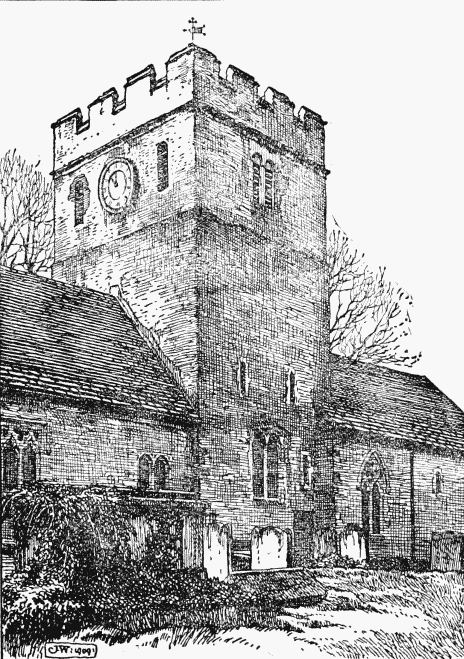
Charlwood Church from the North-east
Lowfield Heath was a large common about 2 miles south-east of Charlwood village, on the Sussex border, inclosed in 1846. As several houses lay about it at some distance from the church a chapel of ease, St. Michael and All Angels, was built in 1868. It is of brick with stone dressings, a tower and spire, in the French 13th-century style.
MANORS
CHARLWOOD seems to have been held from an early period by the Prior and convent of Christchurch, Canterbury, as member of the manor of Merstham (q.v.). (fn. 10) In 1231 the Prior of Christchurch or Holy Trinity, Canterbury, received licence to send letters to his freemen of 'Cherlewud,' desiring them to render him aid to get quit of the debts with which he was burdened. (fn. 11) A ten-years' lease of the manor of Merstham and its member of Charlwood, made in 1396 by the prior, records many particulars concerning the 'live and dead stock' existing at both places (vide Merstham), and mentions, among other things, that the 'digging of iron at Cherlwood' was to remain the right of the prior and convent. (fn. 12) The prior surrendered his possessions in July 1539, (fn. 13) and in the following month Henry VIII granted Merstham and Charlwood to Sir Robert Southwell and his heirs. (fn. 14) In 1542 the manor of Charlwood was quitclaimed to Southwell by Henry de la Hay, (fn. 15) who was possibly the lessee of the prior. This deed marks the separation of Charlwood, henceforth held as a separate manor, from the manor of Merstham, their subsequent descent being entirely distinct. In 1547 Sir Robert Southwell and Margaret his wife alienated the manor of Charlwood to Henry Lechford, (fn. 16) whose family had held land in Charlwood as early as the reign of Edward III. (fn. 17) He died seised of the manor in 1567 and was succeeded by his son Richard, (fn. 18) who was afterwards knighted. It descended in 1611 to the latter's grandson Richard, his son Henry being already dead. (fn. 19) The second Sir Richard Lechford conveyed the manor in 1625 to Edmund Jordan, (fn. 20) who was already seised of the manors of Gatwick and Shiremark in Charlwood, and was also possessed either then or soon afterwards of the manor of Hook (q.v.). These manors remained in the Jordan family, passing from father to son, until the death without issue of Thomas Jordan in 1750. (fn. 21) His sisters and co-heirs, Elizabeth Beaumont and Philippa Sharp, divided his inheritance, the manors in Charlwood becoming the property of the latter, who held them with her husband John Sharp until her death without issue in 1759. (fn. 22) Her husband continued to hold the manors, and by will of 1770, having disinherited his eldest son by a former marriage, entailed them on John and James, sons of William Jennyngs Sharp, his second son. (fn. 23) On his death in 1771 (fn. 24) his eldest grandson, John Sharp, succeeded and held the property intact until 1806, (fn. 25) when he sold the manors of Charlwood, Hook, and Shiremark to Thomas Kerr. (fn. 26) They afterwards passed to James Woodbridge, from whom they were purchased by Michael Clayton before 1841. (fn. 27) He died without issue in 1847, when the estate apparently passed to the family of his younger brother Richard, (fn. 28) whose grandson, Major Edward Clayton, afterwards held the manor. The present lord is Mr. G. S. Clayton, brother of the last owner. (fn. 29)
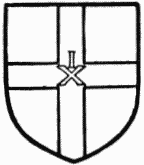
Convent of Christchurch, Canterbury. Azure a cross argent with the monogram [..] sable thereon.

Lechford. Sable a cheveron between three leopards' heads argent.
Grants of free warren in their demesne lands of Charlwood were made to the Prior and convent of Christchurch during the reigns of Edward II and Edward III. (fn. 30) In 1592 mention is made of a fair which was held annually on the feast of St. James, the profits of which belonged to the lord of the manor. (fn. 31) It seems, however, to have long been discontinued.
In 1241 Richard de Warwick and Juliana his wife and Joan her sister quitclaimed a messuage, 4 acres of meadow, and 18 acres of land in Charlwood to John de Gatwick and his heirs. (fn. 32) This land was probably part of that which was afterwards known as the manor of GATWICK and which was held by the de Gatwicks until the 14th century. It is probable that a John de Gatwick who held during the reign of Edward II married Joan de Ifeld, and that their daughter and heir Elizabeth married Thomas de Cobham. (fn. 33) In 1363 the manor of Gatwick was granted to William son of Elizabeth, daughter of John de Gatwick, by the vicars of Charlwood and Horley and by William Jordan; it was stated that the latter parties held the manor of the gift and feoffment of Thomas de Cobham. (fn. 34) In 1396 Reginald de Cobham, son of William, held the manor, (fn. 35) of which he suffered a temporary forfeiture for debt. (fn. 36) In the reign of Henry VII Gatwick was held by Joan widow of Reginald Cobham, son and heir of John, (fn. 37) and presumably grandson of the first Reginald. (fn. 38) Joan Cobham after her husband's death brought a suit against John Jordan, John Lechford, Richard Sanders, and others on the grounds that they, 'by crafty meanes,' occupied the manor and took the profits to their own use; the defendants maintained that Reginald Cobham had disposed of the manor to them by various sales and mortgages. (fn. 39) The result of the suit is not apparent. It is probable that John Jordan, whose actual claim is not stated, eventually acquired the whole manor, as it was in his family by the latter half of the 16th century. (fn. 40) Edmund Jordan, his descendant in direct line, (fn. 41) held the manor in 1625, when he acquired also the manor of Charlwood (q.v.) and that of Shiremark (q.v.). The manors followed the same descent until 1806, (fn. 42) when John Sharp, whose grandmother Philippa was the sister and co-heir of the last of the Jordans, (fn. 43) sold all his manors in Charlwood except that of Gatwick to Thomas Kerr. (fn. 44) Reference is made in 1785 to a capital messuage called Gatwicks with houses, &c., belonging, then in possession, as was the manor itself, of the second John Sharp. (fn. 45) According to Manning a new manor-house, called Timberham House from its vicinity to Timberham Bridge, was erected by this owner, the site of the old manor-house being in the east of the parish. Brayley, writing in 1841, mentions 'Gatwick house' as having been recently sold by John Sharp to Alexander Fraser, (fn. 46) who occupied it as late as 1859. The Gatwick Race Course Company bought the Gatwick estate and the manor-house in 1890 from Mr. John King Farlow of Egham. They do not appear to have bought the manorial rights, and it seems as if these had fallen into abeyance. (fn. 47)
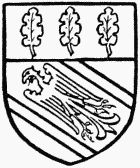
Jordan.Sable an eagle bendwise between two cotises argent and a chief or with three oakleaves vert therein.
The family of Sander, from whom the manor of SANDERS PLACE took its name, was established at Charlwood as early as the 14th century. A court roll of 1388 records that Stephen Sander was called upon to answer for a plea of trespass, (fn. 48) and a reference is found in 1434 to Thomas Sander of Charlwood, (fn. 49) apparently his son. (fn. 50) In 1446 land called Sloghterwyk in Charlwood was granted to Thomas Sander and William his son by Richard son of Thomas Cokeman, (fn. 51) and about the same time they received a grant of 4 acres from Thomas White. (fn. 52) In 1565 Sir Thomas Sander, kt. died seised of 'the manor of Charlwood called Sander's manor,' held as of the manor of Charlwood by fealty and rent of 15s. 1½d. (fn. 53) Edmund his son and heir succeeded to the property, which passed successively to Edmund's son Thomas and grandson Edmund. (fn. 54) The latter died without issue in 1662, having devised all his 'lands and tenements in Charlwood' to his sister Elizabeth Bradshaw, (fn. 55) from whom they evidently passed to Sir William Throckmorton, son of her aunt Dorothy, (fn. 56) as in a conveyance of this property in 1673 from Sir Andrew King to Francis Lord Aungier, it was stated that Sir Andrew had obtained it from Throckmorton. (fn. 57) The deed of 1673 describes the property as 'the site and the remaining part of the late capital messuage … called Charlwood Place, with all fields, &c. called the Great Parke, the Little Parke, the Knowe, the Great Godfreyes, the Lesser Godfreyes, the Greater Biggle Hawe, the Lesser Biggle Hawe, Bush Field, the Granthams, the Skewles mead and Lyons Riddles Mead,' containing altogether about 300 acres. According to Manning the estate afterwards passed, with the church, to the family of Wise. This family held these lands in 1828, by which time, apparently, a new house had been built, as reference is made to 'all that capital messuage, and site and late remaining part of the late capital messuage called Charlwood Place. (fn. 58)
Land called HOKE or LA HOKE existed in Charlwood at an early date, as the name Walter atte Hoke, or Walter de la Hok, occurs as that of a witness to deeds in the early 14th century, (fn. 59) and in 1333 Walter atte Hoke contributed to the lay subsidy for Surrey. (fn. 60) In 1335 the custody of a messuage and 45 acres at la Hoke, possibly in Charlwood, was granted to Thomas de Flaynsford. (fn. 61) In the late 15th century the family of Lechford held at least a portion of the lands afterwards called the 'manor of Hook.' (fn. 62) In 1546 the 'manor of Howke,' then in the possession of Henry Lechford, was sold by him to Henry Amcotts; (fn. 63) he retained, however, a parcel of ground in Hook called Backworth and Littleworth. In 1614 William Hewett died seised of the manor, which was held of the manor of Charlwood by suit at court and yearly rent of 11s. 10d. (fn. 64) According to Manning, William Hewett son of the above William conveyed it in 1627 to Symonds, from whom it afterwards passed to the family of Jordan. (fn. 65) It descended with the other manors in Charlwood which were held by this family, (fn. 66) and probably became united with the main manor. It is named on the tomb of Philippa Sharp in 1759, and in the sale of 1806.
No mention of SHIREMARK as a separate manor is found until the 16th century, and it was probably included in the manor of Charlwood, being evidently situated in that part of the parish which borders Sussex. In 1542 Shiremark was quitclaimed, with the manor of Charlwood, to Sir Robert Southwell and Margaret by Henry de la Hay. (fn. 67) The manor of Shiremark passed to Henry Lechford before the latter obtained that of Charlwood from Sir Robert Southwell, as in 1546 Lechford sold it to Henry Amcotts. (fn. 68) In 1616 Sir Thomas Hewett, then holding the manor, conveyed it to William Mulcaster, (fn. 69) whose son Thomas was rector of the church of Charlwood. (fn. 70) In 1625 it passed from William Mulcaster to Edmund Jordan of Gatwick, (fn. 71) with whose manor of Charlwood it has since descended. (fn. 72)
ROWLEY
ROWLEY is another reputed manor in this parish which was held of the manor of Charlwood. In 1429–30 Reginald Cobham of Charlwood made an agreement with the Abbot of Chertsey concerning the right to repair the banks of a certain brook which flowed past a meadow of Reginald Cobham and into the main stream, called Emel stream (the Mole), flowing from a mill called Rowle Mill to one belonging to the abbot in Horley. (fn. 73) It is possible from this account that the mill marks the position of lands afterwards known as 'the manor of Rowley,' the manor of Gatwick, close by, being held at that time by Cobham. In 1497 the 'manor' of Rowley was held by the family of Culpepper. (fn. 74) John Culpepper died seised of it in 1565 and was succeeded by his son Thomas. (fn. 75) The manor descended in this family until 1648, (fn. 76) when Sir William Culpepper, bart., with his brother and other trustees conveyed it to Thomas Luxford. (fn. 77) George Luxford held the manor in 1683, when he conveyed it to Thomas Jordan, (fn. 78) and it appears to have been in this family as late as 1770. (fn. 79) In 1820 it was held by George Maximilian Bethune of Worth in Sussex in the right of his wife, Anna Maria. (fn. 80) It is now a farm.
In 1295 Master Clement de Wyk held 21s. rent in Charlwood. (fn. 81) In 1357 an inquisition taken on John son and heir of John de Brewes states that he held a tenement called WYKES in Charlwood consisting of a toft, a garden worth 4d., 100 acres of arable land, 5 acres of meadow worth 5s., and 20s. rent; mention is also made of one Richard de Sloghterwyk who held land in Charlwood of John de Brewes, paying an annual rent of 2s. at the tenement called Wykes. (fn. 82)
At the end of the 15th century land called Wykeland is referred to as being parcel of the manor of Gatwick; (fn. 83) it is probable that it was identical with the Wykes before named. In 1539–40 Henry VIII granted the 'manor of Wyklond' (fn. 84) in Surrey to Sir Robert Southwell in fee. (fn. 85)
Sir Robert Southwell was so notorious a recipient of monastic lands that the grant raises a suspicion that 'Wyklond' answered to the 60 acres once held in Newdigate by Merton Priory (see under Newdigate). But a messuage in Charlwood, 'Wykelandes in Charlwood,' and Lowfield Common had been granted for life that same year to Agnes widow of Walter Whyght, lately in occupation of the same, by Thomas Nudygate, John Skynner, and others, and by a deed of 10 October 1541 the reversion of the life interest of Agnes, now wife of William Wever, was confirmed to Sir Robert Southwell and his heirs for the sum of £100 paid to William Wever and Agnes. (fn. 86)
Sir Robert Southwell, in 1547, received licence to alienate the manor to Henry Lechford (fn. 87) together with that of Charlwood (q.v.), with which Wyklond, or Weekland, has since been held. (fn. 88)
EDOLPHS
EDOLPHS, a well-known farm in Charlwood, derives its name from the family of Edolf, who were settled in Charlwood in the early 14th century. (fn. 89) John Edolf made a grant of land in Charlwood in 1318, (fn. 90) and in 1371 Stephen Edolf, or Edolfi, quitclaimed land there to William Walsshe. (fn. 91) At the end of the 15th century a messuage and lands called Edolfi's was held by Henry Lechford, whose family afterwards held the manor of Charlwood. (fn. 92)
Occasional reference is found to a RECTORY MANOR in Charlwood. The earliest mention of land belonging to the rectory occurs in 1316–17, when a grant of land in Charlwood, bounded on one side by that of the rectory, is recorded. (fn. 93) Manning states that in 1406–7 Richard, vicar of the parish, held lands of the manor of the rectory. (fn. 94) In 1535 Philip Mesurer, rector, gave the annual value of the rectory as £20 13s. 4d., of which the house with garden and cemetery of the church was worth 20s. (fn. 95) A conveyance of the rectory, made in 1629, includes 'all manors, views of frankpledge, courts leet and baron &c. belonging,' (fn. 96) and a deed of 1828 also mentions the 'manor of the rectory.' (fn. 97) According to Manning courts were held by most of the rectors from quite early times. (fn. 98)
CHURCH
The church of ST. NICHOLAS consists of a chancel (now used as a vestry and organ chamber) 28 ft. 4 in. long by 16 ft. 7 in., south chapel (now serving as the chancel) 26 ft. 5 in. by 19 ft. 2 in., central tower 16 ft. 8 in. north to south by 15 ft. east to west, nave (the present north aisle) 37 ft. 4 in. by 22 ft. 8 in., south aisle 16 ft. wide below the nave, and a south porch; all these measurements are taken within the building.
The plan is of much interest, preserving the aisleless nave and the tower of a church of c. 1100, the tower having been set between the chancel and nave, with the same internal width as the former, but being externally wider owing to the greater thickness of its walls. The nave is 6 ft. wider than the tower, and the tower itself is not accurately square, being about 2 ft. less from east to west than from north to south. Its greatest inclusive measurment is 24 ft., a size which occurs so often in 12th-century towers that it has claims to be considered normal. In the beginning of the 14th century a south aisle 16 ft. wide was added to the nave, and the chancel seems to have been lengthened and probably rebuilt some thirty years later. The south porch is a 15th-century addition, and about 1480 a large south chapel of the full width of the south aisle was added, and arches opened to it from the old chancel and tower. It is inclosed on the line of the east wall of the tower by a screen, and was doubtless the Lady chapel. In modern times, owing to its greater convenience, it has become the chancel, the old chancel being used as an organ chamber and vestry. Cracklow notes that the church was repaired and a gallery erected in 1716.
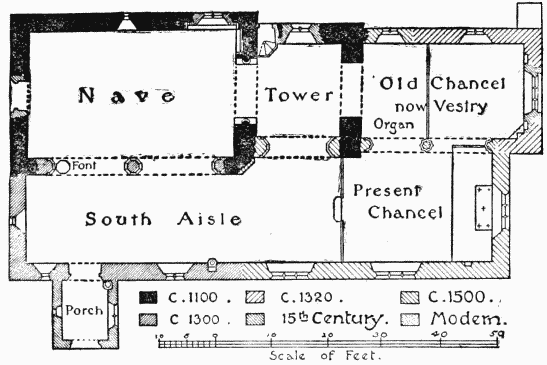
Plan of St. Nicholas' Church, Charlwood
A certain amount of modern repair has been done, much of the external firestone ashlar being in a bad state of decay, whilst there are several cracks over the tower arches.
The old chancel has a 15th-century east window of three trefoiled lights under an elliptical head with moulded labels inside and out; the jambs outside have a wide casement mould; and the external label and outer order of the arch are modern restorations. On either side of the window are 15th-century image-niches about 4 ft. high with trefoiled and square heads; they are only 7 in. deep, but the projecting brackets which formerly existed beneath them have been cut away. A fireplace is now placed across the southeast angle. The first of the two north windows, much restored, dates from c. 1330, and has two ogee trefoiled lights with a half-quatrefoil between them under a square head, the jambs and head being of one hollow-chamfered order, with a scroll moulded label and head stops, now much perished. The second north window is a 16th-century insertion of two plain lights with four-centred arches in a square head; below it the wall has been pierced by a modern doorway of very poor character. An arcade of two bays divides the old chancel from the south chapel (present chancel); its middle pillar is octagonal, each face being concave, and has a moulded base and capital of late section; each respond consists of rather more than half of a similar pillar, and the capitals, especially that of the west one, are set back as far as possible, in a peculiar manner, to obtain a wider arch thereby; the arches are four-centred and of two chamfered orders; and on the north side (towards the original chancel) they have a moulded label, while there is none on the south.
The east window of the chapel has three trefoiled four-centred lights under a depressed four-centred arch; it has been partly repaired outside. In the south wall is a small square recess with moulded edges, which has no drain and seems to be a credence rather than a piscina recess.
The first and second windows in the south wall have details like those of the east window, and are of three lights under square heads, their masonry being to a large extent old.
The ground stage of the tower has a two-light 15th-century window in its north wall, and arches in the other three, that to the old chancel being much altered and made up with roman cement; it is roundheaded, and springs from square imposts, being evidently the original opening; while the west arch of the tower is also original, but much more perfect, with small attached shafts with cushion capitals to the inner order; the shafts have chamfered bases dying on the splayed plinth of the jamb; and the semicircular arch is of two square orders. The south arch dates from the addition of the chapel, and has semi-octagonal responds with chamfered bases and plainly moulded capitals which bear signs of 17th-century or later recutting; the arch is a pointed one of two hollow-chamfered orders.
The tower stair is a modern one of wood inclosed in the north-west corner, accessible only by an external square-headed doorway. The ringing chamber has two rectangular lights on the north, a small round-headed light looking into the nave in the west, and the upper half of a blocked round-headed window on the south; the bell-chamber or third story is lighted in each wall by pairs of round-headed lights; those in the east wall have brick jambs, but the others are of stone in a more or less decayed condition; the parapet has a moulded string and embattled coping of 15th-century date or later.
The early nave walls are very well preserved, except on the south, the original sandstone quoins showing at the western and north-eastern angles. The only original window, however, is that in the north wall, a small round-headed light set about midway in its length.
At the north-east is a very beautiful two-light window of c. 1300 with a quatrefoil in the head, set in a tall arched recess which seems to be of earlier date, possibly of the first half of the 13th century; adjoining it in the west wall of the tower is a smaller arched recess, both being connected with the altar which formerly stood at the north-east of the nave. The recess in the north wall is much taller than is commonly the case, but there seems no reason to suppose that it was ever intended to open to a chapel on the north-east, as has been suggested. It may have been heightened when the window was inserted.
The south arcade, c. 1300, is of two bays with an octagonal pillar and semi-octagonal responds; the bases and capitals are moulded, and the arches are twocentred and of two chamfered orders. The west doorway of the nave is an early 15th-century insertion, and has double-chamfered jambs and a pointed arch of two double-ogee orders with a label; and over it is a 15th-century window of three cinquefoiled lights with cusped tracery in a two-centred arch.
The south aisle has a piscina near where its former east wall stood; it has moulded jambs and a twocentred arch with trefoiled soffit cusps, and a filleted roll hood mould forming a straight-sided gablet over the arch; the sill containing the octofoiled basin projects and is moulded below; halfway up is a shelf, above which the recess deepens. The window west of this piscina is contemporary with the aisle, and is of two trefoiled lights with a cinquefoiled circle in the pointed head; the splayed jambs have hollow-chamfered edges, and the internal label is a scroll mould with mask stops; outside is a similar label with one volute and one mask stop. The south doorway is a pointed one with moulded jambs and arch, and has a scroll mould label with corbel stops, and the west and south-west windows are trefoiled lancets with soffit cusps, all being contemporary with the aisle.
The porch is a 15th-century addition; it has an east window of two plain pointed lights in a square head, and a broken holy-water stoup which was moulded like a capital on three sides. In the west wall is a tiny quatrefoil piercing the outer archway, having moulded jambs and pointed head; it has been much repaired with cement. The porch is built of sandstone ashlar, and contrasts with the rest of the walling, which is of thin shaly rubble with stone dressings. There was formerly an inscription on the porch, (fn. 99) 'Orate pro anima(bus) Thome Sander et Johannae uxoris eius et pro animabus omnium fidelium defunctorum.' This inscription survived the Reformation, for it is noticed in a MS. description of the church written on 12 December 1622 (now in private hands), but was probably destroyed in the Civil Wars.
The east wall of the old chancel is coated with new cement. All the roof timbers are old, those of the present chancel and south aisle being of the date of the building of the chancel, c. 1500, while those of the nave and old chancel are probably somewhat earlier; all seem to have been underdrawn with plaster ceilings. Under the tower is a modern flat panelled ceiling.
Across the entrance to the present chancel is a fine contemporary screen of eighteen panels (four of which are over the central opening) with ogee cinquefoiled heads and trefoiled tracery. The cornice is painted and gilded; the lower part carved with a running vine pattern, and the upper has the initials R.S. (for Richard Sander, who died in 1480) several times repeated between pairs of winged dragons. Over the central opening, which retains its double doors, are the letters IHS and a crowned M supported by angels, and there are also two shields on the cornice, with the arms of Sander—Sable a cheveron ermine between three bulls or, tongued gules, impaling Carew—Or three lions passant sable. The lower panels of the screen are plain and solid, and the middle rail is carved with a band of quatrefoiled lozenges.
The altar table is of dark oak, and is apparently of late 18th-century date. The pulpit is an octagonal one made up with ornamental carved cartouche panels containing painted texts of about 1620, and seven earlier linen panels probably of the 16th century.
In the chapel is an ancient chest 4 ft. by 1 ft. 8 in. by 1 ft. 8 in. with a three-sided lid, bound by plain iron straps and having three locks.
The seats are modern.
On the south wall of the south aisle are a set of very interesting wall paintings, for the most part contemporary with the aisle. To the east of the window by the pulpit are scenes from the story of St. Margaret, arranged in bands one above another. The highest shows the governor Olybrius hunting, and sending his huntsman to bring Margaret to his palace. Below, Margaret is being beaten and imprisoned, and swallowed by the dragon, whose body bursts and the saint comes forth unharmed. The lowest range, which is very indistinct, shows the beheading of the saint.
To the west of the window are some muchdamaged scenes, perhaps from the story of St. Nicholas, with later paintings on a larger scale of the Three Living and the Three Dead, and apparently part of a St. Christopher or St. Edmund. The paintings were in very fair condition when uncovered, but have unfortunately been treated to a so-called preservative process, and have suffered in consequence.
The font is a small one with a plain octangular bowl on a square shaft; it appears to be modern. In the west window of the former nave are some fragments of ancient glass, a portion of the figure of a saint, and several other odd pieces, including two words of an inscription. Also in the first window of the north wall are two small eyelets containing roses and leaves.
On the south wall of the chapel, or present chancel, is the brass of Nicholas Sander, 1553, and his wife Alys Hungate, with four sons and six daughters; there are shields with Sanders quartering Carew, and another with Hungate, a cheveron engrailed between three sitting hounds, a molet for difference. On a separate plate is the Sander crest, a demi-bull holding a flower. In the old chancel is a brass plate to William Jordan, 1625, and Katherine his wife, 1626, and in the south aisle one to Nicholas Jeale, 1615. Lost inscriptions to the Sander family are given by Aubrey. (fn. 100)
There are six bells; of these the treble and second are by Thomas Janaway, 1764; the third, fourth, and fifth by William Eldridge, 1697, 1668, and 1662 respectively; and the tenor by Thomas Mears, 1835.
The communion plate consists of a cup, two patens, and a flagon of 1703–4.
The registers date from 1595.
ADVOWSON
The advowson of the church belonged with Charlwood Manor to Christchurch, Canterbury. (fn. 101) A vicarage was ordained by the monks before 1308–9, as reference is made in that year to the land of the vicar of Charlwood. (fn. 102) After the dissolution of Christchurch the advowson was apparently granted to Sir Robert Southwell with the manor, as in 1547 he alienated both to Henry Lechford, (fn. 103) whose son Sir Richard conveyed the advowson to Richard Dallender in 1609. (fn. 104) In 1615 Dallender quitclaimed to Robert Hatton, (fn. 105) from whom in 1622 it returned to the Lechfords. (fn. 106) Sir Richard, when he sold the manor of Charlwood in 1625, retained the advowson, selling it, however, in 1629 to Edmund Sander of Charlwood Place. (fn. 107)
In 1644 the rectory of Charlwood was sequestered, the rector, Thomas Mulcaster, having been proceeded against by 'five or six of the very scum of the parish,' according to his own account. (fn. 108)
His son-in-law, Henry Hesketh, who was chaplain in ordinary to Charles II, was afterwards rector of the parish. (fn. 109) In 1661 Edmund Sander devised all his lands and tenements in Charlwood, including the property of the rectory, to his sister Elizabeth Bradshaw, (fn. 110) from whom they passed to her cousin Sir William Throckmorton, who sold in 1672 to Sir Andrew King. (fn. 111) In 1716 the rectory and advowson were conveyed to Henry Wise from various parties, (fn. 112) who were according to Manning trustees of Francis Lord Aungier, to whom Sir Andrew King had conveyed them. (fn. 113) The property remained with the Wises until 1884, during which time the church was often served by members of that family. (fn. 114) It passed in 1884 to the Rev. E. M. Gibson, (fn. 115) and the living, which is still in his gift, has been held by him since that time.
The living was a peculiar of Canterbury till 1846, when it was transferred to Winchester. By the rearrangement of dioceses in 1878 it was again transferred to Rochester.
CHARITIES
Smith's Charity is distributed as in other Surrey parishes.
Four houses for the use of the poor were returned as existing in 1786, but are now lost.
The Rev. John Bristowe, rector from 1624 to 1637, left a schoolhouse and 5 acres of land to educate poor children, and Michael Earle, rector 1598 to 1624, left £2 annually charged on land for the poor.