A History of the County of Surrey: Volume 3. Originally published by Victoria County History, London, 1911.
This free content was digitised by double rekeying. All rights reserved.
'Parishes: Banstead', in A History of the County of Surrey: Volume 3, ed. H E Malden (London, 1911), British History Online https://www.british-history.ac.uk/vch/surrey/vol3/pp252-262 [accessed 30 April 2025].
'Parishes: Banstead', in A History of the County of Surrey: Volume 3. Edited by H E Malden (London, 1911), British History Online, accessed April 30, 2025, https://www.british-history.ac.uk/vch/surrey/vol3/pp252-262.
"Parishes: Banstead". A History of the County of Surrey: Volume 3. Ed. H E Malden (London, 1911), British History Online. Web. 30 April 2025. https://www.british-history.ac.uk/vch/surrey/vol3/pp252-262.
In this section
BANSTEAD
Benestede (xi cent.), Banested (xii cent.), Benested and Bansted (xiii cent.), Bendestede (xiv cent.), Bansted (xviii cent.).
Banstead is a village 3½ miles south of Sutton on the east of the road to Reigate. The parish measures 6 miles from north to south, and varies in breadth from 3 miles to a few yards at the southern apex, where it forms an acute angle between Kingswood and Walton. The acreage is 5,552. The whole of Banstead is situated upon the chalk downs, and with Walton and Headley adjoins that row of parishes whose villages lie at the northern front of the downs. The ground rises in places to nearly 600 ft. above the sea level, while much of it is over 400 ft. The soil is chalk, with surface deposits of clay, gravel, and brick-earth.
In 1086 the parish was counted in Wallington Hundred, and it is so entered in the returns of 1316 and 1428. (fn. 1) In 1636 it was entered in Copthorne, but Aubrey in 1718 placed it in Croydon Hundred.
Banstead Downs are still a wide extent of open land, though much reduced since the time when they made one unbroken expanse with Epsom Downs, and the old 4-mile race-course, marked on Norden's map, ran from a point between Banstead village and the railway station into the present 'straight' of Epsom race-course.
The downs, now appropriated chiefly for golf, formerly fed sheep in abundance. The old inn in Banstead village, a building which may well date from the 17th century, is called the 'Wool Pack,' a survival of a past trade. In 1324 the Abbot of Chertsey impleaded John de la Lane, bailiff to Isabella the Queen at Banstead, and others, for taking 1,500 of his sheep at Evesham (Epsom), driving them to Banstead and imparking, or, as we say, impounding, them, till from want of food some of them died. The bailiff answered that he took them on Banstead Down by way of distress as the abbot had been impleaded for trespass in the queen's manorial court at Banstead, but had not answered. In the king's court, to which the case was transferred, the abbot obtained damages. (fn. 2) In 1338 it was ordered that the officers taking wool for purveyance should exact none from the queen's (Philippa's) manors of Witley and Banstead. (fn. 3) The high quality of the wool is shown by a petition of the Commons in 1454, in which they prayed that a sack of wool of the growth of Banstead Down might not be sold under 100s., as the price of such wool was greatly decayed. (fn. 4) The reputation of Banstead Downs for sheep is referred to by Pope in the Imitations of Horace, and by others.
Historically Banstead Downs were the scene of sport. When Holland's ill-contrived royalist rising of 1648 took place at Kingston, the original plan had included a muster of adherents, as for a horse race, on Banstead Downs. Rumour was rife at the time of such an assembly being formed, and that Holland had marched thither from Kingston. But in fact he had marched to Dorking, and Major Audeley, who was on his track, went over Banstead Downs without finding him or the assembly. The rising had in fact exploded prematurely. (fn. 5)
There is evidence of races at Banstead as early as 1625, (fn. 6) but the subject more properly belongs to Epsom. When the great question of the exclusion of the Duke of York from the succession was before the House of Lords, in 1678, the Duke of Ormonde wrote to Colonel Cooke that he tried to delay the first reading by pointing out the thinness of the House owing to a Dog Match at Hampton Court, and a Horse Match on Banstead Downs. He himself did not attend the Horse Match, where 12 horses ran for 3 plates, 'owners up,' (fn. 7) apparently, but he sent a description of it. Two horses fell, one nearly killing his jockey, and 'the Duke of Monmouth escaped narrowly,' so apparently he also was riding.
Hares and partridges were also preserved on the downs. Henry Saunders was made keeper of a portion of the downs at £30 a year under the Protectorate, as a reward for trying to seize a highwayman, (fn. 8) and in 1668 a gamekeeper was appointed by the Duchy of Lancaster, at the same salary, to preserve hares and partridges. (fn. 9) In 1669 the king was hawking there, it not being then the custom to shoot partridges. (fn. 10)
The downs were also used as a muster-place for the Surrey Militia in 1670, when an inspection of the troops was made by the King and Prince Rupert. The formation of a camp of the regular army under the Duke of York or the Duke of Monmouth was discussed in 1678, but it is uncertain whether the plan was carried out. (fn. 11)
The parish is now agricultural, with a considerable number of new small houses in it. The road from Sutton to Reigate, the old Brighton road, passes through the parish, traversing Burgh Heath. The Sutton and Epsom Downs branch of the London, Brighton, and South Coast Railway has a station at Banstead, on the downs; and the Tattenham Corner branch of the South Eastern and Chatham Railway cuts through the middle of the parish. Tattenham Corner station, opened in 1901, is on the borders of Banstead.
From its position on the hills Banstead can never have been well watered. There are no streams in the higher and larger part of the parish. The primitive water supply must have depended entirely upon rain and dew-ponds, and the later supply was dependent on wells. The village well is said to be 350 ft. deep. The Domesday Mill was no doubt at Beddington, where there was a mill called Vielmille held of the manor of Banstead in 1318. (fn. 12) Similarly the Woodmansterne Mill was at Carshalton. But the absence of a good water supply did not hinder settlement, possibly even very ancient, on the high ground near Banstead. At Great Burgh many neolithic flint implements have been found; and on Banstead Heath, knives, two saws, a borer, an axe-head, seven arrow-heads, and other implements and flakes, implying a considerable settlement. (fn. 13) Banstead Downs have been much disturbed by digging for gravel in the brick-earth, by the making of the Epsom Downs railway, and by the laying out of golf links. But to the west of the road to Sutton, north of the railway bridge, were three barrows, one of which has recently been nearly destroyed. Others are said to have existed, and the remains of one seem to exist close to the railway bridge. An old map, reproduced by Manning and Bray, shows a great many barrows and a long bank about Preston Downs (which are now inclosed), the bank continuing on to the now inclosed Ewell Downs. 'Tumble Beacon,' a large mound crowned with Scotch firs near Nork Park, is an unmistakable barrow, and one of the largest in the county. It used to be the site of a fire beacon, and at the manor court a man was appointed to keep the beacon ready for use. Traces of hut-circles are reported to have been observed on Banstead Downs, but have never been explored and verified. One trace of a more remote antiquity still is undoubted, a fossil oyster shell which the writer himself picked up where the ground had been disturbed. John Evelyn reported that he heard from the Shepherds that near Sir Christopher Buckle's house, that is near West Burgh, 'divers medals have been found both copper and silver, with foundations of houses, wells, &c. Here indeed anciently stood a city of the Romans.' (fn. 14)
In 1903 mediaeval remains were discovered south of Banstead Church, consisting of tiles, broken glass, and carved chalk. They are in the St. John's Gate, Clerkenwell, Collection, owing to a supposed connexion with a house of the Hospitallers, who had lands near the church, (fn. 15) but possibly they belonged to the manor-house.
At Burgh in this parish there was a church to which rectors were instituted in the 14th and 15th centuries, (fn. 16) but there is no evidence of its having been a separate parish from Banstead after 1414. An entry in Wykeham's Register (fn. 17) in 1379 speaks of the poverty of the benefice and the ruinous character of the buildings. Aubrey says that the church at Burgh existed in his time, (fn. 18) and that there had been a chapel of St. Leonard at Preston, mentioned in deeds, which had quite disappeared. Salmon, in 1736, said that the Burgh chapel existed, turned into a barn. The return to Bishop Willis's visitation, 1725, described it as in ruins, no service having been held there within living memory. The ruins of St. Leonard's chapel do, however, still exist, in spite of Aubrey's assertion, in Chapel Copse near Preston, with which manor it was conveyed in 1440. Bergh or Burgh Church was between Little Burgh House and Church Lane, where the foundations remained supporting a barn till about 1880.
Tadworth is a hamlet on the Reigate road, included now in the ecclesiastical district of Kingswood. Tadworth Court was built by Mr. Leonard Wessells in 1700 (see manor).
The land to the north of the village on the edge of the downs was common field as late as 1841. (fn. 19) No Inclosure Act is known, but a great deal of open heath and down has been inclosed.
From 1850 to 1890 the common rights of most of the tenants of Banstead Manor in Leigh and Horley, called Walda, i.e. the Weald, in the Survey of 1325, were bought out by private arrangement.
There are a considerable number of gentlemen's houses. Court House is the residence of Mr. B. A. Goad; Banstead Hall of Mr. D. V. James; The Larches of Mr. H. Lambert, C.B.; Tadworth Court of Mr. C. D. Morton; Banstead Place of Mr. Justice Neville.
There were two private schools in 1725 in which reading and writing were taught. In 1837 Lady Arden of Nork endowed a Church school at Burgh Heath with £205; it was rebuilt in 1885, and enlarged in 1901. In 1857 a school, now County Council, was built in the village, and enlarged in 1906. In 1874 a School Board was formed for Banstead, Tadworth, and Kingswood, and in 1875 Tadworth and Kingswood School was opened by the Board. A Wesleyan school was built at Burgh Heath in 1880. The Kensington and Chelsea Pauper Children's School, built in 1880, is in Banstead. It is in a fine position, arranged in 23 separate Homes, with chapel, swimming bath, workshop, laundry, gymnasium, &c. The Boys' Surgical Home was opened in 1895. There is a Church Institute, which was opened in 1906.
A great feature of Banstead is the London County Lunatic Asylum on Banstead Downs, originally opened in 1877. It now consists of nineteen blocks of buildings, with a chapel, and houses for the attendants, and will hold 2,240 patients. It is built of white brick.
There is a Baptist mission room in the village, and a Baptist chapel at Tadworth.
MANORS
The earliest records of BANSTEAD refer to gifts of land there, the first being a grant, in 680, from Caedwalla, King of Wessex, to Bishop Wilfrid; (fn. 20) the second, a grant made by Frithwald, subregulus of Surrey, and Bishop Erkenwald to Chertsey Monastery, in augmentation of the lands given at the foundation of the abbey, the lands mentioned in this second gift being 'xx mansas apud Benesteda cum Suthmaresfelda,' (fn. 21) of which confirmation was afterwards made by King Edgar. (fn. 22) It does not appear, however, that the monastery held land at Banstead in later times.
Banstead Manor was held, prior to the Conquest, by Alnod, very possibly indentical with 'Alnod Cild,' who was one of the largest landowners in Surrey in the time of King Edward. (fn. 23) In 1086 Banstead, in Wallington Hundred, was held by Richard of Odo, Bishop of Bayeux. (fn. 24) Among the appurtenances of the manor was a house in Southwark worth 40d. (fn. 25) Alnod, when he had held the manor, had had a demesne house in London, which Adam son of Hubert held of Odo. (fn. 26) In the time of Henry I Tirel del Maniers gave the church to the monastery of St. Mary Overy, (fn. 27) but there is no other proof that he was lord of the manor. It was held in 1169–70 by Nigel de Mowbray, whose wife Mabel had received it from her father as her marriage portion. (fn. 28) She seems to have been the daughter of Roger, Earl of Clare; it is therefore possible that the Richard of 1086 was the great Richard of Tonbridge himself. (fn. 29)
William de Mowbray son of Nigel was one of the barons who opposed King John in 1215; he was among the twenty-five who were appointed executors of the great charter, and as such was excommunicated by the pope. He was afterwards taken prisoner at the battle of Lincoln, but, by promising to give Banstead to Hubert de Burgh, lord chief justice, he redeemed his other lands before the general restoration later in the year. (fn. 30)
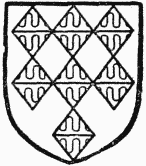
De Burgh. Gules seven lozenges vair.
In 1226–7, after William's death, Nigel de Mowbray his son quitclaimed all right in the manor to Hubert. (fn. 31) The master and brethren of the Knights Templars were given seisin of the manor in 1233, to hold as security for the debts which Hubert de Burgh owed them. (fn. 32) He seems, however, to have recovered the manor, as he died at Banstead in 1243, (fn. 33) and, after the death of his widow Margaret, his son John de Burgh held the manor, (fn. 34) receiving a grant of free warren there in 1260. (fn. 35)
In 1272 John de Burgh alienated Banstead without royal licence to William de Appeltrefeld, (fn. 36) who was ordered to hold until the king's return to England. (fn. 37) The next year John de Burgh granted the manor to the king and his heirs, with the exception of lands to the value of 100s. given to Anselm de Gyse. (fn. 38) Pending the completion of the conveyances Appeltrefeld was allowed to hold, (fn. 39) but John de Burgh finally quitclaimed his right in 1274. (fn. 40) Appeltrefeld later surrendered all claim in it, for which remission the king pardoned him 1,000 marks, in which he was bound in the King's Jewry. (fn. 41) The king seems to have visited the manor soon after he acquired it. In 1276 the reeve of Banstead rendered account of his expenses there, which included 67s. 11d. for repairs in the hall, kitchen, and other rooms 'against the coming of the king'; money spent on tiling and carpentering and on the carriage of materials was also accounted for, and 33s. 4d. was spent in making glass windows for the hall. (fn. 42) The manor-house was probably close to Banstead Church. On the east of the churchyard there used to be a pit called traditionally the cellars of Hubert de Burgh; but the remains referred to above, which must have belonged to a considerable house, were found south of the church.
In October 1275 the manor was assigned as dower to the king's consort, Eleanor of Castile. (fn. 43) In 1299 it formed a portion of the dowry granted to Margaret of France on her marriage with the king, (fn. 44) and she held until her death. (fn. 45) Edward II and Edward III subsequently granted Banstead to their queens as dower. (fn. 46) In 1378 Richard II confirmed to Nicholas Carew a grant of Banstead made to him in 1376 for life, 'saving to the Prior of Merton the term granted to him.' (fn. 47) This latter grant, made evidently after the death of Queen Philippa, was not, presumably, of long duration, as in 1378–9 Carew was tenant of the manor and was ordered to pay 100s. yearly out of the issues of the manor to Stephen de Haddele, yeoman of the chamber to the late queen. (fn. 48) In 1390, after the death of Carew, the manor and park of Banstead were granted for life to Sir Reginald Braybrooke; if, however, the issues exceeded 40 marks annually, the surplus was to be paid to the Exchequer. (fn. 49)
In 1399 confirmation was made of a grant of 1397 to Sir William de Arundel and Agnes his wife of the same manor, (fn. 50) and on their death shortly after without issue, the grant was extended to Sir Richard de Arundel, brother of William, for life, (fn. 51) and on his death to his widow Alice, (fn. 52) who died in 1436. (fn. 53) The king in the following year demised the manor to Sir Ralph Rochefort. (fn. 54) The reversion was granted in November 1437 to John Merston and Rose his wife in survivorship, (fn. 55) and Rochefort quitclaimed his life interest to them in 1438. (fn. 56) In 1448 Henry VI granted the reversion, after the death of John Merston, Rose being already dead, to his new foundation of Eton College. (fn. 57) This grant was, however, cancelled by Edward IV, and the manor was resumed in 1464. (fn. 58) His queen received the manor as dower in 1466; (fn. 59) in 1471 it was given to George, Duke of Clarence, (fn. 60) after whose death it remained in the Crown until Henry VIII, in the first year of his reign, assigned it to Queen Katharine. (fn. 61) She continued to hold after her divorce, and in 1532 leased the manor to Sir Nicholas Carew for ninetynine years, should she live so long. (fn. 62) This deed seems to have been made at the king's desire, as two months later he granted the reversion of the manor, after Katharine's death, to Sir Nicholas Carew in fee. (fn. 63) When it came to the Crown on the attainder of Carew the manor was annexed to the honour of Hampton Court. (fn. 64) It was given back to Sir Francis Carew on the reversal of the attainder in 1549, and continued to be held by this family with their manor of Beddington until 1762, when Sir Nicholas Hacket Carew died. (fn. 65) By the terms of his will the manor of Banstead was sold, according to a previous agreement, to Rowland Frye of Beddington, (fn. 66) who died in 1777, when his brother and heir William inherited the manor. (fn. 67) It passed in 1795 to their nephew Rowland Frye, and on his death in 1801 to the latter's nephew, William Morris Newton, who took the name of Frye, (fn. 68) and was lord of the manor in 1808. (fn. 69) At his death in 1820 it passed to his daughter, wife of Captain Spencer, and she held in 1841. (fn. 70) The property was subsequently sold before 1874 to Sir William Craddock-Hartopp, who held until after 1882. It passed soon after to mortgagees, the trustees of Lady Lavinia Bickersteth, the present lady of the manor. The manor of Banstead included extensive holdings in Horley and Leigh. Sir William Craddock-Hartopp between 1874 and 1878 paid over £13,000 to buy up rights over Banstead Wastes from the following lands: Part of Leigh Place, Dunshott, Flatguns, Sawyers and Skeats, in Leigh, and Horshill, part of Christmas Farm, West Green, Tylers, Fethe-ridge, Watts, Gawlers, Axes, Crutchfield, Flanchford, Rydens and Banfield, in Horley, (fn. 71) a total of 720 acres. Woolvers Farm, Stumblehole, Collendean Farm, and Duxhurst were also in Banstead Manor. (fn. 72)
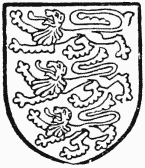
Carew. Or three lions passant sable.
The first mention of the PARK of Banstead occurs in 1299, (fn. 73) when it was included with the manor in the grant made to Margaret of France by the Crown. It was probably imparked after Banstead had been granted to the king by John de Burgh in 1274. An action for trespass in the queen's park was brought in 1305. (fn. 74) In 1348 and 1349, when Queen Philippa held the manor, a writ of aid for one year was granted to the clerk of the great wardrobe to enable him to have timber brought to her wardrobe in La Rioll, London, from her park at Banstead. (fn. 75) In 1439 John Merston and Rose, then holding Banstead, received licence to inclose the park, stated to be in great need of repair, with paling and hedge, and to cause trees and oaks required for the purpose to be felled both within and without the park, under the survey of the Prior of Merton. (fn. 76) The park was included in the grant in fee made to Carew in 1532. (fn. 77) In 1623 John Lambert received a lease of the part of the park called Banstead Old Park. (fn. 78) The manor-house, which succeeded the older manor-house near the church stood in the park; it is now the bailiff's house. The new house called Banstead Wood was built by the Hon. Francis Baring in 1884–90, and is now owned together with the park by Mr. Charles Garton. (fn. 79)
At the time of the Domesday Survey the manor of BURGH or GREAT BURGH (Berge, xi cent.; Bergh, Burgh, Barewe, Berewe, xiii cent.; West Bergh, Great Bergh, xiv. cent.; Borowe, Westborowe, Westburgh, xvii cent.; Burrowe, Westburgh, xviii cent.) was held of Odo of Bayeux by his vassal Hugh de Port for 2½ hides. (fn. 80) Before the Conquest three freemen had held it and could seek what lord they pleased, the assessment then being for 5 hides. (fn. 81) The three manors were held as one in 1086. (fn. 82) The holders of Burgh during the 12th century do not appear. Possibly the Mowbrays had it with Banstead, and enfeoffed one of the family of de Bures, as, between the years 1216 and 1243, John de Bures held a knight's fee in Burgh or Barewe of Hubert de Burgh as of the honour of Mowbray. (fn. 83) In 1276 John de Bures died seised of the whole land of Burgh which he held for the service of one knight's fee and for which he paid 12s. castle ward to Rochester. (fn. 84) His son John succeeded him. In 1325 an extent of the manor of Banstead included a messuage and a carucate of land at Burgh held by de Bures for the service and rent above mentioned and, in addition, for an annual rent of 2s. and suit at the court of Banstead. (fn. 85) His son inherited in 1332, (fn. 86) dying in 1345, when the extent of the tenement at Burgh included a capital messuage and a garden newly planted. (fn. 87) The next John de Bures seems to have become involved in debt to Robert Boteler. In 1346–7 the king pardoned the latter for acquiring for life without licence land of John de Bures at Burgh consisting of a messuage, 240 acres of land, 32 acres of wood, and 12s. rent, (fn. 88) and, by an extent for debt taken on de Bures' lands in 1357, Boteler was found to hold a part of those in Burgh. (fn. 89) The reversion, after the death of Boteler, was granted by de Bures, called John de Bures of Surrey, kt., to John de Bures of London, citizen and fishmonger. (fn. 90) The grant was made before 1362, in which year, Boteler being dead, de Bures of London entered the premises without licence, but was permitted to retain them, (fn. 91) the licence being extended to his heirs in 1368–9. (fn. 92) In 1384 his son (fn. 93) conveyed the manor by means of trustees to Thomas Hayton, (fn. 94) who in 1428 was said to hold the 'half-fee in Berewe which Robert Boteler formerly held of the king in the said vill,' (fn. 95) and in 1432 he died seised of 'the manor of Westbergh.' Agnes, then wife of John Exham or Hexham, was his daughter and heir. (fn. 96) She seems to have afterwards married Thomas Sayer, as in 1450 they conveyed lands in Westbergh, held in the right of Agnes, and identical in extent with those mentioned in 1346, to Richard Ford and Mercy his wife, William Sander and Joan his wife, and John Collard. (fn. 97) Mercy and Joan were daughters of Agnes by her first husband, Thomas Carew. (fn. 98) These parties released the property in 1466 to Henry Merland and others. (fn. 99)
Richard son and heir of Henry Merland died in 1506, having left the lands to his wife Elizabeth for life with remainder to his brother Nicholas. (fn. 100) Nicholas survived and died seised of the manor in 1524, Edward being his son and heir. (fn. 101) Edward married Frances Leigh, and in 1543 settled the manor on her with remainder to their sons. (fn. 102) After his death his widow married Robert Moys; her son William Merland inherited at her death in 1596, her elder sons Arthur and Matthew having predeceased her. (fn. 103) In 1614 Merland, with other members of his family, conveyed to Christopher Buckle, (fn. 104) whose family continued to hold this manor with others in Burgh until the middle of the 19th century. (fn. 105) Christopher Buckle, 1684–1759, built Nork House, where his son, Admiral Matthew Buckle, died. The property descended in the direct line until the death without issue, in 1816, of Christopher Buckle, the fifth of that name to hold Burgh, (fn. 106) when it passed to his sister, wife of Captain Crowe. (fn. 107) A year later it went to the Rev. William Buckle, a cousin, representing the younger branch of the family, and he held until his death in 1832. (fn. 108) His son, the Rev. William Lewis Buckle, held this manor, with others in Banstead and with the church, until 1847, when it became the property of the Earl of Egmont. (fn. 109) From his successor, the fourth earl, it passed (about 1900) to Mr. F. E. Colman, and Mrs. Colman now holds it. Dr. Burton, author of the Iter Surriense, in Greek, in 1752 stayed at Nork House, and describes at length the ingenious waterworks by which water was raised from a very deep well and distributed over the slopes of a dry down.
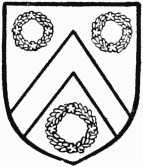
Buckle. Sable a cheveron between three chaplets argent.
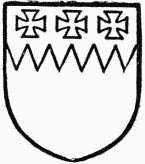
Perceval, Earl of Egmont. Argent a chief indented gules with three crosses formy or therein.
Record is found of a capital messuage at Burgh in 1345. (fn. 110) In 1432 Beatrice widow of Thomas Hayton held part of the site of the manor as dower, her portion including two high rooms and two low ones in the south part of the hall (aula), a third part of the kitchen, of the 'Baggehous' and of the oven, two gerners, a barn, a stable covered with tiles, parts of buildings called the 'Sidyrhous,' the 'Wrengehows,' and the 'Wellehous,' with a third of the garden opposite the hall and various other inclosures. (fn. 111)
The later house was probably built by William Merland, who held the manor from 1598 to 1614. It is said to have been a Jacobean house. In the windows were the arms of the Buckles. It was pulled down by the late Lord Egmont about twenty-five years ago.
A manor called LITTLE BARROW (fn. 112) was held in demesne as of fee by Thomas Barowe in the 15th century. (fn. 113) By his will Katherine, a daughter of William Broke, was to receive the issues and profits of the manor for 28 years after his death, or, if she married, they were to be delivered to her husband. Barowe enfeoffed Thomas Wode to carry out these provisions. Katherine married James Warner, who received all issues from 1473 until 1486, when, by agreement, he sold them to John son and heir of Thomas Barowe. (fn. 114) John then brought a suit against Thomas Wode, who refused to be party to the transaction, (fn. 115) but the result is not apparent. Manning states that a rental of 1531 gives Richard Covert as lord of this manor, his son George afterwards holding. According to the same authority, Christopher Buckle of Burgh held in 1661. (fn. 116) The manor of Little Barrow afterwards descended with Burgh (q.v.), with which it is at present held.
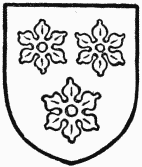
Lambert. Gules three sexfoils argent.
The manor of PERROTTS in this parish belonged in the 16th century to the family of Charlwood. The earliest court of which record exists was held in 1447. (fn. 117) In 1515 Nicholas Charlwood sold it to John Lambert of Woodmansterne, who possibly was connected with the family of Lampet, Lomputte, or Lampert, who were settled in Banstead in the 14th century. (fn. 118) It descended from John Lambert, the purchaser, to Roger his second son, who married Katherine Causton. Roger, the eldest son of Roger, sold the manor to the second son John, the quit-claim being made in 1573. (fn. 119) John the eldest son of this John married Katherine Moys of Canons (q.v.). He was Marshal of the Hall to King James I, and fought for King Charles. To escape sequestration of his estates he conveyed Perrotts to a younger brother Edward. (fn. 120) It afterwards passed to the latter's fifth son Daniel, who purchased it from his elder brother Nicholas. (fn. 121) Thomas eldest son of Daniel sold the manor to his brother Daniel, the third son, who was Lord Mayor of London in 1741, and was knighted in 1743. (fn. 122) He died without issue in 1750, leaving Perrotts to his nephew, also named Daniel, who died in 1765. (fn. 123) The manor is still in possession of this family. Mr. Daniel Henry Lambert, son of the late Benjamin Lambert, of Well House, at present holds. The last court was held about 1866, the last copyhold tenant, Mr. Bonsor, M.P., enfranchised not long since; only a bare seignory therefore remains to the lord. (fn. 124) The manor-house mentioned in a deed of 1680 as having been recently rebuilt stood on the slope facing Rydon Hill. It was pulled down about 1760, when the family moved to the Well House in Banstead.
The first mention of the manor of PRESTON occurs in 1316–17, when John de Chetwode, sen., settled it on himself for life with remainder to his son John and Lucy his wife and their heirs. (fn. 125) Almost a century previously a Ralph de Chetwode had held 10s. rent in Burgh, so it is probable that the family had long been holding land in Banstead. (fn. 126) In 1346 Sir John de Chetwode, kt., and Lucy his wife, settled the manor on Nicholas, apparently their son, and Elizabeth his wife. (fn. 127) In 1384 John de Bures was said to hold a cottage at Burgh of Thomas Hayton as of the manor of Preston. (fn. 128) Hayton, however, who afterwards held Burgh (q.v.), did not die seised of Preston; (fn. 129) probably, therefore, he was a trustee for the Chetwode family, or held the manor for a term of years only, as, according to Manning, Sir Thomas Chetwode, grandson of Nicholas, afterwards held the manor, and in 1473 his sister and heir Elizabeth, then wife of William Woodhall, released it to Richard Illyngworth and others, trustees for Henry Merland. (fn. 130) Richard son of Henry Merland died seised of the manor in 1506, holding also that of Burgh, (fn. 131) and the two manors have since been held together. (fn. 132)
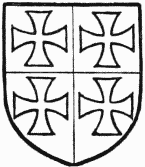
Chetwode. Quarterly argent and gules with four crosses formy counter-coloured.
William de Braose, lord of Bramber, held Tadorne NORTH TADWORTH in 1086 as half a hide, Halsart being his tenant; Godtovi had held it of King Harold and could seek what lord he pleased. (fn. 133) In the early 13th century William Haunsard held a fee in Book-ham and Tadworth of the honour of Brembre (Bramber). (fn. 134) Later in the century, but before 1243, he was stated to hold two fees in Tadworth of Hubert de Burgh, of the honour of Mowbray. (fn. 135) In 1273 John and James, sons of William Haunsard, gave a carucate of land, 2 acres of pasture, 12 acres of wood, and 20s. rent in North Tadworth and Little Bookham to the Prior of St. Mary Overy. (fn. 136) The priory continued to hold North Tadworth as a manor until the Dissolution. In 1524 it was demised with the rectory of Banstead to William Coltson and Richard Moys and Elizabeth his wife for a term of forty years. (fn. 137) After the Dissolution the manor was granted by the Crown to Thomas Walsingham and Robert son and heir of Richard Moys in fee; (fn. 138) Walsingham soon after released to Moys, (fn. 139) who died in 1596 leaving a son Philip. (fn. 140) John son of Philip died without issue, (fn. 141) and Henry, another son, held in 1648. (fn. 142) At Henry's death the manor passed to his five sisters and co-heirs. (fn. 143) In 1659 Sir Henry Hatton and Elizabeth his wife, daughter and heir of Robert Hazard and Ann, a sister of Henry Moys, (fn. 144) John Ireland son of another sister, John Kyme son of Mary, a third sister, and Paul Tracey son of Margaret, a fourth, (fn. 145) conveyed four-fifths of the manor of North Tadworth to Christopher Buckle of Burgh. (fn. 146) In 1663 Christopher Buckle acquired the remaining fifth from John Bushell and Joyce his wife, (fn. 147) daughter and heir of Edward Lambert, who was the son of John Lambert and Catherine, the fifth sister of Henry Moys. (fn. 148) Since that time North Tadworth has been held with the manor of Burgh (q.v.).
In 1086 Ralph held Tadeorde, probably SOUTH TADWORTH, of Odo of Bayeux for 1½ hides; before the Conquest two brothers had held it of King Edward for 5 hides. (fn. 149) Its value had decreased from 40s. to 30s., (fn. 150) and it was still taxed for the latter sum in 1291 when the Prior of Merton held the land. (fn. 151) It is not evident how the prior acquired it, but possibly it had been granted him by the lord of Banstead, as the prior held the land of that manor. (fn. 152) South Tadworth was certainly held by Merton before 1274, as in that year the Prior of Southwark brought a plea of novel disseisin against the Prior of Merton for common pasture in Banstead, North Tadworth, and South Tadworth. (fn. 153) In 1428 the Prior of Merton held a quarter of a knight's fee here. (fn. 154) The manor remained in possession of the priory until the Dissolution, (fn. 155) after which, on coming to the Crown, it was annexed to the honour of Hampton Court. (fn. 156) In 1553 Edward VI made a grant in fee to Edward Harendon or Herrenden. (fn. 157) The manor was settled in 1569 on his son Henry, who married Mary Digby. (fn. 158) In 1587, after the death of Millicent Herendon, widow, Edmund was stated to be her son and heir. (fn. 159) He, with Henry Herendon, senior and junior, levied a fine of the manor in the same year. (fn. 160) The deed was possibly a surrender of Henry's claim, as Edmund still held in 1618. (fn. 161) In 1620 John Herendon conveyed to Thomas Hawes. (fn. 162) From the latter the manor passed in 1631–2 to Thomas Grymes or Crymes, (fn. 163) who died seised in 1644. (fn. 164) His son, Sir George Grymes, kt., inherited, (fn. 165) but before 1650 the manor had come into the possession of Robert Wilson and Katherine his wife. (fn. 166) The Wilsons conveyed in 1694 to Leonard Wessel, (fn. 167) who still held in 1704. Leonard Wessel, about 1700, built the house there known as Tadworth Court. (fn. 168)
By 1724 the manor was the property of John Fleet-wood, who died in 1725 having devised to his sons John and Gerard Dutton Fleetwood in tail male with reversion to his daughter Anne Maria wife of William Bury, or his sons' daughters. (fn. 169) The second John Fleetwood died in 1752 leaving an only child Emilia, wife of Giuseppe Calenda. The Calendas and the Burys in 1755–6 conveyed their interest to Gerard Dutton Fleetwood, who was unmarried, (fn. 170) and he in 1756 procured an Act of Parliament enabling him to sell the manor to William Mabbot. (fn. 171) Mabbot died at Tadworth Court in 1764, (fn. 172) having devised his property to his wife, Lady Rhoda Delves, with reversion to her daughter Rhoda wife of Philip Carteret Webb. (fn. 173) The daughter afterwards married Edward Beaver, (fn. 174) and in 1773, after the mother's death, they, with William Wright and Charles Scrase, executors, conveyed the manor to Sir Henry Harpur. (fn. 175) It passed soon after to Robert Hudson, who held in 1808, (fn. 176) his son and his son's widow holding after his death; Mrs. Hudson was lady of the manor in 1841, (fn. 177) and seems to have held until after 1860. Before the end of the 19th century Sir Charles Russell, afterwards Lord Russell of Killowen, bought the manor, which is now in the possession of his widow, Lady Russell of Killowen. The house which Leonard Wessel built is now owned by Mr. C. D. Morton.
RECTORY MANOR, alias SOUTHMERFIELD, alias CANONS.
The Prior and canons of St. Mary Overy were possessed, as early as the 12th century, of a considerable amount of land in Southmerfield in Banstead. In 1194 Mabel de Mowbray, after the death of Nigel, claimed against the prior two caru-cates of land in Southmerfield, as well as the advowson of the church, as having been given her by her father as her marriage portion. (fn. 178) The prior said that no lord had previously intermeddled with the church there, but she was finally allowed to hold three parts of the land for life; the rest she quitclaimed to the prior. (fn. 179) In the first year of King John's reign Sewel son of Robert of Southmerfield quitclaimed to the prior and his successors two virgates in Southmerfield, with the house belonging, which he had previously demised to the prior for a term of four years. (fn. 180)
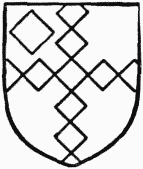
Priory of St. Mary Overy. Argent a cross indented gules with a lozenge gules in the quarter.
In 1269 (fn. 181) John de Burgh, then lord of Banstead, released the prior and his successors from the customary rent, services, and suit at court by which the priory lands in Banstead Manor were held. A rental of the priory in the reign of Edward I shows that its lands in Banstead amounted to nearly two hundred acres. (fn. 182) Of these, 17 acres were held of the gift of John de Burgh, 16 of the fee of John de Bures for the rent of 2s. and a rose, and 7 acres of the fee of Robert Walton for the rent of 12d. (fn. 183) The land belonging to the Waltons lay in Southmerfield. (fn. 184) In 1317–18 Juliana widow of Robert de Walton received licence to have divine service celebrated at a portable altar in her houses of Holeghe (in Coulsdon) and Southmerfield. (fn. 185)
In 1524 the rectory, with the house in Southmerfield, was demised to William Coltson and Richard Moys and Elizabeth, together with the priory's manor of North Tadworth. (fn. 186) In 1549, after the surrender of the priory, these lands were granted to Robert son and heir of Richard Moys and Thomas Walsingham, the latter releasing his share soon after. (fn. 187) The deed of 1549 refers to the lands as the manors of North Tadworth and Southmerfield and the rectory and church of Banstead. They passed successively to Philip, John, and Henry Moys, and finally to the five sisters and co-heirs of Henry. (fn. 188) In 1661 the descendants of four of these sisters conveyed four-fifths of the rectory to Francis Beard. (fn. 189) According to Manning this portion passed from Beard in 1663 to Frances Moys widow of John Moys, and she, out of her share of the impropriation, endowed the vicarage with an annuity of £20. (fn. 190) By 1702 Henry Read held four-fifths of the rectory, (fn. 191) and he still held in 1724. (fn. 192) In 1726 he and Lydia his wife, with Christopher Buckle, levied a fine of four-fifths of the manor of Southmerfield and of the rectory and advowson. (fn. 193) This was probably part of a conveyance of the rectory from the Reads to Buckle, as he afterwards held both this and the advowson (q.v.). The remaining fifths of the rectory and advowson, the portion of Henry Moys's sister Katherine Lambert, passed to her daughter and heir Joyce, (fn. 194) who, with her husband, John Bushell, conveyed in 1663 to trustees of Richard Parr and Elizabeth his wife, widow of Henry Moys. (fn. 195) Parr and his trustees sold in 1668 to Robert Wayth. (fn. 196) In 1732 Edward Fulham, son and heir of Anne daughter and eventually heir of Robert Wayth, sold his fifth to Christopher Buckle. (fn. 197) After this time the entire rectory descended with the advowson, and the Earl of Egmont is the present impropriator of the great tithes with the exception of those in South Tadworth, which apparently passed out of the hands of the owner of the rectory in 1551. (fn. 198)
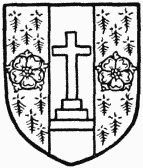
Moys of Canons. Ermine a pale between two roses gules with a Calvary cross or on the pale.
The house in Southmerfield, acquired in 1199–1200 by the prior and convent, (fn. 199) evidently became the site of the rectory manor, as in 1203 record is found of the prior's house in Southmerfield, where his bailiff collected or paid rent. (fn. 200) After the Dissolution, this house, called the capital messuage of the rectory, was known by the name of Canons or Southmerfield. (fn. 201) It descended with the rectory. Land called Canon's Hatch belonging to the priory is mentioned in the late 13th century. (fn. 202) A farm, Canhatch, was afterwards held by the Moys family with the church lands. (fn. 203)
GARRATTS HALL
GARRATTS HALL (fn. 204) (Gerardes, Garades) represents a tenement held of the manor of Banstead, apparently according to the custom of borough English. It preserves the name of a family settled in Banstead in the 15th century. Their estate passed to the Calcokes of Chipstead, and descended from Richard Calcoke to his youngest son Alan, who joined with his mother in conveying it to Jeffery Lambert of Woodmansterne in 1534. From this latter it passed to the youngest son of his nineteen children, Samuel, and after Samuel's death it descended to his son John, born in 1638, who left one daughter, Elizabeth, the wife of Sir Robert Wilmot, Lord Mayor of London. John Lambert rebuilt the mansion-house and conveyed the property to his nephew Thomas, a merchant of London, son of his elder brother Samuel. Thomas Lambert died in 1704, and his son, John Lambert, sold Garratts to his cousin, John Ludlow, whose son Lambert Ludlow died without issue, leaving three sisters and co-heirs. These ladies conveyed to Isaac Hughes of London, merchant, who married a Buckle of Burgh, and left a son John. The estate passed shortly afterwards to the Ladbrokes, and then to the Clowes, from whom it was bought back by Thomas Lambert of Banstead (see Perrotts) about 1850. He gave the property to his brother, John Lambert, an active magistrate and great bene-factor to the parish, who left one son, Wilmot Lambert, after whose death his trustees sold it to the late Mr. F. Lambert. His son, Colonel F. A. H. Lambert, is the present owner. The house has a handsome Queen Anne staircase and some Jacobean panelling. In the chapel is a 15th-century triptych, an ancient crucifix, and some pictures. The house is occupied by Mrs. Davies, and used for a girls' school.
BANSTEAD PLACE
BANSTEAD PLACE (formerly Carpenters) was an estate of the Wilmots early in the 17th century. It passed through an heiress to Elizabeth wife of Gabriel Bestman, and afterwards to her niece, Hannah Wilmot, who married Sir Samuel Prime, a well-known lawyer in the reign of George III. The property passed later to the Westons, and then to John Motteux, of Beachamwell and Sandringham, co. Norfolk, whose trustees sold it to W. S. H. Fitz Roy, from whom it was acquired by John Lambert of Garratts Hall. Is is now the property of the Hon. Mr. Justice Neville.
The WELL HOUSE was a farm which came into the possession of the Lambert family through the marriage of Mary, daughter and co-heir of John Wilmot, with Sir Daniel Lambert. The latter built the present dining and drawing-room, leaving the old house, an early 16th-century building, practically intact. It is now the residence of the Hon. Mrs. Arthur.
NEWLANDS
NEWLANDS belonged in the 17th century to the family of Harris, who were connected with Winchester. Richard Harris, M.D., of Newlands, married a sister of Sir Edward Bysshe, of Smallfield Place, in Burstow, and left a son, Thomas Harris, a secondary of the Court of Exchequer, who married Anne, sister of Sir Timothy Thornhill, bart., and widow of John Wilmot. He died in 1727, and his son John twenty years later. The property subsequently came into the possession of the Aubertins, a Huguenot family, one of whom, the Rev. Peter Aubertin, rector of Chipstead, married a daughter of Mr. Lambert of Banstead. His son, Peter Aubertin, also rector of Chipstead, sold Newlands to Mr. Nisbet Robertson, whose widow is the present owner.
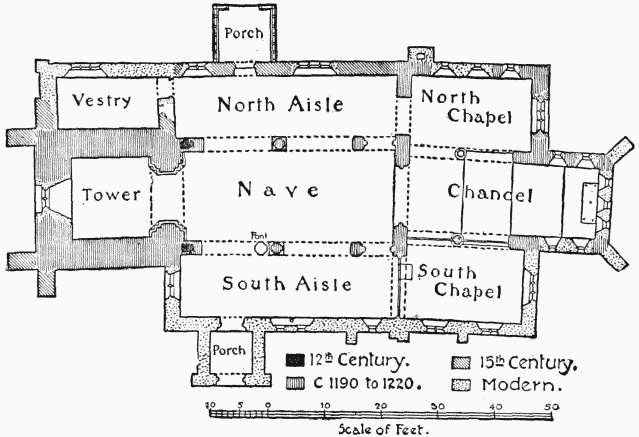
Plan of Banstead Church
CHURCHES
ALL SAINTS' church is a fine building consisting of a chancel 33 ft. 7 in. by 13 ft. 4 in. with a north chapel 21 ft. 6 in. by 13 ft. and a south chapel 21 ft. by 13 ft. 2in., a nave 37 ft. 10 in. by 16 ft. 8 in. with a north aisle 10 ft. 9 in. wide and a south aisle 11 ft. 2 in. wide, a west tower 14 ft. 4 in. by 14 ft., and to the north of it a vestry. The north and south entrances have porches.
The church has been over-restored, but is still of very great interest, the nave and chancel arcades being of a very uncommon type. The nave, as usual, probably retains the plan of a building considerably earlier than any detail now existing, the great height and comparative thinness of its walls suggesting a possible pre-Conquest origin. The arches of the nave arcades and the west arch of the north chapel show distinctive late 12th-century tooling, and are the oldest features to which a date can now be given, and the church must have been brought to its present plan, except as regards the aisles and north-west vestry, somewhere between the years 1190 and 1220. The north aisle seems to have been widened in the 15th century, the south aisle has been rebuilt in modern times, and the vestry is also modern. The south chapel was rebuilt in 1837, and brought to its present form in 1868, and both porches are modern. Cracklow mentions that the chancel was repaired in 1631, and the church beautified by subscription in 1716, and again repaired at a later date.
An old cork model of the church in the vestry shows a 13th-century lancet and a 15th-century three-light window in the north wall of the north chapel, and the east and south chancel windows as of 15th-century date with three cinquefoiled lights.
At present there are three modern lancets in the east wall of the chancel, two in the north wall, partly old, and shown in Cracklow's drawing, and two entirely modern in the south wall.
The arcade between the chancel and north chapel is of two bays with a very interesting and unusual octagonal central column, the faces of which are sunk and hollowed alternately, leaving fillets about an inch wide on either side of each angle. The base is roll-moulded and is now below the floor line, and the bell capital is also moulded and has scrolls of 13th-century foliage at the four cardinal angles curving outwards from the bell of the capital. The responds are quite plain and have simple moulded abaci, and the arches are two-centred of one order with slightly chamfered edges, and with plain labels on both sides.
The opposite arcade is similar, but the faces of the central column are not recessed; it has a watermoulded base and an octagonal moulded capital without foliage, and the arches have no labels. Just above the capital on the chancel side can be traced one of the consecration crosses.
The chancel arch has jambs of two chamfered orders which continue round the arch with a moulded abacus at the springing. It is of early 13th-century date, and the wall in which it is set is square with the chancel and not with the nave. The east window of the north chapel is of 15th-century date, and has three cinquefoiled lights under a four-centred head with a moulded label. On either side of it are stones bearing the outlines of image-brackets which have been cut back to the wall face.
In the north wall are three lancet windows, the eastern of which may be in part old, while the other two replace a 15th-century three-light window. The rear arches are chamfered, and that of the middle window springs from small moulded corbels.
The arch from this chapel into the north aisle has plain square jambs and a pointed arch; the stone is darker than that used in the rest of the building, and the 12th-century diagonal tooling on it is very distinct.
The south chapel dates only from the rebuilding of 1837, and its windows from 1868; the opening from it to the south aisle has a modern pointed arch on old jambs, attached to each of which is a small modern shaft and moulded base with good foliate capitals of 13th-century date.
The nave arcades are of two bays with narrow arched openings in the east responds. It is to be noted that the setting out of the arcade follows the line of the east wall of the nave, which is not square with the side walls, so that the arches are not opposite to one another. The arches and inner order of the jambs of the narrow eastern openings are modern, but the openings themselves seem to be old, and may have been made to give more room for nave altars, like the recesses which are often found in the walls of aisleless naves in this position.
The arcades are finely proportioned with tall octagonal columns and water-moulded bases or square subbases with angle spurs. The capitals are square with moulded abaci, beneath the projecting angles of which are volutes springing from the necking, of very plain detail, only one being carved into leaves.
The responds are plain and have moulded abaci at the springing, while the arches are of a single square order and are two-centred, the diagonal tooling of the masonry being well preserved. The two north windows of the north aisle are modern, the first having three lights and the second two, all with trefoiled heads, while the west window, now looking into the vestry, is 15th-century work of two lights. The north doorway is also of 15th-century date, and has a large hollow chamfer in the jambs which changes to a double ogee moulding in the four-centred arch.
The porch is modern, built of timber on low flint and stone walls.
From the west end of the aisle a plain modern doorway leads to the vestry, which is lighted by a three-light window of the same design as those in the north wall of the adjacent aisle. The south aisle and porch are entirely modern.
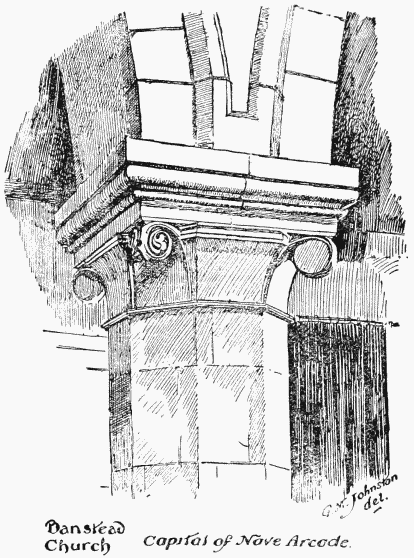
Banstead Church Capital of Nave Arcade.
The tower arch is two-centred, of three chamfered orders continued from the jambs with splayed bases and moulded abaci, all of early 13th-century date; and above it is a blocked doorway which opened from the first floor of the tower. All the walls of the tower are extraordinarily thick, being doubtless intended to be carried up to a greater height than they now are. The west wall measures 6 ft. 5 in., and in it is a modern two-light window.
The tower is of two stages, and has a low-pitched roof from which rises a small octagonal spire, covered with oak shingles. In the upper stage are lancets on the north, west, and south aisles, old within, but with their outer stonework renewed, and on the east side is a modern window of two trefoiled lights under a square head.
The roofs are tiled, the timbers of the chancel, north chapel, and nave being old, and the former having a deep moulded cornice, while the south chapel has a modern panelled ceiling, and the aisles modern lean-to roofs.
All the internal fittings are modern except the font, which has a 14th-century octagonal bowl on modern round stem and base. The top and bottom of the bowl are moulded, and each of the sides has a panel filled with tracery of a different pattern. The effect is not very successful, but a fair number of similar fonts exist up and down the country—Chipstead is a neighbouring example.
In the lower part of the east window of the north thapel are some remains of 17th-century glass, one piece bearing the date 1619. It came from Great Burgh, and has some modern heraldic glass set with it.
There are many monuments in the church, of which the following are the oldest or most noteworthy. In the vestry a quaint little marble wall-tablet to Paul Tracy, 1618, son of Paul and Margaret Tracy and grandson of Sir Paul Tracy of Stanway, Gloucestershire. At the foot is his figure in low relief in a chrism robe. Another, a black marble tablet in an alabaster frame, is to Robert Smyth, fourth son of Richard Smyth of Backton, Suffolk, 1603; and in the north aisle is a wooden panel to Ruth (Lambert) wife of George Brett, citizen and goldsmith of London, 1647, with a set of twelve couplets of somewhat extravagant eulogy, and a shield with the arms—Argent a cheveron azure with three bezants thereon, impaling Gules three sexfoils (narcissi) argent.
In the south chapel are several monuments of the Lambert family, including one to Mrs. Judith Lambert, daughter of Daniel and Elizabeth Lambert, 1725; and one on the south wall of the aisle to Sir Daniel Lambert, Lord Mayor of London 1741, died 1750.
There are eight bells hung on a modern iron frame: the treble and second by Warner 1892, the third by Bryan Eldridge 1638, the fourth by William Carter 1613, the fifth by Thomas Mears 1791, the sixth by Lester & Pack 1756, the seventh by Robert Mot 1585, and the tenor by William Eldridge 1651.
The communion plate is a silver-gilt set of 1788 given by Richard Ladbroke in 1789, and comprising a cup, paten, almsdish, and a large helmet-shaped flagon.
The first book of the registers contains baptisms, marriages, and burials from 1547 to 1618, the second baptisms from 1616 to 1783, and burials from 1663 to 1783, third baptisms and burials 1663 to 1712, and marriages 1663 to 1711, fourth marriages 1754 to 1772, fifth marriages 1773 to 1811, sixth baptisms 1784 to 1812, seventh burials 1789 to 1812, and eighth marriages 1811 to 1837.
The church of ST. MARY at BURGH HEATH, successor of the ancient church, was begun in April 1908 and opened in 1909. It is built of flint and stone, and has a chancel, nave, two aisles, vestry, &c.
ADVOWSONS
There was a church in existence at Banstead in 1086. (fn. 205) Tirel del Maniers granted the advowson to the Prior and convent of St. Mary Overy during the reign of Henry I, (fn. 206) and this grant was afterwards confirmed by Nigel de Mowbray, lord of Banstead. (fn. 207) After his death his widow Mabel seems to have claimed the advowson against the prior, (fn. 208) but without success (see under Banstead Manor), and the prior continued to hold it. (fn. 209) A vicarage was ordained before the end of the 13th century. (fn. 210) In 1549, after the Dissolution, the advowson was granted, with the rectory (q.v.), to Robert Moys, (fn. 211) whose descendants held until 1661, when four co-heirs (fn. 212) conveyed four-fifths of the advowson to Francis Beard. (fn. 213) Frances Moys presented to the church in 1663, (fn. 214) and, according to Manning, she had acquired the four-fifths held by Beard and conveyed them soon after to her brother Christopher Buckle. (fn. 215) His grandson presented to the church in 1714, (fn. 216) and held four-fifths of the advowson in 1726, (fn. 217) obtaining the remaining fifth both of rectory and advowson in 1732. (fn. 218) The rectory and advowson remained in possession of the Buckles (fn. 219) until 1855–6, when they passed to the Earl of Egmont, the present earl being patron of the vicarage.
Nigel de Mowbray, at the close of the 12th century, granted the advowson of the church of Burgh to the priory of St. Mary Overy, (fn. 220) presentation being made to the church by the prior and convent during the 14th and 15th centuries. (fn. 221) After the Dissolution it became the property of the lords of the manor of Burgh, being held by the Merlands and afterwards by the Buckles, (fn. 222) but no incumbents were instituted after the 15th century.
A chapel dedicated to St. Leonard was attached to the manor of Preston in the 15th century. (fn. 223) The advowson was held with the manor, the last record of it being, apparently, in the conveyance from the Merlands to Christopher Buckle. (fn. 224)
CHARITIES
These are recorded in the church as follows:—
1693. Mr. Samuel Wilmot left £50 for 5 poor men and 5 poor widows.
1699. Mr. Robert Wilmot gave £35.
1725. Mrs. Judith Lambert left £10 for 10 poor housekeepers, at the town end of the parish.
1741. Simon Wilmot, merchant, left £100 forthe poor.
1750. Sir Daniel Lambert left £100 for 16 poor people not receiving parish relief.
1770. Dame Mary Lambert, his widow, left £50 for the same purpose.
1785. Mr. Edward Lambert left £100 for the same purpose.
1793. Mr. J. Motteux left £100 for bread on the first Sunday in February.
1805. Mrs. Lucy Burr gave £5 a year for the poor on the first Monday in Advent.
1814. Mr. John Hewitt, £100.
1815. Mr. Wilmot Lambert, £50.
1818. Mr. Richard Pairy, £100.
1822. Rev. J. E. Francis (vicar), £100.
1823. Mrs. Katherine Motteux, £150 for bread on the first Sunday in December.
1824. Mrs. Lucy Motteux, £150 for bread on the second Sunday in the year.
1829. Mrs. Martha Jones, late wife of Mr. W. Lambert, £100.
1833. Mr. Thomas Lambert, £100.
In 1725 £30 a year from a Mr. Lambert was returned to Bishop Willis, but is not in this table.
Smith's Charity is distributed as in other Surrey parishes.