A History of the County of Surrey: Volume 3. Originally published by Victoria County History, London, 1911.
This free content was digitised by double rekeying. All rights reserved.
'Parishes: Epsom', in A History of the County of Surrey: Volume 3, ed. H E Malden (London, 1911), British History Online https://www.british-history.ac.uk/vch/surrey/vol3/pp271-278 [accessed 30 April 2025].
'Parishes: Epsom', in A History of the County of Surrey: Volume 3. Edited by H E Malden (London, 1911), British History Online, accessed April 30, 2025, https://www.british-history.ac.uk/vch/surrey/vol3/pp271-278.
"Parishes: Epsom". A History of the County of Surrey: Volume 3. Ed. H E Malden (London, 1911), British History Online. Web. 30 April 2025. https://www.british-history.ac.uk/vch/surrey/vol3/pp271-278.
In this section
EPSOM
Evesham (xi cent.); Ebbesham (xiii cent.); Ebsham, Ebesham, and Ebbesham (xiv cent.); Ebbisham, Eppesham, and Ebsame (xvi cent.); Ebsham (xvii cent. and xviii cent.); Epsom (late xvii cent.).
Epsom is a town 16 miles north-east of Guildford, 7 miles south-by-east of Kingston, 15 miles from London. The parish measures 4 miles from north to south, and 2 miles from east to west, and contains 4,413 acres. It lies upon the chalk downs, the Woolwich and Thanet Beds, and the London Clay. The church is on the chalk, but the greater part of the old village is on a patch of gravel and sand of the Thanet Beds. The building of later days has had a tendency to spread up the chalk. A branch of the Hoggsmill River flows from Epsom. Besides agriculture, brick-making and brewing are carried on; but the chief importance of Epsom since it ceased to be a small country village has been, first, that of a wateringplace; and, secondly, that of a horse-racing town. Epsom Common is still to a great extent open ground, lying on the clay, and adjoining Ashtead Common to the west of the town. Epsom Downs are a noble expanse of chalk country, comprising 944 acres of open land.
The road from London to Dorking passes through Epsom. This road was evidently passable for carriages when Epsom was a fashionable watering-place, in the latter part of the 17th century; but it was not passable, except with difficulty, beyond Epsom till 1755, when an Act (fn. 1) was passed for carrying on the turnpike road from the watch-house in Epsom. In the same year (fn. 2) the road from Epsom to Ewell, and thence into the Kingston road, was re-made.
The London, Brighton, and South Coast Railway came to Epsom by the Croydon and Epsom line in 1847. The Epsom Downs branch was opened in 1865. The London and South-Western Railway came to Epsom in 1859. The stations of the two companies are some distance apart, but the lines converge just before reaching the London and South-Western Railway Station, and continue together till Letherhead, the Brighton extension to Horsham having obtained running powers over the South-Western Railway line.
Epsom is now a flourishing country town. It was constituted an urban district under the Public Health Act of 1848 on 19 March 1850. By the Local Government Act of 1894 it was put under a Local District Council of nine members, increased to twelve in 1903. It is essentially a town, supplied with gas by the Epsom and Ewell Gas Company, formed 1839; with electric light by a company in Church Street; with water from the chalk by works belonging to the Council. There is a cemetery in Ashley Road, first opened in 1871. The County Court was built in 1848; the Town Hall, in red brick and terra cotta, in 1883. The Technical Institute and Art School was opened in 1897. The sewage of the town is disposed of by an irrigation system on part of the Epsom Court farm lands, the purified effluent is discharged into the Hoggsmill River. The District Council's Isolation Hospital is in the Hook Road. The Union Workhouse is near the Dorking Road. Horton Manor, lying west of the town, has been acquired by the London County Council for an asylum, and the Manor Asylum has been built for 2,100 patients. The Colony for Epileptics, in the same neighbourhood, lying partly in Ewell Parish, was opened in 1902, and can accommodate 366 patients in separate houses. A large suburb of cottages is growing up in the neighbourhood of the asylums. There is another outlying hamlet about Epsom Common.
The wide High Street is still a picturesque feature of the town. Up till 1848 a watch-house, with a sort of wooden steeple, stood in the middle of it, where the present clock tower stands. There was also a large pond, drained in 1854. In this street, as well as in South Street and Church Street, are many interesting old houses and inns. A fair is still held in the town on 25 July and the two following days.
Historically, Epsom was unimportant till the 17th century. Neolithic flakes and implements have been found, but few only, near Woodcote. Toland, in his letter descriptive of Epsom in 1711, speaks of Roman remains at Epsom Court Farm. The old trackway (see under Mickleham) which came over the Downs headed for the western side of Epsom Race-course, but is not to be clearly traced beyond it. It is called the Portway in a rental of 1495–6. (fn. 3) When the church was being enlarged in 1907 a dene hole was discovered in the churchyard. The depth was some 16 ft. to the bottom of the shaft, and chambers ran each way from the bottom of the shaft for 12 ft. or 13 ft. The shaft and most of the chambers had been filled in with loose soil, and a mediaeval grave had been dug to a great depth and reached the top of one of the chambers, whence the bones found there had been let through to the bottom. Nothing else was found but a little loose charcoal, and two or three small pieces of hand-made pottery.
Epsom Well, to the discovery of which the place owed its later fame, is on Epsom Common, some distance from the village. It is in the London Clay. Water charged with sulphate of magnesia is not uncommonly found in this soil, as at Jessop's Well, on Stoke D'Abernon Common, which is probably as powerful as the Epsom spring. The situation of Epsom, however, on the edge of the downs, made it a pleasant resort, and so gave greater fame to its waters. The current story is that the well was discovered in 1618 by one Henry Wicker, who observed that cattle would not drink of it. Dudley North, third Lord North, asserts in his Forest of Varieties, published in 1645, that he first made the Tunbridge Wells and Epsom waters known to the world at large. Aubrey drank the water in 1654. After the Restoration the Epsom Wells became a fashionable resort, Epsom being nearer to London than Tunbridge Wells. Nonsuch, so long as it remained standing, was a royal house in the near neighbourhood, and it was an easy ride from Hampton Court. Charles II, James II, as Duke of York, and Prince George of Denmark, all visited Epsom. Pepys, of course, went there; he paid his first visit in 1663, when the town was so full that he had to seek a lodging in Ashtead. In 1667, he writes, on 14 July, 'to Epsom by eight o'clock to the Well, where much Company. And to the town, to the King's Head; and hear that my lord Buckhurst and Nelly' (Nell Gwynne) 'are lodged at the next house, and Sir Charles Sedley with them; and keep a merry house.' In 1663 he had remarked on the large number of citizens 'that I could not have thought to have seen there; that they ever had it in their heads or purses to go down thither.' The New Inn in High Street dates from about this period. It is now called Waterloo House, and is occupied by shops. It is now mainly an 18th-century two-story building of red brick with plastered quoins, and a low gable in the middle of the front; in the roof are attics lighted by good dormer windows. There is a good gable end over the original entrance, which led into a narrow courtyard in the centre, whence there is an exit at the opposite end. On the first floor, approached by a fine staircase with carved balusters, was the Assembly or Ball Room, now cut up by partitions. In 1690 Mr. Parkhurst, lord of the manor, built an Assembly Room at the Wells, erected other buildings, and planted avenues of elms and limes, which were mostly cut down for timber in the early 19th century. The popularity and fashion of Epsom at this time is sufficiently attested, not merely by the names of visitors, but by the announcement in the Gazette, 19 June 1684, that a daily post would go to and from Epsom and Tunbridge Wells respectively and London during the season for drinking the waters, that is, during May, June, and July. This was the earliest daily post outside London.
In 1711, Toland, the famous deistical writer, gives a very flowery description of the beauties of Epsom in a letter to 'Eudena.' But by this date Epsom had come to rely upon its general attractions for pleasure seekers, rather than upon its medicinal waters. A quack doctor named Levingston sank a rival well, of no particular quality, near the town in 1706, built an Assembly Room and shops near it, and in 1715 got a lease of the old well and closed it till his death in 1727. Queen Anne visited Epsom during this period, but the place decayed as a fashionable resort. The neighbouring gentry, however, used to visit the old well when it was reopened, after 1727. Clearly it continued to be a very different kind of place from any other country town in Surrey. In 1725 Bishop Willis, in his Visitation questions, asked for the names of resident gentry in every parish, and for Epsom, Lord Yarmouth, Lord Guilford, Lord Baltimore, Sir John Ward, eight gentlemen, and eight well-to-do widows are returned, whilst nothing like the same number are returned for any other parish; eight for Kew is the nearest to it. The invention of sea-bathing, about 1753, was finally fatal to Epsom as a watering-place. The Old Well House, however, was not pulled down till 1804, when a private house was built on the spot, a successor to which still occupies the ground. A part of the old brickwork seems to survive in one of the greenhouses in the garden.
Among the recreations of Epsom in its glory were gambling, cudgel-playing, foot-races, cock-fighting, and catching a pig by the tail, besides horse-racing. Robert Norden's map, of the 17th century, marks 'the Race,' extending in a straight line from Banstead Downs on to Epsom Downs. In 1648 a horse-race on Banstead Downs, evidently a usual occurrence, was made the prelude to Lord Holland's rising against the Parliament. (fn. 4) The races were one of the regular diversions of the company at the Wells, and they used to witness two or three heats in the morning, return to dinner in the middle of the day, and come up to the Downs for more heats in the afternoon. These were run in 1730 either on the old straight course, or on what Toland in 1711 calls the 'new orbicular course.' In those days the runners started above Langley Bottom behind the Warren, and, going outside the Bushes, ran by way of Tattenham Corner to the winning-chair. The original Derby course was the last mile and a half of this track, the starting-post being out of sight of the grand stand. The Derby and the Oaks races were founded in 1780 and 1779 respectively, and were called after the Earl of Derby and his seat at Banstead.
In 1846 Mr. Henry Dorling, the clerk of the course, made, on the advice of Lord George Bentinck, a course for the Derby, the whole of which lies on the eastern side of the Warren and in full view of the stands. This, which is now known as the old course, was used until 1871. For the present Derby course, first used in 1872, the horses start on slightly higher ground at the high-level starting-post, and run into the old course at the mile-post. The first half-mile and the last five furlongs of this track are in the manor of Epsom; that part of it above the Bushes, from the City and Suburban starting-post to the old five-furlong start, lying on Walton Downs within the manor of Walton, is owned by the Epsom Grand Stand Association.
The antiquities and history of the race-meetings have been sufficiently treated already. (fn. 5) The popularity of the races survived the popularity of the wateringplace. Dr. Burton (fn. 6) speaks enthusiastically of the crowds of spectators, even from London, and, as he is writing in Greek, is irresistibly reminded of the Olympic Games. Greater crowds than ever used to attend now flock to Epsom races, for the population within reach is larger, and the means of access by railway much facilitated. But probably the almost national importance of the Derby reached its height in the last generation. It was while Lord Palmerston and Lord Derby were political leaders that the House of Commons regularly adjourned for the Derby day. The fashion outlived Lord Palmerston, but it ceased under Mr. Gladstone's rule, and not even in joke can London now be said to be empty on the Derby day.
As a result of the races, rather than that of the old watering-place life, Epsom is an extension of London into Surrey. The county is now permeated by Londoners, but up to about thirty years ago the speech of the country was different north and south of a line drawn about Epsom. An exact demarcation, of course, could not be made.
Epsom Common Fields, which were on the slopes of the chalk in front of the present Medical College, between it and the town, were among the last to survive in Surrey. They were inclosed by an Award of 4 September 1869, under an Act of 1865. (fn. 7) A certain amount of inclosure on the lower part of the downs and on Epsom Common has been made, probably from the watering-place era onwards, by private purchase and arrangements.
Woodcote House is the residence of the Rev. E. W. Northey, J.P.; Woodcote Grove, of Mr. A. W. Aston, J.P.; Hookfield, of Mr. B. Braithwaite, J.P.; The Wells, of Mrs. Jamieson. This last is a new house on the site of the old well-house. Pit Place is the seat of Mr. W. E. Bagshaw. The lions at the entrance and some interior work are said to be from Nonsuch. It was the scene of the well-known story of Lord Lyttelton's apparition.
The Roman Catholic Church (St. Joseph's), Heathcote Road, was built in 1857.
The Congregational church, in Church Street, has taken the place of a Presbyterian chapel, where a congregation met, it is said, from James's Indulgence in 1688, and certainly in 1725. (fn. 8) No trace is found of it after 1772. In 1815 the old chapel, which had been closed, was bought and fitted up for a Congregational church. In 1825 it was rebuilt. (fn. 9) It was again rebuilt in 1904, in red brick with stone dressings, in a quasi-Decorated style. It has chancel, nave, aisles, and tower with a small spire. The first stone was laid by Mr. Evan Spicer. There are also chapels of the Wesleyans and Baptists, and a Baptist congregation meets in the Gymnasium Hall.
Epsom College, incorporated by Act of Parliament in 1855, and by a new Act in 1895, is a first-class public school, with fifty foundation scholarships open to the orphans of medical men, and taking the sons of medical men at a slight reduction. There are five leaving scholarships to the universities, and ten to the hospitals. The buildings are of red brick and Caen stone in 16th-century style, fitted with chapel, laboratories, gymnasium, swimming-bath, and all the accessories of a school. They occupy a fine site on the downs east of the town.
A National School was built in 1828, but a school had been carried on certainly since before 1725.
The present elementary schools are Hook Road (boys), built in 1840 as a mixed school in place of the one above, enlarged in 1886 and 1896; Ladbrooke Road (girls), built in 1871, recently enlarged; West Hill (infants), built in 1844, enlarged in 1872; Hawthorne Place (infants), built in 1893; Hawthorne Place (junior), built in 1904, a temporary iron building. The schools are under a committee of trustees of charities and elected managers. They are endowed, by the original bequest of Mr. John Brayne in 1693, with land in Fetcham, for teaching poor children to read and write, and binding them as apprentices; by bequest of Mr. David White (see also Ewell) in 1725, with a freehold estate; by bequest of Mrs. Elizabeth Northey, in 1764, with £100 for books; by Mr. Thyar Pitt, with £225; by Mrs. J. Elmslie, with £105 by gift, 1851, and one-fourteenth part of £1,236 15s. 1d. by will in 1858, both sums to the infants' school.
MANORS
In 727 Frithwald, subregulus of Surrey, and Bishop Erkenwald, are said to have granted to their newly founded abbey of Chertsey twenty mansas of land in Epsom: (fn. 10) this was confirmed by King Edgar in 967, (fn. 11) and in the Domesday Survey EPSOM is mentioned among the possessions of Chertsey Abbey. (fn. 12) Henry I granted the abbot leave to keep dogs on all his land inside the forest and outside, to catch foxes, hares, pheasants, and cats, and to inclose his park there and have all the deer he could catch, also to have all the wood he needed from the king's forests. (fn. 13) In the reign of Edward I the abbot's right to free warren in Epsom was called in question, and it was found that only in his park he had the right; (fn. 14) this was confirmed later (1285). (fn. 15) In 1291 the abbot resumed the possession of 9 acres of land (part of the demesne land of the abbey) which he, or a predecessor, had granted to Hugh de la Lane. (fn. 16) In 1323–4 the abbot brought a suit against John de la Lane, bailiff of the queen, for distraining him by 1,500 sheep, for his default in not appearing when impleaded in the queen's court of Banstead, and driving them as far as Banstead, where for lack of nourishment some of them died; the abbot was adjudged £1 in compensation. (fn. 17)
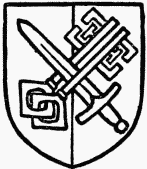
Chertsey Abbey. Party or and argent St. Paul's sword argent its hilt or crossed with St. Peter's keys gules and azure.
Grants of land in Epsom were made to the abbot in 1338 by Peter atte Mulle and Richard de Horton. (fn. 18) In 1535 the rents of the manor were valued at £20 12s. 5½d. (fn. 19) and the perquisites of the court amounted to £2 10s. 4d.; two years later the manor was surrendered to the king. (fn. 20)
Henry VIII granted it in 1537 to Sir Nicholas Carew, K.G., in tail male; (fn. 21) but in 1539, in consequence of his attainder, the manor returned to the Crown, and the next year was annexed to the honour of Hampton Court. (fn. 22) Queen Mary, however, granted it in 1576 to Francis Carew (afterwards knighted), (fn. 23) eldest son of Nicholas, (fn. 24) and his heirs male, with reversion to the queen and her successors. (fn. 25) In 1589 the reversion (Francis Carew being unmarried) (fn. 26) was granted to Edward Darcy, groom of the Privy Chamber (fn. 27) and son of Carew's sister Mary, (fn. 28) who held the manor after the death of Sir Francis in 1611 and died seised in 1612, (fn. 29) having settled it on his wife Mary with remainder to his second son Christopher and contingent remainder to his eldest son Robert. (fn. 30)
Robert died in 1618 (fn. 31) seised of the reversion of the manor after the death of Mary widow of Edward, from which it appears that Christopher, who was alive in 1623, (fn. 32) must have quitclaimed to Robert. Robert's widow and son Edward levied a fine of the manor in 1632. (fn. 33) The rent of the manor (£40) was settled on Queen Anne by James I, (fn. 34) and on Queen Catherine by Charles II. (fn. 35) Edward Darcy sold the manor to Mrs. Anne Mynne, widow of George Mynne of Horton Manor, (fn. 36) and daughter of Sir Robert Parkhurst, and she left it by will to her daughter Elizabeth wife of Richard Evelyn, brother to John Evelyn the diarist. He resided at Woodcote. Courts of the manor were held in his name in 1667 and 1668. (fn. 37) Elizabeth survived him and held courts as lady of the manor until 1691; (fn. 38) she, at her death in 1692, devised the estate to Christopher Buckle of Banstead and his son Christopher as trustees for her sister Ann for her life, with remainder first to her nephew John Lewknor and then to John Parkhurst of Catesby, co. Northants. (fn. 39) The trustees held the courts of the manor until 1706, (fn. 40) when John Parkhurst succeeded to the estate; his grandson John was holding it in 1725. (fn. 41) This John devised the manor to Sir Charles Kemys Tynte, bart., and another trustee for his wife Ricarda during her lifetime, after her death to be sold and the proceeds divided between his two younger sons. (fn. 42) He died in 1765, and in 1770 the manor was sold to Sir Joseph Mawbey, bart., (fn. 43) who was succeeded by his son John in 1798. John had no male heir, and was followed first by his daughter Emily and then by Ann, in right of whom her husband, John Ivett Briscoe, (fn. 44) held the manor till past the middle of the 19th century. It was afterwards held by his trustees, and then went to Charles Vernon Strange, who held it in 1874. From him it passed to James Stuart Strange, who died in 1908 leaving three daughters.
Two mills were in existence at the time of Domesday, (fn. 45) but only one is afterwards mentioned in the records of the manor. (fn. 46) Charles II granted Elizabeth Evelyn, then lady of the manor, the right to hold a weekly market and two fairs at Epsom; the grant was renewed by James II, together with a grant to hold a court of pie-powder at each of the fairs. (fn. 47)
Epsom Court, the old manor-house, was not sold with the property in 1770, but by a family arrangement descended to the Rev. John Parkhurst, eldest son of John and Ricarda Parkhurst (see above), and the great tithes and the advowson went with it. It is now a farm-house.
The manor of HORTON in this parish belonged to the Abbot and convent of Chertsey, but there seem to be no early records relating to it, (fn. 48) unless the lands granted by Richard de Horton in 1338 (vide supra) formed part of it.
According to a charter of the early 15th century, the Abbot and convent of Chertsey owned the hamlet or township of Horton, co. Surrey, with 168 acres of land, 60 acres of pasture lying in common fields of Horton and in two fields called West Crofts and Sampsones, 3 acres of wood called Burnet Grove, 13s. 8d. rent of free tenants there, and 12s. 3d. rent proceeding from the manor of Brettgrave and the lands of Adam Whitlokke in Ewell and 100 acres furze and heath in 'Ebbesham Common' opposite the township of Horton; also another small parcel of land containing 1 rood in 'Ebbesham' near the parish church, parcel of a tenement called Rankyns, with court and view of frankpledge there, 'wayf and strayf' fines, &c. These lands together made the manor of Horton. (fn. 49)
In 1440 the abbot granted it to John Merston, the king's esquire, and his wife Rose, and their heirs, to hold of the king by payment of 3d. yearly for all service. Free warren in all the demesne lands of Horton was also granted by the king to John and Rose, and licence to inclose 100 acres of land for a park. (fn. 50)
After the death of Rose, who survived her husband, the manor passed to William Merston and his wife Anne; (fn. 51) he died in 1495, leaving a son William, (fn. 52) who inherited on his mother's death. He died in January 1511–12, leaving Horton to his wife Beatrice for her life, with remainder to his daughter Joan and her heirs. (fn. 53) Joan married first Nicholas Mynne, (fn. 54) secondly William Sander of Ewell, (fn. 55) and died in 1540 leaving a son John by her first marriage, during whose minority William Sander was granted an annuity of £4 issuing from the manor of Horton, with wardship and marriage of the said John. (fn. 56) This John Mynne was holding the manor in 1564; (fn. 57) he died in 1595, (fn. 58) leaving a son and heir William, (fn. 59) whose son John succeeded his father in 1618. (fn. 60) John married Alice daughter of William Hale and settled various lands and tenements on her, among them the manor-house of Horton; (fn. 61) but in order to pay his debts he with the consent of William Hale sold these estates (fn. 62) to George Mynne (fn. 63) of Woodcote (1626). George Mynne left two daughters, co-heiresses; (fn. 64) Elizabeth married Richard Evelyn (fn. 65) and Anne married Sir John Lewknor. On the division of the estate the manor of Horton fell to the share of Elizabeth, (fn. 66) who, having survived her husband and children, left the manor to Charles Calvert, (fn. 67) fourth Lord Baltimore, a great-grandson of Anne, daughter of George Mynne of Hertingfordbury, a connexion of her family. (fn. 68)
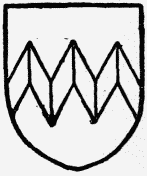
Mynne. Sable a fesse dancetty paly argent and gules of six pieces.
His grandson Charles, the sixth Lord Baltimore, died in 1751, and his son and heir Frederick, Lord Baltimore, who left the country after a celebrated trial in 1768, sold the estates. (fn. 69) During the next twenty years Horton Manor changed hands several times, and was finally bought by Mr. Trotter, an upholsterer in Soho; (fn. 70) his son James, high sheriff in 1798, succeeded him in 1790. (fn. 71) He was succeeded by his son John, M.P. for West Surrey 1841–7, from whom it passed to William S. Trotter. The estate has been recently bought by the London County Council for asylums.
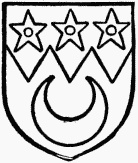
Trotter of Horton. Argent a crescent gules and a chief indented azure with three pierced molets argent therein.
The old manor-house of Horton was a large building surrounded by a moat. It was in the low ground north of Epsom. The Mynnes seem to have lived at Woodcote, for Richard Evelyn married their heiress there in 1648, (fn. 72) and he is said to have rebuilt the house at Woodcote. (fn. 73)
Later, when Woodcote Park had been separated from Horton, Mr. John Trotter, owner of Horton, built a new mansion, called it Horton Place, and inclosed land around it for a park. (fn. 74)
The manor of BRETTGRAVE (Bruttegrave, Bertesgrave, Brottesgrave, Bryddesgreve, xiv and xv cent.) belonged to the abbey of Chertsey as parcel of their manor of Epsom. (fn. 75) It was held of the Abbot of Chertsey in the reign of Henry III by John de Tichemarsh. (fn. 76) Later in the century it was in the tenure of Reginald de Imworth, who died before 1287, leaving a son John, then a minor. (fn. 77) In a suit brought in 1346 by the Abbot of Chertsey against Nicholas de Tonstall, Joan his wife, and Thomas de Saye, this John was said to have granted the manor in fee to Henry Gerard, chaplain, and John his illegitimate son, who were holding in the reign of Edward II by services due. (fn. 78) After the death of John son of Henry, John the then abbot entered upon the manor as an escheat, (fn. 79) and continued his seisin until forcibly and unlawfully disseised by Joan and her first husband, Henry de Saye, who carried off his crops, impounded the beasts from his ploughs, and otherwise persecuted him, until by a writing he released his right in the manor. As the release was obtained by force, and without the consent of the convent, it was not held valid by the jurors, and the abbot recovered seisin of the manor with damages. In the same year the abbot and convent received licence to grant the manor to Guy de Bryan the younger to be held of the king in chief by the rent of 8s. 3d.; (fn. 80) they probably reserved to themselves a rent of 12s. 3d. from the manor, as this is afterwards stated to belong to their manor of Horton, (fn. 81) and this may have led to Brettgrave being considered a parcel of the manor of Horton, which was denied by the jurors in an inquisition taken in 1517. (fn. 82) Guy de Bryan had licence to have Mass celebrated in his chapel in Brettgrave in Epsom in 1348, (fn. 83) but in the same year enfeoffed John Gogh and other clerks of the manor, (fn. 84) probably in trust for Henry, Earl of Lancaster, who in 1350 received a grant of free warren in his demesne lands of Brettgrave. (fn. 85) Henry was created Duke of Lancaster in 1352, and died seised of the manor in 1361. (fn. 86) He left no son, and his eldest daughter Maud, wife of the Duke of Bavaria, dying the following year, (fn. 87) the estates passed to her only sister Blanche, wife of John of Gaunt, Earl of Richmond, (fn. 88) created Duke of Lancaster in 1362, father of Henry IV. (fn. 89) The manor thus became part of the Duchy of Lancaster, leases of it being granted by successive kings. (fn. 90) Ultimately the fee-simple seems to have been acquired by William Merston, whose father John Merston (vide Horton) had held the lease of it. (fn. 91) William died in January 1511–12. (fn. 92) It descended through his daughter Joan, wife of Nicholas Mynne, to John Mynne, the great-grandson of Joan. (fn. 93) He sold it with the manor of Horton to George Mynne, (fn. 94) whose daughter and coheir Elizabeth, wife of Richard Evelyn, owned it in 1652. (fn. 95) From that time it may have been merged with the manor of Horton, (fn. 96) for now no trace of the manor or place of that name can be found. In a survey of Epsom (fn. 97) a boundary point is Brettegravesherne—that is, Brettegrave's Corner, otherwise called Wolfrenesherne. The next mark on the boundary is Abbot's Pit, which on an old map is the name for the disused chalk-pit called Pleasure Pit on the Ordnance map. (fn. 98)
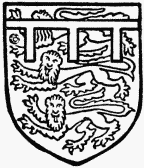
Duchy of Lancaster. England with a label azure.
The estate called DURDANS in this parish, held of the manor of Horton, is probably the property consisting of a messuage, a dovecote, two gardens, two orchards, 12 acres of land with meadow, pasture, and wood, which Sir William Mynne, lord of Horton, conveyed to Elizabeth, Lady Berkeley, in 1617. (fn. 99) She in 1634–5 settled Durdans on her daughter Theophila, wife of Sir Robert Coke, and her heirs and assigns. (fn. 100) Theophila died without issue, Sir Robert Coke surviving. He, by his will of 1652, left Durdans to his nephew George Berkeley, afterwards Earl of Berkeley; he also devised a messuage called the Dog House, in Epsom, which he had lately acquired (probably by fine from John and Thomas Hewett), (fn. 101) to be fitted up as a library and kept for any of the ministers of the county of Surrey, to use on week-days between sun-rising and sun-setting. (fn. 102) The books left for this purpose however, (which probably formed part of the library of his father, the famous lawyer, Sir Edward Coke), seem to have remained at Durdans until 1682, when George, Earl of Berkeley, gave all or part of them to Sion College. (fn. 103) George, Earl of Berkeley, entertained Charles II here in 1662, when John Evelyn records in his diary being invited to meet the King and Queen, Duke and Duchess, Prince Rupert, Prince Edward, and abundance of noblemen. (fn. 104) Charles II also dined with the Earl of Berkeley at Durdans in 1664. (fn. 105) This was probably at the old house, for the Earl of Berkeley is said to have built a new residence with materials from the palace of Nonsuch, (fn. 106) which was pulled down by the Duchess of Cleveland after 1669. During the Earl's tenure of Durdans, it was the scene of the notorious intrigue between his daughter, Lady Henrietta Berkeley, and her brother-in-law, Lord Grey of Wark. (fn. 107) By will of 1698 the earl left the property to his son Charles, afterwards earl, who in 1702 sold Durdans with 'the little park paled in' to Charles Turner of Kirkleatham, co. York. He in 1708 conveyed it to John, Duke of Argyll and Earl of Greenwich, reserving the Dogghouse or Dagghouse Farm. (fn. 108) Before 1712 it seems to have been acquired by Lord Guilford, (fn. 109) and Bishop Willis's Visitation calls him a resident of Epsom in 1725. His son, Lord North and Guilford, succeeded him in 1729. He was lord of the bedchamber to Frederick, Prince of Wales, from 1730 to 1751, during which time the prince seems to have had a loan or lease of the house, (fn. 110) but the tradition that he owned it is incorrect.
Alderman Belchier pulled down Lord Berkeley's house after 1747. The new house was bought by Mr. Dalbiac in 1764, and later, in 1799, was acquired by Mr. George Blackman, who sold it in 1819 to Sir Gilbert Heathcote, bart., M.P. From the cousins and heirs of his son Arthur Heathcote it was bought by Lord Rosebery in 1874, (fn. 111) and he is the present owner.
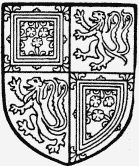
Primrose, Earl of Rosebery. Vert three primroses or within the royal tressure of Scotland for Primrose, quartered with Argent a lion sable with a forked tail for Cressy.
The capital messuage of WOODCOTE in Epsom was held of the manor of Horton. (fn. 112) In the first half of the 16th century it belonged to one John Ewell of Horton, and continued in his family until 1591, when it was the cause of litigation between Agnes Tyther, a descendant of John Ewell, and Roger Lamborde. (fn. 113) It was in the possession of John Mynne, lord of the manor of Horton, in 1597, and he settled it on his son William on his marriage. (fn. 114) It passed with Horton Manor to Elizabeth wife of Richard Evelyn (1648), who built there a new mansion. Mrs. Evelyn bequeathed Woodcote to Lord Baltimore, a remote connexion of her family. (fn. 115) After the seventh Lord Baltimore left England in 1771 it was sold to Mr. Monk, then to Mr. Nelson, in 1777 to Mr. Arthur Cuthbert, and in 1787 to Mr. Lewis Teissier, a merchant of London, having been separated from the manor of Horton. Mr. Teissier's son, created by Louis XVIII the Baron de Teissier, was owner at the beginning of last century. (fn. 116) It was sold by the Baron de Teissier in 1855 to Mr. Robert Brookes, and is now the property of his son, Mr. Herbert Brookes, J.P.
CHURCHES
The church of ST. MARTIN has a nave with aisles and a north-west tower; the church has lately been considerably enlarged eastward, the new work consisting of an addition to the nave, a chancel and north chapel, a south organ chamber, and aisles. The only old part of the present building is the tower, which dates from the 15th century, but has been recased and much modernized. The present nave and aisles were built in 1824, when the old church was pulled down; a print of about this date shows it to have had a nave with a north aisle, and a north-west tower. The chancel was evidently of the 13th century, and had a lancet window midway in its north wall, but all the other windows shown in the chancel and aisle are wide ugly single lights fitted with iron casements. The aisle had been raised to contain a gallery and a second tier of windows added. The nave of 1824 has arcades of four bays with plastered piers and arches; the aisles are lighted by two-light pointed windows, and are filled with wooden galleries, shortly to be removed. The walling of the nave and aisles is of flint and stone, and that of the new portion is of rubble with stone and brick dressings, the chancel and nave having alternate bays of cross and barrel vaulting; the new work is soon to be extended to the present nave and aisles. The jambs of the openings into the tower from the nave and north aisle are moulded and the arches are blocked. The tower is of flint and stone, and has cemented angle buttresses and a north-west octagonal stair turret; an old oak door opens into the turret, the steps of which are inscribed with various names and 18th-century dates, and a stone records the recutting of the steps in 1737. The bell-chamber is lighted by plain pointed windows of two lights, and surmounted by a plain parapet, from which rises a very slender wooden spire covered with oak shingles.
Under the tower is a 15th-century font; it is octagonal with quatrefoiled sides to the bowl and a hollowed under-edge on which are carved heads, a shield, a fish, &c. There is also a fine chest of carved mahogany; on the lid are carved—in the middle—Adam and Eve in the garden, and in the two side panels David and Goliath; on the front are other figures in late 16th-century dress.
On the floor on the north side is a small brass with an inscription to William Marston, or Merston, 1511, and there are wall monuments to Richard Evelyn of Wootton, 1669; Robert Coke of Nonsuch, grandson of Lord Chief Justice Coke, 1681; Robert Coke, 1653; Richard Evelyn, 1691; and others.
There are eight bells: the treble is by Samuel Knight, 1737; the second by R. Phelps, 1714; the third by Thomas Janaway, 1781; the fourth has no date, and is inscribed: 'Although I am but small I will be heard above them all'; the fifth is dated 1737; the sixth by R. Phelps, 1714; the seventh by Thomas Swain, 1760; and the tenor by Richard Phelps, 1733.
The plate is all modern, consisting of a chalice and paten of 1904 given by the parishioners, and a chalice and paten given by Lord Rosebery in 1907, besides six Sheffield plate almsdishes and two cups and an almsdish about a hundred years old.
The first book of the registers contains baptisms and marriages from 1695 to 1749 and burials to 1750; the second repeats the baptisms from 1695 to 1749 and the marriages from 1695 to 1719; the third has baptisms and burials from 1750 to 1773 and marriages 1750 to 1754; the fourth, baptisms 1773 to 1812; fifth, burials 1773 to 1812; the sixth, marriages 1754 to 1783; and the seventh continues them to 1812.
The greater part of the churchyard, which surrounds the building, lies to the north of it. The west entrance is towards the road, and is approached by a flight of stone steps and a flagged landing. There are several large trees about it.
CHRIST CHURCH, originally built as a chapel of ease to the parish church in 1843, is now the church of a separate parish. It was rebuilt in 1876. It is a small building of flint and stone situated on the edge of Epsom Common, and consists of a small chancel with a north transept and south organ chamber, nave of four bays with north and south aisles and a clearstory, and a south-west tower and porch. At the west end is a passage-way containing the font. There are eight bells by Mears & Stainbank, 1890.
ST. JOHN'S, chapel of ease to St. Martin's, is a small building of red brick and stone, off East Street, erected in 1884.
ST. BARNABAS, Hook Road, is a chapel of ease to Christ Church.
ADVOWSON
Two churches on the abbey estate are mentioned in Domesday, (fn. 117) but all trace of one has disappeared; there was a Stamford Chapel in Epsom, near or on the lord's waste, close to where Christ Church, Epsom, now stands, belonging to Chertsey Abbey, which may have been the second church. (fn. 118) Licence to appropriate was granted to the convent by a bull of Clement III, (fn. 119) 1187–91, and a vicarage was ordained before 1291. (fn. 120) A further endowment was carried into effect in 1313 (fn. 121) when John Rutherwyk the then abbot was inducted. (fn. 122) In 1537, when Henry VIII acquired Epsom Manor from the convent of Chertsey, the rectory and the advowson of the church were included, (fn. 123) and he granted them with the manor to Sir Nicholas Carew, (fn. 124) from which time they have always been included in the grants and sales of the manor till 1770, when the manor went to Sir Joseph Mawbey, and the great tithes and advowson to John Parkhurst. They descended to the Rev. Fleetwood Parkhurst, vicar of Epsom, 1804–39. The advowson has since belonged to the Rev. Wilfred Speer and Captain Speer, and now belongs to Mr. H. Speer.
In 1453 John Merston received a grant for founding a chantry in Epsom Church, to be called 'Merston's Chantry,' and for purchasing lands to the value of 20 marks for the use of it. (fn. 125) There is no record of the chantry at the time of the suppression under Edward VI.
CHARITIES
Smith's Charity is distributed as in other Surrey parishes.
In 1691 Mrs. Elizabeth Evelyn left a rent-charge of £10 a year for clothing six poor women.
Since 1692 the rent of a piece of land called Church Haw has been received by the churchwardens, now by the local authority, for the use of the poor.
In 1703 Mr. John Levingston, the quack doctor mentioned above, built almshouses for twelve poor widows in East Street on a piece of land granted by the parish. The almshouses were rebuilt about 1863. They are further supported by the Church Haw rent, by that of 'Workhouse Field,' the site of the old parish workhouse, and by the bequests of Samuel Caul (£500) in 1782, Mr. Langley Brackenbury (£300) in 1814, Mr. Story (£100), 1834, Mrs. Margaret Knipe (£300), 1834, the last to be devoted to this purpose after providing for the upkeep of vaults and monuments in the church.
In 1728 Mrs. Mary Dundas left copyhold premises in Epsom for providing coals.
In 1790 Mrs. Elizabeth Culling left £150, part of which was to be set aside to accumulate, for the church, vicar, sexton, churchwardens, and the surplus for apprenticing children and for bread.
In 1803 Mrs. Mary Rowe left £188 18s. 11d. for bread and meat and firing.
In 1835 Sir James Alexander left £200 for clothing for five men and five women, who had to appear in church.
In 1884 Baron De Teissier left £90 for six poor communicants.
Mittendorf House was presented to the National Incorporated Society for Waifs and Strays (Dr. Barnardo's Homes) by Miss Mittendorf.
Epsom and Ewell Cottage Hospital was built in 1889 by public subscription.