A History of the County of Surrey: Volume 3. Originally published by Victoria County History, London, 1911.
This free content was digitised by double rekeying. All rights reserved.
'Parishes: Fetcham', in A History of the County of Surrey: Volume 3, ed. H E Malden (London, 1911), British History Online https://www.british-history.ac.uk/vch/surrey/vol3/pp284-290 [accessed 30 April 2025].
'Parishes: Fetcham', in A History of the County of Surrey: Volume 3. Edited by H E Malden (London, 1911), British History Online, accessed April 30, 2025, https://www.british-history.ac.uk/vch/surrey/vol3/pp284-290.
"Parishes: Fetcham". A History of the County of Surrey: Volume 3. Ed. H E Malden (London, 1911), British History Online. Web. 30 April 2025. https://www.british-history.ac.uk/vch/surrey/vol3/pp284-290.
In this section
FETCHAM
Feecham (xi cent.); Fecham (xiii cent.); Feecham (xiv cent.); Fetcham, 1499.
Fetcham is a small parish and village, the latter a mile from Letherhead. It measures nearly 4 miles from north to south, and under 2 miles from east to west, tapering to the south, and includes 1,817 acres of land and 22 of water. Roreing House Farm, a small detached portion of Great Bookham, was transferred to Fetcham under the Act of 1882. The Mole forms part of the eastern and northern boundary. The village lies on the Woolwich Beds at the foot of the chalk, but the greater part of the parish to the south is upon the chalk hills, and the northern part and eastern fringe are upon the London Clay and the alluvium of the Mole. It is a purely agricultural parish. The mill, close to Letherhead, is worked by the overflow of a pond formed by several strong springs rising in it, which runs into the Mole in the course of a few yards. The springs do not seem to be connected with the swallows in the bed of the Mole, as they are unaffected by the rising or falling of the river. Fetcham Downs were a large tract of open chalk down, of which much has been inclosed, cultivated, or planted. The road from Letherhead to Guildford passes through the parish, and also the South-Western Railway from Effingham Junction to Letherhead. The London, Brighton, and South Coast Railway line to Dorking also just touches the parish.
Fetcham is rich in prehistoric antiquities. Anglo-Saxon burial has already been noticed (fn. 1) at Hawkshill in Fetcham. Since the publication of the earlier volume, however, additional remains have come to light. The earliest record is the finding of some twenty skeletons in 1758 when the road from Letherhead to Guildford was being first made as a really passable driving road. A small pike-head and some blades of knives were found with them. The remains were probably Anglo-Saxon. Other skeletons were found on the inclosing of the Common Fields in 1803. (fn. 2) Subsequent discoveries have been made which confirm these, but also show more ancient remains at and about Hawkshill. In the year 1900 two hut circles were excavated on the lawn of Hawkshill House, under the supervision of Mr. Reginald Smith of the British Museum. The discoveries included bones of animals, fragments of hand-made pottery, burnt grains of wheat, oats, and barley, and loom weights of burnt clay. The pottery corresponded to fragments found elsewhere of the late Celtic period. Other pits seem to exist, and a larger ring was excavated in the meadow, but the ground had been ploughed formerly, and though traces of fire and a bone were found, the remains here had been scattered. When the house was built twenty years earlier some remains were found, but not properly observed or recorded. (fn. 3) On the downs in the neighbourhood are some deep holes which seem to be collapsed dene-holes, as on Ranmore Common, but though in the neighbourhood they are outside Fetcham parish. There used to be a barrow on Standard Hill near the Guildford road. (fn. 4) These late Celtic remains, of a period rather before the Roman Conquest, are distinct from the Anglo-Saxon burials, which indicate a considerable settlement in the neighbourhood. In these a bronze wheel-shaped ornament, an inlaid glass bead, a coin of Constantine, several small iron knives, and a small handmade black vase were found. Many skeletons were unearthed when the house was built, others have since been discovered, and in laying down pipes by the road six more were found in 1906. The bodies lay with heads to west-by-south and south-west, and Mr. Smith attributes the burials to the 5th or 6th century. (fn. 5)
The neighbourhood was probably continuously occupied, for subsequent in date to the Celtic huts there are Roman bricks in considerable quantities in Fetcham Church, remains of Anglo-Saxon architecture in the church, and a road coming from the north and crossing the Mole by a ford, which passes close by the small rectangular camp or inclosure near Pachevesham Farm in Letherhead, close by which Roman coins and bricks have been found. It may be noticed, however, that Deadwoman's Lane, near Hawkshill, was named from a recent suicide, and that the skeleton found in a coffin farther along the road towards Bookham is recent, probably that of a criminal or suicide. Gallows Bush Shot was the name of a field abutting on the Guildford road. (fn. 6)
There were large common fields at Fetcham inclosed in 1801. (fn. 7) There were then found to be 316 acres of common arable, 26 of common meadow, and 330 waste. All was inclosed except part of the waste. (The award seems to be wrongly dated in Sir John Brunner's Return as in 1813. It was carried out in 1803.)
Fetcham Park, adjoining the church, is the seat of Mr. J. B. Hankey, J.P., lord of the manor; Ballands Hall of Lieut.-Col. Sir F. S. Graham Moon, bart., son of the late rector, the Rev. Sir Edward Graham Moon; and Hawkshill of Sir E. E. Blake, K.C.M.G.
Fetcham School was founded as a Church school in 1854, and passed under a School Board in 1883. The building was enlarged in 1886. There is also a reading-room in the village.
MANORS
FETCHAM is mentioned in the Domesday Survey, when it was held as three manors by the king, Odo of Bayeux, and Oswold the Thegn. (fn. 8) The manor which the king held in 1086 had been the property of Edith widow of Edward the Confessor, (fn. 9) and in 1088–9 was bestowed upon William de Warenne with the rest of her late possessions. (fn. 10) In the 13th century a knight's fee in Fetcham is found to be held of the honour of Warenne. (fn. 11) The holding was in the hands of John d'Abernon, a minor in ward of John de Gatesden, and the bishop's fee in Fetcham was in the same hands (see below). The two were considered as one manor, and parts were said to be held of different lords. In the 15th century a fourth part of the manor was held of the Earls of Warenne and Surrey, and through Elizabeth, sister and co-heir of Thomas Earl of Surrey, (fn. 12) the lordship passed to the Dukes of Norfolk. In 1476 John Duke of Norfolk died seised of this fee, (fn. 13) and in 1553 this part of the manor is said to be held of Thomas Duke of Norfolk, Edward Earl of Derby, and Henry Nevill first Lord Abergavenny (fn. 14) (to whom the Norfolk estates had come by partition) as of their manor of Reigate.
The second manor had been held by Biga of Edward the Confessor, and in 1086 was in the hands of Odo of Bayeux, the Conqueror's half-brother, of whom it was held by Richard de Tonbridge, lord of Clare, and ancestor of the Earls of Gloucester. (fn. 15) In the 13th century a fee in Fetcham is said to be held of the honour of Clare by John d'Abernon, (fn. 16) and in 1314 the manor is included among the fees held of the same honour. (fn. 17) In the 15th century three parts of the manor are said to be held of the honour of Clare, (fn. 18) as a part of which it apparently became merged in the Crown on the accession of Edward IV.
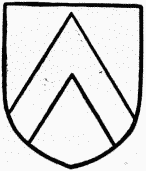
D'Abernon. Azure a cheveron or.
At an early period the two manors appear to have been included in the estates of the d'Abernon family, and the bishop's manor was one of the four knights' fees in Surrey held by the Earl of Gloucester of which Ingelram d'Abernon died seised in 1234, (fn. 19) and which passed to Gilbert d'Abernon, uncle of Ingelram, by reason of Jordan d'Abernon, the rightful heir, having surrendered his claim. (fn. 20) Gilbert paid a relief of 40 marks to the sheriff in 1235 on taking up this inheritance, and on his death, in the next year, the custody of his land and of his heir was granted to John de Gatesden, then sheriff of Surrey and Sussex. (fn. 21) The heir of Gilbert was probably the John d'Abernon who in 1252 granted to William d'Abernon a tenement in Fetcham, (fn. 22) and who claimed liberties in the manor in 1252–3. (fn. 23) He was sheriff of Surrey and Sussex in 1266, (fn. 24) and was apparently dead in 1279, when his son John was made a knight. (fn. 25) The elder John had also been a knight. (fn. 26) The son John claimed the same rights as his father in 1279. (fn. 27) In 1314 John d'Abernon the son was holding the manor, (fn. 28) and in 1326–7 died seised of it as a holding consisting of half a messuage, 100 acres of land worth 25s. per annum, 8 acres of meadow, and 19s. from rent of free tenants, leaving a son and heir of the same name. (fn. 29) The latter was sheriff of Surrey and Sussex in 1330 and 1334, (fn. 30) and in 1339 settled Fetcham on his grandson William son of John and Margery wife of William. (fn. 31)
William died in 1358, (fn. 32) leaving a daughter Elizabeth then wife of William Croyser, and afterwards of John de Grey of Ruthyn. (fn. 33) In 1395 William son of Elizabeth and William Croyser was holding the manor, (fn. 34) of which he died seised jointly with his wife Edith in 1415, leaving a daughter and heir Anne, (fn. 35) then aged nine years, and before her thirteenth year the wife of Ingram Bruyn, son of Sir Maurice Bruyn. (fn. 36) Anne subsequently married Sir Henry Norbury, and died in 1464, leaving a son and heir Sir John Norbury, (fn. 37) afterwards Vice-Marshal to Richard III, (fn. 38) who inherited these estates and married Jane daughter of Sir Otes Gilbert. Their daughter Anne married Richard Hallywell of Devon, and had a daughter Joan, (fn. 39) who in 1514–15 was holding the manor jointly with her husband Edmund Lord Bray. In a bailiff's account of Lord Bray's manors of Fetcham and Letherhead for this date the rents of assize for the two manors amounted to £11 11s. 1½d.; the farm of the manor and the demesne lands was £8 a year. (fn. 40)
In 1548 Joan settled the manor upon herself and her husband for their lives, with remainder to John Bray their son and heir. (fn. 41) The latter married Ann daughter of Francis fifth Earl of Shrewsbury, and was summoned to Parliament as a baron from 1545 to 1555, but on his death without issue in 1557 his estates were divided among his six sisters and co-heirs, Fetcham falling to the share of Frances, the youngest, who married Thomas Lyfield. (fn. 42) In 1575 a settlement was made on Thomas Vincent and Jane his wife, daughter of Thomas and Frances, with remainder to Francis Vincent and Bray Vincent, sons of Thomas and Jane. Francis married Sara daughter of Sir Amias Paulet in 1589, (fn. 43) and in 1617 settled this manor on his son Anthony on the occasion of his marriage with Elizabeth daughter of Sir Arthur Ackland. (fn. 44) Anthony was sheriff of Surrey and Sussex in 1636–7. (fn. 45) He was named as a sequestrator of delinquent estates by the Long Parliament, but died in 1642, and was succeeded by his son Sir Francis. He married Catherine daughter of George Pitt and died in 1670, (fn. 46) having settled this manor on his fourth son Thomas Vincent, (fn. 47) who in 1693, jointly with his wife Mary, conveyed it to Thomas Folkes, (fn. 48) the latter probably acting in the interest of Francis, fifth Baron Howard of Effingham, for whose widow he was executor in 1727. (fn. 49)
Thomas, Lord Howard, son of the said Francis, suffered a recovery of the manor in 1721, (fn. 50) and died without issue four years later. His nephew, Thomas Howard, Earl of Effingham, was seised of it in 1742. (fn. 51) In 1801 Richard, nephew of Thomas and last Earl of Effingham, (fn. 52) conveyed the manor to James Laurell, (fn. 53) who made his seat at Eastwick Park in Great Bookham, and subsequently sold this property to the family of Hankey of Fetcham Park, (fn. 54) whose descendant, Mr. John Barnard Hankey, is lord of the manor at the present day.
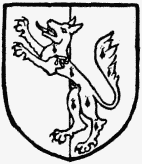
Hankey. Party gules and azure a leaping wolf erminois wounded in the shoulder.
In 1252–3 John d'Abernon received a grant of free warren in his demesne lands of Fetcham, (fn. 55) and the privilege is mentioned as appurtenant to the manor in a conveyance of 1607. (fn. 56) In 1279 John d'Abernon claimed in addition to have view of frankpledge and all things pertaining thereto from time immemorial. (fn. 57)
In 1303 Henry de Gildford had a grant of free warren in his demesne lands in Fetcham, (fn. 58) but there is no other trace of his connexion with Fetcham, except that in 1284–5 he was appointed custodian of Robert d'Abernon, rector of Fetcham, who was under age at the time of his admission to the rectory. (fn. 59)
At the time of the Domesday Survey the king's manor included 4 mills worth 4s., and Richard de Tonbridge received 6s. 6d. from another mill, (fn. 60) which passed with Richard's share of the manor to the d'Abernons, and is probably referred to in the grant by Adam le Jeune to Sir John d'Abernon in 1293 of 'my half of the mill which is called cutte, with half of the pond and of the ditches pertaining thereto.' (fn. 61) In the bailiff's account of Sir Edmund Bray's manor of Fetcham and Letherhead for 1514–15, the water-mill called cutt-mill is said to be let out for £5, and is probably the same as that conveyed by Arthur Moore to Jabez Cellier (fn. 62) in 1717. The flour-mill which exists at the present day near Letherhead Bridge, and which is worked by the overflow from a spring-pond, probably stands upon the ancient site.
On the bishop's manor in Domesday were also the sixth part of a mill and the third part of another mill. These were probably fractions of the dues from the Pachevesham mills (fn. 63) in the Mole between the manors.
The manor of CANNON COURT probably represents that portion of Fetcham which had been held of Edward the Confessor by Oswold, brother of Wulfwold, Abbot of Chertsey, and was retained by him in chief after the Conquest. (fn. 64) By the 12th century, however, it appears to have been acquired by Merton Priory, which had possessions in Fetcham as early as 1167, when William, Prior of Merton, made a grant of certain tenements in Fetcham to one Guarnerius, (fn. 65) and in 1178 Robert, Prior of Merton, conceded to Alexander, a clerk of Fetcham, certain lands in the manor, amounting to a quarter of a virgate, which Gilbert le Blond had given him in fee and inheritance at a quit-rent of 12d. a year. (fn. 66) In 1291 the possessions of the prior at Fetcham and Letherhead were taxed at £3, (fn. 67) and in 1301 the tenants of Fetcham contributed 6s. 8d. towards the loan of £50 from the prior to Edward I. (fn. 68) In the reign of Henry VIII the manor was let out at farm for the sum of £13 6s. 8d. by the prior, who had in addition 6s. 5d. for perquisites from the court. (fn. 69) The priory was dissolved in 1538, (fn. 70) and in 1541 the manor was granted in tail male to Uriah Brereton (who already held the manor of Fetcham in right of his wife Joan late wife of Sir Edmund Bray), to be held of the king for a tenth part of a knight's fee and a yearly rent of £6 1s. 10d. (fn. 71) It appears to have formed part of the marriage portion of Jane, granddaughter of Joan, who married Thomas Vincent, (fn. 72) and from this date it continued with the lords of Fetcham. In 1700 'Cannon Farme' is included in the estates of Thomas Vincent. (fn. 73) This property appears to have been leased out at various times.
In 1560 John Edsawe complained that his father of the same name had occupied the site and demesne lands of the manor of Fetcham called Cannon Court by lease from the Prior and convent of Merton for a term of twenty-one years to commence in the year 1543, but that he, the plaintiff, had been forcibly dispossessed by his stepmother and her sons. Whereupon an award was made that John should for the remainder of his term occupy certain parcels of land, including two closes, of which one called 'Cokkes Close,' containing 6 acres, probably represents the wood now known as Cocklane Shaw, while the other, called 'Bykney,' also containing 6 acres, is frequently mentioned in connexion with this manor. (fn. 74) (See below.) It was probably this manor which Francis Crosse, of Stoke D'Abernon, who must have been a lessee, granted in 1582 under the name of 'the manner place, fermehouse and lands of Fetcham' to John Dewe of Fetcham, who assigned his interest by lease to Robert Gavell of Cobham. (fn. 75)
The prior had a grant of free warren in his demesne lands of Fetcham in 1252, (fn. 76) and the privilege is mentioned as appurtenant to the manor in 1590 and in 1607. (fn. 77)
At the time of the Domesday Survey, Oswold received 6s. 6d. from a mill, (fn. 78) which passed with his manor to Merton Priory, and in 1167 William, Prior of Merton, granted his part in the mill at Fetcham, with a certain acre of land, to one Guarnerius, the latter rendering 5s. yearly and grinding all the corn required for the use of the priory free of charge. (fn. 79)
In the accounts of the prior's manor for 1537–8 certain lands called Bykney Magna are stated to be farmed for £1 6s. 8d., (fn. 80) and in the grant of the manor in 1541, following the dissolution of the priory, a reservation was made of the lands and meadows called 'Moche Bykney,' parcel of the manor, and then or lately in the tenure of Christopher Parker. (fn. 81) In 1544 Sir Anthony Browne, son of Sir Wistan Browne of Abbess Roding and Langenhoe in Essex, received a grant of the tenement of Great Bickney in Fetcham to be held of the Crown in chief by socage at an annual rent of 2s. 8d., being valued at £1 6s. 8d. per annum. (fn. 82) Later documents refer to it as a manor. In 1714 Dr. Hugh Shortrudge suffered a recovery of the 'manors of Slyfield and Bigney,' (fn. 83) and by a deed of trust dated 1715 between Dr. Shortrudge and Sir Francis Vincent the manor of Great Bickney was included among certain estates vested for charitable purposes. (fn. 84) The tenement of Great Bickney was afterwards held by the Howards, together with the manor of Fetcham, with which it was sold to James Laurell in 1801, (fn. 85) and passed with Fetcham to the Hankey family.
The mansion known as FETCHAM PARK is said to have been built by one of the Vincent family, by whom it was sold to Arthur Moore the famous economist and politician, who in 1718 enlarged the property and planted the park; but his profuse expenditure more than exceeded his means, and he died in 1730 'broken in all respects but in his parts and spirit.' (fn. 86) The property was put up for sale by his son William Moore, under the description of 'The mansion house and offices of the late Arthur Moore, Esq., decd., being a beautifull building from the design of the late Mr. Tollmen, consisting of many rooms on a floor, a large hall and staircase, painted by the late famous Laguerre, with a saloon and gallery, and several other rooms finely painted by the same hand, particularly one wainscoted with japan, with Tartarian tapestry silk. Together with the gardens and park, containing by estimation about 100 acres, the whole being finely adorned with canalls, basins, statues, vases, iron gates, pallisades, etc., and laid out in the most elegant manner; with three ponds, containing the space of six acres, in which are several clear and deep springs, which by large engines serve the canalls, basins, reservoirs, etc., and furnish the house with water convey'd in strong leaden pipes.' (fn. 87) It was purchased by Thomas Revell, agent victualler at Gibraltar and member for Dover in 1734, 1741, and 1747, (fn. 88) and on his death in 1752 his immense wealth was inherited by his only daughter Jane, who married George Warren, of Poynton, co. Chester, afterwards created K.B. (fn. 89) Their daughter and heir, Elizabeth Harriet, in 1777 married Viscount Bulkeley, (fn. 90) but in 1788 joined with her father in the sale of this estate to John Richardson. (fn. 91) Shortly after it was sold to Thomas Hankey, a London banker, whose great-grandson, Mr. John Barnard Hankey, holds it at the present day.
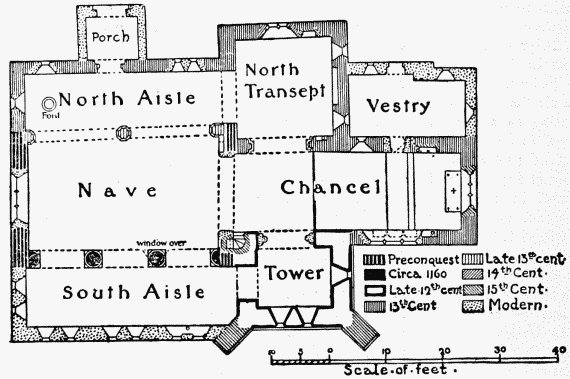
Plan of Fetcham Church
CHURCH
The church of ST. MARY consists of a chancel 26 ft. by 13 ft. 6 in. at the east, and 13 ft. 10 in. at the west, at which point it is flanked on the north by a transept 17 ft. 4 in. by 16 ft. 10 in., and on the south by a tower 12 ft. 10 in. by 10 ft. 2 in.; a nave 33 ft. 7 in. by 20 ft., and north and south aisles 10 ft. 2 in. wide. There is also a north-east vestry and a north porch. All the measurements are internal.
The west wall and the upper part of the south and probably of the east wall of an early nave still remain, and belong perhaps to the beginning of the 11th century, the walls being of plastered flint-work, with quoins and dressings of thin red bricks, no doubt Roman, set in wide mortar joints.
About 1150–60 a south aisle was added to the nave, and towards the end of the same century the tower was built. The present chancel dates from the early years of the 13th century; and the transept seems contemporary with it. The north arcade of the nave is work of c. 1300, of unusual character, but it seems probable that a north aisle was built before that date, perhaps when the transept was added. The tower has been much altered and rebuilt in the 17th and 18th centuries, and the south aisle became ruinous and was pulled down, not being rebuilt till 1872. The vestry and porch are modern, and a good deal of renewal of stonework has been carried out in modern times.
The east window of the chancel is of 15th-century date, with three pointed cinquefoiled lights under a two-centred arch, probably replacing an original triplet of lancets, but the two north windows of the 13th-century work remain, tall narrow lancets with an external rebate. Under the north-east window is a modern doorway to the vestry, and to the east of it an original locker with rebated jambs and flat head, arranged for two doors, modern successors of which are now fitted to it.
There is only one window on the south of the chancel, and this is modern with three wide cinquefoiled ogee lights under a square head; below it are three sedilia in modern stonework of 13th-century design, with detached shafts having moulded capitals and bases and carrying two-centred arches.
Near the east end of the south wall is a piscina probably of 15th-century date with a shallow rectangular basin. The flat head and part of the jambs are quite plain, but below a wooden shelf which has been inserted the jambs have been chamfered.
The north transept opens to the chancel by a two-centred arch of two continuous chamfered orders with a chamfered abacus at the springing, and is lighted on the north by a pretty window of two trefoiled lights with a quatrefoil over, c. 1320. In the east wall are two lancet windows like those in the north wall of the chancel, and between them a wide arched recess with chamfered jambs and dog-tooth ornament on the angles, marking the position of the altar formerly here.
In the north wall, east of the window, is an aumbry with rebated jambs and a wooden lintel, which was originally taller than at present, and at the south-east of the transept is a piscina which has stop-chamfered jambs and a triangular head with an old wooden shelf at the springing. The basin is very shallow, square at one end and semicircular at the other.
The arch opening to the aisle from the transept is quite plain and has been modernized.
The tower is of three stages, the two upper being largely of 18th-century date, with red brick quoins and battlements, but the ground stage is of late 12th-century date, and opens to the aisle by a plain round-headed arch, the western face of which, formerly exposed to the weather, has been restored, and to the chancel by a pointed arch of three chamfered orders, the outer order only being ancient.
At the south-west angle of the tower, and opening from the chancel, is the lower entrance to the roodstair, the steps of which still exist, though the upper doorway facing the nave is blocked up.
The ground stage of the tower has one window in the east wall and two in the south, tall narrow round-headed lights of plain character, belonging to the original work; the space they light is now blocked up by an organ.
The chancel arch has plain jambs in modern stone and a two-centred arch, which looks like 14th-century work, of two splayed orders without corbels or abaci at the springing. It is evidently the successor of a narrower and doubtless earlier arch, for on the nave side its north jamb has destroyed the larger part of a small 13th-century arched recess springing at the north-east from a cone - shaped corbel set across the angle. There was evidently a second recess in the north wall of the nave, destroyed when the present north arcade was built; the object of both recesses was to give more room for the north nave altar.
The north arcade of the nave is of two wide bays with a slender octagonal shaft and responds to match, worked with a single broad chamfer which continues round the two-centred arches, there being no capitals or strings at the springing. A moulded label of good early 14th-century section is the only ornamental detail of the arcade, which is of very uncommon character.
The south arcade of the nave is of three bays with circular columns and large flat scalloped capitals with chamfered abaci; the arches are of one plain semicircular order with chamfered edges, the chamfers being a later addition. Above the eastern column of the arcade is a window belonging to the early aisleless nave, widely splayed towards the nave with plastered jambs and a round arch of Roman bricks set with a wide mortar joint. Towards the aisle it shows as a narrow round-headed light with jambs and arch of Roman bricks, originally intended to be plastered over.
The windows lighting the nave and aisles are entirely modern, except the west window in the north aisle, which has old inside splays, perhaps of 13th-century date. The west window of the nave is of three trefoiled lights with tracery of 14th-century style.
The north doorway is of 13th-century date, having jambs and arch of two splayed orders with a small chamfered label; the moulded abaci at the springing are modern, and all the stones have been retooled.
The nave and chancel roofs have Horsham slabs near the eaves, but are covered with tiles above, and the other roofs have tiles only.
Internally the roofs are modern open timber, except that to the north transept, where all the timbers are hidden by plaster. The western portion of the chancel roof is not quite continuous with the rest, the break occurring just above the east jamb of the arch to the north transept.
All the internal fittings are modern.
On the south wall of the chancel is a monument with Corinthian pillars flanking an oval which contains the half-figure of Henry Vincent, 1631. Above the niche is a defaced shield of arms.
On the north wall of the chancel is a black marble tablet with a round-headed recess flanked by pilasters and containing an inscription to Anthony Rous, who died in 1631.
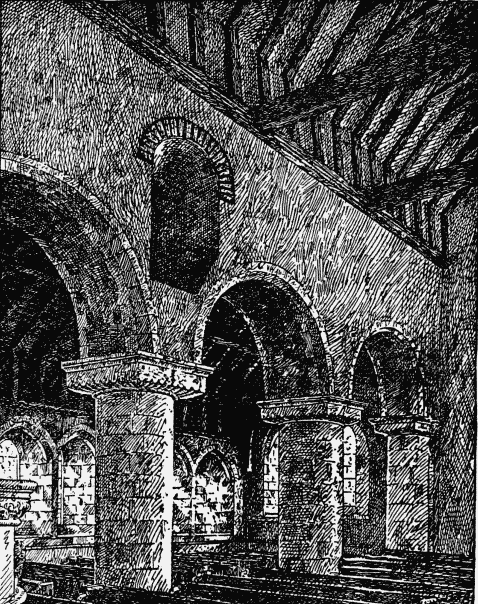
Fetcham Church: South Arcade of the Nave, showing Early Window
There are three bells in the tower, the treble bearing the inscription 'William Eldridge made mee 1665,' and the second 'Robertus Mott me fecit 1588.' The third is by William Land, 1613.
The plate is all modern, and comprises a chalice, paten, and flagon.
The registers are contained in three books. The first, which is of parchment and is a copy up to about 1600, has entries of baptisms, marriages, and burials from 1559 to 1712. The second has baptisms and burials from 1712 to 1812, and marriages from 1712 to 1753. The third book contains marriages from 1754 to 1812 on the usual printed forms.
ADVOWSON
In 1338 the advowson was held by John d'Abernon, lord of the manor of Fetcham, (fn. 92) and from that date descended with the manor at least until 1654, when Thomas Vincent presented to the living. (fn. 93)
Shortly after it was held by William Heckford in right of his wife Elizabeth, with whom, in 1711, he joined in conveying it to Thomas Cooke, clerk, and Joshua Draper, gentleman. (fn. 94) The latter in the same year sold it for the sum of £580 (fn. 95) to Arthur Moore of Fetcham Park, who presented to the living in 1720, 1724, and 1726. (fn. 96)
The advowson was acquired with the rest of Arthur Moore's Fetcham property by Thomas Revell, who presented to the living in 1737 and 1748, (fn. 97) and descended to his son-in-law Sir George Warren, who presented in 1772, (fn. 98) and is said to have sold it in 1788 to Mrs. Ann Kirkpatrick, under whose will it passed to Rev. Abraham Kirkpatrick Sherson, rector of Fetcham, in 1794. Before 1818 it was acquired by John Bolland, whose son Rev. J. G. Bolland presented to the living in 1829. On the death of the latter in 1833 it was sold by his executors to Rev. Robert Downes, incumbent at that date. (fn. 99) The patronage was acquired in 1864 by Alderman Sydney, (fn. 100) trustee for Lady Moon, wife of the late rector. Lady Moon presented in 1904. It is now in the hands of her son, Lieut.Colonel Sir F. S. G. Moon, bart.
In 1535 the farm of the rectory with the accompanying glebe land was valued at £21 19s. 11½d. There was also a pension of 6s. 8d. due to Chertsey Monastery, (fn. 101) which after the Dissolution was granted to the new foundation at Bisham. (fn. 102)
Dr. Thomas Turner, a devoted royalist, was instituted rector of Fetcham in 1634, and after having been deprived of this with his other benefices during the Commonwealth, was reinstated after the restoration of the Monarchy and became Dean of Canterbury. (fn. 103)
Samuel Lisle, afterwards Bishop of Norwich, was rector from 1726 till 1737, (fn. 104) and Dr. J. Conybeare, the famous metaphysician and defender of revelation, was curate for a short time under the rectorship of Dr. Shortrudge. (fn. 105)
In 1358 Robert de Leddrede, the king's sergeantat-arms, had licence for making a chapel at his house at Fetcham, (fn. 106) the site of which is probably that now occupied by the Sun ale-house. Salmon, writing in 1736, says, 'In this parish is an old chapell, now turned to an ale-house which may however supply in excise more than ever it paid in tenths.' (fn. 107)
CHARITIES
The almshouses, for six poor persons, were founded in 1886 by the Rev. Sir Edward Graham Moon, bart., Mr. J. B. Hankey, and Mr. Gervas Parnell.
Smith's Charity is distributed as in other Surrey parishes, but in the case of Fetcham it was endowed with parcels of lands in the common fields and inclosed fields in the parish. It is commemorated on a tablet in the church.
In 1690 a decree in Chancery confirmed the will of Sir George Shiers, bart., (fn. 108) who left rents of land amounting to £24 2s. for apprenticing boys, marrying maids who had lived in the same family for seven years, and relieving the poor not in receipt of parish relief. (fn. 109)