A History of the County of Surrey: Volume 3. Originally published by Victoria County History, London, 1911.
This free content was digitised by double rekeying. All rights reserved.
'Parishes: Effingham', in A History of the County of Surrey: Volume 3, ed. H E Malden (London, 1911), British History Online https://www.british-history.ac.uk/vch/surrey/vol3/pp321-326 [accessed 1 May 2025].
'Parishes: Effingham', in A History of the County of Surrey: Volume 3. Edited by H E Malden (London, 1911), British History Online, accessed May 1, 2025, https://www.british-history.ac.uk/vch/surrey/vol3/pp321-326.
"Parishes: Effingham". A History of the County of Surrey: Volume 3. Ed. H E Malden (London, 1911), British History Online. Web. 1 May 2025. https://www.british-history.ac.uk/vch/surrey/vol3/pp321-326.
In this section
EFFINGHAM
Fingeham, Epingeham (xi cent.).
Effingham is 3½ miles south-south-west from Letherhead, 8 miles north-east from Guildford, upon the road between the two places, the village being fairly compactly placed about the road and a cross road which runs from over the downs northward. The parish is bounded on the north by East Horsley and Cobham, on the east by Little Bookham, on the south by Wotton and Abinger, on the west by East Horsley. It measures quite 4 miles from north to south and one from east to west. It contains 3,183 acres.
The southern limit of the parish is on the summit of the chalk range, which is here extensively covered with beds of clay and gravel. It reaches over the northern face of the chalk down, across the Thanet and Woolwich Beds, down on to the London Clay. The church and village were on the beds between the chalk and the clay, but the houses have spread upwards on to the former. The Guildford and Epsom road, and the Guildford and Letherhead Railway traverse the parish.
Neolithic implements have been found. On the chalk were several dene holes, and a round barrow is recorded near the road from Guildford, (fn. 1) but these seem to have disappeared except for depressions which may mark filled-in dene holes. Manning and Bray record the discovery of a small camp on the downs near Mare House, to the left of the road from Guildford to Dorking, that is on White Downs. The ground has since been cultivated. Lord William Howard, who had property here from the spoils of Chertsey Abbey, resided near at hand in Bookham, and was created Lord Howard of Effingham. The most interesting side of the place, however, historically, is in connexion with the social history of England. Little more than one hundred years ago Effingham was still an open parish almost entirely, such as used to be called 'champion.' Its geographical position is fairly typical of the whole group along the northern side of the chalk range: an elongated parish, with its open fields and waste on the chalk, its settlement, church, and closes on the comparatively dry soil just below the chalk, its waste again on the clay beyond.
There was an Inclosure Act in 1800, (fn. 2) and another in 1802, (fn. 3) inclosing the wastes and common fields of Byfleet Manor in Effingham parish, and wastes of Effingham East Court respectively. There was a further inclosure in 1814, (fn. 4) and another in 1815. (fn. 5)
In Lee Wood, towards the northern end of the parish, on the clay, are the remains of a wet moat, inclosing a square of 60 or 70 yds.
Effingham Hill, built by General de Lancey on the estate of Tib Farm, is the residence of Mr. Caesar Czarnikow. It took the place of the manor-house of Effingham East Court. Effingham Lodge is the residence of Mr. G. Pauling; Dunley Hill of Mr. C. J. Allen. Opposite the Plough Inn is an old house called Widdington; it has a large projecting brick porch of about 1600 to 1620. The pilasters of brick on each side of the doorway resemble those on Slyfield House.
There is a Wesleyan chapel, built in 1854. A national school was built in 1857.
MANORS
The manor of EFFINGHAM EAST COURT was held at the time of the Domesday Survey, of Richard de Tonbridge, Lord of Clare, (fn. 6) by Oswold, who also held the manor of La Leigh, (fn. 7) but it appears to have been acquired very shortly after by the Dammartin family. In 1166 William de Dammartin was holding 11½ knights' fees in Surrey of the honour of Clare, (fn. 8) and in 1230–1 the manor of Effingham was confirmed to Margery widow of Odo de Dammartin, the founder and benefactor of Sandridge Priory and son of William de Dammartin, (fn. 9) as dower, by Alice her daughter and Roger de Clare husband of Alice. (fn. 10) In 1231 Margery was summoned to answer a charge of waste and alienation in this estate, preferred by Alice and Roger, when Margery declared that the heronry had been destroyed by her first husband Odo, and that the alienation had been made by her second husband Geoffrey de Say, from whom she was divorced, but that no proof was forthcoming that waste had been made by her during her widowhood, and consequently no case could be proved against her. (fn. 11) Alice appears to have been holding this manor for a knight's fee shortly after, and in 1248 conveyed it to Thomas de Warblington. (fn. 12) Shortly afterwards Richard de Clare, the overlord, took the manor into his own hands, (fn. 13) and between 1250 and 1260 regranted it to Sir Nicholas de Leukenore, (fn. 14) keeper of the wardrobe to Henry III, (fn. 15) to hold with the manor of Chipstead by the service of two knights' fees. In 1279 William de Hevre, apparently the successor of Leukenore, was holding Effingham, (fn. 16) but not long after the De Clares seem to have resumed their possession, for in 1295 a capital messuage and tenements in Effingham were held by Gilbert de Clare, Earl of Gloucester, as member of Blechingley, (fn. 17) and in 1306, during the minority of his son and heir Gilbert, the manor was held by John Pichard (fn. 18) (who in 1278 had been acting as attorney for the late earl (fn. 19) ) by service of one fee, of the honour of Blechingley, then in the king's hands. The said Gilbert in 1314 died seised of lands at Effingham held as member of Blechingley, including a messuage, 112 acres of arable land, of which 50 were worth 25s. per annum or 6d. per acre, and 62 were worth 20s. 8d., or 4d. per acre; 4 acres of meadow worth 10s., or 2s. 6d. per acre; 30 acres of boscage worth 5s., or 2d. per acre; 74s. 4d. rent of assize; customary work worth 32s. 9d. per annum; pleas and perquisites of the court worth 3s. (fn. 20)
In 1317 Thomas de Geddyng was holding at Effingham a third of a curtilage called 'Bellosehagh' containing 1/8 rood of land held of the inheritance of the Earl of Gloucester by service of 4d., and owing suit every three weeks at the East Court, 'which is in the king's hands by the death of the said Earl.' He also held of the said court 7 acres of land called 'Golereslond' by service of 5s. 5½d., owing suit as above. (fn. 21) In 1347 Hugh de Audley, Earl of Gloucester, died seised of tenements in Effingham held respectively for a quarter and a tenth of a knight's fee, which he had by his wife Margaret daughter and co-heir of Gilbert de Clare. In 1372 Ralph de Stafford died seised of this tenement, having married Margaret daughter of the said Hugh. (fn. 22)

Clare. Or three cheverons gules.
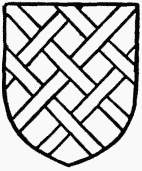
Audley. Gules fretty or.
Their son Hugh died in 1386, (fn. 23) and on the death of his son Edmund, Earl of Stafford, the manor was taken into the king's hands by reason of the minority of Humphrey son of Edmund, afterwards Duke of Buckingham. (fn. 24) The latter settled this manor after the death of his eldest son Humphrey, Earl of Stafford, at St. Albans, 1455, on his third son John, Earl of Wiltshire, and Constance his wife. (fn. 25) Their son Edward dying without issue in 1498–9, (fn. 26) the manor reverted to Edward, Duke of Buckingham, (fn. 27) who was attainted for high treason and beheaded in 1521. (fn. 28) In 1528 the manor was granted to John Bourchier, Lord Berners, (fn. 29) on whose death in 1533 it was conveyed by his executor Francis Hastings, and Joan his wife, to Henry, Marquis of Exeter. (fn. 30) The latter in 1535 settled it on himself and Gertrude his wife and their heirs, (fn. 31) but on his attainder in 1538 it was forfeited to the Crown, and in 1547 was granted by Edward VI to Sir Anthony Browne, (fn. 32) one of the knights of the Bath at the Coronation, created in 1554 Viscount Montagu. (fn. 33) Anthony, Viscount Montagu, his grandson, conveyed the manor in 1618 to Henry Weston and Thomas Grey. (fn. 34) In 1625 Thomas Grey and William Grey conveyed the manor to William Wall and John Fielder, (fn. 35) apparently trustees, for William Grey died seised of the manor and capital messuage of Effingham East Court in 1645, leaving a son and heir Thomas, aged eighteen. (fn. 36)
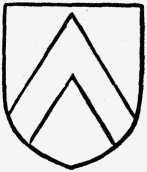
Stafford. Or a cheveron gules.
In 1660 Thomas Grey sold to Matthew Tayler, grocer of London, for the sum of £3,000, the manor of Effingham East Court, a tenement and farm called Nice Court in Effingham, and the rectory and parsonage of Effingham. (fn. 37) Matthew died in 1678, having bequeathed this manor, with the farm of Nice Court and the rectory, to his grandson Thomas White, younger son of Thomas White and of Margaret daughter of Matthew. (fn. 38) Thomas White suffered a recovery in 1692, (fn. 39) and manorial courts were held in his name in 1696, 1697, and 1698. (fn. 40) In 1732 William White son of Thomas (fn. 41) suffered a recovery of the manor, (fn. 42) and by his will dated 1758 devised it to trustees to sell for the payment of debts and legacies. (fn. 43) In 1790 William White son of William sold to William Bryant, (fn. 44) who resold in 1793 to Gerard Dutton Fleetwood of Letherhead. The latter died in 1796, and was succeeded by John Fuller, (fn. 45) who with Dinah his wife made a conveyance of the manor in 1799 to William Lyson. (fn. 46) The manor was subsequently purchased by General Oliver de Lancey, Barrack-Master General, whose estates were, however, seized for debts to the Crown in 1806, and vested in trustees for sale. (fn. 47) This manor was purchased by Miles Stringer, who died in 1839, but it was acquired by the Maxse family before 1874, when Lady Caroline Maxse, daughter of the fifth Earl of Berkeley and widow of James Maxse, was lady of the manor. (fn. 48) Her son Admiral Maxse held the manor in 1891, (fn. 49) and died in 1900. Shortly afterwards it was acquired by Mr. Caesar Czarnikow, the present lord of the manor. (fn. 50)
In the 13th century there appears to have existed some doubt as to the legality of the franchises of the de Clares in Effingham, and when William de Hevre in 1279 claimed view of frankpledge, assize of bread and ale, and other liberties in this manor, it was declared on evidence that when the Dammartins and Thomas de Warblington held the manor they were geldable and came twice a year to the sheriff's tourn, to which they paid 8s. yearly, but that Richard de Clare, father of Gilbert the present earl, after he had taken the manor unto his own hands, had unlawfully appropriated the said rent. Moreover, it is stated that William I had given this manor to Odo Dammartin, his knight and member of his household, who with his descendants had always had seisin of these liberties. (fn. 51) In view of the Domesday entry the alleged grant to Odo by the Conqueror can hardly be correct.
EFFINGHAM PLACE COURT alias EFFINGHAM.
About 1316 Thomas de Geddyng died seised of lands in Effingham, including 29 acres of land at La Place, held of the manor of La Leigh by the service of 2s., 4 acres of land held of the Lord de Berners (Lord of West Horsley Manor in Woking Hundred) by the service of 12d., also a hall, chamber, granary, fishery, and dovehouse at La Place. His heir was Walter de Geddyng, son of his brother Walter. (fn. 52) In 1320 Walter de Geddyng conveyed his lands in Effingham under the name of a messuage, 80 acres of land, 60 acres of wood, and 6s. rent to Master John Walewayn to hold for life, with remainder to William son of Humphrey de Bohun and his issue. (fn. 53) William de Bohun had a grant of free warren in his demesne lands of Effingham in 1328.
In 1347 Humphrey son of Humphrey de Bohun granted the reversion of certain lands to Sir John de Pulteney, (fn. 54) a distinguished citizen of London and five times lord mayor, and apparently a similar transaction took place in regard to some of William's lands also, for in 1362 Sir William de Pulteney conveyed the manor of Effingham (said to be formerly of John his father) to trustees. (fn. 55) In 1363 these trustees settled it on Nicholas de Lovayne and Margaret his wife, widow of Sir John de Pulteney, (fn. 56) for their lives, with remainder to William de Pulteney, and failing issue to him, to Guy de Lovayne and his heirs. (fn. 57) William died without issue in 1367. Whether Lovayne succeeded is not clear, for in 1478 Lawrence Downe died seised of the manor, said to be held of John de Berners as of his manor of West Horsley, leaving his grandson John son of Thomas Downe his heir. (fn. 58) In 1491 John Downe and Joan his wife sold the manor to John Leigh, (fn. 59) who in 1544 conveyed it to the Crown. (fn. 60)
In 1550 Edward VI granted the manor to Lord William Howard, (fn. 61) who died seised of it in 1573, (fn. 62) having in 1554 received the title of Baron Howard of Effingham as a reward for his services in suppressing Wyatt's rebellion. (fn. 63) His son and heir, Charles Howard, distinguished as commander-in-chief against the Spanish Armada and created in 1588 Earl of Nottingham, (fn. 64) suffered a recovery of this manor in 1622, (fn. 65) and on his death in 1624 it passed to his eldest surviving son Charles, second Earl of Nottingham. (fn. 66) The latter was succeeded by his half-brother Charles, third Earl of Nottingham, who in 1647 conveyed the manor to Thomas Turgis. (fn. 67) The latter, by will dated 1703 and proved in 1705, gave the manor to William, third son of Thomas Urry of Gatcombe in the Isle of Wight, (fn. 68) subject to such interest as his wife Mary had in some part of it. (fn. 69) William suffered a recovery in 1704, (fn. 70) but leaving no children the manor passed to Thomas Urry, who died unmarried in 1776, having bequeathed his estates to his niece Elizabeth, wife of Windsor Heneage, with instructions that the court for his manor of Effingham should be kept every three years. (fn. 71) Elizabeth had by her husband, Windsor Heneage of Haynton, two daughters, Elizabeth and Mary, who became co-heirs. Elizabeth married Basil Fitzherbert Squire, of Swynnerton, Staffordshire, and Mary married William Fitzherbert Brockholes of Claughton Hall, Lancashire. (fn. 72) Thomas Fitzherbert Brockholes, son of Mary and William, suffered a recovery of this manor in 1832, (fn. 73) but in the same year the estate, comprising upwards of 800 acres, was disposed of in lots, the manor and manor-house (included in the homestead of the Upper Farm), with the woods and other lands to the extent of 358 acres, being purchased by Sir Thomas Hussey Apreece, bart., (fn. 74) who died in 1833, leaving an only son, Sir Thomas G. Apreece, who died unmarried in 1842. (fn. 75) The manor is now held by Colonel E. Latimer Parratt.
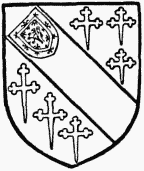
Howard, Earl of Nottingham, bore the arms of Howard with the difference of a molet.
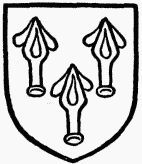
Apreece, baronet. Sable three bloody spearheads argent
The manor of EFFINGHAM-LA-LEIGH was alleged to be Chertsey property as early as 675, when Frithwald, Subregulus of Surrey, and Bishop Erkenwald were said to have granted to the abbey twenty dwellings at Bookham-cum-Effingham. (fn. 76) But the grant is very suspicious (see Chertsey). In 1086 it was held of the Abbot of Chertsey by Oswold, who had it in the time of Edward the Confessor; (fn. 77) but Chertsey does not appear to have exerted any overlordship after this date, and it is possible that Oswold had merely placed himself under the protection of Abbot Wulfwold, who was his brother. (fn. 78) Oswold or one of his successors apparently sub-infeudated, for La Leigh appears subsequently as held of the manor of Wotton, which was among Oswold's possessions in 1086. (fn. 79) Early in the 12th century Oswold de la Leigh, the immediate tenant, granted to Hugh, Abbot of Chertsey, a tithe of his demesne lands in Effingham. (fn. 80) In the reign of John, Maud de Camoys had custody of the heir of Gilbert de la Leigh and of his tenement in Effingham-La-Leigh and Polesden. (fn. 81)
In 1285 Nicholas le Gras had a grant of free warren in the manor of 'La Leye,' (fn. 82) which he held at fee-farm of William de la Leigh, who in that year recovered it from him, Nicholas having for two years failed to pay his farm. (fn. 83) John de la Leigh, son of William, was acting in the service of Humphrey de Bohun in 1314, (fn. 84) and in 1320 released all his right in the manor of La Leigh to Master John Walewayn, (fn. 85) apparently with remainder as in Effingham Place Court, to William de Bohun, who in 1328 had a grant of free warren in all the demesne lands of Effingham and La Leigh. (fn. 86) La Leigh then descended with Effingham Place Court to Lawrence Downe, who died seised of it in 1478. (fn. 87) From this date there is no trace of La Leigh as a separate manor, and it apparently became amalgamated with Effingham Place Court.
The moated inclosure in Lee Wood (already mentioned) is probably the site of the old manor-house of La Leigh.
Aubrey, writing in 1718, mentions a small fair at Effingham on the feast of St. Lawrence (10 August), (fn. 88) the patron saint of the church, which was transferred before the end of the 15th century to 15 July, (fn. 89) and has since been abandoned.
CHURCH
The church of ST. LAWRENCE has a chancel 26 ft. 7 in. by 16 ft. 1 in., south organ chamber and vestry, nave 43 ft. by 21 ft. 6 in., south transept 27 ft. 6 in. deep by 18 ft. 10 in. wide, south aisle 8 ft. 6 in., south porch and a west tower 8 ft. 9 in. by 8 ft. 1 in.; these dimensions are within the walls.
Owing to the great amount of modern reconstruction which the building has undergone the history of the fabric is for the greater part lost, but enough remains to prove that it dates at least from the 13th century, the large south transept having the remains of windows of that date; no old features are left in the nave, but the proportion of two squares is suggestive of a 12th-century date. The chancel was repaired about 1388, but has an early 14th-century window at the north-west, and the masonry of the walls may be considerably earlier. No other details are left to give a clue to the history of the building, but the tower appears to have been built (or rebuilt) in 1757, on the evidence of a stone recording that date; it was again reconstructed in 1888; a brass inscription on the wall states that it was erected at that time. The nave was wholly modernized in 1888, the south aisle added, and the chancel partly rebuilt; the vestry, east of the transept, was added in 1899.
The east window of the chancel is a modern one of three lights under a traceried pointed head; but the north-east and south-east windows clearly belong to the work of 1388, which was done by order of William of Wykeham, and in their simple and rather heavy detail have much of the spirit of his work at Winchester Cathedral. Each is of two cinquefoiled pointed lights with a quatrefoiled spandrel under a two-centred segmental arch; the inner jambs and mullions are moulded, and the outer are doublechamfered with a moulded label. The north-west window is an earlier one of two trefoiled pointed lights with a plain pierced spandrel on a two-centred arch; the jambs are of two chamfers, and the label is a filleted round. A modern archway with moulded and shafted jambs and a four-centred arch opens into the organ-chamber at the south-west, and the chancel arch is also modern with similar jambs and a twocentred arch.
The nave has three modern north windows each of two lights with foiled spandrels in pointed heads. The south arcade, also modern, is of four bays with round pillars of grey stone having white stone moulded bases and capitals; the arches are pointed and of two chamfered orders.
The organ chamber has a doorway in its west wall to the transept, and another in its south wall to the vestry; this has an outer doorway on the east and a three-light south window.
The transept has a 15th-century window at the south-east, now looking into the vestry, of two cinquefoiled lights under a square head with a label. In the south wall is a small square piscina with a projecting corbel basin, 11 in. by 10 in., probably contemporary with the transept. Of the two lancets which pierce this wall the eastern has modern jambs inside and old jamb stones outside and the western old inner jambs and modern outer; only one light existed here formerly, and the two seem to have been made from it. In the west wall are two lancets, of which the north one has old inner jambs and modern outer, and the other is wholly modern. The walls of the transept are unusually thick, the south wall being 3 ft. 6 in.; the others have been thinned above a line about 6 ft. above the floor, but they were originally over 3 ft. thick. The south-west angle seems to have fallen into disrepair in the 17th or 18th century, as it has been repaired with red brick, and the square buttresses supporting the angles are modern. The aisle has two lancets in the south wall and a west window of two lights and tracery, all modern. The south-west doorway is also modern. East of it is an old square recess with chamfered edges in which is set a modern sill with a basin and drain.
A modern arch opens into the tower from the nave. The west doorway is a modern one with a pointed arch in a square head; the window over is of three lights with cusped tracery of 15th-century style in a two-centred head, all modern except for some old stones in the jambs; over this window is a clock. The bell-chamber is lighted by three lancets in each wall except the east, which is unpierced, and the parapet is embattled. The chancel and nave roofs are both gabled and have modern panelled ceilings, the transept has a low gabled ceiling of plaster and appears to be old, but the single tie-beam has been cased; the aisle has a panelled lean-to roof. The south porch is modern, and has pairs of lancet windows on each side and a pointed entrance arch.
The altar table is modern, and a former table (of no great age) serves as a side altar in the transept. There remains an old bench end with a fleur de lis head and part of another, of 15th-century work or perhaps earlier; these have been copied in the modern chancel seats. The font is modern with a bowl of a fine piece of alabaster and a marble stem.
In the nave floor is an early coffin-lid; the inscription around is almost illegible, but is said to read:
+ VATER: DE: GEDDINGCES: GIT: ICI
DEV: A: SA: ALME: FACE: MERCI.
In the tower are placed most of the old monuments; the most interesting perhaps are seven small square tablets to the children of William Walker, formerly vicar; the inscriptions read thus: 'Hic jacent Suna W. ob. 1670 act 8 an—Robt. W. ob. 1686 aet 3 an—Rob. W. ob. 1688 aet 2 hebs.—Gu. Walker huius eccle iam: iam vicario 1693.' They are roughly cut, and are possibly the work of the vicar himself. There are two other small stones, one with initials, apparently, H M or H W dated 1651, and another dated 1587. Another stone is inscribed: 'Thos. Bonney, vicar—Thos. Killick Geo. Monk Churchwardens 1757' and refers to the rebuilding of the tower. A large broken stone slab with chamfered edges, lying in the churchyard south of the transept, appears to be ancient, but has no inscription.
There are also three small brass inscriptions, the oldest reading: 'Pray for the soull of John Aley which decessid the xxvi day of Apriell the yere of oure Lord MCCCCCVII on whose soull Ihu have mercy Ame.' Another has the inscription: 'Here lyeth buried the body of John Agmondesham late of Rowghbarnes in the County of Surr Esquire, somtymes reader of New Inne and after an aprentice in the lawe who dyed the first day of August Anno dni 1598.' The third is in Roman type as follows: 'John Cooke and Frances his wife was buried ye xxv day of April 1629.'
There are five bells, all by Gillett of Croydon, 1890.
Among the communion plate is a silver cup of 1569, with a cover paten dated 1570; there are also a cup, standing paten, and flagon of 1828.
The registers begin in 1565, the first book containing baptisms, marriages, and burials from that date to 1725. The first portion is a copy of 1624; the book is of paper. The second book contains baptisms and burials from 1660 to 1812, and marriages from 1660 to 1772; the third has the marriages from 1754 to 1812.
The churchyard is not large, and surrounds the building; to the south are some large chestnut and other trees; an iron railing bounds the ground towards the road on the west side, and has two gates.
ADVOWSON
The church of Effingham was bestowed on Merton Priory by William de Dammartin, (fn. 90) and in 1269 the advowson was granted to the prior by Gilbert de Clare, (fn. 91) probably in confirmation of the original grant. In 1291 the church was held by the priory and valued at £14 13s. 4d. with a pension of 26s. 8d. (fn. 92) The same valuations were given on an inquiry taken six years later as to whether it would be to the king's loss if the prior and convent were to appropriate the church to their own uses. (fn. 93) On a further inquiry, however, in 1299, the church was found to be worth only 20 marks (£13 6s. 8d.), and the prior and convent had licence to appropriate accordingly. (fn. 94) In 1297 the bishop issued an ordinance for the endowment of the vicarage, under which the vicar was to receive for his maintenance all the altarage of the church, and all small tithes and profits pertaining to the altarage, with the tithe of the produce of crofts and gardens dug in the parish by foot and spade; also the tithe of all hay and produce of the lands of William Wrenne in the parish, and 18½ acres of arable land with common pasture pertaining to the church, free and quit of tithe, as the rector of the place used to hold them, with herbage of the cemetery, and also a competent site near the church, to be assigned by the monks of Merton, whereon to build a suitable vicarage within the space of a year. (fn. 95)
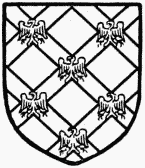
Merton Priory. Or fretty azure with eagles argent at the crossings of the fret.
In 1308 John de Rutherwyk, Abbot of Chertsey, conceded to the Prior of Merton the tithes both great and small from those demesne lands within the limits of the parish church of Effingham, formerly of Philip de la Leigh and Oswold de la Leigh, the prior rendering in return to Chertsey Monastery 50s. per annum, (fn. 96) and on the dissolution of Chertsey this payment was included among the possessions of the monastery granted to the new foundation at Bisham. (fn. 97) In 1317 the prior mortgaged to Philip de Barthon, Archdeacon of Surrey, the tithes of corn or fruit of the great tithes in Effingham, with the court or manse there, for a term of six years, in consideration of a sum of £26, the prior to be responsible for all extraordinary expenses and for the pension of 50s. to the Abbot of Chertsey; the archdeacon to be responsible for all ordinary payments and for the sustenance of all houses and other buildings. (fn. 98)
In 1388 the prior was severely censured for neglecting to repair the chancel, which had fallen into such a state of ruin that the parishioners complained that divine service could not be celebrated there. (fn. 99)
In 1535 the Prior of Merton granted to John Holgate a lease of the rectory, with all tithes and profits, excepting the presentation of the vicar and mortuaries, to hold from Midsummer 1544 for a term of twenty-one years, at a rental of £12 6s. 8d., but chargeable with a pension of 26s. 8d. to the vicar. (fn. 100) In the same year the vicarage was found to be worth with its appurtenances £7 18s. 9d., (fn. 101) while the farm of the rectory was worth £10. (fn. 102) After the dissolution of Merton Priory the king retained the patronage of the living. (fn. 103) In 1551 the rectory and church were granted by Edward VI to John Poynet, Bishop of Winchester, and his successors, (fn. 104) and this grant was confirmed in 1558 by Philip and Mary. (fn. 105)
But this grant was apparently afterwards revoked, for a grant of the rectory appears to have been acquired by William Hammond, who in 1574 bequeathed the remainder of it to Rose Cave his step-daughter. (fn. 106) Rose married Laurence Stoughton, in conjunction with whom she is said to have conveyed the rectory to Thomas Cornwallis of East Horsley, (fn. 107) who in 1588, as farmer of the king's rectory of Effingham, recovered three cartloads of peas, three cartloads of barley, one cartload of oats, &c., to the value of 30s., of the tithes of the rectory, (fn. 108) and again in 1592 recovered forty sheaves of peas to the value of 20s. of the tithes of the rectory. (fn. 109) In 1626 Lady Catherine Cornwallis died seised of the rectory, from the inheritance of her late husband, the said Thomas, having settled the same in 1625 on her nephew Thomas, Earl of Southampton. (fn. 110) The latter, however, in 1629, conveyed the rectory with tithes to Carewe Raleigh, (fn. 111) by whom it is said to have been conveyed to William Grey, (fn. 112) who in 1645 died seised of the rectory and tithes together with the manor of Effingham East Court, (fn. 113) with which it descended from that date. The patronage of the living was, however, reserved to the Crown, (fn. 114) until in 1866 it was acquired by A. Cuthell. (fn. 115) Since 1891 it has been in the gift of the Rev. E. F. Bayly, the present incumbent.
In 1607 a fee-farm rent reserved from the rectory, of the annual value of £11, was granted by the king to William Blake and George Tyte, gentlemen. (fn. 116) Under the Commonwealth Act for the sale of fee-farm rents, it was sold in 1651 to Walter Kempson and his heirs, (fn. 117) but Charles II granted it to Queen Catherine for life. (fn. 118) Subsequently, it appears to have been acquired by James, Duke of Chandos, who in 1732, jointly with Cassandra his wife, conveyed to Sir Matthew Deckes, bart., his annual rents from the rectory of Effingham. (fn. 119) In 1790 the fee-farm rent of £11 payable from the rectory was in the hands of Lord Fitz William and his heirs. (fn. 120)
In 1658 it was proposed to unite the parishes and churches of Effingham and East Horsley, when the commissioners appointed to make inquiries reported that the two parishes were distant about a mile, and neither alone sufficient to maintain 'an able and godly preaching minister,' the real yearly values of both being not above £85 a year. (fn. 121) The project was however abandoned.
CHARITIES
Smith's Charity is distributed as in other Surrey parishes. There were some small tenements near the church used as a poor-house. They were rebuilt in 1774, the proceedings being the cause of a lawsuit which ended in the expense being disallowed. (fn. 122) Later, a workhouse for Effingham stood on the southern verge of the parish, on the brow of the downs.