
A History of the County of Surrey: Volume 3. Originally published by Victoria County History, London, 1911.
This free content was digitised by double rekeying. All rights reserved.
'Parishes: East Clandon', in A History of the County of Surrey: Volume 3, (London, 1911) pp. 344-346. British History Online https://www.british-history.ac.uk/vch/surrey/vol3/pp344-346 [accessed 12 April 2024]
In this section
EAST CLANDON
Clanedun (xi cent.); Clendon, and Clandon Abbatis (xii cent.).
East Clandon is a small parish 5 miles east-by-north of Guildford. It is bounded on the north by Send and Ripley, on the east by West Horsley, on the south by Shere and Albury, on the west by West Clandon. It measures about 2 miles from north to south and about a mile from west to east. It contains 1,444 acres.
The parish extends from the summit of the chalk downs over the northern slope of the chalk and the Thanet and Woolwich Beds on to the London Clay. Clandon Downs on the chalk are still partly open ground, and East Clandon Common to the north is fairly well covered with oaks. The Guildford and Epsom road (see West Clandon) runs through the parish. The Guildford and Cobham line cuts the northern part of it.
The village, which includes several picturesque timbered and thatched cottages, lies as usual just on or below the limit of the chalk.
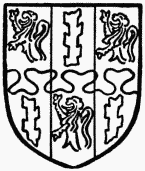
Rendel, Lord Rendel of Hatchlands. Six pieces parted nebuly fessewise sable and argent with a ragged staff between two demi-lions in the chief and a demi-lion between two ragged staves in the foot all countercoloured.
Hatchlands, in East Clandon, is often spoken of as the site of the old manor-house. When Sir Thomas Heath conveyed the manor to Lord King, in 1720, he retained this house. His son Richard sold it, and in 1749 it was bought by Admiral Boscawen. He pulled down the old house and built the present. After his death it was sold to Mr. W. B. Sumner in 1770, and it continued in the Sumner family for some generations. It is now the property of Lord Rendel. It is extremely improbable that it was the site of the manor-house; the name indicates a different property, and on the original manor of the abbey, farmed by the villani (vide infra), there was probably no manor-house at all.
High Clandon is the residence of Mr. F. B. Eastwood, who did much for the restoration of the church. The schools (National) were opened in 1863, and enlarged in 1902.
MANOR
The manor of EAST CLANDON (Clandon Abbatis, xi-xiv cent.) is included among the estates which purport to have been granted to Chertsey at the foundation in 675, but appears for the first time in the copy of the charter ascribed to 727, (fn. 1) which is undoubtedly a later edition and includes all the Chertsey lands of 1086, some of which were certainly acquired long after 675. At the time of the Survey the abbey was still holding, and it was recorded that under Edward the Confessor the abbot had bought two hides in East Clandon and 'laid them in the manor.' (fn. 2) In 1201 Martin, Abbot of Chertsey, granted the manor to John Chaper for life, with reversion to the abbey. (fn. 3) Otherwise the history of East Clandon during the Middle Ages consists for the most part of a recital of grants and licences for alienating lands in mortmain. In 1537, after a reputed tenure of over eight hundred years, the abbey ceded East Clandon Manor to the king. (fn. 4) In July 1544 Henry granted it to Sir Anthony Browne, (fn. 5) who a few weeks later alienated it to George Bigley and Elizabeth his wife. (fn. 6) George Bigley's tenure was marked by a dispute in connexion with the copyhold of certain lands in the manor, (fn. 7) but seems to have been otherwise uneventful. He died in 1558, leaving two daughters and co-heirs, Dorothy and Mary; the manor, in default of issue, was to remain to Edmund son of Richard Sutton, with contingent remainders to his brothers John, James, and Jasper. (fn. 8) At the death of Elizabeth Bigley, (fn. 9) some five years later, Dorothy Bigley had become the wife of Robert Gavell, while Mary had married Edward Carleton. There is record of a fine in the year 1565 in which George Carleton and Edmund Sutton appear as the plaintiffs, while Robert and Dorothy Gavell with Edward and Mary Carleton defended. (fn. 10) Probably this suit represented a division of property, since the manor was afterwards in the possession of the Carletons. Edward Carleton died in 1582, (fn. 11) and in the inquisition taken at his death (fn. 12) his wife Mary is mentioned as having been seised of the manor jointly with him. (fn. 13) Their son Edward, who had just come of age at the time of his father's death, (fn. 14) evidently sold the property, and it came into the hands of Francis Lord Aungier, who died seised of it in 1632. (fn. 15) The Aungiers were Royalists and suffered accordingly. From Gerard son of Francis Lord Aungier it came into the possession of Thomas Earl of Pembroke, whose son sold it in 1692 to Sir Richard Heath of Hatchlands in East Clandon. (fn. 16) The Heath family did not keep the manor long; it was conveyed in 1718 under a private Act (fn. 17) by Sir Richard's sons to Sir Peter King, (fn. 18) whose descendant, the Earl of Lovelace, is the present owner.
Clandon gives an interesting case in Domesday of a manor entirely in the hands of the tenants in villeinage. There is no demesne land mentioned, but the villani paid rent. There was a small separate holding in Clandon claimed by Chertsey Abbey, the overlord of the main part, but taken by Odo of Bayeux. John de Rutherwyk, the stirring and reforming Abbot of Chertsey, temp. Edward II and Edward III, bought out the rights of the villani in the common field called Siggeworth, 1315. But common fields continued to exist at East Clandon, and are marked on old maps. Between James and Malcolm's General View of the Agriculture of Surrey, 1794, and Stevenson's General View in 1809, 150 acres were inclosed at Clandon, perhaps the common fields of the two Clandons. (fn. 19) But there is no reference in Sir John Brunner's Return, 1903. In this, however, the final award of the inclosure of the waste is noted on 21 May 1867.
CHURCH
The church of ST. THOMAS OF CANTERBURY has a chancel 31 ft. 3 in. long by 18 ft. 8 in. wide, nave 36 ft. 4 in. by 20 ft. 5 in., a short north aisle 10 ft. wide, with a vestry to the west of it, and a south porch; all internal measurements.
The nave, which is short for its breadth, is evidently of early origin, probably dating from the end of the 11th century; but no architectural details of the original building are left to give a clue to its exact age. The building originally consisted of this nave and a small chancel, but the latter was rebuilt and considerably enlarged about the year 1220, and a few years later a north aisle with an arcade of two bays was added. The western bay is now closed up, and there is nothing to show when this was done; but it may have occurred as far back as the 15th century, when the present wooden bell-turret seems to have been constructed.
The aisle is now modern, having been rebuilt in 1900, when the vestry also was added and the church restored and re-seated.
In the east wall of the chancel are two 13th-century lancet windows with splayed inner jambs and arches. One of the external jamb stones of the south lancet is made of the small pointed head of a rebated and splayed lancet of very early 13th-century or late 12th-century date. On either side of the chancel are two lancets contemporary with the east window, all four more or less renewed. The pair on the north side have plain square jambs and are very much patched. To the south-west is a rectangular low side window with chamfered jambs and lintel, inserted probably in the 14th century. Opposite to this is a blocked doorway with a shouldered lintel, probably of the date of the chancel.
The chancel arch, also of the same period, has chamfered jambs and a two-centred arch with a plain chamfered label; the angles of the jambs have been partly repaired with oak, and the abaci are now entirely replaced by modern oak copies.
The arch to the north aisle has a half-round east respond and a circular pillar partly buried for its west respond; the filling in of the other bay is plastered on both faces and shows no indication of a blocked arch; the responds have moulded bases and capitals, and the arch is a pointed one of two chamfered orders with a grooved and hollow-chamfered label; in the east respond is a vertical groove (now filled in) showing where the arch was boarded up in later times. A plain opening in the wall above, to the east of the arch, is the passage-way to the former rood-loft from the aisle, and contains several steps in the thickness of the wall.
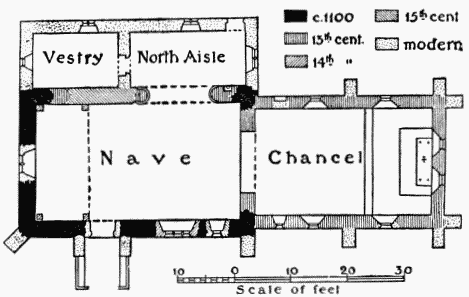
Plan of East Clandon Church
There are two windows in the south wall of the nave; the first is a single trefoiled light near the east, and was inserted presumably to light the pulpit; it is modern externally, but has an old pointed hollowchamfered rear arch of clunch; the second is an insertion close to it dating from the 15th century and consisting of three trefoiled lights much renewed under a square head with a square-cut moulded label; the jambs outside have been partly restored with cement.
The south doorway appears to have been renewed in chalk, and has a pointed head and jambs of a single chamfered order. The west window is of two trefoiled lights with a quatrefoil over in the pointed head, and is entirely modern. Below it is a blocked late 16th-century doorway of two chamfered orders in red brick with a four-centred arch.
In the north aisle is a small 13th-century piscina next to the respond with a mutilated round basin. The east window of the aisle is all modern except its inner jambs, which are of chalk; it has two trefoiled lights under a pointed head inclosing a quatrefoil. On the north side are a doorway and a square window of two lights, and at the west a doorway into the vestry, which is lighted by a north window of two lights and a single west light.
The walling of the nave is of flint and stone, some of the flints in the south wall being set more or less in herringbone fashion, and the masonry has a very early look about it; this wall has been strengthened by modern buttresses of brick and flint. The chancel walls are also of unbroken flints, and have similar modern buttresses.
The roofs of the chancel and nave are gabled and have open collar trussed rafters, which were formerly plastered on the under side. The aisle has a modern lean-to roof. Above the west end of the nave is a square wood bell-turret supported on posts from the floor of the nave; the posts against the west wall are old, but the eastern pair are modern; the turret is covered with oak shingles and is crowned by a foursided spire, also shingled.
The altar table is a modern one of oak. The altar rails, date from the last half of the 17th century and have turned balusters of good section flanked by scrolled brackets. A modern desk in the chancel also contains some pieces of 17th-century carving of a honeysuckle pattern. The pulpit is modern. The font dates from the 18th century and is of stone, with a small cup-shaped bowl on a turned baluster stem.
There are three bells: the treble is a pre-Reformation bell from the Reading foundry, c. 1500, inscribed 'Sancte Toma or'; the second is by Eldridge, 1679, and the tenor by R. Phelps, 1737.
The communion plate includes an Elizabethan cup and cover paten of 1569, also a cup of 1661; a paten of 1776, a standing paten of 1675, of which it is possible that the foot is older than the top, and an electroplated paten of 1883.
The earliest book of the registers contains baptisms from 1558 to 1707, marriages to 1690, and burials to 1711; the second continues the baptisms to 1754 and marriages and burials to 1787; the third has all three from 1788 to 1812. There is also a vestry book from 1591.
ADVOWSON
The church of East Clandon, which is mentioned at the time of Domesday, was, like the manor, held by Chertsey Abbey until the Dissolution. (fn. 20) Henry VIII granted it to Sir Anthony Browne with the manor, with which it has descended ever since.
CHARITIES
Smith's Charity is distributed as in other Surrey parishes. Greethurst's Charity, consisting of £20, was supposed to have been left by a person of the name resident in East Clandon, the name occurring in the registers. The interest was given to the poor.
A convalescent home for children suffering from hip disease, called 'Welcome,' was founded in 1902. It is in connexion with the Alexandra Hospital, London.