A History of the County of Surrey: Volume 3. Originally published by Victoria County History, London, 1911.
This free content was digitised by double rekeying. All rights reserved.
'Parishes: West Clandon', in A History of the County of Surrey: Volume 3, ed. H E Malden (London, 1911), British History Online https://www.british-history.ac.uk/vch/surrey/vol3/pp346-349 [accessed 30 April 2025].
'Parishes: West Clandon', in A History of the County of Surrey: Volume 3. Edited by H E Malden (London, 1911), British History Online, accessed April 30, 2025, https://www.british-history.ac.uk/vch/surrey/vol3/pp346-349.
"Parishes: West Clandon". A History of the County of Surrey: Volume 3. Ed. H E Malden (London, 1911), British History Online. Web. 30 April 2025. https://www.british-history.ac.uk/vch/surrey/vol3/pp346-349.
In this section
WEST CLANDON
Clandun (xi cent.); Clandon Regis (xiv cent.).
West Clandon is a small parish 4 miles east-by-north of Guildford. It is bounded on the north by Send and Ripley, on the east by East Clandon, on the south by Albury, on the west by Merrow. It measures 2 miles from north to south and rather over half a mile from east to west. It contains 1,003 acres.
The parish meets Albury on the top of the chalk down, and extends over the northern slope of the chalk, across the Thanet and Woolwich Beds, on to the London Clay. The church and village, according to the usual rule, lie just below the chalk, or on its extreme boundary. The village is scattered along a road from north to south with many picturesque old cottages. Clandon Downs, on the chalk, are still partly open common. The Guildford and Epsom road runs through Clandon. It was made a turnpike road in 1758, (fn. 1) and diverted in places out of the narrow ravine into which, as usual, the old unmade road was worn down. The old line can be seen in places in this and the neighbouring parishes by the side of the modern road.
Clandon station, on the Guildford and Cobham line, opened in 1885, is at the north end of the village street, and the line passes through the parish.
The old maps mark 'Common Fields' on the chalk downs. The only inclosures, however, recorded are of the Park (see below).
The Woking Water Works are in West Clandon parish. They draw water from the chalk, and supply not only Woking but the two Clandons, the two Horsleys, part of Merrow, Send, and part of Worplesdon. The works have seriously diminished the flow of springs on both sides of the chalk range.
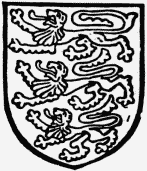
Giffard of Brimsfield. Gules three lions passant argent.
MANORS
At the time of the Domesday Survey WEST CLANDON was held of Edward of Salisbury by a certain Hugh; Fulcui had held it in the time of the Confessor. (fn. 2) The later mentions of the overlordship represent it as belonging to the family of Giffard of Brimsfield. (fn. 3)
This manor was also called CLANDON REGIS, (fn. 4) and it was stated in 1279 that part had been in the king's hands, (fn. 5) and part in those of William de Braose in his manor of Bramley. It is a fact that some houses are in the manor of Tangley, which represents William's Bramley manor. (fn. 6) In 1255 Christina de Alsefeld released to Matthew de Bovill one messuage and lands in West Clandon, (fn. 7) which seem to have been part of the original manor. Matthew de Bovill left a daughter Alice, who in 1294 was the wife of William de Weston. (fn. 8) She had, however, made two previous marriages. (fn. 9) Her first husband was John de Aqua, (fn. 10) who was probably a member of the Atwater family, who in later years tried to assert their claims to this manor. She married secondly Robert de Boclynton, (fn. 11) and in 1290 a settlement was made, probably on their marriage, by which the manor was secured to them for life with remainder to the heirs of Alice. Robert was found dead at Send in the autumn of 1290, having been slain by William Atwater 'qui percussit dictum Robertum in capite et praeterea in sinistra parte collis cum hachia quae vocatur polhax.' (fn. 12) The sheriff of Surrey was afterwards ordered to release Atwater, on the grounds that his attack had been provoked. (fn. 13)
The Atwater family seem to have had certain rights in the manor; in 1279 John Atwater claimed to have liberty to buy and sell in Guildford without payment of tolls 'for himself and his men of Clandon,' and won his case. (fn. 14) It therefore seems as though the quarrel which proved fatal to Robert de Boclynton may have originated in some dispute touching the manor. At any rate, after Robert's death, William and Alice de Weston enjoyed peaceable possession of the manor. (fn. 15) Their son William, who succeeded them, married first Isabel, daughter of Walter Burgess, by whom he was the father of another William, who inherited West Clandon, and secondly Margery de Romaine, (fn. 16) who was custodian of the manor during the minority of her stepson. In 1336 the elder William made a settlement of the manor on himself and his wife with remainder to his son William, and contingent remainders to Edmund and Richard his sons by Margery. (fn. 17)
After William's death the old Atwater dispute reappeared. Robert son of William Atwater brought a suit against Margery de Weston, with intent to recover the manor of West Clandon, into which, so it was declared, 'she would not have had ingress but for the disseisin wrongfully wrought by Robert de Boclynton and his wife Alice on Robert Atwater, grandfather of the plaintiff.' (fn. 18) Some six years later Robert released to Margery and to William son of William de Weston all his right in the manor. (fn. 19) Margery died seised in 1361. (fn. 20)
The manor seems to have descended in the Weston family from father to son until the death of John de Weston, great-grandson of William son of William and Margery, in 1441. (fn. 21) John left no male issue, and his lands were apparently divided among his three daughters, Agnes wife of John Athall of Horsham, Joan wife of John Skynner, and Agnes, who carried West Clandon to her husband Thomas Slyfield of Great Bookham. (fn. 22) His son Henry was given possession by his father's trustees in 1487. (fn. 23)
In 1531 John Slyfield, presumably his son, died seised of the manor, leaving Edmund his son and heir. (fn. 24) He had entered into an agreement with one Walter Lambert, citizen and goldsmith of London, by which the one of John's three sons, Edmund, John, or Richard, who first reached the age of fifteen was to take to wife either of Lambert's two daughters, Elizabeth or Margaret. (fn. 25) Edmund the eldest was only ten years old at the time of his father's death, and there seems no record to show whether the agreement was ever carried out. In 1598 Henry Slyfield, who was the eldest son of Edmund, (fn. 26) died seised, leaving Edmund as his son and heir, then aged eighteen. (fn. 27) By Henry's will, dated 1598, the manor was secured to his wife Elizabeth for life with remainder to his son Edmund and contingent remainders to his other sons Thomas and John. (fn. 28) Elizabeth soon afterwards became the wife of Henry Vincent, (fn. 29) brother of Sir Thomas Vincent of Stoke D'Abernon, and appears as Elizabeth Vincent in the list given by Symmes of persons who held their court at West Clandon as late as 1631. (fn. 30) Of Henry's younger sons, Thomas died in 1608, (fn. 31) and John, who had become a member of Gray's Inn, was convicted of felony and murder and attainted; he contrived to escape the extreme penalty of the law, but his lands and remainders were forfeited to the Crown. (fn. 32) West Clandon was not affected, not being his, and in 1615 Edmund and William Slyfield united in conveying the reversion after their mother's death to George Duncumbe, (fn. 33) who held courts from 1638 to 1645.
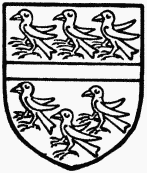
Onslow, Earl of Onslow. Argent a fesse gules between six Cornish choughs.
The Duncumbes, however, did not retain possession long. Sir Richard Onslow had bought the Lodge in the park in 1642, (fn. 34) and a series of transactions with the Onslow family, begun in 1650, (fn. 35) was finally concluded in 1711 by the transference of the manor to Sir Richard Onslow. (fn. 36) The Earl of Onslow, a descendant of Sir Richard, still holds it.
The second Lord Onslow built the house in 1731 from designs by Giacomo Leoni. The house is of red brick with stone dressings, and has the merits of its style, with large and lofty rooms and good ornament.
The second manor in West Clandon, represented originally by the manor of William de Braose, noticed above, is described under Bramley, of which it was part.
On 25 May 1530 Sir Richard Weston of Sutton had licence by charter to impark his land at Merrow and Clandon. The Clandon Park so formed, chiefly in Merrow, was disparked later. In 1642 a later Sir Richard Weston, the agriculturist and canal projector, sold this land to Sir Richard Onslow, the recusant naturally giving place to the Parliamentarian, who inclosed the park again.
CHURCH
The church of ST. PETER AND ST. PAUL has a chancel 24ft. 1 in. by 18 ft. 5 in., nave 50 ft. 8 in. by 23 ft. 4 in., northeast vestry, north tower 13 ft. 9 in. by 13 ft. 6 in. and south porch; all these measurements are internal. The church is mentioned in the Domesday Survey of 1086, but of this building nothing is now left.
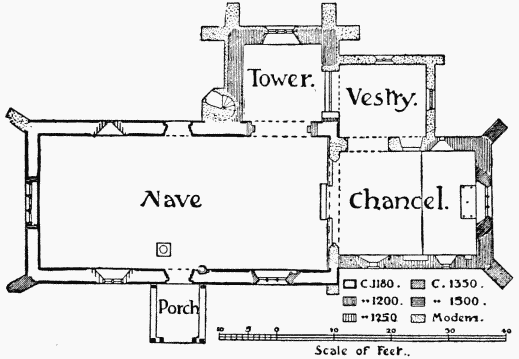
Plan of West Clandon Church
The earliest portion of the present structure is the nave, which dates from about 1180; it is of its original size, but now only retains (of the date) the north and south doorways; the chancel is a rebuilding of about the year 1200, and may have superseded a small apsidal chancel to the first building, or more probably the wooden chancel of the earlier Saxon building which may have been left standing after the nave was rebuilt in stone; of this date a lancet window in the north wall remains; the tower was probably added at the same period, but it has since been re-cased and much altered. Windows were inserted in the south wall of the chancel and in the two side walls of the nave about 1250, and the sedile in the chancel was put in at the same time. The east window of the chancel is the work of about 1330, three original lancets being destroyed to make room for it, and it is probable that the angle buttresses against this wall were work of the same period. The porch, although it has since been reconstructed, may contain timbers of 13th-century date. Much restoration of the windows has taken place, and the chancel arch has been considerably widened; the vestry is a modern addition.
The east window is a mid-14th-century one of three trefoiled ogee lights under a two-centred arch containing cusped net tracery; it is of two chamfered orders and has a moulded label outside. The tracery has been almost wholly restored with clunch and the jambs partly, in Bath stone. To the north and south of it in the same wall are the remains of the original lancet windows. In the north wall is a complete original lancet modernized outside; under it is a plain square recess with rebated edges, all of chalk; it has the holes for the hinge staples and bolts, and another deep hole in its head. To the west of these are the modern doorway and archway to the vestry and organ chamber.
In the south wall are two ancient piscinae; the eastern has a plain round head chamfered like the jambs and a half-round basin; it is also set higher in the wall than the other, which is shallower and of a square shape with chamfered edges and a threequarter round basin. Both basins have three grooves in the bottom radiating from the drain; the sedile west of these is of mid-13th-century date and has an engaged shaft in each jamb (between two hollow chamfers) with moulded base of three rounds and moulded bell capital with a scroll mould abacus; the arch is of two hollowchamfered orders and has a head and scroll mould label with mask stops. The first of the two south windows is a lancet, inserted or enlarged about the same time, whilst the other lancet in the same wall was also replaced by the present trefoil headed light. The chancel arch is modern and is pointed.
The vestry has a two-light window in its north wall and a doorway to the east; a modern arch opens into it from the tower through the east wall of the latter. The tower has its north angles strengthened by modern square buttresses and a vice rises in its south-west angle. The arch opening into it from the nave is of chalk in two chamfered orders without imposts in capitals; the chamfers are finished with pyramidal stops a short distance above the floor. In the north wall of the tower is a modern window of three lights and tracery; there was formerly a lancet in the east window, now removed for the vestry arch; the stone portion of the tower has been heightened and recased in modern times and has a modern cornice over which is a timber bell-chamber with an octagonal spire. The north doorway of the nave has a round head of two chamfered orders continuous with the jambs; they are now modernized outside in chalk with stone bases. The only window north of the nave is a 13th-century lancet either re-cut or modernized outside.
The first window in the south wall of the nave is of three ogee trefoiled lights with intersecting tracery and a two-centred arch with a moulded label; the tracery is of modern stone and the label in chalk. On a keystone in the external arch is a curious shield carved with the arms of the Westons: a cheveron between three lions' heads, the whole very rudely carved.
In the east jamb is a piscina of late 12th-century date; it is the square head of a former pillar piscina beautifully carved with leaf ornament; a rudely pointed arch is cut out of the jamb over. The south doorway is similar to the north doorway and has an old arch with a moulded label, but modern jambs outside. East of it is a portion of a 14th-century holy-water stoup under a pointed head; the front half of the basin has been cut away. On one of the stones inside are three cuttings which appear to be wide sundials. The westernmost south window has two pointed lights re-tooled or modernized outside. The west window was inserted late in the 15th century, and has three cinquefoil lights under a flat segmental arch. It is largely glazed with heraldic glass of the 18th century, placed there by an Earl of Onslow.
The walling is of flint with stone dressings; diagonal buttresses strengthen the angles at both ends; the one to the north-west of the nave is modern; in the modern square buttress against the south-east of the nave is a stone on which is cut an early circular sundial probably of the 12th century; it has three circles and is divided in twenty-four spaces by radiating lines; four dots mark the hour of noon and a small cross that of six p.m.
The south porch has ancient timbers; it is open at the sides, in which were formerly balusters or posts.
The roof of the chancel is of low pitch and with heavy timbers, and may date from the 14th century. The nave roof is of late 15th-century date, although it appears to have been reconstructed in 1716; the wall plate has a handsome embattled cornice fixed to it, probably original.
The font has a bowl of Sussex marble, square, with shelving sides, in which are arcades of shallow circularheaded arches which have been partly chiselled off; it is of the earliest date of the building; the stem and base are modern.
In the chancel are preserved, in a glass case, some ancient panels of oak; it is doubtful whether they belonged to a 'table' behind an altar or to a rood screen; but they appear to be of late 13th or early 14th-century date; the figures upon them are undoubtedly those of St. Peter and St. Paul on either side of St. Thomas of Canterbury; the two apostles bear their respective emblems, the keys and the sword; the martyred archbishop between them has his right hand raised in benediction, while the left holds the cross staff; there are traces of gold on the nimbus of each saint, and the figures are coarsely outlined in black. Much of the pewing in the western part of the nave is nicely carved in dark wood imported from abroad by a former Earl of Onslow.
The six bells were all by Thomas Lester, 1741, but the third, fourth, and fifth were re-cast by Mears and Stainbank in 1875. One is inscribed in capitals 'At propper times my voice II raies, unto my bennifactor praise.'
The communion plate includes an Elizabethan cup and cover paten of the date 1569; also another paten of 1712 given by Sir Richard Onslow.
The registers begin in the unusually early year of 1536. In the first book, which is of parchment, the baptisms, marriages, and burials are mixed thence to 1583, then written separately from 1584 to 1699, followed by a short gap, the baptisms continuing from 1700 to 1755, marriages 1701 to 1735, and burials 1700 to 1746. In a second parchment book are baptisms and burials from 1653 to 1663 and marriages 1654 to 1657; there are also two baptisms of 1675. The third book has baptisms and burials from 1756 to 1807; the fourth has marriages from 1778 to 1812; the marriages between 1735 and 1778 appear to be missing. The fifth continues the baptisms and burials from 1807 to 1812.
ADVOWSON
The advowson of the church of West Clandon always descended with the manor.
CHARITIES
Smith's Charity is distributed as in other Surrey parishes.
Land was purchased for the benefit of the poor at an uncertain date, and vested in the churchwardens (now not known).
— Balcuin left about £25 to the churchwardens for the poor at an unknown date.
William Stovall left money for bread, for the poor, also at an unknown date, and Lord Onslow gave a small piece of land for the same object. (fn. 37)
The various charities produce about £30 a year.