A History of the County of Surrey: Volume 3. Originally published by Victoria County History, London, 1911.
This free content was digitised by double rekeying. All rights reserved.
'Parishes: West Horsley', in A History of the County of Surrey: Volume 3, ed. H E Malden (London, 1911), British History Online https://www.british-history.ac.uk/vch/surrey/vol3/pp353-357 [accessed 9 May 2025].
'Parishes: West Horsley', in A History of the County of Surrey: Volume 3. Edited by H E Malden (London, 1911), British History Online, accessed May 9, 2025, https://www.british-history.ac.uk/vch/surrey/vol3/pp353-357.
"Parishes: West Horsley". A History of the County of Surrey: Volume 3. Ed. H E Malden (London, 1911), British History Online. Web. 9 May 2025. https://www.british-history.ac.uk/vch/surrey/vol3/pp353-357.
In this section
WEST HORSLEY
Horsaleges (ix cent.); Orselei (xi cent.); Horslegh (xiii cent.).
West Horsley lies 6 miles north-east of Guildford and the same distance south-west of Letherhead. It is bounded on the north by Ockham, on the east by East Horsley, on the south by Shere, on the west by East Clandon and Send and Ripley. Blackmoor Heath, in the north of it, was transferred to Ockham 15 March 1883, (fn. 1) and an outlying fragment of Wisley which bordered on West Horsley was also made part of Ockham at the same time. The parish is over 3 miles from north to south, and over one mile from east to west, and contains 2,672 acres. Like its neighbours east and west it reaches from the top of the Chalk Downs, across the chalk, the Thanet and Woolwich Beds, and part of the London Clay. The church is just upon the edge of the chalk, the scattered village on the next soil. Netley Heath, however, which is in the parish, is a bed of sand and gravel lying upon the chalk. There is still some open ground upon the Downs, but the greater part of the commons has been inclosed. The village is scattered about the lanes, but a few houses are clustered together at Horsley Green. The church has very few houses near it, except West Horsley Place, and is close to the border of East Horsley parish.
The road from Guildford to Epsom passes through West Horsley, and the Guildford and Cobham line is in the northern part of the parish.
West Horsley Place (see below) has literary interests connected with it. It was the seat of John Lord Berners, who made the first English translation of Froissart's Chronicle in the reign of Henry VIII. It was shortly afterwards the house of the Earl of Lincoln, whose wife, in whose right he held it, was the widow of Sir Anthony Browne, and was by birth Lady Elizabeth Fitzgerald, daughter of the Earl of Kildare, celebrated by Surrey the poet as the 'Fair Geraldine.' She resided at West Horsley after her husband's death, and corresponded in very unpoetic style with Sir William More at Loseley, where several of her letters are preserved, including an invitation to Sir William to come to her house during the crisis of the Spanish invasion of 1588, dated 30 July, and expressing the consternation in the court at the news that the Spaniards were over against Dover in Calais Roads. Carew Raleigh, son of Sir Walter, was a later owner, and he sold it to Sir Edward Nicholas, Secretary of State to Charles I, who died in 1669. Sir Edward's son, Sir John, was Clerk to the Privy Council and died in 1704. His son Edward, who died in 1726, was Treasurer to Queen Mary. Their correspondence was preserved at West Horsley, and a schedule of the papers was drawn up by Edward Nicholas in 1720. (fn. 2) A considerable part of the collection was purchased for the British Museum in 1879, and now forms part of the Egerton MSS. 2533–2562. But it is unfortunately only a part of what once existed. The whole collection seems to have passed into the possession of Sir John Evelyn of Wotton, after the death of William Nicholas in 1749. Dr. Thomas Birch made transcripts and a catalogue of the papers in 1750–1, describing them as in the possession of Sir John Evelyn. Some of them are still at Wotton, and were printed by Bray at the end of his edition of John Evelyn's Diary and Correspondence, 1818. The rest are supposed to have been returned to West Horsley, whence they passed to the Museum in 1879, but a great many papers referred to by Birch, whose transcripts are in the British Museum, (fn. 3) are now lost. The missing part included a History of the Long Parliament, covering 285 pages in Sir Edward Nicholas's own hand. Only fragments of this and of three letterbooks, from 1648 to 1658, survive.
Extracts from the papers have been edited for the Camden Society and the Royal Historical Society in 1886, 1892, 1897, and a fourth volume is in the press. Inferior to the Loseley MSS. in local interest, they are by far the most valuable general historical collection preserved in any Surrey house.
There is a valuable collection of historical portraits at West Horsley of the Nicholas family and 17thcentury persons of note, Raleigh, Weston Earl of Portland, Clarendon, Hobbes, Compton Bishop of London, Ben Jonson, Anne of Denmark, Nell Gwynn, and others.
Woodcote Lodge in this parish is the residence of the Rt. Hon. Sir Henry Roscoe. The Rectory house was built by the Rev. C. H. S. Weston in 1819, a mile away from the church, near Horsley Green.
In West Horsley were 362 acres of common fields and 16 acres of common meadow. The Inclosure Act was in 1802. (fn. 4) By it 79 acres of common arable and 88 acres of waste on Netley Heath were appropriated as a glebe. Five acres and a half are assigned for the repairs of the church.
There is a Wesleyan chapel in this parish.
Broomhouse on the Epsom road is the property of Lord Rendel, and is used as a convalescent home for Poor Law children.
In 1786 (fn. 5) a house and orchard were recorded as left for a school by an unknown donor. In 1813 Mr. Weston Fullerton built and endowed a school. The Rev. C. H. S. Weston further endowed a school with £760 in 1845. The present school (National) was built in 1861. Mr. Weston's endowment is paid to this, and it seems that Mr. Fullerton's school had been previously amalgamated with Mr. Weston's.
MANOR
The earliest mention of WEST HORSLEY occurs in the 9th century, when a certain Dux Alfred granted it to Werburg his wife. (fn. 6) Bricsi held it in the time of Edward the Confessor, (fn. 7) and at the time of the Survey it was in the possession of Walter son of Other, (fn. 8) from whom the family of Windsor descended. (fn. 9) Hugh de Windsor, grandson of Walter, (fn. 10) held a knight's fee in West Horsley in 1166. Hamo de Wudecote in 1232 brought a suit against Hugh de Windsor, who seems to have been a younger son of the Hugh last mentioned, concerning services which Hugh claimed from him. (fn. 11) Some ten years later Hugh de Windsor bought the right of common pasture in eighty acres of land in West Horsley. (fn. 12) In 1271 Hugh son of Hugh de Windsor granted the manor to Ralph de Berners and Christina his wife in return for an annual rent of £10 during the life of Hugh. (fn. 13) This Christina was probably the daughter of Hugh de Windsor; most of the old historians agree in asserting that the manor passed to the Berners family by reason of the succession of heirs female. (fn. 14) The manor still continued to be held of the main line of the Windsor family. (fn. 15) In 1297 Ralph de Berners died, leaving a son and heir Edmund, (fn. 16) who was reported to be in Normandy at the time of his father's death, although it was uncertain whether he were alive or dead. (fn. 17) Christina wife of Ralph survived both her husband and her son, and in 1317 was party in a fine with Richard de Berners touching lands held by him in West Horsley and elsewhere. (fn. 18) In 1325 another fine was levied: Christina had died in the meanwhile, and the manor had passed to her grandson John son of Edmund. (fn. 19) A final conveyance of these lands was not made until some ten years later, when Thomas son of Richard released all his right to John. (fn. 20) In 1332 John settled the manor on himself and his wife Elizabeth, probably on the occasion of their marriage. (fn. 21) He died in 1361, and the manor passed to his grandson James, who was then a minor. (fn. 22) James de Berners grew up to be a person of some influence in the government, but was accused of taking advantage of the youth of Richard II for his own purposes, and was beheaded in 1388. (fn. 23) His lands were forfeited to the Crown, but his widow Anne secured West Horsley by a special grant from the king. (fn. 24) Henry IV confirmed this grant, while deprecating the fact that his predecessor had alienated the manor without the consent of Parliament. (fn. 25) Anne de Berners married a second husband, John Bryan, who seems to have held the manor jointly (fn. 26) with her until her death (fn. 27) in 1403, when her son Richard de Berners came into possession. Bryan released his right in the manor to Richard in 1406. (fn. 28) Three years later Richard enfeoffed trustees of his estate to the use of himself and his wife Philippa, with remainder to their heirs. (fn. 29) He died in 1417. (fn. 30) Philippa married a second husband, (fn. 31) Thomas Leukenore, (fn. 32) but did not live long afterwards, and at her death Margery daughter of Richard de Berners was found to be her heir. Margery while still a child was married to John Fereby, (fn. 33) who held his first court at West Horsley in 1420. (fn. 34) He died in 1441, (fn. 35) and she then became the wife of Sir John Bourchier. In 1442 certain trustees released the manor to Sir John Bourchier, called Berners, summoned to Parliament in 1455 as Baron Berners, and to Margery his wife, which was probably a form of marriage settlement. (fn. 36) By her second husband Margery had issue Humphrey, who, however, died before his mother, being killed at Barnet in 1471, so that at her death in 1475 the manor passed to her grandson John Bourchier, Baron Berners, then a child of eight. (fn. 37) John, known as the translator of Froissart, was also a distinguished soldier and courtier in the expensive court of Henry VIII, and in 1518 he mortgaged the manor to Thomas Unton (fn. 38) and others. He died in 1522.
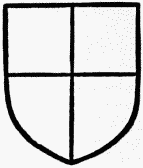
Berners. Quarterly or and vert.
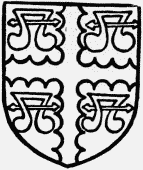
Bourchier. Argent a cross engrailed gules between four water-bougets sable.
Thomas Unton was probably father of Alexander Unton who married Mary, Lord Berners' daughter, who died childless. Joan, his other daughter, married Edmund Knivett and had livery as heiress to the estate in 1534. (fn. 39) The Lady Knivett's steward is referred to in a document at about this date. (fn. 40) The manor afterwards passed into the possession of Henry, Marquis of Exeter, who was seised of it at his attainder in 1539. (fn. 41) His estates were forfeited to the king, who in 1547 granted West Horsley to Sir Anthony Browne. (fn. 42) His widow, daughter of the Earl of Kildare, Surrey's 'Fair Geraldine,' married Lord Clinton, afterwards Earl of Lincoln, and held West Horsley for life. She and her husband resided here till her death, which took place after 8 December 1589. (fn. 43) Her stepson Viscount Montagu succeeded and died here in 1592. His grandson and heir succeeded. His son, who made great sacrifices for the king in the Civil War, apparently mortgaged some of his estates to Sir John Evelyn and sold West Horsley in 1656 (fn. 44) to Carew Raleigh (fn. 45) son of the great Sir Walter, who conveyed it to Sir Edward Nicholas (fn. 46) in 1664. (fn. 47) Sir Edward died in 1669 and was succeeded by his son John. John, clerk to the council, married Penelope daughter of the Earl of Northampton, and died in 1704. He left three sons: Edward, who died unmarried in 1726, John, who left daughters and died in 1742, and William, who succeeded his brother and died in 1749. (fn. 48) He left West Horsley by will to Henry Weston, son of John Weston of Ockham. (fn. 49) Weston died in 1759, and was succeeded by his son Henry Perkins. After Henry's death in 1826 the manor passed in turn to his sons Ferdinand Fullerton and Charles Henry Samuel. (fn. 50) The latter died in April 1849, (fn. 51) leaving his nephew Henry Weston, father of the present owner, as his heir. The manor is now in the possession of Mr. Henry Macgregor Weston, of the ancient Surrey family of Weston of Weston in Albury and Ockham, not to be confounded with Weston of Sutton who held land in West Clandon (q.v.).
West Horsley Place, lately the residence of Mrs. Fielder, is also the property of Mr. H. M. Weston, who himself resides at Cranmere. West Horsley Place used to be commonly known as the Sheep Leze, from the flat meadow in front of it next the road; but West Horsley Place is the name in the 16th century. It is a large red-brick building which has been much altered from time to time. Some parts of the back are of timber, and possibly of 16th-century date, but the front was rebuilt in 1749. It faces south-east, and it has projecting wings at each end, which, however, have been shortened. The west wing originally had a long gallery, which has since been divided up into rooms. The front is of two stories, separated and crowned with large moulded brick cornices. The upper story is divided into bays by projecting pilasters with moulded bases and Ionic capitals. Over the centre is a large gable, and the wings have smaller and plainer gables. All the windows have square heads and wood frames.
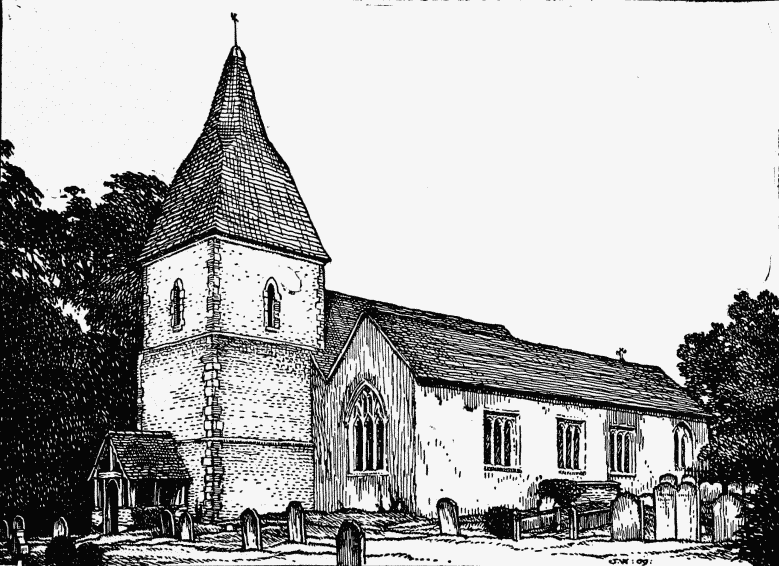
West Horsley Church from the South-west
It appears to have been largely rebuilt in the early 17th century by the second Lord Montagu, who resided there. The two wings formerly projected farther than they do now: foundations exist outside them. Probably Montagu built the gallery in the west wing. Henry Weston who succeeded in 1749 is said to have made alterations. (fn. 52) He probably cut down the wings, destroying the gallery, and built the present 18th-century brick façade. It was again altered in the 19th century.
CHURCH
The church of ST. MARY THE VIRGIN has a chancel 31 ft. 10 in. by 16 ft. 2 in., south vestry, south chapel 16 ft. by 13 ft. 10 in., nave 47 ft. 3 in. by 19 ft. 8 in., north aisle 16 ft. 6 in. wide, north porch, south aisle 13 ft. 10 in. wide, west tower 12 ft. 10 in. square, and a west porch; all these measurements are internal.
The plan is very irregular and difficult to analyse, the centre line of the tower being about 1 ft. to the north of that of the nave, which is itself 15 in. north of that of the chancel. The tower, which is of the 12th century, is built against the west wall of the nave, which is therefore of earlier date than the tower. The length of the nave, and the line of its north wall, probably represent those of an early aisleless nave, and the north wall of the chancel may also stand on the foundations of an equally early chancel.
A north aisle was added to the nave about 1210, at which time the chancel was rebuilt in a very irregular way, its north wall preserving the line of the older chancel, while the south wall fell partly beyond that of the nave. The south aisle and south chapel were both built in the 16th century, but probably the aisle preceded the chapel by a few years; the north aisle has been widened in modern times, the 13th-century north doorway moved out with the wall, while the stonework of the north arcade has been for the greater part either recut or renewed.
The external wrought stonework of the angles and window dressings has been renewed, for the most part in chalk, which is already in very bad condition; the window tracery has been renewed in Bath stone, and the whole church except the tower is covered with modern plaster.
The east wall of the chancel is pierced by three 13th-century lancet windows, their inner jambs having detached shafts with moulded bases and capitals, and pointed chamfered rear arches; and there are two contemporary lancets, set close together, at the northeast and south-east, but these have no internal shafts; a plain roll string-course runs along the eastern half of the chancel below the windows on both sides. The third window in the north wall is of three cinquefoiled lights under a pointed head filled with flowing tracery of mid-14th-century style, the tracery being renewed, but the inner jambs are old and have moulded angles brought out square above the windowledge by semicircular stops. Below the window is a contemporary tomb recess with a feathered cinquefoiled arch and a crocketed label containing a raised tomb on which lies the effigy of a priest in mass vestments; his hands are broken off, and now lie loose on the figure. In the opposite wall is an arch opening into the south chapel and contemporary with it, of very poor late Gothic detail, four-centred, and of two chamfered orders. Across the chancel runs a step of Purbeck marble. The chancel arch dates from the 13th century; it has double chamfered jambs and a pointed arch with chamfered bases and abaci. The south chapel has an original south window of three cinquefoiled lights in a four-centred arch; the jambs are of equal depth inside and out, and are moulded with a wide casement moulding on both sides: there are traces of a vertical joint outside, marking its junction with the south aisle. The nave has a north arcade of four bays, the pillars circular, and the responds half round with water-moulded bases and moulded capitals. The westernmost of the three pillars is the only one that shows signs of age and preserves traces of red colour; all the rest, together with the pointed arches, have a clean, sharp appearance and have been retooled or renewed. The south arcade has three bays with octagonal pillars, hollow-chamfered bases, and capitals of a coarse section like those of the arch to the south chapel from the chancel; the arches are four-centred and of two chamfered orders.
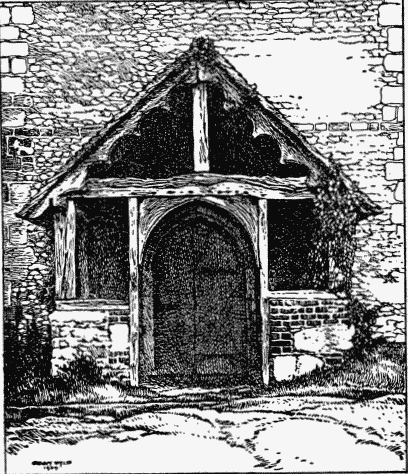
West Horsley Church: West Porch
All the windows of the north aisle are modern, the eastern being set high up in the wall and having wheel tracery in a two-centred arch; the two north windows are each of two trefoiled lights with tracery. The north doorway is of 13th-century date with jambs of three orders, the middle one with an edge roll and the other two chamfered; in the arch the middle order has a keeled edge roll; the label is grooved and hollow-chamfered. The porch is modern.
The three windows in the south aisle are coeval with the south arcade, and each of three cinquefoiled lights under a square head. All have been partly restored. The west window is a modern one of badly weathered chalk, of three cinquefoiled ogee lights under a two-centred traceried head.
In the west wall of the nave is a 13th-century doorway entered from the tower; its jambs and arch are of two chamfered orders with a moulded abacus, and grooved and hollow-chamfered label. Over it is a modern doorway presumably to a former gallery. The tower is of three stages, setting back on the outside at each stage; it is not bonded in with the west wall of the nave, its north and south walls being built against its plastered face.
The west doorway has jambs of two chamfers, changing in the pointed arch to a double ogee and wave mould. The tower is exceedingly plain, having single pointed openings in each face of the upper stage, and a curious shingled spire which is four-sided in the lower half and octagonal in the upper. The west porch is of wood set on a low wall of flint and stone repaired with brick; and has a cusped barge-board; the sides have lost the vertical studs which formerly closed them in.
The chancel roof is open-timbered and appears to be modern; the nave and aisle have semicircular plaster ceilings with old tie-beams; the north aisle roof is modern.
The rood screen is early 16th-century work with twelve traceried bays, four of which are over the central opening, which retains its double doors and a moulded cornice. On either side of the chancel are stalls, returned against the screen, and the south chapel is closed in by screens on the north and west. The font has a retooled 13th-century circular bowl with tapering sides on a modern stem flanked by four shafts with scalloped capitals.
In the nave hangs a very good brass chandelier said to have been presented by William III; it bears the following inscription: 'Martin Kaisinx et Anne Chacon son epouse, 1652: Pour parvenir au roiaume sans fin j'esper en Dieu. Fai a Namur par Pierre Rock maistre fondeur de cuivre et potin.' In the south chapel is an ancient chest with plain iron bands around it.
In the east window of the chancel are two small panels of 13th-century glass, one of the martyrdom of St. Katherine, and the other of the Last Supper, and in the 14th-century north window is the kneeling figure of a man wearing a mail hauberk, plate arm and leg defences, and a surcoat of his arms; below is the inscription: 'Jacobus Berners patronus istius eccl'ie.' Above is his crest, a lion standing. The date must fall between 1361 and 1388, when James Berners was beheaded.
On the east wall of the nave is a small panel of English alabaster of 15th-century date; it represents the Nativity. On the floor are two small brass inscriptions; one is inscribed: 'Pray for ye soules of Martyn Whyth and Annes his wyf ye which Martyn decessid ye XI day of May ye 3ere of oure Lord MCCCCC & VI on whos sowles ihũ have mercy Amen,' while the other reads: 'Hic jacet Henricus Darckam qui obiit IX° die Augusti Ao dni M Vo IIII° cui' aie ppicietur deus.' There are two large monuments in the south chapel, one on the east wall to Edward Nicholas, 1669, and the other on the south side to John and Penelope Nicholas, who died in 1704 and 1703 respectively.
There are three bells, hung in an old cage; the first is by Bryan Eldridge, 1645, the second by William Eldridge, 1687, and the third by Bryan Eldridge, 1621; the last is cracked and disused.
The communion plate comprises a silver cup and stand paten of 1634 and a large flagon and stand paten of 1666.
The first book of the registers contains baptisms from 1605 to 1754, marriages from 1600 to 1754, and burials from 1600 to 1686; the second repeats the baptisms and burials from 1653 to 1660, and the marriages for 1654. The third has burials from 1682 to 1783, of which ten years were omitted. The fourth has marriages from 1754 to 1783, the fifth baptisms from 1755 to 1783, the sixth continues them to 1812; and the seventh has marriages from 1784 to 1812; the eighth has burials to 1812.
The churchyard surrounds the building and runs a long way to the south, evidently a modern extension. The roadway passes to the north of the church and along it are some tall elm trees.
ADVOWSON
There was a church at West Horsley at the time of Domesday. Edward II claimed the presentation in 1309, and actually presented twice, (fn. 53) but the archbishop ordered the Bishop of Winchester to institute the nominee of Christina Berners. (fn. 54) This rector, Roger de Berners, a relative clearly, was removed for dilapidating the church and rectory and for marriage in 1317. (fn. 55) The lord of the manor has presented since.
CHARITIES
Smith's Charity is distributed as in other Surrey parishes.
The Rev. Weston Fullerton in 1817 gave £3,200 in the 3 per cents. for the relief of three men and three women, housekeepers of sixty years of age and upwards.