A History of the County of Surrey: Volume 3. Originally published by Victoria County History, London, 1911.
This free content was digitised by double rekeying. All rights reserved.
'Parishes: Merrow', in A History of the County of Surrey: Volume 3, ed. H E Malden (London, 1911), British History Online https://www.british-history.ac.uk/vch/surrey/vol3/pp357-359 [accessed 1 May 2025].
'Parishes: Merrow', in A History of the County of Surrey: Volume 3. Edited by H E Malden (London, 1911), British History Online, accessed May 1, 2025, https://www.british-history.ac.uk/vch/surrey/vol3/pp357-359.
"Parishes: Merrow". A History of the County of Surrey: Volume 3. Ed. H E Malden (London, 1911), British History Online. Web. 1 May 2025. https://www.british-history.ac.uk/vch/surrey/vol3/pp357-359.
In this section
MERROW
Merwe and Merewe (xiii cent.); Merroe (xviii cent.).
Merrow is a village 2 miles east of Guildford. The parish is bounded on the north-west by Worplesdon, on the north-east by Send and Ripley, on the east by West Clandon, on the south by Albury and St. Martha's, on the west by Stoke. It measures about 1½ miles from east to west, and 2 miles from north to south. It contains 1,792 acres. The southern boundary of the parish is on the ridge of the chalk down. It extends northward over the Woolwich and Thanet Beds to the London Clay. The village is just on the lower border of the chalk.
Merrow Common is open roadside land, with many trees upon it, in the northern part of the parish. The Guildford and Cobham line of the London and SouthWestern Railway intersects it. Merrow Downs, to the south, are a fine expanse of chalk down, partly covered by trees and brushwood. Newlands Corner, where the road from Albury passes up the down, is famous for the view. St. Martha's, crowned by the church, is to the right; the valley at the foot of the chalk escarpment runs eastward with the spire of Shere Church appearing among the trees. The Leith Hill range is across the south-eastern horizon. In front the rising ground of the sand, at a lower level than the chalk, is backed by the woodlands of the Weald, with the Sussex Downs beyond. Hindhead and Blackdown are to the south-west, Crooksbury Hill and the high ground near Farnham to the west.
Further north upon the downs the old Guildford race-course can still be traced. The races used to take place on the Tuesday, Wednesday, and Thursday after Whitsunday. William III gave a King's Plate of 100 guineas, which, having apparently lapsed under Queen Anne, was renewed by King George I. The races used to fill Guildford with a crowd of visitors, but the growth of Epsom and establishment of Ascot, near the same time, diminished this popularity. The Plate, however, was given as a Queen's Plate in Queen Victoria's reign. The grand stand was taken down more than sixty years ago, and the last meeting was held in 1870.
At a very early period Merrow was clearly an inhabited place. Neolithic flints are not uncommon. There is one large round barrow, or possibly two barrows, rifled, at Newlands Corner. In the valley in the downs, called Walnut Tree Bottom, are earthbanks and a barrow opened by General Pitt-Rivers, in which a sepulchral urn was found. Near here the remains of an extensive cemetery with Roman-British urns was found in 1895. Unfortunately much of the find was lost or destroyed before being notified. (fn. 1) The main road in the county, east to west, ran along the downs, and the road from Guildford to Epsom runs through Merrow village.
Of existing houses the inn near the church, 'The Horse and Groom,' is much the most curious. The newel staircase and the interior suggest a date as old as the 15th century. There is some old panelling, and the exterior bears the date 1615. A great part of Clandon Park is in Merrow parish. Among modern houses Levylsdene is the residence of Sir C. H. Stuart Rich, bart.; Woodlands, of Mr. James Cholmeley-Russel; Merrow House was the seat of the late Miss Thrupp.
There is a Congregational chapel, built in 1876. The National School was built in 1853 and enlarged in 1886; the Infants' School in New Down Road was built in 1884 and enlarged in 1896.
MANOR
There is no mention of MERROW (Merwe, xiii cent.) in Domesday Book; probably it formed part of Stoke at that date, since both were royal demesne. Henry II granted part of his demesne land at Merrow to William de St. John, (fn. 2) who granted it to Walter son of Ingard for one knight's fee. Walter had two daughters, of whom the elder married Roger Craft and had half the land which at the time of the Testa de Nevill was held by Roger the heir of Roger Craft. (fn. 3) The other daughter and co-heiress died young, and her land was granted to William de Feogières, who afterwards forfeited it to Richard I. (fn. 4) John granted it to William de Leycester, (fn. 5) whose holding in Merrow was assessed early in the 13th century at £4. (fn. 6)
Merrow was thus divided into three portions, in the hands of the king, William de Leycester, and Roger Craft respectively; the overlordship of the second had apparently passed to the priory of Boxgrove by successive grants of the St. Johns. Roger Craft granted his portion to the Templars in 1241. (fn. 7) By charter (c. 1250–60) Henry III confirmed Boxgrove and the Templars in possession, and granted the royal third to the Benedictire Priory of nuns of Ivinghce in Buckinghamshire, with the advowson. (fn. 8) The grant was confirmed by Edward I. (fn. 9)
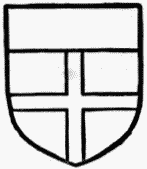
The Templare. Argent a cross gules and a chief sable.
The first grant of land in Merrow to the priory of Boxgrove in Sussex was made apparently in the time of Henry II, when William de St. John gave half a virgate of land for the sustenance of fifteen monks. (fn. 10) It should be noted that the family of St. John was connected by ties of marriage with the de Haia family who founded Boxgrove Priory. (fn. 11) In the time of Richard I Simon de Seynluz granted property in Merrow, which he had acquired of the gift of William de St. John, to Boxgrove; (fn. 12) it comprised four messuages, six tofts, one carucate of land, 30 acres of pasture, 10 acres of wood, and 12s. rent.
Cravenhurst in Merrow was held by Elgar de Utterworth (in Cranleigh) in 1285, (fn. 13) and Lucia de Say gave 17s. a year out of Cravenhurst in Merrow to the Templars. (fn. 14) The fortunes of Cravenhurst are otherwise unknown.
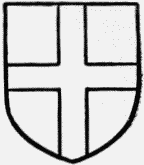
The Hospitallers. Gules a cross argent.
After the dissolution of the Templars, their lands passed to the Hospitallers. All three manors in Merrow were thus ecclesiastical property, and after the Dissolution they all seem to have been acquired by the Westons of Sutton. Henry VIII granted a lease of the Hospitallers' Manor (TEMPLE COURT) for sixty years to Sir Richard Weston. (fn. 15) Queen Mary restored the Hospitallers, and resumed this manor, which she granted to Sir Thomas Tresham, the prior, and the order in 1557. (fn. 16) The order was again dissolved on the accession of Elizabeth, and the manor was re-granted to Sir Henry Weston of Sutton in 1559. (fn. 17) In 1564 he was granted the Boxgrove manor, (fn. 18) and in 1582 he presented to the living. The rectory manor, which had been in the hands of the nuns of Ivinghoe, had therefore come to him probably by purchase from Sir John Daunce (fn. 19) (or Dauncey), for the latter presented to the rectory in 1561 and 1562. (fn. 20) It does not seem quite certain however whether the land (fn. 21) in Merrow belonging to the priory had not already been amalgamated with the rest of the property. At any rate Sir Henry Weston died in 1593 seised of Merrow, Temple Court, and Boxgrove. (fn. 22) Sir Richard Weston, his grandson, the famous agriculturist and canalizer of the Wey, recusant and delinquent in the Civil War, sold Temple House, but not the manor, to Sir Richard Onslow in 1642. His son John sold the Boxgrove part to George Duncombe of Weston in Albury (q.v.). It passed through his family to the Steeres and to the Chatfields, finally rejoining the rest in the hands of Lord Onslow. (fn. 23)
CHURCH
The church of ST. JOHN THE EVANGELIST consists of a chancel 18 ft. 5 in. by 16 ft., with north and south chapels each 19 ft. 5 in. by 14 ft., a nave 40 ft. 3 in. by 19 ft. 10 in., with north and south aisles 13 ft. 2 in. wide, and a west tower 11 ft. 5 in. square. There is also a north porch.
The church is almost entirely modern, having been rebuilt in 1842 with the exception of the south arcade and the south chapel. There are, however, a few remains of a 12th-century building, which have been re-used. Probably the church of this date consisted merely of a chancel and nave, to which were added at the beginning of the 13th century a south aisle and chapel; the arcade of this aisle still stands, and apparently part of the walls of the chapel. Owing to the rebuilding nothing of the later history of the church can be traced. In Cracklow's time it consisted of chancel with south chapel, nave with south aisle, and west tower and spire. He notes a repair in 1665. In 1881 the north aisle was added and further restoration was done.
The modern parts of the building are chiefly in 14th-century style with traceried windows, but those in the south and east walls of the south aisle are of 13th-century design.
Beneath the east window of the north chapel are built in two short 12th-century shafts with ornamental scalloped capitals, one having a scalloped base and the other a moulded one. At present they form the sides of a recess, which contains a wooden cupboard.
The only other 12th-century work is the semicircular arch of the north doorway, which has an edge roll and zigzag ornament on both sides of the order. The chamfered label is also old. The modern jambs have shafts with moulded bases and scalloped capitals.
The south arcade of the nave is of three bays with circular columns having moulded bases and capitals, and the arches are semicircular with two chamfered orders and grooved and chamfered labels on each side.
The arch at the east end of the south aisle is apparently contemporary with the south arcade, and is twocentred and of two splayed orders with a chamfered label on the west face. The jambs are of the same section as the arch, but are either recut or modern; on the east side of the arch are traces of painting.
The inner jambs of the lancet windows in the south chapel are apparently old, and below the sill of the south-east lancet is a piscina or aumbry, but only the upper part shows above the pews.
The walls throughout are of flint with stone dressings, and the roofs, which are of modern open timber construction, are covered with tiles.
The tower has an octagonal shingled spire.
The north porch is roofed with Horsham slabs and has a fine 15th-century barge-board enriched with a series of trefoils. There are six bells; the first was cast by Bryan Eldridge in 1650, the second by Richard Eldridge, and the third, which is badly cracked, is inscribed ' Johannes est nomen eius.' The three others were added in 1897 as a Jubilee memorial.
The oldest piece of plate is a paten dated 1683 and having the initials of the maker, R.P., but there is no hall-mark. Besides this there are a cup, paten, and flagon of 1842 and an elaborate altar cross set with amethysts, given in 1886 in memory of Viscount Cranley and Katherine his wife, by their children.
There are three books of registers, the first being dated 1536, but there are no entries earlier than 1544, at which date the baptisms and burials begin, the former continuing fairly regularly until 1643 and the latter to 1645, and following this are marriages from 1541 to 1636. The latter half of the book contains very irregular entries of baptisms, marriages, and burials from 1643 to 1731. The second book contains marriages from 1754 to 1812, and the third has baptisms from 1754 and burials from 1753, both to 1812.
ADVOWSON
The first mention of Merrow Church seems to be in 1208, when it was said to be in the gift of the king. (fn. 24) In 1233 Henry III granted it to the Prioress and nuns of St. Margaret Ivinghoe, (fn. 25) who retained it (fn. 26) until the Dissolution. It was granted with the other Ivinghoe lands to Sir John Daunce (see above), Sir Henry Knevitt presented in 1574 and 1577, but by 1582 it was in the possession of Sir Henry Weston. (fn. 27) In 1642 Sir Richard Weston conveyed it to Richard Onslow, (fn. 28) in whose family it has since remained.
CHARITIES
Smith's Charity is distributed as in other Surrey parishes. A donor, unknown, gave £30, the interest to go to the poor.
In 1776 Lord Onslow made an agreement with the parish by which he inclosed 19 acres of Merrow Common in Clandon Park, and gave the parish a house for a poor-house. In 1786 two families lived here rent free, and a third paid a small rent which was given to the poor-rate. (fn. 29)