A History of the County of Surrey: Volume 3. Originally published by Victoria County History, London, 1911.
This free content was digitised by double rekeying. All rights reserved.
'Parishes: Woking', in A History of the County of Surrey: Volume 3, ed. H E Malden (London, 1911), British History Online https://www.british-history.ac.uk/vch/surrey/vol3/pp381-390 [accessed 30 April 2025].
'Parishes: Woking', in A History of the County of Surrey: Volume 3. Edited by H E Malden (London, 1911), British History Online, accessed April 30, 2025, https://www.british-history.ac.uk/vch/surrey/vol3/pp381-390.
"Parishes: Woking". A History of the County of Surrey: Volume 3. Ed. H E Malden (London, 1911), British History Online. Web. 30 April 2025. https://www.british-history.ac.uk/vch/surrey/vol3/pp381-390.
In this section
WOKING
Wocingas (viii cent.); Wochinges (xi cent.); Wokynge, Wockynge, Wochynghe, &c. (xiii and xiv cent.).
Woking is a large parish giving its name to the hundred, 6 miles north from Guildford. It contains 8,802 acres, and is in extreme dimensions 6 miles from east to west and 4 miles from north to south. It is bounded on the north by Bisley and Horsell, on the east by Pyrford and Send and Ripley, on the south by Worplesdon, on the west by Pirbright. There is still a little open land about Woking Heath, but it is being covered rapidly with houses. Farther west there is more open land towards Pirbright Common and Brookwood. The soil is mainly Bagshot Sand, with alluvium in the Wey Valley. The river and the artificial navigation run through the parish. The Basingstoke Canal also runs through it. It is traversed by the main line of the South Western Railway, made in 1838, and carried by a branch to Guildford from a station at Woking Junction in 1845. Worplesdon Station on this line to Guildford, and Brookwood Station on the main line, are also in Woking Parish. The road also from Guildford to Chertsey passes through it.
Woking is ruled by an Urban District Council under the Local Government Act of 1894. In 1901 part of Horsell was added to the Woking district. (fn. 1) There are eighteen members chosen from five wards.
The parish is agricultural, where not occupied by new houses on the former waste. A certain number of small businesses have grown up in the new town. In Old Woking Village is an extensive printing establishment of Messrs. Unwin, the Gresham Press. Old Woking Mill is a paper mill. Woking Broad Mead is the old common pasture of 150 acres along the river, also called Send Mead. It is on the border of the parishes, and Woking and Send have rights in it. The old practice was, after the hay was cut, to close it till 18 September, then to throw it open to pasture for the occupiers till March, when it was closed again for the grass to grow. The waste in Sutton in Woking was inclosed in 1803. (fn. 2) The Inclosure Awards of 29 September 1815, Pyrford and Woodham, and that of Sutton in Woking, 1803, affected waste in the parish of Woking.
The parish was divided into nine tithings: Town Street, the old village; Heathside, the rising ground north of it towards the railway; Goldsworth or Goldings, to the west of Woking Junction; Kingfield, north-west of Woking; Sackleford, at the west end of Woking Street; Mayfield, south-west; Hale End, near Goldings; Crastock, in the part of the parish near Brookwood; and Sutton, on the Wey.
The character of the parish has been entirely transformed in about sixty years by the railway. Woking village lies on the river (on the old river, not on the navigation), and is out of the way, on no frequented road. It was a market town, but obscure even when Aubrey wrote, and is probably quite unknown to many people who pass through or stay in the modern Woking near the railway. In addition to the market house of 1665, which still stands in Woking village street, there are other picturesque old houses, notably a considerable brick gabled house of the 17th century, near the west end. On the hill above Hoe Bridge Place stood a brick beacon tower, said to have been built by Sir Edward Zouch to burn a light for directing messengers for James I, when staying with him, across the trackless wastes from Oatlands. It was more probably a beacon tower for the public service. It was ruinous and inaccessible for many years in the 19th century, and was finally taken down in 1858.
Whitmoor House is the property of Mr. Philip Witham, owner of a considerable estate in Woking. Sutton Park Cottage is the seat of Sir Joseph Leese, K.C., M.P.; Little Frankley, Hook Heath, of the Rt. Hon. Alfred Lyttelton, K.C., M.P.; Uplands, Maybury, of Sir A. T. Arundel, K.C.S.I.; Hook Hill, Hook Heath, belongs to His Grace the Duke of Sutherland; and Fishers Hill is a modern house built by the Right Hon. G.W. Balfour for his own occupation.
St. Edward's Roman Catholic Church in Sutton Park was built by Captain Salvin in 1876. There is an iron Roman Catholic chapel, St. Dunstan's, in Woking Town. There is a Baptist chapel built in 1879. Mount Hermon Congregational Church was built in 1903. There are also two chapels of the Wesleyans at Woking and Knapp Hill, three of the Primitive Methodists at Brookwood, Maybury, and Woking, and a meeting-place of the Plymouth Brethren. The Mosque at Maybury was built in 1889. The extensive buildings here were opened as the Dramatic College for the training of actors in 1865; but failing to answer its purpose the place was transformed by the exertions of Dr. G. W. Leitner, in 1886, into the Oriental Institute, for the accommodation of Indian subjects of the Crown visiting England, with two separate departments for high-caste Hindus and for Mohammedans respectively. The Public Hall, Woking, was built by a company in Commercial Road in 1896.
The Mayford Industrial School, for destitute boys not convicted of crime, was established at Wandsworth in 1867, removed to Byfleet in 1871, and to its present site near the line to Guildford south of Woking Town in 1886. It accommodates over one hundred boys, and has a farm and workshops. A cottage hospital was opened in 1893 in the Bath Road, and was transferred to quarters in the Chobham Road in 1897 as the Victoria Cottage Hospital, in commemoration of the Diamond Jubilee. St. Peter's Memorial Home, for sick poor, in connexion with the Kilburn Sisterhood, was opened in 1885 and enlarged in 1894, with additional rooms for ladies in bad health and narrow circumstances. At Brookwood is the Surrey County Asylum for Pauper Lunatics, opened in 1867 and much enlarged in 1903. It has a water tower 90 ft. high, which forms a conspicuous landmark. The convict prisons, male and female, at Knapp Hill, first opened in 1859, are now transformed into barracks. An Orphanage for the children of servants of the London and South-Western Railway was opened close to Woking Junction in 1909.
Woking Waterworks Company was established in 1882. It draws its chief supply from the chalk near Clandon.
Brookwood Necropolis adjoins the Brookwood Station. In 1854 a company purchased 2,000 acres in Woking and Pirbright, of which 400 acres have been laid out as a cemetery, and well planted with rhododendrons and conifers. In 1889 the Woking Crematorium was built. A public recreation ground was laid out in 1906–7 between Woking Town and Old Woking Village.
The oldest provided school in the village of Woking was opened in 1848 as a Church school. It was enlarged in 1901. St. John's was built as a Church school in 1870 and enlarged in 1876. Maybury was built in 1874, by the first elected School Board, and enlarged in 1881, 1886, and 1893. Knapp Hill was built in 1877, enlarged in 1884. Westfield was built in 1884, and enlarged in 1891 and 1895; the infants' school was built in 1896. Goldsworth Road was built in 1898.
MANORS
The manor of WOKING seems to have been Crown property from very early times. When the Domesday Survey was taken Woking was in the king's hands, and the Confessor was also reported to have held it. (fn. 3) It remained in the hands of the Crown for several centuries. King John shortly after his accession made a grant of the manor of Woking to Alan Basset, (fn. 4) who held it for half a knight's fee. His eldest son Gilbert was holding it in 1236–7. (fn. 5) He died in 1242. It was held by his brother Fulk, (fn. 6) who was Bishop of London and died in 1259. His younger brother Philip succeeded. (fn. 7) On the death of Philip, who left no heirs male, the manor descended to Aliva his daughter, who was married twice. Her first husband was Hugh le Despenser the Justiciar, killed at Evesham, (fn. 8) to whom she bore the son who was afterwards popularly known as the elder Despenser. (fn. 9) She married, secondly, Roger Bigod, Earl of Norfolk, (fn. 10) against whom Elaine, wife of Philip Basset, brought a suit for the dower which she ought to have enjoyed in Woking Manor. (fn. 11) Aliva's death, which occurred in 1281, was the signal for a dispute over her estates. (fn. 12) The earl brought a suit against Hugh le Despenser, Aliva's son and heir, on the grounds that he himself had had issue by his wife, but withdrew his claim. (fn. 13)
Hugh le Despenser was executed in 1326 in the troubled time when Edward II was deposed, and Woking reverted to the Crown. Edward III in the first year of his reign granted the manor of Woking, then said to have been forfeited by Hugh le Despenser, to his uncle, Edmund of Woodstock, Earl of Kent. (fn. 14) Under Mortimer's régime, however, Edmund was soon afterwards attainted and executed. (fn. 15) His son Edmund was restored in 1330, but died in 1333 (fn. 16) while yet a minor, and was succeeded by his brother John. After John's death without issue in 1352 (fn. 17) the manor became the right of his sister Joan, (fn. 18) then married to Sir Thomas Holand, who was summoned to Parliament as Earl of Kent in her right. (fn. 19) But his widow Elizabeth kept part of it as dower till her death in 1410–11. (fn. 20) The son of Joan and Thomas was Thomas, second Earl of Kent in the Holand line. (fn. 21)
Joan died in 1386, and although the king is named as her heir in the inquisition taken after her death, (fn. 22) many of her lands apparently passed to her other son; Thomas de Holand was certainly holding Woking at the time of his death some ten years later. (fn. 23) In the next year the Despensers released to Thomas his son and heir all rights which they possessed in Woking Manor. (fn. 24)
After the accession of Henry IV Thomas, whom Richard had created Duke of Surrey and whom Henry had deprived of the dignity, joined in the conspiracy of 1400 against the king and was beheaded as a traitor, and Woking was forfeited among his other lands. (fn. 25) Henry IV, however, restored it to Alice widow of Earl Thomas, (fn. 26) and she continued to hold until her death in 1416. (fn. 27) She left her husband's four sisters as co-heirs, and it seems as though some deed of partition must have been made, since Woking Manor remained intact in the possession of the Beaufort Dukes of Somerset, (fn. 28) who descended from Margaret, one of the co-heirs aforesaid. (fn. 29)
Edmund, Duke of Somerset, son of Margaret, was slain at the first battle of St. Albans, (fn. 30) and it was recorded at the time of his death that he held Woking Manor of the king by the service of paying him one clove gillyflower a year. He was succeeded by his son Henry, (fn. 31) who also embraced the Lancastrian cause, and was attainted in 1461, restored in 1463, but beheaded after the battle of Hexham in 1464, and attainted after his death by an Act annulling his former restoration.
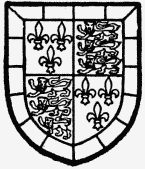
Beaufort. France quartered with England in a border gobony argent and azure.
Woking passed to the Crown. The rightful heir, Margaret Beaufort, daughter of John first Duke of Somerset, was restored to her lands at the accession of her son Henry VII, and she seems to have spent most of her time at Woking, (fn. 32) where the existing remains, though they are on the lines of the moated house described in extents of the 14th century, seem to be chiefly of about her date.
At Margaret's death in 1509 the manor once more became Crown property. (fn. 33) Henry VIII appears to have made it a favourite residence, to judge from the number of his letters which are dated thence, (fn. 34) and it was when Wolsey was on a visit to his royal master at Woking that he received the news of his nomination to the Sacred College. (fn. 35)
The Tudors continued to hold Woking in demesne, for it was Elizabeth's own house in 1583. (fn. 36) James I, however, made a grant of it in 1620 to Sir Edward Zouch, who died in 1634. (fn. 37) From him the manor passed to his son James, who married Beatrice daughter of Lord Mountnorris. (fn. 38) He died in 1643, leaving two sons, of whom Edward, the elder, died in 1658, (fn. 39) and James, the second son, succeeded to the inheritance at his brother's death. (fn. 40) This James became a person of mark in the county of Surrey; he filled the office of High Sheriff, and Symmes, the local historian of the time, speaks of him with considerable respect. (fn. 41) He died in 1708. In 1671 James had granted the reversion of his property to the king, and Charles II leased it for 1,000 years to Lord Grandison, among others, to hold in trust for his cousin, the notorious Duchess of Cleveland, and her children. (fn. 42) She held a court in 1709, but died the same year. The trustees held courts down to the year 1715, when they conveyed Woking to John Walter, who held his first court in May 1716. He was followed by his son Abel Walter, who in 1748 obtained an Act of Parliament (fn. 43) granting him the fee simple in place of the 1,000 years' lease which his father purchased. He sold to Lord Onslow in 1752. (fn. 44) It has remained in the Onslow family down to the present day.
Domesday Book mentions the existence of a mill at Woking. At the end of the 14th century the manor possessed a water-mill and a fulling-mill (fn. 45); it seems possible, however, that one of these was really in Sutton, and should be identified with the mill which was there at the time of the Survey. Henry VIII leased Woking mills to Thomas Spencer, (fn. 46) and the water-mill was again granted out by Elizabeth (fn. 47) and James I. (fn. 48) The fact that the two mills were separated after the grant of Sutton Manor to Sir Richard Weston again seems to suggest that one of these mills was in Sutton. This one would then be the mill near Trigg's Lock, the other the mill on the old river just south of Woking village.
Henry VI in 1451 granted to Edmund Duke of Somerset and his heirs the privilege of having a fair every Whit Tuesday. (fn. 49)
James Zouch in 1662 received the grant of a fair on 12 September and a weekly market on Friday, (fn. 50) and in 1665 he built the market-house which still stands in Woking village street.
The old royal residence at Woking Park lay down the river a mile from old Woking village. An early 14th-century survey was seen by Symmes (fn. 51) in very bad condition, and copied. It has now perished. It appears from it that there were extensive buildings, with two chapels, within a double moat. The double moat is shown in the survey of Woking Park by Norden of 1607, (fn. 52) and the remains of it are still visible at Woking Park Farm. There were a cornmill and a fulling-mill on the manor, and a deer park. The park extended from the manor-house along the river to Woking village and up over the high ground nearly to the present railway line. In addition to the royal visits mentioned above, (fn. 53) Edward VI was there in 1550, (fn. 54) and Elizabeth in 1569 (fn. 55) and 1583. (fn. 56) In what is now a farm building is a brick gateway of the earlier 15th century, much dilapidated, leading into a building with a barrel vault of small bricks of a rather later date, and communicating with what is now a barn of old chalk, brick, and timber work. But the whole is in very bad repair. Sir Edward Zouch, probably finding the manor-house in a ruinous state, built a new house with two courtyards nearly a mile away on higher ground at Hoe Bridge Place. James Zouch his grandson built a third house contiguous to this, on a smaller scale, the date of which is fairly determined by mythological paintings on the staircase attributed to Antonio Verrio, who decorated Hampton Court for James II and William III, and by a painting on the ceiling of a drawing-room, attributed to Sir Godfrey Kneller, and certainly celebrating the peace of Ryswick under allegorical forms. Some part of the second house perhaps remains in the stable buildings and its foundations. James Zouch died in 1708, and Hoe Bridge Place passed to his niece Sophia, who in 1718 conveyed it to James Field, who sold it in 1730 to John Walter; he cleared away the remains of the second house and altered the existing building. It is now the residence of Mr. F. H. Booth, who has made further alterations. The park was destroyed at the time of the Civil Wars, when the Zouch family was royalist. (fn. 57)
The manor of SUTTON was held at the time of Domesday by Robert Malet; Wenesi had held it of King Edward. (fn. 58) Robert's lands were confiscated for his adherence to the side of Duke Robert in 1102. Sutton, which was held as of the honour of Eye, was granted to Stephen, afterwards king. It passed to his only surviving son William, who married the heiress of de Warenne. On his death, 1159, it reverted to the Crown, (fn. 59) and although it was still of the honour of Eye was granted separately by Henry II to a certain Master Urric. (fn. 60) His son died without heirs, and King John granted Sutton to Gilbert Basset, son of the holder of Woking. (fn. 61) It descended to his brother Fulk, Bishop of London, and to his younger brother Philip, (fn. 62) and to Aliva, Philip's daughter, who married first Hugh le Despenser, and secondly Roger Bigod, Earl of Norfolk, who claimed it after her death in 1281, (fn. 63) but whose claim was disallowed in favour of Hugh, Aliva's son by her first husband. It was forfeited with Woking, and with it was granted by Edward III to the Earl of Kent. They continued to be held together for nearly 200 years. In 1521 however Henry VIII granted Sutton to Sir Richard Weston, (fn. 64) at whose house he was afterwards forced to take refuge when an outbreak of the sweating sickness drove him from Guildford. (fn. 65) The manor remained in the Weston family until the end of the 18th century, when Melior Mary Weston, the last of her line, bequeathed it to John Webbe on condition that he assumed the name and arms of Weston. (fn. 66) The male line of Webbe-Weston became extinct in 1857. The manor passed to F. H. Salvin of Croxdale, Durham, a grandson of the first John Webbe-Weston. He died in 1904, and was succeeded by his niece's son, Mr. Philip Witham.
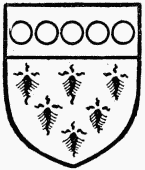
Weston of Sutton. Ermine a chief azure with five bezants there-in.
Owing no doubt of Woking and Sutton having being held together before the reign of Henry VIII, the old manor-house of Sutton had been allowed to fall into decay. In 1329, after the death of Edmund, Earl of Kent, the house was ruinous and worth nothing. It stood near St. Edward's Chapel, a quarter of a mile from Sutton Place. The field is called Manor Field, and traces of foundations, old encaustic tiles, and an old well exist.
Sutton Place was built by Sir Richard Weston, most probably about 1523–5, at one of the most interesting periods of English architectural history, and is from every point of view a notable house. Alike in detail and in plan it shows the meeting of the old and new schools; the ornament is Italian, but the construction is Gothic. There is a hall which had screens, kitchen, and offices after the mediaeval type, but its plan is affected by the desire for exact symmetry and balance which its external elevation to the courtyard shows, and in place of stone all windows, parapets, etc., are of terra cotta.
The plan was quadrangular, four ranges of buildings, with the gatehouse and entrance on the north, inclosing a court 81 ft. square. The hall and kitchen were in the south wing, the great chamber and principal rooms in the east wing, and on the north and west were sets of living rooms called lodgings. A fire damaged the north and east wings in 1560, and they were never thoroughly repaired, and the north wing with its gatehouse, after standing in a ruinous state for many years, was pulled down in 1782, throwing the courtyard open to the north, as it remains to-day.
Though the general arrangement of the original house is certain, many points in it are far from being so, and some of these are of particular importance in the history of house-planning. An inventory of 1542, taken at the death of the builder, Sir Richard Weston, is unfortunately not so explicit as could be wished, making no mention of a great hall or dining chamber of any sort, and, as in the contemporary inventory of the Vyne in Hampshire, the word 'chamber' seems to be used for ground- and first-floor rooms alike. The great hall as it appears to-day is a fine room two stories in height (31 ft.), 51 ft. long by 25 ft. wide, lighted on the north by three-light windows and a four-light bay window in each story, and on the south by two three-light windows and a four-light bay also in each story. The exact repetition of these windows may perhaps be set down to the exigencies of symmetry, for, especially in the bays, the internal effect is far from satisfactory, but the fact that all the details of panelling, etc., are of the early part of the 17th-century raises a question as to whether there was not a first floor over the hall in its original state. The fact that the hall chimney-stack on the south side has not one but three chimneys points in the same direction. The hall fireplace accounts for one of these, and though it is true that there is a cellar under the hall, it is most unlikely that it should have had two fireplaces, and the former existence of a first-floor fireplaces seems therefore very probable.
The upper floor of the east wing is now arranged as a 'long gallery,' 152ft. by 21ft., but although Wolsey had built galleries at Hampton Court before this time, it seems clear that such a room formed no part of the 16th-century house here. Its present form dates only from 1878, and part of it was used as a chapel during the 19th-century.
In spite of the evidences of Italian influence, the general aspect of the house is Gothic, showing everywhere the simple directness and absence of ostentation which mark the mediaeval English country house. The gatehouse was a stately building, as existing drawings show, being nearly twice as high as the rest of the house, but its treatment was absolutely straightforward, and no attempt was made to impress anyone approaching the house with a sense of magnificence, all the elaborate ornament being characteristically reserved for the inner walls of the courtyard. Even here there is a certain artlessness in the way it is used which is entirely native to the soil. The hall doorway, flanked by three-light windows and distinguished by a double row of terra-cotta amorini above its head, is framed by a pair of half-octagonal terra-cotta buttresses running up beyond the general lines of the elevations, and capped by domed pinnacles, having between them a high embattled parapet, forming as it were the centrepiece to the whole design. Yet the very centre of the composition, the facade of the first floor over the hall doorway, where a Palladian architect would have put forth his full strength, is a blank expanse of brickwork.
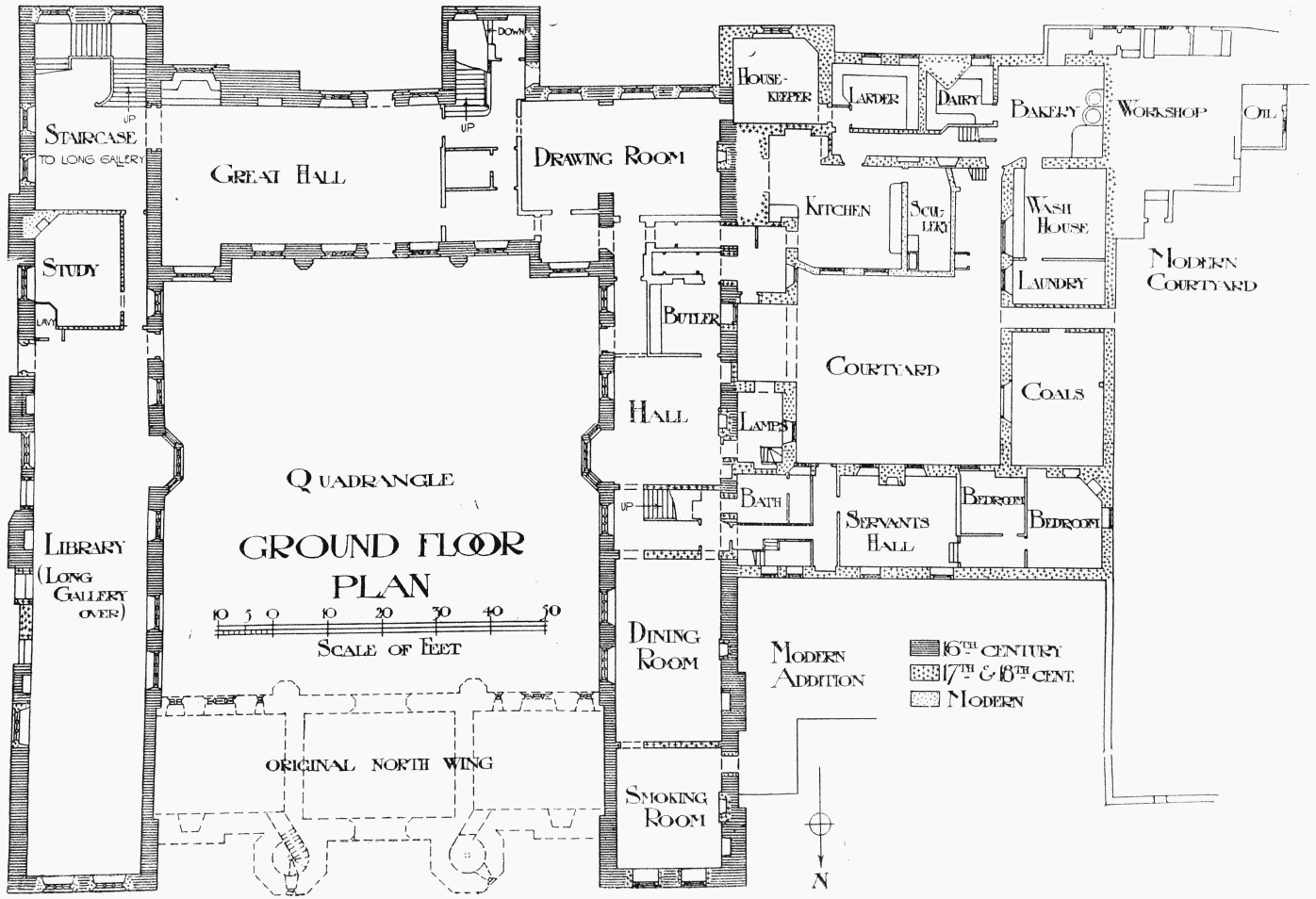
Plan of Sutton Place
The original windows are all of three lights, except in the projecting bays, and are worked in terra-cotta. All have transoms with trefoiled heads beneath them, but the upper lights on the first floor are trefoiled, while those on the ground floor are cinquefoiled. Heads, sills, and mullions are enriched with a line of Italian ornament in low relief, adding a peculiar distinction to the work. The line of the first floor is marked by a string-course of Gothic section decorated with tuns (a Weston rebus) set in Italian floral scrollwork, and there is a similar string-course at the base of the parapet, but without ornament, except on the façade of the hall. On the east and west sides of the courtyard this string runs just over the first-floor window-heads and below it and between the windows is a line of lozenge-shaped panels with leaf ornament. On the hall façade, as formerly on the south front of the gatehouse range, the string is at a higher level, and the line of lozenge-shaped panels runs unbroken over the windows. The parapet itself is solid, ornamented with similar lozenge panels or with quatrefoiled panels; its outline was originally broken by pinnacles, of which only the stumps now remain, while the higher parapet above the hall door has a further band of trefoiled panels containing amorini, and lozenge panels on the battlements. The masonry of the half-octagonal buttresses which flank it is moulded with cusped panels containing the initials of the builder, R.W., or bunches of grapes, and the same detail occurs on the bays at either end of the façade of the hall, and on the north ends of the east and west wings; otherwise the external elevations of the house have no ornament, except the south elevation, where the existing parapet of the hall block is, however, of mid-17th-century date. The modelling of the floral ornament leaves little to be desired; but that on the quoins is markedly inferior, and the amorini are very stiff and clumsy and evidently some way from their Italian originals. That a good deal of this renaissance work was carried out by English workmen is known, as at Hampton Court, where, however, Richard Ridge and his fellow workmen wrought the pendants of the great hall roof of Henry VIII in masterly style; but here at Sutton it must be confessed that the lesson has not been so thoroughly learned.
The terra-cotta work has, with little exception, stood nearly four centuries of English weather in a wonderful way. A good deal of the window tracery, especially on the external elevations, was at one time or another taken out and replaced by sash-windows, but these in their turn have nearly all given way to modern copies of the original work.
It seems probable that the principal alterations to the house, other than those of quite recent date, took place in the 17th century, after the sale of Clandon in 1641, and of Gatton in 1654, when John Weston had command of money. The parapet on the south side of the hall, with its large mill-rind crosses, is clearly of this time, the crosses being the arms of Copley, whose heiress married John Weston in 1637. A great deal of panelling in the house is also of this time, and the impaled arms of Weston and Copley are painted over the fireplace in the small hall in the west wing. The second or kitchen court was doubtless added at this time; being set against the west side of the house, it is quite unpretentious, and makes no attempt to harmonize with the 16th-century work.
The partition walls dividing the original house were as usual of timber, the only internal masonry walls being those which separated the north and south wings from the east and west. Apart, therefore, from the fire of 1560, the chances of alteration of the original arrangements must have been many, particularly as regards the staircases, none which now exist being older than the 17th century. The disposition of the house at present is that the principal entrance is from the court at the south end of the west wing, the doorway opening to a narrow lobby which leads directly to the small hall on the north, and going northward from the hall are successively a staircase, the dining-room, and the smoking-room. The diningroom is furnished with very good oak panelling, a recent importation, but the stair, which is good 18th-century work, has its south wall covered with early 17th-century panelling which seems to be in situ. The drawing-room is on the ground floor at the south-west angle of the old building, a fine modern room, and between it and the great hall is a lobby opening to a staircase in a projecting bay, the woodwork showing its date to be c. 1700. This with the other staircases is doubtless part of the work of John Weston, 1701–30.
The great hall is approximately two squares on plan, and its arrangement, as already noted, is abnormal, as its entrance doorways on the north and south are two bays east of the line of the screens, and could never have opened into anything of the nature of a passage. The present panelling is in part of Jacobean date, and the rest of later 17th-century work with 18th-century alterations. From the inventory of 1542 it is clear that the hall was hung with tapestry, and there was probably no panelling in the first instance. But the principal attraction of the hall is its glass; a great deal of this was evidently put in after the marriage of Richard Weston and Mary Copley in 1637, but some pieces are of earlier date, and may be in their original position, in which case they must have been made about 1530. Some also, which may have come from the royal manor-house at Woking, are apparently older than this, and there are Onslow arms and others which are doubtless added from various sources.
The set of Tudor arms and badges is extremely good, and the arms of Richard III as Duke of Gloucester also occur. The glass was repaired in 1724 by John Weston, and again in 1844. (fn. 67) The fireplace is part of the original work, and has in its spandrels the Weston rebus and the pomegranate.
The east wing, as already noted, was practically abandoned for a long time, and only partly refitted early in the 18th century by John Weston, to whom the fine staircase at its south end is due. The stairhead and the long gallery take up the whole of the upper floor, and the tapestries and panelling are of great interest; about half of the lower floor is now made into a library. The house is full of fine furniture, pictures, etc., which cannot here be adequately described. The quadrangle of offices on the west side of the house is said to be the work of John Weston, 1652–90, and though quite unpretending, is very picturesque. The principal gardens lie to the west of it, and part of their inclosing walls is of 16th-century date and of the same character as the house, but the lay-out of the Tudor garden is unfortunately not now recoverable. The house is now the residence of Lord Northcliffe, to whom the recent restoration is due.
There was a mill at Sutton in the time of Domesday, which does not however appear to be mentioned afterwards. It may perhaps be included with the Woking mills (q.v.).
The manor of CRANSTOCK, CRASTOCK or BRIDLEY was apparently the land recorded in the extent of Woking Manor (fn. 68) as bought by Fulk Basset of the fee of Pirbright, which was part of the honour of Clare; for Cranstock owed suit and service to the Lord of Pirbright. (fn. 69) Both Pirbright and Woking were granted to Edmund, Earl of Kent, (fn. 70) and Pirbright descended to Joan his daughter, who married Edward, Prince of Wales, of whom Cranstock was held in 1366. There was apparently always a sub-tenancy, for in 1219 Gilbert de Chayham and Alice his wife granted half a hide in Cranstock to William de Cranstock, (fn. 71) and some years later Ralph son of William de Tinchingfeld leased the manor of Cranstock to Roger son of William de Cranstock for life. (fn. 72) Apparently the manor did not remain long with either of these families, for in 1321 a certain Lambert de Thrikyngham sold it to John de Latimer and Joan his wife, with remainder to their son Edmund. (fn. 73) The manor remained as a possession of the Latimers for some little time; in 1366 Robert Latimer died seised of it, leaving Robert his son and heir, then only a child. (fn. 74)
Little can be traced of the history of Cranstock for some time after the death of Robert Latimer. In 1469 it appears in the hands of John White, who died in that year, leaving his son Robert as his heir. (fn. 75) In 1531 Henry White conveyed to Walter Champyon, William Roche, Thomas Pierpoint and Anthony Eliot, possibly as trustees, (fn. 76) and until the beginning of the next century the manor seems to have remained with them and their successors. In 1611 William Engler and William Skynner released to James Hobson, (fn. 77) and Christopher Hobson, presumably the heir of James, sold in 1641 to Francis Williamson. (fn. 78) He in 1652 joined with his wife Martha in conveying the manor to Paul Carell (fn. 79) (or Caryll), who held his first court in August 1652, and Paul Carell is said to have bequeathed the manor to his cousin John of Great Tangley Manor, Wonersh. (fn. 80) John was also seised of Bramley Manor and other Surrey lands, most of which were divided at his death among his three daughters and co-heirs, Lettice wife of John Ramsden, Elizabeth wife of Peter Farmer, and Margaret wife of Henry Ludlow. Cranstock was among the lands divided. (fn. 81)
Between 1678 and 1680 John Child of Guildford purchased three parts of the manor, which passed to his son Leonard, who died in 1730. Leonard left it to his nephew Charles, who held a court in 1742. He sold it to John Tickner about 1758, and from him it was purchased by Richard (? Philip) Hollingworth, who sold it to Sir Fletcher Norton, first Lord Grantley. (fn. 82) Lord Grantley's Surrey estates were sold about 1884. Major Ewings' trustees sold Bridley or Crastock to Mr. Garton in 1894, who conveyed it in 1900 to Mr. Richards. Most of the land has been bought by Mr. Anderson, who resides at Bridley Manor. (fn. 83)
In the 13th century Geoffrey de Pourton held MAYFORD in chief of the king, (fn. 84) by grand serjeanty. In 1231 and 1238 the sheriff accounted for 10s. 3d. from the land of the late Henry Kinton in Mayford. (fn. 85) Henry Kinton and Walter de Langeford were Geoffrey's heirs. (fn. 86) Walter de Langeford sold his moiety to John de Gatesden. (fn. 87) The serjeanty was acquired by Fulk Basset, (fn. 88) and in the survey of Woking in 1280–1, (fn. 89) Mayford is called part of Woking Manor. It remained hereafter attached to Woking.
The tithing of Mayford appears in 1666. (fn. 90) Tenements in Mayford occur frequently in Feet of Fines.
The reputed manor of RUDEHALL or HOLLANDS, really a part of Woking, possibly originated in land held by William de la Rude in Woking in the 13th century. (fn. 91) It is at Hale End, which is perhaps a corruption of Holland or Hollands. In the reign of Henry VIII the Heyward family released their rights in the manor of Rudehall to John Grover. (fn. 92) In 1601 William Grover conveyed it to William Collyer, (fn. 93) and in 1622 it passed to Sir Edward Zouch. (fn. 94) It afterwards came into the hands of the Covert family, who were holding it in 1690, (fn. 95) when they sold it to Robert Royden. (fn. 96) Royden in 1724 alienated it to John Coussmaker. (fn. 97) In 1745 Nathanael Newnham conveyed it to William Collyer, (fn. 98) who in 1748 sold it to Philip Hollingworth (fn. 99) (see Cranstock, above). It probably subsequently descended in the same way as Cranstock.
CHURCHES
The parish church of ST. PETER has a chancel 28 ft. by 20 ft. 1 in., modern north vestry, nave 49 ft. 8 in. by 29 ft. 11 in., south aisle 12 ft. 8 in. wide, south porch, and west tower 12 ft. 9 in. square—all inside measurements.
The earliest part of the building dates from the beginning of the 12th century, at which time it consisted of an aisleless nave, the present one, and a chancel; the latter was probably smaller than the present chancel, which is a rebuilding of about a hundred and twenty years later. The lower part of the existing tower was also added in the 13th century, about 1240, and may have had a timber upper stage until the present stone addition over it was built about 1340.
The east window of the chancel is an insertion of the second quarter of the 14th century, and is a fine example of the style; it is set rather to the south of the axial line of the chancel, and this may have been a piece of subtlety on the part of the builders to make it appear central with the nave, as it will be noticed that the centre line of the nave passes through that of the window, which it would not have done had it been in the middle of the wall. The large window in the north wall of the nave is of the same period, but has modern tracery. At the beginning of the 15th century the south aisle was added, with the present arcade, and at the same time the chancel arch was widened to its utmost limits. Soon after this the rood loft was set up and a passage way pierced through the wall above the east respond, the bases of the chancel arch being cut to accommodate the screen. Two other windows were inserted in the north wall in the same century, the easternmost evidently to light the north nave altar.
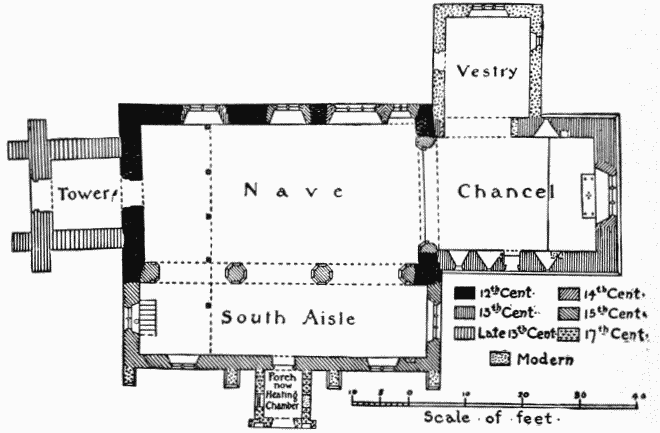
Plan of Woking Church
The west gallery was put up in 1622, and the south porch was probably added at the same time; when the modern vestry was built the 13th-century lancet, displaced by the organ arch, was reset in its east wall. A certain amount of necessary restoration to several of the windows has been carried out and other work done to put the building in good repair. The only entrance to the church (a fairly large one) besides the small door in the vestry is that in the west wall of the nave, approached through the tower.
The 14th-century east window is one of three trefoiled lights under a two-centred arch filled with flowing tracery, now modern; it has two chamfered orders outside and a scroll-mould label; the inside jambs are old and the pointed rear arch is chamfered. In the north wall is a plain square locker, partly restored; the 13th-century lancet in this wall has its glass two inches from the outside, but a groove in the jambs shows that it had formerly been set farther in. On the south side are two original lancet windows like that opposite. Below the first is a modern arched recess with an old sill having a piscina drain in the west half, and a plain surface on the east, while between the windows is a blocked doorway not visible outside owing to the modern coating of cement; it has a segmental arched head inside of square section like the jambs, and is probably contemporary with the windows. At the west end of this wall is a low window of a single trefoiled light with much deeper chamfered jambs outside; it has been a good deal knocked about, but is probably a 14th-century insertion.
The vestry has a three-light window in its north wall, the reset 13th-century lancet already mentioned in its east, and a doorway to the west. In the vestry are preserved two bases of small shafts contemporary with the early nave, and one 13th-century base.
The chancel arch has semi-octagonal jambs with moulded bases and capitals of a heavy section, the latter with ogee abaci; the wall above is evidently of the date of the arch and not older work pierced, and the arch is of three chamfered orders, the inner order considerably wider than the others.
The first of the four north windows of the nave is a 15th-century insertion of two trefoiled lights under a square head with sunk spandrels; the window is set low in the wall and the wall below the sill thinned to form a recess for the nave altar. The second window is a large 14th-century insertion of three lights; the outer order of the double chamfered jambs is old, but the tracery is modern; the inner quoins of the jambs and the pointed chamfered rear arch are also old. The third window is another 15th-century insertion of two cinquefoiled lights with a quatrefoil over in a four-centred arch, and the last or north-west window is of the 13th century, with two plain pointed lights and a pierced spandrel over in a two-centred arch; like the third window the jambs are of a single chamfered order outside.
The south arcade is of three bays with octagonal pillars, fine massive work in chalk, with simple details and semi-octagonal responds, the bases, capitals, and arches being of similar detail to those of the chancel arch. The bases have been mutilated in the responds; on the south side of the east respond the base mould is splayed back to the wall instead of ending square, but there seems no obvious reason for the treatment. The haunch above this respond is pierced by a square passage-way through the wall to the former rood loft. The west doorway of the nave is part of the original work; its jambs have been cut to enable the door to open outwards, and were originally of two orders; in the angles of the remaining order are round shafts with chamfered bases and cushion capitals, the chamfered abaci of which have been much mutilated for the fitting of the door; the arch is round and of one order with a large edge roll and no label.
The wood door itself is evidently very old, and probably with its iron work contemporary with the doorway. It is made of oak planks, half an inch thick, bound together by iron straps of ornamental design on both faces, the hinge straps being the least important part of the work. There are five large horizontal bands, three of which are attached to large C-straps like those shown in early MSS.; all the bands and straps have forked and curled ends, and small curled sprigs of iron spring from them at irregular intervals. In the upper part of the door are a cross, a saltire, and a spider's web with an insect in it. The rounded head of the door is fixed, but probably opened with the rest originally, when it was hung in the east side of the doorway.
The east window of the south aisle is one of three lights under a traceried pointed head; all modern outside except the outer order of the head and the upper half of the jambs; the inner jambs, quoins, and the pointed chamfered rear arch are old. In the south wall is a piscina with a cinquefoiled pointed arch in a square head with sunk spandrels; half of the sill with its round basin has been cut away. The three south windows are alike, each of two cinquefoiled lights with a quatrefoil over; all three are wholly modern outside, but have old inner jambs and pointed rear arches, the latter being almost straight-sided. The middle window has been reduced a half for the insertion below it of a doorway with a two-centred segmental arch; it was probably inserted shortly before the 17th-century porch was built, and is now blocked up. The porch is of narrow red bricks with a stepped gable and has an outer archway with moulded jambs and elliptical arch, flanked by low small arched recesses. The side walls were pierced by windows with wood frames, but that in the east wall is now filled in and the porch used as a boiler room for heating purposes. The west window of the aisle resembles the others and is entirely modern outside; in its flat inner sill is set the plain round drain of a piscina, which must have been brought to the church from elsewhere.
The tower has no break or string-course in its height, the lower part being strengthened by pairs of angle buttresses. The west doorway has jambs of two orders, the outer hollow chamfered, the inner square, the two-centred arch has a much decayed scroll mould label; the door is a modern one, but has a handle and plate inscribed R D F V 1731. The window over is a square one of brick, probably of the 17th century. The first-floor chamber is lighted by a small rectangular light in each wall, that to the south having been repaired with brick; and over these on the north and west sides are clock faces. The windows of the bellchamber are each of two trefoiled lights with a quatrefoil above in a two-centred head; the north window is old, but the others are partly or wholly modernized; the parapet is embattled and has a moulded string-course. The lower part (less than a half) of the tower is of flint and iron conglomerate with stone quoins and dressings; the buttresses, which are of two stages, have been repaired in places with brick and are covered with tiles; the bottom of the north wall has also been patched in brick, while the upper part of the tower is of square-coursed rubble or rough ashlar.
The north wall of the nave is a good specimen of early masonry, built of whole flints and pieces of iron-stone conglomerate, but the chancel walls have been newly cemented outside, and their character thus hidden.
The roof of the chancel is gabled, and has a modern plaster panelled ceiling with moulded wood ribs and moulded tie-beam; the nave has a plastered collar-beam ceiling and modern trusses dividing it into three bays. The gabled aisle roof also had a modern ceiling, but the plaster has been stripped off, revealing the old timbers. The gallery at the west end has an inscription upon it recording its erection by Sir Edward Zouch in 1622; it runs right across the west end of the nave and aisle, the front being carried on five oak posts; but only that part which is in the nave is old.
The altar-table has thin turned legs, and is probably of the 18th century, but the pulpit is six-sided and evidently of the same date as the gallery. The font is modern, of carved and panelled stone on marble shafts.
In the tower is an ancient oak chest of plain design with a plain strap to the lock.
In the quatrefoil in the head of the middle window of the south aisle is a fragment of old glass, probably original with the aisle—a six-petalled double rose, yellow and white, a piece of border with a lozengy or fret pattern, and other flowers.
In the blocked doorway of the south aisle is set a small brass inscription which reads:—'Pray for the soules of John Shadhet et Isabell hys wyfe the which John decessed the XI day of Marche yn the yere of our lord MVcXXVII on whos soullŷ Jhu have mercy.' Above it are two standing figures praying; the man has long hair, and wears a long fur-trimmed cloak with sleeves; the lady has a long linen head dress, fur cuffs, and a loose belt about her dress at the waist with ends reaching to the ground; below is part of an indent, probably that of the children. By the side of this brass is another inscription:—'Pray for the soules of Henry Purdon and Johan hys wyfe which Henry deceessed the VII day of Noveber the yer of ō lord MVcXXIII on whose soules Jhu have mercy, Amen.' Over it were two figures, but that of the man is missing; the lady is dressed like the other. Between these two brasses are the figures of four girls.
In the chancel is a brass inscription to Sir Edward Zouch who died in 1634; it has a long eulogistic epitaph in Latin; also a mural monument to Sir John Lloyd, bart., who died in 1663. There are several later monuments.
There are six bells: the treble, second, third and fifth were cast by William Eldridge 1684, the fourth is dated 1766 and has the initials I F cut in; this is said to have been cast near the church; the tenor was by Eldridge 1684, but was recast by Warren in 1887.
The church possesses no old plate, the set in use comprising two silver cups and a standing paten of 1837, a plate of 1805, and a plated flagon.
The first book of the registers contains baptisms, marriages, and burials from 1653 to 1672; the second has baptisms from 1673 to 1770, marriages 1673 to 1754, and burials 1673 to 1786; the third has marriages 1754 to 1763; fifth, marriages 1763 to 1787; sixth, the same to 1812; seventh, baptisms from 1770 and burials from 1787, both to 1808; eighth, baptisms 1809 to 1812; and ninth, burials for the same period.
ST. JOHN THE BAPTIST'S CHURCH, of stone in 13th-century style, was built by Sir Gilbert, then Mr., Scott, in 1842 at Goldsworth, and enlarged in 1879 and 1883.
The present church of CHRIST CHURCH parish was built in red brick in 1889.
ST. PAUL'S, MAYBURY HILL, built of red brick with Bath stone windows and quoins, was erected in 1895 as a chapel of ease to Christ Church.
An iron church, Holy Trinity, was built at Knapp Hill in 1855.
ADVOWSONS
The church of Woking from early times seems to have had the Prior and convent of Newark in Send as its patrons. (fn. 100) After the dissolution of that monastery in the 16th century, it generally followed the history of the manor. A few exceptions must, however, be noted. Thus it was granted by Philip and Mary to John White, Bishop of Winchester. (fn. 101) Elizabeth seems to have resumed the patronage, and towards the end of her reign granted it to Francis Aungier, (fn. 102) afterwards Baron Longford. Under James I two persons, named respectively Francis Maurice and Francis Phelips, (fn. 103) received it from the Crown, but this grant was possibly in trust for the lord of the manor, for James Zouch presented in 1637, (fn. 104) and from that date it has been united with the manor.
The parish of St. John the Baptist was formed from the old parish in 1884. The living is in the gift of the vicar of Woking.
Christ Church parish was formed out of the same district in 1893. In 1877 it was served by a temporary church. The living is in the gift of trustees.
CHARITY
Of old charities only Smith's, distributed as in other Surrey parishes, appears to exist.