A History of the County of Surrey: Volume 3. Originally published by Victoria County History, London, 1911.
This free content was digitised by double rekeying. All rights reserved.
'Parishes: Chertsey', in A History of the County of Surrey: Volume 3, ed. H E Malden (London, 1911), British History Online https://www.british-history.ac.uk/vch/surrey/vol3/pp403-413 [accessed 30 April 2025].
'Parishes: Chertsey', in A History of the County of Surrey: Volume 3. Edited by H E Malden (London, 1911), British History Online, accessed April 30, 2025, https://www.british-history.ac.uk/vch/surrey/vol3/pp403-413.
"Parishes: Chertsey". A History of the County of Surrey: Volume 3. Ed. H E Malden (London, 1911), British History Online. Web. 30 April 2025. https://www.british-history.ac.uk/vch/surrey/vol3/pp403-413.
In this section
CHERTSEY
Cerotesege (earliest charters, ascribed to vii cent.); Certesia (in Latin of the same); Certesyg (xi cent.); Certeseye (xiii cent.); Chertesay (xiv cent.).
Chertsey is a market town on the Thames 9 miles from Windsor and about the same from Kingston. The parish is bounded on the north-west by Egham and Thorpe, on the north-east by the Thames between it and Middlesex, on the south-east by Weybridge, Byfleet, and Pyrford, on the south-west by Horsell and Chobham. It measures about 4 miles each way, being roughly quadrilateral. The north-eastern and eastern parts are on the gravel, sand and alluvium of the Thames Valley and of the Wey Valley. The old course of the Wey forms part of the eastern boundary, and the actual confluence of the Wey and the Thames is in Chertsey parish, not Weybridge. The Bourne Brook and the stream from Virginia Water which joins it flow through the parish to the Thames. The western and southern parts of the parish are on higher ground where the barren heaths of the Bagshot Sand begin, these stretching back to the commons of Woking and Chobham. Eminences of the Bagshot Sand stand out above the river valleys also, the most striking being St. Anne's Hill, west-by-north of the town. It is only 240 ft. above the sea, but from its situation in the middle of the valley it commands fine views through gaps in the trees with which it is rather too thickly planted.
Chertsey still remains a pleasant country town. There are three chief streets, London Road and Windsor Street forming part of the road between those places, and Guildford Street at right angles to them. In the last is a Jacobean house, now the Queen's Head Inn, and the remains of the house where Cowley died in 1667, incorporated into a modern house. A room supported on posts, which projected over the road, was removed in 1786. The house is the residence of Mrs. Tulk. In 1791 the following description of it is given:—'A good old timber house, of a tolerable model. There is a large garden; a brook arising at St. Anne's Hill runs by the side. They talk of a pretty summer house which he built, which was demolished not long since; and of a seat under a sycamore tree by the brook which are mentioned in his poems. There are good fish-ponds of his making.' (fn. 1)
The parish was divided into tithings called Chertsey, Allesden, and Adisford (i.e. Addlestone), Lolewirth or Hardwitch in Hardwicke, Rokesbury in Lyne, Haim, Crockford or Crotchford, Woodham, and Botleys. The Hundred Court of Chertsey for Godley Hundred was held in Hardwicke. The parish is now an urban district under the Local Government Act of 1894, (fn. 2) and is divided into three wards, Chertsey, Addlestone, and Outer Ward.
Chertsey is served by the Weybridge and Chertsey branch of the London and South Western Railway, opened in 1848, with stations at Addlestone and Chertsey, and since continued to join the Wokingham branch at Virginia Water. The connexion with Woking was completed in 1885. The road from London to Windsor runs through the town, and a bridge connects the town, which lies nearly a mile from the actual banks of the river, with Shepperton in Middlesex.
There was no bridge at Chertsey in 1300, (fn. 3) when a ferry was the only means of conveyance. There was a bridge under Elizabeth, which was out of repair. This wooden bridge, kept up by the counties of Middlesex and Surrey, was badly out of repair in 1780, when the stone bridge was built. The bridges over the branches of the Water of Redwynde, as it was called, the stream which flows from Virginia Water, and over the water-course which left the Thames near Penton Hook and rejoined it near Chertsey, seem to have been originally built or repaired by the abbey. Abbot John Rutherwyk rebuilt the bridge at Steventon End, near the end of Guildford Street, in the time of Edward II, (fn. 4) but this bridge fell into disrepair and was rebuilt under Henry IV by the town with the king's licence, the king insisting that it should be called his bridge. (fn. 5)
A market was granted to the abbey in Chertsey by Henry I, (fn. 6) and was confirmed in 1249 (fn. 7) and in 1281. (fn. 8) It was held on Mondays. Whether this market lapsed at or before the Dissolution is unknown. But in 1599 Elizabeth granted by charter a market on Wednesdays, and a fair, over and above any existing fair, with a parcel of ground for the building of a market-house. The charter was to twenty-one persons, their heirs and assigns, but the profits of the tolls were to go to the poor of Chertsey. (fn. 9) A market-house of the usual type, supported on pillars, was accordingly built near the south-east angle of the churchyard. In 1809 it was demolished, and in 1810 a new market-house was built in Bridge Street.
Henry I also granted the abbot a three days' fair to be held at Chertsey every year at the festival of St. Peter in Chains. (fn. 10) A second grant for a three days' fair to be held annually on the vigil, feast, and morrow of the Exaltation of the Cross was made to the abbot in 1249. (fn. 11) This fair, now held on 25 September instead of the 14th, is called the Onion Fair. (fn. 12)
Yet another grant of a three days' fair, to be held at Ascension-tide, was made to the abbot and convent in 1281. (fn. 13) In 1440 they also received a grant for a fair to be held on St. Anne's Hill alias Mount Eldebury in Chertsey on St. Anne's Day, (fn. 14) 26 July. This is still continued in Chertsey on 6 August since the change of style.
Queen Elizabeth's charter (vide supra) established a fair on the first Monday and Tuesday in Lent, which still continues to be held on the Monday. Another fair on 14 May represents one held on 3 May, old style. (fn. 15)
In 1642 a petition was made by the gentry that a Mr. Boden might preach at Chertsey on market-days and on Sundays when the minister of the parish did not do so. (fn. 16) The business used to be considerable in agricultural produce and cattle. The modern industries of the parish are agriculture, much market gardening, and brick-making.
The Benedictine Abbey created Chertsey, which was a marshy island, inclosed by the Thames and the streams leaving and joining it, till the monks embanked the water. On higher ground in the outlying parts of the parish neolithic flints have been found, in the Charterhouse Museum is a fine polished celt, and on St. Anne's Hill a bronze celt has been found. (fn. 17) About three-quarters of a mile from Chertsey, on the right-hand side of the road to Staines, is a small square inclosure with very low but distinctly marked banks, and an area of under two acres. At Ham, close to the eastern border of Chertsey, is a large moated inclosure, nearly square. The house now inside it is not very old. In Addlestone, near New Haw Lock, on the Wey, is an old farm called Moated Farm, with a moat. This is also square; it is not so large as Ham. There was an entrenchment on St. Anne's Hill. Manning (fn. 18) says 'there were visible traces of a camp.' There are certainly marks that the upper part of the hill has been artificially scarped and the earth thrown outwards, forming in places a counter-scarp. On the left-hand side of the public path leading down the north side of the hill it is obvious. The name, moreover, of the hill was Eldebury Hill. Under this name a chapel of St. Anne was built upon it (vide infra).
The house St. Anne's Hill, whether built on the site of the chapel or not (vide infra), is famous as the home of Charles James Fox. It was copyhold of the manor of Chertsey Beomond. Almners Barns south of the hill and Monk's Grove east of it were both possessions of the abbey, the former the endowment of the Almoner. It is now the residence of Major-General Berkeley. St. Anne's is now the residence of the Hon. Stephen Powys, Monk's Grove of Mr. J. St. Foyne Fair. William Eldridge was a local bell-founder, and a house a few yards to the north of the church on the opposite side of the street is stated to have moulds in the cellars which he used for his foundry, and his family also lived there. Docket Point was the seat of the late Rt. Hon. Sir Charles W. Dilke, bart., M.P.
In 1800 an Act was passed for inclosing land in the manors of Walton-on-Thames and Walton Leigh, which included 565 acres of waste in the parish of Chertsey. Of this 60 acres were left for the use of the commoners. The award is dated 18 December 1804. (fn. 19) In 1808 another Act was passed for the inclosure of waste and common fields in the manor of Chertsey Beomond. (fn. 20) By statute 14 George III, cap. 114, there was an inclosure of common fields in the manor of Laleham lying in Chertsey in Surrey, but the meadow called Laleham Borough was not inclosed, and was specially excepted in the Act of 1808.
A church-room was built in 1897 as a memorial of the Diamond Jubilee. St. Anne's Mission Hall was presented by Mr. Tulk in 1890.
The cemetery is in Eastworth Road, with a mortuary chapel of St. Stephen, consecrated in 1851.
There is reason to believe that a Nonconformist congregation of Chertsey represents a Presbyterian congregation licensed under the Indulgence of 1672. (fn. 21) A chapel was built near the back of the Swan Inn in 1725, which was enlarged in 1823. A new chapel was built in 1876, and the body is now Congregational, not Presbyterian. (fn. 22) The Wesleyan chapel was built in 1863, and renovated in 1897. There are also Baptist and Primitive Methodist chapels.
The School of Handicrafts in Eastworth Road was built by Mr. T. Hawksley, M.D., in 1885, and endowed by him also at a total cost of £25,000 for the elementary and industrial training of boys. There are about 100 boys there.
Sir William Perkins by deed in 1725 founded a school for the education and clothing of twenty-five poor boys and twenty-five poor girls. The value of the property left having largely increased, a scheme was approved in Chancery in 1819 for rebuilding the school and making it available for the education in all of 250 boys and 150 girls, thirty-five of the former and thirty of the latter being clothed. Thorpe, Egham, and Staines children could be admitted by the trustees if Chertsey children were not excluded. An infants' school was built in 1845 and conveyed to the Perkins Trustees in 1890. The whole schools were rebuilt in 1889–92. They are Church of England schools, and by the scheme of 1819 the head master was if possible to be a clerk in holy orders.
Longcross is a hamlet of Chertsey, 3½ miles west of the town. It was made an ecclesiastical district in 1847. The school (Church) was founded in 1847 and enlarged in 1852. The Rev. W. Tringham, vicar, resides at Longcross and is the chief land-owner.
Botleys and Lyne, a hamlet of Chertsey, is 2 miles south by west. The school was built in 1895. Botleys Park, the residence of Mr. Henry Gosling, Almners Barns, now called Almners, mentioned above, Foxhills, the seat of Sir Charles Rivers Wilson, and Fan Court, the seat of Sir Edward D. Stern, are in this district.
Ottershaw and Brox is an ecclesiastical district; the schools (Church) were built in 1870.
There are in the district three homes of the Ministering Children's League, for the rescue of destitute children, established by the Countess of Meath in 1888, 1890, and 1895 respectively. There is another home for children established in 1884 by Mrs. Goldingham of Anningsley Park, in memory of her husband.
Messrs. Fletcher have extensive nursery grounds here.
Ottershaw Park is the seat of Mr. Lawrence James Baker, J.P.; the present house was built by Sir Thomas Sewell, Master of the Rolls. Anningsley Park is the seat of Mrs. Goldingham. It formerly belonged to Mr. Thomas Day, the once well-known author of Sandford and Merton. Ottermead is a seat of the Earl of Meath; and Queenwood is the seat of Mr. R. H. Otter, J.P.
Addlestone, properly Atlesdon or Atlesford, is an ecclesiastical district which may be considered to have outstripped the original centre of the parish, Chertsey, in importance. This ward contains the largest number of people of the three wards into which the Chertsey Urban District is divided, and the number of new houses shows the growing character of the neighbourhood.
Ongar Hill is the seat of Mr. Henry Cobbett. It once belonged to Admiral Sir Hyde Parker the elder, who died in 1782. Sayes Court was an old house, the property of a family named Moore from the 17th to the end of the 18th century. It became in 1823 the property of Sir Charles Wetherell, Recorder of Bristol, who rebuilt it apparently, or altered it very much.
Another ecclesiastical district of Addlestone, called Woodham, was formed in 1902 on the boundaries of Chertsey and Horsell. A Baptist chapel was built in 1872, and a Wesleyan chapel in 1898. At Woburn Park is the Roman Catholic College of St. George, directed by Josephite Fathers, for the education of the upper and middle classes. There is a chapel, and a farm is attached to the college. It was removed from Croydon to Woburn Park in 1884.
The workhouse of the Chertsey Union is in Addlestone, and was built in 1836–8. The chapel was added in 1868. The Village Hall was built in 1887 by the Addlestone Village Hall Company. The Princess Mary Village Homes at Addlestone were established by the exertions of the late Duchess of Teck (Princess Mary of Cambridge) in 1871. They are certified industrial schools for female children of prisoners, or children otherwise in a destitute or dangerous position. They are conducted on the separate homes system, and are supported by voluntary contributions, with a Treasury allowance for children committed under the Industrial Schools Act. The village schools are St. Paul's (Church), built 1841, enlarged 1851 and 1885, for girls and infants. A boys' school was added in 1901. New Ham School was built in 1874. St. Augustine's School (Church) for infants was built in 1882, and Chapel Park (Church) in 1896.
MANORS
CHERTSEY or CHERTSEY BEOMOND was included in the original endowment made to the Abbey of St. Peter, Chertsey, by Frithwald, subregulus of Surrey, between the years 666 and 675. (fn. 23) The name appears in the charter as 'Cirotisege' or 'Cerotesege'—that is, the island of Cirotis. The boundaries included the lands of Chertsey and Thorpe, and were as follows:—first from the mouth of the Wey along the Wey to Weybridge, thence within the old mill-stream midward of the stream to the old Herestraet (military way), along this to Woburn Bridge and along the stream to the great willow and to the pool above Crockford, from there to an alder tree, thence to the 'wertwallen,' to the Herestraet and along to the ' Curtenstapele,' from there along the street to the Horethorn, thence to the eccan trene (oak tree), to the three barrows, from the three barrows to 'sihtran,' to Merchebrook, to a torrent called Exlaepe, to the old maple tree, to the three other trees, along Depebrok straight to 'Wealegate.' Thence to Shirenpole, to Fullbrok, to the black willow and to 'Weales huthe' along the Thames to the other side of the town called Mixtenham, thence by water between an island called Bury and Mixtenham by water to Nete Island, from there along the Thames round Oxlake, along the Thames to Buresburgh, and so along the Thames to the Isle of Hamme, along the river northward and midward along the Thames to the mouth of the Wey. (fn. 24) King Alfred, confirming this grant to the abbey, also set forth the boundaries of Chertsey, which differ slightly from those laid down by Frithwald, with separate boundaries for Egham and Chobham, and a reference to the heath of Geoffrey de Croix. (fn. 25)
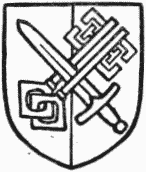
Chertsey Abbey. Party or and argent St. Paul's sword argent with its hilt or crossed with St. Peter's keys gules and azure.
The charter of Frithwald also refers to eight islands, both large and small, which belonged to Chertsey and Thorpe, and to 'seven instruments, suitable for catching fish and keeping them, called weares,' all lying between Wealeshuthe and the mouth of the Wey.
Confirmation of this charter was made by Alfred, Edward the Confessor, and William the Conqueror, (fn. 26) and succeeding kings of England and popes confirmed this grant to the abbey. (fn. 27) At the time of the Domesday Survey Chertsey was held by the abbey as a manor and rated at 5 hides; of these Richard Sturmid held 2½ under King William. (fn. 28) The abbey, however, claimed him as a tenant, and this claim was probably allowed, as he does not appear among the tenants in chief. (fn. 29)
The manor, known from about the 14th century by the name of 'Chertsey-Beomond' (fn. 30) as well as by the simpler form of 'Chertsey,' remained in the possession of the monastery until 1537, (fn. 31) when, upon the surrender of the latter, the abbot conveyed its lands to the king. The manor of Chertsey was leased in 1550 to Sir William FitzWilliam for thirty years. (fn. 32) He died before 1569, when the lease was extended for twenty-one years to his widow Joan. (fn. 33) Upon her death in 1574 the manor reverted to the Crown. James I granted it to his eldest son, Henry Prince of Wales, (fn. 34) after whose death Sir Francis Bacon and others held it in trust for Charles Prince of Wales for ninety-nine years, the term beginning in 1617. (fn. 35) Charles, when king, granted the manor to his queen, Henrietta Maria. (fn. 36) During the Commonwealth the manor of Chertsey was sold, as Crown land, to William Aspinall. (fn. 37) The sale included a wood called Birchwood, whereof 292 trees were reserved for the use of the navy. Returning to the Crown at the Restoration, it was granted by Charles II, for the remainder of the term of ninety-nine years fixed in 1617, to Denzil, Lord Holles, and others in trust for Queen Catherine of Braganza for life and afterwards in trust for the king and his successors. (fn. 38) In 1676, four years after this grant, the manor was granted, for forty-one years, to Sir Gilbert Talbot and Sir Peter Wicke. (fn. 39) The manor remained in the Crown throughout the 18th century. In 1779 a thirty-one years' lease was granted to the Duke of Bridgewater, who died in 1803. (fn. 40) According to Brayley, writing in 1841, the last tenant under the Crown was Frederick, Duke of York, who died in 1827, and in the following year the manor with other Crown lands was sold by the Crown for £3,330 to a Mr. Allison, who disposed of it to James Goren. The latter became bankrupt in 1834, and the manor was sold by auction to Mr. — Cutts of Essex. (fn. 41) Mr. H. E. Paine at present holds the manor, and the house is the seat of Mrs. Hawksley.
The Abbot and convent of Chertsey had full jurisdiction in Chertsey, as in all their lands. (fn. 42) William I, in confirming these privileges, also granted them 'freedom of court' in all their lands, the right of keeping dogs, taking foxes, hares, pheasants, &c., and of using their own woods for whatever purpose they chose, without hindrance from the royal foresters. (fn. 43) Henry I granted the abbot warren in all his lands, and forbade anyone to hunt there without the abbot's permission on pain of a fine of £10. (fn. 44)
The Domesday Survey records the existence of a forge at Chertsey which served the abbey, and also of a mill. (fn. 45) Gilbert Fitz Ralph held the latter of the abbey in 1197. (fn. 46) Water-mills known as the Oxlake or Okelake mills in Chertsey, appear to have been in existence at an early date. They belonged to the abbey and are marked in a chart of the abbey and its lands which is found in the ledger book of the monastery. (fn. 47) In 1535 these mills were valued at £10 13s. 4d. (fn. 48) Surrendered with the abbey, they were granted in 1550 to Sir William Fitz William, (fn. 49) together with the site of the abbey (q.v.), with which property they afterwards descended. This property also included the right of free fishery in water called the Bargewater at Chertsey, which had belonged to the monastery. (fn. 50)
A life-grant of the ferry of Redewynd or Chertsey ferry was made, in 1340, to William de Altecar, yeoman of the chamber. (fn. 51) A similar grant, including barge, boat, and ferry fees, was afterwards made to John Palmer, and in 1395 to Thomas Armner, both Gentlemen of the Chamber. (fn. 52)
Early rents and services due to the abbot and convent from tenants in Chertsey include a rent of 4s. 8d. due from two shops in Chertsey in 1271. (fn. 53)
Weirs, as instruments for catching fish, are alleged to have existed in the river at Chertsey as early as the 7th century. (fn. 54) In 1325 the abbot and convent were permitted to construct a weir there. (fn. 55)
There was a gaol, belonging to the abbey, at Chertsey in 1297. (fn. 56) In 1325 it was shown that, owing to the fact that there was no coroner in Godley Hundred, and that the two coroners of the county would not come as far as Chertsey to hear appeals and do the office of coroner, the prisoners of Chertsey gaol either died in gaol, or on their removal to Guildford gaol for trial were frequently rescued by their friends, where-fore many criminals escaped punishment. In consequence of this, a coroner was appointed for Godley Hundred. (fn. 57)
A survey of the manor of Chertsey made in 1627 mentions as common fields or pastures lands called Wheatworth, Wentworth, Adlesdon Moor, and Chertsey Mead. (fn. 58) The Parliamentary Survey of 1650 includes Marleheath, Childsey Common, and New Lodge Heath as common lands. Court rolls in the 17th century mention, as tithings of Chertsey, Addlesdon, Ham, Lolworth, and Rookbury. (fn. 59) The two latter were known by the alternate names of Hardwick and Lyne. (fn. 60)
The abbot and convent were responsible for the repair of Chertsey Bridge over the Thames. (fn. 61) In 1582, however, it was decided that the burden of repair could not fall on the queen, then lady of the manor. (fn. 62) In 1630 the inhabitants of Chertsey petitioned for the repair of Chertsey Bridge. It was deemed unfit to raise money by collection, and a warrant for sale of trees was applied for. The sum to be raised was £555, and it was suggested that £350 could be raised by sale of trees in Alice Holt, near Farnham, and of trees to be used for piles, &c., in parks near Chertsey. (fn. 63)
In the 17th century mention is made of timber wharves at Chertsey, owned in 1651 by Sir George Ayscue. Compensation for damage done to them was granted him in that year, at the petition of his wife, he himself being absent in command of the fleet which had sailed for the Barbados. (fn. 64) Other records refer to a rabbit-warren on St. Anne's Hill, otherwise Eldebury Hill, in Chertsey, which belonged to the monastery and was granted to Sir William Fitz William in 1550, (fn. 65) and sold during the Commonwealth to George Vincent.
The king's stables at Chertsey are mentioned in 1550, when certain meadows there were converted to the king's use 'for provisions of his stables for lack whereof he susteigneth an intolerable charge'; (fn. 66) in 1617, 99 loads of hay and 68½ qrs. of oats were due from the tenant of the manor of Chertsey for the king's horses and for the deer in Windsor Park. (fn. 67) A letter written by Sir Philip Draycott in 1514 describes a royal hunt which took place in the 'meads under Chertsey.' (fn. 68)
After the surrender of the abbey in 1537 the site of the monastery remained in the Crown until 1553, when Edward VI granted it to Sir William Fitz William, his wife, and heirs, for ever. (fn. 69) The grantee conveyed it to his wife and daughter; the latter held it at her death in 1564, after which date her mother Joan received all profits until she died in 1574. (fn. 70) In 1602 Matthew Browne, son and heir of the daughter Mabel who had married Thomas Browne, (fn. 71) conveyed the site of the abbey to John Hammond, (fn. 72) afterwards physician to James I; a formal grant was made by the Crown in 1610. (fn. 73) Of this estate Hammond settled certain lands and 'a messuage next the gates of the late Abbey of Chertsey, in which Edward Carleton (fn. 74) then lived,' on his wife Mary for life, and afterwards for life on a younger son, Henry, later an eminent divine and scholar, who died in 1660. (fn. 75) The eldest son, Robert, died seised of the site of the abbey in 1623, (fn. 76) and it passed to his son John Hammond, who died in 1643 leaving a son Robert. (fn. 77)
In 1681 James Hayes and Griselda his wife conveyed the site of the monastery to Edward Read, (fn. 78) from whom it passed in 1685 to John Hussey. (fn. 79) At the close of the century the site appears to have been in the possession of Sir Nicholas Wayte, who built a house out of the abbey ruins called the Abbey House, a 'beautiful seat … adorned with pleasant gardens.' (fn. 80) His daughter, who married — Halsey, inherited the bulk of Sir Nicholas's property, (fn. 81) and was in possession of one-third of this estate in 1723. (fn. 82) She apparently sold it to Robert Hinde before 1734, (fn. 83) in which year he died and was buried at Chertsey. His son Robert Hinde inherited it. He mortgaged it and subsequently sold the property to William Barwell in 1751. (fn. 84) It was left by William Barwell's son to one Fuller, who sold the property in lots in 1809. (fn. 85) The site of the abbey was bought in 1861 by Mr. Bartrop, the secretary to the Surrey Archaeological Society. Among the appurtenances of the site of the abbey which descended with it were the watermills known as the Oxlake or Okelake mills and a small river or brook known as the Abbey River or the Bargewater.
Of the abbey (fn. 86) buildings only small fragments remain; a large barn or granary, the west end of which is intact, the rest much repaired, is probably part of the outbuildings. Opposite to it a wall contains early work and part of a blocked arch of the 12th or 13th century. The church and main part of the buildings had been pulled down before James I in 1610 granted the site to Dr. John Hammond. Sir Nicholas Wayte built a house out of the abbey ruins called the Abbey House, as mentioned above. (fn. 87)
The site of the church and other buildings has been partially excavated by the Surrey Archaeological Society and private enterprise, (fn. 88) and a large number of flooring tiles of great merit have been removed, most of them to the Royal Architectural Museum, Tufton Street, Westminster, a few to the Surrey Archaeological Museum, Guildford.
Queen Elizabeth granted the site of the manorhouse of Chertsey Beomond for twenty-one years to Thomas Holte some time before 1580, in which year an extension of thirty-one years was granted him, to begin at the expiration of the previous lease. (fn. 89) In 1606 John Hammond received a grant of the same for thirty-one years, dating from the termination of the leases on which Thomas Holte held it. (fn. 90) The last of these leases expired in 1631, when John son of Robert Hammond, and grandson of the original grantee, entered into possession. (fn. 91) He married Margaret daughter of Sir Robert Rich, and died in 1643, leaving as heir his son Robert. (fn. 92) In the Parliamentary Survey of 1650, however Elizabeth, the mother of John Hammond was stated to be the tenant of the messuage and lands called Chertsey Beomond, (fn. 93) the lease having still twelve years to run. In this survey the manor-house is described as 'an old house part brick, part wood, covered with tiles and consisting of a hall, parlor, kitchen, buttery, brewhouse, milkhouse, and larder below staires and of 7 rooms above staires.' Among the stock 'as well alive as dead' which rightfully belonged to the tenant or farmer of the site of the manor were included '3 horses, 11 oxen, 3 heifers, 1 boore, 3 cows, 16 young hogs, 12 qrs. of wheat, 20 qrs. of barley, 10 qrs. of draggett, 40 qrs. of oats, 2 ploughs with all furniture, with 2 plough shares, 2 cutters, 3 harrows with front teeth, 1 cart with furniture for 3 horses and 3 leather head-stalls.' After the Restoration the site of the manor appears to have followed the descent of the manor, as no separate trace of it is found. The old manor-house has been evidently rebuilt.
The manor of Beomond had for a short time a separate history from Chertsey. In 1306 Walter of Gloucester and Hawisia his wife were holding the manor of Beomond or Bemond in Chertsey. (fn. 94) In 1311–12 Walter died seised of this land held of the abbey of Chertsey. (fn. 95) In 1320 Walter his son conveyed land in Chertsey to Master John Walewayn, in trust for the abbey, and Hawisia granted to John Rutherwyk, Abbot of Chertsey, tenements and lands 'formerly called Gloucester, now known as le Bemond,' which had previously been two holdings belonging to John de Chertsey and William Scot respectively. (fn. 96) In a cartulary of Chertsey Abbey, of the time of Edward III, mention is made of a holding called 'Gloucester,' apparently a sub-manor of Chertsey, and held with the latter. The name of Gloucester gave way to that of Bemond. (fn. 97) The manor of Bemond appears to have been united with that of Chertsey soon afterwards, the two being henceforth known as the manor of Chertsey or Chertsey-Beomond.
Before its alienation by Hawisia the tenement had been held of the abbot and convent at a rent of 28s. a year, a three-weekly suit at the abbot's hundred court, and for certain customary services. (fn. 98)
In 1319 John de Bottele of Chertsey, holding of the abbot and convent of Chertsey, made an exchange with them of lands in Chertsey, (fn. 99) and it is probable that the lands so held were those which became known later as BOTLEY'S Manor. According to Manning and Bray, John Manory owned the lands in the 15th century, and his son conveyed them in 1505 to Henry Wykes under the name of Botlese Park. (fn. 100) Sir Roger Chomeley was in possession of Botley's before 1541, in which year he granted the estate, then for the first time called a manor, to the king, in exchange for other lands. (fn. 101) Leases of the manor were made to Anne, Duchess of Somerset, in 1555 (fn. 102) and to James Harden in 1599. (fn. 103) It was granted in 1610 to George Salter and John Williams, (fn. 104) who conveyed it in the same year to William Garwaie and his heirs. (fn. 105) The manor was sold by William Garwaie to John Hammond and his heirs for ever. (fn. 106) On the marriage of Robert Hammond son of John with Elizabeth Knollis the manor was settled on Robert, (fn. 107) whose son John Hammond died seised of it in 1643, leaving Robert his son as heir. (fn. 108) The manor afterwards passed to the Hall family. Samuel Hall 'of Botleys' died in 1707. (fn. 109) Later in the 18th century Mrs. Pleasance Hall held the estate for life, but in 1763, having purchased the reversion of her son, she sold it to Joseph Mawbey, afterwards Sir Joseph Mawbey, who built the present house. (fn. 110) His son succeeded him and died in 1817 leaving two daughters, one of whom had married John Ivett Briscoe and inherited the estate. (fn. 111) They sold it, however, in 1822 to David Hall, who conveyed to John Beecles Hyndman, from whom it passed to Robert Gosling. (fn. 112) The estate known as Botley's Park is now the property of Mr. Hubert Gosling, J.P.
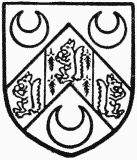
Gosling. Gules a cheveron between three crescents or and on the cheveron a pale ermine between two squirrels sitting back to back and cracking nuts with a like squirrel on the pale.
Among the boundaries of Chertsey set forth in 673 is mentioned the isle of HAM or Hamenege, (fn. 113) which is later represented by Ham Moor and Ham Farm, (fn. 114) and which was known from the 12th to the 18th century as the manor of Ham. The manor was ancient demesne until the reign of Henry I, (fn. 115) who granted it to the Abbot of Chertsey. (fn. 116) In 1197 Martin, Abbot of Chertsey, granted the manor to William de Hamme and his heirs, (fn. 117) and Robert de Hamme was lord of the manor in 1307. (fn. 118) Thomas de Saunterre, apparently acting as trustee for purposes of a settlement, enfeoffed John de Hamme and Alina of the 'manor of Hamme next Chertsey,' and land in Stanore. (fn. 119) John de Hamme died seised of the manor in 1319–20, leaving his brother Robert as heir. (fn. 120)
Thomas de Hamme, probably a member of the same family, held the manor about 1323, when he received licence to have divine service in his oratory at Ham. (fn. 121) He appears to have been still living in Chertsey in 1328. (fn. 122) It is not apparent how the manor passed from Thomas de Hamme to the Fitz Johns, but it was probably by marriage of heiresses. It is at least evident that in 1372 Robert Danhurst and Agnes his wife, possibly the widow of a son of Thomas de Hamme, conveyed all that they held in the manor of Hamme, their share being a life-interest held in the right of Agnes, to William Fitz John and Agnes his wife and the heirs of this second Agnes. (fn. 123) A further settlement of the manor on the Fitz Johns was made in 1381. (fn. 124) The manor descended to Nicholas (fn. 125) son and heir of William Fitz John, to Nicholas's son John and grandson Henry, about whose succession some difficulty arose, a claim to the manor being made in 1466 by John Goryng and John Sturnyn, who said they had been enfeoffed of it by John Fitz John, father of Henry. (fn. 126) The manor came soon afterwards into the possession of Sir Thomas Seyntleger, who in 1481 received licence to alienate it to the Dean and Canons of the free chapel of St. George's, Windsor, (fn. 127) for the support of a chantry, and it remained with the chapter when the chantry was dissolved. (fn. 128) Occasional leases of it were made during the 17th and 18th centuries, when it was known under various names—the manor of Ham or Ham Court or Ham Farm or Ham Haw Farm. It was leased in 1614 to Dr. Henry Hammond, the king's physician, (fn. 129) who held Chertsey (q.v.), and had also a life grant of the manor of Botleys. Later, Sir George Askew and Sir Ralph Clare held leases. (fn. 130)
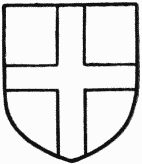
Dean and Canons of St. George's, Windsor. Argent a cross gules.
In 1731 it was advertised for sale as held by the late Robert Douglas, on a lease from the Dean and Canons of Windsor, and was purchased by the second Earl of Portmore, (fn. 131) whose property in Weybridge it adjoined. (fn. 132) It is now held as a farm, on a lease from the dean and canons by Mr. H. F. Locke King, J.P.
The manor of HARDWICK was among the possessions of the abbey of Chertsey in this parish; the first reference to it occurs in 1430, when the manor, held by the abbey, was assigned to William Frowyk to farm. (fn. 133) From a later lease it would seem that this manor was usually demised to farm by the abbot, who reserved to himself the profits of leets and courts held there, and all other manorial rights, granting only to his tenant 'the other half of waifs and strays in the land of the manor.' (fn. 134) These courts would appear to be the courts-leet and views of frankpledge of the manor of Chertsey to which the half-hundred of Godley (q.v.) did suit. The manor of Hardwick has, throughout, followed the descent of the manor of Chertsey (q.v.). During the reign of Charles II the courts of Queen Henrietta Maria were held at Hardwick, as they had been before the Civil War. (fn. 135)
The site of the manor of Hardwick at the time of the Dissolution, or shortly after, was in the tenure of William Cooke. (fn. 136) It was leased with the manor to Sir William Fitz William in 1550 and afterwards to his widow Joan, who died in 1574. (fn. 137) It was again leased, in 1589, to Richard Lilley, this time without the manor, (fn. 138) and sold during the Commonwealth to Robert Boscoes or Bowes. (fn. 139) Later grants of the manor of Chertsey included both the site and manor of Hardwick. (fn. 140)
Land at WOODHAM was granted to Chertsey Abbey by Frithwald, the founder. (fn. 141) In 1402 tithes from the 'township' of Woodham were granted as augmentation of the vicarage of Chertsey. (fn. 142) Occasional references to lands in Woodham are found in the 14th century, but no one family appears to have held them for any length of time. (fn. 143) Symmes, in his collections for Surrey, made in the 17th century, states that Woodham was held as a manor in 1413 by John Erith, Robert Thurbane, and Richard Grene, and by John Brown and others in 1426. According to the same authority John Fagger was lord there in 1482.
In 1526 Richard Covert and Robert Darknold, or Dorkenoll, were lords of the manor in the right of their wives, Elizabeth and Joan. (fn. 144) Richard Covert's wife was daughter of Richard Wasse. (fn. 145) Robert Darknold relinquished his share in 1531, and Giles Covert, the son of Richard Covert, died seised of the manor in 1557, leaving his brother Richard as heir. (fn. 146) Richard Covert conveyed it to John Austin and Thomas Inwode in 1563, (fn. 147) possibly in trust for Walter Cresswell, as the latter, when he died in 1596, was seised of the 'manor or farm of Woodham,' which he held of the manor of Pyrford, (fn. 148) of which manor Woodham, though parochially in Chertsey, was a tithing. His heir, William Cresswell, by will dated August 1622, bequeathed two-thirds of the manor to his cousin Edward Cresswell, with remainder to the male heirs of another cousin, Richard. (fn. 149) The remaining third appears to have become the property of Richard's family immediately on William Cresswell's death in January 1623, as Elizabeth Collins, daughter of Richard Cresswell, died seised of a third of the manor in 1627, leaving as heir her uncle, Christopher Cresswell. (fn. 150) He, as male heir of his brother Richard, had inherited the rest of the manor on Edward Cresswell's death in July 1623. (fn. 151) From Christopher the manor descended to his son Richard and to the latter's son Christopher, who possessed it at the beginning of the 18th century. (fn. 152) After his death the manor appears to have been split up among female heirs, (fn. 153) by whom it was eventually conveyed as a single property in 1714 to Sir John Jennings and his heirs. (fn. 154) In 1741 Sir John Jennings's estates were sold under a private Act, (fn. 155) and Woodham was ultimately acquired by Lord Onslow and is not now distinguished from the manor of Pyrford (q.v.). Ancient rentals of Woodham Manor were in the custody of Mr. Sibthorp, the steward of Woking and Pyrford Manors, in 1795. (fn. 156)
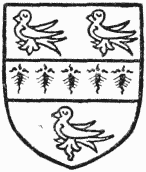
Covert. Gules a fesse ermine between three martlets or.
Land called 'Otreshagh,' OTTERSHAW, is mentioned in the charter of King Alfred to the monastery made about 890, in which he gives the boundaries of Chertsey and Thorpe. (fn. 157)
The Testa de Nevill states that the 'manor of Otterseye' had been given in alms to the abbey before the Conquest. (fn. 158) This is, however, perhaps not the same place as Ottershaw. Ottershaw in its subsequent history is referred to simply as a wood or lands. The possession of Ottershaw by the abbey is doubtful. It appears that in 1270 (vide infra) Nicholas de Croix was one of the holders, and the early charter of Chertsey, re-edited in the 13th century, seems to exclude the holding of Geoffrey de Croix, alive at the date of Testa de Nevill, from the lands granted to Chertsey. In the 14th century it appears to have been held of the king in chief.
Tithes from Ottershaw were due to the Abbot of Chertsey and formed the subject of a dispute in 1270 between the abbot and the rector of Walton, who claimed a portion. (fn. 159) The dispute, which was eventually terminated in favour of the abbot, was renewed in 1279, when Ottershaw was the property of the Earl of Hereford and Nicholas de Cruce. (fn. 160) In 1301 Walter de Langton, Bishop of Coventry and Lichfield, received licence to assart 300 acres of his wood of Ottershaw which he held for life by demise of Humphrey de Bohun, sometime Earl of Hereford and Essex. (fn. 161)
The latter conveyed part of Ottershaw, a messuage, 40 acres of land, &c., to Geoffrey de Parys, whose kinsman and heir, John Aylet, conveyed them to John de Tighele, from whom William Ingelard acquired them. From his heir Edward atte Brugg they passed to Robert Dachet and William his son, who were arraigned for entering into possession without licence from the king. Pardon and restitution of the estates were, however, granted them in 1337. (fn. 162)
John Danaster was seised of Ottershaw in the early part of the 16th century, and at his death it passed to his widow Anne, with reversion to their daughter Anne, who married Owen Bray. (fn. 163) A complaint was lodged by Owen Bray and his wife against Sir Francis Dawtrey, second husband of Anne, his grandmother, on the ground that he had committed great spoil in their lands; in Ottershaw in particular he had cut down and sold 60 oaks of the value of 10s. each. (fn. 164)
The subsequent holders of Ottershaw are not always apparent. Manning, quoting from the title deeds of Edmund Boehm, who held Ottershaw in 1811, states that in the 17th century it belonged to the Roake family of Horsell, who in 1722 conveyed it to Lawrence Porter. He sold it to Thomas Woodford, who also held Stanners in Chobham. Woodford died in 1758, and the property passed from his son to Thomas Sewell, whose son sold it in 1796 to Edmund Boehm. (fn. 165) It afterwards became the property of Sir George Wood, and according to Brayley his son sold a portion of the estate, including the house, to Richard Crawshay. (fn. 166) Brox, mentioned by Aubrey as a tithing of Chertsey, is at present held with Ottershaw by Captain Sumner and Mr. R. Brettell. Mr. Lawrence J. Baker owns Ottershaw Park.
A tenement called SHRYMPLEMARSHE (Simple Marsh, or Simple Mere) was included among the abbey lands, being valued in the 16th century at 100s. (fn. 167) At the surrender of the monastery it was granted to John Prior; in 1550 it was leased to William Fitz William, after whose death it was granted in 1569 to his widow Joan for twenty-one years. (fn. 168) It was granted in 1613 to Francis Morrice and Francis Phillips. (fn. 169) In 1616 they conveyed it to Richard Tylney. (fn. 170) In 1739 John Tylney, afterwards Earl Tylney, whose grandmother was daughter of Mr. Frederick Tylney, sold it to Aaron Franks. (fn. 171) He sold it to Mr. Pembroke in 1807, and he to Mr. G. H. Sumner in 1810, (fn. 172) of whom Captain Sumner is grandson and heir.
In 1535 land called DEPENHAMS in Chertsey was valued among the possessions of the monastery at £6 13s. 4d. (fn. 173) It was conveyed to Henry VIII as a manor by the Abbot of Chertsey in 1537, (fn. 174) but no other reference to Depenhams as a manor occurs. It was granted in 1550 on a lease to Sir William Fitz William, being then, or having previously been, in the tenure of William Loksmyth. (fn. 175) The grant was extended in 1569 to Joan Fitz William, widow of Sir William, for twenty-one years. (fn. 176) In all these transactions Depenhams is referred to as a tenement only. It was granted as a messuage to William Holt and others in 1590, (fn. 177) and in the sale of Crown lands during the Commonwealth the 'brewhouse or farmhouse called Depenhams' became the property of Daniel Wyatt. (fn. 178) It was apparently included in the grants of Chertsey Manor made by Charles II. (fn. 179)
AMPNER'S BARN was also conveyed to the king by the abbot of Chertsey as a manor, (fn. 180) but there is no further evidence to show that it had any claim to be such. Tithes from it were due to the rectory of Chertsey. (fn. 181) After the surrender of Chertsey monastery it was in the tenure of William Stanlake or Robert Skyte, and was granted with other tenements in Chertsey to Sir William Fitz William, and on his death to Joan his widow in 1569 for twenty-one years. (fn. 182) At the sale of Crown land during the Commonwealth J. Bailly purchased Ampner's Barn, described as 'a farm.' (fn. 183) The tenement called Tyleholt or Tylecroft, probably identical with the tenement afterwards called le Tyle, was also referred to as a manor in the conveyance from the abbot to the king. (fn. 184) When granted to Sir William Fitz William it was in the tenure of Roger Fenne. (fn. 185)
A tenement called SAYES was granted to Edward Carleton in 1610, and was sold as Crown land to Samuel Oram during the Commonwealth. David More had a lease of it from the Crown in 1673. (fn. 186) Potter's Park, which still exists in Chertsey, is mentioned as early as the time of Henry VI among the boundaries of Godley Hundred. (fn. 187) During the reign of James I it was sold to the Crown by Richard Furbench. Charles I in 1634 demised the park to Sir Arthur Mainwaring for twenty-one years. His wife, Dame Gressell, was still in possession in 1650 when a survey was made of the property. (fn. 188) In 1661 John Lyne petitioned for a lease of the same park. (fn. 189)
CHURCHES
The parish church of ST. PETER consists of chancel with north organ bay, a vestry, and south chamber with gallery stair, a nave with north and south aisles, the ends coterminous with the west tower and containing stairs to the galleries which surround three sides of the church.
The church was much rebuilt early in the 19th century, but the chancel and west tower have some 15th-century work remaining; the new work is faced with Heath stone. The east window of the chancel is modern of four lights in 15th-century style. On each side are shallow cinquefoiled image niches of 15th-century date. In the north and south walls are two bays of an arcade, now blocked up, showing pointed arches with a moulded order springing without capitals from square piers with rounded angles. On the two central piers are shallow cinquefoiled niches, like those on either side of the east window.
The chancel arch is contemporary with the side arcades and consists of two moulded orders, with small engaged shafts in the jambs having foliate capitals. The nave is of four bays with square piers carried up to the plaster vaulted ceilings of nave and aisles, and is entirely of modern date. The aisle windows have large dripstones to their labels, carved in a rather theatrical style, and under each are the carvers' names, Coade and Sealy of London, and the date 1806.
The tower arch is of two moulded orders, the inner resting on moulded half-octagonal capitals and shafts, the outer dying into the walls.
The tower is of flint and stone with patched diagonal buttresses. It has a west door, a two-light west window, belfry lights, and a brick parapet, all suggestive of 18th-century work, and appears to have been rebuilt, partly with the old materials.
The early monuments of interest are one brass to Edward Carleton, 1608, and a tablet of the same date to Lawrence Tomson.
The bells are eight in number, the treble, second, and tenor by G. Mears, 1859, the last being a bell of 1670 recast; the third by R. Phelps, 1730; the fourth by Lester and Pack, 1756; the fifth a 15th-century bell from the Wokingham foundry, inscribed, 'Ora Mente Pia Pro Nobis Virgo Maria.' The sixth is by William Eldridge, 1712, and the seventh by Robert Mot, 1588.
The present plate, consisting of two cups, two patens, a flagon, and an almsdish, was given in 1843 to replace a set which was stolen.
The registers date from 1610.
ALL SAINTS' Church, Eastworth Road, is of red brick with Bath-stone facings. It consists of a chancel, nave, and south aisle divided from the nave by an arcade with pointed arches.
CHRIST CHURCH, Longcross, was built c. 1847 by Mr. William Tringham, the principal land-owner in Longcross. The church is of brick and stone, with a turret on the south side. The body was lengthened and a chancel added in 1878.
HOLY TRINITY Church, Botleys and Lyne, was built in 1849. It is a small cruciform church of stone, of 13th-century design, with a central tower. Lady Frances Hotham presented the site.
CHRIST CHURCH, Ottershaw and Brox, was built by the late Sir Gilbert Scott, in 14th-century style, of brick and stone, with a tower and spire. The whole cost was borne by Sir T. Edward Colebrooke, bart., who further gave £1,000 towards the endowment. A ring of bells was also given by Mr. William Edward Gibb of Sheerwater Court, in 1885, in memory of his father.
The church of ST. PAUL, Addlestone, built in 1838, is of brick with stone dressings, with a tower, the details of which are quite hidden with ivy. The windows are pointed. It was enlarged in 1857 and restored in 1883. The site was given by Mr. G. Holmes Sumner.
The iron church of ST. AUGUSTINE, Weybridge Road, was built in 1891.
ALL SAINTS', Woodham, is a picturesque stone church in the middle of the pine woods near the confines of Chertsey and Horsell, built in 1893.
ADVOWSONS
A vicarage of Chertsey, with an endowment of £6 13s. 4d., is mentioned in the year 1291. (fn. 190) The church belonged to the abbot and convent, and remained in their hands until John Cordrey, the last abbot, gave up his possessions in 1537. (fn. 191) The vicarage was formally ordained in 1331; (fn. 192) the vicar and his successors were granted the house and certain lands belonging to the vicarage and oblations from the church. He was not required to pay any pension to the abbey, and was entitled to eat in the abbey at the abbey's expense on Rogation days and at Easter. (fn. 193) Augmentation of the vicarage was made in 1402, as the provision made for the vicar was found to be inadequate. He was henceforth to receive tithes of the 'townships' of Crockford and Woodham, (fn. 194) and, in addition, all tithes from the working artificers and merchandises of the parishioners; tithes of the fishing of the parishioners, unless done in the private waters of the abbey; tithes of milk, butter, cheese, cream, eggs, and pigeons; and half tithes of geese, honey, wax, hemp, apples, pears, onions, garlic, and all things titheable if they grew in the gardens of the parish. Various exceptions to the foregoing were made. The vicar was to pay all synodals, martinals, and tenths to the king for the portion of the vicarage. (fn. 195) The rectory and advowson of the vicarage became vested in the Crown in July 1537. (fn. 196) In December of the same year the king granted the rectory to the new foundation at Bisham, (fn. 197) which, however, was dissolved in six months. It remained in the Crown until 1551, when Edward VI granted it to John Poynet, Bishop of Winchester, (fn. 198) who was deprived of his see on the accession of Queen Mary, in whose reign Cardinal Pole appears to have had a grant of this rectory. (fn. 199) A lease of it had been held since 1535 by Henry Gyle, who held it under the Abbot of Chertsey and the Bishop of Winchester. (fn. 200) The lease, renewed by Mary and Elizabeth, (fn. 201) expired in 1587, when Elizabeth granted the rectory to Thomas Horsman for three successive leases of twenty-one years each. (fn. 202) Horsman presumably surrendered the leases, as in 1607 James I granted the rectory, including great and small tithes worth £14, to Richard Lydall and others, (fn. 203) and again in 1622 to Lawrence Whitaker. (fn. 204) The advowson of the vicarage was granted in 1558 to John White, Bishop of Winchester, (fn. 205) who was, however, deprived in 1559, when his lands were sequestered. (fn. 206) The advowson was in the possession of Peter Arpe before 1624. (fn. 207) It is probable that he acquired the rectory also, as his son held both rectory and advowson in 1644, (fn. 208) and both were henceforth held together. They remained in the possession of the family of Arpe or Orby until 1727, (fn. 209) when General Robert Hunter presented to the church. (fn. 210) He had married Elizabeth Orby, sister and heir of Sir Charles Orby. (fn. 211) Their children presented in 1737, and Thomas Orby Hunter, their son, in 1758. (fn. 212) Advowson and rectory were sold in 1764 to Sir Joseph Mawbey, (fn. 213) who presented in 1787, (fn. 214) his son Sir Joseph doing so in 1805. (fn. 215) The advowson was sold in 1819 to the Haberdashers' Company, as trustees to hold advowsons under the will of Lady Weld. (fn. 216) The presentation is now in the hands of the Company, but the Governors of Christ's Hospital nominate alternately with them.
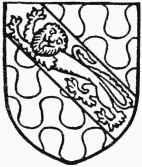
The Haberdashers. Barry wavy argent and azure a bend gules and thereon a leopard of England.
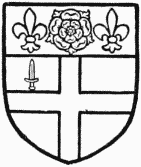
Christ's Hospital. Argent a cross gules with St. Paul's sword gules in the quarter and a chief azure with a Tudor rose between two fleurs de lis or therein.
Longcross was made an ecclesiastical district in 1847. The living is in the gift of the present vicar, the Rev. William Tringham.
The ecclesiastical district of Botleys and Lyne was formed in 1849. The Bishop of Winchester is patron.
Ottershaw and Brox was formed into an ecclesiastical district in 1865. The representatives of the late Rev. B. Hichens are patrons.
Addlestone was formed into an ecclesiastical district in 1838. The living is in the gift of the Bishop of Winchester.
Woodham was made into a separate ecclesiastical district in 1902.
A chapel on St. Anne's Hill, dedicated to St. Anne, existed in the 14th century. The augmentation of the vicarage of Chertsey, made in 1402, granted the vicar all oblations in Chertsey, with the exception of those coming from the chapel of St. Anne. (fn. 217) Licence to perform service in the newly-erected chapel had been granted in 1334. (fn. 218) There is an artificially lined well and a little stonework on the hill, perhaps the remains of the chapel. But Antony Wood says that the Chertsey tradition of his day was to the effect that Laurence Tomson, the Biblical scholar, who died in 1608 and is buried at Chertsey, built the house on St. Anne's Hill on the 'very place where that chapel stood.' (fn. 219) It is not known when the chapel perished. It does not appear among the suppressions of Edward VI of free chapels and chantries, neither does it appear among the possessions of Chertsey when surrendered.
Sir John Denham, in his poem on Coopers Hill,
published in 1643, refers to
' … a neighbouring hill whose top of late
A chapel crowned, till in the common fate
Th' adjoyning abbey fell.'
CHARITIES
Smith's Charity is distributed in Chertsey.
In 1721 Henry Sherwood left land for the clothing of three poor men and three poor women, but all trace of it has been long lost.
Miss Mary Giles, who died in 1841, gave in her lifetime £800, the interest to be devoted to bread for the poor on St. Thomas's Day, and £2 to the vicar and churchwardens for superintending it, and £1 towards keeping up the family monument. By will she left £2,700, clear of all duties, for the poor. From this two almshouses for widows were built and endowed. (fn. 220)
Mr. Edward Chapman, a draper of Chertsey, built two almshouses in 1668 for poor widows, in Windsor Street. In 1815 they were removed to Gogmore Lane.
Mrs. Mary Hammond, widow, of the Abbey House, founded almshouses for four widows in 1645; Thomas Cowley for two widows in 1671. Richard Clark built new houses in place of these two in 1782, and Mr. Hammond's almshouses were rebuilt by the parish, all in Guildford Street.
In 1837 Mr. Thomas Willatts built two almshouses in Chapel Lane.