A History of the County of Surrey: Volume 3. Originally published by Victoria County History, London, 1911.
This free content was digitised by double rekeying. All rights reserved.
'Parishes: Chobham', in A History of the County of Surrey: Volume 3, ed. H E Malden (London, 1911), British History Online https://www.british-history.ac.uk/vch/surrey/vol3/pp413-419 [accessed 30 April 2025].
'Parishes: Chobham', in A History of the County of Surrey: Volume 3. Edited by H E Malden (London, 1911), British History Online, accessed April 30, 2025, https://www.british-history.ac.uk/vch/surrey/vol3/pp413-419.
"Parishes: Chobham". A History of the County of Surrey: Volume 3. Ed. H E Malden (London, 1911), British History Online. Web. 30 April 2025. https://www.british-history.ac.uk/vch/surrey/vol3/pp413-419.
In this section
CHOBHAM
Cebeham (xi cent.); Chabbeham (in Chertsey Charter), and Chabham (xiii cent.).
Chobham is a village 3½ miles north-west of Woking Junction, 6 miles south-west of Chertsey. The parish is bounded on the north-east by Egham and Chertsey, on the south by Horsell, Bisley, and Pirbright, on the west by Ash, on the north-west by Windlesham. It measures about 6 miles from northeast to south-west, 4 miles from north-west to southeast at the north-eastern part, but 2 miles only further west. It contains 9,057 acres of land and 22 of water. It is traversed by the Bourne Brook and its tributaries which flow from the Chobham Ridges to the Thames near Weybridge, and the village and to the Thames near Weybridge, and the village and hamlets are chiefly on the gravel and alluvium of the stream beds, but the rest of the parish is on the Bagshot Sands, with extensive peat beds. There are very extensive open heaths with clumps of conifers. Ironstone abounds, and there are several strong chalybeate springs. The Wokingham and Reading branch of the London and South Western Railway runs through the northern side of the parish, and Sunningdale Station is just beyond the border.
Neolithic flints are said to have been found, and there are several round barrows on the heaths; three stand close together near Street's Heath, and the Herestraet or Via Militaris of the Chertsey Charters ran through Chobham parish. In 1772 silver coins of Gratian and Valentinian (? the first), and copper coins of Theodosius, Honorius, and Valentinian, a spear-head and a gold ring, were found near Chobham Park. (fn. 1)
Near Sunningdale Station is a very large inclosure of earthen banks on the heath. The old ordnance map marked it as 'old entrenchment,' but the later maps ignore it. It is artificial, and not round cultivated ground; the greater part of the land within it is probably not susceptible of cultivation except at great cost, and bears no marks of having been cultivated. It forms a rough parallelogram with the corners towards the cardinal points; the sides measure nearly 800 and 680 yards respectively, and it is not unlike the later form of Roman camp, but is not quite regular. One side has been cut into by cottages near the road.
A battery with embrasures for cannon, made in 1853, has been erroneously treated as an ancient fortification.
There are a few interesting old houses in the parish of Chobham. Unfortunately Chobham House is now only represented by a farm-house.
Brook Place, called Malt House on the old ordnance map, is a small, square, and picturesque 17th-century building, now a farm-house, situated about a mile to the west of Chobham village. It is built in red brick with tiled roofs, and two stories and an attic. The main front faces north towards the road, and has an ogee-shaped gable at its west portion, in which is a panel with the initials and date 'W B 1656.' A plain string divides the ground and first floors, and a moulded cornice and string the first and second. The windows are square with wood frames. On the south and east fronts are similar gables, but having no panels; on the west a later timber-and-plaster wing has been added. From the front doorway (in the middle of the north front) is an original panelled screen with open turned balusters at the top, dividing the passage from the dairy east of it. The stairs are also old, having square newels with modern tops, and a plain moulded handrail, the space below the rails being filled with panelling. Two of the inside oak doors are good examples of the date. They have wide stiles or vertical boards joined by narrow V-shaped fillets. In one of the upper rooms is a fine cupboard of deal inlaid with oak panels, &c. Between the two rooms occupying the western half of the plan is a very thick piece of walling, more than sufficient to contain the flues to the fireplaces opening into it. In 1648 this house was the property of Edward Bray, a descendant of the Shiere family, who paid composition for his estate as a Royalist. It belonged to the manor of Aden, but was not the manor-house.
Chobham Place is, as it now appears, a fine Georgian house standing on rising ground north of the village. The hall was part of a house of much older date, and the woodwork of the dining-room is late 17th-century. It is said by Manning and Bray (fn. 2) to have been the seat of Mr. Antony Fenrother in Elizabeth's reign. His daughter Joan married Samuel Thomas, and their son Sir Anthony Thomas succeeded. (fn. 3) His grandson Gainsford Thomas died unmarried in 1721 and left it to his first cousin Mary, wife of Sir Anthony Abdy, bart. (fn. 4) It descended in that family till Sir William, seventh baronet, sold it in 1809. The purchaser, the Rev. Inigo William Jones, died very shortly afterwards, and it was sold to Sir Denis Le Marchant, bart. His son Sir Henry Denis Le Marchant is the present owner.
Broadford is the residence of Sir Charles George Walpole; Highams, formerly occupied by Lord Bagot, is now the seat of Mrs. Leschallas.
The old vicarage house was the butcher's shop next the churchyard. The present vicarage was built in 1811 by the Rev. Charles Jerram, vicar 1810–34. Mr. Jerram was a noted tutor whose pupils included the late Lord Teignmouth, Horace Mann, and W. T. Grant, brother to Lord Glenelg. Lord Teignmouth's memoirs give a lively account of the secluded condition of Chobham in the early 19th century. He says that the small triangular plot between the churchyard and the White Hart Inn was the scene of a pig auction on Sunday mornings before service, the farmers adjourning to church.
Chobham Common was the scene of the first large military camp of exercise in England since the great French war. It was held in 1853, and was in fact the precursor of Aldershot. In 1901 a cross was erected in memory of Her Majesty Queen Victoria, on the spot where she had reviewed the troops on 21 June 1853.
An Inclosure Award was made in 1855, (fn. 5) but there are still several thousand acres of uninclosed land.
Chobham was divided into tithings, Stanners, Pentecost, and the Forest Tything, lying east, west, and north respectively, but the modern division is practically into hamlets. Of these, Valley End, to the west, is an ecclesiastical parish formed in 1868 from Chobham and Windlesham. West End, at the west side of Chobham village, is an ecclesiastical district formed in 1895. Lucas Green, Colony, and Fellow Green are in Chobham parish.
There are Wesleyan and Baptist chapels in the parish. Chobham Village Hall was built in 1887. The Gordon Boys' Home was built in 1885 as a memorial to Major-General Charles Gordon. The chapel was added in 1894 as a memorial of the late Duke of Clarence. The school maintains 240 boys, who are trained for civil, naval, or military life, according to their preference.
The schools (National) were built in 1814 and rebuilt in 1860; those at West End (National) were built in 1843, and the Valley End (National) schools by the Hon. Mrs. Bathurst in 1856.
MANORS
CHOBHAM was granted to Chertsey Monastery by Frithwald, subregulus of Surrey and founder of the abbey, before 675. (fn. 6) The grant was confirmed in 967 by King Edgar as 'v mansas apud Chabeham cum Busseleghe, cum Frensham et Fremeslye.' (fn. 7) At the Domesday Survey its assessment was 10 hides, as it had been in King Edward's time, and it was still held by the abbey of Chertsey. Of this land, Odmus held 4 hides of the abbey, and Corbelin held 2 hides of the land of the villeins. The monks' part was valued at £12 10s. and the homagers' part at 60s. In King Edward's time the whole manor had been worth £16. (fn. 8)
The manor of Chobham remained in the possession of the abbey until the surrender of the latter in 1537, (fn. 9) when John Cordrey the abbot granted it to the king. (fn. 10) The manor remained in the Crown for some time, during which the king kept it for his own use; he was at Chobham in 1538 and again in 1542. (fn. 11) Sir Anthony Browne was made keeper of the manor in 1543. (fn. 12) Christopher Heneage appears to have had a grant of it during the reign of Elizabeth. (fn. 13) James I granted the manor to Sir George More in 1614 for the sum of £890 12s. 6d. to be held as of the manor of East Greenwich. Annual rent from the manor to the amount of £35 12s. 6d. was also granted him. (fn. 14) This rent was granted to Lawrence Whitaker and others in 1620. (fn. 15) The manor was granted in the same year to Sir Edward Zouch, including the rent previously reserved to Whitaker. (fn. 16) The grant included Bisley and the manors of Woking and Bagshot, and henceforth the manor of Chobham descended with these (fn. 17) and is at present held with them by the Earl of Onslow.
All rights and privileges pertaining to the manor of Chobham were enjoyed by the Abbot and convent of Chertsey, who appear to have exercised very complete power over their lands in Surrey. (fn. 18) John de Rutherwyk, who was abbot from 1307 to 1346 and who was noted for the many improvements which he carried out in his domain, (fn. 19) surrounded the manor-house of Chobham with running water in the first year of his rule as abbot. (fn. 20) In 1254 Geoffrey de Bagshot held Chobham under the abbot, and among the yearly dues of the abbot from that fee are included 10s. 4d. rent, 12 gallons of honey, valued at 6s., 2 sheep or 2s., 2 quarters of oats, 1 ploughshare, and a horse for carrying a monk to Winchester twice a year. (fn. 21)
The grant of Chobham to Sir George More and the later grants include land in Chobham called Langshott, Chabworth, Hill Grove, and Buttes, and a pond called Gratins Pond, also called Craches or Crathors Pond or the Greate Pond. A mill called Hurst Mill in Chobham was conveyed to the abbot by John de Hamme in the early 14th century. (fn. 22)
A court roll of the time of Charles II mentions 'Stanners' and 'Pentecost' as presenting tithingmen. (fn. 23) Sir Charles Walpole of Chobham has a note in his father's writing, 'I have a deed without date wherein is a Fine and Recovery by John de Pentecost of 5 acres in Chobham from John de Ardern and Agnes his wife.' (fn. 24) There is land near Chobham vicarage now called Penny Pot, which possibly means Pentecost. Ardern is the local pronunciation of Aden (q.v. infra).
CHOBHAM PARK
The chief messuage of the manor of Chobham, called Chobham Park, was granted to the king by John Cordrey, Abbot of Chertsey, in 1535, two years before the surrender of the entire manor of Chobham. (fn. 25) The Manor Place, commonly called Chobham Park, was sold in July 1558 by Queen Mary to Nicholas Heath her chancellor, Archbishop of York, for £3,000. The land was inclosed by a pale, whence it was called a park, and is marked as such in Norden and Speed's map of 1610. This grant was confirmed by Queen Elizabeth, (fn. 26) but as Heath had been deprived for refusing the oaths to the queen, the nominal possession was conveyed to his brother William in 1564. (fn. 27) The ex-archbishop continued, however, to reside, and died here or in London in 1578, (fn. 28) when his nephew Thomas is referred to by Lord Montagu as 'the nowe (or newe) owner.' Thomas forfeited his lands in 1588, (fn. 29) but was restored, and in 1606 conveyed them to Francis Leigh. (fn. 30) The next year he conveyed to Antony Cope, (fn. 31) who in 1614 sold to William Hale. (fn. 32) John Hale conveyed it to Henry Henn in 1654. (fn. 33) The same family held it in 1681. (fn. 34) The house was let, and before 1720 was the property of John Martin, (fn. 35) who conveyed it in that year to John Crawley. (fn. 36) Mr. Revel, M.P. 1734–52, is said to have owned it. (fn. 37) His daughter and heiress married Sir George Warren in 1758, and their daughter married Lord Bulkeley in 1777. The latter died in 1822, having left it to Sir Richard Bulkeley Williams, his nephew. From him it was bought by Sir Denis le Marchant, father of the present owner, Sir Henry le Marchant, in 1838. (fn. 38) The old house was pulled down and the park broken up in the 18th century. The farm called Chobham Park is on the old site, and parts of the double moat round the old house remain.
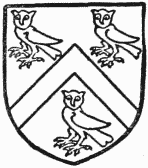
Le Marchant. Azure a cheveron or between three owls argent.
The manor of STANNARDS, STANYORS, or FORDS was held of the abbey of Chertsey with the manor of Ham next Chertsey by John de Hamme and Alina his wife from the feoffment of Thomas de Saunterre in 1307. (fn. 39) John de Hamme died seised of 'Stanhore' in 1319–20. (fn. 40) During the reigns of Edward II and Edward III it was held, under the de Hammes, by a family of the name of Ford, (fn. 41) whose name became attached to that of the manor, which in later times always appears under the name of the manor of Stanners and Fords. A dispute arose in 1343 concerning land in 'Stanore' which John de Totenhale claimed to have received from Alice de Ford and Ralph. It was adjudged that John de Totenhale, being illegitimate, could not inherit this land, which therefore became escheat to the abbey. It was afterwards claimed by Agnes, a daughter of Ralph and Alice. (fn. 42) The manor seems to have remained united to that of Hamme for some time longer. It is at least probable that Nicholas Fitz John, who held the latter (q.v.) about 1400, also held land at Stanore. (fn. 43) After this date there appears to be no record of it until 1532, when the manor, then in possession of William Lambert, was leased for thirty-one years to John Rogers of Chobham at the rent of £7 2s. 8d. (fn. 44) William Lambert died before 1539, when his widow Alice and daughter Collubra, wife of Richard Warde, conveyed the manor to the king in exchange for other lands. (fn. 45) In 1554 the Crown extended the lease previously made to John Rogers to his son Henry for a term of twenty-one years. (fn. 46) The manor in 1559 was granted to Thomas Reve and George Evelyn and the latter's heirs, to hold by knight's service, (fn. 47) Reve being only a trustee. Evelyn died in 1603, and the manor of Stannards passed to his second son John Evelyn, a settlement having been made on the marriage of George eldest son of John Evelyn with Elizabeth Rivers. (fn. 48) In 1618 the moiety of the manor was conveyed by John Evelyn and his wife to Robert Hatton as a settlement on his younger son John Evelyn on the latter's marriage; George Evelyn released his right to his brother, and in 1621 the other moiety of the manor was conveyed to him. (fn. 49) John Evelyn the younger apparently re-sold the manor to his brother George and his son Sir John in 1624, (fn. 50) and the latter was in possession in 1636, (fn. 51) when he conveyed it to George Duncombe and Henry Baldwin in trust for James Linch, who died seised of the manor of Stannards and Fords in 1640, leaving as heiresses his granddaughters Eleanor, Susan, and Elizabeth Gauntlett. (fn. 52) It is probable that Eleanor and Susan married Robert Parham and Robert Hussey respectively and released their right in the manor in 1651. (fn. 53) In 1687 the manor was in possession of Francis Swanton, (fn. 54) son of William Swanton, who married Elizabeth the youngest granddaughter of James Linch. (fn. 55) Francis Swanton is said to have sold it to Nathaniel Cocke in 1694. (fn. 56) In 1721 his widow Anne Cocke was seised of it, with reversion to Zachariah Gibson, (fn. 57) to whom Joseph Paris and Sara, probably the daughter of Anne Cocke, had released their interest. (fn. 58) In the same year Anne Cocke and Zachariah Gibson conveyed 'the manor or lordship or reputed manor or lordship of Stannards and Fords' to John Martin, who in 1728 sold it to Thomas Woodford for £2,300, (fn. 59) the sale including two farms known as Forde Farm and Coxhill Farm, a common called Mynfield Green, and other lands. Thomas Woodford's son Thomas inherited the major part of his father's estate in 1758, (fn. 60) and in 1761 sold the manor of Stannards and Fords to Thomas Sewell, whose son and heir T. B. H. Sewell inherited it in 1784, selling in 1795 to Edmund Boehm, who owned it till 1819. (fn. 61) Mr. Boehm's property was sold in 1820 after his bankruptcy, and the manor was acquired by Mr. James Fladgate, corn merchant of Chertsey. He died in 1857 (fn. 62) and left it to his son James Fladgate. The latter's son Henry sold the manor. The manor-house now belongs to Sir Henry Denis le Marchant, the land and manor to Mr. Otter, J.P., of Queenwood, and Miss Peele. (fn. 63) The manor-house, now tenanted by Mr. A. E. Greenwell, is in part an early 17th-century building with some good Jacobean woodwork. It was probably erected by one of the Evelyns, the old manor-house being a timbered house still standing on the other side of the road, or Stanner's Hill Farm belonging to Mr. Baker of Ottershaw Park. The former is a large, picturesque old cottage of whitewashed brick and half-timber with a tiled roof. It is on the plan of a T with gabled ends to the head and hipped roof at the foot; and is in two stories. It is now divided into two cottages.
ADEN is a house and small estate in Chobham, sometimes called a manor in title-deeds. A John Ardern held land in Chobham in 1331. (fn. 64) John Danaster, baron of the Exchequer, died seised of the manor of Aden in 1540. (fn. 65) His daughter Anne, then aged two, afterwards married Owen Bray, second son of Sir Edward Bray of Shiere. Their son Edward had a son Owen, (fn. 66) whose daughter married a Mr. Sear, and their daughter married Mr. Johnson. The manor was sold to General Broome, and then to Mr. Jerram the vicar of Chobham in 1808. It passed through four more owners to Miss Perceval, the present owner. The house was rebuilt on another site, and is now called 'Chobham House.' The mill, which was part of the estate, was sold separately by Captain Sanders in the 19th century, and is now owned by Mr. F. W. Benham.
CHURCHES
The church of ST. LAWRENCE consists of a chancel 28 ft. 1 in. by 15 ft. 11 in., a nave 72 ft. 6 in. by 18 ft., with a north aisle 11 ft. 3 in. wide and a south aisle and transept 6 ft. 10 in. wide. At the west end of the nave is a tower 11 ft. 1 in. square, with a wooden west porch, and at the east end of the north aisle is a small vestry.
The earlier church was a small building consisting of a chancel with a nave of about half the length of the present one, dating from the beginning of the 12th century or a little earlier. Parts of two of the early windows still remain high up in the south wall of the nave, cut into by the arcade which was built about 1180, when the south aisle was added. In the 13th century a transept chapel was added at the east end of the aisle, which with the nave was lengthened westwards by the addition of one more bay, the old west respond of the south arcade being replaced by a square pier. The history of the chancel during this time has been lost by its complete rebuilding, noted below. The tower was built about 1450, and thus the church remained until 1866, when the north aisle was added and the galleries and high pews removed. In 1892 the west porch was reconstructed, a few old timbers being used. In 1898 the whole of the chancel and the chapel east of the south aisle were rebuilt.
In the east wall of the modern chancel is a triplet of lancets, and in the north wall is a single lancet, also modern. The old chancel had a second north window and a south doorway, but these were removed at the rebuilding. The chancel arch is two-centred and of one moulded order springing from scalloped corbels.
The south arcade of the nave is of five bays, the eastern bay, which opens to the south chapel, not being continuous with the rest. It has been lately rebuilt, and is a copy of the late 12th-century arcades, but without the half-round responds.
The next three bays have two large circular columns and a half-round east respond, all with moulded bases and scalloped capitals. The columns and arches are of chalk, the latter being two-centred and of a single order with chamfered edges and a splayed label towards the nave. The middle arch of the three is lower than the others, and the western half of the third arch seems to have been rebuilt, perhaps in the 13th century, at the lengthening of the church.
The second capital fits its column clumsily, and the arrangement of the scallops on the south side and the jointing suggest that it has been made up with the capital of the original west respond. The western bay is similar to the others as regards the arch, but has square piers with chamfered edges, and a respond to match. The abaci throughout are grooved and chamfered.
The two early windows already mentioned occur over the second bay from the east and the second circular column respectively. They can only be seen on the nave side, and appear as deeply splayed round-headed openings, with part of the stone head showing in the western one, all the rest being plastered.
The south chapel, which is practically a continuation of the south aisle, has a modern east window of two trefoiled lights with a pierced quatrefoil spandrel, and in the south wall are two modern lancets.
Below the sill of these lancets is inserted the head of a narrow round-headed recess of uncertain origin.
There is a modern two-centred arch with chamfered orders between the transept and the aisle.
There are two south windows in the south aisle, one of 15th-century date though much restored, and the other a modern copy of the same. They have each three cinquefoiled lights under a square head without a label, and their inner splays are old with stout wood lintels in the place of rear-arches. To the west of them is the south doorway, which is of late 15th-century date and has hollow-chamfered jambs and a four-centred head, with a wood lintel inside like the windows. The west window of the aisle is modern and has two trefoiled lights with a pierced circle in the spandrel.
The modern north arcade to the nave is of five bays with double shafts of a very meagre description with moulded bases and carved capitals, and the two-centred arches are of one order with moulded edges. The north-east window of the north aisle and that in the west wall are of 13th-century design, the remaining four being of 15th-century character, and in the east wall of this aisle is the doorway to the vestry.
The tower arch is of 15th-century date with two chamfered orders, and the west doorway, which has a moulded two-centred arch, is covered by an oak porch which is all new except its four-centred outer arch and parts of its panelled western uprights, which are 15th-century work. In the south wall of the tower is a small doorway leading to the stair-turret. The tower is faced with Heath stone, and is in two tall stages with an embattled parapet, a short octagonal leaded spire, and plain two-light belfry windows; the west window over the doorway is of three cinquefoiled lights with tracery, and over it, partly hidden by a clock face, is a small single light.
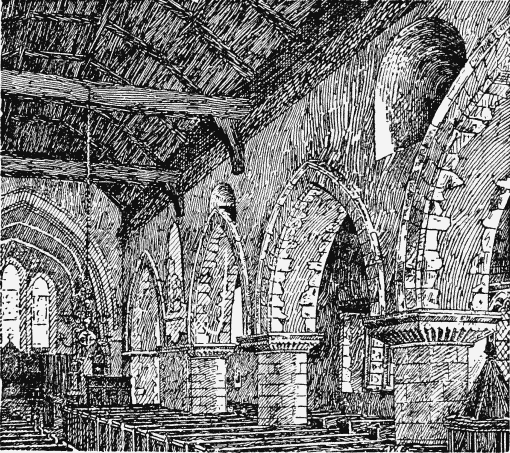
Chobham Church: Nave, showing Early Windows
The wall of the south aisle is built in a chequer pattern of Heath stone and ironstone conglomerate, and all the modern walling is entirely of this conglomerate. The roofs are tiled, that of the nave continuing without a break over the aisles, the eaves courses on the south side being of Horsham slates.
Near the south-east angle of the south chapel is an old dial-stone about 9 in. square, with two concentric circles within which are ten radiating lines unequally spaced.
The timbers of the nave roof are modern covered with modern boarding, but there are four massive old tie-beams still in position. The south aisle has an old roof with vertical posts on the north side standing clear of the wall and resting on wood brackets; from these spring struts to the purlin, which is further strengthened by curved wind-braces. All the other roofs are modern.
The font is of 16th-century date, and is one of the very scarce instances of a font constructed of wood; it is octagonal, each side forming a heavily-moulded panel, and the basin is hemispherical and lined with lead. The stem and base are of modern stonework.
In the vestry at the east end of the north aisle is a fine old iron-bound chest of uncertain date; two of the iron bands have fleur de lis ends, and there are three locks; the lid is apparently of later date. The hinges of the south door also seem ancient, and in the nave hangs a fine brass chandelier for twelve candles, which bears the names of the vicar and churchwardens and the date 1737. In the chancel is a copy of this, made in 1899.
On the west jamb of the arch between the nave and the south transept is a brass inscription in two lines, the ends of the lines missing:—'Here lyeth buryed Will[ia]; Heith of Chabh[am]; … Countye of Surray Esquire who died ye xix November in the yere of our Lorde God mcc…' William Heath was brother of Nicholas Archbishop of York.
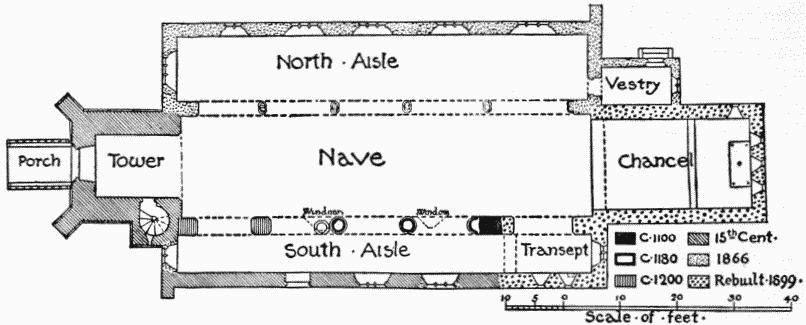
Plan of Chobham Church
Below this is another brass to William Soker, undated, but of the 17th century, with a set of three elegiac couplets in Latin.
In the chancel is a floor-slab to Jane, widow of Samuel Thomas and daughter of Anthony Fenrother, 1638. The arms, as here shown, are:—A cheveron between three terrets with three ostriches on the cheveron, in a quarter a man on a tower holding a banner, the whole within an engrailed border.
Another slab is to Sir Anthony Thomas, 1641, and his wife Maria, 1658, and there are several other monuments to the same family.
There is also a copper tablet, fixed in the chancel in 1908, to Nicholas Heath, Bishop of Rochester 1539, of Worcester 1543, and Archbishop of York 1555. He lived at Chobham Park in 1571, 1573, and 1574, and died at Chobham or in London in 1578, and was buried in the chancel of this church. There are a number of late monuments to the Caldwell family.
In the belfry are eight bells, the treble and second being by Mears & Stainbank, 1892, and the third by the same firm, 1880. The fourth is by William Eldridge, 1684, and the fifth and seventh by Robert Eldridge, 1597. The sixth is by William Culverden of London, c. 1525, and bears in black-letter with crowned capitals 'Sancta Mergereta ora pro nobis,' with the founder's mark. The tenor is another of Robert Eldridge's bells, dated 1610.
The most interesting piece of the plate is a fine cup of 1562, the straight-sided bowl being alone of this date, while the fluted base and the stem with its knot appear to belong to a secular cup of c. 1540–50, but have no marks on them.
Beside this there is a paten of 1727, a flagon of 1755, and a large two-handled cup with a cover which was made in 1787. There is also a standing paten of 1840, another small paten of 1897, and a pewter almsdish inscribed 'Chobham Church in Surrey 1712.'
The church also possesses two small old collecting-boxes with handles and a circle of geometric ornament on the top.
There are five books of registers, the first two of which have been very carefully restored and bound. The first is of parchment, and contains all three entries from 1654 to 1730; the second has the same from 1730 to 1770, and is a paper book. The third contains baptisms and burials from 1770 to 1812; the fourth marriages from 1754 to 1783; and the fifth marriages from 1784 to 1812.
The church of ST. SAVIOUR, Valley End, is a small brick building, erected in 1867, and consisting of a chancel with a south vestry and organ-chamber and a nave with a north porch. Over the west gable is a wood bell-turret. The roofs are tiled and all the internal fittings are modern.
The parish church of HOLY TRINITY, West End, is a small building consisting of a chancel consecrated in 1890, nave consecrated in 1842, and a vestry built in 1906. The material is stone and the style is of the 13th century. Over the west end is a small bell-turret with a square spire. The entrance is at the west end.
There is also the iron mission chapel of St. Luke.
ADVOWSONS
The Domesday Survey records the existence of both a church and a chapel at Chobham, in the possession of the abbey of Chertsey. (fn. 67) The abbot caused the chapel to be repaired in 1318, (fn. 68) but after this there is no further mention of a chapel. As, however, it seems to have been dedicated in honour of St. Lawrence, it may probably be identified with the present church of St. Lawrence, in which case the church was presumably Bisley Church (q.v.).
The church of St. Lawrence remained in the hands of the monks until the surrender of the abbey in 1537. (fn. 69) A vicarage was ordained there in 1330 by Abbot John de Rutherwyk, and was augmented in 1427. (fn. 70) Among the pensions due to the abbot and convent was an annual one of 10s. and 6 lb. of wax, which was paid by Chobham vicarage. (fn. 71) This pension, previously amounting to 20s. and 6 lb. of wax, had been reduced in 1230. (fn. 72) In 1537 the church, with the rectory and advowson, were surrendered to the Crown by John Cordrey, Abbot of Chertsey. (fn. 73) Later in the same year a grant of the rectory was made to the new foundation at Bisham. (fn. 74) The grant must have included the advowson of the church, as in 1538 the abbot received licence to alienate both from the monastery to Sir Thomas Pope, treasurer of the Court of Augmentations. He, in his turn, alienated them to the Dean and Chapter of the cathedral church of St. Paul, London, who held them, by the service of one knight's fee, to the use of the chaplains of two chantries in the church of St. Paul. (fn. 75) At the suppression of the chantries the rectory and advowson returned to the Crown; an effort made by the Dean and Chapter of St. Paul's in 1587 to recover them proved ineffectual, (fn. 76) as they remained in the Crown until 1620. A grant of the rectory alone had been made to William James in 1551 for twenty-one years, reversion being granted in 1564 to William Haber and Richard Duffield, (fn. 77) from whom it passed immediately to Owen Bray of Aden in Chobham, who died in 1568 possessed of it. (fn. 78) His grandson was Owen Bray, who conveyed it in 1638 to Sir Thomas White, (fn. 79) from whom it descended to the Woodroffes. (fn. 80) The latter conveyed it to Elizabeth and Philip Beauchamp in 1687. (fn. 81) After this date the rectorial tithes appear to have been divided. Sir Anthony Thomas Abdy of Chobham Place purchased a part of the great tithes of Anthony Beauchamp before 1774. (fn. 82) The present impropriators are Sir Neville Abdy and Sir Henry le Marchant, the owner of Chobham Place.
In 1620 the advowson was granted with the manor to Sir Edward Zouch, (fn. 83) and it remained in the possession of the lord of the manor until 1752, (fn. 84) when some of the Onslow property was sold, including the advowsons of Chobham and Bisley. They passed together for a time (fn. 85) (see Bisley), Henry Forster presenting in 1800, and the Thornton family in 1810 and 1833. (fn. 86) The vicarage is now in the gift of the Rev. W. Tringham.
Valley End was formed into an ecclesiastical parish separate from Chobham and Windlesham in 1868. The living is in the gift of the Bishop of Winchester.
West End became a parish in 1895. The vicarage is in the gift of Miss Tringham.
CHARITIES
The older charities include Smith's, distributed as in other Surrey parishes.
In 1721 Gainsford Thomas of Chobham Place left by will a charge on land of £4 a year for the poor, and for teaching a child or children to read and write and keep accounts, and also three cottages for the poor. These do not, however, now exist.
In 1722 Mrs. Mary Hope left £5 a year for teaching girls, and 10 guineas a year charged on land for the poor.