A History of the County of Surrey: Volume 3. Originally published by Victoria County History, London, 1911.
This free content was digitised by double rekeying. All rights reserved.
'Parishes: Walton on Thames', in A History of the County of Surrey: Volume 3, ed. H E Malden (London, 1911), British History Online https://www.british-history.ac.uk/vch/surrey/vol3/pp467-475 [accessed 30 April 2025].
'Parishes: Walton on Thames', in A History of the County of Surrey: Volume 3. Edited by H E Malden (London, 1911), British History Online, accessed April 30, 2025, https://www.british-history.ac.uk/vch/surrey/vol3/pp467-475.
"Parishes: Walton on Thames". A History of the County of Surrey: Volume 3. Ed. H E Malden (London, 1911), British History Online. Web. 30 April 2025. https://www.british-history.ac.uk/vch/surrey/vol3/pp467-475.
In this section
WALTON ON THAMES
Waleton (xi cent.); Waletone and Walletone (xiii cent.); Waletone (xiv cent.); Waletone on Thames (xv cent.).
Walton on Thames is a village 5 miles south-west of Kingston, and the same distance south-east-by-east of Chertsey, on the Thames. It contains 6,701 acres of land and 158 of water, and measures nearly 6 miles from north to south and from 3 miles to 1 mile in breadth. The soil is river gravel and alluvium near the Thames and by the valley of the Mole, which river forms part of the eastern boundary of the parish while the Thames forms the northern boundary. Further south, where the ground rises to the higher level of St. George's Hill and the adjacent common, the soil is Bagshot sand. The scenery here is very picturesque. The hill is only 255 ft. above the sea, but it is of irregular form, singularly precipitous and broken in contour in places, and planted with a variety of fine conifers, rhododendrons, and other trees. The roads from London to Chertsey and from London to Guildford pass through the parish, which is intersected also by the main line of the London and South Western Railway. Walton Station is a mile from the body of the village.
Walton is now an Urban District under the Act of 1894, divided into the Hersham, Oatlands, and Walton Wards.
The neighbourhood of Walton on Thames is rich in ancient remains. Two cinerary urns have been found half a mile west of the station, and a neolithic flint knife or dagger. (fn. 1) Other neolithic flints have been found. An uninscribed gold British coin was found in the river, (fn. 2) and an Anglo-Saxon cinerary urn from Walton was exhibited at the Archaeological Institute in 1867. (fn. 3) At Oatlands was a large inclosure, variously described as a Roman or British camp, which was destroyed by the Earl of Lincoln in the 18th century when he was improving the park. (fn. 4) On St. George's Hill is a very considerable fortification. It covers 13½ acres on the highest part of the hill, and is the largest work of the kind in Surrey. The hill is now thickly planted, and covered with fern and brushwood, but the works are complete in circuit, though difficult to trace except in winter owing to the plantations.
The valleys of the Wey and the Mole approach each other closely on either side of the hill. Between the points where these two rivers fall into the Thames there was an ancient ford, Coway Stakes, opposite Halliford, and anyone approaching the ford from Surrey or coming across it from Middlesex would of necessity pass close under this fortification. Coway Stakes Ford has been often taken to be the place where Caesar crossed the Thames on his second invasion. (fn. 5)
On the other side of St. George's Hill, in the grounds of Silvermere, was a round barrow, removed when the house was built about 1830. In it were three cinerary hand-made urns, with bones and charcoal in them, about 18 in. high, 16 in. wide at the greatest diameter, and 13 in. at the lip. One of them was preserved at Silvermere. (fn. 6) Four or five British urns were found about 1900 in excavations on the Apps Court estate.
Near Walton Bridge, and removed when the bridge was rebuilt in 1750, were several barrows. 'Spear heads and earthen vessels' are said to have been found in them. (fn. 7)
Mr. Samuel Dicker of Walton first built a wooden bridge, opened in 1750, at his own expense, obtaining an Act to enable him to do so and levy tolls. (fn. 8) In 1780 his nephew, Mr. Dicker Sanders, obtained another Act (fn. 9) to build a stone and brick bridge with additional tolls. The present iron bridge was opened in 1863, and is wholly in Shepperton parish. The story is that the river used to run (where it still runs in flood time) under the small arches on the Surrey side approach to the bridges. Probably the river has altered its course; for, according to geologists, it used to run where the Broadwater in Oatlands Park is now.
In 1516 Henry VIII granted licence to Robert Nortriche and William Fleyter, constables, and the inhabitants of Walton on Thames, to hold a fair on Tuesday and Wednesday in Easter week and another on 3 and 4 October in each year. (fn. 10) In 1601 a complaint was made of the increase in the number of vagrants in Surrey; it was reported that at the Easter week fair at Walton no less than eighteen such vagabonds assembled together, and were heard engaging in treasonable talk about the death of the Earl of Essex, (fn. 11) who had been beheaded for high treason a few weeks earlier.
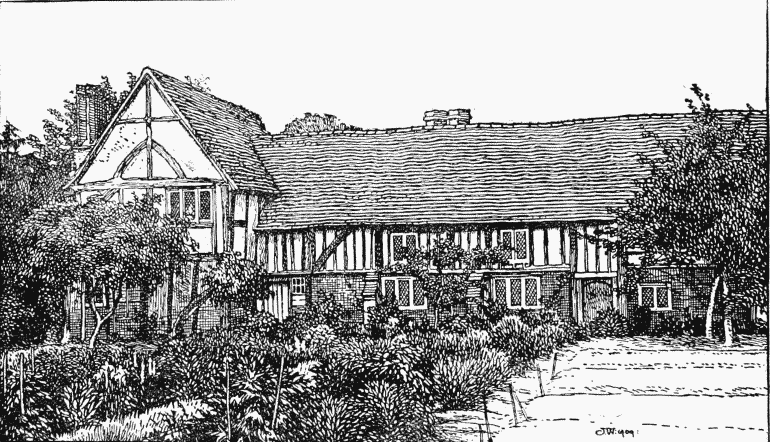
Walton on Thames Manor House
The slopes of St. George's Hill were the scene of an interesting development of the Socialism of the 17th century, when a party of Levellers took possession of the ground in 1649 and began to cultivate it for roots and beans. They encroached upon the waste of the manor of Cobham, and the commoners rose against them and drove them away before the Commonwealth Government had had time to act, though Sir Thomas Fairfax as commander in chief had begun an interference which was as illegal as the acts of the Levellers themselves. (fn. 12)
William Lilly the astrologer, famous in his day, lived in Walton parish at Hersham. On his death in 1681, he left his house to a son of Bulstrode Whitelocke, who had befriended him. John Bradshaw the regicide lived in Walton, in a house still partly preserved. Admiral Sir George Rodney was born at Walton in 1718. His father Captain Rodney, and General Macartney, who killed the Duke of Hamilton, were both living in Walton in 1724. (fn. 13)
The Inclosure Act in 1800 (fn. 14) inclosed 3,117 acres of land in the Walton manors, including parts of Chertsey, and 475 acres of arable common fields.
In the village is a Wesleyan chapel of red brick with stone dressings, with a tower and spire, built in 1887. The Baptist chapel was built in 1901.
The Public Hall, in High Street, was built by Mrs. Sassoon in 1879.
The Metropolitan Convalescent Institution for patients from the London Hospitals was built on a site given by the Earl of Ellesmere in 1840 and enlarged in 1862 and 1868. It accommodates 300 patients, and is supported by voluntary contributions. There is a public cemetery at Walton.
The Metropolitan Water Board have reservoirs in the parish.
A School Board was formed in 1878. A previously existing school was enlarged in 1881. The infant school was built in 1884.
Ashley Park is the seat of Mr. Joseph Sassoon, J.P. The estate was one of those annexed to the honour of Hampton Court by Act of Parliament, (fn. 15) and the house was no doubt originally of about that date. It was of red brick, built in the form of an H. It was alienated by the Crown, and became the property of Christopher Villiers, Earl of Anglesey, brother to the first Villiers Duke of Buckingham. He died in 1624, and his widow, who had remarried, died in 1662. The property then passed through several hands; Viscount Shannon bought it in 1718, and during his tenure the Rt. Hon. W. Pulteney (created Earl of Bath in 1742) lived there. (fn. 16) Lord Shannon died in 1740. He married Grace Senhouse, and their daughter Grace, Countess of Middlesex, died without issue and left Ashley Park to her cousins Colonel John Stephenson and his sisters in succession. The last of these died in 1786, when the property went to Sir Henry Fletcher, bart., another cousin. His son Sir Henry Fletcher, bart., very considerably altered the house.
Walton Grove, standing in a small park, is the seat of Mrs. Cababe; Holly Lodge of Mrs. Dyer.
At the northern end of the Manor Road is a redbrick house with brick pilasters forming a Tuscan order on two sides of the building. It is dated 1732.
Hersham (Heverisham) is an ecclesiastical parish formed in 1851 from the southern part of Walton-on Thames. It is, roughly, the part of the original parish south of the London and South Western Railway line. A chapel of ease (Holy Trinity) was built of yellow brick in Anglo-Norman style in 1839. The present church of St. Peter was built by Mr. J. L. Pearson, R.A., in 1887. It is of brick and stone in 13th-century style. It has a nave and aisles, of five arcades, chancel, transepts, and a western tower and spire. The site was given by Lieut.-Col. Terry of Burvale.
There is a Congregational church in the village built in 1839, restored in 1858, and enlarged in 1889.
An infant school was built when the first chapel of ease was opened in 1839. The present school was built in 1863 and enlarged in 1882.
The parish hall of Hersham was built by a company in 1885 and enlarged in 1892.
Pain's Hill is the residence of Mr. Alexander Cushney. It was celebrated as one of the earliest examples of natural landscape gardening on a large scale. It was laid out by the Hon. Charles Hamilton, youngest son of James sixth Earl of Abercorn, Receiver-General of Minorca 1743–58. The extensive grounds extend also into the parishes of Cobham and Wisley, and owe much to their natural position on the slopes of the high ground about St. George's Hill above the Mole Valley. The present house was built by the next owner Benjamin Bond Hopkins, who died in 1794. A later owner, 1804–21, was the Earl of Carhampton, who as Colonel Luttrell had opposed Wilkes in the Middlesex election.
Burwood Park, the seat of the Misses Askew, was rebuilt before 1809 by Sir John Frederick, bart., M.P. for Surrey, who owned it from 1783 to 1825. It had belonged to a family named Latton, the earliest of whom to come into Surrey was John Latton, steward of the manor of Richmond, 1694. He for a time held the manor of Esher and died 1727. His arms, Party argent and sable a saltire erminees and ermine counterchanged, used to be in a window taken from the old house. Burwood House is the seat of Mary Louisa Countess of Ellesmere; Silvermere of Mr. Archibald Seth-Smith; Burvale of Mr. J. B. Heath; Burhill Park is now used as a golf club.
Oatlands Park is an ecclesiastical parish formed in 1869 out of the north-western part of Walton on Thames. The church of St. Mary was built as a chapel of ease in 1861. It is of stone in 13th-century style, with a chancel, nave, aisles, south porch, and bell-turret. There are fourteen memorial windows, a marble pulpit, and a marble reredos set up as a memorial to the Rev. G. B. Watson, vicar 1885–7.
The Working Men's Club was built in 1884 on a site presented by Mr. F. B. Money-Coutts, J.P., and the parish room in 1887.
The school was built in 1882.
The old palace at Oatlands, acquired for the Crown by Henry VIII, was in Weybridge parish, and with the manor is described under Weybridge, but the greater part of the land was in Walton.
Henry Pelham Clinton, ninth Earl of Lincoln, extended the park and laid out the grounds in 1747 and the following years, when Woburn Park, Weybridge, Pain's Hill, and Oatlands were considered the finest collection of experiments in a romantic style of landscape gardening in England. The Duke of York, son of George III, resided here from 1791 to his death in 1827, and he and his duchess were extremely popular in the neighbourhood. She died here 6 August 1820 and is buried in Weybridge Church. A monument by Chantrey was placed there to her, and a column was erected to her memory on Weybridge Green by the inhabitants in 1822. The park was sold in lots for gentlemen's houses in the middle of the 19th century, and now forms a residential neighbourhood. The house is converted into the Oatlands Park Hotel. Foxholes is the seat of Miss Martineau; Templemere of Lt.-General Sir Arthur LytteltonAnnesley.
MANORS
In the time of Edward the Confessor Azor held WALTON Manor, with a mill, meadow land, woods, &c. William the Conqueror granted it to Edward of Salisbury, ancestor of the Earls of Salisbury. It passed as part of the dowry of his daughter Maud to Humphrey de Bohun, nicknamed 'Humphrey with the beard.' (fn. 17) Humphrey son of Humphrey and Maud married Margery eldest daughter of Miles Earl of Hereford. His grandson Henry was created Earl of Hereford in 1199, and this manor remained in the tenure of the Bohuns, Earls of Hereford, (fn. 18) until 1373, when Humphrey de Bohun, Earl of Hereford and Essex, died seised of it, leaving two daughters, Eleanor and Mary, his co-heirs. (fn. 19) Eleanor married Thomas of Woodstock, Duke of Gloucester. Mary became the wife of Henry of Bolingbroke, eldest son of John of Gaunt, whoobtained the manor of Walton as part of her dower, and was created Duke of Hereford in 1397. Mary died in 1394. (fn. 20) After Richard II was deposed Bolingbroke ascended the throne by the title of Henry IV. The manor descended to his grandson, Henry VI, who in 1422 as signed it to Katherine his mother as part of her dower. (fn. 21)
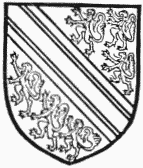
Bohun, Earl of Hereford. Azure a bend argent between two cotises and six lions or.
Queen Katherine died at Bermondsey Abbey on 4 January 1437. In the same year the king, having formerly granted the lordship of Walton on Thames to John Penycok for a term of years at a yearly rent of £25, reduced that sum to £15, and extended the grant to the term of Penycok's life. (fn. 22) After Edward IV had obtained the crown Parliament bestowed upon him the personal estates of Henry VI, who died a prisoner in the Tower in 1471. Henry's only son Prince Edward being dead, and none of the other three sons of Henry IV by Mary Bohun having left issue, the inheritance of the Bohun estates legally devolved on Henry Stafford, Duke of Buckingham, who was descended from Eleanor the sister of Mary Bohun. King Edward, however, retained possession of the property. (fn. 23) On his death Buckingham espoused the cause of Richard Duke of Gloucester, and aided him so effectually that Richard, a few days after his accession, signed an order for the livery of the lands in question to Buckingham. (fn. 24) The duke's subsequent rebellion against the king, however, ended in his own destruction, and neither he nor his family ever obtained Walton, which remained in the hands of the Crown, (fn. 25) and passed from Richard III to Henry VII. (fn. 26) The Tudor sovereigns granted leases of the manor of Walton to various tenants. In 1589 Queen Elizabeth granted to Katherine West, widow, wood, herbage, and pannage in Kingesridons Coppice, parcel of the manor, (fn. 27) and on 11 July 1593 John Woulde received a grant from the queen of the manor, together with the capital messuage known as Dorney House. (fn. 28) In 1612 Francis Drake of Esher had a lease for lives from James I. (fn. 29) Twenty years later Charles I granted the manor to Sir Henry Browne and John Cliffe (with the exception of such lands belonging to the manor as had been inclosed in Oatlands Park, certain rents anciently paid to the manor, and lands in Walton which had been annexed to the honour of Hampton Court), to hold in fee at a rent of £22 10s. 11½d. In 1650 this rent was conveyed by Thomas Coke and others, trustees for the sale of the fee-farm and other rents of the late king, to William Lilly of St. Clement Danes, gentleman, the famous astrologer. (fn. 30) In 1672 Francis Drake was lord of the manor, (fn. 31) but whether he held it under the lease above mentioned, or had purchased the fee-simple, is uncertain. In 1698 Sir Matthew Andrews and his wife Ann conveyed the manor to James Justice and John Phillips, probably trustees, (fn. 32) for the same year William Robinson held his court there. (fn. 33) The manor descended to Sara wife of John Bonsey; they jointly held their court at Walton in 1714. (fn. 34) Mr. Bonsey dying shortly afterwards, his widow married John Palmer, (fn. 35) who survived her and became owner of the estate, (fn. 36) which she settled on him. By his will, dated 1758, he gave this manor and that of Walton Leigh to Thomas and John, the sons of his brother Richard Palmer, and to Henry son of Henry Palmer. Henry's share descended to his daughter Frances, who married Thomas Hurst. His son, Palmer Hurst, sold it to the Duke of York previous to the passing of the Inclosure Act in 1800. The duke dying in 1827, his interest in the manor was sold to Edward H. B. Hughes, the purchaser of Oatlands. The two-thirds held by Thomas and John Palmer came into the possession of their nephew Richard Palmer, D.D., chaplain of the House of Commons from 1765 to 1769; and on his death passed to his son the Rev. John Palmer of Adisham, co. Kent. It was next held by Gillias Payne Palmer, but passed from him under a mortgage into the hands of William Clark, solicitor, of Chertsey, (fn. 37) and the present lord is Mr. Henry Edwards Paine of the firm of Paine, Brettell & Porter, solicitors, Chertsey.
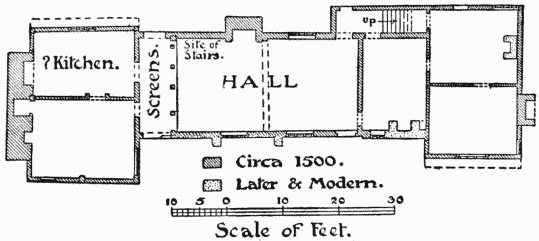
Plan of Manor House, Walton on Thames
The Manor Road, forming a loop from Walton village to the river, incloses the old Manor House, at the north end about 100 yards from the river, a fine specimen of 15th-century building, which has been called Bradshaw's house, but was never owned by him. It consists of a central hall running approximately north and south, with projecting wings at each end, built of timber framing originally filled in with brick and lath-and-plaster. The walls of the hall appear to have been thickened with modern brick in order to carry an inserted floor, and small additions of modern brick have also been made. This floor has in modern times been taken away, restoring the hall to its original design; the wings have each an upper story which projects over the ground floor. The hall has a large brick chimney-breast in the west wall, and in the south wing is a larger stack which appears to have served the kitchen fireplace. In the north wing is a corresponding, chimney-stack, and a modern one has been inserted in the northern room.
The chief entrance is from the east by a wooden doorway at the north end of the hall, which has continuous mouldings, carved spandrels and a square head; another door is opposite this one, but has been altered. From this a stair leads to the upper floor of the north wing. Each wall has a double tier of windows, with wood frames and mullions, but, as in the rest of the house, none appear to be original. A large tie-beam with a king-post spans the hall in the middle, and the roof is partly ceiled.
At the south end of the hall are the screens and gallery, the latter carried by four moulded posts probably originally filled in with panelling. Access to this was by a stair from the floor of the hall on the west side, where there is an opening in the framing which crosses the front of the gallery. From the gallery two doors open to the upper floor of the south wing. At both ends of the passage through the screens are the usual external doors, but these are only reproductions of old work.
From the passage two other doors open into the two ground floor rooms of the south wing, which occupy the normal position of the kitchen and buttery, the large fireplace on the south wall of the wing being partly blocked up, but the traces of decoration in these rooms, a large moulded post in the framing on each side of the east room and moulded joists in the ceiling, and some leaf carving on the frame of the window of the west room, seem to show that they were designed for living rooms and not domestic offices. It is evident, however, that the building has been considerably altered at various times.
The north wing is entered by a door at the northeast angle of the hall, with a moulded wood frame, and contains three rooms on the ground floor, and in the north wall a blocked window with hollow-chamfered wood mullions, which is possibly one of the original lights.
In 1086 Richard of Tonbridge, lord of Clare, held the manor of Walton, later known as WALTON LEIGH, which Erding had held of King Edward. There were on the manor a church, a mill, and a fishery. (fn. 38)
The overlordship continued with the Clares until 1314, when the last Gilbert de Clare died seised of it, (fn. 39) and it then seems to have been divided among his heiresses. In 1324 the manor was said to be held of Hugh Audley, husband of Margaret, one of the sisters of Gilbert. (fn. 40) In 1349 Hugh le Despenser, son of Eleanor, another of the heiresses, died seised of one-fourth of a knight's fee in Walton, (fn. 41) and this descended to Isabella Countess of Warwick, daughter of Thomas le Despenser, who held it at her death in 1439. (fn. 42) Her share probably escheated to the Crown after the attainder of her heir 'the King maker' in 1471. The descendants of Elizabeth, the third heiress, apparently also had a share, for in 1422 the manor was said to be held of Edmund Earl of March, who was grandson of Edmund Mortimer, Earl of March, lord of Clare in right of his wife Philippa, daughter of Elizabeth, granddaughter of Elizabeth the heiress, as of his castle of Clare. (fn. 43) He died without issue in 1425, when his inheritance descended to his sister's son Richard, afterwards Duke of York, whose son became Edward IV, when this part of the overlordship came to the Crown.
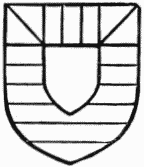
Mortimer. Barry or and azure a chief or with two pales between two gyrons azure and a scutchcon argent over all.
Undertenants appear at the beginning of the 13th century, when half a knight's fee in Walton was held by Geoffrey de Cruce, (fn. 44) whose daughter Avelina, wife of Roger Leigh or de Legh, claimed view of frankpledge and assize of bread and ale within the manor. (fn. 45) She died seised of it in 1299, Joan described as widow of Nicholas de Cruce then being dowered in one-third of the manor. (fn. 46) There were twentysix free tenants, and the manor was valued at £10 12s. 7¾d. It descended to John Leigh, son of Avelina, who conveyed a moiety of this manor to Walter de Langton, Bishop of Coventry and Lichfield, the famous statesman, for his life; the bishop obtained from Edward I a grant of free warren there. (fn. 47) He died in 1322, (fn. 48) and the lands reverted to John Leigh, who died seised of the whole manor in 1325. (fn. 49) In 1346 John Leigh is mentioned as holding the manor of the honour of Clare; (fn. 50) but his mother Margaret, who after the death of his father had married Robert de Kendale, had possession of it for life; she died in 1348. (fn. 51) In 1410 John Leigh of Shell or Shellegh (Shelley), co. Essex, is mentioned as holding the manor. (fn. 52) He was probably the John Leigh who in 1422 died seised of the manor of Leigh's Court, as it was then called. A court baron belonged to the manor. (fn. 53) From him it passed to his son Thomas, and so descended eventually to Giles Leigh, great-grandson of Thomas, who inherited it in 1509. It was then held by the service of half a knight's fee in fee-tail. (fn. 54) In 1537 Henry VIII purchased the manor of Leigh's Court from Giles Leigh, and annexed it to the honour of Hampton Court. (fn. 55) The manor remained vested in the Crown till late in the 18th century, and was granted on lease from time to time to different persons. (fn. 56) In the 18th century leases were generally granted to the owners of the manor of Walton on Thames, and thus the manor of Walton Leigh came into the possession of the Palmer family. (fn. 57) Mr. Palmer Hurst, who held one-third of the manor, sold his share in 1800 to the Duke of York. The other two-thirds belonged to the Rev. Richard Palmer, D.D., and descended to his son the Rev. John Palmer. On the sale of the Crown lands, which had been transferred to the Duke of York under an Act of 1804, the entire manor of Walton Leigh became vested in Edward H. B. Hughes. (fn. 58)
Early in the reign of Henry VIII a quarrel took place between certain fishermen of Walton and Giles Leigh, lord of the manor of Walton Leigh. The fishermen, Thomas Brewer, John Newman, and John and Richard Albroke, with others, claimed that they and their forefathers had been used to fish in the king's water of Thames beside Walton time out of mind. But Giles Leigh, 'by the sinister council of John Carleton, man of law and bailly there,' claimed a several water and fishing there of half a mile. Accompanied by certain persons armed with swords and bucklers he riotously came to Brewer's boats and took away his great salmon net. At other times he took from Brewer certain engines called 'clere weles' for catching roach and dace; and finally went to law with him and the two Albrokes for fishing in his water. Giles was non-suited, but he 'continued in his malicious mind,' and finally gave information which caused Robert Bawce, farmer of the king's moiety of Walton weir, to descend upon the luckless fishermen and 'uncharitably to vex them by privy seals and otherwise' for infringing upon the royal rights, driving them at last to appeal for justice. (fn. 59)
APPS (Ebsa, xi cent.), which now forms part of the parish of Walton on Thames, was originally a separate vill. In 675 Frithwald of Surrey and Bishop Erkenwald are said to have granted five 'mansas' there to Chertsey Abbey, (fn. 60) and this grant was renewed by Edward the Confessor when he restored its lost property to that monastery. (fn. 61) After the Conquest Richard de Tonbridge acquired some land in the manor, (fn. 62) or perhaps the whole manor, which was certainly afterwards held of his successors. The account of the matter given in Domesday is as follows:—'The same Richard has six hides in the manor of Ebsa which Abbot Wulfwold [of Chertsey] delivered to him in augmentation of Waleton, as Richard's homagers say. But the men of the hundred say that they have never seen the King's writ or livery officer who had given him seisin thereof. Nine thegns held this land [under Edward the Confessor] and they could seek for it and for themselves what lord they pleased.' (fn. 63)
A certain Picot held two separate half-hides of Richard de Tonbridge, and there was also half a hide held by a villein, for which he had previously paid rent to the homagers, but which he then held of the king. (fn. 64) This last half-hide appears in the Testa de Nevill as held of the king in free alms by Ralph Blundell, William son of Gunnild, William son of Gilbert, and Osbert Malherbe by the service of brewing and distributing beer for the benefit of the souls of Kings of England on All Souls' Day. In the escheats in the same record the same tenure is in the hands of William le Fraunkeleyn, Osbert Malherbe, Osbert Blundus, and Matilda, a widow. (fn. 65) In 1318 this land belonged to Hawisia de Hautot, and was said to form part of the manor of Apps Court. (fn. 66)
The overlordship of the Clare lands descended after the death of Gilbert de Clare in 1314 to the Despensers, (fn. 67) and subsequently to Isabella Countess of Warwick, daughter of Thomas le Despenser. It probably escheated to the Crown after the attainder of Warwick 'the Kingmaker' in 1471. (fn. 68)
Part of the Clare lands were held in mesne lordship in the early 13th century by the D'Abernons. Gilbert D'Abernon in or about 1235 granted to Jane widow of Engelram D'Abernoun all his interest in half a knight's fee in Apps. (fn. 69) John D'Abernon appears as mesne lord of lands in the manor in 1318, (fn. 70) and in 1361 the manor was said to be held of Sir William Croyser, (fn. 71) husband of Elizabeth, daughter of William D'Abernon. It descended to his son William, after whose death it was held by his wife, Edith, (fn. 72) and the mesne lordship continued with the lords of Stoke D'Abernon until as late as 1546. (fn. 73) Other lands in the manor were held of various lords, (fn. 74) so that it appears to have been a consolidation of several holdings.
These various lands, forming the manor of Apps, were held as sub-tenant by Hawisia de Hautot, wife of Ralph le Hever, at her death in 1318. Thomas de Hever, her son and heir, succeeded her. (fn. 75) His daughter Margaret married Oliver de Brocas, who held the manor of Apps in his wife's right. (fn. 76) John Brocas, his son, succeeded him, and died without issue, leaving as heir Edward St. John, kt., lord of 'Wyldebrugge,' son of Joan sister of Thomas Hever. (fn. 77) The manor was mortgaged under a statute staple for 1,000 marks to John Campden and others, who entered on possession. This probably accounts for a certain Bernard Brocas remitting all right in the manor in 1393 to John Nekelin and others. (fn. 78) Edward St. John therefore never seems to have been in possession. In 1418 the manor was held under the Croysers by John Pegays and William atte Field, probably feoffees. (fn. 79) In 1454 Ralph Agmondesham, whose family belonged to Rowbarnes and East Horsley, and his wife Millicent (fn. 80) were tenants, and it continued in a branch of this family for some time.
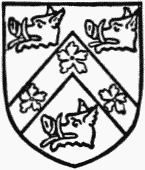
Agmondesham. Argent a cheveron azure between three boars' heads sable with three cinqfoils or on the cheveron.
In 1541 it was in the hands of John Agmondesham and Eleanor his wife, (fn. 81) and in 1546 John Agmondesham died seised of the manor, which he had settled on his wife, who survived him. (fn. 82) He was succeeded by Francis, his son and heir, who in 1547 sold the manor to William Hamond, senior. (fn. 83) From him it passed to his son William, and he sold it in 1565 to Thomas Brend. (fn. 84) Thomas Brend and his son Nicholas in their turn sold the manor in 1584 to Robert Benne, citizen and ironmonger of London, (fn. 85) but it would appear that Benne had for ten years previously had some sort of hold over the property. (fn. 86) From him in 1592 it was bought by Cuthbert Blackden; (fn. 87) and in 1602 Robert Blackden and his wife and Elizabeth Blackden conveyed the manor to Francis Leigh, (fn. 88) created a baronet by James I. He died in 1625, (fn. 89) and the estate descended to his son Francis, who subsequently became Baron Dunsmore and in 1644 Earl of Chichester. At his death in 1653 the property came into the hands of Thomas Wriothesley, Earl of Southampton, who had married Elizabeth daughter and co-heir of Francis. Thomas had by her four daughters, one of whom, Elizabeth, married Joceline, Earl of Northumberland, and after his death in 1670, Ralph, Earl, and later Duke, of Montagu. (fn. 90) He died in 1708–9, and was succeeded by his son John, Duke of Montagu, who died without surviving male issue in 1749. (fn. 91) In 1757 the manor was in the possession of Jeremiah Brown, whose daughter carried it in marriage to Jeremiah Hodges. (fn. 92) A descendant of his, Colonel Hodges, sold the manor in 1802 to Edmund Hill; (fn. 93) he bequeathed it to John Hamborough, after whose death it was sold by the trustees of his will to Richard Sharpe. (fn. 94) Robert Gill bought it before 1867. Mrs. Gill occupied the house after his death. It was sold in 1898–9 to the Southwark and Vauxhall Water Company, who pulled down the house, and excavated the whole estate for a reservoir. A barrel of ale, and a quarter of corn made into bread, were still in the 19th century distributed annually to the poor by the owners of the property on All Souls' Day in respect of the customary tenure. (fn. 95) The Water Company tried to evade the tenure, but on petition of the inhabitants the Charity Commissioners sanctioned a scheme in 1903, by which the interest of £200 paid by the Water Board was vested in trustees for the use of the poor of Walton and Molesey.
In 1639 Francis Dunsmore received licence to inclose 150 acres of land, parcel of the manor of Apps Court, for a park. (fn. 96)
The estate formerly called ASSHLEES, now known as ASHLEY PARK, was in 1433 in the hands of Joan widow of Robert Constable, who held it of the Crown. From her it descended to her son William Constable. (fn. 97) It consisted at that time of 12 acres of land, 4 acres of meadow, and half an acre of wood. Henry VIII bought out the tenant in order to annex it to the honour of Hampton Court. (fn. 98) In 1625 James I granted Ashley to Henry Gibb, together with the manor of Walton Leigh and certain lands in Walton Mead. (fn. 99) The Countess of Anglesey, who married secondly Benjamin Weston, son of Lord Treasurer Weston, the first Earl of Portland, lived here and was buried in Walton Church in 1662. (fn. 100) In 1668 the estate was held by Henry, Lord Arundell of Wardour. Sir Richard Pine, Lord Chief Justice of Ireland, died here in 1710. (fn. 101) In 1718 it was bought by Richard Boyle, Viscount Shannon, who made considerable additions to the house and park. A fine monument to him is in the church. The Countess of Middlesex, his daughter by his second wife, Grace Senhouse, owned it, and died in 1763, leaving it to Colonel Stephenson, son of Jane Senhouse, her mother's elder sister. After his death and that of his three sisters without issue, it came to Sir Henry Fletcher, bart., son of Isabel Senhouse, younger sister of Grace Senhouse. Sir Henry Fletcher was M.P. for Cumberland from 1768 until his death in 1807. He was succeeded by his son Sir Henry, who died in 1821, when the manor descended to Sir Henry, third baronet, who died in 1851. In the time of his son Sir Henry, fourth baronet, the property was sold. (fn. 102) It now belongs to Mr. J. S. Sassoon, J.P. Ashley Park is noted for the size and beauty of its trees. The house is believed to have been built in the reign of Henry VIII.
The estate known as BURWOOD, at one time in the possession of Corpus Christi College, Oxford, was demised by the president and fellows of that college to John Carleton. (fn. 103) From him it was purchased by Henry VIII in 1540. (fn. 104) The family of Drake, who held the bishop's manor in Esher (q.v.), lived at Burwood, (fn. 105) and Mr. Latton, who sold the manor to the Duke of Newcastle, retained Burwood, where he died in 1777. (fn. 106) The arms of Latton used to be in the window of the house. (fn. 107) Later it came into the hands of the Frederick family, one of whom, late in the 18th century, built a large house there, and greatly increased the area of the park. (fn. 108) It is now the property of the Misses Askew.
Hersham contained a manor known as MOREHALL alias SYLKESMORE alias SOUTHWOOD. There is a mention of a court held at Hersham in 1272 by Reginald de Imworth and Matilda his wife, (fn. 109) which may indicate that he was then lord of the manor. When Henry VIII built Nonsuch Palace as many as eighty loads of timber were obtained from Southwood, or the South Woods, for that purpose. (fn. 110) In 1540 Henry VIII purchased from John Carleton the manor of Morehall alias Sylkesmore in Hersham, together with lands and woods in Burwood and Hatch in Hersham. (fn. 111) The manor remained in the possession of the Crown, and was granted by Philip and Mary to David Vincent. (fn. 112) In 1579 Queen Elizabeth granted to Thomas Vincent the manor, site, and demesne lands of Morehall, and the wood called Sylkesmore coppice. (fn. 113) In the 18th century and until 1802 at least, the estate, then known as 'the manor of Southwood and Silksmore,' appears to have been held by the Frederick family. (fn. 114)
CHURCH
The Church of ST. MARY consists of chancel with north vestry, nave with north and south aisles, west tower, and a south porch used as a vestry.
The earliest church for which evidence exists consisted of an aisleless nave, with a chancel of about the same size as at present. About 1160 a north aisle was added, and early in the 14th century a south aisle was built and the chancel remodelled or rebuilt. In the 15th century the present west tower was built. The tracery of the chancel windows is all modern; the east window is of three lights with flowing net tracery, and the others are of 14th-century style, the jambs and rear arches so covered with colour wash and plaster that their age is difficult to determine. A north doorway leads to the vestry, which has a square sash window on the east, and in the south wall of the chancel is a 14th-century piscina with two drains and a restored cinquefoiled head, a single tall arched sedile, and close to it on the west a mutilated ogee-headed recess, probably a second sedile. All this work is old, but the south doorway close by has had its outer stonework renewed.
The chancel arch has two chamfered orders with half-octagonal responds and moulded capitals and bases, dating from c. 1330. The nave has arcades of four bays with pointed arches of two chamfered orders like those of the chancel arch and probably coeval, and the south arcade has octagonal pillars and moulded capitals of the same date, but in the north arcade the pillars are of 12th-century date, with circular scalloped capitals and moulded bases.
On the east respond of the south arcade is the well-known quatrain on the Holy Sacrament, in late 16th-century lettering renewed:
Christ was the worde and spake it
He took the bread and break it
And what the worde doth make it
That I believe and take it
The north aisle has a modern east window of two lights in 15th-century style. In the north wall are two late 15th-century square-headed windows, of three cinquefoiled lights with square labels and stops. A third between them is a modern copy in wood with red-brick jambs.
In the west wall is a small blocked single-light window, the head trefoiled and apparently of 14thcentury date. The aisle wall has been heightened with brick when the gallery was set up. Three windows, each of three uncusped lights, have been inserted. The south aisle has a 15th-century east window with three cinquefoiled lights and tracery, and at the south-east is a like window, but with mullions and tracery removed, with another next to it on the west which retains its tracery. The south doorway is of 15th-century date with a pointed arch under a square head and quatrefoils with shields in the spandrels, each shield bearing a plain cross. There is a trefoiled piscina in this aisle.
The tower is in three stages with rough diagonal buttresses of brick. There is a modern west door, and above it a modern three-light window. The tower arch has three moulded orders with an engaged shaft to the inner order. On the north and south faces of the second stage are single lights, and the belfry windows are also single lights renewed. There is an 18th-century west gallery in the nave, carried by small pillars and a good moulded and carved beam, with a panelled front projecting on brackets; galleries are also set up in both aisles, the organ being in the west gallery, blocking the tower arch. The chancel and nave are ceiled to the underside of the rafters, and have plain tracery and tie-beams which are probably of no great age. There is an octagonal panelled font, dated 1845, and all the rest of the fittings are modern.
On the chancel walls are several monuments, the most interesting being over the south doorway. It bears in an alabaster frame a set of verses 'in further memory of the said Thomas Fitts Gerald' and Fraunces Randolph, dated 1619, and appears to be a pendant to a larger and now destroyed monument. In the north aisle is the large monument by Roubiliac to Richard Boyle Lord Shannon, Field-Marshal and commander in chief in Ireland, 1740, and close to it on the east a brass to John Selwyn, 1587, keeper of the park at Oatlands, with figures of himself, his wife, and eleven children. Above is a square plate with an engraving of a man riding a stag and plunging a sword into its neck; this is repeated on the back of the same plate and probably refers to an exploit of the keeper's.
The bells are eight in number: the treble and second by John Warner & Sons, 1883; the third inscribed 'The gift of John Palmer, Esq., High Sheriff of this County 1726'; the fourth by Joseph Carter, 1608; the fifth by Richard Eldridge 1606, inscribed 'Our Hope is in the Lord, 1606'; the sixth is by Warner, 1883; and the seventh by William Carter, 1610; while the tenor of 1651, by Bryan Eldridge, bears the names of the churchwardens, John Taylor and Thomas James. The sixth was formerly a 15thcentury bell by a London founder, inscribed 'In Multis Annis Resonet Campana Johannis.'
The plate consists of a cup of 1757, a cover paten without hall-marks, but c. 1728, a paten of 1713, two flagons of 1757, and a plated almsdish, dated 1829.
The registers date from 1636, but are imperfect. A scold's bridle is preserved in the church.
ADVOWSON
In 1086 there was a church on the land of Richard de Tonbridge, afterwards called the manor of Walton Leigh, and the advowson belonged to the lords of this manor. (fn. 115) In 1382 Thomas Leigh conveyed the advowson to Geoffrey Michel. (fn. 116) He shortly afterwards enfeoffed John Gray and a number of others, (fn. 117) possibly trustees for Henry Bowett, afterwards Archbishop of York, who, in 1413 endowed his newly founded chantry in York Cathedral with 2 acres of land in Walton and the advowson of the church (fn. 118) for the support of two chantry priests, who had licence to appropriate the church. In 1542 Robert Gybbon and William Watson, the then chaplains of the chantry, demised the rectory to John Carleton and Joyce his wife for forty-one years. Edward VI in 1552 granted a lease to Hugh Rogers at a reserved rent of £22 15s. 8d. After Rogers' death his wife Anne married George Sneyde, and they assigned their interest in the advowson to Richard Drake. (fn. 119) Philip and Mary granted the advowson and rectory in 1558 to John Bishop of Winchester. (fn. 120) In 1622 Thomas Watson died seised of it, or more probably of a lease of it, (fn. 121) for the Crown presented in 1623. In or about 1624 Richard Uridge, then vicar of Walton, asked for a reference to the Bishop of Winchester that the parson impropriate might be caused to increase the endowment of the vicarage. (fn. 122) The Crown presented to the living throughout the 17th and 18th centuries, (fn. 123) but the Rev. W. K. Bussell, the vicar, is now patron.
The rectory of Walton was granted in 1584 to Richard Drake and his son Francis Drake for their lives. (fn. 124) In 1594 a lease for thirty-one years was made to William Askewe, to begin after the expiration of the Drakes' lease. (fn. 125) It was granted in 1609 to Francis Morrice and Francis Phillips, (fn. 126) probably trustees, for in 1622 Thomas Watson died seised of the rectory. (fn. 127) It was ultimately re-acquired by the Drakes. Francis Drake (see the manor) by his will of 1698 left it to his son William. Adria, only daughter of William Drake, married Denton Boate, and died without issue in 1754. She left the rectory to Christopher D'Oyley of the Inner Temple, who was buried at Walton. (fn. 128) His widow received a share of the waste at the time of the inclosure in 1800 as lady of the Rectory Manor. In 1803 she sold most of the estate, and the tithes were bought by the various proprietors. The land inclosed from the waste was reserved for the payment to the vicarage appointed in 1413.
CHARITIES
Smith's Charity is distributed as in other Surrey parishes.
In the church are records of the following bequests:—
By the will of Thomas Fennes, dated 8 February 1635–6, a tenement in Bishopsgate Street, now producing £500 a year (worth £10 a year when Fennes died in 1644), and land in this parish were left for the benefit of the poor.
In 1744, by will dated 1729, Mrs. Elizabeth Kirby left £200, which was increased to £336 by Jeremiah Brown of Apps Court, for ten poor widows, six nominated by the vicar and churchwardens, four by the owner of Apps Court. It was laid out in the purchase of land at Effingham, which in 1830 was exchanged for land in this parish.
The Apps Court Trust (see above) was settled in 1903.
Michael Kneebone, by will dated 1771, gave £350 3 per cent. consols for ten poor widows.
On the inclosure of 1800, land called Sandy Field containing 8 a. 1 r. 17 p. was given to the churchwardens and overseers for their expenses.
The overseers have also two small plots of land, on the south side of the road to Hersham and in Hersham respectively, the rents of which they may apply to their general expenses. The rent of a plot in West Molesey is applied by the churchwardens to the repairs of the church.
Over and above these, 189 acres were set apart for the poor at the inclosure of 1800. Part was sold to the railway, the rest is let as allotment ground and the rent distributed in coals.
William Sherwood, by will in 1822, left £716 19s. 6d. the interest of which is distributed to poor widows and other poor persons, and £1 to the vicar for a sermon.
In 1831 and 1862 Charles Smith and Miss Middleton left £150 for two poor widows and the sick poor.
In 1724 the vicar returned to Bishop Willis (fn. 129) that Baron Hilton, by an undated bequest, had left £16 yearly to the poor, secured upon lands in the bishopric of Durham. The Barons Hilton, so called by courtesy, but not peers of the realm, were owners of Hilton Castle. The last died in 1746. This benefaction appears to be lost.