A History of the County of Surrey: Volume 4. Originally published by Victoria County History, London, 1912.
This free content was digitised by double rekeying. All rights reserved.
'Parishes: Bermondsey', in A History of the County of Surrey: Volume 4, ed. H E Malden (London, 1912), British History Online https://www.british-history.ac.uk/vch/surrey/vol4/pp17-24 [accessed 30 April 2025].
'Parishes: Bermondsey', in A History of the County of Surrey: Volume 4. Edited by H E Malden (London, 1912), British History Online, accessed April 30, 2025, https://www.british-history.ac.uk/vch/surrey/vol4/pp17-24.
"Parishes: Bermondsey". A History of the County of Surrey: Volume 4. Ed. H E Malden (London, 1912), British History Online. Web. 30 April 2025. https://www.british-history.ac.uk/vch/surrey/vol4/pp17-24.
In this section
BERMONDSEY
Bermundesye (xi cent.) (fn. 1); Barmondsey (xvi cent.) (fn. 2); Barmesey, (fn. 3) Barmondsbye, (fn. 4) Barnaby. (fn. 5)
The parish of St. Mary Magdalene, Bermondsey, is bounded by Southwark on the west, by Rotherhithe on the east and by Camberwell on the south. The river frontage extends only from St. Saviour's Dock, of which it comprehends the eastern half, to Cherry Garden Pier. It comprises an area of 620 acres. (fn. 6)
The parish became important from the existence of the abbey, which probably reclaimed, embanked and cultivated it. But it preserved its rural character until the 17th century, and even after it became suburban it had no direct connexion with the City until the Tower Bridge Road was opened. Now the South Eastern and Chatham railway lines to London Bridge run through the parish.
The most ancient streets are those which led from Southwark to the abbey, Long Lane and Bermondsey Street, of which neither is wholly in Bermondsey. (fn. 7) In the beginning of the 18th century the streets, beyond those already mentioned, were Mill Street, Water Lane, London Street, Jacob Street, East Lane, Salisbury Lane and Street, Cherry Garden Street and the west side of West Lane. These are all included in the riverside area now bounded by St. Saviour's Dock, Dockhead and Jamaica Road. The parish comprehended the Snows Fields on the west of Bermondsey Street, the Court Yard and Grange Yard, and the road from Bermondsey Street to West Lane. (fn. 8) The latter is now Grange Road and Southwark Park Road, and was called Blue Anchor Road in the middle of the 18th century (fn. 9) and in 1871. (fn. 10) At the former date the buildings were still crowded to the north of Jamaica Road, then known as New Road, and around Five Foot Lane, Bermondsey Street and Long Lane, and the site of the abbey's grange in Grange Road. In Grange Walk, parallel with Grange Road, is a house of two stories with a considerable street frontage, the back part of which is weather-boarded. The front, which has two gables, has been stuccoed. The windows are all sash, but are possibly insertions, the design of the front, as far as may be judged after the defacing with plaster, suggesting a 17th-century date. Next door to this is a well-built brick house of early 18th-century date with flush sash and a good but simple overdoor. The road now called St. James Road connected Blue Anchor Road, a country highway which it met at Blue Anchor Bridge, and New Road, and there was a turnpike at its junction with the latter street. Savory or St. Saviour's Mill Stairs, East Stairs now East Lane Stairs and Cherry Garden Stairs, as well as Marygold Stairs to the west of the last-named, led to the river. (fn. 11) Fort Road is said to have derived its name from the fort by Kent Street made in 1642–3 by order of Parliament. A building of Jacobean architecture called Jamaica House stood in Cherry Garden Street until about 1860. (fn. 12) This, which was named from the newly-acquired Jamaica and was probably a place where limes, oranges and rum were to be had, was apparently connected with the pleasure garden called Cherry Garden. Pepys writes in April 1667, 'To Jamaica House where I never was before, together with my wife and the Mercers and our two maids; and there the girls did run wagers upon the bowling green: a pleasant day and spent but little.' Jamaica Road must have been so called from it. Five Foot Lane, now Tanner Street, which joins Bermondsey Street to St. Saviour's Dock, existed in 1544. (fn. 13) At that date there is mention of meadows called Sextenes, Curdons and Flymede. (fn. 14)
The town was protected from the river by banks and dikes, but was yet subject to frequent incursions of the tide. In 1230 the Annals of Bermondsey mention the repairs of the Breach of Rotherhithe. (fn. 15) In 1294 'the waters of the Thames passed their wonted limits and flooded the plain of Bermondsey,' (fn. 16) and in 1304 the prior and convent were exempted, at the queen's request, from contributing to the king's needs, because of their losses due to the submersion of their lands through breaches in the bank of the Thames. (fn. 17) A commission de walliis et fossatis was appointed in 1309, on the representation of the prior and of John de Drokensford, king's clerk, then holding the manor of Sayes Court in West Greenwich, to inquire as to the breach in the bank and dike of the Thames near Bermondsey, and the consequent losses there and elsewhere. (fn. 18) In 1311 a like appointment was made at the request of the prior and of John de Drokensford, then Bishop of Bath and Wells, (fn. 19) and the commissioners were instructed to report on the compensation due to the bishop and the prior. (fn. 20) As a result they caused a delivery to the latter of certain lands owned by those on whom repairs of the embankment were incumbent. (fn. 21) In 1346 a commission of oyer and terminer was issued for inquiry as to persons who had broken and demolished the prior's close and dike in Bermondsey, felled and carried off his trees and dug so much in his soil that 140 acres of meadow had been inundated, and he had totally lost all his profit in them. (fn. 22) According to tradition the water-course of the Neckinger was once navigable from the Thames to the monastery. (fn. 23) The Mill Stream in Bermondsey appears to have reached the Thames at St. Saviour's Dock, which has derived its name from St. Saviour's Mill. The existence of these tidal streams is recorded in placenames. In the early 14th or late 13th century there is mention of 'le waterweye,' (fn. 24) and of 'le Handbrigge' on the west of the highway by 'le watergang' of the prior (fn. 25); and in 1639 tenements are described as lying between the Stonebridge and the parish church. (fn. 26) Neckinger Street still preserves the name of the stream. Pevereffelde, (fn. 27) 'le gretewal,' (fn. 28) the common path called Shiteburlane and the garden of Beaurepeyr (fn. 29) occur with 'le Handbrigge.'
A certain importance doubtless attached to Rotherhithe and Bermondsey as a landing-place for boats below the dangerous arches of old London Bridge. A Bishop of Winchester returning from abroad was apparently expected to land on the shores belonging to Bermondsey. (fn. 30) But the dominating feature of Bermondsey was, of course, the great Cluniac Priory. Built on a large scale, with a very fine church and well endowed, it should to all appearances have been a flourishing house. From early times, however, it was in difficulties, whether from the inundations described above, from the mismanagement of the parent house abroad, which interfered with its affairs and frequently changed its priors after the usual fashion in Cluniac houses, from the absence of episcopal visitation, or from the hostility of neighbours and tenants to an alien priory, it is not easy to say. Certainly after 1381, when it became an English abbey, independent of foreign control, its affairs were less in disorder. (fn. 31) But its size and position made it the resort of great men and the scene of some important meetings. In 1140 William Count of Mortain retired there as an inmate. (fn. 32) The Earls of Gloucester claimed a lodging there of right, and Ralph Earl of Stafford died seised of this in right of his wife in 1372. (fn. 33) Henry II held a great council there in 1154. (fn. 34) In 1241 (fn. 35) and in 1259 (fn. 36) the assizes were held there. Katherine widow of Henry V and Elizabeth widow of Edward IV both died in honourable captivity at the abbey. For these reasons Bermondsey must have been one of the towns most damaged by the Dissolution. Though Sir Thomas Pope built a house, apparently out of the ruins of the church, (fn. 37) the place was not permanently attractive for residence, and was gradually deserted by the higher classes. The fatality caused by the plagues of the 17th century, especially that of 1625, (fn. 38) probably shows that it then had a poor riverside population.
Shortly before 1770, however, a certain Thomas Keyse opened in Bermondsey some tea gardens, the discovery of a chalybeate spring enabling the gardens to be described as Bermondsey Spa. About 1784 Keyse received a licence to provide in his garden musical entertainments like those in Vauxhall. They were varied by occasional exhibitions of fireworks and the price of admission was 1s. (fn. 39) They were south of Spa Road close to the spot where it is crossed by the railway arches of the original Greenwich line. The garden of Bermondsey Spa was closed about 1805, (fn. 40) but it gave its name to Spa Road, and its existence makes it probable that the growth of the trade of Bermondsey had brought to it in the 18th and in the early 19th century some wealthy residents. Admiral Sir John Leake, son of Richard Leake, master gunner of England, was born in Bermondsey in 1656. John Scott, the Quaker poet, was also born in Bermondsey in 1730; Robert Harrild, the printer and inventor, in 1780; Octavius Oakley, the water-colour painter called Gipsy Oakley, in 1800; John Francis, the son of a leather-dresser and publisher of the Athenæum, in 1811; and Frederick Henry Ambrose Scrivener, the Biblical scholar, in 1813. (fn. 41)
The growth of modern Bermondsey has been due to the leather trade. This was flourishing in the early part of the 17th century, but during the Great Plague Londoners had fled to the tanning pits of Bermondsey as a supposed refuge from infection. (fn. 42) Its localization in the place was a result of the supply of water which was obtainable twice in every twenty-four hours from the tidal streams of the Thames and was used as a motive power by tanners and leather-dressers; also plenty of oak bark for tanning was still to be had close by. In 1703 a charter of incorporation was granted to all persons instructed as apprentices in tanning for seven years who exercised their craft in the parish. They must have of their number from fourteen to twenty-four assistants, out of whom they must elect annually a master and two wardens. (fn. 43)
In 1792 there had been much building in Bermondsey, but there was still a remainder of grazing land occupied by cowkeepers and 110 acres of garden ground. The lingering suburban character of the neighbourhood is perhaps illustrated by the tradition that the oldest pack of foxhounds in Surrey was kept by Mr. Gobsall at Bermondsey in 1750. (fn. 44) The place, however, had by this time an important trade. The tanners were numerous, and carried on here a more extensive business than in any other part of the country. Some members of allied trades, fellmongers, curriers, leather-dressers and parchment makers, were established in the parish, and calico printers, dyers and pin and needle makers were represented in a small degree. Rope makers, anchor smiths, stave merchants, boat builders and persons who furnished articles of rigging for the navy occupied the waterside, and there were two small docks. (fn. 45) In 1832 the leather trade had outgrown the market in Leadenhall, and in this year and the next the existing leather market, whose frontage is in Weston Street, was erected by the principal tanners of Bermondsey. (fn. 46) The hat factory of Messrs. Christy was established before 1850. (fn. 47)
The wealthier residents had left the parish by 1842 and the place had acquired a character even more repellent than that which it bears at present. A thickly populated district along the waterside was inhabited by coal porters, whippers, longshore labourers and jobbers, corn porters, costermongers, watermen and sailors, whose earnings were irregular. The rest of the parish was occupied by working tanners, fellmongers, leather-dressers and other labourers. Four to five persons, on an average, slept in one room, standards of cleanliness and temperance were low, and the population subsisted chiefly on bread and potatoes. (fn. 48) The streams which surrounded Jacob's Island were built over after the outbreak of cholera in 1850. The district now forms the greater part of Christ Church parish. (fn. 49)
By the Reform Bill of 1832 Bermondsey was made part of the parliamentary borough of Southwark. In 1888 it was included in the county of London, (fn. 50) and finally, in 1899, the metropolitan borough of Bermondsey was created. (fn. 51) This comprehends, as well as the ancient parish, a north-eastern part of old Southwark and most of Rotherhithe. The river frontage of Bermondsey Borough extends from London Bridge to the boundary of Deptford.
The population of Bermondsey parish increased enormously in the 19th century. In 1831 it was 29,741, (fn. 52) in 1901 81,323. (fn. 53) This must have been due in part to the erection of many-storied tenement houses. The most important modern thoroughfare is Tower Bridge Road, which leads towards Tower Bridge from the junction of Bermondsey Street and Grange Road. This has become the site of a Sunday morning street market, which was open until one o'clock before 1907, when the Borough Council directed that it should be closed at eleven. (fn. 54)
The modern town contains in the streets near the Thames a riverside population of the usual description. Its leather trade is still important and is centred in the Leather Market, Bermondsey Street and Tanner Street. For the rest it is a district of poor dwellings and retail shops, interspersed by a considerable number of factories. Legislative and municipal reforms have made a considerable improvement in its condition. Its chief public buildings are the town hall in Spa Road, whose first stone was laid in 1880, and the public library next to it which was erected between 1890 and 1891. The Drill Hall in Jamaica Road was opened in 1876.
The great increase in the population of Bermondsey necessitated the formation in the 19th century of several new parishes: the parish of St. James in Spa Road was formed in 1840 (fn. 55) out of the north-eastern part of the parish of St. Mary Magdalene, including all the waterside district. (fn. 56) The district chapelry of Christ Church was constituted in 1845 out of the part of St. James' district which lay westwards of East Lane (fn. 57); the district of St. Paul was formed in 1846 out of the western part of St. Mary Magdalene (fn. 58); that of St. Anne out of a south-eastern part of St. James' parish in 1871, (fn. 59) and a portion of the new parish was assigned to that of St. Philip, Camberwell, in 1876 (fn. 60); the parish of St. Crispin was formed in 1875 out of the eastern part of the riverside district of St. James' parish (fn. 61); that of St. Augustine of Hippo in South Bermondsey in 1878; and that of St. Luke in Grange Road, out of contiguous parts of St. Mary Magdalene and St. James in 1885. (fn. 62)
There have been a number of dissenting congregations at Bermondsey from the 17th century. In 1670 Mr. Janaway was preacher at 'the great barn in Bermondsey near Jamaica House,' and Mr. Whitaker 'at the Long Walk near Bermondsey Church.' (fn. 63) The former was the founder of the congregation of the chapel in Jamaica Road called Townsend's Chapel, in the middle of the 19th century, which was at first Presbyterian and afterwards Independent. (fn. 64) In 1725 the vicar returned that there were 9,000 people and 3,000 Nonconformists, with two Presbyterian, one Independent, one Baptist meeting, and Quakers with no meeting in the parish. There were also two Papists. (fn. 65) In 1756 there were two Anabaptist meeting houses in Bermondsey. (fn. 66) In 1792 the parish contained two congregations of Independents, an Anabaptist meeting house, a Wesleyan chapel and a Quaker burial-ground. (fn. 67) A Wesleyan chapel called Southwark Chapel was built in Long Lane in 1808. In 1835 the Roman Catholic church of the Most Holy Trinity was opened in Parker's Row, Dockhead. It took the place of an earlier chapel in East Lane. (fn. 68) Additional chapels now in existence are those of the Baptists in Abbey Street, Drummond Road, Ilderton Road, Lynton Road and New Church Street; that of the Plymouth Brethren in Cockson Place, Dockhead; of the English Presbyterians in Southwark Park Road, of the Primitive Methodists in Fort Road and of the United Methodists in Upper Grange Road. The Wesleyans have chapels in Tower Bridge Road and Leroy Street. There was a Wesleyan burying-ground, now disused, in Long Lane.
MANORS
The manor of Bermondsey was held before the Conquest by Earl Harold, in 1086 by the king. The land in 1086 was for eight ploughs, of which one was on the demesne and four were held by twenty-five villeins and thirty-three bordars. There were 20 acres of meadow and the wood was worth five hogs from the pannage. In London thirteen burgesses who paid 44d. in rent belonged to the manor. (fn. 69) This description concerns a larger area than that afterwards known as Bermondsey. In a later register of Bermondsey Monastery it is stated that Bermondsey, Camberwell (part of), Rotherhithe, the hide of Southwark, Dulwich, Waddon and Reyham (probably an error for Leigham in Streatham) all pertained to Bermondsey as having once formed part of the manor which was of the ancient demesne of the Crown. All lands and tenements held of Bermondsey Manor were pleadable in the court of that manor by writ of right according to the custom of the manor and not at common law. (fn. 70) The later and lesser manor of Bermondsey was granted by William Rufus, probably in 1094, to the priory which had been established in Bermondsey by Alwin Child, to be held for ever with all its appurtenances, free and quit of all customs. The grant was confirmed by Henry I in 1127. (fn. 71)
The Count of Mortain held in 1086 I hide in Bermondsey, which in the time of King Edward and in 1066 was in the manor. It was worth 8s. The count's house was situated on it and there was attached to it one bordar. This holding must have resulted from a grant by William 1 to his half-brother Robert, Count of Mortain and Earl of Cornwall, which reduced the hidage of the royal manor of Bermondsey from thirteen to twelve. (fn. 72) Earl William, the successor of Robert, took the habit at Bermondsey in 1140, and died without heirs, (fn. 73) and either by his gift to the house or because the property had devolved upon the Crown his holding was apparently reunited to Bermondsey Manor.
Henry II gave to the monks in 1160 all their lands, men, tithes and other possessions, to hold free of all oppressions and exactions from gelds, aids, forests, assarts, inclosures of parks, sheriffs, requirements of shires and hundreds, pleas and complaints, moots and all other customs. He granted to them soc and sac, toll and theam, infangethef and other liberties, and the right to keep their peace and their will in all their property. Such liberties were confirmed to them by Richard I, Henry III, Edward III, Richard II and Henry IV. (fn. 74) In 1174 Henry II granted free warren in all the lands of the house in Surrey. (fn. 75) In 1291 the value of the property of the monastery in Bermondsey was £19 10s. 8d. (fn. 76)
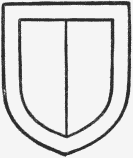
Bermondsey Abbey. Party gules and azure a border argent.
The possessions of the abbey in Bermondsey at the time of the Dissolution are difficult to distinguish from those in Rotherhithe, but were of considerable value. They included the water mill of St. Saviour, which yielded an annual farm of £8, (fn. 77) and whose site is now marked by St. Saviour's Dock. In 1541 Robert Southwell and his wife Margaret (who had received a grant of the site of the manor, see below) and Thomas Edgare received licence to alienate to Sir Thomas Pope, knight and king's councillor, and Elizabeth his wife, the monastery's late rights of fishing and hawking in and near the marshes of Bermondsey. (fn. 78) Edmund Powell was permitted in the following year to convey to the same persons messuages in Bermondsey (fn. 79); and in 1544 Sir Thomas received a royal grant in fee of rents and tenements there, (fn. 80) late of the abbey of St. Saviour, including view of frankpledge, court leet and royalties (that is all manorial rights). He held in the parish at this date, jointly with his wife, the pond known as the east part of St. Saviour's Dock, all fisheries and all profits from the breed of swans in that pond, St. Saviour's water mill, all goods and chattels of fugitives, and other property. (fn. 81) The wall in Bermondsey and Rotherhithe, known as 'Le Long Wall,' which had belonged to the priory of St. Mary Overy in Southwark, was also granted to him (fn. 82) In 1545 he obtained further grants of rents reserved by the Crown on lands in Bermondsey, on the liberty of fishing and hawking in the marshes of Bermondsey and Rotherhithe, on the messuage called 'Le New Estgate,' and on a garden outside the monastery wall (fn. 83); and of the grain rent of St. Saviour's Mill. (fn. 84) Pope held the manor until 1555, (fn. 85) when he sold it to Robert Trappes of London. (fn. 86) In 1556 the manor was settled on Robert and his wife Joan, with remainder to Robert Trappes, presumably their younger son, and to his brother Francis in successive tail-male. The elder Robert died as holder of the manor in 1560, (fn. 87) and it appears to have passed from him to his grandson Robert, the son of the Robert on whom the settlement of 1556 was made. (fn. 88) This Robert gave 50 acres in Bermondsey to his mother Dorothy to hold in dower. He died in 1587, when he possessed the manor and fishing and fowling rights in the waters of Bermondsey and Rotherhithe. He was survived by his mother; and he bequeathed the manor to his wife Katherine, and left as heir a son Robert, aged six. (fn. 89) The latter probably did not outlive Katherine, and the manor passed, in accordance with the settlement of 1556, to Rowland Trappes, the brother of the Robert who died in 1587. Rowland, who was Sheriff of Surrey and Sussex, died in his year of office, 1616, holding the manor, St. Saviour's Dock and a little dock 'this side Rotherhithe,' some meadow land, two gardens in Long Lane, fishing and hawking in the marshes of Bermondsey and Rotherhithe, and three parcels of land and wall in those parishes, which contained respectively 60 acres, 300 roods and 800 roods, and of which two were called 'Le Longe Wall' and 'Sallow Wall.' It is evident that the embankment of the land near the river was still important. Rowland's brother and heir Roger Trappes of Cheam died within three months of him, (fn. 90) and was succeeded by Roger Trappes, gentleman, apparently his son, who at his death in 1622 held the manor and dccks. (fn. 91) He was followed by a son Roger, who died in 1630 at the age of ten and left as heir a brother Edward. (fn. 92) During the latter's minority the courts were held by his mother Rachel. (fn. 93) He was lord in 1675, (fn. 94) and was succeeded by Thomas Trappes, said to be his son, (fn. 95) who held in 1687. (fn. 96) He devised the manor in 1709 to his niece Elizabeth Holford, and died in 1710. Elizabeth, on her marriage in the next year to Edward Thurland of Reigate, (fn. 97) conveyed the manor to trustees to be sold. It was acquired by Peter Hambley of Streatham, (fn. 98) who held in 1718, (fn. 99) and passed from him before 1725 to his son Wiliam Hambley of Carshalton, who died in 1749. In accordance with a settlement it was assigned as jointure to Eleanor widow of William with reversion to his son (fn. 100) the Reverend Thomas Hambley. (fn. 101) The latter married Anne daughter of John Hallet and died childless in 1802. By his will he settled the manor on his wife for her life, and after her on Edmund Robinson, son of his sister Eleanor, with successive remainders to Edmund's sons in tail-male, to his daughters in tail, to his niece Eleanor, only daughter of Jerome Knapp (fn. 102) of Charlton House in Berkshire. Mrs. Hambley was living in 1814. (fn. 103) In 1818 Eleanor Knapp married Abel Ram of Ramsfort, High Sheriff for co. Wexford in 1829, and the manor was thus conveyed to the Ram family. Abel died in 1832 and left as heir Stephen Ram of Ramsfort, D.L., High Sheriff for co. Wexford in 1840. He died in 1899, and his heir was his son Arthur Archibald, who died in 1905. The family property has been inherited by his sisters, the Misses Mary Eleanor and Elizabeth Ram, but all manorial rights are practically obsolete. (fn. 104)
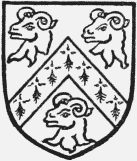
Ram of Ramsfort. Azure a cheveron ermine between three rams' heads razed argent with their horns or.
At the court leet of the manor held in 1637 one constable, two headboroughs, two ale-tasters and a scavenger were chosen, and an ordinance directed certain tenants to pave and mend the pavements before their several houses. (fn. 105) In 1663 three tithingmen were elected; and at the court baron of the next year the lord chose a bailiff who should hold office during his pleasure. (fn. 106) Two constables and four headboroughs were appointed at a court held in 1697. The ale-tasters at this date presented certain who had broken the assize of bread, (fn. 107) which duty was probably theirs by custom.
The site of the monastery of Bermondsey was granted in 1541 to Robert Southwell, together with a coney-yard, neighbouring lands within the parish, and those fishing and hunting rights afterwards conveyed to Sir Thomas Pope. (fn. 108) In the same year Robert was permitted to alienate to certain persons a meadow and pastures called the Swan Mead and the Nether Gravel Pittys, which lay between the highway towards the gate of the monastery on the north and Southwark on the south, the 'Stone House' near the abbey gate, and lands near the gate and near the grange of the monastery. (fn. 109) A rent reserved on the house of the monastery was granted by the Crown to Sir Thomas Pope in 1545. (fn. 110) Stow states that the abbey church was 'pulled down by Sir Thomas Pope, and in place thereof a goodly house built of stone and timbers' (fn. 111); and if he is correct, as is probable, since he himself may have been able to remember the event, the site was one of Pope's acquisitions. The house was, at all events, a modern one in 1598. In 1571 it was held by Thomas Earl of Sussex, who lay 'very sick at Barmesey,' and there received a visit from the queen. (fn. 112) He settled the capital messuage and the site of the monastery in 1579 on his wife Frances for her life, and after her on his heirs in tail-male. He died here in 1583, (fn. 113) and in 1589 his brother and successor Henry dated a letter from his house in Bermondsey. (fn. 114) This earl held the property at his death in 1593, (fn. 115) and his funeral took place in Bermondsey on 6 January 1593–4, 'when my Lord of Essex was chief mourner.' (fn. 116) The house and site were probably alienated by the next earl, Robert. In 1610 there was a conveyance of the site of the abbey from Mary Stanley, widow, to John Moyle, (fn. 117) and in 1621 another between John Moyle and his wife Mary and Richard Croshawe. (fn. 118) Richard held the site when he died in 1631, and had settled it in three parts on the daughters of his sister Frances Carter, who were Judith Haddon, Elizabeth the wife of Michael Hunsley, citizen and saddler of London, and Audrey Carter. (fn. 119) After such division the property ceases to be traceable. (fn. 120)
In 1378 the king made a life grant to Adam de Colton—one of the yeomen of his chamber—of a garden, a dovecote, and 3½ acres of meadow called LA HALE, of the yearly value of 40s., which had been forfeited by Alice Perrers. (fn. 121) In 1380 he granted the same property to William de Wyndsor, who had married Alice, (fn. 122) together with another tenement in Bermondsey which she had also held, and which had belonged lately to Walter Forester. (fn. 123) Subsequently, however, La Hale was acquired by Adam de Colton in fee simple, and in 1384 he received licence to alienate it to any of the king's subjects. (fn. 124)
CHURCHES
The parish church of ST. MARY MAGDALEN consists of a chancel, nave, north and south aisles, a west tower and west entrance vestibule, a north-east clergy vestry, and a south transept opening out of the centre of the south aisle and now used as a quire vestry. Over the aisles and west end of the nave are gables approached from the vestibule, which extends right across the west end of the building.
With the exception of the lower stages of the tower and the west wall of a mediaeval north aisle, now incorporated in the present west wall, the church was entirely rebuilt early in the 17th century. Later in the century additions including the galleries were made, while in the 19th century the building underwent several restorations. In the first of these in 1830 the west front was refaced with stucco and the upper part of the tower rebuilt. The next restoration was in 1852 and 1853, when the building is said to have been 'repaired and beautified,' while in the restoration of 1883 the chancel was lengthened and the vestry enlarged and the pillars to the nave were taken down and recut. The last restoration took place in 1898, when a new north-east vestry was built.
The church as seen from the outside is uninteresting. The roofs are slated. The chancel has round-headed windows on the east and south and a semi-elliptical coffered plastered ceiling. The nave arcades of five bays have stone Tuscan columns supporting modillioned cornices, from which springs, over the nave, a semi-elliptical plaster vault continuous with that of the chancel but not coffered. The tower stands in the end bay of the nave, and the westernmost bays of the aisles are cut off by glass screens and form with the bottom stage of the tower a west vestibule the whole width of the building, out of which rise staircases to the galleries. The centre bay of the nave is wider than the rest. Four bays of the aisles have flat ceilings, but over the centre bay is a semi-elliptical barrel vault, which is continued across the nave and south transept forming groins at the intersection with the nave vault. The nave is lighted by a clearstory of lunettes above the main cornice, the barrel vault being groined to receive them. The aisles are lighted by large semicircular windows and the south transept by a semi-elliptical window with wooden tracery.
In the centre of the vault of each bay of the nave is a large foliated plaster rosette. The tower arches are pointed and spring from semi-octagonal responds with moulded capitals. Above the modern west doorway is a pointed window of three cinquefoiled lights under a vertical traceried head. The tracery has been completely restored, but the inner jambs, which are shafted and have a continuously wave-moulded rear arch, are original. The upper part of the tower, which is modern, has an embattled parapet with crocketed pinnacles at the angles, and is surmounted by an open bell chamber with gabled sides, from which rises a small octagonal turret.
The 18th-century galleries are good examples of woodwork of that period. They are supported by wooden columns of a diminutive composite order, surmounted by an enriched entablature breaking over the columns, while the fronts of the galleries are panelled and over each column the panelling projects and is carved with cherubs' heads and swags of fruit. The woodwork is all painted and varnished, and the capitals to the composite capitals are gilded. On the east wall of the chancel behind the altar are two 18th-century oak panels with carved cherubs and swags, and the organ case is of the same date. Over the centre of the organ are carved the royal arms; the sides of the case are panelled. Under the organ gallery on the south side of the nave is an 18th-century churchwardens' carved pew. Most of the pews in the gallery are of the 18th century, and in the sanctuary are two 17th-century chairs.
The pulpit is octagonal; the upper part is 18th-century carved and panelled work. The font is of marble in the form of baluster, with a bowl carved with cherubs' heads. Round the base engraved on silver plates is the following inscription: 'This Font & Cover are the Gift of Mr. James Hardwidge Churchwarden A.D. 1808 To The Parish of St. Mary Magdalen Bermondsey.'
In the west vestibule is a 13th-century stone coffin, which was found about 6 ft. from the surface in front of the White Bear tavern.
There are two fine brass candelabra, one hanging from the central rosette in the nave vault, the other over the chancel steps; both are the gift of members of the Ellwood family, and are inscribed to that effect, with the dates 1699 and 1703.
On the north wall of the chancel is an elaborate mural monument to William Castell, who died in 1681, with shields of Castell (Argent three castles gules) and Brittaine (Gules a saltire between four fleurs de lis or).
There is on the floor at the west end of the nave a stone slab to Whitaker, a former vicar of the parish, who died in 1654. On the slab is a laudatory verse to Whitaker and Elton, another 17th-century vicar of Bermondsey.
There are three bells: the treble and second by T. Meurs, 1830, and the tenor by R. Phelps, 1721.
The plate consists of a silver-gilt cup of 1608, the gift of William Gardner, and bearing his arms and crest; a second cup of 1611 or 1613, gilded at the charges of Thomas Ledam, churchwarden, 1613; a silver-gilt cup of 1657, 'the Guift of John Scotson, mariner, performed by Elizabeth his widdow … 1657'; two silver flagons of 1662; a silver plate, parcel gilt of the 15th century, said to have belonged to Bermondsey Abbey; a silver plate of 1639; two modern patens and a modern silver flagon; a silver alms-basin of 1711, and two beadles' staves with silver tops.
The registers record baptisms 1548 to 1645, 1653 to 1738, 1740 to 1812; burials 1548 to 1645, 1653 to 1725, 1727 to 1812; marriages 1548 to 1645, 1653 to 1738, 1740 to 1812.
In Abbey Street is a small mission church dedicated to ST. ANDREW. It was built in 1882 and is constructed of red brick and stone and is designed in early 14th-century style. Next door to it is a clergy house erected in 1887 by the Eason trust.
The church of ST. ANNE consists of a chancel, a nave with aisles, and a south-west tower. The whole church is built of brick banded with stone, and is designed in early 14th-century style. The tower is crowned by a small stone spirelet. The church dates from 1869.
The church of ST. AUGUSTINE, Lynton Road, is a tall building of red brick and stone in 13th-century style begun about 1875. It has a chancel, tall north transept, low south transept, nave with a clearstory, north and south aisles, vestry, porch, &c. The roofs are covered with slates.
CHRIST CHURCH consists of a chancel, a nave with clearstory and aisles and south-west tower. The whole building is of stock and grey brick with stone detail and is designed in the style of the 12th century. The church dates from the middle of the 19th century and has no churchyard. At the east are parish rooms, church school, &c.
The church of ST. CRISPIN, endowed for the most part by Sir Frederick W. I. FitzWigram, bart., consists of a polygonal apse and chancel with a vestry, a nave of five bays with a clearstory, north and south aisles, a south porch and a north-east tower. The church is built of red brick with stone dressings, and is designed in late 13th-century style. It dates from the latter half of the 19th century and stands in a small churchyard.
The church of ST. JAMES in Spa Road consists of a wide nave and chancel in one range, with aisles separated from the nave by trabeated Ionic arcades. There are north, south and west galleries and round staircase vestibules at the west. Externally there is a tetrastyle Ionic portico. Above this rises a square tower in series of diminishing stages. The church is built of yellow stock brick with stone detail cornices, columns, &c., and a stone tower. An unusual feature is the clearstory to the nave. The church has a very fine ring of ten bells by Mears, 1828.
The church of ST. LUKE, Grange Road, consists of a continuous chancel and nave with aisles, and stands south-west and north-east. There is a bell-cote at the south-east angle.
The church of ST. PAUL, Kipling Street, which is built of stone, consists of a continuous chancel and nave with aisles and a north-east spire. There is a gallery at the western end.
ADVOWSONS
The 'new and handsome church' which was in Bermondsey in 1086 (fn. 125) must have been that of the monastery, founded a few years previously. The parish church of St. Mary Magdalen probably owed its foundation to the monks, and was a result of their piety and of the growth of the place which followed on their establishment in it. There is no evidence that it was held by anyone before the prior and convent. In 1291 there is record of a presentation to the rectory by the prior and convent. (fn. 126) A presentation was made in 1322–3 by the Bishop of Winchester, apparently during a vacancy of the priory; in 1338–9 John Earl of Warenne presented in right of demise by the king, who then held the priory's possessions; and in 1543 there was a presentation by John Cele, who had received from the abbot a grant of one turn in the advowson. (fn. 127) The rectory was worth £17 5s. 4d. a year in 1535, of which sum £10 was the value of the mansion of the rectory and the messuage, garden and house annexed to it. Out of the income a pension of 26s. 8d. was paid yearly to Bermondsey Abbey, 2s. 1d. to the Bishop of Winchester for synodalia and 7s. 7½d. to the Archdeacon of Surrey for procurations. (fn. 128) After the Dissolution the advowson of the rectory was granted to Robert Southwell, who in 1541 alienated it to Sir Thomas Pope, (fn. 129) after which date it followed the descent of the manor. In 1624 the patronage was exercised by Samuel Paske, citizen and merchant tailor of London, probably for one turn. He appointed Thomas Paske, D.D., master of Clare College, Cambridge. (fn. 130) In 1642 the churchwardens and parishioners petitioned the House of Lords because this Thomas, their rector, had not preached even once a year and had otherwise done nothing to provide preaching or reading in the church or to supply a dwelling for a curate. The expense of such arrangements had fallen on the petitioners. They had lately bought the next presentation to the living and they prayed for a confirmation of their elect. (fn. 131) In the following year a draft order of the House directed the sequestration of Dr. Paske, a non-resident minister and a teacher of heretical doctrines, in order that the parishioners might maintain their own minister. (fn. 132) Paske, whose Arminian opinions were as obnoxious as his negligence, (fn. 133) was ejected accordingly in this year, and the parishioners appointed in his stead Jeremiah Whitaker, (fn. 134) an eminent Orientalist, member of the Westminster Assembly, who held the benefice until his death in 1654 and was buried in the chancel of the church. (fn. 135) He was succeeded by another distinguished theologian, Dr. Richard Parr, who resigned the living in 1682. (fn. 136) William Browning, a fellmonger in the parish who had bought a term in the advowson, presented in 1723, 1726 and 1740. (fn. 137) In the beginning of the 18th century the vestry was general. (fn. 138)
The advowson was bought from the Ram family in 1871 or 1872 with funds raised by Canon Tugwell, rector of Bermondsey, and was vested in the Church Patronage Trustees, who are the present holders. (fn. 139)
The advowson of the vicarages of Christ Church and St. Paul belongs to the bishop of the diocese and the Crown alternately, that of St. James to the rector of Bermondsey, of St. Anne to the rector and two trustees, (fn. 140) of St. Crispin to Sir F. W. J. FitzWigram, bart., and of St. Augustine and St. Luke to the bishop.
CHARITIES
In 1725 there were already four charity schools endowed. The first two, one for boys and one for girls, had the interest of £300 between them, apparently the benefaction of Peter Hills, who by deed of 20 February 1613 gave a Free School and an endowment for the children of poor seafaring men. The second was endowed with £150 a year by will of Josiah Bacon in 1709. The master received £70, the usher £50. There were not to be more than sixty boys, and the number was to be kept up to forty at the least. The fourth school was endowed with £5 a year by Mr. John Wright in 1673 for teaching seven poor children, and the parish had added £5 more. This school was taught by a mistress 'who is chose and payed by ye Upper Church Warden.' (fn. 141) The first two schools were benefited by eighteen different donations between 1718 and 1786, when a return was made to Parliament, showing a total of £349 10s. a year. (fn. 142)
There is in the parish a very long list of charitable gifts:—
1563. Owen Chinn gave land for bread and coals. The land was afterwards utilized for a workhouse, now replaced.
1578. Hugh Full gave £2 12s. 6d. for bread.
1597. William Gardner gave land worth £4 a year for the poor.
1606. Stephen Skidmore gave £1 a year to buy firing.
1607. Ralph Pratt gave £2 13s. 4d. a year for the poor.
1609. Francis Tirrell gave six chaldrons of coal a year for the poor.
Lucia Easson gave two houses, at an unknown date, for an unknown purpose, and 'the houses are not known.' But they are said to have been in Marigold Alley.
Henry Leake, money, date entirely unknown also.
1614. Richard Archden gave £2 a year for bread.
Thomas Kendall, at an unknown date, gave a house, pulled down and thrown into the churchyard in 1775, for two poor persons.
1625. Jane Trapp gave £6 6s. a year for two sermons, and for the poor.
1629. Thomas Chibbald gave £100 to purchase land.
1630. Bernard Hyde gave £4 10s. every ten years to poor maids and widows.
John Lockwood gave a house for the poor, at unknown date.
Sir John Fenner gave £8 a year for the poor, £6 to buy Bibles, at unknown date.
1635. William Steavens gave £55 for bread.
John Scragg gave 6s. 8d. a year for the poor, at unknown date.
Henry Martin gave £3 a year to buy Bibles, at unknown date.
1659. Robert Barryward gave £10 a year for the poor.
Susannah Williams gave £40 towards almshouses, at unknown date.
Francis Rothwell gave £2 a year to the poor, at unknown date.
1672. Joyce Howlett gave £13 4s. a year for the poor, £1 6s. 8d. for two sermons.
1673. John Wright gave £5 for school, as above, £1 6s. 8d. a year for two sermons, £3 for bread, £12 13s. 4d. for clothing.
1675. Andrew Dandy gave £3 a year for the poor.
1688. John Samuel gave £2 10s. a year for bread.
1709. Josiah Bacon gave £150 for a school as above, and £150 to buy land, the rent to be for bread.
George Wheely gave £78 14s. for apprenticing poor boys, at unknown date.
John Taylor gave £100 to poor housekeepers, at unknown date.
'Rebacker' Carey gave £15 to buy bread, at unknown date.
David Apsey gave £100 to provide a guinea a year for a sermon, the rest of the interest for the poor, at unknown date.
Mary Parker gave a rent of leasehold, now expired, for the poor.
Mary Whitcomb gave £21 for the poor, at unknown date.
1783. Edward Evite gave £15 7s. for the parish.
Smith's Charity is also distributed as in other Surrey parishes.