A History of the County of Surrey: Volume 4. Originally published by Victoria County History, London, 1912.
This free content was digitised by double rekeying. All rights reserved.
'Parishes: Coulsdon', in A History of the County of Surrey: Volume 4, ed. H E Malden (London, 1912), British History Online https://www.british-history.ac.uk/vch/surrey/vol4/pp199-205 [accessed 30 April 2025].
'Parishes: Coulsdon', in A History of the County of Surrey: Volume 4. Edited by H E Malden (London, 1912), British History Online, accessed April 30, 2025, https://www.british-history.ac.uk/vch/surrey/vol4/pp199-205.
"Parishes: Coulsdon". A History of the County of Surrey: Volume 4. Ed. H E Malden (London, 1912), British History Online. Web. 30 April 2025. https://www.british-history.ac.uk/vch/surrey/vol4/pp199-205.
In this section
COULSDON
Colesdone (x cent.); Culesdon (xiii cent.); Cowlesdon (xvi cent.).
Coulsdon is a parish on the Chalk Downs 6 miles south of Croydon and 16 miles by road from London. It contains 4,313 acres. The subsoil is all chalk, but clay, brick-earth and gravel occur on the surface. The soil is dry, and water is obtained by deep wells in the chalk; but the curious dry depression in the chalk, called Smitham Bottom, once no doubt the bed of a stream, the water of which now breaks out only at the foot of the chalk in Croydon and Beddington, runs through it. This depression has been made use of for the joint Brighton and South Eastern Companies' railway lines, the Brighton road, and formerly the horse railway from Croydon to Merstham. The Caterham Valley, another depression, joins Smitham Bottom from the south-east, and in wet seasons water used to break out near Caterham and run down to Croydon. It is possible that the water was on the surface when a prehistoric population inhabited the Chalk Downs. Neolithic implements and flakes occur very frequently. On Farthing Down are a large number of barrows, which from the remains found indicate Anglo-Saxon interments (fn. 1); but it is not impossible that the same spot may have been the site of British interments. (fn. 2) It is about 400 ft. above the sea level, and stands up abruptly from the depression in the chalk just mentioned. On Riddlesdown are the remains of three parallel banks with two ditches dividing them, crossing the downs from north-east to south-west. The account in Manning and Bray (fn. 3) speaks of a double bank and ditch coming down the hill from a little wood on the left (east) to the road in Hooley Lane, and says that the banks on Riddlesdown point in the same direction, as if the former were a continuation of these. These Hooley Lane banks seem to be now obliterated. Aubrey (fn. 4) speaks of three banks at the entrance of the down, running for about 2 furlongs. These were probably those on Riddlesdown. Manning and Bray (fn. 5) interpolate 'Farthing' before the word Down. They seem to be referred to in a survey of the manor in the Chertsey Ledger as Newedich or Widedich. (fn. 6) On Riddlesdown there appears to be a trace of an old trackway rather below the crest of the down crossing these banks, and coming from the south-east. The Riddlesdown banks have recently been partly destroyed by the building of new houses.
The village of Coulsdon consists of little more than a few groups of old cottages, the National schools and farm buildings, clustered round a green and duckpond, on one side of which is a circular brick and flint lodge, leading to The Grange, the residence of Mr. C. Babington, an old-fashioned house on an ancient site, set in beautiful park-like grounds adjoining the church. There is a picturesque gabled cottage on the green, with projecting upper story, probably of early 16th-century date. The situation of the village is unusual, being at the summit of a somewhat steep rise, on a long ridge or elevated plateau, as in the case of the neighbouring villages of Sanderstead, Farley and Warlingham. The fine, tall elms that line the roads and are dotted about in the grounds of The Grange are a most picturesque feature. Coulsdon Court, with extensive grounds, lies to the north of the village. In the valley to the east, close to the Caterham Valley railway line, is a mediaeval barn or stable, very well built of black flints with firestone dressings. It has narrow loops of the same stone in the walls, and appears of late years to have served as a stable to the Rose and Crown Inn, a hostelry dating back to the 16th century. The barn or stable was probably built by the abbey of Chertsey as a tithe-barn in the 14th century. The present tiled roof is comparatively modern. (fn. 7)
The court rolls show common fields to have existed in the parish, but the date of inclosure is not known. The whole aspect of the parish has been completely transformed during the last twenty years by building. It was a little while ago entirely rural with a few new houses scattered along the line of the railway and up the valley towards Caterham, whence another deep depression in the chalk runs down to Smitham Bottom. Now there are continuous rows of villas and cottages and shops from Croydon to south of Coulsdon station. Near Purley station villas spread up the down on the west into Beddington parish and up Riddlesdown and on both sides of the Caterham Valley, and now form a town. At Kenley, higher up the Caterham Valley, a great number of larger houses have been built, and gentlemen's houses, some of a considerable size, have sprung up elsewhere in the parish. Riddlesdown, Farthing Down, Foxley Hill, Kenley Common and Coulsdon Common are still, however, open spaces. The lines jointly used by the London, Brighton and South Coast railway and the South-Eastern and Chatham railway run though Smitham Bottom with Purley, formerly called Caterham Junction, Stoat's Nest (goods station) and Coulsdon stations on them. The Caterham Valley line has Kenley station in this parish and the Brighton line to East Grinstead tunnels under the parish and runs above ground in it for a short distance. Near Coulsdon and Purley stations are some very extensive lime works. The London County Asylum at Cane's Hill was opened in 1883. The Reedham Orphanage, founded by the Rev. Andrew Reed in 1844, was established here in 1856, and the district is called Reedham from the founder's name. The present rectory-house was built in 1841. The school was first built in 1845; it was rebuilt in 1888 for 112 children and another has been recently opened for 900 children. Kenley school was built in 1885 for 185 children, the majority of the children of the inhabitants of Kenley (who number 1,300) not being of the elementary school class. The school at Purley was built on its present site in 1889. An infants' school was built in 1893. The Commemoration Hall at Kenley was built in 1897 as a public hall.
MANORS
The manor of COULSDON is mentioned in the Domesday Survey, when it was held by the abbey of St. Peter, Chertsey, (fn. 8) and the metes and bounds of the manor are very fully described in the Ledger Book of that abbey. (fn. 9) The manor was held of the king in chief (fn. 10) by the service of half a knight's fee. (fn. 11) In 1278–9 it was found that the abbey and convent had not the right of free warren in Coulsdon. (fn. 12) In 1324 the abbey lands were augmented by the gift of 171 acres, 1 rood of land and 1 rood of wood from Charles de Conductu, parson of the church of Coulsdon. (fn. 13) Manning asserts that this land was granted for the purpose of founding a chantry in the monastery of Chertsey to be supplied by a secular chaplain, (fn. 14) but this is not named in the patent. Later the abbot acquired 21 acres by an exchange of land with Thomas North of Coulsdon. (fn. 15) The manor continued to be held by the abbey (fn. 16) until its dissolution in 1537, when it was conveyed by the abbot to the king. (fn. 17) In the same year the king granted it in tailmale to Sir Nicholas Carew, (fn. 18) but in 1539, by reason of the attainder of Sir Nicholas, it returned to the king and in 1540 was annexed to the honour of Hampton Court. (fn. 19) Queen Mary in the first year of her reign granted the estate to Francis only son of Sir Nicholas Carew to be held in chief by the service of one-fortieth part of a knight's fee. (fn. 20) John Berriman of Thames Ditton, yeoman, lessee of the abbey of Chertsey, quitclaimed the remainder of his lease to Carew in 1582. (fn. 21) In 1589 Elizabeth granted the reversion of the estate in the event of Carew's death without male issue to the nephew of Sir Francis Carew, Edward Darcy, and his heirs male to hold by an annual rent of £45 12s. 3d. (fn. 22) Sir Francis died unmarried in 1611. (fn. 23) Sir Edward Darcy (knighted in 1603) succeeded, and at his death in 1612 he was found seised of the manor. (fn. 24) His son Robert died in 1618, leaving a son and heir Edward, aged eight. (fn. 25)
There were several petitioners to the Crown for the reversion of the manor of Coulsdon, should it lapse to the Crown for lack of male heirs to Edward Darcy, (fn. 26) and in 1663–4 (Darcy then having no son) Charles II granted the reversion of the estate to Jerome second Earl of Portland in consideration of his surrender of the presidentship of Munster, (fn. 27) to be held as of the royal manor of East Greenwich in free socage, by payment of a rent of £45 12s. 3d. (fn. 28) This rent the king granted to his queen Katherine. (fn. 29) Edward Darcy, who held a court in Coulsdon in 1668, (fn. 30) purchased the feefarm rent in 1670. Thomas fourth Earl of Portland, holder of the reversion, (fn. 31) had sold this in 1669 to Thomas Walcott and Edward Pulter, (fn. 32) probably trustees for Richard Mason, to whom in the same year Elizabeth Barnes and Katherine Phillips, daughters of Edward Darcy, (fn. 33) with their husbands quitclaimed all right to the manor. (fn. 34) Sir Richard Mason held a court in 1670. He died in 1685, and by his will, dated 10 March 1685, he devised all his real estates to his wife and daughter. Lady Mason held her court at Coulsdon in 1687, and the following year she and her daughter Dorothy sold the estate to Sir Edward Bouverie. (fn. 35) During the next hundred years the manor remained in the Bouverie family, which was raised to the peerage in 1747, Sir Jacob Bouverie being created Viscount Folkestone and Baron Longford. (fn. 36) His son William, created Earl of Radnor in 1765, (fn. 37) died in 1776 and his son sold the estate in 1782 to Thomas Byron, (fn. 38) in whose family it has since remained. It is now the property of Mr. Edmund Byron, J.P., who resides at Coulsdon Court. A rabbit warren belonging to Coulsdon Manor is mentioned in the grants by Queen Mary to Sir Francis Carew, and in that to the Earl of Portland, (fn. 39) and there are two charters extant of Sir Francis Carew granting a lease of the 'game of coneys' in the parish of Coulsdon. (fn. 40) The warren was on Hartley Down, and covered 77 acres and produced twenty dozen of rabbits yearly when it was broken up in 1760. This seems a small number, but rabbits were not so numerous then as they have been since their natural enemies have been destroyed by gamekeepers.

Weston, Earl of Portland. Or an engle sable looking backwards.
WHATTINGDON (Whatindone, viii cent.; Watendone, xi cent.; Wodinton, xiii cent.) was among the lands said to have been granted by Frithwald, subregulus of Surrey, and Bishop Erkenwald to Chertsey Abbey in the 7th century, (fn. 41) and confirmed by King Edgar. (fn. 42) At the time of the Domesday Survey it was held by the abbey of Chertsey, (fn. 43) and was assessed for 5 hides. After the dissolution of Chertsey Abbey lands in Whattingdon and Coulsdon, parcel of the manor of Coulsdon, were annexed to the honour of Hampton Court. (fn. 44)
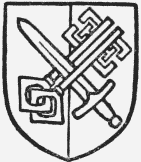
Chertsey Abbey. Party or and argent St. Paul's sword argent, its hilt or, crossed with St. Peter's keys gules and azure.
In 1545 Henry VIII granted two messuages in Whattingdon called Welcombes and Lawrences to Sir John Gresham, kt., (fn. 45) who devised them by will in 1554 to his wife Catherine for life, with remainder to his son William. (fn. 46) This William died in 1578, leaving two sons, of whom the eldest, William, received licence to grant the manor to his mother, Beatrice Gresham, to hold in chief, (fn. 47) and she died seised of 'the manor or farm called Welcombes and Lawrence' in 1604. (fn. 48) Since then the estate has passed through various hands until it was purchased in 1800 by Christopher Saville. (fn. 49) It afterwards belonged to Mr. John Young, from whom it was bought by the present owner, Mr. Carleton F. Tufnell, about 1900. Mr. Tufnell built the present house, called Watendone Manor, near the site of the old chapel.
TAUNTONS (Tanton, xvi cent.).— In 1234 Margaret daughter of William granted to the hospital of St. Thomas the Martyr of Acre in Coulsdon and to the knightly brethren there all her land in Coulsdon with the houses, buildings, men and all that went with them, saving the king's service from free land in the said town and saving to the church of Chertsey 8s. payable yearly at Coulsdon and to William de Lisle 1 lb. of pepper. (fn. 50) This was augmented in 1259–60 by a grant from Robert de Scothon and Margery his wife of 1 carucate of land in Coulsdon. (fn. 51) In 1290 the master of the house of St. Thomas of Acre was granted licence to alienate part of this estate to the Prior and brethren of the Hospital of St. John of Jerusalem. (fn. 52) In 1367 Thomas Purley granted to Thomas de Sallowe, then Master of the House of St. Thomas of Acre, lands, rents and tenements in Coulsdon to be held of the Abbot of Chertsey. (fn. 53) At the time of the Valor Ecclesiasticus the annual rent accruing to the House of St. Thomas of Acre from the manor of Tauntons was 100s. and there were about 45 acres of wood belonging to it valued at a yearly rent of 12d. per acre. (fn. 54) In 1558 Thomas Reve was seised of the manor, (fn. 55) and two years later John Tomson and Dorothy his wife quitclaimed it to Geoffrey Lambert and Richard Lambert his son and heir. (fn. 56) After this it appears to have been divided and the moieties dispersed among various families. Manning and Bray assert that in the beginning of the 19th century there were no courts held in this manor and no quitrents or services due to it. (fn. 57) The moieties were then owned by Mr. Dewdney and Mrs. Cotterell. Taunton House is now the seat of Mr. Harold Kinder, and Taunton Farm is occupied as a farm-house.

Hospital of St. Thomas of Acre. Sable a cross formy parted argent and gules.
The estate called HOLEGH, now HOOLEY HOUSE, appears early in the 13th century as a hide of land granted to Roger de Holegh by Elwin son of John. (fn. 58) In 1258 Thomas de Holegh quitclaimed 1 carucate of land to Robert de Walton and Beatrice his wife. (fn. 59) In 1323 Peter de Purley and his wife Julyan had a licence for a chapel in Holegh. (fn. 60) At the beginning of the 15th century the estate was held by the family of Wood (see monumental inscriptions) and afterwards came into the possession of Thomas Byron, in whose family it continued until early in the 19th century. Subsequently it was bought by Mr. Richard Shuter. It is now converted into a residential hotel, known as the Ashdown Park Hotel.
In 1312 John son of Roger de Wood died seised of the messuage and land now called WOOD PLACE. (fn. 61) It came into the king's hands by reason of the idiocy of John; but it was found by inquisition that at his death he held nothing in chief of which the custody of his lands should pertain to the king. (fn. 62) His sister Lucy was his heir. In 1357 Peter Atte Wood had licence for an oratory in his house at Coulsdon. (fn. 63) In 1403 Hugh Quecche died seised by right of his wife Elizabeth, leaving a daughter and heir Joan; he held it of the Abbot of Chertsey. (fn. 64) In the beginning of the 17th century it had passed into the Lambert family and so continued until 1685, when Alexander Lambert died seised, leaving seven sisters, among whom it was divided. (fn. 65) The greater part ultimately descended to the Roffey family, who also held land in Chaldon and Caterham (vide Stansterd in Chaldon). It is now known as Wood Place Farm.
In 1403 Hugh Quecche died seised of a tenement called KENLEY. This was granted by John Norton, who married Joan daughter of Quecche, to the chantry in the chapel of St. Mary in Steyning Church, Sussex. After the dissolution of the chantry Kenley was granted with other lands to Henry Polsted. (fn. 66)
CHURCH
The church of ST. JOHN THE EVANGELIST occupies the site of one standing here in 1086. The churchyard adjoins the grounds of The Grange, and has lately been extended towards the south. It is well timbered and contains an ancient yew and a great chestnut at the south-east end. At the western end is a modern lych-gate, leading to the west doorway, in front of which are three old ledgers of dark slate with heraldic panels, bearing dates 1760, 1768 and 1773, and inscriptions to the family of Bangham. There are also three ancient coffin slabs of the 13th and 14th centuries, one having a floreated cross in the head, and some fine headstones dated 1757 and 1763.
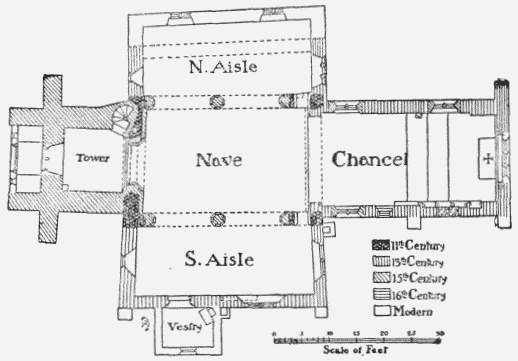
Plan of Coulsdon Church
The church is built of field flints, chalk and firestone rubble, with dressings of firestone, the walls, excepting the chancel, being covered with rough-cast. Bath stone has been used in the recent restoration of the north aisle. Against the south aisle and chancel walls are heavy buttresses of red and brown brick (one lately rebuilt), with two unsightly brick chimneys, and there are brick lacing courses in the chancel walls. The roofs, originally of Horsham slabs, are slated, as is also the base of the spire, the upper part being shingled. The spire appears to date from 1807, as in a drawing in the Sharpe collection made in 1790 the tower is shown with battlements. The buttress weatherings of the tower are tiled. In 1807, according to Cracklow, (fn. 67) 'the church underwent a thorough course of repair and cleansing,' the evil effects of which, including the scabby rough-cast, the brick patchings, the slated roofs, the wooden 'Gothic' tracery of the south aisle windows and the curious lobby squeezed in between the western buttresses of the tower, are still very evident; at the same time the narrow north aisle was extended to its present width. In 1843 and later further repairs and alterations were carried out, and in 1898 the north aisle was partially rebuilt, with shingle wall facing and stone battlementing of the churchwarden type. Notwithstanding these 'restorations,' the church, especially externally, bears as unrestored an appearance as any in the county, and parts, such as the south aisle, are sorely in need of repair.
The plan is unusual in several respects. It consists of a nave 19 ft. 1 in. by 29 ft. on the north and 29 ft. 9 in. on the south; with north aisle 30 ft. 10 in. long, varying in width from 13 ft. 2 in. to 12 ft. 9 in. (fn. 68); south aisle 31 ft. 10 in. to 33 ft. long by 12 ft. 9 in. wide; western tower 11 ft. 7 in. north to south and 10 ft. 11 in. west to east, with walls nearly 4 ft. thick and massive buttresses of deep projection; and chancel 32 ft. 1 in. long by 17 ft. 2 in. in the west end and 16 ft. in the east end. Within the space inclosed by the western buttresses of the tower a sort of porch, with churchcleaner's cupboards right and left, was built in 1807, a doorway to correspond being at the same time pierced in the west wall of the tower. Previously it would appear that the main entrance was in the south wall of the south aisle, with a porch, as shown in Cracklow's view, which doorway now opens into the 19th-century vestry that has taken the place of the porch. The tower, added about 1400, appears to follow an original distortion of the west wall of the nave and is set very much askew. It contains a circular stair in its north-east angle and terminates in a tapering broach spire, resembling that of Banstead. The bell-chamber is lit by louvred cinquefoil-headed lights, while the ringing-chamber has a broad pointed window in the west wall (above which is a clock) and another, which has lost its head, in the south. In the west wall of the ground story is a two-light window, with cinquefoiled heads, rebated for shutters and retaining its original stanchions and saddle-bars, beneath which the modern doorway has been made. The upper and lower doorways of the tower stair have circular heads. In the east wall of the ringing-chamber is a square-headed opening looking into the nave. Externally the construction of the tower is entirely concealed by the heavy coating of rough-cast, and the stone buttress-weatherings are covered with tile slopes, but it appears to be very solidly built of flints and rabble, and the original dressings of the windows remain, patched with cement. The tower arch, of pointed form, rises from a chamfered plinth and is of two continuous chamfered orders, the inner broader than the outer.
In about 1250 the north aisle was thrown out, and certain indications (such as the position of the original windows and Cracklow's plan) suggest that its original width was only about 7 ft. To this period belong the trefoil-headed rebated lancet in its western wall, with hollow-moulded drop-arch inside, and the curious and unusual triplet in the eastern, which consists of two short lancets with pointed heads and between them a higher trefoil-headed light, separated by broad rebated and chamfered mullions, the whole under one internal arch of pointed segmental form, with a hollow worked on the underside. The flat internal sill is kept high for an altar, and in the wall of the aisle adjoining is a small piscina, with a credence shelf and shouldered arch, having a quirked roll moulding. Above and around this the wall has been faced with chalk blocks in modern times and an opening pierced in the wall space, which is repeated on the opposite side. The north aisle was extended about 6 ft. to the northward, probably in the beginning of the 19th century, but, as its north wall has lately been rebuilt and the two windows therein are entirely modern, it is impossible to date the extension by any feature. This aisle suffered severely from the 'churchwarden' repairs of 1807, which included a sort of embattled parapet of coping stones and stuccoed brickwork. This was removed in 1898, but, unfortunately, replaced by an equally meaningless battlement in Bath stone.
The chancel, which must have been the work of Chertsey Abbey, is also of about 1250, and is exceptionally long—2 ft. or so more than the nave—and its details are extremely elegant and good. The wide and lofty chancel arch is of three orders, each a plain hollow, the inner dying into the pier, the middle continuous with the pier, and the outer resting upon a very graceful corbel with hollowed diagonal facet, delicately moulded. The angle of the eastern face of the piers is worked as a shaft between hollows, to form the start of a charming blind arcade of three lofty arches, carried up to the top of the wall, on either side of the chancel. The east and west arches of these arcades are of pointed segmental shape, while the centre one, which is about 1 ft. narrower, is circular segmental, or very slightly pointed, and depressed below the crowns of the others. All stand out in relief from the wall below, and are worked with a single deep hollow, the backs being chamfered. Above the capitals of the slender shafts a cushion is worked in the springers to stop the hollows. Instead of a shaft in the two western bays the capital has a corbel dying into the wall, no doubt on account of the quire stalls planned for the space below. These capitals are of different and very graceful sections and resemble the contemporary work in Westminster Abbey, a sister Benedictine house with Chertsey. (fn. 69) The bases originally rested upon a stone bench-table, parts of which remain, particularly to the west of the beautiful range of sedilia and piscina, which stand under the easternmost arch on the south side. This feature is by far the best of its kind in Surrey. The three recessed seats are stepped up, and the arches over them, deeply moulded, with projecting hoods, are trefoiled, as is that of the piscina. The latter has shafts of Purbeck marble. The hood mouldings terminate in cone-shaped fluted stops. The western arch of the sedilia has a splayed jamb instead of a shaft, and is narrower than the others. The mouldings closely resemble those of the north doorway of St. Mary's, Guildford. There is no priest's door, although one may have existed. There is a coeval low-side window, with pointed head, now blocked up, in the south wall. The opening window in the east wall, which internally is ancient, is filled with incongruous modern tracery, while the original windows of the side walls were replaced, in about 1400, by the present two-light openings with segmental heads and cinquefoiled sub-arches.
The south aisle seems to have been built as a family chapel at about the same date as the north aisle and chancel, but no doubt by different builders, as the details differ. It cannot be later than c. 1270, and may not be so late. (fn. 70) The south door has a pointed head with continuous hollow mouldings in two orders. In the gabled west wall is a very wide and tall lancet, also worked with hollow mouldings, and eastward of the door is a segmental-arched recess, probably covering a founder's tomb. Beyond this is probably a piscina, still blocked up. In the same eastern part of this south wall is a large window, widely splayed, with a segmental rear arch, and in the east wall another with rebated splays and a nicely proportioned pointed arch, both original work internally, but now filled with incongruous two-light tracery of cement and wood.
The great problem in deciphering the architectural history of this church is the disappearing of the 13th-century arcades between these aisles and the nave. Whatever their character, they have entirely vanished and in their place we have two arcades precisely similar in design and detail of early 15th-century date corresponding to the period of the building of the tower. They have piers and responds of octagon form, and the two arches on either side are of two chamfered orders, the capitals and bases being of common 15th-century sections. (fn. 71) The east responds have a considerable wall space behind them, probably for the accommodation of the destroyed rood-screen, and the modern openings like squints pierced through this wall space may have been suggested by some doorway in either pier to give access to the loft.
The modern roof of the chancel is of an elaborate cradled form, of trefoil section, with curved ribs and moulded purlins. The north aisle roof is also modern, but that of the nave, which has four ancient tie-beams, is ancient, though concealed by modern boarding, and the south aisle roof, similarly treated, is probably also ancient.
The step levels in the chancel, the tile-paving, the stone reredos, the dwarf chancel screen, the chancel and nave seating, the communion rails, pulpit, lectern and font are all modern, as is the painted glass in the chancel and the new windows of the north aisle. There are many patches of mediaeval colouring on the chancel arch and north and south arcades, chiefly red with a little black.
The coffin slabs and ledgers bearing indents of brasses outside by the tower have been already referred to. On the south wall of the tower is a small brass inscription as follows: 'Anthonie Bois the sonne of Thomas Bois A man of Armes in Calais & Captaine of Dele Castelle & of Malin daughter of Nicolas Leigh of Addigton, Esq: A man for his pietie, integritie, modestie, charitie to the poore & most lovinge & kinde carriage towards all singvlarly beloved whilest he lived, and after his death generally deplored of the whole covntry, lived Parson of this chvrch 22 yeares & died the 4 day of Avgvst in the yeare of ovr Lord 1610. Non moriar sed viuam et narrabo opera domini: ps. 118.' In the tower floor are two slate slabs to Thomas Wood of Howley, 1716 (probably a descendant of the foregoing, who had turned his name into French), and to his son Thomas, 1723; also two Sussex and Purbeck marble slabs with indents of brasses.
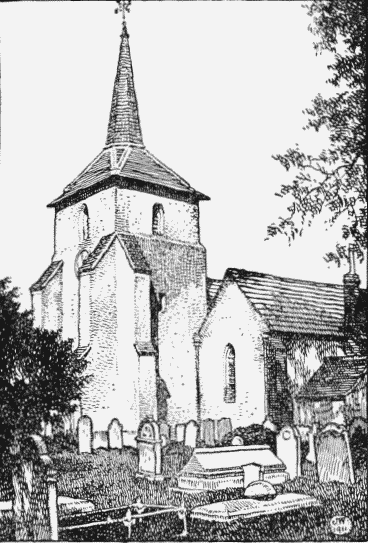
Coulsdon Church from the South-west
High up on the south wall of the south aisle is a very curious little monument to Grace Rowed, 1633, resembling some of the Evelyn monuments in Wotton Church. It is of alabaster and black marble, with a circular pediment, pilasters and a central pedestal, on which stands a well-modelled female figure in alabaster, holding a ball in her left hand. Her face is upturned towards a rising sun in the pediment, besides which are carved masses of rolling clouds and a flying scroll—perhaps in allusion to Revelation vi, 14—' And the heaven departed as a scroll.' Below the cornice are carved two veils or curtains on which are the texts (left): 'For the Lord will destroy in this mountain the face of the covering cast over all people, and the vaile that is spread over all nations,' Isaiah xxv, 7, 8; and (right) 'For unto this day when the law is read, the vaile is upon their heart. Nevertheless when it shall turn to the Lord, the vaile shall be taken away,' 2 Corinthians iii, 15, 16. The initial letters of the inscription beneath this, which is undecipherable, make an acrostic on the names Grace Rowed.
Besides these there are several modern tablets.
The five bells bear the inscription 'John Hodson made me 1675 Ch Thoms Wood Jasper Wood Chvrchwardens.'
The plate is modern and of no interest. There is a brass alms-basin.
The registers are contained in three books: (1) baptisms and burials 1653 to 1767, marriages 1653 to 1754; (2) baptisms and burials 1768 to 1812; (3) marriages 1755 to 1812.
The church of ALL SAINTS, Kenley, was built in 1870 and enlarged in 1897 and 1902. A parish was formed for it in 1888. It is of stone and brick with tower and spire. There is also a large Wesleyan chapel at Kenley.
Purley was made an ecclesiastical district in 1884. CHRIST CHURCH, Purley, was begun in 1877; it is in 14th-century style, of Kentish rag with Bath stone dressings; it has a turret for one bell. There is a large Congregational chapel at Purley, built in 1902, and a Congregational hall. ST. MARK'S CHURCH, Woodcote, at Parkshill, is an iron building, a chapel of ease to Christ Church.
The Memorial Hall was built in 1900 by Mr. William Webb in memory of his father Mr. W. H. Webb, and is used for religious services and other purposes. The district of Purley extends to Sanderstead and Beddington, in the latter of which St. Mark's Church and the Warehousemen's School (see Beddington) are actually situated.
ADVOWSON
The advowson of the church of Coulsdon mentioned in Domesday Book (fn. 72) belonged to the abbey and convent of Chertsey, who obtained a bull from Pope Clement III for its appropriation; the charter of John of Pontoise, Bishop of Winchester, granting licence for the appropriation was confirmed by Edward I in 1292, (fn. 73) but it was never carried into effect. The convent had, however, a portion of tithes in certain lands in Coulsdon worth 25s. (fn. 74) A bull of Pope Alexander IV confirmed to them this right. (fn. 75) In 1535 the clear value of the rectory of Coulsdon was £21 17s. 1½d. (fn. 76) Two years later the abbot conveyed the advowson to the king, (fn. 77) who granted it in the same year to Sir Nicholas Carew, (fn. 78) while all tithes and annual portions which had been due to the abbey from the church were granted to the king's new abbey at Bisham, (fn. 79) which, however, was surrendered immediately. On the attainder of Sir Nicholas Carew the advowson also again came into the king's hands, and was granted by Edward VI to the Archbishop of Canterbury to be held in chief. (fn. 80) Francis Carew, lord of the manor of Coulsdon, presented in 1557, after the manor had been restored to him by Queen Mary, (fn. 81) and again in 1588, and in 1609 gave the next nomination, whenever and however it should occur, to George Hamden, priest, A.M. (fn. 82) The lord of the manor, then Edward Darcy, presented in 1640. (fn. 83) The archbishop exercised his right in 1662, (fn. 84) and the king in 1677, the see being then vacant; but the advowson was included in the king's grant of the manor to the Earl of Portland, (fn. 85) and continued with it in the various sales of the estate. (fn. 86) In 1721 the archbishop again presented, and has done so on each subsequent vacancy. (fn. 87)
A church at Watendene or Whattingdon is mentioned in the Domesday Survey, (fn. 88) and in a grant of land in 1367. (fn. 89) The presentations to the church of Coulsdon were sometimes made 'cum capellâ Whatingdon'; Henry Gerbregge was so instituted in 1453. (fn. 90) In 1549–50 Edward VI granted to William Ward 'the former chapel of Whattingdon in Coulsdon with the burial-ground belonging to the chapel and all its appurtenances.' (fn. 91) At the end of the 17th century Anne Templeman sold the site of the chapel to Thomas Templeman for £200. (fn. 92) The building was used as a barn in the 18th century, and was burnt in 1780. Human bones are still found near the site.
CHARITIES
Smith's charity is distributed as in other Surrey parishes, and there are small charities founded by Byron, Redder (in 1827) and Crowe (in 1835) for the poor of Coulsdon, the aggregate income of which amounts to £11 16s. per annum; and one by Wood in 1842 suspended by order of the commissioners till the principal reaches £100 consols.