A History of the County of Surrey: Volume 4. Originally published by Victoria County History, London, 1912.
This free content was digitised by double rekeying. All rights reserved.
'Parishes: Sutton', in A History of the County of Surrey: Volume 4, ed. H E Malden (London, 1912), British History Online https://www.british-history.ac.uk/vch/surrey/vol4/pp243-246 [accessed 2 May 2025].
'Parishes: Sutton', in A History of the County of Surrey: Volume 4. Edited by H E Malden (London, 1912), British History Online, accessed May 2, 2025, https://www.british-history.ac.uk/vch/surrey/vol4/pp243-246.
"Parishes: Sutton". A History of the County of Surrey: Volume 4. Ed. H E Malden (London, 1912), British History Online. Web. 2 May 2025. https://www.british-history.ac.uk/vch/surrey/vol4/pp243-246.
In this section
SUTTON
Sudtone (xi cent.).
Sutton village is 12 miles from London. The parish is about 3 miles from north to south, and 1 mile from east to west, and contains 1,836 acres. Like the parishes on each side of it, it extends from the Chalk to the London Clay, the ancient sites of habitation being upon the Woolwich Sand between these two soils. In the upper part of the parish neolithic implements and flakes occur.
Sutton is traversed by the road from Croydon to Epsom, which is crossed by the road which runs from London to Brighton, by way of Banstead Downs and Reigate Hill, made in 1755. (fn. 1) This was the usual road to Brighton till 1807, when the road was made from Croydon by Hooley Lane and Merstham to Reigate. (fn. 2) Under the Act a contribution was to be paid from the tolls on the new road to the trustees of the Sutton road. The passing of coaches on the Epsom and Brighton roads changed the character of Sutton, until then an insignificant village, and many inns were built, of which the 'Cock' was the best known. Now the London, Brighton and South Coast railway lines from Mitcham to Epsom, and from West Croydon to Epsom, meet at Sutton Junction, whence also branches the line to Epsom Downs. Belmont station on this last line is on the borders of Cheam and Sutton. A new line from Wimbledon to Sutton Junction is in process of construction.
The downs in this parish, where they adjoin Banstead Downs, rise to over 300 ft. above the sea level and are partly open grass. The common fields, south of the village, and Sutton Common, in the northern part of the parish, were inclosed in 1809, (fn. 3) but the award was not actually made till 1816. There is a small open space called the Green by the side of the road north of the church.
Sutton is now a considerable town of villas and small houses, with shops. The district called Benhilton, properly Bonhill, (fn. 4) Bonehill, or Benhill, and Sutton New Town, connect it with Carshalton, and the houses spread to Cheam on the other side. The district of Belmont on the high land to the south is in Sutton and Cheam. The northern part of the parish, though partly built over, is still mainly agricultural. Sutton has been administered by an urban district council since 1894, and is divided into North-east, North-west and South Wards.
A cemetery was opened at Sutton Common in 1890.
The Sutton Technical Institute and School of Art was built in 1898, the Masonic Hall in 1897. The Cottage Hospital, Hill Road, was opened in 1902.
In the parish are the Belmont Asylum for Imbeciles under the Local Government Board, and the Downs Schools under the Metropolitan Asylums Board. A school was partly endowed in 1829 (see below). The parish schools are West Street, built in 1854 as a Church school, now under the County Council; Benhilton, National, founded in 1866 and rebuilt in 1896, with an infants' school added in 1902; New Town, built in 1876; Crown Road, built in 1883; Belmont, built in 1896.
MANORS
The manor of SUTTON or SUTTON ABBAS formed part of the lands included in the alleged gift to Chertsey Abbey of 727 (for which see Beddington) as well as in those of Athelstan and Edgar confirming the original donation. In 1086 (fn. 5) the abbey of St. Peter of Chertsey held land at Sutton assessed at 30 hides in the time of King Edward, and then at 8½ hides. Appertaining to the manor was a separate holding in the Weald at Thundersfield near Horley. (fn. 6)
In 1232 (fn. 7) Henry Prior of Merton and Alan Abbot of Chertsey made an agreement regarding a common pasture in Sutton to the ditch called Middleditch.
The bounds of the manor (fn. 8) are thus described in the time of Thomas Pigot, abbot in 1496: 'They begin at the enclosure of Robert de Cheyham, go to the Hale on the North, thence to Innemere, and thence to Pilford Bridge, thence to Wollardsfelde on the East, go up to Hethcroft on the South, thence to the South through Kynwardesley Field, thence descend to the two aldefeldes to Redorton, and thence to Esthelds, thence to Cayneres Bush, thence to Batheman, and thence down by Dolleway to Alveslaweshull and so down to Hertesden on the West, thence North-West to Beteburewe, thence to the enclosure of Robert de Cheyham above mentioned.'
In 1537 (fn. 9) the abbot ceded the manor to the king, who in November of that year (fn. 10) granted it to Sir Nicholas Carew in tail-male. Sir Nicholas was convicted of high treason and attainted, and in 1539 his estates were forfeited. In 1540 the manor was annexed to the honour of Hampton Court. (fn. 11) In 1553 (fn. 12) Sutton and other Carew estates were restored to Sir Francis Carew, his son, who died childless. He had two sisters: Mary, who married Sir Arthur Darcy, the third son of Thomas Lord Darcy, executed for complicity in the Pilgrimage of Grace, and another the wife of Sir Thomas Throckmorton. The Sutton property went to the Darcies and that in Beddington to the Throckmortons.
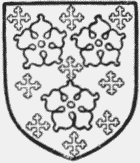
Darcy. Azure crusilly and three cinqfoils argent.
In 1589 (fn. 13) Elizabeth granted the reversion of the manor to Edward Darcy, son of Mary Darcy, in tailmale. In 1609 (fn. 14) Sir Francis Carew and Edward Darcy conveyed the manor to Sir Robert Darcy to the use of Sir Francis for life and reversion to Sir Robert Darcy. In 1612 Sir Edward Darcy died, leaving his son Sir Robert his heir. (fn. 15) James I in 1614 raised an annuity of £40 out of Sutton and Epsom, then in the possession of Sir Edward, for his consort Queen Anne. (fn. 16) In 1618 Sir Robert died, leaving a son and heir Sir Edward, (fn. 17) who had no male issue, and the reversion was therefore liable to fall to the Crown. Sir William Throckmorton (-Carew), James Rooks and Jerome Earl of Portland all competed for the reversion, (fn. 18) and in 1663 the Earl of Portland was awarded the manor. (fn. 19) In 1665 Charles II reserved a similar rent of £45 12s. 3d. in favour of his queen Catherine. (fn. 20) In 1670 Edward Darcy bought the fee-farm rent of the commissioners for sale appointed by Parliament. (fn. 21) Meantime in 1669 (fn. 22) Thomas Earl of Portland sold the manor to Thomas Walcott and Edward Poulter, probably in trust for Robert Long, who immediately afterwards sold it to Sir Richard Mason. (fn. 23) In 1669 Mason received a quitclaim from William Barnes and his wife Elizabeth and Sir Erasmus Phillips, bart. and kt., clerk controller of the Green Cloth to Charles II and James II, and his wife Katherine, Elizabeth and Katherine being the daughters of Edward Darcy. (fn. 24) Richard Mason left two daughters, Anne the wife of Henry Brett and Dorothy the wife of Sir William Brownlow, bart. (fn. 25) In 1716, after the death of Dorothy, Anne Brett (the younger sister) and Sir John Brownlow, bart., son of Sir William, joined in a sale to Henry Cliffe, (fn. 26) an East India captain, who entailed it by will on his two sons successively. The elder Richard died a bachelor; Henry the younger left a daughter Margaretta Eleanora, (fn. 27) who in 1785 married Thomas Hatch. He died in 1822. In 1831 the Rev. Thomas Hatch his son and Anne Marie Ellen his wife conveyed the manor to Charles Thelwell Abbott. (fn. 28) Mr. Norman E. Lamplugh of Carshalton Place is now lord of the manor, but all manorial rights have lapsed.
There was another manor of SUTTON with appurtenances in Sutton and Ewell, apparently belonging to this parish, of which little is known. In 1373 (fn. 29) Sir Simon de Cuddington granted Richard Coc of Carshalton and William Hardegray the manor of Sutton, and they regranted it to Simon St. Michel, lord of Cuddington, and Idonea his wife. Ralph the son of Simon and Idonea granted to John Lepyndon and John Bampton all his rights, (fn. 30) on what trust does not appear.
Probably this manor is identical with the lands held of the manor of Sutton mentioned in the Sutton Court Rolls, quoted by Manning and Bray, (fn. 31) as held in 1362 by Simon de Cuddington and in 1408 as formerly his. In the latter year it is called Halle. From the same authority it appears that in 1509 Thomas Ellingbridge held lands of the manor of Sutton Hall. He left a daughter Anne, who married John Danett, for whom see Albury in Merstham.
Sutton in Shiere and Sutton in Woking have sometimes been confused with this manor. Fulk Bassett, to whom Manning and Bray attributed this second manor of Sutton, held in Sutton in Woking. (fn. 32)
CHURCHES
The church of ST. NICHOLAS, rebuilt in the year 1862, consists of a chancel, north vestry and organ chamber, south chapel, nave, north and south aisles, west tower surmounted by a spire, and north and south porches.
The walls are faced with flint, the spire is shingled, and the roofs are tiled. The style is of the early 13th century, and the design is of no great excellence.
On the west wall of the nave, to the north of the tower arch, is a mural monument in memory of Sarah Glover, wife of Joseph Glover, rector of Sutton, who died in the year 1628. The inscription is as follows:—
Death to mee is gayne; | Here under lyeth interred | the corps of that vertuous & | religious gentlewoman and | servant of god Mrs Sarah Glover | one of the daughters of Mr Roger Orofeld (Citizen & | Fishmonger of London) late | wife of Mr. Jos : Glover & Rector | of Sutton by whome she had 3 | children viz. Roger Eliz. | Sarah she died the 10th of July | 1628 at her age of 30 yeares | in memory of whome her said | Husband hath caused this | monument to be erected | 24 May An° Doni 1629.
This Monument presents unto your Viewe |
A woman rare, in whome all grace divine, |
Faith, Love, zeale, piety, in splendid hue |
With sacred knowledge, perfectly did shine. |
Since then examples teach, learne you by this |
To mount the stepps of everlastinge blisse. |
Above the inscription Sarah Glover is represented in bas-relief kneeling in prayer with her three children. Above the monument is a shield, the tinctures of which can now be with difficulty recognized. The charge is as follows: A battled fesse ermine between three crescents, with a molet for difference, impaling Quarterly (1) and (4) a pile engrailed, (2) and (3) a fesse between three molets. The monument is now concealed behind the screen beneath the west gallery.
Behind the organ, and now completely concealed by it, is an elaborate mural monument in memory of Dorothy Brownlow, who died in the year 1699, wife of Sir William Brownlow, bart., of Belton, Lincolnshire. The inscription states that she was the daughter and co-heiress of Sir Richard Mason, kt., 'Controler of Green Cloath to King Charles and King James the 2nd.'
There are two bells, both by Thomas Mears of London, 1841.
The communion plate consists of a silver chalice of 1843 inscribed 'Presented by Francis Gosling Esq. to the Parish of Sutton, 1843'; silver paten, with foot, of the same year and bearing the same inscription; silver flagon of 1842, bearing the same inscription; silver paten of the same year, also bearing the same inscription; silver chalice of 1895, presented by the then churchwardens; silver paten of 1891, with foot, also given by the above; silver flagon of 1881, part of the same gift; two small silver patens of 1894, part of the same gift.
At the mission church of the Good Shepherd is a plated chalice and paten.
The registers are : (i) baptisms and burials 1636 to 1783, marriages 1636 to 1752; (ii) baptisms 1783 to 1812; (iii) burials 1783 to 1812; (iv) marriages, 1754 to 1812.
The church of ALL SAINTS, Benhilton, stands on the hill on the east side of the Mitcham road about three-quarters of a mile north of Sutton parish church.
The church was built in the Decorated style in 1865, and a parish was assigned to it in 1863. It consists of a chancel with an organ chamber and vestries on the north, a south chapel, a long nave in five bays with north and south aisles the same length, a west tower and north and south porches. The walls are faced externally with flint, with stone dressings to the buttresses, windows and doorways, and the open-timber roofs are of pitch pine covered with tiles.
The chancel screen is a fine piece of modern woodwork with good tracery and a well-carved cornice enriched with a vine ornament and surmounted by cresting and a rood with three figures. It was erected to the memory of Lionel Gordon Detmar by his friends, and is after his own design.
The tower contains eight bells.
CHRIST CHURCH was erected in the year 1888, and a parish was assigned to it in that year. The south chapel was added in 1902, and a narthex and baptistery are now in course of construction at the west end of the nave. The church, which is in 13th-century style, consists of an apsidal chancel, north transept, containing vestry and organ chamber, south chapel, nave, and north and south aisles. The materials are red brick, with stone columns to the nave arcades and with tiled open timber roof. The recently constructed quire stalls and screens deserve mention as fine specimens of modern woodwork. The completed design includes a tower at the northwest, the foundations of which are now being put in, but it is not at present contemplated to proceed with it.
The church of ST. BARNABAS was built in 1884–91, and a parish was formed for it out of Sutton, Benhilton, and Carshalton. The church, which is in 14th-century style, consists of a chancel with an organ chamber and vestry in the north, and south chapel, a nave in five bays, north and south aisles, a west porch, and a north-east octagonal bellturret surmounted by a single spire. The west porch was not added until 1904. The materials are red brick with stone dressings. The roofs are of pitch pine, and are covered with purple slates.
The church of the Good Shepherd is a chapel of ease to the parish church. The Belmont missionroom is in Christ Church parish. There is a Roman Catholic church, our Lady of the Rosary, in the Carshalton Road. A Congregational chapel was opened in his own grounds by a Mr. Wall, a retired London tradesman, in 1799. After some interruption of continuous services it was revived in 1839, and in 1859 a new chapel was built in the Carshalton Road. There is another Congregational chapel in Benhill Street. There are three Baptist chapels, a Wesleyan Methodist, a United Free Methodist, and a Primitive Methodist chapel in the parish; also a Friends' meeting-house and Salvation Army barracks. The new Wesleyan Methodist chapel in Cheam Road is a large building of stone in 14th-century style, with transepts, tower, and spire.
ADVOWSON
In the Domesday Survey two churches are mentioned on the manor, worth £20 before the Conquest, and in 1086 £15. The advowson of one church descended with the manor without interruption until the end of the 18th century. In 1537 the pension payable to Chertsey Abbey from the rectory was granted as part of the endowment of the new foundation of Bisham, Berkshire. (fn. 33) In 1800 one Sarah Watford presented, in 1831 Thomas Williams. (fn. 34) Some time after Padwick the trainer became possessed of it, probably by foreclosure; Mr. Thomas Charles Baring bought it in 1875; it is now held by his trustees. (fn. 35) The history of the second church is very obscure. A possible supposition is that it was at Horley in the Weald (unmentioned in Domesday), which belonged to Chertsey, and close to which were the thirty mansae at Thunresfelda (Thundersfield) mentioned in Athelstan's and Edgar's charters as attached to this manor. Thundersfield Common was partly in Horley, partly in Horne, but close to Horley Church, the advowson of which belonged to Chertsey from an unknown date.
CHARITIES
Smith's charity is distributed as in other Surrey parishes.
1774. Elizabeth Stephens gave £200 for poor widows and housekeepers.
1782. Elizabeth Stephens left £200 for beautifying the church and repaving footpaths.
1782. Robert Holmes left £200 for the poor.
1786. Elizabeth Gibson left £250 for clothing, subject to repair of monument and vault.
1789. William Beck left £110 for bread, meat, &c.
1793. Mary Gibson left £416 for the minister, the clerk, and the churchwardens for examining and repairing a vault, and for the poor.
1800. Mr. Wall endowed the Congregational chapel with £470.
1829. Lucy Manners and Susannah Bently gave £457 for a school.
1883. Barbara Caslake left £135 for money and coals to the poor.
Under the Inclosure Award of 1816 land was reserved for the church, for fuel to the poor, and for repair of highways. For the latter purpose Mr. Wilford also left money in the hands of the Merchant Taylors' Company for this parish, Mitcham, Carshalton, and Streatham.