A History of the County of Surrey: Volume 4. Originally published by Victoria County History, London, 1912.
This free content was digitised by double rekeying. All rights reserved.
'Parishes: Lingfield', in A History of the County of Surrey: Volume 4, ed. H E Malden (London, 1912), British History Online https://www.british-history.ac.uk/vch/surrey/vol4/pp302-311 [accessed 30 April 2025].
'Parishes: Lingfield', in A History of the County of Surrey: Volume 4. Edited by H E Malden (London, 1912), British History Online, accessed April 30, 2025, https://www.british-history.ac.uk/vch/surrey/vol4/pp302-311.
"Parishes: Lingfield". A History of the County of Surrey: Volume 4. Ed. H E Malden (London, 1912), British History Online. Web. 30 April 2025. https://www.british-history.ac.uk/vch/surrey/vol4/pp302-311.
In this section
LINGFIELD
Leangefeld (x cent.); Lingefeld, Lingefend, Lingfeld (xiii cent.); Lingesfeld (xiv cent.); Lyngefeld, Lyngefeud, Lynkefeld, &c. (xv cent. and subsequently).
Lingfield is a village and a parish which occupies the south-eastern corner of Surrey, adjoining the county of Kent on the east. It measures nearly 3½ miles both ways, being roughly square, and contains 9,191 acres. The northern part of the parish is on the Wealden Clay; the southern half, which includes Dormansland, Chartham Park and Felbridge Park, is on the Hastings Sand. Several streams run through it, converging to form the Eden River, which flows by Edenbridge in Kent into the Medway. The water-meadows by the river are noted for their hay. When Manning and Bray wrote, the hay and the aftermath were the property of various farms in the parish, the produce of small strips being apportioned to each. (fn. 1) These authors speak also of the extensive commons, but are said to have overestimated their acreage, as they certainly do that of the parish, which they call 10,000 acres. Under an Inclosure Act of 1809, (fn. 2) followed by an award of 9 July 1816, nearly all the commons were inclosed. Beacon Heath in the south of the parish, slightly rising ground conspicuous over the lower country, is said by tradition (which is probably true) to have been the site of a fire beacon.
On the borders of the parish, near the county of Kent, is a large entrenchment called Dry Hill or Lingfield Mark or Marsh Camp. A flint arrowhead has been found in it, and it is probably prehistoric. Of Sterborough Castle, fortified by Lord Cobham in 1341, there are no remains. The site is marked by the remains of the moat. From a picture which Sir Thomas Turton gave to Mr. Manning, (fn. 3) it appears to have been the usual concentric castle of the period on a small scale, fortified by a moat forming the outer ward and by curtain walls with four round towers at the angles forming the inner ward, and inclosing a small court. It was for a short time the place of captivity of the Duke of Orleans, who was taken at Agincourt. It was perhaps more or less defensible at the time of the Civil Wars, for it is one of the places which the Parliament ordered to be dismantled in 1648, for fear of its being occupied by a Royalist party during the risings of the year. (fn. 4) Its final ruin seems to date from that time. The other important mediaeval foundation of Lingfield was the college, founded in 1431. (fn. 5) The statement that it was founded for Carthusian monks is not true, for the clergy here were secular priests. It is possible that a confusion has arisen from the licence granted to the Countess of Pembroke in 1346 (fn. 6) to found a Carthusian house in Horne, an intention, however, which she never carried out. When Aubrey wrote the house was nearly perfect. (fn. 7) It is said to have been pulled down in the 18th century. (fn. 8) The Guest House, now called Old Guest Hall, is still standing, and it seems likely that it was part of the building described by Aubrey. It is a picturesque brick and timber 15th-century house, with a central hall, once filled in by an upper story, but now restored, and two rooms at each end of it, cellars and solars, the latter overhanging the ground-floor walls. There are also good 15th and 16th-century houses in the village, notably the butcher's shop opposite the Star Inn, which shows a 15th-century shop still used for the same purpose.
There is a tradition of a chapel of St. Margaret in the parish, but the site of this has been lost. (fn. 9) The rising ground between Lingfield village and Sterborough is, however, still called Margaret's Hill.
To the east of the road from Godstone to East Grinstead, and at the junction of the roads leading to Lingfield village and Dormansland, is St. Peter's Cross. It was built by Sir Reginald Cobham, founder of Lingfield College, to mark the boundary between Puttenden and Billeshurst Manors. The cross itself has disappeared, and only the pedestal remains. This is an obelisk of ashlar work in East Grinstead stone, probably of 1437, about 20 ft. in height, and measuring 5 ft. on each face. There are niches in the sides, which are now empty. The north side is partly hidden by the parish cage, a square building with a tower, probably once surmounted by a cross, of the end of the 18th century. (fn. 10)
The southern part of the parish is in the old iron district. A forge and a furnace 'about Copthorne and Lingfield' were owned by Lady Gage in 1574, (fn. 11) and Clarke's pond and Cook's pond may have been heads for water power to work hammers. Iron ore is still very abundant in the Hastings Sand. The parish was and still is for the most part agricultural, but since the opening of the railway station on the London, Brighton and South Coast line from Croydon to East Grinstead in 1884, the laying out of the Dormansland estate with the opening of a station there, and the making of the Lingfield Park racecourse, where another railway station has been opened, the village has become a small town and building has been carried on at Plaistow Street and elsewhere.
The Victoria Memorial Institute was built by subscription in 1901. It contains reading rooms and a library. A parish school and infants' school were founded in 1849. The old schoolhouse belonging to a school which Lord Howard of Effingham endowed with £3 a year (fn. 12) was sold and the procceds applied to the new schools. The school was rebuilt in 1860. The infants' school was carried on in the old building until the latter was rebuilt in 1906. Baldwin Hill School was built in 1874 and enlarged in 1898.
The district called Dormansland, at one time renamed 'Bellagio,' but since known by its old name, was laid out as a residential estate of villas and so-called bungalows about 1880. Richard Derman had land in Lingfield in 1435, (fn. 13) and in 1489 John Underhelde of Lingfield granted to Alice daughter of John Croker land called Newhachecroft and Dermannysland, which, together with William Gainsford, William Innyngfeld, and William Broker of Dermannysland, he held from Richard Derman. (fn. 14) The land was between the land of the Abbot of Hyde on the south and west, of the Abbot of Battle on the north and west, and by the highway from Dermannysland to Edenbridge on the south and east. This seems to fix it as northeast of the common called Dormansland Common, one of those inclosed in 1816. The estate now gives its name to a separate ecclesiastical parish. There is a parish room with a large lending library. A school was built in 1851 and enlarged in 1886. Lingfield Park race-course and club were established in 1890, after the closing of Croydon race-course, and have already been described. (fn. 15)
Chartham Park is a large house in a park in the southern part of the parish. It is the residence of Col. A. R. Margary. Claridges is the residence of the widow of Mr. F. H. Birley, J.P.; The Beacon, Dormansland, of Mrs. St. Clair; The Dees, Dormansland, of Sir G. D. A. F. Wilson, K.C.B.; Nobles, of Sir Lewis Dibdin, the Dean of Arches. Ardenrun Place is the property of Mr. H. H. König; Carewell House of Mr. Walter Williams.
MANORS
A cartulary of the abbey of Hyde or New Minster at Winchester records the gift to the abbey, by Ethelflæd wife of King Edgar and mother of Edward the Martyr, of 6 hides of land at Lingfield. (fn. 16) It is not recorded among the abbey's possessions in 1086, and was possibly then considered appurtenant to Sanderstead, with which it is associated in the will of Dux Ælfred, (fn. 17) and with which it was given to the abbey by Ethelflæd. This association of an estate on the weald with another on a drier and more inhabited soil is not uncommon in Surrey. The abbot's property appears later as the manor of LINGFIELD or FELCOURT (Feldcourt, xv cent.). 'An Assize Roll for 1279 records a case showing that in 1272 two men had come into the abbot's manor at Lingfield, and, having been admitted to the hall of the manor, they attacked the abbot's bailiff and injured him so severely that he died the next day; they had also seized the ploughman of the manor, whom the had dragged to the castle of the Earl of Surrey at Reigate, where they had thrown him into a dungeon and kept him prisoner for a year. (fn. 18) In 1287 William de Beauvais quitclaimed to the Abbot of Hyde his land called Feldlond in Lingfield. (fn. 19) In 1361 and again in 1403 the Cobhams are found holding land in Lingfield for which they paid rent to Hyde Abbey at the abbot's manor of Felcourt in Lingfield, (fn. 20) and this manor continued among the abbey's possessions until the Dissolution.
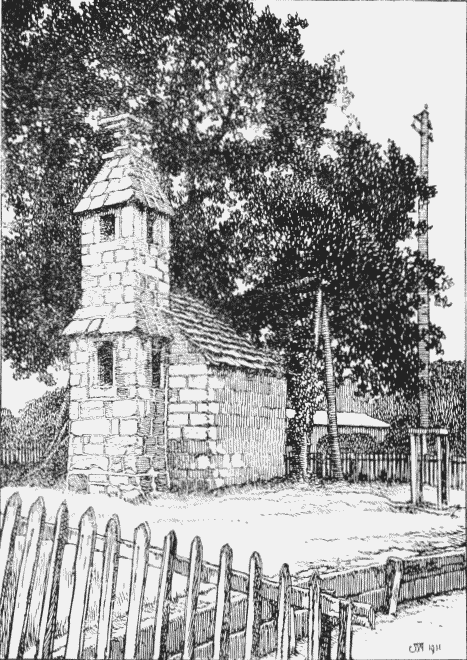
Cross and Cage, Lingfield.
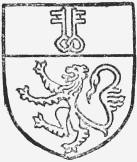
Hyde Abbey. Argent a lion sable and a chief sable with a pair of keys argent therein.
In 1539 Lingfield was granted in fee to Sir John Gresham, (fn. 21) who died seised in 1556. (fn. 22) His son and grandson, both called William, held successively. (fn. 23) In 1589 the later alienated to John Valentine. (fn. 24) Henry Valentine son of John, who inherited at his father's death in 1594, (fn. 25) was during his tenure involved in law-suits with the Crown concerning land in Lingfield called the Gildable, which was alleged to have been Crown land time out of mind, the tenants thereof enjoying common of pasture and other rights, the sovereign taking profits, waifs and strays, &c. Henry Valentine, as lord of Felcourt, the demesne lands of which abutted on to the Gildable, had made certain claims on it, alleging it to be part of his manor. Similar claims, it was said, had been made by his father and William Gresham, always, apparently, without success, as every witness called declared that the common was Crown land. (fn. 26)
In 1616 Henry Valentine and Mercy his wife conveyed the manor of Felcourt to Edward Bysshe and David Bassano (fn. 27); they held in 1625. (fn. 28) Bassano was a trustee for the family of Turner of Ham in Blechingley (q.v.), and in 1637 George Turner, a member of that family, died seised of Felcourt, which he left to a younger son John, (fn. 29) who held in 1657. (fn. 30) At this date the manor appears to have been divided. (fn. 31) In 1684 John Turner and his son George sold a fourth to Anthony Faringdon, (fn. 32) and James Faringdon held this in 1775. (fn. 33) In 1787 he sold it to John Field, and it afterwards became successively the property by purchase of William Tooke, F. L. Dillon and Sir Thomas Turton, whose son held in 1848. (fn. 34) It afterwards passed to the Earl of Cottenham, (fn. 35) from whom it was bought by Mr. H. Sturdy, who resides at Felcourt.
What happened to the main part of the manor is not very clear. In 1774 Robert Linfield of East Grinstead levied a fine of the 'manor of Felcourt' by way of conveying it to John Mylam of Lewisham in Kent, (fn. 36) but an indenture of the same date between the parties mentions only the 'messuage called New Fellcourt' (fn. 37) with the lands belonging to it.
The family of Martin also appear as holding a fourth part of the manor in 1809, (fn. 38) but probably most of the lands belonging to it descended with the estate of New Place. Manning, quoting from court rolls, states that New Place became in 1729 the property of John Hopkins, whose cousin inherited and died in 1754, when trustees conveyed it to Benjamin Bond Hopkins. (fn. 39) He suffered a recovery of the 'manor of Felcourt' in 1772. (fn. 40) His daughter and heiress married Richard Maunsell Philipps, who held New Place in 1808. (fn. 41) Courtenay Phillips suffered a recovery of the manor in 1824. (fn. 42)
New Place is now the property of Mr. E. W. Oliver. The house is of stone. The doorway, removed to its present position from the west entrance of the courtyard, bears the date 1617. Though it was held with land belonging to Felcourt, it is not in the same part of the parish.
In the later court rolls of Croydon, Lingfield appears as a tithing of that manor. But there is no evidence to show that the lords of Croydon had any ancient title to jurisdiction over Lingfield.
The manor of STERBOROUGH alias PRINKHAM was held of the Abbot of Battle and probably originally formed part of the abbey's manor of Limpsfield. In 1280 William de Hever received a grant for himself and his heirs of free warren in his demesne lands of Lingfield. (fn. 43) Joan his daughter and heir married Reginald de Cobham the eldest son of John de Cobham of Cobham and Cowling by his second wife Joan daughter of Hugh Nevill. (fn. 44) Reginald and Joan held the Lingfield lands before the end of the 13th century. (fn. 45) Their son Reginald succeeded them and received a grant of free warren in his demesne lands here in 1340 (fn. 46); in 1341 he was permitted to crenellate his house at Prinkham, (fn. 47) afterwards called Sterborough, which became the principal seat of this branch of the Cobham family. Reginald de Cobham was summoned to Parliament in 1341–2 and in 1360, was knight banneret in 1339 and Admiral of the Fleet in 1344. (fn. 48) He served with distinction in the French wars, being in close attendance on the Black Prince at Crecy (fn. 49); at Poitiers he was one of the two barons who conducted King John as prisoner to the prince's presence. (fn. 50) He met his death, however, at home, being stricken down by the second pestilence in 1361. (fn. 51) An inquisition on the death of his widow Joan daughter of Lord de Berkeley mentions the manor of Prinkham with a capital messuage 'wherein is a little "forcelet" built like a castle with a very strong wall, with hall, chambers, other buildings, and a new garden.' (fn. 52) Their son Reginald was also summoned to Parliament as a baron in 1371 and 1372. He married twice, his second wife being Eleanor widow of Sir John Arundel. Her daughter by her first husband was married in 1394 to William Lord Roos, the ceremony taking place in the chapel in Sterborough Castle. (fn. 53) Margaret, her daughter by Reginald de Cobham, was also married in the chapel in 1403, her husband being Reginald Curtis. (fn. 54)
Lord Cobham died in 1403, being buried, as his father had been, in Lingfield Church, and his son Reginald succeeded him. (fn. 55) The son was never summoned to Parliament. His chief claim to distinction as regards the parish lies in his position as founder of the college of Lingfield (q.v.). His sister Margaret Curtis in 1446, the year of his death, released all her claim in the castle of Sterborough to the feoffees of Reginald. (fn. 56) After his death Margaret daughter and heir of his eldest son Reginald, who had predeceased him, and wife of Ralph second Earl of Westmorland, held Sterborough, with remainder in default of issue to her uncle Sir Thomas Cobham (fn. 57); he became her heir as she left no children at her death. (fn. 58) He died in 1471, his daughter Anne, aged four, being his heir. (fn. 59) Her maternal grandmother Anne, widow of Humphrey Duke of Buckingham, appears to have been her guardian and married her while still a child to Edward Blount, Lord Mountjoy, grandson of Walter Blount, whom the elder Anne had herself married. (fn. 60) The young bridegroom died shortly after, however, at the age of eight years, after which Sir Thomas Burgh, who had obtained the wardship, succeeded in marrying the heiress to his son Edward, who became Lord Burgh on his father's death in 1496. (fn. 61) He was, however, never summoned to Parliament, being 'distracted of memory' (fn. 62); he died in 1528. (fn. 63) His son Thomas held the castle and manor after him, and they were held by the successive heads of this family until at the close of the 16th century Robert sixth Lord Burgh died young and unmarried, (fn. 64) when the property was divided between his sisters and co-heirs, Elizabeth wife of George Brooke fourth son of William Lord Cobham and afterwards of John Reade, Anne wife of Sir Drew Drury, Catherine wife of Thomas Knivett and Frances wife of Francis Coppinger. (fn. 65)
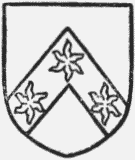
Corham of Sterborough. Gules a cheveron or with three stars sable thereon.
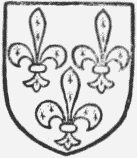
Burgh, Lord Burgh. Azure three fleurs de lis ermine.
The first three heiresses conveyed their reversions in the manor and castle to Sir Thomas Richardson, serjeant-at-law, before 1627, (fn. 66) the Dowager Lady Burgh, their mother, retaining the whole for life. (fn. 67) Richardson was a lawyer of note and in 1626 was made Chief Justice of the Common Pleas; he was also a member of Parliament. He married Elizabeth Beaumont widow of Sir John Ashburnham; she was in 1628 raised to the peerage, being created Baroness Cramond for life, with remainder of the dignity of 'Lord Cramond Baron of Parliament' to Richardson's son by his first wife Ursula Southwell. (fn. 68) Richardson died in February 1634–5, his eldest son Thomas in 1643. (fn. 69) The latter's eldest son Thomas afterwards held these three-fourths of Sterborough as Lord Cramond (fn. 70) and conveyed it with his wife Ann to William Saxby in 1668. (fn. 71)
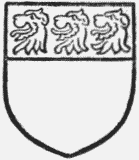
Richardson. Argent a chief gules with three lions' heads razed or therein.
The share of the fourth heiress Frances Coppinger never came to the Richardson family. It appears, from an 18th-century account given by John Coppinger, her great-grandson, that the reversion of the remaining fourth of Sterborough after the death of Frances Coppinger was to the eldest son, but that he died without issue; that Seymer the second son also died without issue, having devised the reversion to his steward William Walter to the exclusion of his three remaining brothers, and that this will was disputed by the family, but without success. (fn. 72) Thomas Coppinger quitclaimed his right to William Walter in 1684 (fn. 73) and Walter conveyed the fourth to William Saxby in 1675. (fn. 74) This account is borne out by documentary evidence. (fn. 75) Saxby thus obtained the whole estate, which he devised by will, proved 1684, to his nephew William Saxby, who in 1695 conveyed to Nathaniel Hunt for the purpose of barring the entail. (fn. 76) Saxby died in 1735 and was succeeded by his son of the same name, who by will of 1744 devised this property to trustees to sell. In 1751 they, with James Saxby son and heir of William, sold to James Burrows 'the manors of Sterborough and Prinkham . . . the messuage or farm called Sterborough Castle or Dairy Farm . . . the castle or reputed castle of Sterborough.' (fn. 77) Two other sons of William Saxby were also parties to the indenture, owing, as was stated in the deed, to the fact that that part of the estate which stretched into Edenbridge in Kent was subject to gavelkind; the Lingfield property had, however, been disgavelled in 1539. (fn. 78) Burrows, who was afterwards knighted, died in 1782. (fn. 79) His nephew and legatee Robert Burrows died in 1793, having devised Sterborough to John Law and Thomas Ludbey to sell. (fn. 80) The purchaser was Thomas Turton, who was created a baronet in 1796. (fn. 81) He sold in 1812 to Christopher Smith, alderman of London, whose executors afterwards sold to John Tonge, who owned in 1841. (fn. 82) It was afterwards in the possession of M. F. Bainford. (fn. 83) About 1870 the estate of Sterborough Castle again changed hands, becoming the property of James Stocks Moon. (fn. 84) In 1891 it belonged to Mr. Walter Waterhouse. It now belongs to Mr. W. H. Topham.
Among the contributions to a lay subsidy raised in 1332 in Surrey is recorded a payment of 8s. 1d. by William de Blockfield in Lingfield. (fn. 85) Manning says that BLOCKFIELD was part of the lands held by the Gainsfords which had formerly belonged to Roland de Oxted. (fn. 86) The manor was held of the lords of the manor of Oxted. From private deeds it appears that Blockfield was held in 1477 by Richard Gainsford, and that William Gainsford his brother died seised of it in 1483. (fn. 87) His son John Gainsford was lord in 1519, (fn. 88) and this family continued to hold the manor for another century and a half. (fn. 89) On the death of William Gainsford, which occurred in 1669, his daughters and co-heirs Margaret, afterwards wife of Edward Johnson, and Dorothy, afterwards wife of George Luxford, each inherited a moiety of Blockfield. (fn. 90) Dorothy Luxford conveyed her share to the Johnsons in 1680. (fn. 91)
The son and grandson of Edward Johnson and Margaret held successively, (fn. 92) and the last, William Johnson, sold in 1727, according to Manning, to Messrs. Lewis & Dugdale, whose heirs conveyed in 1763 to Andrew Jelfe. (fn. 93) From Jelfe the manor passed in the following year to John Major, who was created a baronet in 1765. (fn. 94) He had two daughters and co-heirs, of whom one died without issue, while Anne, the other, married Sir John Henniker and inherited the manor. John Lord Henniker was in possession in 1822. (fn. 95) It was afterwards the property of Patrick Byrne, then of Mrs. Gwilliam, (fn. 96) and now belongs to Mr. C. J. Fisher.
The house, which was also called Old Surrey Hall, is a singularly picturesque example of a timber-framed house, possibly of the 15th century, with unusually elaborate ornamental woodwork on the outside. The great hall has long been divided into rooms. It lies in a very secluded position near the south-east angle of the county at some distance from any main road.
The manor of FORD was also among the Gainsfords' possessions in Lingfield, before 1430, (fn. 97) and it remained in this family, being always held by the lord of Blockfield (q.v.) until the 17th century. After 1682, however, the connexion ceased, as in that year the Johnsons conveyed Ford to Robert Linfield, (fn. 98) whose brother and heir conveyed it ten years after to Anthony Faringdon. (fn. 99) The latter settled it on his son Anthony in 1715, (fn. 100) and it apparently remained in this family until 1775. (fn. 101)
In 1777 the estate was held by Samuel or William Brown, (fn. 102) and according to Manning became in that year the property of Sir James Burrows, who had also purchased Sterborough (fn. 103) (q.v.), with which property Ford was held until 1801, when Sir Thomas Turton sold to Colonel Malcolm. (fn. 104) It was afterwards purchased of the latter by J. F. Elphinstone, who held in 1841. (fn. 105) Norman Morris then bought the property and built a house there, which was afterwards sold to James Spender Clay. (fn. 106) It is now owned by Captain H. H. Spender Clay, M.P., J.P. The house stands in a park of some size.
In 1272 John de la Lynde died seised of the manor of PUTTENDEN (fn. 107) (Podindene or Pudindenne). His heir was Walter de la Lynde, but the manor appears shortly afterwards in the possession of a Simon de Puttenden. In 1281 he granted a messuage, land and rent here to Geoffrey de Haspale for life, with reversion to the sons of Simon. (fn. 108) An inquisition taken in 1287 after Geoffrey de Haspale's death states that he held the manor of Puttenden for life by the terms of the above grant. The manor consisted partly of lands held of the king in chief by rent of 10s. and suit at the hundred court of Tandridge, and partly of other lands held of Roland de Oxted, of the manor of Benchesham, and of the manor of Croham. (fn. 109) Philip de Puttenden, younger son of Simon, died in 1309, (fn. 110) and his son Adam did fealty for the lands held of the king. (fn. 111) John de Puttenden son of Adam succeeded his father in 1359, (fn. 112) but died very shortly afterwards, his heirs being Agnes daughter of Laurence Brown, aged fourteen, Mabel Eyr, and Lucy wife of John Nicole, all described as his kinswomen. (fn. 113) Agnes widow of John de Hadresham obtained the 'manor of Bure or Buer and Puttenden' in 1430 (fn. 114) from William Cheyney and others.
How the manor passed to the Sondes is not evident, but according to a rental of Sterborough Reginald Sondes held the manor in 1477. (fn. 115) Robert Sondes died seised of it in 1530, (fn. 116) and was succeeded by his son Anthony, (fn. 117) who died in 1575. (fn. 118) Sir Thomas Sondes, kt., Anthony's son and heir, left a daughter only at his death in 1593, and by the terms of a settlement the manor passed to his brother Sir Michael Sondes of Throwley in Kent, (fn. 119) to whom Frances Leveson, the daughter of Sir Thomas, afterwards quitclaimed her right. (fn. 120) Sir Richard, the son, and Sir George, the grandson, of Sir Michael held in succession. (fn. 121) Sir George Sondes appears in possession in 1655. (fn. 122) He was in 1676 created Baron of Throwley in Kent (where the family had long held estates), Viscount Sondes and Earl of Faversham. In 1677 he died without surviving male issue. (fn. 123) According to Manning the estate passed to Lewis Watson, Lord Rockingham, who had married Sir George's younger daughter and co-heir and who died in 1724, (fn. 124) and was afterwards sold by their nephew (more correctly grandson Lewis Lord Sondes) to Abraham Atkins, in whose family it remained as late as 1878. (fn. 125) It now belongs to the Hon. Mark F. Napier, J.P.
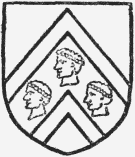
Sondes. Argent three black men's heads cut off at the neck between two cheverons sable.
The house, built about 1510, is of timber. It has an unusually high square hall, with, in the original plan, two rooms on each side of it, one above the other, and a kitchen at the back. It has a good 16th-century chimney-stack and mantelpieces.
In 1336 John de Chevening received licence to have a chapel in his manor of BUER (Beure, xiv cent.). (fn. 126) There is no earlier trace of any such manor, but Adam de Puttenden and John his son both held, besides the manor of Puttenden, some 40 acres of land in Lingfield of John de Chevening. (fn. 127) Apparently the Chevening manor afterwards passed to the holders of Puttenden, as in 1430 Agnes de Hadresham was seised of the manors of Buer and Puttenden (q.v.). The former afterwards became absorbed in the latter, henceforth called the manor of Puttenden alias Buer or Puttendenbury.
The earliest mention of BILLESHURST (Billesersse, xi cent.; Byhgersse, xiii cent.) occurs in 1198, when William de Puttenden and Lucy his wife held land there. (fn. 128) In 1267 William de Billesherst and Juliana his wife quitclaimed 40 acres of land in Lingfield to John son of Gilbert, (fn. 129) and they probably held their land here as a manor, as in 1345 John Lucas granted the manor of Billeshurst with wardship, marriage, courts, &c., to Sir Reginald Cobham, stating that it had descended to him as nephew and heir of Master Luke of London, rector of Lingfield, who had it by grant of feoffment of Richard de Billeshurst. (fn. 130) An inquisition on the lands of Reginald de Cobham, taken in 1403, refers to 'the manor of Sterborough in Billeshurst.' (fn. 131) In 1448 Ann Lady Cobham and widow of Sir Reginald, the founder of Lingfield College, joined with her son Sir Thomas in granting this manor to the master and brethren of this foundation, (fn. 132) by whom it was held until the Dissolution. (fn. 133) Their Lingfield estate then included rents amounting to £2 2s.2½d. and the park of Lingfield called Billeshurst.
In 1544 Billeshurst was granted in fee to Thomas Cawarden or Carden. (fn. 134) He, however, afterwards surrendered these lands, which were then re-granted to him and his wife Elizabeth to hold jointly. (fn. 135) He died in August 1559 and his wife early in the following year. (fn. 136) William Cawarden, his heir, son of his brother Anthony, conveyed the manor in 1560 to William Lord Howard of Effingham. (fn. 137) A claim to the manor was set up in 1607 by Robert Cawarden, a distant cousin of Sir Thomas, but it was found that William Cawarden had been the rightful heir and that Robert was merely tenant in the manor which the Howards held. (fn. 138) It remained in this family until the latter part of the 18th century. (fn. 139) Ann Dowager Countess of Effingham, on whom the manor had been settled, devised it in 1774 to trustees for sale. (fn. 140) It accordingly passed in 1776 to Dr. Frank Nicholls of Epsom, (fn. 141) whose son John afterwards held it. A rental of the manor in 1794, during the tenure of the latter, contains the statement that 'this manor consists of freeholds only and the customs are that the tenants hold by fealty, suit of court and the payment of a heriot—viz. the best beast—while the heir pays relief of one year's quit rent.' (fn. 142) In 1798 John Nicholls exchanged his lands here with Sir Thomas Turton, who gave him Chellows in Crowhurst. (fn. 143) Turton sold in 1809 to the trustees of Robert Ladbroke, (fn. 144) in whose family it remained until after 1841. (fn. 145) It was held in 1878 by Mr. Harvey Hughes, (fn. 146) and now by Mr. W. Gilbert.
After the Dissolution the SITE OF THE COLLEGE OF LINGFIELD was granted with the manor of Billeshurst (q.v.) to Sir Thomas Cawarden and has since been held with that manor, being known as the manor or college of Lingfield or as the manor of Lingfield. (fn. 147) In 1803 the conveyance from Turton to Ladbroke's trustees included the college farm. (fn. 148)
In 1408 Sir John Dalyngridge was seised of the manor of SHEFFIELD-LINGFIELD, and his wife held it after his death. (fn. 149) It was held at the close of the 15th century by Richard Lewknor. (fn. 150) Roger Lewknor held in 1507 or 1508, when he apparently conveyed to Edmund Dudley and others. (fn. 151) In 1511, after Dudley's attainder, a re-grant was made to the other grantees exclusive of Dudley. (fn. 152) They seem to have conveyed to Henry Earl of Arundel, who died in 1580, (fn. 153) leaving no male issue. He seems, however, to have settled the manor some time previously on his daughter and her husband Thomas Howard Duke of Norfolk, as the latter held in 1569. (fn. 154) Both the duke and his eldest son Philip, who became Earl of Arundel on the death of his maternal grandfather, were attainted. Philip's son Thomas was, however, restored in blood in 1604, (fn. 155) and this manor was granted in 1608 to the Earl of Suffolk and Lord William Howard, younger sons of Thomas Duke of Norfolk, (fn. 156) apparently in trust for him, as he held in 1611. (fn. 157) The Howards held as late as 1642, (fn. 158) but by 1665 the manor was in the possession of George Compton. (fn. 159) The latter, in 1673, conveyed to Richard Biddulph, (fn. 160) and the manor was still in this family in 1739. (fn. 161) Manning states that it belonged, in 1808, to Viscount Hampden, (fn. 162) who died without issue in 1824.
The family of Hexted or Heghsted held land in Lingfield in the 12th and 13th centuries (see account of the church), and a wood there belonged to John de Heghsted in 1351, (fn. 163) but the earliest mention of the manor of HEXTED, in 1403, shows it to have been in the possession of the Cobhams of Sterborough, who held it of the Abbot of Battle's manor of Limpsfield. (fn. 164) It was granted by this family with Billeshurst (q.v.) to the College of St. Peter in Lingfield in 1448, and, with that manor also, became the property of Sir Thomas Cawarden after the Dissolution. In 1557 he conveyed Hexted to Thomas Ramsay, citizen and grocer of London. (fn. 165) The latter appears to have settled it on a John Browne and his wife Alice, with remainder to the heirs of Alice, who was probably his daughter. Alice's son John Browne died seised in 1638. (fn. 166) This family seem to have given their name to a manor called Browns, the capital house of which was in Edenbridge. (fn. 167)
The site of the manor of Hexted was conveyed in 1606 to Richard Glover by John Robinson and Mary his wife and William Bonner and Margaret his wife. (fn. 168) Glover still held in 1648. (fn. 169) The manorhouse became a farm, and is now converted into three cottages. Haxted is the name of an adjacent house. There is a water mill about half a mile to the west.
CHURCHES
The parish church of ST. PETER AND ST. PAUL consists of a chancel, north chapel, south vestry and chapel, nave, north and south aisles and southwest tower. With the exception of the tower and the south and west walls of the nave in their lower portions the church is wholly of the 15th century. The tower, which is of 14th-century date, appears to stand on the foundations of one of the 12th century, and a few scattered 12th-century stones in the west end of the building indicate that there was a church on the site in that period. The roofs, which are covered with Horsham slabs, may be of the 16th century, except that of the chancel, which is original. The shingled broach spire is also original. The south vestry is an addition of c. 1490.
The chancel has an original five-light east window with vertical tracery in a two-centred head. The north side is occupied, save for a short spur at the east, by an arcade of three bays of two-centred arches on piers of four slender clustered columns with octagonal plinths and capitals and hollow chamfers between the shafts. The responds are of the same pattern and the inner order of the arches is moulded and set in a wide casement. In the south wall is set a three-light window, whose sill is raised to clear the roof of the south vestry, and to the west of this window is a four-centred doorway to the vestry, down three steps. West of the vestry the south side consists of an arcade of two bays like those on the north. The north chapel has an east window like that of the chancel, now obscured by the organ, and three north windows of three cinquefoiled lights in a drop two-centred head. The south vestry is lighted by an east window of two cinquefoiled lights in a square head and a similar window on the south. It has an external door with a four-centred head under a square dripstone immediately to the west of the south window, descending to the external ground level by three steps owing to the slope of the site from north to south.
The east window of the south chapel, which is raised above the vestry roof, is two-centred and of three lights with vertical tracery. The two south windows are similar, and below the westernmost is an external doorway at the foot of a flight of four internal steps, with three more in the doorway to reach the ground level.
The whole of the eastern part of the church is raised on vaults some 5 ft. high, entered by a doorway with an original door at the east end of the north wall below the north chapel. Under the spur wall between the chancel and north chapel is a good two-centred doorway, and there are traces of a communication between the chancel and the crypt beneath. In the east walls of the chancel and north chapel, below the floor level, are small trefoiled loops in square stone frames, formerly lighting the vaults, but now blocked.
The western bay of the chancel on both sides is occupied by the quire stalls, which return under the chancel arch with a central opening.
The chancel arch, which is supported by the westernmost piers of the north and south quire arcades, forms the centre bay of an arcade of three bays running across the church from north to south and separating the chancel and chapels from the nave and aisle. The chancel arch and the north chapel arch are four-centred, the north chapel being nearly as wide as the chancel. That of the south chapel, which is much narrower, is stilted and twocentred. All are like those of the chancel arcades in detail.
The nave has a north arcade continuous with that of the chancel, of four wide four-centred arches, the easternmost bay being slightly wider than the rest. The south arcade is of two bays only, which are narrow and have two-centred arches and are continuous with the south quire arcade. The western arch of the south arcade rests on the west on a corbelled shaft against the north-east buttress of the tower, whose north face forms the greater portion of the south wall of the nave, and is pierced in the centre by a two-centred doorway to the ground stage and above it by a blocked pointed doorway to a former gallery. West of it, the lower part of the wall is considerably thicker than that above the sill level of a three-light drop-centre headed window, which is the only southern light of the nave. The west wall is also much thicker in its lower than in its upper portion; in the former is the plain chamfered two-centred west doorway and above it, in the thinner part of the wall, a three-light west window with a rather clumsy three-centred head containing vertical tracery.
The north aisle has four north windows like those of the north chapel, and a west window of three lights with vertical tracery in a high two-centred head. At the east end of the north wall is the blocked door to the rood-loft, which seems to have run right across the church. The door was approached by a newel in a half-octagonal turret added externally. There is no trace of the lower door from the aisle, and the turret, which is now used as a furnace, has an external doorway of 18th-century date.
The south aisle is bounded on the west by the east wall of the tower, whose north-east buttress projects into it; it is further reduced in size by a large battered buttress of uncertain date which runs out a considerable distance into the aisle from the middle of the tower wall-face. The aisle has two south windows of three lights, similar to those of the chapel. A blocked doorway to the ground stage of the tower is visible under the plaster between the two buttresses.
The tower, which is of four stages undivided externally, is a peculiar structure of considerable height in proportion to its size on plan, with right-angled buttresses of four offsets at the two southern angles, while it was probably supported originally at the northern angles by a thick nave wall, of which its north-east buttress is a remnant. At any rate, it is plain that it was much weakened by the alteration of the structure of the nave, for it is now supported on the east and west sides by huge battered buttresses reaching almost to the parapet, which are a very much later addition. The eastern of these buttresses descends through the roof of the south aisle, as also does the southern buttress of the same face. The entrance to the tower is on the south side by a two-centred doorway, wholly restored, which is set in the recess made by a deep relieving arch the full width of the wall between the buttresses. In the ground stage are a window in the north-west angle, the trace of the blocked door to the south aisle at the north-east, the doorway to the nave in the north and a plastered-over arcade of two small arches in the southern part of the east wall. In the first stage, which is reached by a ladder and has its original floor beams pierced by the old bell-rope holes, are two windows blocked by the battered buttresses of the east and west faces. The two upper stages have windows in the south wall only, the lower being two-centred inclosing an ogee trefoil, and the upper two-centred and cinquefoiled; both are filled with louvre-slats. Above the latter is a clock face. The tower is surmounted by a pretty parapet of blind quatrefoils with a coping. The bell stage with its old framing is open to the broach spire, whose timbers are all original.
Externally the church is of well-squared large blocks of hard sandstone. Nearly all the stones on the north side and very many on the south bear various masons' marks lightly incised. There are fewer at the east and west. Scarcely any restoration has been necessary, the windows being practically untouched.
Three buttresses, all of two offsets, project at the east—a diagonal at the angle of the north chapel and two right-angled buttresses at the ends of the chancel wall. At the south-east angle of the chancel another buttress projects southward, but its lower portion is absorbed in the east wall of the added vestry, though the moulded parapet stops against the face of the buttress. At the other point of junction of the vestry with the church on the south is a peculiar contrivance. The south-east angle of the south chapel was built originally with a diagonal buttress, against whose upper portion the vestry parapet stops. Its lower portion, however, has been cut away, so as to sink into the head of a right-angled buttress of a single offset, which is built against the straight joint between the vestry and south chapel walls and which forms the first of a series of four buttresses on the south wall of the church.
At the west end are a central buttress at the junction of the nave and north aisle, and two diagonal buttresses at the angles. The north aisle has three buttresses. At the junction of the aisle and north chapel rises the half-octagonal rood-stair turret with a conical tiled eaves roof, now crowned by a chimney-pot. The north chapel has two north buttresses.
All the roofs are caved except that of the vestry. At the south-west of the nave is a moulded cornice below the eaves, but an extra course of rough masonry has been added above it. There is no cornice elsewhere.
The roofs of the church are peculiar, having fourcentred principals and rafters, ceiled in between with boarding. They rest on corbels, and that of the chancel has moulded principals and ridge, but elsewhere all are plain alike. In the south chapel and aisle the plain corbels on which the roof rests are too low, so that the heads of the arcade arches are cut off by the wall plate.
The chancel is inclosed on the north and south sides by simple but graceful screens of original date, having slender open arcading with cinquefoiled heads, surmounted by a cornice with four-flowers and shields in the hollow. On both sides are four-centred doors with carved spandrels. The only modern piece is the filling of the easternmost bay on the north side. The last bay on the south and the returns under the chancel arch (which have no screen above them) contain fine mid-15th-century stalls with misereres splendidly carved with portraits, arms and devices referring to the families of Cobham and of Bardolf, i.e. those of the rebuilder of the church and his wife. At the north-west angle of the return is a good Saracen's head, the Cobham crest. The stalls on the north side are gone, and in the lower part of the screen are some inserted panels of late 16th-century carving with portraits, possibly of Philip and Mary, and conventional designs. A reading-desk has recently been made up of scraps of Jacobean carving.
The font is octagonal, of good 15th-century work with panelled sides and stem and an ogee-shaped wooden cover with crocketed ribs, which appears to be old, and has a finial which seems to be a late 17th or early 18th-century repair.
At the west end of the nave is a fine 17th-century brass candelabrum.
The church is rich in monuments, principally of the Cobham family, to whom the rebuilding of the church and its collegiate endowment are due. The altar tomb, many times repainted, of Reynold first Lord Cobham, K.G. (died 1361), stands on the south side of the north chapel, beside the easternmost pier of the chancel arcade. It has coloured shields in quatrefoils, and narrow trefoiled panels between. The cresting is battled. The effigy, in plates and basinet, is coloured; its head rests on a helm crested with a Saracen's head, and supported by seated angels. The arms, Gules on a cheveron or three stars sable, are carved and painted on the coat. The red thigh-pieces are studded with gilded spots. On the left leg is the garter, of which order Reynold Cobham was a first founder. The feet rest on a reclining Saracen. The arms in the panels are, on the east end: (1) Or three wavy pales gules in a border ermine (Valoignes); (2) Azure three roses or (Cossington). On the north side: (1) Azure a flowered cross or and a martlet or in the quarter (a clumsy repainting of Paveley); (2) Gules three water-bougets argent (Roos); (3) Or a fesse double cotised gules (Delamare); (4) Cobham impaling Gules a cheveron argent (wrongly painted for Joan Berkeley). On the west end: (1) Cobham; (2) Berkeley, his wife. On the south side: (1) Mortimer; (2) Bohun; (3) Vere; (4) Fitz Alan.
The panelled altar tomb of Reynold second Lord Cobham (died 1403) is on the opposite side of the chapel. The top is a massive Purbeck marble slab, in which is a fine brass of the knight in plates with a wreathed basinet and chain camail, the feet resting on a dog and the head on a crested helm. Flanking the head are shields, with enamel inlay, of Cobham and Cobham impaling a fret for his second wife Eleanor Maltravers. The shields, crest, and hilts of the sword and dagger are restorations by the late J. G. Waller. The marginal inscription, with flowered stops, runs as follows, beginning at the top:—
'De Steresburgh domin' de Cobham sic Reginaldus Hic jacet hic validus | miles fuit ut leopardus (Sagax in guēris satis audax oñibz) horis In cunctis terris famam predavit honoris. Dapsilis in mensis formosus moregerosus Largus in expensis imperitu | s generosus. Et quando placuit messie qd moreretur | Expirans obiit in celis glorificetur Mille quadringeno t(erno Julii numeres tres) Migravit celo sit sibi vera quies. Amen. Pater noster. |' (fn. 170)
To the east of this is another altar tomb with elaborately panelled sides and a Purbeck marble slab, of early 15th-century date, with no inscription or effigy.
The huge altar tomb of Sir Reginald Cobham (died 1446) and his second wife Ann daughter of Thomas Lord Bardolf stands in the centre of the chancel. The sides are panelled and contain coloured shields of Cobham and Bardolf (Azure three cinqfoils or), alternated with bouched shields of the Cobham and Bardolf beasts, Gules a sea-wolf argent and Azure a wingless wyvern respectively. The cresting is sunk for an inscription brass, which is lost, a modern strip with the beginning of an inscription being inserted on the south side. The figures are of alabaster. That of the knight is in plate armour and bare-headed, the head resting on the crested helm and the feet on the sea-wolf. The lady is in a wimple, close-fitting dress and cloak with the arms of Bardolf; her head rests on a cushion sown with cinqfoils and supported by angels, and her feet on her beast.
In the north chapel, beside the tomb of the second Lord Cobham, is the brass of Eleonore Colepeper, first wife of Sir Reginald Cobham. The head of the figure is gone and a plain piece of brass has been inserted in its place. The figure is under a canopy with a four-centred arch in a square battled head, with buttresses on either side. From the centre of the canopy rises a banner of Cobham impaling Colepeper (a bend engrailed), and on either side of it are shields of Cobham and Colepeper. This lady died 5 November 1420.
Beside the tomb of the first Lord Cobham is a large and splendid brass of a lady in 14th-century costume (cote-hardi and cloak), with a pet dog at her feet. The marginal inscription is lost and replaced by plain brass. The brass is probably that of the first wife of the second Lord Cobham, Elizabeth Stafford.
Between these two is a brass of a lady, with an inscription to Isabella wife of Reginald Cobham of Gatwyk. She died 2 April 1460.
Other brasses in this chapel are: John Hadresham, who died on the feast of SS. Simon and Jude, 1417. He represented the county in six Parliaments between 1378 and 1399. The figure is in plate armour and has an inscription plate at the feet, and shields above and below of the arms a fesse between three leopards' heads in chief and three fishes haurient in base; a small half-length figure of a woman with the inscription 'Orate pro anima Katerine Stoket' (c. 1420), and matrix (filled with plain brass) of a similar brass.
In the chancel are three brasses, one to the west of the large altar tomb, with the half-length figure of a priest and the inscription:
'Orate pro anima Johannis Swetecok nuper magistri istius collegii qui obiit xix die maii ao dñi millīmo cccc. lxix. cui' aĩe propicietur deus Amen.'
To the south of the altar tomb is a small figure of a young girl with flowing hair and a chaplet, the inscription plate gone and replaced by plain brass (c. 1450).
Near the south vestry door is a brass of the halflength figure of a priest with the inscription:
'Hic jacet dñs Jacobus Velion (?) quondam presbet' istius collegii qi obiit xxix die Maii Ao dñi cccc lviii cujus anime propicietur de' am[en].'
In the chancel is also a stone slab to members of the Agate family, 1691–1754. Set in the north wall of the north chapel are two peculiar earthenware pane's with incised and coloured figures under canopies, probably of the late 16th century.
The organ case incorporates some old oak planks from the north chapel flooring.
There are five bells, all inscribed 'BRYAN ELDRIDGE MADE MEE. 1648.'
The plate consists of silver cup with cover of 1568, silver paten of 1709, silver flagon of 1639, and two silver plates of 1712 and 1866 respectively.
The registers are contained in five books, the baptisms dating from 1559, marriages and burials from 1561.
The church of ST. JOHN, DORMANSLAND, was built in 1883 and a parish assigned to it in 1885. The church is of stone in 14th-century style with a bell turret.
There is a mission church at Baldwin's Hill and there are two Baptist chapels in the parish.
ADVOWSON
Ethelflæd wife of King Edgar and mother of Edward the Martyr is said to have given the church at Lingfield to Hyde Abbey. (fn. 171) The same cartulary which mentions this benefactress and her gift gives also a chronological account of the monastery, from which it appears that Henry of Blois, Bishop of Winchester 1129–71, who was always hostile to this foundation, wrongfully took away this church from their possession. (fn. 172) The family of Heghsted or Hexted in this parish then held the advowson, probably by grant of the bishop. Their right to it, and the authority of the grant, was evidently a source of dispute between them and the abbey. In 1187 Jordan de Hexted, with Walter and Alured his sons, maintaining the justice of their claim, quitclaimed the advowson to the abbot John. (fn. 173) No mention is made in this surrender of the abbot's successors or of the heirs of Walter and Alured, and possibly this omission, whether accidental or intentional, led to the resumption of the advowson by the same family, as in 1264–5 Ralph de Hexted finally quitclaimed all right from himself and his heirs to the abbey. (fn. 174) After this date New Minster remained in undisputed possession until 1431, when the abbot and convent received licence to grant the rectory and advowson to Sir Reginald de Cobham and others who should transform it into a collegiate church and found there a college called St. Peter's College. (fn. 175) The church was apparently appropriated to the college, the master of the latter being rector of the church.
After the surrender of the college, the advowson and rectory were granted with the other possessions of the college to Cawarden, and they afterwards descended with these lands (q.v.), being held from 1560 to the late 18th century by the Howards of Effingham, (fn. 176) passing from them to the Nicholls family in 1776. The impropriators enjoyed both great and small tithes, and paid a stipend to the curate. (fn. 177) The living is now in the gift of the Bishop of Southwark. It was a curacy until, by the Act of 1868, it received the designation of vicarage. (fn. 178)
CHARITIES
In 1654 John Hole left £2 8s. yearly for the poor.
In 1684 W. Saxby left £10 10s. yearly for clothes for five poor men and five poor women.
In 1716 John Piggott left £2 yearly to be divided into groats and given to the poor on Good Friday. It was recently given in clothes.
These bequests were all charged upon land.
In 1734 the parish built a poorhouse, which was sold after the Poor Law Reform Act and the proceeds applied to the union workhouse.
Mrs. Hochee left two almshouses.
S. Turton left £2 16s. 8d. yearly for six widows.—Wearing left £2 3s. 4d. yearly for meat for the poor.
John Smith left £24 yearly for coals for the poor.
Henry Smith's charity is distributed as in other Surrey parishes.