A History of the County of Worcester: Volume 3. Originally published by Victoria County History, London, 1913.
This free content was digitised by double rekeying. All rights reserved.
'Parishes: Dudley', in A History of the County of Worcester: Volume 3(London, 1913), British History Online https://www.british-history.ac.uk/vch/worcs/vol3/pp90-105 [accessed 30 April 2025].
'Parishes: Dudley', in A History of the County of Worcester: Volume 3(London, 1913), British History Online, accessed April 30, 2025, https://www.british-history.ac.uk/vch/worcs/vol3/pp90-105.
"Parishes: Dudley". A History of the County of Worcester: Volume 3. (London, 1913), British History Online. Web. 30 April 2025. https://www.british-history.ac.uk/vch/worcs/vol3/pp90-105.
In this section
DUDLEY
Dudelei (xi cent.); Duddelœge (xii cent.).
Dudley forms a detached part of Worcestershire lying in the county of Stafford on the great South Staffordshire coalfield. The county boundary line makes a peculiar sweep on the north to exclude the portion known as Dudley Castle Hill, crowned by the ruins of the famous castle and containing the celebrated limestone caverns, now forming by itself a Staffordshire parish. (fn. 1) The parish of Dudley contains 3,546 acres, of which in 1905 47 acres were arable land, 1,387 acres permanent grass and 153 acres woodland. (fn. 2)
The land rises gradually from a height of a little over 300 ft. above the ordnance datum in the south to 700 ft. or 800 ft. in the north of the parish, which lies along the ridge of the Pennine Chain.
In the early 17th century Habington approached Dudley 'over hylls resembling with theyre black couller the Moores who are scorched with the Sun.' (fn. 3) From the various sidelights which the records throw on the position of Dudley and from the jealously guarded hunting rights of its lords it is clear that the surrounding country was once undulating forest land.
The town of Dudley has developed entirely to the south of the castle. It probably at first consisted of one long street, the present High Street, stretching between the two churches of St. Thomas and St. Edmund, from which other streets radiated to the south, east and west as the population increased and the coal workings developed.
The Market Place is at the north end of the High Street. The town hall was erected by the late Earl of Dudley and afterwards purchased and reconstructed by the corporation. Near it are the free library and school of art and the art gallery. The municipal technical school in Stafford Street was founded in 1896. The offices of the guardians and officers of the Dudley Union at the junction of St. James' Road and Parsons Street were erected in 1888.
The town is surrounded on all sides by factories and mines.
At Salt Well Wood in Netherton there are salt springs which resemble those at Cheltenham. There are baths in connexion with the springs.
Among the ancient place-names are La Leyne, (fn. 4) found in the 14th century, Yorke Park, (fn. 5) in the 15th century, Pewceter, Eryhytt, (fn. 6) Le Conigree Park, (fn. 7) The Talbott, (fn. 8) in the 16th and 17th centuries. The town cross is mentioned in a deed of 1338–9. (fn. 9)
BARONY CASTLE AND MANOR
DUDLEY was held before the Conquest by Earl Eadwine. At the time of the Domesday Survey the castle, which is specially mentioned, and the manor were in the hands of William Fitz Ansculf, son of Ansculf de Picquigny, (fn. 10) who may possibly have preceded his son in the possession of Dudley. William Fitz Ansculf in 1086 held in chief in the eleven counties of Stafford, Warwick, Worcester, Surrey, Berkshire, Northampton, Buckinghamshire, Rutland, Oxford, Middlesex and Huntingdon, (fn. 11) and his Worcester manors formed only a small portion of the vast estate which later became known as the barony or honour of Dudley. A large part of the barony was in the county of Buckinghamshire, but Dudley Castle in Worcestershire was the head of the honour, and there William held a manor assessed at 1 hide. (fn. 12)
When the barony was divided in 1323 the knights' fees and manors held by John de Somery lay in nine different counties. (fn. 13) In 1166 Gervase Paynel was the overlord of fifty fees which had been subinfeudated before the death of Henry I, as well as of five fees and two-thirds which had been granted to sub-tenants after the death of Henry I. (fn. 14)
The castle, with its members, of which the manor of Dudley was one, was held of the king in chief by the service of a whole barony. (fn. 15) In 1290–1 the castle was said to be held by barony of the king in chief by the service of three knights in time of war in Wales for forty days. (fn. 16)
The castle, barony and manor afterwards passed to Fulk Paynel, who is supposed to have acquired them by his marriage with Beatrice the daughter and heir of William Fitz Ansculf. (fn. 17) Fulk was succeeded by his son Ralf, who held his castle of Dudley in 1138 for the Empress Maud, and on this account the castle was attacked by King Stephen. (fn. 18) His son Gervase Paynel succeeded him, probably before 1160, when he founded the priory of Dudley in pursuance of the intent of his father. (fn. 19) He aided Prince Henry in his rising of 1173–4, and his castle of Dudley was demolished by Henry II in consequence, (fn. 20) but in 1176 he was restored to the king's favour. (fn. 21) Robert, his only child, predeceased him, and his sister Hawise, wife of John de Somery, became his heir. (fn. 22) Although Hawise de Somery survived her brother, the barony passed on his death in 1194 to her son Ralph de Somery, (fn. 23) who in 1195–6 still owed 300 marks for relief of the barony of Gervase. Hawise married as her second husband Roger de Berkeley of Dursley, (fn. 24) and a portion of her brother's lands in Buckinghamshire were granted to her. (fn. 25)
On his mother's death in 1208–9 Ralph de Somery paid a fine of £100 and two palfreys for seisin of the lands which she had held. (fn. 26) He died about 1210, leaving a widow Margaret, (fn. 27) who afterwards married Maurice de Gaunt. (fn. 28)
Ralph de Somery appears to have left two sons, William and Roger, the former being known variously as Perceval de Somery and William Perceval de Somery. (fn. 29) Both were probably minors at the time of their father's death, for the barony of Dudley at about this time was in the hands of the Earl of Salisbury. (fn. 30) William died about 1222, (fn. 31) and the wardship of his son and heir Nicholas was granted to Ranulf Earl of Chester. Nicholas died without issue about 1229, (fn. 32) his uncle Roger de Somery doing homage for the barony on 10 July 1229. (fn. 33)
In 1230 Roger de Somery was abroad on the king's service, (fn. 34) and three years later the Sheriff of Worcestershire was commanded to seize his lands, 'because he came not to the king at the Feast of Pentecost to be girt with the belt of knighthood.' (fn. 35) Roger (fn. 36) had letters of protection for accompanying the expedition to Gascony in 1253. (fn. 37) Roger de Somery is said to have begun to make a castle of his manor-house in 1261–2, but was not allowed to continue it. (fn. 38) In 1264, in recognition of his services to the king in the Barons' War, he was allowed to inclose the dwelling-place of his manor of Dudley with a ditch and wall of stone and lime, and to fortify and crenellate it. (fn. 39) The new castle was apparently not built on the same site as the former one, as it was situated in the manor of Sedgley in Staffordshire. (fn. 40) It was still unfinished at the time of Roger's death in 1272, (fn. 41) but was completed by his son and successor Roger. (fn. 42) This Roger took an active part in the campaigns against the Welsh. (fn. 43) He died in 1291, leaving a son John, then only twelve years of age. (fn. 44) His widow Agnes survived him. (fn. 45) Besides John, Roger de Somery appears to have also left another son Roger and two daughters, who ultimately became their brother's co-heirs. (fn. 46) John de Somery took part in the Scotch War of 1303, (fn. 47) and in 1306 he received the honour of knighthood with Prince Edward. (fn. 48) In 1310 he was again employed in the Scotch wars, (fn. 49) and in 1314, immediately after the battle of Bannockburn, was summoned to attend at Newcastle to aid in defending the north of England. From that date he was in constant military employment. (fn. 50)
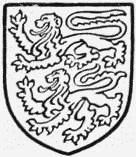
Somery. Or two lions passant azure.
John de Somery seems to have been very overbearing with his tenants and neighbours. In 1310–11 William de Bereford and others alleged that 'he had taken upon him so great authority in Staffordshire that no man could have law or reason by means thereof, and that he domineered there more than a king; as also that it was no abiding for any man in those parts except he well bribed the said John de Somery for protection, or yielded him much assistance towards the building of his castle, and that the said John did use to beset men's houses in that county for to murther them, as also extorted large sums of money from them.' (fn. 51)
His unpopularity may account for a raid made upon the castle during his ownership of it. In 1321 Nicholas son of Robert de Somery and others were accused of breaking into John de Somery's castle of Dudley and carrying away £1,000 in money, and goods to the value of £200. (fn. 52)
Though until this time the Somerys had doubtless been barons by the tenure of the castle of Dudley, this John de Somery seems to have been the first member of the family summoned to Parliament as a baron. The writs were directed to John de Somery from 10 March 1307–8 until 14 March 1321–2, the last being three months after his death. He was never summoned as baron of Dudley. (fn. 53) John died without issue on 29 December 1321, leaving a widow Lucy, and, since his brother Roger had predeceased him, his heirs were his two sisters, Margaret wife of John de Sutton and Joan widow of Thomas de Botetourt. (fn. 54) On his death the barony created by the writ of 1307–8 became extinct, and the manors comprising the barony became divided. (fn. 55) Many of those in Worcestershire passed to Joan de Botetourt, but apparently Dudley Castle and Manor went to Margaret, the elder of the two sisters. It is noticeable, however, that Dudley is not mentioned in the Close Roll of 1323 among the lands so divided. (fn. 56)
John de Sutton and Margaret must, however, have held the castle and manor, for under the tyranny of the Despensers John was imprisoned until, through fear of death, he sealed a charter in 1325 by which the greater part of his wide possessions passed to them, the castle, manor and town of Dudley falling to the share of the younger Despenser. (fn. 57) After the downfall and execution of the Despensers, (fn. 58) John de Sutton and Margaret petitioned for the restoration of their lands, and the castle and town of Dudley were delivered to them in 1327. (fn. 59)
In 1328 John and Margaret settled the castle and manor on their son John and his wife Isabella, daughter of John de Cherleton, in tail, (fn. 60) and later John de Sutton seems to have mortgaged the castle to John de Cherleton, lord of Powis, to whom he owed the large sum of £3,000. (fn. 61) In 1330–1 William le Fisshere and others were summoned before the King's Bench on a charge of besieging Dudley Castle. They assaulted the lord, John de Cherleton, besieged the castle for two days, shot arrows into it and cast stones against it. (fn. 62) John in 1331 again had occasion to complain that his castle at Dudley had been besieged and his goods carried away. Joan de Botetourt, daughter of Roger de Somery and sister of Margaret de Sutton, was chief among the besiegers. (fn. 63)
The castle had been recovered by John de Sutton before 1337, when he had licence to grant to his son John the castle and town of Dudley, which he held of the inheritance of Margaret his late wife, to hold during the lifetime of John de Sutton the elder. (fn. 64) John son of John obtained Letters Patent confirming his right to the castle and town of Dudley in May 1340, (fn. 65) a few days before settling both on his wife Isabel for her life. (fn. 66) John de Sutton, who was summoned to Parliament as Lord Dudley or Sutton de Dudley in 1341–2, (fn. 67) died in 1359, (fn. 68) and his widow Isabel under the settlement of 1340 continued to hold the castle and vill of Dudley until her death in 1397, (fn. 69) when it passed to her great-grandson, another John de Sutton. (fn. 70) He died in 1406, and was succeeded by a son of the same name, (fn. 71) who is said to have served for some time under Humphrey Duke of Gloucester in Guisnes Castle in France (fn. 72); he was appointed Lieutenant of Ireland for two years in 1428. (fn. 73) During the Wars of the Roses John Dudley, one of the most zealous Lancastrians, was taken prisoner at Gloucester in 1451 and at the battle of St. Albans in 1455, and was afterwards wounded at Blore Heath. (fn. 74) However, in spite of his loyalty to Henry VI, he seems to have been immediately received into favour on the accession of Edward IV, who pardoned all the debts due from him to the Crown as Treasurer of the Household of Henry VI, (fn. 75) gave him £100 for his expenses in the king's service, (fn. 76) and in 1465 granted him £100 yearly for life from the customs and subsidies in the port of Southampton. (fn. 77) In 1487 he was succeeded by his grandson Edward Sutton alias Dudley, (fn. 78) who died in 1531–2, leaving a son John. (fn. 79)
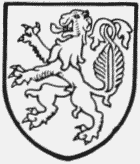
Sutton, Lord Dudley. Or a lion vert with a forked tail.
Immediately after his succession John Lord Dudley, who was already very much in debt, (fn. 80) and is described by Dugdale as 'a weak man of understanding,' (fn. 81) seems to have mortgaged most of his estates to Sir John Dudley, afterwards Duke of Northumberland, for £2,000, for which he agreed to pay £400 yearly. (fn. 82) In 1532 Lord Dudley wrote to Cromwell begging him to use his influence with the king to persuade him to pay the £2,000 and to take in exchange the manor of Sedgley, worth £180 per annum, for twenty years. (fn. 83) Evidently his request was not granted, since in 1533 Cromwell received another letter asking him to pay the £400 interest. (fn. 84) From a Close Roll of 1538–9 it appears that Cromwell lent him £1,000, (fn. 85) but in spite of this Lord Dudley's affairs soon became so much involved that he was obliged to make over most of his possessions to Sir John Dudley, being for the rest of his life dependent upon his friends and known by the name of Lord Quondam. (fn. 86) The castle and manor of Dudley were sold in 1535 to Sir John Dudley. (fn. 87) Cicely the wife of Lord Dudley with one of her daughters found refuge at Nuneaton, where the prioress gave them 'meat and drink free of cost,' (fn. 88) while his eldest son Edward obtained a commission as captain under his uncle Lord Leonard Grey in Ireland, (fn. 89) where he remained for several years. In 1547 he joined the expedition into Scotland and was appointed governor of Hume Castle. He succeeded his father as Lord Dudley in 1553, (fn. 90) and in 1554, after the attainder of John Dudley, then Duke of Northumberland, Queen Mary restored to him the manor and castle of Dudley. (fn. 91)
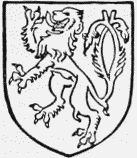
Dudley, Lord Dudley. Or a lion azure with a forked tail vert.
Dudley Castle was proposed as a prison for Mary
Queen of Scots in 1585. Her keeper, Sir Amias
Paulet, (fn. 92) visited the castle and reported that 'the
lodginges . . . . . . . are not so manye in nomber
as I could wisshe and are also verie little and straight
saving the lodginges wch must serve for this Q. wch
are so faire and commodious as she cannot desire to
have them amended.' He then goes on to describe
the defects of the castle; there is plenty of coal and
wood, but they can only be had for ready money;
'also the howse ys utterlie destitute of Table boordes, cup
boordes fourmes stooles and Bedstedes saving that the hall and
greate chambre are provided with Table boordes . . . . . . . .
A barne must be converted to a stable for the gouvernors
horses . . . . . This Queenes gentlemen servantes will not
like with their straight lodginges because they have no ynner
chambers. The brewing vesseles are somewhat decayed, and
some are wanting wch may be supplied from Burton. The
water for the kitchins and howshold must be sett owt of the
dikes without the gate and yet some will say that the pump
wch standeth in the middest of the court yf yt were clensed
would furnishe sufficient and good water, but I find others that
doubt thereof. The chamber windowes of this Q. lodginges are
open upon the park as likewise the windowes of her kitchin,
which I trust may be supplied by a good watche and a deepe
ditche but especiallie by this Q. infirmities wch will not permitt
her to run away on her owne feete. These defectes are
recompenced yn parte with the strength of the howse in other
respectes and with manie other good commodities.' (fn. 93)
It was finally decided to send the queen to Chartley.
Edward eighth Lord Dudley died in 1586, (fn. 94) and was succeeded by his eldest son, also called Edward. (fn. 95) Ferdinando, the only legitimate son of the last-named Edward, died of smallpox during his father's lifetime, (fn. 96) leaving an only daughter Frances, who married Humble Ward, son of William Ward, jeweller to Queen Henrietta Maria, (fn. 97) and to him the Dudley estates were evidently made over for the payment of Lord Dudley's debts. (fn. 98) To ensure Frances's succession a grant was obtained from the king in 1635, which provided that, although Ferdinando Dudley had died in his father's lifetime, Frances should have the same place as if her father had been Lord Dudley. (fn. 99) Humble Ward was created Lord Ward of Birmingham in 1644. (fn. 100)
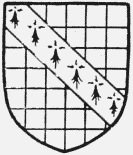
Ward, Lord Ward and Earl of Dudley. Checky or and azure a bend ermine.
During the Civil War the castle was garrisoned for Charles I, and was besieged in 1644, and again in 1646, from the Staffordshire side by the garrison at Wrottesley House, (fn. 101) and on the Worcestershire side by the Edgbaston garrison. The first time it was relieved by troops sent from Worcester by the king, (fn. 102) but in 1646 the governor, Sir Thomas Leveson, surrendered it by the king's orders after his surrender to the Scots 'to avoid bloodshed,' although it was 'provisioned for three years.' (fn. 103) The terms of surrender were accordingly very lenient, and included the stipulation that those who went to their own homes were to have 'unmolested peace' there, that passes were to be given to those who wished to go abroad, that 10 miles' march a day was to be the limit for those who went to join other garrisons, and that carriages should be provided for the officers. (fn. 104) After the second siege the castle was dismantled by order of Parliament. (fn. 105)
Lord Ward seems to have taken no active part in the Civil War, although he and his wife and children were living in Dudley Castle when it was garrisoned for Charles I and during the siege of 1646. (fn. 106) In 1651, in spite of his claim that his freedom from sequestration was one of the terms of the surrender of the castle to Sir William Brereton, and in spite of an order from Parliament for his discharge, Lord Ward's tenants were commanded not to pay him their rents, the county committee reporting that Sir William Brereton had only procured the order on the marriage of his daughter Frances with Lord Ward's eldest son Edward. (fn. 107) Lord Ward's estates do not seem to have been finally discharged until 1656. (fn. 108)
In 1660 Edward Gibson, grandson of John Sutton, second son of Edward eighth Lord Dudley, laid claim to the castle and barony of Dudley, saying that they had been entailed on the said Edward Sutton and his heirs male in the reign of Queen Mary. (fn. 109) His petition was referred to the Committee for Privileges, (fn. 110) but probably no further proceedings were taken, although in 1667 Frances Lady Dudley petitioned the king for the 'title, style and precedence of the barons of Dudley.' (fn. 111)
Edward Ward succeeded his father in the manor, castle and borough of Dudley and barony of Ward in 1670 and his mother in the barony of Dudley in 1697, (fn. 112) leaving them successively to his grandson (fn. 113) and great-grandson, both called Edward. (fn. 114) The latter died unmarried in 1731, (fn. 115) his heir being his uncle William Ward, fourteenth Lord Dudley and fifth Lord Ward, who also died unmarried in 1740. (fn. 116) The barony of Ward with the Dudley estates then passed to a cousin, John Ward, (fn. 117) who was created Viscount Dudley and Ward in 1763, (fn. 118) but the barony of Dudley, created by the writ of 1342, passed to the heir general, Ferdinando Dudley Lea, nephew of the last baron, on whose death without issue in 1757 it fell into abeyance between his five sisters, and still remains so, though the title Baroness Dudley was illegally assumed by Anne eldest sister and co-heir of the last lord. (fn. 119) From John first Viscount Dudley the manor passed to his sons John and William in succession. John William son and heir of William the third viscount succeeded in 1823, and was created Earl of Dudley in 1827, (fn. 120) but died unmarried in 1833, when the barony of Ward, with his estates passed to his second cousin William Humble Ward. The viscounty of Dudley and Ward and earldom of Dudley of the 1827 creation became extinct, but the earldom was re-created in 1860 in favour of William son and heir of the last-named William Humble (fn. 121) and father of William Humble Ward, now Earl of Dudley and owner of the manor of Dudley and of the ruins of the castle.
DUDLEY CASTLE
DUDLEY CASTLE consists of an irregularly shaped walled inclosure, with its greatest length from north to south, having the keep on a mound at the south-west angle, the main gateway and barbican projecting from the external wall at the south-east, and a range of domestic buildings occupying the whole of the eastern side of the bailey, terminated by the chapel on the south and the postern gateway on the north. Near the north-west angle of the external wall is a small doorway, and there are traces of a building having formerly existed on the west side of the bailey about midway between this doorway and the keep. Immediately to the west of the main gateway the external wall is interrupted by a late block of domestic buildings. A deep moat surrounds this area on the east, north and west, commencing on the east side of the barbican and terminating at the north-west of the keep mound, which is unmoated. A considerable portion of the mound itself appears to have been faced with stone. On the northern side of the moat, opposite the north gateway, was a walled triangular outwork, covering the approaches from that direction; a road seems to have approached the castle from the north, passing round its eastern side, and so in by the north gate, where the moat was crossed by a drawbridge. On the edge of a steep slope, about 300 yards south of the keep, is a short piece of walling with a small angle tower and a two-storied gate-house; the work is poor, and seems to be all of late date. The modern approach to the castle leads by a short steep ascent to this gateway, and, turning there in a north-easterly direction, passes below the keep to the gate in the barbican.
Below and outside the chief moat is a second line of ditches, less regular and more difficult to trace clearly in their original outline. This is probably the limit to which the line of outer walls or palisading would have extended, though beyond them are still further ditches and escarpments, some natural and some probably quarries, which would all assist in making the site one of most remarkable strength.
The woods, which now cover the whole hill or ridge occupied by the defences, conceal to some extent, both on the ground and from a distance, the great natural advantages which the position must always have offered for any kind of fortification.
No part of the masonry defences appears to be of an earlier date than the latter half of the 13th century, to which period the keep and gate-house with its barbican belong. The chapel block is of the early 14th century, while the buildings to the north between the chapel block and the postern are mainly reconstructions of the 16th century, (fn. 122) though the external wall against which they are built and some partition walls incorporated into their structure are of the original date. The dismantling of the castle in 1646 accounts largely for the ruinous state of the keep, main gateway, and wall of enceinte. The barons of Dudley and Ward continued to use the domestic portion as a residence until 1750, when it was devastated by fire. Tradition ascribes the fire, which lasted three days, to a set of coiners, who are said to have carried on their trade in the castle.
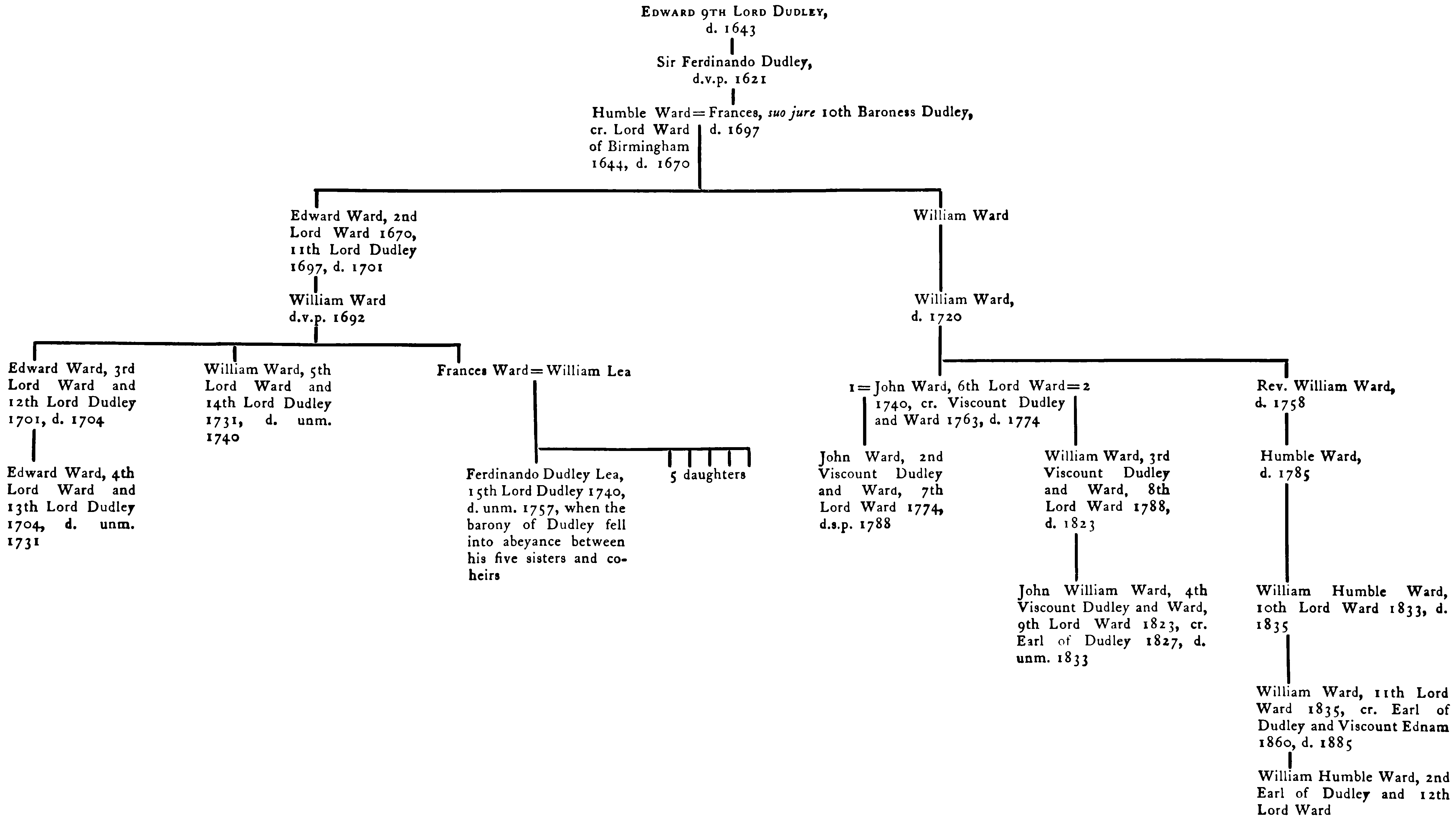
Table showing Descent of the Baronies of Dudley and Ward and of the Manor of Dudley
The keep stands on a mound partly artificial, overlooking the castle area, and forming the southern point of the main defences. The building is of limestone rubble with sandstone dressings, shaped angle pieces being occasionally introduced in the re-entering angles. The walls rise with a batter for about 4 ft. and are vertical above. The plan is rectangular, the longer sides running approximately east and west, and there are large circular towers at the four angles. Of these the northern two with the curtain wall between remain fairly complete as far as the battlements, which on the western tower have been rebuilt, but the rest of the walls and the southern towers have only 4 ft. or 5 ft. of masonry remaining above ground. A sloping approach leads east from the main gateway of the castle towards the keep, curving below a platform in front of the north-eastern tower, and leading to the gateway in the north curtain wall. Here the external doorway consists of a segmental arch of three orders, moulded with wide angle rolls, a 6-inch slot for the portcullis being placed between the second and third, and a rebate for a door inside all, with holes for the bar. The wall at this point is 11 ft. 4 in. thick, and the passage through it from the doorway is vaulted.
The interior of the keep had apparently two floors, without divisions, the towers forming a recess in each corner, and the battlements having a walled passage round the roof of the upper story. A newel stair on the eastern side of the entrance leads to the two floor levels and to the battlements, while a second newel stair adjoining it to the east leads from the first floor level to the battlements of the north-eastern tower. A stairway in each of the remaining towers, now blocked, leads from the ground to the first floor. The curtain and towers are variously pierced with loops and larger openings, and on the first floor above the gateway are two larger lights with moulded rear-arches, having their internal splays thrown to the westward by the position of the newel stairs above described. A blocked arch on the face of the north-west tower close above the moat seems to have been a drain shoot. The battlements are high, and the merlons are pierced with trefoil-headed loopholes, large on the western tower and small on the curtain, all being provided with rebates for shutters.
The remains of the thick wall of the enceinte, which is most probably contemporary with the keep, continue eastwards till they meet the block of 17th-century buildings which adjoin the gate-house. On the inside, and parallel with it, is a short piece of wall, probably of the 15th century, which stops at the platform below the north-eastern tower. It is provided with two large cross loops, which appear to flank the slope leading to the gate of the keep. Perhaps a passage or covered way led down from the level of the keep towards the main gate, but subsequent alterations to the walls, which have been choked up in many places, render it impossible to state this with certainty At the point where this inner wall joins the 17th-century work is part of a buttress. The 17th-century work at this point consists of a thin-walled oblong block of buildings, two stories in height, extending up to the gate-house. On the side towards the bailey the principal floor is lighted by large mullioned and transomed windows of two lights, and the ground floor, where there are also two square-headed doorways, by smaller untransomed windows of the same number of lights.
The main gateway was originally three stories in height, but of the upper floor only a portion of the loopholed walls now survives. The entrance itself is a vaulted passage having doors and a portcullis at both ends, with a two-centred segmental external archway of three elaborately moulded orders, inclosed by a label with leaf stops, and on the bailey side an archway of two similar orders, the outer, which is raised considerably above the inner, being carried by small shafts with moulded capitals and bases, resting on carved corbels. It is protected on the external side by a barbican, having a large gateway flanked by small circular turrets, of which the foundations alone remain. This appears to have been an afterthought, though there is little difference in date. The walling is of rubble, with sandstone quoins, and of the same character as the keep. A doorway with a two-centred head and continuously moulded jambs, which must have been reached by an external staircase from the bailey, communicates with an apartment over the entrance lighted by twin trefoiled lights. The barbican is built with an inclination to the west to meet the curved approach leading to the gate.
East of the gateway and barbican there are now no buildings, and the main wall, which has been much restored, after continuing in a straight line for about 54 ft., trends to the northward and joins the chapel block. At the angle made by the change of inclination is a rounded mass of masonry, perhaps the base of a turret. The building containing the chapel and the domestic apartments adjoining is of the early 14th century. The first floor at the southern end, which is two stories in height, is occupied by the chapel, extending the full width of the building from west to east. It is lighted from the west by a large window with a two-centred head and external label, from which the tracery has disappeared. Sufficient remains to show that it was of three lights, and that the tracery was composed of sexfoiled spherical triangles. At the south-west is an ogee-headed doorway, entering the chapel either from buildings now gone or from an external stair. In the wall close to it is a recess for a water-stoup. A string-course runs round the west wall and what remains of the south wall, being slightly dropped to the north of the chapel. Beneath the chapel is a barrel-vaulted room, entered by a doorway with a two-centred head at the south-east, and lighted by plain square-headed lights, two in the west wall and one in the south wall to the east of the entrance.
The walls of the portion north of the chapel inclose a floorless area with a central dividing wall. The eastern part contained cellars on the ground floor, with two floors above, the east wall showing remains of two fireplaces on the first floor and one of wrought sandstone of more elaborate character on the second floor, all 16th-century work.
The western part has a ground floor room with two cross walls, and above this is what was probably the grand chamber, which is lighted by two large six-light mullioned and transomed windows in the west wall, inserted in the 16th century, with a small fireplace of the same date between. The masonry of this block is clumsy and coarse compared with that of the keep and gate-house. The north-west angle appears to have been cut back and refaced to square with the projecting rooms at the south-west of the hall. A passage in a three-sided turret projecting outside the wall of the enceinte leads from the north-west of the chapel block to the later buildings on the north. Its masonry, of neatly coursed limestone rubble, with regular sandstone quoins, shows it to be an addition of the same period.
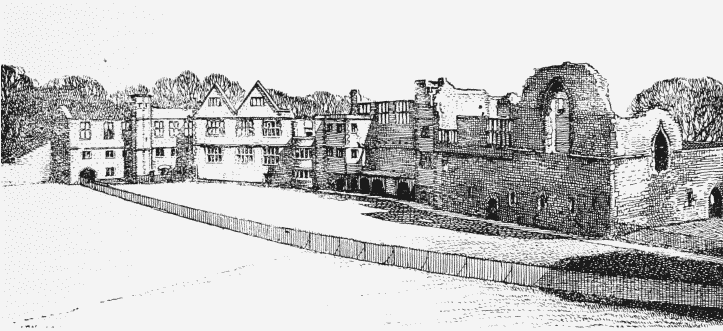
Dudley Castle from the South-west
At the south, in what was the basement beneath the hall, is a room running east and west with a rubble vaulted roof. Contained in a projection at the south-east were three small rooms, one above another, square in shape and lighted by small mullioned windows; the first floor room may have formed a vestibule to the hall. The floor above the vaulted room represents the southern or dais end of the hall, which extended northwards above a range of cellars, which, together with the floor of the hall, are now entirely gone. The south-eastern corner of the hall has required much repair, and the exact means of connexion between the dais and the chambers south of and above it are difficult to trace. There may have been a circular stair in the thick mass of wall at that corner, and there was apparently a passage in the projecting piece of wall, as on the ground floor level. At the top of this projection are the remains of a small room, such as was often at the head of the hall stair, with traces of fan vaulting and carved work between the ribs. The eastern wall of the hall was formed by the main outer wall, and of this only the foundations remain; but the western preserves a row of six large four-light windows with mullions, transoms, and sloped sills. This wall has also small two-light mullioned windows on the ground floor. At the north end of the hall, on the level of the original floor, are three doorways with classical lintels opening into a kind of passage—the development of the earlier type of screens—and above these doors is a two-light pedimented window, which evidently overlooked the hall from a room above the passage.
On the west side of the west wall is a terrace extending about three-quarters the length of the hall. This has been restored, but there appears to have been originally a Corinthian arcade along the front, entered by a doorway at the south end, which communicated through the vestibule with the dais end of the hall. A doorway on the north communicated with a corresponding vestibule at the opposite end of the hall contained in a projecting building answering to that on the south. From the middle of the terrace a flight of steps led down to the level of the court, the terrace itself being supported by a line of arched recesses, which gave light to the small windows of the cellars below the hall.
At the north-east corner of the hall is a projection on the outer wall, part of which seems to have contained a newel stair, and from this point the wall trends to the north-west. This change of direction is followed by the building, with the result that a small triangular-shaped room is formed at this end of the hall, which probably served as a lobby, from which the hall was entered by the doors at that end.
The ground floor of the adjoining block of buildings contains the kitchen on the north, with a large room on the south, divided from the kitchen by a wide passage. This southern room, which, like the kitchen, occupies the whole width from west to east, is lighted by a large semicircular bay window of eight mullioned lights on the bailey side, while at the opposite end there are two arched recesses carrying the masonry floor of a serving lobby to the hall. A wide flight of steps appears to have originally led from this lobby down to the passage adjoining the kitchen. The northern wall is partly of the 12th century, and shows the remains of a large semicircular-headed doorway of this date. The jambs are gone, but a plain rear-arch is visible in its entirety on the south side part of the roll-moulded external order on the north. The doorway has been built up, and the floor of the room above, now destroyed, was below the crown of its head. The north face of this wall has been much disturbed, and is corbelled back on the ground story, the thicker upper portion being carried by a pair of depressed arches of the 16th century, springing from a large central corbel of wrought sandstone.
The eastern wall of this block above the ground floor level appears to be entirely of the 16th century, and to be erected upon the original wall of enceinte. On the west the bay window is carried the whole height of the building, and the wall is crowned by large gables. At the north-east, against the external wall, is an ashlar-faced buttress of contemporary date. The kitchen has a large three-flue fireplace and oven in the north-east wall and a smaller one on the north-west. A small door from the kitchen opens into the court; the adjoining buildings on the north follow the trend of the external wall still further westward. The large room on the ground floor appears to have been a bakehouse, and contains two brick ovens on its south-east wall. Attached to the north-western angle is an octagonal turret with an external entrance door, extending the whole height of the building; the stairs which it contained have disappeared. The walling of the northern gate-house or postern block, though the details of the windows and of the gateway itself show them to have been inserted in the 16th century, is of a much coarser character, and would appear to be of the 15th century. The original wall of enceinte has here been razed to the ground and replaced by a thinner wall. On the north side are two buttresses.
The northern gateway itself consists of two depressed arches about 6½ ft. wide, with a passage between them and a room above. The jambs and arches are very much worn and show evident marks of insertion. The eastern part of the block contains a series of rooms lighted by two-light mullioned windows; these were of small size, and probably servants' quarters. West of this gateway the buildings end. A passage in the wall of enceinte appears to have opened out of the gateway, which may, perhaps, have contained a flight of steps leading to a platform behind the battlements. The foundations of the wall can be traced in their original thickness along the whole of the west side of the bailey, but above ground, for the greater part of its length only a thin piece of wall on the inner side remains. Following this wall south-west and then south a small external doorway is reached; the head is rounded, and there are some traces of a projecting wall and arch to defend it close above the moat. Beyond this are a line of corbels and a large fireplace in the external wall; the foundations of a small building probably of the 16th century, to which it belonged, measuring about 37 ft. 3 in. by 15 ft. 8 in., have been recently uncovered. The original thickness of the wall remains at this angle for a short distance. Approaching the keep the wall rises steeply up the keep mound, meeting its northern curtain west of the gateway.
The bailey may perhaps have been divided into two wards, but the surface has been much altered. There is a deep well in the centre of the present area.
The chapel of Dudley Castle is mentioned in 1323, when its advowson belonged to the lord of Dudley. (fn. 123)
When the manor and castle of Dudley were granted in 1554 to Edward Lord Dudley a rent of £12 5s. 8d. was reserved to the Crown. (fn. 124) This rent was probably included in annuities from the castle and manor granted by Queen Elizabeth in 1579 to Edward Lord Dudley for life with remainder to his daughter Anne, wife of Francis Throckmorton, and her heirs. (fn. 125) John Throckmorton was dealing with it in 1606, (fn. 126) but it apparently reverted to the Crown, for in 1650 it was sold by the trustees appointed by Parliament to Henry Sanders. (fn. 127) At the Restoration it again became a royal possession, and was vested in 1672 in trustees, (fn. 128) who sold it in that year to William Roberts, George Dashwood and Gabriel Roberts. (fn. 129) In 1700 this rent of £12 5s. 8d. was sold by Sir Samuel Dashwood to William Tempest, Richard Taylor and Richard Hoare. (fn. 130)
BOROUGH
The borough grew up round the castle, the head of the great barony of Dudley, and the early working of coal and iron in the neighbourhood may have aided its development. There is no evidence to show that it was a borough at the time of the Domesday Survey or indeed until 1261–2, when Roger de Somery agreed that the Dean of Wolverhampton might establish a market in Wolverhampton on condition that he and his 'burgesses' of Dudley might be free from toll there. (fn. 131)
Though Dudley appeared by twelve separate jurors at the assizes in 1254–5, (fn. 132) it is not called a borough, but it is given that title in the eyre of 1274–5. (fn. 133)
It is not until the death of Roger de Somery in 1272 that any idea can be obtained of the actual value or importance of Dudley. The inquisition was taken in 1273, and, as the manor and borough were valued together, it is exceedingly difficult to get anything like a clear conception of the exact relationship of the two. It is probable, however, that the manorial tenants had obtained certain franchises from their lord, and in return for a fixed rent been freed from some or all of the services required of them as manorial tenants, becoming in fact tenants in burgage. The rents of the burgesses at that time produced yearly £5 15s. 5d., (fn. 134) and the tolls of the markets 40s., while the pleas and perquisites of the hundred court were estimated at 30s. An inquisition taken in 1291 gives another account of the town, the borough being then extended at £30 17s. 3¾ l. yearly. The rent of the burgesses was worth yearly £6 0s. 10d., an increase of 5s. 5d. on that paid in 1273. The tolls had decreased to 20s., (fn. 135) but the pleas and perquisites of the hundred court had increased to 60s. A very significant entry tells us that there was one mine of sea-coal worth a mark a year, another valued at 40s., as well as two great smithies (fabrice) of the annual value of £4. The local coal and iron industry was already born.
It is very difficult to obtain any idea of the early constitution of the borough. Although there is no trace of an early incorporation charter, the town was governed in the 16th century by a mayor, bailiff and other officers, who were elected at the court leet of the lord of the manor, but had no magisterial authority. (fn. 136) A mayor is first mentioned in a list of Lord Dudley's possessions in 1591, which shows that this officer was elected every year and received £7 yearly from the burgesses as his fee. (fn. 137) This form of government seems to have continued until 1853, when a Local Board of Health, consisting of fifteen persons, was established under the Public Health Act. (fn. 138)
The incorporation charter, under which the town is now governed, was granted on 3 April 1865 by the title of the mayor, aldermen and burgesses of Dudley. It divided the town into the seven wards of St. Thomas, the Castle, Netherton, St. Edmund, St. James, St. John and Woodside, each of the first three being represented in the council by two aldermen and six councillors, the others by one alderman and three councillors. (fn. 139)
Dudley was represented in the Parliament of 1295, (fn. 140) but not again until the passing of the Reform Act in 1832, which allowed the burgesses to return one member, a privilege which is still continued. Dudley became a county borough under the Local Government Act of 1888, and has its own bench of magistrates. In 1907 it was granted a Court of Quarter Sessions.
The corporation plate consists of a gold chain and badge given to the town in 1882 by Lord Dudley, a mace and the common seal. The mace is 26 in. long, the upper part being encased with silver, surmounted by a royal crown, and bearing the inscription 'Presented by the Right Hon. William Viscount Dudley and Ward to the Town of Dudley on the 9th August 1798.' (fn. 141) The common seal is a round embossing stamp 2 5/16 in. wide, with the borough arms and crest, circumscribed 'The Mayor, Aldermen and Burgesses of the Borough of Dudley 1865.'
The town arms are Gules a fesse engrailed argent between Dudley Castle in the chief and a salamander in flames proper in the foot with a trilobite (fn. 142) between an anchor and a miner's lamp on the fesse. Crest, a lion's head razed. (fn. 143)
A market on Saturday had been established in Dudley before 1261. (fn. 144) Habington mentions a fair on St. James's Day, (fn. 145) and in 1684 Edward Lord Ward received a grant of two new fairs to be held on 21 April and 21 September. (fn. 146) Besides these three fairs, now held on the first Monday in May and October and the second Monday in August, a fourth fair has been established since 1792 and is held on the first Monday in March. They are all now chiefly pleasure fairs, very few cattle and horses being sold. (fn. 147)
The market was held in the High Street and in Netherton Square and Stone Street until 1848–9, when a market-place was formed by pulling down houses between High Street and Queen Street. (fn. 148)
The market rights and tolls were purchased by the corporation from Lord Dudley in 1870 at a cost of £10,000. (fn. 149)
Wakes used to be held annually at Netherton on the last Sunday in October, and at Kate's Hill on the Sunday before 21 October.
As at Kidderminster, the parish and manor, which in Dudley were at first co-extensive, were later divided into the borough and the foreign, (fn. 150) but by the beginning of the 19th century the borough had spread over the whole parish, (fn. 151) and in 1868 it was made to include, for Parliamentary purposes, the extra-parochial Dudley Castle Hill, the ecclesiastical districts of Pensnett, Brockmoor, Quarry Bank and Brierley Hill in the parish of Kingswinford and of Reddall Hill in Rowley Regis. (fn. 152)
Some idea of the population of Dudley in the 17th century can be obtained from the assessments of the hearth tax in the reign of Charles II. In 1662 there were two hundred and twenty-eight people who contributed to the tax, (fn. 153) while in 1674 there were only ninety-six, (fn. 154) a decrease which may have been due in part to the Great Plague of 1666. (fn. 155)
From the beginning of the 19th century the population seems to have steadily increased. Thus in 1831 there were 23,043 people in the town, in 1891 45,724, in 1901 48,733, and in 1911 51,092. (fn. 156)
During the 16th and 17th centuries Dudley seems to have sunk into great poverty. Sir Amias Paulet writing in 1585 describes it as 'one of the poorest townes that I have sene in my life,' (fn. 157) and in 1617 the inhabitants were obliged to petition for a collection in the county for their poor owing to an epidemic, the town depending 'principally upon poore handicrafts men who are nigh impoverished and now themselves waite ayde who heretofore did contribute to the refuge of the poore sorte.' (fn. 158) The state of affairs evidently considerably improved after the Civil War, when Dudley suffered severely, for Erdeswick writing in 1723 describes Dudley as a 'good handsome town,' (fn. 159) and its increased prosperity during the end of the 18th and the beginning of the 19th century is shown by its growing population and by the various Acts of Parliament which the inhabitants obtained for improving the roads leading to the town, for paving, cleansing and lighting it and for supplying it with water. (fn. 160)
The coal and iron mines for which Dudley is now so famous are known to have been worked in 1291, when, as already noted, Roger de Somery had a mine of 'sea coal' worth 13s. 4d. yearly, a mine of iron and sea coal worth 40s. yearly, and two great smithies of the annual value of £4. (fn. 161) From that time until the 17th century there are occasional references which show that the trade was increasing. Sir Amias Paulet in a letter to Walsingham says there is plenty of 'sea coal and charke coal' in Dudley, (fn. 162) while Habington in his survey of Worcester states that the inhabitants 'follow in profession Tabalcain the inventor of the Smythes hammer, the rest are myners delving into the bowells of the earthe for our fuell theyre profytt and have all of them the reputation of bould spirited men.' (fn. 163) But it was in the beginning of the 17th century that Dud Dudley, an illegitimate son of Edward Lord Dudley, made his great discovery that iron could be smelted with coal instead of charcoal, and in 1622 his father obtained a monopoly of the trade for fourteen years. (fn. 164) The work was begun in Lord Dudley's forges in Pensnett Chase, just within the borders of Staffordshire, a few miles from Dudley, and in Cradley, but partly owing to the enmity of the other ironmasters and to a great flood the trade did not prosper, and during the Civil War was stopped for a time, (fn. 165) though Dud declares he used his invention for founding cannon for the king in Worcester. (fn. 166) The discovery, however, made Dudley an important trade centre, although coal was not generally used for smelting iron until the middle of the 18th century. (fn. 167) Towards the end of the same century the trade was still further increased by the improvement of the roads leading to the town, and by the opening of two canals, one joining the Stourbridge Navigation in Kingswinford, (fn. 168) the other joining the Dudley Canal to the Worcester Canal at Selley Oak. (fn. 169) It is to the coal and iron trades that all the manufactures of Dudley owe their origin and development. The manufacture of all kinds of hardware is extensively carried on. (fn. 170) Nails were made in Dudley at least as early as the 15th century, and in 1538 Reynold Ward of Dudley is said to have sold them at 11s. 4d. the thousand. (fn. 171) Nail and scythe making, when carried on by hand, gave employment to many of the families in the villages surrounding Dudley. (fn. 172) Of late years the hand-made nail trade has nearly ceased, except for some few specified sorts.
Dudley was visited by Edward III in 1328 (fn. 173) and 1332, (fn. 174) and by Queen Elizabeth in 1575, (fn. 175) but the visits were probably made to the lords of Dudley rather than to the town.
The lords of Dudley had formerly two PARKS in this parish, one called the Old Park, which belonged to the castle and survives in the castle grounds, the other called the New Park, which was made by Roger de Somery between the wood of Pensnett and the town, (fn. 176) probably about 1247–8, when Roger acquired the deer with which to stock it from William Burdet in exchange for hunting rights in Dudley. (fn. 177) In 1253 he obtained a grant of free warren in all his demesne lands in England. (fn. 178) In 1275, after Roger's death and during the minority of his heir, the king granted twenty-four live deer out of the park and wood of Dudley to Roger de Mortimer. (fn. 179) The wood mentioned is probably the wood or chase of Pensnett which also descended with Dudley Manor, and which is described in the inquisition after Roger's death as being a league in length and half a league in breadth, stretching from the bounds of the manors of Kingswinford and Sedgley. (fn. 180) It was called a foreign wood in the inquisition taken on the death of Roger's son Roger in 1291. (fn. 181) In 1291 a grant of thirty live bucks from the parks of Sedgley and Dudley was made by the king to Bogo de Knovill. (fn. 182) The part of Pensnett Chase in Dudley called Pensnett Wood was inclosed with the other commons in 1783. (fn. 183)
A third park in Dudley called 'le Conyngre' is mentioned for the first time in 1553, when the custody of it was granted to John Lyttelton. (fn. 184) It was granted in 1554 to Edward Lord Dudley, and it then contained a house or lodge called the Wrennesnest. (fn. 185) It was probably the same as the park called the Quingedde, mentioned in an inquisition of 1592. (fn. 186)
The family of Burnell held property in Dudley in the 13th and 14th centuries. In 1293 Robert Burnell, Bishop of Bath, died seised of land there, which he held of John de Somery. (fn. 187) His heir was his nephew Philip Burnell, who died in the following year. The inquisition taken after the death of Philip states that he had a capital messuage in Dudley which he was 'unable to sustain,' and that the rents of the free tenants had decreased to 37s. 8½d. (fn. 188) The last mention of the Burnells holding land in Dudley occurs in 1315, when Edward Burnell son of Philip died seised of a messuage called 'Russelleshalle,' 128 acres of land and 52s. rent, leaving his sister Maud, who was the wife of John Lovel, as his heir. (fn. 189)
Sir John Sutton of Dudley died in 1487 seised of a messuage called NETHERTON (Nederton) within and parcel of the lordship of Dudley. (fn. 190) By a fine of 1579–80 the manor of Netherton and the 'boroughs of Dudley and Netherton' were settled in tail-male upon Edward Sutton Lord Dudley, (fn. 191) and in 1586 a house called Netherton, in the chase of Pensnett, was among the possessions of Edward Lord Dudley at the time of his death. (fn. 192) This house is again mentioned in 1610–11, (fn. 193) but after that all trace of it disappears. There is now, however, a manor at Netherton belonging to the Earl of Dudley.
PRIORY
The advowson of the priory of Dudley seems to have belonged to Gervase Paynel, the founder, and his descendants, for in 1323 it was assigned to Margaret wife of John de Sutton as part of her share of the lands of her brother John de Somery. (fn. 194) In the 15th century the prior seems to have been appointed by the Prior of Wenlock, but the temporalities of the priory during a vacancy passed to the lords of Dudley. (fn. 195) At the Dissolution the possessions of the priory at Dudley were valued at 117s. 8d., (fn. 196) and in 1541 they were granted with the site to Sir John Dudley. (fn. 197) On his forfeiture in 1553 the estate passed to the Crown, and was granted in 1554 to Edward Lord Dudley, (fn. 198) and it has since descended with the manor. (fn. 199) It is mentioned as recently as 1804. (fn. 200)
The priory church and buildings were allowed to fall into decay, and the lords of Dudley permitted various manufactures to be carried on in the church.
The priory was situated about half a mile west of the castle, but little is now left of the conventual church and offices. They now form a group of picturesque ivy-covered ruins standing in the grounds attached to the Priory House, the residence of Sir Gilbert Claughton, bart.
The remains show the church to have been cruciform with an aisleless nave and two chapels on the south side of the quire, the eastern chapel separated by a blank wall from the western chapel, which opened directly out of the south transept. Of the east and north walls of the quire nothing now remains above ground, while the north transept has entirely disappeared. The secular buildings were on the north side, but of these only a few foundations, overgrown by a thick bed of ivy, are left. Some of the corbels which supported the cloister roof remain on the outside of the north nave wall, and there are fragments of a central newel staircase at the north-east of the former north transept. It would appear, from what little detail remains, that the east end of the church was erected about 1190, while the building of the nave followed early in the 13th century, but the remains are not large enough to allow of this being stated with certainty, while the dating of the secular buildings is quite a matter of conjecture. The south and west windows of the nave, with the west doorway, are insertions of the early 14th century. The easternmost of the south chapels was not added until late in the 15th century. Most of the east and west and parts of the north and south walls of this chapel are left. It appears to have been in three bays and was vaulted possibly with a fan vault. In the east wall is a large four-centred window, the tracery of which was set in the middle of the wall between shallow casements, while the outer order to both jambs was moulded with a double ogee. Over the window on the outside is a moulded label returning on itself in the form of a lozenge. Though the head and most of the jambs are left, all the tracery has been destroyed. On either side of the window were niches surmounted by tall canopies, the soffits of which were panelled in imitation of vaulting, but only the southern one now remains, and this much mutilated, while what is perhaps the soffit of the other, though of a slightly different design, can be seen used in the patching up of the south wall of the west chapel. The westernmost bay of the north wall remains fairly complete, and here the line of the vault can be traced as also on the east and west walls of the chapel. In this bay is flat four-centred doorway opening into the quire. At the south-west are the remains of an octagonal stair turret, with the west jamb of a doorway, about 10 ft. above the ground level, which must have opened on to a small west gallery; the pockets for the joists which supported it can be clearly seen in the north and south walls. At the north end of the west wall are indications of a blocked opening leading from the chapel on the west. The shaped angle stones from which the capitals of the vaulting shafts at this end have almost entirely mouldered away show that the blank ashlar walling here is of original 15th-century date, and probably replaces the east wall of the earlier transept chapel. In the east wall of the south transept is a pointed arch of a single square order with quirked chamfered imposts, opening into the western chapel, the present south wall of which appears to be entirely modern. Against the east end of the south wall of the transept are the remains of a flat buttress, and at the south-west angle a flat clasping one. Most of the walls to the four westernmost bays of the nave are still standing. The sills of the windows in the north wall are at a higher level than those on the south, this being necessary to give sufficient height to the south wall of the cloisters. Only the lower parts of two of the windows remain. These appear to be of original early 13th-century date. In the west end of this wall is a pointed doorway set with deeply splayed external jambs and an external rebate, while the inner jambs have a continuous swelled chamfer. In the south wall are the lower parts of four early 14th-century windows which must have originally been of two lights each with external jambs of two chamfered orders and plain internal splays. Running below the sill on the outside is a string of semi-octagonal section. The sills to all these windows are broken and none of the heads are left, but an engraving of 1731 shows them to have been two-centred and filled with tracery. (fn. 201) At the west end of the wall and between the two centre windows are the remains of buttresses. Their stoppage a few feet above the level of the window sills tends to prove that the nave was never vaulted. In the west wall is a large pointed doorway of three orders with an external hood, but the mouldings are too decayed to allow of identification. Above the doorway was a pointed gable, only traces of which are now visible, the apex of which must have risen above the sill of the large west window over it, and may perhaps have had open-work tracery. Both doorway and window appear to be insertions of the same date as the south windows. In the remaining portion of the nave are two 13th-century stone coffins. The larger one is broken into two, but the smaller one is in a fairly good state of preservation. There are also the remains of the upper part of a stone effigy of a priest dressed in ordinary ecclesiastical vestments. The head, which rests on a cushion, is broken off at the shoulders and is much mutilated.
There seems to have been no mill held by the lords of Dudley, but the Priors of Dudley seem to have possessed one in their manor in the parish, though it is not mentioned until after the Dissolution. In 1610–11 a windmill in Dudley which lately belonged to the priory was in the possession of Lord Dudley, (fn. 202) and in 1741 a water corn-mill was annexed to the site of the priory. (fn. 203) William Frebody died in 1437 seised of a water-mill there, which he held jointly with Margaret his wife of Sir John Sutton, kt. (fn. 204)
CHURCHES
The church of ST. EDMUND consists of a chancel with a south vestry and organ chamber, a nave, north and south aisles and a west tower. Over the aisles and at the west end of the nave are galleries. The old church was destroyed by Col. Leveson in 1646, (fn. 205) and from that date appears to have remained in ruins until rebuilt in 1724. (fn. 206) The galleries were erected early in the 19th century, but were considerably altered in 1864, when the building was restored and the wooden tracery inserted in the aisle windows.
The church is built of red bricks with stone dressings and has a tiled roof. The chancel is lighted by round-headed windows, and the chancel arch is of similar form with moulded archivolt and keystone.
The nave arcades are in four bays with semicircular arches, resting on square piers with moulded capitals and chamfered bases. The aisles are lit by large round-headed windows, one to each bay, and now filled with modern wood tracery of semi-Gothic character. At the west ends of both aisles are early 19th-century porches.
The main entrance to the church is under the tower, but there are also doorways in the west walls of the aisles. The square tower is divided externally by moulded stone cornices into three stages. Above the entrance doorway is a curved pediment with a second cleft pediment resting on three small Doric pilasters over it. The two upper stages of the tower are set back. Round-headed windows light the bell-chamber on each side and the shaped parapet above is finished with crocketed pinnacles at the angles. On one of the pilasters supporting the south aisle is set a sundial.
The plaster ceilings of the chancel and nave are coved at the sides but flat in the centre.
Under the tower arch is a screen with a round-headed doorway and Ionic pilasters on either side.
The front of the organ case is made up of pieces of the 18th-century oak reredos, and portions of an old 'three decker' have been utilized in the present pulpit. In the chancel are two Jacobean chairs, both dated 1611.
A modern brass tablet in the chancel records the burial of Honor wife of Sir Ferdinando Dudley, died 1620.
In the vicarage is kept the old parish chest.
There is one bell, inscribed 'R. Wells of Albourne fecit MDCCLXXVIII.'
The plate consists of a 1748 silver cup and a paten of the same date (both are inscribed 'The Gift of John Hodgetts Gent. 1749'); a silver chalice inscribed 'The Gift of Mrs. Phoebe Dixon to the Church of St. Edmund in Dudley 1801'; an 1872 silver flagon inscribed 'The Gift of Mrs. Elizabeth Benett To St. Edmund's Church Dudley 1872'; and an 1879 silver paten.
The early registers are in two books and are kept at St. Thomas's vicarage: (i) baptisms and burials 1540 to 1544 and 1547 to 1611, marriages 1542 to 1544 and 1547 to 1610, all entries for 1548 missing; (ii) baptisms and burials 1611 to 1646, marriages 1611 to 1643. From 1650 until after 1812 the registers of St. Edmund's and St. Thomas's were kept conjointly at St. Thomas's.
In 1815 the parish church of ST. THOMAS was found to be in so dangerous a condition that an Act of Parliament was obtained for rebuilding it. (fn. 207) The present church was completed in 1817 at a cost of £12,650. It is now (1912) about to be enlarged.
The building comprises a shallow chancel, nave and aisles, with arcades of clustered shafts and wooden galleries, a west tower with spire and porches at the east end. The style is 'late Perpendicular.' An ancient altar slab with its consecration crosses is preserved here.
The bells are ten in number, cast by Thomas Mears of London in 1818; the fifth bears the inscription 'To Doomsday may the name descend Dudley and the Poor Man's Friend, William, Viscount Dudley and Ward.'
The plate includes an Elizabethan communion cup of 1571, another cup of the Puritan type with no hall mark, but inscribed 1626, and a flagon of unusual pear shape of 1724 (?), the gift of Gilbert Shaw in 1743, the later cup and the flagon having been gilt in 1864. There are three patens, the first of 1594, the second undated, but given by Samuel Shaw towards the middle of the 18th century, and the third of 1721.
The registers previous to 1813 are as follows: (i) all entries 1541 to 1610; (ii) all 1610 to 1629; (iii) all 1629 to 1650; (iv) all 1650 to 1653; (v) all 1653 to 1692; (vi) baptisms and marriages 1692 to 1714; (vii) baptisms and marriages 1715 to 1749; (viii) baptisms 1749 to 1771, marriages 1749 to 1754; (ix) baptisms 1772 to 1793; (x) baptisms 1794 to 1812; (xi) burials 1678 to 1712; (xii) burials 1713 to 1747; (xiii) burials 1747 to 1770; (xiv) burials 1771 to 1794; (xv) burials 1795 to 1812; (xvi) marriages 1754 to 1762; (xvii) marriages 1762 to 1770; (xviii) marriages 1770 to 1791; (xix) marriages 1791 to 1808; (xx) marriages 1808 to 1812. From the middle of the 17th century until after 1812 the entries for St. Thomas's and St. Edmund's are found together at St. Thomas's.
The church of ST. LUKE consists of a chancel with a south vestry and north organ chamber, a nave and north and south aisles. It was erected in 1878 and is built of red brick and roofed with slates.
The plate includes two cups, a salver-paten and flagon, all of 1863.
The church of ST. JOHN, Kate's Hill, consists of a chancel with a north organ chamber and south vestry, a nave with north and south aisles and a west tower; over the aisles and the west end of the nave are galleries. It was erected in 13th-century style in 1840, and is built of coursed ironstone rubble with ashlar dressings. The roofs are open and slated.
The plate includes a modern chalice and paten of the mediaeval type given in 1840.
The church of ST. JAMES, Eve Hill, consists of a chancel with a north vestry and south organ chamber, a nave with north and south aisles and a west tower. At the west end of the nave and over both the aisles are galleries. It was erected in 1840, apparently by the architect of St. John's, Kate's Hill, the designs being almost identical. The organ chamber and vestry were not added until 1869.
The plate includes a cup, paten and flagon given by the Cartwright family in 1840.
The church of ST. AUGUSTINE, Holly Hill, was built in 1884, and consists of a chancel with an organ chamber and vestry on the north and a small chapel on the south, a nave, north and south aisles, and porches and a baptistery at the west end of the nave. It is built of red brick with stone dressings in a free Gothic style and has wooden barrel ceilings and tiled roofs.
The church of ST. ANDREW, Netherton, was erected in 1830 on a site given by the late Earl of Dudley. It is a building of stone in 13th-century style, and consists of chancel, nave, aisles and an embattled tower with pinnacles. Connected with this church are chapels of ease, St. Peter's at Darby End and St. Barnabas at Dudley Wood.
ADVOWSONS
From very early times there were two churches at Dudley. They were granted by Gervase Paynel in the middle of the 12th century to his newly-founded priory of Dudley, (fn. 208) and appear afterwards to have become annexed to the priory church of St. James, for when Pope Lucius confirmed the possessions of the priory in 1182 he included the church of St. James of Dudley with the chapels of St. Edmund and St. Thomas. (fn. 209) Both the churches were united in one vicarage, (fn. 210) and Bishop Sandys's survey states that St. Edmund's was the parish church and St. Thomas's a chapel dependent upon it. (fn. 211)
In 1238 an agreement was made between the Bishops of Worcester and of Coventry and Lichfield whereby it was agreed that the whole vill of Dudley with its churches should pertain to the bishopric of Worcester, while the site of the castle and the cell of monks belonging to it in the county of Stafford should belong to the bishopric of Coventry and Lichfield. (fn. 212)
The priory of Dudley had probably appropriated the rectory of Dudley as early as 1292, for Brother Robert de Malleye, Prior of Dudley, was then rector of the parish church of Dudley. (fn. 213) In 1342 the prior and monks appeared before the Bishop of Worcester to account for the appropriation of the church, (fn. 214) while in 1349 the sum of 200 marks was extorted from them for acquiring the advowson without the king's licence, and for licence to appropriate the church. (fn. 215) The advowson was retained by the priory until the Dissolution, when it passed to the Crown and was granted with the rectory in 1541 to Sir John Dudley. (fn. 216) On his forfeiture it again passed to the Crown, and was given by Queen Mary to Edward Lord Dudley in 1554. (fn. 217) It then followed the same descent as the manor, (fn. 218) William Earl of Dudley being now patron of the living.
In 1628 Edward Lord Dudley conveyed the rectory and tithes to Sir Miles Hobart, (fn. 219) probably for a certain term of years only, since, although they were in the possession of the Hobart family in 1668, (fn. 220) they were afterwards again held by Lord Dudley and commuted in 1783 when the parish was inclosed in return for the allotment of a certain portion of the common land. (fn. 221)
An Act of Parliament was obtained in 1836 authorizing the sale of glebe land in Dudley belonging to the vicarage there. It was purchased by the trustees of John William Earl of Dudley. (fn. 222)
In 1844 the four new parishes of St. Edmund, St. James, St. John and St. Andrew, Netherton, were formed out of the old parish of Dudley. (fn. 223) Since that date two other parishes have been formed, that of St. Luke in 1876 (fn. 224) and that of St. Augustine in 1884. (fn. 225) The livings of all these churches are vicarages, and all are in the gift of the vicar of Dudley.
Land at Dudley called 'Our Ladyes lands' in the tenure of the churchwardens for the maintenance of a priest and obits was granted in 1562 to Cicely Pickerell. (fn. 226) She sold it about two years later to Thomas Watwood and Matthew Bysmere. (fn. 227)
The Society of Friends was established in Dudley before 1656, in which year the society's register begin. The Meeting House was built in 1794. (fn. 228)
The Unitarian chapel, called the Old Meeting House, which was situated in Wolverhampton Street, was built in 1702 for the Presbyterians, and rebuilt in 1717 after being destroyed by rioters. The registers date from 1743. (fn. 229)
The Congregational chapel in King Street was built in 1839. An older chapel built in 1788 by the Countess of Huntingdon's students and ministers was acquired in the same year by the Independents, who in consequence of religious disagreements had seceded from the congregation of the Old Meeting House. The registers of this sect begin in 1803. (fn. 230)
There are also Congregational chapels in Himley Street and Woodside.
There is a Wesleyan Methodist chapel in King Street, built in 1788–90, and having registers commencing in 1804; a Baptist chapel in New Street built in 1778, having registers from 1814; and a Wesleyan chapel in Wolverhampton Street, which was built in 1828 and 1829, and belongs to the Methodist New Connexion. (fn. 231)
At Netherton there are Baptist, Congregational and Methodist chapels.
The Roman Catholic Church of Our Lady and St. Thomas of Canterbury in Porter's field was built in 1842, (fn. 232) and registered for marriages in 1847. (fn. 233)
CHARITIES
In 1709 John Tandy, by will, devised a piece of land called the Furnace Piece, the rents to be applied in clothing for poor widows. Upon the inclosure about 2 acres of land were awarded in respect of this charity.
The endowment now consists of Queen's Cross Brewery and Lamp Tavern, let at £23 a year, cottages in Furnace Place, producing £17 a year, and 1 acre at Dudley Wood, producing £1 a year; also £1,615 11s. 5d. Queensland 3½ per cent. stock with the official trustees, producing £56 10s. 10d. in annual dividends, arising from sale of land in 1875, and sale of minerals from time to time.
In 1744 Elizabeth Hinckes, by will, bequeathed £40 for poor widows and housekeepers, and in 1762 Mrs. Parnell Taylor, by will, bequeathed £91 for providing hempen shifts for poor widows. A sum of £114 11s. 4d. Queensland 3½ per cent. stock is held by the official trustees in respect of these legacies, producing £4 0s. 2d. yearly.
The above-mentioned charities are administered together under a scheme of the Charity Commissioners 13 May 1887. In 1908 clothing of the value of £91 13s. was distributed among poor widows on St. Thomas's Day.
The Bread Charity comprises the charities of:
(1) Jasper Cartwright, founded by will, 1659;
(2) William Timmins, mentioned on the benefaction table in St. Edmund's Church; and
(3) The charity of Joshua Newborough the elder and Joshua Newborough the younger, founded by indentures of lease and release dated 3 and 4 July 1679 respectively.
The trust property now consists of 2 r. 10 p. near Mountsweet Brook, producing £1 1s. 6d. yearly, two cottages in Maughan Street, let at £9 2s. yearly, £1,394 18s. 7d. consols, belonging to Cartwright and Timmins charities, and £794 18s. 1d. consols, producing together £54 14s. 8d.
The sums of stock are held by the official trustees, representing sales of land and accumulations of income.
In 1908 the sum of £48 14s. 3d. was distributed in bread among the poor of the several ecclesiastical districts of the town.
The charities known as the Cartwright Clothing Charities are regulated by a scheme of the Charity Commissioners 10 April 1888.
They comprise the charities of:
(1) Mary Cartwright, by deed, 3 June 1818, trust fund, £600 consols with the official trustees, representing the redemption in 1905 of a rent-charge of £15 issuing out of the Yew Tree Farm at Rowley Regis;
(2) Henry Antrobus Cartwright, will proved at Worcester 6 August 1859, legacy of £100;
(3) Mary Anne Roberts, will proved at Worcester 11 July 1870, legacy of £100.
These legacies are represented by £213 11s. India 3 per cent. stock, producing £6 8s. yearly.
In 1908 the income was applied in the distribution of clothing and shoes to seven poor old men.
In 1745 Robert Baylies, by his will, directed (inter alia) that £30 should be paid to the trustees of Baylies' Charity School and the interest applied in relief of the poor.
A sum of £33 5s. 6d. consols was in 1905 set aside out of Baylies' Foundation in respect of this legacy, and is held by the official trustees, producing 16s. 8d. a year.
In 1875 Miss Rebecca Griffiths, by her will proved at Worcester 12 April, directed that stock sufficient to produce £50 a year should be purchased to be distributed in clothing on St. Thomas's Day among poor working people, under the title 'Mr. Thomas Griffiths' and Miss Rebecca Griffiths' Charity.'
The legacy is now represented by £1, 525 4s. 4d. Queensland 3½ per cent. stock with the official trustees. The annual dividends, amounting to £53 7s. 8d., are duly applied.
In 1901 Dr. William Lewis Dudley, by his will, bequeathed £100, the interest thereof to be applied in repairing the tablet and casket containing the ashes of his wife in the parish church, and any surplus to be distributed to the poor. The legacy (less duty) was invested in £88 15s. 7d. India 3 per cent. stock with the official trustees, producing £2 13s. a year.
The following educational charities are dealt with under schools (fn. 234) : The Free Grammar School, the Blue Coat School, the School of Industry for Females, and the Baylies' Charity School.
The charities known as the Cartwright Educational Charity are regulated by scheme of the Charity Commissioners 29 August 1899.
They comprise the charities of:
(1) Mary Cartwright's School Charity, founded by deed 3 June 1819, whereby a rent-charge of £20 issuing out of land at Upper Oakham and a sum of £600 was given as an endowment of the school.
(2) Henry Antrobus Cartwright, by his will, bequeathed £200.
(3) Cornelius Cartwright, by his will proved at Worcester 13 November 1867, left £300.
(4) Mrs. Mary Anne Roberts, by her will, bequeathed £200.
The school buildings and house were sold, and the proceeds together with the gift and legacies above mentioned have been invested in £2,005 15s. 1d. India 3 per cent. stock with the official trustees, producing £60 3s. 4d. yearly, which with the rent-charge of £20 is made applicable under the scheme in providing clothing for girls attending some public elementary school of the Church of England, in granting prizes or rewards, and in the advancement in life of girls.
The hospital known as 'The Guest Hospital' was originally founded by the Earl of Dudley for the benefit of workmen who had become infirm from working in the limestone works. The land and buildings were subsequently conveyed to the trustees of a legacy of £20,000 bequeathed by will of the late Joseph Guest, for the endowment of a hospital. This hospital was further endowed with a sum of £5,095 10s. 9d. consols by will of Mrs. Elizabeth Bennett, proved 7 February 1879, and £10,204 1s. 8d. consols by will of Mrs. Mary Charlton, proved 15 November 1879; also with £1,150 Birmingham Canal Navigation stock by will of Miss Rebecca Griffiths, proved 12 April 1875. In 1876 an annuity of £94 of the Birmingham Corporation Water Board was acquired as an Alexander Brodie Cochrane Memorial Fund, for the assistance of poor patients and of deserving nurses, &c. In 1875 Thomas Roberts, by his will proved 3 December, likewise bequeathed £1,000 to this hospital.
The Dudley Dispensary is endowed with a sum of £3,092 15s. 6d. consols arising under the will of the above-mentioned Mrs. Elizabeth Bennett and that of Mrs. Mary Charlton, and with £1,173 6s. 3d. Birmingham Canal Navigation stock arising under the will of Miss Rebecca Griffiths, proved 12 April 1875, and other gifts.
In 1872 Miss Phoebe Fellowes, by her will proved 19 March, bequeathed £1,000, and the above-mentioned Thomas Roberts likewise bequeathed £500 to this dispensary.
In 1876 Edward Gittos Griffith, by his will proved at Lichfield, bequeathed a sum of money, the income to be applied towards the salary of a Scripture-reader. The legacy with accumulations is now represented by £519 0s. 9d. consols with the official trustees, producing £12 19s. 4d. yearly, which is duly applied.
Dudley, St. Edmund: In 1872 Miss Phoebe Fellowes, by her will proved 19 March, bequeathed £200 upon trust to be invested, and the income applied for the benefit of the poor of St. Edmund at Christmas. The trust fund consists of £214 15s. 3d. consols with the official trustees, producing £5 7s. 4d. yearly.
In 1879 Mrs. Elizabeth Bennett, by her will proved 7 February, left a legacy, now represented by £509 11s. consols with the official trustees, the annual dividends, amounting to £12 14s. 8d., to be distributed to the poor in money or kind at Christmas, at the discretion of the vicar.
St. Thomas: In 1879 Mrs. Mary Charlton, by her will proved 15 November, bequeathed £500 consols, the annual dividends, amounting to £12 10s., to be applied for the benefit of the poor of St. Thomas in money or kind, at the discretion of the vicar. The stock is held by the official trustees.
St. Luke: In 1906 Sarah Ann Waring, by will proved 30 October, bequeathed £200, the income to be applied at Christmas-time in clothing to poor attending St. Luke's Church, under the title of 'The William Waring Charity.' The legacy was invested in £201 9s. 2d. India 3½ per cent. stock with the official trustees, producing £7 1s. yearly.
St. John, Kate's Hill: In 1872 Miss Phoebe Fellowes, by her will proved 19 March, bequeathed £200 upon trust to be invested and the income applied for the benefit of the poor of St. John at Christmas. The legacy was invested in £215 12s. 8d. consols with the official trustees, producing £5 7s. 8d. yearly.
Netherton, St. Andrew: In 1872 Miss Phoebe Fellowes, by her will proved 19 March, bequeathed £200 upon trust to be invested and the income applied for the benefit of the poor of this parish at Christmas. The legacy was invested in £215 12s. 8d. consols with the official trustees, producing £5 7s. 8d. yearly.
The charities, founded by will of Mrs. Blanche Skidmore, proved 20 August 1873, consist of £107 13s. 5d. consols, the dividends, amounting to £2 13s. 10d., to be paid to the bell-ringers; £107 13s. 5d. consols, the dividends to be applied in clothing for the poor in Christmas week, and £430 13s. 9d. consols, the dividends, amounting to £10 15s. 4d., to be applied towards the salary of the Bible-woman. The several sums of stock are held by the official trustees.
Nonconformist Charities: The Wesleyan chapel in King Street, founded by deed 1788, was vested in trustees appointed by order of the Charity Commissioners 20 January 1885, on trusts of 'The Wesleyan Chapel Model Deed.'
In 1844 Miss Ann Knight, by her will, bequeathed £100 5s. consols, now in the names of — Evans and two other trustees, the annual dividends of £2 10s. to be given on Christmas Day to poor of the congregation in bread.
In 1855 Benjamin Pitt, by will, bequeathed £500, the income to be applied in clothing for poor of the congregation on Christmas Day. The legacy is invested on mortgage at 3½ per cent. In 1909 £14 9s. was expended in flannel and calico and the balance in boots.
The Wesleyan chapel in Wolverhampton Street: In 1851 Thomas Fountain, by will proved at Worcester 26 June, bequeathed a legacy now represented by £98 7s. 2d. consols with the official trustees and £90 on deposit at Lloyds Bank. The income, amounting to £4 15s. 5d., is applicable in clothing on St. Thomas's Day for poor attending the chapel.
The Methodist chapel: The trustees are possessed of two cottages in Oakeywell Street derived under the will of Thomas Shaw 16 July 1797, producing £13 7s. yearly, one-half of the net income being applicable in clothing on Christmas Day for poor attending the chapel and the other half for the benefit of the Sunday school of the chapel.