A History of the County of Worcester: Volume 3. Originally published by Victoria County History, London, 1913.
This free content was digitised by double rekeying. All rights reserved.
'Halesowen: Introduction, borough and manors', in A History of the County of Worcester: Volume 3(London, 1913), British History Online https://www.british-history.ac.uk/vch/worcs/vol3/pp136-146 [accessed 30 April 2025].
'Halesowen: Introduction, borough and manors', in A History of the County of Worcester: Volume 3(London, 1913), British History Online, accessed April 30, 2025, https://www.british-history.ac.uk/vch/worcs/vol3/pp136-146.
"Halesowen: Introduction, borough and manors". A History of the County of Worcester: Volume 3. (London, 1913), British History Online. Web. 30 April 2025. https://www.british-history.ac.uk/vch/worcs/vol3/pp136-146.
In this section
HALESOWEN (fn. 1)
Hala (xi cent.); Hales Regis (xii cent.); Hales (xiii cent.); Halesoweyn, Halysoweyn (xiii and xiv cent.).
Part of Halesowen, which was wholly included in Worcestershire in 1086, formed part of Shropshire from the end of the 11th century to the beginning of the 18th, but was finally transferred to Worcestershire under the Acts of 1832 and 1844. (fn. 2) The first change was evidently due to the fact that the manor belonged to the powerful Earl of Shrewsbury, who annexed it to his county of Shropshire, (fn. 3) while Cradley, Warley Wigorn and Lutley, the parts of the parish which belonged to other lords, remained in Worcestershire. Halesowen is still a large parish, although considerable changes have been made in its boundaries during the last century. In 1831 it included the townships of Cakemore, Cradley, Hasbury, Hawn, (fn. 4) Hill, Hunnington, Illey, (fn. 5) Lapal, Lutley, Oldbury, Ridgacre, (fn. 6) Romsley, Warley Wigorn and Warley Salop, its total area being 11,290 acres with a population of 11,839. (fn. 7) Since that date the seven new ecclesiastical parishes of Oldbury, Cradley, Quinton, Langley, Romsley, Blackheath and Round's Green have been formed. (fn. 8) The modern rural district of Halesowen has an area of 5,276 acres. The inclosure award for Offmoor Wood, Great Farley Wood and Winwood Heath in Romsley is dated 22 September 1859. (fn. 9) Oldbury was inclosed under an Act of 1829. (fn. 10)
The town is situated on the right bank of the River Stour in the midst of scenery which is still beautiful in spite of its proximity to the Black Country. There is now no trace of the boundaries of the ancient borough, but an Exchequer suit of the 17th century mentions crosses on the various roads leading into the town as the boundaries. (fn. 11) It is probable that the houses centred round the High Street, which is mentioned in the time of Edward III as the site of the market, (fn. 12) and possibly extended along Great and Little Cornbow towards Cornbow Bridge over the Stour. (fn. 13) At the north end of High Street is the church of St. John the Baptist. In the middle of the 19th century the town is described as consisting 'chiefly of one street in which are some respectable houses, and of some smaller streets containing humbler dwellings irregularly built.' (fn. 14) Since that date it has been extended considerably towards the west.
There are several places of interest near the town, including the ruins of the once famous abbey. The Leasowes, 1½ miles to the north-east of the town, was at one time the home of William Shenstone, who spent many years of his life in beautifying the grounds, which are said to have been 'the envy of the great and the admiration of the skilful.' (fn. 15)
Halesowen Grange has long been the seat of the family of Lea Smith, representatives of the senior co-heir to the barony of Dudley.
The manufacture of nails, screws and screw-shafts for steamers, gun-barrels, files, chains and all kinds of hardware is carried on in Halesowen to some extent. Nail-making was an industry in Halesowen and the surrounding hamlets in the 17th century. (fn. 16) As early as 1625 Humphrey Hill of Cradley is described as 'a driver into the country with nails.' (fn. 17) During the Civil War Halesowen supplied shot to the garrison of Dudley Castle at £14 a ton. (fn. 18) Coal was found in the Hill township in the time of Edward I, (fn. 19) and in 1307 a mining lease at 'La Combes' was granted by the lord to Henry le Knyth and Henry del Hulle. (fn. 20) In 1607 Muriel Lyttelton, then lady of the manor, brought an action against Thomas and John Low for sinking coal-pits in a field called 'Cole Pytt Leasow,' near Combes Wood, from which they made 40s. a week for two or three weeks. (fn. 21) Another attempt to work the mines was made in the 18th century, but it was found unprofitable. (fn. 22)
Oldbury, which is situated 5 miles north-east of Halesowen, has become an important manufacturing town owing to its situation in the great South Staffordshire coalfield, and is now more populous than Halesowen. It is governed by an urban district council, formed under the Local Government Act of 1894, Langley constituting a ward of the Oldbury district. There are important brick-works, iron-foundries and chemical works in Oldbury and in the neighbouring parishes of Cradley, Langley, Black Heath and Quinton. It was at Cradley that Dud Dudley about 1619 set up one of his first forges for smelting iron with coal. (fn. 23)
Besides these busy manufacturing centres there are also in the parish purely agricultural districts raising crops of grain, roots, vegetables and other farm and dairy produce which find a ready market in the neighbouring towns.
Halesowen is connected with Birmingham and Dudley by the Birmingham Canal, opened at the end of the 18th century. The Halesowen branch of the Great Western railway, opened in 1878, and the Halesowen and Northfield railway, worked by the Great Western and Midland, have stations in Halesowen, and Rowley Regis station, on the Great Western railway, is just within the boundaries of the parish. There are also stations at Oldbury and Langley Green on the Great Western railway.
The chief roads are those from Dudley to Bromsgrove and from Birmingham to Kidderminster, which intersect near Halesowen station.
The scanty remains of the Premonstratensian ABBEY OF HALESOWEN founded in 1215 are situated upon a slight eminence in a secluded valley about half a mile south-east of the village. The buildings appear to have been entirely surrounded by a moat fed from a stream running along the west side and joined by another bounding the abbey grounds on the south, but most of the moat is now either dried up or filled in. The conventual buildings were demolished shortly after the Dissolution, and from the churchwardens' accounts for 1539 it appears that the parish authorities took part in the spoliation. A modern farm-house stands a little to the south of the monastic remains. The arrangement of the original buildings is now somewhat conjectural, only fragments of the walls of the church, part of the south wall of the frater and a small building to the south-east of the claustral block being left standing above ground. The church apparently consisted of an aisled nave of seven bays, transepts, with two eastern chapels to each arm, the inner pair projecting two bays east, and an aisleless presbytery of four bays. The surviving remains include one bay of the north wall of the presbytery, the south-west corner of the south transept, the east end of the south wall of the south aisle and a small piece of walling at the south-west corner of the same aisle; these are all circa 1220. The presbytery wall retains both the jambs of a tall lancet in the centre of the bay and the west jamb of another to the east, while on the west is the north-east angle of the inner transeptal chapel. The wall is broken off just below the heads of these windows. At the sill level was an internal moulded string. The presbytery was vaulted, the ribs springing from moulded corbels. Part of one of the buttresses supporting this wall remains, and the building was finished with an external chamfered plinth. The angle corbel and the springing of a low vault remain in the south-east corner of the transept chapel.
In the west wall of the south transept are two tall lancets, similar to those lighting the presbytery, and below them can be seen the outline of two pointed vaults under the rake of the night stairs to the dorter. The corbels and the springing of the ribs of the main vault, which appear to have been in one bay, also remain. The fragments of the south wall of the transept have been patched with modern work. In it is the doorway to an apartment on the south, either the cemetery passage or the vestry, which was formerly vaulted. To the east of the doorway is a small arched recess with a piscina basin. In the small piece of the return wall of the south nave aisle are the pointed arch and one jamb of the east processional doorway, now incorporated in the wall of a large barn which occupies the north side of the cloisters. A small fragment of the original walling at the south-west angle of the aisle determines the limits of the building in that direction. To the south of the remains of the church, and now forming a wall to the garden of the farm-house, is part of the south wall of the frater and its undercroft. The latter was eight bays long and vaulted, with a row of central columns and two-stage external buttresses. One of the moulded corbels supporting the vault remains in the south wall. Five bays of this wall are still standing with a much smaller portion of the frater above. The undercroft was divided by a wall across, five bays from the west end, and immediately west of this is a pointed doorway opening into a valuted passage on the south. In the other remaining bays are small pointed windows. In the south-east angle of the cross wall is a moulded bracket, and behind it is a shallow pointed recess. The frater was lighted by tall coupled lancets, of which five are left. The inner jambs have attached shafts with moulded capitals and bases. These lancets have both internal and external continuous strings and hood moulds.
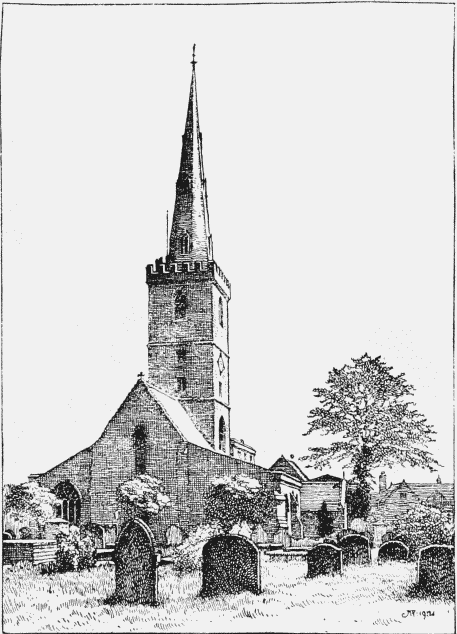
Halesowen Church from the West
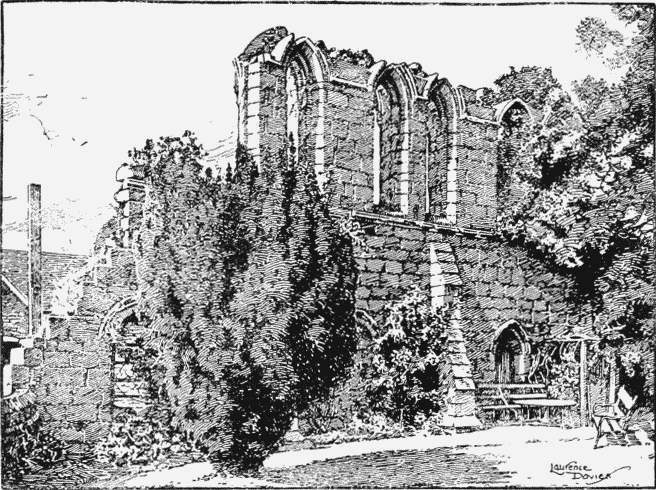
Halesowen Abbey: South Wall of Frater
To the south-east of the church is a two-story rectangular stone building of the latter part of the 13th century, though since that date it has been considerably altered. Its original use is uncertain, but it was probably the abbot's lodging. It is now used as a barn and is very dilapidated. Only a small part of the east end is now floored, the remainder being open to the roof.
From chases in the side walls the first floor appears to have been divided into two rooms. In the east wall is a two-light square-headed window lighting the first floor, an insertion of the 16th century. At the east end of the north and south walls, at the same level, are similar windows, now blocked, and remains of a third, on the north side. In the west end of the same wall are the remains of a blocked-up two-light 13th-century window. In the south wall, and corbelled out at the floor level, is the lower part of a fireplace, and built into the jamb is a fine red sandstone grave-slab of 13th-century date. Carved in the lower part of the slab, under a trefoiled arch, is the kneeling figure of an angel, with the indent for a metal plate held originally in the hands. Below the figure is an open book, while carved in the upper part of the slab is a rood with the figures of our Lady and St. John. To the west of the fireplace is a range of three two-light transomed windows now somewhat damaged. Below the transoms the lights are rebated for shutters. In the west end of the wall is a single pointed opening divided by a transom, but the inner stones only are original. The ground floor is lit by a 13th-century two-light window in the north wall and by three 16th-century windows in the south; one of these a single light, the others of two each. Most of these openings are now blocked. Built into the south wall about half-way along is a curious little stone panel (17 in. by 6 in.) carved with the full-length figure of a late 13th-century knight. The figure is in mail, with legs crossed and a long shield on the left side. In the extreme west end of the south wall is a small 13th-century pointed window restored externally. An original pointed doorway with a segmental rear arch occupies the centre of the west wall.
Externally a chamfered base originally ran round the building, while at the east end were two-stage angle buttresses, the northern one being now broken away.
The roof is in a very dilapidated condition, and is now covered with corrugated iron, though many of the timbers are original. It is steep pitched and of the trussed-rafter type, the principal trusses having king posts supporting a longitudinal tie.
The abbey received several visits from Edward III on his expendition into Wales in 1332. (fn. 24) There is a tradition that King John intended to go there, but turned back on seeing it from Romsley Hill, 3 miles away, because he had wished it to be built in so retired a place that it could not be seen at a distance of 2 miles. (fn. 25) In the Halesowen churchwardens' book there is a record of the payment of 3d. 'to the ringers when the Prince came to Hales' in 1490. (fn. 26)
Among the famous men who lived or were born at Halesowen are Adam Littleton the lexicographer, Benjamin Green the mezzotint engraver, and Amos Green the painter, who was probably his brother. William Caslon the typefounder was born at Cradley in 1692. Thomas Attwood the political reformer, called the 'Founder of Political Unions,' was born at Hawn House in 1783. He was the first representative in Parliament of the borough of Birmingham, and died in 1856. William Shenstone the poet was born at Halesowen in 1714, and was buried in Halesowen churchyard in 1763.
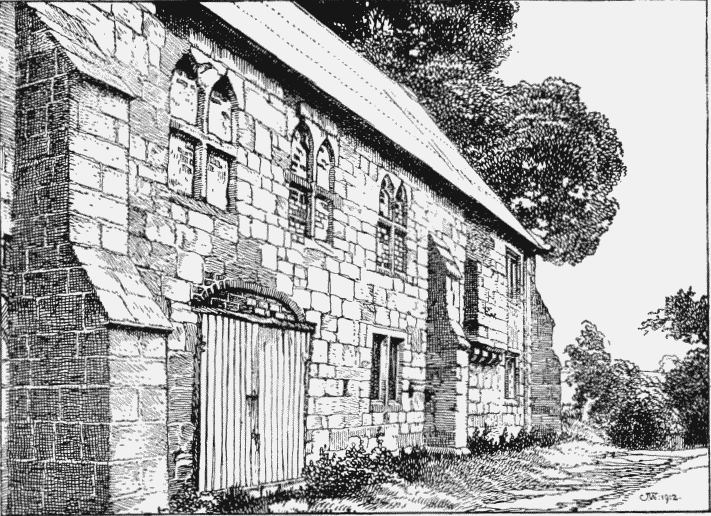
Halesowen Abbey: South Wall of the Abbot's Lodging
The numerous place-names which occur include la Hooly Welle, (fn. 27) Birimore, Cumbes, (fn. 28) Nonnemonnes Lydegate (fn. 29) (xiii cent.); Pendelston, (fn. 30) Trowesmarleput, (fn. 31) Haraldeswelle, (fn. 32) Le Beroplas, Le Wytepole Bridge, (fn. 33) Steynesplace (fn. 34) (xiv cent.); Berehall (fn. 35) (xv cent.); and Le Bretche or the Breach (fn. 36) (xvii cent.). Le Heyfield, also called Heythefeld, Le Hyefelde, Le Hyghefeld, is mentioned in several of the Lyttelton charters (fn. 37) in the 13th, 14th and 15th centuries.
BOROUGH
By the middle of the 13th century, although agriculture was still the chief employment of the men of Halesowen, other industries had already sprung up, as for example the making of cloth. Weavers are found in possession of plots of land, as Osbert and Hernald in the reign of Henry III, while dyers are frequently mentioned in the time of his successor. (fn. 38) Furthermore, a fulling-mill existed quite early, since Thomas the Skinner (fn. 39) (Pelliparius) wilfully drowned himself (gratis se submersit) in the 'Walkenmullenpol' in the later years of Edward I. Coal, again, was dug in Halesowen as early as at any place in Worcestershire, and certainly before the close of the 13th century. (fn. 40) It would have been naturally used by smiths for working up the iron smelted with charcoal at the local bloomeries. Great quantities of mediaeval scoriae have been found in the neighbourhood and either worked again or used for road metal. In 1304 Nicholas de [sic, le] Yrenmongere (fn. 41) witnessed a Halesowen deed. The rise of such an industrial element must have made for change and increased independence, and at some time in the 13th century Henry III allowed (fn. 42) the Abbot and convent of Hales to create a borough, centrally situated within their manor. The rent of each burgage was fixed at 12d., and the holders were to enjoy such of the liberties and free customs of Hereford as they should choose, (fn. 43) and in addition the local privilege of common of pasture throughout Hales Manor as well as in the wood which stretched from the new mill of the abbey to Chatley Ford. (fn. 44) Although the burgages thus created are often referred to in local deeds (fn. 45) from the 13th century onwards, and grants of burgess right on conditions of a money payment frequently found on the Court Rolls (fn. 46) of the borough, the burgesses of Halesowen seem to have enjoyed little real independence. At the eyre (fn. 47) of 1255–6 Halesowen appeared as a 'villata' separate from the hundred by a bailiff and twelve jurors. At later eyres the 'manor' of Halesowen appeared in similar fashion. No important development, however, can be traced in the borough organization, and, as far as we know from existing records, Halesowen never sent representatives to Parliament even in the reign of Edward I. But the constant quarrels (fn. 48) between the men of Halesowen and the abbot suggest that during the 13th century at least there was a certain amount of vitality in the borough and the foreign manor adjacent.
Among the Court Rolls of the manor which are still in existence there are found courts and great courts (fn. 49) of the hundred and courts of the borough of Hales. Very little difference can be detected between these courts and the ordinary manor courts, the same offences being dealt with and the same men acting as jurors. (fn. 50) The extant rolls of the hundred of Hales begin in 1272 (fn. 51) and those for the borough eo nomine in 1422. When the latter begin the former cease, so the jurisdiction of the two courts was probably identical.
The Court Rolls of the early 14th century show that the borough then possessed a high and low bailiff, (fn. 52) but little is known of its internal economy. The entries on the Court Rolls chiefly relate to pleas concerning land and the recovery of small debts. No one was allowed to exercise any trade in the town without obtaining licence from the abbot as lord of the borough. (fn. 53) Halesowen paid its subsidy in 1327–8 with the rest of the manors in the hundred of Brimstree, (fn. 54) and the fire which devastated the town about 1343 (fn. 55) may have put an end to efforts at self-government.
Nothing is known of the number of burgages which existed in the borough at its first foundation. In the valors of the abbey lands in 1291 and 1535 no mention is made of any rents from such tenements. In the latter survey 'Halesburg,' though it is valued separately from Halesowen, would appear to be merely a second manor producing rents of assize £16 15s. 9d., rents from demesne lands 45s. 10d., and amercements of court estimated at 10s. (fn. 56)
As 'the manor of Halesburgh,' what remained of the borough was granted in 1538 with the rest of the abbey lands to Sir John Dudley, (fn. 57) and it appears as the manor of Halesborough in all deeds concerning the manor of Halesowen, the descent of which it follows until 1666. In a survey of the manor of Halesowen, taken in 1601 after the attainder of John Lyttelton, the tenants holding burgages, only four in number, were returned with the free tenants of the manor of Halesowen. In two cases the yearly rents paid were 12d. and in the other cases 12½d. and 16d. (fn. 58)
Before this time, however, the men of Halesowen appear to have made some attempts to recover their burghal rights. Richard Burleton paid 10s. to Sir John Lyttelton in the time of Queen Elizabeth for the right to become a burgess of Halesowen, (fn. 59) and in 1608 a proclamation of the borough of Halesowen, after setting forth that 'wee the Bayliffe, burgesses and inhabytants of Halesowen have had a long tyme a small meeting on the Sabothe Day for the buying and selling of butter cheese and fruite which was not allonely merely repugnante and contrary to the woord of God but also to our Kinges Majesties Laws,' and that Mrs. Lyttelton, then lady of the manor, was displeased at this breaking of the Sabbath, requested the townspeople in future to bring their goods to the Monday market and the fair on St. Barnabas Day, (fn. 60) which had evidently fallen into disuse. (fn. 61) An order of 1572 in the borough court that 'no Inhabitant or Craftsman within the borough shall kepe open their Shop Windows from ye tyme they ring into Servyse until Servyse be done, and likewyse after they ring into Evening Prayer they shall not keep open the Shop windows until Servyse be done on pain of every Default 3s. 4d.,' (fn. 62) was evidently directed against this abuse, but had been ineffectual in stopping it.
At a court held at the same date it was ordered that 'no Person or Persons that brewe any weddyn Ale to sell shall brewe above twelve Strike of malt at the most and that the sayd Persons so marryed shall not kepe or have above eight Messe Persons at his Dinner within the Burrowe and before his Bridall Day he shall kepe no unlawfull Games in his House nor sell any ale or Beer in his House out of his House on Pain of 20s.' (fn. 63) Eight years later it was found necessary to make the further regulations that no one should keep bride ales unless they were approved by the high bailiff and five other 'most substantial persons,' and afterwards by the lord of the borough, that no one should brew or sell ale except on the day of the wedding and one day before and after, and that the ale should only be sold at the price charged by the victuallers of the borough, the fine for each offence being this time 40s. (fn. 64)
The renewed prosperity of the borough at this time did not result in a new charter of incorporation, and at the end of the 17th century the borough boundaries were a matter of tradition, being supposed to be certain crosses (fn. 65) at the limits of the town, and though the constable for the borough and those for the manor were still separate officers, apparently appointed at the courts of the borough and the manor respectively, their functions had to a certain extent become amalgamated and there was considerable difference of opinion as to whether the borough constable had power to act in the parish and vice versa. The confusion seems to have arisen from the fact that only one constable attended at the county sessions, usually the constable of the parish, (fn. 66) and was accepted both for the borough and the parish. Further confusion was probably caused by the union of the borough and the parish for the maintenance of the poor. The burgesses never seem to have admitted any obligation to repair roads outside the borough, though they sometimes did so voluntarily, and a former overseer of roads for the parish admitted that, though he had often required the inhabitants of the borough to join in mending the roads in the parish, he had never prevailed on them to do so. (fn. 67)
The chief officer of the town at that time was the high bailiff, and, though no mention has been found of any other officer but the constable until the end of the following century when Nash wrote his 'History of Worcestershire,' it is probable that, in addition to the high bailiff and constable, a low bailiff and victual taster, (fn. 68) two overseers of swine and two searchers and sealers of leather (fn. 69) existed at the earlier date. All these officers were elected yearly at the lord's court, (fn. 70) and those who had served the office of high bailiff were afterwards reputed aldermen. (fn. 71) The aldermen and high bailiff proclaimed the yearly fair on St. Barnabas Day and appeared at church on that occasion in their robes of office. (fn. 72) In 1822 the borough officers elected yearly at the court leet were the high and low bailiffs, a constable and head borough. (fn. 73) The high and low bailiffs were appointed at least as late as 1868, (fn. 74) but they had long ceased to exercise any magisterial function, if indeed they ever had done so. The borough court seems to have survived as a court of requests for the recovery of debts not exceeding 40s. until the middle of the 19th century. (fn. 75) The town is now governed by a rural district council of ten members.
The Abbot of Halesowen obtained from Henry III in 1220 licence to hold a market every week on Wednesdays and a fair lasting two days at the feast of St. Denis at Halesowen. (fn. 76) Three years later the date of the fair was altered to the feast of St. Kenelm (13 December). (fn. 77) It is probable that these fairs were granted before the constitution of the borough of Halesowen, but were afterwards looked upon as belonging to the borough. A grant in 1344 to the abbot and convent of a market weekly on Mondays and a fair for four days at the feast of St. Barnabas (11 June) (fn. 78) may have superseded the above. In this case the grant is specifically to the manor of Halesowen.
Owing to the declining prosperity of the borough the market and fair seem to have entirely fallen into disuse until they were revived by Mrs. Lyttelton in 1608 as mentioned above. In 1609 she obtained a confirmation of Edward III's grant of 1344, (fn. 79) and the Monday market day continued until the middle of the 19th century. (fn. 80) In 1868 the market day was Saturday, (fn. 81) and so continues. The fair of St. Barnabas probably survives in the Whitsun fair for horses, cattle, sheep and cheese. A pleasure fair has been held on Easter Monday since the early years of the 19th century. (fn. 82) Noake, writing in 1868, mentions a statute fair for the hiring of servants, held in October. (fn. 83)
A fair was still held at the feast of St. Kenelm in 1736, and took place in the chapel yard. Bishop Lyttelton, writing of it at that time, states that it was held by prescription and that there was no charter for it. (fn. 84) It was, however, probably a survival of the fair granted to the Abbot of Halesowen in 1223, or of that granted to Roger de Somery at Clent in 1253. (fn. 85)
MANORS
The manor of HALES, which belonged in the reign of Edward the Confessor to a certain Olwine, was among the lands granted after the Conquest to Roger Earl of Shrewsbury, (fn. 86) who, as before mentioned, annexed it to his county of Shropshire shortly after the date of the Domesday Survey. (fn. 87) It passed from Earl Roger to his two sons successively, Hugh, who died in 1098, and Robert de Belesme. On the forfeiture of the latter in 1102 it fell to the Crown. (fn. 88) Henry II gave it to his sister Emma, who had married David son of Owen Prince of Wales in 1174. (fn. 89) She restored it about 1193 to Richard I, who granted her in exchange rents amounting to its yearly value from this and other manors. (fn. 90) Emma was still holding the rents in 1202. (fn. 91) She left a son Owen, who is sometimes thought to have held the manor, owing to an entry in the Hundred Rolls, which states that King John had held it as an escheat from a certain Owen, (fn. 92) and to the addition of Owen to the name Hales. (fn. 93) In 1214 the king granted Halesowen to Peter des Roches, Bishop of Winchester, for the purpose of building and endowing a religious house, (fn. 94) and in the following year confirmed it to the Premonstratensian canons there. (fn. 95) In 1251 the abbot and convent received from Henry III a grant of free warren in the manor. (fn. 96)
Throughout the 13th and 14th centuries there were numerous disputes between the abbot and his tenants as to the services which the latter owed for their lands in the manor. About 1243 the tenants agreed that they owed the abbot merchet, suit at his mill, (fn. 97) unless it were manifestly out of repair, and six days' ploughing and six day's sowing in Lent, for each virgate of land. In return for this the abbot remitted 12½ marks tallage which they owed, and promised that they should only be tallaged when the men of the king's manors were, and that he would not enter into or in any way obstruct their common of pasture. (fn. 98) In spite of this agreement the quarrels still went on, (fn. 99) and about 1275 an inquisition was taken to ascertain what services and customs had been rendered when the manor belonged to King John. It was found that they had held their land of the king by payment of 40d. yearly for every 'yard land,' by suit of court, heriot (the best horse and half the goats, hogs and bees and all the cocks) and relief. The tenants did six days' ploughing and five days' sowing for each whole yard land and one extra day's sowing by grace for which they had a feast at the manor-house. They had the right of grinding their corn where they would, because the king had no mill. They owed 12s. merchet if their daughters were married within the manor and 2s. if without. (fn. 100)
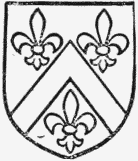
Halesowen Abbey. Azure a cheveron argent between three fleurs de lis or.
The abbot petitioned the king in 1278, stating that the men of Halesowen claiming to be of the ancient demesne (fn. 101) refused their customs and services, and prayed a remedy. (fn. 102) The result was a writ of quo warranto, in answer to which the abbot produced King John's charter and established his claim. (fn. 103) The disputes continued, however, until 1327, when the abbot commuted the services for a fixed rent. (fn. 104) In 1535 the abbot and convent received a revenue of £133 18s. 7¼d. from the manor of Halesowen with its hamlets. (fn. 105)
After the Dissolution Henry VIII granted the site of the abbey to Sir John Dudley, afterwards Duke of Northumberland. (fn. 106) While he held the manor he granted the 'mansion of the manor,' which was evidently what remained of the abbey, to his servant George Tuckey. (fn. 107)
After the Duke of Northumberland's attainder and execution in 1553 his widow Joan recovered Halesowen, (fn. 108) which had been settled on her in 1539. (fn. 109) She died in 1554–5, leaving the manor to trustees for the use of her three sons, who had been attainted for treason, Ambrose, the eldest, having the house and land to the value of £100. (fn. 110) Later in the same year Sir Ambrose Dudley (fn. 111) and his brother Sir Henry gave up their share to their younger brother Sir Robert Dudley, afterwards Earl of Leicester. (fn. 112) He appears to have settled it on his wife, the famous Amy Robsart, who with him conveyed the manor to Thomas Blount and George Tuckey in 1558. (fn. 113) In the same year Blount and Tuckey sold the manor to John Lyttelton, (fn. 114) and since that date it has followed the same descent as Hagley (fn. 115) (q.v.), Viscount Cobham being lord of the manor at the present day.
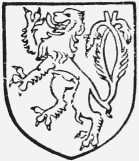
Dudley. Or a lion with a forked tail vert.
There is a list of the customs of the manor in 1817 among Prattinton's MSS. (fn. 116)
Court Rolls for the manor and borough of Halesowen are in the possession of Viscount Cobham at Hagley. (fn. 117)
When the possessions of the monastery of Halesowen were granted to Sir John Dudley a rent of £28 1s. 3d. yearly was reserved to the Crown. This was reduced to £20 in 1611, in consideration that part of the possessions of the monastery were no longer held by the Lytteltons. The £20 was paid to the Crown until 1650, when it was sold by order of Parliament. (fn. 118) On the Restoration it was restored to the king and settled on Queen Katherine in 1663–4. (fn. 119) Some years later an Act of Parliament was passed to enable the king to alienate fee-farm rents. (fn. 120) The purchaser of the rent from Halesowen is said to have been an ancestor of Sir Matthew Deeker, (fn. 121) to whose widow, Henrietta Deeker, the rent was paid in the time of Bishop Lyttelton. (fn. 122) It was finally purchased by Lord Lyttelton in the 19th century.
A park at Halesowen was made by the abbot and convent about 1290. (fn. 123) It was still in existence in 1601–2, and then contained some timber trees and firewood trees to the value of £40. (fn. 124)
There was no mill at Halesowen when the manor was granted to the abbot and convent, (fn. 125) but one seems to have been built very shortly afterwards.
In the reign of Henry III a Roger son of Roger the clerk of Hales gave the abbot certain lands in the parish with permission to erect a mill and mill pool, reserving to himself the rights of fishing in the overflow water and of having his corn ground in the mill without paying toll. (fn. 126)
The abbot had two mills worth 20s. a year in 1291, (fn. 127) and the new mill of Hales is mentioned in a Court Roll of 1293. (fn. 128) It was, however, burnt down in the same year. (fn. 129) In 1350 John de Peoleshal received licence to alienate to the abbot and convent three messuages and a mill in Halesowen, Oldbury and Warley. (fn. 130) These mills seem to have passed with the manor to the Lytteltons.
In 1672 there were, besides those belonging to the lord of the manor, three mills belonging to a certain Henry Haden, who had inherited two of them from his father. (fn. 131) These two are probably the 'Dalwyk Mulne' (fn. 132) and 'le new Mulne' mentioned in an account roll dated 1369–70. (fn. 133) Mills called Birds' Mill (Bruddesmulne), Abbeley Mill, Greet Mill and Blakeley Mill are frequently mentioned in the 14th century Court Rolls. (fn. 134)
Towards the end of the 18th century constables (fn. 135) were elected annually at the different courts for the manor of Halesowen, including all the Shropshire part of Halesowen except Oldbury, and for the manors of Cradley, Lutley and Warley Wigorn. Oldbury had its own constable, and third boroughs or deputy constables were elected yearly for each of the hamlets of Hawn and Hasbury, Hill, Ridgacre, Cakemore, Warley Salop, Lapal, Illey, Romsley and Hunnington. (fn. 136)
It seems to have been considered the duty of the Lytteltons to repair the Malt Mill and Cornbow bridges, which had only been needed since their mills had been built, the river having been formerly crossed by fords. In 1668–9 the bridges were in such bad repair that the constable prosecuted Sir Henry Lyttelton for refusing to restore them. (fn. 137)
In 1086 CRADLEY (Cradelie, xi cent.; Credelega, xiii cent.) formed part of the barony of Dudley, which belonged to William Fitz Ansculf. It was held of him by a certain Payn, who had succeeded the Saxon holder Wigar, (fn. 138) and, since no later underlord is mentioned, must have reverted to the barons of Dudley at an early date. It followed the same descent as the manor of Northfield (fn. 139) (q.v.) until the division of Joyce Burnell's estates between Maurice de Berkeley and Lady Joan Beauchamp took place in the middle of the 15th century. Cradley was then assigned with Northfield and Weoley (q.v.) to Maurice Berkeley, (fn. 140) but since Lady Beauchamp, who claimed some estate in Cradley, had previously settled it on her grandson James Butler Earl of Ormond and later Earl of Wiltshire, he afterwards successfully claimed it, and since then it has followed the same descent as Hagley (fn. 141) (q.v.), now belonging to Viscount Cobham.
In 1291 there was a capital messuage at Cradley worth 6d., one mill valued at 22s. and another at 12d. and mast in the park at 12d. (fn. 142)
The mill at Cradley is frequently mentioned in the Staffordshire Pipe Rolls. It yielded a rent of 3s. a year, which was granted about 1193 to Emma wife of David King of North Wales in part exchange for the manor of Halesowen. (fn. 143) Its first assessment was in 1179. (fn. 144) A mill still belonged to the manor in 1338. (fn. 145) It was perhaps this mill from which John Wall was ejected by Thomas Nevill, Joan his wife and others in 1599. (fn. 146) No mill at Cradley is actually mentioned in the survey of John Lyttelton's lands taken in the reign of Elizabeth, but a memorandum was made that Thomas Birch claimed the liberty of making a fish-pond or stank or 'damme head' for the pond called Birches Mill Pond by rendering yearly 2d. (fn. 147) Just before the Dissolution the Abbot and convent of Halesowen had altered the course of the stream which formed the boundary between Cradley and Rowley and between the counties of Staffordshire and Worcestershire, and on account of this alteration paid to the lord of Cradley 12d. and 1 lb. of wax yearly. (fn. 148) In 1535 the abbot was paying to the king 16s. 4d. yearly for the farm of the mill of Cradley. (fn. 149)
According to Bishop Lyttelton the park was still in existence in the reign of Henry VIII, (fn. 150) but it is not mentioned in the survey taken in the reign of Elizabeth. Nash mentions that ruins of a manor-house with a moat existed on the estate called Cradley Park in his time, but were then much overgrown with wood. (fn. 151) Near these ruins was a field called Chapel Leasow, where tradition says there was once a chapel. The rectory and advowson of Cradley were included in the grant of Halesowen Abbey to Sir John Dudley in 1538, (fn. 152) so the mansion and chapel may perhaps have been on the abbot's estate at Cradley. (fn. 153) The chapel seems to have disappeared shortly after the Dissolution.
In 1535 the Abbot and convent of Halesowen were in receipt of rents amounting to 40s. from an estate in Cradley. It was probably held of the capital manor of Cradley, for a rent of 15d. was paid by the convent to 'Master Seleng' (fn. 154) (Saint Leger). This estate, which probably formed part of the manor of Halesowen, was granted as 'the manor of Cradley' to Sir John Dudley in 1538. (fn. 155) It is mentioned as a separate manor in 1556–7, (fn. 156) but evidently became incorporated with Halesowen shortly afterwards.
The manor of LUTLEY (Ludeleia, xi cent.; Lodleleye, xiv cent.; Ludley, xvii cent.) was perhaps granted by the Saxon lady Wulfrun in 996 to the college which she endowed at Woiverhampton, though it is not mentioned in the foundation charter. (fn. 157) At the time of the Domesday Survey the monastery was in the hands of secular canons of Wolverhampton, who were holding Lutley. (fn. 158) From 1086 until 1610 there is nothing to prove that the college continued to hold Lutley. At the later date the Dean of Wolverhampton granted a lease of the deanery to Sir Walter Levison, and tenements at Lutley were then included in the possessions of the deanery. (fn. 159) It is therefore probable that Lutley was granted with the college by Edward VI to John Duke of Northumberland. (fn. 160) The college was re-founded in 1553 by Queen Mary, who restored to the Dean and Prebendaries of Wolverhampton all their property, (fn. 161) which must have included Lutley, as it was in the possession of the dean in Nash's time. (fn. 162)
Under the Wolverhampton Rectory Act (fn. 163) of 1848 the college of Wolverhampton was dissolved and its estates vested in the Ecclesiastical Commissioners, (fn. 164) who were authorized in 1849 to sell the property belonging to the dean. (fn. 165) It is not known that Lutley was ever sold, and the manor is now extinct.
Lutley was held during the 18th century by the Earl of Bradford's family on lease from the Dean and Prebendaries of Wolverhampton. (fn. 166) It does not appear that there was ever a manor-house there. (fn. 167)
The monastery of Halesowen was receiving rents amounting to 26s. 8d. from an estate at Lutley at the time of the dissolution of their house. (fn. 168) It probably formed part of the manor of Halesowen, and was granted with it in 1538 to Sir John Dudley. (fn. 169)
The manor of OLDBURY (Aldeberia, xii cent.) was a member of the manor of Halesowen. (fn. 170) It evidently passed with Halesowen to the Crown in 1102, and from 1166 (fn. 171) to 1173 (fn. 172) the sum of 26s. 8d. was paid into the Exchequer from the farm of Oldbury. It was probably granted with Halesowen to the abbey of Halesowen, for the vill appeared at the courts of that manor from the time of Henry III. (fn. 173) Indeed, it is not described as a manor until 1557, (fn. 174) when Sir Robert Dudley settled it on himself and Amy his wife, with reversion to her right heirs, Arthur Robsart (fn. 175) being one of the trustees. The latter seems to have succeeded to Oldbury on Amy Dudley's death, (fn. 176) and had manorial rights, including frankpledge, there in 1573, when he settled it on his son Robert. (fn. 177) Robert died during his father's lifetime, leaving a son George, who in 1610 sold the reversion of Oldbury after Arthur Robsart's death to William Turton. (fn. 178) After Arthur's death George repented of the sale, and it was finally decided that certain messuages in the manor should belong to Turton, while the manor itself was settled on George and his wife Anne and their son Arthur. (fn. 179) In 1633 Arthur Robsart and William Turton, son and successor of the above-mentioned William, sold it to Charles Cornwallis, (fn. 180) who held courts there in 1648. (fn. 181) He left two daughters, Anne wife of Anthony Mingay and Frances wife of William Fetherston, (fn. 182) the latter of whom finally succeeded to the whole of Oldbury. (fn. 183) From her it passed to her daughter Anne wife of William Addington, (fn. 184) who also left two daughters, Frances wife of Christopher Wright and Anne wife of Richard Grimshaw. Anne's son sold his share of Oldbury to Christopher Wright. (fn. 185) The latter was holding it in Nash's time. (fn. 186) He married as a second wife the widow of Richard Parrot of Hawkesbury, near Coventry. (fn. 187) The manor of Oldbury afterwards seems to have passed to the relatives of his second wife, for Francis Parrot of Hawkesbury Hall was lord of the manor in 1829. (fn. 188) His daughter Elizabeth married Major John Fraser of Hospital Field, Arbroath, and Oldbury passed from them to their daughter Elizabeth wife of Patrick Allan. (fn. 189) The latter assumed the additional surname of Fraser in 1851, (fn. 190) and Oldbury is now in the hands of the trustees of his will. Courts leet and baron are still held every year.
LANGLEY, which went by the name of WALLEXHALL (Wallokeshale, xiv cent.) alias Langley Wallexhall alias Langley and Wallexhall, and is described as a manor in the 16th and 17th centuries, has descended with Oldbury since the Dissolution. Before that date it apparently formed part of Oldbury. (fn. 191)
ROMSLEY (Rommesley, xiv cent.) may perhaps be identified with the hide and a half in the manor of Halesowen which was held in 1086 of Earl Roger by Roger the Huntsman. (fn. 192) Since the 12th century it seems to have followed the same descent as Halesowen (fn. 193) and now belongs to Viscount Cobham. At the eyre of 1291–2 it was returned that Stephen de Asherug had held Romsley, Hampstead and Hazelbury (now Hasbury) by serjeanty of finding three foot soldiers for the king's army, one with a lance and two with bows and arrows, for forty days. These manors the Abbot of Halesowen then held, and for them he refused to render any service. The abbot, however, stated that he held the whole of the manor of Halesowen, of which these manors formed part, (fn. 194) free of all secular services, according to his foundation charter. (fn. 195) Romsley was, however, a separate manor, and its Court Rolls from 1277 for about 400 years are in the possession of Viscount Cobham. The Romsley rolls are sometimes written on the backs of the Halesowen rolls. (fn. 196)
From the time of Edward I to the 16th century occasional mention occurs of a hamlet in Romsley called KENELMSTOWE or Kelmystowe (fn. 197) which must have grown up round the chapel of St. Kenelm. In 1279 Kenelmstowe was evidently in the manor of Halesowen. (fn. 198) In a deed of 1462–3 'Kelmystowe' is said to be in the parish of Clent, (fn. 199) and in the reign of Queen Elizabeth it also appears to have been, partly at least, in Clent. (fn. 200) The truth appears to be that the hamlet lay partly in Clent and partly in Romsley. An inn called the 'Red Cow' at Kenelmstowe owed its name to the legend of the finding of St. Kenelm's body by a cow grazing in a meadow under Clent Hill, and its prosperity to the pilgrims visiting the shrine of St. Kenelm. It was probably this inn which as hospitium Sancti Kenelmi was rated at £5 in the rental of Romsley Manor in 1499. (fn. 201) It was leased by Lord Robert Dudley in 1556–7 to Richard Harris under the name of 'a mansion in Romsley near unto St. Kenelm's commonly called the sign of the red Cow.' (fn. 202) At the Reformation the pilgrimages to St. Kenelm's chapel ceased and the value of the inn declined. (fn. 203) The hamlet has now almost entirely disappeared.
The manor of WARLEY WIGORN (Werwelie, xi cent.; Wervelegh, Wervesley, xiii cent.; Wervelegh, xiv cent.), which had been held by Æthelward before the Conquest, belonged to William Fitz Ansculf at the time of the Domesday Survey, (fn. 204) and the fee formed part of the barony of Dudley (q.v.) until the death of John de Somery, without issue, in 1321. (fn. 205) This fee is not mentioned in the division of John de Somery's lands in 1323, and was evidently held jointly by his co-heirs, for when Richard de Fokerham granted the manor to Lady Joan Botetourt a moiety was said to be held of her and the other moiety of John de Sutton. (fn. 206) The overlordship seems to have lapsed when the manor was given to the abbey of Halesowen. (fn. 207)
Under these overlords the manor was held by knight's service. (fn. 208) In 1086 a certain Alelm held the manor, (fn. 209) and about the middle of the 13th century Margaret de Somery was holding it. (fn. 210) It afterwards passed to the Fokerhams, land at Warley being granted in 1276–7 by William de Fokerham and his wife Basil to Richard de Fokerham. (fn. 211) Richard died about 1289, and was succeeded by his son William, (fn. 212) who granted the manor of Warley with the chantry of Brendhall in 1309 to his son Richard. (fn. 213) Richard in 1320–1 conveyed the manor called Brendhall, which seems to have been identical with that of Warley, to his overlord John de Somery. (fn. 214) In 1337 Richard de Fokerham granted the manor of Warley to Lady Joan Botetourt, (fn. 215) younger sister and co-heir of John de Somery, and in the same year she granted it to the Abbot and convent of Halesowen on condition that they should find three canons to celebrate divine service in the abbey church and distribute 20s. to the poor on her anniversary. (fn. 216) In the same year John de Sutton, (fn. 217) who had married Margaret, the elder sister of John de Somery, quitclaimed his right in the manor, in return for which the abbot and convent promised him 'full participation in their prayers and spiritual benefits,' and when he died the same 'benefits' as an abbot. (fn. 218) Richard de Fokerham also confirmed the gift, (fn. 219) and in the same year received a grant of the manor for life from the abbot. (fn. 220)
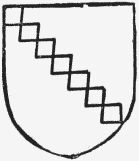
Fokerham. Or a bend indented azure.
At the Dissolution the abbot's estate at Warley was valued at £4 14s. 8d. (fn. 221) It was granted with Halesowen to Sir John Dudley in 1538, (fn. 222) and has since followed the same descent as Halesowen (fn. 223) (q.v.).
Brendhall, the capital messuage of this manor, the moat farm and other lands, and chief rents were sold by George Lord Lyttelton in 1772 to Mr. Robert Glover. (fn. 224) In 1485–6 the lord of the manor granted to William Hadley 'the manor called le Fotherhal de Wearley,' the waters of the moat and the fishery in it being reserved by the lord. (fn. 225) From the mention of the moat it may be inferred that Fotherhal was the moat farm mentioned above.
In the beginning of the reign of Charles I a Gilbert de Warley and Jane seem to have held the manor for a time, probably as lesses of the Lytteltons. (fn. 226)
Besides their manor of Halesowen the abbot and convent also had in the parish the granges of Blakeley in Oldbury, Owley in Lapal, Radewall in Ridgacre, Offmoor, Farley, Hamstead, Home Grange, New Grange and Warley Salop. (fn. 227) One carucate of land at Blakeley valued at 10s. belonged to the abbey in 1291. (fn. 228) Leases of the grange occur in 1329 (fn. 229) and 1343, (fn. 230) one including a water-mill. In 1340 the lessee was John Huwet of Rowley, who in that year obtained licence to have mass celebrated in his chapel of Blakeley Grange. (fn. 231) Owley Grange, the first mention of which occurs in 1415, (fn. 232) was leased in 1533 by the name of the manor of Owley Grange to William Geste and Elizabeth his wife for 8 marks yearly. (fn. 233) It is wrongly said to have been one of the hiding-places of Charles II after the battle of Worcester. It belonged in 1680–1 to William Quest. (fn. 234)
Farley, Offmoor, Hamstead and Radewall Granges, Home Grange and New Grange belonged to the abbot and convent in 1291, (fn. 235) when Farley consisted of 2 carucates of land each worth 10s., Offmoor of 1 carucate, worth 1 mark, and Radewall of 1 carucate, worth 10s. (fn. 236) In the reign of Henry VII Radewall was let for 4 marks. (fn. 237)
Helle Grange was included in the grant of Halesowen Abbey to Sir John Dudley, (fn. 238) and descended in the same way as the manor of Halesowen, being last mentioned in 1598–9. (fn. 239)