
A History of the County of Worcester: Volume 3. Originally published by Victoria County History, London, 1913.
This free content was digitised by double rekeying. All rights reserved.
'Halesowen: Churches and charities', in A History of the County of Worcester: Volume 3, (London, 1913) pp. 146-153. British History Online https://www.british-history.ac.uk/vch/worcs/vol3/pp146-153 [accessed 8 May 2024]
In this section
CHURCHES
The church of ST. JOHN BAPTIST consists of a chancel 29 ft. by 16 ft. 6 in., with vestry and organ chamber on the north, north chapel 16 ft. by 14 ft., south chapel 28 ft. 6 in. by 22 ft., nave, including the central tower, 85 ft. in length by 18 ft. at the east and 17 ft. 6 in. at the west, central tower dividing the nave into two portions 14 ft. 6 in. by 13 ft. 6 in., north aisle 14 ft. 9 in. wide, south aisle 21 ft. wide, with a modern addition at the south-east and a south porch. These measurements are all internal.
The earliest part of the present church is the short section of wall on the north side of the chancel containing a lancet window, parts of the east wall, and a portion of the walling joining the eastern respond on the south side. These represent the chancel of a church of about 1120, some 16½ ft. wide. Further remains of this church are to be found west of the central tower, where two bays of an arcade and a west wall are of a slightly later date.
The chancel arch, though almost entirely rebuilt, represents the eastern arch of the 12th-century central tower, and, from the spacing of the remaining original bays at the west end, the early nave must have been five bays long. The existence of a transept with eastern chapels is indicated by the remains of 12th-century arches to the north and south of the present chancel arch, and the pilaster buttresses at the west end of the present north aisle prove that the 12th-century aisle was about 11½ ft. wide. The early church was thus a large cruciform building, about 117 ft. long, with north and south aisles, transepts with eastern chapels, and central tower. The work was begun at the east end, but took long to complete, and the west door would hardly have been finished before 1200.
In the 14th century the south aisle was widened, its present width of about 21 ft. being probably the depth of the old transept then removed. It is not unlikely that the aisle was then carried on to the east end of the chancel by the insertion of two bays of arcading. At the end of the 14th or early in the 15th century the central tower was removed. It may possibly have fallen at that time and caused the partial ruin of the nave. Only the eastern arch of the old tower was suffered to remain, and, starting from this point, two bays of nave arcading were erected with the evident intention of subsequently building a west tower.
At the same time the north aisle was widened to its present size, 14¾ ft., and the north transept removed. Towards the end of the century the original idea of a western tower was abandoned and the present structure built half-way down the nave, leaving two bays only standing of the original 12th-century arcade, to the west of it.
A chapel dedicated to St. Katherine was next formed by extending the north aisle eastward to the wall of a vestry which was in existence on the site of the present one. A large window was inserted and an elaborate stair was built, in the north wall, to the rood-loft, which extended across the nave and both aisles.
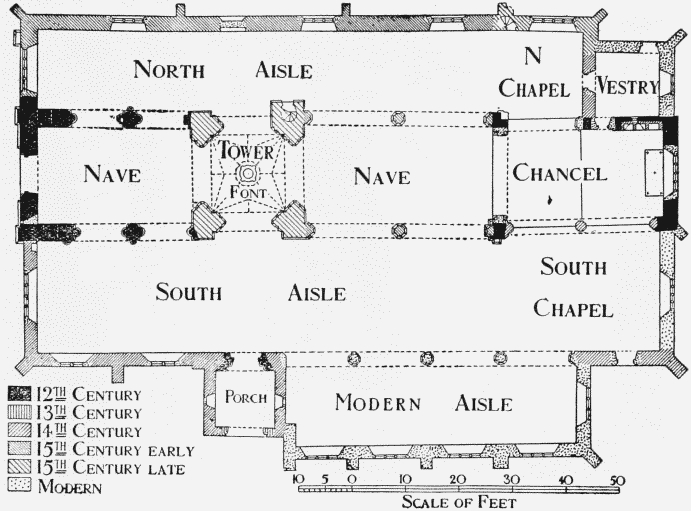
Plan of Halesowen Church
The last important piece of work was the addition, after 1500, of a clearstory and a new roof to the nave, the line of the earlier roof being still visible on the tower wall. In modern times the church has been considerably restored and repaired, the north vestry rebuilt and a second aisle added on the south side.
The east window of the chancel is modern, of four lights, in 14th-century style. Above the window is the line of a round arch from wall to wall, which, together with the difference between the upper and lower masonry in the side walls of the chancel, proves the existence of a 12th-century barrel vault over the chancel. In the gable is a small circular light in a square reveal, considerably repaired.
In the north wall are three shallow niches 5 ft. high, probably lockers, and above is an early 12th-century window with deeply splayed reveal. The head and rear arch are round, the latter showing traces of painting on the plaster. Beyond this window is a break in the masonry, and the small rubble work on the upper wall, which was above the vaulting, here changes to later ashlar. West of the modern vestry is the organ chamber opening from the chancel by a modern arch.
On the south side of the chancel is an arcade of two bays with pointed arches, probably of 14th-century date, of two chamfered orders resting on octagonal piers with capitals but no bases. The chancel arch has been greatly altered, and only portions of it appear to be the actual 12th-century work.
The first two bays on each side of the nave are of 15th-century date with two-centred arches of two orders. Above is a clearstory with three similar windows on each side, of two lights, under square heads.
The tower arches are of the same type as the nave arcade, but later, and have small capitals resembling a string-course which runs round the responds.
On the north side of the north-east pier of the tower is a door leading to the vice, and above it is a piece of old bell framing with the churchwardens' names for 1774. There is also an achievement of the royal arms. West of the tower are two bays of arcading of about 1150. Above the western respond on the north side is a round-headed opening, with traces of a corresponding one on the south side, these leading originally to a 12th-century gallery across the west end, which was approached by a stair in the south-west angle, now hidden. The west wall has three offsets, and is pierced by a large single lancet, below which is the west door with a round head of two zigzag orders. Its jambs are shafted and have moulded abaci and scalloped capitals.
The east wall of the north aisle has been much repaired, but shows the join where it met the early vestry. The first north window is later and more elaborate than the rest, and is of four lights with a transom and late 15th-century tracery (most of which has been renewed) and a crocketed label. The three remaining windows in the north wall date from the 15th century, with a blocked north door between the second and third. The west window of the aisle has four lights. The tracery of these windows is for the most part modern, but the jambs are old.
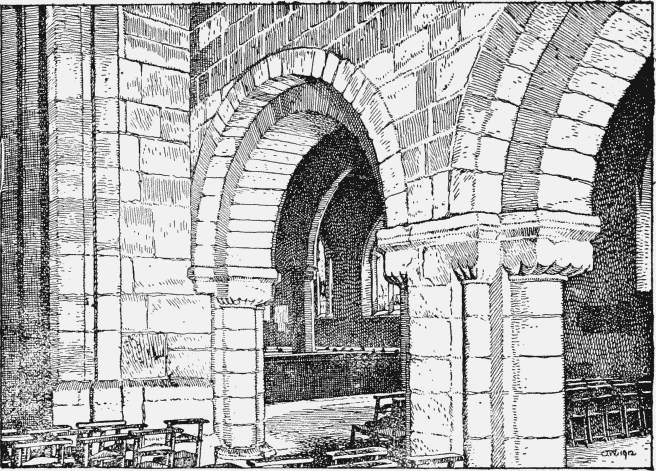
Halesowen Church: West End of the Nave showing 12th-century Arcade
On the north side of the chancel arch is some broken masonry connected with the original transept and a later image bracket.
In the south aisle the east wall and window have been rebuilt in modern times. On the south side of the chancel arch is the offset of the original south transept, and at the point where the respond of the new 15th-century arcade was built against the chancel arch there is a straight joint. Breaks are also visible where the tower was built up to this arcade and where it meets the 12th-century work to the west. The second south aisle, with its arcade of four bays, was built in 1875. At the west end of this aisle is a porch with south door opening into the inner aisle. The doorway, which is reset 12th-century work, has a semicircular head, and is of three orders—one plain, one zigzag and one moulded—carried on double shafted jambs. Inserted in the porch walls are corbels with grotesque heads and beasts. On each side are small trefoiled lights. The external doorway is of 13th-century date. West of the door are two two-light windows with unusually wide splays and modern tracery. The west wall has a four-light window, and north of it a round-headed rebated recess in the wall.
The lofty tower shows externally three stages above the roofs. The lowest has on the north and south a three-light window of the 15th century. The second stage has square-headed two-light windows and a clock.
The belfry windows have two lights with 15th-century tracery and transoms with sub-cusping. The embattled parapet is modern.
The spire has three tiers of windows, all with foliated finials above.
On the exterior the east chancel wall has been much patched, but parts of the east window seem to be old. Above it is a much restored 12th-century wall arcade of eight bays, consisting of round inter lacing arches with cushion capitals, shafts and bases.
The north aisle has a gargoyle at the north-east angle; the rood-loft stair is carried on corbels showing externally, and has a small trefoiled light with a foliated canopy.
At the western end of the nave on each side of the doorway are 12th-century pilaster buttresses and a plinth. On the western end of the north aisle is a 12th-century buttress, which is one of those at the north-west angle of the original church.
The interesting 12th-century font standing under the tower has a rounded bowl with a circular central shaft and four angle shafts with scalloped capitals. Round the bowl are four figures, much worn, which seem to represent our Lady, a king, a queen, and a priest holding a book, with interlaced strapwork between the figures. The roofs and furniture of the church are all modern. Among the monuments are a brass with the remains of an effigy to Rebekah wife of Thomas Littleton, rector, who died in 1669, an urn inscribed to the poet William Shenstone, who died in 1763, and a monument to Major Halliday (1794), by G. Banks, R.A.
There is a ring of eight bells: the first and sixth by John Warner of London, 1864, the second by Thomas Lester of London, 1753; the rest were cast by Joseph Smith of Edgbaston in 1707. On the fifth is 'Be it known to all, that doth me see that Ios. Smith in Edgbaston made all wee'; on the tenor: 'When sound of bell doth pearce your eare come to the church, God's Word to heare, my mournful sound doth warning give that here men cannot allwayes live.'
The plate consists of two chalices inscribed with the names of Francis Pierci, rector, and the churchwardens, 1684, and made two years previously, one large ancient flat paten (unmarked, but seems to be silver), a small flat paten of 1799, a modern silver flagon and a silver almsdish of 1730.
The registers before 1812 are as follows: (i) all entries 1559 to 1620, but leaves are missing from 1601 to 1609 and elsewhere; (ii) 1620 to 1643, these two volumes having been re-bound (from 1643 to 1653 there is apparently a Civil War gap); (iii) baptisms 1661 to 1664, births 1653 to 1660, and burials and marriages 1653 to 1664; (iv) all entries 1665 to 1686; (v) 1687 to 1699; (vi) 1700 to 1716; (vii) 1717 to 1736; (viii) baptisms and burials 1736 to 1761 and marriages 1736 to 1754; (ix) marriages 1754 to 1762; (x) baptisms and burials 1761 to 1812; (xi) marriages 1762 to 1770; (xii) marriages 1770 to 1772; (xiii) marriages 1772 to 1783; (xiv) marriages 1783 to 1803; (xv) marriages 1804 to 1812.
The chapel of ST. KENELM lies in a picturesque hollow on the north-east slope of the Clent Hills. The stream which runs in the hollow below the church is fed by a spring which, according to tradition, rose on the spot where the body of Kenelm, murdered in 819, was found. A chamber, now filled with rubbish, below the east end of the chapel represents the shrine over the spring, which was much frequented by pilgrims. (fn. 1) The chapel consists of a continuous chancel and nave 46 ft. by 19 ft. wide, a space under the west tower, which projects over the nave, 18 ft. by 14 ft. wide, and a wooden south porch. These measurements are all internal.
The present north and south walls and the base of the tower, all built of red sandstone, are of 12th-century date. The east wall of the chancel was rebuilt in the 14th century, and the beautiful tower was added in the 15th century, a greenish sandstone being employed.
The interior of the chapel is uninteresting, being mostly modern. The walls are plastered and there are a modern roof and a large west gallery. On the south wall are the remains of rood screen corbels.
Externally the angles and gable of the east wall have 15th-century pinnacles. The three-light east window is modern and below it is an arched recess or doorway, which has had a wooden pentice over it. The entrance, which is now blocked, seems to have led to the well shrine.
In the north wall the first window is a 14th-century lancet, and west of it is the jamb of a 12th-century light. Further west is a 12th-century pilaster buttress, the lower part being cut away for a 14th-century segmental archway, a feature repeated in the south wall. These were probably provided with steps leading down to the well under the chancel.
Of the two remaining windows on this side, the first, of two lights with a square head, is late 13th-century work, the second is modern. Two early buttresses remain, in one of which is a blocked 12th-century window, the other being a clasping buttress at the north-west angle. The plain 14th-century door is built within an earlier door of the 12th century. The tower wall sets back 1¼ ft. from the nave. The lower part of the tower, which is set astride of the west wall of the nave, is 12th-century work and has a plinth with wide flat angle buttress on the north-west. Over this is a 15th-century buttress with a modern pinnacle and one of the remarkable winged gargoyles which are repeated on the kneelers, angle buttresses, and window label at the west end.
Inside the west face of the tower is a large arched recess inclosing the modern west window, and a blocked round-headed door, which, though restored, represents the early west doorway. Above this the tower rises in two stages with diagonal buttresses. The lower stage has a large gargoyle on each buttress and the upper has a small belfry window in each face with rich crocketed canopy. Niches of similar type flank the belfry lights and are repeated on the buttresses. The embattled parapet has modern angle pinnacles and a line of trefoiled panelling below. The angle buttresses are terminated by smaller gargoyles of the type already noticed. Several of these gargoyles appear to represent butterflies.
The light but rich tower and the quaintly designed west end are very effective.
With the exception of a two-light 14th-century opening at the east end, all the windows in the south wall are modern restorations. Built into the wall is a small 12th-century figure of a priest in chasuble, stole and alb, a book in the left hand, and the right raised in benediction.
The 12th-century south door has a carved tympanum representing our Lord in glory with angels on each side. The arch has two orders, the outer with rays and fillets, the inner with beak heads. The side shafts appear to have been re-dressed. The porch is a 15th-century structure, with a four-centred outer arch of wood and a projecting cornice above, with plaster work and an embattled beam.
There is one bell, by Joseph Smith of Edgbaston, dated 1724.
The plate includes a curious cup of hammered silver with the hall mark of 1592, a silver paten with the hall mark of 1750, and an alms basin of repoussé work, possibly made in the early years of the 18th century. The flagon is plated.
The registers before 1812 are as follows: (i) baptisms and burials 1736 to 1783; (ii) baptisms 1783 to 1819. The second book contains also baptisms and burials of Frankley, 1813 to 1819.
ADVOWSONS
A church and two priests at Halesowen are mentioned in the Domesday Survey. (fn. 2) Possibly the second priest served the chapel of St. Kenelm, which is assumed to have been in existence at that time. The advowson belonged to the lord of the manor, and, while it was in the hands of David son of Owen, he, with the consent of Emma his wife, gave it to the Abbot of Pershore, who, however, restored it to King John in 1199. (fn. 3) It was included in the foundation charter of Halesowen Abbey in 1214. (fn. 4) The church seems to have been appropriated to the abbey about 1270, a vicarage being ordained in that year, (fn. 5) but the appropriation did not receive papal sanction until 1281. (fn. 6) The advowson belonged to the abbey until the Dissolution, (fn. 7) and was granted in 1538, with the rectory, to Sir John Dudley. (fn. 8) It has since followed the same descent as the manor, (fn. 9) Viscount Cobham being the present patron.
In 1291 and 1427 the church was taxed at £26 13s. 4d., (fn. 10) and in 1535 the rectory was valued at £8 2s. 8d. (fn. 11)
In January 1864 a rearrangement of the tithes was made between Lord Lyttelton, the lay impropriator, and the incumbents of the three parishes of Halesowen, Quinton and St. Kenelm's. (fn. 12) Great tithes to the value of about £100 a year were conveyed to the clergy, Lord Lyttelton's estates being rendered tithe free. (fn. 13) Halesowen was constituted a rectory in 1866. (fn. 14)
The chapel of St. Kenelm in Romsley is not mentioned in the Domesday Survey, but may possibly have been served by one of the two priests at Halesowen. (fn. 15) In 1448 an indulgence was granted for the repair of the chapel, (fn. 16) and in 1473 the abbot and convent obtained licence to acquire lands worth £10 yearly for the maintenance of a chaplain. (fn. 17) The oblations offered at the chapel were valued at £10 in 1535. (fn. 18) The chapel was granted with Halesowen to Sir John Dudley, (fn. 19) the advowson belonging to the lords of Halesowen until 1866. (fn. 20) John Lyttelton and his successors held it as a free chapel in no way dependent on the church of Halesowen, (fn. 21) and his chaplains received no institution from the bishop. The stipend of the curate was formerly only £5, but in 1675 Sir Henry Lyttelton settled upon the curate and his successors, in lieu of this stipend, all the great tithes of Romsley. (fn. 22)
In 1841 St. Kenelm's was formed into a separate ecclesiastical parish, (fn. 23) and in 1863 the greater part of the township of Hunnington was added to it. (fn. 24) In the following year, as mentioned above, part of the tithes of Halesowen were assigned to St. Kenelm's, (fn. 25) and in 1866 the parish was constituted a rectory. (fn. 26) It subsequently became known as the parish of Romsley. The rectory is now in the gift of the rector of Halesowen.
As mentioned above, (fn. 27) the chapel of Cradley seems to have disappeared shortly after the Dissolution. The ecclesiastical parish of Cradley was formed in 1841. (fn. 28) The present church of St. Peter was built by Thomas Best, clerk, and others in 1789, and was acquired from them in 1798, when the chapel was consecrated by the Bishop of Worcester. The patronage was secured to Thomas Best for three turns, and was then to pass to the Lytteltons. (fn. 29) The living is now a vicarage in the gift of the rector of Halesowen. The register begins in 1785.
A chapel at Oldbury was built in 1529 because during the winter and in the time of floods it was impossible for the inhabitants of Oldbury to attend the parish church. (fn. 30) It seems to have stood on copyhold land, since in 1574 William Feldon alias Carpenter made an agreement with Arthur Robsart and others that he would make no claim under any copy of court roll or other writing to the chapel croft except 'to hear God's service.' (fn. 31) The advowson was claimed by the patron of Halesowen, Oldbury being a chapelry of Halesowen, (fn. 32) but the presentations were probably irregularly made, and, according to Nash, the chapel came into the hands of Dissenters after the Revolution. The vicar of Halesowen reported in 1705 that the chapel of Oldbury was unendowed, and then served by nonconforming ministers, (fn. 33) but it was later taken over by Bishop Lloyd (1699–1717), who consecrated the chapel and cemetery. (fn. 34) The patronage was vested in the vicar of Halesowen in 1781, (fn. 35) but was said to have been in the Crown in 1808 and 1833. (fn. 36)
When the common of Oldbury was inclosed in 1829 it was arranged that half the proceeds of the sale of the inclosed lands should be assigned to building a new church at Oldbury, as the existing chapel was quite inadequat owing to the increasing population. (fn. 37) A new church, Christ Church, was built in 1841, and the patronage was vested in the vicars, afterwards the rectors, of Halesowen. (fn. 38) When the new diocese of Birmingham was formed in 1905 Oldbury was transferred to it, and the patronage vested in the bishop.
Oldbury was formed into a separate ecclesiastical parish in 1841, (fn. 39) and Langley was separated from it in 1846 and formed, with part of Halesowen, into an ecclesiastical parish. (fn. 40) The church of Holy Trinity, Langley, which was built in 1852, was formerly the parish church, but is now a chapel of ease to the church of St. Michael and All Angels erected in 1890–1. The living is a vicarage in the gift of the Crown and the bishop alternately. At Churchbridge is the chapel of ease of the Good Shepherd, built 1899.
A second ecclesiastical parish, that of Round's Green, was formed from Oldbury in 1905 with its church of St. James, built in 1892. The living is an incumbency in the gift of the vicar of Langley. (fn. 41)
The ecclesiastical parish of Quinton was formed in 1841, (fn. 42) and Christ Church was built in that year. It, like St. Kenelm's, became a rectory in 1866, (fn. 43) having had a portion of the tithes of Halesowen assigned to it in 1864. (fn. 44) Parts of Hill and Lapal were transferred to it from Halesowen in 1863. (fn. 45) The rectory is now in the gift of the Bishop of Birmingham. The parish includes Warley Salop and Warley Wigorn, which in 1884 were united under the name of Warley. A new ecclesiastical district of St. Hilda, Warley Woods, was formed in 1906 (fn. 46) and is served by a curate in charge. Blackheath was formed out of Quinton, Halesowen and Rowley Regis in 1869, (fn. 47) and is a vicarage in the gift of the Bishop of Worcester. The church of St. Paul was built in the same year.
The advowson and rectory of the church of Lutley were included in the grant of Halesowen Abbey to Sir John Dudley in 1538. (fn. 48) The advowson and rectory are mentioned again in 1590–1, (fn. 49) but from that time they disappear.
In 1339 the bishop gave licence to a certain John de Honesworth to have divine service celebrated in his house of 'Walbrok' in the parish of Halesowen. (fn. 50)
In 1309 William Fokerham, lord of Warley Wigorn, gave his son Richard the chantry of Brendhall, belonging to the chapel of St. Katherine the Virgin. (fn. 51) In a rental of Halesowen Abbey of 1499–1500 a sum of 43s. 4d. was received from Margery Westwood for Warley Grange next the chapel of St. Michael. (fn. 52) This seems to indicate a second chapel at Warley. It is perhaps to be identified with the church of Warley, of which the advowson and rectory were included in the grant of Halesowen Abbey to Sir John Dudley in 1538. (fn. 53) No further mention of it has been found.
Nash (fn. 54) gives some interesting extracts from the churchwardens' books of Halesowen. (fn. 55) These show that there was a chancel dedicated in honour of St. Katherine and an image of that saint and lights dedicated in honour of St. Katherine and St. Stephen.
In 1469 William Pepwale granted land at Frankley and at Willingwick to trustees to hold for his wife Agnes while she lived and after her death for a chantry in the church of Halesowen. (fn. 56)
There is a Congregational chapel, built in 1807, and Baptist, Primitive Methodist and Wesleyan chapels in Halesowen, Langley, Cradley, Romsley and Oldbury, Unitarian chapels at Cradley and Oldbury, and United Methodist chapels at Blackheath, Cradley and Oldbury. A Roman Catholic church dedicated to St. Francis Xavier was built at Oldbury in 1865.
CHARITIES
The following charities are regulated by a scheme of the Charity Commissioners 27 November 1874, namely:
1. William Wight's, founded by deed 10 October 1614, consisting of a rent-charge of £1 for the poor, issuing out of a house in Cornbow Street.
2. The same donor, as recorded on a benefaction table, gave an annuity of £2 12s. for the poor and an annuity of £1 6s. 8d. for the minister for preaching sermons on the four quarter days. These payments are made out of the rent of 7 acres of land, known as the World's End, which is in the possession of the parish and is let at £20 a year, of which £3 13s. 4d. is applied towards the church expenses, £1 6s. 8d. to the minister, and the balance to the sick and needy.
3. Richard Dickins, will 1640, consisting of an annuity of 6s. 8d. for church expenses and of 10s. for the relief of the poor, issuing out of a house near Churchgates.
4. John Carpenter's, will 1726, consisting of a rent-charge of 20s. for twenty of the poorest house-keepers, on 2 February yearly, issuing out of a house in the High Street.
In 1789 Richard Green, by his will, gave an annuity of 52s. issuing out of land at Belle Vue, Halesowen, to be distributed in bread to the poor of the Hill and Lapal townships.
The Lea Charities: In 1701 William Lea, by will, devised land for charitable purposes. The endowment consists of about 26 acres of land at Frankley, let at £20 8s. a year, and £542 9s. 8d. consols, with the official trustees, producing £13 11s. yearly.
In 1704 Thomas Lea, by will, devised a rentcharge of £4 issuing out of houses in Cornbow Street.
These charities are regulated by a scheme of the Charity Commissioners 22 April 1910, whereby a moiety of the income is made applicable for the benefit of the poor of the town and borough, and the other moiety for the poor of Romsley Quarter, an annual sum of £2 out of each moiety to be applied in the distribution of clothes, &c., or medical aid in sickness, and the residue for the benefit of poor old men and women in clothing.
In 1906 Felix Smith, by his will, proved 12 May, bequeathed £10, the income to be applied in the upkeep of the parish churchyard. The legacy was invested in £11 17s. 4d. consols, with the official trustees, producing 5s. 8d. yearly.
In 1879 George Grainger, by will, proved 6 January, bequeathed £400, the income to be paid to the minister of the Congregational Chapel. The legacy was secured by a mortgage at 4½ per cent., producing £17 a year.
The same testator bequeathed £100 for the poor in warm garments on New Year's Day. It was represented by £114 13s. on mortgage at 4½ per cent., producing £5 13s. 2d. yearly.
Cradley: The following gifts were mentioned on the table of benefactions in the chapel at Cradley, namely:
John Sparry, will, 1659, the interest of £4 for the poor;
Nicholas Holmer, will, 1673, the interest of 20s. to be given to the poor;
Thomas Cox, will, 1695, the yearly profits of £10 to be given to the poor.
The legacies were paid to the parish officers and the income given on St. Thomas's Day to poor widows.
In 1705 John Mansell, by his will, devised an annuity of 40s. out of his lands and houses within the manor of Cradley to be distributed to forty poor householders in sums of 1s. each. The distribution takes place at Christmas time.
In 1806 John Townshend, by his will, proved at London, 11 September, bequeathed £70 consols, the annual dividends, amounting to £1 15s., to be applied towards the support of the National school, which was conveyed by deed, 9 October 1855.
In 1898 Charles Cockrane, by will, proved 5 July, bequeathed £2,000 (free of duty), the income to be applied for the benefit of the Unitarian Chapel at Netherend.
The Wesleyan Chapel and trust property, comprised in deeds, 1826, 1839 and 1860, was by order of the Charity Commissioners, 4 August 1869, vested in trustees thereby appointed on trusts of 'The Wesleyan Chapel Model Deed.'
Langley: In 1875 Samuel Clifton, by his will, proved at Lichfield, 11 November, bequeathed £100, represented by £106 7s. 8d. consols, with the official trustees, the annual dividends, amounting to £2 13s., to be applied towards the maintenance of such schools at Langley as the trustees should think proper. The income is applied to the Church schools.
The official trustees also hold £446 6s. 1d. consols, producing £11 3s. yearly, purchased with the proceeds of sale of part of the school site and building, and known as the Chance Scholarship Fund, founded by deed poll, 26 December 1851.
By schemes of the Board of Education, 1904 and 1910, the net income is to be applied in awarding secondary school and technical scholarships to children of persons in the employ of Messrs. Chance & Hunt, Limited, but failing suitable candidates therefrom, to children in the ecclesiastical parish of St. Michael and All Angels.
In 1902 Walter Showell, by will, proved at London, 3 January, bequeathed £2,000, the income to be paid to a Church of England clergyman for services in St. James's Church, Round's Green.
The legacy—less duty—is represented by £1,800 on mortgage of houses and land in Coventry Road, Aston-juxta-Birmingham, at 4 per cent., producing £72 a year.
Township of Oldbury: The Oldbury charity (including the benefaction of John Price, bequeathed by will, dated 11 February 1726) is regulated by a scheme of the Charity Commissioners, 28 February 1908.
By the scheme the endowments were divided into three portions:
(a) Site of schoolhouse and buildings thereon, house adjoining the Unitarian meeting-house, and the house and garden adjoining the schoolhouse, the whole producing £35 a year.
(b) A building estate, containing 5 acres in the centre of the town, nearly all built upon, gross yearly income £241 2s. 2d. A strip of land fronting Halesowen Street and Low Town, let on two building leases, yearly income £8 5s. 9d., and 1 r. 20 p., part of Furnace Field, let at 10s. a year, and the following sums of stock, held by the official trustees, namely, £966 13s. 4d. Birmingham 3 per cent. stock, £750 Birmingham Canal stock, £50 debenture stock of the Sharpness Docks and Gloucester and Birmingham Canal Company, and £257 1s. 5d. consols, producing in dividends £67 8s. yearly. At the date of the scheme there was also a sum of £102 11s. 3d. consols, accumulating with the official trustees and £1,000 on deposit at Lloyds Bank.
(c) Several pieces of land, containing 5 a. 2 r., fronting the road leading from Oldbury to Titford, gross yearly income £32 2s. 5d., and £250 Birmingham Corporation 3½ per cent. stock and £1,650 Birmingham Canal stock, held by the official trustees, producing in annual dividends £74 15s.
The scheme further provides that the endowments particularized under division (a) be held upon the trusts contained in an indenture of bargain and sale, dated 25 February 1784, that is to say for educational purposes;
That those under (b) be held upon the trusts contained in an instrument of surrender, 6 April 1659, that is to say in the discretion of the trustees for educational purposes, the said educational endowments to be called 'The Oldbury Educational Foundation.'
That those under (c) be held upon trust for the support of the ministry of the meeting-house at Oldbury held upon the trusts of indentures of lease and release, dated respectively 25 and 26 March 1725.
Endowment for minister of congregation of Protestant Dissenters comprised in deed, 27 September 1817, consisted of land with buildings thereon, subsequently occupied as the Oldbury Institute, exchanged in 1888 for another piece of land adjoining, and a sum of £100 paid by way of equality of exchange, and invested in £103 7s. 2d. consols, with the official trustees, producing £2 11s. 8d. yearly.
The Primitive Methodist Chapel, comprised in indentures of 18 and 19 July 1836, was by a scheme of the Charity Commissioners, 20 October 1905, settled upon the trusts of 'The Primitive Methodist Chapel Model Deed.'
In 1801 Thomas Newby, by deed, gave 2 a. 2 r. or thereabouts in Oldbury, let at £42 a year, one moiety thereof to be distributed among the poor of Rowley Regis, Staffordshire, and the other moiety among the poor of Oldbury. It is applied in gifts of money averaging 5s. each.
In 1869 Mary Palmer, by her will, proved at Exeter, 9 December, left a legacy, now represented by £106 19s. 8d. consols, with the official trustees, the annual dividends, amounting to £2 13s. 4d., to be applied in the distribution of Bibles and New Testaments about Christmas to such persons as the vicar should think proper.
In 1875 Samuel Clifton, by his will proved 11 November, bequeathed £100, the interest to be paid to the Christ Church National schools, Oldbury.
The township is possessed of 4 a. 1 r. 17 p. for public walks or pleasure grounds, acquired by deed 25 November 1892, and another piece of land containing 7,924 square yards, by deed, 10 November 1892.
Romsley: The charity founded in 1684 by William Smith is regulated by a scheme of the Charity Commissioners 10 November 1868. The trust property consists of 2 a. 3 r. at Romsley, let at £7 10s. a year, a rent-charge of £5 issuing out of Dove House Farm, and £10 rent from the master's house. The net income—subject to the payment of 20s. to the poor—is applied for educational purposes. (fn. 57)
In 1883 Thomas Jenks, by his will proved at Worcester 20 February, bequeathed £100, which has been invested in £99 10s. consols, with the official trustees; the annual dividend, amounting to £2 9s. 8d., is applied in the distribution of bread and clothing to the poor on St. Thomas's Day.
Warley Wigorn: The charities known as Moore's Free School, founded by will, 1724, and Richard Powell's, founded by codicil to will proved at Worcester 20 June 1877, are regulated by a scheme of the Charity Commissioners 22 January 1901.
The trust fund consists of £1,563 1s. 1d. consols, with the official trustees, of which £994 1s. 7d. stock represents the proceeds of sale of site and school buildings thereon situated at Hill Top, Warley, and £348 5s. 8d. stock represents Richard Powell's legacy, and the balance accumulated income.
The scheme directs that the annual dividends, amounting to £39 1s. 6d., should be applied in prizes to children at a public elementary school, and in exhibitions not exceeding £10, tenable at any institution of education higher than elementary.
In 1801 Thomas Newby, by deed, gave an annuity of £4, one moiety thereof to be distributed to the poor on 26 December and 24 June annually, and the remaining moiety towards the support of a Sunday school.