A History of the County of Worcester: Volume 3. Originally published by Victoria County History, London, 1913.
This free content was digitised by double rekeying. All rights reserved.
'Parishes: King's Norton', in A History of the County of Worcester: Volume 3(London, 1913), British History Online https://www.british-history.ac.uk/vch/worcs/vol3/pp179-191 [accessed 1 May 2025].
'Parishes: King's Norton', in A History of the County of Worcester: Volume 3(London, 1913), British History Online, accessed May 1, 2025, https://www.british-history.ac.uk/vch/worcs/vol3/pp179-191.
"Parishes: King's Norton". A History of the County of Worcester: Volume 3. (London, 1913), British History Online. Web. 1 May 2025. https://www.british-history.ac.uk/vch/worcs/vol3/pp179-191.
In this section
KING'S NORTON
Nortune (xi cent.); Norton (xi, xii and xiii cent.); Nortun, Norhton (xiii cent.); Kingesnorton (xiv cent.).
King's Norton, the greater part of which was included in the city of Birmingham under the Birmingham Extension Act, 1911, and so is now in Warwickshire, is a large parish situated immediately south of Birmingham, and included the now separate ecclesiastical parishes of Moseley, King's Heath and Wythall. The last was made into a separate civil parish in 1911 under the above-mentioned Act and is still in Worcestershire. In 1901 King's Norton covered an area of 11,726 acres, (fn. 1) of which 112 acres were covered with water, 1,251 were arable land, 7,810 pasture and 37½ woods. (fn. 2) Balsall Heath was formed into a separate civil parish in 1894 from King's Norton, (fn. 3) but is now a part of Birmingham.
The parish is watered by the River Rea, the Bournville River and the River Cole, which last divides it from Warwickshire on the east. The Worcester and Birmingham Canal and the Stratfordon-Avon Canal, which joins it to the north-east of King's Norton village, are fed by two reservoirs on the River Rea. The chief roads are the main road between Birmingham and Alcester and Icknield or Rycknield Street, (fn. 4) the Roman road which joins the same places. These run almost parallel, the first passing through Moseley, King's Heath and Wythall Heath, the second through Stirchley Street and Walker's Heath.
The ground is hilly, being 400 ft. above the ordnance datum on the banks of the Rea, and varying from that to a height of about 600 ft. near Weatheroak Hill. The trade, and consequently the population, of the parish have increased enormously during the last century. Thus in 1831 the population was 3,977, while in 1891 it had increased to 17,750 and in 1901 to 35,790. The most populous parts are Moseley and King's Health, which are the nearest to Birmingham. The chief manufactures are paper, metal and ammunition, gun-barrels and screws. Cadbury's cocoa and chocolate are made at the Bournville factory near Stirchley Street.
King's Norton is rapidly developing the monotonous appearance inseparable from the suburbs of a large town, though the older portion near the church still retains something of its original character. The houses are here grouped about a green stretching almost the length of the village, with the church standing in a large churchyard at the north-west corner.
The Saracen's Head Inn, adjoining the churchyard on the south, is a two-storied building of the late 15th century. The north wing, which fronts the churchyard and is now a separate tenement, retains much of its original appearance, though the window openings have been altered and enlarged. The oversailing upper story is supported by brackets springing from small attached columns cut out of the uprights. The southern portion of the house, which is occupied by the inn, has been encased with brick. A very similar house exists at Yardley in the same position relative to the church. On the north side of the churchyard is the building known as the 'old grammar school,' which seems to have been originally the priest's house. This is of two stories, each story containing one large room, with a projecting porch of the same height in the centre of the south front. The walls of the ground story are of brick, and have small plain stone-mullioned windows, while the upper story is entirely of half-timber. This upper story, curiously enough, appears to be of earlier date than the ground floor, which seems to have been under-built at the time the porch was added, the detail of which shows it to be, at the earliest, of the late 16th century. The upper story, on the other hand, shows all the characteristics of the early 15th century. The roof principals have cambered collars strutted from the uprights by curved braces, forming in the central truss a two-centred arch of perfect curvature, and in the two intermediate trusses on either side segmental two-centred arches. The roof is further strengthened by curved wind-braces. The most remarkable feature is the window in the east wall, which is of three trefoiled ogee lights, with foliated tracery under a pointed straight-sided head, both mullions and tracery being of timber. This appears to be an insertion, and upon its date depends the determination of that of the rest of the structure. The approach to reticulation which the tracery exhibits would at first sight suggest the middle of the 14th century. It does not seem likely that the roof above described is of a date anterior to this, so that it would rather appear that the window is of the later 15th century, or even of the 16th century. The form of the tracery would be naturally suggested by the material, and this would account for its 14th-century air. The walls of the ground story, which have evidently been under-built, are of red brick with stone quoins, and are crowned by a string-course of the same material. The entrance doorway of the porch has a straight-sided arched head with a projecting key-stone and jambs of stone. The windows throughout, with the exception of the east window of the first floor above described, appear to be contemporary with the rebuilding of the ground floor. The diagonal chimney shafts and fireplaces on the north side are modern. The upper floor is reached by an external staircase, not of original date. The building has recently been thoroughly and carefully restored.
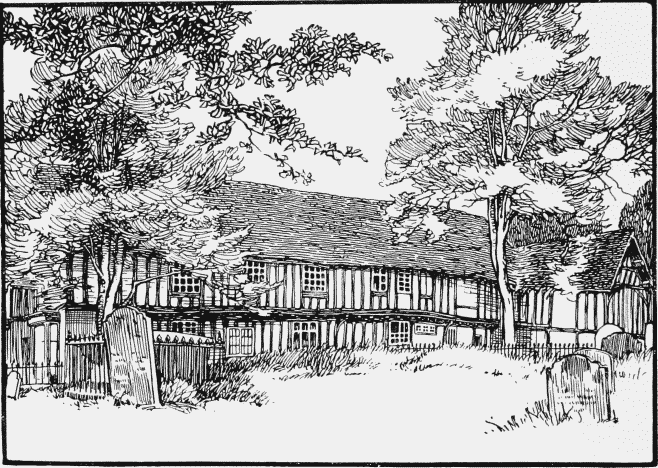
King's Norton: House on South Side of Churchyard, Originally Forming Part of Saracen's Head Inn
At Lifford, about three-quarters of a mile to the north of the main portion of the village, is Lifford Hall, a good brick Jacobean mansion of three stories, the attic story being gabled. The plan is of U type, the principal front facing north. The interior appears to have been wholly remodelled in the early years of the 19th century, when the original entrance doorway in the north front was built up and a new entrance hall and doorway formed in the west wing. The east wing at present consists of one large room with a modern bay window at the north end. The stone fireplace in this room is probably original. For some time previous to its restoration in the first half of the 19th century this wing appears to have been utilized as a barn. To the east of this wing is a range of stables and offices. The original windows have been altered to receive sash-frames, but the openings do not appear to have been enlarged, the original moulded stone sills remaining. In the garden is a small castellated octagonal turret, connected with the house by a fortress-like curtain wall, constructed of brick with a facing of stone. The size of the bricks shows this to be of original date with the house. The grounds are now partly occupied by a large reservoir and an adjoining mill-pond made on the formation of the neighbouring Worcester and Birmingham Canal. The head of water thus obtained has till recently been employed to work an india-rubber mill. The reservoir is used for pleasure-boating.
About 2 miles south of the main village, at Wythall is Blackgrave Farm, a moated brick house of the first half of the 17th century. The interior has been much altered. Weatheroak Hall, about half a mile south-west of Blackgrave Farm, and about the same distance east of the hamlet of Wythall, is an 18th-century house, almost entirely rebuilt in the year 1884. Hawkesley Hall is a modern house built upon the site of an older mansion. Highbury, the seat of the Rt. Hon. Joseph Chamberlain, is to the south of Moseley Hall.
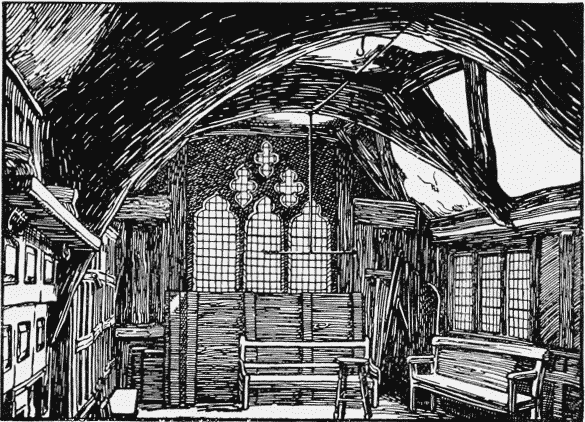
King's Norton: The Old Grammar School: Interior looking East
A cavalry skirmish is said to have taken place at King's Norton in October 1642 between the Royalist cavalry under Rupert, who was advancing with the royal army towards Edgehiil, and some Parliament Horse under Lord Willoughby of Parham, who surprised them, and, according to the Parliament accounts, utterly routed them. One of the Grevis family of King's Norton took a very conspicuous part for the Parliament in the fight at Camp Hill in this parish on Rupert's march to relieve Lichfield in 1643, when, on account of the resistance he met with, Rupert set fire to Birmingham.
King's Norton was visited by Queen Henrietta Maria in 1643. (fn. 5)
The commons, which are said in 1679 to have consisted of 2,000 acres of common and waste land, valued at £100 yearly, (fn. 6) were inclosed under an Act of 1772, (fn. 7) the award being dated 15 March 1774. (fn. 8)
Thomas Hall was vicar of King's Norton in 1660 when he wrote his treatise against May games. In this he says: 'There were two May-poles set up in my Parish, the one was stollen and the other was given by a profest Papist.' (fn. 9) He was ejected for nonconformity, and died in 1665, when he bequeathed his library for the use of the school and parishioners of King's Norton. (fn. 10)
William Lucas Sargent, the educational reformer and political economist, was born at King's Norton in 1809. (fn. 11)
Among the place-names are Schoryebuttes, (fn. 12) Grendone, (fn. 13) Thorntenhulle, Rouacre (fn. 14) (xiii cent.); La Wychhalleacre, (fn. 15) Cokkismore, (fn. 16) Collebrugge, Litell Mayowes Grene, (fn. 17) Ivereslond or Inreslande (fn. 18) (xv cent.); Chyndehouse, (fn. 19) Seyes, (fn. 20) La Crosse House, (fn. 21) Broadford Bridge, (fn. 22) Yamfast Hurst, Heyden Hurst, (fn. 23) Harwicks, (fn. 24) Turvis alias Turvelond (fn. 25) (xvii cent.).
MANORS
Before the Conquest and at the time of the Domesday Survey KING'S NORTON was a berewick of the manor of Bromsgrove. (fn. 26) It seems to have been held as a separate manor before the 13th century, (fn. 27) but followed the same descent as Bromsgrove (q.v.) until 1564, (fn. 28) when the latter was sold by Queen Elizabeth to Ambrose Earl of Warwick. King's Norton remained a royal manor until the beginning of the 19th century, (fn. 29) being settled on Queen Anne, consort of James I, in 1603, (fn. 30) on Queen Henrietta Maria in 1629 (fn. 31) and on Queen Katherine. (fn. 32) On 8 October 1804 it was purchased of the Crown by John Taylor, (fn. 33) whose son James Taylor left it to William Francis, his eldest son by his second wife Anne Elizabeth daughter of Walter Michael Moseley. It now belongs to George William Taylor of Pickenham Hall, Swaffham, son of William Francis. (fn. 34) The manor is now practically extinct, the last court having been held in 1876, (fn. 35) and the manor pound having been appropriated by the district council as a depository for road materials.
The parish was formerly divided into five 'eldes' or 'yelds,' Lee, Rednal or Wrednall, (fn. 36) Headley, Moundsley and Moseley, for each of which there seem to have been an aletaster and a thirdborough. (fn. 37) The whole parish was governed by a bailiff, constable and reeve, elected every year by the tenants at the court leet. (fn. 38) There is one instance in the Court Rolls of the last-named office being held by a woman, or rather by her son as her deputy. (fn. 39) At a later date there were also a steward, who held the office during pleasure and received 53s. 4d. for keeping the court, a crier who received 6s. 8d., and a beadle who received 3s. 4d. (fn. 40)
The court leet was held every year on the Thursday in Whitsun week and the court baron every three weeks. The bailiff of the manor was allowed 66s. 8d. for providing a breakfast, dinner and supper for the judge on the leet day. (fn. 41) Before Bromsgrove was granted to Sir Richard Grobham the court for both Bromsgrove and King's Norton was held at 'the Lickie.' (fn. 42)
There is an interesting survey of the manor taken in 1650–1. (fn. 43) The soil of the heaths called Boswell Heath, Wake Green, Hayter's Heath, Kingswood, Norton Woods, &c., belonged to the lord of the manor and the trees to the tenants.
At the beginning of the reign of Edward III the tenants of the manors of King's Norton, Yardley and Solihull had been involved in a quarrel with Roger de Mortimer Earl of March, then lord of the manor, who had inclosed part of their common in King's Norton Wood. (fn. 44) He charged them with filling up a dyke he had made, and they were fined £300, afterwards reduced to 20 marks.
In 1616 James I granted to the men of King's Norton a market on Saturday and two fairs on the vigil and day of St. Mark and two days following, and on 5 August and two days following with a court of piepowder. (fn. 45) The market was discontinued before the end of the 18th century, but fairs were still held on 25 April and 5 September. (fn. 46) These, though still held in 1849, (fn. 47) were obsolete before 1888, (fn. 48) but a statute fair is held on the first Monday in October at the present day.
The Abbot and convent of Bordesley had a grange at King's Norton in the 13th century. (fn. 49) This is no doubt to be identified with 'the whole demesne of Norton with the land of the forester and the beadle' granted to the abbey by the Empress Maud. (fn. 50) After the Dissolution this grange was included in the grant of the possessions of Bordesley Abbey in 1544 to Thomas Broke, (fn. 51) and passed from him to his sister and heir Jane Arrowsmith. (fn. 52) Her son John Arrowsmith sold it in 1550 to Alexander Avenon, (fn. 53) who died seised in 1580, and was succeeded by his son Alexander. (fn. 54) The latter settled it in 1604 on his wife Mary, (fn. 55) who survived him, and seems to have held the grange until 1628, when her son John Avenon had livery of it. (fn. 56) Two years later John Avenon and Elizabeth his wife conveyed it under fine to Anthony Slater and Anthony Alderson. (fn. 57) There is no further mention of it.
COLMERS
COLMERS (Colmore, Collemer, Colemares, Colemarsh, Chalmers), another estate in the parish, which is described as a manor from the 16th century, probably at first belonged to a family of the same name. Walter de Colmer was living c. 1280, (fn. 58) and John de Colmer, possibly his son, in 1327. (fn. 59) There is no trace of his successors until the 16th century, when John Rotsey mortgaged a capital messuage called Colmers to Robert Gower. (fn. 60) Robert Gower, son of William Gower of Boughton, St. John in Bedwardine, must have entered into possession of the manor before 1599, when he died seised of it. (fn. 61) His son John had livery of it in 1602 (fn. 62) and died in 1625. (fn. 63) The manor had been settled on Robert, his son and heir, and Frances Skinner, his intended wife. (fn. 64) Robert was succeeded by a son Richard who died in 1689, and was in turn succeeded by William Gower. (fn. 65) William Gower and his wife Ellen were among the Roman Catholic nonjurors who refused, after the insurrection of 1715, to take the oath of fealty to King George I. It is probable that Colmers was forfeited to the Crown, but afterwards compounded for. (fn. 66) John Gower son of William, having predeceased his father, by his will dated in 1720 left his reversionary interest to his brother William Gower with contingent remainders if he should die unmarried to Edward Thomas Hawkins, second son of his cousin Thomas Hawkins of Nash, co. Kent, and to John elder brother of Edward. (fn. 67) William Gower, the father, gave his life interest in the estate in 1725 to his son William, who was killed in a duel in the same year. The elder William died in 1736, and the manor passed to Edward Thomas Hawkins, who assumed the name of Gower. (fn. 68) He died unmarried, and Colmers belonged in 1788 to Thomas Hawkins, son of John, who in that year sold it to George Attwood. (fn. 69) Its further descent is not known.
HAZELWELL,
HAZELWELL, which is not called a manor until the 17th century, probably derived its name from the family of Hazelwell who held it in the 14th century. In 1325 William de Hazelwell settled lands in King's Norton on himself and Margery his wife with reversion to his daughter Lucy and her husband William Benet. (fn. 70) Lucy was succeeded by a daughter, who married William Sye, (fn. 71) and left Hazelwell to her only child Alice, the wife of John Middlemore, who is said to have been the second son of John Middlemore of Edgbaston, in whose family it remained until the beginning of the 18th century. (fn. 72) Alice Middlemore, who survived her husband, died about 1524, leaving her property to her eldest son John, who was succeeded about 1527 by his son George. (fn. 73) The latter died in 1566 and his widow Jane, the daughter of Hugh Harman of Morehall, seems to have held Hazelwell until her death in 1591–2, (fn. 74) when it passed to her grandson George Middlemore, whose father Simon had died some years before. (fn. 75) George son of George Middlemore, who succeeded to Hazelwell about 1637, suffered much in the Civil War, his house at Hazelwell being plundered and his estate much reduced in value. (fn. 76) In 1646 his property was sequestered, but was finally discharged on payment of £10. (fn. 77) He was succeeded about 1652 by his son Robert, (fn. 78) and he in 1679–80 by his eldest son George, (fn. 79) who died unmarried in 1700, leaving his property to his nephew William, son of William Middlemore of London. (fn. 80) The latter died childless in 1709, having bequeathed his estate by a will without date to his brother George (who predeceased him) with remainder successively to his cousin George Middlemore, to Samuel Middlemore or his brother John, and to Richard Middlemore. (fn. 81) Since no executor was named in the will, administration of his goods was granted to his widow Margaret, the heirs being said to be Samuel and Thomas Middlemore. The former seems to have laid no claim to Hazelwell, and the latter, who was a soldier in Spain, did not hear of his cousin's death until some time after. However, on his return to England he brought a suit in Chancery in 1712 to recover the manor, which he claimed as being entailed on George Middlemore with remainder to him. It had been sold by Ellen Middlemore, sister of William, to George Birch, who already held a mortgage on it, (fn. 82) and Thomas in 1715 sold his interest to George Birch and confirmed the sale in 1722 to Thomas son of George, afterwards kt. and judge of the Common Pleas. (fn. 83) George Birch, son of Sir Thomas, succeeded him in 1757 and sold the manor to James Carden in 1785. (fn. 84)
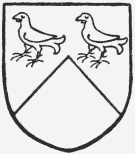
Middlemore of Edgbaston. Party cheveronwise argent and sable with two moor-cocks in their proper colours in the chief.
The present Hazelwell Hall, which was probably built on the site of the old manor-house, is a modern structure belonging to the Cartland family.
The so-called manor of HAWKESLEY (fn. 85) (Hawekelowe, xiv cent.; Hawkeslowe, xvi cent.) was held of the manor of Bromsgrove. (fn. 86) Richard de Hawkeslow was assessed in the manor of Bromsgrove and King's Norton at 5s. 4d. in 1280. (fn. 87) He or a descendant of the same name held land at King's Norton in 1320–1, (fn. 88) and in 1323 William de Hazelwell obtained licence to grant a mill and land at King's Norton to Richard de Hawkeslow and his sons John, Richard and William. (fn. 89) William de Hawkeslow paid a subsidy of 18d. at King's Norton in 1327, (fn. 90) and Richard de Hawkeslow in 1329 received from the Abbot of Bordesley a messuage and 2 carucates of land at King's Norton to hold during his life. (fn. 91) The former seems to have met with a violent death, for in 1344 his son Richard sued John Not for the death of his father. (fn. 92) According to a pedigree of the Hawkeslows given in An Account of the Middlemore Family, Richard Hawkeslow was succeeded by a son John, (fn. 93) and it was doubtless he who before 1424 granted seven messuages and certain land (fn. 94) in King's Norton, afterwards known as 'the manor of Hawkelowes,' to Humphrey Stafford. (fn. 95) Sir Humphrey, his son and successor, forfeited all his possessions on the accession of Henry VII, and the estate at Hawkesley was probably included in the land at King's Norton granted in 1485–6 as a forfeited possession of Humphrey Stafford to Sir Gilbert Talbot. (fn. 96) This grant does not seem, however, to have taken effect, for in the following year the land was granted to John Pympe and John Darell. (fn. 97) On the death of John Pympe in 1496 the estate is called the 'manor of King's Norton,' (fn. 98) but in the inquisition taken on the death of Sir John Darell in 1509 it is called the 'manor of Hawkelowes.' (fn. 99) Sir Humphrey Stafford, son of Humphrey mentioned above, was restored by Henry VIII in 1514–15, (fn. 100) and Hawkesley was evidently given back to him at that time, for in November 1515 John son of Sir John Darell obtained a pardon for all entries on the manor. (fn. 101) Sir Humphrey Stafford died in 1545 seised of the manor, (fn. 102) which must have been sold by his son Humphrey to a member of the Middlemore family. The purchaser was possibly William Middlemore, called in his will dated 1549 'of Hawkeslow.' (fn. 103) His son John Middlemore was dealing with the manor in 1553. (fn. 104)
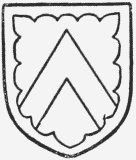
Stafford. Or a cheveron gules and a border sable engrailed.
Part of his house at Hawkesley was leased to his brother Henry, who seems to have held it until 1596. (fn. 105) John Middlemore died in 1597, and his son William settled the capital messuage and other property in Hawkesley on his son John when he married Bridget daughter of Thomas Betham of Rowington, co. Warwick. (fn. 106) John Middlemore succeeded to the whole of Hawkesley in 1633–4, (fn. 107) but his affairs seem to have become very much involved, and in 1637 he was imprisoned for debt in Worcester gaol, where he remained until his death about six years later. (fn. 108) His eldest son William was involved in still greater difficulties through his loyalty to the king in the Civil War. His house at Hawkesley was seized and garrisoned by the Parliamentary forces (fn. 109) early in 1645. In May in the same year the house was besieged by the Royalists, and surrendered to the king on the 15th, because 'the soldiers would not fight when they perceived it was the king's army,' although there 'was a month's provision and ammunition' in the house. (fn. 110) According to Clarendon 120 men, besides the governor, Captain Gouge, were taken prisoners. (fn. 111) The house was burnt after the surrender, and seems to have been rebuilt about 1654. (fn. 112) William Middlemore died in 1663, and was succeeded in turn by his three sons, John, who died in 1681, William, who died in 1711, and George. (fn. 113) The latter in 1723 settled Hawkesley on his eldest son John in tail-male. (fn. 114) Richard Middlemore, son of John, succeeded him about 1734. (fn. 115) In 1803, the year before his death, he conveyed Hawkesley to his second son Richard, who left it to his three daughters and co-heirs, Anne, Mary and Martha. Mary, afterwards the wife of Samuel Hoitt, died childless, leaving her share to her sisters, who in 1869 sold the whole to their kinsman William Middlemore of Birmingham, the father of Thomas Middlemore of Melsetter in Orkney, who now holds it. (fn. 116)
There is said to have formerly been a chapel at Hawkesley. (fn. 117)
At the time of the Domesday Survey HOUNDESFIELD (Hundesfeld, xi and xiii cent.; Huncksfield, xviii cent.) was one of the eighteen berewicks annexed to Bromsgrove. (fn. 118) It belonged to the Crown until the Empress Maud granted it, as the land of Godric de Hundesfeld, to Bordesley Abbey, (fn. 119) probably at its foundation. It followed the same descent as the Grange belonging to the abbey at King's Norton (fn. 120) until John Arrowsmith sold it to a certain William Gilbert, whose son and heir Richard had livery of it in 1590. (fn. 121) William Gilbert, son of Richard, succeeded his father about 1629. (fn. 122) The estate belonged in 1717 to Elizabeth Byton, (fn. 123) and in 1737 it was conveyed by Richard Grevis and his wife Anne to William Salter. (fn. 124) In 1781 Thomas Heveningham and John Reeve conveyed it to Jacob Stokes. (fn. 125) The later descent of this estate has not been found.
KINGSUCH
KINGSUCH (Kingsitch, xvii cent.), another grange belonging to Bordesley Abbey, which was valued at £4 3s. at the time of the Dissolution, (fn. 126) was granted in 1544 to Thomas Broke, (fn. 127) who sold it in 1545 to Thomas Rotsey of King's Norton. (fn. 128) Ten years later it was purchased of the latter by Ralph Palmer, (fn. 129) whose son and heir William succeeded him in 1563, (fn. 130) but seems to have sold it soon afterwards to John Field, who in 1579 settled it on his daughter Anne on her marriage with William Whorwood. (fn. 131) The latter was afterwards knighted, and with his son and heir Thomas sold it in 1611 to Sir Clement Fisher, (fn. 132) who died seised in 1619. (fn. 133) In 1622 it was purchased from his son Sir Robert Fisher by John Turton of West Bromwich, co. Stafford, and William, his son and heir. (fn. 134) From William it passed to his son John, afterwards a baron of the Exchequer and justice of the King's Bench, who left his lands in King's Norton to his daughter Elizabeth Davies during the minority of his grandson John Turton. (fn. 135) The latter was holding the manor of Kingsuch in 1710. (fn. 136) It belonged to Robert Mynors, a surgeon of Birmingham, in 1865, (fn. 137) and is now in the possession of his descendants.
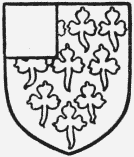
Turton of West Bromwich. Argent ten trefoils vert with a quarter gules.
The manor of MONYHULL (Monehylls, xvi cent.) was held at the time of the Dissolution by the college of Westbury, co. Gloucester, but it is not known by whom it was given to the college. The farm of the manor, with Groveley, was £15 10s. 3d. a year, and from the capital messuage of Ekelyngstret a rent of £4 1s. 6d. was due, while the farm of the pasture of 'Brantyrene' was worth 13s. 4d. (fn. 138) Monyhull was granted with the site of the college to Sir Ralph Sadleir in 1544. (fn. 139) He sold it in 1547 to a certain William Sparry. (fn. 140) In the reign of Philip and Mary William Sparry sued Francis and Richard Rotsey and others for breaking down a seat in King's Norton Church which he had made for himself and his wife. The bill shows that he had been in the parish about thirty years and lived in a 'manor place' there called 'Puyhulls Hall.' (fn. 141) John Sparry and his wife Elizabeth conveyed the manor in 1590 to William Sparry, (fn. 142) and William Sparry died seised of Monyhull in 1610, leaving a son Daniel, (fn. 143) who appears to have sold it to William Child, who was dealing with it in 1650. (fn. 144) From him it passed to his son Peter. (fn. 145) By the middle of the 18th century the estate had come into the possession of James Arderne, whether by purchase or inheritance does not appear, and he conveyed it in 1762–3 to Girton Peake. (fn. 146) It is now the property of the city of Birmingham, and used as a colony for epileptics.
MOSELEY
MOSELEY (Museleie, xi cent.) is also mentioned in the Domesday Survey as a berewick of Bromsgrove, (fn. 147) and probably remained part of that manor for some time, since no further mention of it occurs until the 15th century. In 1456–7 Baldwin Porter sold all his right in the 'manor' to Thomas Lyttelton, serjeantat-law, (fn. 148) who died in 1481, leaving lands in Moseley, to his son William. (fn. 149) Moseley Hall with an estate there afterwards came into the possession of a family called Grevis or Greaves, who are known to have held it in the 17th and 18th centuries. (fn. 150) The adjoining manor of Yardley (q.v.) also belonged to them. Moseley was purchased on 28 January 1767 of Ann Grevis and Henshaw Grevis by John Taylor. (fn. 151) From him it passed to his second son James, who died in 1852. (fn. 152) In 1854 the Hall was the seat of William Taylor. In the Priestley riots the Hall, which was then occupied by Lady Carhampton, was burnt by the rioters. It was rebuilt and was the seat of the Taylors until its recent purchase early in the 20th century by Mr. Richard Cadbury, who made it into a convalescent hospital for children, and gave it for that purpose to the Lord Mayor and Corporation of Birmingham.
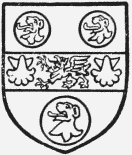
Grevis of Moseley. Argent a fesse azure between three roundels sable with a lion's head razed argent upon each and a griffon passant between two scallops or upon the fesse.
In 1770 MOUNDSLEY was purchased from Honour, Edward and Frances Field by John Finch, (fn. 153) whose sister and heir Jane married John Simpson of Leicester. (fn. 154) Her son and heir John Finch Simpson was holding the property in 1803, (fn. 155) and in 1828 it was settled on his eldest daughter Mary (fn. 156) on her marriage with Edward Dawson of Whatton. (fn. 157) She died in 1843, and nine years later her husband sold Moundsley to Thomas Lane, to whose son Charles Pelham Lane it now belongs, (fn. 158) and he resides at the Hall.
TESSALL
TESSALL (Thesale, xi cent.; Teneshala, xii cent.), now only a farm-house, is mentioned in the Domesday Survey as a berewick of Bromsgrove. (fn. 159) With Houndesfield it was included in the foundation charter of the Empress Maud to Bordesley Abbey and in later confirmations by Henry II, Richard I and Henry III. (fn. 160) Walter son of Ralph de Tessall had in 1255–6 a messuage, rent and mill in Tessall (fn. 161) which he appears to have held of the king. (fn. 162) Before 1425 the manor seems to have been acquired by the lord of King's Norton and was granted by Edmund Earl of March to a certain Stephen Benet for life. (fn. 163) After that date it seems to have become merged in King's Norton Manor.
Besides the more important manors and granges there are in the parish several smaller estates which were the sites of reputed manors in the 17th and 18th centuries. Among these are Farmons, Weatheroak Hill, Wychall and Wythworth.
FARMONS
FARMONS in Moseley probably derived its name from John Farmon, who lived in King's Norton in 1327. (fn. 164) It afterwards belonged to James Earl of Wiltshire, and fell to the Crown on his attainder at the accession of Edward IV. (fn. 165) It belonged in 1777 to Richard Chambers and Anna Maria his wife, (fn. 166) and was purchased of them in 1780 by William Taylor. (fn. 167) It now belongs to George William Taylor, lord of King's Norton.
WEATHEROAK HILL
WEATHEROAK HILL belonged to the Fields. It is probable that it belonged to John Field c. 1280 (fn. 168) and to Richard Field in 1327, (fn. 169) and descended from them to Henry Field, who died seised of it in 1584, leaving it to his brother John Field. (fn. 170) The latter left it before 1604 to his daughter Anne, the wife of Sir William Whorwood (fn. 171) of Bentley Pauncefoot, who settled it on Ursula wife of their son Thomas. (fn. 172) After that date there are no documents relating to it. Before 1806 it seems to have been purchased by Robert Mynors, from whom it has descended to the present owners, the Misses Emily Anne and Florence Annie Mynors, his great-granddaughters. (fn. 173)
WYCHALL
WYCHALL (Wythalle, xiii cent.) may perhaps be identified with 'Warthvil,' one of the berewicks of Bromsgrove in 1086. (fn. 174) It was in the king's possession in 1237-8, (fn. 175) evidently as an appanage of Bromsgrove Manor. The king sued Richard son of Richard de Coston for a carucate of land at 'la Wythalle,' in the manor of Bromsgrove, in 1253, claiming it as an escheat, and promising that, if he should recover it, it should belong to Paulinus de Bampton his serjeant. (fn. 176) It is possible that Richard de la Wychall, who gave an acre of land called 'la Wychhalleacre' to the Abbot of Bordesley early in the 14th century, was tenant of the manor. (fn. 177) The reversion of a moiety of Wychall Farm was bequeathed by Job Marston of Hall Green, Yardley, to his kinsman Joshua Avenant in 1701. (fn. 178) The present Wychall Farm is an old moated half-timbered house not far from King's Norton railway station.
William Sheldon died in 1517 holding of the queen the so-called manor of WYTHWORTH, in King's Norton, which he bequeathed to his brother Ralph. (fn. 179) The manor with a water-mill called Kilcupps was sold in 1633 by William Cowper and his wife Martha to William Chambers, (fn. 180) and in 1711 Thomas and Edward Chambers conveyed it to John Holmden. (fn. 181) The name still survives at Wythwood Cottage in Wythall.
BLACKGRAVE
BLACKGRAVE was given by Richard I to Reginald de Bares. Reginald, after selling the land to Fulk de Wythworth, went on a crusade and never returned. Fulk apparently gave half the tenement, which consisted of a messuage and a carucate of land, to Emma de Alvechurch, against whom the king recovered it in 1237–8. (fn. 182) The king seemed to have based his claim on the fact that Reginald de Bares had broken prison at Feckenham, where he was detained for larceny, so that his land escheated to the king. In 1252 the king was said to have recovered the land from Hugh de Belne, who was vouched to warranty by his under-tenant Henry Lovett. (fn. 183) The king granted the land in that year to William son of Hugh de Belne for the service of rendering 22s. yearly at the Exchequer. (fn. 184) It was stated in 1275 by the 'elder people' of Alvechurch that the tenement of la Blackgrave which William de Belne then held was formerly demesne wood of the Bishop of Worcester, and that it had been alienated from the church by force by 'Folkwy de Wichford,' (fn. 185) and by the assent of Hugh formerly parson of Alvechurch, whose daughter Isabel married Hugh de Belne, and was succeeded by William de Belne her son and heir, who first obtained a charter of the king at the request of Sir John Mancel and others. (fn. 186) Hugh de Belne died about 1317–18 holding a messuage and land in King's Norton to which his son William succeeded. (fn. 187) William died seised of the estate in 1347–8, (fn. 188) when it passed to his brother Thomas, who died in 1361–2 (fn. 189) His son William succeeded and did fealty for the land in 1362. (fn. 190)
Habington states that Blackgrave was lately the land of Mr. Gandy, from whom it passed to Sir Richard Grevis, kt., and 'so descended to Mr. Grevis his son now livinge.' (fn. 191) It is perhaps to be identified with an estate called Walgrave, Whagrave, Bagrave, or Badgrave, which belonged in 1613 to Sir Thomas Palmer, and was then in the tenure of Thomas Grevis. (fn. 192)
There were formerly two mills belonging to the manor of King's Norton, one in Wrednall Elde, the other in Moundsley, (fn. 193) but there is no mention of them after the 17th century. Another mill belonged to Hawkesley and is first mentioned in 1323, when it was settled on Richard Hawkeslow and John, Richard and William his sons. (fn. 194)
In 1311 the king granted licence to William Jurdan to grant a mill and land in King's Norton to Richard de 'Brademedewe,' (fn. 195) but this was probably one of the mills belonging to the manor.
Henry Field left a mill called Hurste Mill to his niece Anne and her husband William Whorwood in 1584, (fn. 196) and it was still in their family in 1625. (fn. 197) Hurste Mill is still in existence. Two 'grist mills' belonged to the rectory of King's Norton in 1651. (fn. 198)
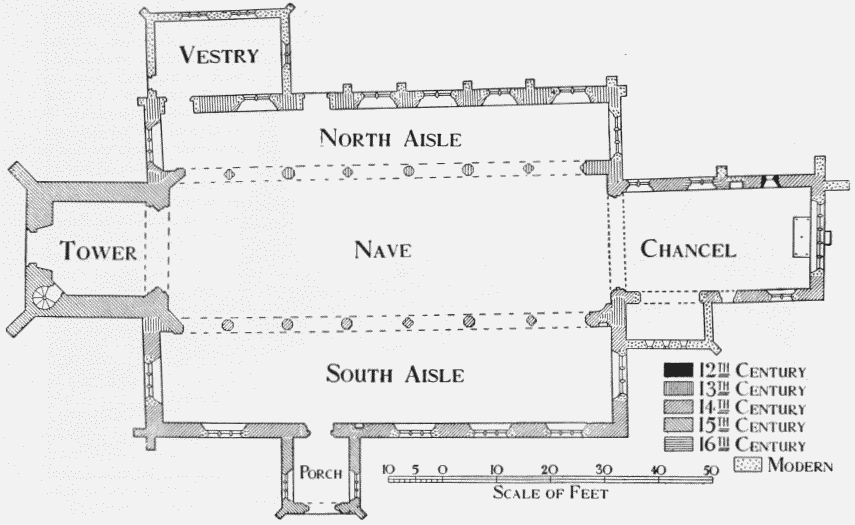
Plan of King's Norton Church
CHURCH
The church of ST. NICHOLAS consists of a chancel 33 ft. by 18¾ ft., with a south organ bay, nave 82¼ ft. by 25 ft., north aisle 10½ ft. wide, south aisle 18½ ft. wide, west tower 17¼ ft. square, and a north vestry and south porch. These measurements are all internal.
The church is large, but with the exception of two 12th-century lancets in the chancel none of the work is earlier than the end of the 13th century. The north arcade of the nave is probably of that date, and the church would then have consisted of chancel, nave, and north aisle. In the beginning of the 14th century the south arcade was built and the south aisle added. The chancel was rebuilt in the 14th century, and the north aisle was either rebuilt or had windows inserted at the same time. The tower is a fine example of late 15th-century work, and the south porch is of similar date. Three gabled roofs were built to each aisle in the 17th century, those on the north being removed in modern times. The clearstory was probably built at the same time, for the windows are set out to space between the gables. A vestry existed on the north side of the chancel in the 16th or 17th century and was removed later. A modern vestry has been added at the north-west end of the north aisle and an organ bay built to the south of the chancel.
The east window of the chancel is of five lancet lights grouped under a four-centred arch, all modern. In the north wall is a 12th-century round-headed single-light window reset, and below it is another smaller and now blocked. The blocked north door with a depressed arch led into the vestry now removed. East of this is a two-light 16th-century window, and a second with 14th-century jambs.
In the south wall is a restored two-light window, the sill being carried down to form sedilia. The south chancel door is modern. The chancel arch is of 14th-century date of two orders, the outer continuous, and the inner, with good ball flower ornament, springs from corbels.
The nave is seven bays in length. The two-centred arcading on the north is of two chamfered orders, resting on capitals and piers of varying design. The first, fourth and sixth piers are of four engaged shafts harmonizing with the eastern respond, the second and fifth are octagonal, and the third round. The capitals and bases vary in moulding, but the whole of this arcade probably dates from the latter half of the 13th century. The south arcade, which is of a similar type, dates from the beginning of the 14th century; the first and third piers are of four clustered shafts, the remainder, with the east respond, being octagonal. The west responds of both arcades are cut into by the diagonal buttresses of the tower. The clearstory on each side has three circular trefoiled and quatrefoiled lights, all probably of 17th-century date. The tower arch is of 15th-century date moulded on the splay.
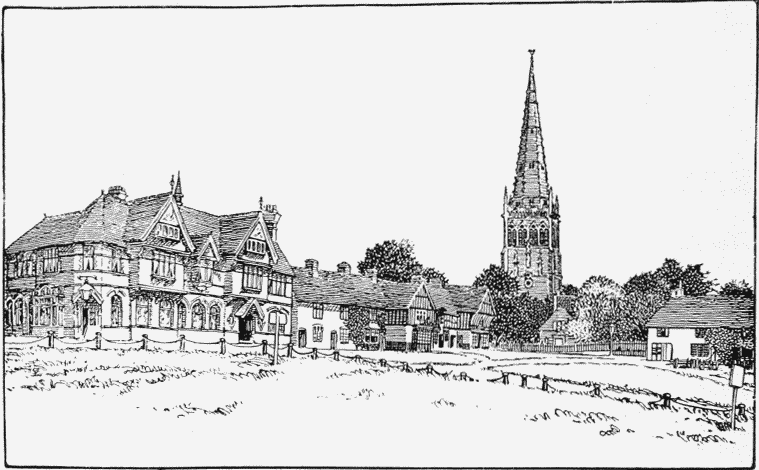
King's Norton: The Church from the Green
The east window of the north aisle is of three lights with modern tracery. In the north wall, which has been much repaired, are five two-light windows with modern tracery. Between the fourth and fifth windows is a modern door, and at the north-west end a modern vestry. The west window of the aisle is similar to the eastern, but the tracery is apparently old.
The windows in the south aisle are of three lights each, and have all been restored in the style of the 14th century. The west window is similar, but of narrower proportions.
To the east of the south door is a 15th-century piscina, presumably not in situ, with an ogee head and remains of crockets.
The south door is of 15th-century date, and above it are fragments of a canopied and crocketed image bracket. The porch itself is of the 15th century, the roof showing traces of vaulting, and the angle corbels bearing the symbols of the Evangelists in high relief. On each side is a three-light traceried window of the 15th century. In the north-east corner is a small recess, probably for a water stoup.
The west tower is in four stages with battlements, angle pinnacles and octagonal spire.
In the west wall of the ground stage is a doorway with a crocketed label much restored, and above it a large four-light window with a label formed by the second course rising above it.
To the north and south of the second stage is a two-light window in a deep reveal. The third stage has niches with crocketed canopies and finials, containing figures, apparently modern.
Two transomed windows of two lights pierce each face of the belfry stage. They are provided with crocketed labels and finials, flanked by similar blind windows.
The embattled parapet has trefoiled panels, the merlons being ornamented with quatrefoils. The spire has three bands of moulding, with ogee-headed lights and a line of crockets to each angle.
The modern roofs rest on carved corbels; the north aisle has a pent roof, the south a roof of three transverse gables, all modern. The buttresses of the north aisle are modern.
The south aisle wall appears to have been refaced from the east end up to the porch, parts of the windows and labels being original. The porch has a crocketed label with finial, and the windows west of the porch have similar enrichment. The three gables over this aisle are of 17th-century date, with lines of trefoiled panels. On the western is a butterfly gargoyle of the type that occurs in several churches in the north of the county.
At the east end of the south aisle is a floor slab of a priest in mass vestments. The inscription is almost illegible, but the date seems to be 1508. On the south wall is a monument to John Middlemore of Edgbaston and Hazelwell Halls, ob. 1698.
High up on the arcade wall of the aisle is a wood painted heraldic tablet to Sarah wife of Henry Est of Slade Pool; the date appears to be 1632.
On the north wall of the north aisle is a brass
tablet inscribed—
Th' Ascension day on ninth of May
Third year of King James reign
To end my time & steal my coin
I William Greves was slain
·1605.
On the north side of the tower is an altar tomb, with two life-size figures engraved on a flat alabaster slab, the lines being filled in with black composition. The man is in plate armour with his head upon his helmet. His wife is in the dress of the period with her head on a cushion.
An inscription in raised letters runs round the edge of the tomb, but is much defaced; it reads 'Humphrey Littleton of (?) Groveley and Martha his wife, daughter of Robert Gower of Colemers Esq. … ob. 1588.' (fn. 199)
On the wall above this is a recess with effigies of a man and his wife in 17th-century costume, kneeling. The only clue to their identity is a shield quarterly or and (?) gules.
On the south side of the tower is a 17th-century altar tomb with two recumbent figures of Richard Grevis of Moseley, kt., and Ann his wife, daughter of Thomas Leighton of Wattlesborough. The figures are in the dress and armour of the period. The man's head rests on a mantled helmet, his feet on a gauntlet. The inscription is on a decorated slab above, with small kneeling effigies of four sons and four daughters. Above are the arms of Grevis impaling Leighton.
Above are two crested helms, the one with a twoheaded eagle sable, for Grevis, the other with a wyvern sable, for Leighton.
There is a ring of eight bells cast by Chapman & Mears of London in 1783; the first and seventh were recast by Blews of Birmingham, 1867, and the fifth by Thomas Mears of London in 1826. The sixth has also been recently recast by Taylor.
The plate includes a good specimen of the Elizabethan cup with cover for paten, with the fringe or gadroon on the stem and the dotted line ornament. There is also a set of plated ware, including a cup, paten, flagon and almsdish.
The registers before 1812 are as follows: (i) all entries 1546 to 1791, marriage entries ceasing 1754; (ii) baptisms and burials 1792 to 1812; (iii) a marriage book 1754 to 1812.
The church of ST. MARY, MOSELEY, consists of a chancel, nave, north aisle, transept and tower. The earliest part of the church is the Tudor tower, which is said to have been built in 1514. In the latter part of the 19th century the church was almost rebuilt. In 1876 the restoration was begun, the north aisle being added in 1886 and the organ chamber in the following year. In 1894 the vestry was built and in 1897 the present chancel and transept were erected. There are eight bells in the tower. The register begins in 1750.
ADVOWSON
The church of King's Norton was formerly a chapel annexed to the church of Bromsgrove (q.v.), and has always followed the same descent. (fn. 200) It was severed from Bromsgrove in 1846, (fn. 201) and the living was declared a vicarage in 1866, (fn. 202) and is in the gift of the Dean and Chapter of Worcester. The chapel was not valued separately until 1536, when it was worth £15 10s. (fn. 203) In 1651 the parsonage-house and lands belonging were sold to Charles Cocks of the Middle Temple. (fn. 204)
In 1561–2 it was returned 'the Chappell and the Chappell More is hole 'the Quenes reserving one little plecke by the lane syde a nowte the well to T. (? J.) Middlemore.' (fn. 205)
The chapel of St. Mary Moseley was built by the parishioners of King's Norton because the parish was 'seven miles broad every way & 40 miles compass,' and many of the inhabitants lived 4 miles from the parish church. (fn. 206) In 1405 licence was given to the parishioners of Bromsgrove who lived near King's Norton to attend mass in the chapel of St. Mary, Moseley. (fn. 207) In 1494–5 the feoffees of the lands and tenements of St. Mary's chapel received from the queen certain pieces of waste land in Moseley. (fn. 208)
The salary of the chaplain was supplied by the parishioners from a fund amounting to £24 10s. 10½d., which had been granted to them by various 'deeds declaring no use,' with which they found one, two, or even three priests, the surplus when there were only one of two being used for the repair of the bridges and highways and 'relieving the poor and other charitable alms and good deeds.' (fn. 209) In 1562 land formerly belonging to the chapel of Moseley was granted to Cicely Pickerell and her heirs, (fn. 210) and in 1577–8 a 'house or room called the Lady Priest's Chamber' in Moseley with land belonging was granted to John Mershe and others. (fn. 211) The chapel apparently continued to be used (fn. 212) and a brief for rebuilding was issued in 1780. (fn. 213)
Moseley was formed into a separate ecclesiastical parish in 1853. (fn. 214) The living is a vicarage in the gift of the Bishop of Birmingham. In 1875 the parish of St. Anne, Moseley, was constituted from this parish, (fn. 215) the living being a vicarage in the gift of the vicar of Moseley. The church consists of a chancel, nave, aisles and tower with spire, and is built of stone. The church of St. Agnes, erected in 1883–4, is a chapel of ease to St. Mary's, Moseley. The boundaries of Moseley were altered in 1879 to include part of Yardley. (fn. 216)
Samuel Shaw, the Nonconformist divine, was curate of Moseley in 1657. (fn. 217)
In 1344 a chaplain called William Paas received licence to alienate a messuage and land and rent in King's Norton to a chaplain for celebrating divine service daily at the altar of the Virgin Mary in King's Norton Church. (fn. 218) This is no doubt the chantry of St. Thomas the Martyr mentioned in a Chancery suit of 1485–1500, (fn. 219) whose invocation is said to have been afterwards changed to St. Michael, (fn. 220) the change doubtless taking place about 1538 in consequence of the proclamation of Henry VIII erasing the name of St. Thomas from the calendar of saints. At the time of its dissolution the chantry supported three stipendiary priests, one being the master of the grammar school and another the usher. (fn. 221) In 1549 rents amounting to 53s. 6d. from lands which had been given 'to maintain a priest in service of the Holy Trinity, Blessed Mary and St. Michael' were granted to Richard Field and others. (fn. 222)
St. Mary's Wythall, became a separate ecclesiastical parish, formed from part of Alvechurch, King's Norton and Solihull, in 1853. (fn. 223) The living is a vicarage, the patron being the vicar of King's Norton. There was formerly a chapel there, which is first mentioned in the 17th century. (fn. 224) After the Restoration Richard Moore, the Nonconformist minister, obtained licence to preach in the chapel, which he described as 'his house and room at Withall,' (fn. 225) but the licence was withdrawn two years later. (fn. 226) In 1672 he was again presented to the chapel, where he remained for two years. (fn. 227) The present church, built in 1862, is of brick in 14th-century style, consisting of chancel, nave, transepts, south aisle, south porch and tower.
The parish of St. Paul, Balsall Heath, was also formed as a district chapelry from King's Norton in 1853. (fn. 228) It was declared a vicarage in 1867, (fn. 229) and the living is in the gift of the vicar of King's Norton. The church is of brick, consisting of chancel, nave, aisle, side chapel, baptistery and tower. The church of St. Thomas in the Moors, Balsall Heath, was built in 1883, and the living is a vicarage in the gift of trustees. The church is of brick and with slate roof, and consists of chancel, nave, aisles and north and south porches. The new parish of St. Barnabas was formed in 1905, and is a vicarage in the gift of the Bishop of Birmingham.
The ecclesiastical parish of King's Heath was formed in 1863 (fn. 230) from Moseley and King's Norton. The living, which was declared a vicarage in 1866, (fn. 231) is now in the gift of the vicar of Moseley. All Saints' Church, built in 1859, is a building in 15th-century style, consisting of chancel, nave, aisles and tower with spire.
The church of the Ascension, Stirchley Street (1900), and St. Agnes, in the Cotteridge (1903), are chapels of ease to the parish church of Moseley.
In King's Norton there is a Roman Catholic church of St. Joseph and St. Helen, and also a Congregational and other Nonconformist chapels.
CHARITIES
The school foundation, ascribed to Edward VI, but existing before the dissolution of the chantries, when it was provided for under the chantry endowments, (fn. 232) was formerly held in the ancient building in the churchyard already described, to which a library was bequeathed by Mr. Hall, a former clergyman of the parish. It was endowed with a rent-charge of £15, less land tax, paid by the receiver of the Crown rents. This has been redeemed by the transfer to the official trustees of £449 6s. 2d. consols, now producing £11 4s. 8d. yearly, which is applied for educational purposes under a scheme, 24 June 1884. The books which formed the library have been deposited in the Birmingham Public Library.
The almshouses, referred to in an ancient table of benefactions as founded by Mr. Avenant, are endowed with £926 2s. 11d. consols, with the official trustees, arising from sale of land and producing £23 3s. yearly, and with the remainder of the land let in allotments, of the annual rental value of £7 4s. The charity is regulated by a scheme of the Court of Chancery 25 May 1855. In 1910 £20 was paid to the almswomen.
In 1701 Job Marston by his will left £100 to be laid out in the purchase of land, the rents and profits whereof to be received by the minister of Moseley Chapel. The endowment now consists of 4 a. 3 r., let at £30 a year, which is paid to the minister, who also receives a rent-charge of £2 10s., supposed to have been created by one Samuel Wells.
The United Charities are regulated by a scheme, 26 August 1868, and comprise the following charities, namely:—
The Moseley Estate, containing 12 a. 2 r.; the Red Hill Estate, containing 12 a. 1 r.; the allotment, containing 4 a. 1 r., producing in the aggregate about £210 yearly; Sir William Whorwood's charity, founded by will proved in the P.C.C. 16 February 1615, consisting of a rent-charge of £5 for the poor, paid by the Earl of Dartmouth; the parish land, containing 19 p., in respect of which the annual sum of 15s. is received; an annuity of £2 6s. 8d., mentioned in the table of benefactions as given by a Mr. Fox; and an annuity of £2, stated to have been given by the will of John Field. The official trustees also hold a sum of £185 7s. 4d. consols, producing £4 12s. 8d., arising from the investment of accumulations of income.
By the scheme two-thirds of the income may be applied for educational purposes and the residue in general distribution among the poor.
The Kingswood Chapel Trust—A meeting-house for Protestant Dissenters and a residence for the minister were built at King's Norton about 1712. In 1791 the meeting-house and the parsonage-house were attacked by the Priestley rioters and burnt down. Two separate actions under the Riot Act were commenced by the trustees against two inhabitants of the hundred, which resulted in £140 being recovered in respect of the meeting-house and £200 in respect of the parsonage-house. Both were rebuilt on land comprised in a deed of 23 January 1775. Other properties were subsequently acquired, and the trust estate now consists of three cottages and gardens, a field containing 2 acres and another field containing 3 acres, part of which is let on a building lease. The rents amount to £65 a year, which with collections and subscriptions are expended in ministerial supplies, salaries of the organist and chapel-keeper and the general maintenance of the chapel.
The Wythall Institute, which was erected in 1889 by public subscription and used for entertainments and concerts, was endowed by Mr. Mynors with £1,800 consols, producing £45 a year. The stock is standing in the names of the administering trustees.
The official trustees hold the sums of £176 16s. 11d. consols and £208 17s. 6d. consols, arising under the wills of Mrs. Sarah Jackson and William Humphrey Jackson (dates not stated), the annual dividends whereof, amounting together to £9 12s. 8d., are applicable towards the maintenance of the church and organ therein.