
A History of the County of Worcester: Volume 3. Originally published by Victoria County History, London, 1913.
This free content was digitised by double rekeying. All rights reserved.
'Parishes: Earl's Croome', in A History of the County of Worcester: Volume 3, (London, 1913) pp. 316-319. British History Online https://www.british-history.ac.uk/vch/worcs/vol3/pp316-319 [accessed 10 May 2024].
"Parishes: Earl's Croome", in A History of the County of Worcester: Volume 3, (London, 1913) 316-319. British History Online, accessed May 10, 2024, https://www.british-history.ac.uk/vch/worcs/vol3/pp316-319.
"Parishes: Earl's Croome", A History of the County of Worcester: Volume 3, (London, 1913). 316-319. British History Online. Web. 10 May 2024, https://www.british-history.ac.uk/vch/worcs/vol3/pp316-319.
In this section
EARL'S CROOME
Crumbe (xi cent.); Crumba, Croumbe Adam (xiii cent.); Croumbe Simond, Symondescrombe (xiv cent.); Erles Crombe (xv cent.); Ellyscrove, Yrlyscrome, Erles Crowme (xvi cent.); Jeffrey Croombe, Jefferry Crombe, Earley Crome (xvii cent.); Irliscroome (xviii cent.).
This parish, lying near the left bank of the Severn in the south of Worcestershire, covers 1,153 acres. Of these 329 acres are arable land, 697 are permanent grass and 39 are laid out in woods and plantations. (fn. 1) The parish lies on the Keuper Marl formation with Alluvium near the river. Wheat, beans and barley are the chief crops. The main road from Pershore to Upton-on-Severn passes through the parish to the south of the village of Earl's Croome, meeting the road from Tewkesbury to Worcester to the south-west of Earl's Croome. The village stands at about 50 ft. above the ordnance datum, but to the north and west the land rises to 100 ft.
The village of Earl's Croome contains nothing of any particular interest, with the exception of Earl's Croome Court, a half-timber house of the early 17th century, which has, however, been considerably altered and modernized. This was formerly the residence of the Jeffery family, and on a plaster panel, in what is now the servants' hall, is their shield, party fessewise embattled gules and or, in chief three leopards' heads, in base three hawks' lures, countercoloured.
Part of Ripple was transferred to Earl's Croome in 1884. (fn. 2)
Among 15th and 16th-century place-names in this parish were Silbefeld, Holewell, Haledowne, Herdwell (fn. 3) and Paynes Meadow. (fn. 4)
MANOR
Æthelswith wife of Burgred, King of Mercia, daughter of Æthelwulf, King of Wessex, is said to have granted Croome to the church of Worcester in the middle of the 9th century. (fn. 5) This possibly included the three later manors of Earl's Croome, Croome D'Abitôt and Hill Croome, and their connexion with Ripple may have dated from this time, for Bishop Aelhun had recovered Ripple at about the same time from Burgred. (fn. 6) In 1086 EARL'S CROOME was a member of the manor of Ripple, (fn. 7) and so continued until the 13th century, (fn. 8) when its connexion with Ripple seems to have ceased. It was, however, said to be held of the Bishop of Worcester in 1406–7. (fn. 9)
Godric, the bishop's tenant before the Conquest, was followed in Earl's Croome by Ordric, who held 1 hide there in 1086. (fn. 10) This estate had lapsed to the Bishop of Worcester as overlord early in the 12th century, when he was holding it in demesne. (fn. 11)
Bishop Samson (1096–1112) gave a hide of land at Croome to Adam de Croome. (fn. 12) Simon son of Adam was holding this land about 1182, (fn. 13) and this manor was probably among the lands for which he paid sums of 90s. yearly from 1158 to about 1172. (fn. 14) Simon and Adam de Croome both occur in 1175 and 1176 as paying fines for trespass in the king's forest. (fn. 15) In 1196–7 Adam de Croome was holding a fee and a half of the Bishop of Worcester in Worcestershire, (fn. 16) and early in the 13th century Adam de Croome was holding this manor with those of Tidmington and Armscote for the service of one knight's fee. (fn. 17) In 1252 he obtained a grant of free warren in this manor, (fn. 18) and was probably succeeded soon after by a son Adam, for in 1273 Simon son of the younger Adam was holding the manor, (fn. 19) which was said to have been held by his father Adam. (fn. 20) In 1273 the bishop confirmed to Simon the liberties which Adam his grandfather had held in this manor, (fn. 21) and in the Hundred Roll of about that time Simon is returned as claiming pleas relating to hue and cry and effusion of blood and the assize of bread and ale and free warren in this manor. (fn. 22) He had married a nicce of Bishop Giffard, (fn. 23) and in 1301 one of the articles brought by the prior and convent against the bishop was that he had granted to Simon the assize of bread and ale without the consent of the convent. The bishop justified himself on the ground that Simon's ancestors had had this privilege from ancient times. (fn. 24)
In 1291 Simon de Croome granted this manor to Geoffrey de Hambury, (fn. 25) who shortly after regranted it to Simon and his wife Maud, daughter of Alexander de Escote, (fn. 26) but in 1319 Simon settled the manor on himself and his wife Christine and their issue with remainder to John and Simon, his sons by former marriages. (fn. 27) Simon and Christine had a son Godfrey, who in 1333 granted the manor to John Hamond of Elmley. (fn. 28) John was a villein of the Earl of Warwick, who on this account seized the manor of Earl's Croome, (fn. 29) but Godfrey seems to have recovered the seisin shortly after. (fn. 30) The three manors of Croome, Tidmington and Armscote were returned in 1346 as held by John de Croome and Roger de Ledbury, (fn. 31) but Croome was probably never held by them, but remained with Godfrey de Croome until his death. It then seems to have passed to Thomas Beauchamp Earl of Warwick, who was dealing with it in 1369 as the manor of Croome Adam, (fn. 32) and had presented to the church of Earl's Croome in 1353. (fn. 33) Reginald de Hambury, who claimed the estates of the Croomes on Godfrey's death (see Tidmington), released all his right in the manor of Earl's Croome (Crombe Simond) in 1375–6 to Thomas Earl of Warwick, Sir Hugh de Segrave, Sir Henry de Arderne and others, (fn. 34) and in 1382 Ellen widow of Sir Henry de Arderne gave up all her claim in the manor to William de Cooksey and others, to whom the manor had been granted by Thomas Earl of Warwick. (fn. 35) They were evidently feoffees in trust for the earl, for he held the manor until his forfeiture in 1396, (fn. 36) when it passed to the Crown. At this date the manor was still held for life by Christine widow of Simon de Croome and by John Russell, who probably had a life grant of it from the earl. (fn. 37) In 1397 the king granted it in fee to John for his good service and a sum of 200 marks. (fn. 38) In the following year John settled it upon himself and his wife Elizabeth and their issue. (fn. 39) John Russell probably died about 1400, when his son William confirmed the advowson to Elizabeth. (fn. 40) Thomas Earl of Warwick was restored in 1399 (fn. 41) and died seised of this manor in 1401. (fn. 42) It then followed the same descent as Elmley Castle, passing into the possession of Henry VII in 1487. (fn. 43) The manor remained in the Crown (fn. 44) until December 1546, when it was granted by Henry VIII to Thomas Wymbish and his wife Elizabeth Lady Tailboys. (fn. 45) In the following February it was sold by Edward Lord Clinton, stepfather of Lady Tailboys, to Thomas Jeffery, (fn. 46) Lord Clinton perhaps acting on behalf of his stepdaughter.
Thomas was succeeded in 1548 by his son William, (fn. 47) on whose death in 1570 his heir was his son Leonard. (fn. 48) In 1583 Leonard had livery of the manor. (fn. 49) He died in 1629, leaving a son Thomas, (fn. 50) who owned the manor until his death in 1650. (fn. 51) It was probably this Thomas Jeffery, who was a justice of the peace, with whom Samuel Butler, the author of Hudibras, spent some years of his early life, acting as his clerk. (fn. 52) William the son of Thomas Jeffery was in possession of the manor in 1657, (fn. 53) his sister and heir Hester, wife of Sir Robert Barkham, holding it in 1689. (fn. 54) She, who died in 1691, (fn. 55) was the last of the Jeffery family, and in 1694 the manor was vested in trustees to be sold. (fn. 56) It appears to have been bought by the Rev. William Marten, who was living there in 1700. (fn. 57) After his death the property was divided between his two daughters. This occurred before 1738, for in that year half the manor was owned by Marian Marten. (fn. 58) She afterwards married Thomas Dunne of Gatley Park and died in 1744. Her eldest son Martin died unmarried in 1814 and was succeeded by his nephew Thomas Dunne. (fn. 59) The second son of the latter, the Rev. Charles Dunne, took the name of Amphlett in 1855 (fn. 60) on inheriting the property of Four Ashes Hall (co. Salop), (fn. 61) and the manor has from that time remained in the Amphlett family, the Rev. George le Strange Amphlett being the present lord of the manor.
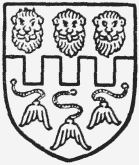
Jeffery. Party fessewise and battled gules and or with three leopards' heads or in the chief and three hawks' lures gules in the foot.
The other daughter of William Marten married the Rev. Francis Welles, and half the manor of Earl's Croome passed into this family. Edmund Marten Welles, probably the son of Francis Welles, owned the property in 1770. (fn. 62) The next owner was Edmund Francis Welles, possibly son of the former owner, and he is known to have held the property between 1805 and 1817. (fn. 63) Shortly after this time this moiety of the manor appears to have lapsed to the Dunnes. (fn. 64)
In the 15th century a fair was held at Herdwell in Earl's Croome at the feast of St. Lawrence. (fn. 65)
CHURCH
The church of ST. NICHOLAS consists of a chancel measuring internally 15 ft. by 13½ ft., a nave 34½ ft. by 18½ ft., a modern western gallery, a western tower built within the nave walls and a modern vestry. The nave and chancel are those of a 12th-century church, which remained practically untouched till the first half of the 19th century, when the west wall was rebuilt. The remains of the old west front, preserved in the vicarage grounds, are sufficient to show that it was shafted and arcaded in an elaborate manner. At the same time the western tower was built within the nave walls, a western gallery erected and the vestry added. New tracery was also inserted in several windows, which had already in some cases been enlarged at various dates in the 14th and 15th centuries.
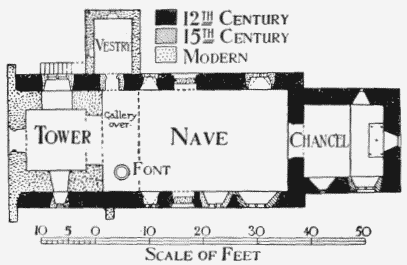
Plan of Earl's Croome Church
The cast window of the chancel is a single light. The rear arch is of 12th-century date and round-headed, but the window itself has a trefoiled head, inserted probably in the 14th century. Above this is a small loophole window, with an elaborately carved 12th-century head, jambs and sill. Below this, externally, is a portion of an enriched cable-moulded string-course of the same period. In the north wall is a small untouched 12th-century window with a round head and an external rebate for a wooden frame. To the south are two windows, the eastern having a two-light wooden frame of the 15th century with trefoiled heads, and the western a single 12th-century light with a modern head of 13th-century character. The chancel arch is semicircular and elaborately ornamented on its western face, with zigzag ornament and a roll moulding. The responds have angle-shafts on the west, with cushion capitals, richly carved with interlacing floral designs, surmounted by deep square abaci, ornamented with 'arabesque' designs in low relief, and, in the case of the southern one, with a well-formed lion looking backwards. The bases are also moulded and carved and the shafts are ornamented with the cheveron. There are two 12th-century openings in the north wall of the nave, both enlarged to two lights. The eastern has modern tracery in the style of the 14th century and the tracery of the other is made up of later work. The north door between the windows is blocked, and though somewhat restored is similar in style and date to the chancel arch. Of the three windows in the south wall the first is of 15th-century date with modern tracery. It is of two lights with traces of flowing decoration in colour on the jambs and rear arch. West of this is a two-light modern window of 14th-century detail, while the third is similar to the corresponding window in the north wall. The 12th-century south door is also blocked, and has a round head enriched with roll and cheveron, the side shafts having scalloped capitals and moulded bases. The old wooden door retains a portion of its ironwork.
Built in the western portion of the nave is the modern tower, and opening into it are two old nave windows, both somewhat restored. The northern is of two lights with a quaterfoil over, and the southern is a single light of a lancet type. the external jambs and head being modern. The west wall is almost entirely modern with a doorway of 12th-century detail. A rough sketch (preserved at the rectory) of the west front previous to the rebuilding shows a double arcade of 12th-century design. The tower is three stages high and has an embattled parapet.
On the north wall of the chancel is a small tablet with a well-designed inscription, in Roman capitals, to Thomas Jeffery, died 1650, and on the south a painted inscription, and over it, carved in low relief, a shield of his arms.
There are five bells: the treble dated 1746, the second 1739, and the third, fourth and fifth 1707.
The plate consists of a cup with a paten cover (hall-marked for 1571), a small plated paten and a plated flagon.
The registers before 1812 are as follows: (i) baptisms from 1647 to 1785, burials 1658 to 1785, marriages 1659 to 1785; (ii) baptisms and burials from 1785 to 1812; (iii) marriages from 1754 to 1812. Some earlier 17th-century entries will be found among the Bishops' Transcripts.
ADVOWSON
The advowson of the rectory of Earl's Croome has always followed the same descent as the manor, (fn. 66) the Welles and Dunne families presenting alternately when the manor was divided between them.
In 1670 Fleetwood Sheppard presented to the church, (fn. 67) and Thomas Wheat did so in 1701, (fn. 68) but it seems probable that this was by arrangement with the Jeffery family, for Sir Robert Sheppard and Thomas Wheat were trustees or the marriage settlement of Sir Robert Barkham and Hester Jeffery in 1689. (fn. 69)
Nash writing in 1779 states that there was then in the registry of the church of Worcester a deed of composition between the rectors of Ripple and Earl's Croome concerning the burial of their dead. (fn. 70)
CHARITIES
In 1796 the Rev. F. Welles—as appeared from the church table—by his will left £20, the interest to be distributed in bread on Christmas Eve. The trust fund now consists of £31 on deposit at a bank, the annual interest of about 15s. being duly applied.
The Church Lands—also mentioned on the church table—consist of 8 a., or thereabouts, producing £11 5s. yearly. The official trustees also hold the sums of £44 15s. 6d. consols and £225 2½ per cent. annuities, arising from sales in 1898 and 1902 of cottages and lands, producing in annual dividends £6 15s.
The income is applied towards the repair and upkeep of the church.