A History of the County of Worcester: Volume 3. Originally published by Victoria County History, London, 1913.
This free content was digitised by double rekeying. All rights reserved.
'Parishes: Daylesford', in A History of the County of Worcester: Volume 3(London, 1913), British History Online https://www.british-history.ac.uk/vch/worcs/vol3/pp334-338 [accessed 30 April 2025].
'Parishes: Daylesford', in A History of the County of Worcester: Volume 3(London, 1913), British History Online, accessed April 30, 2025, https://www.british-history.ac.uk/vch/worcs/vol3/pp334-338.
"Parishes: Daylesford". A History of the County of Worcester: Volume 3. (London, 1913), British History Online. Web. 30 April 2025. https://www.british-history.ac.uk/vch/worcs/vol3/pp334-338.
In this section
DAYLESFORD
Daeglesford, Deilesford, Eilesford (xi cent.); Daeilesford, Dayleford (xii cent.); Dalysford, Dailsford, Dallifford, Dallisford (xvii cent.).
The parish of Daylesford, containing 670 acres, of which 266 acres are arable land, 258 under permanent grass and 47 woodland, (fn. 1) lies between Oxfordshire and Gloucestershire on the left bank of the little River Evenlode, which forms its south-western boundary. The Oxford, Worcester and Wolverhampton branch of the Great Western railway runs alongside the river, which makes a great curve to the east and is twice crossed by the line within half a mile south of Adlestrop station. Close to this curve of the river and rather more than a quarter of a mile from the main road is the neat village of Daylesford, which was entirely built by the late Mr. Grisewood on the road leading to Daylesford Park, the old houses being pulled down one by one as the new were finished. At its western end on slightly rising ground stands the church of St. Peter with its depressed spire looking down on the double row of well-built comfortable cottages which suggests a succession of park lodges rather than a village street.
A road from Kingham (co.Oxon.) separates the church from the village, and runs north-west to join the main road from Stow-on-the-Wold to Banbury, which crosses the Evenlode a little south of Adlestrop station and forms the greater part of the northern boundary of Daylesford. The ground slopes gradually up from the river till it reaches a height of about 700 ft. above the ordnance datum in the north corner of the parish. From this point a footpath leads along the north-eastern boundary to meet the road from Chipping Norton, which runs almost due west along the borders of Daylesford Park to Norton Gap, where it joins the road to Stow-on-the-Wold. Both roads are well shaded, and in the park there are many fine trees, especially beeches.
Daylesford House is a handsome late Georgian building standing in the middle of a well-timbered park. The house was built about 1793 by the East India Company for Warren Hastings, and in it he spent the last years of his life. It is built on the slope of rising ground, the main rooms facing south and west. The entrance front has been added to and altered since Hastings was there. The elevations are of a plain and somewhat heavy classical type, and the interior is decorated with the severe classical plaster detail of the period. The state bedroom is a very good example of the domestic work of this time with a high-domed ceiling and a segmental bay. The old furniture has for the most part disappeared, but many of the pictures remain. Particularly notable is a large collection of exquisite miniatures of Indian workmanship.
The gardens at the back of the house were planned and laid out by the exgovernor. Possibly he regarded such improvements as a part of his inheritance, for there is a local tradition that his great-great-grandfather John Hastings busied himself with agricultural improvements as far as his limited means would allow, and was the first to introduce into England the sainfoin which has now become so thoroughly naturalized in the country round Daylesford. (fn. 2) Corn and root crops are also at the present time grown in the parish, but a large proportion of the land is pasture. The subsoil is Oolite and Lias, with beds of Chipping Norton limestone.
The following place-names occur in local records: Combe Grove, (fn. 3) the Parsons Seete, Hillis Close, Wills Close, Gallaunce, Bickerstaffe Coppice, Baywell (fn. 4) (xvii cent.); Great Hill, the Picked Piece, Proctor's Farm, and Halifax's Farm (fn. 5); the Pike, Hunger Bean, Hangings, Mazey Ground, Tipsey Hill, Sparkwell and Slinket (fn. 6) (xviii cent.).
MANOR
The history of DAYLESFORD during the centuries preceding the Domesday Survey depends almost entirely on the conflicting statements of the two religious houses between whom its possession was for many years disputed. According to the Abbot and convent of Evesham it had been granted to their house for the support of the monks by Earl Ælfgar with the consent of King Edward the Confessor, (fn. 7) while the Worcester monks stated that it had belonged to them ever since the end of the 9th century, though they do not seem to have been quite certain whether the original grant had been made to Bishop Eadberht by Beorhtwulf, King of the Mercians, in 841, (fn. 8) or to the monastery before 875 by King Ceolwulf II of Mercia. (fn. 9) Both statements could be supported by charters in the Worcester chartulary, which also contained leases made by St. Oswald the Bishop to his brothers between 961 (fn. 10) and 979, (fn. 11) as well as a charter of King Ethelbald granting the land to Bœge (Bœgia) in 718 for the foundation of a monastery. (fn. 12) In comparison with so ancient a title the claim made by Evesham Abbey seems modest, but the charter of Ælfgar which her monks were able to produce stated that the earl had made the gift because he 'had heard and knew that the land belonged of old time to that church' (fn. 13); and it was witnessed by almost every person of the day who had any claim to distinction. (fn. 14)
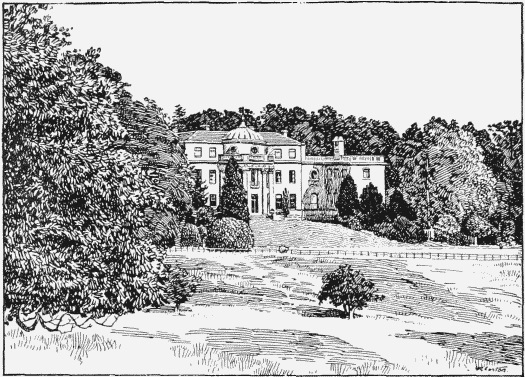
Daylesford House
Of these varying statements the claim of Evesham receives the most support from the Domesday Survey, where it is said that Daylesford was assigned to the support of the monks and was held by the abbot of the Bishop of Worcester until Odo of Bayeux took it from the abbey. (fn. 15) The Bishop of Worcester appears to have been still recognized as overlord in the 12th century, (fn. 16) but after the Hastings family obtained the manor it is usually said to be held of the Earl of Pembroke. (fn. 17) Godfrey Giffard revived the episcopal claims, and succeeded in 1290 in obtaining an acknowledgement from Sir Miles de Hastings that he owed suit at the court of Blockley. (fn. 18) Daylesford was also included in the bishop's hundred of Winburntree, (fn. 19) and appears on the court rolls as late as 1680, though its owners seem usually to have evaded their duty. (fn. 20) The last mention of the overlordship of Pembroke occurs in 1541, (fn. 21) and in 1637 the wardship of John Hastings belonged to the Crown, (fn. 22) though Habington says his inheritance was held 'partly of the Bishop of Worcester.' (fn. 23)
Stephen the son of Fulchered held Daylesford in 1086, (fn. 24) but it seems probable that the land was afterwards acquired by Urse D'Abitot, or his brother Robert Despenser, for the Worcester chartulary records that Walter de Beauchamp held 3 hides there in the time of Henry I. (fn. 25) It subsequently passed to Robert Marmion, who was the tenant in 1182. (fn. 26) At the same date Philip de 'Haster' (? Hastings) was said to hold Daylesford of the bishop, possibly as a tenant under Robert Marmion. (fn. 27) Eutropius Hastings, who held half a fee of the Bishop of Worcester in 1166, may have been owner of Daylesford. (fn. 28) William Hastings was holding lands in the neighbourhood in 1216, (fn. 29) and in 1275 Miles de Hastings granted the manor, on condition that he himself should hold it for life, to his younger son Thomas and the heirs of his body with remainder in default to another younger son Nicholas. (fn. 30) Miles died in 1305, (fn. 31) and was succeeded in Daylesford by Thomas, (fn. 32) who died before 1310, leaving the manor to Roland Hastings, probably his son. (fn. 33) Roland was still living in 1333, (fn. 34) but died before 1335 (fn. 35); his heir was another Thomas Hastings, who died in 1362, leaving a son Bartholomew in his minority. (fn. 36) Bartholomew came of age in 1368, (fn. 37) but the history of the manor during the next twenty years is difficult to trace. By 1393 the property had passed to John Mirye of Lyneham (co. Oxon.), who settled it in that year on himself and Agnes his wife with reversion to his own heirs (fn. 38); and before 1408 it was held by Richard Milton and Katherine his wife in right of Katherine, who was perhaps the daughter of John Mirye. (fn. 39) She and her husband sold Daylesford in 1408 to Thomas Hastings, (fn. 40) traditionally said to have been a member of the old family, though it is not clear whether he was a descendant of Bartholomew or Nicholas.
The manor subsequently continued in the possession of the Hastings family for over 300 years. It was held by Edward Hastings in 1466 (fn. 41) and 1494, (fn. 42) and successively by his son (fn. 43) and grandson, (fn. 44) both John Hastings. Simon the son of John the younger succeeded in 1585, (fn. 45) and made a settlement of the estate in 1618 on himself for life and his wife Susanna during her widowhood and to the use of his younger sons and daughters for sixteen years with reversion to his eldest son John and John's son Edward. (fn. 46) Simon Hastings died in 1628 (fn. 47) and John in the following year (fn. 48); Edward had died during his father's lifetime, and John's heir was his infant son and namesake, (fn. 49) whose long minority only ended in 1648. He married Elizabeth, the daughter of Sir Thomas Penyston, (fn. 50) whose surname was given to his son and continued in the family for three generations. Penyston Hastings succeeded his father before 1674, (fn. 51) but his fortune was so much reduced by 1709 that he and his sons Samuel, Penyston and Theophilus were obliged to covey the estate to trustees to raise money for the payment of £3,345 6s. to the Misses Eaton of Oxford, (fn. 52) and subsequently to sell it to Jacob Knight, (fn. 53) from whose trustees it was bought back in 1793 by Warren Hastings, the great Governor-General of India and grandson of the younger Penyston. (fn. 54)
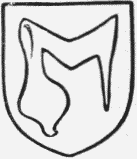
Hastings. Argent a sleeve sable.
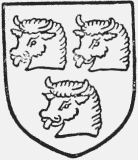
Imhoff. Argent three buffaloes' heads sable cut off at the neck.
Warren Hastings died at Daylesford in 1818. In accordance with a settlement of 1798 he left the property to his wife Marian for her life with reversion to Charles Imhoff, her son by her first husband. (fn. 55) Mrs. Hastings died in 1837, and Sir Charles Imhoff subsequently remained in possession of the manor until 1853, (fn. 56) when he sold it to Mr. Harman Grisewood, who retained it till his death in 1874. (fn. 57) It was afterwards bought from his trustees by Mr. R. Nichol Byass, (fn. 58) who sold it in 1884 to Mr. Charles Edward Baring Young, the present lord of the manor. (fn. 59)
Five messuages and 4 virgates of land in Daylesford were settled in 1275 by 'the younger Miles de Hastings' on Margery de Hastings and her heirs, to be held for the rent of a rose at Midsummer for all service. (fn. 60) She granted her holding in 1286 to William de Chyrinton, clerk, (fn. 61) and it afterwards passed to John le Boteler and Margaret his wife, (fn. 62) who settled it in 1353 on William of Evenlode and his wife Felice. (fn. 63) Its subsequent his tory is obscure.
There was a water-mill attached to the manor of Daylesford in 1275, (fn. 64) which seems to have followed throughout the descent of the manor. (fn. 65) It is mentioned in the sale of the estate to Jacob Knight in 1715, (fn. 66) but had apparently disappeared before 1797. (fn. 67) There is now no trace of the building, but it probably stood on the left bank of the Evenlode near the rectory, where there are sluices and a second stream which looks like a mill-race.
CHURCH
The church of ST. PETER consists of a chancel measuring internally 10½ ft. by 13 ft., a central tower about 11 ft. square, north and south transepts 10 ft. deep and 12 ft. wide, and a nave 30 ft. by 15 ft. There are also a vestry and organ bay on the north side of the chancel and a south porch.
The present building, designed by J. L. Pearson in 13th-century style, was built in 1860 by Harman Grisewood to replace another erected in 1816 on the site of a very much older church. The east window consists of three large lancets, each under an elaborate rear arch, and on each side of the chancel is a wall arcade with an alabaster dado below. Some remains of 12th-century work exist in the north wall of the chancel, consisting of two capitals and one bay of a Norman arcade of two square orders.
The transepts are divided off by screens of open ironwork and the responds of the tower arches are enriched with polished marble shafting.
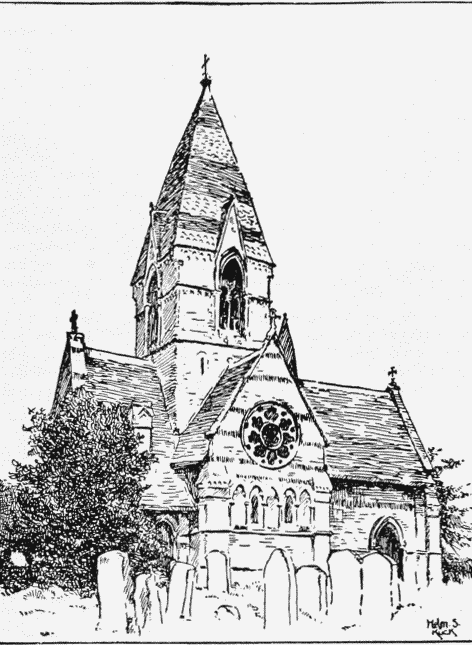
Daylesford Church from the North
In the south porch some fragments of 13th-century work are embodied in the present jambs and capitals. Several tablets and monuments have been transferred from the original church, including a well-preserved brass to William Gardiner of Lagham, Surrey, who died aged twenty-six in 1632. It is engraved with a large figure in short cloak and riding boots, a crest and three coats of arms, two being Gardiner (azure) a griffon passant (or) and one Gardiner impaling Hastings (argent) a maunch (sable). The following inscription forms a border to the brass:—
'A full carrouse, vain world,
Let those drink up that like thy sweets,
I did but miss ye cup,
Thy best I tasted and disliked, for when
Thy enjoyed pleasures do but weary men,
What will thy labours doe?
This made me soone to seek for rest
Before my age's noone.
Should any blame my haste let it suffice
I went to bed betimes, betimes to rise.'
On the west wall of the south transept is a tablet to Abel Makepeace, gent., 1708. On the north wall of the chancel is a tablet to Warren Hastings, acknowledging him as founder of the previous church. His actual grave, in the churchyard close to the east end, is marked by a stone urn inscribed 'Warren Hastings' and mounted on a square pedestal. (fn. 68)
Two monuments of the Imhoff family commemorate General Sir Charles Imhoff, kt., died 1853, and Anna Maria Apollonia Baroness Imhoff, died 1837, 'relict of the Right Honourable Warren Hastings.' The church is built of Broadway stone and has a square pyramidal spire with gables over the four belfry lights.
There is a set of tubular bells and two ordinary bells without inscriptions.
The plate consists of a modern cup, paten and flagon (1860).
The registers (fn. 69) before 1812 are as follows: (i) baptisms from 1674 to 1788, burials 1679 to 1785, marriages 1684 to 1748, many pages being missing; (ii) baptisms from 1787 to 1812; (iii) marriages from 1755 to 1812.
ADVOWSON
At the time of the Domesday Survey there was a church in Daylesford, of which the advowson then belonged to Stephen the son of Fulchered, (fn. 70) and afterwards followed for the most part the descent of the manor. It was granted by Miles de Hastings to his son Thomas in 1275, (fn. 71) but was not included in the life grant which Thomas made to his father in return. (fn. 72) Thomas presented in 1281, (fn. 73) but Miles seems nevertheless to have considered that he had some right to the patronage, for he sued his son for its recovery in 1302. (fn. 74) During this suit the patronage devolved by lapse of time on the Prior of Worcester, (fn. 75) the see being vacant, and the Abbot of Westminster wrote asking that the living might be given to William of Evenlode. (fn. 76) The prior, however, gave it to Wulfstan of Worcester, together with a licence for seven years' absence for study. (fn. 77) But the king sent a writ of prohibition for the duration of the lawsuit, (fn. 78) and Wulfstan the incumbent resigned in 1305, when Thomas de Hastings again presented. (fn. 79) After this date the advoson followed the descent of the manor until the 18th century, (fn. 80) though Sir Francis Russell, bart., presented for one turn in 1679. (fn. 81) It was conveyed in 1716 to the younger Penyston Hastings, (fn. 82) who presumably sold it, for in 1753 Miss Elizabeth Selfe was the patron, (fn. 83) and in 1766 the Rev. Thomas Brooks presented in right of his wife Mary. (fn. 84) The advowson was afterwards bought by Warren Hastings, who presented in 1814, (fn. 85) and was bequeathed to Sir Charles Imhoff. (fn. 86) It was sold with the manor in 1853 to Mr. Harman Grisewood, (fn. 87) who left it in his will to his brother Mr. Henry Grisewood. (fn. 88) The Rev. Arthur George Grisewood, rector of Daylesford and son of Mr. Henry Grisewood, is now the patron.
There do not appear to be any endowed charities in this parish.