
A History of the County of Worcester: Volume 3. Originally published by Victoria County History, London, 1913.
This free content was digitised by double rekeying. All rights reserved.
'Parishes: Overbury', in A History of the County of Worcester: Volume 3, (London, 1913) pp. 468-478. British History Online https://www.british-history.ac.uk/vch/worcs/vol3/pp468-478 [accessed 26 April 2024]
In this section
OVERBURY
Uferabyrig, Uferebreodun, Uferebiri (ix cent.); Uverabreodun (x cent.); Ovreberie (xi cent.); Werebyri (xii cent.); Uverbyri (xiii cent.).
The parish of Overbury lies in the south of the county. Habington in his survey describes it as 'seated at the foote of Breadon Hill in a beautiful vale, and the extreeme southe of our shyre, in so muche as three of her chappelles, being Tedington, Aulston, and Washbourn, are severed from the continent of our shyre by the county of Gloucester.' (fn. 1) The Carrant Brook, mentioned by this name in a 9th-century charter, (fn. 2) forms the southern boundary of Overbury, separating it from Teddington. This stream formerly supplied the power for paper, silk and corn-mills.
The area of the parish, exclusive of Little Washbourne and Alstone, is 2,817 acres. (fn. 3) The village lies at about 200 ft. above the ordnance datum. To the north and west the land rises rapidly to Bredon and Conderton Hills, the northern border of the parish being at a height of 900 ft. above the ordnance datum. The soil varies. The southern part of the parish is on the Lower Lias and the northern on Inferior Oolite, the chief crops being wheat, oats, barley and roots. The inhabitants are chiefly employed in agriculture. In the middle of the 19th century some of the women were employed in glove-sewing. (fn. 4)
The village of Overbury lies on the Tewkesbury and Evesham high road at the foot of Bredon Hill. The church stands near the centre of the village, and on its north side standing in its park is Overbury Court, the seat of Sir Richard Biddulph Martin, bart., J.P. The house is of the early 18th century with modern additions. The cottages which compose the village have been for the most part rebuilt with great taste and judgement by the present lord of the manor. The post office, on the south side of the Bredon road, is an old cottage added to and enlarged in half-timber from the designs of the late Mr. Norman Shaw. On the north side of the same road, to the east of the church, is a pair of stone cottages, with a four-centred entrance gateway upon which is carved 'E.R. 1.R. 1639.' Upon the road which leads northward up the side of Bredon Hill, parallel with the eastern boundary of the grounds of Overbury Court, are many houses and cottages, none, however, architecturally of any importance.
At the hamlet of Conderton, to the eastward of the village of Overbury, is Conderton Manor, an H-shaped Carolean house of stone, two stories in height, with an attic in the roof. Some early 18th-century panelling and a staircase of oak with twisted balusters remain, but the house has been much restored and modernized. It is now the residence of Mrs. Franklin.
The hamlet of Teddington lies to the south of Overbury on the southern side of the high road from Tewkesbury to Stow-on-the-Wold. At the point where this road crosses that from Evesham to Cheltenham and meets Crashmore Lane leading north to Overbury village stands an ancient guide-post of stone called Teddington Hands, (fn. 5) bearing the inscription:
'Edmund Attwood, (fn. 6) of the Vine Tree,
At the first time erected me,
And freely he did this bestow
Strange travellers the way to show;
Ten generations passed and gone,
Repaired by Alice Attwood of Teddington,
August 10th 1876.'
The village is situated on a branch road from the Evesham and Cheltenham road at about 100 ft. above the ordnance datum, and the church stands on rising ground to the south of the road along which the cottages are grouped. To the south the land rises abruptly to Oxenton Hill, which is just over the southern boundary. The Tirle Brook flows through the west of the hamlet.
Little Washbourne is a small village to the north of the road from Tewkesbury to Stow-on-the-Wold, to the east of Teddington. It is still a chapelry of Overbury, but was transferred to Gloucestershire for Parliamentary purposes in 1832, (fn. 7) and for all purposes in 1844. (fn. 8) The chapel of Little Washbourne now stands in the orchard of a farm which with one or two cottages comprises the entire hamlet.
The village of Alstone, which became part of Gloucestershire at the same date, is south-west of Little Washbourne. On the north side of Alstone Church is a fine L-shaped half-timber farm-house of the 15th century, and there are several stone-built cottages of 17th-century date in the village.
On Conderton Hill to the north of the village of Conderton is a small oval camp, near which Roman remains have been found. Fragments of Roman pottery and coins have been picked up in the arable fields near Overbury and Conderton, and it is probable that there was a villa here. (fn. 9)
An Inclosure Act for Overbury was passed in 1811, (fn. 10) and the award is dated 29 March 1815. (fn. 11)
Among the place-names are Butthay, Stanthall, Berry Furlong, (fn. 12) Lower Meron (fn. 13) (xvii cent.).
MANORS
Ceolwulf II, King of Mercia, gave OVERBURY in 875 to the monks of Worcester, (fn. 14) who in 1086 held Overbury with Pendock, (fn. 15) where there were 6 hides that paid geld. (fn. 16) The manor was confirmed to the prior and convent in 1148 by Simon Bishop of Worcester. (fn. 17) In 1240 there was a curia with 3 carucates of land. (fn. 18) The manor remained with the priory until the Dissolution in 1540. (fn. 19) It was granted to the Dean and Chapter of Worcester in 1542 (fn. 20) and confirmed to them in 1609. (fn. 21) The manor was sold in 1652 by the commissioners for the sale of church lands to William Horton, Henry Smith and Anthony Dickins, (fn. 22) the site and warren of the manor having been sold in the previous year to Giles Parsons. (fn. 23) At the Restoration it was recovered by the dean and chapter, and confirmed to them in 1692–3. (fn. 24) In 1859 the lands of the dean and chapter were taken over by the Ecclesiastical Commissioners, (fn. 25) now lords of the manor. (fn. 26)
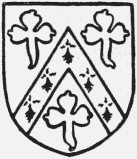
Parsons. Azure a cheveron ermine between three trefoils argent.
The Parsons family held the manor under lease from the dean and chapter from 1641. (fn. 27) William Parsons, the last survivor of the family, died in 1714, leaving an only daughter Mary, an infant, who married in 1735 William Bund. William Parsons was the last life in the lease from the dean and chapter, and at his death it was not renewed. A new lease was then granted to John Martin, a banker, who built at Overbury a house which was burnt down in 1735. A few years afterwards a second house, called Overbury Court, (fn. 28) was built, and is now occupied by his descendant, Sir Richard Biddulph Martin, who was created a baronet in 1905. (fn. 29)
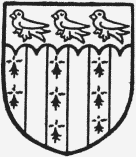
Martin of Overbury, baronet. Paly erminois and azure a chief engrailed gules with three martlets argent therein.
Free warren in the manor of Overbury was granted to the Prior of Worcester in 1256, (fn. 30) and confirmed by Edward III in 1355 (fn. 31) and by Richard II. (fn. 32) The warren was sold by the Parliamentary Commissioners to Giles Parsons in 1651. (fn. 33)
CONDERTON (fn. 34) (Cantuaretun, ix cent.; Cantertun, xii cent.; Kanterton, Canterton, xiii cent.) was granted in 875 with the manor of Overbury to the church of Worcester by King Ceolwulf. (fn. 35) It was confirmed to the monks in 1148 by Bishop Simon. (fn. 36) In 1212 Ralph Prior of Worcester gave to Godfrey son of Stephen de Canterton half a hide of land which Stephen his father had held, for the rent of a mark yearly at the four terms. (fn. 37) In 1220–1 Peter son of Peter and Emma de Bellewe (Bella Aqua) recovered half a hide of land here against Richard le Scot and his wife Alice. (fn. 38) Peter son of Peter was in possession in 1240, when he paid 16d. four times a year to the prior for the estate. (fn. 39)
By an undated charter Walter de Bradewell gave to William de Fescamp all his land in Conderton, saving to the Prior of Worcester a rent of a mark at the four terms and to Walter and his heirs a rent of 20s. 8d. (fn. 40) William de Fescamp was holding the estate, half a hide, of the prior in 1240. (fn. 41) It was possibly the rent reserved by Walter in the above-mentioned grant which was given by him to William de Aqua, whose widow Margery gave it to the almoner of the priory of Worcester. (fn. 42) By an undated charter William Herun gave to the prior and convent 1¼ acres of land in Conderton in exchange for a place called the Chapel Heye in Conderton. (fn. 43) The prior obtained further grants of land in Conderton in 1322. (fn. 44)
Conderton was probably always part of the manor of Overbury, and in 1652, when the latter was sold by the Parliamentary Commissioners, it was called the manor of Overbury and Conderton. (fn. 45)
In 780 Offa, King of Mercia, gave 5 'manses' at TEDDINGTON (Teottingtun, viii cent.; Tidinctune, Tidantun, x cent.; Teodintun, Theotinctun, Teotintune, xi cent.; Tedinton, xiii cent.) to the monastery of Bredon. (fn. 46) The possessions of the monastery afterwards passed to the see of Worcester, (fn. 47) but this manor was taken from the church by Beorhtwulf, King of Mercia, about 831. Bishop Eadberht (Heaberht) went to Tamworth and at Easter 840 proved his right to the manor before the king and the assembled nobles, and the land was restored to him. (fn. 48) It was confirmed to the monks in King Edgar's famous charter of 964 granting the hundred of Oswaldslow to the church of Worcester. (fn. 49) In 969 Oswald, Bishop of Worcester, granted land there to one Osulf and to his two children, and after them to his wife Eadleofu and her two brethren. (fn. 50) In 977 he leased three 'manses' at Teddington to one Eadric for three lives, (fn. 51) and eight years later the same Eadric received a further grant of 5 'manses' for three lives. (fn. 52) In the time of Edward the Confessor one Toki, a rich and powerful minister of the king, left by his will 3 hides in Teddington and Alstone to Ealdred, Bishop of Worcester, but his son Aki, (fn. 53) also a powerful servant of the king, claimed them as his hereditary possession, and endeavoured to set the will aside. Finally, with the consent of the 'great men,' Aki gave up the property, and in return for 8 marks of gold confirmed the possession of it to the bishop, who made it over to the monks. (fn. 54) At the same time the bishop freed it from all services to the episcopal vill of Bredon, to which it was said to have belonged in ancient times, though no man then living could remember it. (fn. 55) In 1086, however, these 3 hides were still held by the monks of the bishop's manor of Bredon. (fn. 56)
In 1240 William de Godeshalve held a virgate in this manor freely for the service of going bail in the county of Gloucester for the prior's men of Teddington and Alstone wherever they should be attached. The lord of Oxenton (a manor in Gloucestershire near Teddington) from ancient times received a cartload of hay yearly from the meadow of Teddington in exchange for an undertaking to protect the manor in time of war. (fn. 57)
In 1256 the prior obtained a grant of free warren here, and this was confirmed in 1355. (fn. 58)
The subsequent history of this manor is the same as that of others belonging to the priory. On the dissolution of the house in 1540 (fn. 59) Teddington passed to the Crown, and it was granted to the dean and chapter in 1542. (fn. 60) This grant was confirmed in 1609, (fn. 61) and the manor was sold by the Parliamentary Commissioners in 1650 to William Clarke and James Stanford. (fn. 62) The farm-house of the manor was sold in the same year to William Attwood (fn. 63) and Conan Daubeney. (fn. 64) The manor was recovered by the dean and chapter at the Restoration, confirmed to them in 1692–3, (fn. 65) and was taken over by the Ecclesiastical Commissioners in 1859. (fn. 66) The commissioners do not now own a manor at Teddington, the ancient manor having perhaps become merged in that of Overbury. (fn. 67)
ALSTONE (Aelfsigestun, x cent.; Alsestun, Elfsiston, xiii cent.; Alston, xvii cent.) was granted with Teddington in 969 by Bishop Oswald to Oswulf, (fn. 68) and was given with it by Bishop Ealdred to the priory of Worcester. (fn. 69) It evidently formed part of the manor of Teddington, being assessed with it in 1240 at 3 hides, (fn. 70) and sold in 1650 as the manor of Teddington and Alstone. (fn. 71)
LITTLE WASHBOURNE (Wassanburna, viii and ix cent.; Wasseburne, x cent.; Waseburne, xi cent.; Wasseburne Militis, xiv cent.; Knyghtes Wasshebourne, xv cent.; Knyghtyswasshebourne, xvi cent.). Offa, King of Mercia, gave 10 cassates of land at Little Washbourne (which had on the east a ford called Geolwaford and on the west a spring called Gytingbroc) to the monks of Worcester in 780. (fn. 72) This land, like Teddington, was afterwards taken from the monks by King Beorhtwulf, but was recovered by them in 840. (fn. 73) In 977 Bishop Oswald granted 3 'manses' there to a monk named Winsig for three lives. (fn. 74)
In the reign of Edward the Confessor one Elmer held 3 hides in Washbourne. He afterwards became a monk, and the Bishop of Worcester took his lands, (fn. 75) but in 1086 Urse the Sheriff held the estate, of the manor of Bredon. (fn. 76) His interest passed with his other possessions to the Beauchamps of Elmley, (fn. 77) and followed the descent of Elmley Castle until the 15th century, the manor of Washbourne being held of the honour of Elmley in 1492. (fn. 78)
Under the lords of Elmley the manor was held in the time of Henry II by William son of Sampson, (fn. 79) and it afterwards passed to the Washbournes, whose ancestor Sampson may have been. (fn. 80) The first member of the family who is known to have held Little Washbourne is Roger Washbourne, who is mentioned as a juror in an inquisition of 1259, (fn. 81) and paid a subsidy of 15s. at Washbourne about 1280. (fn. 82) He was succeeded before 1299 by his son John Washbourne. (fn. 83) Roger Washbourne, son of John, to whom his father granted the manor in 1315–16, (fn. 84) seems to have taken part in the rebellion against the Despensers, and forfeited his estate to the king, for in 1322 his forfeited lands were restored to him. (fn. 85) Roger paid a subsidy of 3s. at Washbourne in 1327, and Isabel Washbourne, who paid a similar sum, was no doubt his mother. (fn. 86)
Roger Washbourne afterwards became a coroner for Worcestershire, and in 1347 the king commanded that another coroner should be elected in place of Roger, who was 'so sick and broken by age' that he could not fulfil the duties of his office. (fn. 87) His son John, who probably succeeded soon after, died without issue, and the manor of Little Washbourne passed to his uncle Peter, who in his turn was succeeded by his son John. (fn. 88) In 1368 John Washbourne was engaged in a suit against Katherine, widow of his cousin John, with regard to this manor. (fn. 89) By his first wife Joan John had a daughter Iseult, who married firstly John Salwey, and secondly Thomas Harewell, the last-named being returned as owner of this manor in 1428. (fn. 90) In 1426–7, however, John Washbourne had conveyed the manor of Knights Washbourne to Norman Washbourne, (fn. 91) his son by his second wife Margaret Poer, and Norman was returned as the owner in 1431. (fn. 92) Humphrey Salwey son of Iseult claimed this manor in right of his mother, and finally in 1479, after much controversy between the two families, it was agreed between John son of Norman Washbourne and Humphrey Salwey that John should have the manor of Little Washbourne, while Humphrey should have Stanford. (fn. 93) The manor then followed the same descent as Wichenford in the Washbourne family (fn. 94) until 1712, when Wichenford was sold by William Washbourne. The manor of Little Washbourne was retained by the Washbourne family. William Washbourne died about 1726, (fn. 95) but seems to have given the manor before this time to his son Ernle, who was dealing with it in 1717. (fn. 96) Ernle died without issue in 1743, (fn. 97) and left this property to his three sisters, Susannah, Hester Soame and Ann Sheppard, in equal shares for their lives, with remainder to their children. In the event of the three sisters leaving no issue, Richard Washbourne, son of Goodwin Washbourne of St. Ann's Lane, Westminster, was to inherit, with remainder to his heirs male. Failing such heirs the property was to go to John Robinson the younger, son of John Robinson the elder of Cransley and his heirs. (fn. 98) Six months after Ernle's death the three sisters leased the manor of Little Washbourne to Timothy Shury for eighteen years at a rent of £225. (fn. 99) The three sisters left no children, Hester, the last of the three, dying in 1782, and the estate presumably passed under Ernle's will to the Robinsons. (fn. 100) It belonged in 1791–2 to Richard Hill, (fn. 101) and it was sold by him or his son at the beginning of the 19th century to Samuel Gist Gist, (fn. 102) who was holding it in 1823. (fn. 103) He died in 1845, and was succeeded by a son Samuel, (fn. 104) who was owner of the manor in 1897. The manor of Washbourne has since this date been sold to Mrs. Eyres Monsell of Dumbleton.
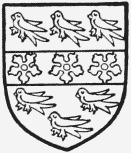
Washbourne. Argent a fesse between six martlets gules with three cinqfoils argent on the fesse.
In 1240 there were four mills at Overbury belonging to the manor and one which belonged to the church. (fn. 105) In 1291 three mills at Overbury were valued at £1 4s. (fn. 106) A water corn-mill was included in the sale of the site of the manor in 1651. (fn. 107) At the end of the 18th century there was a paper-mill on the Carrant Brook, and also a corn-mill and malthouse. (fn. 108) The paper-mill had disappeared before 1868, as had a silk-mill which once flourished at Overbury. There were then two grist-mills on the Carrant Brook. (fn. 109) The only mill in the parish at the present day is Overbury Mill, a corn-mill on the eastern boundary of Overbury Park.
CHURCHES
The church of ST. FAITH consists of a chancel 24 ft. by 16½ ft., nave 56½ ft. long and tapering from 16¾ ft. at the west to 15¾ ft. at the east, with a central tower 12 ft. wide by 13½ ft. from east to west, north aisle to the nave 10 ft. wide, south aisle 9¾ ft. wide and a modern south porch. All the dimensions given are internal.
The earliest part of the building is the nave, with its two arcades and clearstory, which dates from the latter part of the 12th century, but the variation in the width probably indicates the pre-existence of an aisleless building. A tower also appears to have been built on the site of the present one at the same time, and doubtless there was a sacrarium to the east of it. The latter was rebuilt in the 13th century, when it was widened and lengthened, but from an entry in the Worcester Episcopal Registers (fn. 110) it does not appear to have been consecrated before the year 1315. The west wall of the nave was also rebuilt, probably at the same time.
About 1330–40 the narrow 12th-century aisles were widened to their present size, the original south doorway being brought out with the wall and rebuilt. The clearstory had to be abandoned as a source of light, and was inclosed below the new aisle roofs. Nothing important was subsequently done to the structure until the latter half of the 15th century, when the central tower was entirely rebuilt. The capitals of the former 12th-century half-round responds were reversed and reset in the bases of the present arches, and the angle shafts in the chancel were turned slightly to fit the skew walls joining the chancel to the tower. The large east window was inserted at much the same time.
A gallery stood at the east end of the nave in the early part of the last century, and was removed to the west end in 1835, but in 1850 it had entirely disappeared. The church has been restored during the past century, chiefly in 1879–80. The porch is presumably of this date.
The east window is of four main and eight sublights with 'Perpendicular' tracery above under a four-centred main arch. The mullions are continued down below the sill to form a series of blind panels with quatrefoils over. The plinth outside has a moulded top member with two splays below. At the corners are 13th-century shallow clasping buttresses, and a shallow buttress divides each side wall into two bays. Two large and apparently modern buttresses have been added to each side wall. The jambs and arches of the two 13th-century lancets in either wall are richly moulded. Each jamb has detached round shafts both within and without and another engaged shaft flush with the inner face of the wall. All three have carved foliated capitals and moulded bases. The external labels mitre with a moulded string-course of the same section which runs along the wall at the springing level. A similar string-course is carried along the wall a few feet higher. The groined stone vault of the chancel is in two bays and springs from vaulting shafts attached to the wall. The angle shafts are single and filleted, but the intermediate shafts form clusters of three. All have moulded bases and carved foliated capitals. The faces of the window ledges are moulded and continued along as a string-course, which is carried up vertically by the side of the vaulting shaft and around the arch of the vault to form the wall rib. The vaulting ribs are moulded, and at the junction of the diagonals are carved bosses, both with female heads. The chancel walls are rubble-faced inside, outside they are cemented. The two-centred archways east and west of the tower are of two chamfered orders with plain bases and moulded capitals of late 15th-century form.
In the south wall of the tower is a small doorway with moulded jambs and pointed arch. Above it, and also on the opposite side, are windows of three lights under traceried two-centred heads. These lights the space below the modern groined stone vault which spans the lowest story of the tower. The room above the vault is lighted by single square-headed lights in the north and south walls below the moulded string-course which marks the first of the three stages of the tower. In this string are carved square flowers at intervals. In the second stage is a similar small light to the west. The third stage or bell-chamber has a square window in each wall of four lights entirely filled with small and elaborate tracery in stone. At the angles are diagonal buttresses. Grotesque winged gargoyles project at the four corners of the moulded parapet string, and lower down on the south-western buttress is a curious carved reptile. The parapet is embattled with a moulded returned coping, and at the angles are slender square pinnacles with crocketed finials. The tower is of rubble, ashlar-faced outside.
The nave arcades each consist of four bays; both are of the 12th century, but differ slightly in detail, and one (probably the south) was evidently finished before the other was begun. Both have circular columns and half-round responds. The moulded bases on the north side have a very decided 'watertable,' and the scalloped capitals are square with a grooved and chamfered abacus. The capitals on the south side are also scalloped, but in this case the vertical face of the capital is very deep and the flutes are almost horizontal. The arches on both sides are semicircular and of two square orders.
Above each column and over the eastern respond are the small semicircular-headed lights to the former clearstory; their jambs and head are splayed all round inside and rebated and chamfered towards the aisle; the easternmost, on the north side, is partly obscured by the angle wall of the later rood stair turret, in which is a square-headed doorway. In the west wall of the nave are three lancet windows with plain pointed heads. The outside stonework is all new. Inside the shafts between the lights are detached, and are square in plan, with chamfered edges and a filleted roll on the face, the latter having a moulded base and capital. These rolls or shafts are repeated on the jambs.
The 14th-century east window of the north aisle is of three lights with a traceried head. To the south of it is the doorway to the rood-loft stair set on the skew. Another doorway is inserted in the angle buttress of the tower outside. The two north windows of the aisle are of similar detail and date to the east window, and between them is the north doorway with a two-centred drop arch. The modern west window is of two lights in 14th-century style.
The three-light east window of the south aisle has all been renewed except the jambs. The two southern windows are similar, and in each case the inner stones of the tracery and the mullions are modern. The round-headed south doorway is the original late 12th-century entrance reset in the 14th century; the jambs are of three orders, the two outer each having a keeled shaft in the angle. The shafts and edge rolls have carved capitals, most of which have been partly or wholly renewed. The west window resembles that in the other aisle, and with the south porch is entirely modern. The buttresses of the aisles have been renewed with the exception of the eastern buttress of the north aisle. The north wall of this aisle is of rubble or rough ashlar in small square stones and the east end of the south aisle is also in small ashlar. The roof of the nave is gabled, and has a plastered ceiling below, cut up into panels by wood ribs. The aisle roofs are flat and of modern date.
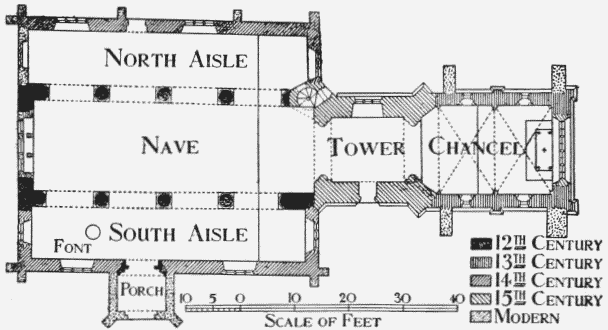
Plan of Overbury Church
The font is large, and has a bowl which appears to date from the 11th century on a 14th-century stem and base. On the curved sides of the bowl are carved two figures, one holding two croziers and the other a small model of a building; there are also a flower scroll ornament, partly repaired, and a cross and dove wholly modern. The stem is octagonal with ball flowers on the faces and the base has a moulded octagonal sub-base.
The tub-shaped pulpit is octagonal and rests on a stone base. Parts of the woodwork date from the 15th century, and the panels have traceried heads with carved spandrels and small roses at the cusp points. The cornice is carved with a running vine pattern, with inverted cresting below. The nave seats are also made up with much fine late 15th-century woodwork.
There are six bells: the treble, by Robert Hendlet of Gloucester (c. 1450), is inscribed 'Sancte Egidi ora pro nobis'; the second, which is probably of late 16th-century date, has an alphabet; the third and fourth are by Roger Purdue and dated 1641, the former is inscribed 'Come when I call to serve God all,' the latter 'Halleliah'; the fifth is by Abraham Rudhall, 1719; the tenor was added in 1903 and bears the following chronogram: 'CaMpana sanCtae f I De I Ceter I s Consonare parata.'
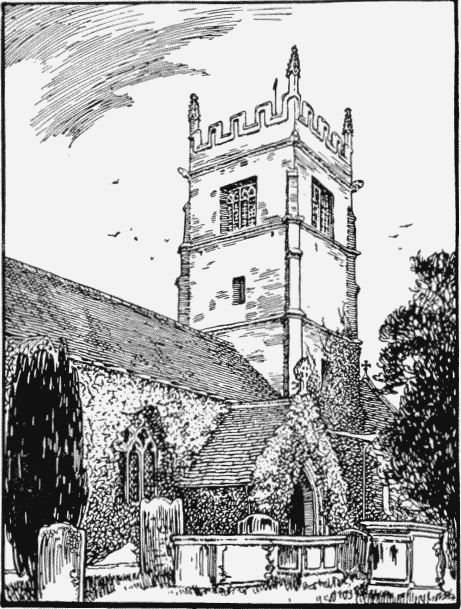
Overbury Church from the South-west
The communion plate includes a silver cup and a cover paten, the latter bearing the date 1571. There are also two patens and a flagon of 1876.
The registers before 1812 are as follows: (i) includes entries 1563 to 1681, with a single baptism entered in 1557; (ii) marriages 1686 to 1755, baptisms and burials 1683 to 1794; (iii) baptisms and burials 1795 to 1812, and (iv) marriages 1755 to 1812.
The church of ST. NICHOLAS, Teddington, consists of a chancel measuring internally 19¾ ft. by 14 ft., nave 36¾ ft. by 19½ ft., west tower 10 ft. by 8 ft. and a south porch 9 ft. 7 in. by 8 ft.
The earliest detail of the building is the plain semicircular chancel arch, which seems to indicate an 11th-century origin. The presence of moulded archstones of the early 12th century in the facing of the wall on either side of it shows that a drastic repair has taken place at some subsequent period, perhaps at the time the present west tower was built, the ground stage of which is constructed of re-used 13th-century stones. The four-centred doorway leading to the vice gives the 15th century as the date of this reconstruction. The source from which these stones were brought is uncertain. The elaborate nature of the tower arch and the west window shows that it must have been a building of considerable importance. The north-east window of the nave and the north porch are of the middle of the 13th century. The east window of the chancel dates from the latter half of the 14th century. New windows were inserted in the south wall of the nave and in both side walls of the chancel in the 16th or early 17th century.
The east window of the chancel is of three trefoiled ogee lights with tracery of a transitional type within a two-centred head. The two north windows are each of two plain square-headed lights, and between them is a small doorway with an elliptical head and moulded external jambs. In the south wall are two similar windows, the sill of the easternmost having been lowered to serve as a credence table. These features are all of the 16th century. The chancel arch, which probably dates from the late 11th century, is semicircular and perfectly plain with unmoulded imposts and plain responds. Built into the wall on either side of it are several fragments of early 12th-century moulded arch-stones and a piece of a moulded impost. Externally there are two small buttresses of one offset on either side of the east window and below the level of its sill, while at the angles of the wall are buttresses of two offsets. The walls are faced with irregularly coursed rubble.
The mid - 13th-century north-east window of the nave is a single lancet light with a trefoiled head and plain wide internal splays. The rear arch is formed by wood lintels. Below the sill is a plain oblong recess in the face of the wall. The north doorway appears to be of the late 12th century. The external head is two-centred and is roll-moulded continuously with the jambs. There is a label with a head-stop on the east and a mask-stop on the west, both partaking more of the Norman than the Early English character. The rear arch is semicircular. In the south wall are two 16th-century windows with square heads and external labels. The eastern of these is of three elliptical-headed lights and the western of two similar lights. Internally the wall sets off with a chamfer about 3 ft. above the floor level. Between these is a blocked doorway of the same date as that in the wall opposite with a two-centred external head and label and a segmental two-centred rear arch. Externally a string-course runs along the western half of the north wall and is twice lifted as if to meet the sills of two windows. There are, however, no traces in the wall above of any openings. The plinth is here swept back to the face above by a deep double chamfer. On the south wall are three buttresses of two offsets, probably of the 13th century.
The tower appears to have been built in the late 15th century. Many 13th-century details are used up in the ground stage, including the west window and the tower arch and the lower stages of the buttresses. The responds of the tower arch are formed of cylindrical piers with attached circular shafts at the cardinal points, and are built clumsily into the angles made by the west wall of the nave with the side walls of the tower, exposing two only of the attached shafts on either side. Their capitals, which are finely moulded, show them to be of the middle of the 13th century. The bases are gone and they stand on rude square blocks of stone. The arch itself fits the improvised responds very ill. It is of the same date and of two elaborately moulded orders. The west window, which is also of the same period, is a particularly fine example of early bar tracery. It is of two cinquefoiled lights surmounted by a multifoiled circle within a two-centred head. Both jambs and mullions are shafted internally and externally and the tracery is richly moulded. At the south-east of the ground stage is a vice leading to the ringing stage, entered by a doorway with a fourcentred head. This is contained within a stone-roofed westward extension of the nave, with a diagonal buttress of two offsets at the western angle. There is a similar feature on the north, by which the nave is made to clasp the tower on both sides. The tower is divided externally into three receding stages by moulded string-courses, and there are diagonal buttresses of three offsets at the western angles. The whole is crowned by a cornice with gargoyles at the four corners surmounted by an embattled parapet. The bell-chamber is lighted by two-light windows with two-centred heads containing tracery of a very poor and debased type. The walls are faced with ashlar work.
The north porch, as stated above, is of mid-13th-century date. The outer entrance has a two-centred head and is chamfered continuously with the jambs.
The roofs of both chancel and nave are of the trussed-rafter type and probably date from the 14th century. The nave roof has been considerably repaired by the insertion of ties at various later dates.
The base and stem of the font belong to the 14th century, but the bowl is modern. The pews, though much restored, are all of the late 15th century. The top-rails are elaborately moulded, but they are otherwise quite plain, with the exception of two ends, which have linen-pattern panels. The altar rails and the priest's stall in the chancel are Jacobean. On the front of the desk is carved 'Quench not ye spirit, Despise not prophecyŇ'; on the seat, 'pray continually.' The pulpit, which has been cut down and set on a stone base, was made in 1655. The date, with the names of the churchwardens, Michael Tyller and William Awoode (sic), is carved on the panels which form the back. The desk-cloth with its goldtasselled fringe has worked upon it C.W./E.A. 1717.
On the plaster of the south wall, occupying the whole of the space between the two windows and above the head of the blocked doorway, are painted the royal arms of William and Mary within a crude architectural frame. On the north wall are the Lord's Prayer and the General Confession inscribed in black letter, the work of the early 17th century.
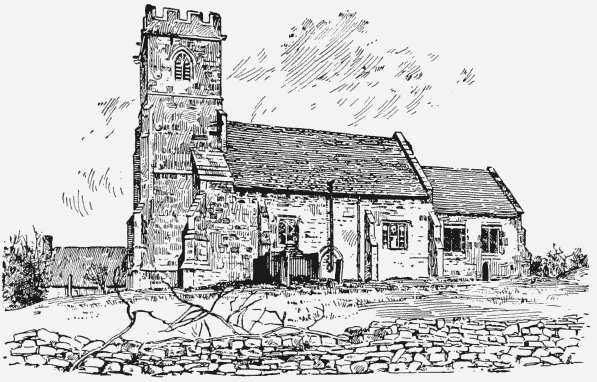
Teddington Church from the South
There are two bells, inscribed as follows: (1) 'Christus est Via, Veritas, Vita 1605,' (2) 'God Save King James 1609.'
The plate consists of a silver cup and cover paten of 1571, a modern paten and flagon and a pewter almsdish.
The registers previously to 1812 are in one volume containing mixed entries from 1560 to 1793.
The church of ST. MARGARET, Alstone, consists of a chancel measuring internally 15¼ ft. by 15 ft., nave 29¼ ft. by 17 ft., a north aisle 30¼ ft. by 8½ ft., a south porch 8¼ ft. by 7¼ ft. and a modern timber belfry over the east end of the nave.
The responds of the chancel arch and the south doorway of the nave date from the middle of the 12th century. No other details of this period remain in position. A rebuilding appears to have taken place in the 13th century, when the chancel and nave were rebuilt, a new two-centred arch being fitted to the existing responds of the chancel arch, the south doorway of the nave being retained in its original position. The south wall of the nave appears to have been again rebuilt at some later period, and the north aisle with the arcade of the nave probably dates from the latter half of the 16th century. The south porch was added in 1621.
The east window of the chancel is of two trefoiled lights and dates from the middle of the 13th century. The north-east window has modern tracery of the same character, but the jambs appear to be original. In the south wall is a window of three square-headed lights, probably of the early 17th century. At the south-east is a 12th-century projecting piscina basin, reset in the wall. A supporting shaft has evidently disappeared. The chancel arch is of two orders towards the west. The responds alone date from the 12th century. The jambs of the outer order are shafted and the shafts have enriched scalloped capitals, cabled neckings and moulded bases. Their abaci, which are enriched with the star ornament, are continued round the responds. The southern shaft, with its capital and abacus, is a modern restoration. The arch itself is of the 13th century; it is two-centred, and the orders are moulded with deep chamfers. The wall on either side is pierced by large square-headed squints. Externally there are buttresses of two offsets at the eastern angles. A deep chamfered plinth, surmounted by a small roll moulding, runs round the walls and is interrupted by the buttresses, which have independent plinths of slighter projection. The walling is of ashlar work in deep courses. The east gable has a chamfered coping and is crowned at the apex by a stone cross, probably of original 13th-century date.
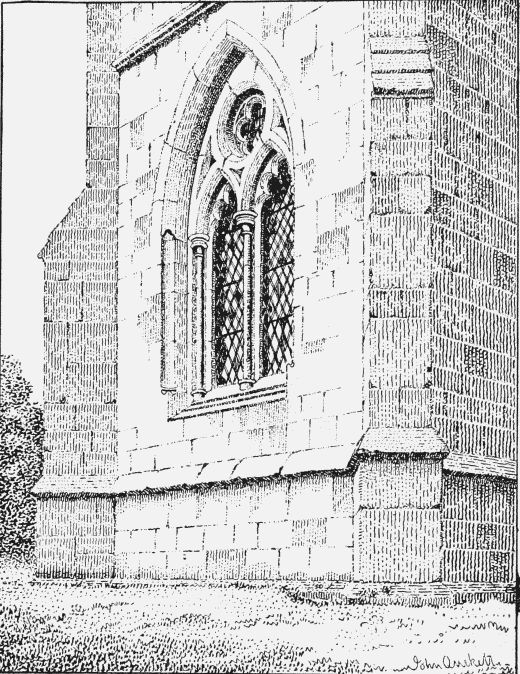
Teddington Church, West Window
The 16th-century north arcade of the nave is of three bays, with two-centred arches of two orders and octagonal columns and responds. The mouldings are of a simple and nondescript type. The easternmost window of the south wall has three four-centred lights within a square head and appears to be contemporary in date with the north arcade and aisle. The south doorway has a semicircular head, and is of two orders externally, the outer order having shafted jambs. The details are very similar to those of the chancel arch, with which it is evidently contemporary. The opening itself is square-headed, the arch being filled with a plain tympanum. This has been cracked at the head, and the stones generally bear evident marks of having been reset. The westernmost window is of two plain lights with modern mullions. It is probable that the whole of this wall was rebuilt at the time the north aisle was added, various fragments of window mullions and other moulded stones being worked into the internal facing. In the west wall is a single trefoiled light of the 13th century with an external chamfered label. The thrust of the nave arcade is taken on the east by a buttress of two offsets set with its south side against the north wall of the chancel. The west wall is crowned by a modern half-timber gable and is flanked by buttresses of two offsets. There is a buttress of a single offset at the south-west.
The north aisle is lighted by square-headed windows of two four-centred lights in the east, north, and west walls. There are angle buttresses of two offsets at the east and west and one in the centre of the north wall. The whole aisle has the appearance of having been put together of fragments.
The south porch has stone seats on either side, and the outer doorway has a four-centred head. Above the arch is carved the date 1621. The open timber roofs are tiled. The stone font is octagonal, simply moulded, and of original 13th-century date. In the south-west window of the nave are some fragments of 15th-century stained glass. The 16th-century pulpit has linen-pattern panels. Some of the bench-ends appear to be of the same date.
On the north wall of the north aisle is a monument with a long inscription in verse to the wife of 'T. D.' (Darke ?), who died in 1662. Among the other monuments is one to Elizabeth daughter of 'Mr. Smith, Minister of this Parish,' who died in 1682, and to Humphry Smith, evidently the 'Mr. Smith' of the preceding inscription, who died in 1729. There is also a fragment of an inscription in verse, from which the name has gone, to a child of nine, who died in 1696.
There is one bell, inscribed: 'Jn° New Churchwarden, 1790.'
The plate includes a cup with a floral band but without date and probably Elizabethan. There is also a plated paten as well as a silver flagon of 1880, the gift of Miss Levett of Cheltenham.
The registers previous to 1812 are as follows: (i) baptisms, burials and marriages 1546 to 1734; (ii) baptisms, burials and marriages 1782 to 1804.
The chapel of ST. MARY THE VIRGIN at Little Washbourne consists of a chancel 13 ft. by 18 ft., a nave 28½ ft. by 18½ ft., and a timber bell-turret over the west end of the chancel.
The building dates from the middle of the 12th century, but seems to have been largely rebuilt at later periods. The earlier work is of rubble masonry, but the north wall of the nave and the greater part of the south wall are faced with ashlar. The present windows are modern enlargements of the older openings and probably date from the late 18th century. The building is now in a very bad state of repair. The walls have been pushed very much out of the perpendicular by the thrust of the roof-trusses, to counteract which massive buttresses have recently been erected. The outward movement seems, however, to have ceased, as the buttresses themselves have commenced to fall away from the walls.
The east window of the chancel is a large pointed light without tracery, and there are no windows in the side walls. The timber bell-turret is supported by uprights rising from the floor. The chancel arch is semicircular and of a single plain order with jamb shafts on the nave side, having scalloped capitals and chamfered abaci. The walls are of rubble masonry, and a small blocked semicircular-headed light, with a rebate for a shutter, is visible externally in the north wall. The east gable is crowned by a 14th-century cross.
There are no windows in the north wall of the nave. In the south wall is a modern doorway, and to the east of it a window of the same character as the chancel window. There is a similar window in the west wall. The north wall and the greater part of the south wall appear to be later rebuildings, perhaps of the 15th century. They are faced with ashlar work, in deep courses. The west wall, which is of rubble, still remains much in its original condition; there are pilaster buttresses at the north and south and one in the centre, the upper part of which has been cut away for the sill of the window. A plain cross with arms of round section crowns the gable.
The roof of the chancel has trusses with tie-beams and collars strutted by arched braces. The roof of the nave seems to have undergone many repairs at various periods. The collars of the trusses are stiffened by straight struts, and there are cambered tie-beams. Externally the roofs are stone-slated. The pulpit and pews are extremely good examples of late 18th-century joinery. The altar table, which has a marble top with a narrow edge of wood, is a fine piece of furniture of the same date.
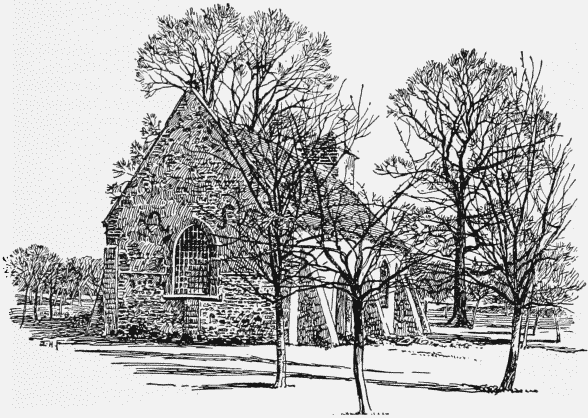
Little Washbourne Chapel from the South-west
The original bell, which is seriously cracked, is still preserved in the building. It is inscribed in black letters: 'made 1584.' The present bell was cast in 1892.
The plate includes an Elizabethan cup without hall mark or date and a pewter plate or paten.
The registers are kept with Alstone.
ADVOWSON
In 1086 the Prior and convent of Worcester had on their manor of Overbury a priest who had half a hide of land. (fn. 111)
In 1194 the Bishop of Worcester granted the prior an annual rent of 2 marks in his church of Overbury and half a mark in his chapel of Berrow (Berga) for a special feast on the Feast of the Transfiguration, and for doles to the poor. (fn. 112) In 1291 the church of Overbury with its chapels (fn. 113) was valued at £16, and the prior received £3 6s. 8d. a year for the great tithes. (fn. 114) In 1315 Bishop Maidstone consecrated the high altar in the church of Overbury. (fn. 115)
The advowson of Overbury belonged to the Prior and convent of Worcester, and remained in their possession until the Dissolution, when it passed to the Crown. (fn. 116) In 1330 the prior and convent obtained licence to appropriate the church of Overbury with its chapels, (fn. 117) but the appropriation does not seem to have taken place immediately, for in 1344 the Letters Patent granting the licence were exemplified, (fn. 118) and in 1346 Queen Philippa petitioned the pope that the appropriation might be made for the payment of the debts of the priory, and for the support of two monks at the University of Oxford. (fn. 119) The appropriation was made in the same year, (fn. 120) and the vicarage was ordained in 1368. (fn. 121) The advowson was granted to the Dean and Chapter of Worcester in 1542 (fn. 122) and has since remained in their possession. (fn. 123)
In 1240 there were chapels at Alstone, Teddington and Little Washbourne (fn. 124) attached to the church of Overbury. (fn. 125) The chapel of Alstone is not mentioned in 1330 in the licence to appropriate the church of Overbury, though the other two are then said to be chapels of Overbury, (fn. 126) but in 1535 the chapels of Alstone and Teddington were said to be chantry chapels. (fn. 127) The three chapels are still annexed to the church of Overbury.
In 1868 Noake records a chapel in Overbury used by Baptists and Independents. (fn. 128) At the present day there is a Baptist chapel, which was opened in 1861.
CHARITIES
Elizabeth Wood, who died in 1824, by her will bequeathed £200 bank stock, the dividends to be applied, subject to keeping in repair certain vaults, in the distribution of clothes for labouring poor who support their families without parish relief.
The stock was sold out and the proceeds thereof, with accumulations of income, were invested in £444 6s. 3d. consols, which is now held by the official trustees, producing £11 2s. yearly. In 1908 the income was distributed in clothing to twenty-six recipients.
Church Lands.
—The parish is in possession of about 5 acres, acquired on the inclosure in 1811, in exchange for land intermixed with other lands in the common fields. The land is let at £12 10s. a year, which is carried to the churchwardens' accounts and applied in cleaning, lighting and heating the church.
Mrs. Agg, as stated on the church table, gave £10, the annual interest to be laid out in bread to be distributed to poor widows. The principal sum, with other sums, appears to have been applied towards defraying the expenses of building the poor-house.