
A History of the County of Berkshire: Volume 3. Originally published by Victoria County History, London, 1923.
This free content was digitised by double rekeying. All rights reserved.
'Windsor castle: Architectural history', in A History of the County of Berkshire: Volume 3, (London, 1923) pp. 29-56. British History Online https://www.british-history.ac.uk/vch/berks/vol3/pp29-56 [accessed 23 April 2024]
In this section
ARCHITECTURAL HISTORY OF THE CASTLE
The castle of Windsor appears first in history in the Domesday Survey in connexion with the manor of Clewer, which was held of the king by Ralf son of Seifrid, but had formerly belonged to Harold the Earl; 'then it was taxed for 5 hides, now for 4½ hides, and the castle of Windsor is on the (other) half hide.' (fn. 1) The castle was thus a new work, and there are no grounds for assuming it to be older than the Conquest or that any part of it occupies the site of defensive earthworks of earlier date. (fn. 2)
Although the Survey does not ascribe its building to King William, the castle was no doubt raised by his orders, (fn. 3) and from the first it has been the special stronghold of the Sovereign. This may account for its exceptionally large area of some 13 acres within the lines of defence, instead of the more usual 4 or 5. It also fills a prominent place in the great series of castles that were planted all over England by the Conqueror to effect the subjugation of the country, (fn. 4) and apparently forms one of a ring set about London to keep the turbulent citizens in order, in addition to the two castles within the city itself. (fn. 5)
Windsor Castle is placed upon the top of a steep chalk cliff which rises almost abruptly from the south bank of the Thames opposite Eton to a height of 100 ft. The site is protected by easily defended slopes on the east and south, and has another slope towards the west forming part of the castle area.
Although later walls and towers of masonry and the filling in of the ditches have largely obscured the original lines, it is clear that from the first Windsor was a mount and bailey castle of the first rank, with earthworks crested with timber palisades.
The lower or outer bailey covered the slope towards the west and was defended by banks and ditches on the south and west and by the cliff on the north; at the south-west corner was the entrance. At the upper end the lower bailey was crossed by the ditch and bank of the middle bailey, which was continued southwards round the base of the mount. The mount itself is still intact and is about 50 ft. high and 100 ft. wide across the top, with a base nearly 300 ft. in diameter. It was encircled by its own ditch, and had on the north a narrow roadway leading into the inner or upper bailey. This formed a square to the east along the cliff, roughly of about 500 ft., with a bank and ditch on the east and south joining up to the defences of the middle bailey. Both the upper and the middle bailey occupied the level ground on top of the cliff. All the banks were no doubt crested by lines of wooden palisades and the top of the mount by a circle of the same inclosing a wooden tower, like that of the castle of Dinan as shown in the Bayeux Stitchwork. The cliff facing the river was probably also crested with palisading, so as to surround the castle with a continuous line of defence.
Such was the castle in the days of William the Conqueror. During his reign nothing is recorded of it by the historians or chroniclers, and for that of his son the only fact noted is the imprisonment here of Robert the governor or Earl of Northumbria in 1095. (fn. 6) Of Henry I it is stated that he held his court at Whitsuntide in 1110 'at New Windsor, which he himself had built.' (fn. 7) This probably refers to the completion of the royal lodging in the upper bailey, and the only Pipe Roll for the reign, that for 1130–1, notes a payment 'for the liveries of Nicholas the keeper of the king's house at Windsor.' The existence of a chapel within the castle is indicated by the fact that King Henry was married in it to his second queen, Adeliza.
With the reign of Henry II the documentary history passes from the fitful references of historians to the actual account of works entered on the Pipe Rolls and other official records. For the first seven years nothing was done, but the chaplain's pay of a penny a day points to the maintenance of the chapel. From 1161–2 to 1171–2 considerable sums were spent, chiefly on 'the king's houses,' and on the kitchen, the chapel and the castle generally. References to the castle works occur in 1169–70 and following year, and again from 1172–3 to 1178–9, in which seven years more than £663 were laid out upon them. A large sum was also spent in 1171–2 and two following years upon the wall about the castle.
From existing remains of the Norman period these works seem to have included the building of the walls and towers along the three sides of the upper bailey, the rebuilding in masonry of the royal lodging on its north side and of the great tower crowning the mount, together with the stepped curtains connecting the great tower with the bailey walls. Some progress was also made with the walling in of the middle and lower baileys, and in the case of the latter with the towers along its north front. Since these works involved the substitution of walls and towers of masonry for the older timber defences, they no doubt followed the original lines and continued to be strengthened by the original ditches.
At the close of the 12th century, besides the great tower on the mount and the royal lodging in the upper bailey, there seem to have been in the lower bailey a camera or lodging for the king, a chapel, kitchens inclosed by hedges, a larder, and an almonry, all of which involve the existence of the great hall of which they were appendages; this is not, however, specially mentioned until 1197–8.
Early in the reign of Richard I, while the king was away on the third Crusade, Windsor Castle was successively in the hands of Hugh Bishop of Durham, William Bishop of Ely (the chancellor), and Walter Archbishop of Rouen, but at the beginning of 1193 it and the castle of Wallingford were given up to John Earl of Mortain, who had tried to raise a rebellion against the king, his brother, during his imprisonment abroad. John's tenure of Windsor was, however, resented by the loyal barons, who tried to take it by force, and after a siege of several weeks it was surrendered through the influence of the Bishop of Salisbury, Hubert Walter, and retained by him for the king. Sundry repairs to the gate, bridge and other buildings, 'which were broken and burnt … through the war,' are entered on the Pipe Roll for 1194–5.
In 1216 occurred the memorable siege of the castle already referred to. Notwithstanding the damage that the castle must have sustained in this siege, no effort was made to repair it until 1220–1, when Engelard de Cygony (who was still constable) accounts for the building of a wall that had been destroyed and other works. These seem to have been only necessary outside repairs, but from 1222–3 onwards operations of a more extensive nature were undertaken upon the great hall in the outer bailey, the 'king's houses,' the 'houses on the mount,' and the great tower that inclosed them. The repairs occupied three years and included a considerable outlay on 'the works of the castle,' and expression usually applied to the external defences. This probably involved the substitution of new towers in place apparently of the Norman towers at the south-west corners of both the middle and upper baileys and connecting them by a strong curved wall as a defence to the great tower on the mount. At the same time the remaining palisading of the lower bailey was replaced by walls and towers of masonry along the north and south sides. The completion of this essential work is marked by a further charge in an account for 1227–30 'on the work of a wall with three towers,' which there can be little doubt is that still forming the western front of the castle. (fn. 8) On 14 January 1235–6 King Henry married Eleanor daughter of Raymond Count of Provence, and in the following year a lodging for the new queen was begun in Windsor Castle.
The royal lodging at this time was the only important block of buildings in the inner bailey. It was substantially of late Norman date and stood against the north wall about the middle of its length. It seems to have included a hall, a chapel and a chamber beside the hall, as well as a great chamber for the king and a wardrobe adjoining; there must also have been a kitchen, &c., while cellarage was no doubt provided in the usual way by placing all the living rooms on the first floor. The various buildings were arranged about a court or cloister with covered alleys, the garth of which was laid out as a herb garden.
The new lodging built for the queen was apparently a rebuilding of the western range, and extended southwards from a Norman 'corner tower towards the north,' which in 1241 was raised two stories, as were two other Norman towers east of it in the following year. The queen seems, however, to have misliked her lodging, and in 1237 it was rebuilt according to her wishes. Two years later the birth first of a son and then of a daughter necessitated the building of chambers and nurseries for them. These seem to have been two-storied half-timbered structures arranged about a second court to the west of the queen's lodgings. At some time between the beginning of 1244 and Easter 1247 a large stone tower was built upon the north side of the castle, apparently at the north-west corner of the children's cloister, and in 1253 this 'new tower which has been assigned to our seneschals' was raised a story and releaded. For the decade 1246–56 there are no entries relating to the royal lodging, notwithstanding that, according to Matthew Paris, the queen's apartments were damaged by lightning in 1251. It is also to be noticed that for the rest of the reign all the parts of the royal lodging are described only as the queen's, as if they had been given up to her and her growing family, while the king's lodging was henceforth in the lower bailey. Here there had been begun to be built in 1240 a certain lodging for the king's use, with a lodging for the queen under the same roof, and a certain chapel, a sufficient space being left between the lodgings and the chapel to make a certain grass plot. (fn. 9) These buildings, which were apparently not finished until about 1250, occupied the north-west corner of the lower bailey, where remains of them still exist amongst later work. They seem to have been largely of carpentry, at any rate as to the upper floor, and covered with lead.
In 1257 the queen's private apartments in the upper bailey were again rebuilt, and early in 1258 the royal chapel which adjoined them was reconstructed and rearranged. These and other works seem to have lasted on until 1262, after which nothing further was done in the castle, on account of the state of the king's and queen's affairs.
During the reign of Edward I, who was busily occupied for most of his time in building castles elsewhere, no new works were undertaken at Windsor, and the only matter worth noting is the destruction by fire early in 1295–6 of the king's great chamber in the outer bailey. (fn. 10)
Although Edward II, unlike his father, was constantly at Windsor, no important structural works were done by or for him. An Account Roll for 1320–1 contains particulars of certain works done in brattices, barriers and other engines made for the munition of the said castle by reason of the perturbation of the kingdom between the lord king and his earls, (fn. 11) but the total cost was under £10. For the last seven years of his reign the king hardly ever visited Windsor.
The beginning of the long reign of Edward III is marked as regards the castle by an inquisition and report made in September 1327 (fn. 12) of the state of the walls, towers and buildings and of the repairs deemed necessary by the jurymen. No steps, however, were taken to act upon the report until apparently 1343–4 and 1344–5, (fn. 13) and for the first fifteen years of the reign there is no important documentary history or details of any large expenditure. The subsequent repairs were only of minor character.
In February 1343–4 Edward III began a hall or house for a proposed order of the Round Table and the work continued for forty weeks, hundreds of men being engaged upon it till the end of November, when work ceased for the winter. (fn. 14) The building of the Round Table house does not seem ever to have been resumed. According to Thomas of Walsingham (fn. 15) it was 200 ft. in diameter, and it must, therefore, have stood in the court of the upper bailey, since there is no other possible place for it. From concurrent references to the great tower on the mount, which has only an internal diameter of less than 100 ft., it was undoubtedly a distinct and separate building. Its fate is nowhere recorded.
The king, about the middle of 1348, founded the order of the Garter. Many facts concur in fixing upon Windsor as the place where, and 24 June as the date when, the hastiludes that gave rise to the order occurred, (fn. 16) and on 6 August Edward issued Letters Patent substituting for the eight chaplains of St. Edward's chapel in the castle, wherein he had been baptized, a college of twenty-four canons (one of whom was to be warden) and twenty-four poor knights, a number which was at first that of the knights of the order itself. (fn. 17) The Knights Companion were afterwards increased to twenty-six, and in 1351 the College of Windsor was settled upon a new establishment, consisting of a warden and twelve other secular canons, thirteen priests or vicars, four clerks, six choristers and twenty-six Poor Knights.
The Great Pestilence, better known as the Black Death, ravaged England during 1348 and 1349, and it was not until 1350 had set in that King Edward was able to proceed with his plans in connexion with his newly-founded order.
The first work undertaken was the refurnishing of the 13th-century chapel of St. Edward (henceforth to be associated with St. George) with canopied stalls for the knights and canons of the Garter, a pew for the queen, painted windows, and a wooden roof above the vault, of great beams given by the Bishop of Salisbury, together with a new belfry over the western gable. The works in question were begun in April 1350 and not finished until four years later. On the east side of King Henry's cloister, north of the chapel, were built a vaulted vestry (1350–1) and a chapter-house (1350–2) with a lodging for the warden, which also extended over the chapter-house. To the north of the cloister stood the half-burnt camera of Henry III. This was now cleared away and on its site was raised, between January 1351–2 and the end of 1353, a two-storied half-timbered cloister, with twenty-six sets of chambers for the canons and their vicars. King Henry's cloister was next rebuilt in stone, with a vaulted porch outside its north-west corner, having above it a vaulted treasury. The great hall, &c., in the lower bailey were henceforth used as such by the canons and vicars, for whom a roasting-house was built in 1353 and a brew-house and bake-house, with a mill, the following year. A lodging was also built in 1353–4 for the Usher of the Black Rod.
Besides these works a striking clock was set up in the great tower in 1351, and between Michaelmas 1353 and the autumn of 1355 the buildings within the great tower were undergoing reconstruction for the temporary accommodation of the king and queen pending a rebuilding of the royal lodging.
Of the foregoing works, those between April 1350 and August 1351 were carried out under the supervision of Richard of Rothley, one of the new canons. He was succeeded by another canon, Robert of Burnham, who acted as clerk of the works until the end of October 1356, when he in turn was followed by William of Wykeham.
During Wykeham's first year of office the finishing touches were put to the stone cloister and the apartments in the great tower completed for the king's and queen's use.
The rebuilding of the royal lodging was begun in 1357–8 with a new gate-house or entrance tower in the middle of the front, and contracts were made for the replacing of the half-timbered western block by more permanent stone buildings. In the same year the Norman tower on the north-west of the middle bailey was converted into a residence for the clerk of the works, (fn. 18) and a stone belfry tower begun in the lower bailey opposite the chapel, which was finished the next year. These works were followed by the rebuilding of the gate-house into the upper bailey and in 1360 by the erection of a row of houses beside the new belfry.
Wykeham was succeeded in November 1361 by William of Mulsho, canon of Windsor, who held office till April 1365. Under him the reconstruction of the royal lodging was continued and completed. The range of buildings east of the new entrance tower was vaulted and enlarged and a new chapel and hall placed upon the first floor. The western block was finished by Wykehan's contractors and a small tower called La Rose added at the south-west corner. The courts or cloisters about which the various ranges of chambers stood were also rebuilt, and a kitchen court formed by the addition of several new buildings, including a gate-house from the bailey.
Before William of Mulsho went out of office a beginning had been made upon the building of ranges of chambers against the outer walls of the east and south sides of the upper bailey, and upon the completion of the towers about it. These works were eventually carried out under Mulsho's successor, Adam of Hartington, who was clerk of the works until the end of the reign, but his detailed accounts do not carry the story beyond 1368. That for his second year of office, when much of importance was done, probably to the ranges and towers along the east front, is unfortunately lost. The works along the south front, which included the enlargement of the 'Blaketoure,' the addition of a story to the large 13th-century tower on the south-west, and the construction of a new vaulted entrance beside it, were mostly carried out by 1367, in July of which year the mason's lodge was given to the vicars of the chapel.
During the reign of Richard II nothing beyond ordinary repairs seems to have been carried out, and the only fact of interest is the appointment in 1390 of Geoffrey Chaucer, esq., clerk of the works at Westminster Palace, the Tower of London and elsewhere, to be clerk for three years of certain repairs to St. George's chapel, 'which is threatened with ruin, and on the point of falling to the ground unless it be quickly repaired.' (fn. 19) Pending the repairs, of which unluckily no details have been preserved, the great hall in the lower bailey was temporarily fitted up with an altar, stalls, and other furniture, for use as a chapel.
The reign of Henry IV was also one of no important works at Windsor beyond small repairs, but in 1409 a grant was made by the king to the dean and canons of a certain place within the castle called Woodhaw, beside the great hall, to build their houses for the vicars, clerks and choristers of the chapel of St. George. (fn. 20) These houses seem to have been built in 1415–16, but the roll of particulars is missing. As King Henry V was abroad for a large part of his reign, no works beyond repairs were carried out in the castle.
The reign of Henry VI, who was but a baby at his accession, was not marked by any great works at Windsor, and even before the king came of age he began to be busied with the two colleges which he founded at Cambridge and Eton in 1440. Sundry repairs were of course carried out from time to time in the castle, but the rebuilding in 1439–40 of the lower part of the stair up to the great tower (then called le donjon) was the only noteworthy event.
From the accession of Edward IV in March 1460–1 to the death of King Henry VI in 1471 nothing beyond minor repairs was done, but from 1476 onwards some important changes, of which few details are forthcoming, were made in the king's and queen's lodgings in the upper bailey. A more notable work, however, was the building of the new chapel of our Lady and St. George in the lower bailey, to the west of the old chapel of St. Edward and St. George. This was begun in 1475, but by the time of the king's death and burial in it in 1483 the quire with its aisles, &c., was the only part roofed in and fitted for use. A new chapter-house was also built to the north of it in 1477 and the bells transferred the same year from the old belfry to the Clewer tower. From 1478 to 1481 the lodging of the vicars to the west of the chapel was rebuilt and now forms the so-called Horseshoe cloister.
For the short reigns of Edward V and Richard III there are no accounts relating to the castle in general. The fitting up of the quire of the new chapel seems, however, to have gone forward, and in 1484 the bones of King Henry VI were removed from Chertsey Abbey to Windsor and reburied in a vault made for their reception on the south side of the quire.
Owing to the paucity of records for the reign of Henry VII there is no documentary evidence of the works of his time, but they certainly included the finishing of the new chapel begun by Edward IV, the rebuilding of the old chapel of Henry III and Edward III east of it as a Lady chapel, and the erection of a 'tower' of chambers to the west of the royal lodging in the upper bailey. The chapel works were completed in 1508 and the Lady chapel built between 1494 and 1498. The 'kyngs newe tower' was begun about the same time, and completed before the coming of the King of Castile to Windsor in January 1505–6. (fn. 21)
According to Leland (fn. 22) and Lambarde (fn. 23) the only work done in the castle by Henry VIII was the rebuilding at some unrecorded date of the gate-house at the lower end of the outer bailey, but certain pay books of James Nedam, surveyor of the king's manors, (fn. 24) record the construction between May 1533 and September 1538 of a 'new wharff' or wooden gallery along the top of the cliff on the north side of the castle, with a bridge at the east end into the park. Various works were likewise undertaken within the castle, including the whitewashing of walls and ochring of ceilings of the royal apartments, to render them more habitable for the new queen, Anne Boleyn. There was also built out, before 1533, from the western part of the north front a 'new lodging called the Prince's lodging' for the king's bastard son, the young Henry Duke of Richmond and Somerset. Another important work in the lower ward also belongs to this reign, the building, at the cost and charges of Master James Denton, one of the canons, in 1520 of a hall, &c., on the north side of St. George's chapel, for the chantry priests and choristers to keep their commons in. It was unfortunately destroyed in 1859, after being for a long time converted into a canonical residence.
King Henry VIII died on 28 January 1546, and was buried on 16 February in the same vault in St. George's chapel wherein Jane Seymour had been laid to rest in 1537.
The short reign of Edward VI was marked by the provision of a new water supply from Blackmore Park, instead of the wells sunk in the chalk hitherto used. It was begun in 1551, but the pipe was only partially laid, when the work was temporarily stopped in August 1553, a month after the king's death.
Under Queen Mary the work was resumed, but not until the second half of 1555, during which the pipe was finally brought into the castle, where it ended in a gorgeous fountain or head-conduit built in the middle of the upper ward in 1557–8.
One other work of this reign must be noticed, the provision in 1557 and 1558 of a proper lodging in the lower bailey of as many sets of chambers for the thirteen Poor Knights of the order of the Garter created under the will of Henry VIII.
For the first twelve years of Elizabeth's reign, owing to the queen's parsimony, nothing was done in the castle, and strong measures had at last to be taken to save it from becoming too ruinous to live in. During the ten years from 1570 onwards extensive repairs were carried out, including the rebuilding of the royal chapel in the upper ward at a cost of £1,900. Four of the wooden bridges were also rebuilt in stone, and a decent approach with gates made along the south side of the castle into the Little Park. The old timber 'wharf' of Henry VIII along the north side was entirely rebuilt in masonry, with a stone bridge and banqueting-house at the park end. In 1582–4 almost the last addition to the castle was made by the building of the gallery (now part of the royal library) between Henry the Seventh's tower and the inner gate-house west of it.
The story of the castle during the reigns of James I and Charles I is one of repeated surveys and consequent repairs, which did not involve any important changes. All these works ceased apparently in 1637 owing to the unhappy state of the kingdom, and in October 1642 one of the earliest acts of the Civil War that had just begun was the occupation of the castle of Windsor by the Parliamentary forces.
While the castle was in the hands of the soldiery the various members of the college of St. George, saving apparently the Poor Knights, were turned out of their houses, and the rich plate and ornaments of St. George's chapel seized and sold, together with the valuable metal work of the unfinished tomb of King Henry VIII. (fn. 25) But the chapel itself seems not to have been seriously injured, nor was any particular damage done elsewhere in the castle, while special pains were taken to maintain the water supply from Blackmore Park.
In 1657–8 the last important addition to the castle was made by the building, at the west end of the lower ward, of a house for five more Poor Knights, under a bequest of Sir Peter le Maire, augmented by his brother-in-law Sir Francis Crane, after whom the building was named. It was unfortunately destroyed so recently as 1862.
For some time before the Restoration Elias Ashmole had begun collecting materials for his great work on the order of the Garter, which was published in 1672. Among the illustrations is a valuable series of views of Windsor Castle, drawn and engraved by Wenceslaus Hollar between 1659 and 1663, which are of special interest as showing the various stages of its architectural history just described. The bird's-eye view from the south-east in particular is a most valuable document, and forms a useful pendant to the large coloured drawing made by Norden in 1607 from the opposite side of the castle. (fn. 26)
From 1660–1 to 1674 large sums were spent upon the castle, mostly for repairs, which unfortunately involved the demolition in 1671 of the old 'gunner's tower' above the bridge from the lower into the middle ward. This is shown for the last time in Hollar's bird's-eye view.
In 1674 more old buildings and towers were destroyed during preparations for rebuilding the range of chambers forming the north-west section of the royal lodging. This was now replaced by a four-storied block (fn. 27) of the plainest possible character externally, but containing within on the main floor a fine set of rooms begun to be decorated in 1676–7 with carvings by Grinling Gibbons and Henry Phillipps, and in 1678 with painted ceilings and gilded work by Verrio and Coussin. The other rooms forming the royal lodging, including the king's chapel and St. George's hall, were likewise refitted and decorated to correspond, and the whole formed into one splendid series henceforth called the State apartments. The work upon these was completed in 1683–4. The rooms on the ground floor were also rearranged and decorated and allotted to various high officers of state, and the courts about which they stood entirely remodelled. The buildings in and about the kitchen court were included in the new work.
The southern range of the upper ward was taken in hand at the same time as the royal lodging, and altered and decorated internally, chiefly for the use of the king's brother, James Duke of York, and three of the four towers on the east front practically rebuilt. The great terrace along the north front was lengthened westwards and reconstructed throughout, and new terraces formed in continuation of it along the east and south fronts.
The 'Sole Architect in Contriving and Governing the Workes in the Great Alterations made by his Majtie in that Castle,' to quote from his coffin-plate at Mid Lavant, was Hugh May, who was controller of works from November 1673 till his death in February 1683–4, when he was succeeded by Sir Christopher Wren.
During the course of the works just described the House of Commons on 30 January 1677–8 voted £70,000 for defraying the expenses of a solemn interment of his late Majesty King Charles I and the erection of a monument to his memory. (fn. 28) The money was paid over to the king, and a design made by Sir Christopher Wren for the proposed memorial, which was to be built to the east side of St. George's chapel on the site occupied by Henry the Seventh's Lady chapel. Wren's scheme was not adopted, but certain repairs were done to the old Lady chapel in 1680–2, apparently in view of a memorial to the late king, and in 1682–4 its walls and ceilings were elaborately decorated by Verrio. Further works were stopped by King Charles's death on 6 February 1684–5.
During the short reign of James II various minor changes were made in the new buildings, including the refitting of both the king's and the queen's chapels and such little improvements and alterations as usually follow a change of tenant. The great works, however, had all been finished for King Charles II. A planting of 240 young elm trees in 1684–6 'in ye upper and lower Avenue' apparently marks the beginning of the famous Long Walk in Windsor Park.
King James's reign ended in December 1688, and for many years after no more important works were done in the castle. Both King William and Queen Mary seem to have preferred Hampton Court to Windsor, and expended their energies upon improving and enlarging it. Towards the end, however, of King William's sole reign a great scheme for transforming Windsor after the manner of Hampton Court was drawn up by Sir Christopher Wren which would have involved the destruction of nearly all the remaining old buildings. Fortunately it was never adopted.
Beyond the usual necessary repairs nothing of note was done in the castle during the reign of Queen Anne, who devoted herself chiefly to the laying out of the grounds about the castle. The work was mostly confined to the Home Park, under the direction of Henry Wise, and the effect of the resulting series of banks and terraces (now obliterated) on the north front of the castle is well shown in Kip's view, published in 1709. (fn. 29) The road along the Long Walk was made in 1710 and an extensive series of gardens, &c., which were never finished, was apparently in course of construction (fn. 30) when the queen died in August 1714.
From the death of Queen Anne to the end of the 18th century Windsor Castle, save for ordinary repairs, was left alone. Both George I and George II preferred Hampton Court and Kensington Palace, and, although George III eventually developed a strong liking for Windsor, the castle, except as regards the interior of St. George's chapel, remained unaltered down to 1800.
The straitened accommodation which the castle afforded for a king with a large family, like George III, partly accounts for this, and the difficulty was met, not by enlarging the castle, but in another way. To the south of the upper ward a house had been built shortly before 1690 and bought for the residence of Prince George of Denmark and the Princess Anne. Between 1778 and 1782 this house was enlarged for the use of Queen Charlotte, and was henceforth known as the Queen's Lodge. Nell Gwyn's old house, which stood just south of it, was also bought, and converted in 1779 into the 'Queen's Lower Lodge' for the reception of the four younger princesses.
During the alterations to these two houses a large quantity of rubbish and excavated material had to be dealt with, and this was most readily done by shooting it into the castle ditch along the south front, which was thus filled up, much to the detriment of the appearance of the castle. (fn. 31)
Between 1782 and 1792 extensive repairs and alterations were made in St. George's chapel, chiefly at the king's expense.
From 1800 onwards a number of works were carried out under the direction of James Wyatt (who had been appointed surveyor in 1796) with the object of converting the plain style of the exterior of the buildings in the upper ward, as left by May, into the Gothic manner which was now coming into vogue. All the windows within and without were thus gradually converted and new string-courses and battled parapets added where necessary. Stucco turrets were added to the upper corners of the north front of the Star Building, together with a porch from the terrace, and a porch was built in front of the 'gothicized' entrance tower to the State apartments. Within this latter a new lobby and great staircase replaced May's, and various other changes were made throughout the State apartments generally. The 17th-century arrangements in Horn Court were destroyed, and in their place was built a two-storied Gothic cloister. A new tower called the Blenheim tower was likewise raised on the north front at the end of the king's guard chamber. From 1801 to 1804 a series of repairs was carried out on the 'tombhouse,' as the old Lady chapel in the lower ward was called, and in 1810 a vault was constructed beneath it as a burying-place of the royal family. All work was stopped about 1814 owing to the unhappy state of the king, who from 1811 to his death in 1820 was hopelessly insane.
Shortly after the accession of George IV steps were taken to convert the buildings about the upper ward into a comfortable residence for the sovereign. Hitherto there had been no direct communication between the State apartments on the north and the lodgings on the east and south sides usually occupied by the royal family and visitors of distinction, and the maids of honour and lords and gentlemen in attendance could only reach their quarters by crossing the open quadrangle. There was also little privacy for the king and queen when living in State apartments to which the public were admitted. It was therefore decided to construct new lodgings for the sovereign along the east front and to connect the whole of the buildings about the ward by a two-storied gallery against the east and south sides. Had this been the only object of the proposed changes little alteration would have been made in the castle, but they unfortunately included others which involved the needless destruction of many ancient features that might well have been spared.
The new works were entrusted by a commission appointed to carry them into effect to Jeffrey Wyatt, a nephew of the late surveyor James Wyatt, and on 12 August 1824 the first stone was laid by the king, who on the same day authorized the architect to change his name to Wyatville and granted him an augmentation of his arms.
The works were carried on with great energy, and on 9 December 1828 the king was able again to take up his residence in the castle, when he conferred upon the architect the honour of knighthood.
From the beginning Wyatville's expenditure seems largely to have exceeded his estimates, and instead of the £150,000 first voted by Parliament more than half a million had been spent upon the alterations by 1830. (fn. 32) A select committee was accordingly appointed to inquire into the expense of completing them, before which Sir Jeffrey Wyatville tendered explanations. He also submitted a statement of the works carried out since 1824 to the following effect:
A List of the Works that have been done,
beginning on the South Side.
Twelve old houses have been pulled down and cleared away.
The boundary wall to the round tower mound on the east has been built.
The new St. George's gate and adjoining walls, also wall and stairs up the slope to the round tower on the south side.
A new octagon turret to the Devil's tower has been built.
The Devil's tower repaired externally, and the old gateway apartments adjoining.
The Lancaster tower, containing six stories, and 100 ft. high.
King George the Fourth's gateway.
The York tower, containing six stories, and 100 ft. high.
The line of building extending to the south-east tower has been repaired and raised an additional story, 200 ft., exclusive of towers.
The top part of the south-east or King's tower, which, with the corbels and battlements, required fully 1,000 tons of stone; there were also five stories of windows, with stone tracery, inserted in this tower.
The library or Chester tower has been rebuilt, and is five stories high.
Part of the walls and all the flues of the dining room or Prince of Wales's tower have been rebuilt.
Many of the cross walls betwixt the towers from the Devil's tower to the last-named tower at the north-east angle are new, and others have been raised to form servants' apartments for the length of 380 ft., having new timbers and floors. The roofs have also been new for the same length.
The Brunswick tower, upwards of 100 ft. high and 40 ft. in diameter, containing seven stories, has been entirely rebuilt.
The King's passage on the north side and the great window and George the Third's tower at the end of the ballroom are entirely new.
There have been new windows with tracery inserted in the throne room, presence chamber and state drawing room; the walls over this last room have been carried up to form King George the Fourth's tower.
A new turret on the north-west angle of the Stuart buildings.
Within the quadrangle or upper ward the new grand entrance tower has been built, being 40 ft. square and 73 ft. high.
The front of the old private chapel and St. George's Hall, 200 ft. long and 60 ft. high, has been refaced, and has new windows, new battlements, &c.
The kitchen gateway and two octagon towers, each 78 ft. high, have been rebuilt, containing staircases, bedrooms, &c.
The gallery of communication on the south and east sides of the quadrangle, leading from the Devil's tower to St. George's Hall, a length of 550 ft., including the king's private entrance, with breakfast room over the king's private staircase and visitors' entrance, lined with Gothic stonework, the whole being two stories in height, is quite new.
The statue has been removed and erected upon a new pedestal, constructed with a fountain and basin on each side.
The water-service pipes have been laid round the quadrangle and various cocks applied to throw water on the building in case of fire.
The new terrace about 1,060 ft. long, some parts of the walls are 30 ft. from the foundation, and the orangery under part of the terrace.
The boiler-house and gardeners' rooms, forming the north bastion which widens the terrace.
The steps down to the garden from the east terrace.
Another flight of steps from the garden on to the new terrace.
Repairs of the southern and eastern old terraces.
Part of the road to the south towards the long walk.
Lowering the courtyard from three to six feet; removed 13,000 cubic yards.
Draining a large drain along the east and south sides of the quadrangle and cross-drains.
New pumps to the engine on the Thames and additional service-pipes from ditto to the Round tower.
A great part of the Round tower is rebuilt. (fn. 33)
Internally.
The visitors' apartments, beginning at the Devil's tower turret and continuing along part of the south side.
His Majesty's apartments, beginning at part of the south side and continuing along the east, and including the Octagon tower on the north, containing the queen's drawing room, bedrooms, dressing rooms, bath, &c.; His Majesty's ante-room, bedroom, writing room, wardrobe, small drawing or dining room, library, great drawing room, dining room, beaufette room and orchestra, also the gallery or corridor, 500 ft. long.
The servants' passage in the north front.
The kitchen apartments, &c.
Confectionery apartments.
Steward's room, servants' hall, &c.
The beer cellar and wine cellar.
State apartments.
A comparison of this list with the plan will illustrate the drastic nature of some of Wyatville's changes in the upper ward. On the north front are his George the Fourth's tower and Cornwall tower, with the gallery masking the kitchen which extends to his new Brunswick tower. This displaces one of Norman date. The east front has been entirely altered in appearance by the new oriel and other windows inserted in it and by the formal garden laid out before it. On the south side the York tower has been cased and raised, the new Lancaster tower built as its companion, and George the Fourth's gateway made between them through the range, in line with a new prolongation northwards of the Long Walk. The old gateway further west has been blocked and masked and largely destroyed. The appearance of this side has been entirely changed through the heavy tops to the towers and the added stories towards the east. The St. George's gateway and the turret alongside the 13th-century tower are new.
Within the upper ward new porches have been added on the west of the State apartments and a new entrance tower made in the middle of the south front, to the destruction of the Edwardian gate-house behind. The old kitchen gate-house is also masked and blocked by a new one, from which the new two-storied gallery extends southwards. The south-west corner of the ward is filled by the new sovereign's entrance, and from it the new gallery is continued along the south range. (fn. 34) A further unfortunate change was the filling up of the section of the mount ditch within the ward and the needless removal and 'restoration' of the pedestal of the equestrian figure of Charles II.
The changes within the State apartments have resulted in the obliteration, except in three rooms, of all Verrio's painted ceilings and the destruction of nearly all the beautiful carvings of Gibbons and Phillipps. The old chapel has disappeared and its area been added to St. George's Hall, which thus becomes of inordinate length.
In the middle ward the Round tower has been cased internally and raised with a hollow wall to twice its former height. The curving walls inclosing the ward on the south were destroyed and replaced by a new wall on a different line; all the old Black Rod and other lodgings in rear were also destroyed. The Stuart guard-house adjoining the Winchester tower was also pulled down and replaced by a block of offices.
It was part of Wyatville's scheme to remove and rebuild all the quaint houses of the dean and canons in the lower ward and to effect other drastic changes within and without it; but these works were fortunately not carried out.
George IV died on 26 June 1830, while the great cost of Wyatville's works was being considered, and was succeeded by his brother William Duke of Clarence.
During the short reign of King William IV the alterations then in progress were completed, including the formation of the Waterloo Chamber in the upper part of the old Horn Court.
The reign of Queen Victoria, despite its length, from 1837 to 1901, was not marked by any great changes in the castle, the most noteworthy being the formation by Blore of a private chapel (to replace that destroyed by Wyatville) in the upper story of the old kitchen gate-house, and of a new grand staircase to the State apartments, designed by Salvin. In the lower ward various restorations were effected in the Military Knights' residences, St. George's chapel and its cloister and the Horseshoe cloister, as well as a gradual gothicizing and modernizing of the north front of the canons' houses. A sad chapter of destruction has also to be recorded of the old canons' chapterhouse, the fine hall, &c., forming Denton's Commons, and the whole of the north-east wing of the Horseshoe cloister in 1859; and of the Cromwellian Crane's buildings in 1862, to be replaced by a dull-looking guard-house designed by Salvin. In 1863 the Clewer tower was transformed in appearance by recasing it and concealing the quaint belfry on top under a high French-looking conical roof. Lastly, in 1874, the conversion, at the queen's expense, was completed of the old Lady chapel of Henry VII, long known as the tomb-house, into a memorial chapel for Albert the Prince Consort, who died in 1861.
The brief reign of Edward VII was not marked by any other than such internal changes in the royal apartments as were inevitable and necessary at the close of a long tenancy, and nothing has yet been done under the rule of George V.
The elevated position of Windsor Castle and its picturesque outline make it a striking object from many points of view, especially from the north and north-west, and a particularly attractive aspect of it, with a constantly changing perspective, may be enjoyed when approaching Windsor from Slough by the Great Western railway. The great length of the castle, of nearly 1,600 ft., can also be realized by viewing it from the Eton end of Windsor Bridge. From the south side the castle cannot well be seen except when the trees in the park are leafless, but there is a charming distant view of it from St. Leonard's Hill.
The old fortress-like appearance of the castle is still noticeable when it is approached from either of the two railway stations, but owing to the many windows that have been made in the outer walls during the last hundred years and the filling in of the ditches it assumes a more domestic character on further inspection.
The chief entrance is through Henry the Eighth's gateway. It was once approached by a drawbridge over the ditch formerly in front of it, but now by a modern causeway. This leads to a vaulted passage, with a chamber over it, anciently the court room of the honour of Windsor, flanked by two large polygonal towers. These are continued inwards to form three stories of chambers, access to which and to the old court room over the passage is gained by two tall octagonal stair turrets on either side of the entrance.
The lower ward, into which the gate-house opens, slopes from west to east with a gradual rise of 27 ft., and is for the most part occupied by the buildings of the Dean and Canons of Windsor. The most notable of these is the great chapel of St. George in the middle of the ward, with the old vicars' lodging, now the Horseshoe cloister, to the west, and the Albert Memorial chapel to the east. Behind these, towards the north, are a number of buildings of various dates, including the old cloister of Henry III and the long and narrow court with the houses of the canons and their vicars built by Edward III. South of St. George's chapel, against the castle wall, are the residences of the Military Knights.
St. George's chapel has a total length of 237 ft., and consists of a presbytery and quire of seven bays, with aisles extending a bay further east and connected by an ambulatory, a crossing with north and south transepts ending in half-octagon chapels, and a nave and aisles of seven bays with polygonal chapels flanking the west end. Another polygonal chapel, carried up as a three-storied tower, stands at the south-east corner of the chapel, and is balanced on plan by a low rectangular vestry on the north. Just east of the south transept a small chantry chapel is built between the buttresses, and to the west of it is a modern porch covering the south door. There is a corresponding north door, but the principal entrance is the little used one in the west front. A fourth doorway opens from the chapel at its north-east corner into the cloister.
Externally the chapel is noteworthy for its polygonal projections, its continuous series of large clear story windows and flying buttresses and the lofty domed stair turrets at the west end. The buttresses are carried up with tall square pedestals that formerly supported stone figures of 'the king's beasts' holding gilt vanes; but these were unfortunately taken down in the 17th century as being unsafe. They can be seen in Hollar's bird's-eye view. In five places below the windows are large rayed roses, each charged with a crucifix and crowned, which were meant to serve as part of the series of consecration crosses.
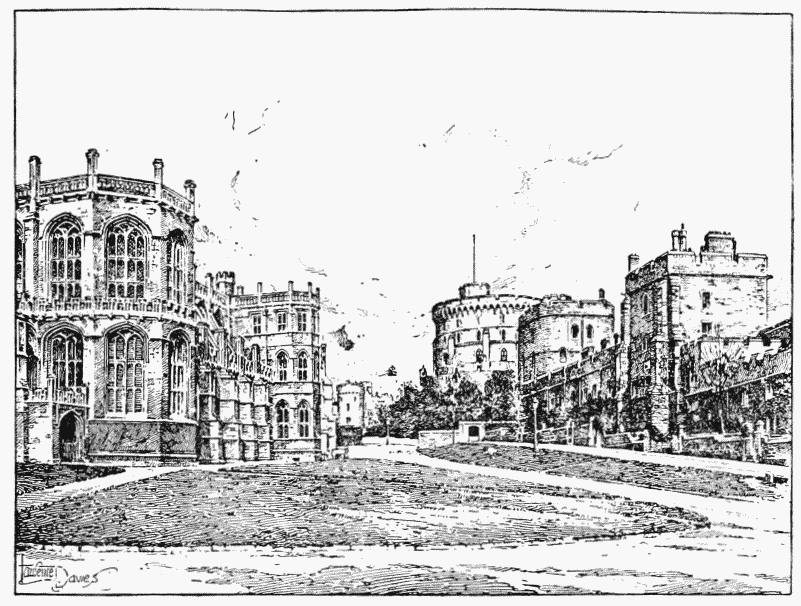
Windsor Castle: The Lower Ward looking East
The most interesting section of the interior is the ambulatory behind the high altar. The east side of this is the lower part of the west front of Henry the Third's chapel, with a wide-pointed doorway flanked by two arched recesses of similar design and height. The door is covered with rich 13th-century ironwork, stamped in places with the name of the maker, 'GILEBERTVS.' The west side of the ambulatory is decorated with panelling and has towards its south end the recently erected screened entrance to the royal vault. The panelled stone ceiling of the ambulatory is of the reign of Henry VII. The first bay of the south aisle forms a vestibule to the chapel south of it, and has on the key of its fan vault figures of Edward IV and Bishop Beauchamp kneeling on either side of the famous Cross-Neyt (fn. 35) given to St. George's chapel by Edward III. The polygonal chapel to the south was built to contain the relics of Master John Shorne, the saintly rector of North Marston, Bucks. (fn. 36) Licence to move his remains hither was granted by Pope Sixtus IV in 1478, and the chapel must immediately have been built to receive them; the enterclose for it was being made in 1480–1. The chapel is now nearly filled by the alabaster tomb with effigies of Edward (Clinton) Earl of Lincoln, K.G., ob. 1584–5, and his third wife the Lady Elizabeth Fitz Gerald. The earl's effigy shows him lying bare-headed in full armour. Round his left leg is the garter, and on his knee-pieces are anchors, in allusion to his office of lord high admiral. About the sides of the tomb are kneeling figures of the earl's children by his first and second wives. On the west wall of the chapel is a delicately carved and coloured alabaster panel with the earl's armorial ensigns. The chapel has a fan vault, and is now inclosed by an Elizabethan iron grate. (fn. 37)
The arch into the aisle west of the Lincoln chapel, as it is now called, has a deep recess in each jamb. That on the north contains an old Bible, but formerly, as the painted inscription below shows, a copy of (probably) the Sarum Porthos, laid there by Bishop Beauchamp, whose arms occur below the opposite recess, in which was displayed some notable relic, perhaps at times the Cross-Neyt itself. The aisle windows here and throughout the building consist of two pairs of cinquefoiled lights, in three tiers, flanked by narrow blind panels. These divisions are continued downwards to form a series of wall panels resting on a stone bench, which runs all round the chapel. Upon the bench stand the vaulting shafts. The south aisle is covered throughout with a fan vault with carved keys, which include the arms of Henry VII, Henry VI, Arthur Prince of Wales and Dr. Oliver King. The arms of Henry VI occur in the same bay in which his remains were reburied after their removal from Chertsey in 1484, and those of Oliver King before the little chantry chapel built by him outside the aisle, apparently between 1493 and 1496. Under an arch between the aisle and the chapel is the bishop's tomb or cenotaph, and on the opposite side of the aisle is a row of panels painted for him with figures of Edward the first-born son of Henry VI, Edward IV, Edward V and Henry VII. The aisle also contains, against the fifth arch on the north side, the chantry chapel, inclosed by elaborate stone screenwork, of John Oxenbridge, canon from 1509 to 1522. The angel cornices and niches within deserve notice, and likewise the panel paintings, dated 1522, with the passion of St. John Baptist, that cover the north side.
In the bay west of Oxenbridge's chapel are the stone doorway and iron grate that inclosed until 1824 the chapel of Dr. Christopher Urswick in the nave. Under the third arch in this aisle is the grave of Charles Brandon Duke of Suffolk, brother-in-law of King Henry VIII, and the helm on the pillar near by probably formed part of his funeral achievements.
The easternmost bay of the north aisle of the quire is covered with a fan vault with the rayed rose badge of Edward IV, and forms a vestibule to the vestry which extends northwards from it through a doorway inserted in 1785. The vestry measures 26 ft. by 15 ft., but has been much modernized, and only its wooden roof is old. Its north end abuts upon the canons' porch, built temp. Edward III, and contains its rich but mutilated doorway. Within the vestry are the great sword of Edward III that formerly hung over the sovereign's stall in the chapel of St. Edward and St. George, and a full-length picture of him painted in 1615.
The two next bays of the aisle formed originally the lower chapel of the founder, Edward IV, and within the first arch of the presbytery, under which he was buried, is the king's unfinished tomb of black marble, beside which is fixed a funeral helm. Opposite it is a doorway into a small chamber with a (blocked) fireplace built outside the aisle, and westward of this another doorway opening into a vice to an upper chapel. This is 40 ft. long by 12½ ft. wide, and was built, in accordance with the will of Edward IV, above the vault of the three bays of the aisle just described, to contain an altar, and another tomb with the king's image of silver-gilt or, at the least, copper and gilt. The tomb seems never to have been set up, but the chapel was finished before the king's death in 1483. It has unfortunately been modernized internally, but still retains its windows: one on the south, another on the east and three on the north. In its west wall is a little oriel window looking down the aisle, and in its south side were two larger oriel windows towards the presbytery. The westernmost remains, but the other has given place to a deeper oriel of wood with traceried panels, inserted temp. Henry VIII. The chapel is now subdivided by Georgian Gothic partitions into two wainscoted pews or closes with fireplaces for the royal family and their suite. The vault that carries it, which is kept low for the purpose, has upon its keys the arms and badges of Edward IV, but the higher vault to the west is of the time of Henry VII, and two of its keys bear the arms of Thomas Fitz Alan Lord Maltravers, 1461–87, and of William Lord Hastings, beheaded in 1483. In the same bay as the latter, on the south side, stands the beautiful stone chantry chapel of Lord Hastings, within which he is buried. It closely resembles the Oxenbridge chapel, which was obviously copied from it, and is decorated within by a series of contemporary painted panels with the passion of St. Stephen.
Before leaving the quire aisles mention may be made of certain modern monuments in them. In the south aisle, at the east end, stands the life-size marble statue of the German Emperor Frederick, who died in 1888, in uniform and military cloak, with the collar of the Garter, and in the north-west corner, under Oliver King's painted panels, is a tomb of red serpentine and white marble with inlaid brass cross, erected by Queen Victoria in memory of Mary Duchess of Gloucester, who died in 1857. In the north aisle, under the third arch, is a statue in white marble of William Earl Harcourt, G.C.B., who died in 1830, under the fifth arch is a marble bust of Lt.-Gen. Sir John Elley, K.C.B., K.G.H., who died in 1839, and in the sixth arch a white marble tomb and recumbent effigy of the Hon. Gerald Wellesley, for twenty-eight years Dean of Windsor, who died in 1882.
The crossing of the chapel is oblong in plan, and has on every side a tall four-centred arch with flat sides and soffit, relieved by panelling. Across the eastern arch is a Gothic gallery, which carries the organ, built of Coade's artificial stone in 1790–1, in place of the earlier gallery figured by Hollar. The new gallery, which was designed by Emlyn, has to the nave an open arcade of five arches, with a similar arch at each end with panelled parapet above. Beneath is the main entrance into the quire, through a wide square-headed opening fitted with a pair of richly carved doors of the same date as the stalls. Like all the other doors within the chapel these are solid as to the lower half, but have the upper part of open tracery filled with simple iron grates.
The quire is separated from the aisles by four-centred arches with continuous mouldings, divided from the clearstory by panelling surmounted by a continuous row of feathered angels with outspread wings carrying scrolls. The clearstory windows are tall pointed openings similar to those in the aisles. In front of each pier, rising from an angel corbel at some height up, is a group of shafts carrying the vault; not that for which provision was first made, but a rich one copied from the nave vault, contracted for by, probably, the same freemasons, John Hylmer and William Vertue, in June 1506, to be finished by Christmas 1508. (fn. 38) The numerous keys display various royal and other badges, including those of all the then English knights of the Garter who contributed to the cost, which was £700. The seven pendants forming the principal keys bear the arms of St. George, St. Edward, King Henry VII and his rose and portcullis badges. The great east window of the quire, of fifteen lights, with painted glass by Clayton & Bell, is a restoration by Scott of one taken out in 1786 to make way for a huge transparency by West depicting the Resurrection. The quire of golden angels round the window and the altar piece below it, with the Ascension in white marble, are also from Scott's designs.
South of the altar, over the quasi-sedilia, hangs a panel of Arras tapestry, copied from Titian's picture, which was formerly in the castle, of Christ and the two disciples at Emmaus. It was given to the chapel by John Viscount Mordaunt, constable of the castle in 1660, and at one time was hung over the altar.
The arch north of the altar and that next to it are lower than the rest, owing to Edward the Fourth's chapel behind them. The first was blocked by the existing panelling in 1790, and in front of it was placed the magnificent pair of iron gates that once formed the western boundary of the king's chapel in the aisle. These beautiful gates and the open traceried towers between which they are hung are formed of numerous superposed pieces of thin pierced and hammered iron carefully pinned together, and were almost certainly made under the direction of John Tresilian, the principal smith, who was working at Windsor from 1477 onwards at the high wage of 16d. a day.
The splendid canopied oak stalls of the knights of the Garter ranged along both sides of the quire and returned against the screen at the west end were begun to be made as early as 1478, and were apparently all fixed in their places by 1485. There were originally four returned stalls on each side and twenty-one more in front of the arcades, or fifty in all, but two more stalls were added on both sides in 1786, and the number is now fifty-four. There is also a lower row on each side of ten and nine old stalls, with two Georgian added to the latter, with beautiful carved texts above them in front of the upper desks from the 20th and 84th Psalms. The lower desks are richly panelled, with sculptures in the spandrels, and have below them seats and desks for the choristers and towards the east for the Military Knights. Both ranges of stalls have misericordes with the usual delightful diversity of carved devices and subjects. The rich effect of the stallwork is greatly enhanced by the painted banners of the knights of the Garter that hang above them, the crested helms and wooden swords that surmount the canopies, and the glittering stall-plates affixed to the panelling; the display of all which is enjoined by the statutes of the order of the Garter. The stall-plates date, with some few earlier exceptions, from 1421, since which there is a fairly perfect continuous series down to to-day. (fn. 39) The oldest plates are of copper, silvered or gilded, with the arms, &c., in enamel, and are to be found in the alternate stalls originally set apart for the Knights Companion. The Stuart and later plates are mostly of gilt brass, with the arms merely painted, sometimes over engraving. Recently there has set in a reversion to the old fashion of brilliantly enamelled plates. Taken as a whole the series of stall-plates forms such a storehouse of ancient and modern historical armoury as exists probably in no other church in Europe.
In the middle of the quire is the gravestone laid down in 1818 to mark the vault containing the remains of Henry VIII, Jane Seymour and Charles I. Further west stands the fine early 16th-century latten desk from which the lessons are read, anciently used by the chanters when the quire was ruled.
The organ upon the loft at the entrance of the quire was built by Green in 1790 and given to the chapel by George III. Its Gothic case was designed by Emlyn.
It was originally intended that the crossing of the chapel should be carried up as an open lantern with glazed sides, and a strong effort was made from 1515 onwards to obtain subscriptions from the knights of the Garter towards the completion of it and a proper rood-loft. The project was, however, eventually abandoned, and in 1528 the crossing was ceiled instead with the existing fan vault, painted with the arms of the several knights. The beginnings of the proposed lantern are still to be seen above it.
The north arch of the crossing was formerly spanned at about half its height by a loft in the form of a stone gallery, with a slight pulpit-like projection facing south. It was inserted in the reign of Henry VIII, but for what purpose is uncertain. It was needlessly destroyed in 1789.
The north and south transepts are identical in plan, and have not only a window like that of the aisles in each of their sides, but an upper series in continuation of the clearstory, rising from a similar sculptured quire of angels. The consequent effect is that of a great glazed lantern. Each is covered too by a richly groined vault with various devices and badges on the keys. The polygonal apses are shut off from the oblong bay next the crossing by open traceried stone screens surmounted by the armorial ensigns of Sir Reynald Bray, K.G., and formed chapels. That to the north is the Rutland chapel, within which a chantry was founded in 1481 by Sir Thomas St. Leger in memory of his wife Anne Duchess of Exeter and sister of Edward IV, who was buried in it. In the middle stands an alabaster tomb with fine recumbent effigies of Sir George Manners, Lord Roos, who died in 1513, and his wife, the lady Anne daughter of the Duchess of Exeter, who died in 1526. Along the sides are figures of their children and upon the ends angels, all holding shields. On a bracket in the east window is a large funeral helm that may belong to this tomb. The place of the altar is marked by a cornice, under the window, of sculptured angels like those in the Hastings and Oxenbridge chapels.
The south transept formed the Bray chapel, and was apparently appropriated by his executors for the burying place and monument of Sir Reynald Bray, K.G., notwithstanding his desire to be buried elsewhere. It was accordingly enriched by the addition of canopied niches for images upon the vaulting shafts, by the insertion of a reredos over the altar, and of large panels of Della Robbia ware, 50 in. square, under each of the other four windows. These panels have unfortunately all been destroyed, and only the frame remains of that under the south-east window around the alabaster monument of Sir Richard Wortley (ob. 1603). The reredos, which consisted of tabernacle work and imagery, is also partly destroyed, through the insertion in it of the monument and bust of Giles Tomson, Bishop of Gloucester, and some time Dean of Windsor, who died in 1612. Beneath the other three windows are monuments of Sir William Fitzwilliam (ob. 1551), Ralph Brideoake, Canon of Windsor, Dean of Salisbury, and Bishop of Chichester (ob. 1678), and Christian Victor, Prince of SchleswigHolstein (ob. 1900). The place of Sir Reynald Bray's tomb in the middle of the chapel is occupied by the white marble cenotaph and effigy of the Prince Imperial (ob. 1879), subscribed for to be set up in the abbey church of Westminster, but owing to difficulties allowed to be erected instead at Windsor by Queen Victoria.
The nave resembles the quire in elevation, except that the vaulting shafts in front of the piers start from the floor. The vault which they support also resembles that of the quire, which was copied from it, but lacks the pendants which characterize the latter. Among the devices of the principal keys are the Cross-Neyt in the first bay, and the arms, &c., of Dean Christopher Urswick, Sir Reynald Bray and King Henry VII. As Sir Reynald Bray's arms are encircled by the garter, the vault cannot be earlier than 1501, when he was elected K.G., nor later than either his death in 1503 or that of Urswick in 1505. The aisles have fan vaults like those of the quire aisles, and bear the same arms, &c., as the nave vault, with which they are contemporary. The west end of the nave is occupied for almost its whole height and breadth by a great window of fifteen lights, flanked by canted angles containing doorways to the stair turrets within. The window is filled for the most part with made-up figures of old glass, fragments of the original glazing collected with mistaken zeal from all parts of the chapel in 1767. Though the general effect is not unpleasing, the figures have been so much restored as to be devoid of any antiquarian interest. By their removal from their original places all hope of recovering the original glazing scheme, even from fragments, has been destroyed.
The westernmost bay of the nave is narrower than the others and flanked by polygonal chapels opening from the aisles. The southern chapel is that in which Sir Reynald Bray by his will desired to be buried, but its ornaments include nothing allusive of him, and the chapel is largely occupied by the marble tomb with alabaster effigies of Sir Charles Herbert, K.G., Lord Herbert of Gower (afterwards Earl of Worcester) and Elizabeth his wife. The chapel, which was dedicated in honour of our Lady, was assigned to Lord Herbert by the dean and chapter in 1506, and to him is due the large niche north of the altar place and the bronze grates or screens that inclose the chapel and surround the tomb. Lord Herbert's effigy represents him as bareheaded and in armour, with the garter round his left leg and about him the mantle and collar of the order. Lady Herbert is shown with her hair let down and encircled by a fillet. On the wall of the chapel is a long inscription recording its defacement during the 'Great Rebellion' and its restoration by Henry Duke of Beaufort in 1699. A huge monument was also set up to this duke in the chapel, but removed to Badminton, on account of its size, in 1874.
The corresponding north chapel is that of the Salutation, and in it a chantry was founded in 1493–4 by Thomas Passhe and William Hermer, formerly canons, and John Plummer, some time virger. Another chantry was founded at the same altar in 1507 by Dean Christopher Urswick, who inclosed the chapel with the screen and grate now in the south aisle of the quire. They were removed thence in 1824 to make way for Wyatt's well-known marble monument of the Princess Charlotte Augusta of Wales and her stillborn son, who died in 1817. The chapel is now inclosed by an insignificant modern railing. Outside stands the marble statue of the princess's husband, Prince Leopold George Frederick of Saxe-Coburg-Saalfeld, afterwards King of the Belgians, erected here by Queen Victoria in 1879. Further west in the same aisle is the mural monument, with bust of a blind man within a wreath of poppies, of George V, the blind King of Hanover, who died in 1878.
At the west end of the south aisle stands an elaborate alabaster font, designed by Mr. J. L. Pearson and given in memory of the Rev. F. Anson, for forty years a canon, in 1888. Hard by, under the sixth arch of the main arcade, is a high alabaster tomb with marble effigy of Edward Duke of Kent and Strathern, who died in 1820.
The pulpit, which stands in the nave, was designed by Mr. A. Y. Nutt and is of quite recent date.
Close to the south doorway is a remarkable iron box for offerings. It consists of an octagonal body 17 in. high and 13½ in. wide, standing upon four round pillars, with hexagonal capitals and bases, set in a block of Purbeck marble. On each side is a crocketed canopy springing from buttresses upon the angles, and surmounting a Lombardic letter b. On the top are four slits for offerings with sliding lids, alternating with as many castles, also pierced for coins, arranged about a much larger castle with a domed roof encircled by a (broken) crown, likewise furnished with coin slits. This unique object is in all 3 ft. 10½ in. high, and was apparently made to receive the offerings at the tomb of King Henry VI. It is undoubtedly by the same craftsman who designed the magnificent iron gates of Edward IV's chapel. Before leaving the nave attention should be called to the little 'brays' or hempbrakes of iron, the badge of Sir Reynald Bray, with which the inner face of the south door is powdered, and to the beautiful lock plates on the various doors and gates within the chapel in general. The flooring throughout the chapel, except the 17th-century black and white marble pavement in the quire, was all relaid at the end of the 18th century. The chapel fortunately contains little modern painted glass. That by Willement in the quire aisles, inserted at various times between 1845 and 1854, is interesting from its date, but consists of mere translucent coloured pictures. The heraldic glass in the clearstory windows is of more sensible character.
Owing to the considerable rise of the ground from west to east, the western part of St. George's chapel is built upon a basement. This consists of a polygonal chamber beneath each of the western chapels, connected by a barrel-vaulted tunnel. The chambers were well-lighted living rooms, with doorways from without and furnished with bed recesses and chimneys. That to the north is still easy of examination, despite its being converted into a lead-casting room for the plumbers, but the southern one is nearly filled by the organ bellows. Neither chamber has any direct communication with the chapel, though the northern has a staircase leading upwards towards the north doorway; but both were probably built as the abodes of chantry priests or clerks of the chapel. The west front of the chapel has the large window flanked by lofty stair turrets, and up to the great doorway is an ascending flight of stone steps of modern date.
The old doorway in the ambulatory of St. George's chapel now opens into a passage 11½ ft. wide from the lower ward to the cloisters, &c. This was originally the ante-chapel of Henry the Third's chapel, and still retains its north doorway, but the rest of the passage, including its panelled vault (fn. 40) and south doorway, belongs to the Lady chapel of Henry VII. This was built inside the older chapel, the north wall of which has been retained to a sufficient height for the new buttresses to stand upon it without intruding upon the cloister, but the south wall has gone. The new building is thus only 28 ft. wide as against the 36 ft. of its predecessor. Owing, moreover, to the western gable of the Lady chapel being built upon the line of the old screen between the chapel and ante-chapel its length is only 71 ft. instead of the possible 83 ft. (with its ante-chapel) of the chapel of St. Edward and St. George. The Lady chapel now forms the Albert Memorial chapel, and is five bays long, with a three-sided apse towards the east. It is entered by a Tudor doorway from the passage, which serves as a vestibule to it. The floor and steps are throughout of marble and mosaic, and along the side walls is a marble bench. The walls are panelled up to the windows with variously coloured marbles in which are set large pictures in tarsia work of scenes from Old Testament history with intermediate figures of the Virtues. This decoration is continued into the apse with pictures of our Lord's Passion. The altar has a slab of green marble, and stands before a reredos with a representation of the Resurrection in white marble. The windows are all of four lights and transomed, but the west window has twelve lights, now closed with mosaic pictures of notable persons connected with or benefactors to the College of Windsor. The other windows contain modern stained glass by Clayton & Bell. The vault is enriched with mosaic by Salviati. In the north wall is a Tudor doorway communicating by a wall passage with the old vestry, now part of the Deanery. Before the altar stands the cenotaph of the Prince Consort, an elaborate marble tomb surmounted by a white marble recumbent effigy in fluted armour. The middle of the chapel is occupied by the more magnificent but unfinished monument, by Alfred Gilbert, of H.R.H. the Duke of Clarence and Avondale, who died in 1892. The sarcophagus which contains his body is of Mexican onyx, and is surmounted by a recumbent effigy of the dead prince in bronze. The tomb is inclosed by a splendid bronze screen with statuettes of saints. Further west is a third tomb, in white marble, with effigy of H.R.H. the Duke of Albany (ob. 1884).
The marble mosaic work of the chapel was executed by M. Jules C. Destreez from the designs of Baron H. de Triqueti, and the general restoration was carried out under the direction of Mr. (afterwards Sir) G. G. Scott.
Externally the chapel is divided into bays by boldly projecting buttresses bearing the arms and badges of Henry VII, and carried up as pedestals intended for images of the king's beasts. Below the south windows are more badges and over them an open traceried parapet, but towards the north the parapet is plain and battled. Both parapets were renewed in Portland stone in 1800–1.
The passage between the two chapels opens directly into the Lower or Dean's cloister. This is about 67½ ft. from north to south and 75 ft. from east to west, with covered alleys on all four sides about the grass-plot in the middle. The alleys vary in width, the eastern and western being from 12 ft. to 13 ft. and the others 11½ ft. The south wall formed one side of the chapel of Henry III, and has an arcade of one narrow and four wider arches with part of a fifth, standing upon a stone bench. The arches are of two orders, carried by shafts with stiff-stalked carved capitals; the principal shafts are of Purbeck marble. The incomplete arch towards the east shows that the 13th-century cloister was somewhat longer than the present; it has within it a blocked Tudor doorway with the old vestry passage within. The west wall also dates from c. 1240, if it be not earlier, and has along it a stone bench. In its south end is a doorway from St. George's chapel, made probably in 1482–3, and next to it a modern entrance to the vestry, &c. This is copied from an original Tudor doorway further north, now converted into a window, which formerly opened on to a wall stair to the erary or treasury. In the north end of the wall is a wide doorway of a date c. 1351–2 into the porch below the erary. The north alley has a stone bench like the south and west alleys, built against a wall which formed part of the camera ordered to be built by Henry III in 1240. The original buttresses have been cut away, but one of the windows remains, a plain square-headed loop grated with iron. In the middle of the wall is an inserted 14th-century doorway into the Canons' cloister. The east wall of the cloister is all of the 14th century and has no bench along it. In its northern half are various interesting openings. They include (1) a wide doorway into the Deanery, and a group consisting of (2) a doorway formerly a window, (3) another doorway and (4) a traceried window. The modern window at the south end was inserted by Dean Wellesley. The cloister alleys are paved with stone, with occasional pieces of old monumental slabs. The walls were wainscoted until quite late in the 18th century. The south alley is covered by a lean-to roof and the other alleys with flat modern ceilings.
The wall inclosing the grass-plot should date from 1352, but has been so often 'restored' that, except at the angles, it is practically new. The corner piers have on each face a canopied niche for an image, flanked by Purbeck marble shafts. In each side are four windows of four cinquefoiled lights. The inclosing arches are set in square openings with pierced quatrefoils in the spandrels. On the garth side the divisions are marked by slender buttresses which once carried pinnacles, but these are now lacking. The buttresses on the west side were rebuilt on a larger scale in 1852, when the chapter-room above was added by Scott. This room is a pretentious and elaborately panelled apartment lighted by pairs of Gothic windows, but quite devoid of interest. Adjoining it on the north is the chapter clerk's office, a work, apparently, of the latter part of the 15th century, still retaining a panelled wooden ceiling with carved bosses and one of the windows of the old library, of which it formed part. Both rooms are reached from the cloister by a stair in the thickness of the west wall. The north alley is partly over-ailed by a 16th-century room with oriel window, all of timber with brick nogging, belonging to one of the houses in the Canons' cloister; it has, however, been much modernized. The south and west alleys were formerly surmounted by the library, which was placed here in 1483–4; it was, however, restricted temp. James I to the western side, and eventually removed to the old vicars' hall, where it still is.
The eastern side of the cloister is now covered by a range of buildings containing the chief apartments of the Deanery. These include not only the rooms that replace the original lodging of the warden, but, on the ground floor, the vestry and chapter-house appended in the 14th century to the chapel of St. Edward and St. George. The vestry was built in 1350 in the usual place north of the high altar, and is 21½ ft. long and 12½ ft. wide. The walls are now covered with wainscot, but the drain for the altar remains behind it. The arch of the east window is also left, but has lost its tracery. The room is covered by its original lierne vault with carved keys, which abuts westward upon a strong transverse arch, about 2½ ft. in advance of the end wall. The recess thus formed contains a modern chimney and window, and an old doorway into a passage communicating with the Albert Memorial chapel. Next to the vestry is the old chapter-house of 1350–2, now the dean's dining room. This measures 22½ ft. by 30½ ft., and has on the east the two original window openings, but these have lost their tracery. The walls are wainscoted chair-high, and the room is covered, as always, by a flat ceiling. To the north of the room is a passage from which it is entered. This was originally wider, and formed a lobby to the chapterhouse, having at its west end the large doorway and its flanking windows still to be seen in the cloister. The doorway north of these once led to the warden's hall, &c., on the first floor, but this and a later extension of the house into the castle ditch were rebuilt in their present form in brick, instead of half-timber work, by Dean Urswick. The original windows of the western block can be traced on both sides, but with the exception of some remains of moulded plaster ceilings, c. 1587–8, in the eastern wing, the building contains nothing of interest. (fn. 41) A straggling extension northwards along the ditch to the north wall of the castle was added in the 17th century, and contains the kitchen and offices below and a wainscoted gallery on the first floor.
The 14th-century doorway in the north alley of the cloister leads into an irregular quadrangle, (fn. 42) about which the houses of the canons and their vicars were built between 1352 and 1355. These occupy the site of the camera of Henry III, which was partly burnt in 1296, and removed later to make room for them. They fill up all the space between the King's cloister and the castle wall, and extend westwards from the old ditch across the north end of the lower ward. Three of the early towers along the castle wall are incorporated into them. The original houses of half-timbered construction still remain along three sides of the court, and are of two stories, the upper being carried forward in front of the lower over an open gallery or ambulatory extending all round the quadrangle. The original arrangement consisted of thirteen sets of chambers for the vicars upon the ground floor and the same number above for the canons, but the inevitable changes during six and a half centuries have obscured the old divisions, and the houses now form ten separate tenements for the canons and minor canons. The houses have also been much altered externally by additions to their height and the building of new chimney stacks, &c.; they nevertheless form still a very picturesque corner of the castle. The garth is divided into two unequal portions by a transverse pentise. (fn. 43) from the entrance passage to the tower opposite, through which there is a modern way down, continued outside by the 'hundred steps.' The west end of the quadrangle has been rebuilt, and is now closed by a substantial three-storied red brick house of the end of the 17th century, forming two tenements.
The doorway in the north-west corner of the Dean's cloister opens into a passage going westwards. This forms one end of a beautiful porch, measuring 23 ft. by 11½ ft., built, with 'la Tresorie' over it, in 1353–4. It is two bays long and has panelled walls and an elaborately panelled stone vault. The chief doorway is at the south end, and can now be seen only from the vestry. The treasury above, now called the erary, by corruption from its older name of erarium, has a tiled floor, a stone vault with carved keys, a chimney (inserted in 1443–4), and a two-light window, guarded within by a heavy iron grating added in 1496–7. It is reached by a staircase from the cloister, and in it are kept the muniments of the dean and chapter. The west side of the porch and erary was formerly covered by the canons' chapterhouse. (fn. 44) This was rebuilt circa 1477, but eventually converted into a dwelling-house, and needlessly destroyed in 1859.
The wide space north of St. George's chapel was, and still is, filled with a variety of buildings. Its eastern half used to be occupied by a walled-in court, having on the east the large house forming the end of the Canons' cloister, on the north another good house, also of brick, of the 17th century, which is still there, and on the west by Denton's Commons. The house to the north has its front divided by Ionic pilasters into four bays, and into three stages by simple string-courses, but the simple dignity of the original work, which was perhaps designed by Wren, is marred by the modern windows. The wall that inclosed the court before the house was pulled down in 1843.
The building known as Denton's Commons stood partly upon the site of the great hall. This was almost entirely destroyed by Bishop Beauchamp when clearing the ward for the new chapel, but a fragment of it yet survives and its foundations remain. Such of its walls as were left were incorporated in 1520 in Master James Denton's new building, which consisted of a rectangular block 63½ ft. long and 15½ ft. wide, standing north and south, and of two stories. On the upper was the hall with its pantry, where the chaplains and choristers kept their commons, and in the lower the kitchen, buttery, larder, and pastry. The south end of the hall was filled with a large square-headed window of five lights. The 'cook's chamber,' a two-storied structure with lodgings for the cook and undercook, stood on the north-west, and to the north across a narrow passage was a building along the castle wall, with the storehouse below and the choristers' lodgings above. To the east and the west of Denton's building were narrow courtyards. In 1550 this interesting structure was converted into a dwelling-house, and so continued until 1859, when it was most unnecessarily destroyed, with the exception of its north end. The hall chimney-piece, bearing Denton's rebus, was saved through the efforts of Mr. Cope, the chapter clerk, and inserted in the old vicars' hall, now the chapter library, where it may yet be seen.
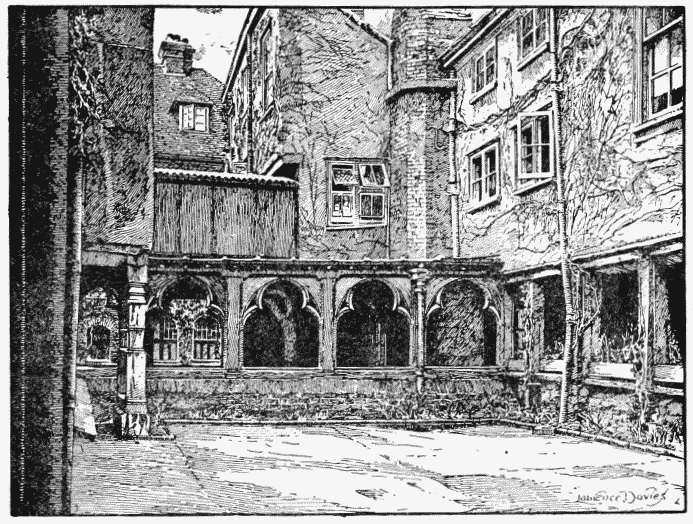
Windsor Castle: The Canons' Cloister
When Denton's Commons was pulled down it was found that the lower part of its east wall had formed part of the great hall and the remains of a rich doorway temp. Henry III adjoined it. A window and an upper doorway of the hall were also uncovered in its north end, and may still be seen in the fragment of the building which has escaped destruction.
To the west of the site of Denton's Commons, against the castle wall, is a good red brick house of the time of Queen Anne, the residence of one of the canons. Next to this is a picturesque half-timbered building, also along the wall, used until lately for some time as the choristers' lodging; it now forms two tenements. The front is quite modern and dates only from 1874, when the old house was reduced in size and the remains thoroughly 'restored.' The old roofs and several chimney-pieces have survived the operation. The building seems to have been erected at the end of the 15th century for the 'schoolmaster of grammar' and the 'schoolmaster of music.'
The choristers have been housed since 1891 in a building below the castle on the north, erected in 1802 for the abortive foundation of the Naval Knights of Windsor, provided for in 1724 under the will of Mr. Samuel Travers.
The north-west corner of the lower ward is filled with the lodgings built originally for the accommodation of the vicars. The thirteen vicars ordained by Edward III first lived in the chambers below the canons, but this arrangement not working well Henry IV in 1409 granted the place called the Woodhaw, beside the great hall, as a site for houses for the vicars, clerks and choristers. These seem to have been built in 1415–16, but only the hall (since 1693 the chapter library) remains, the other buildings having been removed during Bishop Beauchamp's clearance for St. George's chapel. The old hall extends southwards from the castle wall, upon which its north gable is built, for some 70 ft., (fn. 45) and is 23 ft. wide, but sundry restorations have left little of interest architecturally (fn. 46) beyond its original kingpost roof and the rescued Denton chimney-piece; its south end is a timber partition, dating from a shortening of the hall for the new work south of it. Beneath the hall is the organist's house, formed out of the original cellars. After 1550 the hall was converted to other uses.
The buildings now adjoining the hall consist of a number of two-storied half-timbered houses, built about a polygonal courtyard and pentise, filling up all the space between St. George's chapel and the castle wall west of it. In Norden's picture they are called 'the Kewe,' and in Hollar's view 'Petty Canons' Houses,' but are now known as the Horseshoe cloister.
The houses were twenty-two in number, and in building from 1478 to 1481, and originally extended on the north side nearly up to the north doorway of the chapel, but this block was unfortunately destroyed in 1843. The timber framing is filled in with brick nogging, and surmounted by a coved cornice with open traceried parapet, all of wood. The ground story is masked by a wooden pentise with cradle roof covered with lead, with wide traceried openings set upon a low brick wall. The doorways are all four-centred and the lower windows mostly of two tiers of uncusped lights; the upper windows are square-headed and of three lights. The cloister is entered by a wide passage from the south, but all the architectural features of this are modern. The upper story of all the houses is also more or less modern, and the windows, coving and parapet wholly so, as well as the two turrets flanking the library end, and all the chimney stacks; but occasional fragments show that the old lines have been followed. The lower story of the houses and the pentise contain more original work. The general restoration was done in 1871 under Scott. Since the reduction of the collegiate establishment in recent years the vicars have become minor canons, and again returned to houses in the Canons' cloister, while their old lodging has been given over to the lay clerks and virger, &c.
A passage through the north-west section of the Horseshoe cloister leads into a court behind in front of the large tower that stands so prominently at the westernmost point of the castle. This tower, which is one of the three built, with the connecting walls, across the west front in 1227–30, was from quite early days known as the Clewer tower, and consists of a basement, a main floor and an upper floor. The flat side towards the court was new faced with firestone in 1863, when the contour of the tower was changed by the addition of the present ugly gabled roof. Owing partly to the fall of the ground and partly to the tower being built in the Norman ditch the basement has to be reached by steps leading down to its wide entrance. This has a depressed head, flanked by two square-headed windows, and has within it more steps down to the earthen floor. The basement measures 32 ft. by 22 ½ ft. wide, and in plan consists of a square and a half-octagon, covered by a simple ribbed vault springing from moulded corbels. In each side of the polygonal part is a deep recess with a narrow loop at the back. The masonry throughout is of excellent ashlar, and the walls 13 ft. thick, except towards the court, where the thickness is only 5 ft. The main floor is reached by steps from the court and entered by a wide pointed doorway. This opens into a lofty chamber faced in chalk or clunch ashlar, with firestone dressings to the windows and doorways. The plan is quite different from that of the basement, being roughly a polygon with three long and four short sides. Round the outer curve are disposed six broad and deep window recesses, each with a wide square-headed loop at the back. The north-east corner is partitioned off to form a room for the bell-ringer, and has within it the remains of a fine original hooded chimney, beyond which is a large window.
The upper floor is reached by a massive wooden staircase and is similar in plan to the main floor. In its east wall are two pairs of original window recesses with pointed lights, and between them the remains of a chimney like that below. There are four other windows in the sides towards the field and in a fifth recess a garderobe.
The interior of the tower is now filled by a massive timber belfry about 21 ft. square, carried by twelve great vertical uprights, upon which is fixed the bell cage. This stood above the tower roof and was inclosed by boarding covered with lead sheeting and surmounted by a picturesque lead-covered cupola. During the changes of 1863 the boarding and leadwork were stripped off and bell cage and cupola hidden under the new gabled roof, where they can still be seen awaiting their being again brought to light.
The tower still contains the same number of eight bells that were brought over from the old belfry in 1478–9, but the bells themselves have passed through many vicissitudes. The great bell was recast in 1598–9 and the whole ring in 1612, but only the 4th, 6th and 7th are of that date now. They bear the initials of the founder, John Wallys of Salisbury. The great bell was sold in 1614, towards the payment of the college debts, but replaced in 1623 by a second-hand one cast by Wallys in 1614. The 2nd and 3rd bells were again recast in 1650 by W. Whitmore, and the treble in 1741–2 by Thomas Lester of London, who also recast the 5th in 1745. The inscriptions and diameters of the bells are as follows (fn. 47) :
Down to 1863 the belfry had affixed to it a handsome clock case with a copper dial, dated 1756, containing a clock bought of John Davis of Windsor in 1689. The clock has been preserved, and has in connexion with it a chime that plays the old psalm tune 'St. David' every three hours.
The main floor of the Clewer tower has a doorway on the south communicating with a mural chamber, through the floor of which access can now be had to a postern passage and sallyport, constructed in the thickness of the curtain wall at its building. The passage is 6 ft. wide and filled with a descending flight of forty chalk and stone steps, covered by a sloping barrel vault of chalk blocks, plastered. The sides of the stair are of coursed chalk blocks. At the stair foot the passage turns at a right angle and continues down into the ditch, but its lower end and opening are blocked.
The next tower southwards is known as Garter's tower and is semicircular in plan. Until 1860, when it was 'restored' by Salvin, it was a roofless shell with the flat side completely broken down. The basement is now entered by a wide depressed archway in the 13th-century style, and contains three deep pointed recesses with loops overlooking the ditch, and another recess on the south. The roof is a modern brick vault. The main floor is reached by a modern external staircase and has also three old looped recesses towards the west, but the remaining features are Salvin's. The tower is now used as a cooking place for the guard.
Against the wall, between Garter's tower and that to the south, stood the block of chambers known as Crane's Buildings, erected in 1657 as a lodging for five more Poor Knights. It was a plain, unpretentious structure with a pedimental gable in the middle and a row of gardens in front. As an inoffensive building erected during the Commonwealth it was of interest architecturally, but this did not save it from being destroyed in 1863, to make way for Salvin's ugly guard-house, which stands upon its site. This consists of a large room with stone vaulted roof and a lesser division at the south end open to the ward.
The third of the towers of the west front is called the Chancellor's or Salisbury tower, from the Bishop of Salisbury, who was anciently chancellor of the order of the Garter. It is nearly circular in plan, with a flat side towards the bailey, and is now used as a residence of one of the Military Knights. It was refaced and the main floor altered by Blore, who rebuilt the upper story, but the basement retains its original window recesses as well as the blocked entrance with its flanking openings from the bailey.
From the great gate-house there extends eastward along the castle wall a long range of lodgings for the Military Knights. It consists of a series of seven two-storied ashlar-faced houses towards the west, a square tower in the middle built of coursed heathstone, which is the residence of the governor of the knights, and a further series of six houses towards the east. The latter date from 1359–60, and are also built of heathstone, but were altered to their present form in 1557–8, when the western range of houses was also built. The tower is the old belfry of 1359–60 and contained the chapel bells until their removal to the Clewer tower in or about 1478. The single house west of the tower (the others are arranged in pairs) has attached to it the remains of the 13th-century bastion that here projects from the castle wall, and formerly contained a common hall, kitchen and pantry for the use of the Poor Knights. It was almost completely rebuilt by Sir Jeffrey Wyatville, and now forms a residence for one of the castle officials. Each house has on the ground floor a four-centred doorway and a two-light window, and on the first floor another two-light window and one of a pair of lights conjoined over the coupled doorways. The tower is three stories high and flanked at the corners by buttresses. Over the principal window of the first floor is a carved panel with the armorial ensigns of Queen Mary and her Spanish consort, a modern version of a like panel inserted in 1558. The Military Knights' lodgings have a row of gardens in front, fenced in by modern stone walls, and stand upon a terrace raised above the level of the ward. The whole range underwent a very complete restoration in 1840–50.
Externally the nether lodgings have also a Marian facing of sandstone, now pierced, where none was before, with a number of 19th-century windows. In the cellar story these are square-headed loops, in the main floor trefoiled lights, and in the upper story pointed or trefoiled lights. The battled parapet and the chimney stacks are likewise new. The 13th-century round tower has for a long time been reduced to its present height and has a modern casing of heathstone pierced with three tiers of Wyatville's windows. The old belfry has fortunately preserved its original exterior, except that three tiers of modern windows have been inserted in it. The lofty heathstone wall east of the belfry, against which the upper lodgings stand, is possibly temp. Henry II, but now exhibits four rows of modern windows similar to those of the nether lodgings.
The outside of the north face of the lower ward is usually so much hidden by the trees which have unwisely been allowed upon the side of the Castle Hill that it is not always easy to see its architectural features. All the sections of the wall west of the Winchester tower, between the three succeeding towers, as well as the towers themselves, were thoroughly 'gothicized' and for the most part refaced in the middle of the last century, and almost every trace of their Norman origin and later history obliterated. Nearly all the many windows are also modern. From the Middle tower issue the socalled Hundred Steps down to Wyatville's gate-house in Thames Street; their actual number is, however, 134. From the third tower to the Clewer tower the wall, though irregular in parts and much patched, is ancient. The north front of the old brick house next to the third tower stands upon it, and has alternate courses of brick and stone with flint work, but its original 17th-century windows are now being 'restored.' The two houses to the west have both been 'gothicized.' Below the eastern part of the gable of the chapter library is a built-out projection of four stages, with quoins of Portland stone, which evidently formed part of some older building. The Clewer tower has a bold battering plinth, but was raised in 1863 and cased throughout with mechanically coursed heathstone; it has also a new parapet, from within which rises Salvin's semi-conical roof. Garter's tower has been refaced like the Clewer tower, but is fortunately finished off with a battled parapet only. The Salisbury tower, as already noted, was refaced by Blore. The lengths of walling between the three towers are all of the 13th century and of heathstone with ashlar courses of white stone. The windows are all recent, except a small loop that lights the sallyport stairs. The upper part of the wall from the Salisbury Tower to the gate-house is Wyatville's, but the lower part is ancient and belongs to the defences added by Henry III.

Windsor Castle: West Wall, showing Clewer and Garter's Towers
The west side of the castle is now the only section that has any traces of the old outer ditch; this has been sadly encroached upon to widen the street. It enables, however, some idea to be formed of the loss of dignity which the castle has sustained along the south and east sides by the filling up of this ancient defence.
The head of the lower ward was anciently traversed by a ditch with a bridge across it, defended by a tower on the upper or eastern side. The ditch has been almost entirely filled up, but part of its northern half is now represented by the Deanery garden and the later buildings of the Deanery stand in it. Behind them also exists a good length of the old wall that once formed the western boundary of the middle ward. The gate-tower that defended the entrance was pulled down in 1671, and the middle ward is now approached by a wide opening in a modern wall built by Wyatville upon the line of the old wall.
The lofty tower that stands in the south end of the transverse ditch was built probably in 1223–6, and may fairly be allowed to be called Henry the Third's. The main portion of it is nearly circular, but its eastern half is rectangular and contains the staircase. (fn. 48) It is three stories high and built of rubble faced with heathstone, but all the dressings are modern and there are no ancient features within. The north front is of interest as containing the only two complete examples now left of the peculiar type of window used temp. Charles II by Hugh May in all the parts of the castle dealt with by him. They are tall round-headed openings with a balustraded transom. The other windows in the tower are almost all insertions by Wyatt c. 1800. The outer face has a tall battering plinth and traces of original loops now represented by wide modern openings. The eastern face of the tower is partly masked by a block of offices extending southwards, erected by Wyatville on the site of an older building. Further along to the east stood a scattered series of small houses, apparently of the early 18th century, known as the offices of the Black Rod, (fn. 49) but these were all swept away by Wyatville, together with the old curved wall that inclosed the southern side of the middle bailey. In its place Sir Jeffrey built the present wall on a totally different line. It starts from the corner of his block of offices and consists of three straight sections divided by small square turrets. The lower part is battered externally and pierced with arrow-slits, and the upper part forms a rampart walk with battled parapet. At the end of the third section the wall stops abruptly against a tall pointed archway, called the Barbican, standing at right angles to it, from the other side of which the wall is continued eastwards. The space within the archway forms a small court before another creation of Wyatville, the pretentious entrance into the upper ward called St. George's gateway. This is as egregious a sham as the Barbican and consists of a vaulted gate-passage with sham portcullis grooves. The wall in which it is set is old and carries a stepped gallery, built by Wyatville to connect his great corridor with the Round tower.
The north-west corner of the middle ward was open until about 1680, when a large guard-house was built upon it alongside the old wall behind the Deanery. It was of brick, with a lofty tiled roof with dormers and a stone portico or pillared porch with steps at its south end. Between it and the Winchester tower was a lower building, at first a canteen but later a public-house. Wyatville swept away both buildings and erected upon their site an equally large but much less picturesque building of three stories faced with stone, now used as the lord chamberlain's upper stores. At the north-west corner of the ward stands the lofty four-storied Winchester tower. It is nearly square in plan and probably of Norman origin, but was raised and otherwise enlarged and altered when William of Wykeham first became clerk of the works. He seems also to have lived in it, hence its old name of 'Wichamtour.' It was likewise the residence of Sir Jeffrey Wyatville, who is responsible for the oriel windows and other modern features and additions. The castle wall going east from the Winchester tower is partly old and probably of the 14th century, but has been a good deal patched and new faced. It is pierced in one place by a modern cart archway, and abuts eastward upon a small square battled tower projecting northwards. This Magazine tower, as it is called, is a low two-storied building of the 14th century with living rooms and garderobes on each floor; that in the ground story has a good chimney. From the Magazine tower to the inner gate-house there extends a nearly straight length of the castle wall, built of coursed heathstone and apparently of the 12th century. It has a good Elizabethan stone parapet built in place of some ruinous brickwork. The middle ward is actually a slender semicircular court surrounding and forming the counterscarp of the ditch of the mount of the Great tower, but the ditch is bounded on the ward side by a vertical wall rising from its outer margin. The flat bottom is laid out as a rock and water garden and the slope of the mount obscured by walks and shrubs. The larger part of the mount and its ditch are actually within the middle ward, but the Great tower can be reached only from the inner ward. This is entered by a two-storied gate-house to the north of the mount, miscalled the Norman gate. It is, however, really a work of the 14th century, and a good, though much restored, example of its date. It consists of a narrow passage or gate-hall, vaulted in stone, flanked by two large drum towers with small chambers behind and a vice to the upper floor. The outer archway was defended by a portcullis, which remains in part, with a double gate behind, and has three holes in the crown of the arch for thrusting down weapons upon an attacking party. The windows above have been modernized, and the machicolations overhead, as also the parapets of the towers, are additions by Wyatville. The tower windows are also his. On the inner side there are two original two-light windows over the archway, but the upper works are all quite recent. The ground stories of both towers are hexagonal in plan and vaulted in stone, and the rooms behind on the north once formed the porter's lodge. The vice on the south side ascends to the first floor and upwards to the roof. The first floor consisted originally of three intercommunicating rooms, one in each tower, and a third over the gate-hall. The north chamber was walled off and absorbed into Queen Elizabeth's new gallery, and the large room is encroached upon by the gallery chimney-breast. It still, however, retains an original chimney with joggled lintel, and has in its west wall a wide arch in which the remnant of the portcullis is fixed. It was formerly suspended by a chain passing through a square hole in the top of the arch to a windlass on the roof. Behind the portcullis are three pointed recesses, which have in their floors the holes (blocked above) that appear in the arch below. These could be used offensively only when the portcullis had been lowered. The middle recess once had a cruciform opening at the back, now enlarged into a window. The room in the south tower is hexagonal like that below and floored with old figured tiles. Towards the south it has an old window with its shutter and an original chimney with horizontal lintel, but the other windows have been modernized. Between this room and the vice is a lofty vaulted lobby.
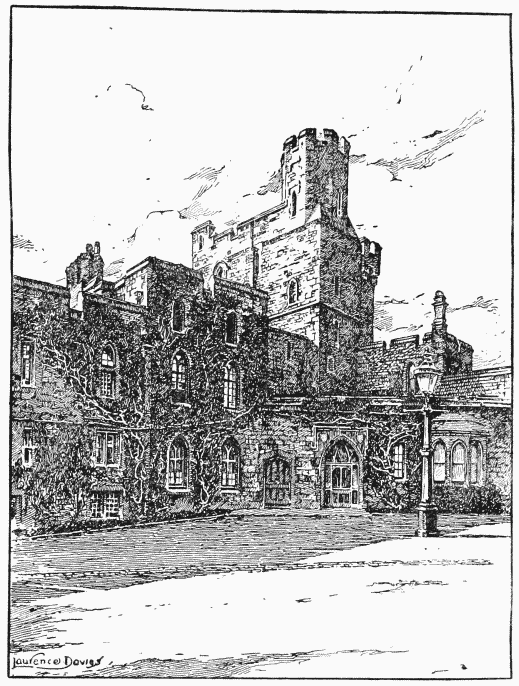
Windsor Castle: The Winchester Tower
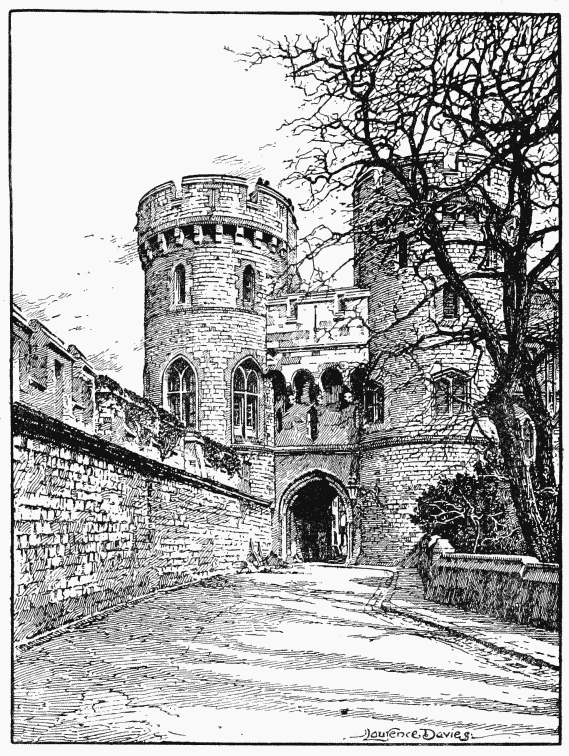
Windsor Castle: The 'Norman' Gate
Attached to the gate-house on the south-east is a two-storied Elizabethan building, the front of which stands upon a plinth of earlier date. The lower story has a doorway flanked by two transomed windows, and the upper three three-light windows with a restored parapet over. The rooms within form part of a small L-shaped block which in the 18th century was expanded southwards into a three-storied brick residence for the castle housekeeper. This was refaced and 'gothicized' by Wyatville, but enlarged in 1866 to its present form. It and the rooms in the gate-house now form one residence.
The dominant feature of Windsor Castle is of course the Great tower, Keep, or Round tower, as it is called, from its plan. It stands upon a large artificial mount of chalk, still surrounded in part by the ditch out of which it was cast up. This mount is now the only visible portion of the Conqueror's castle mentioned in the Domesday Survey.
The ascent to the Round tower begins on the right hand of the passage from the Norman gate, through a 14th-century porch with chambers over. The steps through this are continued up a gallery with raking roof, rebuilt in the 15th century, to a 14th-century tower, once defended by a portcullis that blocks the ascent. The stair passes on through this and an extension of it behind, largely rebuilt by Wyatville, and ends on the chemise or gallery that encircles the Round tower. The staircase is commanded by an old gun, which points down it through a loop in the Round tower, and contains eighty-nine steps, or ninety-seven with those in the porch.
The gallery round the base of the keep is about 10 ft. broad, and encircled by a wall with occasional embrasures, in which stand twelve small brass cannon dating from 1794 to 1801. The gallery is interrupted in two places: on the north-east by the ascent from the upper ward, on the south by a porch at the head of the steps down to Edward the Third's tower.
The Round tower is only roughly circular in plan, being more pear-shaped than round, and its south face is considerably flattened. Its longest outside diameter is 103 ft. and the shortest 94 ft. Externally it is divided into twelve segments by broad pilaster buttresses and horizontally into four stages. The lowest stage has a battering plinth with a belt of heathstone pierced by a series of 14th-century windows. The next or principal stage is also faced with heathstone, but its upper courses are modern. It contains a series of large two-light windows inserted by Wyatville. The top story is faced with heathstone, and has in its lower half a number of small windows which light a wall gallery within, and above these a row of sham loops. The whole is crowned by a bold machicolated parapet, which is interrupted towards the north-east by a stair turret and flagstaff that rise above it. The lower part of the tower with its buttresses is late 12th-century work, but all above the middle of the principal story is Wyatville's. The main entrance is also Wyatville's, and leads through his brick stair turret into a two-storied wooden building which nearly fills the lower part of the tower. This was originally arranged about an open court, and is finished off with a deep coved cornice and a sloping lead roof. Much of the construction is hidden by later panelling, but the inner face of the building seems to have been formed of a series of pointed opening framed between massive uprights. In some of the lower rooms the cross-beams have curved braces and supporting posts midway. In the upper story most of the rooms, which are loftier than those below, have a deep moulded cornice towards the court. When the tower was raised by Wyatville the old wall was thickened internally, and so the original proportions of the rooms have been destroyed. Those in the lower story are lighted by the Edwardian windows and the upper story by new ones. The old staircases have also given way to a single one on the south side. This leads to a gallery with rounded corners built by Wyatville about the old court, which has thus been greatly reduced in size; it has also been further encroached upon by a transverse gallery and by the intruded staircase to the present parapet walk. Both stories are now cut up into a number of small rooms, none of which presents a single feature of interest. The old timber-framed building is no doubt that constructed within the tower for the lodging of Edward III and Queen Philippa by William of Wykeham. Certain other features, such as the internal panelling, date from the reign of Anne, but the hand of Wyatville is visible upon almost everything else. Within the tower is an ancient well 164½ ft. deep.
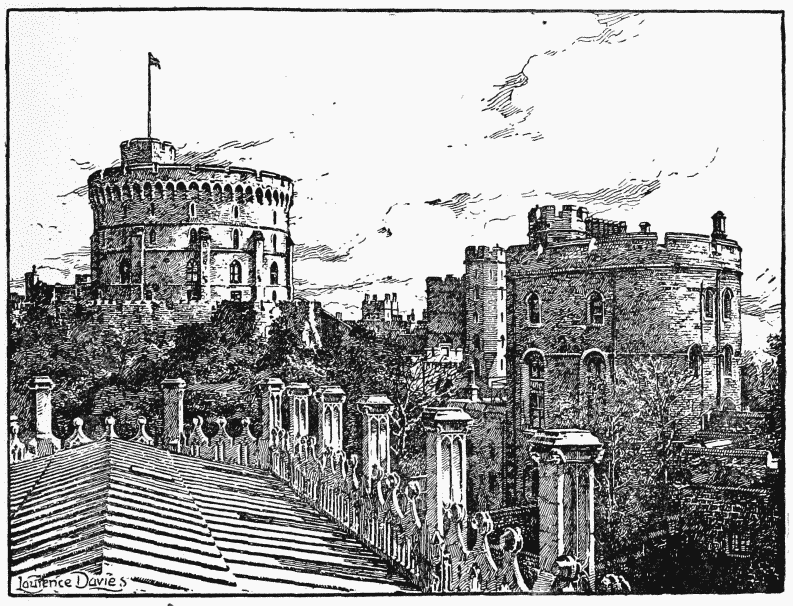
Windsor Castle: The Round Tower from the Roof of St. George's Chapel
Extending eastwards from the north side of the Norman gate is the two-storied gallery built for Queen Elizabeth. The lower story contains various offices and passages and has a doorway in the middle surmounted by the initials ER and the date 1583. West of this are two square-headed windows with a bay window by Wyatville between, and east of the doorway a series of loops lighting passages within. The upper stage has three five-light oriel windows, two of which are now walled up, and a battled parapet above. The doorway opens into a passage with steps down to the North Terrace, through an opening made by Wyatville. The north front has to the west a deep recess, an oriel over and two transomed lights. Wyatville's archway is pierced through a porch-like projection, and has over it the queen's initials and the date as on the south side. The upper stage of the projection has a pair of square-headed windows and above them a large oriel. Further east are a number of small windows, and in the upper story several more and another oriel. The parapet is modern and breaks out over the oriels.
The offices, &c., in the ground story have been modernized and are devoid of interest. The upper story or gallery proper is now part of the royal library, and forms one chamber, 91 ft. long and 12 ft. wide, entered through older rooms on the east. It has three rectangular recesses towards the north, corresponding to the oriels, and a rounded end formed in the absorbed turret of the inner gate-house. Two of the three southern oriels are masked by bookcases. Towards the west end of the south wall is the great chimney, with an elaborately carved chimney-piece of white stone extending up to the ceiling. It is ornamented with the queen's badges and has along the top: 'ÆTA TIS 50 REG NI 25 | ER | A° D° 1000 500 83.' The floor is of modern boarding and the walls are hidden by lofty bookcases. The ceiling is of moulded plaster, elaborately panelled, with the arms and badges of Queen Elizabeth, but was raised and made new in 1832, when the ceiling in the rounded end was inserted.
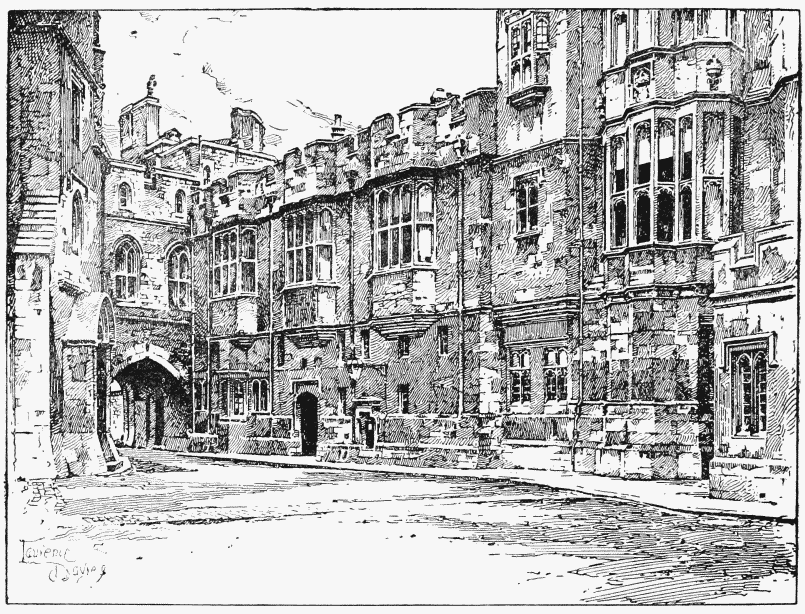
Windsor Castle: The Norman Gate, Queen Elizabeth's Gallery, and Henry VII's Building
What is left of Henry the Seventh's building has suffered much from 'restoration,' the surviving oriel of a former pair towards the ward and most of the topmost story being all new. The south face has a high plinth, above which, towards the west, are two modern square-headed windows with corbelling over. This is carried up as a three-sided projection with a square-headed window on the first floor and an oriel above. The principal oriel has on both floors a plain pedestal rising from the ground and breaking out into three half-hexagons with a transomed light in each face. Between the two stories are the royal arms and badges. The place of the old second oriel is taken by a repetition by Wyatville of the arrangement to the west. The whole is surmounted by an heraldic cornice with a battled parapet following the projections of the oriels. The north face of the block has on the free angle an octagonal turret corbelling out into a two-storied oriel with divisions alternately round and square. Another oriel further east was destroyed by Wyatt, and the front now contains three tiers of modern windows and is finished off with a mean battled parapet. Within the block contains nothing of interest. On the ground floor are a passage and two rooms devoted to library uses. The first floor originally contained two rooms, but is now one, forming part of the library. The uppermost floor contains rooms for visitors.
Before the changes of the 19th century the upper ward was an oblong court about 360ft. long from east to west and 250 ft. wide, approached by a narrow gangway from the space within the inner gate-house. It had lofty ranges of chambers on three sides, and was bounded on the west by the ditch of the Round Tower. About the middle, on the site of the conduit-head of 1555, stood a pedestal carrying a bronze equestrian statue of Charles II as a Roman emperor. The changes in question involved the building of Wyatville's gallery against the east and south sides and of his tower porch on the north. He also filled up the ditch and made round the base of the slope a public path, separated from the ward by a low wall, in front of which he set up the king's statue, after giving it a new granite pedestal and flanking it with fountain basins. The old way out of the court southwards was closed and masked at both ends and a new passage outwards made further east. St. George's gate was also built at the south-west corner.
The north side of the ward is occupied by the great range of buildings which contains on the upper floor the state apartments. Until the middle of the 19th century these formed the lodging of the king and queen, but since the provision of more private quarters elsewhere they have been thrown open to the public, except when needed for the accommodation of a foreign sovereign. Previous to the same changes the northern range consisted of a series of buildings arranged about a succession of three open courts, Brick Court, Horn Court and the Kitchen Court. These have, however, been built upon or covered in, and the range practically forms one compact block with a frontage of about 330 ft. and a maximum breadth of about 150 ft. The north front is over 400 ft. long.
The west end of the block has on the north a corner of the old Star building. This is masked as to its lowest story by Wyatville's porch, and its upper stories have been 'gothicized' by Wyatt. The old main block has its ground story partly covered at both ends by Wyatville's additions, (fn. 50) and its three remaining windows are insertions by Wyatt. The first floor has seven large 'Gothic' windows and the top floor a row like those to the ground story with a battled parapet over, all Wyatt's work. Projecting from the south end is the four-storied tower anciently called La Rose, but now, for no sufficient reason, King John's. It consists of a square section containing a vice to the floors and roof, above which it appears as an octagonal turret, and a polygonal section forming the corner of the block, with windows on all sides to each floor, and a battled parapet.
From King John's tower there extends eastwards along the south or principal front of the block a contemporary two-storied range of six bays, with square-headed windows to the basement story and large pointed windows on the first floor, all insertions by Wyatt. Behind the battled parapet a modern attic story has been added. The State Entrance tower, which comes next, was built by Wyatville in 1827, in front of the old gate-house of Edward III. The ground story forms a vaulted porch with wide archways on all three sides. The first floor has a large four-light window on each face, and the clockhouse, which forms the attic story, is lighted by small loops. The clock has a dial on the south face, and strikes upon three bells cast by Mears of London in 1830.
From the state entrance tower to the visitors' entrance, which masks the old kitchen gate, is another long battled two-storied range, of twelve bays, with windows like those further west, but copied from his uncle's by Wyatville, who also partly refaced the range. The sixth window of the ground story has a doorway built into its lower half.
The old buildings forming the eastern side of the ward are to a great extent masked by Wyatville's gallery, &c., but the upper story, which is Wyatt's, shows behind, and is pierced by a number of windows. The back of the Clarence tower is old, and also shows above the gallery, but the windows are Wyatville's.
The new gallery begins with a sham gate-house built across the corner of the ward, consisting of an arched opening below with a large window over, flanked by two tall polygonal turrets of four stories with a machicolation between them. Next to the gate-house is the three-storied tower of the old visitors' entrance, but the doorway is now a window; over it is a large oriel on the first floor and two long narrow windows above. The main gallery is lighted as to the ground story by square two-light windows and in the upper by taller square-headed windows of two lights with tracery above. In the south-east corner of the ward the gallery breaks out into a large three-sided porch, forming the sovereign's entrance. This is flanked by octagonal turrets, and has on each face a wide archway with a large transomed window above, all crowned by a machicolated parapet with the royal arms in front and G. R. IIII, 1830. Behind rises the heavy mass of the Victoria tower. The southern section of the gallery continues the lines of the eastern section, but the lower windows are four-centred openings of four lights with tracery, and several have doorways through the lower part. Towards the west the line is interrupted by George the Fourth's gateway, with its wide four-centred archway surmounted by the royal arms, &c. The gallery is continued through the first floor of this, but above is a plain attic story carrying the parapet.
Behind the gallery rise Wyatt's added story between the Victoria and York towers and the heavy tops of the latter and its new fellow the Lancaster tower.
The large 13th-century corner tower, now called Edward the Third's, is square in plan, with a rounded apse on the outer face. The front towards the ward has been practically refaced. The ground story once had a doorway to the vaulted chamber within, but this was converted by Wyatville into an ugly heavy window. The large windows on the first floor and the lights in the two upper stages are Wyatt's. Traces of several original openings are visible on the west face, which is partly masked by the adjuncts to Wyatville's St. George's gateway. The octagonal appendage to the tower was built by Wyatville in place of an older one of more simple character, and has a small window in each face to the several stories within.
Externally the former ditch along the south front has been filled up and replaced by lawns and shrubberies extending up to the base of the buildings. The rounded front of Edward the Third's tower here shows the battering plinth of its 13th-century basement, and above it four tiers of windows. The string-course which cuts the second tier marks the original height of the tower, and the ashlar course running through the third tier an additional stage added in 1252–3; above this is 14th-century work. The short length of building east of the tower has in front a masking wall by Wyatville, and over it appears a battering projection which blocks the old exit of the rubbish gate, containing a row of three square windows, and three taller openings in the upper floor. The narrow section next the Lancaster tower has an upper window of Wyatt's pattern over a square window below.
The Lancaster and York towers, with the archway, &c., between them, form the new gate-house to the upper ward contrived by Wyatville. The archway is four-centred and has over it a row of three windows on the first floor and three lesser lights above under a machicolated parapet. The towers have five tiers of windows of different sizes and are crowned with heavy machicolations. The Lancaster tower is Wyatville's, but the York tower is substantially of the 12th century, enlarged in the 14th and refaced and new topped in the 19th. The stretch of building from the York tower eastwards is of uniform appearance, with three tiers of windows, square two-light to the ground story, of Wyatt's large pointed pattern to the main floor, and square-headed lights to the attic story. The Augusta tower, which projects midway, has lost its top story and is structurally of the 12th century, as is the walling east of it, but the section to the west with the tall battering plinth is of the 14th century. The tower was refaced by Wyatville, and has windows corresponding to those east and west of it.
The large square Victoria tower at the south-east corner of the castle was built by May in 1677–9 on the site of an older tower, probably of the 12th century, but was much altered by Wyatville, to whom are due all the windows and the heavy machicolated parapet, and an addition behind towards the court. The tower is four stages high up to the parapet, but contains five tiers of windows, those on the main floor being tall square-headed openings with transoms and tracery. On the east and south faces the windows form pairs, but the northernmost of the chief south windows is corbelled out as an oriel, with ornate parapet. From the York tower there extends eastwards all along the front a raised terrace.
The east front of the castle is broken into three sections by towers and traversed by a double series of terraces, an upper between the towers and a lower in front of them. From the middle upper section are flights of steps down to the lower. The large square tower to the north, now called the Prince of Wales's tower, was rebuilt by May in 1679–80 to match his other tower at the south end, but like it has had all its features 'gothicized,' and a larger oriel corbelled out from its east face. Of the two lesser towers the southernmost is structurally of the 12th century. The northernmost was also Norman, but largely rebuilt by May. Under Wyatville they were named respectively the Clarence and Chester towers, and received new windows with large oriels facing east. Of the intervening ranges of building, that between the Victoria and Clarence towers contains apparently the Norman curtain wall with large square-headed oriel and other windows inserted by Wyatville. The next section seems to have been refaced by May, but contains four more of Wyatville's windows, one being an oriel. The story of the third section is similar, but the oriel is much larger and carried up even with the parapet, with a richly panelled parapet of its own.
The broad ditch shown in Hollar's view as traversing the east front of the castle was filled up in 1676 and the present lower terrace formed upon its site. This is 430 ft. long, and abuts at either end against extensions eastwards of the north and south terraces. These are prolonged beyond it and combined as five sides of an octagon which incloses an Italian garden. This inclosure and garden were laid out by Wyatville, who at the same time built the descending stairs from the terrace and the orangery under the north-west section.
The north front of the castle is bounded on the east by the lofty octagonal Brunswick tower, built by Wyatville on the site of a 12th-century rectangular tower. It is four stages high, with five tiers of windows, diminishing in size upwards, and a machicolated parapet. The corner between it and the Prince of Wales's tower is partly filled with a modern block of offices. From the octagonal tower to the Cornwall tower westwards is a two-storied gallery built by Wyatville in front of the kitchen, which is thus masked by it. The lower story is lighted by six square-headed windows with transoms and panelling under, and the upper story by as many similar but taller windows with labels. The Cornwall tower stands approximately upon the site of a Norman tower destroyed by May, and is characterized by a huge five-light double-transomed window, which nearly fills its elevation, and is carried upwards even above the tops of the flanking buildings. Below it are two tiers of lesser windows.
The building continuing on from the Cornwall tower is one of the oldest in the castle and probably structurally of the 12th century. Its base is masked by modern offices, above which is a row of Wyatville windows. The eight large square-headed windows to the main floor were inserted by Wyatville in place of earlier openings by May.
The large projecting block that extends as far as Henry the Seventh's building was once May's Star building, but it has been so altered that hardly any of its original features are left. The old windows in all four stages were 'gothicized' by Wyatt, who added octagonal turrets at the outer corners. Wyatt also battled May's plain parapet and obliterated the doorway in the middle of the ground story. Under Wyatville the corner turrets were destroyed, that on the west being shortened to a 'pepper box' rising above the parapet, and a new block built out at the east end called George the Fourth's tower. This has on the ground floor a wide four-centred archway, flanked by windows, and on the main floor a large three-sided oriel. Over this are two small windows and a battled parapet. Quite recently there have been also corbelled out from the first floor two closets in connexion with the chambers within. The external features of the remainder of the front have already been noticed.
The great terrace along the north front owes its beginnings to the 'new wharf' of timber made by Henry VIII. This was replaced from 1574 to 1578 by a more substantial structure in stone, consisting of a western section 283 ft. long divided by a gate from the eastern section, which was some 530 ft. long, continued over the ditch towards the park by a bridge, and ending in a banqueting-house and steps down to the park. The banqueting-house was taken down in 1636 and the gate-house shown in Hollar's view set up in its stead. The whole terrace was again reconstructed in its present form for Charles II, who extended it westwards to the Winchester tower and built the broad bastion in front of his Star building. The east and south terraces were formed about the same time. The total length of the north terrace before Wyatville's extensions was about 1,060 ft. At the north-east end of the enlarged terrace is a large brass sundial made by Henry Wynne, bought in 1679–80, and fixed upon a stone pedestal with carvings done the same year by Grinling Gibbons.
The present public entrance to the state apartments is through George the Fourth's tower on the north terrace, but, as the state entrance has always been on the south, it will be more convenient to begin the description of the buildings there.
The Edwardian gate-house that formed the old entrance was destroyed by Wyatville when he built the present tower porch. The doorway within this leads into a Gothic vestibule, built by Salvin in imitation of old work, right and left, with a pair of arches in its west side. These open into a 14th-century sub-vault of five bays, with a plain quadripartite stone vault carried by a row of octagonal pillars. The sub-vault is lighted by Wyatt windows towards the court. In the east wall is a double doorway to the grand staircase. In the north end are two doorways into a further three bays of the sub-vault, now converted into lavatories. A modern doorway from this leads into the turret portion of King John's tower (the original entrance of which has been altered), and the basement story of the tower opens out of it. It is lighted on three sides by modern windows, and covered by a ribbed vault converging upon a central key carved with a large rose, which gave to the tower its old name of La Rose.
Northward of the sub-vault, from which the tower is reached, is a passage from without into the old Brick court, devised by Wyatville as the public way into the state apartments. North of it is a large chamber, originally five bays long, now subdivided into a billiard room, telephone office, &c. The modern porch outside the south-west corner of the Star building opens into a wide vestibule. To the north of it are a number of modernized rooms, in part given up to the royal library and in part forming lodgings for the master of the household. The vestibule is paved with marble quarries, and had once, towards Brick court, an open colonnade, the two pillars of which remain. Beyond the colonnade at each end is a doorway into a contemporary staircase built in the corners of the court, and behind the pillars a deep recess with doorways to the grand staircase and offices beneath it. The east end of the vestibule opens into a spacious 'Gothic' lobby or corridor, formed by Wyatt and his successor, which originally extended through the range from the upper ward to the north terrace. It is divided into a wide middle and two narrow side alleys by piers under the cross walls above and by slender clustered pillars elsewhere, which carry a nearly flat vault. At the north end are the steps up from the public entrance into George the Fourth's tower from the terrace, and there are similar steps up from the state entrance at the south end, but this has recently been closed by a wall with a window in it. On the west side of the lobby was the entrance to Wyatt's grand staircase, now replaced by Salvin's. To the east of the lobby is the cloister built by Wyatt in the old Horn Court. It has alleys with plaster ceilings on all four verted into a beer cellar. The traceried windows are now masked towards the alleys by bookcases and cupboards set within them. The block north of the old Horn Court is subdivided into rooms and offices, and has very thick walls, but no visible features of interest. It may be structurally of the 12th century. The block east of Horn Court also has thick walls, and is perhaps of the same early date, but in both cases all the doorways and windows are modern. Along the south side of Horn Court is a long subvault like that further west but somewhat wider. Its walls are probably of the 13th century or earlier, but the vault and its sustaining pillars date from 1362–3. The sub-vault is thirteen bays long. The westernmost bay forms a servant's room and the next five bays the servants' hall, then comes another room, and the eighth bay forms a passage through from the ward. The remaining bays are all subdivided into rooms for servants. A passage from the south-east corner of Horn Court leads into what was once the kitchen court. This has on the south a narrow corridor four bays long, covered by a quadripartite vault with carved keys, and buttressed outside. It was built in the 14th century to give greater width to the hall, which was built above it and a 13th-century sub-vault south of it. This is now the steward's room, and of five bays, covered by a quadripartite vault springing from shafts along the side walls. The windows and doorways are modern, but there has been built into the north side a fine stone chimney-piece with the rayed rose badge of Edward IV, brought from some other part of the castle. The south side of Kitchen Court was completed by the gate-house built in 1362–3, of which some greatly altered remains still exist. The passage through it was blocked by Blore. The kitchen occupies the north side of the court and is oblong in plan. Its north wall is probably the 12th-century castle wall, but the rest of the building is apparently in substance a 14th-century rebuilding. A wide doorway of this date (now blocked) remains in the south-east corner. There is a wide chimney in the east wall, two in each of the north and south walls, and three in the west wall, all save one filled with modern gas ranges. The kitchen is lighted by a range of south windows, and by a lantern story to its wooden roof, but all this is the work of Wyatville. The rest of the kitchen court is entirely filled with recent brick offices of all kinds in connexion with the kitchen, and many of them can only be lighted by skylights. The originally open section between the kitchen and its gate-house was converted by Blore into a Gothical glass-roofed cloister. The portion of the eastern range which overlaps the kitchen court, including the basements of the Brunswick and Prince of Wales's towers, is all filled with various offices and store places connected with it.
The state apartments are gained, both by the public and by visitors of state, by the grand staircase. The original stair built by May was immediately within the remains of the Edwardian gate-house, but was replaced by Wyatt by one filling up the area of Brick Court, and going westwards from the corridor devised by him. This in turn was destroyed by Salvin, who reversed Wyatt's arrangement and built a new 'Gothic' staircase in the 13th-century manner, ascending eastwards from two insignificant entrances, the one from May's vestibule on the north, the other from the sub-vault on the south. The new stair is lighted by an octagonal lantern, and has upon the halpas midway up a white marble statue by Chantrey of George IV as Sovereign of the order of the Bath. About the staircase are arranged various armed figures and military trophies. The stair opens by a lofty arch into the grand vestibule, a lofty room standing north and south, and measuring 45 ft. by nearly 30 ft. The roof is a wooden fan vault with an octagonal lantern. At the north end, before a blocked door, is a seated figure of Queen Victoria in white marble, in the south end three doorways, and on the east a chimney, and a doorway into Waterloo Chamber. Round the walls and in cases against them are all kinds of trophies of arms. The southern doorways lead into the Guard Chamber. This was formed by Wyatville by extending the old Queen's Guard Chamber into the main floor of his new State Entrance tower at its south end. The room is now nearly 80 ft. long, and has at its north end a Gothic gallery, and towards the south three large windows overlooking the upper ward. The walls are hung with portraits and collections of weapons, and against them are cases of arms. The ceiling is a plaster imitation of a flat-ribbed vault and of six bays. A doorway in the south-west corner opens into the old Queen's Presence Chamber. This is 48 ft. long and 24 ft. wide, and has three windows to the ward and a good chimney-piece by Bacon opposite. The walls are hung with panels of Gobelin tapestry with old mirrors between. The portraits (fn. 51) over the chimney and over the two doorways are hung within magnificent carved festoons by Gibbons and Phillipps, who also carved the cornice. The ceiling was painted by Verrio in 1678, and depicts Queen Catherine of Braganza surrounded by the Virtues, &c. The next room westwards is the old Queen's Audience Chamber. It is 37 ft. long, with three windows to the south with mirrors between, and panels of Gobelin tapestry on the walls. To the north is a good chimney-piece and two doorways with portraits (fn. 52) over surrounded with carvings by Gibbons and Phillipps. The portrait of Mary Queen of Scots above the door from the Presence Chamber is similarly decorated. The ceiling was painted in 1678 by Verrio with Queen Catherine being drawn by swans in a chariot to the Temple of Virtue.
The two rooms just described, with what is now called the State Ante-room, are all of the state apartments that retain the fine carvings and painted ceilings with which they were decorated under May for Charles II.
A doorway in the north end of the Audience Chamber leads into the first floor of the old La Rose tower. It opens into a vaulted lobby with a rose as key, whence a vaulted passage goes on to the polygonal main chamber. This is lighted by four tall windows and covered with a flat wooden ceiling.
Extending northwards from the west end of the Audience Chamber is the old Queen's Gallery or Ballroom, now called the Van Dyck Room, from the magnificent collection of pictures by that painter which adorns the walls. The room is 64 ft. long by 22 ft. wide and lighted by five windows facing west. The walls are hung with crimson damask. Verrio's painted ceiling has been replaced by one of Wyatville's, but retains the old carved cornice. The three large crystal chandeliers are noteworthy.
Northward of the Queen's Gallery is her old Withdrawing Room, known recently as the Zuccarelli Room, from the collection of his paintings on the walls. They have now been moved elsewhere and the room renamed the Picture Gallery. It is 47½ ft. long by 27½ ft. wide, and has two Wyatt windows at the north end and a marble chimney-piece in the east wall. The walls are covered with crimson damask; the moulded plaster ceiling is by Wyatville.
The room west of the Withdrawing Room now forms part of the library, but formerly consisted of the Queen's Bedchamber towards the north and a lesser room and stair down towards the south. It is lined with bookcases, and has a plaster heraldic ceiling with the arms of William IV and the date 1834.
The rooms beyond to the west in Henry the Seventh's tower and Queen Elizabeth's gallery have already been dealt with.
A doorway in the north-east corner of the Withdrawing Room leads into the old King's, now the Queen's, Closet. It measures 28 ft. by 18 ft. and has damask-covered walls and a plaster ceiling with the name of Queen Adelaide. It is lighted by one north window and has a white marble chimney-piece. Next comes the King's Little Bedchamber, now the King's Closet. This is about 18 ft. square with a north window and a marble chimney-piece, and a Wyatville ceiling with the royal arms and initials W IV R. Next eastwards is the King's Great Bedchamber, now the Council Chamber, a room 27 ft. square, with two north windows and a chimney opposite. The walls are covered with crimson damask; the ceiling is modern. Against the east wall is an old state bed. The King's Withdrawing Room, which follows, is now called the Rubens Room, from the fine series of paintings by him that is displayed here. It measures 47 ft. by 31 ft. and has its north end nearly filled by the large oriel window of George the Fourth's tower. It has also another window looking east and on the west, two doorways with a yellow marble chimney-piece between. The walls are hung with crimson damask, and the modern ceiling bears the arms of George IV. In this room is a fine brass chandelier.
From the two rooms now called the Picture Gallery and the Rubens Room doorways lead into the State Ante-room. It was first called the King's Eating Room, and latterly the King's Public Dining Room, and is the most interesting of the state apartments, and the third that retains its original carvings and painted decorations. It measures 31 ft. by 26 ft. and has lantern-roofed alcoves east and west. In the north wall is a simple marble chimney-piece. The south side formerly had windows towards Brick Court, but was 'gothicized' by Salvin and the middle window made into a doorway towards his staircase. The walls are wainscoted and surmounted by a cornice carved by Gibbons and Phillipps. About the picture over the chimney, the openings into the alcoves, and between the windows are some splendid wood carvings by the same gifted artists, and the ceiling is covered with a painting by Verrio of the Banquet of the Gods. The alcoves originally formed 'music rooms' and have wainscoted ends with doorways surmounted by more wood carvings by Gibbons and his mate. Opening out of the western alcove are two doorways; one opens on to a staircase, the second into a small octagonal lobby with wainscoted sides surmounted by other Gibbons carvings.
The eastern doorway of the Rubens Room leads into the Ante-throne Room and on to the Throne Room. These originally formed two rooms of nearly equal area, the King's Privy Chamber and his Presence Chamber, enriched with carvings by Gibbons and Phillipps and painted ceilings by Verrio. This arrangement was altered by Wyatville, who enlarged the Presence at the expense of the Privy Chamber and added new ceilings of his own design.
The Ante-throne Room is about 24 ft. square and has two north windows. The walls have lately been wainscoted and the east and west sides hung with large tapestries. The south doorway is flanked by some beautiful carved festoons by Gibbons and Phillipps.
The Throne Room is 74 ft. long by 23 ft. wide, with six windows on the north with mirrors between. The first two windows once lighted the Privy Chamber, and the room is crossed next to them by a flattened arch on the line of the old division, with imitation Gibbons carvings. The walls are wainscoted chair high and then covered with blue velvet woven with the Star of the Garter and the arms of St. George. The south wall has two doorways with beautiful Gibbons carvings over, and a chimney-piece between, with a large portrait of George III surrounded by more carved woodwork. The doorways at the ends of the room also have carvings over them. The silver-gilt throne which gives name to the room once belonged to the Kings of Candy, and stands on two steps at the west end beneath a velvet canopy with the arms of Queen Victoria. The eastern doorway of the Throne Room opens into the Grand Reception Room, anciently the King's Guard Chamber. This fine and lofty room is 31 ft. wide and about 90 ft. long, and lighted from the north by the huge window of Wyatville's Cornwall tower. In the east side are two chimneys. The west side has two doorways and there is a third to the south. The walls are covered with six large panels of Gobelin tapestry given by Charles X of France to William IV, and here and there with mirrors. The ceiling is of plaster, and suspended from it are four crystal chandeliers. The upper part of what was Horn Court is now filled with the lofty hall called the Waterloo Chamber. This is about 100 ft. long and 50 ft. wide, and was built by Wyatville over Wyatt's cloister as a gallery to hold the portraits commemorative of the victory of Waterloo given to the nation by George IV. The room has a shallow gallery at each end, with entrances under, and an open lantern roof of five bays with heavy pendants, with skylights and sunlights above. The walls are wainscoted half-way up with panelling for pictures, and above with fretwork panelling, also for pictures. Over the chimneypieces and along the side walls are some beautiful Gibbons festoons, and other fine carvings are hung on the doorways. The room was redecorated under the direction of the Prince Consort in 1861.
From Waterloo Chamber and the Old Guard Chamber doorways open into St. George's Hall. This preposterous apartment is 185 ft. long and 30 ft. wide, and was formed by Wyatville by adding to the old hall the area hitherto occupied by the chapel west of it. It has eleven windows towards the ward with a corresponding number of recesses in the opposite wall. At the west end is a Gothic screen with gallery over, and at the upper or eastern end another screen against which is placed upon a low dais a throne or chair of state under a canopy. The sides are panelled for some way up as high as a band of plaster work with coloured shields of all the knights of the Garter from the foundation. In the recesses opposite the windows are large portraits of sovereigns of the order from James I to George IV, and between them brackets with armed figures and trophies, a recent addition. The nearly flat panelled ceiling is painted with arms of knights of the Garter, and its tie-beams rest upon corbels with shields of the First Founders, and their banners hanging in front. Along the side walls is a series of busts of Hanoverian and Guelph kings and princes.
The last of the state apartments is the Private Chapel, which for lack of a better place is arranged over the old kitchen gate-house. It consists of a square nave with canted angles, and a shallow altar recess projecting northwards, in defiance of all English tradition. Another recess to the west holds the organ. The canted angles at the south end of the nave each contain in their upper part a gallery for the royal family. Behind the altar is a reredos with the Creed, the Lord's Prayer, and the Ten Commandments in the vulgar tongue, and over and on each side of it painted glass windows inserted by King Edward VII in memory of Queen Victoria. East of the altar recess is a small vestry and passage to the pulpit. The ceilings are of panelled plaster work. That of the nave rests on a frieze with Te Deum in English, and has an octagonal lantern in the middle. The oak pews are arranged along the walls and across the floor, and the canopied pulpit and reading desk stand on either side of the altar recess.
Over various parts of the state apartments are added attic stories for the accommodation of servants.
The ranges of chambers forming the east and south sides of the upper ward consist generally of buildings erected in the 14th century against the outer wall and within the towers, now connected by Wyatville's interior gallery, but arranged somewhat differently. The ground story chambers on the east side have their chief approach from the ward through the equerry's entrance, and consist of sets of rooms formed partly of the subdivisions of Wyatville's building and partly of earlier rooms behind entered as before from a narrow passage next the outer wall. On the south side the older chambers are independent of the newer and coupled up by passages along their north sides. The subdivisions overlooking the ward are interrupted at intervals by the staircases to the upper floors, and are single rooms connected by passages behind. West of George the Fourth's gateway the passage is in front and becomes an ascending stair into the rooms in Edward the Third's tower. The ground story of the Victoria tower contains a good set of chambers. None of these divisions contain anything of antiquarian interest, except the sallyport into the old south ditch. This is now entered through the floor of one of the southern rooms and consists of a passage about 5 ft. wide with pointed head, lined with excellent masonry. Where it passes under the walls it is spanned by round-headed arches, which also contract the passage to 3½ ft. Beyond the passage the sallyport becomes a long tunnel with a descending floor, cut through the solid chalk. Its outlet in the ditch is now blocked and buried.
In the basement story between George the Fourth's gateway and Edward the Third's tower is the lower part of the 14th-century 'rubbish gate' destroyed by Wyatville, consisting of the gate-hall and its flanking chambers for the porter.
The lower story of Edward the Third's tower is almost entirely filled with small rooms for various purposes, but is otherwise a lofty chamber covered by its original 13th-century vault. (fn. 53) This is now inaccessible, but part of that in the rectangular section can be seen in one of the rooms next the ward.
Wyatville's sham gate-house called the equerry's entrance opens into a hall from which access may be had to a staircase in its south turret leading up to an ante-room on the first floor. Northward of this are other rooms communicating with the private chapel and the rooms in the north end of the east front. The first of these is the octagonal chamber in the Brunswick tower, with which are connected the China Gallery north of the kitchen and a serving room on the east of it. Then comes the Dining Room, a fine chamber over 40 ft. long and 30 ft. wide, with a northern triplet of windows and a large oriel to the east. Next follow in turn the Crimson, Green, and White Drawing Rooms, so called from the prevailing colour of their decorations. The first is 64 ft., the second 52 ft., and the third 37 ft. long, with a uniform width of 24 ft., and all are lighted by large windows looking east. From the White Drawing Room to the Victoria tower inclusive is a series of small rooms forming the private apartments of the king and queen. They all have windows towards the park, and besides intercommunicating in the old-fashioned way have an independent narrow passage behind, from which separate access may be had to each. The first five rooms include the King's Council Chamber and his writing room, the Red Drawing Room, an ante-room, and the king's bathroom. In the Victoria tower are the queen's bedroom with bathroom on the north, dressing room and sitting room, and in the upper floors the rooms occupied by the royal children. These rooms contain some rare cabinets and a few historical portraits.
The whole of the royal apartments are traversed on the west by the great gallery or long corridor built against them as a general means of communication. The first section extends from a small chamber next the ante-room mentioned above, and is about 130 ft. long and 16 ft. wide. It is lighted by windows towards the ward and has a flat panelled ceiling. On the walls are hung divers pictures and cases of miniatures. The second section of the corridor is deflected through the block over the sovereign's entrance and is only 60 ft. long. On one side of it is the sovereign's staircase, leading up from a spacious vestibule on the ground floor. From the landing of this is a bridge to the corridor, and on the opposite side of the latter a doorway into the semi-octagonal oak room above the sovereign's porch. Beyond the oak room the corridor runs westward for another 240 ft. and then ends in a narrower section about 40 ft. long against Edward the Third's tower. This portion also contains portraits and pictures and other historical relics.
The range of chambers along the south front which is traversed by the long section of the corridor consists of two divisions: (1) a practically unaltered row extending from the Victoria nearly to the York tower usually occupied by members of the royal family; and (2) a further series, very irregularly disposed, continuing to the west end of the range, for the accommodation of foreign royalties and their suites. Like the private apartments of the king and queen, the first-named series has a separate passage of communication in the rear parallel with the long corridor.
The rooms in the upper stories of all the towers and the extensive series added over the eastern and southern ranges serve for the accommodation of the numerous members of the household as well as for the domestic servants, and are all of befittingly simple character.
It only remains to add that beneath both the southern range and the northern front of the northern range are considerable basements containing coal stores, heating chambers, &c., connected by tunnels beneath the upper ward. There are also a number of storage vaults under the north terrace.