A History of the County of Berkshire: Volume 3. Originally published by Victoria County History, London, 1923.
This free content was digitised by double rekeying. All rights reserved.
'Parishes: Ruscombe', in A History of the County of Berkshire: Volume 3, ed. P H Ditchfield, William Page (London, 1923), British History Online https://www.british-history.ac.uk/vch/berks/vol3/pp203-206 [accessed 30 April 2025].
'Parishes: Ruscombe', in A History of the County of Berkshire: Volume 3. Edited by P H Ditchfield, William Page (London, 1923), British History Online, accessed April 30, 2025, https://www.british-history.ac.uk/vch/berks/vol3/pp203-206.
"Parishes: Ruscombe". A History of the County of Berkshire: Volume 3. Ed. P H Ditchfield, William Page (London, 1923), British History Online. Web. 30 April 2025. https://www.british-history.ac.uk/vch/berks/vol3/pp203-206.
In this section
RUSCOMBE
Rothscamp (xi cent.); Rotiscamp, Rotescamp (xii cent.); Rowescompe, Roscompe, Roscombe, Ruscoumbe (xiv, xv cent.).
The parish of Ruscombe covers an area of 1,294 acres, of which 680 are arable land, 395 permanent grass and 29 woods and plantations. (fn. 1) The soil is mostly gravel with a subsoil of gravel and clay, but the northern part of the parish is on chalk, and here there is a disused chalk-pit. The chief crops are wheat, barley and oats, but, though agriculture is the chief occupation of the inhabitants, a certain number are employed in the brick-works. The parish is lowlying, the highest point being about 170 ft. above the ordnance datum, near the church, and the lowest 121 ft. in the south-east. A tract of alluvial land marks the site of Ruscombe Lake, and still keeps that name. This was formerly famous for its fish, but since 1820, when the Bray Cut was made, it has been drained and cultivated. It is now crossed by the little River Broadwater, which, after flowing through Stanlake Park, falls into the Loddon at Twyford.
The main road from Reading to Maidenhead runs north-eastwards through a corner of the parish. The church of St. James, with Southbury Farm to the east and Northbury Farm to the north, stands a little to the east of this road. The old manor-house of Northbury Farm is now converted into two cottages. It is a much modernized half-timber and brick building of the early 17th century with a tiled roof, the principal front facing east. The main building is rectangular, running north and south, and has a slight projection to the west; a north wing projects east and west beyond this block, while on the south is a similar wing projecting in front of the central block on the east only. The hall originally occupied the central block and extended the full width of the house, but a passage has been taken out of it on the west. The kitchen was in the north wing, with its fireplace in the west wall, and behind it were two other rooms used for farm purposes. In the south wing were two living rooms, while in the north-west angle of this wing was a staircase. The ridge of the main roof runs north and south down the whole length of the building, and the west elevation is gabled in three bays. The old manor-house of Southbury was pulled down about eighty years ago.
The village consists of a few modern cottages built along the road leading from the church to Twyford village. The nearest railway station is at Twyford on the Great Western railway.
Part of Stanlake Park lies in Ruscombe. This with Hinton Pipard has been treated under the parish of Hurst in Charlton Hundred.
The whole parish was inclosed under an Act of Parliament of 1828. (fn. 2)
From entries in the burial register it would appear that Ruscombe was visited by the plague in 1646, and there are also entries of thirteen soldiers buried there after the fight at Henley in the Civil War. (fn. 3) The neighbourhood of Ruscombe appears to have been Puritan in its sympathies. When William Manning, a divine of that persuasion, held the living there the marriage register was greatly swelled, people coming in from the various surrounding districts in order to receive his ministrations. Again, in 1673, when, after the burning of Drury Lane Theatre, a collection was made at Ruscombe, the parish signified its disapproval by the smallness of its contribution, which amounted only to 2d. (fn. 4)
MANOR
The first mention of RUSCOMBE occurs in 1091 in the foundation charter of the cathedral of Old Sarum, from which it appears that 10 hides here were among the lands granted to it by Osmund Bishop of Salisbury. (fn. 5) The manor was assigned to one of the prebendaries of the cathedral before 1209. (fn. 6) The prebend of Ruscombe was held by the succentor of Sarum. Though it was usual in the first centuries after the Conquest for the prebendaries to reside for at least a part of the year upon the manors which supported them, Ruscombe appears to have been occupied in 1209 by a certain Elias de Chivele as lessee, who had the right of entry into the garth (gerstona). (fn. 7)
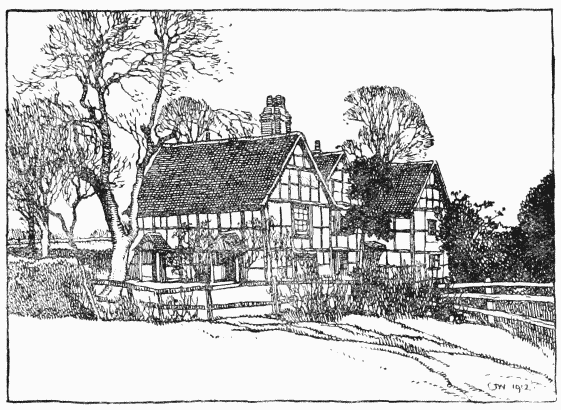
Ruscombe: Northbury Farm from the South-east
In 1316 the Bishop of Salisbury is returned as lord of the vill of Sonning-cum-Ruscombe. (fn. 8) In 1535 the prebend was held by William Chamberlain, prebendary. (fn. 9) The estate was then divided into Ruscombe Northbury and Ruscombe Southbury. (fn. 10) In 1650 Ruscombe Northbury was purchased from the trustees for the sale of ecclesiastical lands by William Barker, (fn. 11) but reverted to the cathedral at the Restoration.
During the 17th century a family named Strowde had a lease of the manor. (fn. 12) William Strowde left a daughter and heir Margaret, who married Nathan Knight, and thus the property passed to that family. (fn. 13) A warrant was issued in 1688 for the arrest of Nathan Knight, probably in connexion with the political unrest of the period, as an order was given that no one should hold conference with him. (fn. 14) His descendants are said to have continued to hold the lease of the manor until towards the end of the 18th century, when William Walter Knight conveyed it to Richard Palmer, the ancestor of the Palmers of Holme Park, Sonning, (fn. 15) who also purchased other property in the parish.
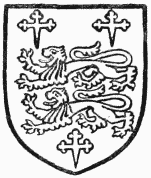
Garth. Or two lions passant between three crosslets fitchy sable.
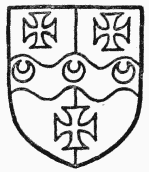
Godsal. Party gules and azure a fesse wavy argent between three crosses formy or with three crescents sable upon the fesse.
In 1787 Richard Palmer sold the manor to Sir James Eyre, chief justice of the Common Pleas, who had been engaged as counsel in the Wilkes case. He occupied the mansion known as Ruscombe House, near Southbury Farm, and practically rebuilt it. (fn. 16) This had formerly been owned by a Mr. Foster, and from 1710 to 1718 had been the home of William Penn, the founder of Pennsylvania. (fn. 17) After the death of Sir James Eyre in 1799 his widow remained in possession of the property, but the reversion was sold to Mr. John Leveson-Gower, whose son General Leveson-Gower pulled down the house in 1830. (fn. 18) In the Inclosure Act of 1829 he is described as lord of the manors of Ruscombe Northbury and Southbury and lessee of the prebendary. The estate was afterwards purchased by Mr. Thomas Collecton Garth of Haines Hill, (fn. 19) and is now held by Captain Godsal (see Hurst in Charlton Hundred).
At the sale of the cathedral lands during the Commonwealth Ruscombe Southbury was purchased by George Hatton, a goldsmith, and William Boyer, a linen-draper, citizens of London. (fn. 20) At the Restoration it returned to the cathedral, and during the 17th century was leased to the family of Hyde. It now belongs with Northbury to Captain Godsal.
The right of fishery in Ruscombe was held in 1612 by William Strowde. (fn. 21) Similar rights were held by other landowners. (fn. 22)
CHURCH
The church of ST. JAMES consists of a chancel measuring internally about 22 ft. by 17 ft. 5 in. with a modern north organ chamber, a nave 42 ft. 5 in. by 19 ft. 4 in., a west tower 12 ft. square and a south porch.
The oldest part of the present church is the chancel, which dates from late in the 12th century, the nave and tower having been rebuilt in 1638. The church was restored in 1859–60, when the old high pews were taken out, and again in 1870–80, when the organ chamber was added. The 17th-century part of the building is of particular interest as an example of the last phase of Gothic art, and is built almost entirely of brick with moulded door and window jambs and mullions and tracery of the same material. An entry in the first volume of the registers after the entries of the baptisms for the year 1638 is as follows: 'This yeare 1638 the Church and Steeple were new builded.'
In the east wall of the chancel are two small lancets with semicircular rear arches, splayed inner jambs, and external chamfers, and in the north wall is a similar window. The inner jambs are original, but externally the windows are partly restored. In the west end of the north wall is a modern opening into the organ chamber extending the full height of the wall. In the south wall are two windows; the first a small modern one of two pointed lights, while the second is a small original lancet with modern external sill and jambs. In the west end of the wall is part of the pointed head of a blocked priest's doorway, over which is a relieving arch of Roman bricks. There is no chancel arch, the wall between the roofs of the chancel and nave being carried on an oak beam. Internally the chancel walls are plastered and externally faced with flint with stone dressings. At the angles of the east wall are modern diagonal buttresses.
The nave has three north windows, each of three lights with three-centred heads, the mullions of which are carried up and mitre with the mouldings of the triangular main head, over which is a chamfered label. Between the two westernmost windows is a blocked four-centred doorway with a segmental rear arch, and at the north-east is a segmental-headed recess. In the south wall are three windows like those in the north wall, and opposite the blocked north doorway is a pointed doorway with chamfered jambs and head and a segmental rear arch. On either side of the first of these windows is a small round-headed external recess having a moulded label. The walls, which are plastered internally, are built of red brick, and stand on a plinth in which is used a considerable quantity of flint. At the east end of the nave, and between the windows on both sides, are two-stage buttresses round which the plinth is carried, while at the wall head is a small moulded brick cornice.
The tower stands on a plinth and is in three stages with an embattled parapet coped with stone, and diagonal buttresses of three stages at the angles, stopping midway up the walls of the bell-chamber. In the east wall of the ground stage is a four-centred doorway, in the south a three-light window, the mullions of which are modern, and in the west wall a doorway of two continuous chamfered orders, the inner four-centred and the outer square. Over the doorway is a stone lintel with a key-stone. Both the levels of the ringing stage and the bell-chamber are marked by projecting string-courses, and below the parapet is a small moulded brick cornice. In the west wall of the ringing chamber is a window of two pointed lights under a pointed head, and in each wall of the bell-chamber is an elliptical-headed window with a moulded label, of three acutely-pointed lights, each with an elliptical sub-head a little below the springing of the upper head by way of tracery. Over the south-west corner of the tower is an iron weather vane of flag shape, with a crown between the letters C.R. and the date 1639 over. The ringing stage is reached from the ground by a wooden stair in the south-east corner.
The porch is gabled and has a stone coping with moulded brick kneelers, against which the small cornices supporting the eaves stop. The head of the doorway is semicircular, and has a moulded archivolt, flat keystones, and projecting impost mouldings, and is contained within a square label. In both the side walls are semicircular lights with moulded labels.
The chancel has an open 14th-century roof of collared rafters supported by arched braces. The braces to the central pair of rafters are moulded, and there are shields at their junction with the moulded wall-plate. At the east end is a truss with a moulded tie-beam supported by curved braces which spring from moulded wooden corbels. The nave has a trussed rafter roof of three bays. All the roofs are tiled.
On the jambs of the east windows of the chancel are preserved some 13th-century wall paintings. They are very indistinct, but appear to be robed figures of saints with nimbi painted in red and yellow ochre. Of the two in the jambs of the north light that on the north jamb holds a book in his left hand; the other has no distinguishable attribute. In the jambs of the south light are figures of St. Paul and St. Peter with their emblems.
The hexagonal wooden pulpit is of the early 17th century, the lower part being modern. The old work consists of two rows of panels separated by a carved moulding, the top row having an enriched arcade and the lower three triangular panels in each side. One side is carried up to support an elaborate twelve-sided sounding-board.
At the west end of the church are two 17th-century oak pews and in the tower is an old chest with three locks. The south doorway of the nave and the outer doorway of the porch retain their original nail-studded doors. A 17th-century communion table is preserved in the tower.
There are two bells, the first inscribed 'Sancte Clete Or[a],' the second 'Blessed be the name of the lorde—Joceph Carter 1584.'
The plate consists of a fine pewter flagon, the gift of Richard Aldworth in 1630, with a pewter paten by J. Shore, a silver cup, the gift of Richard Aldworth, 1631, stamped with the date letter of 1630, with a cover paten inscribed 'Soli deo gloria,' and a flagon, paten and two almsdishes, all bearing the date letter of 1821 and presented to the parish by the Rt. Hon. the Dowager Lady Sherborne in that year.
The registers previous to 1812 are as follows: (i) baptisms 1574 to 1704, marriages and burials 1559 to 1705; (ii) all entries from 1705, marriages to 1753, baptisms and burials to 1812; (iii) marriages 1754 to 1812.
ADVOWSON
In a visitation of 1220 the church of St. James at Ruscombe was said to be held with the vicarage of Sonning. Both the church and the chaplain's house there were said to be in a ruinous condition. (fn. 23) It is also mentioned that Vitalis, who then held the vicarage of Sonning, had restored the chancel of the chapel, but that the windows were broken. (fn. 24) Apparently the place was left to its fate, since in a report on the condition of the churches in the peculiar jurisdiction of the Dean of Salisbury, made circa 1300, the same state of affairs is returned. (fn. 25)
The rectory was held on a lease under the dean and chapter in 1535 (fn. 26) and was held by the Barkers in the 17th century. (fn. 27) Their lease was purchased by Robert Palmer in 1742, (fn. 28) and remained with the Palmers until vested in the Ecclesiastical Commissioners in the middle of the 19th century. (fn. 29) In 1656 William Strowde and other inhabitants petitioned the Protector on behalf of the incumbent, who was receiving only £23 a year, whilst the tithes were worth £260. An order was passed for £40 a year to be settled on the minister. (fn. 30)
The advowson remained with the Dean and Chapter of Salisbury until 1846, when the patronage of the living was vested in the Bishops of Oxford, (fn. 31) with whom it still remains.
CHARITIES
This parish is entitled to nominate an inmate to Lucas Hospital (see under Wokingham).
In 1777 Francis Lawson, by will proved in the P.C.C. 3 November of that year, bequeathed £100 consols, the income, subject to repair of tomb in churchyard, to be applied for the benefit of the poor.
In 1825 Dame Mary Eyre, by will proved in the P.C.C. 1 December, gave £50 for the benefit of the poor. The trust fund, augmented by accumulations of income and by a gift of George Barker, now consists of £100 consols, the income of which, together with that of the preceding charity, is applied in the distribution of coal.
Charity of Mrs. Sarah Yarnold (see under Wokingham)—This charity is administered by the trustees of the Wokingham Municipal Charities. Out of the yearly income the sum of 10s. is paid to the sexton for attending to the tomb of testatrix's husband in the churchyard, and further payments are made to four poor widows nominated by the vicar and parish council, and a sum of about £15 in payments of £5 each to blind persons, with a preference for Ruscombe when there is an eligible applicant.
The Barker Foundation Fund, founded by deed poll dated 17 August 1857, consists of a sum of £327 14s. 7d. consols, the gift of George Barker, income to be applied in support of the National school at Hurst for the children of Hurst and Ruscombe, regulated by scheme 2 March 1886 (see under Hurst, hundred of Charlton).
In 1870 George William Barker, by will proved 21 May in that year, bequeathed £300, now represented by £319 11s. 6d. consols, the income to be distributed in coal. The dividends, amounting to £7 19s. 8d. a year, are applied in providing a bonus in the form of coals to members of the coal and clothing club.
The several sums of stock are held by the official trustees.
The charity of Edward Polehampton was founded by will dated 27 July 1721. (fn. 32)