A History of the County of Berkshire: Volume 3. Originally published by Victoria County History, London, 1923.
This free content was digitised by double rekeying. All rights reserved.
'Parishes: Barkham', in A History of the County of Berkshire: Volume 3, ed. P H Ditchfield, William Page (London, 1923), British History Online https://www.british-history.ac.uk/vch/berks/vol3/pp238-241 [accessed 30 April 2025].
'Parishes: Barkham', in A History of the County of Berkshire: Volume 3. Edited by P H Ditchfield, William Page (London, 1923), British History Online, accessed April 30, 2025, https://www.british-history.ac.uk/vch/berks/vol3/pp238-241.
"Parishes: Barkham". A History of the County of Berkshire: Volume 3. Ed. P H Ditchfield, William Page (London, 1923), British History Online. Web. 30 April 2025. https://www.british-history.ac.uk/vch/berks/vol3/pp238-241.
In this section
BARKHAM
Bercheham (xi cent.); Berkham (xiv cent.); Barcombe (xviii cent.).
Barkham is a small parish 1,388 acres in area, of which 417 acres are arable, 559 permanent grass and 333 woods and plantations. (fn. 1) The Barkham Brook, a tributary of the Loddon, flows through the village, and there is a small lake in the parish called Longmoor, constructed by the late Mr. John Walter, where formerly the Longmoor bog existed. The parish is chiefly on London Clay, but the higher ground is covered with sand of the Lower Bagshot Beds, and there are patches here and there of plateau gravel. By the side of the brook there is a narrow strip of alluvium. The surface is undulating, the highest points being the Copped or Barkham Hill and Coombes Hill. The parish forms part of the forest of Windsor and is well wooded, Coombes Wood, which adjoins Bear Wood in Hurst parish, and Kidgham Coppice being extensive, whilst the fir woods with heather extend from the south of the parish for a long distance to Sandhurst and Broadmoor. (fn. 2) Norden's map of Windsor Forest shows that the village stood on the border line of the Bigshot and Bear Wood Walks. (fn. 3) In 1630 and 1655 the inhabitants of this parish petitioned the constable of Windsor Castle against inclosures made by Richard Arrowsmith, who under licence from James I had built a hunting lodge and formed a deer park at Bear Wood. (fn. 4)
The open fields were inclosed by award of 1821 under an Act of 1813 'for vesting in his majesty certain parts of Windsor forest in the county of Berks. and for inclosing the open commonable lands within the said forest.' (fn. 5) The parish was formerly entirely agricultural, but part of it is now occupied by the War Office as an army remount dépôt. Dairy farming has much increased of late years. Until recently in front of the Bull Inn and smithy there was a curious stand for shoeing oxen.
A road from Wokingham passes through the village, thence to Hand Post Farm, where it branches to Arborfield and Swallowfield. From Copped Hill in the village a road runs north to Sindlesham. There are several by-lanes and green rides in the parish.
The manor-house is situated in the centre of the village. The oldest portion of the present building is not earlier than the end of the 18th century. Stewponds remain in the garden, where a fine cedar, which has recently been lopped, was planted in 1788. (fn. 6) From the manor-house a lane runs south to the church, about a quarter of a mile distant.
There were two moated farm-houses in the village, one of which, Bigg's Farm, has been recently pulled down; but a portion of the moat remains, and a new house called the Moat House preserves its memory. The other moated house, near the church, has been converted into two cottages. Langley Pond Farm is an ancient building recently restored. The moulded beams show that it was of early 16th-century construction.
Amongst the place and field-names found in Barkham are the following: Inhams, French Close, Graffage Ground, Jeremy Corner, Rooks Nest and Dotkins (fn. 7) (1595).
The Kingsmill family appears frequently in records of Barkham. John Kingsmill (de Kyngesmalle) was resident in the parish in 1327, (fn. 8) and the names of John Kingsmill and Adam his son and Elizabeth wife of Adam occur in 1337. (fn. 9) Thomas Kingsmill and Richard his brother, living in 1476, are called sons of William Kingsmill of Barkham, deceased. (fn. 10) Richard Kingsmill of Barkham was father of John Kingsmill, justice of the Common Pleas, who died in 1504 and whose daughter Alice married Thomas Bullock of Arborfield. (fn. 11) His son Sir John Kingsmill was of Sydmonton, Hants, and was the ancestor of Elizabeth Brice (see manor), whose husband Robert Brice took the name and arms of Kingsmill in 1766 and was created a baronet in 1800. (fn. 12) Another family resident in the parish were the Balls, the reputed ancestors of Mary Ball, mother of George Washington. William Ball of Barkham died in 1480, and was succeeded by his son Robert, who at his death in 1543 left his personal estate to his elder son William, who lived at Wokingham, and his lands to his second son Edward. By his will proved in 1558 Edward Ball left 5s. 'to the buying of a crosse to gooe afore the procession at Barkham Church.' (fn. 13) The registers record the baptism of many children, but the family soon afterwards moved to Wokingham.

Kingsmill of Sydmonton. Argent crusily fitchy sable a cheveron ermine between three millrinds sable with a chief ermine.
MANOR
In the time of Edward the Confessor BARKHAM was in the tenure of Ælmer, who held it of the king. (fn. 14) The Domesday Survey records that William I held it in demesne and that it was assessed at 3 hides. It was possibly granted with Earley to the family of Earley, for the Testa de Nevill gives it as held of the fee of Henry de Earley. (fn. 15) The immediate tenants in the 13th century were a family of Barkham. John de Barkham held the fee under Henry de Earley. He forfeited about 1249, (fn. 16) but was apparently restored before 1253, when John, called son of Robert de Barkham, levied a fine of lands in Barkham. (fn. 17)
Before 1279 the manor had been acquired by Thomas Cantilupe, Bishop of Hereford, who in that year granted it to his servitor William de Nevill. (fn. 18) In 1316 the manor was held by John Botiller, (fn. 19) against whom in 1327 an action for waste was brought by Agnes daughter of Thomas de Nevill, who claimed that John held the manor for life of her inheritance. (fn. 20) She recovered seisin of 200 acres of wood, parcel of the manor. In 1330 Philip and Henry Botiller, sons of John, who had recovered the 200 acres of wood against Agnes de Nevill, (fn. 21) conveyed the manor to John Maltravers, jun. (fn. 22) He was summoned to Parliament as Lord Maltravers in 1330, and in the same Parliament was condemned to death for his responsibility in connexion with the death of Edmund Earl of Kent. (fn. 23) He escaped the sentence by flight to Flanders, and was restored on his return to England in 1345. During his forfeiture judgement was given in an assize of novel disseisin brought by Agnes de Nevill against John Maltravers and Philip and Henry Botiller, and by this judgement (given in 1334) she obtained possession of the manor. (fn. 24) By a subsequent settlement the manor was entailed on John Bullock (fn. 25) and his heirs, a life interest being reserved to a certain Agnes Ganefield, against whom a suit for dower was brought by Agnes widow of John Maltravers in 1368. (fn. 26)
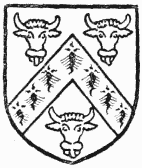
Bullock. Gules a cheveron ermine between three bulls' heads caboshed argent with horns or.
The manor came subsequently to the Bullocks of Arborfield. The name of Thomas Bullock appears in the Domesday of Inclosures of 1517 as owning 100 acres of land and a house in Barkham which had been occupied as a farm until 1514, from which time he had allowed the house to remain in disrepair. (fn. 27) In his will of 1557 he gave his wife the choice between certain rooms in the manor-house of Arborfield and the farm of Barkham 'to inhabit there or not.' He left to the church a pair of white satin vestments 'with crosse redde velvett.' (fn. 28) With Arborfield the manor was sold in 1589 to Edmund Standen, and was in the Standen family (fn. 29) (see Arborfield) as late as 1700, when Edward Standen suffered a recovery of it. (fn. 30) It is found soon afterwards in the possession of the Waterman family, who are said to have bought it from the Standens. (fn. 31) John Waterman presented to Barkham Church in 1739. (fn. 32) He married Penelope daughter of Sir William Kingsmill by his second wife Rebecca. (fn. 33) In 1755 William Waterman suffered a recovery of the manor, (fn. 34) and again in 1757 with Esther his wife. (fn. 35) The manor apparently passed by settlement to Elizabeth Brice, daughter of Frances Cory, daughter of Sir William Kingsmill by his first wife. She with her husband Robert Brice levied a fine of it to Sir Samuel Fludyer, bart., and his brother Sir Thomas Fludyer in 1763 (fn. 36) and again in 1766 to Thomas Ward. (fn. 37) In 1821 Samuel Fludyer, (fn. 38) son apparently of Sir Samuel Brudenell Fludyer, bart., (fn. 39) suffered a recovery. (fn. 40) What interest the Fludyers had in the manor is not clear. According to Lysons the manor passed to the Pitts and Fonneraus. (fn. 41) William Pitt presented to the church in 1768 and John Pitt in 1782, (fn. 42) but the ownership of the rectory seems to have become distinct from that of the manor about this date, for the rectory is mentioned with the manor in 1757, but is not included in the deed of 1763. The manor-house also at this date was held separately from the manor. (fn. 43) Possibly there has been a confusion between the different estates. It seems, however, that the manor was purchased by Lady Gower, the third wife of John first Earl Gower, about 1783 from the Pitts. (fn. 44) She died from injuries received in a fire on 19 February 1785. (fn. 45) After her death her step-son claimed this estate and Bill Hill, Hurst, the family seat, and a lawsuit followed, resulting in a decision that as the property was purchased with Lady Gower's own money it should descend to her own son, (fn. 46) the Hon. John Leveson-Gower, Admiral of the White.
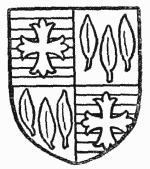
Leveson-Gower. Barry of eight pieces or and gules a cross paty sable quartering Azure three leaves or.
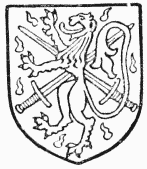
Walter of Bear Wood. Argent sprinkled with blood two swords gules crossed saltirewise with a lion sable over all
The family resided at their seat Bill Hill, in the parish of Hurst, but their family vault was at Barkham. (fn. 47) Admiral the Hon. John Leveson-Gower was succeeded by his son General Leveson-Gower, (fn. 48) who died in 1816, and was succeeded by his son John. During his minority the trustees sold the manor of Barkham to Henry Arthur Broughton. It was then sold to Henry Clive, second son of George Clive of Wormbridge, co. Hereford. He was at one time Under-Secretary of State for the Home Department, and married Charlotte Jane Buller of Morval, Cornwall, leaving no children. (fn. 49) Dying in 1848 he left the manor to his widow for life and the remainder to his nephew, George Clive. Mrs. Clive died in 1874, (fn. 50) and immediately after her death Mr. George Clive sold the manor to the late John Walter of Bear Wood. (fn. 51) His son Arthur Fraser Walter inherited the property in 1894 on his father's death. Mr. A. F. Walter died in 1910, and his son Mr. John Walter is now lord of the manor, and until recently owned almost all the land in the parish. Several farms were sold in 1912, when one of them was bought by the War Office for its army remount dépôt here.
CHURCH
The church of ST. JAMES is a modern building in 13th-century style of flint with stone dressings, the chancel being all of stone. It was erected on an old site in 1862, the eastern portion being again rebuilt in 1887, and consists of a chancel, north and south transepts, north vestry, and an aisleless nave with a south tower, whose lower stage serves as a porch. The roofs are tiled. The top stage of the tower is of wood and has a small octagonal spire covered with shingles.
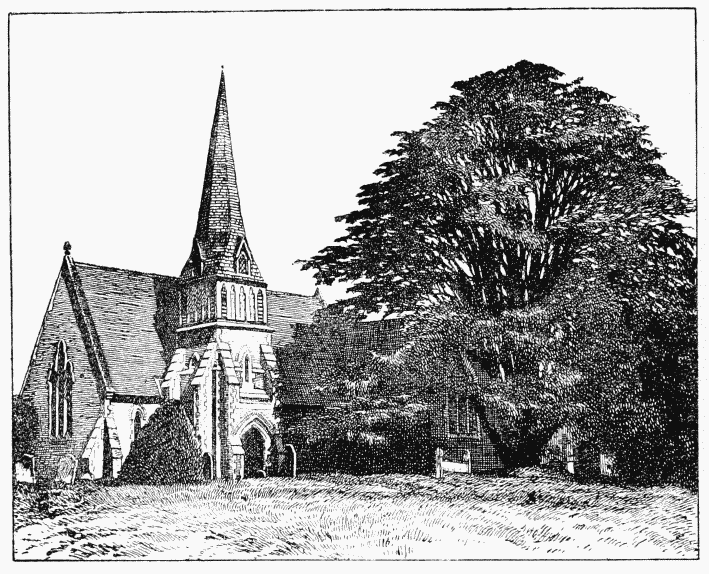
Barkham Church from the South-west
In a recess in the east wall of the porch is a carved wooden effigy, probably of the 13th century, of a lady in a long, loose dress and linen head-dress. Both the hands are missing and the face is much damaged. There are several 18th-century floor slabs in the nave, and tablets to the memory of the Rev. David Davies, Henry Clive and to former rectors.
There are four bells, cast by Warner & Sons, 1863.
The plate includes a silver chalice of 1561, a silver paten given in 1664 by John Stronghill, who described himself as head churchwarden, a large silver flagon inscribed, 'The gift of Dame Rebecca Kingesmill, Relict of Sr Wm Kingesmill Kt., late of Sidmontain in the County of Hampshire to the Parish Church of Barkham, in the County of Berkshire, 1729,' and a second silver paten given by the Rev. John Gabriel, a former rector, in 1775.
The registers previous to 1812 are as follows: (i) all entries 1538 to 1732; (ii) baptisms and burials 1741 to 1812 (no entries exist between 1732 and 1741); (iii) a book containing entries of three marriages in 1764, 1767 and 1768 respectively; (iv) marriages 1770 to 1812.
ADVOWSON
The church of St. James is mentioned in 1220, when William de Wenda, Dean of Salisbury, held a visitation at Sonning, and John, rector of Barkham, was reported to be holding the chapel of Arborfield by rendering half a mark to the dean. Henry, chaplain of Arborfield, lived with the rector of Barkham and received a stipend of 20s. (fn. 52)
The right of presentation to the rectory was vested in the lord of the manor. (fn. 53) In 1334 the king presented to the church, the lands of John Maltravers being in his hands through forfeiture. (fn. 54) After 1757, when William Waterman was holding both manor and advowson, (fn. 55) the records of the manor do not mention the advowson (see above). In 1768 the advowson was in the hands of William Pitt, and in 1782 John Pitt presented. (fn. 56) The advowson was purchased by Lady Gower, and remained in her family until the year 1810, when the Rev. Henry Ellis St. John purchased it from Major-General John Leveson-Gower and became rector of the parish, he being also rector of Winchfield (co. Hants) and Finchampstead. (fn. 57) His widow, Mrs. Elizabeth St. John, was patron of the living after his death in 1841, and was followed by her son the Rev. Edward St. John, then rector. (fn. 58) In 1862 he sold the advowson to the Rev. Arthur Roberts, curate of the parish, and two years later Mr. Roberts sold it to John Walter of Bear Wood, (fn. 59) whose grandson Mr. John Walter is now the patron.
The Rev. David Davies, D.D., rector of Barkham (1782–1819), was the author of Cases of Labourers in Husbandry Stated and Considered, 1785. He made a very careful study of the condition of the labouring poor, and recorded in his book valuable statistics regarding the wages, cost of food, &c., in various districts of England and Scotland.
CHARITIES
The official trustees hold the following sums of stock in trust for the poor of this parish:—
£16 2½ per cent. annuities, representing the redemption in 1899 of a rent-charge of 8s., the gift of John Brookbank, mentioned in the table of benefactions, dated in 1724;
£267 4s. 5d. consols, arising from sales in 1871 and 1874 of part of Half Moon Close and Long Moor Common, constituting the endowment of Alice Allwright's charity, founded by deed, 1758;
£488 11s. consols, representing proceeds of sale in 1874 of land awarded in 1821 as fuel allotment;
£9 1s. 5d. consols, arising from sale of heath land under the same award; and
£199 10s. consols, being a legacy by will of Mrs. Sarah Glasspool, proved 24 February 1881, the dividends being applicable in the distribution of blankets or flannel.
The dividends, amounting to £24 10s. a year, are, together with the income of a charity known as Dalamore's charity, stated to be £100 consols, applied in gifts of coal.