A History of the County of Berkshire: Volume 3. Originally published by Victoria County History, London, 1923.
This free content was digitised by double rekeying. All rights reserved.
'Parishes: Shinfield', in A History of the County of Berkshire: Volume 3, ed. P H Ditchfield, William Page (London, 1923), British History Online https://www.british-history.ac.uk/vch/berks/vol3/pp261-267 [accessed 9 May 2025].
'Parishes: Shinfield', in A History of the County of Berkshire: Volume 3. Edited by P H Ditchfield, William Page (London, 1923), British History Online, accessed May 9, 2025, https://www.british-history.ac.uk/vch/berks/vol3/pp261-267.
"Parishes: Shinfield". A History of the County of Berkshire: Volume 3. Ed. P H Ditchfield, William Page (London, 1923), British History Online. Web. 9 May 2025. https://www.british-history.ac.uk/vch/berks/vol3/pp261-267.
In this section
SHINFIELD
Selingefelle (xi cent.); Shenyngfeld (xv cent.); Shenfeld, Shyningfeild (xvii cent.); Shinfeild alias Shineingfeild alias Shinwills (xviii cent.).
The parish of Shinfield is situated on the left bank of the River Loddon between Stratfield Mortimer and Earley, and consists of a central ridge of high land sloping eastwards to the Loddon and westwards towards the Kennet valley. The soil is almost wholly London Clay with considerable spreads of valley gravel about Hyde End and School Green on the east and Grazeley and Three-Mile-Cross on the west side, and some patches of plateau gravel on the hill-tops near Spencer's Wood and Shinfield Lodge. There are also some alluvial meadows near the Loddon. The area of the parish is 4,313 acres, of which 1,426 are arable land, 2,247 permanent grass and 75 woods and plantations. (fn. 1) Recently a large part of the estate of Shinfield Manor, the property of the late Captain Cobham, has been sold, and numerous small houses and cottages have been built.
A part of the parish on the west, comprising the Diddenham estate, formed an outlying portion of Wiltshire (see under hundred) until transferred to Berkshire in 1844.
The liberty of Hartley Dummer in Shinfield parish lies within the hundred of Theale. Although still in the civil parish of Shinfield, it has been transferred to the ecclesiastical parish of Lambwood Hill, formed out of Shinfield in 1854. (fn. 2) To this parish were added in 1860 the tithing of Grazeley in Sulhamstead Abbots and a portion of Sulhamstead Bannister, and it was then renamed Grazeley. (fn. 3) A new ecclesiastical district has recently been formed at Spencer's Wood, embracing parts of Shinfield, Grazeley and Swallowfield.
Part of Shinfield which has been included in Reading municipal borough was added to the civil parish of St. Giles's, Reading, in 1889. (fn. 4)
The church and manor-house of Shinfield lie on the eastern side of the parish, not far from the River Loddon. The manor-house, an 18th-century building, formerly the rectory, belongs to Mr. Alex. Blyth Cobham, son of Capt. Cobham. The old manor-house was pulled down at the end of the 18th century by Alexander Cobham, who purchased the estate from the Earl of Fingal; its site is near a small farm-house in an opening of the avenue on the east side of the road leading from Shinfield to Reading. The modern vicarage is on the north of the church. On the opposite side of the road to the church is a modernized 17th-century farm-house of half-timber and brick. The house contains a fine oak staircase of Jacobean date. In a field to the east of this farm and on the same side of the road is a small, deep moat. It is possible that this may be the remains of the clay-pits dug for the making of the bricks used in the 17th-century church tower. A by-road runs past the church and manor-house to the Reading road, a picturesque highway lined with elms and oaks with a stretch of common on the right, now inclosed and built over with modern villas. On the left are Shinfield Lodge and Shinfield Grove, until recently the property of the Hulme family, who held them from the end of the 18th century, and Goodrest, built in the 'ornamental Gothic' style, the property in 1843 of Edward Willes, whose son William Willes sold it to Mr. John Dawson Mayne. From the Black Boy Inn a road leads past Shinfield Grange to Lower Earley. The land south of this and to the east of the Reading road is partly occupied by the Reading College experimental farm and has partly been cut up by new roads for building purpose. The hamlet of Three-Mile-Cross, on the Reading road, is a picturesque little village which figure in Miss Mitford's Our Village. The house in which Miss Mitford lived for thirty years is now used as a club-house. In 1851 she moved to a small house in Swallowfield, still standing, where she spent the last five years of her life and from which she published in 1852 the Recollections of a Literary Life.
School Green lies a little to the south of the church and takes its name from the school-house erected here in 1707 by Richard Piggott, citizen and cutler of London. The original house still stands. It is a two-storied building of brick with a tiled roof and wooden modillion cornice. There is an attic story in the roof, lighted by dormer windows. The windows of the ground and first floors are of the casement type usual at the period, having a central unmoulded mullion of wood, the upper third being divided from the lower part by a transom. Over the doorway, which is placed centrally, is a stone tablet inscribed as follows: 'This school was | Built by Richard | Piggott Citizen & | Cutler of London | son of William | Piggott of this parish | Anno Domini | 1707.' Modern additions have been built on either side of the main building.
Highlands, to the west of the Reading road, was the residence of Miss Crowdy, who died recently, and the estate is now about to be sold. Stanbury, a little further north, is the seat of Mr. Frederick Allfrey and was built in 1859–60. In Grazeley parish are Grazeley Court, formerly known as Grazeley Lodge, owned by Captain Drake, and Hartley Court, the property of Mr. J. H. Benyon. The latter is an ancient building with a modern front. It contained in 1843, in the attics, a carved mantelpiece showing the arms of Beke, wrought in inlaid coloured woods, dated 1509. (fn. 5) This has been removed, but the study contains an Elizabethan overmantel. (fn. 6)
There is a Baptist chapel in Shinfield, a Wesleyan chapel at Three-Mile-Cross, and a Congregational chapel at Spencer's Wood.
MANORS
In the time of King Edward the Confessor SHINFIELD was held in alod of the king by Sexi, and in 1086 formed part of the royal demesne. It was an important manor and had a mill worth 5s. and 150 eels and five fisheries worth 550 eels. (fn. 7) It is not improbable that although in the king's hands in 1086 the manor had once formed part of the fee of William Fitz Osbern Earl of Hereford (who gave the church to his abbey of Lire) and had been forfeited by his son Earl Roger in 1174 (see Swallowfield). Before 1166 Shinfield had been granted to one of the Earls of Warwick, and in that year was held under William de Newburgh Earl of Warwick by his tenants the St. Johns. (fn. 8) The manor seems to have been regarded as part of the St. Johns' manor of Swallowfield (fn. 9) (q.v.), from which it was apparently not separated until the middle of the 16th century.
In 1560 Queen Elizabeth granted the manor of Shinfield to William Marquess of Winchester, owner of Stratfield Mortimer. (fn. 10) This was probably in trust for Edward Martin, who in 1561 settled it on himself and his wife Katherine and the issue of Edward, with remainder to William Martin, his natural brother. (fn. 11) Edward Martin's much mutilated monument in the church records that he was at one time a royal surveyor. He died in 1604 seised of the manor of Shinfield. (fn. 12) His daughter and heir Anne had married William Wollascott of Woolhampton, (fn. 13) and the manor afterwards followed the descent of Brimpton (fn. 14) (q.v.) until about 1786, when it was sold by the Earl of Fingal to Alexander Cobham, who was Sheriff of Berkshire in 1790. (fn. 15) He died suddenly in 1810, owing to a fall from his horse, and the manor passed to his great-nephew Alexander Cobham Martyr, who afterwards took the name of Cobham. He died in 1902, leaving the property to his son Captain Alexander William Cobham, late of the 44th Regiment, who died in 1913. Captain Cobham took part in the Crimean war and received the Order of the Medjidie (5th class). His son Mr. A. B. Cobham is now owner.
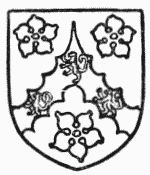
Cobham of Shinfield. Gules a cheveron engrailed between three cinqfoils or with three lions sable on the cheveron.
The manor of HARTLEY DUMMER, which has always been included in the hundred of Theale, is not mentioned by name in the Domesday Survey, but it may, perhaps, be identified with that hide in Reading Hundred (out of which Theale Hundred was afterwards formed) which belonged to Swallowfield and had been held, like the capital manor, by Sexi in the time of King Edward. (fn. 16) In 1086 it was held by the king. During the first half of the 13th century Richard de Dummer held 1 hide in Hartley (fn. 17) by service of a quarter of a knight's fee. (fn. 18) He quarrelled with the Abbot of Reading over common of pasture in Grazeley, which he ultimately quitclaimed to the abbey in return for a grant of the land between Fulritham and the Trunkwell road. (fn. 19) In 1249 Sir Richard de Dummer granted his land in Hartley, except his meadows called Eldemed and Niwemed and his free men and villeins and their tenements, to Giles Bridport, then Archdeacon of Berkshire and afterwards Bishop of Salisbury. (fn. 20) The grant was confirmed by Sir Richard's daughter Alice and her husband Luke Rop, (fn. 21) and Bridport bestowed the land on his college of St. Nicholas de Vaux at Salisbury. (fn. 22)
The college remained in the possession of this estate till the Dissolution, (fn. 23) by which time it consisted chiefly of the manor called ERBAR or ARBOR, described as situated 'in the vill of Hartley Dummer in the parishes of Shinfield and Burghfield.' (fn. 24) It was granted to Sir John Williams in 1543, (fn. 25) and afterwards followed the descent of the manor of Burghfield, appearing as a separate estate until as late as 1700. It probably lay not far from Amners in Burghfield, but the name Erbar now seems to be lost. (fn. 26)
In 1656 Montagu Earl of Lindsey and Bridget his wife, daughter of Edward Wray and Elizabeth Norreys, conveyed the site of the manor to Anne James, widow. (fn. 27)
Another hide of land at Hartley was held in the early part of the reign of Henry III by the Abbot of Battle. (fn. 28) This holding, which was afterwards known as HARTLEY BATTLE, (fn. 29) is not mentioned in Domesday. Possibly it still belonged in 1086 to the king's manor of Shinfield or to Ralph de Mortimer's 'Hurlei,' (fn. 30) or it may have been assessed, as it was in the 15th century, (fn. 31) with the abbot's capital manor of Brightwalton, 15 miles away. The tenants of Hartley Battle did suit at the view of frankpledge held at Brightwalton Court at least as late as 1503. (fn. 32) In 1424 Robert Woodcock seems to have been holding a large part of this estate, for he was then paying 8s. yearly to the abbey for himself and his tenants. (fn. 33) There is no mention of Hartley in the Ministers' Accounts of Battle in 1479, (fn. 34) and no grants of the land have been found at the Dissolution, but apparently the lordship which the abbey had held persisted, for in 1709 a 'manor and liberty of Hartley Battle,' parcle of the manor of Brightwalton, is said to have been conveyed by its owner, John Westmoreland, to Sir Owen Buckingham, (fn. 35) and thereafter to have descended with Moor Place (q.v.).
Early in the reign of Henry III there were 2 hides in Hartley, of which one was held by Amys de Pellitot and the other by Matthew de Burghfield, who seem to have been kinsmen. (fn. 36) Their lands, which are described in a late inquisition as being held of the lord of Stratfield Mortimer, (fn. 37) are not entered separately in Domesday Book, unless they may be identified with the 2 hides in 'Hurlei,' (fn. 38) entered under Reading Hundred in the Domesday Survey, which had been held of Edward the Confessor by Rachenild and formed part of the fee of Ralph de Mortimer in 1086. (fn. 39)
The descent of these holdings, distinguished in the 14th century as HARTLEY AMYS and HARTLEY PELLITOT, (fn. 40) is extremely difficult to trace, but it seems probable that they early came into the same hands. About 1255 an Amys de Pellitot, probably the above-mentioned Amys or his heir, was holding in Hartley; he was then in great difficulties and granted several rents out of his lands to Reading Abbey in return for money to meet his debts. (fn. 41) The second hide came to Richard son of Matthew de Burghfield, (fn. 42) who was probably the same as the Richard son of Matthew de Pellitot mentioned in the Vaux chartulary. (fn. 43) Richard de Burghfield granted land in Hartley to Nicholas de Diddenham. (fn. 44)
Both holdings seem to have come to John son and heir of John de Burghfield, who possibly bought them from a descendant of Matthew de Burghfield mentioned above. (fn. 45) John in 1361 released all right in his lands of Burghfield, Hartley Amys and Hartley Pellitot to Hugh de Segrave, John de la Huse and John atte Beche. (fn. 46)
In 1441 the lordship of 'Hartley Abys' was still held with the manor of Burghfield. (fn. 47) Hartley Pellitot afterwards came to the Woodcocks, (fn. 48) and is generally treated as an appurtenance of Moor Place, though it is distinguished as a separate manor in 1540 (fn. 49) and again in 1630. (fn. 50)
The early descent of the so-called manor of MOOR PLACE is obscure. In 1540 it is described as lying in Hartley Dummer, (fn. 51) Hartley Amys, Hartley Pellitot, Hartley Battle, Hartley Regis, Shinfield and Burghfield. It may have been composed of part of Sir Richard Dummer's holding (see above) and of that part of the Battle Abbey estate held in 1424 by Robert Woodcock (see above), and probably of other holdings. Richard Woodcock dealt by recovery with the manors of Moor Place, Hartley Pellitot and Diddenham in 1540. (fn. 52) He was succeeded by George Woodcock, (fn. 53) who married Anne daughter of William Hyde of South Denchworth. (fn. 54) Robert Woodcock (fn. 55) died seised of the manor in 1630, leaving a widow Margaret and a son Thomas, (fn. 56) who was succeeded before 1657 by Samuel Woodcock. (fn. 57) Samuel together with his wife Hannah was dealing with the manor in that year, but he seems to have died before 1666, for the Woodcock estates were then in the hands of Edmund Ansley, the guardian of another Samuel Woodcock. (fn. 58) The younger Samuel probably died without issue, for the manor seems to have come to Mary Spier née Woodcock, wife of John Spier of Huntercombe, apparently daughter and co-heir of the elder Samuel. In 1676 she as Mary Spier, widow, was settling the manor in conjunction with Richard and Edward Taylor, (fn. 59) and it seems to have descended to her three co-heirs. (fn. 60) In 1702 William Gibbons, M.D., and Elizabeth his wife, daughter of Mary Spier and apparently widow of Robert Huntington and Samuel Danvers, John Touchett and Martha his wife and Robert Breedon the younger released their right in the manors of Moor Place and Diddenham to Sir Owen Buckingham. (fn. 61) The estate descended with Earley Bartholomew in Sonning (q.v.) to Elizabeth Manley, wife of Sir John Powell Pryce. In 1752 she with her husband quitclaimed the manor to Alexander Whitchurch. (fn. 62) The estates afterwards passed to H. Plant, (fn. 63) whose devisees sold them before 1806 to Mr. William Dearsley. (fn. 64) His son Mr. William Hanson Dearsley died seised of them in 1825, (fn. 65) after which they were held by his widow, who married as her second husband Mr. Thomas Owst, and was still in possession of them in 1843. (fn. 66) They were afterwards bought by Mr. Richard Benyon, whose nephew Mr. James Herbert Benyon is the present owner.
The so-called manor of DIDDENHAM COURT was parcel of the manor of Sheepbridge (q.v. in Swallowfield), (fn. 67) and in the early part of the reign of Henry III was held of Ela Countess of Salisbury by Roger de Didenham. His brother John afterwards held under Henry de Mara, who was enfeoffed of the rights of overlordship by William Longespée, son of the Countess Ela. (fn. 68) John was probably succeeded by Nicholas de Didenham, whose name appears in several deeds of the latter half of the 13th century. (fn. 69) The descent of the holding after this date is not clear, but ultimately it came with Hartley Pellitot to the Woodcocks, and was in the possession of Richard Woodcock in 1540. (fn. 70) It then follows the descent of Moor Place (q.v.).
A reputed manor of Hartley was in the 16th century in the possession of Thomas Vachell of Coley. To judge from certain of the place-names (fn. 71) it seems to have been formed in part out of lands in the manor of Hartley Battle. The Vachells held land in the parish in the 13th century. (fn. 72) The Vachell estate followed the descent of Coley until as late as 1611, (fn. 73) but its history after this date is not known.
Another manor of Hartley, called also HARTLEY COURT, is mentioned in 1525, at which time it was held by Sir Edmund Bedingfield and Grace his wife in right of Grace, who was daughter and heir of John Russell (fn. 74); they quitclaimed their interest in it to John Baldwyn and others, (fn. 75) who conveyed it to Thomas Beke of Earley Whiteknights, (fn. 76) the descent of which manor (q.v.) it followed till 1832. (fn. 77) It was afterwards bought by Mr. Benyon.
The capital messuage of Hartley Court was held in 1609 by Sir Thomas Smyth, who left it by his will to his son Robert, with successive remainders to his daughter Margaret for life and to his brother Richard. (fn. 78) Robert died childless in 1625, and was succeeded by his sister, then only seventeen, the wife of Thomas Cary. (fn. 79) Richard Smyth conveyed it by fine to Thomas Fisher in 1652. (fn. 80) In 1659 it was held by Margaret Herbert, widow, and Alexander Thayne and his wife Anne, Anne being apparently an heiress. (fn. 81) Margaret Herbert dealt with it in 1668. (fn. 82) Hartley Court was bought by 'Deane a pinmaker and haberdasher of Reading.' He died about 1795 and his daughter Anne married her cousin Charles M. Deane. (fn. 83) They were living there in 1805, (fn. 84) and in 1843 Mrs. Cooper occupied it. (fn. 85) Later Mr. Richard Benyon bought it.
Waleran Earl of Warwick, chief lord of the Shinfield fee, granted to Piers Blund and his heirs about 1190 all the land in Shinfield and Trunkwell held of him by Walter Luffant and Richard, Walter's nephew. (fn. 86) This seems to have been the estate afterwards known as the manor of GARSTON, which was held by the Blounts of the Earls of Warwick, (fn. 87) and which followed the descent of Sheepbridge (see Swallowfield).
A park called Moregarston is mentioned in the 13th century among the boundaries of a certain moor held by Luke de Grazeley of Amys de Pellitot. (fn. 88)
Certain lands in Shinfield and Burghfield, including the 'chief tenement called Elyns,' were granted by Amys de Pellitot and his under-tenants the Mores to Reading Abbey in the 13th century. (fn. 89) These remained in the possession of the abbey till the Dissolution, when they were leased to John Beke for a term of twenty-one years, on surrender of a lease made to him in reversion after Richard Alsey by the last Abbot of Reading. (fn. 90)
CHURCHES
The church of ST. MARY THE VIRGIN consists of a chancel 32 ft. 7 in. by 17 ft. 3 in., south chapel 19 ft. 1 in. by 13 ft., nave 56 ft. 3 in. by 22 ft., south aisle 56 ft. 3 in. by 15 ft. 8 in. and west tower 13 ft. 4 in. by 13 ft.
The church appears to date from the last half of the 12th century, to which period the north doorway belongs. The nave arcade having been rebuilt in modern days, it is impossible to say when the south aisle was added. Two early 14th-century windows which still survive in the north wall of the chancel point to a rebuilding at that date. There are windows of similar character at the east end of the south wall of the south aisle and at the east end of the north wall of the nave, though both have been much restored. Late in the 15th century several new windows were inserted in the nave and south aisle. In 1596, as recorded by a tablet set in the exterior of the east gable, the south chapel was built, no doubt to contain the Martin pew. The west tower was rebuilt of brick c. 1630. In 1857 the church was restored, when the south arcade of the nave was rebuilt and the chancel walls were very considerably repaired.
In the east wall of the chancel is a modern window of three lights. In the north wall are two 14th-century windows. The eastern is of two acutely pointed cinquefoiled lights with a quatrefoiled spandrel within a two-centred head. The western window is also of two cinquefoiled lights, with tracery of a flamboyant type within a similar head. At the north-east of the chancel is a modern credence table niche. In the eastern part of the south wall is a modern window copied from the corresponding window in the north wall. Westward is a roundarched opening of two chamfered orders into the south chapel, and probably contemporary with it. The chancel arch is modern and of two orders, designed in the style of the early 14th century. The exterior of the chancel is faced with flint, and at the north and south-east angles are angle buttresses of two offsets.
The east window of the late 16th-century south 'chapel' is of three pointed lights, uncusped, their mullions being carried up into the two-centred containing head. On the north side is a small modern doorway with a four-centred head. Between is a small buttress of one offset, and at the south-east are angle buttresses, also of one offset. The south window is square-headed and of three plain transomed lights. In the exterior of the east wall, high up in the gable, is a stone panel, inscribed 1596 M/EM. A four-centred arch divides the 'chapel' from the south aisle. The walls are plastered externally.
The nave has three north windows; the easternmost is similar to the easternmost window in the north wall of the chancel, the other two are late 15th-century windows of three cinquefoiled lights within square heads. Between these last is the late 12th-century north doorway. This is externally of two semicircular hollow-chamfered orders. The jambs of the outer order are shafted, and those of the inner order moulded with a small roll. The head stop of the label on the east side appears to have come from the original nave arcade, the stone being the double skew-back of an intersecting label. The west head stop may be in situ. At the east and west ends of the north wall of the nave, which is plastered externally, are buttresses of two offsets. The south arcade of the nave is modern and of four bays. The north porch is also modern.
In the south wall of the south aisle are three windows. The easternmost is similar to the corresponding window in the north wall of the nave and has been much restored. The other two windows are each of three cinquefoiled lights with vertical tracery within a square head, and are of the same date as those in the north wall of the nave. Between them is a built-up doorway with a four-centred head, probably also of the same date. On the exterior of this wall are three buttresses, placed there in the 17th century. In common with the wall they support, these are plastered, and where the plaster has fallen away they appear to be of brick. In the east wall is a modern window of two trefoiled lights.
The west tower is built of brick in three stages with octagonal angle buttresses and an embattled parapet. The two-centred tower arch is modern, and has been stuccoed. The west doorway has a semicircular head with a projecting brick key, and is surmounted by a moulded brick entablature, supported by heater-shaped corbels of brick. Above the doorway is a window of five lights within a square head. Externally a string-course of fanciful brickwork, which marks the division between the ground and first stages, is broken upwards over this window to form a label. The ringing chamber is lighted on the north and south by square-headed windows of two plain lights having two-centred heads and flat brick mullions. The jambs of the lights, which are set back slightly from the face of the wall externally, are stuccoed. The labels are of unmoulded brick, arranged in a simple pattern. The belfry is lighted by similar two-light windows on all four faces. Above and below this stage are string-courses formed in the same manner as the labels described above. The walls of the belfry stage are slightly recessed in the centre of each face.
The roofs of the nave, south chapel and south aisle are original. The nave roof probably dates from the latter half of the 14th century, and is a fine specimen of an uncommon type. It is supported by four trusses having collars, plain king-posts and cambered tiebeams, supported by wall-posts and short curved braces resting on stone corbels. On the king-posts, and braced by curved struts springing from these, rests a longitudinal beam supporting the collars of the principal and intermediate rafters. These collars are braced by straight struts abutting against the lower part of the rafters. The king-posts themselves are strutted from the tie-beams by curved struts. The aisle roof, which is probably a 17th-century reparation, is supported by rough queen-post trusses. The second truss from the east is, however, in all probability of earlier date. The rafters are braced by curved braces, starting at the feet of each rafter and crossing in the centre, a two-centred arch being thus formed. The roof of the south chapel has a pentagonal wooden ceiling, with moulded ribs and carved bosses at their intersections. The ribs appear to be modern. The main part of the ceiling, however, is probably contemporary with the erection of the chapel. The altar table is of Elizabethan date and has large baluster legs of the 'melon' type. This was at one time in the vestry, but has been replaced in its original position. A large Jacobean chest with three locks is also preserved.
On the west wall of the nave is a Purbeck marble tablet sculptured with a shield of twelve quarters, and on a scroll beneath the following inscription: 'Huico (?) filio suo hic humato Marcus filius Simionis Steward armig: de | Lakingheth in com: Suff: posuit.' Below the inscription is a broken sword, and on the hilt the date 1576. On the west wall of the south aisle is an elaborate mural monument of marble to Edward Martin, who died 5 June 1604, aged seventy-nine, and his wife Mary, who died 1 October 1607, aged seventy-one. He was probably the builder of the south chapel, the initials corresponding with those carved on the tablet, mentioned above, in its east gable. The monument appears to have been much disturbed at some period, the figure of Edward Martin having disappeared, those of his wife and daughter alone remaining. The monument is framed by Corinthian columns supporting an entablature, surmounted by a shield, Argent a bend sable cotised ermine with three cinqfoils or on the bend and a ring for difference, impaling Gules a saltire between four sheaves or, for Reade. The figures of the two women are of alabaster and are kneeling in prayer. On the base of the monument are two panels containing the inscription, which seem to have been transposed, the second half of the inscription being on the dexter panel and the first half on the sinister. On the north wall of the nave is a marble tablet sculptured with a shield to Henry Beke, who died in 1580. His arms were Or two bars dancetty sable and a chief azure with three rings argent therein. Above is his crested helm. Below are two smaller shields, Beke impaling Lewknor, and beneath is the inscription. On the south wall of the south aisle is an elaborate marble monument to Henry Beke. On a projecting base are the kneeling figures of himself, his wife and daughter. Two female figures support an entablature, surmounted in the centre by a pedimented superstructure, on which is sculptured a shield of his arms with a crested helm. The entablature is broken forward over the heads of the supporting figures, and crowned by small obelisks standing on pedestals. On the dexter pedestal is a shield quarterly, (1) and (4) a double headed eagle, a crescent for difference, (2) and (3) a fesse engrailed between three eagles, for Crooke, impaling Beke. On the sinister pedestal is a shield charged with Beke, impaling three cheverons, a crescent for difference. A black marble panel on the base of the monument is inscribed with the following:—
Hic pater Henricus, mater Jana, et filia Eliza |
Eminguntur, adest urnula sola patris. |
Beake nomen patrum, domus Hartley-Curia, mater |
Rogero Lewkener milite nata fuit |
Georgius extruxit monumenta (enatus Eliza |
Filius Hugonis Speke) pia jussa matris.
Above is inscribed 'Ano DnĈ: 1627.'
There is a peal of six bells: the treble, inscribed 'David Headland c.w. 1730 i.w.f.'; the second, 'Honour the Kinge 1664'; the third, 'Hope in God 1664'; the fourth (in upper hand), 'Dainell Headland Thomas Hollyer Churchwardens' (below, in lower hand) 'Henry Bagley Made Mee 1722'; the fifth, 'Reioice in God 1664,' and the tenor, by Thomas Mears of London, 1805.
The communion plate consists of an almsdish bearing the date letter of 1761, a chalice and cover paten, a small plated paten, a chalice bearing the date letter of 1855 and a flagon of 1854.
The registers previous to 1812 are as follows: (i) baptisms 1649 to 1757, burials 1653 to 1757, marriages 1653 to 1754; (ii) baptisms 1757 to 1812, burials 1757 to 1812; (iii) marriages 1754 to 1777; (iv) marriages 1777 to 1796; (v) marriages 1797 to 1812.
The church of ST. MICHAEL AND ALL ANGELS at Spencer's Wood consists of a chancel, south vestry, nave and south porch, and was built in 1908. The materials are red brick with stone dressings, and the design is in the 14th-century style. Over the west gable of the nave is a brick bellcote.
ADVOWSON
The earliest notices (fn. 91) extant of Shinfield Church and its attached chapel of Swallowfield show that in the 12th century they belonged to the abbey of Lire in Normandy and had been obtained by grant from William Fitz Osbern Earl of Hereford, the founder of the abbey. Doubtless the abbey of Lire experienced the usual difficulties of alien priories in dealing with their English property, and by the reign of Edward I the advowson had passed to the lord of the manor, (fn. 92) though a pension of £2 a year was still retained by the monks. (fn. 93) In the year 1294 the advowson of Shinfield with Swallowfield chapel was transferred (fn. 94) to the Dean and Chapter of Hereford by the patron, Sir John St. John. In 1320 licence was granted to the dean and chapter to devote the proceeds of the two churches to the rebuilding of the cathedral church so long as the work should last. (fn. 95) and in the same year the Dean and Chapter of Hereford paid 5 marks for licence to appropriate both mother church and chapel. (fn. 96) In or about the year 1327 they granted (fn. 97) the church to Adam Orlton, Bishop of Worcester, for life, in consideration of his efforts in forwarding the canonization of St. Thomas Cantelupe.
The rectory and advowson have remained with the Dean and Chapter of Hereford, (fn. 98) by whom the rectory has been leased out from time to time. (fn. 99)
The ecclesiastical affairs of Shinfield were in a deplorable state during the Commonwealth period and at the Restoration. In 1661 Bishop Humphrey of Salisbury issued an order requiring William Cosens, vicar of Shinfield and Swallowfield, to do the duties of his parish, forbidding William Stanley, a mechanic, who had been permitted for a year, to perform any ministerial acts. The parishioners were ordered to put him out quietly, if they could. It appears that the Rev. William Cosens had been ejected for lewd living fifteen years before, but had returned and appointed Stanley, an Anabaptist minister, to act for him. The orders of the bishop were contemned by Cosens, Stanley and certain factious parishioners, who disclaimed the authority of bishops. The justices were appealed to, but refused to interfere without the king's order. Stanley, who was a cordwainer by trade, refused to cease from preaching, stating that he had been chosen by a majority of the parishioners, and that he would stand by them if they stood by him. He spoke contemptuously of the bishop's order, praising the good old times and condemning the spirit of Antichrist reigning in the land. Subsequently he brought sixty stout fellows from Reading to support him. The settlement of the disturbance is not recorded. (fn. 100)
CHARITIES
The following charities are distributed together by the churchwardens as one charity, namely: Nicholas Russell's, will, 1611, being 20s. a year charged on a farm formerly known as Blackhouse Farm, but now as the Grovelands; Reynold Butler's, will, 1614, trust fund, £11 10s. consols, arising from redemption in 1871 of annuity of 6s. 8d.; John Reynolds's, will, 1646, trust fund, £35 consols, arising from redemption in 1868 of annuity of 20s. charged on land at Wokingham; William Wollascott's (Williscott), trust fund, £101 13s. 4d. consols, redemption of annuity of £3 3s. 4d. charged on manor of Somerford Bowles; and an annuity of 8s. charged by a donor unknown on the 'Swan' public-house at Three-Mile-Cross.
The sums of stock are held by the official trustees. The annual income of these charities, amounting together to £5 1s. 8d., is distributed in coals.
The charity of Richard Piggott for clothing, founded by will proved in the P.C.C. 12 June 1731, consists of two cottages and gardens containing together about an acre, let at £16 a year. The rents are being accumulated to form a rebuilding fund. By an order of the Charity Commissioners of 14 August 1903 the legal estate was vested in the official trustee of charity lands.
In 1842 Richard Body, by will proved at London 13 July, bequeathed £100 for the annual distribution of blankets, subject to the repair of tablet and monument in the church. The legacy is represented by £104 0s. 7d. consols with the official trustees.
In 1856 a piece of land containing 1a. or. 36p. was awarded to the churchwardens in lieu of 3r. 29 p. found by an inquisition taken at Reading in 1654 to belong to the church, the rent of which is applied towards the church expenses.
Educational charities.
—The free school was founded by Richard Piggott, by deed, 1724, and augmented by will of William Edward Francis Feilde, proved at London 10 February 1851. (fn. 101)
The endowments consist of a rent-charge of £12 issuing out of property known as Lauds Place in Broad Street, Reading; an allotment of 26 p. in Pond Green, Grazeley, let at 5s. a year; £1,621 5s. 1d. consols, Piggott's charity, and £1,063 9s. 2d. consols, Feilde's charity, with the official trustees, who also hold £1,332 11s. 10d. consols and the credit of an investment account, accumulating.
The school is now regulated by a scheme of the Board of Education, dated 13 May 1903. The income, amounting to about £80 a year, is applicable, subject to the payment of £1 1s. a year to the vicar for a sermon and 1s. to the clerk, in the education and clothing of twenty-six children in respect of Piggott's charity and of six children in respect of Feilde's charity, the residue being paid to the Berkshire Education Committee in the relief of the education rate.
Charity of Mary Spicer. (fn. 102) —The endowment consist of two allotments containing together 3 a. 0r. 20 p., acquired under an award of 1858 in lieu of an old inclosure called Charity Pightle, and £400 consols with the official trustees.
The annual income of £15 is applied in aid of the public elementary school of Grazeley.
Ecclesiastical parish of Grazeley.
—Charity of Mrs. Mary Spicer for school. (fn. 103) The educational foundation of John Merry consists of school buildings, teacher's house and grounds, conveyed by deed, dated 2 September 1862 (enrolled), and £1,566 16s. 8d. consols, arising under the donor's will, proved at London, 10 March 1873. The stock is held by the official trustees, who also hold £155 11s. 2d. like stock as a repair and insurance fund, producing together an annual income of £43 1s., of which £20 is applied for clothing poor children attending the school, which is situated in that portion of the parish of Grazeley formerly in the parish of Sulhamstead Bannister, Lower End.
Merry's eleemosynary charity, founded by the abovementioned John Merry of Spencer's Wood, consists of an alms-cottage, part of the school buildings and garden attached, occupied by the parish nurse, and £1,557 12s. 2d. consols with the official trustees, producing yearly £38 18s. 8d., which is applied partly in payment of the nurse's stipend and partly in fuel and lighting for her and other necessaries for her and her patients.
In 1906 there was an accumulation fund amounting to £133 9s. 3d.