A History of the County of Berkshire: Volume 3. Originally published by Victoria County History, London, 1923.
This free content was digitised by double rekeying. All rights reserved.
'Parishes: Thatcham', in A History of the County of Berkshire: Volume 3, ed. P H Ditchfield, William Page (London, 1923), British History Online https://www.british-history.ac.uk/vch/berks/vol3/pp311-329 [accessed 30 April 2025].
'Parishes: Thatcham', in A History of the County of Berkshire: Volume 3. Edited by P H Ditchfield, William Page (London, 1923), British History Online, accessed April 30, 2025, https://www.british-history.ac.uk/vch/berks/vol3/pp311-329.
"Parishes: Thatcham". A History of the County of Berkshire: Volume 3. Ed. P H Ditchfield, William Page (London, 1923), British History Online. Web. 30 April 2025. https://www.british-history.ac.uk/vch/berks/vol3/pp311-329.
In this section
THATCHAM
Thaecham (x cent.); Taceham (xi cent.).
The parish of Thatcham contains 5,936 acres of land, of which 2,123 acres are arable, 2,062 acres are permanent pasture and 614 acres are woods and plantations. (fn. 1) It formerly contained nine tithings, Thatcham, Awberry Street, Parsonage, Henwick, Coldrop, The Lords or the Earl of Worcester's tithing, Richard Goddard's tithing, Greenham and Midgham. In 1878 a large part of Greenham was included in the borough of Newbury, (fn. 2) and for the remainder of the tithing a separate rural district council was constituted. In 1894 Cold Ash, which had previously been formed into an ecclesiastical parish, (fn. 3) became, with the addition of Ashmore Green, part of Long Lane, Henwick and Shaw Fields, a separate civil parish, containing 1,928 acres, which includes 613 acres of arable land, 641 acres of permanent grass and 194 acres of woods and plantations. (fn. 4) In the northern part of Thatcham parish the land lies between 300 ft. and 400 ft. above the ordnance datum, rising to 448 ft. near Mount Pleasant and 431 ft. at Harts Hill. Near Thatcham village and the River Kennet the altitude is between 230 ft. and 250 ft. Towards Crookham it again rises to 387 ft. on Crookham Common. The Kennet and the Kennet and Avon Canal cross the parish, and the River Lambourn joins the Kennet in the west of the parish near Ham Mill. There is a small stream also joining the Kennet called the Moor Ditch, while the River Enborne forms part of the south border of the parish. The subsoil consists of Woolwich and Reading beds, alluvium, London Clay and Bagshot and Bracklesham beds. The road from Newbury to Reading crosses the parish, passing through the village of Thatcham, where it is called first Cheap Street and then Chapel Street. New Town is at the west end of the village, and the cemetery lies to the east, beyond Chapel Street. The Berkshire and Hampshire section of the Great Western railway passes through the parish, the station being about a mile south-east of the village.
The houses and cottages are almost all built of red brick with slate or tile roofs, but there is on the main road a picturesque group of five thatched cottages built of timber framing with brick filling. To the east of these is a small church school, formerly a chapel, founded 1304. It is a small rectangular building, having a modern two-light east window with tracery and two windows in each side wall, apparently of the 16th century. In the south wall near the east end is also a blocked doorway of the same date with moulded jambs and a four-centred head with a label. At the west end is a modern porch, on either side of which is a small niche apparently of 14th-century date, each having an ogeeshaped trefoiled canopy flanked by small crocketed pinnacles and a projecting moulded corbel. The roof is of the 15th century and has moulded timbers. Near the east end of the south wall inside is a small recess, which was probably originally the piscina. The walls are of flint and rough plaster with brick patching, and the roof is tiled. The most important houses are Thatcham House, the residence of Major Charles Turner, J.P., Crookham House of Mr. A.R. Tull and Little Park House of Major W. J. Langford. Rainsford's Farm was in the tenure of the Tull family in the 17th century. (fn. 5) Other place-names of interest are Widemede, mentioned in a grant in the early 13th century by Peter son of Herbert to Reading Abbey, (fn. 6) Pinkeneys, Brasiers, Clarote Brook, Katch-frenches-ham, Nothaches (fn. 7) and Mousefield. (fn. 8) Dunstan House, which was situated to the north of Thatcham village, was built by General Waring, who bought the manor (q.v.) in 1720. (fn. 9) When Sir John Croft's estates were put up for auction in 1798 Dunstan House was not sold, and was thereupon pulled down, although it was in good repair. (fn. 10)
Flint and bronze implements (fn. 11) and Roman remains (fn. 12) have been found. A dyke runs north and south over Greenham Common called Berry's Bank, (fn. 13) but is thought to be of comparatively modern date.
The tithing of Greenham in the hundred of Faircross, now for most purposes separated from the parish of Thatcham, contains 2,348 acres of land, of which 167 acres are arable, 827 acres permanent grass and 194 acres woods and plantations. (fn. 14) It extends into the borough of Newbury (q.v.), and the urban part of it was separated from Thatcham and included in the borough at the extension of the latter in 1878. The remaining portion has a separate parish council. The River Kennet forms the northern boundary of Greenham, separating it from Thatcham, and the Enborne forms a considerable part of the southern boundary. There is a large common to the north of the Enborne, on which there was formerly a rifle range. The land rises to a height of nearly 400 ft. on the common, but slopes down towards the Kennet, where it is less than 240 ft. above the ordnance datum. The subsoil consists of Bagshot and Bracklesham beds, London Clay and Woolwich and Reading beds. The southern road from Newbury to Reading crosses the common. The new Newbury race-course, opened in 1905, is in Greenham, and the Great Western Railway has opened a station close to the course, only used when there is racing. Various relics of Roman times have been found. (fn. 15) The following place-names in Greenham occur in various documents: Maggotts, lands called Howchyn and Woodwardes, a pasture called Killhill and the Courte Heath and Tenants Heath, both part of Greenham Heath. Greenham Lodge, the residence of Mr. L. H. Baxendale, is a modern red brick building.
The tithing of Midgham contains 1,436 acres of land, of which 254 acres are arable, 854 acres permanent pasture, 146 acres woods and plantations. (fn. 16) The land near the River Kennet, which forms part of the southern boundary, lies about 200 ft. above the ordnance datum, but near Kent's Down Farm it rises to over 400 ft. The Kennet and Avon Canal crosses Midgham, and Midgham Marsh is on the Kennet River. The subsoil is Woolwich and Reading beds, London Clay, Bagshot and Bracklesham beds and alluvium. The main road from Newbury to Reading crosses the tithing. Midgham station, on the Great Western railway, is in Woolhampton parish, about 1½ miles from Midgham, but the railway passes through the tithing. Midgham House, which stands in a park, is the residence of Mr. A. F. Clarke, the lord of the manor.
BOROUGH
Thatcham is not described as a borough in the Domesday Survey, but probably some burghal development had already taken place, since twelve hagae, i.e., houses or closes, are mentioned in the extent of the manor, (fn. 17) the term haga being only used at places that then or later were boroughs and towns. In the grant of Thatcham by Henry I to Reading Abbey (fn. 18) there is no defining term of borough or manor. Probably there was a market held at Thatcham before it belonged to the abbey. Henry II confirmed to the monks the right to hold a market on Sundays, which they had held in the time of his grandfather, and he further forbade the men of Newbury to injure and interfere with it. (fn. 19) Henry III in 1218 (fn. 20) ordered the market day to be changed from Sunday to Thursday, and in 1222 (fn. 21) he granted the abbot a fair to be held on the vigil and day of the Translation of St. Thomas (6 and 7 July) each year. The market seems to have dwindled. At the time of the dissolution of Reading Abbey the market and fair were returned as of no value, (fn. 22) and no reference is made to the market by Ashmole in the 17th century. (fn. 23)
In the 14th century there were various grants of burgages (fn. 24) in Thatcham, and the churchyard of the borough is mentioned. (fn. 25) In the assessment of a lay subsidy granted to Edward III (fn. 26) Thatcham was classed as one of the four boroughs in the county, together with Windsor, Wallingford, and Reading. Newbury is omitted from the list, but it was probably due to the rivalry and proximity of Newbury that the further development of the borough of Thatcham was stifled. There is no trace of any movement towards selfgovernment or any mention of borough officials, but there seems to have been a definite geographical distinction between the borough and the other part of Thatcham Manor. (fn. 27) The borough consisted of several streets in the 14th century; East Street, afterwards Chapel Street, West or Broad Street and South Street are mentioned in different documents, (fn. 28) while Cheap Street (fn. 29) must have obtained its name from the market having been held there. After the dissolution of Reading Abbey the borough of Thatcham was granted in 1540 (fn. 30) with the manor (q.v.) to John Winchcombe, and it has since always passed with the manor. In a court roll dated 1600 (fn. 31) no division seems to have been made in the courts of the borough or manor, although the former was still a separate tithing. During the 17th century it became customary to hold separate courts, (fn. 32) one for the manor and borough, the other for the manor of Thatcham alias Henwick. A court of the borough was held in 1834. (fn. 33) This seems to be practically the last mention of it, and the two annual fairs which had been held in the 18th century, one on the Tuesday after Easter Week and the other on the first Tuesday after 29 September, were abandoned before 1888. (fn. 34)
MANORS
The manor of THATCHAM belonged to the king in the early 11th century. (fn. 35) and was the head of a hundred of that name. Land at Thatcham was left by the Ealdorman Alfeah about 965 to King Edgar. (fn. 36) Edward the Confessor held Thatcham, (fn. 37) and after the Norman Conquest it remained in the possession of the Crown until the foundation of Reading Abbey by Henry I. (fn. 38) Thatcham formed one of the original endowments of the monastery. The grant probably included both the borough of Thatcham and the manor which was afterwards distinguished as the manor of Thatcham alias Henwick. The borough and manor were always held by the same lords, but formed separate tithings in the 14th century. (fn. 39) Separate courts for the upland manor of Henwick were not held till some time after the dissolution of Reading Abbey. (fn. 40) In the 12th and 13th centuries various grants of land in Thatcham were made to the abbey. (fn. 41) The abbey held the manor in frankalmoign until its dissolution. (fn. 42) In 1540 it was granted to John Winchcombe (fn. 43) of Bucklebury (q.v.). The Winchcombes held Thatcham Manor throughout the 17th century, (fn. 44) but on the death of Sir Henry Winchcombe, bart., in 1703, (fn. 45) there was no male heir to succeed to the estates or the baronetcy. He had settled the manor of Thatcham on his second daughter Elizabeth and her heirs, (fn. 46) but she died unmarried in 1705, (fn. 47) and it passed to her two sisters, Frances the wife of Henry St. John afterwards Lord Bolingbroke, and Mary the wife of Robert Packer. (fn. 48) On the division of the estates Thatcham was assigned to Frances, who settled it on her husband for life, (fn. 49) and in consequence, on his attainder in 1715, the manor was forfeited to the Crown. (fn. 50) It was shortly afterwards vested in commissioners appointed for the sale of forfeited lands, (fn. 51) but in 1717 Lady Bolingbroke assigned the remainder, after the death of herself and her husband and on the failure of her own sons, to her nephew Winchcombe Howard Packer. (fn. 52) By Act of Parliament the Packers were enabled to lay their claim to the Winchcombe estates before the commissioners, (fn. 53) but, though they kept Bucklebury Manor, Thatcham was sold by the commissioners in 1720 (fn. 54) to the Duke of Chandos, who sold it in the same year to Brigadier-General Waring. (fn. 55) The new owner died in 1737 (fn. 56) and left the manor to his son William Ball Waring, (fn. 57) who died in 1746 and left it to his sister Frances, the wife of Sir Archer Croft, bart. (fn. 58) Lady Croft by her will left Thatcham to her son Archer, with remainder on failure of heirs male to her younger son John. (fn. 59) On the failure of John's heirs male the estate was to be sold for the benefit of the three daughters of her son Archer and a son and daughter of her daughter Frances. (fn. 60) Lady Croft died in 1767, (fn. 61) and her son Archer, who had succeeded to the baronetcy in 1753, (fn. 62) inherited the Thatcham estate. On his death in 1792 (fn. 63) it passed under the terms of his mother's will to his brother John. (fn. 64) The latter died childless in 1797, (fn. 65) and the manor was put up for auction in 1798, but was bought in, and was sold by the heirs in 1799 to William Mount of Wasing Place. (fn. 66) His son, grandson and great-grandson, all of the same name, succeeded him, (fn. 67) the last, Mr. William Arthur Mount, M.P., being the lord of the manor of Thatcham at the present day.
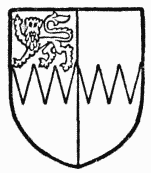
Croft, baronet. Quarterly fessewise indented azure and argent with a leopard or in the quarter.
After the borough and manor of Thatcham had been bought by General Waring he inclosed a large park to surround Dunstan House. (fn. 68) On the sale of Sir John Croft's estates Dunstan Park, containing 6,000 acres, was bought by the auctioneer and sold afterwards in separate lots. (fn. 69)
HENWICK appears to have formed part of Thatcham Manor until after the dissolution of Reading Abbey. It is mentioned in the 14th century (fn. 70) as being in the parish of Thatcham, and was presumably included under the heading of 'Thatcham with its members' among the abbey lands in 1539. (fn. 71) Lands in Henwick were included in the grant to John Winchcombe in 1540. (fn. 72) After his death in 1557 (fn. 73) his estates in Henwick were separated, part passing with Thatcham Manor to his eldest son and heir John. This part appears to have formed the manor of Hinwick later Thatcham alias Henwick, which descended with and was afterwards united to Thatcham. He also settled an estate in Henwick on himself for life, with final remainder to his third son Henry Winchcombe. (fn. 74) Henry died in 1562. (fn. 75) In 1570 his widow petitioned Cecil for the wardship of their son John. (fn. 76) This John Winchcombe in 1596, (fn. 77) on the occasion of the marriage of his eldest son John with Mary daughter of Thomas Verrey, settled this estate, then described for the first time as the manor of Henwick, on his wife Margery for life and then on his son in tail-male. Margery predeceased her husband, who died in 1610. (fn. 78) The younger John Winchcombe held the manor till his death in 1636, when it passed to his son John, (fn. 79) who was a Roman Catholic, his estates being in consequence sequestrated in the time of the Commonwealth, (fn. 80) He is described as of Henwick, Berks., in 1656, (fn. 81) but after the Restoration, although he recovered his estates, he appears to have lived in London. (fn. 82) He is said to have sold Henwick in 1669 with other estates to Philip Jemmett, the final conveyance, (fn. 83) however, not taking place until two years later. (fn. 84) Henwick Manor passed to Jemmett's daughter and heir Anne the wife of Jonathan Raymond, (fn. 85) knighted in 1679, (fn. 86) when Sheriff of London. (fn. 87) On the death of Anne, which occurred in 1709, (fn. 88) Henwick Manor passed to her son Jemmett Raymond, who had been knighted in 1680. (fn. 89) Sir Jemmett was engaged in a long lawsuit with General Waring, beginning before 1729, (fn. 90) the latter, as lord of the Thatcham Manors, claiming that there was no manor of Henwick, except his own manor of Thatcham alias Henwick, but it was decided that there was a separate manor at Henwick belonging to Sir Jemmett Raymond. Mr. Barfield points out that the only court rolls for the manor in existence belong to the years 1735 to 1737, in the midst of the dispute, and that these were the only rolls that were produced as evidence of his manorial rights by Sir Jemmett. (fn. 91) By his will he left Henwick Manor to his wife for life, then to his daughter Elizabeth and the heirs of her body, with remainder to his son Jemmett and his heirs. (fn. 92) Elizabeth came into the estate, but in 1755 she made an exchange with her brother (fn. 93) by which Henwick became his property. He died about 1767 and by his will Henwick passed to his widow for life and then to his nephew Thomas Henshaw, (fn. 94) the son of his sister Mabel, who had married Philip Henshaw. (fn. 95) Thomas Henshaw in turn left the manor to his nephew Bartholomew Tipping, the son of his sister Anne. (fn. 96) Tipping inherited the estate, which included the manor and other lands in Henwick, in 1783 or 1784. (fn. 97) He died unmarried in 1798, leaving it to his niece Mary Anne and her husband the Rev. Philip Wroughton. (fn. 98) In 1807, however, an Act of Parliament was obtained to enable them to sell the estate, (fn. 99) which had been left with a remainder to their son Bartholomew. The manor and certain farms were bought by Mr. Mount, (fn. 100) who had recently acquired the manor of Thatcham (q.v.), and Mr. William Arthur Mount, M.P., is now the owner of this property at Henwick.
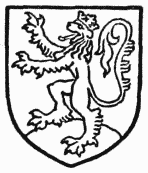
Mount of Wasing. Argent a lion gules crowned or on a mount vert.
One hide in CROOKHAM was held by Alwi Ceuresbert both in the time of Edward the Confessor and as late as 1086, (fn. 101) but probably the main manor of Crookham was included in Thatcham (fn. 102) and was granted with it in frankalmoign to Reading Abbey by Henry I. (fn. 103) The manor was subinfeudated, but the overlordship of Crookham was retained by the abbey until the 14th century, (fn. 104) when the service by which the manor was held was merely suit of court at the abbot's view of frankpledge.
The first under-tenant of whom there is any mention is Peter Fitz Herbert in the early 13th century, whose father Herbert Fitz Herbert (fn. 105) held several knights' fees in Berkshire. A tenement was held of the abbey by Peter for a rent of 12s. 1d., (fn. 106) but in 1226 he obtained a quitclaim of the whole of this rent from the Abbot of Reading in return for a certain meadow and lands in Thatcham, which he gave to the abbey in frankalmoign. (fn. 107) In 1228 (fn. 108) Peter Fitz Herbert obtained a grant from the king of free warren in his lands at Crook ham, and in April of the next year Henry III seems to have been himself at the manor. (fn. 109) Peter died in 1235 (fn. 110) and was succeeded by his son Herbert Fitz Peter, who was ordered in that year to give reasonable dower to Isabel, his father's widow. (fn. 111) Herbert died about 1248, (fn. 112) and his brother and heir Reynold (fn. 113) held Crookham Manor until his death in 1286, (fn. 114) when it passed to his son and heir John Fitz Reynold, the son probably of his first wife Alice. (fn. 115) The new lord of the manor challenged the rights of Reading Abbey over Crookham, and Abbot John only obtained his homage and the payment of a relief of 100s. (fn. 116) in 1300, after an appeal to the king. John appears to have granted the greater part of his lands to Edward II, (fn. 117) and to have received some of them back to hold for his life, but Crookham Manor must have been granted either by John or the king to Piers Gaveston before 19 May 1308, (fn. 118) since on that day a grant of it from Gaveston to the king is enrolled. In the following month Edward II granted it back to Gaveston and his heirs, (fn. 119) but it was forfeited after the execution of Gaveston in 1312. John Fitz Reynold had died in 1309 or 1310, (fn. 120) but his son and heir Herbert did not succeed in regaining his inheritance, which the king granted immediately after the death of Gaveston to John de Knokyn for life. (fn. 121) Edward II was himself there in 1317. (fn. 122) When John de Knokyn died about 1320 Herbert Fitz John seized the manor and a considerable quantity of goods. (fn. 123) The king ordered the escheator to recover possession owing to the reversion to the Crown on the death of John de Knokyn, but Herbert had drawn attention to his rights in Crookham and a settlement was made whereby he obtained the wardship of lands to the value of £20 a year. (fn. 124) This closed the connexion of his family with Crookham, and after his death in 1321 his widow Eleanor could not obtain dower there, although it had been granted to her on her marriage in 1291. (fn. 125) Edward III gave the manor in dower to Queen Isabella. (fn. 126) She surrendered it in 1330, and it was granted to William Montagu in 1331, (fn. 127) while a few months later free warren was granted to him and his wife Katherine and the heirs of his body. (fn. 128) Montagu was created Earl of Salisbury in 1337 (fn. 129) and obtained various other confirmations (fn. 130) of the grant of Crookham Manor. The countess survived her husband and held it until her death in 1349. (fn. 131) The extent of the manor made at that time shows the ravages caused by the Black Death in the neighbourhood. The value of rents and services of the customary tenants was usually £10 a year, but the tenants were all dead of the plague; their holdings were in the lord's hands, and, as no one would take them up, the land lay useless and uncultivated. (fn. 132) The manor remained with the Earls of Salisbury, the Montagus, Nevills and Plantagenets, (fn. 133) except during minorities and the vicissitudes of the Wars of the Roses, (fn. 134) until the attainder of Margaret Countess of Salisbury in 1539. (fn. 135) In 1540 Henry VIII leased the manor of Crookham to William Earl of Southampton, (fn. 136) and two years later granted it to him in tail-male, (fn. 137) with remainder to William Lord Herbert, son and heir of Henry Earl of Worcester. The new grantees were connected with the old lords of the manor, the earl's mother Lucy being one of the eight daughters and co-heirs of John Nevill Marquess of Montagu, the second son of Richard Nevill Earl of Salisbury, while Lord Herbert was the son of Southampton's half-sister Elizabeth the daughter of Lucy Nevill and her second husband Sir Anthony Browne. (fn. 138) Southampton died in 1542, (fn. 139) and the manor passed to Lord Herbert, who succeeded his father in the earldom of Worcester in 1549 and held the manor till his death in 1588–9. (fn. 140) His son Edward, who then became lord of Crookham, married Elizabeth Hastings, a descendant of Margaret the last Countess of Salisbury (fn. 141); he died seised of the manor in 1627–8. (fn. 142) His heir was his son Henry, (fn. 143) the tenth earl, who was created Marquess of Worcester in 1642–3. (fn. 144) The marquess and his son Edward, who succeeded him in 1646, were prominent Royalists, and the lands of the family were seized by Parliament (fn. 145); but they do not seem to have been sold, since in 1652 Henry Lord Herbert, the son and heir of the second marquess, was able to buy back from the Parliament several manors, including Crookham, for £800. (fn. 146) The second marquess returned to England at the Restoration and died in 1667, (fn. 147) leaving his estates much encumbered. (fn. 148) His son obtained in the same year from Charles II a new grant of the manor and of the reversions remaining in the Crown. (fn. 149) This grant enabled him to sell the manor at once to Andrew Barker and William Robinson, (fn. 150) who appear to have conveyed it to Samuel Mico, since in 1675 Mico, who is described as of Magdalen College, Oxford, made a settlement of the estate. (fn. 151) He died before 1681–2, (fn. 152) and his sister and heir Winifred the wife of Thomas Powell shortly afterwards sold Crookham to Sebastian Lyford of Reading. (fn. 153) Lyford, who died in 1703, left it by will to his grandson Clement Kent, (fn. 154) who was lord of the manor in 1704. (fn. 155) Kent sold it in 1729 to Bulstrode Peachey, who afterwards took the surname of Knight (fn. 156); from him it passed by will to his brother Sir John Peachey, bart., for life, and then to his nephews John and James, who held it successively. (fn. 157) James was created Lord Selsey of Selsey in 1794, (fn. 158) and Crookham, after the death of the third and last Lord Selsey in 1838, (fn. 159) passed to his granddaughter Caroline (fn. 160) the wife of the Rev. Leveson Vernon Harcourt. After her death it was bought in 1872 by Mr. A. R. Tull, (fn. 161) whose family had been settled at Crookham for three centuries or more. (fn. 162) In 1790 Richard Tull, the grandfather of the purchaser of the manor, had bought a considerable estate from Sir George Cornewall, (fn. 163) including the house at Crookham in which Sir George and his father Sir George Amyand lived. On its site the present Crookham House, the residence of Mr. A. R. Tull, now stands.
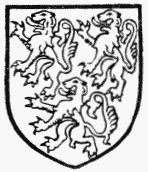
Fitz Reynold. Gules three lions or.
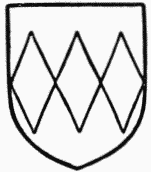
Montagu. Argent a fesse indented of three points gules.
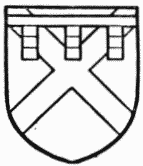
Nevill. Gules a saltire argent and a label gobony argent and azure.
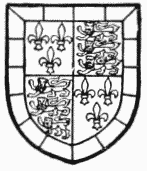
Somerset, Marquess of Worcester. The royal arms of FRANCE quartered with ENGLAND in a border gobony argent and azure.
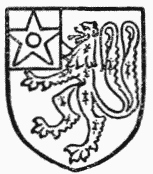
Peachey, Lord Selsey. Azure a lion ermine with a forked tail and a quarter argent with a pierced molet gules therein.
In 1228 Peter Fitz Herbert obtained a grant of free warren in his lands at Crookham, (fn. 164) but the first mention of a park there is found in the time of his grandson John Fitz Reynold, who appointed a bailiff of his park, (fn. 165) which was later known as CROOKHAM LITTLE PARK or OLD PARK. (fn. 166) It was situated in the south-east of Crookham, the name being preserved in Little Park House. William Montagu obtained a grant of free warren, (fn. 167) and in 1337 the further privilage of imparking his wood at Crookham, together with 400 acres of land meadow, moors and pasture. (fn. 168) This formed CROOKHAM GREAT PARK or WEST PARK, (fn. 169) and with the Little Park was always in possession of the successive lords of the manor. (fn. 170)
The history of the office of bailiff of the Little Park is interesting. In 1298 John Fitz Reynold granted it to Nicholas Thornford and to his heirs and assigns with certain privileges recited in detail. (fn. 171) The Thornfords held the bailiwick for nearly 100 years, but in 1395 William son and heir of Nicholas Thornford granted it to Richard Pavy. (fn. 172) In 1404 it passed from Pavy to Sir John Lisle of Wodinton and Elizabeth his wife, from whom it descended to their son and grandson, both named John. (fn. 173) The grandson transferred the office in 1439 to his sister Elizabeth and her husband John Pury. (fn. 174) Nearly forty years later Pury obtained a ratification of the bailiwick of the park from George Duke of Clarence, then lord of Crookham. (fn. 175) John Pury left an only daughter and heir Anne the wife of Sir William Danvers, justice of the Common Pleas, (fn. 176) and she granted her interest in the office to her daughter Isabel and her husband Martin Docwra. (fn. 177) The original grant of 1298 was made when there was only one park at Crookham, and presumably never gave the bailliffs any rights in the new park of William Montagu; but the existence of this office does not seem to have precluded the appointment of temporary parkers while the manor was in the king's hands. Thus in 1326, (fn. 178) while only the Little Park existed, Edward II appointed John Pecche parker at Crookham. Edward III, Henry IV, Henry V, Edward IV, Henry VII and Henry VIII made similar appointments (fn. 179) when the parks were in their hands. The old hereditary office seems to have fallen into abeyance by the beginning of the 16th century. Margaret Countess of Salisbury having appointed William Perkins keeper of the two parks at Crookham for life, (fn. 180) Docwra and his wife petitioned her for the restitution of the bailiwick to them, John Pury having been seised of it at the death of the Duke of Clarence. (fn. 181) The office, however, is not heard of again. In 1598 (fn. 182) Edward Earl of Worcester and Elizabeth his wife leased the Great Park to John King for twenty one years.
The reputed manor of CROOKHAM and HENWICK appears to have originated in lands settled by John Winchcombe in 1548 on his second son Thomas. The latter sold them in 1554 to John Goddard, (fn. 183) whose descendants held them (fn. 184) until 1650, when John Goddard conveyed the manor of Crookham and Henwick to Humphrey Dolman and others, (fn. 185) probably in trust, for it was soon afterwards in the possession of the lords of the manor of Crookham. Samuel Mico owned it in 1675, (fn. 186) and his sister and heir Winifred and her husband sold it in 1682 (fn. 187) to Sebastian Lyford. It passed finally to the Peacheys, (fn. 188) Lord Selsey being the owner in 1806. (fn. 189)
The manor of CHAMBERHOUSE is first mentioned in 1445. (fn. 190) It was held of the manor of Crookham by the service of one pair of gilt spurs or 6d. yearly. (fn. 191) It is possible, however, to trace the earlier history of the estate. In the 13th century (fn. 192) Roger de la Chambre held land in Thatcham, and in 1352 (fn. 193) Thomas de la Chambre of Crookham is mentioned, but there is no proof that they held Chamberhouse. William Montagu, the second Earl of Salisbury, granted a messuage, mill, 2 carucates of land and 4 acres of meadow in Crookham to Thomas Street, who alienated them to John Frome and five others. These grantees in turn alienated to Richard Pavy, who was the bailiff of Crookham Park. (fn. 194) Pavy was living at Chamberhouse in 1397, (fn. 195) and it seems possible that the lands he obtained by these grants formed the Chamberhouse estate. In 1404 he alienated two messuages and lands in Crookham and Thatcham to Sir John Lisle and his wife Elizabeth and the heirs of John. (fn. 196) The estate was held by the hereditary bailiffs of Crookham, (fn. 197) but did not come into the possession of John Pury and his wife Isabel (fn. 198) until 1445, six years after Pury had obtained the bailiwick. Pury was an esquire of Henry VI, and in 1446 (fn. 199) he obtained licence to inclose the manor of Chamberhouse, to crenellate and embattle it, together with a grant of very considerable privileges in the manor, including the view of frankpledge. He was living in 1480, (fn. 200) but appears to have died shortly afterwards. (fn. 201) Chamberhouse passed to his daughter Anne. (fn. 202) Her husband Sir William Danvers died in 1504, (fn. 203) and his widow held the manor till her death in 1531–2. (fn. 204) According to a settlement made about 1514 (fn. 205) and her will dated 1530, it passed to her daughter Isabel and son-in-law Martin Docwra, who were to maintain a chantry in the chapel of Chamberhouse (fn. 206) (q.v.). Martin and Isabel obtained possession of the manor on the death of Anne, but not long afterwards the Abbot of Reading and sixteen others entered it in arms and did much damage. (fn. 207) The Docwras appear to have recovered seisin of the manor. Martin died in 1534, (fn. 208) and his eldest son Edward was probably the owner of the manor until his death in 1545. (fn. 209) His heir was his brother Edmund, who was in possession in 1549–50 (fn. 210) and was a member of Parliament in 1572. (fn. 211) Pecuniary difficulties forced him with the assent of his wife Dorothy and son Arthur to sell the Chamberhouse estate to Nicholas Fuller in 1585. (fn. 212) The purchaser also obtained quitclaims from the various mortgagees and others (fn. 213) and finally a decree in Chancery. (fn. 214) Nicholas Fuller died in February 1619–20, (fn. 215) and Chamberhouse passed to his widow Sarah as part of her jointure. (fn. 216) It was entailed on his son Sir Nicholas Fuller, who died in the July following, (fn. 217) leaving his son Dowse, aged three, as his heir. Dowse Fuller inherited Chamberhouse Manor on his grandmother's death in 1642. (fn. 218) He died at Chamberhouse in 1657, (fn. 219) and was succeeded by his son Dowse, (fn. 220) who was knighted in 1663 (fn. 221) and married Elizabeth the daughter of Sir Thomas Aleyn, (fn. 222) a London alderman, the manor being settled on her for life. (fn. 223) Sir Dowse died in 1673 (fn. 224) and his son and heir, another Dowse Fuller, died in 1689, (fn. 225) but it is not clear whether he ever obtained possession of the Chamberhouse estate, since his mother, on whom the manor was settled for life, (fn. 226) was living the year before when he made his will. (fn. 227) He left all his Berkshire lands to his widow Jane in trust for his children Dowse and Margaret till they came of age. (fn. 228) The manor finally came into the possession of Margaret, her brother having died childless, before 1714. (fn. 229) She married Samuel Pargiter, who took the name of Fuller, and in 1716 (fn. 230) they sold it to John Lansdell of the Tower of London. He died in 1730, (fn. 231) and his sons John and Chrysostom sold it some years later to George Amyand, (fn. 232) a merchant, who was created a baronet in 1764. (fn. 233) His son and heir George assumed the name of Cornewall on his marriage in 1771 with Catherine daughter and heir of Velters Cornewall. (fn. 234) He had succeeded to the baronetcy in 1766. (fn. 235) A private Act of Parliament was passed by which Chamberhouse Manor and other property in Crookham were vested in trustees, who sold the manor in 1798 to Henry Tull. (fn. 236) He died in 1815, and his property afterwards passed (fn. 237) to the family of his brother Richard of Crookham House. His nephew Richard Tull owned the Chamberhouse estate till his death in 1868, (fn. 238) when he was succeeded by his son, the present owner.
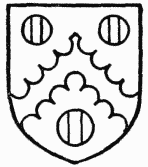
Docwra. Sable a cheveron engrailed argent between three roundels argent each charged with a pale gules.

Fuller. Argent three bars and a quarter gules.
In 1446 (fn. 239) John Pury inclosed 300 acres of land, 40 acres of wood and 4 acres of meadow by the king's licence and converted them into a park. In 1547 (fn. 240) Chamberhouse Park is mentioned as forming one of the boundaries of Greenham Manor. Pury also obtained a grant of free warren (fn. 241) in his demesne lands of the manor, and the same privilege descended to subsequent lords of the manor. (fn. 242) A free fishery belonged to the lords of the manor in the 15th century, and in 1446 Pury leased his fishing weir to Martyn Jourdan for nine years. (fn. 243) The fishery belonged to the subsequent lords of Chamberhouse. (fn. 244) A mill was granted by the second Earl of Salisbury during the 14th century to Thomas Street (fn. 245) and passed to Richard Pavy before 1394. (fn. 246) It passed with the manor of Chamberhouse at the subsequent alienations (fn. 247) of the manor, and a water-mill called Chamberhouse Mill exists at the present day.
The manor of COLTHROP has been identified with the Domesday manor of Crokestrope, which four freemen held of Edward the Confessor. (fn. 248) The Count of Evreux held it in demesne in 1086, (fn. 249) but if this entry in the survey refers to Colthrop he must have forfeited it not long afterwards. His other possessions in England he granted to the Norman priory of Noyon, but neither Crokestrope nor Colthrop is amongst the places enumerated in the charter of confirmation granted by his grandson Count Simon between 1140 and 1157. (fn. 250) The manor of Colthrop, however, was in the hands of Henry I, who granted it at the same time as the manor of Aldermaston to Robert Achard. (fn. 251) It was held of the lords of Aldermaston, (fn. 252) the Achards and their successors the Delameres, until the 16th century, but the overlordship disappeared when the manor was released to Henry VIII (fn. 253) by the under-tenants, the Warden and scholars of St. Mary's College, Winchester. R. son of Achard, apparently the original grantee, enfeoffed an under-tenant, Hugh Brittinolle, (fn. 254) of Colthrop Manor to hold by the service of one knight's fee. (fn. 255) The tenant in 1166 (fn. 256) is not named, but the same family held it during the 13th century. William Brittinoile was lord of the manor about 1241, (fn. 257) and it seems probable that he or his successor was holding it in 1263. (fn. 258) William Brittinolle was overlord of certain land at Sandon near Hungerford, which followed the same descent, at this time. Sir William Brittinolle held this overlordship in 1294. (fn. 259) Before 1298 (fn. 260) Sandon had passed to Sir Richard Forkeram. The latter, or possibly his son Richard, was assessed at Colthrop for a subsidy about 1307. (fn. 261) Sir Richard died before 1316, (fn. 262) and two years later his son settled the manor of Colthrop on himself and his wife Isabel, with remainder to his son Robert and his wife Joan and the heirs of their bodies. (fn. 263) Isabel survived her husband and afterwards married Richard Penlegh, and they were holding the manor in 1347–8 for the term of her life. The reversion of the manor belonged to John Fokeram of Thatcham, evidently a younger brother of the Robert Fokeram mentioned in the settlement of 1318. John granted his reversion in 1347–8 (fn. 264) to Master Hugh Monington and four others, possibly in trust for Richard Penlegh and Isabel his wife, who were holding in 1349. (fn. 265) There is nothing to show how long Richard and Isabel held the manor or whether the next change in ownership was due to an alienation of the manor or a marriage. In 1364 (fn. 266) it was settled by Henry Aldrington and his wife Elizabeth on themselves for their lives with remainder to John son of Henry. Henry died before 1376, when Colthrop was held by Elizabeth Loveday, (fn. 267) presumably his widow. Before 1392 she had married John Shilford, and in that year John Aldrington arranged the alienation of his manor of Earley Whiteknights to Shilford and Elizabeth and the heirs of Shilford. (fn. 268) The following year (fn. 269) Earley was settled on the Shilfords in fee-tail with remainder to Thomas Overey of London and his wife Constance and her heirs, but the relationship of Constance Overey to the Aldringtons or to Shilford does not appear. Probably a similar course was followed with regard to Colthrop, as in 1393 (fn. 270) Overey and Constance quitclaimed the manor of Colthrop to John Shilford and his heirs. In 1402 (fn. 271) John granted it to trustees, who conveyed it the same year (fn. 272) to the Warden and scholars of Winchester College in frankalmoign, the overlords apparently remitting the military service due from Colthrop. (fn. 273) Henry VIII in 1543 (fn. 274) exchanged certain lands of Hyde Abbey with Winchester College for Colthrop and other lands. Edward VI granted Colthrop, to hold by military service, in 1552, (fn. 275) to Edward Fiennes, Lord Clynton and Say and Henry Herdson, the latter obtaining sole possession. Three years later (fn. 276) Herdson sold it to Thomas Dolman (fn. 277) and his wife Elizabeth, who also obtained the manor of Shaw in Donnington (q.v.). The Dolman family owned the manor until 1707, (fn. 278) when Sir Thomas Dolman, kt., and his wife Dorothy sold it to Henry St. John, (fn. 279) afterwards Lord Bolingbroke, who was then lord of the manor of Thatcham (q.v.) in right of his wife. It passed with Thatcham until the sale of Sir John Croft's estates in 1798, (fn. 280) when Colthrop Manor was bought by John Brooke and Colonel Brooke. The former was the son of Sir John Croft's sister Frances, the latter the husband of her daughter. (fn. 281) It was bought from the Brookes in 1801 by William Mount, (fn. 282) and is now the property of his great-grandson (fn. 283) Mr. William Arthur Mount, M.P., of Wasing.
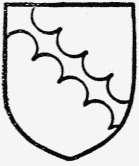
Achard. Or a bend engrailed sable.
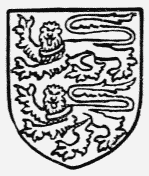
Delamere. Gules two leopards argent with collars azure.
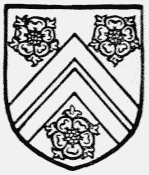
Winchester College. Argent two cheverons sable between three roses gules.
The lords of the manor held the view of frankpledge (fn. 284) down to 1834. (fn. 285)
A several fishery was held by the lords of Colthrop in the 14th century, (fn. 286) and in a rental of the manor made in 1547 (fn. 287) four several fisheries are enumerated, one in the Kennet, two in Allforde's Stream and the fourth in the King's Stream alias High Stream. The right was mentioned in 1707. (fn. 288)
The first reference to the mill of Colthrop occurs in 1376, (fn. 289) but the name of Humphery the Miller is found some seventy years earlier. (fn. 290) It passed with the manor to Winchester College, (fn. 291) and was leased with it in 1421 to John Godfader for ten years. (fn. 292) Two mills were built in 1472 (fn. 293) at Colthrop; the old corn-mill was presumably rebuilt entirely, while the second mill must have been the fulling-mill, which is mentioned in the subsequent accounts of the manor. (fn. 294) Both were let at lease by the college, (fn. 295) but in 1485 (fn. 296) they appear to have been leased separately from the manor. The fulling-mill was leased by the Crown to Thomas White and his wife Agnes in 1540. (fn. 297) It was not granted by Edward VI with the manor to Lord Clynton and Henry Herdson, but in 1557 Thomas Dolman, who had already purchased the manor, and presumably the corn-mill, appears to have purchased the fulling-mill as well. (fn. 298) Colthrop Mill is mentioned in 1605, (fn. 299) and in 1689 (fn. 300) two corn-mills were included in a settlement of the manor, the fulling-mill having been probably converted after the decay of the cloth trade in the earlier part of the century. These mills were replaced by a paper-mill built on their site before 1799. This has been separated from the manorial estate, and is now the property of Messrs. Henry. (fn. 301)
GREENHAM was held of Edward the Confessor in alod by Seward; Henry de Ferrers held it in demesne in 1086. (fn. 302) An Earl of Ferrers, probably Robert the son and successor of the Domesday tenant, is said in a 13th-century document to have given Greenham in marriage to Ralph Paynell, (fn. 303) whose son Gervase inherited the manor on the death of his father before 1166. (fn. 304) He granted it to the Knights Hospitallers, and his grant was confirmed by King John in 1199. (fn. 305) A preceptory was founded there before 1338. (fn. 306) The manor belonged to the Hospitallers until the dissolution of the order by Henry VIII, (fn. 307) when it was seized by the king. It remained in the hands of both Henry VIII and Edward VI, (fn. 308) although the latter granted the site, house and demesne lands of Greenham to John Lucas in 1553. (fn. 309) Queen Mary revived the order of the Hospitallers by her Letters Patent, and the manor of Greenham was restored, (fn. 310) but it seems doubtful whether the Lucas family was ever dispossessed of the house and estate there. John Lucas died in 1556, leaving them to his wife for her life (fn. 311); they were, however, leased to John Winchcombe, the lord of Thatcham Manor. (fn. 312) Queen Elizabeth again dissolved the order of the Hospitallers, (fn. 313) and in 1568 (fn. 314) granted the manor of Greenham to Thomas Henneage and his wife Anne, who sold it in 1573 (fn. 315) to Brian Chamberlain. In the following year it was in the hands of trustees, who immediately alienated it to William Bond, Thomas Pullyson, William Woodcock and William Napton. (fn. 316) In 1584 (fn. 317) the manor was conveyed to Daniel Bond. In 1586 (fn. 318) Bond sold it to Sir Thomas Lucas, kt., who also obtained a grant in confirmation from the former owners, Pullyston, Woodcock and Napton. (fn. 319) Sir Thomas was the son of John Lucas, (fn. 320) to whom the site and demesnes of the manor had been granted in 1553. (fn. 321) Thomas Lucas, his son, died in 1625, (fn. 322) and was succeeded by his son John, a minor. (fn. 323) John Lucas was an active Royalist, and in 1644–5 was created Lord Lucas of Shenfield. (fn. 324) Although his Essex estates were sequestered, (fn. 325) Greenham apparently escaped, as there is no record of his compounding for it. Possibly it formed part of his mother's jointure, she being still alive in 1650. (fn. 326) On his death in 1671 the manor passed to his only daughter and heir Mary. (fn. 327) His son John having died young, the heir to his barony was his nephew Charles, but in 1663 he obtained a separate peerage for his daughter, who was created Baroness Lucas of Crudwell. (fn. 328) She married Anthony Grey Earl of Kent. (fn. 329) Her son Henry, who was made Duke of Kent in 1710, inherited Greenham Manor on her death in 1702, (fn. 330) but in 1725 (fn. 331) he sold it to General Waring, who had previously purchased the manor of Thatcham (q.v.). It followed the same descent as Thatcham at this time, except that by the will of Lady Croft (fn. 332) it was left directly to her second son John Croft, who afterwards succeeded to the baronetcy and the rest of her estates. (fn. 333) On the sale of Sir John Croft's lands in 1798 Greenham was bought by James Croft, formerly Woodcock, the husband of Charlotte, the eldest daughter of Sir Archer Croft. (fn. 334) Her grandson Archer Bernard Croft sold the manor to Lloyd Baxendale about 1856–60. (fn. 335) Mr. Lloyd H. Baxendale is now lord of the manor of Greenham.
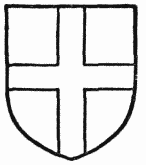
Knights Hospitallers. Gules a cross argent.
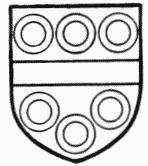
Lucas of Shenfield. Argent a fesse between six rings gules.
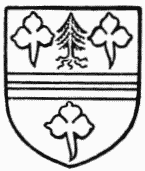
Baxendale. Gules two bars argent with a fir tree proper between two trefoils argent in the chief and a like trefoil in the foot.
A mill and the moiety of a mill at Greenham are mentioned in 1086, (fn. 336) then worth 10s. 10d. A mill called 'Doddesmulne' there belonged to Roger le Forester about the close of the 13th century, and it was inherited by his daughter Agnes, who married Henry Pax of Basingstoke; she granted it when a widow to Sir Hugh le Despenser. (fn. 337) No mill is mentioned in the extent of the Hospitallers' lands in 1338, (fn. 338) but later a mill was attached to their manor of Greenham, which was leased to John Stower in the 16th century at a yearly rent of £8 6s. 8d. (fn. 339) Greenham Mills are mentioned in 1637. (fn. 340) These mills in 1811 (fn. 341) were also used as cloth-mills, and a few years later, when they were advertised to be sold by auction, (fn. 342) consisted of two corn-mills converted into one mill and a blanket manufactory, while there was also a silk-mill in the same ownership, but probably not included under the Greenham Mills.
In the reign of Edward the Confessor five freemen held the manor of MIDGHAM of the king. (fn. 343) In 1086 it was held by Giles Pinkney. He had granted part of the land to three sub-tenants, Almær, Ragner and Gilbert, who held 3 virgates, 1 virgate and 1 hide and 1½ virgates respectively. (fn. 344) Midgham formed part of the honour of Pinkney, which was held by the service of ward of Windsor Castle. This honour consisted of fifteen knights' fees, for which £15 were paid yearly to the constable of the castle. (fn. 345) Gilbert, grandson of Giles, answered for the Pinkney honour in 1166 (fn. 346) and held Midgham in 1198. (fn. 347) He was succeeded by his son Henry, (fn. 348) who granted tithes in Midgham to the priory of Weedon Pinkney, (fn. 349) and by his grandson Robert (fn. 350) in turn. The latter forfeited his estates for rebellion against King John, (fn. 351) but recovered them on the accession of Henry III. (fn. 352) Probably the Pinkneys had ceased to hold the manor in demesne, (fn. 353) and had enfeoffed three under-tenants, each of whose holdings was afterwards known as the manor of Midgham. Robert Pinkney's son, grandson and great-grandson, all named Henry, succeeded him. (fn. 354) Robert son of Henry Pinkney, who died about 1296, left as heir his brother Henry. (fn. 355) Midgham then seems to have followed the descent of the manor of Datchet in Buckinghamshire. (fn. 356) In the 14th century Sir John de Molyns (fn. 357) held the overlordship, but it cannot be traced later.
The division of part of the manor of Midgham amongst three sub-tenants in the Domesday Survey has already been mentioned, but it seems impossible to connect their holdings with the three manors of Midgham, which were held of the honour of Pinkney. (fn. 358) One of them may have become Hall Court (see below). The manor of MIDGHAM or ERLEY'S MANOR was held as one-fourth of a knight's fee (fn. 359) by a branch of the Erley family. Giles Erley was the lord of the manor in the first half of the 13th century. (fn. 360) He was probably succeeded by Roland Erley, who had rents in Midgham in 1271. (fn. 361) Bartholomew Erley was the next tenant of the manor, (fn. 362) which, however, passed to Thomas Erley before 1316. (fn. 363) Thomas was living in 1334, (fn. 364) but his successors are unknown throughout the 14th century. In 1402 and after, John Erley held the family estate. (fn. 365) He died in 1432, (fn. 366) his son and heir John being a minor. (fn. 367) Another John Erley, perhaps his grandson, had died before 1546, when his son, a fourth John Erley, and his wife Thomasina made a settlement of the manor. (fn. 368) This John and his son Richard were the defendants in a lawsuit begun by the lords of one of the other manors in Midgham about 1552. (fn. 369) In 1613 the manor belonged to Joan Erley, (fn. 370) who may perhaps be identified with Joan Bird, widow, who in 1630 (fn. 371) made a settlement of the manor jointly with Henry Erley. Henry died in 1635, (fn. 372) leaving two daughters and heirs. The elder daughter Joan married Richard Garrard, (fn. 373) while the younger daughter was probably Mary the wife of Richard Caryll. (fn. 374) The Carylls held a moiety of the manor, but in 1659 (fn. 375) a settlement was made by which apparently it was settled on the Garrards on the death of Richard and Joan. Joan Garrard died in 1654, (fn. 376) and her moiety was held by her husband, who was living in 1673. (fn. 377) Her son and heir Richard (fn. 378) appears to have owned the whole manor, (fn. 379) but he sold it to Thomas Brumpsted before 1689–90. Brumpsted died very shortly after this date, and in his will (fn. 380) directed that it should be sold for the benefit of two of his children, Charles and Lucy. It afterwards passed to the family of Hillersdon. John Hillersdon, who rebuilt Midgham Chapel in 1714, was lord of the manor. (fn. 381) He is said to have sold it about 1735 (fn. 382) to Stephen Poyntz, a diplomatist, and afterwards governor and steward of the household of the Duke of Cumberland, the second son of George II. (fn. 383) The sale appears to have been completed in 1738, (fn. 384) with Michael Hillersdon, but Poyntz was already living at Midgham, where he was 'laying out in further improvements a good deal of money.' (fn. 385) The Duke of Cumberland spent some years as a boy at Midgham, (fn. 386) where two rooms were added to the house for his accommodation, and are still known as the Duke's Rooms. Stephen Poyntz died in 1750 and the manor passed to his son William. (fn. 387) The latter died in 1809 and was succeeded by his son William Stephen, on whose death in 1840 Midgham passed to his three daughters and co-heirs. (fn. 388) It was sold in 1842 to Mr. Thomas Thorpe Fowke, R.N., who sold it in 1856 to Mr. William Massey. From him it was bought by Mr. Benjamin Buck Greene, (fn. 389) who was lord of the manor until his death in 1902, when the manor was sold to Mr. A. F. Clarke, who is now lord of the manor of Midgham.
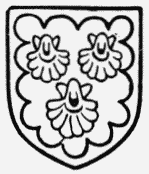
Erley. Gules three scallops and a border engrailed argent.
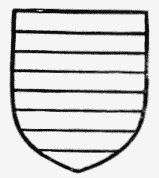
Poyntz of Midgham. Barry of eight pieces or and gules.
The history of the second manor of MIDGHAM probably begins with the conveyance in 1234 of 1 carucate of land by John de Macy and his wife Avelina to Henry de Scaccario. (fn. 390) Ralph de Scaccario, the son of Henry, inherited it not long afterwards. (fn. 391) His property passed at his death to his daughters and heirs, (fn. 392) Agnes the wife of Ralph Chenduit and Katherine, who afterwards married William Hawtrey. In 1286 (fn. 393) a settlement was made on Katherine and William and the heirs of their bodies, but the estate finally came into the possession of Ralph Chenduit, the son and heir of Agnes. (fn. 394) He was holding in 1316, but died before 1335. (fn. 395) His heir was probably his grandson William Chenduit, (fn. 396) who was then a minor in the wardship of William Englefield. (fn. 397) William was of age before 1340, (fn. 398) since in that year Thomas Sibthorpe conveyed to the Knights Hospitallers certain tenements in Midgham which he had acquired from William. (fn. 399) The remaining Chenduit property, however, seems to have come into the possession of Geoffrey Weston, who in 1350 (fn. 400) settled a moiety of the manor of Midgham on himself and his wife Alice in fee-tail. In 1428 (fn. 401) John Popham held the Chenduit property, but before 1437 (fn. 402) the manor passed, presumably by sale, to John Stokes and his wife Alice. They had no children, and a settlement was made in 1465 (fn. 403) by which they held the manor for their lives, with remainder to their trustees. Alice survived her husband, and held the manor till her death in 1478–9, (fn. 404) when it passed to William Staveley, (fn. 405) one of the trustees mentioned in the settlement. Staveley settled it on himself and his wife Alice for life, and bequeathed it after her death to their sons William and John in tail, with a contingent remainder to their daughters Mary and Isabel. (fn. 406) He died in 1498, (fn. 407) and his widow, who married Humphrey Conyngsby, held it till her death two years later. (fn. 408) Her two sons had predeceased her, and Midgham was divided between her daughters. Mary married Thomas Giffard of Twyford and Isabel one of the Tanfields of Gayton, Northants, who is named in different documents Francis, John and William. (fn. 409) Isabel married secondly Richard Humphreys, and held her moiety of the manor till her death in 1544, (fn. 410) when her son Francis inherited it. (fn. 411) He was succeeded after 1552 (fn. 412) by his son Clement, who sold the reversion of the moiety to Richard Goddard in 1571. (fn. 413) Mary Giffard held her moiety till after 1552, (fn. 414) when she was a widow, and was one of the plaintiffs in the lawsuit already referred to in Erley's Manor. Apparently Clement Tanfield inherited her moiety as well as his grandmother's since he died seised of the whole manor in 1585. (fn. 415) Richard Goddard seems to have obtained the reversion of the whole manor before this date, and it passed either to him or to John Goddard, who settled it on his son George. (fn. 416) George succeeded on his father's death in 1589 (fn. 417) and was living in the summer of 1621, (fn. 418) but seems to have predeceased his son and heir George, who died in the following December. (fn. 419) The elder George also left a daughter Benet the wife of Edward Gilmore of Brimpton. (fn. 420) In 1681 (fn. 421) the manor had passed to Robert Gilmore, who seems to have sold it to Thomas Gunter.
The third division of Midgham, which was also known as the manor of MIDGHAM, was held by William Bastard in the first half of the 13th century, (fn. 422) and from him it appears to have passed to Peter Bluet, who held it during the reign of Edward I. (fn. 423) It was settled jointly on his wife Lucy, who survived him and held one-third of Midgham till her death in or before 1337. (fn. 424) Their heir was their daughter Thomasia, (fn. 425) possibly the wife of William Everard, who answered for this part of Midgham in 1316 (fn. 426) and in 1334, (fn. 427) presumably as joint tenant of the reversion. William Everard died about 1344, (fn. 428) when his son and heir Sir Edmund Everard did homage for all his lands held in chief. The latter died in 1370, (fn. 429) his heirs being his two sisters, Elizabeth the wife of Robert Loundres and Margaret the widow of Thomas Ramsbury. (fn. 430) Robert and Elizabeth appear to have obtained the whole manor, probably by a settlement of 1380. (fn. 431) In 1428 (fn. 432) Thomas Loundres, the founder of the almshouses at Thatcham, (fn. 433) held it, and the greater part probably went to endow his almshouses. (fn. 434)
The manor of MIDGHAM or HALL COURT can be identified with the holding of John Hall, who was assessed for a subsidy in the reign of Edward I. (fn. 435) In 1335 (fn. 436) it had passed to Thomas Hall, but from that date the manor is lost sight of till 1506–7, (fn. 437) when Sir William Norreys died seised of Hall Court Manor, which was held in chief. The Norreys family held it till the death of Francis first Earl of Berkshire in 1621–2 (fn. 438); his heir was his daughter Elizabeth the wife of Edward Wray, (fn. 439) who alienated it in 1628 to Christopher Monck, (fn. 440) the steward of the late earl. (fn. 441) Monck appears to have held it till his death in 1661, (fn. 442) when it apparently passed to his great-nephew Christopher (fn. 443) the second Duke of Albemarle, son of General Monck. The duke died childless in 1688, (fn. 444) and Hall Court came into the possession of his two cousins Mary and Elizabeth, daughters of Nicholas Monck, Bishop of Hereford. (fn. 445) Mary married Arthur Farewell of Westminster, (fn. 446) and was in possession of a moiety of the manor in 1689, (fn. 447) when she was a widow. This moiety of Hall Court seems to have come into the ownership of Peter French in 1821. (fn. 448) Elizabeth Monck married Curwen Rawlinson of Cark Hall, Lancs. (fn. 449) She died in 1691, and left her share of Hall Court to her younger son Christopher, (fn. 450) who a few years later came into possession of the Rawlinson property as well. (fn. 451) He was an antiquary and scholar of considerable fame. (fn. 452) He died unmarried in 1733, (fn. 453) when all his property passed to his five cousins, the descendants of his two aunts, Anne the wife of Christopher Crackenthorpe of Newbiggin Hall and Catherine the wife of Roger Moore. (fn. 454) The cousins were two granddaughters of Anne Crackenthorpe, Deborah, who died unmarried, and Anne the wife of the Rev. Adam Askew, D.D., (fn. 455) and three daughters of Catherine Moore, Anne the wife of William Aylmer, Mary the wife of Charles Blake and Catherine the wife of Clement Rigge. (fn. 456) The whole Crackenthorpe share of the moiety of Hall Court came to the Askew family, (fn. 457) but it seems to have been further divided amongst the children of Anne Askew, since Adam, one of her sons, had a fourth of the moiety of the manor in 1782. (fn. 458) It seems difficult to ascertain how the share divided between Catherine Moore's daughters descended. Her share of the Rawlinson property at Cark finally came to the Rigges, since Anne Aylmer in 1760 and Mary Blake in 1768 (fn. 459) both died childless, but the Rigges seem only to have inherited a third of the moiety of Midgham. Catherine Rigge died in 1761, and was succeeded by her grandson Fletcher, (fn. 460) who seems to have left his third to his two daughters, Ann the wife of Dr. John Heys and Jane the wife of Edward Moore, (fn. 461) since in 1823 (fn. 462) Jane's son, Stephen Roger Moore, had one-sixth of a moiety of the manor. The fact that these small portions of the manor are mentioned at so late a date suggests that no actual division had taken place of the moiety of the manor of Midgham, which is the more probable since the Cark property was not divided amongst Christopher Rawlinson's heirs till 1860. (fn. 463) Some years before this, however, the house at Hall Court, and presumably part of the manor, had come into the possession of the lord of the main manor, since it was put up to auction in 1856 (fn. 464) with the manor (q.v.) and bought by Mr. B. B. Greene. Possibly this represented the Farewell moiety of Hall Court only, and not the moiety shared by the Rawlinson heiresses. When the ecclesiastical parish of Midgham was formed in 1857 Hall Court was converted into the vicarage-house. (fn. 465)
The priory of Poughley obtained lands in Midgham at the close of the 12th or the beginning of the 13th century Robert Pinkney granted them land and rent there, (fn. 466) and the total holding of the priory was 1 carucate of land some years later. (fn. 467) The tenements were held by Poughley until its dissolution to form part of the endowments of Wolsey's college. (fn. 468) After the fall of the cardinal the possessions of the priory were given in exchange by Henry VIII to Westminster Abbey. (fn. 469)
The priory of Sandleford held land in Midgham, (fn. 470) which was assessed as 1 carucate during the 13th century. (fn. 471)
A mill at Midgham is mentioned in 1086, (fn. 472) its value being 14s. a year.
CHURCHES
The church of ST. MARY THE VIRGIN consists of a chancel 34 ft. 2 in. by 20 ft., north vestries and organ chamber, south chapel 17 ft. 10 in. by 15 ft., nave 66 ft. 3 in. by 21 ft. 6 in., north aisle 12 ft. 10 in. wide, south aisle 13 ft. 7 in. wide, west tower 13 ft. 9 in. square and a south porch. These measurements are all internal.
The earliest detail of the present building is the south doorway, which dates from the latter half of the 12th century, and was evidently moved to its present position when the arcades were pierced in the walls of the nave in the 13th century. The modern west doorway and the window above it, which are designed in the style of the 14th century, and may be copies of the window and doorway existing before the restoration, suggest that the tower is an addition of this period, though the present stonework of the lower part is apparently of the same date as the north aisle, which is a 15th-century rebuilding. The south chapel was added by Lady Anne Danvers late in this century, the arch from the chancel being of this date. In 1852 the building underwent so drastic a restoration that the chancel, south chapel and south aisle walls are practically modern, and all the windows, with the exception of those in the north aisle, have been renewed. The top of the tower was also rebuilt, and the vestries and porch are modern.
The east window of the chancel is of three cinquefoiled lights. The north and south walls have each one plain lancet light and below that in the north wall is a low blocked doorway which may have originally led to an early vestry. The archway between the chancel and the south chapel or chapel of St. Anne has moulded jambs with an attached shaft. The chancel arch has plain square jambs, moulded abaci and a semicircular arch with cheveron ornament and a label, but is entirely modern. The south chapel has an east window of three cinquefoiled lights and two windows, each of two lights, in the south wall.
The north arcade of the nave is of four bays with two-centred arches of one slightly chamfered order supported by much-restored square piers with moulded abaci and stopped chamfers at the angles. The first three bays are of about the same width, but the western one is much narrower, and the springing of its arch is much below that of the adjacent bay. The two westernmost arches are plastered, while the other two show the modern stonework. The south arcade is similar, but has not the low west arch. The spacing is not equal, the two easternmost bays being a good deal narrower than the others. All the arches are modern, and most of the piers are also of modern stonework.
In the east wall of the north aisle is a 15th-century window now looking into the quire vestry. It is of three cinquefoiled lights with vertical tracery in the head, the jambs, arch and mullions being original. The inside splays have small attached shafts with moulded capitals and bases and the rear arch is moulded. On the vestry side is a moulded label. Below the sill is a modern doorway opening from the aisle to the vestry. The three north windows are each of two cinquefoiled lights and their inside splays are treated like those of the east window of this aisle, with which they are contemporary. The west window is also of the same date and has three cinquefoiled lights, the centre having an ogee head, but the inside splays are only hollow-chamfered at the edges. Between the two western windows in the north wall is an original doorway with deep moulded jambs and two-centred arch under a square head with a moulded label.
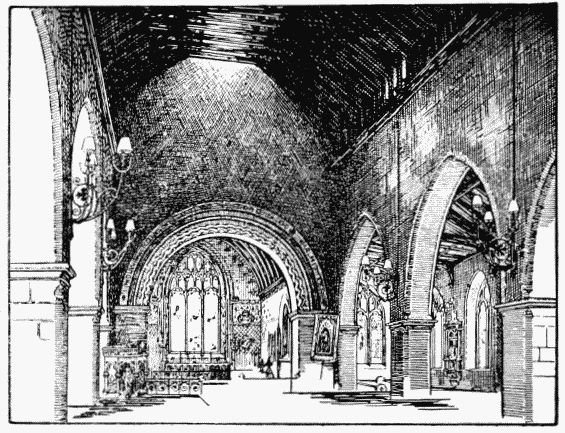
Thatcham Church: The Nave looking East
The windows of the south aisle are all modern and are designed in the style of the 14th century. Between the two western windows in the south wall is the 12th-century south doorway, which is of three roundarched orders, the outer continuous and enriched with a zigzag edge roll and a leaf pattern suggestive of beak-heads, the intermediate order carried by modern jamb shafts and carved with the cheveron on the face and soffit, while the inner order is moulded with a simple edge roll and springs from modern imposts. The modern south porch has an outer entrance with shafted jambs and a moulded two-centred head.
The tower arch has plain double-chamfered jambs and a two-centred head without capitals or bases. The west doorway and the window above it are modern restorations in the style of the 14th century. The walls of the tower, which is crowned by an embattled stone parapet with angle pinnacles, are of uncoursed rubble below, and of modern flint with stone dressings above. The top stage has on each face a modern window of three cinquefoiled lights. The stage below is lighted by small trefoiled loops, that on the east looking into the nave. The remainder of the walls are of flint with stone dressings, except those of the north aisle, which are of rubble with some flint.
Internally all the roofs are modern, with the exception of that to the south chapel, which has a 15th-century flat panelled ceiling with moulded framing, the principal beams having curved bracket supports with carved spandrels. Below the spandrels the timber seems to have been cut off.
All the internal fittings are modern.
In the archway between the chancel and the south chapel is a tomb on a brick base to Sir William Danvers, judge of the Court of Common Pleas (d. 1504), and Anne his wife. The front towards the chapel is divided into seven panels, all except those at the ends being filled with feathered quatrefoils containing blank shields. On the top is a large grey granite slab in which are the indents of the brasses of a man and a woman, two groups of children, four shields and a narrow border with foiled corners. On the south wall of the chapel is a Renaissance monument to Nicholas Fuller, who died in 1620. He is represented kneeling at a desk opposite his wife, wearing a ruff and a long robe. On either side are Corinthian columns supporting an entablature, beneath which are two semicircular panels with the inscription. In the base, which is supported by carved brackets, are his two sons, and, kneeling opposite, his five daughters, while at the bottom is another inscribed tablet. On the entablature are the arms, Argent three bars and a quarter gules with a helm crested with a beacon above. On the north jamb of the tower arch is a small brass inscribed 'Here lythe John Godfadyr on whos Sowlye God have mercy.'
The tower contains a peal of six bells, the first having the inscription 'I as trebil begin' and the next 'I as second will swing' with the initials R.E. V.K. and G.H. below; the third has 'I as third wil ring,' with an imperfect die of the letter A between the first and last words; the fourth has the die of the letter E and the inscription 'As fourth in my place'; the fifth has a hollow letter S and the words 'I as fift wil sound' (fn. 473); and the tenor is by Thomas Mears, 1821. Besides these there is a small sanctus bell inscribed 'Sacerdotes tui induantur justitiam 1882.'
The plate comprises a paten and two chalices, all modern.
There are nine books of registers before 1812: (i) baptisms, marriages and burials 1561 to 1628; (ii) 1629 to 1649; (iii) 1649 to 1653; (iv) 1653 to 1694; (v) 1695 to 1771; (vi) baptisms and burials 1771 to 1806 and marriages 1771 to 1773; (vii) marriages 1766 to 1786; (viii) the same from 1786 to 1813; (ix) baptisms and burials 1806 to 1813.
There is also a churchwardens' account book dating from 1561 to 1633. (fn. 474)
In the vestry chest are some sixty-four ancient deeds for the sale or transfer of land in the parish of Thatcham, of which the earliest dated is in the ninth year of Edward II, whilst a few undated appear to be even earlier.
The church of ST. MATTHEW, Midgham, is a small building in 13th-century style erected in 1869, consisting of a chancel with a north vestry and an organ-chamber, nave of five bays with a north transept and a south aisle, a south-west tower and a south porch. The walls are of flint with stone dressings and the roofs are tiled. The tower has an embattled parapet and an octagonal stone spire. There is a peal of six bells, all modern except the third, which is inscribed 'Ellis and Henry Knight made mee 1674.' The old church stood to the north-east of the present building in the grounds of Midgham House. The registers begin in 1622.
The church of ST. MARK, Cold Ash, was built in 1864. It consists of an apsidal chancel with a north vestry, and a nave with a south porch. The arcade of a north aisle has been built, but is temporarily filled in. The details are in the 14th-century style, the material being red brick with stone dressings and tiled roofs. At the west end of the nave is a bellcote with two bells. The churchyard, which is of moderate size, is surrounded by a brick wall with a lychgate on the east side.
The church of ST. MARY THE VIRGIN, Greenham, to the south of Newbury, is a small building of flint and stone in 13th-century style, consisting of a chancel, north vestry and organchamber, nave, north aisle, west baptistery and south porch. In a west bellcote hang two bells. The registers date from 1706. The building was erected in 1876 on the site of an older chapel and occupies a lofty position overlooking the town.
There are Congregational, Primitive Methodist and Wesleyan chapels in Thatcham and a meetinghouse belonging to the Plymouth Brethren.
At Cold Ash there are two chapels belonging respectively to the Primitive Methodists and the Wesleyans.
In Greenham is a Baptist and a Primitive Methodist chapel.
ADVOWSONS
The church of Thatcham was held in 1086, together with 3 hides of land worth £3 a year, by two clerks. (fn. 475) Although it is described as the church of the manor of Thatcham, the geld due from the church land was paid separately, and had not been remitted with the geld from the manor. (fn. 476) Roger Bishop of Salisbury (1107–39) held the advowson, (fn. 477) but whether in right of his see or as his own property does not appear. No mention of the church is made in the charter of Henry I granting the manor to Reading Abbey, (fn. 478) and apparently the right of the Crown was not recovered until after the death of Roger in 1139. In 1141 (fn. 479) the Empress Maud was at Reading, and granted the monks the church to hold as fully as ever Bishop Roger had held it. (fn. 480) In 1190 Abbot Hugh II founded the hospital of St. John Baptist in Reading, (fn. 481) outside the gates of the abbey, for the assistance of the local poor and wayfarers, and with the consent of Bishop Hubert (1189–93) he assigned the church of Thatcham to it. (fn. 482) Pope Clement III also confirmed the grant. (fn. 483) The division of the vicarage into portions from which rents were payable to the abbey seems to have been recognized in 1201 (fn. 484) by Bishop Herbert le Poor (1194–1217). At that date, therefore, the division of property between two clerks, recorded in the Domesday Survey, still existed, R— the clerk of Thatcham holding two-thirds, his predecessor being named Nigel, and Hugh the Burgundian holding one-third. The full right of the abbey to the latter portion was granted by Bishop Herbert after the death of Hugh the Burgundian. (fn. 485) In 1239 (fn. 486) G. de Byham, rector of Thatcham, after a suit with the abbot and monks, obtained a charter from Bishop Robert Bingham (1229–46) granting him the whole church of Thatcham, from which he and his successors were to pay an annual pension of 20 marks to the monastery, the older arrangement ratified by Herbert le Poor being cancelled. The Abbot of Reading in 1309 obtained a licence from the king (fn. 487) and Pope Clement V (fn. 488) to appropriate the church, but the institution of the vicarage was not finally accomplished till 1317. (fn. 489) The abbey held the rectory and advowson until its dissolution, (fn. 490) but the revenues were no longer specially assigned to the hospital of St. John, which had disappeared as a separate institution during the 15th century. (fn. 491) Although it was revived as a grammar school under the second Abbot Thorne, the rectory of Thatcham remained amongst the general revenues of the abbey. (fn. 492) In 1540 (fn. 493) the rectory and advowson were granted by Henry VIII with the manor to John Winchcombe, and belonged to the lords of the manor (fn. 494) until the sale of Sir John Croft's lands in 1798. (fn. 495) The rectory was bought by various purchasers, some of them being the farmers from whose land the tithes were paid. (fn. 496) The advowson was bought by William Mount with the manor, but he sold it to the Rev. Archer Thompson, a nephew of Sir John Croft and vicar of Thatcham. (fn. 497) In 1804 (fn. 498) John Thomas Hope presented to the living, probably as trustee for Mr. Thompson, who had just resigned. (fn. 499) The latter was patron until the advowson was acquired by John Hanbury, from whom it passed to William Hanbury of Rugeley, Staffs. In 1858 Oswald Milne was patron, having presumably obtained it for the presentation in 1855, when the Rev. John H. Milne became vicar. It shortly afterwards (before 1869) became the property of the Rev. Hezekiah Martin, brother-in-law of Mr. A. R. Tull. It is now the property of Mrs. Chamberlaine.
The chapel of St. Anne, in the church of Thatcham, (fn. 500) at the east end of the south aisle, was probably built by Lady Anne Danvers for the reception of the body of her husband Sir William Danvers, who died in 1504. (fn. 501) In her will, dated 1530, (fn. 502) Anne endowed a chantry in the chapel of Chamberhouse, its revenue being a charge on that estate. The chantry chapel was not returned by the commissioners of Edward VI, the Docwra family presumably being successful in concealing Lady Danvers's bequest and also in recovering the endowment of the chantry. The chapel in the church was known as the Danvers or Fuller aisle, the Fullers being later lords of the manor. In a terrier of the vicarage of Thatcham made in 1783 (fn. 503) Sir George Cornewall, bart., the owner of Chamberhouse, was said to be responsible for the repair of the chapel, which still belongs to the owner of the manor, Mr. A. R. Tull of Crookham.
In 1857 (fn. 504) the chapelries of Midgham and Greenham were separated from the church of Thatcham, and were formed into two ecclesiastical parishes.
In 1865 (fn. 505) part of Thatcham, including Cold Ash, Ashmore Green, part of Long Lane, Henwick and Shaw Fields, was formed into the separate ecclesiastical parish of St. Mark's, Cold Ash. This living is a vicarage in the gift of the vicar of Thatcham.
The chapel of the borough of Thatcham, (fn. 506) which was probably also called the chapel of St. Thomas the Martyr, (fn. 507) was built before 1304, (fn. 508) in which year Bishop Simon de Ghent (1297–1315) gave a provisional licence for two years to Sir Richard Fokeram and certain other parishioners of Thatcham to have divine service celebrated in the chapel by a chaplain provided at their own cost. The permanent licence was granted at the end of the two years. (fn. 509) There is no record of the endowment of the chapel, but presumably divine service was celebrated there until the dissolution of the chantries. Various chaplains and clerks are mentioned in Thatcham documents during the 14th century, who were possibly the chantry priests attached to the chapel, (fn. 510) but it is curious that no return of the chapel was made by the commissioners of Edward VI. The chapel of the borough seems to have been disused and in a ruinous state during the 17th century, but it was bought before 1707 (fn. 511) by Lady Frances Winchcombe, widow of Sir Henry Winchcombe, bart. In that year she gave certain property, including about half an acre of land in Chapel Street, 'together with a decayed chappell thereon standing with intention to convert the said chappell into a school house,' to trustees for the endowment of a Blue Coat School. (fn. 512) She had already given orders for the repair of the chapel (fn. 513) and the necessary alterations, but apparently by the neglect of the trustees her intentions were not carried out immediately, since the school was only opened after certain Chancery proceedings in 1713. (fn. 514) The Blue Coat School had a chequered history in the 18th century, but the old chapel is still used.
The free chapel of St. Mary at Crookham is first mentioned in 1299–1300, (fn. 515) when John de Bassbrigg was presented to it by John Fitz Reynold, but was refused admission, since he was under age. There seems, however, to be no evidence to show when or by whom it was founded. It was attached to the manor of Crookham and the right of presentation belonged to the lords of the manor. (fn. 516) During the Wars of the Roses the manor and chapel were forfeited to the Crown, (fn. 517) and Henry VII granted the chapel in 1491 (fn. 518) to John Barrett, afterwards rector of Monxton, Hants. The latter received a pension and the tithes attached to the chapel and said mass in it once a year. (fn. 519) At the time of the dissolution of the chantries the chapel of Crookham was still owned by Barrett, (fn. 520) but it was then 'wholly decayed and fallen down,' so that no masses could be said in it, although his pension of 20s. and tithes worth 6s. 8d. a year were still paid. The estate was leased to William Perkins, (fn. 521) but in 1549 (fn. 522) Edward VI granted it in fee to John Knight of Newbury and Robert Were alias Browne of Marlborough. John Knight had already obtained in 1544 (fn. 523) the tithes and tenth portion of the rectory of Crookham, formerly belonging to Reading Abbey. Presumably these were the tithes from Crookham belonging to the rectory of Thatcham (q.v.) which had belonged to the abbey since the 12th century. They had been granted by Henry VIII to Richard Andrewes in 1543 (fn. 524) and from him passed to John Knight. The latter died in 1549–50, (fn. 525) seised of both the rectory of Crookham and the free chapel there, leaving his son Richard, a boy of five, as his heir. The latter granted the rectory to his son John in 1577, (fn. 526) who together with his wife Elizabeth and his son John sold it to Leonard Bilson twenty-five years later. (fn. 527) He settled the rectory (presumably including the chapel property) in 1628 on his nephew and heir Sir Thomas Bilson, the son of Thomas Bilson, Bishop of Winchester (fn. 528) (1597–1616). Sir Thomas Bilson was succeeded by his sons Thomas, who died in 1649, (fn. 529) and Leonard, and his grandson, another Thomas. (fn. 530) The last-named married Susan daughter of Colonel William Legge. His sons Thomas and Leonard both died childless, (fn. 531) and on the death of Leonard in 1715 (fn. 532) the rectory passed under his will to his mother, and to Thomas Bilson, formerly Bettesworth, the grandson of Susan daughter of Sir Thomas Bilson. (fn. 533) In the following year they sold it to John Waller of Middlesex. (fn. 534) It was acquired during the 18th century by the family of Peachey, who also owned the manor of Crookham (q.v.), and in 1806 (fn. 535) belonged to Lord Selsey.
The chapel at Chamberhouse was founded in 1397 by Richard Pavy, (fn. 536) who obtained a licence from Bishop Mitford (1395–1407) to have divine service celebrated in the oratory of his house at Chamberhouse. It was not a separate building, but a room in the house, and Ashmole (fn. 537) records that it measured 4 yds. 8 in. broad and 5 yds. 8 in. long. It remained in occasional use during the 17th century, a baptism there being recorded in 1610. (fn. 538) A house was standing when the manor was sold to John Lansdell in 1716, (fn. 539) but whether the chapel remained in the condition in which Ashmole had seen it there is no evidence to show. The house of 1716 seems to have been pulled down after the manor of Chamberhouse passed to the Tulls.
A church at Greenham is mentioned in the Domesday Survey, (fn. 540) but no land was attached to it. In the early 14th century the chapel of Greenham was attached to the parish church of Thatcham, and it is mentioned in the ordination of the vicarage of Thatcham. (fn. 541) In 1535 (fn. 542) the chapel was still appurtenant to Thatcham, and being a parochial chapel escaped dissolution under Edward VI. In 1857 (fn. 543) the chapelry of Greenham was formed into a separate ecclesiastical parish, the benefice being called a perpetual curacy. The tithes of Greenham, hitherto belonging to the vicarage of Thatcham, had been commuted in 1842 (fn. 544) to an annual rent-charge of £130, and this charge was assigned to the new benefice. The patronage belonged to the vicar of Thatcham. (fn. 545) In 1866 the benefice was declared a vicarage, and the Bishop of Oxford was made patron. (fn. 546)
Owing to the dependence of the chapel on Thatcham Church, which belonged to Reading Abbey from the 12th century, (fn. 547) the rectory of Greenham passed into the hands of laymen at the dissolution of the monasteries. At that time it was worth £4 13s. 4d. a year (fn. 548) and was granted by Henry VIII in 1543 (fn. 549) to Richard Andrews, but was subject to a Crown lease granted previously to John Winchcombe. Next year (fn. 550) Andrews alienated it to John Knight and his wife Elizabeth, who also obtained the rectory of Crookham. From this time the rectory of Greenham passed with that of Crookham (q.v.) until 1806. (fn. 551) The old chapel of Greenham was rebuilt by Mr. Lloyd Baxendale, the new church of St. Mary the Virgin being consecrated in 1876.
The chapel of Midgham is mentioned at the time of the appropriation of the rectory of Thatcham (q.v.) to Reading Abbey, when it was a parochial chapel, and its history is similar to that of Greenham chapel (q.v.).
At the time of the Dissolution the rectory of Midgham was valued at £5 6s. 8d. (fn. 552) Part of the tithes were granted in 1543 (fn. 553) with the rectory of Greenham, but the main part of the rectory appears to have been leased from the Crown at a rent of £5 6s. 8d. (fn. 554) In 1638 it was held by William Smith, his lease ending before 1649. Afterwards it was held by the Gilmores during the reign of Charles II. (fn. 555) In 1824 (fn. 556) Lord Clinton and his wife owned both the rectory and the manor. In 1714 (fn. 557) John Hillersdon, the lord of the manor, rebuilt the old chapel of Midgham, but in 1868 Benjamin Buck Greene pulled down this chapel, (fn. 558) which like its predecessors stood close to Midgham House, and in 1869 built the new church of St. Matthew in a more central position in the parish. Mr. A. F. Clarke of Midgham House is patron of the living.
CHARITIES
For the schools founded by Lady Frances Winchcombe, deed 1707, see article on Schools. (fn. 559) The trust estate consists of the school building, master's house and 1a. or. 27p. and £7,855 12s. 1d. consols with the official trustees, comprising £5,922 5s. 5d. stock transferred out of court in 1864, and £1,933 6s. 8d. consols, representing the redemption in 1878 of the original rent-charge of £53 by Lieut.-Colonel Charles William Miles and an addition made by him to the endowment.
The Church Estate.
—Before the Reformation certain lands and tenements were vested in the churchwardens, which were the subject of an inquisition taken at Abingdon in 1609 under a commission of charitable uses. The trust estate now consists of shops, cottages and gardens, 2 r. 22 p. known as Plough Meadow, and six-sixteenths of 8 a. or. 38 p. known as Moor Meadow, awarded on the inclosure in 1852 in respect of sixteen commons in the moor and gravel-pit, and £564 19s. consols arising from sales of land. The gross income amounts to £106 17s. 4d. The trust is regulated by a scheme of the Charity Commissioners of 27 January 1899, whereby the vicar and churchwardens were appointed the administering trustees.
The church estate is indebted to the other charities to the extent of £200.
The almshouses founded by John Hunt, deed, 1590. The trust property consists of almshouses now occupied by three widows, a cottage adjoining the infants' school and site, and three-sixteenths of Moor Meadow and a rent-charge of £8 18s. issuing out of the Moor Land Farm in Beenham, producing a gross income of £14.
John Hunt's charity for poor kinsfolk, founded by will about 1590, trust property, two cottages and 2 a. 2 r. 24 p. and one-sixteenth of Moor Meadow, gross rental £14 12s.
'Nine Shilling Houses,' formerly included in the church estate, consist of four cottages in Duke Street, let to various tenants, each at 1s. weekly, and onesixteenth part of Moor Meadow, gross rental £11 6s. 9d.
These charities are also regulated by the scheme of 27 January 1899, and were thereby placed under the management of the vicar and churchwardens ex officio and five representative trustees.
Loundres's Almshouses—The earliest document extant would appear to be a deed poll, dated 7 July 1446, whereby Robert Clark, vicar of Thatcham, executor of Thomas Loundres, granted to the churchwardens a house in the south side of East Street. commonly called the almshouse, situate near the chapel.
The said Robert Clark by deed of even date (now lost) granted other lands for providing (inter alia) firewood for the same almshouse for the maintenance of those dwelling and seeking hospitality there, being intended, as it were, for the poor traveller and the lame soldier returning homewards. The endowment now consists of the almshouses occupied by six poor widows, blacksmith's shop and garden, 3 r. of meadow land, and four-sixteenths of Moor Meadow, also £2,021 14s. 9d. consols arising from sales of land at various times, gross income £73 10s. Each almswoman receives 3s. 6d. a week. Each house receives 1½ cwt. of coal per week in the winter months and 1 cwt. per week in the summer, and an allowance of wood of the value of £10 to £13 yearly. The inmates also receive the dividends on £105 consols, representing a legacy by will of John Sargood, proved 26 August 1826.
In 1585 Richard Bye, by deed, as appeared from the benefaction table, gave to the poor £1 per annum, issuing out of a meadow on the east side of Stony Street, also a messuage in Broad Street, now two cottages and gardens. The charity is also entitled to one-sixteenth part of Moor Meadow, gross income £12 6s. 9d.
The official trustees also hold a sum of £399 9s. 3d. consols, representing the proceeds of sale in 1870 of a messuage situate at Newbury, granted by Francis Winchcombe by deed dated 7 January 1605, for the use of the poor. The annual dividends, amounting to £9 19s. 8d., are applied with the income of Richard Bye's charity and apportioned among different parts of the ancient parish roughly in proportion to their population.
In 1594 the Rev. John Heardman, vicar of Hampstead Norris, by his will proved in the P.C.C. 19 April, bequeathed 'unto fower of the poorest folke in Thacham' £6 to be equally divided between them. The annuity is paid out of land in Thatcham now belonging to Mr. W. A. Mount of Wasing Place. The recipients are chosen from various parts of the ancient parish.
In 1680 Thomas Goddard, by will proved in the P.C.C. 12 January, devised a rent-charge of £1 15s., part thereof to be given to the poor people inhabiting Goddard's tithing (now Crookham) and 5s. to the poor inhabiting the borough tithing on Christmas Day yearly. The annuity is now charged on a field in Woolhampton called the Gun Ground, forming part of Burnell's Farm, which has recently been sold, subject to the charge, to Mr. C. S. Holberton of Brimpton.
In 1823 William Northway, by will proved in the P.C.C. 4 June, left £500 stock, one moiety of the dividends thereof to be divided equally amongst the three oldest single poor men of Thatcham and the remaining moiety in the purchase of bread for the poor on St. Thomas's Day yearly. The legacy, less duty, is represented by £450 consols, and the dividend, amounting to £11 5s. a year, is duly applied. In 1905 the number of the recipients of the bread was ninety-two.
In 1859 Miss Elizabeth Coxe Baily, by will proved at London 17 November, in order to establish a perpetual memorial for her late brother Francis, who was buried at Thatcham, left £450 stock, the dividends thereof to be divided yearly among twelve poor men and twelve poor women and no more, resident in the parish of the age of sixty years and upwards between St. Thomas's Day and Christmas Day. The legacy is represented by £450 consols, producing yearly £11 5s.
The several sums of stock above mentioned are held by the official trustees.
In 1899 Samuel Barfield, by will proved at London 12 December, bequeathed his residuary estate to his trustees upon trust (inter alia) after the death of his wife (which occurred in 1901) to pay £2,000 to the vicars and churchwardens of Thatcham and Cold Ash, the income arising therefrom to be distributed annually between Michaelmas and Lady Day either in money or in the purchase of food, fuel, or clothing in the proportion of two-thirds to the poor of Thatcham and one-third to the poor of Cold Ash.
The legacy, less duty, was invested in £380 Great Eastern Railway 4 per cent. debenture stock, £311 4 per cent. rent-charge stock of the same company, £385 South-Eastern railway 4 per cent. debenture stock, and £288 guaranteed 4½ per cent. stock of the same company held by the official trustees, producing a yearly income of £56. The distribution is mainly made in doles of cash, coal, wine and soup.
The Independent Chapel and minister's house comprised in indentures of 20 June 1804 and 28 May 1825 (enrolled) respectively was by a deed poll dated 20 January 1821 endowed by John Barfield with £1,000 stock, which is now represented by £750 on mortgage at 4½ per cent. on a freehold house and land at Westcliff-on-Sea, and £176 Great Western Railway 4 per cent. debenture stock. The income, amounting to £40 15s. a year, is paid to the minister of the chapel.
The parish club and reading room was in 1906 erected on land on the south side of Chapel Street out of funds collected for the purpose.
By an award made under the Inclosure Act, (fn. 560) and the Thatcham inclosure award, dated 6 November 1852, certain allotments were made for public purposes containing in the aggregate 22 a. 3 r. 15 p. Some of the land is let in plots of half a rood to a rood, producing a rent of about £7 2s. 6d. a year.
Chapelry or Township of Midgham.
—The Parliamentary returns of 1786 mention that Thomas Jayes gave £14 to the poor widows of Midgham. In 1787 William Poyntz added £16 to this gift. The sum of £30 is now in the Newbury Savings Bank, the interest of which is given to poor widows.
The almshouses consist of four cottages and gardens, which were, according to tradition, built for poor widows by a lady in the Poyntz family. They are claimed as private property by the owner of the Midgham estate, who appoints the inmates.
The Church Acre, acquired in 1814 by an award under the Inclosure Act, was sold in 1889, and the proceeds invested in £128 10s. 8d. consols with the official trustees, augmented by the goodwill of the purchaser to £154 3s. 3d. consols, producing yearly £3 17s., which is carried to the expenses of the church. In 1902 Benjamin Buck Greene, late of Midgham House, by his will proved at London 2 June, bequeathed £600 to the Charity Commissioners, upon trust to invest the same, the income to be applied by the minister and churchwardens in insuring the church erected by him in an amount of not less than £2,000, and the chancel and stained glass windows for not less than £500, and the surplus income in the repair of the church and chancel and in keeping the churchyard in order. The investment was made in £629 1s. 11d. consols with the official trustees, producing yearly £15 14s. 4d.
Chapelry of Greenham.
—Miss Martha Smith, by deed dated 21 September 1852 (enrolled), conveyed to trustees a messuage and outbuildings in Greenham, and parcels of land containing together 3 a. 1 r. 22 p., upon trust, that the annual income might be a perpetual fund for poor and deserving persons belonging to Greenham not receiving parochial relief, the distribution to be made on or about 25 December in every year. The gross yearly income is about £50, which less expenses is divided equally between the ecclesiastical parishes of Greenham and St. John, Newbury, in money, coal and clothing.