A History of the County of Berkshire: Volume 3. Originally published by Victoria County History, London, 1923.
This free content was digitised by double rekeying. All rights reserved.
'Parishes: Burghfield', in A History of the County of Berkshire: Volume 3, ed. P H Ditchfield, William Page (London, 1923), British History Online https://www.british-history.ac.uk/vch/berks/vol3/pp399-404 [accessed 30 April 2025].
'Parishes: Burghfield', in A History of the County of Berkshire: Volume 3. Edited by P H Ditchfield, William Page (London, 1923), British History Online, accessed April 30, 2025, https://www.british-history.ac.uk/vch/berks/vol3/pp399-404.
"Parishes: Burghfield". A History of the County of Berkshire: Volume 3. Ed. P H Ditchfield, William Page (London, 1923), British History Online. Web. 30 April 2025. https://www.british-history.ac.uk/vch/berks/vol3/pp399-404.
In this section
BURGHFIELD
Borgefelle (xi cent.); Burgefeld, Berfeld (xii and xiii cent.); Burefeld (xiv cent.); Burfield (xvi to xviii cent.).
The parish of Burghfield contains 4,309 acres of land, of which 1,660 acres are arable, 1,940 acres permanent pasture and 163 acres woods and plantations. (fn. 1) The land lies low in the valley of the Kennet, at an average altitude of a little over 100ft. above the ordnance datum, rising in the south-west to a height of 302ft. The Kennet River and the Kennet and Avon Canal cross the parish in the north and Burghfield Brook in the south. The subsoil is London Clay. The village lies at the meeting of two roads, one to Reading and the other a branch road from the village to the station at Theale, on the Great Western railway, which is 2½ miles distant. The village is spread over a considerable area and contains several large houses. The house now known as the Manor House, the residence of the Rev. Sir James Stuart, bart., is near the church; the old manor-house stood on the site of the present rectory. Culverlands, the residence of Col. Sir Charles Wyndham Murray, C.B., is an 18th-century house altered and enlarged in 1879. It is a plain plastered building with a balustraded parapet and slate roofs, situated in an elevated well-wooded park, the cedars being particularly fine. The araucarias were raised from seed brought from South America by the late Thomas Bland Garland and are probably the oldest in England grown on this method. Hillfields, the residence of Mr. H.G. Willink, is a modern red and blue brick gabled house with a slate roof. Highwoods, the residence of Mr. F. Foster, is also modern, and is built of yellow brick with a slate roof. The remaining houses and cottages are of red brick and for the most part modern.
On Burghfield Common are parochial schools and a mission hall. The latter was built by the late Dr. Bland to house the collection which he bequeathed to Reading Corporation. In the playground of the schools is a large Japanese bell, covered with characters and ornament, now cracked, which was brought to England by Dr. Bland. A similar smaller bell was formerly used in the mission hall.
Pinge Wood and Sheffield Bottom are two hamlets in the parish.
The following place-names occur in different documents: Garenters brook, Sarpacia in Burghefeldingefeld, Landmede, Wicland, Husseie bridge, the Dune, the Hussi puddel, Wettmed, Suthmore and Ladylands.
MANORS
Burghfield appears to have been divided from very early times into two equal portions, each containing 1½ hides of land, and this division is probably the origin of the two manors of Burghfield which existed later. Not only the land, but also the rents from the mill and fishery were similarly divided. (fn. 2) One of these holdings in Burghfield is traditionally said to have been granted by Queen Emma to the old abbey of Winchester, (fn. 3) and in the time of Edward the Confessor Abbot Elsi held it 'under the old minster of the Church of Winchester.' (fn. 4) On his outlawry, which occurred about the year 1070, his holding passed to Ralph Mortimer, who was holding in 1086, (fn. 5) and the intermediary overlordship continued with the Mortimer family (of whom Roger Mortimer was created Earl of March in 1328) until the death of Edmund, the last Earl of March of that name, in 1425. (fn. 6) His heir was his nephew Richard Duke of York, a minor. (fn. 7) On his attainder in 1459 his honours passed to the Crown, with which they were finally united on the accession of Edward IV. The last mention of the overlordship is in 1614, (fn. 8) when the manor was held of the king in free socage and by fealty only, a change of tenure probably dating from the new grant made to the Talbots by Henry VIII in 1513.
The first sub-tenant of the manor of BURGHFIELD, BURGHFIELD REGIS or NETHERCOURT (xv cent.) (fn. 9) holding under Ralph Mortimer (fn. 10) was a certain knight, possibly the ancestor of the Burghfield family, who were lords of the manor in the following century. Thomas Burghfield was living in 1175 (fn. 11) and his grandson Robert was in seisin in 1210, (fn. 12) and may perhaps be identified with the Robert Burghfield who is mentioned some time before 1240 as tenant under Ralph Mortimer. (fn. 13) It is probable that this Robert was followed by a son of the same name, (fn. 14) and that the next owner was Roger, who succeeded before 1280, when he, with the lord of the second part of Burghfield, was charged with the repair of a foot-bridge in the parish. (fn. 15) He was a knight of the shire for Berkshire in the Parliament of 1301. (fn. 16) He died in 1327, (fn. 17) and his heir was his brother Peter Burghfield, parson of the church of Burghfield. (fn. 18) In 1333 (fn. 19) Bartholomew Burghfield held the manor, and was succeeded by John Burghfield, (fn. 20) who died before 1358, when his son John was in seisin of the manor, (fn. 21) and granted two-thirds of it and the reversion of the other third to Thomas Cateway. (fn. 22) Three years later John Burghfield granted all his lands and tenements in Burghfield to Hugh de Segrave, John de la Huse and John atte Beche. (fn. 23) This took place very shortly before his death, since in 1362 Gilbert Burghfield, presumably his heir, granted the manor to Sir Hugh de Segrave, who also obtained a quitclaim from Walter Catewy. (fn. 24) Sir Hugh was a lawyer of some distinction, and rose to the position of Treasurer and Chancellor of England. (fn. 25) He settled the manor on himself and his wife Isabel for their lives, with remainder to William of Wykeham, Bishop of Winchester. (fn. 26) Segrave died, probably in 1385, (fn. 27) without issue, and, probably by virtue of the feoffment already mentioned, Burghfield passed either to his aunt and heiress Sarah or to her descendants, the Draytons. (fn. 28) Her grandson, Sir John Drayton, (fn. 29) probably was in seisin of the manor in 1406–7, when he obtained a grant of tenements in Burghfield from Alvered Kent. (fn. 30) Two years later William Brightwell, clerk, gave seisin, by his attorney Robert Swynerton, to Sir John Drayton and his wife Isabel, (fn. 31) but this was probably merely a settlement of the manor on their marriage. Nicholas Drayton, the brother of Sir John, released all his right and claim in the manor in 1412. (fn. 32) Sir John died in 1417, (fn. 33) and his widow Isabel held the manor of Burghfield during her lifetime. (fn. 34) She married after his death Stephen Hatfield, who was holding half a knight's fee in Burghfield in right of his wife in 1428. (fn. 35) In 1430 the manor (or probably the reversion of it) was dealt with jointly by the daughters and co-heirs of Sir John Drayton and their husbands (fn. 36); Joan had married Drew Barentyne and Elizabeth married Christopher Preston. Before 1441 Preston had died and his widow had married John Wenlock, (fn. 37) afterwards Lord Wenlock, (fn. 38) and a fresh settlement seems to have been made. (fn. 39) Drew Barentyne died in 1453, (fn. 40) and apparently his wife had predeceased him. Their son and heir John, a minor at the time of his father's death, inherited their moiety of the manor, (fn. 41) but sold it in 1469 (fn. 42) to Alice Duchess of Suffolk, who granted it the following year to trustees, presumably to hold to her use. (fn. 43) By her will it passed to her son John Duke of Suffolk. (fn. 44) The other moiety of Burghfield passed in the same way to the Duke of Suffolk. His mother obtained it in 1465–6 from Lord Wenlock, (fn. 45) and in the same year (fn. 46) settled it on various trustees, finally leaving the whole manor of Burghfield to her son. (fn. 47) The latter appears to have granted it to his son John Earl of Lincoln, (fn. 48) who was killed at the battle of Stoke in 1487 fighting against Henry VII. Lincoln was attainted after his death and his lands, including the manor of Burghfield, were forfeited to the Crown, (fn. 49) although the Duke of Suffolk lived until 1491. (fn. 50)
In 1513 Henry VIII granted the manor of Burghfield in tail-male to Sir Gilbert Talbot of Grafton, (fn. 51) who was succeeded in its possession by his son of the same name (fn. 52); the latter settled it in 1529 on himself and his issue male with contingent remainder to his brother Sir John Talbot. (fn. 53) After Gilbert's death in 1542 (fn. 54) the manor is mentioned in the inquisition of his lands. It then evidently passed to his brother, in view of the fact that Sir Gilbert had only daughters to succeed him. (fn. 55) This branch of the Talbot family apparently held the manor without interruption, although in the reign of Queen Elizabeth William Tipper and Robert Dawe obtained a grant of it as 'fishing grantees.' (fn. 56) John Talbot, the grandson of Sir John, died seised of the manor in 1610–11, (fn. 57) and was succeeded by his son George, (fn. 58) who became Earl of Shrewsbury on the death of his distant cousin, Edward the eighth earl, without heirs male of his body. (fn. 59) The manor was settled on John Talbot, the nephew and heir of the Earl of Shrewsbury, who inherited in 1630. (fn. 60) The Earls of Shrewsbury held the manor until the second half of the 19th century. (fn. 61) In 1883 Mrs. Davis was lady of the manor, which belongs at the present day to Mr. G. Hatfeild of Morden Hall, Surrey.

Talbot. Gules a lion and a border engrailed or.
A view of frankpledge extending into Burghfield was held by the lord of Purley, but after the death of Nicholas Carew in 1390 Richard II granted to Robert Cholmeley for life 'the farm of the profits of the view of frankpledge.' (fn. 62) In the grant made by Henry VIII in 1513 to Sir Gilbert Talbot view of frankpledge was included. (fn. 63)
There appears to have been a claim made in 1327 by the Abbot of Reading that action for dower in the manor of Burghfield should be tried at the abbot's court at Reading, the manor being in the liberty of the abbot. (fn. 64)
John Burghfield obtained a grant of free warren in his demesne lands at Burghfield in 1343, (fn. 65) and all such rights which had been held by the Earl of Lincoln were renewed in the grant to Sir Gilbert Talbot by Henry VIII. (fn. 66)
The second portion of BURGHFIELD was held in the reign of Edward the Confessor by two alodiaries who did service, the one to the queen and the other to Bundi. (fn. 67) At the time of the Domesday Survey the overlordship of this holding in Burghfield had passed to Henry de Ferrers, with the same men holding under him, but the hundred court did not know by what warrant they held it. (fn. 68) In the second half of the 12th century, probably in the reign of Henry II, Earl William Ferrers confirmed a charter in which one of his tenants granted land in Burghfield, (fn. 69) but this is the last occasion in which the overlordship is mentioned.
At this date (fn. 70) the earl's sub-tenant was Aumary son of Ralph, who appears to have held as a mesne lord. He granted the land which James Burghfield held of him to the abbey of Reading, (fn. 71) but it seems probable that this did not include all his holding in Burghfield, since in 1203 the Burghfield family were subtenants of 'Almaric son of Robert' of land paying a yearly rent of 20s. (fn. 72) This mesne lordship, however, cannot be traced further.
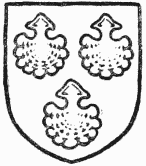
Reading Abbey. Azure three scallops or.
The land of James Burghfield, held from this time under the abbey of Reading, may be identified with the manor of Burghfield Abbas, of which the members of a second family taking its name from the place were the lords. James was probably succeeded by Odo Burghfield, who died before 1203, when his son Matthew was in seisin. (fn. 73) The latter built a narrow wooden bridge across the water of the Abbot of Reading in Burghfield 'moved merely by piety and not impelled there to by any right.' (fn. 74) His grandson Peter Burghfield was lord of the manor in 1280, (fn. 75) and petitioned against the contribution levied on him for the repair of his grandfather's bridge by the king's carpenter. It was decided that he ought to repair the southern half of the bridge and Roger Burghfield the northern part. (fn. 76) In 1316 the Abbot of Reading answered for this part of Burghfield, (fn. 77) but in 1386 Thomas Blount was lord of the manor, (fn. 78) and as such was bound to repair the High bridge. He was, however, the last under-tenant who is mentioned, and probably the manor was held by the abbey in demesne from this time. Other pieces of land besides the gift of Aumary son of Ralph were given to Reading Abbey, the most important being the grant in frank-almoign of 1 carucate of land and 5 marks of rent from Gilbert de la More in 1260–1. (fn. 79) In 1291 the value of the holding of the abbey in Burghfield was £7 7s. 8d. a year, part being in the hands of the abbot and the remainder being assigned to the almoner. (fn. 80) At the Dissolution the demesne land, worth £15, was held by the almoner of the abbey. (fn. 81) Certain rents were also assigned to the warden of the chapel of the Blessed Mary. (fn. 82) Henry VIII in 1541 granted the manor of Burghfield to Sir John Williams, (fn. 83) afterwards Lord Williams of Thame. (fn. 84) It passed to his two daughters and co-heirs, (fn. 85) Isabel the wife of Sir Richard Wenman, and Margaret the wife of Henry Norreys, (fn. 86) afterwards first Lord Norreys of Rycote, who in 1560 granted it to Nicholas Williams, nephew of Lord Williams. (fn. 87) On his death it reverted to the co-heirs, and Sir Richard Wenman and his wife released their moiety of the manor of Burghfield to Lord Norreys and his wife, (fn. 88) who thus became possessed of the whole manor. (fn. 89) Lord Norreys appears to have mortgaged the manor in 1574 to Sir Roland Hayward, (fn. 90) and in 1589 Burghfield was one of several manors granted by Lord and Lady Norreys to Lord Burghley (fn. 91) as security for the payment of £3,000 to the Crown before the last day of February 1589–90. (fn. 92) An extension of time was granted in March 1589–90. Two months afterwards Lord Burghley and John Fortescue alienated their interest to John Popham and Thomas Egerton. (fn. 93) Lord and Lady Norreys appear to have recovered seisin of the manor by 1598, (fn. 94) and their descendants held it during the 17th and 18th centuries. Burghfield Place Farm and the estate belonging to it were, however, sold, and came into the possession of Sir William Coventry before 1689, (fn. 95) and probably comprised most if not all of the land attached to the manor, so that the Earl of Abingdon (descendant of Lord Norreys) probably only possessed certain manorial rights at Burghfield. (fn. 96) In 1803 a quit-rent was paid annually to the heir of Lord Norreys from the tenants of Burghfield Place. (fn. 97) Coventry sold his estate to Francis Parry, whose property passed in 1740 to his four granddaughters. (fn. 98) Two years later three-fourths of the estate were sold to Lord Uxbridge. (fn. 99) His grandson the second earl sold it to Bernard Brocas, whose widow was the owner in 1803. (fn. 100) The remaining fourth was held at that date by the Rev. Dr. Morgan, grandson of Charles Parry who died in 1740. (fn. 101) Probably it passed, with his property in Wokefield (q.v.), which he had inherited from the same source, to Mr. Alfred Palmer, who is now a landowner in this parish.
A small estate in Burghfield bought by Francis Hare, Bishop of Chichester, about 1738 was called the manor of Burghfield in certain documents. (fn. 102)
The manor of SHEFFIELD or Soefeld can be identified with the land in Reading Hundred (fn. 103) held by Coleman and Brictward of Edward the Confessor. (fn. 104) They could go to whatever lord they pleased. In 1086 this land, which is called 'Sewelle' in the Domesday Survey, was held by the Count of Evreux, (fn. 105) who gave it to the priory of Noion in Normandy. (fn. 106) His grant was confirmed between 1140 and 1157 by his grandson Simon, in whose charter it is called 'Seuevella.' (fn. 107) The prior and monks of Noion were overlords of the manor in the 13th century, (fn. 108) but their rights in the manor disappear after the confiscation of the lands of alien priories during the Hundred Years' War. (fn. 109)
The manor was held of the priory for the annual rent of 40s. with a later addition of 8d. (fn. 110) The first under-tenant whose name is preserved was Roger Whitchurch, who paid half a mark on Sheffield in 1166–7. (fn. 111) His son Alan Whitchurch made various alienations of land and other property in 1197 (fn. 112) and the succeeding years. (fn. 113) Alan was succeeded by a second Roger in the 13th century. (fn. 114) A little later it passed to Sir William Huntercombe, who in 1270 (fn. 115) gave the manor of Sheffield with its lands, rents, and services to the abbey of Reading, to hold by a rent of the abbey of Noion. The abbey held the manor till the Dissolution, (fn. 116) when rents there were still assigned to the cellarer. (fn. 117) Sheffield was granted to Sir John Williams with Burghfield Manor (q.v.) to be held by knight's service, (fn. 118) and it followed the same history until the death of the first Lord Norreys in 1601. (fn. 119) He left it apparently to his third son Sir Edward Norreys, (fn. 120) who held it till his death in 1603, (fn. 121) when it reverted to his nephew and heir Francis, who was also the heir of Lord Norreys. (fn. 122) It was sold in 1608 (fn. 123) to John Talbot, who died seised of the manor in 1610–11, (fn. 124) and it passed to his son George, (fn. 125) who succeeded to the earldom of Shrewsbury on the death of the eighth earl in 1617–18. (fn. 126) The estate was bought from the Earl of Shrewsbury by the Thoyts family after 1852, and was sold by Col. N. B. Thoyts to Sir William G. Watson in 1910. (fn. 127)
In the 16th century deeds relating to the second manor of Burghfield, the so-called manor of AMNERS COURT, is continually mentioned. It belonged with Burghfield to the co-heirs of Lord Williams in 1560 when it was granted to Nicholas Williams, and afterwards passed with Burghfield Manor. (fn. 128) Amners Farm still exists, and belongs to Mr. J. H. Benyon.
It seems probable that a farm in Sheffield was granted at fee by the lords of Sheffield to the owners of Bradfield Manor or that part of Sheffield belonged to the fee of Bradfield. The Englefields seem to have held land in Sheffield of William de Somery in the 14th century, (fn. 129) as well as a holding in the manor of Sheffield, which they gave to Reading Abbey, (fn. 130) while another tenement owed a fifth part of the serjeanty of the manor of Padworth (fn. 131) (q.v.). In the 15th century property called the manor of Sheffield came into the possession of Sir John Langford of Bradfield (fn. 132) and afterwards passed to the Staffords by the marriage of Sir John's daughter and heir Anne with William Stafford. (fn. 133) Sir Reade Stafford held it at his death in 1605, (fn. 134) and it may be probably identified with the farm-house in Sheffield sold by his nephew and heir Sir Edward Stafford in 1615 to John Curtice. (fn. 135)
The mill of Burghfield was equally divided into two portions, one of which was attached to each manor of Burghfield, at the time of the Domesday Survey. (fn. 136) The moiety belonging to the Mortimers' fee in Burghfield was held by their under-tenants in the 12th century. Thomas Burghfield, who was living in the reign of Henry II, granted it to Nicholas son of Sexus for a yearly rent of 13s. and two sticks of eels. (fn. 137) William the miller of Burghfield and son of Nicholas granted the moiety of the mill to the abbey of Reading, the same rent being payable to the overlord, and the grant was confirmed by Robert Burghfield. (fn. 138) In 1272 the abbey had leased it at a rent of 26s., (fn. 139) but it is not mentioned again, nor is there any reference to the second moiety of the mill belonging to Henry de Ferrers in 1086, which presumably passed to the abbey of Reading with the manor of Burghfield (q.v.). Burghfield Mill at the present day is worked by steam and water.
A mill at Sheffield, parcel of the Englefield estate in Sheffield already referred to, is mentioned in 1086. (fn. 140) About 1197 Alan Whitchurch, the lord of the manor, granted it to William Englefield, together with certain lands and pannage for eighteen pigs, (fn. 141) and by another charter he sold him three villeins, the sons of Bernard the miller of Sheffield. (fn. 142) In the second half of the 13th century there were two mills there, a fulling-mill and a corn-mill, in the tenure of Margery widow of another William Englefield. (fn. 143) They formed part of her dower, and she gave them to her son John. He granted them to Reading Abbey, with lands and services of tenants. (fn. 144) His lands were assigned to the cellarer of the abbey, to whom a certain Bartholomew the Fuller paid a rent of £4 7s. 8d. for both mills. (fn. 145) John's widow Burgia and her husband William Balliol claimed her dower in this property (fn. 146) against the abbey, but the abbot successfully resisted her claim, it being decided that she must recover her dower from the guardian of Roger Englefield. (fn. 147) After the dissolution of Reading Abbey (fn. 148) Sheffield Mills probably passed with the manor to Sir John Williams. (fn. 149) In 1811 the Sheffield Mills were paper-mills, which, with the house and appurtenances, were worth £600 a year. (fn. 150) The paper manufactory was still carried on in 1869, but was burnt down in 1877. The mill was afterwards bought by James Dewe of Burghfield Mill, who thus secured the water rights. (fn. 151)
CHURCH
The church of ST. MARY THE VIRGIN was erected in 1843 on an old site. It consists of a chancel, north vestry, south organ chamber, nave, north and south transepts and a west apsidal porch, over the centre of which is a small bell tower. The building is in Romanesque style and is built of blue bricks with stone dressings and slated roofs. All the internal fittings are modern except the font, which has a large tapering bowl, probably of 12th-century date, and originally circular, but recut into its present ten-sided form with shallow trefoil-headed panels late in the 14th century. The moulded base is in its original state, and has a cable-moulded upper member. All the chancel walls are painted, and over the chancel arch is a painting of the Annunciation. The screen and pulpit are gilded. On the east wall of the south transept is a brass plate to 'Raynoulde Butler,' yeoman, and 'Alyce' his wife. He was buried in 1589 and she in 1612. They had five children, all of whom died young: 'Raynoulde,' a son, died 1565, and their daughter Ann in the same year; 'Alyce,' another daughter, in 1561; John, 1559; and another John in 1562. On the west wall of the nave is a 16th-century brass with a long laudatory verse inscription to William Cores. There is a shield on either side of the first two verses, the first being charged with the canting arms, three rooks and a chief with three bells therein, and the second with a cheveron between three sleeves. Above the verses are the figures of a man in plate armour and a woman in dress and cloak. In the porch is a very much worn white marble recumbent effigy of a lady, apparently of the 14th century. In the porch at the foot of the stairs to the belfry are two effigies, one a wooden figure of a knight, apparently of 13th-century date, possibly of Robert Burghfield. He lies with his legs crossed, wearing chain armour, over which is a surcoat. Only one of the angels which support the cushion at his head, and a fragment of the animal at his feet, now remain. The greater part of his left side is gone, including the left arm and the right hand, and there is only a part of one foot on which was a spur. Round his waist is a loose belt, from which hung his sword. The other figure, of the 15th century, is of white marble and represents, perhaps, Sir John Drayton (d. 1417) in plate armour with a mail gorget, his legs being broken off. His hair is very thick, and is cut short above the ears. Only a hand and foot of one of the angels at his head now remain, and the figure itself is much worn.
There is a peal of six bells, recast by Mears & Stainbank in 1888.
The plate comprises a silver cup of 1632 with a cover which bears no hall-mark, but is apparently silver, a stand paten of 1714, a chalice of 1889, and a paten of 1881. There are also a large plated flagon and two plates.
The registers before 1812 are as follows: (i) a parchment book containing baptisms from 1562 to 1643, marriages 1559 to 1643 and burials 1559 to 1635; (ii) baptisms, marriages and burials from 1662 to 1760, 1763 and 1761 respectively; (iii) marriages from 1754 to 1812; (iv) baptisms and burials from 1761 to 1812 and marriages from 1761 to 1794.
There is a mission room on Burghfield Common and Wesleyan and Primitive Methodist chapels at Burghfield.
ADVOWSON
The church of Burghfield was attached in 1086 to the manor held of Ralph Mortimer, (fn. 152) and the advowson was held by the successive lords of the manor, although their right was apparently not undivided during the 12th century. It seems to have been then divided into two moieties, like the manors, mills and fisheries, for the lords of the other manor of Burghfield laid claim by inheritance to the right of alternative presentation to the benefice early in the 13th century. (fn. 153) They did not gain their case, however, (fn. 154) and the lords of Burghfield presented with but one or two interruptions until the Earl of Shrewsbury sold the manor in the 19th century. (fn. 155) The advowson was then reserved, and the present earl is the patron of the rectory and church. In 1638, however, the Crown corroborated a presentation by Martin Wright, a citizen of Oxford, (fn. 156) and the Crown again presented in 1699. (fn. 157) In the 18th century a lease appears to have been obtained by the family of Robinson. (fn. 158) Matthew Robinson Morris, Charles Robinson and Charles Commeling presented in 1767 and William Robinson, clerk, in 1800. (fn. 159)
CHARITIES
Parochial Charities.
—The following charities, mentioned in the table of benefactions, dated in 1731, are regulated by a scheme of the Charity Commissioners of 13 May 1873, viz.: (1) Reynold Butler, being a rent-charge of 15s. a year, issuing out of the Field Farm, now paid by Mr. J. H. Benyon of Englefield; (2) Widow Butler, rent-charge of 3s. 4d.; (3) Hugh Sawcer, rent-charge of 10s.; (4) John Brightwell, rent-charge of £2. The last-mentioned three annuities, amounting to £2 13s. 4d., are now treated as being charged on Woolridge Green Farm, and are regularly paid by the present owner. The income is applied, when required, in making payments for specific objects, such as medical assistance, or in the form of a small pension.
In 1705 Mrs. Ann Brightwell, by will proved at Oxford 20 September, directed that her residuary personal estate should be laid out in land, the rents to be applied for the apprenticing and outfitting of poor children and in the purchasing of implements. In 1735 the sum of £200, representing such residue, was used in purchasing a messuage and close known as the Poor's Field. In 1853, upon the inclosure of Burghfield Green, certain allotments were made to the trustees in respect of their trust estate. Under an order of the Charity Commissioners dated 19 January 1877 all the property belonging to this charity was sold and the proceeds invested in £958 1s. 2d. consols with the official trustees. The income, amounting to £23 19s., is applied in apprenticing as occasion offers.
In 1847 Charles May, by will proved in the P.C.C. 21 July, bequeathed £400, the income to be distributed on 21 December to ten poor men and ten poor women of the oldest inhabitants of the parish. The trust fund is represented by £478 19s. consols with the official trustees, and the income, amounting to £11 19s. 4d., is duly distributed.
In 1880 Miss Ann Stephens, by will proved at Oxford 6 May, also bequeathed a sum of £400 upon similar trusts as May's charity. The legacy is represented by £407 2s. 8d. consols with the official trustees, and the annual dividends, amounting to £10 3s. 4d., are divided among a different set of recipients.
Recreation grounds containing 2 a. 1 r. 5 p. and 1 a. 2 r. were acquired under an award dated 6 October 1853; also 10 a. of allotments for the labouring poor, which is let in various allotments producing £8 13s. 4d. a year, which, however, is subject to a rent-charge of £3 10s.
The rural district council also hold a sum of £48 18s. consols, arising from the sale in 1894 of a gravel allotment plot, the dividends of which are applied in relief of the highway rate.
For Mary Lyne's almshouses see under parish of Tilehurst, hundred of Reading.
Educational Charities.
—Mrs. Bland's school was founded by Horatio Bland in memory of his wife by deed dated 6 January 1872 (enrolled), who also, by his will proved at London 5 May 1876, bequeathed £3,000 for its endowment. In 1905–6 the trustees were authorized by the Board of Education to apply £700 towards the cost of alterations and additions to the school. The endowments of the charity are: the school buildings, master's house, museum or parish room, gross rental £27 14s.; £804 5s. 6d. consols, annual dividends £20 2s., and £1,735 12s. 8d. consols (accumulating). The sums of stock are held by the official trustees.
The old charity school, founded in 1843, has since 1873 been used as a working men's club and reading room at a yearly rent of £6, which is used for repairs. The present village school was built by the late Mr. Benyon.