A History of the County of Berkshire: Volume 3. Originally published by Victoria County History, London, 1923.
This free content was digitised by double rekeying. All rights reserved.
'Parishes: Aston Tirrold', in A History of the County of Berkshire: Volume 3, ed. P H Ditchfield, William Page (London, 1923), British History Online https://www.british-history.ac.uk/vch/berks/vol3/pp452-457 [accessed 30 April 2025].
'Parishes: Aston Tirrold', in A History of the County of Berkshire: Volume 3. Edited by P H Ditchfield, William Page (London, 1923), British History Online, accessed April 30, 2025, https://www.british-history.ac.uk/vch/berks/vol3/pp452-457.
"Parishes: Aston Tirrold". A History of the County of Berkshire: Volume 3. Ed. P H Ditchfield, William Page (London, 1923), British History Online. Web. 30 April 2025. https://www.british-history.ac.uk/vch/berks/vol3/pp452-457.
In this section
ASTON TIRROLD
Estone, Extona (xi cent.); Eston (xiii cent.); Aston (xiii-xiv cent.); Aston Torald, Thorold, Thurroll (fn. 1) (xv-xvi cent.); Austenthorold (xvi cent.).
Aston Tirrold lies on the southern edge of the fertile valley which crosses the county nearly east and west from Wallingford to Ashbury. The parish contains 1,753 acres, and is broken up by detached portions of Aston Upthorpe. The soil is loam and lies partly on the Upper Greensand (fn. 2) and partly on the chalk of the downs, which has been worked within the parish. Some 1,175 acres are arable land, and there are considerable apple and cherry orchards, while the pasture covers about 536 acres. (fn. 3) The common downs and twelve of the open fields were inclosed in 1743 (fn. 4) and the remaining fields in 1808. (fn. 5)
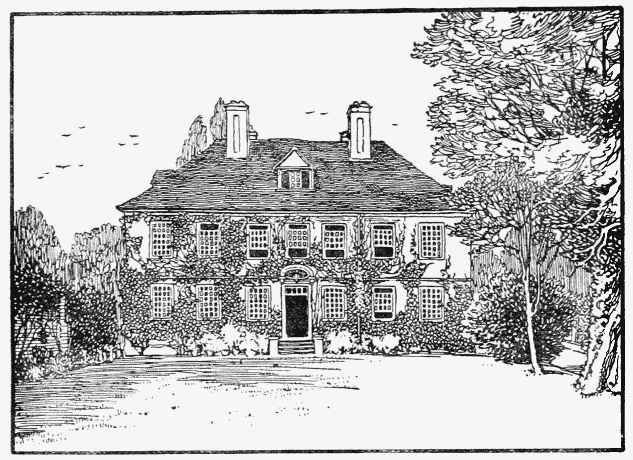
The Manor House, Aston Tirrold
The village lies a little north of the main road from Wantage to Reading, 3 miles east from the Upton station on the Didcot and Newbury railway, and 3 miles west from Moulsford station on the Great Western railway. On the west it adjoins the village of Aston Upthorpe, locally known as 'Thorpe.' The majority of the buildings are of some antiquity, and are generally of brick or half-timber construction with tiled, and, in some cases, thatched, roofs, while several of the cottages have their walls externally plastered or hung with tiles. The church stands at the north end of the village.
On the north side of the churchyard, standing well back from the roadway, is the Manor House, the property and residence of Mr. Francis J. K. Cross, J.P. It is a fine Queen Anne building of red brick, two stories in height, with an attic. The principal front has a projecting wooden cornice, and is crowned by a hipped roof of tiles, a feature being formed by two panelled chimney stacks which are carried up on either side of the central dormer. The entrance doorway has a shell canopy supported by elaborately carved consoles. A few yards further north along the road is a large barn of brick and half-timber with boarding upon the upper portion.
At the corner of the fork of the road, south of the church, is an interesting little 17th-century house with mullioned and transomed windows, rough-casted walls with imitation quoins at the angles, and a wooden cornice below the tiled roof.
At the south end of the village is an 18th-century Presbyterian chapel, standing in a prettily wooded graveyard. The building, which is square in plan and is built of red brick with a tiled roof, is lighted by round-headed windows on the north, south, and west, and by a small circular light over the pulpit on the east. At the north-east is a small vestry with a panelled dado, while on the west front have been built two modern porches. This chapel was served by Thomas Keyworth, author of Principia Hebraica, 1841–5. (fn. 6) Attached to it was a school, opened in 1871 and closed in 1907. (fn. 7) The Church of England school was built in 1847 and enlarged in 1882. There is a village recreation ground of 5 acres.
Aston Tirrold is traversed by several ancient roadways. The southern boundary is an old track in the hollow of Deans Bottom, and just north of it is the 'Fairmile,' a branch of the Ridgeway leading towards Moulsford. Grims Ditch and the Portway can also be traced in the parish. (fn. 8) Some place-names of interest are Baggs's Picks, the Berry, Goozle Mere, Rowham, Mar Furlong, the Severals, the Tubbies, Waterslade Bottom and Windrell Copse. Windmill Piece is the site of a mill which was standing early in the 19th century.
MANORS
Before the Conquest the main part of ASTON TIRROLD, then assessed at 15 hides, was held by the wife of Lanc. (fn. 9) In 1086 it was in the king's hands. (fn. 10) William Earl of Warwick returned one knight's fee held by Nicholas son of Torold (lord of Aston) among the lands held of him in 1166. (fn. 11) The overlordship remained with the successive Earls of Warwick (fn. 12) at least until 1446, (fn. 13) and at the death of Anne Beauchamp (fn. 14) in January 1448–9 it apparently lapsed to the Crown. Thenceforward the service, of two parts of a knight's fee, (fn. 15) was attached to the honour of Wallingford. (fn. 16)
Possibly it was to Torold son of Geoffrey, (fn. 17) father of the Nicholas holding in 1166, that Aston Tirrold owes its name. Certainly Nicholas son of Torold de Aston, (fn. 18) and possibly his father before him, was immediate tenant of the manor under the Earls of Warwick. (fn. 19) Nicholas had brothers, Richard, who may have succeeded to this holding, (fn. 20) and Miles, who certainly did so. (fn. 21) Apparently these brothers left no heirs male, and the manor afterwards followed the descent of Wokefield in Stratfield Mortimer (q.v.) until 1241, when it was permanently divided between Robert Danvers and Margery wife of Alan de Farnham and co-heir of Nicholas de Bolney. (fn. 22) In consideration of the surrender of Wokefield Robert agreed to do to the co-heirs of Nicholas de Bolney the service which he had formerly done directly to the Earl of Warwick. (fn. 23) There is record of the service due from the Danvers portion to the descendants of Alan and Margery in 1336. (fn. 24) The lands of Robert Danvers, described in 1331 as the manor of ASTON DANVERS, ultimately descended to William Danvers, (fn. 25) who made settlement of the manor in 1427 upon himself for life with remainder to his wife Joan. Upon her death it was to be sold for deeds of charity. (fn. 26) In 1457 Joan widow of William Danvers conveyed her interest to William Bishop of Winchester, (fn. 27) but the reversionary rights had been purchased for 200 marks (fn. 28) by William de la Pole, Marquess, afterwards Duke, of Suffolk, (fn. 29) whose widow Alice with her son John, the second duke, had a release of his right in it from John Jankins of Reading, fuller, probably a trustee, on 26 March 1458. (fn. 30) By the attainder of Edmund third duke and eighth Earl of Suffolk in January 1503–4 (fn. 31) Aston Danvers fell to the Crown and was for a time in the custody of Anthony Fettiplace, squire of the body to Henry VIII, (fn. 32) and afterwards of William Compton. (fn. 33) It was evidently accounted a member of Donnington, (fn. 34) which was granted to Charles Brandon in February 1513–14, when he was created Duke of Suffolk. (fn. 35) He sold his right in the manor to the Crown in 1535. (fn. 36) In 1554 it was purchased, together with the manor of Aston Priors, by Thomas Everard of Buckland and Richard Yate of East Longworth, (fn. 37) his brother-in-law. (fn. 38) In 1577 Thomas Stampe bought both manors (fn. 39) from John Yate, evidently the heir of Richard, and Thomas Everard, probably the son of Thomas. (fn. 40) Thomas Stampe also acquired a third estate in Aston, formerly Cheneys, (fn. 41) and a portion of tithes in the parish. (fn. 42) He died on 18 July 1579 and was succeeded by his son Edward. (fn. 43) John Stampe, probably the brother and heir of Edward, (fn. 44) was dealing with these manors early in 1605. (fn. 45) Either this John or another settled the estate on his daughter Dorothy upon her marriage, about 1610, with Sir Henry Sambourne, kt., of Moulsford, (fn. 46) who had a grant of view of frankpledge 21 June 1616. (fn. 47) In 1649 Sambourne, with his son Henry, conveyed the manors of Aston Tirrold to Richard Mansner and George Hatton, (fn. 48) but he was still dealing with them in 1650. (fn. 49) A moiety of the estate was, however, in the possession of the Hatton family early in the 18th century, and the other moiety, possibly representing the interest of Richard Mansner, was in the White family. (fn. 50) In 1716 Richard Hatton and his wife Eleanor were dealing with two messuages and lands and a moiety of a messuage and certain other property in Aston Tirrold and Moulsford, including a common ferry across the Thames. (fn. 51) Richard Hatton joined with William Hatton, Henry Predy and his wife Dorothy, Dorothy Predy, spinster, and Richard and John Fuller, in a conveyance of the 'manor of Aston Tirrold' to Cornelius Norton, 1727, (fn. 52) possibly for the purposes of a settlement. Subsequently one moiety was in the possession of Thomas Fuller and the other of Joseph and John Fuller. (fn. 53) At the close of the 19th century the whole had passed into the possession of Thomas Wellingham Fuller, grandson of the above-named Thomas Fuller, and he sold in 1901 to Mr. Francis John Kynaston Cross, the present lord. (fn. 54)
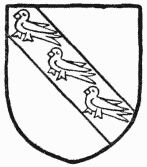
Danvers. Argent a bend gules with three martlets or thereon.
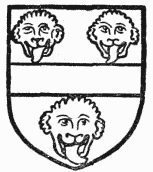
De la Pole, Duke of Suffolk. Azure a fesse between three leopards' heads or.
A moiety of the capital messuage was assigned to Robert Danvers in 1241, (fn. 55) and a capital messuage was attached to Aston Danvers Manor in 1336. (fn. 56)
The manor of ASTON, i.e., that portion of the inheritance of Nicholas son of Torold which was retained in demesne by Alan de Farnham and his wife Margery, (fn. 57) descended, evidently through the marriage of their daughter Juliana with John de Elsefield, to Gilbert son of John de Elsefield. He had a marriage settlement upon himself and his wife Joan (fn. 58) and was holding the manor about 1316. (fn. 59) He was succeeded by his son Gilbert, (fn. 60) whose widow Elizabeth was holding in dower in 1367. (fn. 61) In that year Thomas de Elsefield, who was brother and heir of the younger Gilbert, sold his reversionary interest for 200 marks to Thomas Cheney and Robert de Erburghfeld, clerk. (fn. 62) Possibly they were trustees on behalf of Sir Hugh Segrave, treasurer of England, (fn. 63) who was evidently acting for William of Wykeham in the foundation of New College, Oxford. (fn. 64) Joan, then wife of Robert atte Wood, had a life interest in 1381, when the manor of Aston formed part of the estate with which Wykeham endowed the college. (fn. 65) She was still living in June 1392, when the college, with its founder's consent, alienated its rights in Aston to John Sende. (fn. 66) Robert Quinerton was attorney to deliver seisin to John Sende, (fn. 67) and was evidently holding the manor in trust in 1400. (fn. 68) A plea was then brought against him by Joan wife of John Hore the granddaughter, and Joan wife of Thomas Loundres the daughter, of William brother and heir of Thomas de Elsefield. (fn. 69) It was adjourned from time to time until Easter 1403, (fn. 70) and its termination has not been found. Subsequently the manor was acquired, probably by purchase, (fn. 71) by Sir John Drayton, kt. (fn. 72) John Dalbert, who was holding in 1428, (fn. 73) seems to have been trustee for his heirs, (fn. 74) who were his daughters Joan wife of Drew Barantyne and Elizabeth wife of Christopher Preston. (fn. 75) In 1453 the two daughters were holding jointly, (fn. 76) but the manor was subsequently divided into moieties.
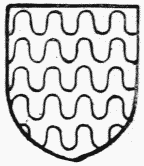
Elsefield. Barry wavy argent and sable.
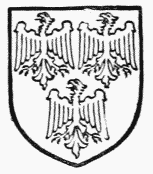
Barantyne. Sable three eagles argent.
The moiety of Elizabeth Preston evidently descended to Richard Preston, whose daughter Elizabeth died seised of it 12 January 1520–1. (fn. 77) She was the widow of Nicholas Lovett of Slapton (Northants), (fn. 78) but by a former husband had a son and heir Miles Hampden. (fn. 79) Thomas Hampden, evidently heir to this Miles, sold the manor in 1596 to John Stampe, (fn. 80) who thus united it to the estate formed in Aston by Thomas Stampe. (fn. 81)
The moiety of Aston Manor which formed the portion of Joan wife of Drew Barantyne passed to their son John, (fn. 82) after it had been held for a term of years by trustees for a chantry of their endowment at Henton in Chinnor (co. Oxon.). (fn. 83) John Barantyne died seised of this moiety 30 June 1474, leaving a son John, aged fourteen. (fn. 84) No further connexion between the Barantyne family and Aston Tirrold has been found. (fn. 85) It was probably this moiety of the manor that became the property of Sir Thomas Bryan and was by him pledged to Henry VIII for the marriage portion of his daughter. (fn. 86) By process of reduction it would also seem that this was the 'manor' which afterwards came into the possession of Westbury College (co. Gloucester). (fn. 87) In 1544, after the suppression of the college, this 'manor of Aston Tirrold' was granted to Sir Ralph Sadleir, kt., and his wife Ellen, (fn. 88) but Sadleir surrendered his rights to Edward VI in 1547. (fn. 89) About 1553 Sir Thomas Cheney, K.G., treasurer of the household, purchased it from the Crown. (fn. 90) He bequeathed it to his kinsman John Cheney of Woodhay and to Dorothy his wife in tailmale. (fn. 91) John Cheney died at Rochester, 1 January 1567–8, and was succeeded by his son Thomas, (fn. 92) whose mother surrendered to him her rights. (fn. 93) His son Thomas broke the conditions of Sir Thomas Cheney's will by alienating the manor to Thomas Barham, gent., (fn. 94) whereupon Henry Lord Cheney, son and heir of Sir Thomas, entered upon it under the terms of the will. (fn. 95) He died seised of it in 1587, (fn. 96) when it reverted to Thomas Cheney, grandson of John Cheney of Woodhay, as heir at law. (fn. 97) The rights of Barham had been purchased by Thomas Stampe, lord of Aston Danvers, (fn. 98) who apparently obtained an assurance of title from Thomas Cheney. (fn. 99) Thus this moiety of Aston Manor was added to the estate consolidated by the Stampe family. (fn. 100)
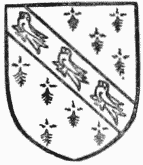
Cheney of Woodhay. Ermine a bend sable with three martlets or thereon.
Five hides in Aston belonged before the Conquest to a certain Anschil. (fn. 101) About 1080 William I gave this land, sometimes styled PRIORS in Aston, (fn. 102) to the abbey of St. Peter, Préaux (diocese of Lisieux), in exchange for St. Clair in Normandy, which the king bestowed upon his brother Count Robert of Mortain. (fn. 103) The abbey held Aston of the count in 1086, (fn. 104) but in the 13th century the abbot said that he held in frankalmoign. (fn. 105) Henry II confirmed the grant of William I, (fn. 106) and the abbey remained in possession of this manor (fn. 107) until it was seized into the king's hands together with the abbey's cell of Toft, co. Norfolk, during the French wars. (fn. 108) In 1390 the abbey granted to Lewis de Cliffort and Lewis his son life interests in all their English lands, including Aston. (fn. 109) For a time a rent was reserved to the Crown during the French wars. (fn. 110) Cliffort conveyed his interest to Sir Thomas Erpingham, K.G., (fn. 111) a trusted supporter of Henry IV, (fn. 112) who received the resignation of Richard II (fn. 113) and became warden of the Cinque Ports. (fn. 114) Erpingham afterwards acquired the same estates for his own life (fn. 115) and transferred them to the Carthusian priory of Witham Friary (co. Somerset), which obtained a grant in perpetuity from the Crown in 1413. (fn. 116) The Priors of Witham remained in possession of Aston Manor (fn. 117) until the surrender of their house in March 1538–9. (fn. 118) Their manor of Aston was purchased from the Crown by Thomas Everard and Richard Yate, together with Aston Danvers, and was sold with the latter to Thomas Stampe, and thus became a part of the estate consolidated by himself and his son. (fn. 119)
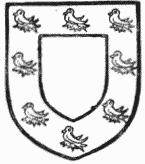
Erpingham. Vert a scutcheon in an orle of martlets argent.
A capital messuage was attached to this holding in 1401. (fn. 120)
CHURCH
The church of ST. MICHAEL consists of a chancel measuring internally 27 ft. 9 in. by 15 ft. 2 in., a modern organ chamber, a nave 43 ft. 6 in. by about 20 ft. 7 in., a modern north aisle, a south transept 17 ft. 3 in. by about 16 ft., a tower about 12 ft. square, and a modern south porch.
The church in the 12th century consisted of a nave and chancel, but was probably of earlier origin, as in the wall of the north aisle is a reset square-headed doorway of roughly hewn masonry, possibly of preConquest date. In the first half of the 13th century the chancel appears to have been rebuilt and the south transept and west tower added, but, apart from the partial remodelling of the transept in the 14th century and the insertion of windows, no structural alterations appear to have been made until about forty years ago, when the north aisle was built. The present organ chamber was erected in 1910, and in 1913 the chancel was repaved with stone and marble and refurnished in oak, in memory of Sir John Leigh Hoskyns, bart., rector from 1845 to 1911.
The east window of the chancel, a mid-14th-century insertion, is of three uncusped lights with foiled intersecting tracery under an ogee head. The rear arch is moulded, and springs from small attached jamb shafts. At the north-east is a single lancet, and under its west jamb is a plain aumbry; the remainder of the north wail is occupied by an archway opening into the organ chamber. Under the west jamb of the south-east window, which is like the corresponding window on the north, is a piscina with a foliated basin corbelled out from the wall. At the south-west is a round-headed window of two pointed lights with a circle in the head; it is of 13th-century date, but was raised from its original position when the church was restored. Immediately to the east is a blocked 13th-century doorway, the pointed external head of which has been raised by the insertion of two square stones above the abaci of the jamb shafts, which have foliated capitals. The chancel arch is modern. The walls are coated externally with roughcast, and at the eastern angles the foundations of flat buttresses may be seen. The organ chamber is lighted from the east by a reset 15th-century window of two cinquefoiled lights under a square head, which was probably taken from the north wall of the nave when the aisle was added.
At the north-east of the nave is a doorway with a four-centred head to the now blocked rood stairs, which has been carried through into the north aisle. A similar upper doorway to the loft also exists. The modern north arcade is of three bays, and is designed in the style of the 14th century. The opening into the south transept is pointed and of two chamfered orders; the responds have narrow chamfered angles and much restored moulded abaci. To the west of the opening is a late 14th-century window of two trefoiled lights with tracery of flowing character under a square head. The rear arch is four-centred and the central mullion has a small capital above the springing of the heads of the lights, as if it had been intended to continue it as a vertical tracery bar. At the south-west is a round-headed Norman doorway with square responds and moulded abaci cut off flush with the wall, and to the east of the doorway externally is a small holy water stoup, but the basin has long since been destroyed. Immediately above the doorway, and visible only internally, is a blocked round-headed window with widely splayed inner jambs.
The modern north aisle has three single trefoilheaded lights on the north, and in the east bay is inserted the square-headed doorway referred to above, which was taken from the north wall of the nave when the aisle was added, and was originally opposite to the present south doorway. On the outside, immediately below the head, are two crudely cut projecting brackets, while in the blocking is set a 13th-century tomb slab on which is carved a very fine foliated cross; the upper part is missing and the head is broken across the middle. In the west wall is a restored round-headed opening with original splayed inner jambs, which was originally in the north wall of the nave.
In the east wall of the transept are two much restored trefoiled lancets with widely splayed inner jambs. Between these windows, and beneath their sills, are 14th-century image brackets. In the south wall is a restored early 14th-century window of three uncusped lights with reticulated tracery under a pointed head. In the west wall is a window of about the same date, of two uncusped lights with a quatrefoil above, the tracery being set flush with the outside wall. Externally below the level of the window sills is a moulded string-course; the diagonal angle buttresses appear to be modern.
The tower is in two stages with an embattled parapet, and diagonal buttresses of three offsets at the western angles, stopping just above the moulded stringcourse which marks the level of the bell-chamber. At the north-east is a vice, now entered from the outside, but originally from inside the tower through a small three-centred doorway in the north wall. The tower arch is of a single pointed chamfered order, and springs directly from the side walls of the tower, the eastern chamfer being continued down the meeting angles of the nave and tower walls. The west window is of 15th-century date, and is of three trefoiled lights with a traceried four-centred head. The ringing chamber is lighted by a small squareheaded opening, and the bell-chamber by small pointed lights in each face.
The south porch is comparatively modern. Fixed against the east wall is a piece of 14th-century oak tracery, the upper part of which has been cut out of a single timber. It consists of seven trefoiled openings, the spandrels between the heads being pierced with trefoils. On the opposite wall is some 15th-century oak tracery of six cinquefoiled ogee lights, with half lights at the ends, and quatrefoiled circles in the spandrels.
Like those of the chancel, the walls of the nave, transept, porch, and tower are covered with rough-cast, the stone quoins and the door and window jambs being left uncovered. The chancel and nave roofs are modern, but a truss with a king-post and braced tie-beam, evidently portion of a low-pitched 15th-century nave roof, still remains above the chancel arch on the west. Over the transept is an original trussed rafter roof with a king-post principal towards the south end. The wall-plate and the principal tie-beam are moulded. All the roofs are covered with tiles.
The font, which is probably of 12th-century date, has a circular bowl. In the tower are a restored 16th-century chest and an early 18th-century altar table.
There is a peal of five bells and a sanctus bell: the treble is by Joseph Carter, 1603; the second, probably by John White, about 1520, is inscribed in Lombardic capitals maribelw; the third is by Henry Knight, 1617; the fourth is inscribed 'Love God 1639'; and the tenor is by Lester & Pack, 1737.
The plate consists of a paten and chalice, both stamped with the date letter of 1754, and a small unmarked cover paten, which is evidently of the same date.
The registers previous to 1812 are as follows: (i) baptisms 1726 to 1775 and 1773 to 1783, marriages 1728 to 1752, burials 1727 to 1783; (ii) baptisms and burials 1769 to 1812; (iii) marriages 1754 to 1812 (printed). The churchwardens' accounts begin in 1705.
ADVOWSON
A church existed about 1080, when William I included in his grant to Préaux Abbey the church and 'burying' of the whole vill of Aston. (fn. 121) The church is returned in the Domesday Survey with the abbey's holding in Aston, (fn. 122) but it was notified by Bishop Jocelin of Salisbury (1142–84) that the abbot had no right to present a parson save in the presence and with the consent of Nicholas son of Torold, (fn. 123) i.e., of the lord of the holding which had been in the king's hands in 1086. (fn. 124) The advowson evidently followed the descent of Aston Priors until 1561, when it was sold by Thomas Everard and Richard Yate (fn. 125) to Henry Clerke of West Hendred. From him it was purchased by Edward Archer of Compton Beauchamp, who sold to Leonard Lidcott on 10 April 1575. (fn. 126) Thomas Jones bought the advowson, became rector, and died at Aston Tirrold on 10 September 1596. (fn. 127) He was succeeded by his son Christopher Jones of Highworth, who sold in 1608 to Magdalen College, Oxford, (fn. 128) in which the patronage has ever since been vested. (fn. 129)
CHARITIES
In 1680 (as appears from an inscription in the church) William Smith, by his will, gave 30s. yearly, charged upon his estate in Aston Tirrold, for buying books and paying for the schooling of a poor boy.
Mrs. Susannah Rigby, by her will, date unknown, gave 20s. per annum, charged upon Bell's Acre in the parish, for the schooling of four poor children.
The two annuities are received from Mr. F. J. Kynaston Cross of the Manor House and paid to the local education authority.
William Sambourne (as appears from the table of benefactions), by his will, gave £5 a year, charged upon Aston Farm, to be distributed to the poor on St. Thomas's Day. This annuity also is paid by Mr. F. J. Kynaston Cross. In 1905 there were ten recipients, being poor women, who received 10s. each.
The table of benefactions also stated that Susannah Cock, who died in 1762, gave £32 10s. to be laid out in lands, the rents to be distributed on 29 May amongst the poor people of the parish. The endowment is now represented by 1 a. or. 22 p. allotted on the inclosure of the parish in lieu of the land originally purchased, producing yearly £3 10s., which is distributed in bread, one loaf to each recipient.
The table of benefactions further stated that Christopher Rednap (recte Rednage), who died in 1790, by his will gave £50, the interest to be distributed among the poor. The legacy having been lost through the insolvency of a person to whom the same had been lent, Mr. William Bushnell, who was the churchwarden at the time, by his will proved in the P.C.C. 28 January 1823, bequeathed £50 consols in lieu thereof. The stock is held by the official trustees, and the annual dividends, amounting to £1 5s., are added to the funds of the clothing club.