A History of the County of Berkshire: Volume 3. Originally published by Victoria County History, London, 1923.
This free content was digitised by double rekeying. All rights reserved.
'Parishes: Basildon', in A History of the County of Berkshire: Volume 3, ed. P H Ditchfield, William Page (London, 1923), British History Online https://www.british-history.ac.uk/vch/berks/vol3/pp457-463 [accessed 10 May 2025].
'Parishes: Basildon', in A History of the County of Berkshire: Volume 3. Edited by P H Ditchfield, William Page (London, 1923), British History Online, accessed May 10, 2025, https://www.british-history.ac.uk/vch/berks/vol3/pp457-463.
"Parishes: Basildon". A History of the County of Berkshire: Volume 3. Ed. P H Ditchfield, William Page (London, 1923), British History Online. Web. 10 May 2025. https://www.british-history.ac.uk/vch/berks/vol3/pp457-463.
In this section
BASILDON
Bestlesford (vii, ix cent.); Bastedene (xi cent.); Bastenden, Bestlesden (xii, xiii cent.); Baselden, Bassenden, Bassilden, Bastelden, Bastlesden, Bastlesdon (xiii–xix cent.).
The parish, including the villages of Basildon and Upper Basildon, contains 3,139 acres and is bounded on the north-east by a curve of the Thames, whence it rises south-westward to an altitude of 466 ft. 1,547 acres are arable, 986 grass, 430 woodland, (fn. 1) besides 42 acres of water. Barley, oats and roots are grown, but little wheat recently, and much arable land is waste. The soil is chalk, loam, gravel and clay, the subsoil chalk with patches of the Reading Beds at Upper Basildon, where the clay-pits afford excellent brick material. The principal village, 8 miles northwest of Reading, lies near the river on the high road, whence a network of roads leads to Upper Basildon and Ashampstead, and a short by-way leads north-east to the church of St. Bartholomew and Church Farm.
Basildon House, now the property and residence of Major James Archibald Morrison, stands on the slope of a hill in the large and well-wooded park (fn. 2) which lies on the south side of the Reading and Oxford road, overlooking the Thames Valley. The house, which was designed by Carr of York for Mr. Sykes, (fn. 3) and added to by John Papworth (or Buonarotti) for Mr. James Morrison, (fn. 4) is a fine example of the classical manner of the 18th century. The elevations are faced with Bath stone, and the plan is symmetrically arranged with a three-storied principal block in the centre, connected by low stone wings with two-storied office blocks on either side. In the centre of the west, or principal, front is a tetrastyle portico of the Ionic order, elevated on a rusticated basement, which, with the cornice of the portico, is continued round the other elevations of the central portion of the house. Three arches in the basement of the portico lead into an open entrance hall, divided into three groined bays by small coupled Doric columns, out of which rises a stone staircase leading to the first floor, where the principal apartments are placed. The centre of the building is occupied by the drawing room on the west, and an octagonal room on the east overlooking a small terrace laid out on this side of the house. The valuable collection of pictures and statuary was formed by Mr. James Morrison. (fn. 5) The Grotto, on the Thames, is the residence of Mr. G. J. C. Harter. North of the village a ferry crosses to Gatehampton in Goring. This crossing is doubtless 'Bestlesford,' (fn. 6) the place being named successively from the 'ford,' the 'dene' and the 'don' or down. Basildon Heath was inclosed in 1744, (fn. 7) the rest of the parish in 1809. (fn. 8) There is a village green at Upper Basildon, and a recreation ground is provided by the lord of the manor. The Great Western railway traverses the western edge of the parish between the village and the church. An iron church, St. Stephen's, was erected in 1895 at Upper Basildon. The school (Church of England) at Lower Basildon was built in 1831, another at Upper Basildon by Mr. Charles Morrison in 1895. A chapel, formerly of Lady Huntingdon's Connexion, is now Congregational. The river was crossed at this point by a primitive trackway, (fn. 9) afterwards a Roman road, represented by Hook End Lane, which Oase Mill Lane formerly continued. (fn. 10) A Roman villa and other remains were found here in 1839. (fn. 11) Grimsdyke begins near the river at Holeys, at the northern point of this parish, and could formerly be traced to Perborough Castle. (fn. 12) There is a ruined stone mausoleum, 'Nobes Tomb 1692,' near Hook End Farm. (fn. 13) At Tomb Farm is a half-timbered 16th-century house.
Edward II in 1309 granted to Thomas le Boteler a market every Monday at Basildon and an annual fair on the vigil, feast and morrow of St. Barnabas. (fn. 14) A market and fair are mentioned in 1731 as belonging to William Allen's manor of Basildon. (fn. 15) 'Basildon Revel' was held in July until recent years, but is now obsolete.
Among the place-names are Skeyrs (fn. 16) (1523, 1591); Howgrove, Ingrames Grove, Pildowne, Wilcocks Doune (1544); Pynnycrofts, Carmon Parrock, Hadach (grove), Coventries, Kydmare feilds (fn. 17) (1589); Rostwolds, Harrolds, Malyns (fn. 18) (1591); Angewens or Angells, Slies, Mullend (fn. 19) (1649). Hill Corner (fn. 20) and Hook-end or Hockin (fn. 21) are near the northern boundary.
Jethro Tull of Shalbourne, the noted agriculturist, was born (1674) and buried here, 1741. (fn. 22) Allen Francis Gardiner, missionary to Patagonia, was born in Basildon parsonage in 1794. (fn. 23)
MANORS
According to a tradition of the early 12th century the under-king Cissa gave 15 hides at Bestlesford, with lands at Bradfield and Streatley, to 'Hean' (Hæha) for his proposed monastery in 675, and the land called Bestlesford is included in a charter which probably preserves a genuine grant by Ini to Hæha and Ceolswyth. (fn. 24) The abbey of Abingdon, however, laid no claim to the place in later times, for in a spurious charter of King Alfred lands elsewhere are exchanged with Bishop Denewulf of Winchester for 100 hides at Cholsey, Hagbourne and Basildon. (fn. 25)
Before the Conquest Aileva, a free woman, held BASILDON as 20 hides. (fn. 26) The Conqueror granted it to William Fitz Osbern Earl of Hereford, whose son Roger forfeited it for conspiracy in 1074. (fn. 27) At the date of the Survey the king held it in demesne as 6 hides, with a mill worth 15s. and a very large proportion of woodland. (fn. 28)
The facts indicate that Ashampstead, except Hartridge, was included in this manor. It was probably given after the Conquest to Henry of Newburgh, Earl of Warwick, and the overlordship remained with his successors. (fn. 29) It was assumed by Henry III until the conclusion of the war with France, the right of the Earl of Warwick being recognized. (fn. 30) Thomas, the last of the Newburgh earls, held it at his death in 1242 (fn. 31) (peace having been made in that year), and in 1276 it had passed to Henry, lord of Newburgh, (fn. 32) a descendant of Robert the younger son of the first earl. In the time of Edward II it was with the king, of whom the manor was held by service of one knight's fee and a half down to 1540. (fn. 33)
A younger branch of the Newburgh family held the manor circa 1180, when Henry the son of Robert of Newburgh and grandson of the Earl of Warwick, together with his son Robert, gave to Richard de Vernon and his heirs, in exchange for his land at Radepont in Eure, a moiety of Basildon and a moiety of Ashampstead (q.v.), with the 'messuage of Ashampstede' and the land of William de Puteo there; all to be held by service of half a knight's fee. (fn. 34) From the later records it may be inferred that these two moieties, subsequently known as a whole manor, were the southern portion of the estate. The history of the descent of the other moieties of the two places will be traced below.
Vernon probably forfeited his lands for the time in 1194, when he was imprisoned for supporting John against Richard I. (fn. 35) King John gave the custody of Basildon and Ashampstead (perhaps the whole estate) to William de Fruges free of service, (fn. 36) but in 1216 he reinstated William the son of Richard de Vernon, freeing him of all claim from Fruges as long as he remained in the king's service with the Earl of Ferrers, (fn. 37) and Henry III in 1219 forbade Fruges to demand homage from Vernon for this land because it is 'of the fee of the lord of Newburgh of the lands of the Normans.' (fn. 38) After the death of Henry Earl of Warwick in 1229 (fn. 39) Fruges was distrained to render scutage to Thomas his son and heir for his knight's fee in Basildon. (fn. 40) Fruges died in or before 1233, (fn. 41) and in 1240 the king gave the manor of Basildon to Robert de Gygnes and his heirs to hold by service of one knight's fee until there should be peace between England and France, when Normans might claim their lands again. (fn. 42) Robert conveyed the fee to Peter Dansy or de Anesy, (fn. 43) who in 1266 obtained remission of claims made by the officers of the Exchequer for 118s. 8d., which he received of the rent of Richard de Vernon from the manor of Basildon. (fn. 44) He died in 1276, when it was proved that the king had granted him free warren in his demesne land in Basildon seven years before. (fn. 45) The manor remained in the hands of his widow Margery and Matthew de Anesy, probably his son, who about this time seized the lands of Richard de Vernon, declaring that he had taken them wrongfully during the war; but Richard recovered them, pleading that he held them of Robert de Ferrers Earl of Derby, with whom he served, (fn. 46) and thus misrepresenting, as it seems, the terms of his tenure. (fn. 47) Robert the nephew (nepos) and heir of Peter Dansy conveyed this manor to Christiana 'de Marisco,' who conveyed it to Peter le Boteler; for he and Aveline his wife in 1280 called Christiana to warranty and she proved by charters how it had descended to her from Robert de Gygnes, maintaining also that a yearly rent of 4 marks which she had paid to Gygnes was due to Robert Burnell, Bishop of Bath and Wells; but the bishop allowed the king's claim to it. (fn. 48) Aveline widow of Peter le Boteler conveyed the manor in 1308 to Thomas his son, (fn. 49) to whom in 1309 the king granted free warren in his lands in Basildon and Ashampstead. (fn. 50) Thomas le Boteler died about 1318, leaving his brother Peter his heir, 40 marks being assigned to Aveline le Boteler for her life. (fn. 51) In 1331 Peter le Boteler, together with John and Nicholas atte Crouch, who held the manor (perhaps as trustees), and Edmund atte Crouch, (fn. 52) Peter Fraunkeleyn and Stephen de Stekkeby, who held other estates in Basildon and Ashampstead, were sued by Isabel widow of Richard de Vernon for third portions as dower excepting in 16 virgates of the manor, her claim being allowed against Boteler and Fraunkeleyn only. (fn. 53) In 1337 Peter le Boteler settled the manor on himself and Beatrice his wife, (fn. 54) and in 1342 'a third part of the moiety of Bastilden' (probably the moiety of the whole vill as in the 12th century) was recovered against Boteler by Elizabeth wife of Sir William de Burton 'per considerationem,' (fn. 55) perhaps as pledge for a debt. Boteler held the manor at his death in 1349, when all the customary lands were in the lord's hands through mortality in the pestilence. (fn. 56) Thomas his son and successor died in 1350 and was succeeded by his brother John, (fn. 57) who the next year conveyed his manor to William Holbech, citizen and draper of London, in settlement of a debt of £400. (fn. 58) Holbech conveyed it the same year to Amaury de St. Amand. (fn. 59) Onethird remained as dower of Agnes widow of Thomas Boteler. (fn. 60) St. Amand enfeoffed John de Inkpen for life in 1358, (fn. 61) and Sir William de Mulso and others, probably as trustees, in 1368, (fn. 62) and died seised of the manor in 1381, Agnes le Boteler surviving him. (fn. 63) The whole estate passed to his son Amaury, (fn. 64) who died in 1402, leaving a widow Eleanor, to whom a third of the manor was assigned, and two daughters, Eleanor daughter of his first wife Ida, married to Gerard Braybroke, and Ida of his second wife Eleanor, married to Thomas West (fn. 65); but Ida West died without issue in 1416, and her share passed to her sister's son Gerard Braybroke, junior. (fn. 66) He died in 1422 holding the two-thirds and the reversion of the dower and leaving three daughters under age. (fn. 67) Elizabeth, the eldest, who ultimately became sole heir, was married first to William son of Sir Walter Beauchamp, who became Lord St. Amand. (fn. 68) He died in 1457 and his widow married Sir Roger Tocotes. Her estate passed to her son by her first husband, Richard Beauchamp, who was attainted at the accession of Richard III in 1483 and restored to his honours by Henry VII in 1485. (fn. 69) He died in 1508 without legitimate offspring, (fn. 70) bequeathing his manor of Basildon 'to Antony Seyntamande sonne of Mary Wroughton and his heirs.' (fn. 71) It is not known how the manor passed from him to Sir John Hussey and Ann his wife, but they in 1509 sold it to Henry Bridges. (fn. 72) His son Richard Bridges, who succeeded between 1537 (fn. 73) and 1540, (fn. 74) sold the Ashampstead portion in 1542 to William Fettiplace (fn. 75) and the next year granted the manor of Basildon to Roger Yonge. (fn. 76) Roger Yonge was owner of the manor when he died in 1589, aged ninety-six, 'after he had continued in the commission of peace in the county of Berkshire without any intermission these sixty years.' (fn. 77) His son William predeceased him, having married Catherine daughter of William Barker of Sonning. (fn. 78) She afterwards married Sir Christopher Lytcott, who died in 1599 at Basildon. (fn. 79) Her son and heir Sir William Yonge (Sheriff of Berkshire in 1615), (fn. 80) to whom she surrendered the manor in 1605 to be settled on herself, made in 1615 a further settlement of it after her death upon his wife Anne, daughter and co-heir of Richard Paulet, and finally at his death in 1618 he bequeathed it to his uncle Roger Yonge, whose son Humphrey inherited it (fn. 81) and conveyed it in 1619 to William Davies. (fn. 82) Lady Lytcott survived until 1622, (fn. 83) when Davies and the Yonge family conveyed it to John Lambe and Edward Whistler. (fn. 84) It does not appear how it passed to Rachel Countess of Bath, (fn. 85) who held it about the middle of the century and bequeathed a mortgage upon it in 1680 to Sir Henry Fane, (fn. 86) son of her brother Sir Francis. He acquired the manor, (fn. 87) and dying in 1706 was succeeded by his son Charles, who in 1718 was created Viscount Fane in the peerage of Ireland (fn. 88) and was living here in 1727. (fn. 89) After descending to his son Charles, last viscount, who died without issue in 1766, it passed to his sister Mary Countess de Salis, (fn. 90) who conveyed it in 1768 to Humphrey Marriott. (fn. 91) Soon afterwards it was purchased by Francis Sykes, formerly Governor of Cossimbazar in Bengal, who was created a baronet in 1781 and died in 1804, his son and successor Sir Francis William Sykes surviving him only eight weeks and being succeeded by a son of the same name. (fn. 92) He mortgaged the estate in 1820, (fn. 93) and in 1838 sold the whole property, including the manor of Basildon and the dependent manors of Breamores and Crooks and Dunts, (fn. 94) to James Morrison, a merchant and politician, who died in 1857. (fn. 95) It passed to his son Charles Morrison, who died in 1909, aged ninety-two. He bequeathed the Basildon property to his sister Miss Ellen Morrison for life, to pass absolutely to his brother Walter Morrison, (fn. 96) who inherited it the same year and gave it to Major James Archibald Morrison, son of his brother Alfred. (fn. 97)
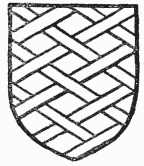
Vernon. Argent a fret sable.
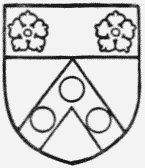
Yonge of Basildon. Argent a cheveron azure charged with three bezants and a chief gules with two cinqfoils or therein.
The Earl of Warwick's overlordship in the second moieties of BASILDON and Ashampstead passed, as in the former case, from his successors to the Crown. It was in dispute in 1279, when it was decided that it belonged to the king, and not to William Beauchamp (fn. 98) nor to Christiana de Marisco, (fn. 99) who held the lordship of the other moieties, but at a later date the Earls of Warwick made good their claim. After the death of Thomas Beauchamp in 1401 (fn. 100) a knight's fee in Ashampstead and Basildon was part of the dower of his widow, passing to Richard their son and heir and to his successors. (fn. 101) It was held of the earldom as late as 1625. (fn. 102)
No record of the moieties of Basildon and Ashampstead retained by Henry of Newburgh appears until 1278–9, when they are described as manors held by Gilbert le Fraunceis. (fn. 103) After Gilbert's death William de Garlaund, king's yeoman, had in 1280 a grant of the custody of his lands during the minority of the heirs. (fn. 104) Gilbert's successor was probably Ralph de Knyveton, who held Basildon in 1316, (fn. 105) but on 10 May of the same year free warren in Basildon and Ashampstead was granted to John de la Beche, (fn. 106) whose lands are afterwards described as of the inheritance of Ralph de Knyveton. (fn. 107) It may be assumed that this was the northern portion of the two townships, adjacent to Beche Castle in Aldworth. Descending in the family of de la Beche, (fn. 108) it passed with their manor of Bradfield (q.v.) to the Langfords and Staffords. In 1650 Edward Stafford conveyed it to Jerome Rawstorn. (fn. 109) It was conveyed in 1714 by Thomas Earl of Strafford to William Rawstorn, (fn. 110) but had passed before 1720 to William Allen, who then devised it to his sons and their issue in tail. (fn. 111) William Allen was still in possession in 1731, (fn. 112) and Richard Allen sold it about 1750 to Lord Fane, (fn. 113) in whom the moieties of the original manor, severed in the 12th century, were again united.
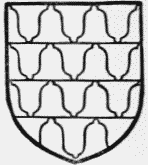
Dela Beche. Vairy argent and gules.
Church Farm was retained by Richard Allen, who conveyed it by fine in 1757 to George Blagrave. (fn. 114) It eventually passed from the Allens with the sister of the last heir male to Samuel Brooks, who sold it to Mr. William Stone of Streatley House, and he bequeathed it in 1845 to William Shackel, whose son Richard sold it to Mr. Charles Morrison in 1884. (fn. 115)
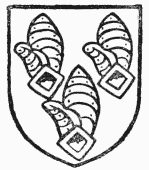
Fane. Azure three gauntlets or.
Agnes widow of Roger de Somery (fn. 116) of Bradfield at her death in 1309 held of Ralph de Knyveton in Basildon a water-mill and rents amounting to 26s. 8d., which passed to her son John de Somery. (fn. 117) He died in 1322, his heirs being his sisters Margaret wife of John de Sutton and Joan widow of Thomas Botetourt. (fn. 118) The lands and tenements which his mother had purchased here were assigned to Lucy his widow in dower, having been held of John de Somery as of his manor of Bradfield by John de la Beche. (fn. 119) In 1341 John de Sutton and John his son conveyed this estate with Bradfield Manor to Nicholas de la Beche. (fn. 120)
The mention of the water-mill in 1309 seems to prove the identity of Somery's holding with what was afterwards known as the manor of BREAMORES. William Stokes in 1427 held of Robert D'Arsy a messuage and land in Basildon called 'Brymmores.' (fn. 121) It appears that it was on the river and in the northern portion of the parish. It was probably part of the estate sold by the Weldons to Sir John Davys in 1613. (fn. 122) It then passed to Sir William Yonge, for in 1615 he settled it, together with the principal manor (q.v.), as jointure upon his wife. (fn. 123) In 1622 the 'manor of Bremors' was conveyed with the others, (fn. 124) but William Davies leased it separately to Humfrey Oneby in 1629 (fn. 125) and sold it in 1634 to the Allen family, (fn. 126) from whom it was purchased in 1656 by Charles Lord le Despenser. (fn. 127) No complete descent can be made out from the later records, but in 1673 Sir Thomas Dolman and others granted a lease for ninety-nine years. (fn. 128) In 1739 the manor belonged to Charles Viscount Fane. (fn. 129) Finally, in 1768 a moiety of Breamores was conveyed with the principal manor to Humphrey Marriott, (fn. 130) the other moiety being reserved with the manor of Crooks and Dunts, next to be noticed. (fn. 131)
It may be assumed that the reputed manor of CROOKS AND DUNTS derives the former name from the family of Atte Crouch or De la Croice, which was prominent here in the 14th century, (fn. 132) and it was doubtless held afterwards by a person called Dent, Dunt or Dunk, of whom no record appears.
The estate held by John de Cruce in the time of Edward I, and Edmund de la Crouche in 1331, (fn. 133) may probably be taken as the origin of this manor, but there is no record of courts.
In the 15th century the 'manor of Crowchys alias Dentes' was held of Lord St. Amand by William Bedwell, passing at his death in 1502 to his daughter and heiress Elizabeth wife of William Cottesmore. (fn. 134) Afterwards it became the property of Reading Abbey, which held in 1539 rents in Basildon amounting to 18s. 9d. and a manor farmed at £5 6s. 8d. (fn. 135) In 1543 a messuage called 'Crookes' was leased to Sir William Penyson. (fn. 136) The lands in his tenure formed part of the 'manor of Bastilden' which was granted in 1544 to Thomas Stroud and others and conveyed to Roger Yonge, 'Duncis coppice' being named. (fn. 137) It then passed with the principal manor (q.v.). In 1625 William Davies conveyed his rights in it to Griffith Allen and Richard his son. (fn. 138) Griffith or Griffin Allen died in 1640, bequeathing one-third of the manor to his son Griffith and two-thirds to his sons John and Thomas; Griffith died the same year and left a son Griffith. (fn. 139) One-third was conveyed in 1665 by Francis Rigg to John Allen and by him in 1672 to William Allen, and by Isaac Matthew in 1713 to Charles Fane. (fn. 140) A third was conveyed to Sir Thomas Head in 1748. (fn. 141) The whole doubtless passed with Allen's manor to Lord Fane. One-third was conveyed with the moiety of Breamores (q.v.) in 1768, becoming part of The Grotto estate (q.v.), while two-thirds were held by Sir Francis Sykes with the principal manor. (fn. 142)
It appears, therefore, that THE GROTTO consists of the moiety of the manor of Breamores and the third part of Crooks and Dunts conveyed to Humphrey Marriott in 1768. Humphrey Marriott, probably a relative of the widow of Lord Fane, (fn. 143) appears to have reserved for her this portion of the estate fronting the Thames at the northern end of the parish. She built here the mansion called The Grotto. (fn. 144) After her death in 1792 (fn. 145) this was purchased by Richard Benyon de Beauvoir of Englefield, who in 1797 married Elizabeth daughter of Sir Francis Sykes, (fn. 146) and was given by him to his nephew the Rev. William Sykes, who died in 1875. (fn. 147) It passed by purchase to Mr. Arthur Smith, who was Sheriff of Berkshire in 1878 and died in 1884. (fn. 148) The next owner was Mr. D'Arcy Reeve, who sold it to Mr. Gilbert James Collier Harter, the present owner. (fn. 149)
Henry of Newburgh in 1276 confirmed a grant made by his ancestors of land in 'Bastendene' to the convent of St. Mary of Casa Dei, (fn. 150) or Chaisse Dieu, in Eure, a dependency of Fontevrault. (fn. 151) In the returns of 1231 the prioress had 3½ carucates in Basildon assessed at 7s. (fn. 152) This land passed to Nuneaton, a cell of Fontevrault in England, the Prioress of 'Eaton' having a pension of £1 in the rectory of Basildon in 1291. (fn. 153)
CHURCH
The church of ST. BARTHOLOMEW consists of a chancel 33 ft. 2 in. by 19 ft. 2 in., a nave 60 ft. by 19 ft., a modern north aisle, a west tower about 12 ft. 8 in. square, and a south porch. These measurements are all internal.
The nave is the oldest part of the present building, and appears to have belonged to an early 13th-century church, the chancel of which was rebuilt about the year 1280, while the tower was added in the 18th century. In 1875–6 the church was completely restored, when the roof, which had previously been ceiled, was opened, and at the same time a gallery was removed from the west end, and the north aisle was added. The walls are faced with split flints, and the dressed stone quoins at the east end are original. The tower is of brick. The roofs are tiled and the tower is leaded.
The east window is of three pointed lights, the centre light, which runs to the head of the arch, being trefoiled, while the side lights have trefoils above cusped sub-heads. The mullions have an external three-quarter round moulding, and there is an external hood mould with carved stops. This window may be compared with the east window at North Moreton. In the north wall are two windows, each of two trefoiled lights with a cinquefoiled circle above, each foil of which is trefoiled. The external detail is similar to that of the east window. In the south wall are two similar windows. The western label stop of the easternmost window is the head of a knight wearing camail. Between the windows is a pointed priest's doorway with filleted keel-moulded angles and a segmental rear arch. The chancel arch is of two orders moulded with sunk quarter rounds, and springs from triple-shafted responds with moulded capitals and bases. Carried round the chancel walls at the level of the sills and over the head of the south doorway is a filleted half-round string, and at the west end of the south wall is a buttress in two stages. The kneelers of the east gable are original, and are carved with projecting heads. The walls on the inside have been faced with false-masoned cement.
The modern north arcade of the nave is of three bays with pointed arches carried on circular piers and moulded corbels. To the west of the arcade is a pointed window with original inner jambs, moulded at the angles with a filleted bowtel between two hollows. The tracery is modern, of two cinquefoiled lights with a multifoil over. In the south wall are three similar windows with modern tracery; that of the easternmost is inserted in the jambs of an early window having shafted angles with carved capitals and moulded bases carried to within about a foot from the floor. This window was originally of one light, and the western splay has been cut back to make room for a second light, probably early in the 14th century. The rear arch and a few of the stones in the sill and jambs of the middle window are original. Between the two western windows is a pointed early 13th-century doorway of three orders with a chamfered hood mould. The two inner orders are square and continuous, but the outer one has a roll between two hollows and is carried by modern shafts. The rear arch and jambs have been restored. Built into the east wall of the modern porch is a part of a 12th-century stone arch. Internally the walls of the nave are plastered, with the exception of the west face of the east wall, which has a facing of flint bonded with stones. The aisle has one window in the north wall.
The brick tower is of three stages marked by slightly projecting string-courses, and has an embattled parapet with stone pinnacles at the angles. The tower arch is modern. In the south wall is a semicircular-headed doorway with a stone keystone and springing blocks, and in the west wall is a window of the same type with a stone sill. The ringing stage has a semicircular-headed window on the south and a round-headed recess on the west, while the bell-chamber has four unglazed openings like the west window of the ground stage. The roofs of the chancel and nave are of the early 15th century, with tie-beams and collars supported by arched braces, and curved wind-braces. The spaces between the rafters are plastered.
In the heads of the north-east and south-east windows of the chancel are a few fragments of 14th-century glass. The altar table is of the 17th century, and there are also two 17th-century chairs in the chancel.
In the floor of the nave is a brass to John Clerk, who died in 1497, and Lucy his wife, with their figures above the inscription. Let into the east wall of the chancel behind the altar is a brass commemorating Roger Young, who died in 1589, his son William, 1584, and the wife of the latter, Catherine, second daughter of William Barker of Sonning; the inscription is in Roman capitals. In the floor of the chancel are two slabs, the first to Henry Hood, son of William Hood, who died in 1680, the second to Richard Cobb, 1689.
There is a ring of four bells, the treble and second by Mears & Stainbank, 1876, and the third by Henry Knight, 1665; the tenor is by Henry Knight, 1621, and is inscribed in Roman capitals, 'In true desier for to do well the Ladi Litcot gave this bell.'
The plate includes an Elizabethan chalice with a cover paten dated 1577. (fn. 154)
The registers are complete from 1538.
ADVOWSON
At the Survey two priests held two churches endowed with 1 hide, (fn. 155) the second being doubtless at Ashampstead. (fn. 156) Henry of Newburgh gave the churches of Basildon and Ashampstead to the abbey of Lire in Normandy before 1154 and Henry II confirmed the grant. (fn. 157) Returns of 1231 assess parts of a carucate in Ashampstead owned by the abbey at 17d. (fn. 158) The taxation of 1291 values the spiritualities at £16 13s. 4d., besides 6s. 8d. to the Abbot of Lire and £4 6s. 8d. to the vicar, (fn. 159) who is here first mentioned; while the temporalities were 5s. with a pension of 3s. 4d. to the abbot. (fn. 160) Christiana de Marisco unsuccessfully claimed the presentation at the end of the 13th century. (fn. 161)
When the properties of alien priories were resumed by the Crown in 1337 the king presented Ranulf le Hunte, and the next year gave the advowson to the chantry at Shottesbrooke (fn. 162) (q.v.). Shottesbrooke College being dissolved in 1547, (fn. 163) the advowson and rectory came to the Crown. The rectories of Basildon and Ashampstead with the joint advowson were granted by the Crown in 1548 to Thomas and Edward Weldon (fn. 164) and continued in the family (fn. 165) until 1583, when Edward Weldon conveyed them to John and George Kingsmill. (fn. 166) In 1624 Sir Henry Kingsmill sold them to William Davis, who sold them to Edmund Morgan in 1630 (fn. 167); but the Crown presented in 1636 and Parliament in 1651. (fn. 168) The advowson was conveyed to Robert Sayer in 1667 possibly as trustee. (fn. 169)
Edmund Morgan left five co-heirs, two of whom, John Bedingfield and Hannah wife of Roger Draper, conveyed their two-fifths of the rectory and advowson to William Allen in 1671. (fn. 170) In 1675 the executors of Priscilla Bence, a third co-heir, sold her fifth to William Allen, (fn. 171) who in 1694 purchased of the executors of Hester widow of Sir Thomas Gery another fifth of the property. (fn. 172) The remaining fifth, belonging to Arabella wife of William Nurse, (fn. 173) was divided at her death among her three daughters, Mary Poplar, Arabella wife of John Brighter, and Martha wife of John Davis, and they in 1719 conveyed it to William Allen, who thus held the whole. (fn. 174)
William Allen presented in 1728 (fn. 175) and made a conveyance of the rectory and advowson in 1731, (fn. 176) but in 1734 Susan Sayer was patron, (fn. 177) and from that time the advowson and rectory were held in moieties, that belonging to the Allens passing with the manor of Basildon to Lord Fane, (fn. 178) and the other remaining with the owners of Ashampstead Manor. (fn. 179)
The former of these alternate rights passed with the moiety of the manor of Breamores (q.v.) in 1768, (fn. 180) was purchased by Mr. Benyon in 1838 and given with The Grotto (q.v.) to the Rev. William Sykes, descended to his son the Rev. Edward John Sykes, passed at his death in 1891 to the trustees of Sir Francis Sykes, and was purchased of them in 1898 by Miss Ellen Morrison, sister of the then lord of the manor. After her death in 1909 it was held by the trustees of her will (fn. 181) until 1911, when it was purchased by Major J. A. Morrison.
The other alternative presentation, held by the lord of the manor of Ashampstead, passed with the moiety of that manor (q.v.) in 1796. It was bought shortly afterwards by Sir Charles Marsh of Reading, and descended to his son the Rev. William Marsh, (fn. 182) a distinguished evangelical divine, subsequently vicar of Beddington, Surrey, (fn. 183) who had been presented to the vicarage of Basildon by Sir Francis Sykes in 1802, (fn. 184) and who in 1824 gave the alternative patronage to the Simeon Trust. (fn. 185) They held it until 1911, when Major J. A. Morrison made an exchange with them by which the advowson of Basildon passed to him and that of Ashampstead to them.
Meanwhile the rectorial estate of Basildon passed with the principal manor from the Fanes to the Sykes family and was purchased with it in 1838 by James Morrison, (fn. 186) with whose descendants it remains.
CHARITIES
In 1623 Dame Catherine Lytcott, widow of Sir Christopher Lytcott, kt., in order to perpetuate her charitable gifts, by deed gave a yearly rent-charge of £5 10s. payable out of her messuages and farms in Streatley, called Kittendon's and Perman's, to be applied as to 10s. for a sermon on Good Friday, and as to £5 for the benefit of the poor. The rent-charge is now paid by Colonel T. J. Bowles, lord of the manor of Streatley, the portion for the poor being applied in gifts of 2s. 6d. each at the church on Good Friday to poor persons, preferably widows.
Poor's Land—This parish was in possession from time immemorial of an estate containing about 5 acres lying dispersed in the common fields of Clapcot Priory, (fn. 187) the object of the charity, as stated in the Parliamentary return of 1786, to be apprenticeship. The endowment now consists of 7 a. 3 r. in South Moreton, stated to have been acquired in exchange for the original land, let at £10 a year, and £46 17s. 6d. India 3½ per cent. stock with the official trustees, arising from the sale in 1884 of a rood of land to the Great Western Railway Company and accumulations of income. The net income is applied from time to time in apprenticing, the premium being usually £20.
In 1720 William Allen by his will directed that the same allowance as was made by him in his lifetime in bread and money to the poor, and to the dame of the school, should be paid out of his estate. Two rent-charges of £4 for education and £1 14s. 8d. for bread are now paid by Major J. A. Morrison of Basildon Park. The education money is paid to the Education Committee of the county, and £1 14s. 8d. is distributed in bread to poor persons with large families.