
A History of the County of Berkshire: Volume 3. Originally published by Victoria County History, London, 1923.
This free content was digitised by double rekeying. All rights reserved.
'Parishes: Didcot', in A History of the County of Berkshire: Volume 3, (London, 1923) pp. 471-475. British History Online https://www.british-history.ac.uk/vch/berks/vol3/pp471-475 [accessed 8 May 2024]
In this section
DIDCOT
Dudecote (xiii–xv cent.); Doudecote (xiii cent.); Dudcote (xiii–xix cent.); Dodecote (xiv–xvii cent.); Dudcott (xvi–xviii cent.); Didcott (xvii–xix cent.).
Didcot lies chiefly on a ridge running east and west between the Thames Valley on the north and the Hagbourne Marshes on the south. The village is situated a little to the north of the main road from Wantage to Wallingford. Between the church of All Saints and the Manor Farm, occupied by Mr. Dennis Napper, are clustered a few dwellinghouses and ancient cottages, the village smithy, and the elementary school opened in 1896. The Glebe Farm House or Old Rectory is an ancient halftimber building near the church, now used as a parish room West of the village 'Didcot Field' stretches to the parish boundary, where stands 'Marshland Barn.' The land north and east of the village is subdivided and inclosed to a far greater extent. During the 16th century the tenants complained bitterly of attempts to inclose the common land and convert the arable into pasture, stating that it was the lord's intent to 'pull down the whole town and convert it into pasture.' (fn. 1) A dispute as to the commonable nature of the 'Frith' near 'the Marsh' even led to an assault by the lord's servants upon his farmer. (fn. 2) Of the 1,120 acres contained within the parish 444 are now arable and 572 acres pasture land. (fn. 3) The soil is chiefly chalk-drift upon a subsoil of Gault Clay and Upper Greensand on rubble.
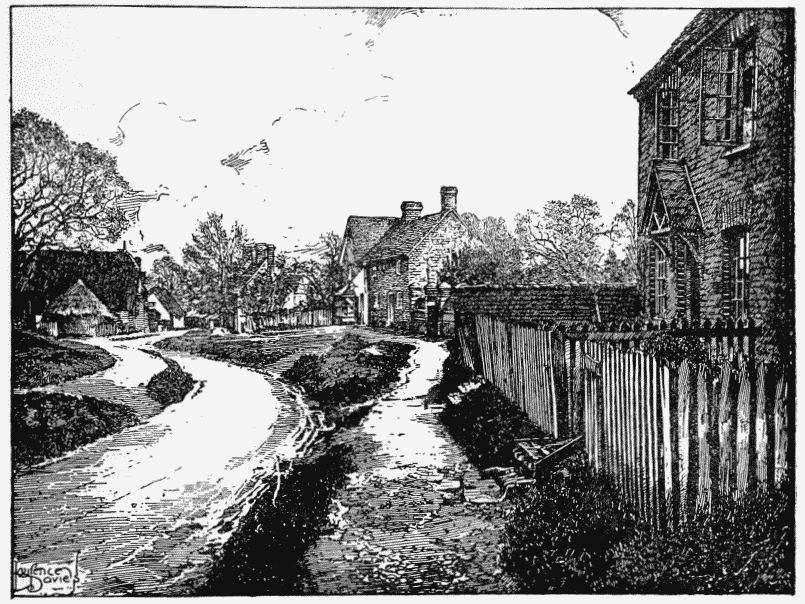
Didcot Village
The station of the Great Western railway to the north of the village was opened in 1840, and a branch line to Oxford was laid down in 1844. The development of this junction and the establishment of provender stores for the railway within this parish have recently led to a considerable increase in population. The new houses extend into North Hagbourne. A corn market is held on Tuesdays outside the station in a place formerly called Foxhall ground, and a wool fair is held yearly on the first Tuesday in July. There is a village feast on the Sunday after Old Michaelmas (11 October).
Copse Lane is a bridle-path leading to Sutton Courtney. Lydall Lane is evidently connected with the Lydall family resident in Didcot during the 17th century. (fn. 4) Eleven acres in the west of the parish are known as Parsonage Pen and other place-names of interest which occur in the manorial records are Tubbeney Cottage, (fn. 5) a messuage called Bowyers, (fn. 6) and the house called Wights in the 18th century, (fn. 7) doubtless after the Wight family, lords of the manor at the close of the 17th century. (fn. 8)
Village tradition says that human sacrifices were offered on a barrow planted with trees on the high ground to the west of the parish. A silver coin of Plautilla Augusta wife of Caracalla was found in a garden near the railway station about 1880.
MANOR
There is no reference to DIDCOT by name in the Domesday Survey. It is possible that a part at least of it was included in the 4 hides and a virgate at Wibalditone held of Henry de Ferrers by Niel (Daubeny) in 1086. (fn. 9) Before the Conquest Wibalditone had been held of the king by Turchil, a freeman. Niel Daubeny with his wife Amice gave the church, which is mentioned in the Domesday Survey, with 2 virgates to Tutbury Priory. (fn. 10) The name Wibalditone possibly survives in 'Willington's Farm' and 'Willington's Down Farm' in the neighbouring parish of Long Wittenham. Its proximity to Didcot is proved by the boundaries of a charter of King Alfred. (fn. 11) It seems probable that the remainder of Niel's holding is represented by Didcot, which was in the tenure of Robert Daubeny in the 11th century, and the supposition is strengthened by a subsequent claim to Didcot Church put forward by the Prior of Tutbury. (fn. 12) It is said that Robert Daubeny threw a stone and hit King Henry II. (fn. 13) The event probably took place before Bedford Castle, (fn. 14) possibly when Henry invaded England in 1153. (fn. 15) In lieu of the heavy penalty due for the hurt done to his liege lord, Daubeny surrendered Didcot Manor to the king in his court at Westminster (fn. 16) in 1155. (fn. 17) Henry gave it, in recognition of services done to the Empress Maud, to Hugh de Mare to hold of the honour of Wallingford by service of half a knight's fee. (fn. 18) The manor continued to be held of the honour of Wallingford. (fn. 19) To Hugh de Mare succeeded Geoffrey de Mare, (fn. 20) possibly his son. This Geoffrey fell into debt to Bonechose the Jew and pledged Didcot to him for a term of years. (fn. 21) The manor thus came to King John in 1204, when he seized all the lands of the Jews, and in the same year he gave it to Robert Aguillon, who was to pay £17 yearly to the king and 60s. to Geoffrey de Mare. (fn. 22) Geoffrey recovered it in 1208 by paying 100 marks and a palfrey to the king. (fn. 23) He was evidently succeeded by his son Hugh de Mare, (fn. 24) who died about the year 1237. (fn. 25) His heir was his daughter Ellen wife of Andrew Blunt (le Blund). (fn. 26) In 1240 Andrew and his wife sued Emma de Mare concerning lands in Berkshire. (fn. 27) Evidently these included Didcot. (fn. 28) Andrew's widow paid 200 marks to have the custody of his land and heir in 1259, (fn. 29) and about 1261 she married David de Ossington. (fn. 30) Andrew Blunt's heir was his son Robert, who forfeited his lands, possibly including Didcot, as a supporter of Simon de Montfort. (fn. 31) They were granted to Queen Eleanor, (fn. 32) but were probably recovered by Robert or his heir under the Dictum of Kenilworth. (fn. 33) Robert's successor was Sir Hugh Blunt, (fn. 34) who had grant of free warren in Didcot in 1305. (fn. 35) He settled the manor upon himself and his wife Nicholaa in 1315, (fn. 36) and in 1317 they sold the remainder contingent upon their deaths to John Stonor, afterwards Sir John Stonor, kt., and to his wife Maud. (fn. 37) Sir Hugh Blunt was dead before 1350, but his wife survived him and married John de Alveton, with whom she held the manor jointly during her life. (fn. 38) Sir John Stonor, son of the John mentioned above, died seised of Didcot on 10 July 1361, leaving a son and heir Edmund. (fn. 39) The latter pledged an annuity of £50 from Didcot to William of Wykeham, Bishop of Winchester, as security for the undisturbed possession of Ashe Manor (co. Hants), (fn. 40) which he had recently sold to the bishop. (fn. 41) Edmund Stonor died 25 April 1382, when his eldest son John was aged thirteen. (fn. 42) This John died while still a minor in the king's custody, (fn. 43) and was succeeded by his brother Ralph, afterwards Sir Ralph, Stonor. (fn. 44) In 1394 Sir Ralph died seised of Didcot Manor, leaving an infant son Gilbert Stonor, (fn. 45) who died while still a minor. (fn. 46) His brother and heir Thomas conveyed the manor to Thomas Chaucer and other feoffees in 1417 (fn. 47) and died in 1430. (fn. 48) To him succeeded Thomas his son, (fn. 49) whose widow Joan held Didcot for life. (fn. 50) She survived William son and heir of Thomas Stonor, whose only son John died in infancy. (fn. 51) Didcot had been settled in tail-male and passed to Sir Walter Stonor, kt., son of Thomas, brother of William Stonor. (fn. 52) Under Sir Walter, and probably in the time of his predecessors, the demesne lands were let to farm, (fn. 53) and about 1539 considerable illfeeling was roused between the lord and his farmer on account of the former's attempts to inclose pasture and convert arable into meadow land, to which reference has already been made. (fn. 54) Sir Walter Stonor died 8 January 1550–1, having bequeathed Didcot to his younger brother John Stonor of North Stoke. (fn. 55) The latter's son Sir Francis Stonor inherited under this will (fn. 56) and sold the manor in 1563 to Edward Griffin. (fn. 57) In 1599 Edward Griffin conveyed to Rice Griffin (fn. 58) of Burnells Broome (co. Warw.), who in 1602 resold the manor to Sir Francis Stonor of Stonor. (fn. 59) In 1600 Rice Griffin had enfeoffed Robert Winter and others of this manor, (fn. 60) probably for the purposes of the sale to Stonor. Robert Winter was implicated in the Gunpowder Plot with his brother Thomas, one of its chief movers. (fn. 61) After his execution in 1606 Didcot was seized by the king, (fn. 62) but was evidently recovered by Sir Francis Stonor, who was dealing with it in 1616 (fn. 63) and in 1621–2 settled it on his third son William Stonor upon the occasion of his marriage with Elizabeth daughter of Sir Thomas Lake. (fn. 64) William Stonor was convicted of recusancy in 1627, and in February 1635–6 it was agreed that he should have a forty-one years' lease of the two-thirds of Didcot and other lands forfeited to the Crown, and should be pardoned upon payment of a yearly rent to the Crown. (fn. 65) Thomas Stonor, his son and heir, alienated the manor in 1653 to John Crisp of London. (fn. 66) The latter petitioned for its restoration in 1654, as it had again been sequestered for the recusancy of William Stonor. (fn. 67) The sequestration was discharged, (fn. 68) but Thomas Stonor evidently recovered the manor from Crisp. In 1671 he conveyed it to Dr. John Cawley, (fn. 69) who sold it to Thomas Wight and Robert Jenings in 1678. (fn. 70) It evidently descended to Samuel Wight, living in 1699, (fn. 71) and was afterwards purchased by Richard Blake, who lived at Didcot and dealt with the manor between 1731 and 1756. (fn. 72) His son and heir Henry Blake the elder sold it in 1778 to John Baker of Little Berkhampstead (co. Herts.). (fn. 73) William Robert Baker, great-nephew of the purchaser, sold the manor in 1857 to Lewis Loyd, (fn. 74) father of Samuel-Jones Loyd, first Lord Overstone, to whom the estate descended. His daughter Lady Wantage is the present lady of the manor.
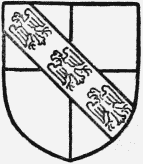
Blunt. Quarterly argent and gules a bend sable with three eagles or thereon.
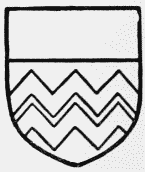
Stonor. Azure two bars dancetty or and a chief argent.
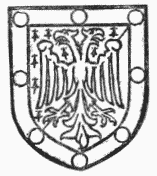
Loyd, Lord Overstone. Party bend sinisterwise ermine and argent an eagle sable with two heads and a border sable bezanty.
A capital messuage existed in 1362 (fn. 75) and probably earlier. The present Manor Farm presumably occupies the site of the farm let with the demesne lands in the time of Sir Walter Stonor. (fn. 76) The windmill attached to the manor was reserved by Sir John Stonor in 1350 in his lease to John de Alveton and his wife Nicholaa. (fn. 77)
CHURCH
The church of ALL SAINTS consists of a chancel 18 ft. 2 in. by 16 ft. 10 in., nave 42 ft. 6 in. by 17 ft., south aisle 8 ft. 9 in. wide, and a modern vestry, north aisle, south porch, and timber-framed belfry and broach spire covered with oak shingles rising from the west end of the south aisle. All these measurements are internal.
The nave walls are probably of the 12th century, a capital of c. 1160 having been found at a recent repair. The chancel was rebuilt and widened about 1340, and the south aisle was added about the same time. The responds of the chancel arch, the rood-stairs and doorways, and the west window of the nave are of the 15th century. The chancel arch, the north arcade of the nave, the north aisle and vestry, the south porch, and the timber steeple are modern, though an old sketch, made previous to the restoration of the church in 1865, shows the lower stage of a somewhat similar bell-tower. The roof of the chancel is modern and high-pitched, probably following the lines of the original 14th-century roof; the sketch just referred to shows a chancel roof of similar pitch. The low-pitched roof of the nave dates from the 15th century, but the south aisle roof is coeval with the aisle, having moulded principals and ridge.
In the east wall of the chancel is a modern three-light window, and in the north wall are two 14th-century windows. The eastern is of two trefoiled ogee lights with quatrefoiled tracery in a two-centred head. On the west jamb is a grotesque head with an iron ring in its mouth, perhaps for the lenten veil. The western window is of two cinquefoiled lights with a multifoiled spandrel in a two-centred head. The internal labels of these windows are mitred on to a moulded string-course of a slightly different section, which continues to the eastward and joins a modern string-course running along the east wall. The chancel is lighted from the south by two modern windows. Beneath the easternmost of these windows is a square unmoulded piscina niche with a plain basin, apparently of original date. Between these windows is a modern doorway. The chancel arch is modern and of a single two-centred chamfered order, but the responds are of 15th-century type. The base of the north respond is partly cut away to receive one of the uprights of the rood screen, which has long disappeared.
At the eastern end of the north wall of the nave are the stairs to the rood-loft. The entrance is about 2 ft. above the floor of the nave, the original steps to which have probably disappeared. The stair chamber projects beyond the face of the north wall of the nave, and is roofed with stone flags. Above the rood-stairs is a 14th-century pointed window of two trefoiled lights under tracery, moved from the west gable of the chancel. The north arcade is modern and of three bays with two-centred arches, the eastern bay being occupied by the organ. The west window, of three cinquefoiled lights with vertical tracery within a two-centred head, is of c. 1400. The 14th-century south arcade of the nave is of three bays, with two-centred arches of two chamfered orders, the pillars being so short that the springing is not 5 ft. from the floor. The east respond has a slender round shaft and very plain capital and base, simply recessed in a number of rectangular members, and the west respond has a similar capital; both are doubtless late repairs. The eastern pier of the arcade is composed of four filleted rolls placed diagonally, with a circular moulded capital and unmoulded circular base. The western pier is octagonal, with a moulded capital and plain chamfered base following the same plan. Over the eastern column is a small square-headed blocked clearstory window.
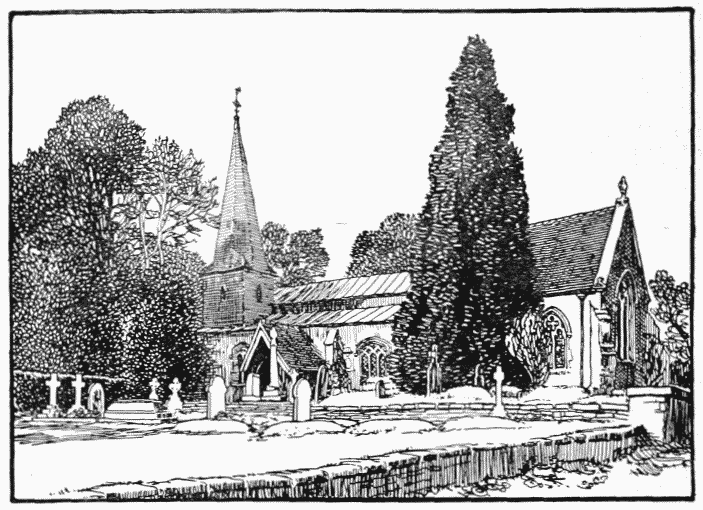
Didcot Church from the South-east
The modern north aisle is lighted by three windows. The present vestry at the north-east is a recent addition. In the east wall of the south aisle is a 14th-century window of three trefoiled lights with ogee heads and flowing tracery within a flat segmental head. In the south wall is a three-light window of similar type and date. In the south-east angle of the aisle is a semi-octagonal corbel, possibly an image bracket, of original date. Below the eastern window in the south wall is a piscina with a two-centred trefoiled head. The south doorway has moulded jambs and a moulded two-centred head of typical 14th-century section. The western window in the south wall is of two semicircular-headed trefoiled lights with flowing tracery within a flat segmental head. The timber south porch is modern. The belfry, which is also modern, is of framed timber, covered with oak shingles, and is surmounted by a broach spire of the same materials. It is placed at the west end of the south aisle, the framing rising from the floor and being left uninclosed below the roof of the aisle.
Built against the west face of the western pier of the south arcade of the nave is a tub font, perhaps of late 12th-century date, standing on an octagonal step with chamfered nosing. In the west window of the nave are some fragments of 15th-century glass. In the churchyard, immediately to the south of the south porch, standing on two modern steps, are the base and stem of a cross, probably of late 14th-century date, and near to it is a very fine yew tree.
In the south aisle, in a position far too humble for its value, is a very fine Purbeck marble life-size effigy of a bishop or mitred abbot in mass vestments under a trefoiled canopy, c. 1290. It was found in 1775 reversed in the pavement of the causeway near the church, and is a good deal damaged. Outside on the east wall of the south aisle is a memorial tablet to Mervall, daughter of Francis Bichopton, and wife of Edward Sawyer, who died on 22 April 1641. The date of the death of her husband, who died in 1640, is also recorded. Over the inscription are two shields, the dexter, a fesse between three birds, and the sinister, a cheveron between three horses' heads cut off. In the floor of the nave is a slab to Robert Lydall of Didcot (d. 1677), and another to Robert Jennings (d. 1685).
There are three bells: the first and second, which have no inscription, are of the late 14th century and bear the earlier lion's head stamp of the Wokingham foundry, (fn. 78) while the third, probably by Samuel Knight of Reading, is inscribed 'Robert Jenninns, John Tayler, C.W.'
The plate consists of a chalice, paten, flagon, and almsdish, all silver and stamped with the date letter of 1862.
The registers before 1812 are as follows: (i) baptisms 1562 to 1678, marriages 1571 to 1674, burials 1568 to 1681; (ii) baptisms 1681 to 1735, marriages 1685 to 1735, burials 1678 to 1735; (iii) baptisms and burials 1736 to 1812, marriages 1736 to 1748; (iv) marriages 1755 to 1812. There is also a volume of churchwardens' accounts dating from 1754 to 1879.
ADVOWSON
The 12th-century church at Didcot was probably built by the lord to replace Wibalditone Church which had been granted to Tutbury Priory. (fn. 79) The Prior of Tutbury afterwards laid claim to present, but the right of the lord of the manor was successfully defended by Hugh son of Geoffrey de Mare in 1220, (fn. 80) and in 1250 was recovered by Andrew Blunt and his wife Ellen, daughter of Hugh, against Emma de Mare. (fn. 81) The advowson continued in the successive lords of the manor until the 17th century, (fn. 82) and was included in the Stonors' conveyance of the manor to John Crisp in 1653, (fn. 83) but seems to have been alienated from it soon afterwards. John Pollard presented to the living in 1664, (fn. 84) and the patronage was afterwards acquired by Robert Lydall and his wife Ann and Richard Matthew and his wife Elizabeth, who in 1689 sold it to Brasenose Collage, Oxford, after the death of John Cawley, D.D., the incumbent. (fn. 85) The patronage is still vested in Brasenose Collage.
CHARITIES
The tables of benefaction in the church mention that an unknown donor gave £14, that Mr. Robert Sayer by will gave £6, and that in 1776 the Rev. Ralph Nicholson, rector, gave £2 for the use of the poor. These sums, with accumulations, are now represented by £41 3s. 7d. consols with the official trustees, producing £1 0s. 4d. a year, which is distributed in coal with the income of the nextmentioned charity.
The Coal Charity—The poor are entitled to the dividends on a sum of £405 6s. 8d. Metropolitan Water Board 3 per cent. stock, standing in the names of the Principal and Fellows of Brasenose College, Oxford, representing a sum of stock, which is understood to have been set aside on the inclosure of the common fields, in extinguishment of the right of the poor to take fuel from a portion of the common fields known as the Hadden.
The income, amounting to £11 11s. a year, is applied, with the sum of £1 0s. 4d. above mentioned, in the distribution of coal at Christmas equally among twenty-five to thirty-five persons.