A History of the County of Berkshire: Volume 3. Originally published by Victoria County History, London, 1923.
This free content was digitised by double rekeying. All rights reserved.
'The borough of Wallingford: Introduction and castle', in A History of the County of Berkshire: Volume 3, ed. P H Ditchfield, William Page (London, 1923), British History Online https://www.british-history.ac.uk/vch/berks/vol3/pp517-531 [accessed 30 April 2025].
'The borough of Wallingford: Introduction and castle', in A History of the County of Berkshire: Volume 3. Edited by P H Ditchfield, William Page (London, 1923), British History Online, accessed April 30, 2025, https://www.british-history.ac.uk/vch/berks/vol3/pp517-531.
"The borough of Wallingford: Introduction and castle". A History of the County of Berkshire: Volume 3. Ed. P H Ditchfield, William Page (London, 1923), British History Online. Web. 30 April 2025. https://www.british-history.ac.uk/vch/berks/vol3/pp517-531.
In this section
THE BOROUGH OF WALLINGFORD with THE LIBERTY OF CLAPCOT
Welinga, Wealinga-ford (ix–xi cent.); Walenge, Warenge, Warine-ford (xi–xii cent.); Walingeford (xi–xvi cent.).
Wallingford stands at an elevation of 165 ft. above the sea level, on the right bank of the Thames, at the outflow of a brook flowing from Brightwell, and at the foot of a gradual descent from the Wittenham Hills. The town now consists of four parishes, that of St. Mary the More being 97 acres in extent, that of St. Peter 34 acres, that of St. Leonard 236 acres, and that of All Hallows 13 acres. The liberty of Clapcot, being ecclesiastically in the parish of All Hallows, with the extra-parochial precincts of Wallingford Castle merged into it, now forms an additional parish of about 877 acres. The entire area is 1,257 acres. Chalmore (Chalfmore, xiii cent.) is a district south and south-west of the town and in the parish of St. Leonard.
The soil of the town is gravel and sand of considerable thickness overlying the Upper Greensand.
The town preserves its primitive form as a parallelogram with the river as its eastern base, protected on the three other sides by a raised bank and a moat outside it. The bank is complete, with little interruption, from the south gate and along the western half of the town to the north gate, whence the castle defences took the place of it eastward. Along the eastern half of the south side of the town it existed in 1550, the terrier of that year stating that at the southern end of Wood Street 'ther is a certeyne banke being commen wheruppon groweth xiij trees.' (fn. 1) The moat is formed by diverting the Moreton Brook at a right angle against the western side and carrying it by another right angle along the southern side. (fn. 2) The original course of the brook appeared in recent excavations in and near the market-place, which showed a thick layer of very black swampy soil with oyster shells, animal bones, and unworked timber. (fn. 3) The three bridges over the moat are named in an inquisition of 1555 as 'the southgate bridge, the westgate bridge, and the northgate bridge, two of them being built of stone and one of timber'; and it also describes 'a certain sluice or lock, built of timber, to turn the water into the castle ditches every Saturday at noon until even-song time the Sunday following; the which bridges and sluice or lock were to be repaired from time to time at the only costs and charges of the king and queen's majesty.' (fn. 4) A sluice at the angle of the brook to supply the northward part of the moat existed until recent times, and the ditch passed under the roadway at the west gate, but is now filled in; the ditch at the north gate has long been filled in, but stones were found in a recent excavation; the south gate bridge necessarily survives.
The plan of the streets seems to show that the town was formed on the usual Roman model. The High Street perhaps represents the primitive track westward from the ford. From north to south the town was traversed by a broad, open space, of which the remaining portions are the market-place, the Upper Green (now St. Leonard's Square) and the Lower Green, but the intervening portions of this space are inclosed or built over, leaving a thoroughfare on either side except in the northern portion where Castle Street is the only thoroughfare. The principal approach to the town from the south was until the close of the 18th century by the Lovers' Lane, in the line of St. Martin's Street and Castle Street, the thoroughfare passing in front of St. John's Hospital and the bridge being some yards west of the present one. In the parallel thoroughfare, St. Mary's Street (formerly Fish Street), from High Street to the south gate (fn. 5) (where the part north of the market-place was not a carriage-way until modern times), the crossing of the brook at the mill was the more convenient position for the bridge, and thus the more eastern of the two lanes to Winterbrook (fn. 6) was adapted to be made a turnpike road about the year 1800. The lines of the secondary streets which divided each of the four quarters of the town are distinctly traceable. The southern portion of the town is crossed in the western half by Goldsmiths' Lane (possibly the site of the mint), (fn. 7) and in the eastern half by Wood Street (so called from the 13th century), (fn. 8) both showing the trace of continuation north of the High Street, the one in the entrance to the former priory grounds and the other in the back yard of the George Inn; but the remaining portions of these streets were possibly obliterated in the Norman period in the one case by the priory and in the other case by the castle. (fn. 9) Of the secondary streets from east to west, parallel with the High Street, the southern one is lost at its eastern end, but survives in Hart Street (the line of which was formerly continued behind St. Mary's Church, but was added to the churchyard early in the 19th century), (fn. 10) and in St. Mary's Lane leading to the Kine Croft. In the northern half of the town there is the public lane dividing the castle grounds from the college grounds (now the castle gardens), and this appears to have continued westward in a lane called Houndes Street which led from near the north gate into the priory grounds. (fn. 11) In addition to these there is Thames Street, representing the primitive track near the river bank, the line of which continues northward along the back way into the castle precincts; and from its southern end St. Leonard's Lane (formerly Little Fish Street) (fn. 12) leads along the line of the southern embankment to the south gate and passes on to meet Goldsmiths' Lane. With Tamise Streat, Fische Streate, Wood Streat and Goldsmithes Row Leland names 'Bred Streat,' (fn. 13) which may perhaps be the 'Bruttestrete' named as near St. Ruald's Church in deeds of 1300 and 1312, (fn. 14) and seems to be another name for the southern part of St. Martin's Street, but St. Martin's Lane often occurs in the 16th and 17th centuries. (fn. 15) Recent excavations in High Street and St. Martin's Street have shown that unbroken pebbles had been used in the formation of the roads, and lie in a thickness of several inches about 2 ft. below the present surface. (fn. 16)
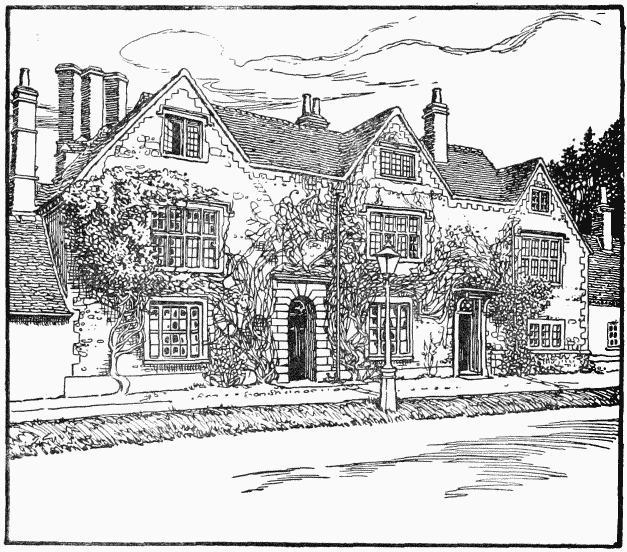
Wallingford: 16th-Century House in the High Street
The high road to Gloucestershire and South Wales passed through Wallingford until 1415, when the bridges at Culhamford and Burford by Abingdon were built, and the road was diverted from a point near Nuffield in Oxfordshire, about 3 miles above Wallingford. At the beginning of the 19th century two new turnpike roads were brought through the town in consequence of the exertions of Sir William Blackstone, (fn. 17) one passing from Streatley northward to cross the Thames at Shillingford, the other from Nuffield westward to Wantage and the Vale of the White Horse.
An Act for paving and lighting the town was passed in 1795. (fn. 18) The gasworks were founded in 1836 on the north side of the bridge-foot, and were transferred about thirty years later to the present site close to the railway station.
A lock with a weir known as Chalmore Lock, adjacent to the southern boundary of Chalmore but on the Cholsey side, was constructed in 1837 and removed in 1883. (fn. 19)
The station on the Great Western railway, with the branch line from Cholsey, was opened 2 July 1866, the station near Moulsford having previously been named Wallingford Road.
Drainage works on the hydro-pneumatic system were carried out throughout the town in 1891 at a cost of about £10,000. (fn. 20)
The Kine Croft (called in the 13th and 14th centuries Canecroft, (fn. 21) and in the 16th and 17th centuries Kenny Croft) (fn. 22) is the western portion of the south-west quarter of the town. The ancient earthworks, protected now by an injunction of the Court of Chancery, (fn. 23) are continuous along the south side and are only broken on the west side by embrasures which are traditionally said to have been cut by Prince Rupert in the Civil War. (fn. 24) The croft was formerly held subject to certain common rights for kine, but in recent times these rights have been commuted, and it is appropriated as a public recreation ground. (fn. 25) The Bull Croft, an inclosure in the north-west angle of the town, appears to be corruptly named by analogy with the Kine Croft; for it is evidently identical with the croft of 7 acres between the west and north gates called Bodecroft or Bothecroft (presumably boothcroft) in 1425, when it was a subject of litigation between the town and the priory, (fn. 26) and is named Bodye Croft in the valuations and grants of the priory lands after the Dissolution. (fn. 27) It was given to the town in 1912 by the owner, Mr. Powyss Lybbe. The Old Moor or Portman's Moor (known a Porthmannefeld in the time of Edward I, when part of it was given to the priory, (fn. 28) and Portmanfeld in the 16th century) (fn. 29) consists of 20 acres of pasture in the parish of St. Leonard and west of Chalmore, held formerly like the Kine Croft under common rights, which are now commuted. (fn. 30)
The north-eastern part of Chalmore near the wharf is known as the Hog Common, and formerly as the Common Eyott. (fn. 31) In the same part was a plot of ground known as Rack Hill, occupied in 1634 by Thomas Norcott, and belonging to St. Leonard's Church. (fn. 32)
Bradford's Brook, dividing Chalmore from Winterbrook in the parish of Cholsey, appears to be the 'Winterdich' which was a boundary of 'Winterbroc' in the time of Henry III. (fn. 33) A meadow in Chalmore called Winter's Mead was common land in the 17th century from 1 August to 1 February. (fn. 34) Other lands commonable for part of the year were a field called the Gore without the west gate and a field called the Oxlease formerly belonging to the priory. (fn. 35)
A close called Beansheaves, between Goldsmiths' Lane (fn. 36) and the Kine Croft, of which the name survives in Beansheaf Terrace, is frequently mentioned in the 16th century, (fn. 37) and may be supposed to take its name from Thomas Benecheff or Beneshef, who was mayor in the time of Edward III, (fn. 38) and represented the town in several Parliaments from 1376 to 1387. (fn. 39)
There are many interesting buildings in the town, the majority being of the 18th century, though several are earlier. The material used is generally brick or half-timber, with tiled roofs. In some instances the houses, originally half-timber, have been refronted in brick, a vitrified purple brick being extensively used during the 18th century. The town hall, on the south side of the market-place, was built in 1670 and repaired in 1822 and again in 1887, at which last date the flat ceiling was replaced by the present coved ceiling in commemoration of Queen Victoria's jubilee. The upper story, which is of plastered half-timber work with a slated roof, is carried on stone Doric columns, coupled at the angles. In the south-west corner of the building is a fine oak staircase leading to the upper floor. On each side of the upper story are five windows, the north window opening on to a projecting balcony. The hall occupies the three northern bays, and behind the staircase is the council chamber; both rooms have panelled oak dados. The space beneath the building was used for a corn market until 1856, when the corn exchange was built.
Round the market-place are several 18th-century houses. On the west side of St. Mary's Street, just past the church, is a small mid-17th-century brick building, the residence of Mr. W. B. Nelson. It has been much modernized, but on the first floor are two original three-light windows, with arched central lights rising above the side lights. Perhaps the most interesting piece of domestic architecture in Wallingford is a small but complete Tudor house overlooking the river on the south side of the mill brook, now known as 'St. Lucians,' the residence of Mr. F. Miller. It is two stories high, with an attic. Above a flint base the walls are pargetted, and the doors and windows have stone dressings. The tiled roof is in one span, with the side walls carried up on each side in three gables, and at either end of the house is a brick chimney stack. In the centre of the west front is a four-centred doorway, on either side of which is a small two-light window (the one on the south is now, however, blocked up), while under each of the side gables is a three-sided bay window with an embattled parapet lighting the rooms on each floor by a three-light window in the front, and a single light in each return. Along the front, just below the first floor level, runs a moulded string, which breaks over the windows and doorway on the ground floor. Above the doorway, lighting a passage on the first floor, is a seven-light window which has been much restored, the three centre lights having been lowered. In the apex of each gable, lighting the attic, is a small two-light window. The east front has been much modernized and partly rebuilt. On the west wall much of the original design of the pargetting is still to be seen. Large hearts seem to have been the chief form of decoration, and round the door and window jambs are imitation quoin stones. The plan of the house is simple; the front door opens into a small hall which is carried through the full width of the building and has a 17th-century staircase on the north side. Some of the rooms have stone fireplaces with four-centred openings under square heads. There is a 16th-century malt-house of half-timber with a tiled roof on the north side of the original building. A refronted house of earlier date, west of St. Mary's Church, is now used for the county court offices.
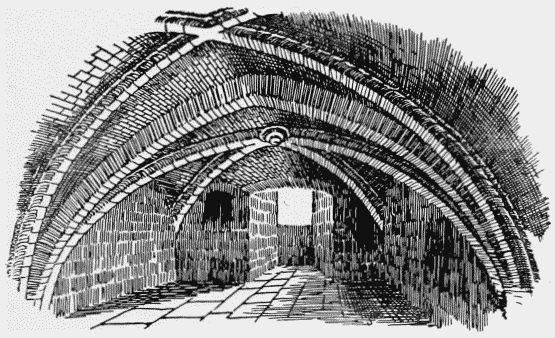
Stone Vaulting in a Cellar in High Street
Stone Hall, so-called in 1550, on the north side of the High Street, opposite the Kine Croft, is a modernized 16th-century house, now converted into two private residences. Originally there appear to have been projecting wings at either end of the front, but the space between these has been filled up by an addition, the original gable having been moved forward, so that it is now flush with the gabled ends of the wings. The building is of two stories and the walls are of flint with stone dressings.
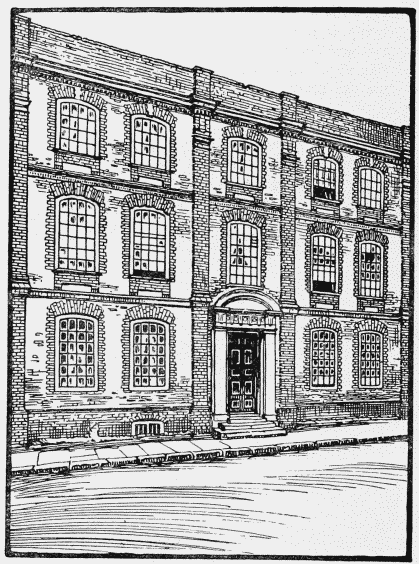
Calleva House School, Wallingford
Below the shop of Mr. Davis, a dealer in antiquities, on the south side of the High Street, is a cellar with a vaulted ceiling partly made up with re-used 14th-century material, probably from the priory church. It is in two quadripartite compartments, with an unmoulded transverse arch of the 16th century, the date of the superstructure. The diagonal ribs are hollow-chamfered and the lowest stones show the springing of other ribs in different directions. One of the head corbels upon which the ribs are received on either side of the transverse arch has cheveron ornament, and a stone in the east wall shows similar ornament. At the intersection of the ribs in the north bay is a circular 16th-century keystone with a carved head on the north side.
On the south side of the High Street, almost at the west corner of Thames Street, is Calleva House School, a fine 18th-century brick house. It is three stories high, and the front is divided into three bays by brick Doric pilasters standing on pedestals the height of the ground story, and carrying a moulded brick cornice with a parapet above. A little higher up the road are two small 18th-century houses, and opposite to them is a large plain Georgian house, three stories high, built of purple vitrified brick, with red brick dressings.
The house known as Castle Priory, on the river, was the residence of Justice Blackstone, and is now the property of Mr. E. A. S. Potter. The house south of this, described as a 'wharf-house' at the beginning of the 18th century, (fn. 40) has been named Cromwell Lodge, from a tradition that Oliver Cromwell stayed in it.
Angier's almshouses stand on the east side of the Reading road. The building is two-storied and covered externally with rough-cast. The roofs are tiled. There are six dwellings contained in a single block with two projecting wings at the rear. A central passage runs through the building, the dwellings being entered from the back. There are three gables on the front towards the road. All the windows appear to have been reglazed in the 'Gothic taste' in the early years of the last century. In the end gables of this elevation and in the gable of the central porch are large flowers modelled in stucco. In the central gable is a tablet bearing the following inscription: 'This Hospital was built & Endowed | for ye releife of Six Poore People by | Mr. William Angier & Mary his Sister | Anno Dñi 1681 | Mr. Francis Bunting Further | Endowed It With A Gift of | One Thousand Pounds | A.D. 1886.'
The grammar school stands in the High Street opposite the station. It is a red brick building with tiled roofs and was built in 1877. A laboratory was added in 1899 and eight years ago additional class rooms were built. The free library and institute, in St. Leonard's Square, was opened in 1871.
In the centre of the market-place there is an obelisk, surrounded by a paved ring of light coloured stones, which is known as the Bull Ring. It is said to mark the place where bulls were baited. (fn. 41) The pillory and whipping-post stood to the west of the town hall until 1830, and the stocks remained until a later date, when they were removed to the private museum in Wallingford Castle. (fn. 42)
Many of the old inns still remain. The back part of the 'Lamb,' which stands at the north-east corner of the Oxford road and the High Street, is of 16th-century date, though most of the building was erected in the 18th century. The name was changed from that of the 'Bell' by Silvanus Wiggins, the landlord, who issued a halfpenny token bearing a lamb and who entertained the Prince of Orange in 1688 and Hearne the antiquary in 1713. (fn. 43) Thomas Clack, who was landlord a few years later, had three daughters famed for their beauty, one of whom married William second Viscount Courtenay, and another Sir John Honywood, bart. (fn. 44)
A few houses lower down on the same side of the High Street is the 'George,' an old building with an overhanging upper story. The coach-house at the back is of the 16th century, and, although of no great architectural pretensions, is worthy of notice. The entrance doorway is moulded and four-centred, and the Tudor door and doorway of the inn stable are said to have come from the castle. In 1636 the commissioners for brewing and malting prosecuted Francis Smith, the landlord, for brewing on his premises. (fn. 45) The inn has the sign of St. George and the Dragon on halfpenny and farthing tokens of 1669 and 1652. (fn. 46)
On the south side of St. Mary's Street, between the market-place and the High Street, stands the 'White Hart,' another 16th-century inn. It is a two-storied building of half-timber construction, having the walls covered with plaster, and an overhanging upper story, above which are two projecting gables, roofed with tiles. The gables are carried by moulded beams, at the ends of which are pendants, the spaces between the pendants being spanned by curved braces, with Tudor roses in the spandrels. At the south end is a four-centred doorway of two orders with spandrels containing a Tudor rose and an escutcheon. Further south on the same side of the road is a small early 17th-century inn, the 'King's Arms.' It is a two-storied building; the overhanging upper floor is supported on shaped brackets, but the lower part of the house is completely modernized. The 'King's Arms' stands at the south corner of a small street running east, on the same side of which, a few yards lower down, is the 'Fat Ox,' a small 18th-century inn, while on the west side of the market-place is the 'Ironmonger's Arms,' an inn of the same date. The 'Kinges Hedde' in the High Street is mentioned in 1550, (fn. 47) the 'Greyhound' in 1651, (fn. 48) and the 'Elephant and Castle' in 1669 and 1691. (fn. 49) Ashmole describes some arms in the windows of the Elephant Inn, one having an elephant crest, which were brought from Caversham Lodge. (fn. 50) The 'Lion,' in the western part of the High Street, now one of the principal inns, may perhaps represent one of the unidentified inns. The 'Black Boy' was in St. Martin's Lane, at the north-west corner of the market-place, (fn. 51) and is mentioned in 1651 and 1691. (fn. 52) Near it at the same dates was the 'Plume of Feathers,' (fn. 53) which still exists. The 'Eight Bells,' at the south-west corner, probably represents the ancient church-house of St. Mary's Church. Near this, in the 17th century (fn. 54) and until recently, was the 'Mermaid.' The 'Cock,' in the market-place, appears from 1550 (fn. 55) to 1651, (fn. 56) and in the latter year also the 'Tallbot.' (fn. 57) The 'Green Tree,' still exisiting in St. Leonard's Square, is mentioned in 1651. (fn. 58)
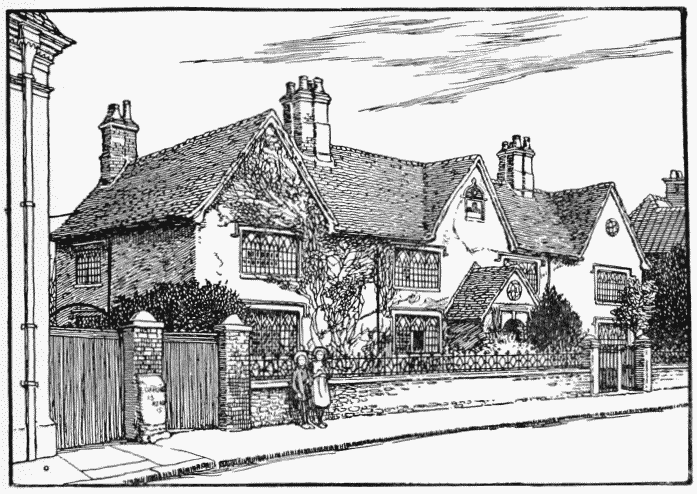
Angier's Almshouses, Wallingford
The earliest evidence of a bridge at Wallingford is about 1141, when Stephen besieged the castle. (fn. 59) It is said that the present bridge was built by Richard, King of the Romans, in the reign of Henry III, (fn. 60) and a part of the existing structure may be of this date. The bridge was under the charge of two wardens. stewards, or bridgemen, and bequests were made and pontage was from time to time granted during the 14th century and later to the burgesses and to these officers for its maintenance. (fn. 61) In 1429 the bridge was reported to be so ruinous that it was the cause of many accidents. (fn. 62) Considerable repairs were done in 1507 (fn. 63) and again in 1528–30, when the material of 'half the priory church,' then lately dissolved, was purchased at the cost of £9 for the repair of the bridge. (fn. 64)
The bridge is described in the time of Queen Elizabeth as being in length 900 ft. and consisting of twenty arches, but in 1571 it was 'in such ruin and decay that the inhabitants of the borough (by means of their great poverty) cannot support and repair' it. In 1576, therefore, the mayor, burgesses and commonalty were empowered to charge certain tolls for its maintenance, (fn. 65) but it was reported that in spite of the levy of the tolls the bridge was 'nothing repaired,' and the collector was severely admonished by the council. (fn. 66) In 1633 the officers of the navy complained to the lords of the Admiralty of the difficulty of conveying ship timber by water from the forests of Shotover and Stowwood because no barge above 16 ft. 4 in. in width could pass through Wallingford Bridge. (fn. 67) During the siege of the castle by the Parliamentary forces in 1646 some of the arches were removed and drawbridges erected in their stead. (fn. 68) In 1751 an agreement was made with Joseph Absolon of Wallingford 'for doing the four arches of the great bridge.' (fn. 69) A tablet formerly existing on the eleventh arch from the east recorded that 'the four wooden arches in this bridge were taken up and cast with brick and stone in 1751.' (fn. 70) They are elsewhere described as 'four drawbridges.' (fn. 71) The bridge was partly widened in 1770. (fn. 72) As shown in old engravings it had the usual projecting cutwaters carried up to the top of the parapet to afford security to foot passengers. In 1809 the bridge was greatly damaged and partly broken down by a severe flood, and an Act of Parliament was passed 'for partly rebuilding, widening, and improving' it. The three arches across the main stream were entirely rebuilt and the whole of the bridge was widened 7 ft., at a cost of about £7,000. (fn. 73) A new scale of tolls, which brought in about £500 a year, was in force till the debt was cleared off about 1842. At the beginning of the 19th century the bridge is described as consisting of nineteen arches, (fn. 74) and this is the present number still open if three small culverts at the eastern end are included.
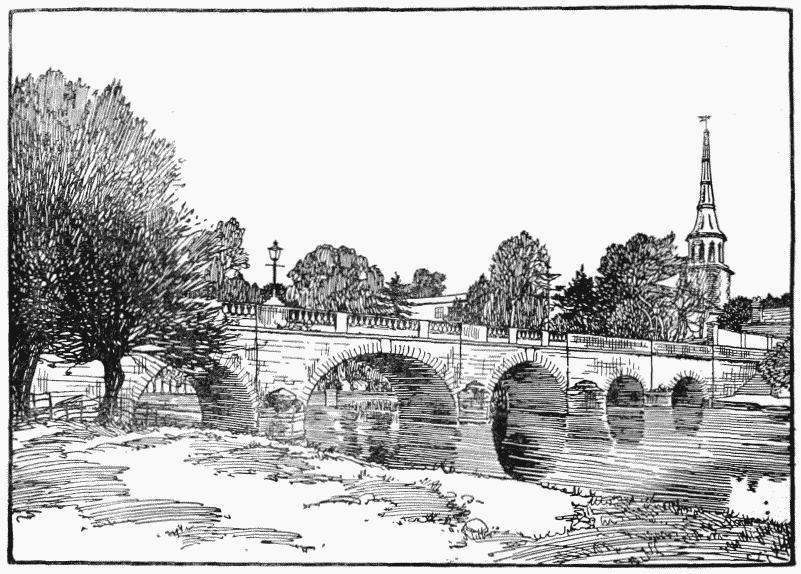
Wallingford Bridge
The bridge is about 900 ft. long, but varies in width from 23 ft. 6 in. to 21 ft. 6 in. On the north side is a narrow footway. Of the mediaeval structure the westernmost arch remains, but was closed up on the north side in 1809. There are sixteen other arches, of which the first, the tenth, and the fourteenth are also original. They vary in width between 16 ft. 1 in. and 17 ft. 4 in. and in span between 15 ft. and 16ft., and are each strengthened with four chamfered ribs. On the north side between the arches are large projecting pointed starlings, most of which still remain, and protrude beyond the 19th-century widening. The third, fourth, and fifth are the arches of 1809, the second and sixth are evidently the work of 1751, and the seventh also appears to be of the 18th century, while the eighth and ninth arches, which are pointed, were, no doubt, rebuilt in the 16th century. In the soffits are several pieces of Norman ornament which are doubtless some of the material of the priory church. The character and masonry of the next arch suggest late Norman work. The eleventh arch is segmental and was inserted in 1751. The next two arches were built of material taken from the priory church. The last two of the main arches were both rebuilt in 1751. At the end are the three small culverts above mentioned, which seem to have been substituted for the easternmost arches in 1809.
CASTLE
Wallingford owes its origin to the neighbouring ford across the Thames. Many traces of prehistoric settlements have been found in or near the castle and town. (fn. 75) The date of the extensive earthworks, the remains of which are still to be seen, (fn. 76) has been disputed. In the 8th-century wars between Mercia and Wessex the district round Wallingford was a debatable land, and Offa, after his victory at Bensington A.D. 779, seized the lands between Wallingford and Ashbury, and between Ashdown and the Thames. (fn. 77) In the 10th century a mint was set up, and the first Saxon coin issued from Wallingford dates from the reign of Athelstan (924–40). (fn. 78) From this time onwards coins of most of the kings were issued from here until the middle of the 13th century. (fn. 79) The charter bearing date 945 which mentions the 'castellum' of Wallingford (fn. 80) is a forgery, but the town was important during the period of the Danish invasions. One line of attack on the West Saxon kingdom came up the Thames, and in 1006 the coming of the Danes to Wallingford is recorded, when they utterly destroyed the town. (fn. 81) In 1010 another invading host passed Wallingford on its way to burn Oxford, and three years later the Danes under Sweyn came to Wallingford on their way to Bath. (fn. 82) The town evidently recovered rapidly, for the mint was again at work in the reign of Canute. (fn. 83) Wallingford was one of the 'burhs' enumerated in the Burghal Hidage. In the reign of Edward the Confessor it was already a royal borough, and may have been occasionally a royal residence, as the king had 15 acres within the borough on which his house carles dwelt. (fn. 84)
Wigod of Wallingford, who was Sheriff of Oxford and cup-bearer to King Edward, held the town under the king. He seems to have supported William's cause from the first, and when the Conqueror with his victorious army reached Wallingford on his march northwards he was entertained there by Wigod. (fn. 85) Stigand the archbishop is said to have come to Wallingford (Guarengefort) to make his submission to William. (fn. 86) The Conqueror probably left at Wallingford the Norman garrison mentioned in the Survey, and then, crossing the Thames by the ford which lies south of the present bridge, continued his march on London. (fn. 87) The reign of William the Conqueror saw the building of a great Norman castle, eight out of the 276 closes owned by the Saxon king being destroyed to make room for it. (fn. 88)
In 1071 the castle received its first state prisoner, the Abbot of Abingdon, who was suspected of complicity in Hereward's rising, being confined there and afterwards transferred to Winchester. (fn. 89)
Wigod of Wallingford died before 1087. The descent of his lands is uncertain, but it is stated that his son Tokig had been slain in battle in 1077, giving his life for the king's, when rescuing him from his son Robert, (fn. 90) and his daughter Ealdgyth had married Robert Doyley. (fn. 91) Doyley is regarded as the founder of the college of St. Nicholas within the castle. He had held the honour of St. Valery, (fn. 92) which he gave before 1086 to Roger d'Ivry. To Doyley many estates in the neighbourhood which later formed part of the honour of Wallingford passed at Wigod's death, the remainder being held by Miles Crispin, who is said to have married Doyley's daughter Maud (fn. 93) and held with her the custody of the castle and town of Wallingford. This Miles, who is often known as Miles of Wallingford, held large estates in the counties of Oxford and Buckingham, most of his lands in the former county lying in the Chiltern Hundreds, (fn. 94) the bailiwick of which was later often held with the honour of Wallingford. (fn. 95) After his death Maud of Wallingford married Brian Fitz Count, who was appointed constable of the castle and lord of the honour. (fn. 96) In 1131 he rendered account of the farm of Wallingford, paying a customary offering of 100s. for a cloak (palleo). (fn. 97)
For some years Brian Fitz Count supported Stephen, and he was one of the witnesses of his charter of liberties in 1136, (fn. 98) but when the empress came to England in 1139 he took up her cause and drew Wallingford and the surrounding district, which was of great strategic importance, into the struggle against Stephen. (fn. 99)
Wallingford Castle being strongly fortified, garrisoned by troops 'in the flower of youth,' and provisioned for several years, seemed impregnable, (fn. 100) and Stephen decided to try and starve it out, a siege being maintained by two forts built at Crowmarsh on the other side of the river. (fn. 101) The forts, however, were captured by Miles of Gloucester and the siege was raised. (fn. 102)
After her defeat at Winchester in 1141 Maud retreated to Oxford, and, when the besieged city was on the eve of surrendering to Stephen, fled at dead of night to Wallingford, where she was received into the castle. The Earl of Gloucester brought her son Henry to join her there. (fn. 103)
This is the period assigned by the chroniclers to the building of an inner prison in the castle by Brian Fitz Count. (fn. 104) The castle had a grim reputation, and according to the chroniclers the cries of the tortured prisoners who were confined in Brian's dungeons startled the townsfolk from their sleep. Brian's men terrorized the neighbourhood and supplied the castle by pillage. For long Wallingford stood for the empress, though the other strongholds in the county were held by the king. At last, in 1145–6, Stephen marched once more to besiege Wallingford, and again garrisoned the forts at Crowmarsh, but, baffled by the strength of Brian's garrison, he was again forced to retreat. (fn. 105) In 1152, after the failure of another attack, Stephen came to Wallingford with a very powerful force, but the castle was relieved by Henry of Anjou (fn. 106) in January 1152–3, (fn. 107) Stephen withdrawing at his approach, to bring up more troops. (fn. 108) Henry revictualled the castle and besieged Stephen's forts at Crowmarsh and the fort built in 1152 to command the bridge, surrounding them with a line of entrenchments extending up to Wallingford Castle. (fn. 109)
On Stephen's approach with a large force Henry led his army out to meet him, but negotiations were opened in a meadow at Wallingford. No agreement was reached for the moment and hostilities were continued in a desultory way. It was not until November (1153) that the treaty of Wallingford put an end to the long conflict which had devastated England. (fn. 110) Stephen was acknowledged as king and Henry as his heir. The latter's gratitude to the town, whose stout defence had done so much for the house of Anjou, found expression later in the grant of a charter of privileges. (fn. 111) Brian Fitz Count and his wife Maud had no heir, and both entered into religion. According to an inquisition as to the descent of the honour of Wallingford, it was then seized by Henry Duke of the Normans, afterwards Henry II, and remained in his hands when he became king. (fn. 112) On 10 April 1155 Henry held a Great Council at Wallingford, where the bishops and barons did fealty to the king and his sons William and Henry. (fn. 113)
Richard I bestowed the honour of Wallingford in 1189 on his brother John, the custody of the castle being given to the Archbishop of Rouen. (fn. 114) John, however, obtained possession of the castle when he rose in rebellion against Richard. He stayed for a short time at Wallingford, which he fortified with a strong mercenary garrison. (fn. 115) It is clear that, by the terms of the truce arranged between the king and John in 1193, the castle was handed over to Queen Eleanor in trust for the absent king. (fn. 116) In 1202 Hubert de Burgh, the king's chamberlain, was appointed constable of Wallingford Castle. (fn. 117) King John visited Wallingford in 1204 and 1205, (fn. 118) but there is no record of his being there again until 1212, when a reconciliation between him and his barons took place. In the following year Wallingford was the scene of the completion of the king's submission to the pope. (fn. 119)
During the last stormy years of his reign John was often at Wallingford, which he fortified strongly against his rebellious barons. (fn. 120) In 1215 he ordered that the moats of both town and castle were to be repaired, summoned the knights of the honour to garrison the castle and strengthened its fortifications. In this and the following years many prisoners were sent for safe keeping to the castle. (fn. 121) In June 1215 the castle was placed under the joint control of the Sheriff of Berkshire, of Walter Foliot and of the king's son Richard, (fn. 122) but on 17 October 1216, two days before the king's death, it was handed over to Richard alone. He was continued as constable by Henry III, and the custody of the honour was granted to him. (fn. 123) In 1224–5 he was created Earl of Corn wall, (fn. 124) and he lived constantly at Wallingford during the greater part of the reign of Henry III. The castle, honour and town were formally bestowed upon the earl in 1231, to be held by him of the king by the service of three knights' fees. (fn. 125) He kept up a stately hospitality in Wallingford Castle, to which a new hall was added in this reign.
The burning of the king's chamber is recorded in 1218. (fn. 126) The king visited the castle in July 1220, when he ordered that royal robes and cloaks should be sent to Wallingford for his own use and that of the Earl of Cornwall. (fn. 127) In 1225 the windows of the hall were glazed, and Henry paid another visit in September of that year, while an order for wine to be sent to Wallingford is perhaps evidence of his coming there in 1226. (fn. 128) The king was again at Wallingford in 1227 and in 1233. (fn. 129)
The custody of the honour of Wallingford, which had been given to Henry de Chequers in 1220, was granted to Hugh le Despenser during pleasure in 1226 and to Hugh de Bath in 1227. (fn. 130) The lastnamed was followed by Philip Daubeny, who only held the custody of the honour for a year, being ordered to surrender it to Godfrey de Crowcombe in 1231, and in the same year the king granted the custody of the honour to Richard Earl of Cornwall, who was already constable of the castle. (fn. 131)
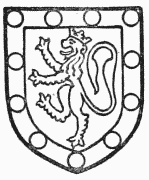
Richard of Cornwall. Argent a lion gules crowned or and a border sable with bezants.
In 1236 Otho, the papal legate, who had been rescued from the violence of hostile students at Oxford, was brought for safety to Wallingford Castle, some of the ringleaders being imprisoned there. (fn. 132) In March 1240–1 Henry was at Wallingford, and at Christmas in the following year he was splendidly entertained there by Earl Richard, who had just returned from the Holy Land. (fn. 133) Many of the nobles were present as well as Sanchia daughter and heir of Raymond Count of Provence, whose marriage to Earl Richard followed soon afterwards. (fn. 134) At the time of his marriage the earl made a settlement of his property, including the honour of Wallingford. (fn. 135) In several subsequent years the king was the earl's guest at Wallingford at Christmas and at other times. (fn. 136)
In 1246 the birth of a son to the earl at Wallingford was celebrated with great rejoicings there, (fn. 137) and about this date large sums were spent on building operations at the castle. (fn. 138) The king's servants were sent to Wallingford early in 1255 to fetch the money advanced by the earl on security of the Crown jewels, (fn. 139) and in July money obtained by tallaging the Jews was being repaid to the earl at Wallingford by the constable of the Tower. (fn. 140) To deal with the chattels of the Jews bound over to Earl Richard a chirographer's chest was set up at Wallingford, two keys being kept by two Christians and two keys by two Jews of Oxford chosen by the earl, all deposits and withdrawals being made at Wallingford by all four together, 'according to the custom of the Jewry.' (fn. 141)
In July 1256 Sir Edward, the king's son, visited the Earl of Cornwall at Wallingford, and his attendants distinguished themselves by breaking into the priory attached to the castle, where they did much wanton damage, destroying doors, windows and furniture. (fn. 142) After Earl Richard's election as King of the Romans in 1256 (fn. 143) he was very little at Wallingford and was often out of England.
Wallingford Castle played an important part in the struggles between the king and his barons in the later years of the reign. It was held for some time for the king by Richard Earl of Cornwall, (fn. 144) and in June 1263 was appointed as a meeting-place for the king and the barons. (fn. 145) It remained in the hands of the king's supporters until after his defeat at the battle of Lewes, when the castle with the town was surrendered to Montfort, the king, his son Edward and the Earl of Cornwall being sent there as prisoners. The king and earl were soon released, Edward and Earl Richard's son Henry being detained as prisoners. Their rescue was attempted by a surprise assault on the castle at sunrise, in resisting which the governor is said to have threatened to shoot Sir Edward from a mangonel. (fn. 146) Montfort, fearing a second attempt at rescue, transferred his prisoners to Kenilworth, from which Edward soon afterwards escaped. (fn. 147)
After the king's triumph at Evesham (3 August 1265) Wallingford was surrendered, (fn. 148) and was restored by Henry to the Earl of Cornwall, who before the end of the year was back again at the castle, (fn. 149) which he was still holding at his death in April 1272. (fn. 150) His long association with the castle and town of Wallingford is illustrated by the ballad of 'the Kyng of Almaine.' (fn. 151)
The honour, castle and town passed to his son Edmund Earl of Cornwall, who held it with the honour of St. Valery, which had apparently been granted to his father by Henry III as part of the duchy of Cornwall. (fn. 152) The new owner of the castle came to Wallingford with his bride, Margaret sister of Gilbert de Clare Earl of Gloucester, on 7 December 1272, and great rejoicings and celebrations followed. (fn. 153) The king seems to have visited Wallingford in 1276. (fn. 154)
In 1278 the earl endowed the collegiate chapel of St. Nicholas within the castle, for the souls of his father and mother, of King Henry his uncle and of King Edward, granting it lands for the maintenance of a master, six chaplains, six clerks and four acolytes. (fn. 155) The earl held the position of sole guardian of the realm from 1286 to 1289, and he was visited by the king at Wallingford in February 1289–90 and in October 1293. (fn. 156) He died without issue on 1 October 1300, when the earldom of Cornwall became extinct. (fn. 157) The castle, borough and honour of Wallingford with the rest of his vast possessions fell to the Crown, (fn. 158) his widow Margaret being given dower from some of his lands. (fn. 159)
In 1307 Edward II granted the castle, town and honour of Wallingford with the honour of St. Valery to Piers Gaveston, who had been created Baron of Wallingford and Earl of Cornwall shortly after the king's accession. (fn. 160) Gaveston's betrothal to the king's niece Margaret, sister of the Earl of Gloucester, was celebrated by a magnificent tournament at Wallingford Castle in December 1307, at which the earl's insolent behaviour to his noble guests roused a storm of hostility. (fn. 161) The king visited the castle in the following March. (fn. 162) The large sums expended in keeping the buildings in repair at this period appear in an inquest of 1308. (fn. 163) Gaveston's old enemy, Walter Langton, Bishop of Coventry, was confined in Wallingford Castle about this time. (fn. 164) The unpopularity of Gaveston led to his banishment in 1308, but in July 1309 he returned to England, the honour of Wallingford being confirmed to him and his wife Margaret in August. (fn. 165) In 1310 he had a grant of free warren in his demesne lands at Wallingford. (fn. 166) His second exile, during which the castle and honour were in the custody of a receiver, Edmund Bacon, ended in 1312, (fn. 167) when the honour was restored to him by the king together with the revenue derived from it during his exile. (fn. 168) A rising of the barons against him, however, was followed by Gaveston's surrender. It was arranged that he should be brought to Wallingford to meet the king, (fn. 169) but on the way there he was seized by the Earl of Warwick and beheaded without trial on 19 June 1312. (fn. 170)
The honour remained in the king's hands until 1317, Edmund Bacon being reappointed as receiver on Gaveston's death. (fn. 171) In January 1316–17 the king visited Wallingford, (fn. 172) and on 22 April following he granted the castle and honour of Wallingford with the honour of St. Valery to his wife Queen Isabel for life. (fn. 173) In November 1317 a quantity of Italian wine was sent to Wallingford for the king's use, and in the following April he visited the castle. (fn. 174) He was there again in March, April and May 1321. (fn. 175)
Many of the barons who were hostile to the Despencers were thrown into Wallingford Castle in 1322, the chief among them being Hugh de Audley and Maurice de Berkeley. In the following year they plotted with Roger de Mortimer, then a prisoner in the Tower of London, to seize the Tower, Windsor and Wallingford. (fn. 176) The plan with regard to the Tower failed, but the conspirators, led by one Roger de Wauton, won over the governor of Wallingford, who admitted them by a postern gate near the river, and thus they got possession of the castle. (fn. 177) A few weeks later, in January 1322–3, the castle was besieged and recaptured for the king by a force under Sir Richard Damery. (fn. 178) Lord Audley soon afterwards escaped from Wallingford, but Maurice de Berkeley remained a prisoner there until his death in 1326. (fn. 179)
During the rebellion of Queen Isabel and Roger de Mortimer in 1326 the castle was for some time the queen's head quarters, (fn. 180) and she issued her manifesto against the Despencers from there. After the king's capture Isabel gave the custody of the castle to Mortimer, and she kept a 'ryall Christmasse' with him there with great state. (fn. 181) Involved in the disgrace of Mortimer, Queen Isabel surrendered the castle and honour of Wallingford, which formed part of her dower, to Edward III. He held it for a time, visiting the castle fairly often, (fn. 182) and then, in December 1330, granted it to his brother John Earl of Cornwall, (fn. 183) who died childless in 1334. Edward often visited the castle in his time. He was at Wallingford in October 1333, and he stayed a long time there in the following winter, arriving before Christmas and remaining until 18 January, with an interval of two flying visits to Woodstock. (fn. 184) In the year following the death of John Earl of Cornwall the earldom of Cornwall was raised into a duchy, annexed to the Crown, and settled on the eldest sons of the Kings of England in succession. The castle and honour of Wallingford and the honour of St. Valery passed under this settlement to Edward Duke of Cornwall, later known as the Black Prince, with remainder to his heirs, 'first-born sons of the Kings of England.' (fn. 185) Thus the honour of Wallingford, which had been connected with the earldom of Cornwall ever since the time of Brian Fitz Count, was formally included in the duchy, and its revenues were, down to the 16th century, usually collected and managed by the steward or treasurer of the royal household.
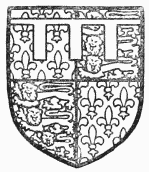
The Black Prince. The arms of Edward III with the difference of a label argent.
The king was at Wallingford in May 1336, (fn. 186) and in the following year he gave his kinsman, Robert of Artois, permission to reside in either of his castles of Wallingford, Guildford, or Somerton at his pleasure. (fn. 187) Very few visits by the king are recorded in the years that followed. He was there in October and November 1340. (fn. 188)
During the prince's absence in Gascony many acts of oppression and extortion were alleged to have been committed by his stewards and bailiffs in Wallingford, St. Valery and Berkhampstead, and an inquiry was ordered. (fn. 189)
In 1361 the marriage of the Black Prince with the Fair Maid of Kent, his cousin Joan, the daughter of Edmund Earl of Kent, took place at Windsor, and the princess made Wallingford Castle her chief residence. (fn. 190) Considerable building works were undertaken at this period, probably in consequence of the princess's residence there, and in 1364 carpenters, masons and other workmen were being impressed for the repair of the castle. (fn. 191)
The king visited the castle in September 1372. (fn. 192) On the death of the Black Prince in 1376 the castle and honour of Wallingford, which were part of the inheritance of his son Richard Duke of Cornwall, were held in dower by his widow Joan. (fn. 193) She was frequently in residence at the castle, and many building works were undertaken there during her widowhood from 1378 onwards. (fn. 194) In 1378 she obtained the king's pardon for a man imprisoned in the castle on suspicion of robbery, and in 1380 the keeper of the castle gaol was pardoned at her intercession for the escape of five prisoners during his absence in the king's service. (fn. 195) When she came to stay at Wallingford she was empowered by royal licence to demand entertainment for herself and her household and horses within 3 leagues of the castle. (fn. 196)
On the death of Joan, the Black Prince's widow, at Wallingford in 1385, (fn. 197) the castle and honour reverted to the king. The inquiry into the financial burdens on the honour, undertaken in 1384, was resumed, and in 1387 it was reported that the revenues of Wallingford Castle were so diminished that the castle could not be supported without provision for its succour, and it was therefore ordered that all the profits granted out for life or terms of years should revert to it at the decease of the possessors. (fn. 198) In spite of this the old system of making grants from the castle revenues and from the fee farm of the borough was soon revived. (fn. 199) The constable of the castle was often in difficulties owing to the escape of felons from the castle gaol, (fn. 200) for which he had to obtain the king's pardon. The difficulty of his position as gaoler is illustrated by an order he issued in 1390; he was to arrest and bring to Wallingford gaol thirty-one men accused of felonies, some of whom were in London, others in Northampton, Abingdon, Brigstock (co. Northants), Daventry, Astbury (co. Chester), and other distant places. (fn. 201) When the Mayor and Sheriffs of London were imprisoned by Richard II in 1390 for refusing a loan, one of the sheriffs was thrown into Wallingford Castle.
In 1389 and 1392 building and repairing was going on at the castle, a clerk of the works being appointed. Further repairs were undertaken in 1398 and 1399. (fn. 202) The king was at Wallingford at the end of July and beginning of August 1399, (fn. 203) and on the news of the landing of Henry of Bolingbroke the queen and her household were hastily removed from Windsor to Wallingford, the Earl of Wiltshire and others being appointed keepers of the castle. (fn. 204) The queen left Wallingford for Sonning soon afterwards, and Henry's capture of King Richard was followed immediately by the surrender of Wallingford Castle to him. (fn. 205)
After the failure of their plot to murder Henry IV at Windsor in January 1400, the Earls of Kent, Salisbury and Huntingdon rode westward through Wallingford, taking with them King Richard's double, a priest named Maudelen, to whom they paid royal honours; but the neighbourhood failed to rally to them, and the earls marched on to meet defeat at Cirencester. (fn. 206)
Henry IV visited Wallingford early in his reign. (fn. 207) On 30 June 1415 Henry V gave his mother licence to reside in any of his castles of Windsor, Wallingford, Berkhampstead, or Hertford while the king was 'on his present voyage beyond the sea.' (fn. 208)
On his marriage with Katherine of France the castle and honour of Wallingford, with the honour of St. Valery, formed part of her dower, and she held it till her death in 1437. Considerable repairs were undertaken in 1424, with a view of making the castle more fit for the queen's residence, and in 1428 it was appointed as a summer residence for the young king Henry VI. (fn. 209)
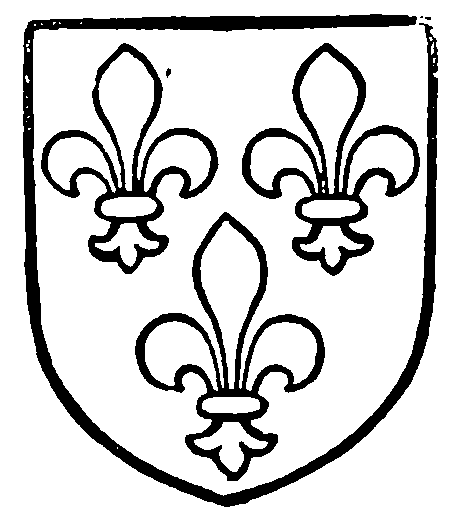
Katherine of France. Azure three fleurs de lis or.
Owen Tudor, the husband of Queen Katherine, was imprisoned in Wallingford Castle in 1438, but was soon afterwards removed to London. (fn. 210)
The Duke of Suffolk, then all-powerful in England, was appointed Constable of Wallingford in 1434, (fn. 211) the appointment to take effect after the death of Thomas Chaucer, but in 1449 he was accused of having 'furnished the castle with all warlike munition for his own defence' and was banished. (fn. 212) After his murder in 1450 his widow lived at Ewelme for a time, (fn. 213) but as she was an object of suspicion and hostility on the part of Parliament, (fn. 214) the office of keeper of the castle of Wallingford was granted to Sir William Lovel, kt., Lord Lovel, in August 1450, for life, (fn. 215) and he held it until his death in 1455, when it returned to the Suffolk family. (fn. 216)
The Duke of Exeter was sent to Wallingford in 1455 on a charge of rioting, the Earl of Worcester being ordered to take charge of the distinguished prisoner, but the Duchess of Suffolk seems to have complained that the commission to Worcester was an infringement of her rights as constable and it was cancelled. (fn. 217)
During the Wars of the Roses Wallingford does not seem to have played any important part in the war. John de la Pole Duke of Suffolk became constable in 1461, (fn. 218) and the dowager Duchess of Suffolk seems to have been associated with him in the office. (fn. 219) In 1471 Queen Margaret was sent to the castle as a prisoner, and she remained there until ransomed by her father in 1475. (fn. 220)
In August 1483 the custody of Wallingford Castle and honour with the honour of St. Valery and the four and a half hundreds of Chiltern was granted to Francis Viscount Lovel. (fn. 221) Having fought at Bosworth he was attainted by the first Parliament of Henry VII, and the custody of the castle and honour of Wallingford was bestowed upon John de la Pole Earl of Suffolk. (fn. 222) His son the Earl of Lincoln, however, immediately entered into an intrigue with Lovel. Their rebellion was crushed at the battle of Stoke, and in February 1487–8 Sir William Stonore and Sir Thomas Lovel obtained a grant of the office on the surrender of the duke. (fn. 223) Sir Thomas Lovel was still constable in 1506. (fn. 224) In 1488 Sir Thomas Scrope of Upsall, kt., who had been implicated in a rebellion against Henry VII, was a prisoner on parole at Wallingford Castle. (fn. 225)
In December 1490 the castle, town and honour of Wallingford with the honour of St. Valery were granted to Arthur Prince of Wales as part of the duchy of Cornwall, (fn. 226) and passed on his death to his brother Henry.
In 1518 the court was in residence at Wallingford, and Pace, writing to Wolsey on 14 July, said that the king was at Wallingford, but that he was leaving for Bisham on the following day on account of the sickness. (fn. 227) This is one of the last notices of the use of Wallingford Castle as a royal residence. Henry's visits were rare, and those of his successors rarer still.
The castle was often used as a place of confinement for political prisoners at this period. In June 1535 a woman who was alleged to have called the king 'an extortioner, knave and traitor' and Queen Anne 'a strong harlot' was sent to Wallingford Gaol. A little later the constable asked for orders about her, 'as the said Margery is aged and lacks wit, and there is no one to attend upon her husband, who is mad.' (fn. 228) Other prisoners were a priest 'taken with a book of conjurations, a crystal, &c.,' a 'seditious tale teller,' and many others who had spoken lewde wordes' or words against the king. (fn. 229)
In 1540 the castle and honour of Wallingford were separated from the duchy of Cornwall and annexed to the king's manor of Ewelme, which was erected into the honour of Ewelme, all the liberties and privileges of Wallingford Honour being transferred to it. The reason assigned for the change was that Wallingford Castle was near the king's manor of Ewelme and was 'very commodious, decent and pleasant for the king's own residence.' Certain Cornish manors were assigned to Prince Edward and his successors, Dukes of Cornwall, in exchange. (fn. 230) In spite of this transfer Henry VIII does not seem to have stayed at Wallingford, and in the later Tudor period, when the castle ceased to be even an occasional residence of royalty, the building was neglected and began to fall into decay. Leland, writing in 1540, thus describes the castle (fn. 231) :—
The Castelle yoinith to the North Gate of the Toune, and hath 3 Dikis, large and deap, and welle waterid. About ech of the 2 first Dikis as apon the Crestes of the Creastes of the Ground cast out of rennith an embatelid waulle nowe sore yn ruine, and for the most part defaced. Al the goodly Building with the Toures and Dungeon be within the 3 Dike. There is also a Coilegiate Chapel emong the Buildinges within the 3 Dike. … There is a Deane, 4 Prestes, 6 Clerkes and 4 Choristers. … The late Deane afore Dr. London that now is buildid a fair Steple of Stone at the Weste Ende of the Collegiate Chapelle, to making wherof he defacid, as it is said, withoute Licens a Peace of the Kinges Lodging joyning on the Est Ende of the Chapelle. The Deane hath a fair Lodging of Tymbre withyn the Castelle: and to it is yoined a Place for the Ministers of the Chapelle.
In the reign of Mary the castle, which was reported to be 'in greater desolation and ruin than ever it was in every manner of way,' was stripped of lead, stone and other building materials for works at Windsor Castle. (fn. 232) An inquisition of 1555 (fn. 233) gives a picture of the castle with its gate-houses, the collegiate church with its square bell-tower of freestone, the keep containing a kitchen with a room over it, and a winding staircase, two dungeons with iron-barred windows and heavy iron-barred doors, iron hasps and staples, the great chamber and the privy chamber. Much of the lead had already been removed and the whole front was falling into decay. The spoliation was continued in the reign of Elizabeth. (fn. 234) In 1561 it was proposed that Wallingford or some castle in North Wales would be a suitable place of detention for 'incorrigible Arians, Pelagians, or Free-will men,' but there is no record of such prisoners being received there, though certain 'vagabondes naming themselves Egiptians' were incarcerated. (fn. 235) The castle gaol was not too secure, and a man indicted for 'two or three detestable murders' boasted that he would easily escape. (fn. 236)
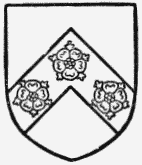
Knollys. Gules a cheveron argent with three roses gules thereon.
During the reign of Elizabeth and for many years afterwards the castle was in the custody of various members of the Knollys family, who succeeded each other in the office of constable. The best known of these was William son of Sir Francis Knollys, who succeeded his brother Henry as constable of the castle in 1584. (fn. 237) He became treasurer of the Household in 1600, was created Viscount Wallingford in November 1616 and Earl of Banbury in 1621. (fn. 238) During his tenure of office in 1603 the honour had been assigned by James I to his queen as part of her dower. The office of constable passed on Banbury's death to the Earl of Berkshire, who as Sir Thomas Howard had obtained a grant of the reversion of it jointly with his brother Charles Howard in January 1609–10. (fn. 239) The Earl of Berkshire was a Royalist, and, having summoned a meeting of Royalist gentlemen, was arrested by order of Parliament and sent to the Tower, where he remained until 1643. (fn. 240) The castle formed part of Queen Henrietta Maria's jointure, but was not leased out owing to its bad state of repair, the meadow and fisheries being the only valuable part of the estate. (fn. 241) With the outbreak of the Civil War Wallingford Castle, which was described in 1636 as 'almost defaced into fragments,' (fn. 242) once more became important as a place of defence. The neglected buildings were repaired and new fortifications were undertaken. Colonel Blagge was appointed governor of the castle, and on 1 May 1643 the king wrote to him ordering that the work of fortification be 'cheerfully and speedily' proceeded with. Its proximity to the royal head quarters at Oxford made the defence of Wallingford specially important, and in August money was raised by Colonel Blagge in Reading and other towns under warrants from the king and Prince Rupert, Reading having petitioned the king in vain for exemption. (fn. 243) Next year the contribution demanded from Reading for the maintenance of Wallingford amounted to £150 for three weeks, and the townsmen sent 'submissive' answers alleging their utter inability to pay in spite of their willingness to do so. (fn. 244) On 24 April 1643 the king visited Wallingford and personally inspected the fortifications, advancing from there to Reading in an attempt to relieve the town. Reading, however, surrendered a few days later and the garrison joined the royal army and retreated through Wallingford. (fn. 245) Colonel Blagge's reception of the Parliamentary commissioners who came to Wallingford in 1643 in the hope of finding the king there was not encouraging. He received them, 'not rudely, but with haughtiness enough,' sending a troop of horse to escort them as if they had been prisoners. High words followed; the commissioners feared they might have their throats cut by the garrison, and gladly took their leave of the 'proud governour.' (fn. 246) On 4 October 1643 the king and queen again visited Wallingford from Oxford. (fn. 247) In the summer of 1644 Reading and Abingdon were surrendered, part of their garrison with guns, arms and ammunition being thrown into Wallingford. (fn. 248)

Anne of Denmark. Or strewn with hearts gules three leopards azure having golden crowns.
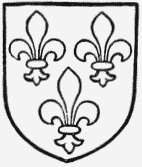
Henrietta Maria. Azure three fleurs de lis or.
After the battle of Newbury, 27 October 1644, the royal army led by Prince Maurice and Goring fell back upon Wallingford, the king going by way of Donnington to Bath. (fn. 249)
In November Parliamentary commissioners came to Wallingford in the hope of finding the king, who was then at Oxford. (fn. 250) The Parliamentary leaders were anxious for the reduction of the castle, and in 1645 Colonel Baxter, the governor of Reading, brought a large force against it, but, finding town and castle much more strongly fortified than he had anticipated, retired. (fn. 251)
By the end of the year Wallingford, Faringdon and Donnington were the only Royalist strongholds in the county, and in November it was rumoured that the king was coming to Wallingford 'with all his horse.' (fn. 252)
After the king's defeat at Naseby the siege of Wallingford by General Fairfax, which lasted sixteen weeks, began in earnest. The town was blockaded on all sides, but though his difficult position became desperate after the surrender of Oxford, the governor refused to submit without orders from the king. (fn. 253) He even threatened to fire the town to prevent the further advance of the besiegers, and the difficulty of taking the castle by storm appeared so great that a special council of Parliamentary officers met to draw up terms which might induce Blagge to surrender. (fn. 254) To the terms offered him the governor again replied that he could not surrender the town without the previous consent of his Majesty. By this time Wallingford was the only stronghold in this part of England still held for the king. The blockade became stricter than ever, though there was no attempt at storming the place. In July the gallant governor was forced by the privation of his troops, the distress of the town, the failure of any chance of relief, and the king's surrender to the Scotch army, to reopen negotiations, which he did in a 'high and proud letter.' (fn. 255)
The articles of capitulation drawn up on 22 July 1646 were very honourable to the garrison. (fn. 256) The castle and town were to be surrendered to Fairfax on 29 July with all its ordnance, arms, ammunition, stores and provisions of war. The governor and garrison were to march out with their horses and arms, 'with flying colours, trumpets sounding, drums beating, matches lighted at both ends, bullets in their mouths, and with bag and baggage,' to any place appointed by the governor within 10 miles of Wallingford. Provisions as to the subsequent disbanding of the garrison, with the exception of those who should 'desire to take entertainment for foreign service,' followed. The governor was provided with passes for himself and for three officers named by him 'to go to the king and give him an account of the said garrison.' (fn. 257) During the week that elapsed before the day appointed for the surrender a mutiny broke out in the garrison on the suspicion that the governor was selling corn and provisions for his own profit. It is said that they threatened to murder the governor, who felt bound to offer to surrender the castle to Fairfax before the day agreed on. Fairfax sent a regiment into the town to keep order, and Wallingford was surrendered on 27 July 1646. (fn. 258) Only two castles in England, Raglan and Pendennis, now stood for the king, and they fell in August. Adj.-Gen. the Hon. Arthur Evelyn was then appointed Parliamentary governor of the town and castle of Wallingford. Whitelock and others had 'laboured with the general and other members of the Parliament to get an order for the demolishing of it,' but it was spared for a time and during the ascendancy of the Independents after Pride's Purge became a place of confinement for Presbyterian prisoners. (fn. 259)
Among the prisoners at Wallingford in 1650 and 1651 were Sir John Clotworthy, Maj.-Gen. Brown and Captain Bray, the last-named being reported as being 'very dangerous to the peace and safety of the garrison of Windsor Castle,' where he had formerly been confined. (fn. 260) Later there were a number of Scotch prisoners at Wallingford. (fn. 261) The governor did not live in the castle, but in a house within the walls, which was rented from a Mr. Knapp for as long as 'the commonwealth' should require at a rent of £20 per annum. (fn. 262)
In 1651 a Presbyterian intrigue with the Royalists was discovered, some of the prisoners in Wallingford being accused of a share in it. (fn. 263) This plot was perhaps not without influence on the fate of the castle. On 17 November 1652 the Council of State resolved that Wallingford Castle should be 'forthwith demolished and the workes thereto belonging effectually slighted.' The commissioners appointed for this work included the governor Evelyn. (fn. 264) It was thought possible that the value of the buildings might slightly exceed the cost of demolition, (fn. 265) and the balance, if any, was to be given to the poor. As it turned out, the sale of materials realized £516 17s. 11d. and the demolition cost £450 5s. 8d., the balance of £66 12s. 3d. being handed over to Michael Molyns in compensation for his losses over timber forcibly taken by the Royalists for the repair of the castle at the beginning of the war. (fn. 266)
At the Restoration the Earl of Berkshire, in reward for his tried loyalty, was prominent at the king's reception and coronation. He was perhaps appointed constable of the castle, but the office, which was only an empty one after the destruction of the castle, disappeared soon afterwards. The stewardship of the honour of Ewelme and the manor of Wallingford was exercised by deputies (fn. 267) appointed by the comptrollers of the royal household down to 1817, when the honour and manor were sold by the Commissioners of Woods and Forests.
Occasional leases of the site of the castle were made by the Crown from the 16th century onwards. (fn. 268) Thomas Renda, who was one of the members for the borough, obtained a lease about 1709. (fn. 269) In 1768 the western and southern portions of the outer rampart and the southern portion of the inner rampart could still be seen 'exceeding bold and fresh,' also parts of the river and of the northern ramparts and bastions and the east pier of the principal gate. (fn. 270) A brick building within the castle walls was occasionally used as a prison in the 18th century. William Hucks was lessee in 1806. (fn. 271) In 1817 the castle estate, which included gardens, moats and pasture land and the king's meadow – about 62 acres altogether—was sold by the Commissioners of Woods and Forests. Part was bought by Mr. James Blackstone, who was followed by his son William Seymour Blackstone, from whom it was purchased by John Kirby Hedges. (fn. 272) The other part was bought in 1817 by John Allnatt Hedges, from whom it descended to John Kirby Hedges, who died in 1901. The present owners are his daughters, the Misses Hedges, who occupy a mansion known as Wallingford Castle.
The site of the castle appears to have been inclosed by a double line of moats on the north, west, and south, and by a single moat on the east, where the river takes the place of the outer moat. The inner ward had the keep-mound at its southern end, and was inclosed by the inner line of moat on the three landward sides, the side towards the river impinging upon the eastern moat. On the north side the town moat formed a third line of defence running parallel with the two castle moats, which are placed so close together as to allow of no ward between them. All this is still plainly traceable, the mound, with a foundation of solid masonry several feet thick, and the lines of the moats being almost intact, but of the walls nothing now remains beyond two fragments on the north and east sides of the inner ward and the ruins of the collegiate church of St. Nicholas which stood at the eastern end of the southern ward. The modern mansion stands at the south-west corner of the same ward, the bank of the outer moat forming a terrace in front of it. Near the northern end of the space between the moats is the traditional site of the dungeon called Cloese Brien, or Brian's Close. The extent and arrangement of the ward may be reconstructed by the aid of a plan surveyed in the second year of King Edward VI, now in the possession of Mrs. J. Mitchell Marshall. The ward was of an irregular polygonal shape, measuring 480 ft. from north to south, and, if the plan be correctly plotted, about 400 ft. from east to west. The mound occupying the southern end is shown as a circle of 240 ft. in diameter (somewhat more than its present diameter), the southern portion of its circumference being washed by the inner moat. The entrance to the ward, the site of which can still be traced, was near the centre of the western side, and at each angle of the walls was a square tower projecting into the moat. There was a similar but slightly smaller tower near the centre of the northern side, the position of which may perhaps be shown by the fragment of wall existing on this side, which ends in the jamb of an opening, possibly a doorway communicating with the tower. The fragment of wall remaining on the east, overlooking the river, traditionally called the Queen's Tower, retains the opening of a large window near the southern end, and has a base mould of early 14th-century character. The northern end shows the broken masonry of a wall at right angles, and no trace of a party wall intervenes; the window would therefore appear to have belonged to a room of considerable size. The remains of the building of the collegiate church of St. Nicholas in the southern ward comprise a west wall with a doorway and four windows of 15th-century character, and a lofty south wall with part of the church tower, built between 1510 and 1536 by Dean Underhill, at its eastern end. The entrances to the grounds at the foot of the High Street, near the bridge, and in Castle Street, doubtless occupy the positions of the original entrances. Prints of the early 19th century show the southern gate-house, a lofty embattled building, as still standing. An heraldic lion, said to be from this gateway, is built into the gable of a house on the opposite side of the High Street.