A History of the County of Hertford: Volume 2. Originally published by Victoria County History, London, 1908.
This free content was digitised by double rekeying. All rights reserved.
'Parishes: Aldbury', in A History of the County of Hertford: Volume 2, ed. William Page (London, 1908), British History Online https://www.british-history.ac.uk/vch/herts/vol2/pp143-148 [accessed 30 April 2025].
'Parishes: Aldbury', in A History of the County of Hertford: Volume 2. Edited by William Page (London, 1908), British History Online, accessed April 30, 2025, https://www.british-history.ac.uk/vch/herts/vol2/pp143-148.
"Parishes: Aldbury". A History of the County of Hertford: Volume 2. Ed. William Page (London, 1908), British History Online. Web. 30 April 2025. https://www.british-history.ac.uk/vch/herts/vol2/pp143-148.
In this section
ALDBURY
Aldeberie, xi cent.; Audebur', xiii cent.; Albury, xvi cent.
The parish of Aldbury comprises 2,020 acres of land and seven acres of land covered with water, consisting in 1905 of 596 acres of arable land, 193 acres of permanent grass, and 277 acres of wood, (fn. 1) and includes the hamlets of Moneybury Hill on the north of the village, and Northfield to the north-west. The land rises from about 400 ft. above the ordnance datum on the south and west of the parish to about 700 ft. on the north-east. On Moneybury Hill, about the highest spot in the parish, standing 731 ft. above the ordnance datum, is a monument in the form of a granite column, erected in 1832 to the memory of Francis, third duke of Bridgewater, 'the father of inland navigation.'
The soil of the parish is chalk, except at the eastern extremity, where it consists of clay with flints. The crops are mostly wheat, barley, oats, and roots. There is an extensive common on the east side of the parish, which is a continuation of the great common of Berkhampstead. The only important roads are that from the Akeman Street passing through the village to Ivinghoe, and that from Tring to Little Gaddesden, but there are numerous footpaths. Of other means of communication there are the Grand Junction Canal, which runs through a small portion of the parish on its western side, and the London and North Western Railway main line, with a station in this parish called Tring Station, opened in October, 1837. (fn. 2) There are no factories, the population being mainly engaged in agriculture. Amongst other place names, the following may be noticed: Cherrywicke and Bursden's Hall Lane. There is a large wood to the north-west of the parish called Aldbury Nowers, formerly known as Owrez.
A windmill was erected at Aldbury towards the end of the sixteenth century, and in 1589–90 licence was asked by Thomas Kynge of Aldbury to erect a cottage for the miller, 'a painfull man in his calling.' (fn. 3)
In 1826 part of the old highway leading from Aldbury to Ivinghoe, within the parish of Aldbury, was diverted and carried through the Stocks estate. (fn. 4) A new high road was made in 1829 between Aldbury and Tring. (fn. 5)
The village of Aldbury lies in a valley with chalk hills on either side, well covered with beech and fir, whose dark foliage is relieved here and there by the patches of white from the exposed chalk. It is prettily situated at the intersection of the roads from Tring to Little Gaddesden and from Great Berkhampstead to Ivinghoe. Where the roads cross is an open space with a large pond and one or two elm trees; at the south end of the pond are the old village stocks and whipping post, which are still in fairly good condition. The main street lies along the road from Berkhampstead to Ivinghoe. The houses are mostly of two stories, and built of timber frames filled in with red brick, which in many cases is coloured stone colour, a few having projecting upper stories. The most interesting of them is at the corner of the street just to the north of the pond, with close-set timbers and brick filling, and probably dates from the first half of the seventeenth century. The roofs are mostly of tile, but four or five are thatched, a covering rarely seen in this part of Hertfordshire. The modern houses are of brick, with slate roofs.
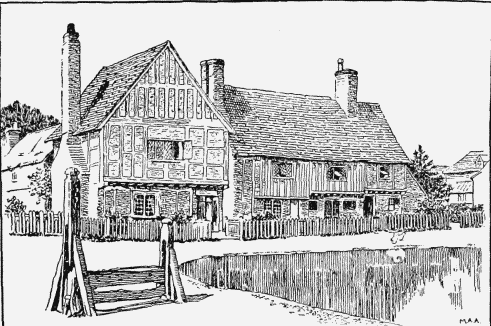
The Village Pond and the Stocks, Aldbury
The church stands at the north-west end of the village, on the Tring road, and the schools are on the west of the cross-roads, near by. East of the village, on the north of the Ivinghoe road, is Stocks, the residence of Mr. T. Humphry Ward, and other important houses in the parish are Tom's Hill (Mr. R. W. Wood), south of the village; Northfield (Mr. John Mead), north-west of the village; Brightwood House (Mr. H. R. G. Craufurd, J.P.), and The Wolds (Mr. F. Bloxam).
MANORS
The manor of ALDBURY was held of the honour of Berkhampstead by fealty and the rent of 5s.; and 3s. 4d. for release of suit of court; and 16d. for free common for the lord of the manor and his tenants in the Frith. (fn. 6) The court leet, which was held on Thursday in Whitsun week, belonged to the honour of Berkhampstead, and had jurisdiction over the tithings of Long Marston, Betlow, Dunsley Grove cum Pendley, Wigginton, Northcote cum Lyghe, Drayton Beauchamp, Gubblecote cum Cheddingdon, and Aldbury cum Helpusthorp. (fn. 7) Each tithing had its own constable. We have also mention of Tiscote and West Rollsham as members of the manor.
In the time of Edward the Confessor Aldbury was held by Alwin, a thegn of the king, and at the time of the Domesday Survey it had passed into the hands of the count of Mortain. (fn. 8) William de Bocland held the manor in 1203, (fn. 9) and granted the advowson of the church to the priory of Missenden. (fn. 10) He died about 1218, leaving as his heirs three daughters, Maud wife of William de Averenges, Hawisia wife of John de Bovill, and Joan wife of Robert de Ferrars, and on a partition of his lands this manor was assigned to Hawisia and John. (fn. 11) In 1225 John died seised of the manor in right of his wife Hawisia, (fn. 12) who died in 1226, leaving as her heirs her two sisters, of whom Maud, the wife of William de Averenges, took this manor. (fn. 13) William de Averenges died about 1230, when the custody and marriage of his heirs were at first granted to Hubert de Burgh, and afterwards in 1233 (fn. 14) to the bishop of Exeter, except the custody of the lands at Aldbury, which the king had granted to Eudo his brother. (fn. 15) The heir possibly died a minor about 1235, for in January of the following year Hamon de Crevequer did homage for the lands which Maud his wife, daughter of William de Averenges, had inherited. (fn. 16) Maud died in 1271 leaving four daughters, when the manor fell to the share of Isabel, who married Henry de Gaunt, (fn. 17) and died in 1283, apparently without issue, for at her death her sisters and their heirs were said to be her heirs. (fn. 18) Her sister Eleanor, the wife of Bertram de Criol, took the manor as her share and died in 1302, (fn. 19) when, her eldest son John having died without issue, she was succeeded by Bertram her second son. This Bertram died in 1306 without issue, and was succeeded by his sister Joan the wife of Sir Richard de Rokeslegh. (fn. 20) In 1309 the manor was sold by Sir Richard and Joan his wife to Walter de Aylesbury, (fn. 21) from whom it appears to have passed to Philip de Aylesbury, who presented to a chantry, the advowson of which was held with the manor, in 1345 and 1356. (fn. 22) From Philip de Aylesbury it passed apparently to Sir John Aylesbury, his second son, who died in 1409. (fn. 23) Sir Thomas Aylesbury, son and heir of Sir John, granted the manor in 1416 to Sir Thomas Chaworth, (fn. 24) husband of his daughter Isabel, who obtained full possession of it, (fn. 25) and in 1438 settled it on himself and his wife Isabel. (fn. 26) In 1447, with Elizabeth, possibly his second wife, he held manorial courts here. (fn. 27) Sir Thomas died 10 February, 1459, and was succeeded by William his son and heir, (fn. 28) who appears to have conveyed the manor to the earl of Shrewsbury and others, feoffees, to the use of his son Thomas, who held courts there in 1471–2. (fn. 29) This Thomas died before 1485 without issue, (fn. 30) and had apparently settled the manor upon his wife Margaret, who after his death married firstly Ralph Vernon of the county of Derby, and secondly, about 1493—Talbot. In 1485 Ralph Vernon and Margaret his wife leased the hall and the demesne lands to Henry Wynch for twenty-seven years. (fn. 31) On the death of Margaret the manor passed to Joan, sister and heir of Thomas Chaworth, then married to John Ormond, (fn. 32) who in 1502 conveyed it to Thomas Babington, Robert Brudenell, and others, as trustees for a settlement upon herself and her husband for life, with remainder in thirds to her daughters Joan wife of Thomas Dynham, Elizabeth wife of Anthony Babington, and Anne wife of William Meryng. (fn. 33) Joan died in 1507, and her heirs were her daughters Joan and Anne, and Thomas Babington son of Elizabeth and Anthony. (fn. 34) Sir Thomas Dynham and Joan and their co-parceners held a court for the manor in 1519, (fn. 35) and Sir Thomas died in the same year. (fn. 36) His widow Joan married Sir William FitzWilliam, and they held a court of the manor in 1530. (fn. 37) Joan was again a widow in 1538, (fn. 38) and in the following year conveyed her third of the manor to a younger son Thomas Dynham. (fn. 39) Anne Meryng died without issue, and her third descended to her two nephews, Thomas Babington and George Dynham eldest son of Joan FitzWilliam. (fn. 40) George sold his sixth part in 1542–3 to John Hyde, (fn. 41) and Thomas Babington sold his half in 1544 to the same John, (fn. 42) who had acquired the remaining third from Thomas Dynham in the same year. (fn. 43) John Hyde of Hyde in the county of Dorset was an officer of the court of Exchequer and already had a lease of the manor. (fn. 44) He died in 1545, (fn. 45) and his son Thomas Hyde succeeded to the manor, which passed on his death in 1570 (fn. 46) to his son George, who died in 1580, (fn. 47) leaving his brother Robert his heir. On 16 June, 1590, Robert conveyed this manor to Miles Sandys and William Sydley as feoffees to the use of Nicholas Hyde his brother, who had married Bridget daughter of Miles Sandys of Latimers in the county of Buckingham. (fn. 48) Upon the death of Robert Hyde in 1607 he was succeeded by his brother Nicholas, (fn. 49) who was created a baronet and died in 1625, leaving Sir Thomas Hyde his son and heir. (fn. 50) Thomas died in 1665, (fn. 51) and Bridget, his only daughter, married Peregrine Osborne second duke of Leeds, (fn. 52) and the manor passed with that title until 1736, when Thomas the fourth duke of Leeds sold it to Scroop Egerton earl and first duke of Bridgewater. (fn. 53) From him it descended to Francis Henry, ninth and last earl of Bridgewater, whose widow held it for life, and at her death it passed to John Hume Cust, Viscount Alford, son of the first Earl Brownlow, and from him to the present Earl Brownlow. A few of the court rolls of the manor are at the Public Record Office. (fn. 54)
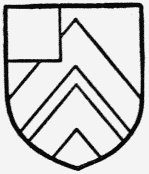
Criol. Or two cheverons and a quarter gules.
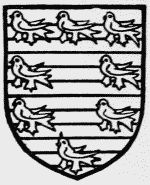
Chaworth. Burelly argent and gules an orle of martlets sable.
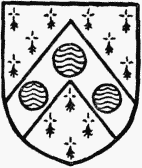
Cust, Earl Brownlow. Ermine a cheveron sable with three fountains thereon.
The manor of LAUNCELENES, consisting of 70 acres of land, 3 acres of meadow, and 5s. rent, was held in 1361 of the heir of Roger Launcelene in free socage for the service of one pair of white gauntlets worth a halfpenny. (fn. 55) John son of William Aignel died seised of this manor in that year, (fn. 56) and from this time it appears to have descended with the manor of Pendley (q.v.), (fn. 57) into which it was evidently merged early in the sixteenth century. (fn. 58) In 1331 John Aignel obtained licence to have an oratory in his manor house in Aldbury, which was probably the house of this manor. (fn. 59)
William de Mandeville was holding land in STOCKS (Stok) in 1176–7, (fn. 60) and in 1270 John de la Stock died seised of a carucate of land in la Stock, held in free socage of the heir of Ralph de Querdon, and of a small piece of land held of Katherine, daughter of Arnold de Berkele in free socage. His heir was a minor, whose name is not given. (fn. 61) In 1273 Walter de la Mare and Katherine his wife, in whom we may perhaps recognize Katherine Berkele, conveyed rent in La Stok to Master Henry Sampson, who was to hold it of Walter and Katherine for the service of one clove gilly-flower, (fn. 62) and in the same year Thomas de Brayford conveyed a messuage and land in La Stok to the same Henry, to be held of Thomas and his heirs for a rent of 6d. at Easter. (fn. 63) Richard de Cantilupe also held land here in the reigns of Henry III and Edward I. (fn. 64) In 1280–1 Adam Wace granted a tenement, which Adam Cotton and Maud held for life, to Walter de Agmondesham, (fn. 65) and in 1283–4 Walter conveyed it to Humphrey de Bohun, earl of Hereford and Essex. (fn. 66) Henry de Bohun in 1277–8 made the men of la Stok come to his view of frankpledge at Agmondesham in Buckinghamshire, (fn. 67) and in 1286–7 a new warren at Stok was made by Humphrey de Bohun. (fn. 68) In 1318 a piece of land called 'Stockyngge' was granted by Philip de Aylesbury to William de Dunhamstede and Alice his wife, with remainder in tail to Thomas, William's brother, and reversion to the grantor. (fn. 69) No mention of Stocks has been found since this date till the seventeenth century, when it was in the possession of Robert Duncombe, son of William Duncombe of Barley End, ancestor of the Lords Feversham, who died in 1630. (fn. 70) From Robert, Stocks descended to John Duncombe, on whose death in 1728 (fn. 71) the estate came to his son John, who died in 1746, and was buried in Aldbury church. The second John left a son Arnold, who died without issue, leaving William Hayton, son of his sister Elizabeth, wife of William Hayton, his heir. (fn. 72) William died without issue in 1811, and was succeeded by his niece Harriot, wife of James Gordon, daughter of William's half-sister Harriot, the wife of Samuel Whitbread. (fn. 73) James Gordon died in 1832, leaving James Adam Gordon his son and heir, (fn. 74) who died in 1854, leaving Stocks to his widow, Emma Katherine, daughter of Thomas Wolley, for life, with a choice of persons to whom it should go on her death. James Adam Gordon was a friend of Sir Walter Scott, and there is a tradition, which seems to have some foundation in fact, that the poet visited his friend at Stocks. Mr. Gordon's widow afterwards married Richard Bright, M.P. for East Somerset, who died at Stocks in 1878. Mrs. Bright died in 1891, and left the estate to Sir Edward Grey, present minister for Foreign Affairs, as descendant of Mary daughter of Samuel Whitbread. (fn. 75) He shortly afterwards sold the house to Mr. T. Humphry Ward, whose wife, Mrs. Humphry Ward, is the well-known novelist.
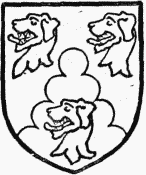
Duncombe. Party cheveronwise engrailed gules and argent with three talbots' heads razed and countercoloured.
Robert Dogget bought land in Aldbury from Edward Verney in 1557. His name also appears in the Subsidy Rolls for 1566, (fn. 76) and in 1615 CHERRYWICKE in Aldbury, described as a manor, was sold by Edward Dogget, son and heir of Edward Dogget of Wigginton, deceased, to Francis Bellingham and Mary his wife. (fn. 77) In 1638 John Dogget held several pieces of land in Aldbury, near to the churchlands. (fn. 78)
CHURCH
The church of ST. JOHN THE BAPTIST has a chancel 13 ft. 6 in. wide by 27 ft. 3 in. long, with north chapel and vestry, nave of the same width 59 ft. long, with north and south aisles and south porch and west tower. Nothing older than thirteenth-century detail is now to be seen, a window at the north-east of the chancel dating from the first quarter of this century. The chancel arch and nave arcades (the two eastern bays of the north arcade are modern) are all of one pattern. The arches are pointed, of two hollow-chamfered orders, a detail of frequent local occurrence, but difficult to date within narrow limits, as it was used without essential difference from the thirteenth century (as at Flamstead) to the fifteenth. The mouldings of the capitals suggest a date early in the fourteenth century, and it is difficult to see any evidences of difference in date, as far as masonry details are concerned. The break in the south arcades of the nave between the second and third piers probably gives the position of the east wall of an earlier nave, whose width of about 13 ft. 6 in. is retained, its length having been about 38 ft.
The probable development of the plan was that the present chancel was added to the east and outside the lines of an earlier chancel about 1220, the area of the old chancel being thrown into the nave. Aisles to the nave were perhaps added at this time, or may have existed previously, and probably some transeptal arrangement flanked the new east end of the nave. About the end of the thirteenth century, or beginning of the fourteenth, the present chancel arch and nave arcades were set up, and the aisles were perhaps widened at the same time.
The tower seems to have been added later in the fourteenth century, and the widening of the east end of the north aisle may be connected with the foundation of a chantry by Sir P. Aylesbury in 1335. (fn. 79) An opening from the east of the north aisle witnesses to the existence of a north chapel in the first half of the fourteenth century, but the existing chapel contains nothing older than a sedile of c. 1400. The church underwent much repair in 1867, and a great part of the window tracery is modern; the tower and south porch were repaired in 1905.
The chancel has a three-light window of geometrical style with modern tracery. In the north wall near the east angle is a thirteenth-century lancet window with an outer rebate, and below it a fourcentred recess, probably of the fifteenth century. The rest of the north side of the chancel is occupied by a modern arcade of two bays, opening to the north chapel. In the south wall is a two-light window of fourteenth-century style, and a plain doorway, the masonry being modern in both, and near the southwest angle a small lancet window, low in the wall, its external stonework being modern. In its west jamb is a squint from the east end of the south aisle.
The chancel arch is of two hollow-chamfered orders with half-octagonal moulded capitals, the upper member of which has been cut away. Above the arch the wall sets back on both faces.
The north chapel has a three-light east window, and a north window of two lights, the tracery being modern in both. At the south-east is a cinquefoiled piscina, and adjoining it on the west a single sedile with an ogee head cinquefoiled. The date of both is c. 1400, but half the head of the sedile is modern. In the north-east angle is a marble altar tomb of 'London' type in Purbeck marble, in the slab of which are inlaid brass figures of Sir Ralph Verney, 1546, and Elizabeth (Bray) his wife, with nine sons and three daughters. At the corners of the slab are four shields with heraldry, and there have been others on the sides of the tomb, but these, with the marginal inscription, are lost. Sir Ralph wears a tabard with his arms of Verney quartering an unknown coat (fn. 80) and Whittingham. His wife bears on her mantle the same arms, together with the Bray quarterings; and of the four shields one bears Verney and another Bray, while the remaining two have the two coats impaled.
On the north wall is an alabaster and marble monument to Thomas Hyde, 1570, and George his son 1580. It has a cornice and broken pediment, carried by three Corinthian columns, the panels between which are carved with strap-work with a skull in the centre of each. Above the cornice are the arms of Hyde of Aldbury, while beneath the panels are lozenges with the Butler arms and the arms of Sedley. On the west wall is a black marble panel in a white marble frame, the monument of Thomas Hyde of Aldbury, 1665.
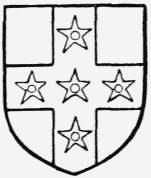
Verney. Azure a cross argent with five pierced molets gules thereon.
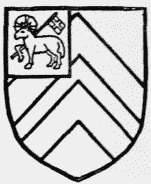
Verney. Azure two cheverons or and a quarter argent with a paschal lamb gules.
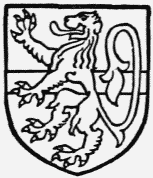
Whittingham. Argent a fesse vert and a lion gules over all.
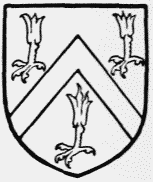
Bray. Argent a cbeveron between three eagles' legs razed sable.
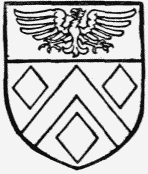
Hyde of Aldbury. Or a cheveron between three lozenges azure and a chief gules with an eagle or therein.
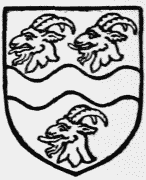
Skdley. Azure a fesse wavy between three goats' beads razed or.
The nave is of five bays with arcades as already noted. The north aisle for 16 ft. 6 in. from the east is 13 ft. wide, and for the rest of its length 10 ft. 6 in. wide. In its east wall is a fourteenth-century arch of two orders dying out at the springing, and to the north of the arch the remains of a late fourteenth-century canopied niche. In the north wall of the wider eastern part of the aisle is a window of three trefoiled lights, originally of the fourteenth century but now in modern stonework. A fourth light, with a cinquefoiled head, has been added on the east, apparently in the fifteenth century, though the stonework is now modern. The narrower part of the aisle is lighted by two square-headed windows, each of two trefoiled lights, the stonework being modern, and west of them is a plain north door also in modern stone. In the west wall is a two-light window with tracery in the head, with modern stonework like the rest. The east end of the south aisle is taken up by the fine altar tomb of Sir Robert Whittingham, 1471, brought to Aldbury, with its inclosing stone screens, from the church of the suppressed house of Bonhommes at Ashridge in 1575 by Edmund Verney. On it lie the stone effigies of Sir Robert Whittingham and his wife. He is fully armed in plate with a mail hauberk and wears a collar of SS and a short surcoat on which are the arms of Whittingham. His head rests on a helm which has lost its crest but retains the crest-wreath, and at his feet is a wild man with a club. His wife's feet rest on a hind. The tomb has been somewhat altered, probably at its removal from Ashridge, and the slab has a gadrooned edge of Elizabethan style. The sides are panelled, having five panels on north and south and three at east and west. On the west end are two female figures and between them a shield with azure two cheverons or and a quarter argent with a paschal lamb gules, (fn. 81) quartering Whittingham. On the east end is an armed man between two shields of Whittingham and Verney. On the north side; (1) Verney quartering Verney (?) and Whittingham, (2) an armed man standing, (3) Whittingham impaling Bockland, (4) as (2), (5) as (1) on this side, and on the south side (1) as (1) on north, (2) Verney, (3) as (3) on north, (4) Verney, (5) Bray, the cheveron and eagles' legs, quartered with another Bray coat, vair three bends gules, with an escutcheon quarterly of Halliwell, (fn. 82) Boteler, Norbury, and Sudley. A brass plate on the south wall of the chapel, which must date from 1588 or soon after, records the history of the tomb, how it was set up in 'the Monasterie of Ausheritch,' Sir John Verney, husband of Margaret sole heir of Sir Robert Whittingham, being afterwards buried in it with his wife, as was his son Sir Ralph Verney and Anne his wife. Then it was moved to Aldbury in the eighteenth year of Elizabeth and the chapel and vault made by Edmund Verney, his wife Dame Audrey (Carew) being buried here in 1588. It is not clear whether the making of the chapel implies a rebuilding of the walls, but it more probably refers to the setting up of the stone screens which were brought from Ashridge with the tomb and still inclose it. They are good specimens of fifteenth-century tracery, but that on the north side has been lowered and part of it taken back to Ashridge. The chapel has no east window, the wall being occupied by the marble monument of Sir Richard and Lady Anderson, 1699 and 1698, and an inscription to Simon, Henry, and John Harcourt. There are two funeral helmets in the chapel. In the south wall is a square-headed window of four cinquefoiled lights in modern stonework and in the aisle west of the chapel two square-headed windows, each of two trefoiled lights, on either side of the plain south doorway. The west window of this aisle is like that in the north aisle. Over the doorway is a stone porch with an upper room, rebuilt in 1871, of fifteenth-century style, the stair to the upper room opening to the aisle.
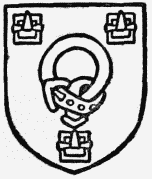
Bockland. Sable a garter between three square buckles or.
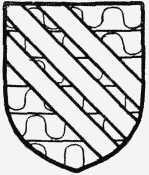
Bray. Vair three bends gules.
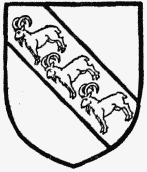
Halliwell. Or a bend gules with three goats argent thereon.
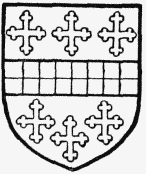
Boteler. Gules a fesse checky argent and sable between six crosslets or.
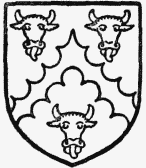
Norbury. Argent a cheveron engrailed between three bulls' beads cabossed sable.
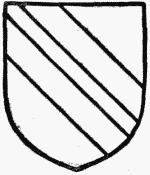
Sudley. Or two bends gules.
The west tower is tall, of three stages with an embattled parapet, and belfry windows of two cinquefoiled lights with a quatrefoil in the head. The east arch of the tower and probably part of the walling of the lower stages is of fourteenth-century date, but the upper stages seem to be entirely of the fifteenth century. All are much repaired with modern stonework, and externally there is little old masonry to be seen in any part of the church. The roof timbers are also modern, but a few old bench ends with moulded uprights remain. In the north aisle and in the Verney chapel are a few mediaeval floor tiles, but there are no remains of ancient glass or paintings. A small brass of good style with a figure and inscription to a boy John Davies, son of Henry Davies of London, mercer, 1478, is set in the wall below the eastern corbel of the north arcade of the nave.
The font, under the tower, is modern, with a round bowl of Bath stone and a central stem flanked by four columns of serpentine.
There are four bells, the treble by Robert Oldfeild, 1634, the second by Chandler, 1655, the tenor by Richard Chandler, 1683, and a small priest's bell of 1840. On the bell frame is cut 'I. E. Marton gave this bel frame 1681.'
The church plate consists of a vase-shaped secular cup used as a chalice, with fluted sides and an embossed cover and foot, bearing the London hall-mark for 1514, and a paten and flagon dated 1803.
The first book of the registers contains baptisms, burials, and marriages from 1693 to 1773, the second book those from 1774 to 1804. The third contains baptisms and burials from 1804 to 1812 and the fourth book marriages between the same dates.
ADVOWSON
The church of Aldbury was granted early in the thirteenth century by William de Bocland to the canons of St. Mary, Missenden, together with a virgate and a half of land which Robert de Breccesdune held, with all the assart which Archibald took from the wood of Aldbury, except 3 acres which Robert held of William in chief. (fn. 83) The church was held by the abbot and canons till the dissolution, when the advowson of the rectory was granted in 1546–7 to Thomas Babington and John Hyde, (fn. 84) and subsequently passed with the manor to Robert Hyde who died seised of it in 1607. (fn. 85) From this point the descent of the advowson is identical with that of the manor (q.v.), Earl Brownlow being the present patron.
A chantry in the parish church of Aldbury was founded in 1335 by Philip de Aylesbury, then lord of the manor, who obtained licence to alienate a messuage, land, and rent in Aldbury to a chaplain, to celebrate divine service daily in the chapel of St. Mary, Aldbury, for the soul of Philip and the souls of his ancestors for ever. (fn. 86) From its foundation till the dissolution the advowson of this chantry remained in the hands of the lords of the manor. (fn. 87) Its revenues, amounting in all to 65s., consisting of rent from various tenements, and from a tenement called the 'Chantry House,' let to William Butler for fifty years in 1543, had been given to the parson of the parish in augmentation of his living. (fn. 88) The chantry house and closes called Hall Closes, Preests Close, and Reve Close, with land in Shepley, Micklefield, and Mogborowe, were granted in 1548 to John earl of Warwick, Richard Forsett and Margaret his wife, and the heirs of Richard. (fn. 89) The chantry house subsequently came to Robert Hyde, lord of the manor of Aldbury, who died in 1607, (fn. 90) when it passed to his brother Nicholas, on whose death in 1625 it came to Thomas his son, (fn. 91) and probably followed the descent of the manor.
Land in 'Mychellfyld' and Staynefilde and rent from Donaines land had been given time out of mind for finding lights in the church. (fn. 92)
Edmund earl of Cornwall in 1297 granted to the rector and brethren of Ashridge a rent of £8 from the lands of Bertram de Criol for the maintenance of a chaplain to celebrate divine service daily in the chapel of Hamelden. (fn. 93) This chapel is mentioned in the inquisition taken after the death of Bertram de Criol, (fn. 94) but its site is not apparently known. The rent of £8 was granted in 1544 with the advowson to Thomas Babington and John Hyde. (fn. 95)
There was in the fifteenth and sixteenth centuries a church house which was held by the churchwardens for the use of the parish together with 2⅓ acres of land. (fn. 96)
The first registration of a place of meeting for Dissenters in Aldbury occurred in 1691, but no house is specified. In 1699 the house of Austin Brooks was certified as a place of meeting, and other registrations followed in 1707, 1747–8, 1795, 1809, and 1827. (fn. 97) There is no Nonconformist chapel in Aldbury at the present time.
CHARITIES
Sir Thomas Hyde, bart. by his will left £120 for the benefit of the poor of this parish. In 1675 a close of land called Butts Field in Berkhampstead St. Peter, containing 6 acres or thereabouts, was purchased therewith. The land was sold in 1886, and the net proceeds invested in £1,425 10s. 4d. consols with the official trustees. The dividends amounting to £35 12s. 8d. were in 1905–6 divided as to £11 5s. amongst old and infirm widows and widowers, £10 3s. 6d. amongst deserving poor generally, and the balance among children of poor persons.
Poor's Land and Houses Charity.
—There are no documents extant showing the origin of this charity; but there were formerly certain tenements called Church Houses adjoining the churchyard, which were some forty years ago thrown into the churchyard; there are still four tenements in the village street occupied by poor persons who are in receipt of parish relief; there are also a piece of land containing 3 roods 2 poles in the parish of Tring, and three pieces of land in Aldbury containing together 2 acres 2 roods 35 poles. The several pieces of land are let at rents amounting to £4 12s. a year, which are applied in keeping the poor's houses in repair. Under the provisions of the Local Government Act, 1894, the Parish Council nominate members of their body to be trustees of the above-mentioned charities.
In 1721 Simon Harcourt by his will gave £150 to be laid out in land, the rent to be applied in the distribution of bread among the poor of the established church. The legacy was laid out in the purchase of three pieces of land in the parish of Buckland, county Bucks., containing about 10 acres or thereabouts, now let at £8 a year, which is applied by the minister and churchwardens in the distribution of bread.