A History of the County of Hertford: Volume 2. Originally published by Victoria County History, London, 1908.
This free content was digitised by double rekeying. All rights reserved.
'Berkhampstead St Peter: Introduction, honour, manor and castle', in A History of the County of Hertford: Volume 2, ed. William Page (London, 1908), British History Online https://www.british-history.ac.uk/vch/herts/vol2/pp162-171 [accessed 30 April 2025].
'Berkhampstead St Peter: Introduction, honour, manor and castle', in A History of the County of Hertford: Volume 2. Edited by William Page (London, 1908), British History Online, accessed April 30, 2025, https://www.british-history.ac.uk/vch/herts/vol2/pp162-171.
"Berkhampstead St Peter: Introduction, honour, manor and castle". A History of the County of Hertford: Volume 2. Ed. William Page (London, 1908), British History Online. Web. 30 April 2025. https://www.british-history.ac.uk/vch/herts/vol2/pp162-171.
In this section
BERKHAMPSTEAD ST. PETER or GREAT BERKHAMPSTEAD
Beorhhamstede, Berchehamstede, xi cent.; Berchamstede, Berkhamsted xii to xiv cent.
The parish of Berkhampstead comprises 4,345 acres of land and 19 acres of land covered by water. Of this, 1,484 acres are arable, 1,265 acres are permanent grass and 312 acres are woodland. (fn. 1) It includes the hamlet of Potten End (two miles to the north-east of the town on the top of the hill, made into an ecclesiastical parish in 1894 and served by the church of Holy Trinity, built in 1860), comprising an inn, the large nursery gardens of Messrs. Lane & Son, and a small collection of cottages; the hamlet of Frithsden, on the Buckinghamshire border, picturesquely lying in a hollow, and the small hamlet of Little Heath.
As in all western Hertfordshire, this parish was apparently at one time forest land; the extensive wastes, described in mediaeval times as woods, the frequent references to assarted lands, the large amount of pannage which is recorded in the Domesday Book, and also the great extent of the manor, which included the parish of Northchurch, all point to this conclusion. We have also here, as elsewhere in western Hertfordshire, the usual holding, within the manor, of a messuage and a carucate of land. (fn. 2) The River Bulbourne and the Grand Junction Canal, which runs beside it, pass through the parish from north-west to south-east, the town lying mostly in the valley of the river and being about 375 ft. above the ordnance datum. The hills on either side of the river rise in places rather steeply to a height of about 550 ft. The subsoil is chalk and the upper soil is of gravel and flints, lending itself to the cultivation of wheat and to the growth of beechtrees, which are abundant in the neighbourhood.
Whether the Grim's Dike, which passes across Berkhampstead Common, is pre-Roman or later has not yet been satisfactorily settled. A copper coin of Cunobeline, a British gold coin (uninscribed), and others of this and the Roman period have been found. (fn. 3)
The Roman road called Akeman Street, the main highway from London to Aylesbury, runs through the parish, and there are numerous roads northward and southward. It is evident that the kings of England utilized Berkhampstead Castle as a stopping place in their journeys to the north-west counties when travelling along the Akeman Street, and they maintained here great stables, which are frequently referred to in the accounts and surveys of the castle and manor. (fn. 4) There is a railway station at Berkhampstead on the main line of the London and North Western Railway, opened 1 January, 1838. A new station was built in 1874.
Among the older place-names are the following:—le Corourstrete, Strickelane, le Shopperowe (probably now Middle Row), Northmulane, Jacobsbern, Hulfed, the field of St. Edmund (behind the cemetery), le Foulsho, Pourputte, and Benethenstrete. It is difficult in the survey of the manor to distinguish whether the following places are in the parish of Great Berkhampstead or Northchurch, viz. Westhalfden, Wodgrene, le Synyldeffeld, Sokereweye, Polfotesland, Haryngeshangre, le Maysterland and Froggemordan.
A portion of the beautiful park of Ashridge attached to the seat of Earl Brownlow lies in this parish, besides which there are also parks at Ashlyns Hall, Haresfoot, and Berkhampstead Place, which last now comprises only a small part of the original park of the castle. Berkhampstead Common, where there is a golf course, and the Frith are two very large commons situated on the high ground on the north-east side of the manor. In 1357 the wood called the Frith is said to have contained 763 acres I rood of land, the herbage of which was common to all the tenants as well free as villein, except in the time of pannage, which extended from the feast of St. Michael to the feast of St. Martin; in return for this right, the tenants of the borough, except widows, had to mow and do other work on the lord's lands. (fn. 5) It appears from some legal proceedings in the time of Edward VI that the tenants and inhabitants of the lordship of Berkhampstead and the towns and parishes of Berkhampstead, Northchurch, Aldbury, Pitstone, Cheddington, Little Gaddesden, Frithsden, Nettleden, Hemel Hempstead, Bovingdon, and Flaunden, to the number of 2,000, also claimed common rights here. (fn. 6) There are many small pieces of waste land or greens in the parish.
The requirements of the castle brought a large general trade to the town in the mediaeval period; at the same time, however, there was beyond these some trade in timber, probably on account of the quantity of beech-trees grown in the neighbourhood. In the early part of the thirteenth century we find reference to the manufacture of roofing tiles, (fn. 7) and in 1440 to lime kilns. (fn. 8) Norden, writing in 1616, says that the making of malt was then the principal trade of the town. There is now a large trade in timber, a quantity of which is brought by the canal. Tent-pegs, pick-handles, brushes, and other like articles, are made in considerable quantities, and the large agricultural chemical works of Messrs. William Cooper & Nephews, the boat and barge building works of Mr. W. E. Costin, and the nursery gardens of Messrs. H. Lane & Son, give occupation to many persons. The town, however, probably owes its principal support to the educational advantages of its schools.
Perhaps the most important occurrence in the history of Berkhampstead is the submission here of the English to William the Norman in 1066. We learn from the Anglo-Saxon Chronicle (fn. 9) that after the battle of Hastings and the death of Harold, Archbishop Aldred and the people of London chose Edgar Atheling as their king, so William marched from Hastings, crossing the Thames at Wallingford, laying the country waste as he went, till he came to Berkhampstead. Here, however, there came to meet him Edgar Atheling, Aldred archbishop of York, Earls Edwin and Morcar, and all the chief men of London, 'and then from necessity submitted when the greatest harm had been done; and it was very imprudent that it was not done earlier, as God would not better it for our sins: and they gave hostages and swore oaths to him; and he promised them that he would be a kind lord to them.' William then went to Westminster, where he was crowned king by Archbishop Aldred.
Berkhampstead was visited in 1643 by a violent pestilential fever. Twenty families, consisting of eighty persons, had to be cared for at the parish expense, and though the collection had been doubled, the parishioners were unable to meet the additional expense and begged for help from neighbouring towns. (fn. 10)
William Cowper the poet was born at his father's rectory of Great Berkhampstead in 1731, and in the garden there is a sundial which marks the site of the old well-house known as Cowper's Well. He died in 1800, and the east window in Berkhampstead church is dedicated to his memory; there is also a mural tablet in the church to Anne Cowper, the poet's mother. George Field the chemist, inventor of improved methods of preparing pigments and dyes, was born at Berkhampstead about 1777. Thomas Dorman was born at Berkhampstead and studied at the free school there under Richard Reeve. Being opposed to the religious changes which took place in the early years of Elizabeth's reign, he went abroad and continued his studies at Louvain. In 1569, on the invitation of William Allen, founder of the English college at Douay, he settled there, and for a while 'assisted both with his purse and learning towards that establishment.' Henry Johnson, the traveller, resided towards the end of his life at Berkhampstead, where he died in 1760. Sir George William Lefevre, a physician of some eminence, was born at Berkhampstead in 1798. In 1842 he published The Life of a Travelling Physician, and he was the author of several medical works.
It would seem probable that at one time the present parish of Berkhampstead St. Peter, or Great Berkhampstead, which is bounded on the east and west sides by the parish of Northchurch or Berkhampstead St. Mary, formed a part of the latter parish. In the entry in the Domesday Survey relating to Berkhampstead there is mention of a priest with fourteen villeins, possibly indicating a manor of the rectory, which we know existed at Northchurch, (fn. 11) while there is no evidence of such a manor at Great Berkhampstead, so that we may perhaps recognize the priest of Domesday as belonging to Northchurch. It was most unusual, at all events in this part of the country, to find two parishes occupying the whole extent of one manor. Between 1087 and 1104 William count of Mortain granted the advowson of the church of Berkhampstead, probably the church of Berkhampstead St. Mary, together with the advowson of the chapel of the castle and the tithes and lands which Godfrey the chaplain held, to the monastery of St. Mary of Grestein in Normandy, (fn. 12) and it was about this time possibly that the parish of Great Berkhampstead was created.
The chapel of Godfrey the chaplain we may perhaps identify with the chapel of St. James, which seems to have been the parochial chapel of the borough, with its churchyard and consequently its parochial rights of burial. (fn. 13) It would seem that about the time of the charter of confirmation by King Richard I or a little later a new church dedicated to St. Peter was commenced, probably by Geoffrey Fitz Piers, which took the place of the old chapel of St. James. When the existing church was built early in the thirteenth century and the parish of St. Peter probably formed, the abbot of Grestein relinquished the patronage of the old church of St. Mary, retaining only a pension of £2 a year from it. (fn. 14)
The chapel of St. James, already referred to, stood apparently on the south side of the main road between Berkhampstead and Northchurch. (fn. 15) Adjoining it was a well called St. James's Well, which was probably the principal water-supply to the town. (fn. 16) The two keepers or wardens of this well were recognized officials of the Portmote Court, and regulated the use of the water. In 1400 these officers presented persons for washing their clothes at the well against the ordinances. (fn. 17)
It is worth noting that the fair (so frequently held on the feast of the saint to whose honour the parish church is dedicated) was held on St. James's Day. (fn. 18) It is possible that the gild organization, which there is little doubt existed in connexion with the chapel of St. James from the survival in the appointment of wardens of the well, was continued by Geoffrey Fitz Piers in the brotherhood of St. John the Baptist. This may be the cause of the confusion in the name of the well, and the position of St. John's Well in Mr. Lane's nursery garden corresponds to the position of St. James's well given in the surveys of the manor of the seventeenth century.
The town of Berkhampstead lies principally along the Roman Akeman Street, here called the High Street, and stretches for about a mile on each side of the church, which stands in the middle of the town on the north side of the street. Leading down from the east end of the church to what was the principal gate of the castle, but now the way to the railway station, is Castle Street, formerly Castle Lane. These, with Ravens Lane (Ravenyngeslane), probably called after the family of Raven living here in the fourteenth century, Green Lane (Greneweylane), Mill Lane, and Elvenweye, afterwards Grubs Lane and now Chesham Road, Water Lane, and the Wilderness, formed the old town. The High Street consists for the most part of two-storied houses or shops of brick and plaster, slated or tiled, the very varied styles of architecture of which are a pleasant and characteristic feature. Entering the town by the High Street from the east or London end, there will be noticed on the south side, The Hall, a large plastered building, the residence of Captain Constable Curtis. A little farther along, on the opposite side, are some old half-timber cottages and the Baptist Chapel, at the corner of Ravens Lane. On the south side are Three Close Lane and Highfield Road, with paths still paved with cobble stones, near to which is Highfield House, the residence of Mrs. Steward. Westward is Egerton House, a fine example of a sixteenth-century house, now occupied by Mr. Llewellyn Davis, and farther on the same side is the Red House, a large, comfortable house of red brick, with an exceptionally fine garden at the back. It was formerly the residence of John Tawell, who murdered a young woman at Slough in 1845, and was the first murderer caught by the aid of the telegraph. It was afterwards the residence of Mr. Robinson of the Coalbrookdale Ironworks, and is now occupied by Canon Alfred M. Norman, D.C.L., LL.D., F.R.S., whose researches in marine biology are well known. Almost opposite is the Manor House, or Pilkington Manor, a large plain house covered with plaster, now divided into three, the greater part of which is occupied by Mr. F. Farren. It is mentioned in Norden's survey (1616) as a capital messuage, called Pilkington's, in tenure of Francis Barkes. The grounds of this house, inclosed within high walls, formerly extended eastward to Ravens Lane, but were cut up and built over in the latter half of the nineteenth century. Opposite the church is an old sixteenth-century half-timber house recently restored, which is said to have been the residence of John Incent, dean of St. Paul's, a native of the town. To the north-west of the church is the court-house, where the port-mote or borough court was held. It is a half-timbered house with a fine open roof probably of sixteenth-century date. The ownership of this house seems to have been a matter of frequent dispute. It is said to have been built on the waste of the manor, and therefore claimed by the lord, while on the other hand it was alleged that it was built by the inhabitants for their own use. In the middle of the sixteenth century the court-house is stated to have belonged to the churchwardens, but in 1591 the crown granted it to Edward Stanley. (fn. 19) In Sir John Dodderidge's survey of the manor, made in 1607, this house is again stated to have been in the hands of the churchwardens for the use of the inhabitants, and was from time to time leased by them, provision being made in the leases for the use by the churchwardens of part of the house called the church loft. It seems to have remained in the possession of the churchwardens till about 1673, when an information was filed by the Attorney-General against the churchwardens as to their right, and judgement was given for the crown. (fn. 20)
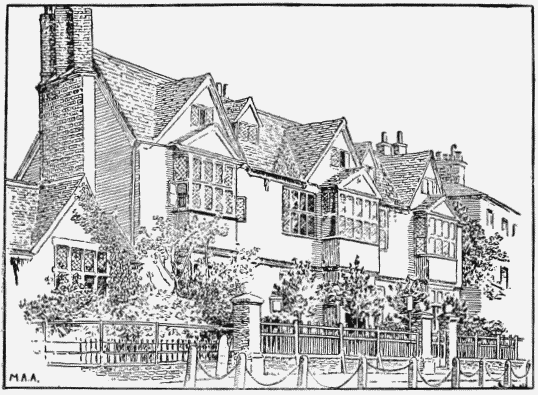
Egerton House, High Street, Great Berkhampstead
It seems afterwards to have passed with the manor, and in that way came into the possession of Earl Brownlow, who in turn granted it to trustees at a nominal rent to be used as a national school. To adapt it to this purpose the floor of the upper story or loft has been taken away, and additional school accommodation has been built on at the back.
Around the market-place are the principal inns, all eighteenth-century houses—on the south side the 'Swan,' the 'Crown' and the 'King's Arms,' and on the north the 'Bell'—remains of the time when Berkhampstead was an important posting town. The north side of the market-place is formed by a long narrow island of shops called Middle Row, behind which is a narrow lane called Back Lane. At the west end of Middle Row stood the market-house, built by the townspeople in the reign of Queen Elizabeth, (fn. 21) which contained the corn and butter market and the butchers' stalls. It stood upon oak posts, was open on the ground story, and had a loft or room above. In the front of it were the stocks, pillory, and whippingpost. It was burnt down in 1854, it is supposed by incendiaries. At the west end of Back Lane is a good sixteenth-century half-timbered house, now converted into a shop. On the opposite side stands the new police-station, on the site of which stood the 'cage' or place for the detention of prisoners, of which we have mention in 1616. (fn. 22) This was succeeded by the Bridewell, built about 1763, (fn. 23) a building constantly out of repair, and from which the prisoners frequently escaped even when fettered. (fn. 24) It is minutely described in a report of 1824, and consisted of a dwelling-house for the keeper and four bedrooms upstairs. There was one ward for men and another for women connected by a passage, and a dungeon or small cellar, which was, however, never used. It was devoid of ventilation, and quite unfit for a house of correction. (fn. 25) In 1843 it was decided after some alterations to adapt it for a police-station. (fn. 26)
Further westward along the High Street are the Sayer Almshouses, dated 1684, a range of low red brick buildings with sets of rooms for six widows, the Friends' Meeting House, the workhouse, Bourne's School, the Elms, a red brick house occupied by Mr. Herbert Smith, and Boxwell House, an eighteenth-century house of plastered brickwork with a slate roof, occupied by Mr. H. A. Mandeville. Beyond this is Gossams End, which takes its name possibly from the family of Gossam, concerning which there are many entries in the parish registers. To the south of this part of High Street is the district known as Kitsbury, which is named after Kitsbury Farm, the house of which stands near to the Union. The farm lands were first developed as a building estate about 1870, and since then roads have been made and streets of detached and semidetached houses erected, mostly to accommodate those who desire to participate in the educational advantages of the town.
In Castle Street is the grammar school founded by John Incent, dean of St. Paul's, and built by him in the year 1544. The school consists of a long narrow building lying nearly east and west, the east end abutting on the street. The building is of red brick with stone dressings to the doors and to some of the windows. The end portions consist of two stories and attics, and originally formed the residences of the head master and the usher. The head master still occupies the west end. The schoolroom is in the centre, and its high-pitched roof is continued over the end blocks, broken only by two gables on either side of each end block. The schoolroom is lighted by six three-light windows on either side with four-centred arches over them, the openings being filled with plain Gothic tracery. On the south front the moulded work to the windows is of stone, and there is a simple pattern over the windows executed in blue bricks. On the north front the mouldings and tracery have all been executed in brick (now cemented over), and each window has a relieving arch over it formed of alternate red and blue bricks. Both sides of the schoolroom are buttressed between the windows. The schoolroom and the usher's house are each provided with two outer doorways, one on each side of the building. All these doorways are of stone, having four-centred arches, with square moulded hoods over. The original wooden door still remains on the south side of the usher's house, and has some late moulded tracery in its head. The principal entrance to the head master's house is on the south side. This doorway is wider than the others and has a square-moulded lintel and hood mould over. The end gables on the south front are finished with brick saddle-backed copings; on the north they are flat. The chimneys on the ridge of the roof over the ends of the schoolroom each consist of one large shaft of brick, hexagonal on plan, each face being ornamented with a plain sunk panel with arched head. The other chimneys are of the more usual type, with square brick shafts set diagonally in groups. The roof is slated, and a modern ventilating turret occupies the centre over the schoolroom. There is nothing in the interior of the end houses to call for special attention; they are very plain, but probably their arrangement has been little altered, though the head master's house has been added to on the west, and has had a bay thrown out on the north side.
The terrace walls and steps are said to be of the same date as the school.
The schoolroom internally measures about 59 ft. by 28 ft., and has a high pitched open timber kingpost roof. The moulded tie-beams are supported at the ends by curved brackets resting on carved wooden corbels. Some of these corbels are grotesque figures, others bear the Incent arms, in one instance impaled with other arms. The Incent arms, flanked by the initials I. I. of the founder, which form the school arms, may also be seen on the hood termination over the north doorway to the schoolroom outside.
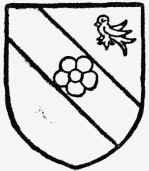
Incent. Or a bend gules with a rose or there-on and a martlet sable in the cantle.
In 1864 two blocks of buildings were added on the north side of the school, hiding a portion of the old work, and since then, under the headmastership of the Rev. Dr. Fry, the school has been greatly enlarged, but not in any way to the detriment of the old building. The school chapel, built in 1894 by Dr. Fry, is of red brick and tiled, and is copied from the church of La Madonna di Miracole in Venice.
There are several picturesque seventeenth-century cottages at the lower part of Castle Street, the most interesting of which is now used as a Roman Catholic chapel. The road here has been raised to form the approach to the bridge over the canal made about 1798, so that these houses being on the level of the old road are below that of the existing one.
HONOUR, MANOR, and CASTLE
Before the Conquest Berkhampstead was held by Edmer Atule, a thegn of King Edward the Confessor. (fn. 27) William I granted it to his half-brother, Robert count of Mortain, to whom he gave the county of Cornwall in 1068. William son of this Robert having joined in the rebellion against Henry I was taken prisoner and dispossessed of his lands in 1104, when the king gave them to his chancellor, Randulph, who was killed by misadventure at Berkhampstead in 1123. (fn. 28) The castle and honour again came to the crown, and were, it is supposed, given to Reginald de Dunstanvill, a natural son of Henry I, upon his creation as earl of Cornwall in 1140. Reginald died in 1175, and if he held the castle must have surrendered it before his death, as we find that in 1155 it was in farm from the crown to Thomas Becket, archbishop of Canterbury and chancellor of England, (fn. 29) who held it down to 1165, (fn. 30) when William of Windsor appears as farmer and so continued to 1174. (fn. 31) At this date the castle was apparently leased to William de Mandeville, earl of Essex, who probably held it till his death in 1189. (fn. 32) In the following year we find it in the hands of a warden on behalf of the crown. (fn. 33)
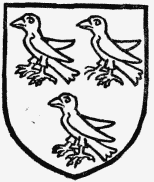
Becket. Argent three Cornish choughs.
About this time the honour with the castle and manor was apparently granted in dower to Berengaria, queen of Richard I, who was dispossessed by John on his accession to the throne. Pope Innocent III from time to time urged John to make restitution to his sister-in-law, and in 1209 threatened to place the honour and all the lands which the queen ought to have had as dower under an interdict till satisfaction should be made. (fn. 34) In the following year the bishops of Rochester and Salisbury were ordered to publish the sentence of interdict (fn. 35); the matter, however, was not settled till 1216, when a composition was made by the king for payment of arrears and the payment of an annuity to Berengaria. (fn. 36) In the meantime John had granted the farm of the honour to Geoffrey Fitz Piers, who became earl of Essex in right of his wife, in whose hands we find Berkhampstead in 1202. (fn. 37) In 1204 John settled the honour on Queen Isabella, his second wife, for life. (fn. 38) She however seems never to have had seisin, as a little later in the same year it was in the hands of a keeper on behalf of the crown, and on 29 May, 1205, it was granted to Geoffrey Fitz Piers, earl of Essex, and the heirs by his second wife, Aveline. (fn. 39) At the death of Geoffrey in 1212, nothwithstanding there was issue, a son by his second wife, Berkhampstead was placed in 1213 in the hands of a keeper, Terrice or Theodoric Teutonicus, on behalf of the crown, (fn. 40) and was held on behalf of the king till 1215, when the queen received a confirmation of the grant to her of 1204. (fn. 41) In 1216 Queen Isabella resided for some time at the castle, (fn. 42) and in December of the same year the castle was attacked by King Louis of France with the English barons, and, having withstood a fortnight's siege, surrendered.
After King John's death Isabella married Hugh Count de la March, and in 1222 the castle and honour were delivered to them. (fn. 43) On 5 October, 1220, Theodoric Teutonicus was ordered to deliver the castle to Hugh de Nazia, knight of the count of March, (fn. 44) and eighteen months later it was committed to Guy Peveril, knight of the count of March, and his wife. (fn. 45) Not liking however to leave so important a position as Berkhampstead Castle in the hands of a foreigner, Hubert de Burgh, the justiciar, and the council, and, later, King Henry III seem to have retained the control of it in their own hands. In November, 1223, the custody of the castle was granted to Geoffrey de Lucy, a servant of the king, and in June, 1224, the custody of the castle and honour, and of all lands which had belonged to the count of March and Isabella, was granted to Thomas de Cyrencestre. (fn. 46) The castle and honour were possibly granted to Richard, second son of King John, when he was created earl of Cornwall in 1225. On 4 January, 1244, they were confirmed to his wife Senchia as dower in case of his death. (fn. 47) Richard was a frequent resident at the castle (fn. 48) and died there in 1272. He was succeeded by his son Edmund earl of Cornwall, (fn. 49) who was born at the castle in 1249. (fn. 50) This latter earl died in 1300 without issue, when Edward I succeeded him as cousin and heir. (fn. 51) In 1303 Edward I granted the honour, including the castle and manor, in dower to Margaret of France, his second queen. (fn. 52) Edward II seems, however, to have dispossessed his step-mother and granted Berkhampstead to his favourite Piers Gaveston in 1309, (fn. 53) but in the following year he confirmed the charter to Queen Margaret, (fn. 54) who held it till her death in 1317, after which Edward II appears to have granted it to Isabella his queen. (fn. 55)
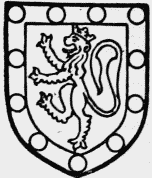
Cornwall. Argent a lion gules with a golden crown in a border sable bezanty.
In 1329 Edward III granted the castle and honour to John de Eltham, his brother, (fn. 56) who died in 1336 without issue, when the king took possession as brother and heir. (fn. 57) By an Act of Parliament of 17 March, 1336–7, the king created his son Edward (the Black Prince) duke of Cornwall and granted him the honour of Berkhampstead. (fn. 58) This prince resided for some time towards the latter years of his life at the castle, and during his tenancy, John king of France was confined here as a prisoner of war, being brought from Somerton Castle in Somerset in 1360. (fn. 59) From this date the honour followed the descent of the duchy of Cornwall and passed successively for some time to the eldest son of the reigning monarch.
In this way we find it went from Edward the Black Prince to his son Richard, who became Richard II, and it was at this time that Geoffrey Chaucer the poet was clerk of the works at the castle. (fn. 60) Immediately upon the accession of Henry IV in 1399, the castle and honour were granted to his son Henry prince of Wales and duke of Cornwall, (fn. 61) and later they appear to have been held by Margaret of Anjou, queen of Henry VI. (fn. 62) In 1459 they were delivered to Edward, prince of Wales and duke of Cornwall, her son. (fn. 63) After the accession of Edward IV they were granted in 1469 by the king to his mother, Cicely duchess of York, for life. (fn. 64) This lady resided at the castle till her death there in 1496, when the honour with the castle passed to her granddaughter, Elizabeth queen of Henry VII, as part of her jointure. (fn. 65)
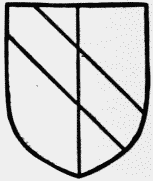
Chaucer. Party gules and argent a bend counter-coloured.
In 1509 the honour was granted as jointure to Katherine of Arragon (fn. 66) and was afterwards held successively as jointure by Anne Boleyn (fn. 67) and Jane Seymour, (fn. 68) queens of Henry VIII. From the date of the death of the latter the honour remained in the hands of the crown till the end of Henry's reign. Edward VI, in 1550, granted the manor and park to his sister the Princess Elizabeth for life, (fn. 69) and upon her accession to the throne she in 1559 leased the site of the castle with the castle mead, the long stable mead, and two water-mills to Sir Thomas Benger for fifty years. (fn. 70) This lease seems to have been surrendered and a fresh one made in 1580 to Sir Edward Carey and his wife, (fn. 71) who built the house now known as Berkhampstead Place, and when in 1610 the castle, manor, and lordship were granted to Henry, prince of Wales, eldest son of James I, (fn. 72) the prince paid Sir Henry Carey, son of Sir Edward, £4,000 for the newly erected house. (fn. 73) Prince Henry died in 1612, and in 1615 the honour was granted to his brother Prince Charles, (fn. 74) afterwards Charles I, who leased Berkhampstead Place to Thomas Murray. (fn. 75) In 1627 the grounds of the castle were disparked and reduced from 1,132 to 376 acres (fn. 76) and were leased to Jane Murray. (fn. 77) The unexpired term of the lease to Murray was in 1650 assigned to Major John Alford, in which year minute surveys were taken by the Parliamentary Commissioners. (fn. 78) In 1651 the trustees for the sale of the king's, queen's, and prince's lands sold to Henry Murray, son of Jane Murray, before referred to, the house and park containing 253 acres of land (fn. 79) with the site of the castle, and in 1656, since it was found that the sale to Henry Murray was in reversion after the expiry of the lease, and that Murray had assigned his interest to Thomas Aldridge and Mordecai Herne, the premises were confirmed by Cromwell to Aldridge and Herne, (fn. 80) whose under-tenant, Colonel Axtel, was at the Restoration hanged as a regicide. (fn. 81) The honour and manor were sold by the same parliamentary trustees in 1652 to Godfrey Ellis and Griffin Phillips. (fn. 82)
All these grants made during the Commonwealth became void at the Restoration, and the honour, castle, and manor returned to the crown, and, as parcel of the duchy of Cornwall, remained in the crown or the eldest son of the reigning sovereign till 19 March, 1862, when the manor was purchased by the trustees for John second Earl Brownlow, then a minor, whose brother now holds it.
Berkhampstead Place with the park containing 376 acres and other lands were in 1660 leased for thirty-one years to Jerome Weston, earl of Portland, (fn. 83) and during his tenancy the house was burnt, when about two-thirds of the mansion perished. In 1662 Lord Portland assigned the remainder of his lease to John Sayer, (fn. 84) in whose family the house remained till 1718, when it passed to the Atwells, and in 1720 to the Ropers, who received various renewals of these leases. In 1807 John Roper assigned his interest to John William earl of Bridgewater, to whose descendant, the Earl Brownlow, as is before mentioned, the manor, including Berkhampstead Place, passed by purchase from the duchy of Cornwall. Earl Brownlow also holds by lease the site of the castle.
The manor of Berkhampstead, which includes the parishes of Berkhampstead and Northchurch, was a liberty outside the jurisdiction of the sheriff. (fn. 85) The bailiff of Berkhampstead went before the justices at each circuit and demanded the liberties of this honour, whereupon the justices sent one of their number to hear all pleas within the honour. (fn. 86) There were two coroners, one for the liberty and the other for the borough. (fn. 87) The lord had all waifs, strays, goods of felons and treasure-trove. (fn. 88)
The lord of the manor appears to have had the fishery in any brook, water, or river within the manor from a place called Bulbourne Head and so along the river within the manor to King's Langley Park, without the bounds of the manor but within the honour. (fn. 89) Two mills are mentioned in Domesday, and in 1357 we have reference to the Castle mill, 'Sisethemulle' and 'Bankmulle,' (fn. 90) but in 1559 and 1627 we have mention of only two water-mills, (fn. 91) which were called the Upper and the Lower mills. (fn. 92)
There were three courts held in the honour and manor, (1) the Great Court held at Whitsuntide and Michaelmas; (2) the view of frankpledge, the attendance at which at an early date, owing probably to the inconvenience to jurors living at long distances, appears to have been commuted to a fixed yearly payment. (fn. 93) This court which corresponded to the hundred court was held usually in the castle, but in times of sickness it was held at an oak within the park or at a willow without the park, probably a survival of the earlier custom of holding the court in the open. (fn. 94) On the day following the above court there was another similar court held at the church-house of Berkhampstead. (3) The halmote courts or courts leet and baron of the manor were held fortnightly at the castle. The portmote court to which reference will be made in the history of the borough was also held fortnightly. (fn. 95) The only courts now held are those of the petty sessions, which are kept on the first and third Wednesday in each month.
The bailiwick of the liberty or honour of Berkhampstead was held as appurtenant to a messuage and thirty acres of land and four acres of meadow. In 1321 Geoffrey le Sumenour conveyed these lands, which are said to have been held by the service of executing all writs touching the liberty of Berkhampstead, to Thomas son of John de la Hay of Hemel Hempstead. (fn. 96) In the following year this grant was confirmed by John son of Geoffrey le Sumenour. (fn. 97) The bailiwick remained, it would seem, in the de la Hay family till the death of Edward de la Hay in 1510, when his daughters apparently sold it to Dr. Incent, who conveyed it to the grammar school, by the trustees of which the land is now held. (fn. 98)
In 1584 an agreement was made between the bailiff of the honour and the bailiff of the town whereby it was arranged that the latter should account for one-half of the fines, escheats, &c., collected in the town, to the bailiff of the liberty. (fn. 99) In 1649 the master and usher of the school leased the bailiwick of the honour to the bailiff and capital burgesses of the town. (fn. 100) Attached to the office of bailiff of the borough was about an acre of land, called in 1357 Reeveacre, situated in a common field called Nether Close. (fn. 101) This land was later called the Bailiff acre and was leased from time to time by the bailiff and capital burgesses of the town. (fn. 102)
CASTLE
Of the origin of the castle little can be said. The position is well chosen, commanding the narrow valley through which both road and river pass, and for that reason alone an early date for the making of a stronghold here is likely. William's march to Berkhampstead after the battle of Hastings, and his reception there of the submission of the English, is a further witness to its importance. In Domesday Berkhampstead is entered as part of the possessions of Robert, count of Mortain, having formerly been held by Edmar, a thegn of Earl Harold. Mr. Round is of opinion (fn. 103) that the terms of the entry suggest that the count actually resided here, the existence of a vineyard and of a 'burbium' with fifty-two burgesses pointing in this direction. More important is the mention of a 'fossarius,' one whose duty it was to look after the earthworks, and whatever may be the date of the first occupation of the site there can be little doubt that the mount and main lines of the existing earthworks were in existence at the time of the Survey, and may be the work of Count Robert.
In 1104 the castle was in the king's hands and was dismantled, but in 1123 Henry I came to Berkhampstead after spending his Christmas at Dunstable, (fn. 104) and probably lodged in the castle.
The first entry in the Pipe Rolls referring to Berkhampstead is in 1155–6, when 63s. was spent on the work of the castle. In the following year £10 was spent on repairing the king's houses within the motte or mount and for one chamber within the bailey 40s. In 1159 £13 was spent on the work of the chamber and the motte, and in 1160 building on a considerable scale was in progress. The engineer (ingeniator) received 48s., and there was spent on the castle works £43 6s. 8d., together with £4 15s. for finishing the work on the chamber, £8 for two limekilns, and 107s. 7d. for carriage of stone.
Nothing is entered on the roll for 1161, but in 1162 £34 was spent on the castle works. Then in 1170 £5 is entered for repairs to the king's houses in the castle, and £18 in 1172. This appears to cover work done at various times between 1163–72, as it is stated to be de pluribus annis. In 1173 £60 1s. 4d. was spent on the castle, the lodgings, granary, and bridges; and in 1180 is an entry of £23 for repair of lodgings, bridges, and gates of the motte of the castle for three years past, and another of £7 4s. 7d. for similar expenses during the current year.
In 1181 £5 8s. 6d. was spent in repairs, and £4 0s. 9d. in 1182, and then, with small sums in 1185–6, 14s. 6d. and 25s. 7d., the entries ceased.
At the end of John's reign in 1215, doubtless in view of the unsettled state of the kingdom, an order was given to take from the wood of Berkhampstead so much as was necessary for fortifying the castle. In the next year the defences were put to the test, when Louis of France besieged the castle, and, in spite of several spirited sallies by the garrison, took it after a fortnight's attack, mainly by the strength of his mangonels and other engines of war. He directed a continuous fire of destructive missiles (damnosi lapides) from all sides on the castle, and the commandant Waleran, a German by birth, 'after manfully resisting with his companions in arms, and sending to Hell the souls of many excommunicate Frenchmen,' (fn. 105) surrendered by order of the king on 20 December, 1216.
The amount of damage done in the siege is nowhere stated, but repairs were going on from 1224 to 1227, and again in 1243, and in 1254 (fn. 106) Richard earl of Cornwall built a tower of three stories and covered it with lead. In 1269 (fn. 107) various repairs were ordered to the barbican, and the lead of the great tower and of the turret over the sally port was remade. The chambers of the king and queen, the chapel of the queen, and the chamber of the nurse are mentioned, and there is a very interesting reference to the chamber of St. Thomas. Thomas Becket, while chancellor, was in charge of the works at the castle from 1156 to 1160, and the chamber is no doubt named from him. One of the charges against him when he fell into royal disfavour related to the expenditure upon the works of the castle. (fn. 108)
A view of defects taken in 1327 (fn. 109) gives a good deal of information about the buildings. At the entry of the castle was a barbican of stone, a great part thrown down, and the two wooden bridges at the entry were ruinous. In the circuit of the curtain wall were ten turrets, both curtain and turrets being in need of repair in places, as was the great tower or keep. Within the area of the castle were houses with tiled roofs, many in a bad state.
Again, in 1336, a commission to survey (fn. 110) was issued, and the report, dated 11 Edward III, suggests that the former survey had no results, as there is much in need of repair. The great tower was split in two places and needed a new roof, the wall and turrets were in a bad state, the outer gate and barbican were entirely in decay; the lower gate required support from a buttress, the dernegate was also in a bad state, and many things were wanting to various dwellings and rooms, as the great painted chamber, with the chapel adjoining, also the great chapel, &c.
In 1361 the castle was put in order in readiness for the coming of John king of France, as a prisoner of war, but from this time onward there is no record of any important building operations. The castle ceased to be inhabited some time between 1495, the date of the death of Cicely duchess of York, and 1540, about which time Leland noted that it was 'much in Ruine,' (fn. 111) and from the latter part of the sixteenth century it served as a quarry for building materials.
Parts of the curtain walls are still standing, with a projecting tower on the west, but the chief interest centres in the earthworks, which are on the whole well preserved. They are of the mount and bailey type, and consist of an oblong inclosure measuring about 450 ft. from north to south by 300 ft. from east to west, having at the north-east corner an approximately circular mount about 45 ft. high by 180 ft. in diameter at the base and 60 ft. at the summit. The whole is surrounded by a wide ditch, beyond which is a bank, a second ditch, and an outer bank, the last line of fortification having been obliterated on the south and west by the railway and a road. The fall of the ground is from north-west to south-east, and the ditches, which were wet, and still hold a little water, were fed by a stream coming from the north. The main entrance seems to have been on the west or south-west, and the central inclosure or bailey was reached by bridges thence over the two moats. There was also another gateway on the south side of the bailey, and a smaller one called the dernegate on the north. At the south-west and south-east angles of the inner bank are mounds known as cavaliers, which may have carried towers, but no traces of masonry have been found in them; and against the outer bank, on its outer face, are set on the north and east sides a remarkable series of eight mounds or platforms. On the accompanying plan they are marked by letters c and d, to distinguish those which are set on lines radiating from the mount from the others. Their tops are level with the top of the outer bank, with a slight fall outward of four to five degrees. An interesting suggestion has been made by Mr. W. H. St. J. Hope that they are platforms thrown up for the siege engines, with whose aid Louis of France took the castle in 1216. (fn. 112) From the four mounds cccc a heavy fire could be directed on the keep, while the engines on the other four would hurl their damnosi lapides into the inner ward, at the north end of the castle. Against this theory, however, it must be noted that excavations did not suggest that the platforms were later additions to the banks.
The masonry defences, as already noted, are unfortunately too fragmentary to allow of identification with the buildings mentioned in the survey, but enough remains to show that the keep with its wing walls, and the curtain wall inclosing the bailey, date in the main from the twelfth century, and are doubtless part of the work for which Thomas Becket rendered accounts as farmer from 1156–60. Excavations lately carried on by Mr. W. Page and Mr. D. H. Montgomerie have been of much value in revealing masonry details to which approximate dates can be assigned.
The keep is approximately circular, with an external diameter of 61 ft. and walls 7 ft. thick. Within it on the south side were found the well and the remains of the stairs to the upper stories, and on the north side were the remains of a fifteenth-century fireplace, with jambs and curb of clunch, and hearth and back of tiles placed herring-bone fashion. There are traces of a fore-building on the south, from the outer angles of which wing walls ran south-west and south to the curtain, crossing the ditch which encircled the mound, and separated it from the rest of the castle.
Of the south-west wing wall considerable traces have been found, and from its width it is clear that it carried a stair by which the keep was approached, but nothing but the start of the south wall remains, and it seems to have been much thinner than the other. It must have joined the curtain at its north-east angle, now destroyed; and a little to the south of this point a square turret of twelfth-century date is built against the inner face of the curtain, and appears to mark the junction with it of a wall running westward across the bailey, and dividing it into inner and outer wards. Some 70 ft. of this wall remain, turning slightly northward at the west end, but the actual area of the inner ward is difficult to determine, as the ground from this point has been levelled, and all remains of foundations destroyed.
At a short distance to the north-west of the junction of the thicker wing wall with the curtain, traces have been found of a small gateway opening northward from the inner ward to a bridge across the inner ditch, the outer abutment of which is marked by a mound on the bank opposite. This, from the survey of 1336, may be identified with the dernegate, and the mound on the bank is the site of the 'gate of the drawbridge beyond the moat,' from which a bridge led 'towards the park beyond the second moat.' There was also near this point a third bridge leading ad alluras, to the ramparts, the position of which is uncertain, and it is not clear whether it is connected with the other two bridges or not.
The entrance of the dernegate, when uncovered, was found to be 7 ft. wide, blocked by a thin wall, and there were remains of unimportant buildings adjoining it on the west, of which nothing can be said.
At the north-west angle of the ward a length of the curtain remains, with a mass of masonry built against its outer face, perhaps the base of an added turret. The survey mentions that there are two turrets in the wall between the dernegate and the great gate of the castle towards the west, and this may be the site of one of them. Near it on the west, but at a lower level, and well outside the line of the curtain, a rectangular block of masonry has been found, about 16 ft. by 17 ft. 6 in., continued towards the curtain for another 5 ft., in rough chalk masonry. Its outer or north-west face abuts on the ditch, and at its north angle is a projecting buttress, the whole block being built of good rubble plastered, with ashlar quoins and a string course on the north side. It may be of fourteenth-century date, and its use can only be conjectured, the most obvious suggestion being that it was the abutment of a bridge.
In the middle of the western boundary of the bailey stands what is now the most important existing building, a chamber of irregular shape set across the line of the curtain, its greatest internal dimensions being 22 ft. 6 in. by 39 ft. 6 in. The west end projects nearly 20 ft. beyond the face of the curtain, and has clasping buttresses at both angles. It is of the same date as the curtain, and was certainly three floors in height, with very thick walls. Little can be said of its internal arrangements, but there are traces of a large arched opening at the first-floor level on the west side; and at the south-west angle the lowest course of one jamb of a doorway, c. 1200, was found by Mr. Montgomerie. Against the west face of the building, and overlapping it on the north, were found three chambers, clearly later additions, and at a lower level. They were approached by a passage on the north-east, and contained nothing except a fireplace with a stone curb and a backing of herring-bone tile work, in the north-west angle of the north chamber, and the jambs of a doorway opening from the north to the middle chamber. To the north again was another chamber, of later date than the three just noted, and built against them without a bond. Only the lowest courses of its west and north walls were left, and at the east it abutted on the curtain, the traces of a doorway just outside the curtain, and opening northwards, being preserved. It is difficult to identify these buildings from the survey. The large chamber set across the line of the curtain looks at first sight like a gate tower, but there is no sign in the west wall of any gateway. Its east and west position also suggests that it may have contained a chapel, but again there is nothing else to support the idea. The three chambers in front of it are perhaps of late thirteenth-century date, and the added northern chamber of the next century. A length of 60 ft. of the curtain is left at this point, but on the south of the large building it is almost entirely destroyed as far as the south-west corner of the circuit. Traces of walls running at right angles to it have been found in the garden of the caretaker's cottage close by. Somewhere at this point must have stood the great gate of the castle, but not a trace of it is now to be identified. On the south, and along the whole of the east side of the bailey, the curtain is fairly well preserved, standing to a considerable height, but retaining no architectural details. Somewhat east of the centre of the south side are the remains of the south gate, from which two bridges led across the two ditches towards the town. The outer ditch and bank, the site of the south barbican, have been destroyed by the railway, but traces of the masonry of the bridge-head remain on the middle bank.
In the east wall are remains of two half-round projecting towers, about 30 ft. by 15 ft., the only survivors, if the foundation at the north-west angle be excepted, of the ten towers which existed in the circuit of the curtain in 1327.
There are traces of the abutment of buildings against the northern part of this wall and against the wall dividing the wards, but they are not sufficiently perfect to give any idea of their character. The area within the walls has been levelled, and it is probable that the internal arrangements of the castle are irrecoverably lost.
In the course of excavation very little was found except glazed tiles of a good quality, and for the most part of fourteenth and fifteenth-century date.
BERKHAMPSTEAD PLACE
BERKHAMPSTEAD PLACE, which stands on rising ground overlooking the town about a quarter of a mile north of the ruins of the old castle, was up to the time of her death held from Lord Brownlow by Gertrude countess of Pembroke. It is a long building of two stories with attics, having short wings at the north-east and south-west, projecting on the south-east front only, the remains of those burned down in 1661–2. The north-west front is almost in its original state, built of flint and Totternhoe stone in chequers 7 in. square, as described in the survey of 1650. There is a gable on each flank, in which are attic windows with stone mullions and low pediments. Most of the other windows on this front belong to a period after the fire. Two brick buttresses, and two octagonal brick turrets, which do duty as chimneys, also belong to the time of Sayer's repairs. The window to the present smoking-room is a charming little bit of early eighteenth-century woodwork.
The north-east end, which overlooks the kitchen offices, has a gable with attic window, similar to those on the north-west front, and immediately below the gable is a fine stone oriel window, with mullions and two transoms, now built up. There are one or two other small stone mullioned windows in various parts of the building, but all are built up.
The principal, or south-east, front is more picturesque than the others, being well broken up by the side wings, and a number of small gables and projections over the hall, but the effect is marred by the cement which covers all but the front wall of the hall. It is, however, well covered with flowering creepers, which give it a charming appearance in summer. Under the sill of the drawing-room window, a small weather-worn stone is built into the wall, bearing the date 1611, which may refer to some additions made at that period, after the purchase of the house by Prince Henry, eldest son of James I. The stone cannot, of course, be in its original position, as, until the fire of 1661–2, this portion formed part of the wing.
The hall, which was probably built, after the fire, on what was a part of the old courtyard, has a front of red brick, with embattled parapet, and a projecting porch with angle buttresses, and four-centred arched doorway. Internally, it is a paved apartment about 32 ft. long by 15 ft. 6 in. wide, with a late seventeenth-century oak chimney-piece opposite the entrance. On either side of the brick fireplace are a pair of three-quarter columns, supporting the mantelshelf, carved below and fluted above, with carved capitals and richly carved panels between the columns. Above the fireplace are two arched openings, now containing mirrors, flanked by carved and fluted columns, all the rest of the overmantel being covered with moulded panels and carving. On the top is a heavy coved cornice, carved with acanthus leaves.
Immediately behind the hall, and entered from it, is the dining-room, which has some panelled beams in the ceiling.
To the left of the hall is a short corridor leading to the principal staircase. The drawing-room and morning room are entered from this corridor; both rooms are modernized, and have large modern bay windows on the south-west front.
To the right of the hall is a corridor leading to the kitchen offices, and the garden entrance. In this corridor is a newel stair from ground floor to attics; the newel is of oak, and measures 9 in. in diameter.
Opposite the stair is a wide lobby to the garden entrance, and on the right is the smoking-room, at the north angle of the main building. This room appears to have been fitted up in the beginning of the eighteenth century, the walls being panelled to a height of 8 ft. 6 in., with bolection mouldings. The wood chimney-piece has fluted Ionic columns, supporting a frieze and cornice which forms the mantelshelf, above which is a large panel, with pediment over containing a portrait.
The room over the smoking-room has a ribbed plaster ceiling of geometrical design, and was originally lighted by the built-up oriel window at the northeast end of the main building. Over the servants' hall is a room with a wood chimney-piece, with plaster swags of fruit in the frieze, and a plaster frieze above the shelf, on which is some boldly modelled foliage below a plaster cornice. The nursery, which is also in this wing, has some plain panelling, and a moulded mantelpiece of wood.
The attics contain nothing of interest, the usual long corridor being divided up into bedrooms, some of which are passage rooms.
ASHLYNS HALL
ASHLYNS HALL, a late Georgian house of two stories with a central bow in the front, is surrounded by a park in which are many well-grown beech-trees. The house and grounds belong to Mr. Smith-Dorrien, but are let to Mr. R. A. Cooper.
HARESFOOT
HARESFOOT (Harfoteshall) is a smaller house of a little earlier date, and is the residence of Mrs. Smith-Dorrien.
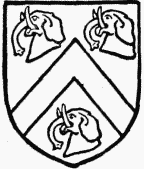
Evans. Argent a cheveron between three elephants' beads sable cut off at the neck.
Among other large residences in the parish are Manor End in the occupation of Mr. J. R. Thursfield, M.A., J.P., and the newlybuilt red brick house of Sir John Evans, K.C.B., called Britwell, on the common.