A History of the County of Hertford: Volume 2. Originally published by Victoria County History, London, 1908.
This free content was digitised by double rekeying. All rights reserved.
'Parishes: Bushey', in A History of the County of Hertford: Volume 2, ed. William Page (London, 1908), British History Online https://www.british-history.ac.uk/vch/herts/vol2/pp179-186 [accessed 30 April 2025].
'Parishes: Bushey', in A History of the County of Hertford: Volume 2. Edited by William Page (London, 1908), British History Online, accessed April 30, 2025, https://www.british-history.ac.uk/vch/herts/vol2/pp179-186.
"Parishes: Bushey". A History of the County of Hertford: Volume 2. Ed. William Page (London, 1908), British History Online. Web. 30 April 2025. https://www.british-history.ac.uk/vch/herts/vol2/pp179-186.
In this section
BUSHEY
Bisseia, viii cent.; Bissheye, xiv. cent.
The parish of Bushey, formerly called also Hartshead (Hertesheved, twelfth century), was apparently separated from the parish of Watford, of which it formed a part, about 1166. (fn. 1) It lies to the south of the county, and is bounded by the River Colne on the north, and the Middlesex county boundary on the south. The town now practically joins Watford. It is about 330 ft. above the ordnance datum, comprising 3,208 acres of land, and 10 acres of land covered by water, and contains the hamlets of Great Bushey, Little Bushey, Bushey Heath, Bushey Hartsbourne, and New Bushey. The soil is principally of chalk with gravel and clay, and the subsoil is of clay and chalk. It comprises 505 acres of arable land, 1,939 acres of pasture, and 84 acres of woodland. (fn. 2)
The parish was divided for civil purposes under the Local Government Act, 1894, the urban district being included in the Watford Urban District and now called Oxhey Ward, and Bushey Rural District comprising the remainder. In 1906 the latter was made into an urban district. There was formerly an extensive common called Bushey Heath and the Warren, which were inclosed under an award of 1809, (fn. 3) and are now largely built over. There are parks at Bushey Grange and Haydon Hill. The town of Bushey lies along the road running from the Watling Street at Edgware to Watford, where it branches out to Berkhampstead, Rickmansworth and St. Albans, from which road other roads branch off to Elstree and Aldenham, and there are numerous cross roads. New roads were made under the Bushey Heath inclosure award above referred to, and old ones were stopped and diverted. There is a railway station on the London and North-Western Railway main line.
The parish of Bushey lies for the most part on the slope of the hill rising from the eastern bank of the River Colne, and has magnificent views over well-planted meadow and pasture to St. Albans tower on the north, the wooded hills of Buckinghamshire on the west, Harrow spire on the south, and the smoke-enveloped towers and chimneys of London on the south-east. The village stands along the road from Watford to London, here called the High Street or London road. The church is picturesquely situated on the south side of the road beyond the village pond, but is partially hidden by a row of cottages. The houses in the village are mostly of brick, the older with tiled roofs and the later slated. There are a few old half-timbered houses notably 'Friedheim,' and No. 53, High Street, opposite the Bell Inn. The influence of the Herkomer School pervades the village, and is noticeable in the colony of artists, the numerous studios, and in the design of many of the houses. This school was commenced in 1883 as an experiment, by Sir Hubert von Herkomer, C.V.O., M.A., R.A., and Mr. Thomas Eccleston Gibb, F.A.S., of Bushey, to use the words of Sir Hubert von Herkomer, 'with the aim of retaining the English feeling for nature with the addition of some better technique than is encouraged in most English Art Schools,' and further aiming 'at the individual development of each artistic nature.' Four years later a new constitution was adopted, but in 1905 the school was abandoned, the buildings being taken by the Bushey Art School under Miss L. Kemp-Welch. Sir Hubert von Herkomer's house, 'Lululand,' lies behind the school down Melbourne Road, and is a large building of red and white stone, with a slate roof. The style is original, and perhaps approaches the Byzantine more than any other. A little to the west of the church on the north side of High Street is the Manor House, a large red brick building with a slated roof, the property of General Forestier-Walker. Opposite the church is 'Kingsley,' where Miss Kemp-Welch, R.B.A., the well-known artist, lives; and further east are Bourne Hall in the occupation of Mrs. Milner, and the 'Cloisters,' an eccentric building in the occupation of Mr. Richard Thomas. Bushey House, a large house covered with plaster painted white with a slate roof, on the south side of High Street, belonged to Mr. Thomas Clutterbuck, who died in 1837. (fn. 4) He was succeeded by his son Thomas, who died a few months after his father, when Bushey House came to his brother William, (fn. 5) who died in 1866. (fn. 6) In 1873 it was the residence of Mr. George Lake, (fn. 7) from whom it passed after 1899 to Mr. Edward Hedley Cuthbertson. Still further east are 'Cleveland,' a brick house with the upper story rough-cast, the residence and property of Mrs. Kynaston; Hogarth House, built in a like manner, the property of Mr. Barry Pain; and 'Claybury,' a brick house with slated roof the residence of Mr. Ricardo Palmer, J.P. Beyond this the district is known as Sparrows Herne, and from this part of the parish the views are particularly fine, especially from 'Hill Mead,' a white brick house with a slate roof, in the occupation of Mr. James Farmiloe. Sparrows Herne House in the High Street is the residence of Mr. A. Frewin, and on the opposite side of the road are the extensive grounds of Sparrows Herne Hall. Past Sparrows Herne is Bushey Heath, which leads on to the county boundary. Before the inclosure of 1809, this district was open heath land, and was described, in 1547, as a 'suspect' place where many robberies had been committed. (fn. 8) The land is now mostly laid out in streets, and built over with small houses.
Little Bushey lies to the north of Clayhill, and is a small hamlet consisting of a few houses along the road to Aldenham. Holly Grove House is the residence of Mr. H. W. Pennington. The Little Bushey estate and other lands here are being cut up into building plots.
New Bushey is the district adjoining Bushey Station, and consists of streets of modern houses mostly occupied by those whose work takes them daily to London. The Bushey Grove estate on the north side of the London Road is now being developed for building, and streets are being laid out, and suburban villas erected.
Bushey Grange was in 1837 the residence of Basil Burchell, (fn. 9) son of John Blount Burchell by Sarah his wife, sister of Sir William Herne. Basil died in 1838, leaving a son and heir Humphrey Harper Burchell, who as grandnephew and heir of Sir William Herne assumed the additional surname of Herne. He died in 1868, and left a son, the Rev. Humphrey Frederick Herne Burchell-Herne, now of Bushey Grange. (fn. 10)
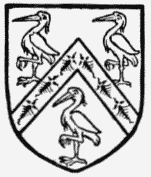
Herne. Sable a cheveron ermine between three berns argent.
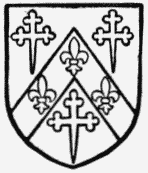
Burchell. Argent a cheveron sable between three crosslets fitchy sable with three fleurs de lis argent on the cheveron.
Haydon Hill, a large house built of white brick and slated, lies down the hill to the south of the church, and is occupied by Mr. R. P. Attenborough. A little to the south-east is Merryhill House, a large house formerly belonging to the Coghills of Aldenham, and part of the settlement by Henry Coghill on his wife Anne Nicoll. It followed the descent of Aldenham House and was sold by Henry Hucks Gibbs to Mr. Eley in 1878. It is now the residence of Mr. W. M. Harford. The Royal Masonic School for Boys and Caledonian Asylum and St. Margaret's Clergy Orphan School for Girls are important institutions in this parish.
At Bushey Hall Farm there appears to be a square moat, having an overflow into the River Colne. Bushey Hall is a large modern building, now a hotel. The Bushey Hall Golf Club occupies the greater part of the grounds once belonging to it.
In this parish, half a mile south of Bushey Grange, is the site of an unfinished house and rectangular moat, which is said to date from about 1700. The whole area intended to have been inclosed by it is close upon ten acres. It appears to be supplied by a ditch on the south-east.
Richard Ward, a well-known divine, was incumbent of Bushey from 1647 to 1684. He was presented to the living by Oliver Cromwell, conformed at the Restoration, and was buried in the church. In 1655 he published A Treatise on the Three Theological Graces, Faith, Hope and Charity, and in 1673 Two Very Usefull and Compendious Treatises; the First showing the Nature of Wit, Wisdom and Folly, The Second describing the Nature, Use, and Abuse of the Tongue and Speech. This latter volume is dedicated to Colonel Titus.
Silius Titus (? 1623–1704) the son of Silius Titus of Bushey was a keen politician. He first took up arms for the Parliament, and although a strong Presbyterian, afterwards became an ardent Royalist, devoted to Charles I and Charles II. (fn. 11) In 1679 he was M.P. for Herts. Though not eloquent, he would often illustrate his speeches with a humour that rendered them effective. Once, when it was complained that he made sport of the House, Titus retorted that things were not necessarily serious because they were dull. Again, when Charles II, rather than exclude his brother from the throne, offered to impose limitations on a Roman Catholic sovereign, Titus likened such a plan to having a lion in the lobby and then voting to secure ourselves by letting him in and chaining him, rather than by keeping him out. He transferred his allegiance from James II to William III, and in 1704 died and was buried at Bushey.
In the churchyard is the tomb of Thomas Hearne (1744–1817), not the historical antiquary of that name, but the painter who executed the drawings for The Antiquities of Great Britain, undertaken in conjunction with Byrne. Hearne was celebrated for his topographical water-colours, both of landscape and antiquarian remains, a fine collection of which may be seen in the British Museum.
Another tomb in the churchyard is to Henry Edridge, A.R.A., F.S.A., an artist of great talent who died in 1824.
Dr. Thomas Monro, M.D., the well-known patron of young artists, had a country house at Bushey from about 1805. His son, Henry Monro the portrait painter, died at Bushey in 1814.
William Jerdan, journalist, founder of The Literary Gazette, who seized Bellingham, the murderer of Spencer Perceval in the lobby of the House of Commons in 1812, died at Bushey, 11 July, 1869, and is buried in the churchyard.
Samuel Weller Singer, the author, resided for some time at Bushey. He began life as a bookseller in London, but retired to Bushey in 1815, and devoted himself to literary pursuits. His most important original work is Researches into the History of Playing Cards; with Illustrations of the Origin of Painting and Engraving upon Wood. The illustrations are very beautiful and add much to the value of the work. Towards the close of 1815 Mark Beaufoy, the astronomer and physicist, came to live at Bushey Heath. Here he made the series of observations on the eclipses of Jupiter's satellites which won for him the Astronomical Society's silver medal in 1827. He died at Bushey in that year, and his instruments were presented to the Astronomical Society. William Falconer, known as the translator of the Geography of Strabo, was rector of Bushey from 1839 till his death in 1885.
MANORS
BUSHEY was, according to the St. Albans chronicles and registers, granted to that monastery by King Offa in the eighth century. (fn. 12) In the time of Edward the Confessor it was held by Lewin, a thane of the king, but was granted by William I to Geoffrey de Mandeville, (fn. 13) in whose heirs, the earls of Essex, the overlordship continued. (fn. 14) The Jarpenville, or Jarkeville, family held the manor of Bushey from an early date. We find that Geoffrey de Jarpenville held one knight's fee, and probably the manor, of Geoffrey de Mandeville, who died in 1166. (fn. 15) From Geoffrey de Jarpenville the manor passed to David his son, (fn. 16) and at his death to Geoffrey de Jarpenville, who was dealing with land here in 1235, (fn. 17) and died about 1240, leaving a son and heir David. (fn. 18) Probably a later Sir David de Jarpenville, who died about 1300, left an only daughter Joan, then under age, but it would seem that Thomas brother of Sir David had seized the manor and granted it to Hugh le Despenser the elder. (fn. 19) Joan married Geoffrey FitzWarren, and upon her claiming the manor Hugh le Despenser so persecuted her and her husband by indicting Geoffrey of various felonies of which he was afterwards acquitted, and then as a justice of the forest imprisoning him for a trespass, that they, as they said, were compelled in 1305 to convey the manor to him by fine. (fn. 20) Geoffrey and Joan had two daughters, Margaret who married Henry de la Marler or atte Marlepitte, and Margery who married Henry de Harpesbourne. These ladies and their husbands unsuccessfully petitioned Parliament in 1347 to reinstate them in the possession of the manor. (fn. 21)
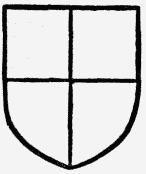
Mandeville. Quarterly or and gules.
Hugh le Despenser the younger and Eleanor his wife conveyed the manor, possibly for the purpose of a settlement, to Hugh de Audley and Margaret his wife, sister of Eleanor, in 1321; (fn. 22) and upon the attainder and execution of the two Despensers, in 1326, Edward II granted it to his brother Edmund of Woodstock earl of Kent. (fn. 23) Edmund of Woodstock was attainted in 1329 for complicity in a plot for the restoration of Edward II, whom he supposed to be still alive, to the throne.
In 1330 a lease for life was granted to Bartholomew de Burgherssh. (fn. 24) In the same year, however, this manor was assigned to Margaret, widow of Edmund of Woodstock earl of Kent, in accordance with a petition from her. (fn. 25)
At her death it passed to her daughter Joan, the Fair Maid of Kent, then married to Sir Thomas Holand, who with his wife in 1353 strengthened their title by taking a conveyance from Henry atte Marlepitte and Margaret his wife, and William de Harpesbourne and Margery his wife, heirs of Joan FitzWarren before referred to. (fn. 26) In 1361 Sir Thomas de Holand earl of Kent died seised of this manor, which he held of the earl of Hereford in right of his wife. (fn. 27) Joan, who married secondly Edward the Black Prince, died in 1385, and was succeeded by her son Thomas Holand, (fn. 28) who died in 1397, (fn. 29) seised of this manor, leaving Thomas his son and heir. Thomas, third earl of Kent, was beheaded and attainted, but notwithstanding the attainder, Edmund his brother succeeded to the title and some of the estates in 1400. The manor of Bushey, however, was assigned to Alice widow of the attainted Thomas. (fn. 30) Alice died in 1416, (fn. 31) when this manor fell to the share of Eleanor, wife of Thomas earl of Salisbury, as one of the sisters of the said Thomas and Edmund, earls of Kent. Thomas, who died in 1428, and Eleanor his wife, earl and countess of Salisbury, had an only daughter Alice, (fn. 32) whose husband, Richard Nevill, became, in right of his wife, earl of Salisbury. He was beheaded in 1460, when he was succeeded by Richard earl of Warwick, the 'King Maker.' Notwithstanding the forfeiture which followed upon the death of the earl of Warwick at the battle of Barnet in 1471, this manor descended probably by settlement to his daughter Anne wife of Richard duke of Gloucester, afterwards Richard III, (fn. 33) who by Act of Parliament in 1475 exchanged it with King Edward IV for the castle of Scarborough. (fn. 34) In the same year the king granted this manor to Elizabeth his queen, Richard bishop of Salisbury, and William Dudley dean of the chapel of the royal household, (fn. 35) but shortly afterwards it was again exchanged with the king for other lands. (fn. 36) In 1484 it was granted to Francis Lord Lovel, but on his attainder in 1486 it again became forfeited to the crown. In 1486 the manor was granted to John de Vere earl of Oxford and the heirs male of his body, (fn. 37) and he leased it to Thomas Thrale. (fn. 38) In 1511, in default of such heirs, the reversion was granted to Sir Thomas Boleyn, father of the unfortunate Queen Anne Boleyn, and his heirs male. (fn. 39) John earl of Oxford died without issue in 1513, but it is doubtful if Sir Thomas Boleyn ever obtained possession of the manor, as in this year Margaret countess of Salisbury was by Act of Parliament restored in blood, title, and estates, (fn. 40) and entered upon this manor, holding her first court there in May, 1514. (fn. 41) At her attainder and execution in 1541 this manor again came to the crown, and in 1543 the demesne lands, fisheries, mill, coney warren and other royalties then in the tenure of John Wythe were granted to William Milward alias Alexander, (fn. 42) and became known as the Bushey Hall estate, while the rents of assize, perquisites of court, and other profits of the manor were in the following year leased to him for twenty-one years. (fn. 43) In 1554 the manor was granted by Queen Mary to Sir Thomas Hastings (fn. 44) and Lady Winifred his wife, and the heirs of the body of Lady Winifred, with remainder to Lady Catherine wife of Francis earl of Huntingdon, as kinswomen and heirs of Margaret, late countess of Salisbury, being daughters and heirs of Henry Lord Montagu. (fn. 45) Winifred afterwards married Thomas Barrington, who in 1565 obtained a confirmation of the manor from the crown. (fn. 46) In 1566 Thomas Barrington and Winifred his wife conveyed this manor to Andrew Jenoure, (fn. 47) who in 1573 sold it to Robert Blackwell. (fn. 48)
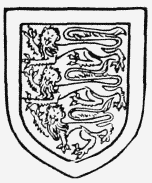
Edmund of Woodstock. The arms of England in a border argent.
At the death of Robert Blackwell in 1580 the manor was divided between his sons—George the elder taking one-third, while his brother Robert had two-thirds, probably, as Chauncy says, in consequence of a lawsuit. (fn. 49) George sold his share in 1583 to Sir Charles Morrison, from whom it passed to his daughter and heir Elizabeth, (fn. 50) who married Arthur Lord Capell, whose son Arthur was created earl of Essex in 1661, and from whom the manor descended to the present earl of Essex.
Some confusion arose at the time the Capells came into possession as to the various interests in the manor of Bushey; that is to say, the interest of Henry Hickman in the site of the manor called Bushey Hall, the Capells in one-third part of the manor, and the Blackwells in two-thirds; and in 1618 all these interests were, for confirmation of title, surrendered by fine to King James I, who on 21 May in that year granted that Ellis Wynn and Francis King might for the purposes of such confirmation enter upon the manor and advowson of the church, and use all such liberties therein as fully as Margaret countess of Salisbury held them. (fn. 51) The two-thirds belonging to the Blackwells descended in the family to Richard Blackwell, who died without issue in 1677, when they passed to his cousins, Susan wife of Sir William Parkyns, and Anne the wife of Rowland Pitts, daughters of Thomas Blackwell. Rowland Pitts and Anne his wife sold their portion for £1,240 to Sir William Parkyns, one of the chief clerks in Chancery, and Susan his wife, on 20 February, 1684–5. (fn. 52) Sir William Parkyns being convicted of complicity in Sir John Fenwick's plot was executed at Tyburn in 1696. At the time of his attainder he was seised of two third parts of the manor, (fn. 53) but having mortgaged these to his uncle, who had entered upon the lands as mortgagee, (fn. 54) they escaped forfeiture and came to Blackwell Parkyns, who in 1715 sold them to the Rev. William Streng-fellow, (fn. 55) and he in 1719 conveyed them to Richard Capper, whose son Francis, with Mary his wife and Richard their son and heir, barred the entail in 1759. (fn. 56) Robert son of the latter Richard sold this estate to General Frederick Nathaniel Walker in 1814, and it is now held by his grandson, General Sir Frederick William Edward Forestier-Walker, K.C.B., C.M.G.
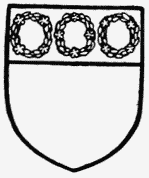
Morrison. Or a chief gules and therein three wreaths or.

Capell. Gules a lion between three crosslets fitchy or.
Some of the court rolls of this manor are at the Public Record Office, and we find from them that there were two reeves, two constables, and two ale-tasters elected yearly at the court of the manor. (fn. 57) The manor was divided into three tithings, namely, Great Bushey, Little Bushey, and Leavesden in the parish of Watford. (fn. 58) The several fishery of the Colne was from time to time leased by the lord, and in 1428 we find the several water of the lord with the fishery in the same 'from Chalney to le Wassyngstole next Watford,' except what was reserved to the miller, was leased to John Bereford and Nicholas Segrave of Aldenham for seven years at a rent of 20s. and two pike, the lessees being bound to mow 'les wedes' growing in the water twice yearly. (fn. 59) In 1459 Thomas Lanham was presented at the court for having taken five swans from the several water of the lord and selling them in London for 10s. (fn. 60)
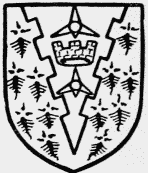
Walker. Erminois a pile azure battled with a mural crown between two caltraps or thereon.
By a charter dated 13 February, 1270, David de Jarpenville received a grant of free warren (fn. 61) in his demesne lands, and it would seem that game has always been strictly preserved in the manor, particularly pheasants and rabbits, from about 1426, and partridges from about 1492. (fn. 62) There was a manorial water-mill apparently on the Colne, which was from time to time leased with a stipulation that whenever the lord or lady of the manor should happen to be residing at Bushey the miller should grind their corn free from toll. (fn. 63)
As early as 1141 the Empress Maud granted to Geoffrey de Mandeville a market at Bushey on Thursdays, and a fair lasting for three days beginning on the vigil of St. James. (fn. 64) This grant was confirmed to David de Jarpenville in 1270, (fn. 65) and again in 1280; on the latter occasion the grant was confirmed notwithstanding it had not been fully used. (fn. 66)
The foundation of a magnificent house known as BUSHEY HALL or BUSHEY BURY was laid by Thomas earl of Salisbury in 1428. (fn. 67) This house followed the descent of the manor down to the time of the forfeiture by Margaret countess of Salisbury, when it was in lease with the demesne lands, mill, coney warren, and the advowson of the church to John Wythe for thirty years. (fn. 68) These properties, together with Bushey Hall Park, Hounslow Grove, Bushey Grove, and Bushey Heath, were in 1543 granted to William Milward alias Alexander, (fn. 69) and in the same year there were leased to him the rents of assize, perquisites of court, and other profits of the manor for twenty-one years. (fn. 70) Upon the expiration of this lease the manorial profits appear to have passed to the owners of the manor under a grant to Sir Thomas Hastings and Lady Winifred his wife, in 1554. (fn. 71) William Milward died in 1546, and was succeeded by his son William, (fn. 72) who sold Bushey Hall to Henry Hickman in 1579, (fn. 73) and in the same year he conveyed the advowson of the church, the watermill, free fishery, and coney warren to Anthony Brigham, who immediately sold them to Henry Hickman. (fn. 74) In 1585 Hickman conveyed the property to Richard Franklyn and Robert Millett, (fn. 75) probably for the purpose of a settlement, as we find he died seised of them in 1594, leaving John Scott, son of his sister Margaret, his heir. (fn. 76) John in 1604 conveyed Bushey Hall to Henry Hickman, (fn. 77) who died seised of it in 1622, leaving Henry his son and heir, (fn. 78) to whom livery of the manor was made in 1626. (fn. 79) It would appear that Bushey Hall subsequently came into the possession of Sir George Walker, and passed from him to Sir Robert Marsham, bart., who in 1701 joined with Margaret his wife in selling the estate to Thomas Ewer. (fn. 80) It afterwards came into the hands of Edward Marjoribanks, who held property in Bushey in 1839, (fn. 81) and died in 1879. (fn. 82) Bushey Hall was in 1882 converted into a hydropathic establishment and licensed hotel, in the grounds of which are some well-known golf links.
The manor of BOURNEHALL was held of the earl of Hereford, probably of the Mandeville Fee, and owed suit at the court at Hertford and White Appleton, in London. (fn. 83) In 1231 John de Martham conveyed the manor under the description of a hide of land in Bushey to Ralph son of Bernard. (fn. 84) This Ralph died in 1306, leaving his grandson Thomas son of John his heir. (fn. 85) Thomas granted the manor in 1317 to John de Wengrave and Christiana his wife and John their son, (fn. 86) and in the same year one John Blaket released all claim in it to the said John de Wengrave and Christiana his wife and to John their son, with remainder to Thomas brother of John the younger. (fn. 87) In 1336 John de Wengrave and Christiana and John the son granted the manor to John Hauteyn, of London, and Isabella his wife, and in 1348 John Hauteyn conveyed it to Richard son of Richard de Eccleshale, clerk, and Clementia de Titenhangre of St. Albans, his wife. (fn. 88) It would appear that Clementia was a daughter of John de Wengrave, for on her death Thomas FitzJohn claimed to be her heir. (fn. 89) Clementia, by her will, left this manor to trustees to be alienated in mortmain for the support of a perpetual chantry of four chaplains, (fn. 90) but it would seem that this was not done, but that Richard FitzJohn alienated the manor, probably to William de Gresle, who conveyed it in 1373 to James Bernes of London. (fn. 91) Shortly after, the manor was in the hands of William de la Marche and Thomas Wershepe, who apparently sold it to the celebrated Alice Perrers, mistress of Edward III, (fn. 92) who claimed her estate in the manor from Thomas FitzJohn. (fn. 93) Alice Perrers held it up to the time of her conviction, and after her forfeiture in 1377 Richard II in 1379 granted it, together with the tenements called Harpesbourne, Marlepitts, Latymers, and Halles, to Sir Thomas Peytevyn for his life, (fn. 94) and in the following year he gave the fee simple to Sir William de Wyndesore, then the husband of Alice Perrers. (fn. 95) Sir William de Wyndesore died seised of the manor in 1384, leaving his three sisters, Christiana the wife of William Morers, Margery the wife of John Duket, and Isabella, his heirs. (fn. 96) It would seem, however, that John de Wyndesore, nephew of Sir William, inherited the lands, (fn. 97) and probably sold them to Robert Thorley, at whose death they passed to his daughter Margaret, wife of Sir Reginald West, (fn. 98) who was in 1426 created Baron De La Warr. (fn. 99) In 1450 Lord De La Warr died seised of this manor (held of the earl of Salisbury as of the manor of Bushey), and of the manor of Hartesbourne in this parish, (fn. 100) leaving Richard his son and heir. Richard died seised of these manors in 1476, (fn. 101) and they followed the descent of the barony of De La Warr till 1538, when Sir Thomas West, Lord De La Warr, and Sir Owen West, his half-brother, conveyed them to Michael Lyster, Francis Sawtrey, and others. (fn. 102) In 1556 Richard Lyster granted them to James Pargyter, (fn. 103) who with Katherine his wife in 1568 sold them to Henry Hickman. (fn. 104) In 1594 Hickman died seised of the manor of Bournehall, leaving his nephew John Scott his heir, (fn. 105) who, with Alice his wife, in 1596 conveyed it to George Hickman and Ralph Baldwyn. (fn. 106) George Hickman died seised of the manor in 1635, leaving a son George, (fn. 107) who sold this manor in 1639 to James Mayne of Bovingdon. (fn. 108) At the death of James Mayne in 1642 (fn. 109) the manor was partitioned by his wife Dorothy between his two daughters, namely, Mary, the wife of Thomas Engham, who sold her moiety to Joshua Lomax of Bovingdon (fn. 110) in 1656, and Sarah, the wife of William Glascock, who in 1667 purchased her sister's moiety from Joshua Lomax. (fn. 111) Sarah Glascock was indicted in 1679 as a Popish recusant, and was summoned before the justices of the peace to take the oaths of allegiance and supremacy, and to enter into recognizances to keep the peace. (fn. 112) In 1688 William and Sarah sold the whole manor to John Huxley and Walter Overburgh. (fn. 113) They were probably trustees for George Hadley of East Barnet, for in 1690 they joined with him in conveying the capital messuage and some parcels of land to John Greening and Edward Clerke in trust for Nathan Southen of Hemel Hempstead. (fn. 114) Nathan in 1696 conveyed these premises to Thomas Gratwick and Huntley Bigg, trustees for Edward Barradall. (fn. 115) George Hadley's grandson, John Hadley, sold the manor in 1770 to Richard Capper of Lincoln's Inn, (fn. 116) whose grandson, Rev. Daniel Capper, sold it in 1865 to Richard Harrison of the Hansteads, St. Stephen's. (fn. 117) The manor was afterwards sold to Mr. Arthur Hope Rydon, who now owns it.
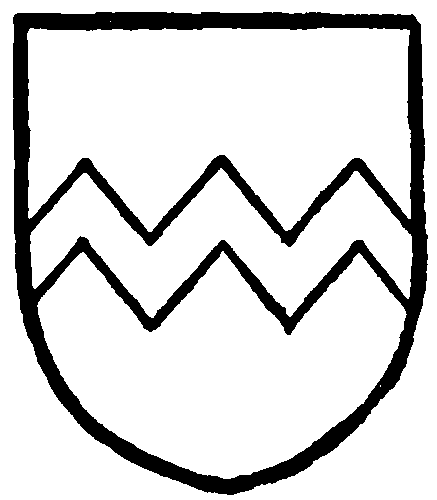
West, Lord De La Warr. Argent a fesse dancetty sable.
Manor of HARTESBOURNE (Harpesbourne, Hertysbyrn).
—This manor under the description of a messuage and 200 acres of land in Little Bushey and Harteshead appears to have been held by John Gregory, of Sarratt, who in 1330 conveyed it to Thomas Wyliot and Eleanor his wife. (fn. 118) In 1344 Edmund Wyliot and Ellen his wife granted it to William de la Marche, (fn. 119) from whom it followed the descent of the manor of Bournehall till the end of the sixteenth century, when in 1594 Henry Hickman died seised of the manor described as the manor of Hartesborne or Hasborne, Marcolles, and Slackdeacons, leaving John Scott, a nephew, his heir. (fn. 120) John Scott apparently sold this manor, for we find in 1598 that George Melton and Alice his wife settled it described as above upon themselves and their issue, and in default to Susan the wife of John Andrews, of Broughton (county Bucks.) sister of Alice, for life, then to Francis Duncombe of Eastcote Hall, in the county of Warwick, her brother, and the heirs of his body. (fn. 121) This manor seems again to have been settled in 1602, for we find George Melton then conveyed it to William Stevenson and afterwards to Richard Perrin and Edward Curtis, (fn. 122) probably for the purposes of a trust. George Melton died in 1617 seised of the manor, lordship, or grange of Hartesborne alias Harsborne, Marvells, and Slackdeacons, and left a son and heir George. (fn. 123) Apparently George died without issue, and the manor came to Susan wife of John Andrews under the above settlement. (fn. 124) In 1622 Sir Francis Duncombe died seised of the reversion of the manor after the death of Susan, leaving Thomas his son and heir, (fn. 125) who with his wife Sarah, and Susan Andrews, widow, James Mayne and Mary his wife, and Evan Melton, sold it in the following year to Henry Coghill. (fn. 126) In 1769 Sarah Hucks, widow, sister and heir of Henry Coghill, and Robert Hucks her son, conveyed the manor to William Hucks for a settlement upon Sarah for life with remainder to Robert, (fn. 127) who sold it in 1851 to Mr. Travers. The estate afterwards came into the possession of Joseph Sladen, (fn. 128) eldest son of Joseph Sladen of Lee, who held it in 1873 and died in 1882. (fn. 129) His son sold it two years later to Frederick Charsley, and at some date previous to 1899 Hartsbourne manor passed to the Hon. Copleston Richard George Warwick Bampfylde, who now owns it.
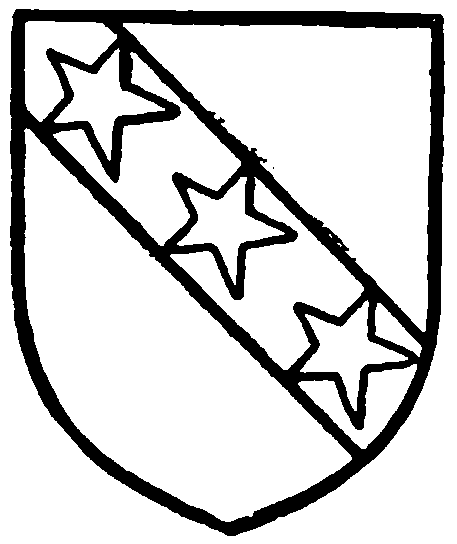
Bampfylde. Or a bend gules and thereon three molets argent.
CHURCHES
The parish church is dedicated in honour of ST. JAMES, and stands to the south of the main road passing through the village, the fall of the ground being towards the west. The walls are of faced flint rubble with Totternhoe ashlar dressings, but very little ancient external work remains, and the modern ashlar is of Bath stone. The roofs are tiled. The church consists of chancel 35 ft. by 17 ft., south vestries and organ-chamber, nave with north and south aisles and north porch, and west tower. It underwent a thorough 'restoration' in 1871 at the hands of Sir Gilbert Scott, when the aisles and organ-chamber were added. Before that time it consisted of a chancel and a long narrow aisleless nave, of the first half of the thirteenth century, and a west tower of the fifteenth. On the north side of the nave was a building with square-headed windows and wooden mullions, apparently c. 1700, which served as a family pew for the lord of the manor.
The chancel has in the east wall three lancet windows, which replace a late Gothic window removed in 1871. The north and south walls have shallow wall-arcades of three bays with pointed arches and simple labels, springing from circular stone capitals with Purbeck marble shafts and moulded stone bases. In each bay on the north side is a plain lancet window; on the south side the eastern bay has a similar window, though opening now to a modern vestry; in the middle bay is the upper part of a lancet window, with a doorway below, all stonework being modern; and in the western bay is a three-light window much repaired, of the second half of the thirteenth century. It now opens to the organ chamber and its glass has been removed. The roof timbers are apparently modern, but the moulded wallplate is of the fifteenth century. The fittings of the chancel are all modern, and there is a modern wooden screen at the west. There is no structural chancel arch, but over the screen is a cambered and moulded beam of the fifteenth century coeval with the nave roof, carrying a plastered partition, on which are painted the arms of Queen Anne, with a diaper of floral pattern and a leaf border. A mediaeval painting may be hidden behind this.
The nave is of five bays and has no ancient features except the fine fifteenth-century roof. This is high pitched with tie-beams and arched braces to the collars, and intermediate trusses with hammer-beams; there are heavy wind-braces to the purlins, and the plate, tie-beams, and hammer-beams are moulded. Its date is probably early in the century. The arcades of the nave are of two-chamfered orders with octagonal columns and moulded capitals and bases, copied from an arch destroyed in 1871, which stood where the west bay of the north arcade now is. The south arcade is of five bays, and the north of three, the north aisle not being the full length of the nave. The two eastern bays of the north arcade mark the position of the eighteenth-century building before mentioned.
The aisles, of the same date as the nave arcades (1871), are of fourteenth-century style—the south aisle being considerably wider than the north. There is a modern north porch—its inner doorway has a wooden head and jambs of the fifteenth century—with a four-centred arch and carved spandrels. The west tower, of three stages, is of the fifteenth century and opens to the church by a much-restored arch of two orders. It has a vice at the north-east, which retains its original plain door. The west doorway of the tower is narrow, with a continuous moulding of two hollow chamfers. Over it is a sixteenth-century square-headed window, with two wide lights, to which cinquefoil cusping in Bath stone has been added. The second stage of the tower has small pointed lights, and the belfry windows are of two trefoiled lights under a square head, the stonework of all being modern. There is an embattled parapet and flat lead roof, the vice being carried up above the parapet as a turret.
The fittings of the church are, with two exceptions, modern. The pu'pit is a good specimen of early seventeenth-century date, octagonal with a tester over, carved and panelled, with a projecting book-board carried on carved scroll brackets. It has steps with moulded handrails and twisted balusters, and stands in the north-east angle of the nave, having been on the south side before 1871. In the chancel hangs a fine brass chandelier, the gift of one of the Capper family; it was formerly in the nave. The font, at the west end of the nave, is modern, having a square bowl on a central stem and four angle shafts.
In the vestry are a few pieces of seventeenth-century glass, with the arms of Gale, dated 1638, Altham, 1611, and Egerton.
There are eight bells—the treble and 2nd by Warner, 1889, 5th and 6th by William Eldridge, 1664, the 7th is a fifteenth-century bell with the mark of Roger Landon, a Wokingham founder, and inscription in black-letter capitals and smalls sancta TINTITAS UNUS DEUS MISERERD NOBIS, and the 3rd, 4th and tenor are by Warner, 1887.
The church plate consists of a chalice and cover paten of 1633 given by John Gale, a salver of 1671 given by Lady Mary Walker, and a flagon of 1634 given by John Gale, the latter bearing on a fesse three lions' heads couped between three saltires, impaling party palewise and cheveronwise an escutcheon bearing a man's head couped and garlanded. There are also two patens, two chalices, a flagon, and an almsdish, presented by Mr. and Mrs. Edward Marjoribanks in 1871, a silver wine strainer and wafer box, and a plated almsdish given by Dr. Ibbetson, 1754.
The registers begin in 1684. Book i contains baptisms 1684–1812, burials 1735–1812, and marriages 1684–1753. Book ii has marriages to 1812.
Bishop's Transcripts of older registers exist for the years 1581, 1590, 1599, 1674, 1676, 1679, 1681, and 1682. (fn. 130)
The district church of ST. PETER at Bushey Heath was opened in 1838. The living is a vicarage, and Lieut.-Colonel G. A. Elliot was patron in 1889. The advowson is now vested in the bishop of St. Albans. The nave and transepts are built of white bricks with stone quoins, and covered with slate, and the chancel and vestries are of stone with red tiles. The chancel is of two bays with a vestry on the north side, replacing a chancel of the same character as the nave. At the west end of the nave is a bell-cote. The east window is by Kemp, and represents the Crucifixion. The altar frontal is composed of five canopied panels, each containing a figure in beaten brass. There is a stone canopied reredos with paintings, and at the west end of the nave is a gallery.
ADVOWSON
Bushey or 'Hertesheved' was originally part of the parish of Watford. (fn. 131) Its existence as a separate parish probably dates from about 1166, when an agreement was made between Robert abbot of St. Albans, and Geoffrey de Jarpenville as to the church of Hertesheved otherwise called Bussheye. Geoffrey and his heirs were to have by gift of the abbot the chapel of Hertesheved with the churchyard and lands belonging, and a virgate of land which Earl Geoffrey de Mandeville had given to the same chapel. One half of the tithes from Geoffrey's lands was to go to the chapel of Bushey, and the other half to the church of Watford. (fn. 132)
The church of Bushey was always held with the manor (fn. 133) till 1543, when it was granted with Bushey Hall to William Milward, (fn. 134) from whom it passed with the mill and fishery to Henry Hickman, (fn. 135) who died in 1622, when the advowson passed to his son Henry. (fn. 136) In 1618 it had been surrendered with Bushey Hall to the king for the purpose of confirmation. (fn. 137) The king presented in 1662 by reason of a lapse, (fn. 138) and in 1676 Henry Hickman sold the advowson to Richard Smith, (fn. 139) who presented in 1684 and 1693. (fn. 140) He conveyed it in 1700 to his grandson William Smith, (fn. 141) who dying unmarried devised it to his stepmother, Grace Smith. (fn. 142) Grace, who presented to the rectory in 1739, (fn. 143) conveyed it in the same year, under the terms of her stepson William Smith's will, to the rector and scholars of Exeter College, subject to a demise for a term of years to Ebenezer Ibbetson. (fn. 144) Catherine Ibbetson and Samuel Ibbetson presented in 1748 for that turn, (fn. 145) and the advowson came on the death of James Ibbetson in 1781 (fn. 146) to Exeter College, which presented in 1782–85, 1794 and 1797. (fn. 147) At some date between 1879 and 1899 the advowson passed to Mrs. Kynaston of Danes Road, St. Leonard, and it is now vested in Sir C. F. Cory-Wright, bart., D.L., J.P.
The first appearance of Independents in Bushey occurs in 1809, when they registered a building belonging to Joseph Keene for religious worship. In accordance with this registration Joseph Keene of Chesham and William Jennings of Kensington, assisted by Robert Capper, lord of the manor, fitted up and opened an outhouse or lumber-room on the premises of Keene on Clayhill. Preachers were supplied by the London Itinerant Society. This meeting place was enlarged in 1812, and in 1814 Mr. Capper erected a chapel and minister's house on his own freehold. (fn. 148) There are Congregational and Primitive Methodist chapels, and a Roman Catholic chapel dedicated to the Sacred Heart and St. John the Evangelist.
CHARITIES
In 1631 Mrs. Barbara Burnell by her will bequeathed to the Clothworkers' Company, London, £300 to be laid out in the purchase of lands for the performance of divers charitable uses, and among them to pay the annual sum of £4 6s. for distribution of clothing among six poor women of Great Stanmore, Middlesex, one year, and in the next year among two poor women inhabiting the parish of Bushey and those of Harrow and Edgware in the county of Middlesex. Two gowns are given to two poor women of this parish every alternate year.
John Gale, who died in 1695, as appears in the old parish register, 'gave a Haberdine fish (barrelled cod, so called from Aberdeen, which was formerly famous for curing this kind of fish), and half a peck of blue peas to twenty widows and widowers once a year; half a peck loaf, and two pounds of cheese to each person are given instead.' In 1894 this charge was redeemed by the transfer to the official trustees of £100 consols, and by a scheme of 1897 the trustees were authorized to apply the dividends by way of supplementing the income of the charity of George Johnson Reveley mentioned below, or otherwise, at their discretion.
In 1708 Mrs. Elizabeth Fuller of Watford Place left (inter alia) '1s. 6d. in twelve wheaten loaves to twelve poor persons of this parish to be delivered upon her tombstone by the churchwardens after morning service on every Sunday for ever.' A sum of £4 is received annually from the trustees of the charity at Watford, and applied in the distribution of bread.
The British School is endowed with a sum of £3,027 2s. India 3½ per cent. stock given by deed, 1857, by Stewart Marjoribanks, and with £2,191 London Brighton and South Coast Railway 4½ per cent. debenture stock arising under the will of Arthur Ashfield, 1861. The sums of stock, which are held by the official trustees, produce about £204 a year.
The Reveley Almshouses were founded by George Johnson Reveley, who by his will, proved on 15 February 1877, directed his trustees to expend £1,500 in the erection of ten almshouses, and to invest £10,000 and apply the yearly income in the repair of the same, and in the maintenance and support of the inmates. The site was given in 1878 by Mr. George Edward Lake and Mr. Reginald John Lake. The charity is regulated by a scheme of the Court of Chancery, dated 4 July 1881; and the endowment funds, which are held by the official trustees, are now represented by £430 Midland Railway Company 2½ per cent. debenture stock as a repair fund, £6,459 like stock, and £4,966 3 per cent. perpetual debenture stock of the London and North Western Railway Company, producing an annual income of about £310.
In 1883 George Clark by his will bequeathed £300 stock to provide six loaves of the value of 6½d. each, to be given from the church porch every Sunday after morning service to the poor of Bushey proper and Clay Hill, the surplus to be given to the person in charge of the bread. The legacy is represented by £270 consols with the official trustees.
In 1894 Miss Mary Smith by will bequeathed to the rector and churchwardens £100 to be invested, and income applied in the purchase of clothing to be distributed among poor people not living in any almshouse. The trust fund consists of £93 os. 6d. consols with the official trustees.
The Bushey Congregational Chapel Trust was formerly administered with the Hackney College endowments, but by a scheme of the Charity Commissioners, of 5 January, 1904, was separated therefrom, and the Hertfordshire Congregational Union (incorporated) were constituted the trustees.
The trust funds now (1906) consist of £201 10s. 2d. consols, £722 3s. 7d. Cape of Good Hope 3½ per cent. stock, and £204 17s. 5d. New Zealand 3½ per cent. stock; the income, amounting to about £37, is applied for the purposes of the trust.