A History of the County of Hertford: Volume 2. Originally published by Victoria County History, London, 1908.
This free content was digitised by double rekeying. All rights reserved.
'Parishes: Northchurch or Berkhampstead St Mary', in A History of the County of Hertford: Volume 2, ed. William Page (London, 1908), British History Online https://www.british-history.ac.uk/vch/herts/vol2/pp245-250 [accessed 30 April 2025].
'Parishes: Northchurch or Berkhampstead St Mary', in A History of the County of Hertford: Volume 2. Edited by William Page (London, 1908), British History Online, accessed April 30, 2025, https://www.british-history.ac.uk/vch/herts/vol2/pp245-250.
"Parishes: Northchurch or Berkhampstead St Mary". A History of the County of Hertford: Volume 2. Ed. William Page (London, 1908), British History Online. Web. 30 April 2025. https://www.british-history.ac.uk/vch/herts/vol2/pp245-250.
In this section
NORTHCHURCH or BERKHAMPSTEAD ST. MARY
Northcherche (xiv cent.); North Berkhampstead (xvii cent.).
Northchurch lies to the north-west of Great Berkhampstead and borders that parish on the east and west sides. There is a strong probability that before the end of the twelfth century it included the parish of Great Berkhampstead (q.v.). There are two detached portions of the parish, one to the north-east and the other to the south-east of Great Berkhampstead. The Grand Junction Canal and the London and North Western Railway pass through the parish, but there is no station, that of Great Berkhampstead being about a mile and a half from the village. The River Bulbourne forms the boundary between this parish and Great Berkhampstead on the north-east.
The parish is fairly high, rising rapidly from the valley of the Bulbourne to 500 ft. above the ordnance datum to the south, and to 600 ft. at Norcott Hill on the northern border.
It is not well timbered, Cock Grove and Hamberlins Wood being the only woods of any size. The area is 3,908 acres, and in 1905 consisted of 1,656 acres of arable, 1,166 acres of permanent grass, and 184 acres of woodland. (fn. 1) The chief crops are wheat, barley, oats, and peas. The soil is flinty loam and subsoil clay with flints. The Inclosure Award is dated 1864. (fn. 2)
At Bourne End there is a corn mill on the River Bulbourne, which is mentioned in 1609, and was then called Whelpisborne Mill or Burnend Mill. (fn. 3) Traces of St. Mary Magdalene's Chapel are found near Rossway to the south-west of the village, and considerable remains of the earthwork known as Grim's Dyke exist.
The following place-names occur:—Pinnuks, Weedens Wick, Witch Hill, Woman Croft, Laglie, Kyght or Kite Field, Merlyng Croft, Chapel Crofts, and Amberlaynes, in which we recognize the modern Hamberlin.
The village of Northchurch lies in the valley of the Bulbourne about a mile and a half north-west of the town of Great Berkhampstead, the road between them being bordered by a continuous line of houses and shops, part of which forms the hamlet of Gossoms End in Northchurch parish. Entering the village from the south there may be noticed Lagley House, the residence of Miss Duncombe, whose family have long been inhabitants of the parish. Further north, on the opposite side of the road, adjoin ing the churchyard, is the old rectory, now the residence of Mr. Blount, a picturesque house with a fine old garden sloping down to the River Bulbourne. The present rectory was built by the late Canon Sir John Hobart Culme Seymour, who was rector from 1830 to 1880. Near by are the almshouses and some brick and timber cottages which form a pretty group of buildings. There are some other old brick and timber houses in the village, notably that now known as Northchurch Hall, formerly a farm-house, which was enlarged in 1760 by William Duncombe and sold by his son John. After passing through many hands it was purchased by Mr. Barnett, who now owns it. There are technical schools here, built in 1905.
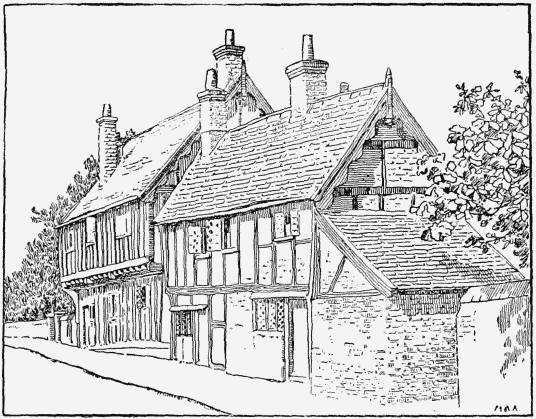
Old Cottages, Northchurch
The hamlet of Dudswell lies to the north of the main road. Sunnyside and Broadway, other hamlets, lie to the south-east. In the former of these is Millfield, belonging to Mrs. Pearson; Netherfield, the residence of the Rev. Dr. Baker, late head master of Merchant Taylors' School; and Rosebank, the residence of Mr. Edward Mawley, the well-known rosegrower. There is an iron church here dedicated in honour of St. Michael. At Broadway is the church of St. John, built by Canon Sir John Hobart Culme Seymour in 1854 to serve as a chapel of ease to the parish church.
Among other important houses are the Cottage, the residence of Major Granville; the Limes, the residence of Mr. Spencer Holland; and the Pheasantries, where there is a large pheasant-farm carried on by Mr. William Dwight. The Old Pest House, now called Moor Cottage, is situated on the common and is the residence of Sir Henry Craik.
Northchurch was devastated by fire in 1664, the total loss amounting to £824 17s., a large sum for that date, and a petition was sent to the king for permission to collect money by a brief for the relief of the inhabitants. (fn. 4) Much damage was also done by a storm in 1774. (fn. 5)
The Michaelmas fair in this parish was abolished in 1883. (fn. 6)
In the church at Northchurch there is a memorial to Peter the Wild Boy, who was found wild in the forest of Hertswold near Hanover in 1725. He then appeared to be about twelve years old. In the following year he was brought to England by order of Queen Caroline, and the ablest masters were provided for him, but as he proved incapable of speaking, a comfortable provision was made for him at a farm-house in this parish, where he remained until his death in 1785. (fn. 7)
MANORS
The parish of Northchurch is within the manor of GREAT BERKHAMPSTEAD (q.v.), and is now known as the manor and halimote of Northchurch in the possession of Earl Brownlow.
The manor of NORCOTT, or NORCOTT CUM LEE, which lies to the north of the village of Northchurch, was held by the service of a third of a knight's fee, as of the honour of Berkhampstead. (fn. 8) The first mention of this manor occurs in 1300, when Ralph le Marshall granted it to Nicholas de Bosco and Margery his wife. (fn. 9) Nicholas and Margery held it till the death of Nicholas in the early years of the reign of Edward II. (fn. 10) In 1346 Margery, who was wife of Thomas de Luton, held the manor by grant of Ralph le Marshall, (fn. 11) and she is probably the Margery mentioned above as wife of Nicholas de Bosco. She left no issue, but the manor had been settled by Ralph le Marshall on the heirs of Thomas, and his son Nicholas de Luton succeeded to the manor. (fn. 12) Nicholas died in 1359–60, (fn. 13) leaving a son Robert, who died in 1391 seised of the manor held jointly with his wife Katherine. (fn. 14) He left a son William, then aged thirteen, but the manor remained with Katherine during her lifetime. In 1409–10 the reversion, after the death of Katherine, was held by Eleanor wife of John de Bosenho, probably a sister of William de Luton. She and her husband granted the remainder, after the death of Katherine, to John Trussell, John Horwood and others, and the heirs of John Horwood, (fn. 15) but this would seem to be only a settlement, since between 1436 and 1440 Thomas Stokes, husband of Eleanor daughter of Robert de Luton, paid relief for the manor, (fn. 16) and this gives approximately the date of the death of Katherine Luton, who was still holding the manor in 1435. (fn. 17) Thomas Stokes and Eleanor had a daughter Agnes, who married, as her second husband, Henry Petit, (fn. 18) and in 1466 she and her husband settled the manor on themselves and the heirs of their bodies with remainder to the right heirs of Agnes. (fn. 19) Agnes died in 1479, leaving her grandson William Hampden, son of her daughter Elizabeth who had married John Hampden of Kimbell, her heir. (fn. 20) William was succeeded by his son Thomas, who died in 1525, (fn. 21) leaving a son and heir Jerome. Jerome settled the manor of Norcott upon his son Michael in 1525, (fn. 22) and died about 1541–2. (fn. 23) Michael died in 1570, having in 1568 settled the manor on his son Alexander, on his marriage with Elizabeth Hankins. (fn. 24) In 1595 Alexander conveyed the manor of Norcott Court to John Southen and Francis Wethered, who were to suffer William Edlin and Richard Wood to recover it against them. William and Richard were to be seised of the manor to the use of Alexander Hampden and Richard Chubnoll, and the heirs of Alexander for ever. (fn. 25)
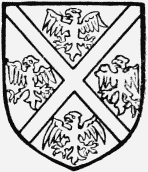
Hampden. Argent a saltire gules between four eagles azure.
Soon afterwards the manor seems to have been divided into two parts, one of which, called Norcott Hill, was apparently sold by Alexander to William Edlin mentioned above, for he died seised of it in 1606, leaving a son William, his heir. (fn. 26) William held this manor under the name of Norcott Hill Court in 1616. (fn. 27) William Edlin, the son, died in 1649, (fn. 28) and was succeeded by his son John, who died in 1685, (fn. 29) having left the manor of Norcott Hill to his daughter Sarah, who married Thomas Emerton. (fn. 30) On her death in 1705 the manor came to her sister Mary, who died in 1730, when the manor was sold, (fn. 31) apparently to Richard Keen, who in 1733 was vouchee in a recovery by John Duncombe against William Duncombe. (fn. 32) In 1787–8 the manor of Norcott Hill was conveyed by fine from Henry Clifton Atkinson and Mary Isabella his wife, and John Price and Elizabeth his wife, to Edward Johnson and Charles Herries, (fn. 33) but this may have been a settlement, as the manor was held by Brandreth Duncombe in 1817–18, when he and Elizabeth his wife conveyed it to John Duncombe, senior. (fn. 34) In 1829 John Hercy and Frances his wife granted it by fine to John Earl Brownlow and others, (fn. 35) and it is now owned by the present Earl Brownlow. The site of the manor house is probably Norcott Hill Farm.
The second part of the manor, namely, the manor house called Norcott Court, and divers parcels of the demesne, were sold in 1597 by Alexander Hampden to John Southen or Southend, (fn. 36) also mentioned in the above indenture. John died seised of it in 1607–8, leaving a son John under age, (fn. 37) who held this manor in 1616. (fn. 38) In 1632 it was conveyed by John Ford and Margaret his wife to John Squire. (fn. 39)
Norcott Court passed before 1709 to Thomas Smart, whose widow Tabitha was residing there at that date. Thomas was succeeded by a son and grandson of the same name. Thomas Smart, the grandson, died in 1780, (fn. 40) having devised Norcott Court to his son William Smart, on whose death in 1837 it passed to his daughter Elizabeth, widow of John Loxley. (fn. 41) Her son John Loxley succeeded in 1887, and the estate passed at his death in 1892 to his grandson, the present owner, Commander Arthur Noel Loxley, R.N., son of the Rev. Arthur Smart Loxley. (fn. 42)
The present mansion was built by the late Mr. John Loxley on the site of the former house. It has been leased since August, 1898, to Mr. Edward Bovill. (fn. 43)
The manor of MAUDELEYNS was held of the manor of Berkhampstead by the service of a twentieth part of a knight's fee, and extended into the parishes of Northchurch, Rickmansworth and Standon, and Chesham in the county of Buckingham. (fn. 44) At the end of the reign of Henry III it was in the possession of Sir Lawrence de Broc, and may have been identical with land in the honour of Berkhampstead given to him by James de Audeley, of whom part of it was held at the time of Lawrence's death in 1275. (fn. 45) He left a son and heir Hugh, (fn. 46) who died at the close of the thirteenth century, and was succeeded by his son Lawrence, (fn. 47) on whom, with his wife Ellen, this manor was settled by fine in 1302, with remainders to his right heirs. (fn. 48) Lawrence and Ellen had issue Robert and Ralph, who held the manor successively, (fn. 49) and Ralph de Broc left issue Joan, Agnes, and Ellen. Upon a partition this manor was allotted to Agnes, who had issue Joan, first married to Sir Peter Scudamor, and secondly to Robert Corbet, upon whom the manor was settled in 1387. (fn. 50) Joan had issue by her first husband Katherine, who married John Reynes and had issue Thomas, Ralph, and Cecily. Thomas died in 1417, leaving John his son and heir, an infant who died in 1421, whereupon Ralph Reynes, his uncle, entered upon the land and died without issue. William Strete, son of the above Cecily, succeeded, (fn. 51) and in 1426 conveyed the manor to Humphrey duke of Gloucester, John Escudemore, and others, probably for the purpose of some settlement. (fn. 52) In 1409 the messuage called Maudeleyn seems to have been sold to John Hertwell, (fn. 53) who in 1427 mortgaged this messuage with a garden and field, which were said to have constituted the manor of Maudeleyns, to John Pidmyll. (fn. 54) William Strete died seised of the manor in 1431, and was succeeded by his brother Henry. (fn. 55) In 1469 a writ was issued to put Thomas Holbache into possession of the manor, (fn. 56) of which he had been unjustly disseised by William Alyngton and Joan his wife, William Taillard and Elizabeth his wife, and Henry Langley and Mary his wife. Joan, Elizabeth, and Mary were daughters of Joan the sister of William and Henry Strete. (fn. 57) In the previous year they had sued Thomas Tyrell and others for the manor. (fn. 58) In 1483 Thomas Holbache granted the manor to Thomas Scott archbishop of York, John Morton bishop of Ely, and others, and this gift is said to have been made in fulfilment of the last will of John Forster. (fn. 59) However, in the following year John Forster and Joan his wife, and Thomas Holbache and Edith his wife, conveyed the manor by fine to Robert Brakynbery and others, (fn. 60) and in 1487 John Forster granted it to John Morton archbishop of Canterbury, Robert Morton bishop of Worcester, and others, (fn. 61) feoffees to the uses of the will of John Forster. These two conveyances were probably made for the purposes of settlement, for John subsequently bequeathed the manor to Robert son of Robert Morton and the heirs of his body, with remainder to Agnes Forster, daughter of Robert brother of John, and the heirs of her body, with remainder to John Mordaunt and his heirs for ever. (fn. 62) On the death of John Forster, Robert Morton and Agnes his wife became possessed of the manor but not without considerable difficulty, for a certain Richard Whittingham put in a claim to it, saying that his father, Sir Robert Whittingham, was seised of the manor of Maudeleyns, and he enfeoffed Richard Fray and others now dead, to the use of the said Robert and his heirs, and for the due performance of his will: that by this will Robert left the manor to his son William and the heirs of his body, with remainder to his second son Richard: that Richard Fray survived his co-feoffees, and that after his death the trusteeship came to his grandson William Waldegrave, son of his daughter Elizabeth: that William son of Robert Whittingham also died without leaving heirs of his body, and that the use of the manor should have come to Richard, but that William Waldegrave refused to make him any estate in the manor. (fn. 63) From a second suit it appears that John Verney, son-in-law of Robert Whittingham, also claimed this manor, having obtained charters which Richard Whittingham demanded as his right. (fn. 64) In 1497 all these claims were over-ruled by the court in favour of Robert Morton and Agnes his wife, (fn. 65) but after Robert's death it would seem that his widow had further trouble with Richard Whittingham, for in 1502 a fine was levied between them by which Richard gave up all his claim to Agnes, (fn. 66) and in 1512–13 Ralph and John sons of John Verney released to Robert Morton (probably a son of Robert and Agnes) all their claim in the manor of Maudeleyns. (fn. 67) The manor remained in the possession of the Morton family till 1556, (fn. 68) when Robert Morton and Dorothy his wife conveyed it to John Dell of Leyhill. (fn. 69) In 1607 the manor was in the hands of John Gardner, (fn. 70) and in 1616 it was held by Robert Bradley, at which time it is said that it had been dismembered and sold away, and no courts had been held within the memory of man. (fn. 71)
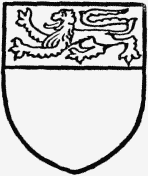
De Broc. Gules a chief argent with a lion passant gules therein.
In 1627 Roger Pemberton died seised of a messuage called Maudlyns and lands in occupation of Edward Crawley in Northchurch. (fn. 72) In 1624 it had been settled on Elizabeth wife of Roger so long as she remained a widow, with remainder after her death or remarriage to Ralph son of Roger. (fn. 73) Elizabeth outlived both her husband Roger and her son Ralph, who died in 1644 seised of the reversion of the manor after his mother's death, which he devised by his will to his second son Ralph. (fn. 74)
The manor rights have long been lost, but the name still survives in Marlin Chapel Farm, where there is the perfect vallum of a moat, in the inclosure of which the house and buildings stand. It covers about 190 ft. each way, and is a perfect square. The ruins of the ancient chapel of Magdalene, from which this manor probably took its name, still exist. By an undated deed at the end of the thirteenth century we find that Sir Hugh de Broc augmented the endowment of his chapel of Magdalene, and Sir Richard de Berchamsted was chaplain there. (fn. 75)
There is mention in the court rolls of the manor of DURRANTS or NORTHBERKHAMPSTEAD as early as 1495, (fn. 76) but the name of its owner is not given. In 1607 this manor was said to be dismembered, and was in the hands of divers persons. The demesne and house appear to have been held by John Orrys, who had purchased them from Henry Seare the elder, and Henry Seare his son. (fn. 77) In a later survey of 1616, however, the manor is said to have been held by Henry Seare of the prince as of the honour of Berkhampstead in free and common socage for suit of court and rent. (fn. 78) In an undated survey of the reign of James I, John Norrys or Orrys held three tenements for which he paid rent to Durrants and to the rector of Northchurch, and Timothy Dawbney held a meadow called Durrant Mead. (fn. 79) Subsequently the manor came into the possession of John Cock, whose heir was his sister, Anne Partridge. She held a messuage called Durance in 1729, (fn. 80) and devised the manor to her heir at law, William Cock of Barley End, from whom it descended to his son William. (fn. 81) In 1739 William sold the manor and messuage called Durrants to Thomas Egerton, (fn. 82) and it is now doubtless merged with the manor paramount. The site of this manor still exists at Durrants Farm to the south of the village of Northchurch.
ROTHWAY
ROTHWAY, now called ROSSWAY, on the western border of the parish, was a tenement held in 1616 by Russell Webb, and it had formerly been called Pratt's Place. (fn. 83) At that time it consisted of a messuage and 50 acres of land, and the jurors said that it was originally purchased of one Moreton 'who as we conceive was lord of Maudleyns,' and it had lately belonged to Francis Wethered. (fn. 84) The estate, part of which extends into Wigginton, was bought in 1802 by Robert Sutton of Highgate, (fn. 85) of whose executors it was purchased in 1863 (fn. 86) by Charles Staunton Hadden, who built the present mansion, near the former residence. (fn. 87) The estate was let from 1886 to 1903 to George Frederick McCorquodale. In 1903 it was transferred by Mr. Hadden to his son, Major-Gen. Charles Frederick Hadden, who has since resided there. Hawridge Bottom Farm was added to the estate in 1906. (fn. 88)
There was also a manor of the RECTORY of Northchurch, whereof John Hopkins, one of the king's chaplains in ordinary, was endowed by right of his church in 1616. (fn. 89)
CHURCH
The church of ST. MARY stands on the east of the main road, on a site falling from west to east, and is a cruciform building with chancel 33 ft. 10 in. by 17 ft. 2 in., (fn. 90) modern north vestry and organ chamber, central tower 15 ft. square, north and south transepts, nave 58 ft. 9 in. by 22 ft. 4 in., and modern north aisle and south porch. It has undergone so much repair and refacing that its earlier history is a matter of speculation only. The plan of the chancel belongs to the first quarter of the thirteenth century, and a window of that date remains at the east end of the north wall. The nave has no detail older than the middle of the same century, but its plan is almost certainly earlier, and it seems that it has had at the west a square chamber of the same external width, but with thicker walls. Exact parallels occur at South Elmham, Suffolk, and Daglingworth, Gloucestershire, (fn. 91) both in pre-Conquest churches, and in neither case is it at all likely that the chamber was the base of a tower, which would have been out of all proportion to the contemporary nave and chancel.
The earliest plan here may therefore have consisted of a chancel whose area is now occupied by the central tower, an aisleless nave 32 ft. 9 in. by 22 ft. 4 in., and a west chamber about 21 ft. square. The present central tower is entirely of the fifteenth century, but it is unlikely that at such a date it should be other than a rebuilding of an earlier tower, and the probable development of the plan has been that the church became cruciform in the thirteenth century, a central tower being then built over the lines of the old chancel, and flanked by transepts, and the existing chancel added to the east. This central tower was entirely rebuilt, as has been suggested, in the fifteenth century, and the transepts were repaired or in part rebuilt about the same time. The later history of the building is one of renewal of walling and stonework, with the additions on the north side already noted. Externally the church has plain parapets and low-pitched roofs, the flint walling and Totternhoe ashlar being for the most part modern. The chancel has an east window of three lights, modern save for a few fifteenth-century stones in the outer jambs, and towards the east end of the north wall is a thirteenth-century lancet, now blocked by the vestry. In the south wall, which has a considerable lean outward, are three two-light windows of the end of the fourteenth century, the lights being trefoiled, with a quatrefoil over them, and between the second and third windows is a small doorway, blocked on the outside by a wide buttress added to support the leaning wall. At the south-east of the chancel is a modern cinquefoiled piscina-niche, and the sill of the adjoining window is carried down in modern stonework to form a seat. On the north of the chancel are a modern arch to the organ-chamber, and a door to the vestry.
The central tower stands on plain and heavy halfoctagonal responds, with coarsely-moulded capitals and arches of two moulded orders, and the lower stage has a plaster vaulted ceiling of modern date. At the north-west angle is a vice, entered from the north transept, which gave access to the rood-loft by a doorway still remaining in the north-east angle of the nave, and continues upwards to the belfry and leads of the tower. Externally the tower rises two stages above the roofs, and is faced with wrought Totternhoe stone, which has been covered with a thin coating of plaster, now much patched and dilapidated, but undoubtedly useful in preserving the friable face of the stonework. The tower is embattled, and has belfry windows of two trefoiled lights with a quatrefoil in the head.
The north transept opens east and west to the modern organ-chamber and north aisle, and has in its east gable a two-light fifteenth-century window retaining a little of its old stonework. In the south transept all details are in modern stonework, the east and west windows being of fifteenth-century style, and the south window of fourteenth-century style, with a round-headed rear arch. (fn. 92) All are of two lights, and in the south-west angle is a modern doorway. (fn. 93)
In the south wall of the nave are three windows, the first of three cinquefoiled lights under a fourcentred head, a modern copy of a late fifteenth-century original, which was probably inserted to give better light to an altar; the second a good window of c. 1250, with two trefoiled lights and a quatrefoiled circle in the head; the third, to the west of the modern south door, now the principal entrance, of c. 1320, of two trefoiled lights. The third window, though mostly modern, preserves a little early fourteenth-century tracery, and the west window of three cinquefoiled lights with flowing tracery is of the same style, a little of the internal stonework being old. Below this window was a small doorway, which was the principal entrance to the church until the present south door was built; it has now entirely disappeared.
The north aisle is separated from the nave by a modern arcade of four bays in fifteenth-century style, and is lighted by five two-light windows in which a few old jamb-stones, &c. are re-used. The originals of these windows may have been of the beginning of the fourteenth century.
All woodwork of the roof is modern, and there are no old fittings except a very fine Flemish chest in the vestry, of the fifteenth century, with richly-carved tracery panels, and shafts and pinnacles on the styles. It also has a good wrought-iron lock plate.
The font is octagonal with a plain bowl, which is ancient, and a modern moulded base.
The church has been unfortunate with regard to its plate, having twice lost a set by robbery; it has at present a chalice of mediaeval pattern and two patens of 1898. There are six bells, the treble by Warner, 1886, the next four by Chandler of Drayton Parslow, 1651, each inscribed 'LORD HAVE MERCY OF MAN,' and the tenor by Thomas Mears of Whitechapel, 1834. On part of the bell-frame is cut 'T K, 1615.'
There are no remains of ancient glass or wall paintings, nor any monuments of note, beyond a slab at the east end of the north aisle, with the indent of a brass.
The memorial of Peter the Wild Boy, a brass plate with an inscription and his portrait as an old man, is referred to above.
The first book of the registers runs from 1655 to 1763, the marriages to 1753 only; the second has baptisms, 1764 to 1812, and burials, 1764 to 1786; the third is an affidavit-book of burials in woollen, 1678 to 1812; and the fourth contains marriages, 1754 to 1811.
ADVOWSON
It is probable that before the church of St. Peter in Great Berkhampstead was built, the church of St. Mary, Northchurch, was the parish church of Berkhampstead, which was then included in the parish of Northchurch. Its early history is given under the parish of Great Berkhampstead (q. v.). The gift of this church was in the king's hands in 1325 and 1337, because the temporalities of the priory of Wilmington, a cell of the priory of Grestein in Normandy, were in the king's hands, (fn. 94) probably on account of the war with France. The advowson of the rectory of Northchurch was granted by Queen Elizabeth in the second year of her reign to Sir Thomas Benger for fifty years, (fn. 95) and he afterwards granted it to Sir Edward Carey, but later it returned to the crown. (fn. 96) By a private Act of Parliament, passed in 1708, the advowson of the rectory was vested in the dean and canons of the king's Free Chapel of St. George, Windsor, in lieu of the rectory of Haseley in Oxfordshire, (fn. 97) but it seems to have returned to the crown shortly after, and when the manor of Northchurch was sold in 1862 to Earl Brownlow, the advowson of the church was excepted, (fn. 98) and remains vested in the prince of Wales, as duke of Cornwall.
A rent from an acre of arable land in Salmonsfield in Northchurch was given for finding a lamp. In 1548–9 it was in tenure of Stephen Daubeney. (fn. 99)
A tenement called the church house in Northchurch in the tenure of — Axhill was granted in 1590–1 to Sir Edward Stanley. (fn. 100) The church house is mentioned again in 1684, when it was apparently used as a workhouse, and is described as being 'full of poor people, viz. five several families.' (fn. 101)
A house in Northchurch was licensed in 1696 as a place of worship for Anabaptists, and houses at Bourne End and Gossoms End in 1798 for Protestant Dissenters. (fn. 102) In 1729 the Baptists used a house called Durance, and a house in Dudswell was licensed for them in 1730. (fn. 103) They now have a small chapel at Northchurch, erected in 1900. In 1665 twenty persons of this and the surrounding parishes were imprisoned and fined for attending a conventicle in the house of John Puddefat in Northchurch. (fn. 104)
CHARITIES
The church estate now consists of tenements adjoining the churchyard known as Church Houses, and half an acre in a field known as Chawmead, producing 35s. a year, and the dividends on £293 13s. consols (with the official trustees) arising from sales of land in the Broodmead and in Finchingham Field. There are also 1 acre 2 roods in the Broodmead purchased in 1648, with £50 given for the poor by Edmund Young, and 1 acre 3 roods adjoining purchased in 1672 with gifts for the poor of £50 by Mary Daubney and of £5 by John Edlin.
The land is let for £6 6s. a year. The income is applied as to £1 15s. for the Church Houses occupied by aged poor, and the balance is distributed in doles of money of 2s. 6d. and less among the poor of the parish.
In 1696 Edward Salter by deed conveyed to trustees 7 acres called Friars Field, in Northchurch, the rents to be applied for the benefit of industrious householders not receiving parish relief. The land was sold in 1860, and the net proceeds invested in £557 12s. 9d. consols (with the official trustees), dividends amounting to £13 18s. 9d. applied in doles.
Dr. Thomas Smoult by will, date unknown, left £100 for the use of the poor. The legacy was laid out in the purchase of 1 acre 0 rood 24 poles, having a frontage to the High Street, and of 2 acres 1 rood 20 poles in Doctors Commons, Berkhampstead, which was sold in 1901, and the net proceeds invested in £800 consols (with the official trustees), and the dividends, amounting to £20 a year, together with the rent of £7 a year received from the land remaining to the charity, are applied in apprenticing, as required.
The parish is possessed of a house and orchard in Cholesbury, and about 8 acres of land in Drayton Beauchamp, both in the county of Buckingham, acquired under a settlement by Mrs. Sarah Emerton, and ratified by will of her sister, Miss Mary Edlin, proved at Huntingdon in 1730. The house and orchard is let at £10 a year and the land at £10 10s., and net income distributed in doles.
In 1887 Elizabeth Loxley by her will bequeathed the sum of £50 to be invested and income applied in the distribution of bread at Christmas, represented by £50 consols (with the official trustees).
In 1863 Earl Brownlow conveyed to the rector and churchwardens of the parish of Northchurch and their successors a site for a schoolhouse, and residences for a master and a mistress, for the purposes of a national school. The buildings were erected at a cost of about £1,500, provided out of a sum of £4,500 arising from the residuary estate of the late Philip Van de Wall, esquire, which was bequeathed in 1861 for charitable purposes at the discretion of his executor. A sum of £3,333 6s. 8d. consols (with the official trustees) arising from the same source was set aside by way of endowment.
This parish has also a joint benefit with Berkhampstead St. Peter in the schools founded in 1838 by the countess of Bridgewater, and in the Augustus Smith Memorial Fund. See Berkhampstead St. Peter.
In 1884 William Holinshead, of Hemel Hempstead, declared the trusts of a sum of £81 15s. 2d. consols (with the official trustees), the dividends to be applied by the rector and chapel-warden of St. John's Chapel of Ease, Broadway, in the repair of the said chapel.