
A History of the County of Hertford: Volume 2. Originally published by Victoria County History, London, 1908.
This free content was digitised by double rekeying. All rights reserved.
'Parishes: Puttenham', in A History of the County of Hertford: Volume 2, (London, 1908) pp. 261-264. British History Online https://www.british-history.ac.uk/vch/herts/vol2/pp261-264 [accessed 14 April 2024]
In this section
PUTTENHAM
Puttanho, Puteham (xi cent.); Puttnam, Puttingham (xix cent.).
The little parish of Puttenham lies on the Aylesbury plain. It is bordered on the west and south by Buckinghamshire. The surface is quite flat and unbroken except by rows of willows and poplars which grow along the sides of the fields. The village, which stands in the centre of the parish, contains only the Manor Farm, the Grange Farm belonging to Mr. J. G. Williams of Pendley, Potash Farm and a few cottages, and none of the houses are of very great age. The sites of the old manor and grange are known, but the fabric of both has entirely disappeared. The church, standing a little apart from the houses and road, helps to testify to the slow decrease in population which has taken place for many years past. Depression in agriculture has driven many inhabitants away, and the tendency has been to repair or build dwellings only near the high road. There is a small hamlet called Astrope a little to the east of the village at the branching of the road to Tring. The area of Puttenham parish is only 769 acres, and in 1905 414 acres were permanent grass, 119 acres were arable land, and there was no woodland. The chief occupation of the people is dairy-farming, and some oats and beans are grown. The soil is sandy loam and the sub-soil stiff blue clay.
The Grand Junction Canal cuts through the southern edge of the parish. A little stream flows through the north. The nearest station is Marston Gate, on the Aylesbury branch of the London and North Western Railway, and the nearest town is Tring, which lies 4 miles to the south-east.
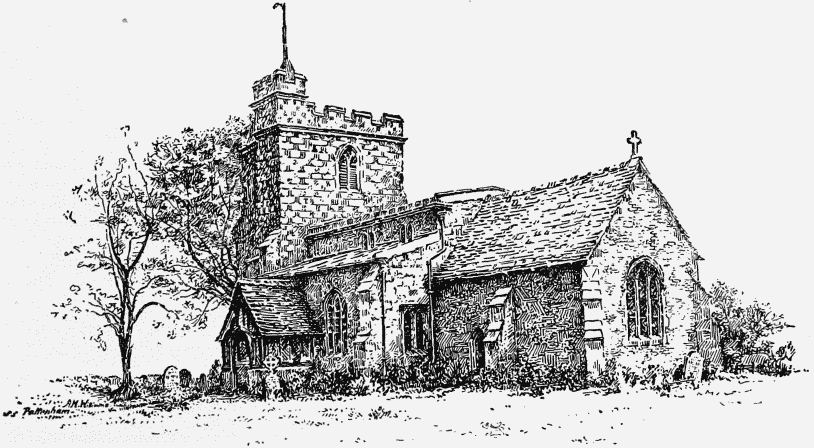
Church of our Lady, Puttenham, from South-East
Two mills are mentioned in Domesday in this manor, (fn. 1) and again in conveyances of the manor which took place in 1552 and 1560. (fn. 2) They may have been situated on the small stream which rises at Astrope and falls into Thistle Brook, a tributary of the Thames.
Christopher Urswick, the diplomatist, was rector of Puttenham from about 1482 to 1485. He undertook several journeys between England and Flanders to negotiate a marriage between Henry, earl of Richmond, afterwards Henry VII, son of his patroness, Margaret Beaufort, and Elizabeth of York. He landed with Henry at Milford Haven in 1485, and accompanied him to Shrewsbury and Bosworth. In 1487–8 he was sent on an important embassy to Ferdinand and Isabella to negotiate the marriage between Prince Arthur and Catherine of Arragon. He became dean of Windsor in 1495, and under his direction St. George's Chapel was rebuilt.
Thomas Fanshawe Middleton, first bishop of Calcutta, became rector of Puttenham in 1811. When the diocese of Calcutta was formed in 1813 the bishopric was offered to Middleton, and he remained there till his death in 1822. He was buried in Calcutta Cathedral.
MANOR
The manor of PUTTENHAM was left by Edwin of Caddington to his son Leofwin, (fn. 3) and it afterwards came to Earl Lewin, brother of King Harold. (fn. 4) After the Conquest it was given to Odo, bishop of Bayeux, of whom it was held by Roger. (fn. 5) Odo forfeited his lands about 1088 after the siege of Rochester, and Puttenham seems to have been subsequently granted to one of the earls of Leicester, for in 1210–12 it was held as of the honour of Leicester (fn. 6) and continued to be so held till about 1298. (fn. 7) In 1303 it was held of the honour of Wallingford, which then belonged to the king. (fn. 8) The over-lordship was probably granted by Edward I to Sir Thomas Wale, for the manor was held of him in 1304–5 for the service of one knight's fee and a pair of gilt spurs yearly. (fn. 9) Later the overlordship came to Sir Thomas Spigurnel, who granted it in 1340 to Nicholas de la Beche. (fn. 10) He in the same year transferred it to Sir John de Molyns, the service remaining the same as in 1304. (fn. 11) Sir John forfeited his lands in 1353, and though many of his estates were restored to his son William, (fn. 12) it is probable that the over-lordship of Puttenham remained in the crown, for in 1556 the manor was held of the king and queen as of the manor of Tring for homage and rent, (fn. 13) and the tenure was the same in 1613. (fn. 14)
In 1210–12 Ralph de Puttenham, who may have been a descendant of the Roger who held of Odo of Bayeux at the time of Domesday, held this manor, (fn. 15) and it was held by a Ralph de Puttenham, possibly a son, in the middle of the thirteenth century. (fn. 16) It afterwards seems to have come into the possession of Hugh de Herdeburgh, (fn. 17) from whom it descended to his son Roger. Roger left two daughters, Ela and Isabel, who jointly held the manor in 1297–8. (fn. 18) From them it appears to have returned to the family of Puttenham, for in 1303 it was held by the lady of Puttenham, (fn. 19) probably Alice wife of John de Puttenham, who in 1309 released two-thirds of the manor, which she may have held in dower, to Roger de Puttenham and Alina his wife. (fn. 20) The manor had in 1304–5 been granted to Roger, son of John de Puttenham by Sir Thomas Wale, of whom the manor was to be held for the service of one knight's fee, and a pair of gilt spurs. (fn. 21) After the death of Roger, Alina married Thomas de Hay who held the manor in 1340 jointly with Alina for her lifetime, (fn. 22) and on her death it came to her son Roger by her first husband. It 1414 it was held by Robert Puttenham, (fn. 23) and in the court rolls of the Duchy of Lancaster of 1480 it was presented that Isabel Puttenham, widow, owed suit, probably for this manor. (fn. 24) In 1534–5 livery of this manor was made to Robert son of George Puttenham, whose mother Rose, relict of George, held this manor as her jointure. (fn. 25) Robert and his wife Anne in 1550 conveyed the manor by fine to their second son Richard, (fn. 26) and in 1552 he sold it to Richard Duncombe, for a rent in malt, sheep, and lambs. If this rent fell into arrear for more than one year it was agreed that Richard Puttenham should re-enter the manor. (fn. 27) Richard Duncombe died seised of the manor in 1556, (fn. 28) and it passed to his son John, but it would seem that Richard in his life-time had left the rent unpaid, and much litigation arose between John and Richard Puttenham as to the title to the manor. (fn. 29) Judgement was given for Richard, and in 1559 John formally surrendered all his claim in the estate. (fn. 30) Either this Richard Puttenham or his elder brother George was the author of a treatise entitled The Arte of English Poesie, published anonymously in 1589. The author was the first writer who attempted philosophical criticism of literature, and his book was much appreciated. Ben Jonson's copy of the work is now in the Grenville Library at the British Museum.
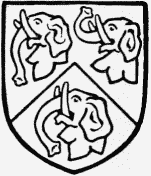
Saunders. Party cheveronwise sable and argent three elephants' heads razed and countercoloured.
Richard sold the manor in 1560 to John Saunders of Marston, (fn. 31) who died seised of it in 1613, (fn. 32) leaving a son Thomas aged thirteen. In 1623 Thomas conveyed the manor to John Benner and William Rowland, probably for the purposes of some settlement. (fn. 33) John son of Thomas predeceased his father in 1648, and his son Thomas Saunders of Beechwood succeeded his grandfather. Chauncy states that Thomas sold this manor in or about 1690 to Francis Duncombe of Ivinghoe, co. Bucks. (fn. 34) Francis died about 1728, leaving the manor to his nephew John Duncombe, son of his brother William, who was succeeded by his daughter Rebecca, wife of the Rev. Edward Lucy. Sarah Lucy their daughter became heir to the manor on the death of her three brothers and sister. (fn. 35) She married Thomas Meacher, and died leaving Edward Lucy Meacher her son and heir, who in 1806 conveyed the manor for a settlement to William Elley. (fn. 36) Edward sold it in 1810 to John William Egerton, seventh earl of Bridgewater. From him it passed to Earl Brownlow, who conveyed the estate to Baron Lionel Nathan de Rothschild in exchange for land in the parish of Northaw. (fn. 37) From Baron Rothschild the manor descended to Lord Rothschild the present owner. The old manorhouse has completely disappeared. It is said to have stood in a field at the east of the church. There are no courts held.
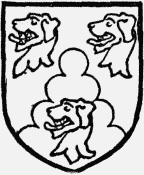
Duncombe. Party cheveronwise engrailed gules and argent three talbots' heads razed and countercoloured.
CHURCH
The church of OUR LADY has a chancel 13 ft. 8 in. wide by 23 ft. 8 in. long, internal measurement, nave 14 ft. 4 in. by 28 ft. 11 in., with north and south aisles and modern south porch, and west tower 12 ft. east to west by 11 ft. 3 in. north to south.
No features now existing appear to be older than the fourteenth century, though the small nave with its proportion of two squares suggests an earlier aisleless building, the chancel of which was superseded by that now existing.
The chancel is faced with flint work, and has cemented buttresses and a red tiled roof, and shows few signs of age.
The east window is modern, of three lights, and in the south wall is a fifteenth-century piscina, while opposite to it in the north wall is a recess with a trefoiled head, which seems to be a re-used fragment.
The nave arcades, of three bays, belong to the earlier part of the fourteenth century, though, as so often happens, their details are not alike. The north arcade has arches of two orders with wave-mouldings, (fn. 38) while those of the south arcade have plain chamfers. Both have octagonal shafts with moulded capitals and bases, but the details of the north arcade are better than those in the south, (fn. 39) and the pillars on the south are taller than those on the north. The chancel arch is of much the same date as the arcades, and has two chamfered orders with half-octagonal responds.
The clearstory, of late fifteenth-century date, has square-headed windows of two uncusped four-centred lights in the two east bays, but no window in the west bay. The east windows of both aisles are of like character with the clearstory, and in the north wall of the north aisle are two late fifteenth-century windows, the first of three cinquefoiled lights under a segmental head, and the second of two lights with a pierced spandrel under a four-centred head. In the south aisle are likewise two windows, the first corresponding to that in the north aisle, and of like design, while the second is like the east window of the aisle. Between the two south windows is a plain late fifteenth-century doorway, with a four-centred arch under a square head, in which is hung a door as old, or possibly older, than the doorway, but with moulded beads of the seventeenth century nailed on its outer side. The aisle walls are built of unsquared blocks of stone with flints set in the wide joints between, and both aisles and nave have low-pitched lead roofs.
The west tower, a very picturesque specimen of chequered flint and stone masonry, is of the fifteenth century, and has a projecting vice at the south-east angle, and four belfry windows of two trefoiled lights with a quatrefoil in the head. It is finished with modern battlements, and in the ground story has a west window of three cinquefoiled lights of late fifteenth-century style, and below it a west doorway of the same date, but clumsily made up with Roman cement.
The chancel roof is modern, but the nave roof is the best thing in the church, with heavy moulded ridge, purlins, principals, intermediates, and tie-beams, having large carved bosses at the intersections of the timbers, and large standing figures below the tie-beams. The western figure on the north side is St. Philip, and the eastern perhaps our Lady and Child, while the other two are bearded figures which have lost any distinctive emblem. On the south side the east and west figures are mitred, the former wearing mass vestments, the latter holding a round object in the left hand. The second figure from the east with a wallet over the right shoulder, may be St. James, but the third has no distinguishing mark. All stand on the foreparts of large birds, projecting from the wall with heads outstretched. At the ends of the intermediates are half figures holding blank shields, and wearing diadems; they may have had wings originally.
The central bosses in the east and second bays bear shields of arms, on the former three annulets on a bend engrailed quartered with a cheveron between three hunting horns impaling a bend, and on the latter an uncertain coat, two cheverons between three roses. Elsewhere on the bosses occur shields bearing a rose, a hind's head couped, and a rebus of a ton on which is hut. The other carvings are foliage patterns.
The north aisle roof is modern, but the south aisle has a simple late fifteenth-century roof with moulded timbers, and some pierced cresting and a flowing vine pattern, perhaps from a rood screen, has been fixed to its wall plate. In the nave are several massive benches with moulded rails, and on the north side of the chancel is another; from the roughness of the work it is hard to say whether they are of the seventeenth century or older. The hexagonal pulpit is of early seventeenth-century date, with upper and lower panels carved, the former with fishlike and scaly monsters, the latter with lozenge patterns. The cornice and base are modern.
The font, at the west end of the nave, has a plain circular bowl stem and base, but has lost its old surface and any definite marks of its age. It has a flat cover with a turned seventeenth-century finial.
In the chancel are a few fifteenth-century floor tiles, and in the north aisle a few pieces of old glass, a part of a heraldic quarry with a ship in sail, and a chief bearing a leopard between two roses, of seventeenth-century date.
Over the chancel arch are the royal arms of George III.
In the tower are three bells, the treble by Chandler of Drayton Parslow, 1714; the second blank, and the tenor also by Chandler, 1656. The cannons of the second bell are broken, and it lies useless in the frame.
The plate consists of a cup of 1569, with a band of strap-work and a raised moulding near the lip of the bowl, and a cover paten without marks, but engraved with similar strap-work. There are also a modern paten and flagon, plated. The maker's mark on the cup is a lis in a shield, for which see the list in Cripps's Old English Plate, under 1562.
The registers begin in 1678, the first book containing baptisms and burials to 1759, and marriages to 1754. The second, an affidavit book for burials in woollen, runs from 1684 to 1723, and the third, 1681–1812, is a copy of book 1 with continuations. Book 4 contains marriages from 1754 to 1809.
ADVOWSON
The church of Puttenham was held by the priors and canons of Canons Ashby (fn. 40) until 1309, when they granted it to the bishop of Lincoln. (fn. 41) Cussans suggests that the church was probably built by the family of la Zouche, who were liberal benefactors to the priory of Ashby, and bestowed by them upon the priory. (fn. 42) The bishops of Lincoln at some time previous to 1550 must have sold the advowson to the lord of the manor, for it was held with the manor at that date, (fn. 43) and from that time it follows the descent of the manor (q.v.) until 1628, when Thomas Saunders conveyed the advowson to Arthur Wilmot. (fn. 44) Arthur died without issue, and was succeeded by his nephew, Charles Wilmot, first Viscount Wilmot of Athlone. (fn. 45) From him the advowson seems to have passed during his life-time to his son Henry, who was holding it in 1637. (fn. 46) The Wilmots may have held the advowson only under a lease, for it seems to have returned to Thomas Saunders, who conveyed it in 1663 to Robert Sadler and Edward Sadler, (fn. 47) probably for a settlement upon his wife. In the same year the bishop of Lincoln presented to the rectory, (fn. 48) and the advowson remained with the bishops till 1852, when the patronage was transferred to the bishop of Peterborough. (fn. 49) In 1874 it was exchanged with the crown, (fn. 50) in which it has since been vested.
Rent from a croft called Taunts in Puttenham, containing an acre, was given for finding a lamp. In 1548–9 this land was held by Thomas Graunge. (fn. 51)
There are no places of worship for Nonconformists, who do not seem ever to have obtained a footing in this parish.
CHARITIES
This parish had been in possession from time immemorial, under the title of Church Head Land, of land at Astrope, with cottages thereon, also of a piece of garden ground with a cottage thereon adjoining the graveyard of the parish church, and of an allotment in Astrope containing 1a. or. 23p. The first-mentioned land was sold in 1890 for £70, and the remaining pieces of land in 1898 were sold for £100.
The net proceeds were invested in the purchase of £161 19s. 5d. consols, with the official trustees, and the annual dividends amounting to £4 9s. are applied under a scheme of 2 August, 1889, by the vicar and churchwardens for the maintenance of the fabric and services of the parish church.