A History of the County of Hertford: Volume 2. Originally published by Victoria County History, London, 1908.
This free content was digitised by double rekeying. All rights reserved.
'Parishes: Studham', in A History of the County of Hertford: Volume 2, ed. William Page (London, 1908), British History Online https://www.british-history.ac.uk/vch/herts/vol2/pp274-280 [accessed 7 May 2025].
'Parishes: Studham', in A History of the County of Hertford: Volume 2. Edited by William Page (London, 1908), British History Online, accessed May 7, 2025, https://www.british-history.ac.uk/vch/herts/vol2/pp274-280.
"Parishes: Studham". A History of the County of Hertford: Volume 2. Ed. William Page (London, 1908), British History Online. Web. 7 May 2025. https://www.british-history.ac.uk/vch/herts/vol2/pp274-280.
In this section
STUDHAM
Stodham, Estodham, Stotham (xi cent.); Stodham (xiv and xvi cent.).
This parish, which used to be partly in the county of Hertford and partly in the county of Bedford, was transferred wholly to the latter in 1897, (fn. 1) but at Parliamentary elections each portion is attached to the county to which it once belonged. Studham is an entirely agricultural parish of 3,033 acres, of which (in 1905) 1,252 acres were arable, 571 acres were permanent grass, and 190 acres woodland. (fn. 2) It lies high, rising in the north to some 700 feet, and falling on the south and west to 400 feet.
In the south of the parish is a large common, covering about 315 acres. Half of this, once in Hertfordshire, was inclosed in 1846, (fn. 3) but the other half is still common land, the inhabitants retaining the rights of cutting furze and carrying away the red gravel yielded by the pits in the north-east corner. The village, which occupies a central position in the parish, is divided into two parts, Church End and 'The Village.' The former contains, besides the church, the vicarage, the manor-house, and a few cottages. The 'Village' consists of small houses and cottages.
In the south of the parish is the manor and farm of Barworth, called Barwythe by its present owner, Mr. E. Alexander.
The high road from Hemel Hempstead to Leighton Buzzard goes through the south of Studham. The road from Little Gaddesden to Whipsnade passes through the village, while that from Kensworth to Dagnall is a little to the south of it.
Though there are no parks or large woods the parish contains a fair amount of timber in small copses. The soil is gravel and clay and the subsoil chalk, and the chief crops are wheat, barley, and turnips.
There has been ever since 1871 a steady decline in the population, which is partly attributable to the almost entire disappearance of the straw-plaiting industry. (fn. 4) During the nineteenth century nearly all the land in the parish was brought into the Ashridge estate by sale or exchange. (fn. 5)
Among the ancient place-names are Charlewood or Cherlewood, Pedeleia, Holebem, Grenemere, Wardhole, Haietot, Feldemerishull, Longewerde, Manesdelle, Halcroft, and St. Margaret's Wood.
MANORS
The manor of STUDHAM was held in the early part of the eleventh century by Ulf, whose widow Adelitha married Oswulf son of Frane, a thegn of Edward the Confessor. Oswulf and Adelitha granted about 1064 the reversion of the manor after their deaths to Leofstan, abbot of St. Albans, for the health of their souls, the soul of Ulf and other relatives. (fn. 6) Oswulf was living apparently at the time of the Conquest, and William I, it would seem, seized his lands, ignoring the grant to St. Albans, and gave the manor of Studham to his follower Robert de Tony or Todeni of Belvoir before 1086. (fn. 7) At this date Baldric was holding the manor of Robert de Tony. (fn. 8)
The overlordship of Studham and Barworth was given by Robert de Tony to his daughter Agnes, wife of Hubert de Rye. (fn. 9) Her son Henry was succeeded about 1162 by his nephew Hubert, son of his brother Hubert, who held three fees in Studham in 1166. (fn. 10) He died in 1171–2 leaving Alina, wife of John Marshal, and Isabel, wife of Roger de Cressie, his daughters and co-heirs. (fn. 11) The fees in Studham fell to the share of John and Alina, (fn. 12) and passed in 1234–5 to their son John, (fn. 13) who died in 1242–3 and was succeeded by his brother William. (fn. 14) On the death of the latter in 1264–5, the fees passed to his son John, (fn. 15) who died in 1282–3 leaving a son William, then five years of age. (fn. 16) In 1314–15 William Marshal was succeeded by his son John, (fn. 17) who died in 1316, (fn. 18) and two fees in Studham and Whipsnade were assigned to his wife Ela, with the consent of Robert de Morley, who had married Hawisia, sister and heir of John. (fn. 19) Ela afterwards married Robert Fitz Payn, and in 1327 it was agreed that he should hold these fees jointly with Ela. (fn. 20) After the death of Ela these fees came to Robert de Morley, who died seised of them in 1360–1, (fn. 21) and they were held by his descendants until 1428. (fn. 22) Some time after this date the overlordship must have passed to the crown, as in 1616 the manor is stated to have been held of the king in chief by knight service. (fn. 23)
In the middle of the thirteenth century Walter de Basingham held half a fee in Studham of John Marshal. (fn. 24) By 1283 it had come to William de Botlesford, (fn. 25) and he was succeeded before 1294–5 by Walter son of John de Botlesford, (fn. 26) who held half a fee in Studham in 1302–3. (fn. 27) He was succeeded about 1316 (fn. 28) by Robert de Botlesford, who was lord of Studham in 1320. (fn. 29) Geoffrey son of Robert de Botlesford succeeded before 1343 and sold the manor of Studham in that year to Henry son of Sir Bartholomew de Burghersh the elder, (fn. 30) and in 1346 Henry de Burghersh held half a fee in Studham. (fn. 31) Henry died in 1350 and was succeeded by his brother Bartholomew, (fn. 32) who in 1355 died seised of one carucate in Studham which he held for a third of a knight's fee, and left his son Bartholomew his heir. (fn. 33)
John Hawle conveyed the manor in 1366–7 to William Clipsham, (fn. 34) and in 1428 it was held by Nicholas Carew of Beddington as half a fee in Studham, which Henry de Burghersh once held. (fn. 35) Nicholas leased it in 1435 for three years to Sir John Holland and others, (fn. 36) and left it by will dated 1458 to his wife Margaret for life with remainder to his second son James. (fn. 37) It seems to have passed out of the hands of the family of Carew before the death of James in 1492–3, (fn. 38) and to have come into the possession of William Lucy and Anne his wife, who also held half the manor of the Hyde (q.v.), for in 1549 they conveyed half the manor of Studham (fn. 39) to Sir Robert Dormer, (fn. 40) who died in 1552 and was succeeded by his son Sir William Dormer. (fn. 41) William died seised of the manor in 1575, leaving a son and heir Robert, (fn. 42) who also died seised in 1616, and as his son William had died a few months before, he was succeeded by his grandson Robert, who was then nearly six years old. (fn. 43) Robert Dormer afterwards became earl of Carnarvon, and in 1632–3 he and his wife Anna Sophia conveyed the manor, probably for the purposes of a settlement, to Sir Benjamin Rudyerd and Samuel Turner. (fn. 44) Robert's son Charles, second earl of Carnarvon, married Elizabeth Capell in 1653, and a settlement was made of the manor in this year. (fn. 45) Charles and Elizabeth had two sons who died young, and three daughters, one of whom, Elizabeth, became the third wife of Philip Stanhope, second earl of Chesterfield, and brought this manor to her husband's family. Elizabeth died in 1679 and Philip in 1713, and they were succeeded by their eldest son Philip, (fn. 46) who married Lady Elizabeth Savile, one of the daughters of George, marquis of Halifax, by whom he left issue four sons and two daughters. His second son William married Susanna Rudge, and in the settlement made upon his marriage this manor was limited by the name of Studham and Hudnall to him for life, with remainder to Susanna his wife and to his sons in tail male. (fn. 47) The manor and estate were sold in 1738 by the trustees of this settlement, under an Act of Parliament of 5 George II, by the name of the manor or lordship of Hudnall, to Elizabeth Dyson of Charterhouse Square, London, widow. (fn. 48) Elizabeth, by her will dated 25 February, 1743, devised the estate to her son Jeremiah, clerk of the House of Commons, and he by will dated 26 January, 1775, devised it to his son Jeremiah and others in trust to be sold for the benefit of his younger children. (fn. 49) In 1778 Jeremiah Dyson conveyed it to William Bray. (fn. 50) It was afterwards sold to Thomas Poynder of Bishopsgate Street, London, of whom it was purchased in 1808 by John William, earl of Bridgewater, (fn. 51) from whom it has descended to the present Earl Brownlow.
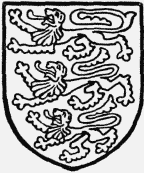
Carew. Or three lions passant sable.
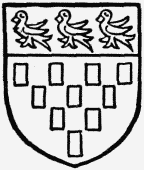
Dormer of Wing. Azure ten billets or and a chief or with three martlets azure therein.
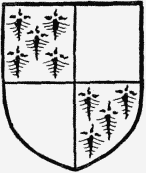
Stanhope. Quarterly ermine and gules.
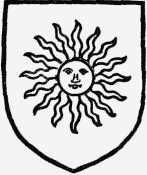
Dyson. Azure a sun or.
The manor-house is now called Church Farm, and stands about 100 yards south-east of the church. The house contains a wide staircase, and one of the upper rooms has a carved oak mantelpiece with figures of Time and Death, and is entirely panelled with oak. There is a circular moat nearly surrounding the house, which has been partly filled in on the side towards the farm-yard.
In an adjoining field are a fine holly hedge and the remains of a large avenue.
The manor of STUDHAM or STUDHAM cum BARWORTH was held by the priors of Dunstable, but it is not quite clear how, or at what date, they became possessed of it. Chauncy states that it was granted to the priory by Henry I, (fn. 52) but as we find that Alexander de Stodham in the reign of Henry II granted the church of Studham and half a hide of land there to the priory, (fn. 53) it would seem probable that this may have formed the nucleus of the prior's manor, particularly as the capital messuage of the manor seems to have belonged to the parson of the church of Studham. (fn. 54) The priory continued to acquire lands in the parish. In 1218 Adam son of John gave land to the priory, (fn. 55) while the land of Baldwin of Whitchurch was acquired in 1259, (fn. 56) and John Humphrey and Matilda his wife gave a messuage and land in 1260. (fn. 57) Robert Ferrer of St. Albans confirmed the lands of Robert de Cheletone, his father, in 1278, (fn. 58) and in 1368–9 William Haddon and Roger Harneys granted four acres of wood. (fn. 59) By 1288 there is evidence that the prior had a manor here to which were attached about ten tenants. (fn. 60) In 1246 the prior's house at Studham was burnt, (fn. 61) and in 1253 the pigeon-house was rebuilt. (fn. 62) In 1330 the prior was impleaded because he claimed view of frankpledge and free warren in Studham. The view he claimed by prescription, (fn. 63) and the warren by charter of Edward II made in 1323. (fn. 64)
After the Dissolution the manor was granted in 1544 to William Belfield, (fn. 65) formerly the lessee of it and the rectory under the prior. (fn. 66) William died in 1559, and was succeeded by his son John, (fn. 67) who died about 1590, (fn. 68) leaving William his son and heir. William died in 1605, and left Anthony, his eldest son, a minor, to whom livery of the manor was made in 1609. (fn. 69) From Anthony the estate came to his son Henry, (fn. 70) and he was succeeded by his son Henry, who conveyed the manor in 1722 to Thomas Pickering, probably for a settlement on his wife Helen. (fn. 71) Henry died soon after this conveyance was made, (fn. 72) and the manor came to his son, a third Henry, who married Elizabeth Jarman. Henry died in 1733, (fn. 73) and was succeeded by a fourth Henry, his son, who in 1754 conveyed the manor to Hale Wortham and John Astwood, (fn. 74) probably for a settlement upon his sister Ellen, wife of William Bayley, to whom he devised the manor by his will dated 15 October, 1795. (fn. 75) Ellen, by her will dated 8 June, 1812, devised it to trustees for sale, (fn. 76) and in 1815, Kirkman Gardiner and William Bayley and Anne his wife sold it to John William, earl of Bridgewater, (fn. 77) in whose descendant, Earl Brownlow, it is now vested.

Belfield of Studham. Ermine a molet gules and a chief gules with a label of five pendants argent therein.
Part of the Belfield estate went to Mr. W. Parkinson, who died in 1820. His daughter married the Rev. T. W. Mead, vicar of Studham and rector of Whipsnade, and after his death in 1849 the land was bought by Earl Brownlow, and Studham House, where Mr. Mead had lived, was considerably enlarged. (fn. 78) It was for a long time the residence of Lord W. Compton, afterwards marquis of Northampton, and later of the Ladies Osborn. It was purchased in 1900 by Major J. Y. Stephen, (fn. 79) who sold it in 1906 to Mr. E. Alexander. The latter changed the name to Barwythe House.
Land in Studham was held at an early date by the family 'de Stodham.' (fn. 80) This was probably the five hides of land called in Domesday 'Bereworde,' which was held by Baldric of Robert de Tony. This, like Studham, had been held before the Conquest by Oswulf son of Frane, (fn. 81) and is probably identical with the manor which later on became known as LA HYDE. Alexander de Stodham held land in Studham in the reign of Henry II, (fn. 82) and William de Stodham held land there between 1190 and 1200, (fn. 83) and died in 1222. (fn. 84) Jordan son of Alexander de Stodham seems to have succeeded to the manor, as he confirmed the grant of the church made by his father. (fn. 85) He left four daughters, Alice wife of Hugh Britt, Lavinia wife of Elias de Turri, Paschasia wife of Gilbert son of Richard, and Sarah, who, with their husbands, granted the manor to Robert de Stodham, perhaps another son of Alexander, in 1202. (fn. 86) It was, however, agreed that the capital messuage and advowson of the church (fn. 87) were to remain to the sisters. (fn. 88) Jordan de Stodham conveyed land in Studham by fine to William de Eltesdon and Margaret his wife in 1231–2 and 1235–6, (fn. 89) and in 1236 the prior of Dunstable granted William a chantry in his chapel at Barworth. (fn. 90)
Members of the Eltesdon family seem to have been considerable benefactors of the priory of Dunstable, for William granted to the prior land in Feldmerishull and all the services of Reginald de Hesriche, (fn. 91) and John de Eltesdon in 1262 granted rent and lands in Studham and Barworth. (fn. 92) The prior of Dunstable held land in Barworth in 1275 of John de Eltesdon, and did not do suit at the tourn as John used to do. (fn. 93) John was succeeded by his son Walter, who is called lord of the manor of Studham in 1275 and 1287. (fn. 94) His descendants appear to have assumed the surname 'de Stodham,' or to have conveyed the manor to a member of that family, for in 1294–5 Thomas de Stodham died seised of a rent paid by Richard atte Hille from a messuage and 240 acres of land in Stodham, which is later called the manor of la Hyde in Barworth, and which was held by Thomas of Walter de Botlesford, then lord of the manor of Studham. (fn. 95) Thomas left a son and heir Thomas, (fn. 96) who in 1308 sold this rent to Sir Henry Spigurnell. From this deed it appears that Thomas de Stodham, the father, had for the said rent granted the manor to Richard atte Hille, and Maud his wife, and Thomas, their son. It was further agreed that if Thomas son of Richard should die without issue the manor should remain to Sir Henry. (fn. 97)
In 1309 Henry obtained a grant of free warren, (fn. 98) and in 1312 Thomas son of Richard atte Hille conveyed the manor to Henry Spigurnell. (fn. 99) In 1328–9 Henry died seised of land in Studham held of the barony of La Rye, and left a son Thomas his heir. (fn. 100) Thomas died in 1332–3, (fn. 101) and seems to have been succeeded by William Spigurnell, probably the son of his son Henry. (fn. 102) William died in 1366 leaving a son William, an infant. (fn. 103) In 1386 William Spigurnell died seised of land in Studham which had been settled on him and his wife Joan by his father William. (fn. 104) He left no children and was succeeded by Lucy his father's sister, wife of William Alberd. (fn. 105) William Alberd was seised of a toft and land at Studham when his lands were extended in 1387 for debt. (fn. 106) Lucy, who retained her maiden name, died in 1390–1, seised of la Hyde and Hydewood in Studham held of the king in chief for knight service. (fn. 107) She left a daughter Amy or Anne who married John Kyrkham, and died without heirs in 1427. (fn. 108) The manor apparently descended to John son of David Brecknock and Lettice his wife in right of Lettice, for in 1476 John died seised of land in Studham and Barworth which had been settled on him and his wife. They had issue Alice, late wife of John Smith, and Margaret, wife of William Lucy. John Brecknock survived Lettice, and the manor was settled on him for life with remainder in moieties to Alice and Robert Radclyff, her second husband, and William Lucy and Margaret. (fn. 109) The latter moiety seems to have passed from William Lucy to his great-grandson William, for in 1549 William Lucy and Anne his wife conveyed half the manor of the Hyde to Sir Robert Dormer, (fn. 110) and it is probable that this portion of the manor then became merged in the manor of Studham.
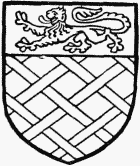
Spigurnell. Gules fretty argent and a chief or with a lion passant gules therein.
By her husband John Smith, Alice Brecknock had a daughter Alice who married Thomas Cavendish, and by her third husband, Alexander Quadring, she had a son Richard, and in 1493 a settlement of a moiety of the manor was made upon Alexander Quadring for life, with remainder as to a quarter to Richard Quadring and Margaret his wife, and as to the other quarter to Thomas Cavendish and Alice his wife, with contingent remainders. (fn. 111) Richard Quadring and Margaret died before Alexander, and their share came to John Smith son and heir of Margaret, (fn. 112) who had apparently married—Smith as a second husband. Thomas Cavendish survived his wife Alice and died in 1524, holding a quarter of 200 acres of land in Studham and elsewhere of the king in chief for a twentieth part of a knight's fee. (fn. 113) George his son and heir, the friend and biographer of Cardinal Wolsey, died in 1561–2. (fn. 114) His share of the manor probably became joined to the part held by John Smith, and passed to John Sheparde of Offley, for in 1544 he and Philippa his wife granted the manor of Studham to John Sibley of Ayot St. Lawrence, senior. (fn. 115) The manor with the wood called Charlewood was granted in 1557 by John Sibley to his son John, (fn. 116) and in 1587 John Sibley, yeoman, died seised of a capital messuage in Studham held of Sir Robert Dormer as of the manor of Studham, and of a farm in Studham called Halseys Farm, held of William Belfield as of his manor of Barworth cum Studham. (fn. 117) He left this estate to his second son John, (fn. 118) and in 1614–15 view of frankpledge and court-leet was granted to John Sibley in Studham. (fn. 119) Thomas Sibley, a signatory of a petition in 1689 from the inhabitants of Studham and other neighbouring parishes, protesting against the bill enjoining the wearing of woollen hats, may have been a member of this family. (fn. 120) John son of Edward Sibley died in 1737 and was buried in the chancel of the church. (fn. 121) Edward left two daughters: Elizabeth married to Rev. A. Smith, curate of Market Street, and Anne who married John Bentley. (fn. 122) In 1748 Anne Sibley, spinster, probably the Anne just mentioned conveyed the manor of Studham to Thomas Nicoll and William Jarman. (fn. 123) The manor subsequently came to Edward Nicoll, sheriff of Bedfordshire, in 1794. It now belongs to Earl Brownlow. (fn. 124)
The prior of GROVEBURY or LA GRAVE acquired land in this parish between 1256 and 1258, some of which was given to him by John de Eltesdon in exchange for other land in Bedfordshire, (fn. 125) and part by Richard de Evyesholt and Alice his wife. (fn. 126) In 1263 Hawisia widow of William de Hyde granted to the prior and convent a yearly rent of 11d., which they had been accustomed to pay to her and her son William for a tenement in Studham. (fn. 127) In the reign of Henry III the possessions of this priory had come into the hands of the king as those of an alien house on account of the wars with France, and the manor which they had held in Studham, at that time consisted of two carucates of land with one windmill and some wood. (fn. 128) One messuage, 3 tofts, 60 acres of land and rent in Studham, which had formerly been held by the abbess of Fontevrault, of which house Grovebury was a cell, were granted in 1413 with the manor of Grovebury to Sir John Philip, kt., (fn. 129) who died seised of this estate in 1415. (fn. 130) Sir John was related to the Burghershes, who held the manor of Studham (q.v.) in the fourteenth century, through his marriage with Alice daughter of Maud Burghersh and Thomas Chaucer, son of the poet Geoffrey. The estate had been settled upon him and Alice and the heirs of their bodies by Sir William Philip, Thomas Chaucer, John Throgmorton and others. (fn. 131) He left no heirs by Alice, who survived him and afterwards married William de la Pole, duke of Suffolk. They, in 1446–7, granted the estate to Eton College, for the life of Alice, (fn. 132) and it reverted to their son John, afterwards duke of Suffolk, who with his wife Elizabeth, sister of Edward IV, granted it in 1480 to the dean and canons of the king's Free Chapel of St. George, Windsor. (fn. 133) When deans and chapters were abolished in 1650 this manor was sold to Edmund Sibley of Great Gaddesden. (fn. 134) The manor had been leased in 1566 to Robert Christmas for a term of 99 years, the benefit of which lease was then with Francis Barnham and George and John Barnes. (fn. 135) After the Restoration the dean and chapter recovered possession of their lands, and in 1870 this estate came by exchange into the possession of Earl Brownlow, who now holds it.
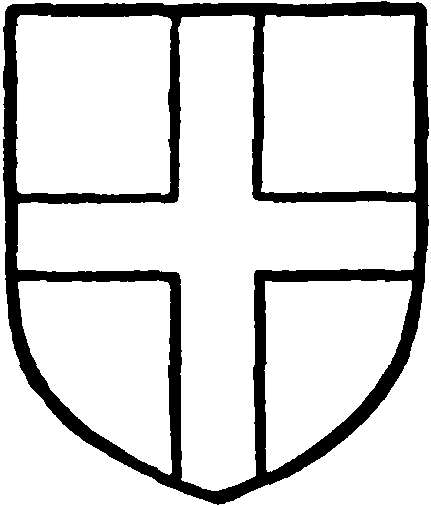
Dean and Canons of St. George's, Windsor. Argent a cross gules.
A residential house called The Grove, lately pulled down, was part of the Barworth property, and probably built on that portion which was once attached to the priory of Grovebury.
The manor of SHORTGRAVE (Scortegrave, Sorthegrave, xiii cent.), which extends into the parishes of Totternhoe, Whipsnade, and Studham, was held by the priory of Dunstable until the Dissolution, at which time the farm of the manor was worth £10, and had been demised by the prior to William Belfield at a rent of forty quarters of wheat. (fn. 136) The manor had apparently been given to the monastery by William de Cantelupe in 1209, (fn. 137) and additions were made to their possessions here by Thomas Inge, (fn. 138) John de Eltesdone, (fn. 139) and others. This manor was granted in 1546 to Sir Roger Cholmeley and Christiana his wife, to be held for a fortieth part of one knight's fee. (fn. 140) Sir Roger and Christiana seem to have sold it to Sir Thomas Russell, Richard Lygon and Mary his wife, for in 1567 they obtained licence of the queen to sell it to Michael Lodge and Ellen his wife. (fn. 141) Ellen survived her husband and died seised of the manor in 1574, leaving her son Henry her heir. (fn. 142) Henry settled it on his eldest son Michael on his marriage with Alice daughter of Robert Barbor in 1607, and died in 1617. (fn. 143) The manor was settled on Michael's eldest son Henry in 1627. (fn. 144) Michael died in 1639 and Henry succeeded him. (fn. 145) In 1655 Henry Lodge, senior, and Henry Lodge, junior, sold the estate to Henry Honnor, (fn. 146) who with John and Thomas Honnor sold it in 1711–12 to Thomas Cowslade. (fn. 147) From him it passed to John Cowslade, who sold it in 1774 to Robert Pardoe. (fn. 148) The later descent of the manor has not been ascertained.
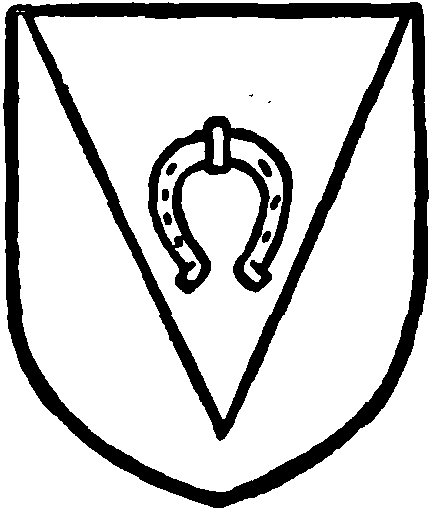
Dunstable Priory. Argent a pile sable with a horseshoe or affixed to it by a staple or.
CHURCH
The church of OUR LADY has a chancel 28 ft. by 17 ft. 9 in., with a modern north vestry, a nave of the same width and 44 ft. long, with north and south aisles and south porch, and a west tower 10 ft. 8 in. square within the walls.
A consecration of Studham church in 1219 is recorded in the Annals of Dunstable, pointing to building here in the early years of the thirteenth century, and the mention of five altars agrees with the architectural evidence that at the time of consecration the church had north and south aisles to the nave. The first church on this site, built in the time of Abbot Leofstan of St. Albans, may have been of wood, though the terms of the grant of 1064 do not exclude the possibility that it was a masonry building; in any case the architectural evidence goes to show that a masonry building was standing here before the thirteenth-century enlargements. It probably had an aisleless nave about 34 ft. long inside, and as wide as the present one, with a chancel of proportionate length, some 13 ft. wide. The break in the existing nave arcades probably marks the line of the west wall of the old church, and it seems possible that when the addition of aisles was taken in hand this wall was left standing, either for convenience or because it was not in the first instance intended to lengthen the church westwards. The arcades are of three continuous bays on the east side of the break, and of a single bay to the west of it. The capitals are of three types, scalloped, foliate, and moulded, the scalloped capitals, four in number, being those of the responds at the east and west ends of the north arcade, the west end of the south arcade, and the west of the third bay of the south arcade. The foliate capitals are those of the four octagonal pillars in the north and south arcades, and of the east respond of the latter; and the east responds of the west bay of each arcade, together with the west respond of the third bay of the north arcade, have moulded capitals. There are several minor differences of detail in the arcades, pointing to slow and irregular progress, and the work may well have been begun some fifteen to twenty years before the date of consecration. The scalloped capitals, of late Romanesque detail, are of earlier character than the rest, and being four in number, and all belonging to responds, may have been originally set up at the four ends of the projected three-bay arcades, the first part of the work to be undertaken. One of them, at the west of the third bay of the south arcade, remains in position, a second, at the east end of the north arcade, being probably in its original place, but raised above its original level, while the other two are at the west ends of the added fourth bay. The capital at the east end of the north arcade is set at a higher level than the rest of the capitals in the church, and from it spring a few courses of an arch of different radius from those of the north arcade, to which it has been clumsily adapted. It is probably a case of a later alteration to give more room beneath it for the reredos of an altar, or for some other reason of the sort. The corresponding capital in the south arcade has been altered to suit the design of the arcade, and the former capital may be that now at the east of the fourth or added bay on this side. The west wall of the nave is not parallel to the east wall, and it seems that this must have been the case with the former west wall, as the three east bays of the north arcade are set out with a uniform spacing of 10 ft. 6 in., as against 10 ft. 4 in. in the south arcade, and a line drawn between their west responds would be parallel to the west wall of the nave, the arches in the west bay being of equal span. When this bay was added the rest of the arcades must have been built, and its details are plainer than those of the older work. The plainly moulded capitals of its east responds suggest that funds to repeat the beautiful foliage of the eastern bays were not forthcoming, and it would seem that the scalloped capital from the west end of the third bay of the north arcade was moved one bay further westward, its place being taken by a moulded capital of the latest design, while that at the west of the corresponding bay of the south arcade was not moved, as another capital of the sort, from the east end of this arcade, was available for the west respond on the south side of the new bay. The break in the arcade may be due to the fact that it was cheaper to leave the older responds in position than to change them into columns, and the centering for the south arcade would also serve for the arches of the new bay.
The later history of the church includes alterations to the aisles in the fourteenth and fifteenth centuries, the addition of a west tower and a clearstory, the rebuilding of the chancel in the fifteenth century, and the building of a wider chancel arch and a north vestry in modern times. The church is built of flint rubble and Totternhoe stone, and is covered with rough-cast externally; there is a record that a complete coat of rough-cast was put on in 1774. Repairs costing £500 were carried out in 1825, and the tower was repaired in 1840.
The chancel, which is of equal width with the nave, having doubtless been built round the former chancel in the usual way, has a three-light east window with fifteenth-century tracery, a square-headed window of two cinquefoiled lights on the north, and a corresponding window on the south, both of fifteenth-century detail, and near the south-west angle a plain single light, the stonework of which has been repaired. There is a plain south doorway, and a piscina in a four-centred recess, and the sill of the two-light window on the south is carried down to form a seat.
The chancel arch replaces a small low arch with squints on either side of it, and, in the desire to throw open the chancel to the nave, has been made of such a width that its abutments are not sufficient to resist its thrust; the east window of the south aisle is already somewhat dislocated in consequence.
The nave arcades, as already noted, are of four bays with a break between the third and fourth bays; the arches are of two hollow-chamfered orders with moulded labels, and the columns octagonal. The foliate capitals are exceedingly beautiful, with groups of trefoiled leaves springing from the bell; that of the second column in the south arcade is of a different type from the rest, but all are of admirable style. The treatment of the springers of the arcades is not uniform; in some cases broach stops are used, or a peculiar scrolled stop—over the first column of the south arcade—and elsewhere the arch section springs directly from the capital. The clearstory has only two windows a side, that at the north-east being of two square-headed lights, while the other three have pairs of cinquefoiled lights under a square head.
In the north aisle are three north windows, all under square heads, the easternmost of fifteenth-century date, with three cinquefoiled lights, and the other two of the first half of the fourteenth century, with two trefoiled ogee lights. The north doorway is of two chamfered orders, and contemporary with the two-light windows.
The south aisle has a three-light fifteenth-century east window, a fourteenth-century two-light window at the south-east, and a fifteenth-century window at the south-west, also of two lights, but having the unusual feature of a small moulded capital or necking on the central mullion at the springing of the lights. The south doorway is of a single-chamfered order, under a modern porch. At the south-east is an ogeeheaded recess with a small drain set in the east half of its flat sill, leaving a considerable blank space to the west of it. It is to be noted that both aisles overlap the west tower some 9 ft.; the development of this part of the church seems to be that the aisle walls were rebuilt in the fourteenth century, and probably lengthened a few feet westward, beyond the line of the former thirteenth-century walls. When the tower was added in the fifteenth century, its east wall was set out within the existing west wall of the nave, as far to the east as possible without interfering with the west bay of the nave arcades, and the width of the tower was regulated by the space between the nave walls, in which its east wall was inserted. The idea may have been to encroach on the churchyard as little as possible. In the west end of the south aisle the font is placed. This is an unusually fine piece of thirteenth-century work, with a rather shallow circular bowl, rounded beneath, and having a band of dragons and foliage round the upper part. It rests on a circular stem and spreading base, the latter carved with sprays of trefoiled foliage springing from a necking at the base of the stem and spreading downwards and outwards on the slope of the base.
The west tower is very plain, with an embattled parapet and square-headed two-light belfry windows. In the ground stage is a single square-headed west window, and the tower opens to the nave by a small fifteenth-century doorway, the door opening towards the tower, with a two-centred arch of fifteenth-century detail. There is no stone stair to the upper stories.
All roofs are of low pitch, and the only old wooden fittings in the church are some seats with linen pattern panels, probably of early sixteenth-century date, in the west end of the nave. There are also a few mediaeval floor-tiles.
There are four bells, the treble and second by Chandler, 1666, the third of 1599, inscribed 'Pries the Lord,' and the tenor of 1627 by Joseph Knight, inscribed 'God save our King.'
The plate consists of a plain communion cup inscribed 'Nathaniell Fisher Churchwarden 74' (1674), and a pewter flagon and two plates.
The first book of the registers contains all entries from 1570 to 1639, the second those from 1640 to 1740, and the third those from 1741 to 1812. There is also an affidavit book for burials in woollen from 1680 to 1741, and the vestry book from 1750 to the present day is preserved.
ADVOWSON
There was probably a church at Barworth before the Conquest, as a priest is mentioned in Domesday, (fn. 149) and Adelitha and Oswulf, after they granted Studham to the monastery of St. Albans, asked Abbot Leofstan to give them wood for building a church in Studham, (fn. 150) which was to be a special sign of ownership, so that the abbey should not lose Studham for any cause. (fn. 151) In the reign of Henry II the church was granted to the priory of Dunstable by Alexander de Stodham, and the gift was confirmed by Henry II, Hugh bishop of Lincoln, Nicholas archdeacon of Bedford, and Pope Innocent III. (fn. 152) Various descendants of Alexander confirmed this grant; among them Jordan son of Alexander, Hugh Bretti or Britt and Alice his wife, William de Stodham and Robert de Stodham. (fn. 153) The church was dedicated in 1219 by Robert bishop of Lismore, and at the same time five altars and a large churchyard were consecrated. (fn. 154) In 1220 it was ordained that the vicarage of Studham should consist of the altarages of the church and of Vivian's Croft which contained about 7 acres, saving to the prior from the altarages one mark and ten lambs. The vicarage was worth 6 marks, and the whole church 20 marks. (fn. 155) The church remained in the possession of the priory until the Dissolution, and at this time the rectory was farmed to William Belfield. (fn. 156) The advowson of the vicarage was granted in 1558 to Thomas bishop of Lincoln. (fn. 157) It came to the crown by lapse in 1672, (fn. 158) and from that time has continued in the crown.
The rectory was granted for a term of twenty-one years, beginning in 1571, to Freeman Young, and in 1588–9 it was granted to John Welles and Hercules Wytham, to be held as of the manor of East Greenwich for fealty. (fn. 159) In 1609, at the petition of Thomas Pigott it was given to Thomas Sankey of Edlesborough and Thomas Pigott and his heirs for ever, (fn. 160) and in 1624 they sold it to William Halsey. (fn. 161) In 1628 John Smith and Martha his wife conveyed it to William Beamont, (fn. 162) and from him it seems to have come to co-heirs, for in 1661 Edward Beamont and Sarah his wife conveyed half the rectory to John Sibley, (fn. 163) and in 1695 Thomas Beamont conveyed half to Robert Meade. (fn. 164) In 1715 the rectory had come into the possession of William Smith and Mary his wife and William Varney and Catherine his wife, who conveyed it by fine to Thomas Shotbolt and William Tuckey. (fn. 165) In 1719 the last two grantees conveyed it to Thomas Shotbolt. (fn. 166) Earl Brownlow is now the owner of the great tithes of that part of the parish which lay in Bedfordshire, while Mr. G. Seabroke of Rugby has the tithes of the portion which was formerly in Hertfordshire.
The prior of Dunstable in 1236 granted licence to William de Eltesdon to found a chantry in his chapel at Barworth provided that William would subtract no tithes from the mother church of Studham. (fn. 167) From the entries in the annals of Dunstable it would seem that this chantry was soon dissolved. (fn. 168)
Two acres of land in Studham were given for keeping a light in the church of Studham, and one acre for celebrating a certain anniversary. In 1553 both these plots were granted to George Rotheram and Roger Barbor. George Rotheram died about 1567–8, and the land came to his son George, on whose death in 1592–3 it came to George his son and heir. (fn. 169)
There was a church-house in Studham which was granted in 1584–5 to Theophilus Adams and Thomas Butler and the heirs of Theophilus. It was then in a ruinous condition. (fn. 170)
A house at Studham was certified as a place of worship for Anabaptists in 1698. (fn. 171) There is now a Wesleyan chapel in the parish.
There are no endowed charities in this parish.