
A History of the County of Hertford: Volume 2. Originally published by Victoria County History, London, 1908.
This free content was digitised by double rekeying. All rights reserved.
'Parishes: Bramfield', in A History of the County of Hertford: Volume 2, (London, 1908) pp. 343-345. British History Online https://www.british-history.ac.uk/vch/herts/vol2/pp343-345 [accessed 4 May 2024]
In this section
BRAMFIELD
Brandefelle, Brantefelde (xi cent.); Brauntesfeld (xiii cent.); Brantfeld, Branfeld, Brantefelde or Brantefeldbury (xvi cent.); Braintfield (xvii cent.).
The parish of Bramfield lies in the centre of the county, about 3½ miles to the north-west of Hertford, and 4½ miles east from Welwyn. It is a parish of pasture and woodland lying on a plain sloping down towards the south. The surface is undulating in the north, and there are extensive woods here and in the west. The timber is chiefly oak and ash, and the underwood is hornbeam, which grows freely. The little village with its population of only 188 inhabitants is grouped in the middle of the parish. A road runs through the village from Knebworth to Hertford, and another leading south connects it with the Hertford and Welwyn highway. There are stations at all three of these towns, and Bramfield is some four miles from each. There is one large modern house here called Bramfield House, which was built as a dower house to the estate of Woodhall in the parish of Watton-at-Stone, and was much added to in 1878. Mrs. Browning has lately come into residence there. It is suggested that Bramfield House occupies the site of the old manor-house. About half a mile west of the church and standing at the edge of the woods is a plain rectangular red brick house with large beams across the open roof, now used as three cottages, which may be on the site of the dwelling-house said to have been built by Robert Ware, bursar of St. Albans, at Bramfield. (fn. 1) It is generally called Bramfieldbury or Nancy Bury.
There is one hamlet belonging to Bramfield in the south-east of the parish, but being attached ecclesiastically to the hamlet of Waterford in the parish of Bengeo, it is practically severed from its mother church.
There is a little bricked-in muddy pond in the vicarage farmyard called Becket's pond, associated by tradition with Thomas Becket, whose first cure, according to Matthew Paris, was that of Bramfield. The chronicler speaks of Becket's gratitude towards St. Albans: 'because from that house he received the first earnest of future promotion, that is the little church (ecclesiola) of Brantefeld.' (fn. 2) The use of this word and the fact that in 1428 the parish, having no inhabitants, contributed nothing towards the two subsidies granted by the last Parliament, (fn. 3) throw some light on the condition of the neighbourhood during the Middle Ages.
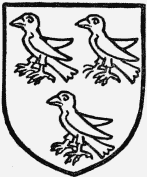
Becket, Archbishop of Canterbury. Argent three Cornish choughs.
The whole parish of Bramfield belongs to Mr. Abel H. Smith, of Woodhall, Ware, with the exception of the public house and Bacon's Farm. This latter is a small estate in the south, and is held with the Panshanger estate in which Lady Cowper has a life interest.
The subsoil is chalk and the surface soil gravel with some clay.
There are several disused chalk and gravel-pits in the neighbourhood. Extensive woods lie to the north and west of the parish, and the chief crops raised are grass, wheat and barley. The parish contains 1,609 acres of land, of which in 1905 about 632½ acres were arable, 432½ permanent grass and 5 acres woodland. The pasture of this parish is very good, and Place Farm, the largest here, is almost entirely given up to dairy farming, great quantities of milk being sent up to London. But there is no other trade here and the small population is slowly decreasing.
MANOR
In the Domesday Survey BRAMFIELD was assessed at five hides. It was held by Harduin de Scalers, and had been the property of Achi, one of Harold's thegns. (fn. 4) In 1086 (fn. 5) Harduin gave the manor to the abbot and convent of St. Albans, (fn. 6) and it seems to have continued in their possession until the time of the dissolution of that house in 1539.
In the thirteenth century Abbot John withdrew Bramfield from the hundred of Hertford, to which it formerly belonged, and attached it to the liberty of St. Albans and hundred of Cashio. (fn. 7)
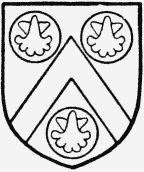
Dacres of Cheshunt. Argent a cheveron sable between three roundels azure with a scallop argent upon each.
In 1540, after the dissolution of the monastery of St. Albans, the king granted the manor and the church to Robert Dacres of Cheshunt, (fn. 8) to be held of the crown in chief at a service of one twentieth part of one knight's fee. (fn. 9) From Robert it descended to his son George, who in 1557–8 obtained licence to alienate to John Forster and Margery his wife. (fn. 10) On his death in February, 1559, Forster bequeathed the manor of Bramfield to his wife for the term of her life, with remainder to his son Humphrey, (fn. 11) and in 1565 Humphrey conveyed it to John Spencer, gentleman, John Spencer, citizen and grocer of London, and George Smyth, (fn. 12) from whose hands it passed in 1567 to Edward Skegge or Skegges. (fn. 13) A conveyance of the autumn of the same year between Skegges and Humphrey Forster (fn. 14) seems to have been made merely in confirmation of title.
The manor remained in the family of Skegges for some twenty years. Edward died in 1579 leaving two-thirds of his property to his widow Joan and her heirs and one tenement to his daughter Mary. (fn. 15) Some time before 1597 Joan sold the estate to James Smyth and Anthony his son. (fn. 16)
By 1637 the property had passed by sale from the Smyths to John Lord Butler, and from him to his son William. (fn. 17) And since William was an idiot, Lord Butler settled the estate on Francis Lord Dunmore and Endymion Porter, husbands of two of his daughters Audrey and Olive respectively, as trustees to pay annuities to William for life, the remainder to go to his six daughters and their heirs. (fn. 18)
Between 1658 and 1732 there were several fines levied concerning various sixth parts of the property, (fn. 19) but in the latter year James Fitzgerald Villiers, great-grandson of George Villiers, 4th Viscount Grandison, appears to have obtained possession of the whole estate. (fn. 20) It remained in the same family (fn. 21) till 1828 when Henry Villiers Stuart, great-grandnephew of James Fitzgerald, conveyed it by fine to Edward Majoribanks and others. (fn. 22) This may have been only for the purpose of settlement. It is now in the possession of Mr. Abel Henry Smith, of Woodhall Park, Ware. Manor courts in Bramfield have now entirely lapsed.

Villiers. Argent a cross gules with five scallops or thereon.
CHURCH
The church of ST. ANDREW is a small building of chancel with north vestry and organ chamber, nave with south porch, and west tower with spire.
The simple plan of nave and chancel has probably remained unaltered from an early date, but a drastic restoration in 1840 has removed nearly all traces of antiquity from the building. It is entirely faced with Roman cement, the walls being built of flint rubble, and the roofs of nave and chancel covered with red tiles.

Smith of Woodhall. Or a cheveron couple-closed sable between three demi-griffons sable, the two in the chief facing each other.
The chancel has an east window of three lights with net tracery in Roman cement, and two square-headed south windows, each of two cinquefoiled lights, which retain for the most part their late fifteenth-century Totternhoe stonework. On the north side are no windows, the whole space being covered by the modern vestry and organ chamber, and there is no chancel arch, its place being taken by a modern truss. In the south wall near the east end is a trefoiled piscina which seems to be of the fourteenth century, the bowl being level with the floor, which was considerably raised in both nave and chancel about 1840.
The nave is lighted by two two-light windows on each side, only the eastern window on the north side showing any old masonry. The rest are in Roman cement, of two cinquefoiled lights with a quatrefoil in the head. The south doorway and porch have nothing ancient to show, with four-centred arches worked in cement like the rest.
The west tower was entirely built in 1840, and is of two short stages with angle buttresses and plain square-headed windows, and a west doorway now blocked up. It is finished with a battlement, in which are luffered openings serving as belfry windows, and from it rises a short ribbed spire, in cement like the rest, and ending in a point without any finial. On the tower are lozenge-shaped dials for a clock. The ground story of the tower is occupied by a modern font, and the only access to the upper part is from outside by a ladder through one of the upper windows.
None of the fittings of the church are ancient, but some of the roof-timbers of the chancel are old, though hidden internally by a plaster ceiling, as are those of the nave.
On the north wall of the chancel is a good white marble monument to George Viscount Grandison, 1699, with scroll work and heraldry, and on the south wall another to the Rev. Edward Bourchier, 1775. The tower stands over an ancient well, which is locally said to have been a holy well; it is now covered over, but the font drains into it.
There are two bells, (fn. 23) one of 1757, without further inscription, and the second a late fourteenth-century London bell, by William Founder, whose surname was probably Dawe, inscribed:
'Cristus Perpetue Det Nobis Gaudia Vite.'
The plate consists of a communion cup of 1562, with an engraved band of hyphens at the lip and base of the bowl, a cover paten of 1617, and a flagon and bread-holder of 1714, with the Grandison arms.
The first book of parish registers begins in 1559, (fn. 24) and contains the baptisms to 1723, the marriages to 1716, and the burials to 1730. The second book contains baptisms and burials from 1731, the third the same from 1770; the fourth marriages from 1755, and the fifth the same from 1813. The three books now in use contain respectively the baptisms from 1813, the marriages from 1838, and the burials from 1813. There is a book of parish accounts, beginning in 1826.
ADVOWSON
The patronage of the church of St. Andrew in the parish of Bramfield belonged to St. Albans Abbey and was part of the grant of Henry VIII to Robert Dacres with the manor, and they were held together from that time till 1740. (fn. 25) In 1775 Edward Bourchier was patron and in 1786. (fn. 26) John Calvert and James Forkington presented jointly. The present patron is Mr. Abel Henry Smith, who is also lord of the manor.