
A History of the County of Hertford: Volume 2. Originally published by Victoria County History, London, 1908.
This free content was digitised by double rekeying. All rights reserved.
'Parishes: Norton', in A History of the County of Hertford: Volume 2, (London, 1908) pp. 361-364. British History Online https://www.british-history.ac.uk/vch/herts/vol2/pp361-364 [accessed 18 April 2024]
In this section
NORTON
Nortone (xi cent.); Northona, Nortona (xiii cent.)
The parish of Norton is situated on the Bedfordshire border of the county. At the time of the Domesday Survey it was included in the hundred of Broadwater, but was later transferred to the hundred of Cashio, since it formed part of the possessions of the abbey of St. Albans, to which the hundred of Cashio belonged. (fn. 1) Part of the parish was annexed to Baldock in 1880. (fn. 2)
Norton is a parish with two distinct aspects. In the north and east it is entirely given up to agriculture, and seems far removed from the busy world. Cornfields cover the higher slopes, while on the lower levels the little River Ivel, fed by springs and marking the eastern boundary of the parish, winds slowly through swampy meadows. Watercress used to be much grown here, but competition has spoiled the market. Other springs near fill the manor moat, and uniting into another stream flow into the Ivel. On slightly higher ground to the west is the old village of Norton. The chief houses are Norton Hall and Payne's Farm, two farms of no special note. These, with the church and cottages irregularly grouped, form the old village. The cottages generally are poorly built, but three joined under one dark red tiled roof are of interest. Originally they formed a single farm-house, and close by is the old dove-cot now used as a dwelling. Only three years ago this old village and two outlying farms called Stand-alone or the Rectory Farm and Willbury Farm, both in the south-west, were the only dwellings in Norton. But in 1903 the whole parish was bought by the First Garden City Company, the land was cut up into plots, and building began.
Leaving the shady old village by the road which leads south-west, the other aspect of Norton presents itself. On all sides are seen the bright red roofs of the new houses of the modern Garden City. Many of them very quaintly designed and painted white and green, are irregularly scattered about the land, and present a strange appearance. This part of Norton is quite bare of trees, but the good roads and gardens are being well planted. Quite in the south is an open common of rough grass with clumps of tangled brambles, hawthorns, and other bushes. It is now used as a People's park, and it is very many years since it parted with its ancient rights as a cowcommon.
That Norton should have developed first in the south is easily explained. The parish lies in the northern portion of the Garden City Estate, and also the Icknield Way which forms its southern boundary gives easy means of communication. Quite in the south-west is the site of an ancient camp, called Willbury Camp. Gravel was dug near here for use in making the Cambridge branch line of the Great Northern Railway, and a good deal of gravel is dug now, but as it is poor and mixed with chalk, it is not of much use except for building purposes. The soil is gravel and chalk, and the subsoil chalk. There are disused chalk-pits in the parish.
In 1905 the parish contained 1,191 acres of arable land, 203 acres of permanent grass, and 2¾ of woodland. (fn. 3) Good crops of wheat and barley are grown.
Place-names which occur in records of this parish are Monklands, Halle Orchard, and Halle Croft.
In 1865 a gipsy caravan stationed in the Icknield Way was attacked by small-pox. A baby was christened by the clergyman on the caravan steps, and its father was converted and became the great Gipsy Smith, the evangelist preacher. The mother and baby died, and hundreds of pilgrims visit their tomb every year.
MANOR
The first definite mention of the manor of NORTON is in a charter of Ethelred in which, when confirming Norton to St. Albans at the request of Abbot Leofric, the king stated that Alfric the archbishop and Leofric his brother, abbot of St. Albans, bought from him Norton, Rodanhangron, and Oxangehæage. (fn. 4) It is added that part of these lands had been given by Offa, king of Mercia, to St. Albans, but had been seized by 'wicked men' and had come into the hands of Leofsig the ealdorman who was banished in 1002 for the murder of the king's high steward Aefic. (fn. 5) It must have been between this date and 1007—the year of Ethelred's charter of confirmation—that Alfric and Leofric effected their purchase, and the statement that they gave Norton to the abbey of St. Albans may be referred to the same date. Whether this estate had really been in the possession of the monastery before remains doubtful, as the royal charter speaks vaguely of 'part of these lands,' and there is no mention of any of the places in question in the lists of Offa's benefactions. (fn. 6) However this may be, it is certain that at the time of the Domesday Survey the abbot was holding here, the entire tenement being assessed at four hides, of which two hides were in demesne. (fn. 7) The manor was confirmed to the abbey by King John in 1199, (fn. 8) and by Pope Honorius III in 1219. (fn. 9)
Throughout the thirteenth century the abbot seems to have subinfeudated part of Norton for the purpose of supplying knight's service. Lucas de Norton was one of the knights of St. Albans in 1166, (fn. 10) and in the reign of John and Henry III, William de Norton apparently held here under the abbot. (fn. 11) From him or his descendants the property appears to have passed to John de la More, who held land in Norton under Abbot Roger of Norton (1260–90) and Abbot John of Berkhampstead (1290–1301), (fn. 12) and is mentioned in 1303 as a tenant of one-sixth and one-fortieth part of a knight's fee in Norton. (fn. 13) In 1306 Abbot John de Maryns acquired from John de la More of Erdlee one messuage and 116 acres of land, 1 acre of meadow, and money rent and one pound of cummin in Norton by Baldock, (fn. 14) which he continued to hold as one-sixth and one-fortieth part of one knight's fee in the fourteenth century. (fn. 15) Forty quarters of best wheat from Norton were assigned in 1333 to the refectorar, (fn. 16) and Abbot John of Wheathampstead (1420–40) bought a tenement in Norton late of Walter de Bradweye, saving to Walter a corrody of 2d. a day, which had been granted to him for life. (fn. 17) This tenement was assigned to the refectorar in recompense for two barns which he claimed in the said manor. (fn. 18) Under the same abbot, a barn with a dwelling for a farmer was built at Norton. (fn. 19) In the fifteenth century the only mention which we have of this manor is to the effect that it was held by William Dysney and Eustachia his wife. (fn. 20)
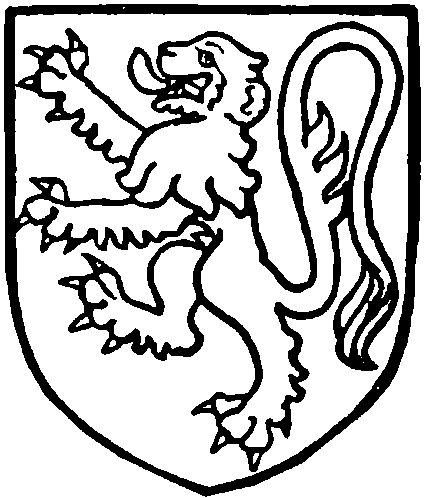
Cromwell. Sable a lion argent.
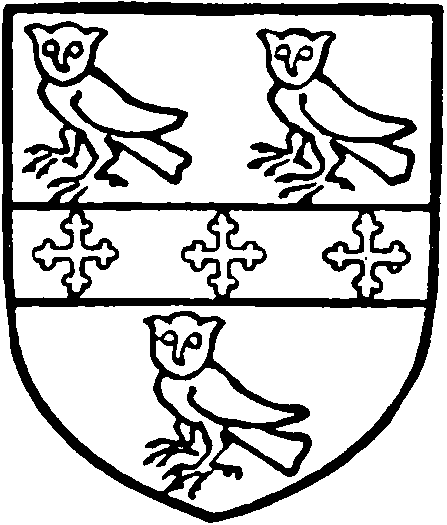
Pym. Sable a fesse between three owls or with three crosslets sable on the fesse.
The site of the manor was leased at the time of the Dissolution to John Bowles. (fn. 21) It was granted in 1542, amongst other lands, to Sir Richard Williams or Cromwell, the great-great-grandfather of the Protector, in exchange for lands which he surrendered to the king, together with a sum of £131. (fn. 22) A fee of 6s. 8d. was to be paid to John Bolles [Bowles], the bailiff, and a similar fee together with a cloak to the farmer, besides a pension of 40s. to the vicar of the church of Norton. (fn. 23) In the following month Sir Richard obtained licence to alienate to John Bowles the manor, rectory, and advowson of Norton together with the right of free warren. (fn. 24) John Bowles died in 1543 seised of the manor, which he held of the king in chief by the service of a twentieth part of a knight's fee, and was succeeded by his grandson Thomas, the son of Richard Bowles, (fn. 25) who settled the manor in 1557 upon himself and his wife Mary. (fn. 26) He, dying in 1596, left an heir Thomas, son of his first wife Mary, (fn. 27) who conveyed the manor in 1608 to John Wentworth (fn. 28) for a settlement on the marriage of Thomas's son Lewis and Diana, daughter of Sir John Wentworth. The manor seems to have passed to Lewis before the death of his father, which occurred in 1626, (fn. 29) for in 1621 and 1624 conveyances of the manor, probably mortgages, were made by Lewis, (fn. 30) and in 1629 he and his wife Diana and his brother Charles joined in selling it to Richard, John, and Henry Cleaver. (fn. 31) Richard son of Richard predeceased his father, and the manor was sold by his granddaughters and co-heirs Philadelphia Sayer and Anne Courteen in 1662 to William Pym of St. Martin's-in-the-Fields. (fn. 32) He died in 1673 and was succeeded in turn by his son, grandson, and great grandson of the same name. (fn. 33) The last died in 1788 when the manor of Norton came to his son Francis, who was also succeeded by son, grandson, and greatgrandson of the same name, of whom the last sold the manor in 1903 to the First Garden City, Limited. (fn. 34) The company also bought up land from the vicar of Norton in the same year, (fn. 35) and is now the sole landowner in the parish. The company was founded to develop an estate on the lines suggested by Mr. Ebenezer Howard in his book entitled Garden Cities of To-morrow, with the purpose of dealing with the two questions of overcrowding in towns, and depopulation of rural districts. The exceptional features of the scheme are that the population of the town is to be limited to about thirty thousand inhabitants, and that the greater portion of the estate is to be retained for agricultural purposes.
The present manor-house is a large farm-house called Norton Bury. In front of the house is a rectangular moat about 150 ft. by 100 ft. having an arm connecting it with a pond near by, which shews that it may at one time have been more extensive, and perhaps inclosed the manor-house.
There are no manor courts held.
A custumal of Norton is preserved, though in a much mutilated condition. (fn. 36) The tenants seem to have performed the usual services of carrying poultry and eggs to St. Albans, and of doing harvest work, boon work and ploughing. The exact allowance of food for each service is recorded. (fn. 37) The lords of the manor had free fishing, free warren, and view of frankpledge in their demesnes of Norton. (fn. 38)
The inhabitants of Norton were amongst those who extorted a charter of liberties from the abbot of St. Albans at the time of Wat Tyler's rebellion, and like others lost it on the suppression of the rising. (fn. 39) In 1480 Thomas, Richard, and Walter Albey, bondmen of the abbot, were manumitted by the abbot and convent. (fn. 40)
There were two mills at Norton at the time of the Survey, (fn. 41) and they were farmed in the time of Abbot Hugh (1308–26) for 40 marks. (fn. 42) At the time of the Dissolution one water-mill is mentioned which was then leased to William Wynne. (fn. 43) Norton Mill is no longer used for its original purpose, but the waters have been used for the last four years by Messrs. Lothian and Clement Sawrey-Cookson for trout-rearing. The site of the second mill is perhaps at Black Horse Farm now in the parish of Bygrave, but near the boundaries of Norton. In the middle of the eighteenth century there was a mill there, and the miller's daughter was far-famed for her exceptional beauty. The miller also kept an inn at the sign of the Black Horse, and there is a tradition that Dick Turpin once lodged there on one of his excursions along the Great North Road. (fn. 44)
CHURCH
The church of ST. NICHOLAS consists of a small chancel, an aisleless nave 48 ft. 6 in. by 20 ft. with south porch, and a west tower 12 ft. 4 in. square, these measurements being internal. A dedication of the church by Herbert Losinga, bishop of Norwich (1094–1119), is recorded, (fn. 45) and it is possible that the chancel arch, and parts of the east, north, and south walls of the nave may belong to his time. A west tower was added, and the nave lengthened westward about 8 ft. in the fifteenth century, the approximate date of this work being indicated by bequests to the fabric among the St. Albans wills of 1420, 1432, and 1453. (fn. 46)
The chancel was entirely rebuilt in the then current Gothic style, about the year 1814, at which time a number of small repairs were undertaken in accordance with decisions made at an archidiaconal visitation, the minutes of which are preserved among the church papers. Some of them are characteristic of the time, as that the south door being decayed the west door is to be taken off its hinges and used to supply its place; the west doorway to be blocked with brickwork. The east wall of the nave is 3 ft. thick, the chancel arch being of one square order, 7 ft. 10 in. wide, with a chamfered string at the springing. The masonry, where exposed by the fall of the plaster, is of clunch, with wide joints, and has an early look. If it is really of the date suggested, it gives an early instance of the use of clunch as wrought stone. The nave walls have been heightened in the fifteenth century, the added work being thinner, and no traces of original windows remain. A piece of the original walling is, however, exposed on the south side, and is of wide-jointed rubble, banded at irregular intervals by single courses of clunch, a similar construction to that in the early twelfthcentury nave of Kensworth church. The nave is lighted by four windows, two on the north and two on the south, of fifteenth-century date, with two cinquefoiled lights and tracery in the head. There is a plain north doorway blocked in 1814, a brick chimney being built against it, and a fifteenth-century south doorway with continuous mouldings, of the same date as the windows, and occupying the place of the original entrance, which by the lengthening of the nave is now but little to the west of the middle of the nave.
The tower has an east arch of two orders, with shafts to the inner order, a west doorway with traceried spandrels under a square head, and over it a three-light window with tracery. It has a vice in the south-west angle, and belfry windows originally of two lights, but now deprived of their tracery. It is finished with plain battlements, and like the rest of the church is covered with plaster, and patched with brick in places. The mullions of its west window are rough wooden posts, set up in 1814 in place of the old stonework, and the nave windows show similar patching of the same date; the low-pitched nave roof is also of this time.
In the nave are a number of seats with moulded rails and sills, c. 1500, with the stepped buttresses characteristic of their kind, and the hexagonal pulpit with its tester is of Jacobean date, its moulded oak panels having been lately freed from a thick coating of paint.
The Creed and Lord's Prayer are painted in black on the north wall of the nave, the lettering being renewed in 1814, and at the same date the royal arms painted on the east wall were replaced by a painting on canvas. In the north-east angle of the nave is the rood-loft stair, both upper and lower doorways remaining intact, with the staircase. The lower doorway contains a plain oak door, which may be old. (fn. 47)
The font is at the west end of the nave, and has a plain octagonal bowl of the fifteenth century, painted to imitate marble, and a re-worked panelled stem.
The only monuments of interest are an alabaster tablet at the east end of the nave north of the chancel arch, to the children of Thomas and Katherine Cole of Radwell, 1648–52, and a white marble slab opposite, to William Pym, 1716, and his wife Eleanor.
There are three bells, the treble by John Briant of Hertford, 1815, and the second a fifteenth-century bell inscribed 'Sancte Petre ora pro nobis.' It has the 'cross and ring' shield, the mark of Richard Hille, a London founder, surmounted by a lozenge, which has been explained as implying that the bell was cast after his death by Joan, his widow. (fn. 48) It has on the crown the evangelistic symbols. The third bell has an unmeaning inscription, and is of the same kind as those at Clothall and Newnham.
The plate consists of a cup, c. 1570, without hall marks, with a band of engraved ornament round the middle of the bowl, a bread-holder of 1813, inscribed 'Norton Herts, 1813,' a modern paten, two glass cruets, and a pewter flagon of eighteenth-century date.
The registers begin in 1579, the first book continuing to 1759, and containing at the beginning several paper leaves giving the elections of parish officers from 1653 to 1660. The entries for 1680–87 are in Latin, and there is also a list of burials in woollen, 1678–1761. The second book contained baptisms and burials from 1759 to 1812.
The inclosure award is dated 19 April, 1798.
There is reference in 1455 to the fraternity of the Holy Trinity of Norton which probably had its altar in the church, where there was an image and lights of the Holy Trinity. (fn. 49)
ADVOWSON
The church of Norton belonged to the abbey of St. Albans, (fn. 50) but the donor is not known. It is probable that there was a church here at an early date, for there was a priest at Norton at the time of the Domesday Survey. (fn. 51) The church was confirmed to the abbey by Pope Honorius III in 1219, (fn. 52) and in 1258 was assigned to improve the monks' ale, the incumbent voluntarily resigning his living, but it afterwards appears that the abbot retained the church in spite of this grant. (fn. 53) The tithes which belonged to the almoner were transferred to other offices by Abbot Thomas (1349–96). (fn. 54) The church remained part of the possession of the abbey of St. Albans until the suppression of that house, but in 1349 the king presented on account of the vacancy of the abbey at that time. (fn. 55) In 1533 the abbot granted the rectory with tithes and a messuage called Halle Orchard, and a croft called Hallecroft to George Hyde for a rent of £17 13s. 4d. paid to the refectorar, (fn. 56) and Hyde was the tenant of the rectory at the time of the Dissolution. (fn. 57) The rectory and advowson were granted in 1542 to Sir Richard Williams or Cromwell, (fn. 58) who conveyed them in the same year to John Bowles. (fn. 59) The advowson and rectory descended with the manor till 1614 when Lewis Bowles mortgaged them to Henry Haselfoote, citizen and haberdasher of London. (fn. 60) The conditions of the mortgage were not fulfilled, and in 1621 the property became Henry Haselfoote's, (fn. 61) in whose family it descended till Robert Cleere Haselfoote sold it in 1819 to George Paske, by whom it was again sold in 1825 to Rev. Robert Wooding Sutton. (fn. 62) He sold it before 1836 to Joseph Watson (fn. 63) and it passed from him to his son, Rev. J. B. Watson the incumbent, whose son, Philip Allen, sold it in 1857 to George Devin Wade, a solicitor. (fn. 64) He sold it in 1865 to the trustees of Mr. Francis Pym, (fn. 65) of whom it was purchased in 1907 by the bishop of St. Albans.
The Quakers had a conventicle at Norton in 1669, and in 1803 the house of Thomas Street was certified as a place of worship for Methodists. Another certificate was taken out for Independents in 1806, (fn. 66) but at the present time there are no Nonconformist places of worship in the parish.
CHARITIES
Thomas Chapman's Charity.
—A sum of £1 a year payable on St. Andrew's day is received from the parish of Stevenage, and is applied by the vicar and churchwardens in the distribution of bread and flannel, the latter being preferred by the recipients.
In 1803 Edward Wright by will proved in the P.C.C. on 11 May, 1812, left £500, now represented by £566 13s. 4d. consols with the official trustees, the dividends to be applied for educational purposes, subject as therein mentioned.
In 1861 John Izard Pryor by will proved this date left £100, now represented by £108 11s. consols with the official trustees, the income to be applied in providing charitable relief whether in food, fuel, clothing or other necessaries in the discretion of the vicar and churchwardens. The charity is applied for the most part in the distribution of coal, and in assistance to the sick and needy.