A History of the County of Hertford: Volume 2. Originally published by Victoria County History, London, 1908.
This free content was digitised by double rekeying. All rights reserved.
'Parishes: Sarratt', in A History of the County of Hertford: Volume 2, ed. William Page (London, 1908), British History Online https://www.british-history.ac.uk/vch/herts/vol2/pp438-443 [accessed 30 April 2025].
'Parishes: Sarratt', in A History of the County of Hertford: Volume 2. Edited by William Page (London, 1908), British History Online, accessed April 30, 2025, https://www.british-history.ac.uk/vch/herts/vol2/pp438-443.
"Parishes: Sarratt". A History of the County of Hertford: Volume 2. Ed. William Page (London, 1908), British History Online. Web. 30 April 2025. https://www.british-history.ac.uk/vch/herts/vol2/pp438-443.
In this section
SARRATT
Syret (x cent.); Syreth (xi and xii cent.); Seret (xiii cent.); Saret, Sarett and Sarette (xv cent.); Sarrett (xvi and xvii cent.).
Sarratt is a small parish of only 1,540 acres on the Buckinghamshire border of the county. The village stands on a ridge of land about 400 ft. above the ordnance datum. There is a dip from here on all sides, especially to the west, where the ground slopes down to the bed of the River Chess, but in the north it rises again, and Rosehall Farm stands at a height of 430 ft. There is a long and wide village green and the houses stand along its edges. The church is three-quarters of a mile away to the south-east, with a few houses near it on the east, and overlooking the wooded slopes of the Chess valley.
The hamlet of Belsize is about half a mile to the north of the village, and contains some nine or ten cottages. This and the outlying farms called Sarratt and Rosehall complete the village.
There are no high roads and no railways within the parish, but by-roads lead to other villages and to Rickmansworth, which lies four miles to the south. The parish contains a good many small woods, and in the south-west is a wooded furze common known as Dar's Common. In 1905 there were 919 acres of arable land, 394 acres of permanent grass, and 165 acres of woodland. (fn. 1) The soil is mixed clay, sand, and gravel, and the chief crops are corn and roots. Orchards of cherry trees are the chief feature of the village, and in good years they are a source of great profit to the inhabitants. Some of the trees are of an immense size. Formerly paper-making, straw plait, and bead-work were carried on here. There used to be a corn-mill, later a paper-mill on the Chess, and the Mill House remains and is the property of the duke of Bedford.
At Marginia Wick, on the north side of the road, a little distance to the west of the village, is a small quadrangular earthwork, with an outer ditch, which may be of Roman date, though there seems to be no record of the finding of Roman objects here. To the south, on the opposite side of the road, is Rosehall Wood, in which is the supposed site of the manor-house of Rooshall.
Sarratt Bottom Farm stands to the south of Rosehall Wood, in the valley of the Chess, on the low ground near the banks of the stream. To the north of the house the ground rises gradually, the field adjoining the rickyard being known as Church Field. A building long known to have existed here has just been excavated by Mr. Peter Clutterbuck, and proves to be of Roman date. It is rectangular, 48 ft. by 33 ft. within the walls, which are of flint rubble, and has a western apse 17 ft. wide.
Some Roman urns and a fibula have been found in the churchyard.
Place-names which occur are Oldlands, le Goosehalt, and Bragnams.
MANORS
The manor of SARRATT was granted by King Offa to the abbey of St. Albans, (fn. 2) and was confirmed to them in 1199 by King John. (fn. 3) The manor was granted by Abbot Paul (1077–93) to Robert the Mason, who shortly afterwards resigned it to the monks. (fn. 4) It had previously been held by the wife of Derlewin, and for it a rent of 60s. a year was paid to the abbot. (fn. 5) Abbot Richard, Paul's successor, against the wishes of the whole convent, gave it to Peter, butler of William, count of Mortain, and his nephew. (fn. 6) This was probably only a lease, for under the next abbot, rent from Sarratt paid by Peter de Syret was given to the hospital of St. Julian at its foundation. (fn. 7) In the middle of the twelfth century Sarratt was given by Abbot Robert de Gorham, without the consent of the convent, to his brother Ralph. (fn. 8)
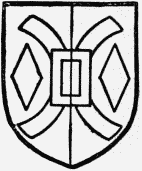
Ibgrave. Party argent and gules a millrind between two lozenges all counter coloured.
After the Dissolution (1539) the manor was granted in 1544 to William earl of Essex, James Rokeby, William Ibgrave, John Cokke and others, apparently trustees for William Ibgrave, (fn. 9) for he died seised of it in 1555, leaving a son Thomas, his heir. (fn. 10) Thomas settled the manor on his wife Sancta, and died in 1558 without issue. (fn. 11) His brother Ellis was his next heir, and died in 1563 seised of the reversion after the death of Sancta, who outlived him. (fn. 12) Benjamin, son and heir of Ellis, succeeded to the manor after the death of Sancta, who had married— Clitherowe, by whom she had a son Thomas. (fn. 13) Bennet the wife of Ellis Ibgrave married Robert Smethwick, who claimed two-thirds of the manor as the jointure of Bennet settled upon her by her husband Ellis. (fn. 14) Thomas Clitherowe also claimed an interest in the manor as heir of his mother Sancta, but as she had only a life interest in the estate, (fn. 15) Benjamin was the true heir, and in 1604 died seised of a third of the manor, with the reversion of the other two parts after the death of Bennet. (fn. 16) He left no children, and the manor went to his brother William. (fn. 17) He also died without issue shortly after, and for lack of an heir the manor came to the crown, and was granted in 1606 to Edward, Lord Bruce of Kinloss, Master of the Rolls. (fn. 18) His title to the manor was confirmed in the same year by Michael Doyley and Frances his wife, John Sapperton and Margery his wife, William and Beale Sapperton, claimants to the manor under the will of William Ibgrave. (fn. 19) Lord Bruce died seised of the manor of Sarratt in 1611, leaving Sir Edward Bruce his son and heir, (fn. 20) who died unmarried two years later, when he was succeeded by his brother Thomas. (fn. 21) Thomas Lord Bruce sold the manor in 1624 to Thomas Childe and John Childe his brother, and the heirs of Thomas, (fn. 22) who died seised of it in 1644, and was succeeded by his son John. (fn. 23) His brother Henry succeeded him, and in 1659 with his brother Robert sold this manor to Robert Gilbert, (fn. 24) who in 1681 conveyed it to John Duncombe. (fn. 25) John's son or grandson, Arnold Duncombe, sold the manor in 1752 to David Williams, (fn. 26) who succeeded his father Sir Gilbert in the baronetcy in 1768. (fn. 27) In 1762 David settled the manor on his wife Rebecca, (fn. 28) and afterwards mortgaged it to James Watkins for £1500. (fn. 29) In 1778 Sir David sold the reversion after the death of his wife Rebecca, subject to the mortgage to Watkins, to William Duncombe of Lincoln's Inn, and Elizabeth Lowle, a trustee for William. (fn. 30) William devised the reversion to his grandson, John Duncombe, (fn. 31) of Northchurch, who sold his interest in 1808 to Robert Haldane Bradshawe. He sold it in 1814 to Sophia, relict of Sir David Williams of Goldingtons, son of Sir David mentioned above. (fn. 32) From Sophia the manor came to her daughter Sophia Charlotte, wife of Thomas Tyringham Bernard. (fn. 33) Thomas became a bankrupt in 1826 and his life interest in the estate was sold apparently to George Miller Clarke, who died seised of the manor about 1858, (fn. 34) but Bernard's son, in whom the reversion was vested, died a few years later, and his father regained it as heir of his son. (fn. 35) He sold the reversion about 1860 to Herbert Ingram, proprietor of the Illustrated London News, by whose executors it was sold in 1862 to Thomas Clutterbuck of Micklefield Hall. (fn. 36) Clarke's interest in the manor was sold by his heirs in 1868 to Thomas Clutterbuck, (fn. 37) and from him it has descended to Mr. Peter Clutterbuck, the present owner. Mr. Clutterbuck owns also the manors of Goldingtons and Rooshall. His residence is on the site of the old Goldingtons manor-house in the south of the parish.
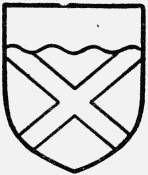
Bruce, Lord Bruce of Kinloss. Or a saltire and a chief wavy gules.
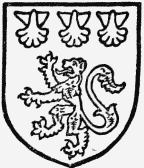
Clutterbuck. Sable a lion ermine with three scallops argent in the chief.
The manor of ROOSHALL (Rosehall, Rusthall) was held of the manor of Sarratt. (fn. 38) Geoffrey de Siret, who was one of the knights of St. Albans in 1166, (fn. 39) appears to have been a tenant of this fee, and it afterwards passed to Nicholas Belesmeins, and consisted of half a virgate of land. (fn. 40) Nicholas was holding it in 1245, (fn. 41) and in 1258 it was held by Roger son of Alured. (fn. 42)
Land in Sarratt was held by Robert de Roos of the abbot of St. Albans at the beginning of the fourteenth century. (fn. 43) In 1336 this manor, under the name of the manor of Sarert, was settled upon Sir John de Roos and Alice his wife in fee tail. (fn. 44) Sir John died seised of it in 1373 and at that time it was held of the abbot of St. Albans by the service of 30s. John's heir was his grandson John, but the manor was held by his wife until her death in 1375–6. (fn. 45) It afterwards passed to Sir Geoffrey de Brokeholes in right of his wife Ellen, heiress of John de Roos, probably his sister. (fn. 46) Ellen died in 1419–20 leaving as her heirs her daughter Joan, widow of Thomas Aspall, and her grandson John, son of John Sumpter and Margery his wife, another daughter of Ellen. (fn. 47) John Sumpter, a minor, died seised of half the manor in 1425–6, without issue, and his two sisters, Christine and Ellen, aged fifteen and fourteen respectively, were his heirs. (fn. 48) Ellen married James Bellers, and Christine married Thomas Bernard. It would seem that a partition was made of the land of John Sumpter, and that his share of the Hertfordshire manors of Ellen de Brokeholes was assigned to his sister Ellen Bellers, and the Essex manors to Christine Bernard. (fn. 49) In 1436–7 James Bellers and Ellen conveyed half the manor of Rooshall to Thomas and William Peck, and John Lane, (fn. 50) and these feoffees in 1437 conveyed it to John Frank and others, probably trustees for some settlement. (fn. 51) James Bellers afterwards died and his widow married Ralph Holte, by whom she had a son Thomas. (fn. 52)
Joan Aspall married Robert Armeburgh as her second husband, and in 1442–3 half the manor of Rooshall was settled upon Robert and Joan for their lives, with remainder to John Palmer and his sister Joan, in fee tail, and a contingent remainder to Sir Philip Thornbury, John Brokeholes, clerk, Henry Gawstang, Robert Armeburgh and John Gervays, and the heirs of Philip. (fn. 53) Joan died seised of half the manor in 1443, (fn. 54) but her husband survived her and held the manor for life. Joan's heir was her cousin the above-mentioned Ellen Sumpter, then wife of Ralph Holte, who already possessed half the manor, and she and her husband claimed Joan's share after her death against the feoffees to the uses of the above settlement. (fn. 55) Their claim was apparently recognized, for in 1543–4 their son Thomas Holte sold the whole manor to Nicholas and John Lodington or Luddington. (fn. 56) After the death of Nicholas, his wife Joan married Sir William Laxton, who held the manor jointly with his wife, and dying in 1556 left it by his will to Nicholas Luddington, his stepson, after the death of his wife Joan. (fn. 57) In the following year Sir William's heir Joan, wife of Thomas Wanton, daughter of his brother, John Laxton, confirmed the manor to Nicholas Luddington, (fn. 58) and in 1570 Nicholas assured to his mother Joan her life interest in the estate. (fn. 59) Nicholas sold the manor in 1583 to William Kindesley or Kingsley, (fn. 60) who died seised of it in 1611. (fn. 61) He left five sons, Thomas, Francis, George, William, and Edward, and this manor seems to have passed to Thomas the eldest, after whose death his widow Elizabeth married John Lane, and held the manor jointly with him. (fn. 62) The manor afterwards came to the second brother Francis, and he was succeeded by his son William, (fn. 63) who settled it in 1637 upon his wife Dorothy. (fn. 64) William's only daughter and heir married Robert Gilbert, (fn. 65) and brought this manor to her husband, who bought the manor of Sarratt in 1659. (fn. 66) Robert and Dorothy were succeeded by an only daughter, Elizabeth, wife of Matthew Williams, (fn. 67) and she and her husband in 1701 conveyed the manor of Rooshall and Goldingtons to Daniel Clutterbuck. (fn. 68) This conveyance was, however, probably made for the purposes of a settlement, for Rooshall came on the death of his father in 1737 (fn. 69) to Sir Gilbert, son of Matthew and Elizabeth Williams. Sir Gilbert died in 1768, and was succeeded by his son Sir David. (fn. 70) On Sir David Williams's death the manor came to his son, a second Sir David, who, dying in 1798, left as his heir his daughter Sophia Charlotte, wife of Sir Thomas Tyringham Bernard. (fn. 71) Rooshall, now Rosehall, Farm was sold with the manor of Sarratt (q.v.), (fn. 72) and has descended with it to Mr. Peter Clutterbuck, the present owner.
The manor of GOLDINGTONS was held as of the manor of Sarratt. (fn. 73) Land in this parish was held by Peter de Goldington in 1236–7 (fn. 74) and by Grace de Goldington in 1245. (fn. 75) Grace was probably the wife of Peter and daughter of a certain Akarius or Acarius, who was one of the knights of St. Albans in 1166 and whose son held land in Sarratt in the thirteenth century. (fn. 76) Bertram de Goldington held land in Sarratt in the early years of the fourteenth century, (fn. 77) and in 1347–8 it belonged to John de Chilterne and consisted of a fifty-sixth part of a knight's fee. (fn. 78) Thomas de Goldington conveyed land in Sarratt to Roger Lynster in 1402–3. (fn. 79) In 1437 Agnes late wife of John Wylby sued John Exham and others for the manor of Goldingtons in Sarratt, which Peter de Goldington had given to his son John. Agnes Wylby was the great-granddaughter of John son of Peter. (fn. 80) William Brampton and Elizabeth his wife conveyed this manor in 1520 to John Baldwin. (fn. 81) He appears to have been succeeded by a second John Baldwin, probably a son, and he by James Baldwin, who was holding land in Sarratt in 1545. (fn. 82) Goldingtons was settled on Margery the wife of James Baldwin, who afterwards married Thomas Hobbes and had a life interest in the manor in 1595. (fn. 83) Christopher Kendall of Brill and his son Edwin sold Goldingtons in 1595 to William Kindesley or Kingsley, of Rooshall, and Christopher's title to the manor is deduced from the Baldwins. (fn. 84) William Kingsley died seised of the manor of Goldingtons and the farm called Bragnams in 1611, (fn. 85) and its subsequent descent is identical with that of Rooshall.
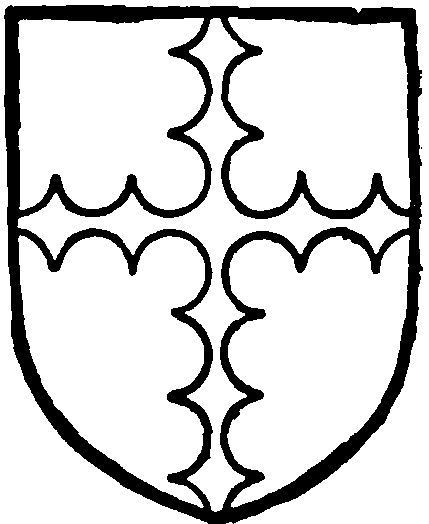
Kingsley. Vert a cross engrailed argent.
In 1611 William Kingsley died seised of a farm called WOODMANS or SHOVELMAKERS, (fn. 86) which was appurtenant to the manor of Rooshall and seems to have descended with it to Robert Gilbert. It probably then became separated from the manor of Rooshall and was sold with the manor of Sarratt to John Duncombe, for in 1752 Arnold Duncombe sold a tenement called Woodmans and Shovilmakers, then in the tenure of John Alden, with the manor of Sarratt to David Williams, (fn. 87) and again it was sold with Sarratt manor by Sir David Williams to William Duncombe. (fn. 88)
A fourth part of the manor of MAPLE TREE CROSS in Sarratt was conveyed in 1765 by John Light and Mary his wife to John Merry. (fn. 89) In 1807–8 Richard Smith and Penelope his wife conveyed a quarter of the manor to Margaret Merry, spinster. (fn. 90)
There appears to have been another manor known as the manor of SARRATT, which was conveyed by Humphrey Moore and William Ewer in 1599 to Robert Woolley, (fn. 91) but this conveyance was evidently made for a settlement, as in the following year Francis Ewer and Joan his wife and Edward Ewer conveyed the manor to Henry Childe, with a warranty against William Ewer brother of Edward. (fn. 92) In 1709 Moses Martin sold the manor of Sarratt to Henry North. (fn. 93)
SARRATT HALL has belonged to the family of Day, a branch of the Days of Micklefield Green, since the middle of the eighteenth century. (fn. 94) It now belongs to Mr. William Burgess, a relation of the Day family.
CHURCH
The church of THE HOLY CROSS (fn. 95) is a small cruciform building of the following internal dimensions: chancel 25 ft. 3 in. by 13 ft., nave 28 ft. 6 in. by 16 ft. 9 in., north transept 12 ft. by 12 ft. 3 in., south transept 14 ft. by 12 ft. 10 in., modern north and south aisles with south porch and west tower 9 ft. by 8 ft. 9 in. The combination of so short an aisleless nave with transepts is a very uncommon one, the length of the nave west of the transept being about equal to the projection of the latter. The chancel, which is nearly as long as the nave, seems to preserve its original width, but has probably been lengthened several feet in the thirteenth century, and again in the latter part of the fourteenth century. The west tower is an addition, perhaps of the fifteenth century, but its west window being of thirteenth-century date must in this case be assumed to have been re-used at the time, and may have been the west window of the nave. There are various small irregularities in the plan, which may be due to rebuildings, the difference in the width of the transepts being especially noticeable, and the east wall of the south transept is further east than that of the north transept. The walls of nave and chancel are 2 ft. 9 in. thick, and those of the transepts about 2 ft. 4 in. The plan altogether has an early look, but there is nothing in the architectural features to suggest a date earlier than the last decade of the twelfth century, to which time, in spite of much restoration, the main part of the fabric seems to belong. Till 1865 the nave was aisleless, but in that year, the church being in a very bad state, Sir Gilbert Scott repaired it, adding the present aisles, and making wide openings to them in the west walls of the transepts and in the north and south walls of the nave. The north wall of the nave, indeed, fell in process of repair, (fn. 96) and was completely rebuilt.
The walls are built of flint, with a few tiles and bricks, some of the latter being probably of Roman date, as Roman antiquities have been found near the church, and the ashlar work is of Totternhoe stone. Blocks of puddingstone occur as footings to the southwest angle of the tower, the angles of the south transept and elsewhere, and the roofs are covered with red tiles.
The chancel has an east window of two lights, dating from 1864, and as far as its style is concerned, following the lines of an old window of which traces were then found. Before this time there was a squareheaded opening of no great age. In the north wall, close to the eastern angle, is a modern lancet window, and opposite to it in the south wall, a plain squareheaded light with moulded head and jambs which is perhaps late fourteenth-century work. The only other window in the chancel is a modern single light about the middle of the south wall, having to the west of it the rear arch of a doorway, blocked by the modern vestry on the east side of the south transept. Between the two south windows is a large double piscina with a keeled roll on the jambs of the recess, and a central shaft, having a round moulded capital. It is probably part of the original work, and retains its western drain, the eastern opening having been cut down to serve as a sedile, probably at the time when the small late fourteenth or fifteenth-century piscina, in a trefoiled recess, was inserted. At the west of the double piscina is a plain roll string, running vertically up the wall, having doubtless continued horizontally over the heads of the original sedilia, now destroyed. All this points, as has been already said, to a lengthening of the original chancel. In the north wall are two recesses, one having a modern trefoiled head; it is probable that one served as the loculus for the Easter sepulchre. (fn. 97)
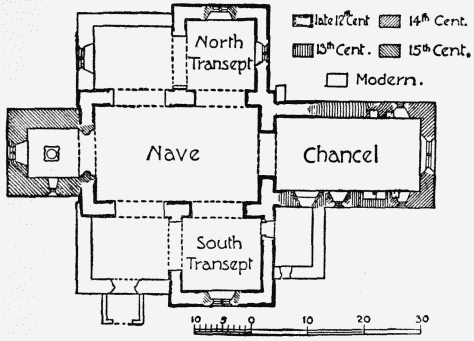
Church of the Holy Cross, Sarratt
The chancel arch is a perfectly plain pointed arch of one order, with a chamfered string at the springing, and belongs to the original work. The arches opening to the transepts are of the same form, though slightly wider, but preserve little old masonry, and those opening to the aisles from nave and transepts are modern copies of them. The north transept has a modern east window of two lights, and a fifteenth-century north window of two cinquefoiled lights under a square head, while in the south transept only the rear arch of the two-light south window is old. Both transepts have an external plinth of several courses of red roofing tiles laid horizontally, and no doubt intended to be plastered. This is a not uncommon substitute for a wrought stone plinth, where the available building stone does not stand well when exposed to the weather. The nave has no other traces of antiquity, but some of the oak seating in the north transept is old. The roofs retain some old woodwork, and that of the chancel is a good specimen with moulded collar beams and ties, the eastern tie having been cut to clear the head of the east window.
The west tower is of two stories, and opens to the nave with an arch of two continuous chamfered orders, probably of the fifteenth century, though it may be older, and has a small south window of a single light, and a west window of two uncusped lancet lights with a plain circle in the head, which seems to be thirteenth-century work. The upper stage of the tower seems to have been rebuilt with brick quoins and window openings in place of former stone ones, in the sixteenth century. On the north side, however, the east quoin is of stone, as is the window, a single squareheaded light inclosing a modern cinquefoiled head. The brick windows are square-headed with labels, the west window having two four-centred lights and the south being of one light. The tower is finished with brick gables on the north and south and a red tiled gabled roof, with a very picturesque effect. Certain traces of wall painting are recorded to have been found over the chancel arch, and on the north wall of the chancel were decorative designs of fruit and flowers in yellow. On the east wall of the south transept are to be seen remains of a series of scenes in the life of Christ from His birth to His ascension. (fn. 98) There were in the church in the fifteenth century the high altar and the altars of Our Lady and St. Katherine, with their lights and the sepulchre light. (fn. 99) The only monument of note which is preserved is that of William Kingsley, 1611, on the south wall of the chancel, the date being given in error as 1502. The effigies of Kingsley and his wife Katharine kneel at prayer desks, four sons being behind the man and one daughter behind the woman. In the churchyard is a coffin lid of late thirteenth-century type, with scrolls on either side of the stem of the cross.
Three small pieces of fifteenth-century figures from former brasses, two being busts of a man and a woman, c. 1480, are preserved at the rectory.
A few fifteenth-century tiles, of the type usual in the district, and probably of London make, are placed under the communion table.
The font is in Sussex marble (fn. 100) and is copied from a former font, the remains of which lie in the churchyard. It is of a common late twelfth-century type, with a shallow square bowl ornamented with blank arcades, and resting on a central and four angle shafts. The plinth is ancient, and belonged to the old font.
There are three bells, the treble of 1606 by Knight, the second of 1719 by Chandler of Drayton Parslow, and the tenor of 1865 by Mears and Stainbank of Whitechapel.
The plate consists of a cover paten of 1635, a tall cup and cover paten of 1764, and a flagon of 1792 given by William Hayton in 1807.
The registers begin in 1560 and the first book goes down to 1733, the second containing baptisms and burials, 1733–1812, and the third, marriages, 1755–1812. There are no records of baptisms from 1564 to 1572, nor of marriages in 1642, 1654, or, 1722–1755.
ADVOWSON
The church of Sarratt belonged to the abbey of St. Albans, and at the time of the Dissolution was worth £9 18s. with tithes. (fn. 101) The advowson with a pension of 2s. from the rectory was granted in 1544 to William Ibgrave, (fn. 102) and descended with the manor to Arnold Duncombe. (fn. 103) He sold the manor in 1752, but retained the advowson, (fn. 104) and on his death without issue it came to William Hayton son of Arnold's sister Elizabeth wife of William Hayton. (fn. 105) William and his wife Clara conveyed it in 1774 to Bernard Chapman, (fn. 106) but this conveyance was probably made for the purpose of some settlement, for William Hayton presented in 1807, (fn. 107) and on his death without issue in 1811 the advowson came to his niece Harriet the wife of James Gordon, who presented in 1815. (fn. 108) James died in 1832 leaving his son James Adam Gordon (fn. 109) his heir, from whom the advowson passed to Charles Augustus Barnes of Chorleywood, who sold it in 1859 to Samuel Ryley of Edstaston (co. Salop), (fn. 110) father of the present rector and patron.
The living was originally a vicarage, but since the incumbent received part of the rectorial tithes he was sometimes styled rector. (fn. 111) It was constituted a rectory by the Ecclesiastical Commissioners in 1867. (fn. 112)
There are indications of Nonconformity in this parish at an early date. Thomas Hemingforth, to whom the vicarage was given in 1479, was ejected in 1485 for 'apostacy,' by which term we may probably understand Lollardism. (fn. 113) John Butler, the incumbent in 1584, gave 'signs of his Puritanism in somewhat irregular proceedings for which he has to apologise publicly.' (fn. 114) There is, however, only one registration of a chapel under the Toleration Act, in 1798. The Baptist church was formed in 1857, and the chapel was enlarged in 1874. (fn. 115)
CHARITIES
The almshouses known as the Church End Almshouses were founded by John Baldwin in 1700. They were pulled down and rebuilt in 1821 at the sole expense of Ralph Day, and a sum of £201 10s. 1d. consols was given by Thomas Day his brother, for keeping the same in repair.
In 1828 the said Ralph Day by deed gave £503 15s. 2d. consols, the income thereof to be applied as to one moiety in clothing or bedding for the benefit of the inmates of these almshouses and of the Dell Almshouses on Chipperfield Common mentioned below, and as to the other moiety for the benefit of other poor of the parish.
In 1819 Henry Day by a codicil to his will gave £300 to be disposed under the direction of the said Thomas Day and Ralph Day his brothers, of which £200 was laid out in the purchase of two copyhold tenements and gardens thereto, situate at Chipperfield Dell in the parish of King's Langley, and the balance of the legacy was applied in the cost of enfranchisement and repairs and improvements. These almshouses were sold in 1888, and the net proceeds invested in £100 5s. consols. The income of the several charities, after providing for the repairs of the Church End Almshouses, is applied in the support of coal and clothing clubs, among poor families, including the inmates of the almshouses.
In 1838 the Rev. John Foster by will bequeathed £110 consols, the dividends to be applied in the distribution of Bibles, Testaments, and Prayer Books, among the poor people of the parish and poor children at school.
The several sums of stock are held by the official trustees of charitable funds.