A History of the County of Hertford: Volume 2. Originally published by Victoria County History, London, 1908.
This free content was digitised by double rekeying. All rights reserved.
'Watford: Introduction', in A History of the County of Hertford: Volume 2, ed. William Page (London, 1908), British History Online https://www.british-history.ac.uk/vch/herts/vol2/pp446-451 [accessed 30 April 2025].
'Watford: Introduction', in A History of the County of Hertford: Volume 2. Edited by William Page (London, 1908), British History Online, accessed April 30, 2025, https://www.british-history.ac.uk/vch/herts/vol2/pp446-451.
"Watford: Introduction". A History of the County of Hertford: Volume 2. Ed. William Page (London, 1908), British History Online. Web. 30 April 2025. https://www.british-history.ac.uk/vch/herts/vol2/pp446-451.
WATFORD
Watforda (x and xi cent.); Watfordia (xiii cent.); Watteford (xiv cent.); Watfurth (xvi cent.).
The parish of Watford is situated in the south-western corner of the county. It is watered by two small rivers; one, the Colne, flowing from the north-east, forms part of the eastern boundary of the parish, and passes through the lower part of the town; the other, the Gade, coming from the north-west, runs through the parks of The Grove (earl of Clarendon), and Cassiobury (earl of Essex), side by side with the Grand Junction Canal, and finally leaves the parish near Rickmansworth, where it joins the Colne.
The whole parish lies on the chalk formation, more or less deeply covered with gravel, sand, and brick earth. It is, generally, well wooded, with a slight upward slope towards the Chilterns in the north of the county, and the surface of the country is diversified, more especially on the western side, by abrupt descents into narrow valleys.
Besides the town of Watford there are the hamlets of Leavesden in the north-east, and Oxhey on the border of Middlesex. The hamlet of Cassio is now absorbed in the town of Watford.
At Leavesden are situated the Metropolitan Asylum for Imbeciles, with accommodation for 2,000 inmates, and the St. Pancras Industrial School for 500 children.
There are two main highways through the parish; one, from London, crosses the Colne and enters Watford at the lower end of High Street, and runs in a north-westerly direction to Tring and Aylesbury; the other, from St. Albans to Rickmansworth, crosses the first named road at the upper end of High Street.
During the seventeenth century Watford had attained sufficient importance to have a service of carriers to London, (fn. 1) though at that period the Colne had to be forded on entering the town from London, the water being sometimes up to the saddles of the riders. (fn. 2)
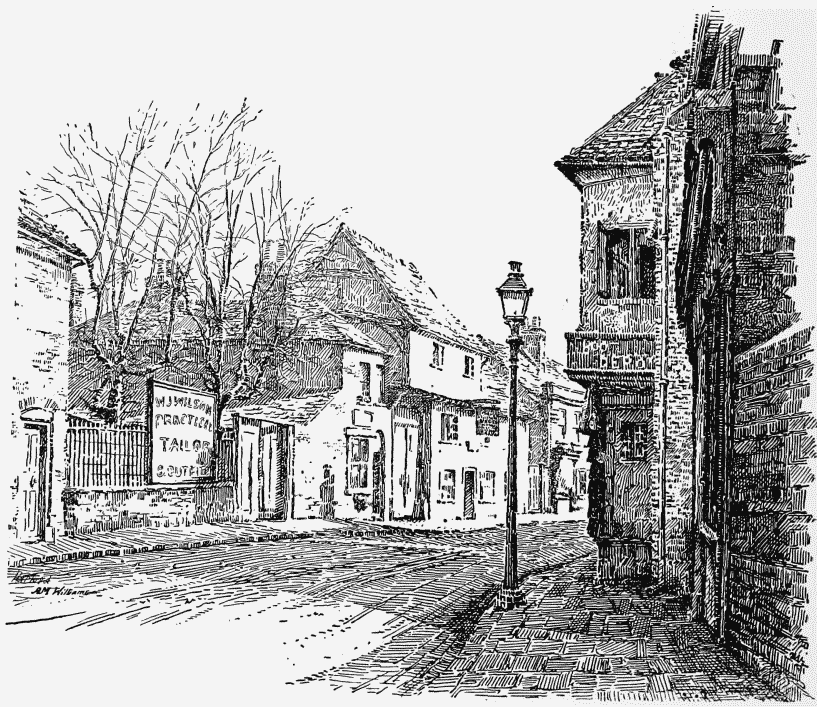
Watford: 'The Angel,' High Street
Defoe in his Tour (ed. 1778) describes Watford as being a 'genteel markate town, . . . very long, having but one street,' and this is a sufficient description up to the middle of the nineteenth century, when the town began slowly to expand under the impetus derived from the opening of the London and North Western Railway in 1838.
In the year 1850 a local board of health was formed, the town population being then about 6,500, and, immediately afterwards, the first new streets out of High Street were opened, King Street on the west, and Queen's Road on the east, the latter being eventually carried down to the station. In 1855 the corn exchange was erected in High Street, to take the place of the old market house, which had been burned down.
The opening of the branch line to St. Albans in 1858, and that to Rickmansworth in 1862 marked important advances, and the erection of the large buildings of the London Orphan Asylum on the rising ground near the station, helped to bring the town into greater prominence.
In 1871 the town population had risen to about 12,000, the extension being chiefly confined to the district opened up by Smith Street, the two new thoroughfares, Queen's Road and Clarendon Road, which gave access to the station, and also along the line of St. Albans Road.
The Public Libraries Act was adopted by the town in 1871, and two years later a building was erected in Queen's Road, by private subscription with a grant of £500 from the Science and Art Department, as a public library and school of science and art. This building has been greatly enlarged in recent years.
In 1891 the population stood at 17,063, and from this time the growth of the town became still more rapid, and several large tracts of land contiguous to Watford were opened up for building purposes. The Colney Butts estate, and the Harwoods Farm estate, to the west of the old town, came under the hammer, and the area built on has been steadily extending, most of the houses being of the smaller description, and these have attracted a large number of workers engaged in London, while the comparative cheapness of the land, and the good railway facilities, have resulted in the erection of a number of factories and works; these include breweries, a very old established industry in Watford, a steam laundry, engineering works, a cold storage company, and large works for colour printing and engraving. On the east side of the railway, along the line of the road to St. Albans, the district of Callowland is extending in a similar manner, the factories there including large cocoa works and several printing and colour process works. A large number of the employees of the London and North Western Railway Company are housed in this district.
In 1894 the urban district council superseded the old local board of health, and the area of the town was extended so as to include a portion of the parish of Bushey and the hamlet of Oxhey.
The residential portion of Watford lies to the north of the town, and is bounded by Hempstead Road on the west and the railway on the east. It is well timbered and contains many pleasant residences, with large gardens and grounds, mostly occupied by gentlemen engaged in business in London. The greater part of this district, however, lies outside the urban area.
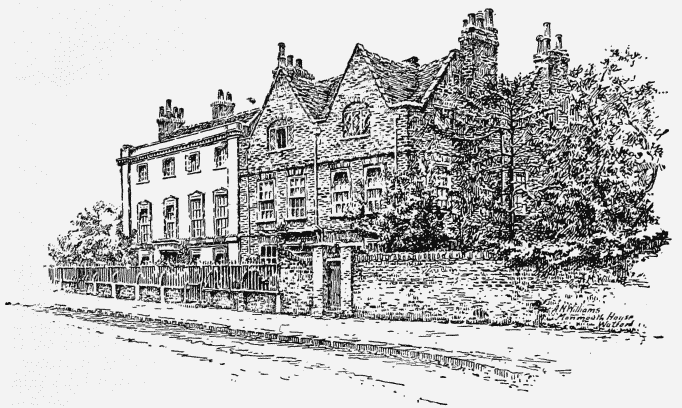
Monmouth House and the Platts, High Street, Watford
The area of Watford Urban District has been extended several times. In 1901 it was 1,627 acres, and the population 29,327. In 1906 the estimated number of inhabitants had risen to about 36,000, more than double what it was in 1891.
In spite of the modern aspect of Watford there are still a number of interesting relics of former times to be found in the old High Street. At the beginning of the nineteenth century Watford was little more than a long straggling village through which the road ran to Berkhampstead and Aylesbury. In Cassio hamlet at the northern end of High Street is Little Cassiobury (Mr. G. S. Whitfield), a charmingly situated eighteenth-century house, built as a dower house by a former earl of Essex. Proceeding south, at the junction of St. Albans Road with High Street is the Elms (Mr. J. L. Clark), so called from the fine old trees in front. It was formerly known as Townend House, and has been rebuilt within recent years.
A little beyond are two houses known as Monmouth House and the Platts. They originally formed one house which was built by Robert Carey, earl of Monmouth (then residing at Moor Park, Rickmansworth), early in the seventeenth century, as a dower house. After his death in 1639 his widow lived here until her own death three years later, when the property was sold. Soon after 1771 the house was divided into two, and about the year 1816 the then owner altered the portion now known as Monmouth House, cementing the front, and entirely altering its appearance.
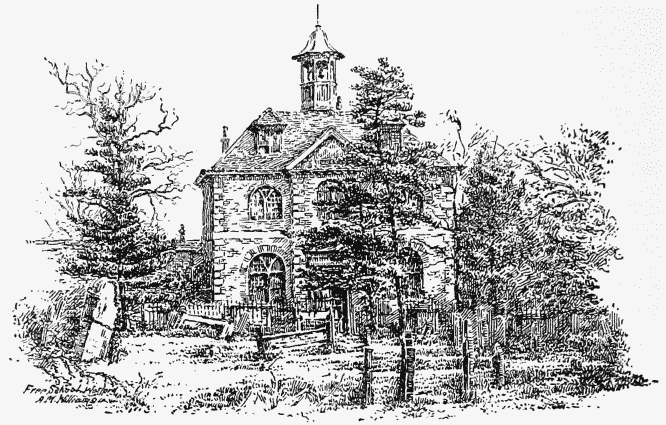
Free School, Watford
The other part, The Platts, is however, in pretty much its original condition. It is a brick building with two steep gables to the street, and has massive projecting chimneys at the end. Though very simple and quite devoid of ornament it is a very pleasing and well-proportioned building of the period. The interior has been a good deal altered, but in the diningroom the walls have wooden panelling, and there is a good oak moulded chimney-piece reaching up to the ceiling. The old stair is of oak, and is of small dimensions, with massive moulded newels, but, like the other woodwork in the house, unrelieved by carving.
Between Monmouth House and the south end of the market place there is very little old work of interest, with the exception of a small oak traceried window of fifteenth-century work, which was discovered during alterations, and refixed in the outer wall of the 'Compasses' public house at the corner of Market Street. At the south end of the market place are two small houses, at the back of which, in Church Street, is a well-carved oak barge-board, pierced and foliated, probably of sixteenth-century work. In an alley off Church Street is a block of houses known as Ballard's Buildings, now inhabited by very poor families, which has an early eighteenth-century brick front with some good moulded brickwork, and a wooden hood with carved brackets over the entrance.
On the south side of the churchyard is the Free School, an interesting brick building with stone quoins, which has a good open bellturret of wood on the roof. The school was built in 1704 and endowed in 1708 by Mrs. Elizabeth Fuller. In one of the class rooms is a fine oak chimneypiece, which appears to belong to the late Elizabethan period, and which must have been brought from elsewhere.
Adjoining the Free School is the present vicarage, with a central block and east and west wings, partly of timber construction. In the west wing is some good early seventeenth-century woodwork, and parts of the house may well be of yet older date. Behind is a pretty old-fashioned garden.
At the back of this is the old vicarage, one of the most interesting old buildings left in Watford. It is situated in Fenn's Yard, off High Street. It is a two-storied building of timber plastered on the outside, and has a plain brick chimney and a tiled roof. There are two small gables on the roof over the upper windows. The building dates from the latter part of the sixteenth century, or early in the seventeenth.
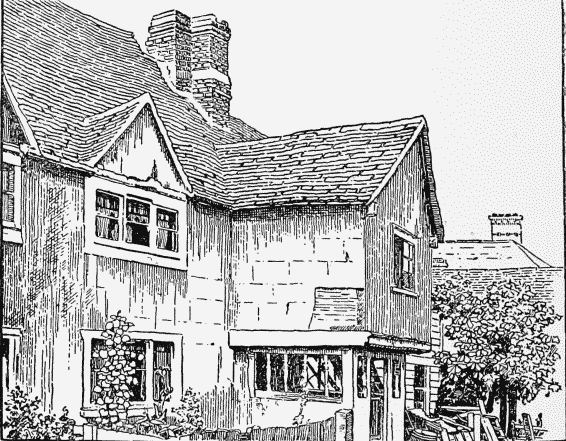
Watford : The Old Vicarage
It is not large, measuring only about 32 ft. in length by 22 ft. in depth. It is entered through a porch having a room over, a very common feature in the old cottages in this part of Hertfordshire. The upper part of the sides and front of the porch are open, the opening being filled with moulded balusters placed rather widely apart. The entrance to the porch is closed by a low wicket-gate with moulded panels, each panel being partly filled by a curious ornament, which may be best described as a style which only reaches about three-quarters of the way up the panel, the shape being that of an acutely pointed pyramid. The panel mouldings are carried round these. The outer entrance has a moulded architrave of oak. The inner entrance door is panelled in a similar manner to the wicket gate, but the panels are smaller, and it has a good iron knocker. Inside the house, which is now divided into two cottages, is some good oak dado panelling with the upper panels filled with early seventeenth-century carving, and in one of the rooms is a well carved oak chimney-piece. The whole building is much decayed.
Adjoining the old vicarage on the west is a wooden tithe-barn with tiled roof. It is in bad repair, and the outside weather-boarding has been renewed at different times, but the old roof principals and framing indicate a period before the Reformation.
The timbers are roughly cut, and the tie-beams have curved brackets under their ends, and between the principals are wind-braces with curved struts. The dimensions of the barn are 41 ft. 6 in. by 22 ft.
There are still a number of interesting eighteenth-century brick fronts in High Street, in many cases having wood and plaster buildings of picturesque appearance behind them. No. 97, High Street has good brick pilasters with Ionic capitals, and until recently it possessed a fine moulded brick cornice.
A little way down Water Lane, on the east side of High Street, is an old cottage, with the upper part of the front weather-boarded, which has a brick chimney with moulded string. At the foot of High Street, on the west side, is Farthing Lane, which contains some picturesque old lath-and-plaster cottages with gables, and a little farther down High Street, on the same side, is a house now divided into shops and dwelling houses, which has a good seventeenth-century chimney-stack, and an old wooden mantelpiece and some panelling inside. Opposite this, the old 'Angel' projects its timbered upper story over the pavement, while just beyond is some good eighteenth-century brickwork in Grove Place.
Parts of the parish of Watford were assigned to Northwood in 1854, to Croxley Green in 1872, and to Langleybury in 1878. (fn. 3) The ecclesiastical district of Oxhey was formed from Watford and Bushey in 1879, (fn. 4) and Leavesden was formed into an ecclesiastical parish in 1853 out of the parishes of Watford, St. Albans, and St. Stephens. (fn. 5)
The Watford Union Workhouse is at Colney Butts near the cemetery. This cemetery was formed in 1858, and is 14 acres in extent and contains two mortuary chapels. It is under the control of a burial board of nine members. The Watford and District Isolation Hospital in Tolpits Lane was erected in 1896 and enlarged in 1904.
There are parks at Garston House, the residence of Mr. Thomas Farries, in the hamlet of Garston, a small village lying on the St. Albans road; at Garston Manor a little farther north, the seat of Mr. Claude Watney; at the Stanborough, the residence of Miss. Cottrell; at Munden House, the property of the Hon. A. H. Holland Hibbert; at Redheath, the residence of Mr. Henry Baldwin Finch; at Carpenders Park, the seat of Mrs. Carew, in the southeast of the town; and at Eastbury, to the west of Oxhey Woods, an extensive piece of woodland containing about 500 acres. In 1905 the parish included 3,314 acres of arable land, 5,131 acres of permanent grass, and 1,211 acres of woodland. (fn. 6) Watford Common Moor was inclosed in 1889, and Watford Common Field in 1855. (fn. 7)

Farthing Lane, Watford
There is a rifle range of 1,000 yards in Cassiobury Park, and the A and G companies of 2nd (Herts) Volunteer Battalion are stationed in the town.
Inns in Watford called the 'Swan,' the 'King's Head,' the 'White Hart,' the 'Saracen's Head,' the 'Christopher,' and the 'George' are mentioned in old deeds.
Place-names which occur are Hawkyns le Reue, Le Holme, Bromefeild, Conybutt field, High field, Thistley field, Boning field, Tolpitts, Tolpade, Whependen Grove, Lakershote, Carpenter Atte Hille, and Galpyns; in Oxhey, Aesculves croft, La Hoche croft, Pitte croft, Hausexdone, Cobbe croft, Borwefeld, Wygenhale Wyk, Pese croft, Coteswyk, Gipps, Gibstouch, Symonds Close, Grindons, Amoyesland, and Milnegyte; in Garston, Motegrove, Moregrove, and the Blynde Lane.
In the civil wars of the seventeenth century, Lord Essex, the Parliamentary leader, to whom the manor of Cassiobury was granted in 1645, had 500 horse quartered at Watford, and 1,000 men were placed there to be at the disposal of Sir Thomas Fairfax, but a letter states that their activity was crippled by lack of provisions and necessary ammunition, and stores provided for the service in Ireland had to be borrowed for these troops. (fn. 8)
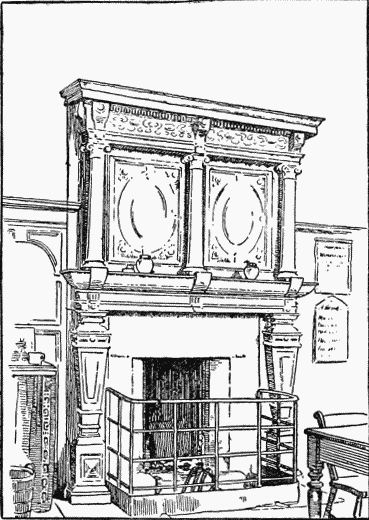
Watford: The Free School, Old Chimney-piece
John King, the eldest son of Ralph King of Watford, was born and baptized in this town in 1597. He received his early education from Dr. Taylor of Aldermanbury, later of Watford, and afterwards went to Emmanuel College, Cambridge. He became vicar of Abbots Langley in 1626, and held the living for fifty-three years, till his death. He was the author of several books, the last of which was The Nonconformist's Plea, dedicated to Bishop Morley of Winchester and Bishop Gunning of Ely.
Giles Fletcher, ambassador and poet, was born in or about 1549 at Watford. He went on various embassies to Germany, Hamburg, and Stade, and in 1588 was sent on a special mission to Russia, where he was treated with the greatest indignity, but managed to secure for English merchants very considerable concessions. He wrote an account of Russia which appeared in 1591, but since it was believed that it would give offence it was quickly suppressed. Fletcher also designed to write an extensive history of the reign of Queen Elizabeth, but the project apparently came to nothing. (fn. 9)
Robert Clutterbuck, the topographer and author of the History and Antiquities of Hertfordshire, was born at Watford in 1772, and educated at Harrow School. He died in 1831, and Watford is his burial place. (fn. 10)
Thomas Cobham, the actor, made his first professional appearance at Watford. He has been placed in respect of genius above all actors of the day except Kean, Young, Macready, and Charles Kemble. (fn. 11)
Watford is also the birthplace of Richard Barrett Davis, the animal painter. He was born in 1782, and died in 1854, having been a constant exhibitor at the Academy for fifty years. (fn. 12)
William Taylor Copeland, alderman of London, and porcelain manufacturer, died at Russell Farm in this parish in 1868. He was the son of William Copeland, the partner of Josiah Spode, and after the death of his father and the retirement of Spode he was for a long period at the head of the large pottery establishment known as that of 'Spode,' at Stoke on Trent. The branch of the ceramic art which he carried to the highest perfection was the manufacture of Parian groups and statuettes.
Watford is the birthplace of Henry Montague Grover, writer of Anne Boleyn, a Tragedy, and Socrates. He was born in 1791, and received his education at St. Albans Grammar School. Beginning life as a solicitor, he afterwards took holy orders, and is the author of various books on religious and scientific subjects. (fn. 13)
James Vernon, secretary of state, spent the last years of his life in retirement at Watford, where he died in 1726–7. On him fell the main burden of hushing up the charges brought by Sir John Fenwick against Godolphin, Shrewsbury, Marlborough, and Russell. In support of the Bill for Fenwick's attainder in 1696 he made the only important speech which he is recorded to have delivered throughout his Parliamentary career. He was a staunch Whig, and on the death of the duke of Gloucester in 1700, he proposed that the king should again marry, and settle the succession in default of issue in the Hanoverian line, thus passing over Anne. This brought him into such bad favour with the Tories that soon after the accession of Anne he was dismissed from public service. (fn. 14)
Heath Farm, Watford, was the seat of William Baliol Brett, Viscount Esher, the eminent judge.
The town of Watford possessed a bailiff in early times, the first mention of this officer occurring in 1247. (fn. 15) This bailiff, however, seems to have been a servant of the abbot of St. Albans, and in no sense an officer of the townspeople, for on the election of Roger Mapultone to the office in 1466–7 it is clearly stated that he held the position by leave of the abbot and at his will. (fn. 16)
Chauncy states that the market at Watford was held by a grant of Henry I, (fn. 17) and it is certain that a market was held there in the reign of Henry II, as the town of Watford with its market-place (forum) was confirmed to the abbey by that king and by King John. (fn. 18) Two fairs were granted to the abbot of St. Albans in 1336 by Edward III at the supplication of William de la Marche, for himself and other men of Watford, in satisfaction of a debt owed by the king to them for victuals. One fair was to be held on the Monday, the morrow of Holy Trinity, and two days following, and the other on the day and morrow of the Decollation of St. John the Baptist. (fn. 19) The profits of the market and fair belonged to the abbey until the Dissolution, at which time they passed to the crown. In 1556 the inhabitants received the toll of the market, rendering to the bailiff yearly 5s. The bailiff had the toll of the two fairs, for which he rendered 4s. (fn. 20) Queen Elizabeth granted the tolls in 1578 for a term of twenty-one years to Charles Morrison and Francis Heydon, to the use of the inhabitants of the vill, and in 1585 the tolls of the market and two fairs were granted to William Hunnye (fn. 21) for a term of twenty-one years, beginning in 1600, but the issues were to be used for the maintenance of the poor of the parish and for the repairs of the church. In 1609 James I granted the tolls, with the manor, to Thomas Marbury and Richard Cartwright, (fn. 22) from which time they have descended with the manor (q.v.).