A History of the County of Hertford: Volume 2. Originally published by Victoria County History, London, 1908.
This free content was digitised by double rekeying. All rights reserved.
'St Albans abbey: The abbey church building', in A History of the County of Hertford: Volume 2, ed. William Page (London, 1908), British History Online https://www.british-history.ac.uk/vch/herts/vol2/pp488-507 [accessed 9 May 2025].
'St Albans abbey: The abbey church building', in A History of the County of Hertford: Volume 2. Edited by William Page (London, 1908), British History Online, accessed May 9, 2025, https://www.british-history.ac.uk/vch/herts/vol2/pp488-507.
"St Albans abbey: The abbey church building". A History of the County of Hertford: Volume 2. Ed. William Page (London, 1908), British History Online. Web. 9 May 2025. https://www.british-history.ac.uk/vch/herts/vol2/pp488-507.
2. DETAILED DESCRIPTION OF THE CHURCH
The LADY CHAPEL is vaulted in three bays with a modern stone ribbed vault, replacing the wooden vault set up by Hugh of Eversdon about 1310. It forms part of the eastward extension of the church which was begun about 1257, but for reasons already given was the last part to be undertaken. In 1308, the first year of Hugh of Eversdon, the walls were standing to their full height, (fn. 1) but there was no roof and the windows were not glazed. It was probably complete by 1310 or soon after, as in 1315 a new set of quire stalls was being made, and work in the south transept was going on about the same time. Below the windows runs an arcade of cinquefoiled arches, now entirely modern, but following the lines of an original arcade which remained in a much damaged condition till the late repairs. It is ornamented with naturalistic carvings of trees, flowers and fruits, more especially those which grow in the neighbourhood. (fn. 2) The character of the original arcade was much like that in the south aisle of the vestibule of the Lady chapel, and it was probably set up in the last twenty years of the thirteenth century. The windows of the chapel are of much more advanced style, with a mixture of flowing and geometrical lines in the tracery, and if the statement is correct that they were only in need of glazing in 1308, they are very early examples of their kind. (fn. 3) The east window is of five lights with gabled and crocketed canopies in the tracery, and the three north windows and two of those on the south are of four lights, two having net tracery. All have a line of ball flowers set on a continuous stem on the inner angles of the heads and jambs, and another similar line framing the outer order of the tracery. Externally their stonework is modern, having been cut back to the glass line by Sir Gilbert Scott and renewed, but internally the tracery and mullions are for the most part old and in some cases retain traces of red colour. On the central mullions and the jambs of each window are set small figures under canopies, nine to each window; many are much damaged, but others are sufficiently perfect for identification, as for example St. Edward the Confessor and St. Edmund in the middle window on the north side; their arrangement seems to be as follows:—
North side.—East window: East jamb, beginning at the top, (1) an archbishop, (2) a bareheaded figure holding crown in right hand, (3) a kneeling figure. Central mullion, (1) and (2) kings, (3) a kneeling figure. West jamb, (1) bearded figure with a palm (a martyr), (2) doubtful, (3) destroyed.
Middle window: East jamb, (1) St. Edward the Confessor, (2) a headless figure, (3) destroyed. Central mullion, (1) figure with spear and book, (2) and (3) destroyed. West jamb, (1) St. Edmund, (2) mitred figure in mass vestments, (3) headless figure, apparently in mass vestments.
West window: East jamb, (1) mitred figure in mass vestments, (2) the same in cope, (3) destroyed. Central mullion, (1) mitred figure in mass vestments, (2) the same, a shield by the left foot, (3) perhaps a monk in his habit. West jamb, (1) and (2) mitred figures in mass vestments, (3) destroyed.
South side.—The east window has no figures, being only a triangular opening above the sedilia.
Middle window: East jamb (1) an Evangelist, (2) a prophet, (3) destroyed. Central mullion, (1) a prophet, (2) doubtful, (3) St. Stephen. West jamb, (1) an Evangelist (?), (2) doubtful, a short octagonal pillar by the figure, (3) a prophet.
West window: East jamb, (1) a queen, (2) a female martyr, (3) a queen (?). Central mullion, (1) our Lady with St. Anne, (2) a female figure holding a sword in the right hand, (3) destroyed. West jamb, (1) female martyr, (2) abbess (?), (3) destroyed.
In the south-east bay, against which the small chapel of the Transfiguration was afterwards built, the window takes the form of a spherical triangle, with tracery radiating from the centre, and below it are two ranges of canopied niches, the sedilia and piscina being in the lower range. Of these little except the backs of the recesses are ancient. The projecting gabled canopies had been cut back to the wall face, and have been renewed on the old lines. The piscina recess had two grooves for shelves at the back. In the back of the eastern sedile is a square-headed opening to the chapel, and at the west of the bay a doorway, inserted at the date when the chapel was added. (fn. 4) It was built by Thomas Westwode at a cost of £46, (fn. 5) and its altar was consecrated in 1430. The chapel has been entirely rebuilt by Lord Grimthorpe, and serves as a vestry, none of its ancient features being preserved.
It is recorded that John of Wheathampstead adorned the Lady chapel with paintings and inscriptions, and on the west jamb of the south-west window a foliage pattern in gold on a red ground yet remains and is probably part of his work. It bears traces of inscriptions on scrolls, a few words being in one place legible. (fn. 6)
The VESTIBULE of the Lady chapel consists of a central space of three bays with a panelled wooden ceiling, and north and south aisles of two bays with wooden vaults on stone springers, all the woodwork being modern.
In the original design the central space, which includes the site of the apse of Paul of Caen's church, was to have been vaulted in three equal spans, with a high-pitched stone vault; the sleeper walls which were to carry the two rows of pillars demanded by this scheme have been found below the floor. The first parts undertaken, exclusive of the east walls of the presbytery, were the south wall of the south aisle to its full height, and the east wall of the same aisle to the window sill. These seem to have carried on the design of the two east bays of the south aisle of the presbytery, and were probably nearly contemporary with it. (fn. 7) In the same way the wall arcade in the west bay of the north aisle of the vestibule carries on the design of that in the north aisle of the presbytery, (fn. 8) and was probably the first part to be built on this side. The details of the two north windows of the north aisle were like those on the south, as far as can be judged from what remains of the ancient stonework, and with the lower parts of the east wall of this aisle must belong to an early stage of the building. The pillars and arches dividing the aisles from the central space correspond in detail with the earlier work, the first change being in the rear-arches of the east window of the south aisle and of the north and south windows of the east bay of the central space. The east window of the north aisle has a rear-arch like those of the earlier work, except that it has no label, but its tracery is of the same type as that in the Lady chapel, and belongs to the early part of the fourteenth century. In both aisles and in the two western bays of the central space the wall ribs of the projected stone vaulting remain, and at the west angles of the latter the vaulting shafts exist, though on the two intermediate responds they have been cut away. No part of the stone vault can have been finished, as the abandonment of that of the central space made it impossible to give sufficient abutment to stone vaults over the aisles, and the latter must have been covered as now with timber vaults. In the eastern bay, however, there is no structural reason why the vaults should not have been completed in masonry. The wall arches over the windows here are of a different section from the rest, and of a higher pitch. They do not complete themselves, but die into the west wall of the Lady chapel, some way short of their eastern springing, but their present condition is due to Lord Grimthorpe, and before his alterations the springers of the three spans of the vault were to be seen in the eastern angles of this bay and on the responds of the arch leading into the Lady chapel. This arch being wider than the central span of the vaulting, the three spans here were of irregular shape, the central span being wider at the east than at the west, and the side spans wider at the west than the east. The flat panelled wooden ceiling which was eventually set up here by Hugh of Eversdon was painted with the Assumption of our Lady, and had moulded beams and cusped borders to the panels. (fn. 9) It was replaced by a copy, at the time of the repairs under Sir Gilbert Scott.
The arrangement of this part of the church can be for the most part recovered from records. In the north aisle was the altar of St. Michael and St. Katherine, and, perhaps against the eastern respond of the north arcade, that of St. Edmund. (fn. 10) In a corresponding position in the south arcade was that of St. Peter, and in the south aisle the important altar of our Lady of the Four Tapers, before which the heart of Abbot Roger Norton was buried in 1290. Part of a box of oriental origin was found here in 1872 in a stone hollowed out to contain it, and may have been the case in which the heart was inclosed. In the central space the shrine of St. Amphibal was set up by Ralph Whitchurch, sacrist during the rule of Thomas de la Mare; and at its west end was an altar dedicated in honour of the saint. Broken pieces of the pedestal of this shrine, in clunch, were found by Sir Gilbert Scott and put together as far as possible. In the general arrangement of canopied niches on a rectangular base it resembles that of St. Alban, but the details are very different, and its date must be about 1350. The base is covered with a raised diaper inclosing the letters R and W, the initials of Ralph Whitchurch; and the diaper pattern is called in a contemporary description opus interrasile, a word from which arises our 'tracery' and the Italian 'intarsia.' The pedestal now stands at the east end of the north aisle of the presbytery, in loco nimis abjecto, as the shrine once did, between 1323 and 1350, not far from the same spot.
The south chapel must have been a very beautiful work, judging from the few fragments of wall arcades, &c, which have served as models for the modern work. The arcades are cinquefoiled with deep mouldings and feathered cusps, and in the south wall of the east bay is a triple recess with two piscina drains, vaulted internally with moulded ribs, parts of which are ancient. The front of the recess is finished with a gabled head, the top of which projects above the sill of the window over it, and has a large tympanum carved with two birds among foliage; the whole of this work is modern. In the east wall is a locker on the south, and a blocked doorway on the north, which led to a now destroyed stair to the roof of the Lady chapel. On either side of the west arch of the Lady chapel are tall niches with gabled heads filled with foliage, of early fourteenth-century date, and in the north wall of the east bay of the vestibule is a locker. In the north aisle there is a vice or circular stair in a turret at the north-east angle, approached by a rib-vaulted passage in the wall.
The conversion of this part of the church into a school in the sixteenth century, and the making of a thoroughfare through its west bay, has led to the destruction or mutilation of so much of the original work that there is now left to us only enough to show that it was of the highest excellence, and in some respects better than anything else in the church. The Totternhoe stone of which it was chiefly built is capable of taking the finest detail, and though soft and easy to work, retains its original surface, where sheltered from the weather, in a remarkable degree.
The central space of the vestibule has now been fitted with a row of canopied seats on the west side, and paved with marble, and is intended to serve as a consistory court, though the arrangement is very little suited to the purpose.
The EASTERN ARM of the church is of five bays, of which the feretory of St. Alban takes up a bay and a half on the east and the presbytery the remaining three and a half bays. Its dimensions, (fn. 11) except for the loss of the eastern apse, are the same as those in Paul of Caen's church, a good part of the walling of which remains at the west. In this church the main span of the presbytery was separated from the aisles by solid walls, and was moreover divided into four bays, instead of five as at present, although the aisle has had five bays from the first. The evidence for this may be seen in the roof space above the aisle vaults, where parts of the pilaster buttresses marking the divisions of the bays in the main span still remain. The object of the arrangement was to avoid inconveniently narrow oblong bays in the main span or the aisles, the inference being that masonry vaults were contemplated for the former as well as the latter. Whether the vault of the main span was ever actually built is not now to be deduced from the building itself, but the documentary evidence on the point has been given above. The evidence for the form of the east end of Paul's church is not complete. As regards the aisles, Mr. Buckler, who was allowed to make excavations here in 1845, says that a wide foundation runs across from north to south on the line of the east wall of the feretory, and it may well be that its great width points to the former existence of ends to the aisles which were square outside and apsidal inside like the late eleventh-century example at Durham. With regard to the central apse, Mr. Buckler says that parts of the springing remain to the east of the wide foundation, and that the curve of the semicircle is by no means slightly indicated in the southern of these fragments. (fn. 12) He also notes that the length of the eastern arm from the tower to the internal limit of the apse is the same as that of the corresponding part of Peterborough Cathedral.
The elevation of the bays of the presbytery was no doubt very similar to that of the east sides of the transepts, and the triforium probably had a number of turned baluster shafts like those which are set in so conspicuous a place in the transepts. Of the original aisles two bays remain perfect on the south and one on the north, divided by rectangular plastered brick pilasters with recessed angles and chamfered stone abaci, from which spring plain semicircular transverse arches and quadripartite groined vaults of plastered brick, the lines of the groins dying out at the crowns; this may, however, be due to repair of the surface. The western bays of the aisles were entirely overlapped by the eastern chapels of the transepts, and in the south wall of that in the south aisle is a wide round-headed arch of brick, which must have opened into the adjoining chapel, while above it is a roundarched opening with recessed jambs, now glazed as a window. Its object may have been to obtain light for the aisle, otherwise very dark at this point, through the upper part of the chapel. There is no trace of any like arrangement in the north aisle, where a modern window is now inserted in the north wall. In the north wall of the west bay of the south aisle is part of a blocked arch, probably one of the original upper entrances to the quire (ostia presbyterii), superseded at the thirteenth-century remodelling by the openings which still exist, though in a much restored condition. No trace of a similar doorway is to be seen in the north aisle. In the second bay of the south aisle is a remarkable double opening in the south wall, built in brickwork from which the original plaster has been stripped. It has two tall round-headed lights divided by a rectangular pier, the western light being now built up with brickwork, and the eastern cut into and partly destroyed by an irregularly splayed pointed window, now blocked on the outside. The double opening belongs to the original work, and must have been partly overlapped by the apse of the transept chapel, its unusual form and size being probably due to the desire to get as much light as possible. (fn. 13) In the north wall of this bay may be seen signs of a brick arch flush with the wall-face, and perhaps contemporary with it. Whether it covered a recess, or is of the nature of a relieving arch, is not clear.
The first structural alterations which have here left any trace are those made by William of Trumpington (1214–35) in the course of fitting up the new Lady altar in the south aisle. Only one bay of his work remains, but it is probable that he altered the three eastern bays of the aisle, two of these being again rebuilt after 1257. The part which is left is the central bay of the aisle, and the western of his work; it has a quadripartite ribbed vault, higher than that of the early work to the left, but lower than that of the two later bays to the east. It is lighted by a three-light window on the south, the tracery of which is modern, (fn. 14) and below it is a small late fifteenth-century doorway, which formerly opened to a small building on the south, now destroyed. (fn. 15) On the north side of this bay is the chantry chapel now known as Wheathampstead's, and over it is a pointed arch with clustered piers, belonging to the later thirteenth-century work, and blocked with a thin wall on which is the upper part of a blank arcade of two pointed arches, the lower parts having been cut away when the chantry chapel was inserted. There was a similar thin blocking wall in the corresponding bay on the north of the presbytery.
In 1257, as has been already noted, the dangerous condition of the east end of the church made it necessary that a great part should be taken down and rebuilt, and as the result of this work the whole presbytery, except those portions already noted as original, was remodelled, and the main span divided into five instead of four bays. Of these bays the two eastern had clustered piers with pointed arches of three richlymoulded orders, opening to the aisles, while in the third bay were similar arches blocked by thin walls on the line of their inner orders. In the remaining two bays the original solid walls were preserved, but thinned by cutting back their inner faces to line with the thinner walls of the new east end, and blank arcades were built against them, ranging with those of the eastern bays. (fn. 16)
Above the arcades is a small and unimportant triforium 7 ft. 3 in. high, consisting of a range of trefoiled arches, seven in each of the three eastern bays, and six in each of the other two, the two central arches in the latter, and the three central in the former bays, being pierced, while the rest are blank. Between the bays are clustered vaulting-shafts, those in the western bays springing from corbels on the level of the base of the triforium, and the others from the spandrels of the arches below. The clearstory has on each side five three-light windows, the tracery of which, before the late repairs, consisted of three uncusped lancets with pierced spandrels, but these have been destroyed in favour of a more elaborate design. In the east wall the clearstory has a central window of four trefoiled lights, (fn. 17) with a cusped circle in the head and trefoils over each pair of lights, and on each side of the central window is a single trefoiled opening. All the tracery in these windows has been renewed. At the eastern angles of the presbytery are corner turrets containing vices, which with the gable between them have been rebuilt without reference to their former appearance, the pitch of the roof having been raised at the same time. Before this rebuilding the turrets and parapets were embattled, and the roof was of flat pitch.
The intention of covering the presbytery with a stone vault has been already noted, and the existing wooden vault which was substituted for it seems by its details to belong to the end of the thirteenth century, the foliage cut in low relief on the bosses retaining much of the typical trefoiled feeling characteristic of thirteenth-century work. The painted decoration on the ribs, and the circular medallions inclosing the Lamb and the Eagle alternately are the work of John of Wheathampstead in the fifteenth century. These being symbols of St. John the Baptist and St. John the Evangelist were taken by this abbot as his particular badges and set as his mark on all work done by him, as he explains in four somewhat roughhewn hexameters still to be seen over the east arch of the central tower, at the west of the presbytery.
The wooden shields set round the spring of the vault commemorate a repair in 1681–3, and bear the arms of those who contributed to it, as well as, apparently, the armorials of some mediaeval benefactors of the church.
The shields on the south side, beginning at the westernmost and going eastward, are:—
1. Argent three bulls' heads razed sable: Skeffington; 2 Quarterly, 1st and 4th Party fessewise argent and sable a fesse battled on both sides between three harts passant all countercoloured, 2nd and 3rd Gules a lion party fessewise argent and or: Robotham of St. Albans quartering Grace of London; 3. Or three lions passant bendwise sable between two bends vair: Gape of St. Michaels; 4. Or an eagle vert: Monthermer, earl of Hertford and Gloucester; 5. Argent three running greyhounds sable: Brisco of Aldenham; 6. Gules a fesse and six crosslets or quartered with Checky or and azure a cheveron ermine: Beauchamp, earl of Warwick; 7. Argent a fesse sable with three martlets sable in the chief: Edmonds; 8. Argent a cross azure with five fleurs-delis or upon it: ?; 9. Azure a fesse between six crosslets fitchy or with three roundels gules upon the fesse: Titley; 10. Argent a cheveron between three crosses paty sable:Anderson of Penley, baronet; 11. Bendy argent and gules with a chief sable and a bar dancetty or therein: Wittewrong of Rothamsted, baronet; 12. Azure an eagle argent: Ridware, ancestors of the Cottons; 13. Argent a saltire engrailed between four rings gules (perhaps a mistake for roses): ? Napier, baronet; 14. Ermine two piles sable: Holies; 15. Gules a cheveron argent and ten crosses formy argent: Berkeley; 16. Gules a lion and three crosslets fitchy or: Capell; 17. Argent a cheveron between three griffons passant sable: Finch, earl of Nottingham; 18. Sable a cheveron between three leopards' heads or: Wentworth, earl of Strafford; 19. Or a chief indented azure: Butler, duke of Ormonde; 20. The royal arms of the Stuarts, France and England quartered with Scotland and Ireland, differenced with a label argent: the Prince of Wales; 21. Barry argent and azure with three roundels gules in the chief: Grey, earl of Kent; 22. Argent a lion gules and a chief sable with three scallops argent: Russell, earl of Bedford; 23. Sable three harts' heads cabossed argent: Cavendish, earl of Devonshire; 24. Azure a lion passant or between three fleurs-de-lis or: North; 25. Azure a pall imposed upon an archbishop's cross (which is the shield of the see of Canterbury) impaled with Argent a cheveron between three crosses formy gules with three doves argent on the cheveron: William Sancroft, archbishop of Canterbury, 1678–91; 26. Barry of ten pieces argent and azure with six scutcheons sable each charged with a lion argent: Cecil, earl of Salisbury.
On the north side beginning with the westernmost shield and going eastward are these arms:—
1. Argent two bars sable with three lions sable in the chief: Howland of St. Albans; 2. Argent a fesse gules with three bezants thereon: Jennings of Sandridge; 3. Argent a cheveron sable between three buckets sable with hoops or: Pemberton of St. Albans; 4. Quarterly 1st and 4th Argent a cheveron gules between three leopards' heads sable, 2nd and 3rd Gules three cinquefoils ermine: Farington; 5. Quarterly 1st and 4th Gules seven lozenges vair, 2nd and 3rd Argent a fesse sable with three pheons argent thereon; ? for De Burgh, earl of Kent; 6. Ermine a chief indented azure with three golden crowns therein: Lytton of Knebworth; 7. Gules a fesse checkered argent (wrongly painted or) and sable between six crosslets or: Boteler of Woodhall and of Stapleford; 8. Barry wavy or and sable: Blount of Tyttenhanger, baronet; 9. Or three bars azure and a quarter argent with a lion's head gules cut off at the neck: Cox of Beamond; 10. Azure a cheveron or battled on both sides: Hale of Codicote; 11. Gules a cross paty argent and a chief azure with a lion passant or: Chauncey of Sawbridgeworth; 12. Argent a fesse sable with a lion passant argent thereon: Garrard; 13. Azure a fesse argent between three swimming dolphins argent: Leman; 14. Argent a lion azure quartered with Gules a bend or: ? for Fawconbridge; 15. Argent a fesse sable with three spur-rowels or thereon and an ermine tail in the quarter: Grimston, baronet; 16. Ermine a lion sable and a quarter sable: Jeffreys, baronet; (fn. 18) 17. Argent a Jesse indented of three points gules in a border sable: Montagu, earl of Sandwich; 18. Azure a cheveron and three sheaves or: Hatton; 19. Sable an eagle ermine with two heads in a border argent: Tufton, earl of Thanet; 20. Gules a saltire and a chief or with a quarter argent and therein a lion azure: Bruce, earl of Elgin and Ailesbury; 21. Sable a leopard or between three helms argent: Compton, ? for Henry, bishop of London, 1675–1713; 22. Gules a cheveron between three lions' heads razed argent: Monck, duke of Albemarle; 23. Argent a lion gules between three pheons sable in a border engrailed sable: Egerton of co. Essex; 24. Azure three stars and a chief wavy or: Robartes, earl of Radnor; 25. Gules a bend between six crosslets fitchy argent with the Flodden augmentation: Howard, duke of Norfolk; 26. France quartered with England with the difference of a bend gules with three roundels argent thereon: a wrongly-painted coat intended perhaps to commemorate the first duke of St. Albans.
In the north aisle four of the five bays were affected by the rebuilding, the three eastern bays being completely renewed, while in the fourth bay the original vault was replaced by a ribbed vault ranging with that of the eastern bays. Along the north wall of these bays runs a trefoiled wall arcade and a stone bench, having a moulded string over it which mitres with the labels of the arches, and in the spandrels are small trefoils, a detail which, as already noted, was continued in the west bay of the vestibule, east of the aisle. The bays are divided by single vaulting shafts with moulded capitals and bases and rings at half height, the shafts below the rings being detached monoliths, while above the rings they are bonded to the wall in courses. In the two eastern bays are two-light north windows with cinquefoiled circles in the head, and in the third bay a window of later type, and plainer detail, with three quatrefoils in the head, its springing being at a lower level than that of the other two. The fourth bay has no window. In the arcade under the window in the east bay is a wide segmental arch spanning a recess with splayed sides. The arch was found in fragments elsewhere in the church, and as it fitted this opening, was here inserted by Sir Gilbert Scott, and its spandrels carved with foliage. The recess has been supposed to be made for a tomb, possibly that of John of Hertford, in whose time the arcade must have been begun. It seems to be an alteration from the first design, in which the bench ran without a break along this wall, but there is no definite evidence of its intention, and the splayed sides suggest a doorway rather than a tomb recess. In the second bay a fifteenth-century doorway has been inserted, its head blocking the lower part of the window and finished with an embattled moulding. Over the arch at the west end of this aisle is a curious fifteenth-century painting of King Offa. On the floor is a row of grave stones with indents for brasses, the only brass that remains being that to Thomas Fayrman and his wife (1411).
In the south aisle the two eastern bays only belong to the later thirteenth-century work, the detail of the wall arcade here having apparently been richer than that of the north aisle; but only a fragment of the original work is left at the east end, enough to show that it was of the same type as that in the south aisle of the vestibule. The arcade in the first bay has been destroyed by the building of a chapel opening to the aisle at this point with a central doorway flanked by two-light traceried openings. The chapel has long disappeared, but its foundations were discovered in 1846, with an empty grave in the centre. It was built by John of Wheathampstead in 1429 during his first abbacy to contain his own tomb, (fn. 19) but was appropriated as a chantry chapel for Humphrey duke of Gloucester, in the time of John Stoke, 1440–51. The doorway from it to the south aisle was blocked at some time after its destruction (of which there is no record), and another doorway cut through close to it on the west. This has now been removed and the central doorway restored to use. To the west of this chapel was a second building, also of the fifteenth century, which has left no traces except the stone screen set in a recess in the second bay of the aisle, and now partly masked by a modern copy of the former thirteenth-century wall arcade, the original of which was probably destroyed when the screen was set up. (fn. 20) The stonework of the windows in this aisle is entirely modern.
On the wall to the west of the door leading into the feretory is a painted board setting forth in great detail the arms and particulars of Ralph Maynard of St. Albans, who died in 1613. In the middle is the shield of Maynard: Quarterly of 12: 1 and 12. Argent a cheveron (fn. 21) quarterly gules and azure between three left hands gules cut off at the wrist with the difference of a crescent sable, Maynard. 2. Gules a fesse vair between six crosses formy or, Filleigh. 3. Gules fretty argent and a quarter ermine, ?Hewish. 4. Argent a cheveron sable between three sleeping lions gules, Lyons. 5. Argent a hart gules with horns and hooves or lying on a hill sable, Harthill. 6. Gules a cheveron between couplecloses argent with three lions gules on the cheveron, Rowlatt. 7. Paly argent and gules a border engrailed azure and a quarter gules with a spur or therein, Knight. 8. Quarterly argent and sable fesswise indented with two hunting horns sable, Forster. 9. Azure three peacocks' heads razed argent, Waring. 10. Gules a fesse or between three falcons argent with three fleurs-de-lis azure on the fesse, Pennington. 11. Azure a lion or in a border engrailed gules with a quarter or, Nevill.
Above the shield is a helm with a crest of a hart.
The arms of Margery Rowlatt, Ralph Maynard's mother, who died 1547, are on a lozenge with the arms of Rowlatt as above: Quarterly of 6: 1. Rowlatt, 2. Knight, 3. Forster, 4. Waring, 5. Pennington, 6. Nevill. The arms of Margery Seale, his second wife, who died 1619, are on a second lozenge: Quarterly 1 and 4, Or a fesse azure, between three wolves' heads razed sable; 2 and 3. Barry of ten pieces argent and azure with a bend gules. Above the lozenge is a crowned helm with the crest of a wolf's head argent bleeding at nose and mouth.
In this aisle, below the tomb of Humphrey duke of Gloucester, is an altar tomb with a slab of Frosterley marble on the top which has on it the five crosses, showing that it was once an altar slab. On the floor is a monumental brass to Ralph Rowlatt, merchant of the Staple (1543).
The arrangement of this part of the church must have been in some degree altered by the rebuilding in 1257 and subsequent years. It is probable that the shrine of St. Alban was originally set in the eastern apse, and that the high altar was approximately on the chord of the apse. This is at any rate the normal position in such a case, and it remains unaltered at Durham and Peterborough. Durham is, of course, the closer parallel. From the early years of the fourteenth century, that is, from the completion of the rebuilding begun in 1257, the place of the shrine has been that which its mutilated remains still occupy, the first bay west of the original apse. That this is not its original position seems to be implied by the statement that it was moved by John de Maryns between 1302 and 1308, (fn. 22) and this would entail the removal of the high altar, supposing it to have been then in the position suggested above. (fn. 23) In the fifteenth century there were three altars in the feretory, that of St. Alban at the west end of the shrine, that of the Relics (fn. 24) (also called St. Hugh's Altar) in the northern of the three east arches, and that of the Salutation in a corresponding place on the south. (fn. 25) The connexion of this arrangement with the positions of altars in the feretory before 1257 may be seen from the fact that William of Trumpington (1214–35) set up an altar of St. Wulstan next the altar of St. Oswin, close to the old shrine, that is to say, towards the east. (fn. 26) The image of St. Wulstan in the fifteenth century was in the north transept over St. Citha's altar, and is said to have been moved thither from the altar of the Salutation. (fn. 27) The inference is that St. Wulstan's altar was afterwards known as that of the Salutation. In 1257 the original tomb of St. Alban was found between the altars of St. Oswin and St. Wulstan, (fn. 28) and in this connexion Matthew Paris notes that the old shrine and a marble tomb, known as the old tomb of St. Alban, stood by the altar of St. Wulstan. The point which is hard to determine is whether those altars, which it may fairly be assumed were represented at a later date by those of St. Hugh and of the Salutation, were on the site of the later altars, or further east, within the apse. The fact that the morrow mass was said at St. Oswin's altar suggests that it was in a more accessible place than the apse, which was also not well suited to contain two altars east of the shrine.
Nothing is proved by the fact of the discovery of the ancient tomb, because although the destruction of the apse in 1257 would undoubtedly reveal anything buried on its site, there may equally have been a good deal of disturbance in the bay west of the apse, and we are told that the hollow sound of the pavement when struck with a mattock led to the discovery.
When the relics of St. Amphibal were brought to St. Albans in 1178 they were set up secus majus altare, close to the shrine of St. Alban, and on the north side of it; eight years afterwards a shrine was made for them, and apparently set up in the same place. It was moved to the rood altar by William of Trumpington.
The FERETORY as it exists to-day is inclosed on the east by a low wall blocking the three arches which open eastward to the vestibule of the Lady Chapel. The arches are sharply pointed, and of the plainest detail, and it seems that they have lost an inner order, or perhaps a thin blocking wall which closed the whole opening save for a small space at the apex of each arch. The low wall which now exists is partly ancient, but much of it is new, and in it are set broken pieces of architectural detail collected from different parts of the church, together with some modern carvings which could well have been spared. Remains of late fourteenth-century painting are to be seen on the old masonry, and in the north-east corner is a well-preserved figure of St. William of York, with a shield of the arms of Fitzwilliam—Lozengy argent and gules—below his feet, and the inscription 'Scs Willmus' (see frontispiece). The archbishop is represented wearing a blue mitre with a golden band set with gems. The face is well drawn, and has an expression denoting sorrow; the hair is wavy and long, and the saint wears a beard. He is vested in a red embroidered amice and a red chasuble, a blue dalmatic lined with red, and an alb with its embroidered apparel in red. He has black shoes on his feet. His right hand is raised in the attitude of benediction, and on his second finger he wears a ring. In his left hand he carries a cross-staff. In a similar position on the south side of the chapel is the fragment of a painting of another archbishop. The figure wears a blue jewelled mitre, an embroidered amice of orange colour, and a purple chasuble lined with blue, upon which is an orphrey embroidered with red crosses. The lower vestments are not sufficiently distinct to be made out. From his left arm hangs an embroidered fanon of orange colour fringed with blue, and in his left hand he holds a staff surmounted by a peculiarly large red cross. The background is white, powdered with four-leaved flowers and crescents in red. This painting probably belongs to the early part of the fifteenth century.
On the north of the feretory is a wooden structure of two stories, with cupboards below to contain relics and the like, and a small chamber above, reached by a flight of steps at the east end, which was the chamber of the brother in charge of the shrine, camera feretrarii. It was set up early in the fifteenth century, as may be gathered from an entry in the Book of Benefactors, (fn. 29) which must date between 1400 and 1420, that Robert of Malton gave 20s. to the 'nova camera feretrarii juxta majus altare.' It is a very fine specimen of woodwork, the upper story projecting over the lower, with ribbed vaulting beneath, and a series of carvings along the beam dividing the two stories, representing, among other subjects, the months, while the central carving on each side is the martyrdom of St. Alban. The badge of Richard II also occurs, suggesting a somewhat earlier date than that given. On the south side the upper story has a row of traceried openings, but on the north it is blank with tall canopied panels, the details of crockets, &c., being very good. Offerings at the shrine may have been made here, for in the door of one of the cupboards is a slit, as if for coins, with the remains of a leather bag below it. On the south side of the feretory is the fine monument of Humphrey duke of Gloucester (ob. 1447), set up before 1450 by John Stoke, on the site of an earlier tomb, with an effigy of William, Lord Clinton, created earl of Huntingdon (fn. 30) (ob. 1354). It consists of a triple open arch springing from panelled responds set against the pillars of the arcade, and surmounted by a cornice ornamented with four shields of the duke's arms, France and England quarterly in a border argent, ensigned with ducal caps and supported by chained antelopes collared with crowns, and alternating with three smaller shields similarly charged, but having crested helms with mantling over. Above rise tall pierced tracery panels with crocketed heads and pinnacles, and niches which on the south side are still filled with small figures of kings, seventeen in number. They are curious and ill-proportioned, the heads being far too large, and the work coarse, and in general bear nothing by which they can be identified. The north side of the monument has been more damaged than the south, and retains no figures. In the spandrels of the triple arch and in other parts of the monument are more shields of the duke's arms—which strangely enough form the only armorials ornamenting the shrine, and the whole surface of the stonework is elaborately panelled and carved, a device of daisies in a standing cup (fn. 31) being repeated constantly. The soffit of the arch is ornamented with tracery patterns in relief. Against the south side of the monument is set a lattice grate of wrought iron of much interest, as it may be of thirteenth-century date, and is clearly reused in its present position. The paries ferreus et craticulatus set up round the rood altar by William of Trumpington, 1214–35, was probably of this description. (fn. 32)
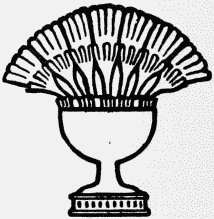
Badge of Humphrey, Duke of Gloucester
The marble tumba or pedestal which carried the shrine of St. Alban was broken in pieces after the Suppression, and most of its fragments were built into the blocking of the eastern arches of the feretory, where they were discovered in 1872, and fitted together so that the general design has been recovered. The tumba is almost entirely of Purbeck marble, and consists of a base 8 ft. 7 in. long by 2 ft. 6 in. wide and 3 ft. 2 in. high, panelled with richly-moulded quatrefoils, two of which have lozenge-shaped openings in their centres. These may be intended to admit cloths or the hands of those who visited the shrine, but this is not certain, as the niches above would probably answer the purpose quite well enough. Of these niches there are ten, four on each side and one at each end, separated from each other by marble slabs reduced to the extreme of thinness consistent with safety, and worked with net tracery in low relief. Over the niches were canopies, three of which have been lost, but the rest remain, with beautifully-worked details and figures in the spandrels between them. At the west end is the martyrdom of St. Alban, and this end of the pedestal must have formed the reredos of the altar of St. Alban which stood here. At the east end is the scourging of St. Alban, with a seated king, perhaps Offa, below. On the south side are figures of King Offa, and perhaps St. Oswin, the third figure being lost, and on the north side only one figure remains, and may be that of St. Wulstan of Worcester. In the spandrels at the angles are censing angels. The whole was crowned with a rich cresting of foliage, of which a good part remains. The shrine rested on the top of this tumba, but all traces of its fitting are gone, unless a mark still remaining in the vault above is that of the hook to which the pulley for raising the cover of the shrine was attached. Round the base of the tumba are places for fourteen detached shafts, and outside these on the north and south were six larger twisted shafts, probably to carry lights. (fn. 33) In the niches are remains of painting with the leopards of England and the lilies of France on red or blue backgrounds powdered with stars and pellets. The whole was doubtless gilt and coloured, and with the shrine and its cover above must have been a magnificent sight. Abbot John de Maryns, 1302–8, is recorded to have set up the tumba, and if all that now exists is to be attributed to his time, the net tracery on the divisions between the niches is the earliest known example of its kind.
The great altar screen of Abbot William of Wallingford closes in the feretory on the west, and is returned eastward at both ends to fill in the second bay of the arcades, the entrances to the feretory being in these wings, superseding former entrances in the same position.
Of the former adornments of the high altar there is a certain amount of documentary evidence. An altar beam was set up here by Adam the Cellarer about 1170, with figures of the twelve patriarchs and twelve apostles, 'in the likeness of the synagogue and the church,' that is to say, representing the old and new law, after a fashion common in the Middle Ages. It was replaced in Trumpington's time by a beam with the story of St. Alban, and was set up in the south transept. Trumpington also made structuras quasdam nobilissimas round the high altar, doubtless in the form of a low screen, not further described, but apparently the work of Master Walter of Colchester, who also made the beam. This screen probably replaced an earlier screen, as there must have been from the first a division between the feretory and the high altar. (fn. 34)
An inventory (fn. 35) of the early years of the fifteenth century mentions the abbot's seat by the high altar, and the priests' seat, that is, the sedilia, for which there were three cushions. If the sedilia were of stone they must have been destroyed at the making of the chapel south of the high altar, and there is now no trace of them. The great screen, built from the foundations (fn. 36) by William Wallingford at a cost of 1,100 marks, and finished before 1484, (fn. 37) is adorned with three main tiers of niches, having in the centre of the middle tier a great Rood with our Lady and St. John below. The original images which filled the niches have long perished, only small portions of St. Stephen and St. Erasmus remaining till modern times. A new set of figures has supplied their place, the gift of Lord Aldenham, and at the same time the broken cresting and canopies, &c., were repaired. In general design the screen is like the contemporary example at Winchester, but the projecting central canopy over the rood is not so prominent, and has not the same arrangement for holding the pyx. Above the rood are angels, and below are the twelve apostles, while the reredos of the high altar is formed by an unfinished representation of our Lord rising from the tomb, between two angels, the work of Mr. Alfred Gilbert, R.A.
On either side of the altar are doorways to the feretory, with a shield of the royal arms—France quartered with England—over the south door, and another with the cheveron and wheat-ears (attributed to either Abbot Wheathampstead or Wallingford) above the north door. Each shield is supported by two angels. The screen is returned at both ends to fill the second bay of the main arcades. The back of the screen towards the feretory is covered with panelling, and has a wide central recess with the saltire shield of St. Alban over it, while over the doors from the presbytery are shields with a cheveron between nine wheat-ears. This shield also occurs over the outer faces of the doorways from the aisles to the feretory. Over the inner face of the doorway from the south aisle are the arms of St. Oswin, and above the other doorway the corresponding shield is blank. The doors in the two last-mentioned doorways are contemporary with them, but those towards the presbytery are modern copies of the old pair.
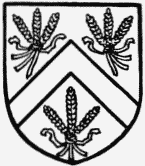
Arms commonly attributed to Abbot Wheathampstead. Gules a cheveron or between nine ears of wheat or tied in groups of three.
In the third bay of the presbytery are four steps, and the arches on either side are blocked with chantry chapels. That on the north is the chapel of Abbot Ramryge, built about 1522. Before its building the bay was blocked with a thin wall on the centre line of the arcade, and this being removed to make room for the chapel, an inner order was added to the arcade, which is easily distinguished by its sixteenth-century mouldings from the thirteenth-century orders on either side.
The chantry is entered from the south-west, the door having a painted inscription dated 1678. 'Ego dixi in dimidio dierum meorum vadam and portas inferi,' an addition probably due to the appropriation of the chapel as a family vault by the Farringtons, a Lancashire family then living at St. Albans. At the east end of the chapel are shields with the saltire of St. Alban, the crowns of St. Oswin, and the lions of St. Amphibal, with niches for figures, and at the west end the arms of St. Alban and Abbot Ramryge, who bore Gules a bend or with three double-headed eagles gules on the bend between a lion and a ram both argent. On the floor is an incised slab with the mitred figure of the abbot, and an inscription round the margin: 'Benedicta sit Sancta Trinitas atque indivisa unitas [confitebimur ei] quia fecit nobiscum misericordiam suam. Amen.' The roof is fan vaulted, and a very charming specimen of its kind. In the solid panels on the lower part of the south face of the chapel, towards the presbytery, are a series of shields having for supporters rams which hold croziers and have the letters RYGE on their collars. On the shields are the arms of St. Alban, Abbot Ramryge, and St. Oswin, while that at the east end, which has an eagle displayed, is believed to be the shield of Wymondham Priory. Above the panels are tall traceried and transomed openings, surmounted by a cornice on which are shields which are considered to refer to the various cells of the monastery, as follows:—(1) St. Alban, (2) Binham Priory—the arms are those attributed to Peter de Valoins, the founder, Gules a lion passant (here a leopard) or in an orle of martlets argent, (3) St. Oswin's arms, three crowns, for Tynemouth Priory, (4) Henry VIII, (5) St. Amphibal (6) Wymondham Priory, an eagle displayed, (7) Hertford Priory—the arms of Ralph de Limesi, the founder, Gules three eagles displayed or.
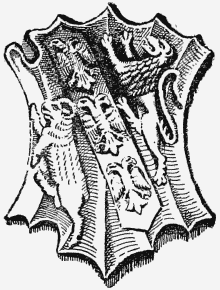
The Shield of Abbot Ramryge
Above the shields is an inscription, beginning at the south-east corner, and taken from the Salisbury Missal, being part of a sequence and antiphon of the psalms for Whitsuntide. 'Sancti Spiritus assit nobis gracia, veni Sancte Spiritus reple Tuorum corda fidelium et Tui amoris in eis ignem accende. Amen.' The north face of the chapel, towards the aisle, is like the south face, but the lower row of shields have only the saltire of St. Alban. On the cornice the shields are (1) St. Alban, (2) A lion in an orle of roses, perhaps for Pembroke Priory, founded by Walter Marshall, in which case the lion might refer to the lion in the shield of the Marshalls, (3) Abbot de la Mare, whose arms were Argent a bend azure and thereon three eagles or, (4) Henry VIII, France quartering England, (5) A cross between four lions, (6) Three pierced roundels, (7) Redbourn Priory, A bend between six martlets. (fn. 38) Nos. 5 and 6 may possibly refer to Wallingford, Belvoir, or Hatfield Peverell priories, but neither of these shields has the arms assigned to the founders of those houses.
The smaller details of this chapel, which is built of clunch, are for the most part well preserved, and of great beauty and interest. They include the emblems of the Passion, a Tau cross, conventional leaves and flowers. In the spandrels of the doorway are carved representations of the martyrdom and scourging of St. Alban.
On the south side of the presbytery, corresponding in position to the Ramryge chapel, stands the chapel known as that of Abbot John Wheathampstead, ob. 1464. It has a wide arch towards the presbytery, closed by a contemporary iron grate of plain design with little gilt shields on it. Over the arch is a cornice with the motto, Valles habundabunt, and wheat-ears, and above it is a band of quatrefoils inclosing small devices, the most noticeable being the rose in sun of Edward IV, the arms of St. George, and a mitre with wheat-ears. There are three large shields on this side of the chapel, one of St. Alban, and two with the wheat-ears and cheveron, as on the altar screen. The doorway to the chapel is in the south aisle, at the south-west angle, and the south side has a plain panelled and moulded plinth, and above it open tracery, with a cornice bearing the motto as on the other side, though the general design is slightly different. The interior of the chapel has little to show, and the stone roof is of low pitch, with cinquefoiled panelling. The carvings are of late fifteenth-century character, and all the details of the chapel point to a similar date. A number of loose brasses from various parts of the church are here preserved, fixed to an oak board, and the floor is occupied by the magnificent Flemish brass of Abbot Thomas de la Mare, 1349–96. This was one of a pair, bought with their marble stones by the abbot during his lifetime, to commemorate his predecessor Michael of Mentmore and himself. (fn. 39) The abbot wears mass vestments, with mitre, crozier, gloves, and shoes, and stands under a multifoiled arch flanked and surmounted by canopied niches. In the central canopy at the top is God the Father between figures with censers and musical instruments, flanked by St. Peter and St. Paul. Below on the right is a large figure of St. Alban, and three pairs of figures in succession, St. John with Daniel, St. Andrew with David, and St. Thomas with Hosea; on the left in corresponding positions are St. Oswin, St. James with Isaiah, St. Bartholomew with Haggai, and St. Philip with Joel. Of the surrounding inscription only the opening words have been engraved:—'Hic jacet dominus Thomas quondam abbas hujus monasterii'; the band has the evangelistic symbols at the four corners, and the arms of the abbot—which were Argent a bend azure with three eagles or thereon— in the middle of each side.
The wheat-ears, the mottoes, and general tradition, have led to the attribution of this tomb to John of Wheathampstead. The documentary evidence is with one exception quite clear in a contrary direction. In 1429 (fn. 40) Wheathampstead built a chapel for his tomb abreast of the shrine, outside the south aisle of the presbytery in the monks' cemetery, and it was consecrated in 1430. (fn. 41) This chapel, after his resignation in 1440, was made the chantry chapel of Humphrey of Gloucester. (fn. 42) Wheathampstead was re-elected abbot on 16 January, 1452, and died on 20 January, 1465, and there is no record of his having made any other chapel for his tomb, but during his second abbacy he caused a marbler (vir marmoreus) to make a grave and gravestone, (fn. 43) spending £20 on it.
William Wallingford, 1476–84 (?), built a chapel for his own burial on the south side of the church, close to the high altar, with suitable iron work and a marble slab, (fn. 44) at a cost of £100. Except for the loss of the marble slab, this entry accurately describes the chapel in question, and its style equally suggests a date of c. 1480. The wheat-ear shield on the tomb also occurs on the great altar screen, undoubtedly a work of Wallingford's, while it does not occur on anything definitely known to be Wheathampstead's, and Wheathampstead's special badges, the eagle and lamb, are nowhere to be found on the chapel. (fn. 45)
The only documentary evidence in favour of Wheathampstead occurs in the remark (fn. 46) 'J. de Frumentariis bis colles istius ecclesiae accinxit exultatione, bisque valles ipsius frumento habundare fecit,' in reference to his two abbacies, and clearly connected with the motto on the chapel. In the remains of the chapel built by Wheathampstead in 1429 were found traces of painting and the inscription Deus misereatur. This also occurs over the eastern arch of the central tower, in company with Wheathampstead's hexameters, and may have been his motto. There is of course no reason why he should not have adopted Valles habundabunt as a second motto. It occurs on the sedilia in Luton church, but there is no direct evidence that these are Wheathampstead's work.
No record appears to exist of what arms Wallingford bore, and a possible (but most unlikely) explanation is that he may have adopted those of his illustrious predecessor. The earliest evidence of the attribution to Wheathampstead seems to belong to the latter part of the seventeenth century, and a set of verses of this date are painted on the wall above the chapel telling us that the wheat-ears are a play on his name. Weever, who must have been here about 1625, gives no definite evidence, as he was concerned with inscriptions only. Wallingford's inscription he gives, containing the words 'whose praiseworthy work this is,' which probably refer to the screen, but says nothing of its position, and there was evidently no epitaph to Wheathampstead in existence at the time, though he gives a manuscript epitaph composed for him. (fn. 47)
At the foot of the altar steps in the presbytery are the grave-slabs, now despoiled of their brasses, of three abbots, Hugh of Eversdon, 1308–26, Richard of Wallingford, 1326–35, and Michael of Mentmore, 1335–49. Next to the last was the brass of Thomas de la Mare, now in the south chantry tomb. Immediately west of the altar rails are two rows of gravestones stretching across the presbytery, a few having remains of their brasses. In the first row the third from the south retains the figure of Sir Anthony de Grey, 1480; the fourth has the figure and inscription of Robert Beauver, 1470, monk of the abbey; the fifth, also that of a monk, c. 1450, preserves only the inscription coming from the mouth of a figure kneeling beneath a cross with our Lady and St. John: Salva Redemptor plasma tuum nobile Signatum sancto vultus tui famine Nec lacerari sinas fraude daemonum Propter quos mortis exsolvisti pretium. The sixth, of Abbot John Stoke, 1440–51, retains part of a triple canopy, two scrolls, and the marginal inscription. In the second row the second slab is that of Abbot John de Maryns, 1302–8; the third, perhaps of Abbot John de la Moote, 1396–1400, has parts of its marginal inscription, and a plate at the foot with verses: Hic quidam terra tegitur Peccati solvens debitum Cui vomen non imponitur In libro vitae sit conscriptum. (fn. 48) The fifth, of Abbot John Berkhamsted, 1291–1302, has an inscription Le Abbe Johan gist ici Deu de sa alme eit merci vous ke par ici passes Pater e Ave pur lalme pries e tous ke pur lalme priunt Deu karaunte ans e karaunte jours de pardun averunt. The sixth slab has an inscription to Richard Stondon, priest. Other brasses here are to Bartholomew Halley and Florence his wife (1468), a portion of a figure of a monk, and some fragments of scrolls, &c. The floor of the presbytery, where not covered with gravestones, is laid with modern green-glazed tiles with a raised design copied from thirteenth-century examples found on the spot.
In the west bay of the presbytery are the upper entrances to the quire, which though much restored are in essence those which took the place of the original entrances at the rebuilding after 1257. The moulded arches towards the presbytery are set in a block of masonry projecting from the wall face, and having above the doorway triple gabled canopies, open at the front and sides, and carried on round shafts with capitals and bases. The canopies have groined stone vaults, and their open arches are trefoiled, with sunk trefoils over them in the gables; the gables being crocketed, with tall finials, and flanked by crocketed pinnacles. On the eastern face of the east tower arch facing the high altar and a little under the ceiling is a mural painting of Abbot Wheathampstead's time, representing the arms of the three saints whose relics were the glory of this church. In the middle is the shield of St. Alban with a ducal hat above it and with Agnus Dei and the eagle of St. John as its supporters; the red shield with three golden crowns for St. Oswin is on the south side of it, and the arms attributed (fn. 49) to St. Amphibal, Quarterly gules and or with four lions countercoloured, on the north side.

St. Alban
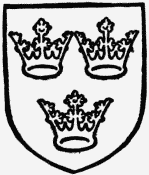
St. Oswin
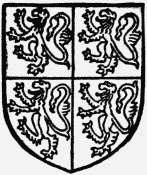
St. Amphibal
The CENTRAL TOWER is not a true square in plan, owing to the difference in width between the nave and transepts, its internal dimensions being 32 ft. 3 in. from north to south by 30 ft. 9 in. east to west. It is carried on four massive recessed piers and slightly stilted semicircular arches of three square orders, two of the four stages above the crossing arches being open to the church, and forming a lantern. The lower of these stages has a triforium gallery with three plain round-headed openings on each side, each inclosing two subordinate arches, which spring from a central stone pillar. The arches have a plain chamfered impost of stone or plastered brick at the springing, and are of square section, built of plastered brickwork. The stone pillars vary considerably in detail, those on the east, as being the most conspicuous, having circular shafts, and large cushion capitals, while of the rest two on the north side are plain rectangles, and all the others except the east shaft on the south side rectangles between half-round shafts. Their capitals are very simply treated, some having only a chamfer on the lower edge, while others have half-cushion capitals to the flanking shafts. The east shaft on the south side is octagonal, and has an octagonal capital chamfered below. The bases are in all cases of brick in stepped courses, and the abaci are either of stone or brick, thickly coated and set in cement to give the required profiles. The slabs used to make up the shafts appear to be of Barnack stone, and are made out to uniform length with short pieces, being no doubt re-used Roman material from Ve ulam. (fn. 50) The roofs of the presbytery, nave, and transepts abut against this stage of the tower, their ridges rising to the top of the stage, which has no windows, but opens to the interior of the roofs on all sides except the east.
The upper stage of the lantern has on each side two wide round-headed lights, simply recessed, without any wrought stone details. Between each pair of lights is painted a large shield, with the arms of Edward I—Gules three leopards or; Edmund earl of Lancaster his brother—the shield of England with the difference of a label azure with five pendants; Eleanor of Castile his wife—Gules a castle or for Castile quartered with Argent a lion purple for Leon; and Richard, earl of Cornwall, his uncle—Argent a lion gules with a golden crown in a border sable bezanty. The ceiling of this stage is flat, divided into square panels, and ornamented with sixteenth-century painting, showing the arms of England, St. George, St. Alban, and St. Edward the Confessor, the outer panels being filled with red and white roses alternately.
The third stage of the tower, immediately above the ceiling just noted, is quite plain on the inside, with a small doorway in each face opening into a gallery on the outer face of the tower. Each gallery has four round-arched openings, subdivided by smaller arches resting on stone columns, with cushion capitals to the columns and responds, the galleries being only 20 in. wide, and covered with a plastered vault. (fn. 51) Between the two central openings on each face is a pier with a rectangular pilaster buttress on the outer side, and a half-round projection on the inner side, a corresponding recess being made in the back wall of the gallery to allow a passage behind the projection. The galleries do not communicate with each other, the angles of the tower being solid except at the north-west, where is a newel stair. At the top of this stage the flat angle buttresses take a rounded form, and were originally carried upwards to end in circular angle turrets, probably like those which till lately existed on the west sides of the transepts. They must have been finished with conical stone caps, but the upper parts have long since disappeared. The pilaster buttresses in the centre of each face of the tower also change at the same point as the angle buttresses, becoming pairs of half-round shafts. It is not clear what their upper termination was, and they now die into the wall below the later brick embattled parapet with which the tower is crowned.
The belfry stage has a pair of double windows under wide inclosing arches on each face, with a stone roll moulding and nook-shafts with cushion capitals to the inclosing arches, the rest of the detail being of brick. The tympana over the windows are pierced with two rows of triangular openings to lighten the weight on the heads of the windows, and above the haunches of the inclosing arches are similar openings, but lozenge-shaped.
The roof of the tower is now flat and leaded, but formerly had a small leaded spirelet of the type known as the Hertfordshire spike, a good many examples of which still remain in the county. It was probably of the fifteenth century. The original roof of the tower was probably pyramidal, of low pitch, and covered with shingles, and was replaced in William of Trumpington's time by a leaded spire, about which there is a very interesting passage in the Gesta Abbatum. (fn. 52) It was as it seems rather ugly, and rose awkwardly from its square base, and soon after its erection was improved by the addition of angle rolls and broaches, and probably herringbone lead rolls on the faces of the spire.
What may be a very curious contemporary record of these alterations is to be found in the southern clearstory passage of the west part of the nave, built by Trumpington about this time, where among the many mason's marks is a device of two spires side by side, one plain and the other with herringbone lead-work. There are several instances of this, and in one case partly behind a detached shaft, so that the presumption that they are ancient is not unreasonable.
The present height of the tower is about 144 ft., and, as has been said, it is at the present day in remarkably perfect condition. Serious defects in the northeast pier came to light in 1870, chiefly on account of the bad state of the mortar in a section of the pier, (fn. 53) and it was with difficulty that the tower was eventually saved from falling. The south-east pier also was found to have been undermined and much weakened.
The NORTH TRANSEPT has in great measure preserved its original design, and dates from the eleventh-century rebuilding. It is of three bays, divided by broad and shallow pilaster buttresses, the ground story having in each bay, except on the east, a wide round-headed window twice recessed on the outer face, and once at the inner face of the splay. In the east wall are round arches of two square orders, formerly opening to eastern chapels. The triforium bays have open arcades in front of the wall passage, with four roundarched openings under two main arches, carried by stone shafts with cushion capitals and variously moulded bases. The shafts are roughly worked, circular or octagonal, but two in the southern bay on the east are lathe turned, with irregularly moulded capitals, rings, and bases worked on them, and made to range with the rest by being set on eleventh-century bases and crowned with cushion capitals. The clearstory has a tall open arch in each bay, with no ornament but a chamfered string at the springing, and is lighted by large round-headed windows like those on the ground story. The whole design is of the plainest character, except for the triforium arcades, and the stages are divided from each other by chamfered string-courses. The flat panelled wooden ceiling, which is modern, replaces a ceiling of like construction, but painted with a series of shields (fn. 54) and a representation of the martyrdom of St. Alban, the latter a poor thing of seventeenth-century style. (fn. 55) The roof of the transept, originally of a high pitch, was lowered, perhaps in the fifteenth century, (fn. 56) and has now been raised to its former shape. The external elevations of the transept were as simple as the internal ones, with a single round-headed window in each bay of the ground stage and clearstory. Strings ran at the level of the sills of the windows, and of the springing of the clearstory windows. On the west, at any rate, the wall at the triforium level was blank, but whether it was the same on the north front cannot be known. Across the base of the north gable ran an arcade of six pairs of round-headed openings under inclosing arches, (fn. 57) flanked by circular openings at the springing of the gable, and there was probably some further breaking of the wall surface above the arcade. At the angles were recessed pilaster buttresses, and a similar buttress ran up the centre of the face, while in the north-west angle was a vice crowned by a circular turret with battering sides and four pairs of round-headed openings with stone shafts and cushion capitals, and finished with a conical stone roof. All this work seems to have remained unaltered till the roof was lowered and the upper part of the gable destroyed, probably in the fifteenth century, and the clearstory and triforium gave place between 1476 and 1484 to a large four-centred window inserted by William Wallingford, cutting off the access from the west clearstory to that on the east by destroying the old passage. A stair was therefore made in the north-east angle of the transept, and crowned by an octagonal embattled turret, balancing the original north-west turret, which perhaps lost its conical top at this time, and was finished with a battlement. In this condition the transept remained to modern times, but under Lord Grimthorpe both angles of the north front, and all the wall from the triforium level upwards, were destroyed and rebuilt as they now appear, with a high-pitched gable flanked by heavy turrets, and in the middle of the front a large circular window filled with cusped circles of various sizes, and surrounded on the inside by a copy of a late twelfth-century moulding from the passage at the end of the south transept. (fn. 58)
The apsidal chapels on the east of the transept seem to have been pulled down in the fifteenth century, though it does not appear that anything was built on their site, as in the case of the south transept chapels. Blocking walls, with fifteenth-century windows of two lights with tracery, were inserted in their western arches, and the lines of their gabled roofs were till lately visible on the walls above. The traces of former arrangements are now nearly destroyed, but the springing of the vault of the southern chapel remains, and the south respond at the chord of its apse. The fifteenth-century windows have given way to windows of Lord Grimthorpe's design, a third specimen of which now lights the west bay of the north aisle of the presbytery.
The transept has an external doorway in the north wall near the north-west angle, the outer arch being of plain brickwork, and the inner of wrought stone, the masonry seeming of later date than the outer arch, which is part of Paul of Caen's work. The space between the arches is vaulted with a groined plastered vault, and from its west side opens the passage to the vice in the north-west angle, now entirely modern.
The townsfolk had certain rights of access to this transept from an early date, probably entering the precincts by the Waxhouse Gate or its precursor. In the transept were three altars, of the Trinity (fn. 59) in the north bay, of St. Citha or Osyth in the next bay, and of the Holy Cross against the pier immediately to the south. The last altar was also known as the Pity Altar, (fn. 60) and had several other dedications: our Lady, the image from the altar of our Lady and St. Blaise having been removed here by William of Trumpington; St. Laurence, whose image with that of St. Grimbald was brought here in 1428, formerly being in the destroyed almonry chapel; and St. Blaise: this last dedication being probably consequent on the removal of the old altar of St. Blaise in the alterations to the presbytery after 1257. Its best-known name, however, was the altar of the Bowing Rood, Crucis Inclinatoriae, Crucifixi flectentis, and the like. A detailed account of its appearance is given in MS. Harl. 3775, fol. 122, (fn. 61) showing how it was set between two columns, one 'earth-coloured' and one red, with the symbols of the Passion on them, and verses, and on their capitals angels holding scrolls with other verses, while over the altar were two scenes, the history of the Resurrection above, and that of the Passion below, with verses between them. The upper painting is still in a fair state of preservation, and from its style must have been nearly new at the time the account was written, c. 1428. It shows our Lord standing, holding a banner, while St. Thomas kneeling thrusts his hand into His side. Parts of the verses between the two paintings also remain. On the floor of this transept are several slabs with the indents for brasses, and some mediaeval floor tiles. There are also here altar tombs to Thomas Legh Claughton, first bishop of St. Albans (1892), and Alfred Blomfield, bishop of Colchester (1894).
The SOUTH TRANSEPT is in general design similar to the north transept, and as regards its gable wall has had much the same history. Wallingford inserted in it a large window, causing the making of a second stair and turret, and the whole arrangement was swept away, though even more completely, by Lord Grimthorpe, who rebuilt the whole south wall and both staircases, not exactly in their old position, and also destroyed the remains of Abbot Geoffrey's passage from cloister to cemetery, set against its outer face. The archway (fn. 62) by which this passage, called the slype, formerly opened to the cloister was set up again, much 'restored' and with a new inner order, in the middle of the south wall, opening to the lobby which now represents the old passage, and part of the wall arcading of the passage is set up over the doorway, below the sills of five huge lancet windows, which fill the whole end of the transept up to the flat ceiling. Internally their heads are level, but externally they are graduated, the middle lancet being the tallest. (fn. 63)
The east wall of the transept differs only from that of the north transept in having in its triforium arcades six of the turned baluster shafts instead of two only. This probably means that it was built before the north transept, the stock of shafts being nearly used up by the time that the latter came to be built; the south side of the church, being next the claustral buildings, would naturally be undertaken before the north side.
The apsidal chapels here were destroyed early in the fourteenth century, and low walls with central doorways built across their western arches. The larger or northern chapel was the original Lady chapel, and continued to be so used till the new Lady chapel was finished early in the fourteenth century. The original image at this altar made in the time of Abbot Robert (1151–66) was replaced by a very beautiful one, made by Master Walter of Colchester, and Abbot William of Trumpington did a good deal of work here, panelling the roof over the image, and setting up near it the old altar beam made about 1170 by Adam the Cellarer, then recently displaced in favour of a new beam made by Walter of Colchester. (fn. 64)
In Trumpington's time an endowment for two additional lights at the old Lady altar was given, making four in all; and from this arose the name 'the altar of the Four Tapers.' This endowment was transferred to the new Lady altar in the south wing of the vestibule of the Lady chapel where the mass pro Ecclesia was sung. (fn. 65)
Other work by Trumpington in the south transept was the replacing of the two original windows in the west wall, on the ground stage, by two lancets, which were afterwards blocked by the roof of the rebuilt cloister, and now are again open. (fn. 66) They have jamb shafts with foliate capitals, and moulded arches whose heads rise above the level of the triforium floor. The central shafts in each bay of the triforium were disturbed by this alteration, and have been replaced by curious rectangular pillars with bowtels at the angles and plain leaves on the capitals, a thirteenth-century attempt to harmonize with their eleventh-century surroundings. In the south-east pier of the central tower on the south side are two thirteenth-century bases, which may well be of this date, and suggest that it was intended to add shafts in the recessed angles of the tower piers. The southern or smaller apsidal chapel contained the altar of St. Stephen, at which King Stephen heard mass when staying in the abbey between 1151 and 1154. (fn. 67) The site of the apse was afterwards occupied by a vestry, which seems to have been built in the second half of the fourteenth century, (fn. 68) while on the site of the old Lady chapel stood a two-story building, the upper story of which, used as the treasury, received a stone vault about the same time.
The lower story was either a vestry or perhaps a second treasury and was vaulted, like the room over it. A treasury somewhere in this position is mentioned in 1235, (fn. 69) and must have been either above or to the east of the Lady chapel. Nothing now remains of these buildings except the springing of a fourteenth-century vaulting-shaft in the north-west angle of the building under the treasury. In the west wall of the transept, beside the windows already noted, is a blocked doorway, now used as a cupboard, (fn. 70) but originally opening to the cloister. Like the north door of the north transept it has a plain round inner arch, and the opening in the wall is vaulted. The masonry, though early, hardly looks as old as the wall in which it is set. (fn. 71) In the southern clearstory window in this wall the south jamb had a stone shaft with a cushion capital, a feature occurring nowhere else in the church, though it may have done so in the original presbytery. In any case the change of design is a further argument for the early date of this part of Paul's church. Close to the angle of the south aisle of the nave is a blocked two-light fifteenth-century window, about 12 ft. up; it formerly opened from a small chamber cut in the thickness of the wall, and known in modern times as 'the watching chamber,' which has been built up solid to strengthen the wall. (fn. 72) The roof of this transept is flat, with plain oak boarding, replacing a painted ceiling as in the north transept. At the north end of the east wall of this transept are the remains of a thirteenth-century painting of an angel with outstretched wings. There is a brass on the floor here to Thomas Rutlond, sub-prior (1521), and several slabs containing indents for brasses, one of which, possibly to Robert Norton, prior (1350), shows a large floriated cross terminating in vine leaves, standing on a small dog. In the middle of the cross is the indent for the figure of an ecclesiastic, and, above, a crocketed canopy.
The NAVE is of thirteen bays, nine on the north and three on the south belonging to the original work. They are of the plainest description, the main arcades having square orders with a chamfered string at the springing, and the piers being simply recessed, with a chamfered plinth at the base.
The triforium stage was altered in the fifteenth century, when the aisle roofs were lowered, by the insertion of large three-light windows in each bay, and the removal of all features except the outer order of the main opening. In the third bay, however, where the pulpitum stood, the windows were not inserted, and there remains a semicircular arch of three plain orders with chamfered strings at the springing. It seems unlikely that this should not have been subdivided, but no trace of such subdivision remains. The clearstory windows are plain round-headed lights like those in the transepts, doubly recessed and with stepped sills, and the flat wooden ceiling over them probably follows the original lines, though itself of later date.
There are chamfered strings at the springing level of the arches in all three stages, and at the base of the clearstory and triforium. In one instance on the north side the string at the springing of the triforium opening is carved with the sunk star ornament, but elsewhere everything is plain. The equality in height of the three stages, which is so marked in the contemporary work at Winchester, does not exist here. It will be noticed that the piers and arches of the main arcades in the three bays east of the rood-screen are of different section from those to the west of it; this may perhaps be another indication of a break in the work, as shown in the south transept (q.v.).
The two eastern bays (fn. 73) of the nave, together with the space under the tower, were occupied by the monks' quire. None of the old woodwork has been preserved, but the foundations of the old stalls, probably those set up by Abbot Hugh of Eversdon about 1320, have been uncovered at various times and are shown on the accompanying plan. The present stalls, throne, and lectern were set up in 1904, in memory of Bishop Festing and others, but the western return stalls are a few years older, those on the south side being a memorial of Archdeacon Mildmay, and those on the north of Archdeacon Ady and others.
Over the third bay is the organ loft, in the position formerly occupied by the pulpitum, and at the east side of the fourth bay stood, and still stands, the rood-screen, though its loft has disappeared. It is a beautiful work, wrought in the soft clunch which allows of the most delicate detail, and was probably begun by Abbot de la Mare, 1349–96, after the completion of the rebuilding of the five bays of the south arcade which fell in 1323. Towards the quire it is panelled with cinquefoiled arcades in simple fashion, but towards the nave it has a range of projecting canopies, one in the middle, wider and more important than the rest, and three on each side of it, in the space between its two doorways. There are brackets for two tiers of images under the canopies, and over each doorway three plainer niches, also with image brackets. Beyond the doorways on north and south are other canopies, and to the north is a modern lengthening of the screen across the north aisle. For the arrangement of altars formerly here see below. The two piscinae now in the screen are both modern restorations.
Between the clearstory windows over the stalls are traces of large painted figures discovered in 1875; there were originally four on each side, but now three remain on the north and two on the south. It has been suggested that the four Evangelists were on the north wall and the four Doctors on the south.
On the west face of the second pier on the north side is a defaced painting of the Trinity, which has been attributed to the time of Abbot Ramryge, 1492–1521, on the strength of a painting in the Book of Benefactors, representing the abbot with an exactly similar picture of the Trinity.
The three eastern bays of the north aisle are now inclosed as a vestry and library, the panelling which incloses them being part of that formerly in the presbytery.
In the east bay of the south aisle is the beautiful late fourteenth-century doorway, known as the abbot's door. It led by a flight of steps into the cloister, and is the work of John de la Moote while prior. In the spandrels are two carved shields, that on the east side having the arms of Richard II, Old France quartered with England, while the shield in the western spandrel has what is believed to be the earliest existing example of the arms of the abbey—Azure a saltire or. Both of these shields are in high relief and painted in their proper heraldic colours. The door itself is a very fine piece of woodwork with elaborate tracery.
West of the doorway, in the second bay of the aisle, is a thirteenth-century tomb recess in the south wall, with a beautifully moulded and cusped arch and jambs with engaged shafts. Above it, in letters of sixteenth-century character, is the inscription:—
'Vir Domini verus jacet hic heremita Rogerus Et sub eo clarus meritis heremita Sigarus'
The aisles have in no case preserved their original windows, but had doubtless a single light in each bay. All were renewed by William of Trumpington, and his windows still exist where the aisle wall has not been rebuilt, but are for the most part filled with modern copies of two-light tracery inserted by Abbot Wheathampstead.
It seems more than likely that four magnificent shields of stained glass, now inserted in the easternmost window of the north aisle of the nave, are fragments of de la Mare's glazing of the cloisters. These shields are blazoned with the arms of Edward III— Old France quartered with England; Edward, Prince of Wales—the King's shield with the difference of a silver label; Lionel, created duke of Clarence in 1362, 'when he appears to have assumed a silver label charged on each point with a canton gules,' (fn. 74) which label is here used as his mark of cadency; and the arms of John of Gaunt, fourth son of the king, who differenced Old France and England with a label ermine.
In the second window of the north aisle, westward of the rood screen, is a glowing escutcheon of arms—Or two bars gules; and in the next window is a shield of similar form and size, displaying Azure a saltire or and a border gules with eight golden mitres, which are the arms of Abbot William Heyworth. These two shields are held by angels, and evidently belonged to the same series.
The only other heraldic glass in the church is modern. On the north side, in the sixth window of the aisle west of the rood-screen, is a shield of the arms of Toulmin— Argent a cheveron erminees between three crowns sable, impaling Wroughton—Argent a cheveron gules between three boars' heads sable. This finely-executed shield is part of the memorial window of H. H. Toulmin of Childwickbury, who married in 1861 Emily Louisa, eldest daughter of Philip Wroughton of Wolley Park in Buckinghamshire, and died 13 June 1871.
The window immediately west of the screen in the south aisle has two modern shields, which are Azure two bars ermine with three suns or in the chief, the arms of Dr. H. J. B. Nicholson, rector 1835–64; the other shield—Azure two bars nebuly erminois and a quarter gules with a cross formy fitchy argent, has the name of Archdeacon Burney on a scroll below it.
It was no doubt intended that the aisles should be vaulted, but there is nothing to show that this was ever done, (fn. 75) except in the three eastern bays of the south aisle, which retained their original groined vaults till they were destroyed by Lord Grimthorpe a few years since and replaced by those now existing.
The fourth, fifth, sixth, seventh, and eighth bays on the south side belong to the rebuilding of 1323–43. Their general design is ruled by the thirteenth-century work to the west of them, the chief differences being in matters of detail. As a result the clearstory is less important, and the triforium more so, than is usual in work of this date. (fn. 76) The clearstory windows are all single lancet lights, corresponding to those of the thirteenth-century clearstory, with moulded rear arches of two orders and two engaged shafts in each jamb, and are evenly spaced, two windows in each bay. (fn. 77) The triforium arcades, in like manner, run unbroken, with continuous hood-moulds mitring with a string at the base of the clearstory. The arches are of two moulded orders, with a line of ballflowers on the inner half of the outer order, and are subdivided, the sub-arches being sharply pointed, with cinquefoiled cusping, and having a pierced spandrel above with trefoiled tracery. Flowing curves are introduced into the cusping and the trefoiled arches spanning the triforium passage, but the general character of the tracery is geometrical. The shafts are in clusters of three, with four-leaved flowers or foliage between them, and the capitals of the subordinate arches are worked with foliage, while those of the main arches are moulded. At the base of the triforium is a string with four-leaved flowers, and below it, under the main piers, some good heraldic work, carved in stone. It consists of six great shields of arms, of the leopards of England thrice repeated alternating with three other shields carved with the cross paty and martlets of the Confessor, the crowns of St. Oswin and fleurs-de-lis of most elaborate and beautiful foliage-like design in the shield of St. Louis of France. The triforium is reached from the roof of the south aisle by small doorways, and was never more than a narrow passage as at present.
The main arcades have moulded arches of four orders with labels, and piers with round engaged angle shafts and a canted face between, the moulded capitals and bases following the same plan. The heads used as dripstones to the labels are conspicuous, and probably intended for portraits; they represent an abbot, a queen, a king, and a layman, and may be supposed to be Hugh of Eversdon, Isabel of France, Edward II, and the magister operum of the abbey, Master Henry Wy, or another. The five bays of the south aisle, contemporary with the arcade, are lighted by two-light windows, of which the tracery is entirely modern, but the rear arches, with engaged shafts in the jambs, are original, as is the quadripartite stone rib-vault of the aisle. This springs on the south side from clustered responds with moulded capitals and bases, and a moulded ring on the shaft. In the fourth bay from the east is a stair in the thickness of the wall, now closed with an iron door and used as a safe, but formerly leading to the abbot's chapel on the south of the nave.
The five western bays of the nave on the south side and the four western on the north belong to the work begun by John de Cella and finished by his successor, William of Trumpington. The evidence of details and masonry shows that they were begun at the west, and built eastward, slowly and with pauses in the work. There are four different types of bases and capitals, evidently consecutive. To the first type belong the two bases and the two capitals of the western responds, (fn. 78) to the second the bases of the first and second piers from the west, and capitals of the first and second piers on the north and the first on the south. To the third type belong the bases of the third pair of piers from the west, and the capitals of the third pier and east respond of the arcade on the north, and of the second and third piers on the south. The fourth type occurs in the capitals and bases of the fourth pier and east respond of the south arcade.
The progress of the work may therefore be shown as follows, as far as regards the main arcades. First work: western responds. (fn. 79) Second work: two bays of arcade on north, one on south, the east pier of the second bay being built to some point below the capital. Third work: third and fourth bays completed on north, and second and third on south. It was probably intended to carry the south arcade no further eastward than the north, but for some reason (fn. 80) it was decided to take down another bay of the Romanesque arcade, and to continue the south arcade in its place. This was the fourth and last stage of the work.
The question of the original levels of de Cella's work is an interesting one. It is clear that the western bay of the nave was from the first set out at a much lower level—some three feet—than that of the then existing nave, and the vaulting shaft in the south aisle, which belongs to this setting out, is thus designed. But the bases of the piers of the arcades, which must belong to de Cella's later work, are arranged at the higher level, that of the nave floor, and as it seems must have been so from the first, so that there must have been steps in about the same position as now. As regards the aisles, in the south aisle there has been found some evidence that the lower floor level ran further east than at present, and from the excavations of 1860–1 in the north aisle it is clear that this was the case on that side, as the floor level of the arcades opening to St. Andrew's Church both before and after the rebuilding of 1454 was the same as that of the west end of the nave.
In the upper stories the history of the building shows chiefly in the preparation for and abandonment of a stone vault over the main span. Vaulting shafts, starting from the triforium floor level, with shafted corbels beneath them in the spandrels of the main arcades and corbels over the points of the arches, were prepared for in all the bays of the north arcade, and in the three west bays of the south, the abaci of the triforium piers being cut back to make room for the shafts. In the added fourth bay of the south arcade no preparations for a vault are made, showing that the intention had been abandoned in the interval between the building of the third and fourth piers on that side. The setting out of the clearstory has been influenced by the preparation for a vault, but it was probably very little advanced when the scheme was given up. The flat faces of the piers, which would have been covered by the shafts, are worked to relieve their plainness with two shallow sinkings pointed above and below.
A little interesting corroborative evidence may be obtained from the masons' marks which abound in this part of the church. The commonest mark in the north clearstory is a pointed leaf with a stalk, which occurs also in the west bay of the north triforium and the east bay of the south clearstory. With this in the north clearstory occurs a banner on a staff, which is also found, without the leaf, in the west part of the south clearstory and in the triforium below it. The commonest mark in the triforium on the south side is a pair of curved lines set back to back; these are found everywhere except in the east bay on the south side, which has a set of marks of its own, which are found nowhere else. Arguments based on such grounds must be used with caution, but as the clearstory was of course built later than the triforium, its characteristic marks, the leaf and banner, must be those used by the latest masons. The pair of curved lines characteristic of the triforium (except in the one demonstrably later bay on the south) should be earlier than the leaf mark, and the banner is probably intermediate between the two, as it occurs with both. The order of building therefore, on these grounds should be (1) four western bays of south triforium and three eastern bays on the north triforium; (2) four western bays of south clearstory; (3) eastern bay of south triforium; (4) west bay of north triforium, the whole of north clearstory, and eastern part of south clearstory. The occurrence of the curious mark of two spires, one plain and one with lead rolls, in the east part of the south clearstory has already been noted as possibly connected with Trumpington's alterations to the roof of the central tower.
The general details of this part of the church are exceedingly good, and the excellence of the earliest work, which must be associated with John de Cella, makes it a matter for great regret that he was not a better man of business. His first attempt at a new west front seems to have been abandoned and destroyed by the frosts of 1197–8, and what is now left must belong to the second work, begun in 1198. It comprises the lower part of the west wall of the nave, with the eastern halves of the north and south porches and rather more of the central porch, together with the remains of the flanking towers on north and south and part of the first bay of the south aisle. The masonry of all this work has diagonal tooling, and the capitals have long-stalked foliage with small leaf-bunches at the top, contrasting with the looser and more spreading foliage of the later work. The jambs of the three doorways in the west wall are of Purbeck marble with lead joints, and all the shafts of the doorways and wall arcades are of the same material. The central doorway is double, with two pointed arches and a central group of three marble shafts; above it are three arched recesses, and the porch has on either side a stone seat backed by a wall arcade of two tiers, the upper with pointed and the lower with trefoil arches. In the front of this a second arcade of two bays has been added by Lord Grimthorpe, its central shaft resting on the stone seat. The side porches follow the same general arrangement, but have single doorways with two arched recesses over them; all are vaulted, with moulded ribs, but in the side porches only the eastern halves of the vaults are old, the rest having perished when the porches were mutilated and blocked up with brickwork. The western arches of all three porches are modern, and form part of the general rebuilding of the west front by Lord Grimthorpe.
The west responds of the nave arcades were designed to have five shafts round a half-octagonal pier, with a marble band at half height, but only two of these shafts have been carried up, the more elaborate scheme being abandoned. The capital, being suited to the simple design, is of course later than the base, and the blocked south arch of the north-west tower shows a like simplification. In this case all the free-standing marble shafts have been omitted and the smaller engaged clunch shafts carried up.
There is nothing to show what the character of de Cella's original design for the clearstory and triforium was, though a good deal of the existing work must have been finished before his death in 1214. The clearstory has two lancets in each bay, externally set in a continuous arcade—blank panels alternating with the windows—and having internally moulded inner arches with a single line of dogtooth, and three shafts in each jamb with moulded capitals and bases.
The triforium is similarly arranged with two openings to a bay, each subdivided, with moulded arches and a pierced and foliate quatrefoil in the spandrel. A line of dogtooth round the arch is continued down the jambs between the shafts, and the string at the floor level of the triforium is ornamented in the same way, projecting to form the abaci of the vaulting corbels below. The scheme of vaulting shows a group of three shafts at the sides and a single shaft in the middle of each bay, an arrangement which suggests that a sexpartite vault was intended. The nave arcades are of four moulded orders with moulded capitals and bases, the piers in all following the same general plan with engaged shafts at the cardinal points and canted faces between; the variations in detail have been noted above.
There is no trace of a doorway from the south aisle to the western walk of the cloister, though such a doorway may have existed in Paul of Caen's church. There is, however, as at Worcester, a doorway further to the west, opening from the aisle to a vaulted passage below the abbot's camera, which must have served the purpose of a western procession door; it is now blocked up and nearly destroyed, but its remains can be seen on the outer face of the wall, with parts of the steps leading up to it.
In the north aisle the Romanesque doorway leading to the chancel of the later church of St. Andrew, and to the nave of the former church, is to be seen in the fifth bay from the west; it is now blocked and used as a cupboard.
The four western bays of the north aisle formerly opened to the church of St. Andrew, which was destroyed in 1553 when the abbey church became the property of the parish. Its general plan as recovered by excavation dates from a rebuilding begun in 1454, and shows a rectangular building with a central arcade, incorporating at the south-west the base of the unfinished north-west tower of John de Cella. The general progress of its rebuilding can be gathered by extracts from St. Albans wills of the time. The Register of John of Wheathampstead (fn. 81) states that in 1454 the abbot destroyed the old chapel of St. Andrew, vilem veterem et vetustam capellam, and set up a new one of ample size and more pleasing to God and all men. But from the wills it is clear that the parishioners had been setting aside funds for the purpose since 1441 at least, (fn. 82) as in this year is a legacy to the church work 'si contingat illa de novo fore edificata,' and there are many bequests to the fabric from 1454 onwards. From 1458 the general formula is ad reparacionem, a phrase here, as commonly in mediaeval documents, meaning not repair in the modern sense, but rather completion and fitting up of a new building. (fn. 83) In 1462 occurs a bequest to the making of the high altar, and in 1464 to the setting up of the rood-screen. Other bequests to the screen occur in 1466 and 1467, and in 1470, and from 1497 to 1501 are references to covering the roof with lead.
The five western bays of the south aisle of the nave, having on the south the buildings of the abbot's house, had no windows except in the eastern bay, and those now existing are modern. The vaulting is also modern, but the shafts are ancient, and part of the thirteenth-century work.
The west front of the church is due to Lord Grimthorpe, and makes no attempt to follow the indications of the thirteenth-century front, which were to be seen before the rebuilding. It may be doubted whether the thirteenth-century design was ever completed—the western towers which formed part of it were undoubtedly abandoned early in the work and never carried up—and the front which came down to modern times was in part at least of William of Wallingford's date—the large central window being one of the three which he made in the church. (fn. 84) Below it the central porch had a pointed outer arch and an embattled parapet, similar parapets masking the ends of the aisles and running across above the central west window; the side porches, as already noted, being partly destroyed and walled up. The present front takes the form of a screen like that at Salisbury and Lincoln, with north and south wings ending in octagonal stair turrets and masking the aisles. The west window is very large, of fourteenth-century style, and the wall surfaces are covered with stiers of arcading.
The nave preserves several traces of its ancient arrangements, and from documentary evidence a good deal is known. The most important document is the account of the altars, monuments, and tombs in the church, (fn. 85) compiled about 1430, but it is not certain that all the entries are of one date. (fn. 86)
The rood altar occupied the normal place in the middle of the west face of the rood screen from the building of Paul of Caen's church onward, but seems to have been moved in the fifteenth century and does not occur in the list just mentioned. It may have been set in the rood loft, or perhaps merged in the altar of the Bowing Rood in the north transept, which, it must be remembered, was accessible to the public. At any rate its site seems to have been occupied in the fifteenth century by one of the three altars set up against three of the pillars of the south arcade of the nave at the rebuilding of 1323–43, and afterwards moved to the rood screen. They were dedicated in honour of our Lady, St. Benedict and all Apostles and Confessors, and St. Thomas and St. Oswin.
Two altars set up under the rood loft in the time of Michael de Mentmore—1335–49—on the north side of the church, (fn. 87) are not otherwise identified. It seems unlikely that there were altars in the north and south aisles at this point, and there is no evidence that screens crossed the aisles. In the north aisle the parishioners of St. Andrew's had rights, with access to and from the north transept, and the aisle was doubtless kept clear for this reason alone. The series of paintings on the eastern bays of the north arcade of the nave certainly suggest the former existence of altars against the piers, but they are nowhere mentioned. Further west in this arcade, opposite to the door leading into the chancel of St. Andrew's chapel, was an altar of St. Katherine, and opposite to it (fn. 88) the important altar of our Lady at the Pillar, which was inclosed by an iron screen, and had above it the famous 'Fair Mary,' the image of our Lady made by Master Walter of Colchester about 1225, and originally set up in the south transept between the two eastern chapels.
After the completion of the eastern Lady chapel early in the fourteenth century, its position in the south transept would be less appropriate, but it is not clear when it was moved to the nave. From the evidence of wills it seems to have been already there in 1416, (fn. 89) but there is a reference to it in its old position in the account of the altars, &c., already noticed, as having been compiled about 1430; this reference may, however, be an older record incorporated in the later account. The altars in the chapel of St. Andrew before rebuilding were three, of St. Andrew in the middle, and our Lady and St. Nicholas on either side. After the rebuilding mention is made of the high altar there in 1462, and of our Lady altar, also called the charnel altar; and there seems to have been a chapel of St. Mary Magdalene. In 1503 (fn. 90) occurs a mention of an image of our Lady in the west end of the south wall of the chapel of St. Andrew.
The soft Totternhoe stone, of which much of the church is built, affords great scope for the scratching of inscriptions or figures, and many ancient specimens remain. On the south wall of the north-west porch is a large eagle of thirteenth-century style, and between the central and south-west doorways of the nave, on the west wall, is a bull. On the pier on which the inscription to Sir John Mandeville is painted is scratched in an early sixteenth-century hand, 'Syr John Mandevylle, knyght,' and there are many other short inscriptions on the columns of the nave. In the feretory, on the back of Wallingford's screen, is a scratched inscription of 1643, made by one of the Royalists who was here imprisoned.
The remains of wall-painting in the nave are numerous and important. The soffits of the arches in the monks' quire are enriched with polychromatic ornaments all of the same design but differing in colour. They consist of two series of cheverons or cheverons reversed in red or blue on an ivory-white ground meeting in the middle of the soffits and having a border pattern of squares in red and blue on the outer orders.
The soffits of the Norman arches in the nave are also decorated, but with different designs, consisting of patterns of cheverons, double cheverons, lozenges, and masonry patterns with stars and five-leaved flowers in yellow, blue, and red on an ivory-white ground.
On the western faces of the Norman piers of the north arcade is a series of paintings of the thirteenth century. Each painting consists of two subjects one above the other, the upper in all cases representing the Crucifixion, and the lower an incident in the life of the Virgin. The drawing is poor, but the pose of the figures has a considerable amount of feeling. In the first from the rood screen the upper painting, representing the Crucifixion, has a background of red, or more properly of purple, powdered with stars and five-leaved flowers. In the middle is the cross with the body of the Christ falling forward and the knees drawn up in the attitude of death. The figure has an ample cloth round the loins which is much draped. On the left is the figure of the Virgin standing on a raised mound, and on the right is the figure of St. John standing upon a similar mound. The heads of both are inclined to denote deep sorrow. The lower painting under a trefoil canopy is a representation of the coronation of the Virgin. On the right is the figure of Christ seated upon a throne, His right hand raised in benediction and His left holding a book having a finely wrought cover. The Virgin is seated on the left wearing a crown, and having an under-garment of red and an upper of white. The throne is of a type found in thirteenth-century St. Albans MSS. Under the mounds upon which the Virgin and St. John stand are angels censing.
There is a considerable amount of spirit and individuality in this work which is wanting in the other paintings, the treatment being more naturalistic than is usual for a work of this date.
The upper picture on the second pier shows the crucifix alone; only the outlines in black now remain. The lower painting, of the Annunciation, is probably by a different hand, and is much the same in treatment as the representation of the same subject on the third pier.
Little but the outline remains of the painting of the Crucifixion on the third pier. The head of St. John is leaning upon his hand in an attitude of deep sorrow. The picture has been re-painted, the heads of what is apparently the later painting being seen over the figures now left. The lower painting represents the Annunciation. The figure of the Virgin and the angel Gabriel are under separate arches. The remarks regarding the capitals in the description of the next painting apply equally to those here shown.
The painting on the fourth Norman pier represents, as before, the Crucifixion in the upper part. Christ is upon a cross raguly, painted green, and has a fully draped red cloth round His loins. The hair is fair or auburn. On the right is the figure of the Virgin with her arms crossed upon her breast, barefooted, and wearing a white under-garment with a red robe over it, and round her head is a red nimbus. On the left is a figure of St. John, also with a red nimbus. It may be noticed that this and the painting of the Crucifixion on the third pier are clearly by the same hand; the want of proportion in the length of the leg from the foot to the knee, the drawing of the arms, the arrangement of the draperies, and the pose of the Virgin, are alike in both. The lower picture, representing the Virgin and Child, has been re-painted, and little now remains of the painting of either period. The Virgin is seated under a cinquefoiled arch, the spandrels of which are decorated with an elaborate scroll pattern in white upon a red ground. The arch is supported upon pillars, the capitals of which are similar to the early thirteenth-century capitals of Abbots John de Cella and William of Trumpington, which may fix the date of the painting between about 1210 and 1235.
In the upper painting on the west face of the fifth pier Christ is on a cross raguly, painted green; around His head is the nimbus cruciger, and the hair is long and flowing, of auburn colour. The flesh throughout the painting is of an extraordinary dark brown; probably caused by some chemical action. Our Lord wears a cloth tied round His loins; on the left is the Virgin with a covering like a shawl over her head, an upper garment of grey tied at the waist, and a brown under-garment. St. John, on the right, holds a book in his left hand, and wears an upper garment of red and a lower of grey. His feet are incased in boots. The lower painting of the Virgin and Child is in a very fragmentary condition; a fifteenth-century bracket, which held the figure of St. Richard, has been inserted into the middle of the picture, the lower part of which has been cut away. The Virgin holds the Infant Saviour on her left arm, and in her right hand a sceptre or lily. Above are two angels censing. A similar rather awkward treatment of the sceptre or lily, but with the position of the hand reversed, occurs in an early thirteenth-century St. Albans MS. (fn. 91)
The series of paintings in the southern faces of the same piers are of a later date and belong to the middle of the fourteenth century. Unlike the paintings just described, which were covered with white-wash before the religious changes of the middle of the sixteenth century, these pictures have been literally defaced under the orders of that date.
The first of these paintings from the rood screen is entirely in light red, and consists of two figures standing on a pedestal with bare heads and bare feet; the one on the left has a staff in his right hand and a satchel at his right side. The background has a powdering of five-leaved flowers. The painting has been variously supposed to represent St. Edward the Confessor relieving a pilgrim who turns out to be St. John in disguise, St. John giving the ring to the pilgrim, and St. Alban and St. Amphibal.
The second painting, judging by the form of the canopy and pinnacles, was probably painted at the same date as that of St. Thomas. It represents a figure, of which only the lower part now remains, in a long blue or black robe, standing on a red pedestal, holding in its left hand a rosary. The background is covered with tendrils terminating in red four-leaved flowers. At the head of the figure on one side is the letter S, and on the other C and a letter resembling an A, possibly the remains of words denoting St. Cytha or Osyth.
The third painting is that of St. Thomas of Canterbury standing under a crocketed canopy with a pinnacle on either side. The whole of the upper part of the figure has been scraped off, but from what remains the saint is shown vested in a red chasuble, white dalmatic, and an alb with square apparel of embroidery in red. His feet are incased in red shoes. In his left hand he carries his cross-staff, and from the arm hangs an embroidered and fringed fanon. His right hand is raised in benediction. It is difficult to see what the object on which he stands is supposed to represent. It is recorded that Robert of Trunch, keeper of the shrine of St. Alban in 1380, caused to be painted the image of St. Thomas, in honour of whom we know that an altar was dedicated at the rood screen near by.
The fourth of these represents the figure of St. Christopher walking through water in which is a fish. He wears a red garment and bears the infant Saviour on his left arm. The whole painting is very indistinct and fragmentary, and may possibly belong to the fifteenth century.
On the western face of the sixth pier from the rood screen on the south side is a painting in red outline of the Virgin and Child.
The ceiling of the monks' quire is a work of panelling in eleven rows with six panels in each row, forming a checkered pattern of the sacred monogram alternating with angels holding shields, and scrolls which name the shields. There are thus three shields and three monograms in each row, except in the sixth or middle row, where the arrangement is interrupted by a painting of the coronation of the Virgin, which occupies the two central panels. The total number of shields is thirty-two, painted with the following ensigns: In the first row, Azure three crowns or, St. Edmund, king and martyr; Azure a saltire or, St. Alban; Gules three crowns or, St. Oswin: in the second row, Argent a cross gules, St. George; Azure a cross paty between five martlets or, St. Edward the Confessor; Azure three fleurs-de-lis or, St. Louis, king of France: in the third row, Argent (fn. 92) Argentan eagle sable with two heads, the emperor; Azure a crucifix with a chalice at the foot, 'the King of Judaea,' that is, our Lord; Or a cross moline between four roundels with a cross cut off at the ends on each roundel, the emperor of Constantinople: in the fourth row, Gules a castle or, for Castile quartered with Argent a lion purple for Leon, the king of Spain; Gules three leopards or for England quartered with Azure powdered with fleurs-de-lis or for France, (fn. 93) the king of England; a wrongly-painted shield, which from the inscription should be Argent five scutcheons azure set crosswise, each having a saltire of five roundels argent within a border gules having eight castles or thereon, (fn. 94) the king of Portugal: in the fifth row, Azure three black men's heads sable with crowns and beards or, (fn. 95) the king of Sweden; Barry argent and azure a lion gules with a golden crown, (fn. 96) the king of Cyprus; Gules three bent legs in armour joined in the middle of the shield, the king of Man: in the sixth row, Gules the heraldic emblem of the Trinity or, 'the shield of faith'; the instruments of the Passion, 'the shield of salvation': in the seventh row Paly of eight pieces or and gules, the king of Aragon; Argent a cross potent between four crosses cut off at the ends all or, the king of Jerusalem; Or three leopards azure, the king of Denmark: in the eighth row, Ermine, the duke of Brittany; Or an eagle sable quartered with argent a lion gules, the king of Bohemia; England quartered with Old France with the difference of a border and a label argent, (fn. 97) 'Lord Thomas, the king's son': in the ninth row, Old France with a label gules, the king of Sicily; Burelly argent and gules, the king of Hungary; Azure powdered with fleurs-de-lis or, the king of France: in the tenth row, England quartered with Old France with the difference of a label ermine, the duke of Lancaster; (fn. 98) the royal arms with a label argent, the prince of Wales; (fn. 99) the royal arms with a label argent having three roundels gules on each point, the duke of York: (fn. 100) in the last row, Or a lion gules holding a battle axe, the king of Norway; Gules an escarbuncle or, the king of Navarre; Or a lion in a tressure (fn. 101) counterflowered gules, the king of Scotland.
This very elaborate heraldic ceiling is the subject of an important paper by J. G. Waller, F.S.A., (fn. 102) who argued from the omission of the shield of Lionel of Clarence, and the prominence that is given to the armorials of descendants and kinsmen of John of Gaunt, as well as the introduction of the central subject of the coronation of the Virgin, that the scheme is a glorification of the house of Lancaster, with special reference to the coronation of Margaret of Anjou on 30 May 1444.
The nave ceiling is a flat work of wooden panels, supported on wooden corbels carved to represent halflength figures of angels, twenty on each side of the nave. Most of these figures have clasped or crossed hands, a few of them hold shields. Such are seven of them on the north side, which bear escutcheons painted with the following devices: Gules the letters IW gold between three white roses; Gules the monogram of the Blessed Virgin under a crown; Argent the five wounds; Gules a cross argent; Argent a cross gules; Party gules and argent a crosslet countercoloured; Azure the monogram of our Lord argent. On the south side there are only three shield-bearers, which carry Azure a saltire or for St. Alban, Gules three crowns or for St. Oswin, and a very mysterious shield, which must have been repainted—in its present condition of Argent a fesse sable with a bird on the fess dimidiating vert a cross engrailed gules it is undecipherable.