
A Topographical Dictionary of Scotland. Originally published by S Lewis, London, 1846.
This free content was digitised by double rekeying. All rights reserved.
'Banff - Berwick (North)', in A Topographical Dictionary of Scotland, (London, 1846) pp. 101-123. British History Online https://www.british-history.ac.uk/topographical-dict/scotland/pp101-123 [accessed 25 April 2024]
In this section
Banff
BANFF, a sea-port, burgh, market-town, and parish, in the county of Banff, of which it is the chief town, 165 miles (N. by E.) from Edinburgh, on the road from Aberdeen to Inverness; containing 3958 inhabitants. This place, called in ancient records, Bainiffe, Boineffe, &c., appears to have derived its name from the district in which it is situated, and which obtained the appellation of Boyn from the Gaelic, signifying "a stream," in reference to the river Boyn, by which it is intersected. The town, previously to the middle of the 16th century, was little more than a small fishing village, and seems to have owed its origin to the foundation of a Carmelite monastery, which was occasionally the residence of some of the Scottish kings; and to the erection of a castle, governed by a thane, or constable, who administered justice, and of which the only vestiges now remaining are, a portion of the outer walls, and the ditch by which it was surrounded. Few transactions of historical importance occur with reference to the place. In 1644, the lairds of Gight, Newtown, and Ardlogie, with a party of horse and foot, made an irruption into the town, and levied exactions upon the bailies, in the absence of the provost, who had taken flight, and compelled them and the townsmen to abjure the covenant, and to acknowledge submission to the king and his deputies, as formerly. In the following year, the Marquess of Montrose entered the town with a hostile force, plundered the inhabitants, and burnt several of their houses, in compensation for which losses, they obtained, on their petition to parliament, a grant of their own excise. In 1746, the Duke of Cumberland's troops, on their march to Culloden, passed through the town, burnt the episcopal chapel, and hanged one of the inhabitants, whom they suspected of being a spy; and in 1759, a French fleet, under the command of Thurot, appeared off the coast; but the apprehensions of the inhabitants were relieved by the dispersion of their vessels in a storm, before the enemy attempted to effect a landing. A battery of eighteen and twenty-four pounders was subsequently erected, on the heights immediately above the harbour, at an expense of £400, defrayed by the inhabitants; but, soon after the peace, it was dismounted, and the cannon returned to the government, by whom they had been supplied.
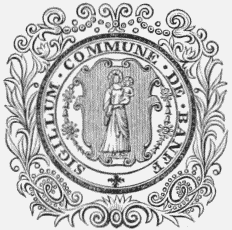
Seal and Arms.
The town consists of two portions, detached from each other, one of which, constituting the port, stands on an elevated level, terminating abruptly towards the Moray Frith, and having the battery at its northern extremity. Between this and the other portion, which is partly on the plain, and partly on the declivity of the bank of the river Doveran, is the present castle, a plain modern building, occupying an elevated site, and commanding the sweep of the river, with the fine slope on the opposite side, surmounted with the woods of Mountcoffer. The streets are regular and spacious, and the houses, though unequal in size, are in general neatly built; most of the older houses have been taken down, and rebuilt in a modern style, and the town retains few indications of its real antiquity. The streets are lighted with gas, by a joint-stock company established in 1831; and the inhabitants are supplied with water, conveyed into the town by pipes laid down in 1810, at an expense of £1100, and by pumps attached to several of the houses. Hot, cold, and shower baths, fitted up with every accommodation, have lately been established, by a company; and in connexion with a literary society founded in 1810, and which has a library of 2000 volumes, is a reading-room, well supplied with newspapers and the most popular periodical prints. An institution for the cultivation of science and the encouragement of native talent, was founded in 1828, and has collected a museum of natural history, antiquities, and curiosities, among which is a very extensive collection of the most beautiful shells found in Java and in the Eastern Archipelago. A room in the town-hall is appropriated, by the magistrates, to the use of the literary society.
A principal trade of the port is the herring-fishery, which, within the last thirty years, has been established on the shores of the Frith, with considerable success, and is still very prosperous. The quantity of fish cured in the district of Banff, which extends from Gardenstown to Portsoy, is, in favourable seasons, about 30,000 barrels, of which one-half is sent to Germany, a considerable quantity to London, and the remainder to Ireland. The number of herring-boats from the port of Banff alone, has fluctuated exceedingly, and is at present very much reduced, probably from the want of room near the harbour, for the erection of the requisite buildings, and from the higher rate of dues; but the general trade of the district is still flourishing. Cod, ling, and turbot are found in abundance, off the coast, and, if prosecuted with spirit, might add greatly to the trade of the port; and lobsters, crabs, shrimps, and other fish are brought to the markets, but only for home consumption, though the bay abounds with shrimps, which might be made a profitable branch of trade. The salmon-fishery in the river Doveran, which is the property of Lord Fife, is let for £1600 per annum, and there is, on each side of the estuary, a fishery in the open sea, of which one is let by the corporation for £191 per annum; the salmon are sent, either packed in ice, or pickled, principally to the London market. A very considerable trade is also carried on in the exportation of grain, live cattle, and cured pork; and in the importation of coal, groceries, and other commodities. During a recent year, 29,790 quarters of oats, 1174 quarters of wheat, 976 quarters of barley and bear, and 194 bags of potatoe-flour, were shipped from the port, chiefly for London and Leith; and 440 head of live cattle, 911 pigs, and 156 sheep and lambs, for the London market alone. The trade in cattle has since greatly increased; and in 1841, not less than 1792 head of cattle were sent to London. The number of vessels registered at Banff, as the head of the district, is sixty-seven, of the aggregate burthen of 4301 tons; of these, ten schooners of 878 tons, and eleven sloops of 657 tons aggregate burthen, belong to this port, and the remainder to the several creeks of Fraserburgh, Gardenstown, Macduff, Portsoy, Port-Gordon, and Garmouth. Several of these vessels make voyages to Sweden, for iron and deals; to Russia, for hemp; and to Holland, for flax; and, in the autumn, frequently to Hamburgh and Stettin, with cargoes of herrings, bringing in return grain, wool, bark, and hides.
The harbour is situated at the western extremity of a circular bay, at the opposite extremity of which are the town and harbour of Macduff; both these extremities are rocky, and between them is a beach of sand. The old or inner harbour, completed in 1775, was formed by two piers and the land, inclosing a triangular area, having at the angle towards the north-north-east, an entrance which, in 1816, was protected by a new pier and breakwater, forming a basin, or outer harbour, to the north of the former. This addition, which was made under the superintendence of the late Mr. Telford, at an expense of £18,000, one-half of which was defrayed by government, though not productive of all the benefit expected from it, as ships have since been wrecked in the new basin, has still materially diminished the swell in the old harbour, now one of the safest in the Moray Frith, and has afforded additional facilities for the entrance and departure of vessels. A vessel drawing 12 feet water can enter the new basin, at highwater of neap tides, and one drawing 15 feet, at spring tides; and vessels drawing respectively 8 and 10½ feet water, may enter the old harbour at high-water of neap and spring tides. A patent slip, on Morton's principle, has been constructed in the harbour. Ship-building is occasionally carried on, and there is a small manufactory for ropes and sails, chiefly for home use; the thread and stocking manufacture, formerly pursued here, has been discontinued for some years. A public brewery, erected on the high ground above the harbour, was once conducted on a large scale, but, of late, has been confined to the supply of the immediate neighbourhood: a distillery at the Mill of Banff, about a mile from the town, produces on an average from 11,000 to 12,000 gallons of proof spirits annually. A foundry for machinery, grates, ploughshares, and various kinds of cast-metal work, was established about fifteen years since, by Messrs. Fraser, and affords employment to ten men; the works are set in motion by a steam-engine of six-horse power, constructed by the proprietors. The market is on Friday, and is well supplied with fish of every kind; there are no cattle-markets, and, though by charter the inhabitants are allowed seven or eight fairs, only four are held, and of these, the Whitsun-fair alone is of any consideration. Coaches pass daily to and from Aberdeen and Elgin, and to and from Peterhead.
From a grant of a toft and garden in the burgh, by William the Lion, in 1165, to his chaplain, Douglas, Bishop of Moray, the town appears to have been previously a royal burgh; and, according to tradition, it received from Malcolm Canmore, those privileges which were ratified by Robert Bruce, and subsequently, in 1372, by Robert II., who also conferred upon the inhabitants liberties equal to those of Aberdeen, which were afterwards confirmed by James VI. and Charles II. The government is vested in a provost, four bailies, a dean of guild, a treasurer, and ten councillors, all elected by the £10 constituency; the corporation revenue is about £1200. The taxes and assessments for the burgh, however, are not imposed as in other burghs, by the magistrates and council, but by the inhabitants themselves, assembled in a special court for that purpose. The affairs of police are under the management of commissioners, who are elected in accordance with the provisions of a particular act of parliament, and by whose authority the police rates are levied and expended. No one could formerly carry on business without becoming a member of the merchant-guildry of Banff, or of the incorporated trades, of which there are six, namely, the hammermen, wrights, shoemakers, tailors, coopers, and weavers, who all claim exclusive privileges. The town is classed with Elgin, Cullen, Inverury, Kintore, and Peterhead, in returning a member to the imperial parliament; and under the Reform act, the constituency includes the qualified voters in the neighbouring, and otherwise independent, burgh of Macduff. The townhall, a spacious but plain building, erected within the last sixty years, occupies two sides of a quadrangle, with a tower at the external angle, of older date, surmounted by a spire of graceful proportion, together 100 feet high; the building is of hewn stone, three stories in height, and contains a hall, two large drawing-rooms, a council-chamber, a court-room for the sheriff's court, offices for the chamberlain and sheriff clerks, and the prisons for the burgh. The old prison contained two apartments, each nineteen feet square, for the reception of civil prisoners; and two cells for criminals; but they were badly arranged, and totally inadequate for the purpose of classification. The new jail, by which the old one has been superseded, is on the best principles.
The parish, which formed part of that of Boyndie till 1634, is about six miles and a half in length, and two miles and a half in breadth in the centre, from which, towards each extremity, it diminishes materially; comprehending about 6312 acres, of which 3778 are good arable land, 1161 uncultivated and in pasture, and about 220 wood. It is bounded on the east by the river Doveran, which has its source on the confines of the counties of Aberdeen and Banff, and falls into the sea at the town; and on the west, by the burn of Boyndie, by which it is separated from the parish of that name. Over the former of these rivers, situated close to the town, is a substantial stone bridge of seven semicircular arches, erected at the expense of government, in 1779; and over the latter, are two stone bridges, of two arches each. The surface is very uneven, rising, in the lower part of the parish, from 200 to 300 feet above the sea, and forming an eminence called the Gallow Hill; and in the upper part of the parish, are eminences of much greater elevation, though less raised above the surface of the adjacent lands. The system of agriculture is improved; and within the last forty years, a large tract of land, previously in pasture, has been brought under tillage. Draining has also been carried on to a very considerable extent, and the greater portion of the land is inclosed with fences of stone; the farm-houses and offices are generally well built, and many of them afford superior accommodations. The rateable annual value of the parish is £12,889, including £6977 for the burgh. The substrata are chiefly clay-slate and greywacke. At Cairn of Ord, in the south-western part of the parish, is found granite, which, in some places, rises to the surface; it is of excellent quality for building, and has been quarried for that purpose, but, on account of its distance from the sea, it has not been worked to any great extent. The scenery is, in several parts, pleasing, and in others romantic and picturesque: the river Doveran, on its first entering the parish, winds into a rocky glen, of which the steep sides, crowned with luxuriant wood, are connected by a circular arch of stone; beyond this point, the glen gradually expands into an open valley, round the eastern side of which the river forms a graceful curve, inclosing the plain on which Duff House is situated. The road from Aberdeen winds round the verge of a verdant hill, on the extremity of which, sloping towards the sea, and stretching into the bay, is the town of Macduff; and on the western side, near the bend of the river, rises a precipitous bank, on the summit of which is seen the mausoleum of the Duff family, embosomed in sheltering woods, and, near it, a funereal urn containing some human bones that were found on the spot, which was formerly the cemetery of the Carmelite monastery. Duff House, the splendid residence of the Earl of Fife, occupies the grounds formerly belonging to the monastery, which were, in 1630, conveyed to Lord Airlie, and, in 1690, to Lord Fife, who, in 1752, purchased the superiority, which had been granted by James VI. to King's College, Aberdeen. The mansion was erected about the middle of the last century, by Lord Braco, after a design by Adams, the first architect of that name, at an expense of £70,000; it is a spacious quadrilateral structure of freestone, in the Roman style of architecture, and contains a choice collection of paintings of the Flemish and Italian schools, and numerous portraits by the most eminent masters. The demesne is richly planted, and comprehends much interesting scenery; and, from many points, commands extensive and varied prospects.
The parish is ecclesiastically in the presbytery of Fordyce and synod of Aberdeen; the minister's stipend is £245. 19. 9., with a manse, and the glebe is valued at £45; patron, the Earl of Seafield. The church, situated on the south side of the town, is a plain structure, erected in 1790, and is capable of containing 1500 persons; the interior is chastely decorated, and has some handsome monuments of marble, one of which, by Bacon, representing a soldier weeping over a funereal vase, is finely executed, and was erected by Sir David Ochterlony, and the army under his command, to the memory of Lieut.-Col. Lawtie, a native of this place. A chapel in connexion with the Established Church, for a district including the more remote portion of the parish and others adjoining, and a manse, have recently been erected, at the upper end of the parish, at an expense of £600; the stipend of the minister is derived from the seat-rents, augmented with £20 Royal bounty. There are places of worship for members of the Free Church, Episcopalians, members of the United Secession, Independents, and Wesleyans, and a Roman Catholic chapel. A grammar school was founded in 1786, under the direction of Dr. Chapman, formerly rector of the grammar school of Dumfries; the number of boys usually attending is about 170, and the rector, who is obliged to employ two qualified assistants, has a considerable salary from the funds of the town. This school is endowed with funds, the interest of which is regularly appropriated to the maintenance of sixteen bursaries; one, in the gift of the presbytery of Fordyce, is worth about £30, and the others are from £2 to £3 per annum. A free school was founded by Mr. Alexander Pirie, who, in 1804, bequeathed to the town-council and kirk-session £1100 for that purpose, with a tenement, and £100 for the erection of a school-house and house for the master. Mr. George Smith, a native of Fordyce, by will dated at Bombay, in 1769, vested in the magistrates of Banff, the residue of his estate, amounting to £10,297. 16. 6., of which he appropriated £1000 to the endowment of an infirmary in this town or at Fordyce, and £40 per annum to a school-master, to educate as many boys of the name of Smith as the funds would maintain, at £25 per annum each; the dividends, amounting to £308. 18. 8., are applied according to the will, and nine boys are maintained and educated. Mr. James Wilson, of Grenada, vested the whole of his stock, after the decease of certain annuitants, in the magistrates of Banff, to be appropriated to charitable purposes, according to their discretion; this estate, which ultimately produced £3561. 16. 1. three per cents, and £2647 in cash, was appropriated to the erection of an infant school, a free school on the Madras system, and class-rooms for the grammar school teachers, with a library and museum. Mr. Alexander Cassy, a native of the town, then resident in Pentonville, in 1819, bequeathed the residue of his estates to the magistrates, to be appropriated to the half-yearly relief of aged and infirm persons and helpless orphans; of this property, £10,000 three per cents have already fallen into the disposal of the trustees, who apply the dividends. Miss Elizabeth Wilson, in 1825, bequeathed to trustees the whole property of which she should die possessed, the produce to be appropriated to six poor tradesmen and six poor maidens; the annuitants receive from £9 to £10 each per annum. Alexander Chalmers, Esq., of Cluny, in 1834, bequeathed property which will amount to £40,000, in trust, to the lord-lieutenant and member for the county, the minister and magistrates of Banff, and others, for the erection and endowment of an hospital and dispensary, to be called Chalmers' Hospital, for the county of Banff; the hospital to be erected on the site of the residence of the founder.
Scarcely any vestiges of the ancient Carmelite monastery are remaining; some arches, apparently parts of cells, are still to be traced in the yard of the inn called the Royal Oak, and near the foundry is a vaulted chamber, now occupied by the boiler of the steam-engine belonging to that establishment. A portion of the building occupied by Sir George Ogilvy, afterwards Lord Banff, and which appears to have been regarded as a palace, from the occasional visits to it by the Scottish kings, was destroyed, in 1640, by General Monroe, who, having marched into the town, encamped in the gardens of that house, which he totally destroyed, carrying away the timber and iron-work, and leaving only the shattered walls, a heap of ruins. That part of the town which is called the Sea-town, is supposed to occupy the lands of the chapel of the Holy Rood; and another chapel, dedicated to St. Thomas, is thought to have stood somewhere between the site of the parish church and St. Andrew's chapel. The Knights Templars anciently had a preceptory in the town; their possessions were erected into a lordship, in favour of Sir John Sandilands, in 1563, and several small and scattered portions of their lands appear to have passed into burgage tenures. The old castle of Inchdrewer, erected about the time of James IV. or V., is still so entire as to be habitable, and is now in the occupation of a tenant; it is chiefly memorable for the death of a lord of Banff, who was burnt in it in 1713, under circumstances that have never been fully explained. Adjoining the mausoleum of Lord Fife, is an ancient monument, on which is the recumbent figure of an armed warrior, with the inscription, "Hic Jacet Johannes Duff, de Maldavat, et Baldavi; obiit, 2 Julii, 1404:" this monument, with the ashes of the deceased, was brought from Cullen. James Sharp, Archbishop of St. Andrew's, who was waylaid and assassinated, was born at Banff Castle, in 1613.
Banffshire
BANFFSHIRE, a maritime county, in the north-east part of Scotland, bounded on the north by the Moray Frith; on the east and south-east, by Aberdeenshire; and on the west, by the counties of Moray and Inverness. It lies between 57° 5' and 57° 43' (N. lat.) and 2° 17' and 3° 37' (W. long.), and is about fifty miles in length, and varying from twenty miles to three miles in breadth; it comprises an area of about 647 square miles, or 414,080 acres, and contains 11,149 inhabited houses, and a population of 49,679, of whom 23,249 are males, and 26,430 females. This county, which includes the districts of Boyne, Enzie, Strath-Doveran, Strathaven, Balvenie, and part of Buchan, was a sheriffdom in the reign of David I., and, previously to the Reformation, was included in the diocese of Moray; it is now partly in the synod of Moray, and partly in that of Aberdeen, and comprises several presbyteries, and twenty-four parishes. It contains the royal burghs of Banff and Cullen, of which the former is the county town, and several thriving and populous villages, whereof the chief are, Keith, Newmill, Gardenstown, Dufftown, Buckie, Portsoy, and Macduff: under the act of the 2nd of William IV., the county returns one member to the imperial parliament.
The surface is beautifully diversified with mountains and vales, and the scenery enriched with woods and plantations, and enlivened with rivers and lakes. The principal mountains are, the Cairngorm, which has an elevation of more than 4000 feet above the sea; Benmackdhuie; Belrinnes, rising from the river Spey to the height of 2747 feet; Knockhill, near the north termination of the Grampian range, the Buck of Cabrach, and others, about 2500 feet high. The chief vales are, those of Strath-Doveran and Strathaven, the former branching off to the right, and the latter to the left, from the forest of Glenavon; Glen-Livet; and Glen-Fiddich, which last extends to the strath of Balvenie. The rivers are, the Spey, which has its source in Loch Spey, and, after a long course, falls into the Moray Frith near Fochabers; the Doveran, which rises in the hills of Cabrach; the Avon; the Livet; and the Isla; with countless smaller streams, which turn numerous mills. The salmon-fisheries on the Spey and Doveran are extensive, the former yielding a rental of £6000, and the latter of £2000 per annum. The coast, which extends for nearly thirty miles, is bold and rocky, and, in some parts, precipitous; and is much indented with small bays.
The soil, near the sea, is rich; in the valleys, luxuriantly fertile; and in the mountainous districts, affords tolerable pasturage; the moors abound with game. Nearly one-half of the land is under cultivation; the system of agriculture is in a highly improved state, and much waste has been inclosed and rendered profitable. The rateable annual value of the county is £116,968. The natural woods and plantations are extensive and well managed, and there are numerous oaks and firs of extraordinary dimensions; the chief minerals are ironstone and lead-ore, and there are some fine quarries of limestone, freestone, gneiss, and granite. The best seats are, Gordon Castle, Glenfiddich, Duff House, Rothiemay, Banff Castle, Balvenie Castle, Cullen House, Birkenbog, Forglen, Troup, Arndilly, Baldorney, Edingarth, and Kinnairdy. The principal manufacture is that of linen; there are several tanneries, some distilleries, and other works in connexion with the shipping, which is confined chiefly to the ports of Banff, Macduff, Portsoy, and Gardenstown. The herring-fishery is also very extensive, and is prosecuted along the coasts with great industry and success. Facility of intercourse has been greatly promoted by many excellent roads, constructed by commissioners appointed under an act of parliament; and the bridges over the different streams are kept in good order. There are numerous cairns, tumuli, ruins of ancient castles, and other monuments of antiquity, all noticed in the respective articles on the localities in which they are situated.
Bankend
BANKEND, a village, in the parish of Caerlaverock, county of Dumfries, ½ a mile (S.) from Caerlaverock; containing 189 inhabitants. It lies in the eastern portion of the parish, and on the west side of the river Locher, which separates it from the parish of Ruthwell.
Bankfoot
BANKFOOT, a village, in the parish of Auchtergaven, county of perth; containing 760 inhabitants. This village, which takes its name from its situation at the base of an elevated ridge, on the road from Perth to Dunkeld, is of very recent origin, having been wholly built on lands leased for that purpose, by Mr. Wylie. The houses are neatly built, and chiefly inhabited by persons employed in weaving for the manufacturers of the neighbouring towns, and in various trades. A daily post has been established, which forwards letters to Perth; and facility of intercourse is maintained by good roads, kept in repair by statute labour. There is a considerable trade in coal, for the supply of the parts of the parish adjacent. A subscription library was opened in 1822, under the direction of a committee of subscribers; the collection consists of about 300 volumes, on theological, historical, and literary subjects. There are places of worship for members of the United Secession and the Relief Synod.
Bankhead
BANKHEAD, lately a quoad sacra district, in the parish of Midmar, district of Kincardine O'Neil, county of Aberdeen, 4 miles from Leggerdale. It is about a mile north of the road from Aberdeen to Tarland, and two miles south of that to Alford; the soil of the district is generally light, and far from being productive. The population is chiefly engaged in agriculture; and the females employ themselves, to a large extent, in stocking-weaving. The ecclesiastical affairs are under the superintendence of the synod of Aberdeen and presbytery of Kincardine O'Neil, and the election of the minister is vested in the communicants. The church is a plain substantial building, erected in 1832, by subscription of the members and others, and is seated for 300 persons; it stands in the north-western part of the parish of Midmar, adjoining the parishes of Kincardine O'Neil and Cluny. In the vicinity are a few Druidical remains and Pictish encampments, but none of them are of sufficient importance to require a particular description.
Bankhead
BANKHEAD, a hamlet, in the parish of Monikie, county of Forfar, 4 miles (W. by N.) from Monikie; containing 56 inhabitants.
Bankton-Park
BANKTON-PARK, a village, in the parish of Kettle, district of Cupar, county of Fife, ½ a mile (S.) from Kettle; containing 136 inhabitants. It is pleasantly situated on the road from Cupar to Leslie, and consists of neat houses of modern erection.
Bannockburn
BANNOCKBURN, lately a quoad sacra parish, including the village of Bannockburn, in the parish of St. Ninian's, county of Stirling; containing 3176 inhabitants, of whom 2206 are in the village, 2 miles (S. S. E.) from Stirling, on the road to Falkirk. Most of the inhabitants are employed in manufacturing tartans, shawls, and carpets, and here are very extensive coalworks, producing a material of the best quality, which is sent in large quantities to most of the surrounding districts; there is also a tan-work for preparing foreign skins, as well as those from the country around. A post-office is established under Stirling, and fairs are held in June and October. The small river Bannock, running on the western border, gives name to this place, which is celebrated in history as the scene of the decisive battle between Robert Bruce and Edward II., when the Scots obtained a signal victory, Edward and the English being completely routed; and about a mile from the village, on the 11th of June, 1488, was fought the field of Stirling, or battle of Sauchie, between James III. and the confederate lords, wherein that monarch lost the field and his life. A church, containing 900 sittings, was opened in October 1838; there is also a place of worship for members of the United Secession.
Banton
BANTON, lately a quoad sacra parish, forming part of the parish of Kilsyth, in the county of Stirling; containing 964 inhabitants, of whom 130 are in the village of Banton, 3 miles (N. E.) from Kilsyth. This district, which includes the village of Auchinmully, and is five miles long, is situated in the east barony of the parish, and is inhabited principally by colliers and miners, employed at the neighbouring works. A church has been erected, with accommodation for above 400 persons, by subscription and a grant from the General Assembly's Church Extension Committee; and a school and master's house, erected in 1771, have been rebuilt on an improved plan, at an expense of £320, wholly defrayed by voluntary contributions. There is also a subscription library, opened in 1835, and which contains about 200 volumes.
Bara
BARA, Haddington.—See Garvald.
Barachnie
BARACHNIE, a village, in the parish of Old Monkland, forming part of the late quoad sacra parish of Crosshill, Middle ward of the county of Lanark, 3½ miles (E.) from Glasgow; containing 235 inhabitants. This place is situated on the road from Glasgow to Airdrie, a short distance from Bailiestone Toll, and on the borders of Barony parish. In the vicinity are extensive coal-works.
Barbaraville
BARBARAVILLE, a village, in the parish of Kilmuir Easter, county of Ross and Cromarty; containing 173 inhabitants.
Barbaswalls
BARBASWALLS, a hamlet, in the parish of Ruthven, county of Forfar; containing 36 inhabitants. It is situated on the borders of Airlie parish, a little to the south of the road between Blairgowrie and Kirriemuir; and the river Isla flows eastward of the hamlet.
Barhill
BARHILL, a small hamlet, in the parish of Colmonell, district of Carrick, county of Ayr, 12 miles (S. S. E.) from Girvan. This place, which is of very recent origin, is situated on the river Dhuisk, and on the road from Girvan to Newton-Stewart; cattle-markets are held on the fourth Friday in April, September, and October (O. S.), and are attended by numerous dealers from the adjoining districts.
Barjarg
BARJARG, a hamlet, in the parish of Keir, county of Dumfries; containing 58 inhabitants. It lies near the river Nith, on the east side of the parish, about two miles and a half south from the village church, and on the road between Penport and Dumfries.
Barleyside
BARLEYSIDE, a village, in the parish of Falkirk, county of Stirling, 3 miles (S. by W.) from Falkirk; containing 92 inhabitants. It is situated near the western boundary of the parish of Polmont.
Barn-Yards
BARN-YARDS, a village, in the parish of Kilconquhar, district of St. Andrew's, county of Fife; containing 232 inhabitants. It adjoins the village of Kilconquhar, which lies to the north of Elie, and of which, although it retains a separate name, it may now be said to form a part.
Barnhill
BARNHILL, a hamlet, in the parish of Monifieth, county of Forfar; containing 41 inhabitants. It lies a little south of the high road between Dundee and Arbroath.
Barnhill
BARNHILL, a village, in the parish of Blantyre, Middle ward of the county of Lanark, ½ a mile (N.) from Blantyre; containing 165 inhabitants. It is near the eastern boundary of Cambuslang parish.
Barnweill
BARNWEILL, county of Ayr.—See Craigie.
Barony
BARONY, county of Lanark.—See Glasgow.
Barr
BARR, a parish, in the district of Carrick, county of Ayr, 8 miles (E. S. E.) from Girvan; containing 959 inhabitants, of whom about 230 are in the village. This place is supposed to have derived its name from the almost inaccessible site of the ancient village, surrounded on all sides by rugged hills of precipitous elevation, and only to be approached by a narrow wild glen, frequently impassable from the swelling of a small stream which intersects it, and which, in winter, attains the violence of a torrent. The parish, which formed a natural barrier between the counties of Ayr and Galloway, was included in the parishes of Girvan and Dailly till the year 1653, when it was erected into a parish of itself; it comprises nearly 70,000 acres, of which only 1200 are arable, and not more than 1000 capable of being rendered profitable. The surface is mostly an extensive level, with various ridges of different elevation, two of which rise from the banks of the river Stinchar, to the height of nearly 1200 feet; and a third, in a direction nearly parallel to these, on the south-east, is about 1400 feet above the sea. Another range, forming part of that chain of mountainous heights stretching from Ayrshire into Galloway, has an elevation of nearly 2700 feet. The chief rivers are, the Stinchar, which has its source in this parish, and, taking a south-westerly course, falls into the sea at Ballantrae; and the Minnoch, which, rising in the highest ridge of hills, flows southward through the lands, and falls into the river Cree, which separates this parish from the county of Galloway. The Stinchar, in its course of nearly fifteen miles through the parish, forms a beautiful cascade of about thirty feet; and most of the smaller burns with which the parish abounds, in their several courses, fall from heights, with various degrees of beauty. There are numerous lakes of different extent, varying in depth from six to fifteen feet, all of which afford trout of a dark colour, and also yellow trout; the scenery is dreary, from the want of wood, of which there is scarcely any in the parish.
The soil, in the lower lands, is of very fair quality, and in the high lands principally moss; the chief crops are, grain of all kinds, and potatoes. Surface-draining has been extensively practised, and the grounds are partially inclosed, but improvement in the system of husbandry, from the want of good roads and facilities of drawing lime, is greatly retarded. Attention is paid to the management of the dairy, and a moderate number of milch cows, mostly of the Ayrshire breed, have been introduced; but the main dependence of the farmer is on the rearing of cattle and sheep, for which the hills provide tolerable pasturage. The rateable annual value of the parish is £7578. The few trees indigenous to the soil, are ash and alder; and the plantations, which are on a very limited scale, are larch, interspersed with oak and ash, which seem to thrive well. The substrata are chiefly conglomerate rock, which appears in very irregular masses, and limestone of good quality, which is slightly wrought; in that portion of it that lies near the bed of the river, some fine specimens of fossil shells are found. Slate-quarries have been also opened, but have not been wrought to any extent. The village, which is neatly built, has a post-office, established under Girvan; and fairs are held annually, but very little business is transacted, and, from the want of good roads, little facility of intercourse is afforded with the surrounding district. The parish is in the presbytery of Ayr and synod of Glasgow and Ayr, and patronage of the Crown; the minister's stipend is £231. 3. 1., with a manse, and a glebe valued at £18 per annum. The church, an ancient edifice, is in good repair, and had a gallery added in 1834; it is adapted for a congregation of 410 persons. A place of worship has been erected in connexion with the Free Church. The parochial school is well conducted; the master's salary is £34. 4. 4½., with £18 fees, and a house and garden. A parochial library has been established, which has a collection of nearly 200 volumes. There are some remains of a chapel called Kirk Dominæ, and on the rising ground near its site, is a well, to which is an approach through an ancient and well-built archway. This chapel was in tolerable preservation till the year 1653, when the roof was taken off, and placed on the parish church. Viscount Stair, well known as ambassador of George II., at the court of France, in 1720, was born in the parish.
Barra
BARRA, a parish and island, in the county of Inverness; including the islands of Bernera, Fladda, Fuday, Helesay, Mingala, Pabba, Sandra, and Watersay; and containing 2363 inhabitants, of whom 1977 are in the island of Barra. The word Barra is supposed by some to be formed of Bar, a point or top, and Ay or I, an island, and to have been applied to this place in reference to its position in the great group to which it belongs, it being the most southerly or head of the larger islands among the Hebrides. But its etymology is more generally traced to St. Barr, the tutelary saint to whom the principal place of worship, called Killbar, was dedicated, and whose reputation was here so great, that his anniversary has been celebrated for ages, on the 25th of September, and is still regularly observed with morning ceremonies at the chapel, and afternoon festivities at Killbar, by the inhabitants, most of whom are Roman Catholics. The island of Barra, and the islands surrounding it, have been from time immemorial the property of the Macneils, who are said to have been in possession of them before the Danish invasion, and to have been the first of that name who came from Ireland. This family, by their great power, and particularly their skill in maritime affairs, gave great annoyance to all their neighbours, carrying their depredations into every part of the Western Islands; and one of them, called Resary an Tartair, or "the noisy or troublesome Roderick," signalized himself especially by his piracies, but was at length captured for an attack on one of Queen Elizabeth's ships; great skill and ingenuity, in consequence of a reward offered, having been employed to effect his apprehension. The seat of the family was Kismull Castle, still in good preservation, situated in the centre of a bay, and on a small rock which is covered at high water; the structure is of irregular figure, about sixty feet high, with a square tower at one corner, the whole strongly built, and surrounded by spots for the anchorage of small vessels. It was the residence of the lairds of Barra till the beginning of the last century, about which time it ceased to be inhabited.
The parish consists of more than twenty islands, about half of them uninhabited, and serving only as grazing stations, and was disjoined from that of South Uist in 1733. It is situated at the south-western extremity of the Hebrides, and measures in length, from Scirrival, the most northerly point of the main island, to Bernera, the most southerly island, about twenty-eight miles, including the several intervening channels; and comprises about 22,000 acres, of which 3922 are under cultivation, 1540 sandy waste, 16,139 hill pasture, and the remainder moss. The currents run with great rapidity and violence through the channels, of which that on the north is six miles across, separating Barra from South Uist. On the east, are the islands of Canna and Rum, distant twenty-six miles; those of Coll and Tiree, on the south, are thirty miles off, and on the west is the Atlantic Ocean, which, at the blowing of the south-west wind, rolls its waves with such impetuosity and fury, that they not only drive large quantities of sand over the islands, but render intercourse between them quite impossible. The shore is indented with numerous fissures and creeks, and pierced with many arms of the sea, and on the west, with the exception of two or three sandy inlets and bays, is thickly set with rocks, a huge barrier of which, broken in several parts into frightful chasms by the constant action of the sea, rises majestically against its tremendous waves, and supplies a powerful rampart to check its fury. On the east, the coast is in general rocky, with some intervening portions of heath, moss, and sand; and in this part are the principal bays, which form excellent and safe harbours, and among which are those of Bayhierava, Uilevay, Castlebay, Watersaybay, Fladda Sound, and Ottirvore. The chief headland is Barra Head, on the island of Bernera, where a very superior lighthouse has lately been erected. This island, and the contiguous one of Mingala, are particularly distinguished for the height of their rocks, and for their grand and romantic scenery, heightened in its effect by the numberless sea-fowl that frequent them throughout the summer. Barra, the largest island, is about twelve miles long, and from three to six miles broad, and is broken, especially on the eastern side, by many bays and arms of the sea. It has a rocky barren aspect at a distance, but, upon a nearer approach, its appearance is more interesting, and its lower grounds, containing some rich meadows and fertile valleys, contrast well with its lofty hills, covered to the summits with verdant pasture. There are many springs of good fresh water, and four fresh-water lakes, abounding in black trout and eels, and varying in length from half a mile to a mile.
The soil comprises light black, and sandy earth, moss, and meadow; and the crops, consisting of barley, oats, and potatoes, grown merely for home consumption, ripen very early on the sandy soils, of which much exists in the parish: agriculture here takes its prevailing character from that of the population, and is unformed and rugged, and the district is more suited to grazing than tillage. The lands are let principally to small tenants; the habitations, in general, are of the very lowest description, as well as the resources, and manner of life of the tenants. The cattle are of a good quality, and a new and improved breed of sheep has been recently introduced; the horses are small, but hardy and well shaped, and are kept in great numbers, being found useful for transporting sea-weed for manure, and for the preparation of kelp. The rateable annual value of the parish is £2470. The rocks consist chiefly of coarse granite; but in the island of Bernera, a quarry of this stone, of a very superior kind, has been discovered, of which the lighthouse was built. The only mansion is the house of Barra, at Eoligary, which is a commodious residence, well sheltered, and surrounded by good fields. It was built by the late proprietor, who transplanted some trees, of which the parish is remarkably bare, to the grounds of his mansion; but, though they had thriven tolerably well in their former situation, they soon pined away after their removal. A few of the inhabitants are engaged in fishing, and four vessels used for this purpose belong to the place; but the poverty of the people operates not only to straiten their agricultural efforts, and to keep the capabilities of the soil, to a great extent, in abeyance, but also to confine their fishing within very narrow limits, although Barra is one of the best stations on the west coast. Besides lobsters, crabs, whelks, limpets, mussels, and cockles, the quantity of which last is very great, and often supplies a principal article of food, the neighbouring seas abound with ling, cod, tusk, hake, turbot, and flounders; and immense shoals of herrings also come up, which the inhabitants are unable to take for want of suitable tackle. About twenty or thirty boats are sometimes employed, with five men in each, and if successful, and the weather permits, they carry the ling and cod to Glasgow and Greenock in their own boats. Many cearbans, or sail-fish, were formerly taken by means of the harpoon, and large quantities of oil extracted, but this branch has now failed, through the inability of the fishermen to provide the necessary tackle.
The parish is in the presbytery of Uist and synod of Glenelg, and in the patronage of the Crown; the minister's stipend is £165. 10. 5., of which a portion is received from the exchequer, with a manse, and a glebe valued at £17. 10. per annum. The church is a plain structure, built a few years since, and conveniently situated in the centre of the parish, about six miles from each extremity of the main island. There is a Roman Catholic chapel. The parochial school affords instruction in English and writing, though the master is qualified to teach the classics, book-keeping, and geography; he has a salary of £26: the school has been only lately opened, and education is at present quite in its infancy, the inhabitants being mostly unable to read or write. The poor enjoy the benefit of a bequest of £400, left by two persons, natives of the parish. At Killbar, are several ruins of ancient chapels dedicated to St. Barr, some of which have an altar of rough stones at one end, and the pedestal of a cross at a short distance: a wooden figure of the saint was formerly fixed up for the adoration of the people, and was dressed in superior attire, on the celebration of the anniversary. Watch-towers are seen in every direction; and each lake has a "dun," supposed to be of Scandinavian origin, as well as those circles usually called Druidical remains. A few years since, a gold medal was found, in digging the clergyman's garden, about the size of a half-crown piece, cast for the coronation of Augustus II., king of Poland, and which is said to have belonged to some passenger on board of a Dutch ship wrecked here in the early part of the last century.
Barrel-Of-Butter
BARREL-OF-BUTTER, an islet, in the parish of Orphir, county of Orkney. It is one of the smallest of the Orkneys, and is situated to the south of the island of Pomona, in Scalpa Flow, a large expanse of water resembling a small Mediterranean Sea. Here was formerly a seal-fishery, for which the neighbouring farmer paid the proprietor a barrel of oil yearly, until the frequency of shipping scared the animals from the isle, when the proprietor, determined not to lose his rent, converted the tack-duty into a barrel of butter, which is still paid by the tenant; and hence the isle derives its present name, the ancient one being Carlin-Skerry.
Barrhead
BARRHEAD, lately a quoad sacra parish, including the villages of Cross-Arthurlee, Grahamstown, Newton Ralston, and Barrhead, in the parish of Neilston, Upperward of the county of Renfrew, 4 miles (S. by E.) from Paisley; the whole containing 5337 inhabitants. This place is situated on the stream of the Levern, on which are a number of fine waterfalls that have contributed much to the manufactures of the district, consisting of cotton spinning and weaving, and printing, bleaching, and dyeing, all extensively carried on, principally for the Glasgow and Paisley markets. Coal is abundant, and three mines are at present in operation. A fair is held, chiefly for pleasure, on the last Friday in June, when a horse-race also takes place. The village, situated on the road from Glasgow to Irvine, is of considerable size, and, for the most part, inhabited by persons engaged in the various works; it has a postoffice, with a daily delivery. The parish is in the presbytery of Paisley and synod of Glasgow and Ayr: the church, a neat structure, was built by subscription, in 1839; the minister is elected by the male communicants. There is a good school, of which the teacher has a room rent-free, and affords instruction to a considerable number of the children of the place; also a mechanics' subscription library.
Barrie
BARRIE, a parish, in the county of Forfar, including the late quoad sacra district of Carnoustie, and containing 2124 inhabitants, of whom 217 are in the village, 9 miles (E. N. E.) from Dundee. This parish is situated at the southern extremity of the county, on the shore of the German Ocean, and at the mouth of the Frith of Tay, measuring about four miles from north to south, and above three from east to west. In the latter direction it is intersected, throughout its whole extent, by a high verdant bank, supposed to have once formed a steep shore of the ocean, and separating the locality into two grand divisions totally dissimilar in character. That on the north is of a good soil, and elevated about fifty feet above the southern portion, from which it has the appearance of an extensive and regularly constructed terrace; while the lower division is sandy and sterile, affording in general but a scanty pasture for a few sheep and cattle, with small patches of arable land, producing, in moist seasons, moderate crops of grain. The whole comprises about 4000 acres, half being in the sandy, and half in the cultivated, portion. The soil in the upper part has the several varieties of light loam, good gravel, and a deep black earth; and, under the skilful application of the most approved usages of husbandry, crops are obtained of wheat, barley, oats, peas, turnips, flax, clover, and potatoes, nearly equal to those grown in more favoured districts. Of the part never yet cultivated, covering nearly 2000 acres, very little is serviceable on account of the light and sandy nature of the soil, except for occasional pastures. The rateable annual value of the parish is £4052. The larger part of the population, both male and female, are engaged in the manufacture of brown and white linen, for the Dundee and Arbroath houses; a vitriol-work, employing four or five hands, was erected a few years since, and there are five stations for the fishing of salmon, belonging to three different proprietors. A turnpike-road from Dundee to Aberdeen, and the rail-road between the former place and Arbroath, pass through the parish; and to the two latter towns, the produce is usually sent for sale. The parish is in the presbytery of Arbroath and synod of Angus and Mearns, and in the patronage of the Crown; the minister's stipend is £143. 12. 11., with a manse, and a glebe of five acres, valued at £5. 10. per annum. The church, situated in the centre of the parish, is a plain structure, altered and enlarged in the year 1818. A place of worship has been erected in connexion with the Free Church. The parochial school affords instruction in the usual branches; the master has a salary of £29. 18. 9., with £30 fees. Till lately there were tumuli on the eastern limit of the parish; and in the same vicinity, near Carnoustie, were the vestiges of a camp, where, it is said, the Danes were defeated under Camus, by the Scots headed by Malcolm II.
Barvas
BARVAS, a parish, in the island of Lewis, county of Ross and Cromarty, 10 miles (N. W. by N.) from Stornoway; containing, with the late quoad sacra district of Cross, 3850 inhabitants. The name of this place, like that of many others in the neighbourhood, is supposed to be of Norwegian derivation; but its signification is altogether unknown. From the memorials which still remain, the Danes appear to have had some connexion with the district: a fort, now in ruins, evidently of Danish construction, stands on the border of a loch south of Bragar, and three buildings of the same description are to be seen between Shadir and Borve, each of them, by its peculiar form, locality, and appendages, indicating the scene of the military operations of that people. On a plain of moss between Barvas and Shadir, stands an immense stone, eighteen feet high, and almost as much in girth, supposed to have been raised as a triumphal memorial of the slaughter of some cruel and reckless tyrant of the Danish nation; and the ruins of several old chapels and burying-grounds still remain, showing the subsequent occupation of the soil by religious teachers. These chapels were dedicated to St. Bridget in Borve, St. Peter in Lower Shadir, St. Mary in Barvas, and St. John in Bragar.
The parish, which is remotely situated, in the northern extremity of the island of Lewis, is about twenty-two miles long, and seven broad, and contains 16,103 acres, of which number 1468 are in tillage, 489 the best kind of pasture, and 14,146 pasture of an inferior kind; it is bounded on the north-west by the Atlantic Ocean. The coast, which comprises a length of about fourteen miles, is rugged, and in many parts bold and rocky, and is beaten by a violent surf when the wind blows from the west or north-west. The surface of the ground in the interior is diversified by gentle elevations, except in one or two instances, where it is broken by a deep glen traversed by rivulets, or occupied by a sweeping moor covered with red mountain deer. There are five rivers, the Glen, Borve, Shadir, Arnal, and Torra, which generally rise from springs or lochs, six or seven miles up the country, and empty themselves into the ocean. The climate is surcharged with vapour and fog, and subject to violent storms and rains; the striking phenomenon of the Aurora Borealis is frequently seen, in all its splendour and majesty. The soil of the cultivated land, which chiefly lies along the sea-shore, is black earth, often largely mixed with gravel or sand, but, as the main part of the parish is moor, the soil is mostly mossy. The arable portion is overspread with quantities of stones, which, together with exposure to winds from the sea, without hill or mountain to protect behind, supply formidable impediments to the labour of the farmer, and sometimes destroy his crops altogether. The rental is small; no produce is exported, the whole being used in home consumption, and but few improvements have been made in agriculture, chiefly from the shortness of the leases, and the poverty of the people, who, in seasons of scarcity, are compelled to live upon whelks, limpets, and crabs, the only shell-fish to be found. About 2500 head of black-cattle are reared, which are fed in winter chiefly on sea-weed; and the sheep amount to upwards of 7000, and are all of small stature, as are the horses, which, however, are compact, active, and mettlesome, and well suited to their ordinary work of carrying the sea-weed in double-baskets, over difficult and rocky grounds. The subsoil is a stiff hard clay, which, in some parts, is covered with large banks of sand, twenty feet high, driven inward from the shore by the continued action of westerly winds. The rateable annual value of the parish is £1942.
The inhabitants live in numerous villages on the coast, almost entirely in an insulated state, having very little communication with others; there are two roads, one running along the coast, and another to Stornoway, the only mart in the island. The parish contains four small bays, into which boats sometimes enter; but the violence of the wind prevents the anchorage of any vessel. Salmon-fishing has been carried on for some years, with considerable success, near the mouths of the rivers; but the nature of the coast rendering other fishing impracticable, the people are generally little inclined to make the employment a steady pursuit. The ecclesiastical affairs are subject to the presbytery of Lewis and synod of Glenelg; the minister has a manse, a glebe worth about £20 per annum, and a stipend of £158. 6. 8., partly paid from the exchequer; the patronage belongs to the Crown. The church, built nearly sixty years since, is a long narrow building, and contains 300 sittings, all free. There is a parochial school, in which the classics and the common branches of education are taught, and the master of which has a salary of £28; and two other schools are supported by the Edinburgh Gaelic School Society. The parish contains several chalybeate springs, but none of any note.
Bass, Isle
BASS, ISLE, in the parish of North Berwick, county of Haddington. It is situated in the Frith of Forth, above a mile distant from the south shore, and is of stupendous height, inaccessible on all sides, except by one narrow passage. On the summit is a spring, sufficient to provide water for the garrison of a small castle; there is also pasturage for a few sheep, and a warren. This island was an ancient possession of the family of Lawder, and was purchased, in 1671, by Charles II., during whose reign, and that of James II., it was made a state prison, where the Cameronians, or Western people, were confined for being in arms against the sovereign. A cavern runs through the rock from north-west to south-east, in the centre of which is a deep pool of water. St. Baldred, the apostle of East Lothian, in the sixth century, is generally supposed to have made the isle his place of seclusion.—See Berwick, North.
Bathan's, Abbey St.
BATHAN'S, ABBEY ST., a parish, in the county of Berwick, 7 miles (N. by W.) from Dunse; containing 146 inhabitants. The name of this place has been successively written St. Boythan's, Bothan's, and Bathan's, which last form it has preserved since the earlier part of the last century. The word Abbey, it is supposed, was prefixed to distinguish it from the parish of Gifford or Yester, in East Lothian, which was also called St. Bothan's, but had no convent; the name Bathan was derived from the patron saint, who laboured here in the early part of the 7th century, and to whom the first church was dedicated. Near this church, which was destroyed more than once by fire, during the incursions of the Danes, a convent of Cistercian nuns was founded between the years 1184 and 1200, with the title of priory, by Ada, daughter to King William the Lion, and wife to Patrick, Earl of Dunbar. This institution, by the liberal benefactions of the foundress and her husband, and various other persons, acquired considerable estates, in addition to the patronage of the church, by which the nuns were enabled, through the appointment of a vicar, to appropriate to themselves the revenues of the living. A chapel was also founded in the parish, about a quarter of a mile from the nunnery, on the same side of the river Whiteadder, the foundations of which lately existed. At Strafontane, too, which is now part of the parish, but was anciently distinct, an hospital was founded in the reign of David I., which, at one time, was dependent on the abbey of Alnwick, but was transferred, in 1437, by the abbot of that place, to the monastery of Dryburgh, and came afterwards into the possession of the collegiate church of Dunglass, and was ultimately converted into a church.
The mean length of the parish, from east to west, is about 3¼ miles, and its breadth 2½ it contains about 5000 acres, of which 2600 are hilly pasture never cultivated, 100 wood, and 2300 arable. It is situated among the Lammermoor hills, and the surface consequently consists of hills and slopes, the former of which are, for the most part, covered with heath, and rise to various elevations, of between 300 and 400 feet above the intervening vales, and then spread out into extensive flats. The level grounds on the banks of the streams which receive the drainage of the hills, are in general fertile, as well as many of the slopes, but the upper lands are altogether barren. The Whiteadder is the only river; after a course of about 12 miles, in which it is joined by the Dye and many smaller streams, it assumes, in its passage through the parish, a beautiful meandering form, and receives, besides many rivulets, the tributaries of the Monynut and the Ware, which extend its width to about eighty feet. A bridge constructed of wood, and raised upon stone piers, has very recently been erected across the river, on the tension-bar principle, and is much and deservedly admired for its simplicity and elegance. The soil is equal, if not superior, to any part of the Lammermoor, but is in some parts of meagre impoverished quality, and much better suited to the pasturage of sheep and cattle than the growth of corn; the produce principally comprises oats, barley, potatoes, and turnips. The sheep are the Cheviots, mixed with a few of the black-faced, and the ewes of each of these are, in many cases, crossed with the Leicesters; considerable improvements have recently been made in husbandry, consisting chiefly in drainage, and the reclaiming of waste land. The rateable annual value of the parish is £1397. Veins of copper-ore have been discovered on the estate of St. Bathan's, and were worked in 1828, by an English mining company; but after the first attempt the undertaking was abandoned. There is no village; but a group of pleasing and interesting objects in the beautiful and romantic vale through which the Whiteadder runs, includes the house of St. Bathan's, a corn-mill, the church, the manse standing on an acclivity in the midst of trees, and the school-house. The ecclesiastical affairs are subject to the presbytery of Dunse and synod of Merse and Teviotdale; the patronage belongs to the Crown, and the minister's stipend is £155. 9. 3., with a manse, built in 1822, and a glebe of 14 acres, worth £13 per annum. The church, which is an ancient edifice in good repair, is conveniently situated, and accommodates 140 persons; the east window, of pointed architecture, is still in some measure preserved. When lately repairing the north wall of the edifice, a recumbent statue of a nun was found, but without any inscription: in this wall was formerly an arched door, now built up, which communicated with the monastic buildings. There is a parochial school, in which the usual branches of education are taught, with mathematics, and Latin, and of which the master has a salary of £26. 8., with about £12 fees, and a house. In a woody nook at a little distance from the church is a spring named St. Bathan's well, formerly esteemed of miraculous power in healing diseases, and to which the superstitious still attach many surprising virtues.
Bathgate
BATHGATE, a burgh of barony, and a parish, in the county of Linlithgow, 7 miles (S. by W.) from Linlithgow, and 18 (W. by S.) from Edinburgh; containing, with the village of Armadale, 3928 inhabitants, of whom 2809 are in the town. This place, of which the name, in a charter of Malcolm IV. written Batket, is of unknown derivation, formed part of the extensive possessions given by King Robert Bruce, in 1316, with his daughter, the Princess Marjory, on her marriage to Walter, high steward of Scotland, ancestor of the royal family of Stuart, who had one of his principal residences at this place, where he died in 1328. Of this ancient castle, some slight traces of the foundations only are discernible, in a morass about a quarter of a mile from the town, in which, though it has been drained and brought into cultivation, kitchen utensils of brass, and coffins rudely formed of flat stones, have been discovered by the plough. The barony, with the sheriffdom, which had been annexed to it, was granted by Charles II., in 1663, to Thomas Hamilton, and subsequently became the property of the Hope family, of whom John, the second Earl of Hopetoun, on the abolition of hereditary jurisdictions, in 1747, claimed £2000, as an indemnity. There are few events of importance connected with the history of Bathgate, with the exception of some occasional encounters which took place, during the time of the Covenanters, between the inhabitants and the soldiery who were sent to disperse their meetings.
The town is chiefly situated on the acclivity of a hill, on the north side of the middle road from Glasgow to Edinburgh, and consists of several well-formed streets of neatly-built houses, from which others, of inferior character, branch off in various directions. The principal streets are paved, and well lighted with gas from works erected by a company recently formed; and the inhabitants are amply supplied with water. A subscription library has been recently established, which has a collection of about 300 volumes, and is well supported; the post-office has two deliveries from Glasgow, and one from Edinburgh, daily, and branches of the National Bank of Scotland, and the Glasgow Union Bank, have been opened in the town. The cotton manufacture is carried on to a considerable extent, affording employment to about 500 of the inhabitants, in hand-loom weaving, chiefly for the Glasgow houses; and about 160 women and girls are engaged in tambour-work. A distillery and a brewery, both on an extensive scale, are in active operation; and there are two brick and tile works, in which several hands are employed. The market, which is abundantly supplied with grain, and numerously attended, is on Wednesday; and fairs for cattle and horses are held on the third Wednesday in April, the first Wednesday after Whitsuntide (O. S.), the fourth Wednesday in June, the third Wednesday in August, the fourth Wednesday in October, and the first Wednesday after Martinmas (O. S.). Of these, the principal are the Whitsuntide and Martinmas fairs, which are attended by dealers from all parts of the country. Facility of communication is afforded by the Edinburgh and Glasgow, and the Lanark and Borrowstounness, turnpike-roads, which pass through the parish, and by other roads kept in good repair by statute labour; and a branch from the Slamannan railway will be extended to this place, and contribute greatly to promote its intercourse with the neighbouring districts. The inhabitants, with the concurrence of the superior of the town, obtained an act of parliament, in 1824, conferring a charter of incorporation, and vesting the government of the burgh in a provost, three bailies, a treasurer, and twelve councillors, annually elected by the burgesses, who must be holders of houses or tenements valued at £3 per annum, and are entitled to become burgesses on the payment of fees not exceeding £2. 2. The jurisdiction of the magistrates, which is confined to the limits of the burgh, extends to civil pleas not exceeding £25, and to the trial of petty offences, for which they hold courts as occasion may require; but the number of causes is very inconsiderable, and courts for the recovery of small debts are held every two months, by the magistrates. A sheriff's court is held four times in the year, under the sheriff of the county, who is also appointed sheriff of Bathgate. There is a small prison, containing three cells for criminals, and a room for debtors, under the management of the corporation; but it is rarely used, except for the temporary confinement of deserters on their route to Glasgow or Edinburgh. The seal of the burgh simply bears the inscription, "Sigillum Commune Burgi de Bathgate," in an outer circle, and, within, the words, "erected by act of parliament 5th Geo. IV. 1824," with a crown.
The parish is about seven miles and a half in length, and about four miles in extreme breadth, comprising an area of 11,214 acres, of which 8700 are arable, 800 pasture, 500 woodland and plantations, and the remainder, excepting the site of the town and the village of Armadale, roads and waste. The surface, though generally level, is diversified by the hills of the Knock and the Reiving Craig, which nearly equal the Cairnapple in height, attaining an elevation of about 1450 feet above the sea. The only river in the parish is the Almond, which separates it, for about a mile, from the parish of Whitburn; there are numerous springs, and, in the grounds of Balbardie, a lake partly artificial, about eleven acres in extent, and averaging five feet in depth. The soil, on the slopes of the hills, is rich, and in the lower grounds wet and marshy, though it has been greatly benefited by draining; and the lands which are not under tillage, afford good pasturage for cattle. The system of agriculture is in an improved state, and a considerable portion of waste has been reclaimed; the crops are, grain of every sort, with potatoes and turnips, and much attention is paid to the management of the dairy-farms. Few sheep are pastured, and the cattle are of various mixed breeds, but, on the dairyfarms, mostly of the pure Ayrshire kind. The farm buildings are inferior to others in the district; but improvements are gradually taking place, under the auspices of an agricultural society in the town, which awards premiums at its annual meetings, when there is a show of cattle. A horticultural society has also been established. The rateable annual value of the parish is £12,975.
The plantations consist of oak, ash, elm, and plane, with larch, and silver, spruce, and Scotch firs. The substratum is principally coal, forming part of the central coal-field of Scotland, but the seams are frequently intersected with dykes of whinstone. Limestone is also found, both of the marine and lacustrine formation; in the former, are various species of corrallines, ammonites, and marine shells, and in both are veins of lead containing portions of silver-ore. In one of the mines, called the silver mine, the ore was wrought for some time, yielding a considerable quantity of silver, which gradually diminished till the working was ultimately discontinued. In connexion with the strata of coal, is found iron-ore, which was formerly wrought by the Carron Iron Company, and for the working of which, in another part of the parish, a company recently formed have commenced operations; and there are occasionally found, in the limestone, thin layers of mineral pitch. Several coal-mines are in operation, and some have been recently discontinued; there are also lime-works, all of which produce lime of good quality. Freestone and whinstone are likewise abundant; of the former, one quarry is constantly wrought, on the lands of Balbardie, producing stone of excellent quality for building, and the latter is wrought occasionally for the roads. Balbardie House, in the parish, is a handsome mansion, erected towards the close of the last century, after a design by Mr. Adam, and beautifully situated in a well-wooded park of more than 100 acres, containing much diversified scenery; and Boghead, another residence, is surrounded with thriving plantations, formed by the present proprietor.
The ecclesiastical affairs are under the superintendence of the presbytery of Linlithgow and synod of Lothian and Tweeddale; the minister's stipend is £132. 8. 4., with a manse, and a glebe valued at £19 per annum; patron, the Earl of Hopetoun. The church, erected in 1739, is a plain building, situated in the town, and nearly in the centre of the parish; it is in good repair, and contains 719 sittings, a number very inadequate to the population. There are places of worship for Free Church, Relief, United Secession, and Original Burgher congregations. The parochial school is well attended; the master has a salary of £34. 4. 4½., with a house and garden, and the fees average £26 per annum. The Bathgate Academy was founded by Mr. John Newlands, a native of this parish, who died in Jamaica, in 1799, and bequeathed the principal part of his property to trustees, for the erection and endowmen of a free school here. The trustees, after resisting an attempt to invalidate the bequest, in which they were indemnified by the personal security of Mr. Majoribanks, received £14,500, and immediately opened schools in different parts of the parish, which, on the subsequent increase of the funds, were concentrated in the present institution, in 1833. The academy is under the superintendence of a rector, who is also the classical master, two English masters, and a master for writing, arithmetic, and the mathematics; and is attended by about 500 children, who are all gratuitously taught. The building is a handsome structure, consisting of a centre and two wings connected by a colonnade, and comprises a house for the rector, with four ample class-rooms, a library, in which are more than 700 volumes, and other apartments, with a spacious play-ground in front. The poor are partly supported by the interest of £1100 bequeathed by Mr. Henry Calder, yielding £53 per annum. There are some Druidical remains in the vicinity; and in different parts of the parish, have been found coins of Edward I., Queen Elizabeth, and Charles II. Several of the springs are strongly chalybeate; and on the estate of Couston, the water resembles in its quality that of the celebrated spring of Dollar.
Baynton
BAYNTON, county of Fife.—See Baneton.
Beath
BEATH, a parish, in the district of Dunfermline, county of Fife, 2½ miles (S.) from Blair-Adam Inn; containing, with the villages of Cowden-Beath, Kelty, and Oakfield, 973 inhabitants. This parish, though now destitute of any trees of the kind, is supposed to have originally abounded with birch, and from that circumstance to have derived its name, anciently written Baith, which, in the Gaelic language, signifies a birchtree. It is situated on the great road from Perth to Queensferry, extending for about four miles in length, and three miles in breadth, and comprising 6500 acres, of which about 5300 are arable, 500 meadow and pasture, 500 woodland and plantations, and the remainder water and waste. The surface is very irregular, rising in many places into hills of considerable elevation, some of which afford rich pasture, and one called the Hill of Beath commands interesting views; the scenery has been, in some parts, enriched with thriving plantations, and is enlivened by the loch Fitty, a fine sheet of water, about three miles in circumference, and abounding with pike, perch, and other fish. The soil is generally good, consisting of a clay and loam, interspersed occasionally with moss; the crops are, oats, barley, peas, beans, potatoes, and turnips, with wheat occasionally, and a small quantity of flax. The system of agriculture is excellent; a considerable quantity of waste has been reclaimed, and much which, from previous mismanagement, had been unproductive, has been rendered fertile. The rateable annual value of the parish is £4404. The substrata are chiefly whinstone and sandstone; coal is found in abundance, and there are at present three collieries worked in the parish, which afford a plentiful supply of fuel; limestone is also wrought, but on a very limited scale. The parish is in the presbytery of Dunfermline and synod of Fife, and in the patronage of the Earl of Moray; the minister's stipend is about £165, with a manse, and a glebe valued at £17 per annum. The church is a handsome edifice, erected in 1835, by the heritors, and affords ample accommodation. The parochial school is attended by about 100 pupils; the master has a salary of £34. 4. 4., with £30 fees, and a house and garden.
Beauly
BEAULY, a village, in the parish of Kilmorack, county of Inverness, 18 miles (W.) from Inverness; containing 560 inhabitants. It is situated at the mouth of the river of the same name, and was distinguished for a priory founded in 1230, which, at the Dissolution, came into the possession of Hugh, Lord Frazer, of Lovat, in whose family it continued until 1745, when it was forfeited to the crown: a portion of the walls is still standing. The village is a considerable thorough-fare to and from all the more northern Highland counties; and the Beauly is navigable for small vessels for about three miles above it. The river is formed by the union, near Erkless Castle, of the Farrur, Canich, and Glass streams, and takes an easterly course, and, after forming the falls of Kilmorack and other cascades, merges in an arm of the sea connected with the Moray Frith.
Bedrule
BEDRULE, a parish, in the district of Jedburgh, county of Roxburgh, 3 miles (S. W.) from Jedburgh; containing, with the villages of Newtown and Rewcastle, 256 inhabitants, of whom 111 are in the village of Bedrule. This place derives its name from its situation on the small but rapid and impetuous river Rule, whose waters, impeded in their progress by fragments of loosened rock, pursue their course with tumultuous noise. It lays claim to considerable antiquity, and formed part of the possessions of the Turnbull family, one of whose descendants was keeper of the privy seal in 1441, and subsequently Bishop of Glasgow. The parish, which is nearly in the centre of the county, is of elliptic form, and comprises about 1600 acres of arable land, and an equal quantity in pasture, with about 40 acres of wood and plantations, and a considerable portion of waste. The surface is diversified with hills and dales; of the former, the hill of Dunian, in the south-east, is the highest, rising in a circular form to an elevation of more than 1000 feet above the sea; it is flat on the summit, and forms a conspicuous mark for mariners. The scenery is generally pleasing, and in some parts enriched with stately wood. The chief rivers are, the Rule, which winds beautifully between wooded banks displaying much picturesque beauty; and the Teviot, which skirts the parish for a considerable distance, and receives the waters of the Rule at no great distance from the village.
The soil is extremely various, though generally fertile; near the rivers it is a rich sandy loam, resting on a bed of gravel, and in some parts intermixed with clay; in others, of a thinner and less productive quality, on a subsoil of retentive clay. The principal crops are, oats, barley, wheat, potatoes, and turnips; the system of agriculture is improved, and lime and bone-dust are unsparingly used for manure. Great attention is paid to the rearing of live stock, for which the pastures are well adapted; the sheep are of the Cheviot breed, with the exception of a few scores of the Leicestershire, and a few Merinos; the cattle, of which only a moderate number are fed for the butcher, are all of the shortnorned breed. The rateable annual value of the parish is £2747. The woods consist chiefly of birch, alder, common and mountain ash, hazel, cherry, and oak; and the plantations, of firs of all kinds, which thrive well. The substrata are generally greywacke, of which the hills mainly consist, and sandstone of a reddish hue; there are some indications of coal, but no adequate attempts have been made to obtain it; limestone is also found, at Bedrule hill, and a quarry was formerly open there, but the working of it has been discontinued. The sandstone is of excellent quality, and is extensively quarried for building and for ornamental uses. Knowsworth House, in the parish, is a very elegant mansion in the Elizabethan style of architecture, situated in a highly picturesque and richly-wooded demesne, laid out with great taste.
The parish is in the presbytery of Jedburgh and synod of Merse and Teviotdale; the minister's stipend is £148. 9. 8., with a manse and glebe; patrons, the Hume family. The church, erected about 1805, is a substantial edifice, situated on the summit of a steep bank, and is adapted for 140 persons. The parochial school is well attended; the master's salary is £26, with £7 fees, and a house and garden. There are some slight remains of the castle of Bedrule, the baronial seat of the Turnbulls, consisting chiefly of the foundations of the ancient buildings, on the right bank of the Rule; and on the opposite side of the river are vestiges of outworks formerly connected with that stronghold; the site commands an extensive prospect. Remains also exist of an old fort at Fulton, one of the numerous strongholds erected during the times of border warfare. On the farm of Newton, near the road from Jedburgh to Hawick, is the site of an encampment, surrounded on all sides but one by a fosse of running water; it is situated on the slope of a hill, and is about 600 feet in circumference; it is supposed to have been an outstation connected with a Roman camp at Stirk-rigg, about a mile distant, but of which every trace has been obliterated by the plough. Not far from this station, is a well called Our Lady's Well, said to have been constructed by the monks of Jedburgh, for a fish-pond.
Beil-Grange
BEIL-GRANGE, a hamlet, in the parish of Stenton, county of Haddington, 1 mile (S. S. W.) from Stenton; containing 53 inhabitants. It is near the borders of the parish of Dunbar, and is remarkable for a splendid mansion in its vicinity, built by the Nisbet family: the Beil rivulet passes on the north of the hamlet, and, flowing by Belton and West Barns, empties itself into the German Sea.
Beith
BEITH, a parish, chiefly in the district of Cunninghame, county of Ayr, but partly in the Upper ward of the county of Renfrew, 18 miles (W. S. W.) from Glasgow; including the villages of Gateside, Northbar, and Burnhouse, and containing 5795 inhabitants. This place is supposed to have taken its name from a Celtic term signifying "birch," and many parts of the district are referred to, as still bearing names formed partly with the word wood, such as Roughwood, Woodside, Threepwood, and others. The locality consisted, in ancient times, of the two great divisions called the barony of Beith, and the lordship of Giffen, the latter being the more extensive, and the two districts being divided from each other by the Powgree, a stream falling into the Garnock near the south end of Kilbirnie loch. The barony was given by Richard de Moreville, the son and successor of Hugh de Moreville, constable of Scotland, and lord of Cunninghame, to the abbey of Kilwinning; and his wife Avicia de Lancaster, gave the lands of Beith, Bath, and Threepwood, also to the abbey; which conveyances were made in the 12th century. This religious establishment erected a chapel here, afterwards the church of Beith, the monks enjoying the tithes and revenues, and finding a curate to do the duty; but, about the period of the Reformation, the abbot and chapter feued out the lands in the barony for small feuduties, which, with the other temporalities of the church, passed to Hugh, fifth earl of Eglinton, who was created lord of erection of the monastery. The lordship of Giffen was given by the family of the de Morevilles, to Walter de Mulcaster, the donation comprehending the whole of the lands to the south and west of the Powgree; and the ruins of a chapel founded by the monastery of Kilwinning, and dedicated to St. Bridget, are still to be seen on a part of this property.
Beith
BEITH, at the beginning of the last century, was only a small village, consisting of a few houses in the vicinity of the church, but has since grown into a thriving manufacturing town, with a large and industrious population; it is situated on an eminence, in the midst of a district abounding with beautiful scenery, and is well lighted with gas, supplied by a company established in 1831, with a capital of £1600. The town contains a subscription library, with 400 volumes; and two circulating libraries. The population, which also comprises several respectable and wealthy merchants, and persons engaged in various kinds of traffic, is, to a great extent, composed of hand-loom weavers; and about 200 persons resident in the parish, are regularly engaged in the manufacture of flax thread. A mill for spinning flax, lately erected at North-bar, two miles from the town, affords employment to eighty hands; the proprietor has built several houses, and has commenced feus, so that a considerable village may be expected shortly to arise on this spot. At Roughbank, is an establishment of the same description, but on a smaller scale, and also a mill for making potato-flour, occupying about fourteen persons; and at Knows, an establishment has been formed, containing forty steamlooms, furnishing employment to thirty persons: there are two bleachfields at Threepwood, in the north-eastern part of the parish; and in the town, the tanning and currying of leather are pursued to a good extent. Many persons carry on a large traffic in grain, and the enterprising spirit of the inhabitants has left untouched scarcely any article of profitable speculation. Beith is a post-town, and there are two arrivals and departures daily; also a daily dispatch of letters to the neighbouring towns of Dalry, Kilbirnie, and Lochwinnoch: the great line of road from Glasgow to Portpatrick passes through the town, and the Glasgow and Ayrshire railway crosses the western extremity of the parish, and has one of its principal stations here. The marketable produce is usually sent for sale to Glasgow and Paisley; a weekly market, however, of ancient date, is held on Friday, and fairs are held, chiefly for horses, on the first Friday in the months of January, February, May, and November, old style. A festival, also, called vulgarly Tenant's day, attended by a great concourse of people, and celebrated for its show of horses, is held yearly on the 18th of August (O. S.), in honour of St. Inan, from which name, with the last letter of the word saint, the present appellation has been formed, by corrupt usage. Inan flourished about the year 839, and, though resident chiefly at Irvine, occasionally remained for a time at this place, where he has left memorials in the name applied to the cleft in a rock, still called St. Inan's chair, and in the name of a well, called St. Inan's well. A fair called the "Trades' race," was formerly held, in June, when the trades assembled, and went in order through the town, with music and flags, but this has been given up; there is, however, an annual dinner among the merchants, who were united as a society previously to the year 1727, and the whole of whom meet for conviviality on the anniversary, and annually choose a president. A kind of fair, likewise, is held in July, called the "Cadgers' race," when the carters ride in procession through the town. A baronbailie and an officer were formerly appointed by the Earl of Eglinton, who had considerable property in the parish; but nothing of this kind has taken place for many years, and the town has no particular local government. The town-house was built by subscription, in 1817; the lower part consists of two shops, and the upper part of a large hall, in which are held the justice-of-peace courts, the sheriff small-debt circuit courts, and various public meetings; it is also used as a public reading-room. The lower part of the building contains a lock-up house, for the custody of prisoners intended to be sent to Ayr, and for the punishment of minor offenders.
The parish is in the form of a triangle, and is bounded on the west by Kilbirnie loch. It measures at its greatest length, from south-east to south-west, four miles, and comprises 11,060 acres, of which 500 are in Renfrewshire; about 320 acres are uncultivated, 100 in plantations, and the remainder is pasture and tillage. The surface is considerably varied, throughout, with undulations, without presenting any remarkable elevations, the highest point, called Cuff hill, being only 652 feet above the sea; but from this eminence, as well as from some of the uplands, extensive and beautiful views are obtained of the surrounding country, amply compensating for the general uniformity of the local scenery. The hill is supposed to take its name from the word Coifi, or Cuifi, the appellation of the chief priest of the Druids, and to have been a principal seat of the worship of that ancient order; the fair of St. Inan, also, in later times, was held here, and from the top may be seen the mountain ranges of Galloway and Carrick, the expansive estuary of the Clyde, the outline of the Perthshire hills, and the majestic Ben-Lomond. The surface gently slopes from the north-eastern quarter, the vicinity of Cuff hill, and is lowest at Kilbirnie loch, being here only ninety feet above the sea; and from this sheet of water, a stream flows northward, through Lochwinnoch, to the river Clyde, along a valley in which runs the line of railway to Glasgow. At Blaeloch-head is a small lake; and in different parts are several streams, the two principal being the river Lugton, rising in Lochlibo, and falling into the Garnock below Eglinton Castle, and the Dusk, which rises at Threepwood, and joins the Garnock at Dalgarvan, below Dalry. The lands present a great variety of soil, but in general are fertile, and tolerably well cultivated; the chief crop is oats, but large portions are in pasture, and about 900 milch cows, mostly of the Ayrshire breed, besides young cattle, are grazed on the different grounds. Cheese is consequently a leading article of traffic, and is purchased of the tenants by cheese-merchants, for the Glasgow market; milk is also disposed of, to some extent, in the surrounding villages, and large quantities of rye-grass seed are shipped to England, by merchants residing in the town. The farms are of small size, varying from 50 to 100 acres; and fully two-thirds of the rent are made by the sale of the cheese, which is of excellent quality, and brings the highest price at market. The rateable annual value of the parish is £15,140. The chief mineral deposits are coal and limestone, which are wrought extensively; clay-ironstone is also found, and good brickclay, used at manufactories here for making drain-tiles; ironstone exists in several parts, and a freestone quarry is in operation. Plantations are rare, especially those of an ornamental kind, except in the vicinity of the mansions, among which is Caldwell House, at the eastern extremity of the parish, a large and elegant modern structure, surrounded by a spacious park, richly ornamented with trees, including some of great stature and beauty. The parish is in the presbytery of Irvine and synod of Glasgow and Ayr, and in the patronage of the Earl of Eglinton; the minister's stipend is £251. 5. 11., with a manse, and a glebe valued at £130 per annum. The church, commenced in 1807, and opened for public worship in 1810, is a plain edifice, with a tower and clock, and accommodates 1254 persons; it was erected at a cost of £2790, and the bell, which has a very fine tone, was the gift of Robert Shedden, Esq., of London, a native of Beith. There are places of worship for members of the Free Church, the Associate Synod, and the Relief persuasion. The parochial school affords instruction in the usual branches; the master has a salary of £26, with fees, and a substantial residence: there are also schools at Hazlehead and other places. A savings' bank was formed in 1834, and two societies have been partly endowed, for the relief of the poor. Alexander Montgomerie, one of the earlier Scottish poets, and of some celebrity, was born in the parish.
Belhaven
BELHAVEN, a village, in the parish of Dunbar, county of Haddington, ¾ of a mile (W.) from Dunbar; containing 380 inhabitants. It is a suburb of Dunbar, pleasantly situated on the south-eastern shore of Belhaven bay, which opens into the Frith of Forth; and a strong mineral spring draws hither a number of summer visiters. A church was opened for divine service in 1840, since which period a place of worship has been erected in connexion with the Free Church. The place gives the title of Baron to a branch of the noble family of Hamilton.
Belhelvie
BELHELVIE, a parish, in the district and county of Aberdeen, 8 miles (N. by E.) from Aberdeen; containing 1594 inhabitants. The name of this place is derived from a word in the Gaelic language, signifying the "mouths of the rivulets," and applied, in the present case, as descriptive of the locality, which is marked by the rise of seven small streams. Here were several Druidical temples, which have now disappeared before the operations of husbandry, indicating the original settlement of that ancient and widely-spreading people in this district of the country. Numerous tumuli and barrows, also, are still visible, in which are found urns made of coarse clay, and filled with dust and human bones, pointing out this spot as the scene of some extensive military operations, the particulars of which are entirely unknown; and on the sea-shore is a bed of yellow flints, where a considerable number of arrow-heads have been found at different times. A large part of the parish, known by the name of the estate of Belhelvie, once belonged to the Earl of Panmure, but, being forfeited in 1715, was purchased by the York Building Company, and again sold, in lots, in 1782, before the court of session, since which time it has been brought into a very superior state of agricultural improvement.
The parish is bounded on the east by the German Ocean, and the number of acres within its limits is 19,000, of which 5000 were recovered, not long since, from moorland, and 5000 still consist of sea-beach, peat-bog, and wood; about 4000 acres are employed for grain, and 10,000 for turnips, potatoes, hay, pasture, grass, &c. The coast consists of a fine sandy beach; but the general character of the surface, from the sea to the western extremity, is hilly and broken. The first land from the coast, is a narrow belt of sand, with short grass suited for pasture, and, on account of its smooth surface, was selected by the government engineers appointed to measure Scotland, as the most level ground to be met with, for laying down a base line of 5 miles and 100 feet. The next tract is an alluvial deposit, crowded with marine stones of all sizes, covered with mould and moss; and after this, the ground rises towards the western boundary, until it attains an elevation of about 800 feet above the level of the sea. The hills whereof the parish consists, are formed into two general ridges, from south to north, the termination of the western extremities of which is the highest land in the district. The soil in the parts nearest the shore is sandy, and in some places mixed to a great extent, with clay and stones; some pieces are rich alluvial deposits, and the interior is a deep clayey mould, mixed sometimes with peat-moss: the subsoil is usually clay and sand, with a considerable admixture of stones. All the wood, which generally stands in hedge-rows, has been recently planted; it comprises chiefly elm, plane, ash, alder, and willow. The few sheep that are kept, are the black-faced; and the cattle are mostly of the Aberdeenshire breed, which, being small-boned and fleshy, and easily fed up, are found most profitable, and are sent in large droves to the London market: the cultivation of grain, however, is the main dependence of the farmer. Considerable improvements have taken place of late years in husbandry, in the reclaiming of waste land, and in draining and inclosures; the farm-houses are on a much better scale than formerly, and most of the changes have been made upon the best principles, and by the united efforts of the people among themselves. The rateable annual value of the parish is £7317.
The rock consists of trap, a seam of which, about half a mile broad, runs for seven miles through the parish, from south-east to north-west; a rivulet flows through this bed, and small hills frequently rise above the stream to a height of some hundreds of feet, among which are found all the ordinary kinds of minerals. On the south-west side of this layer, the rocks are chiefly granite; and on the opposite side they consist of coarse stone, fit only for the construction of dykes. There are, also, large beds of peat-moss, some of which, near the shore, are covered with ten or twelve feet of sea-sand. They are supposed to extend some distance under the sea, as large masses or blocks of hard peat-moss, with the remains of trees imbedded, are frequently cast upon the beach in stormy weather: in the year 1799, at Christmas, a block containing upwards of 1700 cubic feet, was thrown upon the shore, which, with the wood contained in it, had been perforated by several large auger worms alive in their holes. A salmon-fishery extends along the coast, in which stake-nets are employed, and the profits arising from it are very considerable. Fairs are held for the sale of cattle, in spring, summer, and autumn. Ecclesiastically, the parish is subject to the presbytery and synod of Aberdeen; there is a good manse, with a glebe of five acres; the minister's stipend is £179. 13., and the patronage is in the Crown. The church, which is in good repair, contains 519 sittings; and there are places of worship for the Free Church and United Associate Synod. A parochial school is supported, the teacher of which has a house and garden, with a salary of £27, fees to the amount of about £40, and a portion of Dick's bequest; the classics and mathematics are taught, with all the ordinary branches of education. Another school is endowed with a few acres of land; there is a savings' bank, with a stock of about £300, and bequests have been left for the relief of the poor, amounting to about £20 per annum. The antiquities are, some tumuli, and the ruins of an old chapel; and there are, also, several chalybeate springs, but none of particular note.
Bellie
BELLIE, a parish, in the counties of Banff and Elgin, 8 miles (E. by S.) from Elgin; including part of the quoad sacra district of Enzie, and the village of Fochabers, and containing 2434 inhabitants. The Gaelic word bellaidth, signifying "broom," has been considered by some as giving the name to this place; but others derive it from beul-aith, the meaning of which is "the mouth of the ford." The parish is situated on the eastern bank of the river Spey, and is bounded on the north by the Moray Frith; it is of an oblong form, though narrower at the northern than at the opposite end, and comprises 12,048 acres, of which 3658 are arable, 643 pasture, 2852 wood, and the remainder chiefly moor. The highest land is in the south-eastern portion, consisting principally of barren uncultivated moor, diversified by hills of various figures and altitudes; the soil here is partly clayey loam, mixed with moss, and resting on a substratum of blue slate. On the west and south of this high district, is a red impervious clay, intermixed with gravel and small stones. The earth near the eastern boundary of the parish is sandy and light, and the lower lands are of the same nature, approximating, in the vicinity of the river, to a fertile loam, resting on a stony or gravelly bed, once overflowed with water. The tract along the coast, about a quarter of a mile wide, is altogether barren. All kinds of grain and green crops are raised, of good quality, and an improved method of husbandry has been pursued with considerable enterprise, for many years; barley was formerly the leading crop, but since the suppression of illicit distillation, wheat has been grown in large quantities, and, with oats, turnips, and potatoes, receives much attention. The manures comprise lime, sea-weed, farm-yard dung, and the refuse of herrings obtained from the fishing-station of Port-Gordon, with, sometimes, portions of bone-dust. The rateable annual value of the parish is £4802, including £617 for the Elginshire portion. The principal rock is the red sandstone, consisting of a mixture of dark argillaceous and siliceous earths, large masses of which are applied to various architectural uses; but, though very hard when first quarried, its friable quality, after long exposure to the air, renders it necessary to cover it with a thick coating of lime. The loose strata, of the same component parts, in which it is generally found, are much in demand for roads and garden-walks, and its interior often contains breccia rock. Beautiful specimens of asbestos are frequently found, washed down, as is supposed, by the mountain streams.
The plantations include Scotch fir, with mixtures of birch and larch. The grounds of the splendid mansion of Gordon Castle exhibit a fine display of numerous other trees, among which are many limes, planes, and horse-chesnuts, with majestic rows of elm and beech, and an eminence known by the name of the "holly bank," is covered with a profusion of that evergreen of the most luxuriant description. This magnificent edifice, the seat of the Duke of Richmond, is situated in an extensive park in the immediate vicinity of Fochabers, and stretches in a direction from east to west nearly 570 feet; it is a modern structure, and the roof and interior of the eastern wing are of still more recent date, having been restored in consequence of an accidental fire on the 11th of July, 1827. The great road from Edinburgh to Inverness, through Aberdeen, traverses the parish, and crosses the Spey by a bridge originally built in 1804, at a cost of upwards of £14,000; in 1829, two of the western arches were carried away by the flood, and were replaced in 1832, by a beautiful wooden arch of 184 feet span, raised at an expense of more than £5000. The parish is in the presbytery of Strathbogie and synod of Moray, and in the patronage of the Duke of Richmond; the minister's stipend is £158. 6. 8., of which about £60 are received from the exchequer, with a manse, and a glebe valued at £33 per annum. The church is situated in the village of Fochabers, and is a handsome edifice, built in 1798. There is a place of worship for members of the Free Church. An episcopal chapel has lately been built by the Duchess of Gordon, on the north side of Fochabers; the Roman Catholics have a place of worship in that village, and another about four miles distant, near the eastern boundary, where their clergyman resides. The parochial school affords instruction in the classics, in addition to the usual branches; the master has a salary of £34. 4. 4., with a house and garden given by the Duke of Gordon, and £18 fees; he also participates in the Dick bequest. A legacy of 100,000 dollars was left by Mr. Alexander Milne, merchant of New Orleans, and a native of Fochabers, who died in October, 1839, for the erection and endowment of a free school for the use of the parish of Bellie. To the north of Gordon Castle, are the remains of a military station, of quadrangular form, styled the "Roman Camp," thought to have been formed by a portion of the troops of Agricola, and intended to cover a ford on the river Tuessis, or Spey; a little to the east, are the remains of a Druidical temple, and not far off, a mound called the "Court hillock," supposed to have been the seat of an ancient court of justice. Within the Duke of Richmond's park, is an old cross.
Bells-Quarry
BELLS-QUARRY, a village, in the parish of Mid Calder, county of Edinburgh, 2 miles (W.) from Mid Calder; containing 120 inhabitants.
Bellshill
BELLSHILL, a village, in the parish of Bothwell, Middle ward of the county of Lanark, 1½ mile (E.) from Bothwell; containing 1013 inhabitants. It lies on the great road from Edinburgh to Glasgow, and the hill from which it is named attains an elevation of 372 feet above the sea: the population partake in the manufactures of the parish. There is a post-office; also a Relief meeting-house, and two schools.
Bellstown
BELLSTOWN, a hamlet, in the parish of Methven, county of Perth; containing 25 inhabitants.
Bellyclone
BELLYCLONE, a hamlet, in the parish of Maderty, county of Perth; containing 69 inhabitants. It is situated a little east of the road from Foulis to Auchterarder, and on the south side of the small river Pow.
Benbecula
BENBECULA, an island, in the parish of South Uist, county of Inverness; containing 2107 inhabitants. It lies between the islands of North and South Uist, from the latter of which it is separated by a narrow channel, nearly dry at low water; and is a low island, about nine miles in length, and the same in breadth, with a sandy and unproductive soil, except on its western side, which is rather fertile. The coast all round is indented with bays, and in the interior are numerous fresh-water lakes; a great quantity of sea-weed is annually thrown on the shore, from which kelp is made. A missionary here has a stipend of £60, with an allowance of £20 more in lieu of a manse. There were formerly remains of a nunnery, the stone of which has been used in the erection of a mansion.
Bendochy
BENDOCHY, a parish, in the county of Perth, 2 miles (N.) from Cupar-Angus; containing 783 inhabitants. This place, previously to the Reformation, belonged principally to the monks of the Cistercian abbey at Cupar-Angus; and the church was, till that time, the parish church of Cupar-Angus; but after the Dissolution of monasteries, the lands were sold, and the resident tenants generally became the purchasers. Many of these lands still retain their ancient names, as Monk-Mire, Monk-Callie, and the Abbey Mill of Blacklaw, to which the adjacent estates were bound in thirlage, from which the proprietors lately obtained their exemption, by the payment of large sums of money. At Monk-Callie, formerly existed a small cell, of which the cemetery is still used as a burying-ground; and there are yet to be traced the foundations of an ancient chapel dedicated to St. Phink. The parish, which is situated near the eastern extremity of the county, is bounded on the south-east by the river Isla, and the lower lands are intersected by the river Ericht, which divides them into two nearly equal parts. The Isla and Ericht have both their source in the Grampian range; the former, after a south-easterly course of several miles, entering Perthshire, deviates to the south-west, and falls into the Tay at Kinclaven; and the Ericht, which consists of the united streams of the Blackwater and the Ardle, forms a confluence with the Isla. The south-eastern extremity of the parish is twelve miles distant from the north-western; but the surface is divided into detached portions by the intervention of the parishes of Rattray and Blairgowrie, which separate the highland from the lowland districts; and the whole area is not more than 10,000 acres, of which 5145 are arable, 2963 meadow and pasture, and 986 woodland and plantations.
The soil, in the lower lands, is rich, and the system of agriculture in a highly improved state; the chief crops are, wheat, barley, and oats, with potatoes and turnips. The introduction of bone-dust for manure, at an early period, has tended greatly to the improvement of the lands; furrow-draining has been extensively practised, and by the construction of embankments from the Isla and the Ericht, 500 acres of most valuable land have been protected. No sheep are reared in the parish, but considerable numbers are bought in October, and fed upon the turnips; the cattle are of the Teeswater and Angus breeds in the lower parts of the parish, and in the uplands chiefly of the Highland breed. There are salmon-fisheries on the Isla and Ericht, but they are not rented at more than £20 per annum. The rateable annual value of the parish is £6951. The substratum of the lower districts abounds with freestone, of which several quarries are in operation; and there is a bed of clay-slate, crossing the highland portion of the parish, which might be profitably wrought. A mill was erected at Cupar-Grange, by Mr. Archer, about the year 1840, for extracting the farina of potatoes, and the flour thus obtained is of excellent quality. The turnpike-road from Cupar-Angus to Blairgowrie passes through the parish, for about a mile; and an omnibus runs daily to the terminus of the railway at CuparAngus, whence trains start to Dundee. The ecclesiastical affairs are under the superintendence of the presbytery of Meigle and synod of Angus and Mearns; the minister's stipend is £251. 17. 6., with a manse, and a glebe valued at £14 per annum; patron, the Crown. The church is a very ancient structure, containing a monument to Nicol Campbell, of Keithock, son of Donald, abbot of Cupar-Angus, a curiously carved pulpit, and various antique relics; it was repaired in 1843, and has 400 sittings, all free. The parochial school is well conducted; the master has a salary of £34. 4. 4., with a house and garden, and the fees average about £10 per annum. The late Principal Playfair, of St. Andrew's, author of a work on chronology, was a native of this parish.—See Persie.
Benholme
BENHOLME, a parish, in the county of Kincardine, 3 miles (S. W.) from Bervie, on the road from Aberdeen to Dundee; containing, with the village of Johnshaven, 1648 inhabitants. The name is derived from ben, a hill, and holme, a piece of low level ground, terms which are descriptive of the peculiar features of the district. Very little is known concerning the primitive history of this locality; but it appears that the ancient tower of Benholme, a strong building still in a state of good preservation, was formerly the residence of the earls-marischal, memorials of whom remain in inscriptions upon two monuments, transferred from the burying-aisle of the old church, and now forming a part of the wall of the present edifice. The parish is nearly square in form, and contains about 5400 acres, of which 4000 are under cultivation, 325 in wood, and about 1060 uncultivated; it is bounded on the south-east by the German Ocean. The surface is considerably varied, though there is no elevation deserving the name of a hill, except that of Gourdon, which rises 400 feet at the boundary between Benholme and Bervie. The shore is about three miles in length, along which is a plain extending the whole distance, and varying in breadth from 100 yards to a quarter of a mile; beyond, is an acclivity of equal extent, the surface of which is furrowed in many places with lofty ridges; and from this the ground gently rises till it reaches the high lands of Garvock, on the western boundary of the parish. The coast, which in general is rough and cragged, has neither cliffs nor headlands, and is altogether barren and uninteresting in its aspect; it is indented with the small bay of Johnshaven, and that of the Haughs of Nether Benholme. There are three small streams in the parish, two of which meet a little below the church, at the corner of the manse garden, and, after running about a quarter of a mile, fall into the German Ocean. These rivulets, during heavy rains, frequently swell to a considerable size, and, augmented by the waters from the drainage of the lands, overflow the banks of the deep and narrow hollows through which they flow, and commit great havoc upon the neighbouring grounds.
There is every variety of soil, from soft fine loam to wet heavy clay, the latter of which predominates. In some places, the earth is light and sandy, and consists, to a very considerable extent, of a deep alluvial deposit, intermixed with boulders of different sizes, some of quartz, some of granite, others of greywacke, and a few of trap, and which are scattered in great quantities over the fields. Most of the plantations are of recent growth, except those about Benholme and Brotherton, and consist chiefly of fir, ash, beech, and oak; but the trees invariably pine and become stunted in growth when within the range of the sea-breeze, those only exhibiting a tolerably healthy appearance which are further removed and under some protecting cover. The state of husbandry is excellent; the lands are well drained, and many of the farms are provided with threshing-machines, more than half of which are driven by water; the farm-buildings are generally good, and much spirit and enterprize have been shown, within the last twenty years, in recovering desolate wastes. The rateable annual value of the parish is £5501. The prevailing rock is the old red sandstone and conglomerate, the strata of which are cut in a direction from east to west with dykes of trap; these rocks are diversified by almost every variety of quality and intermixture, and in the trap formation agates have been found in different parts of the parish. There is a considerable quarry of coarsegrained sandstone. The seats are, the mansion-house of Benholme, the entrance to which, in the direction of Benholme tower, is by a passage formed over the moat on the west of that ancient structure; and Brotherton House, a very ancient edifice, with a terraced garden. The linen manufacture employs about 230 hands; and there is a fishery, the produce of which, consisting of cod, haddocks, and turbot, with a few small fish, is cured, and carried inland to Laurencekirk, Fordoun, &c., and sometimes to Montrose. Herrings are also taken; and salmon are caught off the coast, with tolerable success, by means of bag-nets, the shore being too rocky to allow of the use of stake-nets. The ecclesiastical affairs are directed by the presbytery of Fordoun and synod of Angus and Mearns. The patronage belongs to the family of Scott of Brotherton and Lord Craustoun, the former for two turns, and the latter for one, and the stipend of the minister is £232. 4., with a manse, built in 1826, and a glebe of six acres, valued at £12. 10. per annum. The church, built in 1832, is a neat edifice, in good repair, accommodating 768 persons: the old church, which was taken down in 1832, was furnished with a font for holy water, an incense altar, and a niche in the wall, supposed to have been a receptacle for sacred relics; and there are several curious inscriptions on the stones yet preserved, one of which points to this edifice as the burying-place of the Keith family. There are places of worship belonging to the Free Church and United Associate Synod. The parochial school affords instruction in Latin and the usual branches of education, under a master who has a salary of £34. 4. 4., with £22 fees. A parish library, consisting of 500 volumes, and a juvenile library with 400, are extensively used by the population; there are also two friendly societies, one of which has a stock of £600, and bequests amounting to £500 have been left to the poor, who annually receive the interest.
Bennetstone
BENNETSTONE, a village, in the parish of Polmont, county of Stirling; containing 642 inhabitants. It is situated a few miles east of Falkirk. In a schoolroom in the village, divine service is performed on Sundays by various ministers of dissenting congregations.
Benvie
BENVIE, a village, in the parish of Liff and Benvie, county of Forfar, 5 miles (W. by N.) from Dundee; containing 60 inhabitants. It is situated near the borders of Perthshire, which bounds the parish on the east. About a mile from the present church, are the ruins of the old church of Benvie; and near the village is a strong chalybeate spring.
Bernera
BERNERA, an island, in the parish of Barra, county of Inverness; containing 30 inhabitants. It is one of the Hebrides, and most southerly of the whole range of these islands, and is about one mile in length, and three-quarters of a mile in breadth; from its being also called the Bishop's Isle, it seems to have belonged to the Bishop of the Isles, and it is said to have been a sanctuary of the Druids. The soil is fertile, and in the centre is a fresh-water lake, diversified with small islets; towards the south, the rocks are rugged and precipitous, and on this side is a point of land called Barra Head.
Bernera
BERNERA, an island, in the parish of Harris, island of Lewis, county of Inverness; containing 713 inhabitants. This isle, with those of Pabbay, Killigray, and Ensay, constituted the late quoad sacra parish of Bernera; it is situated in the sound of Harris, and is about four miles in length, and one and a half in breadth, and comprises 3545 acres of arable, and 1310 of pasture land. The surface is rocky, principally whinstone, and the soil mostly of a sandy quality, interspersed with patches of moor; the tenants have a small portion of ground called a croft, and two have each about 330 acres. The manufacture of kelp employs all the population, and fish, chiefly ling, cod, and skate, are obtained at certain seasons: fairs for black-cattle and horses take place in July and September. The parish was under the presbytery of Uist and synod of Glenelg, and in the patronage of the Crown; the stipend of the minister is £120, with a manse, and a glebe valued at £1 per annum, with the right of cutting peat: the church was erected in 1838. There are some remains of religious houses on the island.
Bernera, Great and Little
BERNERA, GREAT and LITTLE, two islands, in the parish of Uig, island of Lewis, county of Ross and Cromarty. These islands are situated in Loch Roag, and off the western coast of the island of Lewis; the first is about twelve miles long and four broad, and the other four miles in length and one in breadth. They are two of a large group of islands in an arm of the sea which here indents the main land of Lewis. Great Bernera abounds with lakes, and has a considerable portion of fertile land; it contains a tolerably entire circle of large upright stones, only paralleled by those of Stonehenge and Stenhouse, and supposed to be of Druidic origin. Little Bernera, in which is a fresh-water lake, is covered with pasture.
Berriedale
BERRIEDALE, lately a quoad sacra parish, in the parish of Latheron, county of Caithness, 27 miles (S. E.) from Wick; containing 1750 inhabitants. This parish, which is on the coast, between the Ord of Caithness and the harbour of Dunbeath, was separated from Latheron in 1833. The church, which is close to the sea-shore, was erected by government, in 1826, at an expense of £750; it is a neat structure, containing 312 sittings; the minister has a stipend of £120, paid by government, with a manse and small glebe provided by the late, and continued by the present, Mr. Horne, proprietor of Langwell. In the vicinity is a place of worship for members of the Free Church. A parochial school in connexion with this parish, has been built at Dunbeath, by William Sinclair, Esq., of Freswick, at an expense of £300; and there are also a school supported by the General Assembly, and a Sabbath school. The place gives the title of Baron to the Earl of Caithness.
Bertram-Shotts
BERTRAM-SHOTTS, a parish, in the Middle ward of the county of Lanark; including the villages of Harthill, Omoa-New-Town, Sallysburgh, and Shotts-Iron-Works; and containing 3861 inhabitants, of whom 751 are in the village of Shotts-Iron-Works, 5 miles (E. by S.) from Holytown. This place is generally supposed to have derived its name from a famous robber called Bartram de Shotts, who, in ancient times, signalized himself by his depredations, and was eventually killed near the site of the present church. The whole of this extensive parish, except Blair-mucks and Murdostown, belonged to the Hamilton family, from the year 1378 to 1630, when the Marquess of Hamilton disposed of the larger part of the barony. Not far from the mansion of Murdostown formerly stood the abbey of St. Bertram; but no portion of this ancient establishment is now to be seen. The Parish, which was once part of that of Bothwell, is nearly a parallelogram in form, and is ten miles long, and eight broad, and contains 25,434 acres; it is bounded on the north by the North Calder, which separates it from East Monkland and Torphichen, and on the south, by the South Calder, which divides it from the parish of Cambusnethan. The surface is tolerably level throughout, except in the middle quarter, where it is diversified by elevations, among which are, the Hirst, the Tilling, and the Cant hills. The climate is more than ordinarily salubrious, which induced the celebrated Dr. Cullen, who commenced practice in the parish, to say, that Bertram-Shotts was the Montpelier of Scotland. The rivers connected with the district are the North and South Calder, with a few small burns not of sufficient importance to demand notice; and there is a loch called the Lily, in which are found common trout and an excellent species of red char.
The soil is for the most part clayey, except on the banks of the rivers, where the loamy kind prevails; nearly two-thirds of the land are arable, and the rest, with the exception of a small proportion of wood and common, is unsheltered moor, annually covered with the blossom of the heather-bell. About 1000 acres are under wood, consisting of Scotch fir, spruce, and larch, all which thrive well: formerly the Scotch fir was the only kind attended to. The cows are in great repute for their superior stock, the improvement of which has been greatly promoted by the establishment of an agricultural society; and the horses, which are of the Clydesdale breed, are famed for their strength and symmetry. Every kind of farming-stock has been greatly improved within the last thirty years; and much waste land has been reclaimed by means of draining and digging, for which two prizes, some time since, were awarded by the Highland Society of Scotland, to two gentlemen in the parish. The state of the farm-houses, however, is generally below that of buildings of this class in parishes where agricultural improvement has made much progress, although they are far better than formerly, and are undergoing a gradual change. The rateable annual value of the parish is £19,910. The parish forms a portion of the great coalfield of Lanarkshire, and its carboniferous and mineralogical productions are extensive and various, the two grand general divisions of its subterraneous contents being the igneous and sedimentary rocks. The northern half of the land consists almost entirely of the trap, or common greenstone; the other half is the coal-bed, which consists of the splint coal, the parrot or cannel coal, the smithy coal, and the Shotts-Iron-Works first and second coal. In some parts, is a very fine ironstone, above the coal, and in others, a considerable quantity of limestone, lying at a great depth beneath the coal, with a succession of 147 different strata between them. There is an abundant supply of fire-clay of various kinds, in the carboniferous division of the parish, lying over the coal, and large quantities of it are used, for making bricks for blast and air furnaces; one of the strata has been wrought for a considerable period, and is several feet in thickness, though the portion which is worked, in the middle of the stratum, is not more than about three feet deep.
Among the principal residences are, Murdostown House, belonging to Sir T. Inglis Cochrane; Easter Moffat, a handsome modern edifice in the Elizabethan style; Craighead House, Fortissat, and Shotts House. Sub-post-offices have been established at the villages of Sallysburgh and Shotts-Works, and there are annual fairs, chiefly for the sale of horses and cattle, on the third Tuesday in June and November (O. S.), both of ancient date, being held by a warrant granted by James VII., in 1685, to the Duke of Hamilton. The parish contains two iron-works, of which one, in the south-eastern quarter, designated Shotts works, is not only adapted for the smelting of iron-ore, for which there are three furnaces, but has connected with it an extensive foundry, and a large establishment where steam-engines of a superior kind for both land and water are constructed. At the other establishment, called the Omoa iron-works, situated in the south-west part of the parish, three furnaces are also in effective operation. These works, which together employ about 1500 persons, have contributed to a large increase in the population; and by the circulation of several hundreds of pounds weekly, in the form of wages, great changes and improvements have taken place in the general appearance of the neighbourhood, particularly through the formation of roads and the cultivation of the land. The ecclesiastical affairs are subject to the presbytery of Hamilton and synod of Glasgow and Ayr; the patronage belongs to the Duke of Hamilton, and the minister's stipend is £267. 11., with a substantial and commodious manse, built in 1838, and a glebe of nearly 44 acres, in which are two seams of coal. The church, the position of which is central, and on an elevated site, was built in 1820, and has 1200 free sittings. There is a place of worship belonging to the Associate Synod; also a parochial school, in which the classics are taught, with the usual branches of education, and of which the master has a salary of £34. 4. 4., about £28 fees, and a house. Belonging to the Shotts iron works, is also a school; another, called Murdostown school, has an endowment of £19 per annum, assigned by Sir Thomas Inglis; Harthill school was endowed by the late James Wilson, Esq., with £500; and another is supported by Mrs. Robert Haldane. There are two circulating libraries, in one of which, at the Shotts works, the collection of books is very superior; and the poor have the benefit of a bequest of £500, left by Thomas Mitchell, a native of the place. Gavin Hamilton, the historical painter; John Miller, professor of law in the university of Glasgow, well known to the public by several learned publications, and who was buried at Blantyre, not far from Shotts; and Dr. Matthew Baillie, physician to George III., and brother of Joanna Baillie, the authoress, were all natives of the parish. The Rev. James Baillie, father of the doctor, was minister of Shotts.
Bervie, or Inverbervie
BERVIE, or INVERBERVIE, a royal burgh, and parish, in the county of Kincardine, 82½ miles (N. N. E.) from Edinburgh; containing, with the village of Gourdon, 1342 inhabitants. This place is named from the small river Bervie, on its north-eastern boundary, which stream is so called from an ancient British word signifying a boiling or ebullition, a word exactly corresponding to the peculiar nature of the water. The town appears to have been, in early times, of importance, and to have attracted some attention. The fine old castle of Hallgreen, which is romantically situated on the shore, a little to the south of the town, and has been recently completely repaired with due attention to its original style, has a date on the west front, which, though partially effaced, is traced to the year 1376. The walls of this building are massive, and perforated with arrows, and it seems to have been formerly surrounded by a moat, with a drawbridge and a portcullis near the outer gate of the court. Above one of the doors in the court, the date of 1687, with the initials of the proprietor of that period, is still visible, and in one of the principal rooms, on the stucco-ceiling, is a coat of arms, with the motto spero meliora, and the date 1683; on the old wainscots, are some Dutch paintings, consisting of two landscapes and a flower-piece. A spacious mansion, indicating, as well as the castle, the ancient occupation of the locality by important personages, and which is said to have belonged originally to the marischals, and was recently in the possession of the noble family of Arbuthnott, was removed about twenty years since, to make way for improvements of building and agriculture; and several other old buildings are still pointed out as the town residences of neighbouring lairds. There was also, in former times, a religious establishment of White friars; and the discovery of some graves, in the construction of a turnpike-road near a place called Friar's Dubbs, is supposed to mark the spot where this monastic order had a burying-ground. At the time of the Rebellion in 1745, the troops of the Duke of Cumberland, suspecting that the inhabitants of the neighbouring parish of Benholme had transported provisions, by means of the Bervie boats, for the use of the Pretender's troops who were passing by sea, began to destroy and plunder the village of Johnshaven, in Benholme parish, and to burn the boats of the Bervie fishermen. The minister of Bervie, Mr. Dow, however, upon hearing of this, repaired to the bridge of Benholme, three miles distant, where he met the army, headed by the royal suite, and so satisfied the duke of the loyalty of his parishioners, that he went with the minister to his house, and became his guest for the night. A singular occurrence took place here in the year 1800, when a French privateer made its appearance off the coast, and pursued several merchant vessels, which were compelled to take shelter in the port at Gourdon. A small body of volunteers belonging to the place were immediately assembled, and marched down to the beach in two divisions, to face the enemy; and one party, stationed among the rocks on the shore, exchanged several rounds of masquetry with the guns of the sloop, upon which the crew, suspecting that a battery was about to be opened upon them by the other division, who had proceeded in the direction of the old castle of Hallgreen, crowded sail and made off.
Burgh Seal.
The town is situated at the eastern extremity of the parish, near the small bay of Bervie, on the shore of the North Sea; the approach on the north-east, is by an elegant bridge over the river Bervie, of one arch, the height of which from the river is about eighty feet. A meal and barley mill stands on the haugh below the bridge, and near it a small spinning-mill; on the upper side of the bridge, is a spinning-mill of three stories, the first that was erected in Scotland for yarn and thread. At the north entrance to the burgh, stands the head inn, commanding a fine view of the scenery above the bridge, the remote distance being adorned with the old castle of Allardice, with its trees and shrubbery, standing in the parish of Arbuthnott. Water of the best description, from springs in the parish, is conveyed into the town by leaden pipes, and deposited in reservoirs of metal, for general use. The chief manufacture is of the linens usually called duck and dowlas, which is carried on to a considerable extent, through the medium of agents, who superintend for merchants in Aberdeen, Dundee, and Arbroath; a kelp manufactory existed for some time, but, like most others of the same description, was given up when the duty was taken off foreign barilla. The small port and fishing village of Gourdon, upwards of a mile distant, but within the parish, is the place where vessels trade, which, however, are not chartered here, but have to clear out at the custom-house in Montrose: two shipping companies are connected with the place, and vessels frequently come in with coal, lime, pavement, wood, tiles, and slates, and sometimes Orkney and Shetland cattle and ponies, and take, in return, ballast or grain, which latter is the only article exported from Gourdon. The principal fisheries consist of those of salmon, cod and ling, and haddock; the first of these is carried on in the bay, commencing on the 2nd of February, and ending on the 14th of September, and the fish taken is considered of superior quality. The cod and ling fishery begins on the 1st of October, and ends on July 15th, and about 300 cwt. are shipped every year, at Montrose, for the London market; the haddocks which are caught are dried and smoked, and consigned by a company established here, to dealers in Glasgow and London, with whom an extensive traffic is maintained. Six boats are also engaged in a turbot and skate fishery, which begins on the 1st of May, and ends on the 15th of July: a herring-fishery formerly carried on, was some time since broken up, in consequence of the shore being deserted by the fish. Crabs and lobsters are taken in great numbers, among the rocks near the bay, and there is a good supply of shrimps on the sands. A market for corn was established a few years ago, which commences at the close of harvest, and is open on every Wednesday afterwards for six months; it is in a very flourishing state, being frequented by corn-merchants from Montrose, Brechin, and Stonehaven, and by farmers and millers from all the neighbouring parishes. About 40,000 quarters of grain are purchased yearly, and the greater part of it shipped at Gourdon. Two fairs have long been held annually for the sale of cattle, the first on the Thursday before the 19th of May, and the other on the Thursday before the 19th of September; and in 1834, three additional markets were established, for the hiring of servants, and for the sale of cattle. That for cattle in general, and for hiring servants, is on the Wednesday before the 22nd of November, and those for fat and other cattle are on the Wednesday before Christmas (O. S.), and the Wednesday before the 13th of February. The mail from Aberdeen to Edinburgh, and a coach from Aberdeen to Perth, travel on the turnpike-road that runs directly across the parish, and afford considerable facility of intercourse.
Bervie was erected into a royal burgh in 1362, by charter from King David II., who, having been forced by stress of weather to land on a rock in the parish of Kinneff, still called Craig-David, was received by the inhabitants of Bervie with so much kindness and hospitality, that he raised the town to the dignity of a royal burgh, as a mark of his gratitude and esteem. In the year 1595, James VI. renewed the charter, and confirmed the privileges before granted. The public property is distinctly marked out by the charter, comprehending nearly the whole extent of the parish, but the lands now belonging to the town, consist only of a piece of moor, a few acres of haugh ground, and a range of braes about a mile in extent; the revenue is about £120 a year. The burgh is governed by a provost, three bailies, a dean of guild, nine councillors, a treasurer, and a clerk; and, with Montrose, Brechin, Arbroath, and Forfar, returns a member to parliament. The town-hall is an edifice of two stories, the upper of which consists of a hall and council-room, and the lower contains the flesh and meal market, with a small arched vault for the confinement of prisoners, which, however, is very deficient as a place of security; on the top of the building, is a handsome belfry, with a bell which is rung four times every day. Near the town-hall, is a market-cross of great antiquity, formed of a column of stone which measures about fourteen feet high, with a ball on the summit, and a flight of steps surrounding the base.
The parish, which was formerly joined to that of Kinneff, but was separated from it about the time of the Reformation, is of quadrilateral figure, and contains about 1800 acres, of which 1222 are under cultivation, about 70 planted, and 500 waste. It is bounded on the south-east by the German Ocean, and embraces about a mile and a half of coast, which, with the exception of the part near the town, is covered with rocks, mostly hidden at high water. The craig, where King David landed, also called Bervie Brow, bordering on the parish, is a conspicuous land-mark for mariners; and Gourdon Hill, within the parish, is also seen at a great distance. The land in the interior is considerably diversified in its surface, rising in a gradual manner from east to west, and being marked by two ranges of hills, parallel to each other. The ground is flat near the southern and eastern boundaries, but the vicinity of the latter is ornamented with a small fertile valley, through which the water of Bervie, well-stocked with trout, runs to the sea, and on each side of which the land is elevated and varied. The only streams are, the Bervie, which rises in the Grampians, and falls into the sea at the eastern extremity of the district; and the burn of Peattie, which runs from the north-east boundary, into the Bervie, and, though small, is of very considerable utility to those tenants through whose farms it pursues its course.
The soil in the lower lands is a deep fertile loam, resting on a gravelly subsoil; the haugh lands adjoining the sea consist of black earth, mixed with large quantities of pebbles, upon which they are said to be dependent for their great fertility. In the upper district of the parish, some of the land is a strong soil, upon a clay bottom; but upon the surface in the highest part, where it reaches an elevation of about 400 feet, very little earth is to be seen, the outside chiefly consisting of naked rock. All kinds of corn and green crops are produced, of excellent quality; the plantations are flourishing, though of recent growth, and comprise every variety of trees peculiar to the country. The system of husbandry is of the most approved kind, and the highest state of cultivation is indicated by the abundance and quality of the produce. Improvements, within the last few years, have been carried on to a considerable extent, especially in draining and reclaiming waste land, and the farm-houses and offices, which are roofed with slate or tiles, are in good condition. The rateable annual value of the parish is £3344. The predominating rock is sandstone, which, in some places, is marked by veins of trap, between one and two feet in thickness. Boulders of quartz, granite, mica-slate, gneiss, &c., are met with on the shore, and near the village of Gourdon the beach consists of masses of small pebbles of jasper, porphyry, slate, and agate, of the last of which beautiful specimens are sometimes found among the loose soil on the higher grounds, as well as on the beach. Several quarries of sandstone are wrought in the parish, supplying the excellent material from which the church was constructed, as well as most of the new buildings in this and the neighbouring parishes.
The ecclesiastical affairs of the parish of Bervie are directed by the presbytery of Fordoun and synod of Angus and Mearns; the patronage belongs to the Crown, and the minister's stipend is £141. 12., with a manse, and a glebe worth £18 per annum. The church, which was opened on the 1st of January, 1837, and contains 900 sittings, is an elegant structure, with a square tower more than 100 feet in height, ornamented with carved minarets. The site, which is gently elevated, at a small distance from the street, is highly advantageous, and the main entrance and imposing outer gate heighten the general effect of an object that has greatly contributed to improve the aspect of the town. There are places of worship belonging to the Free Church and Independents; also a parochial school, in which the classics, mathematics, and the usual branches of education are taught, and of which the master has a salary of £29. 18. 9., with an allowance of £2. 2. 9. in lieu of a garden, and between £15 and £20 a year fees. A bequest of £500 was left to the poor, who receive the interest, by the late James Farquhar, Esq., of Hallgreen. The burgh confers the title of Baron on Lord Arbuthnott, whose ancestor, Sir Robert Arbuthnott, was knighted for his faithful adhesion to the fortunes of Charles I., and was afterwards raised to the peerage by the style of Baron Inverbervie and Viscount Arbuthnott, Nov. 16, 1641: he died in the year 1655.
Berwick, North
BERWICK, NORTH, a burgh, market-town, and parish, in the county of Haddington, 10 miles (N. by E.) from Haddington, and 23 (N. E. by E.) from Edinburgh; containing 1708 inhabitants, of whom 1028 are in the burgh. This place derives its name from its situation at the mouth of the Frith of Forth; and though its origin is involved in obscurity, the manor appears to have belonged to the earls of Fife, in whose possession it remained till near the close of the fourteenth century, and of whom Duncan, who died in the year 1154, founded a convent here, for sisters of the Cistercian order. This establishment was amply endowed by the founder, and by numerous benefactors, with lands in the counties of Berwick, Roxburgh, Edinburgh, and West Lothian; and continued to flourish till the Reformation, when the site and revenues were conferred on Sir Alexander Home, of North Berwick, by James VI. After the death of Isabel, the last Countess of Fife, the manor passed into the possession of William, Earl of Douglas, who, in 1373, obtained from Robert II. a charter constituting this place a royal burgh, with the privileges of a market and port, with custom-house and other advantages. In 1455, the manor became forfeited to the crown, on the attainder of James, Earl of Douglas, but was restored by James III. to Archibald, Earl of Angus, the heir male of the Douglas family, and erected into a free barony, in his favour. After the grant of the monastery and part of its lands to Sir Alexander Home, by James VI., the barony, on the failure of that family, passed into other hands, and in 1640, by act of parliament, was confirmed to Sir William Dick, from whom it passed to Sir Hew Dalrymple, lord president of the court of session, and ancestor of the present proprietor.
Burgh Seal.
The town is advantageously situated on the south side of the Frith of Forth, near its influx into the sea, and consists principally of two streets; one of these is of considerable length, extending from east to west, and is intersected, near its eastern extremity, by the other, a shorter street, which is continued to the harbour. The houses in the first are irregularly built, and many of them of antique appearance, and those in the other street are of a superior class, and mostly inhabited by the gentry and more opulent families; on both sides of the latter street, are rows of trees, giving it a pleasant and cheerful appearance, and the scenery surrounding the town combines many interesting and picturesque features. A subscription library has been established, which is well supported, and contains a good collection; and a branch of the East Lothian Itinerating Library is also stationed here. The waste or common lands on the west of the town, are much frequented by the members of a golf club, who hold meetings for the celebration of that game, which is also the favourite amusement of the inhabitants. The only manufactory is a foundry for the construction of steam-engines, machines for making tiles for draining, and other articles. The trade of the port consists mainly in the exportation of grain, lime, and agricultural produce, chiefly for the Newcastle and London markets; and the importation of coal, rape, and oil-cake, and crushed bones for manure. There are nine vessels belonging to the port, of the aggregate burthen of 568 tons, of which four are employed in the foreign, and the rest in the coasting trade; the exportation of grain and lime has materially decreased, but that of potatoes very much increased, within the last few years. The harbour is spacious and secure; it is dry at low water, but is commodious, and considerable sums have been expended on its improvement. The fishing is conducted on a limited scale. The market is chiefly for the supply of the town and neighbourhood; fairs are held in June and November, and facility of communication with the adjacent towns is maintained by good roads. The inhabitants obtained their earliest charter in the reign of Robert II., which was confirmed in 1568, by James VI.; and the government of the burgh is vested in two bailies, a treasurer, and nine councillors, elected according to the provisions of the act of the 3rd and 4th of William IV. The magistrates hold no regular courts, but act as justices of the peace within the royalty of the burgh; all criminal jurisdiction is referred to the procurator-fiscal and sheriff of the county, and petty misdemeanours are punished by temporary confinement; a town officer is appointed by the magistrates, who also choose a town-clerk, and a shoremaster. The town-hall is a commodious building, and there is a small prison. Since the Union, the burgh has united with those of Haddington, Dunbar, Lauder, and Jedburgh, in returning a member to the imperial parliament; and by the act of the 2nd and 3rd of William IV., the right of election, previously vested in the corporation and burgesses, was extended to the £10 householders, resident within the parliamentary limits of the burgh. The bailies are the returning officers.
The surface of the parish is greatly varied; a range of rocks of various hues intersects it from east to west, presenting in some parts a barren and rugged aspect, and in others being clothed with wood. About half a mile south of the town is a hill of conical form, called North Berwick Law, crowning the summit of a gently sloping eminence, and rising to an elevation of 940 feet above the sea; it was occupied as a signal station during the war, and the remains of the buildings, which were suffered to fall to decay, have the picturesque effect of an ancient ruin. The hill is wooded near its base, and the other parts of its surface, comprising an area of nearly seventy acres, afford pasturage for sheep; the views from it are extensive, and strikingly diversified. In the mouth of the Frith of Forth, and about a mile and a half from the shore, is the well known rock called the Bass, rising abruptly from the sea, in a circular form, nearly a mile in circumference, to a height of 420 feet; it is of very rugged aspect, extremely precipitous on the north side, and on the south more resembling a cone in form, and accessible only on the south-east, where are two landing-places: about half way up the steep, are the remains of an ancient chapel. The rock is perforated, from the north-west to the south-east, by a cavern, which is dry at full tide; and on the side commanding the landing-place, are the remains of an old fortress, and of the dungeons formerly used for state prisoners, for which purpose it was purchased from Sir Andrew Ramsay, in 1671. Its surface is estimated at seven acres, and it forms an object both of scenic and historical interest; it is supposed to have been the retreat of Baldred, the apostle of East Lothian, in the sixth century; and in 1406, was the temporary asylum of James I., in which he was placed by his father, Robert III., previously to his embarkation for France, to avoid the persecution of his uncle, the Duke of Albany. During the time of Charles II. it was a state prison for the confinement of the covenanting ministers, many of whom died here; but at the Revolution of 1688 it ceased to be used for such a purpose. This rock, which is let on lease to a keeper, affords pasturage for sheep, which are in high estimation; and is frequented in great numbers by Solan geese, which, when young, are taken by a hazardous process, and conveyed to the opposite shore. Opposite to the town, and about a mile from the coast, is the island of Cragleith, a barren rock, about a mile in circumference, abounding with rabbits, and resorted to by sea-fowl, of which the puffin is the most conspicuous. The coast of the parish is boldly rocky, and indented with bays, of which one, of semicircular form, reaches from the west of the harbour to Point Garry; and a still larger, about two miles to the east of the town, and directly opposite to the Bass rock, called Canty Bay, is the residence of the tenant of that rock and his assistants. The shore, to the west, is a flat sand; and towards the east, a line of precipitate rocks, terminating in a lofty eminence, on the summit of which are the picturesque ruins of Tantallan Castle, noticed hereafter.
The soil, though various, is generally fertile, and the system of agriculture in a highly improved state; the whole number of acres is estimated at 3456, of which 3280 are arable, about 170 in pasture and in woods and plantations, and the remainder common. The chief crops are, wheat, barley, oats, peas, beans, potatoes, and turnips; the principal manures are lime and rapecake; furrow-draining has been extensively adopted, and the farm buildings and offices are generally substantial and commodious. About 1000 sheep are annually fed, and from 300 to 400 head of cattle, mostly of the short-horned breed. The rateable annual value of the parish is £12,967. The woods are chiefly ash, elm, oak, beech, and plane. The substrata are mainly trap, sandstone, and limestone; the sandstone, which is usually of a reddish hue, is frequently intersected with strata of limestone. The rocks are principally of the secondary formation; the lower part of North Berwick Law is trap tuffa, above which is a sonorous clinkstone, and near the summit the height assumes the character of amygdaloid; the Bass rock is generally a fine granular greenstone, abounding with felspar, and strongly exhibiting the tabular structure. At North Berwick Law, are extensive quarries of excellent building-stone; and at Rhodes, and on the Balgone estate, limestone is quarried to a considerable extent. North Berwick House is a fine mansion, erected in 1777, in grounds embellished with thriving plantations; Balgone and Rockville are also handsome mansions, finely situated.
The parish appears to have existed from a very remote period of antiquity, and its church was most probably founded by St. Baldred; on the foundation of the nunnery here, the church, with all its possessions, was given by the founder to that establishment. The ecclesiastical affairs of the parish are now under the superintendence of the presbytery of Haddington and synod of Lothian and Tweeddale. The stipend of the incumbent is £306. 2. 5., and the patronage is exercised by Sir Hew Dalrymple, Bart.; the manse is a substantial and comfortable residence, built in 1825, and pleasantly situated on an eminence, and the glebe is valued at £35 per annum. The church, erected in 1770, on the site of the former edifice, was, in 1819, thoroughly repaired, and the interior renewed; it is adapted for a congregation of 550 persons, and has a spacious cemetery, planted with stately avenues of ancient elms. There are places of worship for members of the Free Church and the United Associate Synod: the former was erected with a view to honour the memory of the covenanters imprisoned on the Bass rock, and the expense was defrayed by a special subscription. The parochial school is but indifferently attended; the master has a salary of £34. 4. 4½., with a house and garden; the school fees are very inconsiderable. A burgh school until lately existed, endowed by the corporation, by whom the master was appointed, and from whose funds his salary was derived; and on the lands of Tantallan is a subparochial school. There are also, a considerable bequest by Alexander Home, Esq., and a donation of £450, called the Edwin fund, for the benefit of the poor. About a quarter of a mile to the west of the town, are the remains of the Cistercian abbey, beautifully situated on an eminence planted with trees, but so greatly dilapidated as scarcely to convey a faint idea of that once venerable and stately edifice; the vaults, which formed the principal relic, were many years since destroyed. Near the harbour, are the remains of what is supposed to have been the ancient church, consisting chiefly of the entrance doorway, which is still entire; the sea is constantly encroaching upon the cemetery, and laying bare the remains of bodies interred there. Three miles to the east of the town, are the remains of the old Castle of Tantallan, seated on a precipitous eminence projecting into the sea; the outer walls, of hexagonal form, are of massive thickness, and above the entrance is a sculptured stone shield, bearing the device of its ancient proprietors, the Douglases. The interior consists of numerous apartments, inaccessible from the dilapidated state of the various staircases which formerly afforded an approach; and the vaults contain many dark dungeons. The original foundation of this castle is not distinctly ascertained; it was the stronghold of the Douglas family, on their obtaining the barony of East Lothian, at the accession of Robert II., and for centuries the seat of their power. It was always regarded as impregnable, and was frequently assaulted without effect; it was finally besieged, and, after an obstinate defence, taken by the forces under Oliver Cromwell; and, together with the lands, was sold by the Marquess of Douglas to Lord President Dalrymple, by whom it was dismantled, and suffered to fall into decay. About half a mile to the west of the castle, is St. Baldred's well, a spring of excellent water. Fenton Tower, an ancient edifice, of which only the bare walls remain, is situated on a commanding eminence; and nearly adjoining, are the remains of the palace of Sydserf, so called from St. Serf, the instructor of Kentigern, whose retreat was in this place.