
A Topographical Dictionary of Scotland. Originally published by S Lewis, London, 1846.
This free content was digitised by double rekeying. All rights reserved.
'Culross - Saint Cyrus', in A Topographical Dictionary of Scotland, (London, 1846) pp. 246-259. British History Online https://www.british-history.ac.uk/topographical-dict/scotland/pp246-259 [accessed 24 April 2024]
In this section
Culross
CULROSS, a royal burgh and a parish, in the county of Perth, 7 miles (W.) from Dunfermline, and 21 (W. N. W.) from Edinburgh; containing, with the villages of Blairburn and Lowvalley-field, 1444 inhabitants, of whom 603 are in the burgh. This place, which is of remote antiquity, derives its name from its situation in a detached portion of the county, forming part of the peninsula of Fifeshire. It was anciently the property of the Macduffs, of whose baronial residence, Dunnemarl Castle, there are still some remains on Castle Hill, on the banks of the Forth, to the west of the town. Here, according to tradition, was perpetrated the murder of Lady Macduff and her children by the usurper Macbeth. A monastery was founded in 1278, by Malcolm, Thane of Fife, for brethren of the Cistercian order, and dedicated to the Virgin Mary and St. Serf or Servanus. It continued to flourish till the Reformation, at which time Alexander, son of Sir James Colville, was abbot; and to his brother, Sir James, the revenues, amounting to £768. 16. 7¼ in money, besides considerable payments in kind, were, in 1604, granted by James VI., who also raised him to the peerage by the title of Lord Colville of Culross. The abbey and lands attached to it subsequently became the property of the Earl of Dundonald, from whom they were purchased by Sir Robert Preston, Bart., whose representative is the present proprietor.
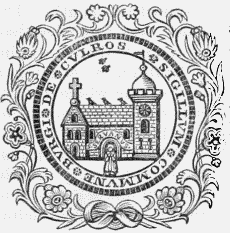
Burgh Seal
The town, which is situated on the north shore of the Frith of Forth, consists of one principal street, extending from the Frith by a precipitous acclivity towards the north, and of several detached portions along the coast. The houses are generally of ancient character, and to most of them is attached a portion of garden ground, presenting, as seen from the Frith, a picturesque and interesting appearance, which is heightened by numerous handsome seats and pleasing villas in the immediate vicinity. A very considerable trade was formerly carried on in the export of coal, of which a mine had been excavated, extending for some distance under the waters of the Frith, and also in the manufacture of salt. The produce of the mine was chiefly sent to Holland, whence various kinds of merchandise were imported, and distributed from this town to different parts of the country; but the mine was long since exhausted, and the trade has been discontinued. The manufacture of girdles for baking oatmeal cakes, for which the town had patents from James VI. and Charles II., was also pursued for some time; but since the establishment of the Carron iron-works, where they are made at a very reduced price, that manufacture has ceased. The only trade now carried on is the weaving of linen for the manufacturers of Dunfermline, and of cotton-cloths for those of Glasgow, in which about seventy persons are employed. Fairs are held on the 2nd of July and the third Wednesday in November; and there are two good inns.
Culross was erected into a royal Burgh in 1588, by charter of James VI., under which it is governed by a chief magistrate and nineteen councillors. There are seven incorporated trades, the weavers, wrights, shoemakers, bakers, smiths, tailors, and butchers, into which only burgesses are admissible; the fees for admission vary, for sons of freemen from 13s. 6d. to £1. 1., and for strangers from £2. 5. to £3. The magistrates have the usual civil and criminal jurisdiction, but no cases have come under their notice since the year 1828. The burgh is associated with those of Dunfermline, Inverkeithing, Queensferry, and Stirling, in returning a member to the imperial parliament; the number of qualified voters is twenty-two. The town-house is an ancient building, to which is attached a small prison containing two apartments, one for debtors, and the other for criminal offenders, chiefly against the police. Facility of communication is afforded by good roads, of which a turnpike-road, recently constructed, passes through the centre of the parish to Dunfermline; and a pier has been constructed at the old harbour, from which there is a ferry to Borrowstounness, on the opposite shore of the Frith.
The parish formerly included the barony of Kincardine, which was separated from it in 1672, and added to the parish of Tulliallan. It is about four miles in length, and nearly of equal breadth, comprising about 10,000 acres, of which nearly 4000 are arable, 2000 woodland and plantations, and the remainder pasture, garden ground, and waste. The surface rises in bold undulations from the shore of the Frith, for some distance towards the north and north-west, forming a ridge of low hills, beyond which it subsides into a fertile valley watered by a rivulet called the Bluther. The soil along the shore is a deep black loam of great fertility; towards the middle of the parish, of a clayey nature, but under good management producing favourable crops; and towards the north and north-west, of poorer quality. The crops are, wheat, oats, barley, peas, beans, potatoes, and turnips; the system of husbandary is in a very advanced state. The rateable annual value of the parish is £5600. The plantations, which are very extensive, and in a thriving condition, contain every variety of firs and hard-wood trees, of which latter oak and beech seem best adapted to the soil. The principal substrata are clay-slate and sandstone. Clay of good quality for pottery and for fire-bricks may be procured in abundance; limestone and ironstone are also found, but not in sufficient quantities to remunerate the labour of working. The mansion houses are, Culross Abbey, formerly the seat of the Bruce family, and afterwards of the Earl of Dundonald, beautifully situated on the shore; Valleyfield, lately the seat of Sir Robert Preston, an elegant mansion in a demesne tastefully laid out, and embellished with plantations; Castle Hill, a handsome modern seat, near the site of the castle of the Macduffs; and Blair Castle, built on the site of an ancient seat erected by Hamilton, Archbishop of St. Andrew's.
The Ecclesiastical affairs are under the superintendence of the presbytery of Dunfermline and synod of Fife. The living is collegiate; the minister of the first charge has a stipend of £156, with a manse, and a glebe valued at £20, and the minister of the second charge £116, with an allowance in money in lieu of manse, and a glebe valued at £25. Lady Keith and Lady Baird Preston are alternate patrons. The church is a portion of the ancient abbey, originally a venerable cruciform structure, with a lofty tower rising from the centre, which, with the choir now appropriated as the parish church, and containing 700 sittings, are the only parts remaining. On the north side is the burying-place of the Bruce family, containing a monument on which are recumbent figures of Sir George Bruce and his lady, and, beneath, of their seven children in a kneeling posture, beautifully sculptured in white marble. On one side of this aisle is a projecting piece of masonry containing, in a silver case, the heart of Edward, second Lord Bruce of Kinross, who fell in a duel near Bergen-op-Zoom, in 1614. The parochial school is well attended; the master has a salary of £34, with a house and garden, and the fees average £30, in addition to which he receives £10 from a bequest. There is also an endowed school for boys and girls, of which the master receives a salary of £36, with a house and garden, for gratuitously teaching twenty children, and superintending a Sunday school.
Dr. Bill, a native of the parish, who died in London in 1738, bequeathed £1000 for the payment of small sums quarterly to four decayed tradesmen and two tradesmen's widows, for apprenticing young persons, and for the foundation of a bursary in one of the universities. Sir George Bruce of Carnock, in 1639, founded an hospital, which he endowed for the maintenance of six aged widows of the parish; the building has long since fallen into decay, but the income from the endowment is distributed among eight widows. The late Sir Robert Preston and his lady bequeathed an endowment for the distribution of meal and money, weekly, to six aged men and six aged women, who have lived for ten years in the parish. Connected with this charity is a building in which soup is given, two days in the week, during the winter, to families in this and the adjoining parish of Torryburn. Miss Halkerston, of Carskerdo, in the county of Fife, lately left a sum of money to be invested in land, for the relief of industrious persons not receiving parochial aid. At the east end of the town are the remains of St. Mungo's chapel, near which, according to tradition, that saint was born, and educated by Serf, the patron saint of the parish; and to the west of the abbey are some remains of the ancient parish church.
Culsamond
CULSAMOND, or Culsalmond, a parish, in the district of Garioch, county of Aberdeen, 2½ miles (N. W.) from Old Rayne; containing 1104 inhabitants. This place is said to have derived its name from the Gaelic term Cul-Sal-Mon, signifying the end of the hill lands. The parish is about four and a half miles in length, from north to south, and three in breadth; and comprises 7400 acres, of which 4000 are in tillage, 300 in pasture, 900 in plantations, and the remainder uncultivated. The surface is level, with the exception of one or two moderate elevations, of which Culsamond hill commands a fine view of Belrinnes on the west, and, on the north-west, of the Caithness hills, and part of the Moray Frith and of the Buchan district in the distance. The river Urie passes through the whole length of the parish, and, after flowing for about nineteen miles from its source in the parish of Gartly, and drawing into its channel many minor streams, empties itself into the Don at Inverury. The soil is various, but in general consists of a dark loam, partly on a sandy and ironstone bottom; clay in some places forms the subsoil, and the land is for the most part fertile, and the crops usually early. In the hill of Culsamond are several quarries of valuable slate, of a fine blue colour, from which large quantities are annually raised; and ironstone is also found in the parish, lying in detached masses on or near the surface. Bog-iron ore has also been discovered in combination with decomposed oakwood, about eight feet below the surface. A bed of sand, of a coarse kind, is spread a little below the ground on the estate of Pulquhite, supposed to be the debris of granite belonging to the hill of Benochee, and brought hither by the action of water; and on the same farm, in the northern portion, is a bed of moss, about three feet below the surface, in some parts above eight feet deep, and reaching from north to south between thirty and forty yards, over which a soil composed chiefly of gravel and stones has been deposited by some casualty. The rateable annual value of the parish is £4602.
The plantations, which were commenced about seventy years since, though not very extensive, yet being dispersed, and often appearing in the form of clumps and belts, give a picturesque appearance to the district. On the hill of Culsamond, 250 acres have been planted within the present century; and the vicinity of Williamston House, and also that of Newton House, both modern mansions, pleasantly situated on the east bank of the Urie, have been much improved and beautified by the tasteful arrangement of their surrounding plantations. The turnpike-road from Aberdeen to Inverness, by Inverury and Old Rayne, passes through the parish. A fair is held in June, for cattle, horses, sheep, and wool. The parish is in the presbytery of Garioch and synod of Aberdeen, and in the patronage of Sir John Forbes; the minister's stipend is £150, of which above a third is received from the exchequer, with a manse, and a glebe of ten acres, valued at £30 per annum. The church is in good condition. The parochial school affords instruction in the usual branches; the master has a salary of £34, with a house, erected in 1823, an allowance in lieu of a garden, and about £19 fees. Among the numerous vestiges of military works, are those of a British encampment on the north-east side of the hill of Culsamond. There are also slight remains of Druidical temples and some ancient cairns, in one of the latter of which, on the farm of Mill of Williamston, opened in 1812, was found an immense wooden coffin, of very rude construction, containing an urn, and supposed to have been deposited anterior to the Christian era. A few stone axes and other warlike instruments have been found; and some years since a gold coin of James I. was dug up, in fine preservation. A highway called the Lawrence road, thought to be some hundreds of years old, and to have been constructed for the avoidance of the swamps and floods on the lower grounds, and for security against wild beasts, crosses the hill of Culsamond, and was formerly used by persons travelling to St. Lawrence fair, at Old Rayne.
Culter
CULTER, a parish, in the Upper ward of the county of Lanark, 2½ miles (S. W.) from Biggar; containing 536 inhabitants, of whom 197 are in the village. This place takes its name from its situation in the rear of the district of which it forms a part. The parish was originally of less extent than at present, having in 1794 been much enlarged by the addition of part of the parish of Kilbucho, in the adjoining county of Peebles. It is now seven miles in length, and rather less than three in average breadth; it is bounded on the west by the river Clyde, and comprises 11,547 acres, of which 4000 are arable, 7000 meadow and pasture, and 500 woodland and plantations. The surface is pleasingly undulated, and towards the south rises into hills of considerable eminence, increasing into mountains, of which the highest, called the Fell, has an elevation of more than 2300 feet above the sea. The lower part of the parish is diversified with spreading vales and narrow glens. The former are enlivened by the course of the river Clyde, the banks of which are ornamented with handsome seats and pleasure-grounds; and of the latter, the glen of Culter Water, which derives its name from that rivulet, is beautifully picturesque and romantic. The wider portion of it is richly cultivated and wooded, and the narrower part gradually diminishes till it scarcely affords room for the passage of the stream, which, after flowing through the whole length of the parish, falls into the Clyde a little below the village. At a point called Wolf-Clyde, the river makes a remarkable curve towards the north-west, approaching very nearly to the bank of the Biggar water, which runs into the Tweed; and in high floods, uniting with that stream, a considerable portion of the Clyde waters is carried into the Tweed.
The soil varies considerably, but is generally dry and fertile. The lower lands consist of a sandy loam, which, under good management, is very productive; on the hills the soil is of much lighter quality, and on the summits mostly a sterile moss; towards the eastern part of the parish, on the lands of Kilbucho, it inclines to clay. The hills are of the greywacke formation; and little variety is found in the substrata, except the occasional occurrence of conglomerate or pudding-stone. The system of agriculture has been greatly improved under the auspices of the chief landed proprietor, who has also greatly promoted the plantation of timber, the draining and inclosure of the lands, and the raising of wheat crops, to which previously little attention had been paid. The rotation plan of husbandry is now generally prevalent, and green crops are found to answer well; the chief produce of the cornfields is oats. The sheep are the short black-faced breed, which are found to be the best adapted to the hilly pastures; the cows are the Ayrshire. The rateable annual value of the parish is £5231. The plantations are principally of Scotch fir; but, though it thrives well for a few years, it soon falls into decay, and consequently little timber of any growth is produced. At Culterallers, however, are some acres of natural trees, among which are the alder, birch, hazel, mountain-ash, and willow; and in other parts of the parish are remarkably fine specimens of ancient timber. The mansion-houses, most of which are beautifully situated on the banks of the Clyde, add greatly to the scenery of the parish. The village is pleasantly situated on the banks of the Culter water, along which, at irregular distances, a range of neatly-built houses with intervening trees of fine growth, extends for a considerable way. It is intersected by the turnpike-road from Dumfries to Edinburgh, which is carried over the stream by a neat bridge of modern erection.
The parish, which is of some antiquity, belonged in the reign of David II. to Walter Byset, who held the half barony of Culter of the king in capite, and in 1367 granted the lands, with the advowson of the church, excepting only the lands of Nisbet, to William Newbiggin, of Dunsyre. They afterwards came into the possession of William, Earl of Douglas, by whose descendant, James, they were in 1455 forfeited to the crown. Sir David Menzies, who afterwards obtained possession of the half barony, gave the lands of Wolf-Clyde to the abbey of Melrose, and they now pay annually a small sum to the Duke of Buccleuch as lord of that manor. The parish is in the presbytery of Biggar and synod of Lothian and Tweeddale, and in the patronage of the families of Baillie of Lamington, and Dickson of Kilbucho, alternately. The minister's stipend is £217, with a manse, and a glebe valued at £30. 12. per annum. The church, erected in 1810, a plain edifice beautifully situated, commodious, and accessible to the parishioners, is adapted to a congregation of nearly 400 persons. A place of worship has been erected in connexion with the Free Church. The parochial school affords education to all the children of the parish except those of the part formerly in the parish of Kilbucho, the original school of which is still retained; the salary of the master of Culter school is £34, with £20 fees, and a dwelling-house and garden. There was formerly a preceptory of the Knights' Templars on the banks of the Culter water, a little below the village; the site is called Chapel Hill. Remains exist of four circular encampments, which seem to have been formed for the protection of the inhabitants, and the security of their cattle, during the periods of the border warfare. There are also two circular moats, one at Wolf-Clyde, and one at Bamflat, which appear to have been raised as signal stations; and along the vale between the Clyde and the Tweed, is a continuous chain of similar mounds, most probably employed for the same purpose. About half a mile from the lands of Nisbet, is an oval mound in the midst of a deep morass; the longer diameter is about forty yards, and the shorter about thirty, and it rises above the surface to the height of nearly three feet. It is called the Green Knowe, and consists of heaps of loose stones, compacted together by stakes of hard oak, sharpened at the points, and driven into the ground. Around the base is a causeway of larger stones; and the whole is surrounded by a soft elastic moss, impervious to the approach of an enemy.
Cults
CULTS, a parish, in the district of Cupar, county of Fife; including the village of Pitlessie, and the hamlets of Crossgates, Cults-Mill, Hospital-Mill, and Walton; and containing 889 inhabitants, of whom 46 are in the hamlet of Cults-Mill, 4 miles (S. S. W.) from Cupar. This parish, of which the name, in ancient documents Quilts or Quilques, is of Celtic origin, and supposed to be descriptive of its situation, lies nearly in the centre of the county, and is about two miles and a quarter in length, and one mile and a half in breadth. It comprises 2250 acres, of which 1900 are under cultivation, 140 meadow and pasture, 115 woodland and plantations, 35 garden, and about 60 roads, fences, and waste. The surface, though for the greater part flat, is diversified with hills, of which the chief in height is that of Walton, near the south-eastern boundary of the parish, and from some of the hills are fine views over the rich valley of Strath-Eden, embracing the Lomond heights in the distance. The scenery is in some places embellished with wood, and in others enlivened with various streams, of which the Eden, winding through the lands, forms a boundary between part of this parish and that of Collessie, and, towards the west, is joined by the Ballomill rivulet, which, though of considerably less breadth, has a plentiful supply of water.
The soil varies considerably in quality. In some places it is light and sandy; in others, a rich black loam of about twelve inches in depth; and on the higher grounds, a strong clay which, under good management, produces excellent crops. The system of agriculture is improved; but much of the surface would be rendered more productive if draining were extensively practised, and little progress has been made in the inclosure of the lands. The crops are, grain of all kinds, turnips, and potatoes. Few sheep are either reared or fed, and these are generally of the Cheviot breed; the cattle, to the improvement of which much attention is paid, are of the Fifeshire breed. The rateable annual value of the parish is £3208. The substrata are, yellow sandstone, limestone, and in some places coal; and the hills, towards their summits, are generally trap or whinstone, partly of amygdaloid, and partly of greenstone. Limestone is procured in abundance from quarries on the Pitlessie hill; the principal vein is about fourteen feet in thickness, and of a blue colour, and above it is another stratum, two feet thick. Both, when wrought, produce lime of excellent quality, of which more than 25,000 bolls are annually obtained, the greater part whereof is shipped at Newburgh for Dundee and Perth, and the remainder used in the parish and adjacent district. Coal was formerly worked, of which there were pits on the southern declivity of the Pitlessie hill; the seams are superincumbent on the strata of limestone, and one of them is about twelve inches in thickness. There are several quarries of freestone of good quality, affording an abundant supply for building and other purpose; and boulder limestone is also procured for mending the roads. The only house of any importance is Crawfurd Priory, a handsome castellated mansion, erected by Lady Mary Lindsay Crawfurd in 1813, when the ancient family seat in the adjoining parish of Ceres, having become dilapidated, was abandoned.
The weaving of linen affords employment to about 150 persons, of whom nearly one-half are females; the number of webs, which are 140 yards in length, and thirty inches wide, may be reckoned to average 1700 per annum. The linen chiefly woven is dowlas, for the manufacturers of Kettle, Leslie, and Newburgh, who furnish the materials. The spinning of tow is also carried on at Hospital-mill, where an old corn and flax mill has been converted to this purpose, at an expense of £4000; the machinery is propelled by a water-wheel of fourteen-horse power, and the quantity of yarn spun annually is from 160 to 180 tons, sent principally to Dundee. This work affords employment to about fifty persons, of whom the greater number are women and children. There are also mills for flour, barley, malt, and oatmeal, a saw-mill driven by water, and another by steam. The high road from Edinburgh to Dundee passes through the parish. An annual fair is held for the sale of agricultural stock and implements of husbandary, on the second Tuesday in May (O. S.), and is numerously attended. The parish is in the presbytery of Cupar and synod of Fife, and patronage of the United College of St. Andrew's; the minister's stipend is £162, with a manse, and a glebe valued at £11 per annum. The church, which is situated about a mile from the village, and nearly in the centre of the parish, is a neat plain edifice, erected in 1793, and contains a handsome monument in marble, by Chantrey, erected by Sir David Wilkie to the memory of his parents. There is a place of worship for members of the United Associate Synod. The parochial school affords education to about sixty children; the master has a salary of £34, with about £35 fees, and a good house and garden. On the sides of Walton Hill are several ramparts, supposed to have been a Roman encampment; and urns and other relics have been discovered on and near the spot. Sir David Wilkie, the eminent painter, was born in the manse on the 18th November, 1785, while his father, the Rev. David Wilkie, was incumbent. The latter was the author of a treatise on the Theory of Interest and Annuities; the former, who had been appointed limner for Scotland to George IV., was knighted by his Majesty William IV., in 1836, and died in 1841. Dr. Thomas Gillespie, professor of humanity in the university of St. Andrew's, and author of sermons on The Seasons contemplated in the Spirit of the Gospel, was for fifteen years incumbent of the parish.
Cumbernauld
CUMBERNAULD, a parish, in the county of Dumbarton; including the village of Condorat, and containing 3501 inhabitants, of whom many reside in the village of Cumbernauld, 10 miles (W. S. W.) from Falkirk. This place derives its name from a Celtic term signifying a confluence of streams, in reference to the junction of several small streams just below the village. It is of considerable antiquity, though the parish was not erected until 1649: the wall of Agricola, called Graham's Dyke, with other ancient relics, connects its history with that of the Roman invaders, but nothing is recorded to supply us with any particulars concerning their proceedings in these parts. There was formerly a castle here, and at the close of the 13th century, the castle and barony belonged to John Comyn, Earl of Buchan, but afterwards fell to the crown by the forfeiture of that nobleman: in the 14th century, they passed to the Flemings, of Biggar and Cumbernauld, who were subsequently created earls of Wigton, and rose to considerable importance in the transactions of Scottish history. The barony formerly belonged to Stirlingshire, but in the reign of David II., Malcolm Fleming, sheriff of Dumbarton, obtained its annexation to Dumbartonshire, and the disjunction of several parishes from Dumbarton, and their annexation to Stirling. This arrangement was afterwards disturbed by an act of parliament, in 1503; but the act was repealed, and the settlement effected by Malcolm Fleming permanently established.
The parish, situated at the eastern extremity of the shire, is about eight miles long, and from three to four broad, and contains 9145 Scotch acres. The surface is diversified by a succession of ridges and slopes, and the whole sweep being very considerably above the level of the sea, the climate is rendered sharp and cold. The highest part is a deep moss covered with heath, and called Fannyside-muir, in which quantities of grouse and black-cock are found; the remainder of the surface is arable and wood, among which game of all kinds is abundant, and in spring the roebuck is frequently seen, and sometimes the squirrel. The streams of Luggie and Kelvin enliven the lands, but are of inconsiderable dimensions; they formerly abounded in good fish, but now a few trout only are to be found. The lakes, which were once numerous, have been drained, and converted into arable land, and the only remaining one is the fresh-water loch of Fannyside, which covers about seventy acres, and is but a few feet deep; pike and perch are taken in it, and it is visited by flocks of wild-duck and teal. The soil is chiefly a deep clayey loam, tolerably fertile; 6168 acres are arable, 2170 pasture and moss, 580 plantations and woods, and the rest roads and water. Within the last twenty years, many improvements have taken place in husbandary, by draining and levelling, and by the use of lime and good dung manure; and since the introduction of green crops, a considerable quantity of land has been brought into corn cultivation, though previously considered altogether unfit for the purpose. The breed of cows and horses has recently been much attended to; the dairy-farms are of a very superior kind, and their chief produce is butter, which is sold at Falkirk and Glasgow. The rateable annual value of the parish is £15,430.
The subsoil is an impervious till, much of which has been advantageously drained; the rocks are whinstone and trap, which mainly compose those numerous ridges whereby the surface is marked. Freestone and limestone are found in large quantities, and a quarry of the former is wrought at Netherwood, near the Forth and Clyde canal, where also, as well as at Cumbernauld, limestone of excellent quality is obtained. The freestone, which is chiefly used in building, produces annually a large sum, and the limestone £6000. Coal is found in several places, especially near the freestone quarry at the Hirst; and on the farm of Westerwood is a mine of ironstone, let to the Carron Company. The mansion of Cumbernauld, the ancient seat of the Flemings, is surrounded by fine plantations, some of the trees of which are holly of a large size and imposing appearance. Here and in many other parts, oak, ash, lime, chesnut, elm, beech, and plane diversify the scenery, and are in a flourishing condition. The village of Cumbernauld, which contains nearly one-half of the population of the parish, was created a burgh of barony in 1649; it has a fair in May, at which there is a considerable traffic in cattle. About one-fifth of the population is employed in cotton-weaving, 560 looms being at work in the parish; but, during the fluctuations to which the trade is exposed, many of the hands obtain support by labouring in the coal and iron mines. There is a penny-post to Glasgow; and the mail by Crieff, and coaches to Perth, Edinburgh, Alloa, and Stirling formerly passed daily to and from Glasgow, but that to Perth is the only one now left on the road. The Edinburgh and Glasgow railway, also, which passes through the parish south of the canal, attains its summit level here.
The Ecclesiastical affairs are subject to the presbytery of Glasgow and synod of Glasgow and Ayr. There is a manse, built in 1827, with a glebe of about eleven acres, valued at £17.10. per annum; the minister's stipend is £230, and John Elphinstone Fleming, Esq., is patron. The church is situated in the village, in the centre of the parish, and is an old, inconvenient, and uncomfortable building; it contains 650 sittings, but is much too small for the population. There are also places of worship for members of the Free Church and United Secession; and a parochial school is supported, the master of which has a salary of £25, with house and garden, and £26 fees. The village has a good subscription library, consisting of 1200 volumes; also a savings' bank, established in 1815; and a society of masons. The late Viscount Keith bequeathed £90, the interest to be divided among the poor on the 1st of January. The chief relic of antiquity is Graham's Dyke, a part of which runs through the parish. Traces of an old Roman road may be seen in the moss of Fannyside; and in the vicinity of Cumbernauld House is an elevation called the Towe Hill, where in ancient times the feudal baron held his court. In the formation of the Forth and Clyde canal, which runs through the bog of Dullatur, many warlike instruments were found, with the bodies of men, among which was a trooper, completely armed, and sitting upright on horseback, exactly in the position in which he had perished. He is supposed to have belonged to Baillie's army, when that general fought the Marquess of Montrose, 15th of August, 1745, and in his flight to have ridden accidentally into the bog.
Cumbray, Great
CUMBRAY, GREAT, an island and parish, in the county of Bute, 2 miles (W.) from Largs; including the villages of Millport and Newton, and containing 1413 inhabitants. The name is derived from a Gaelic term signifying a bold or steep coast rising abruptly from the sea, and this description corresponds with the natural appearance of the island, which presents a steep and precipitous coast all round. The island is supposed formerly to have been in the possession of the Norwegians, concerning whose occupancy, however, no particulars are known. They are said to have been dispossessed of the property after many successive encounters with the Scots, by the decisive battle of Largs, when they were completely routed and driven from the coast. A cathedral once stood here, which was dedicated to St. Columba, but no remains of it are now visible. The island was formerly distributed into a number of small baronies, the owners of the principal of which were the families of Hunter, Stuart, and Montgomerie. The barony of Kames, belonging to the Hunters, has given the name to one of the finest bays in the island, and on this property, also, once stood the village of Kames, some vestiges of which may still be traced. The barony of Ballykellet, which appears to have been the most considerable of all, belonged to the Montgomeries, who possessed the patronage of the parish, and part of whose mansion-house was until lately standing, having in it a stone with the family arms sculptured.
The island is of very irregular figure, extending about three and a half miles in length, from north-east to south-west, and about two miles in breadth: its circumference is ten miles, comprehending an area of 5120 acres. It is situated on the Frith of Clyde, and is separated from Little Cumbray, on the south, by a strait three-quarters of a mile in breadth; from Ayrshire, on the east, by Fairley Road, about one mile and a half broad; and from the isle of Bute, on the west, by a part of the Frith, which is about four miles wide. Numerous hills rise, with a gradual ascent, from the extremities of the island to its centre, and merge in one continuous range called the Shough-ends, which runs from north to south nearly throughout the whole length of the island, it attains an elevation of about 500 feet above the sea, and commands in every direction a beautiful view. The shores and bays abound with fish of various kinds, and oysters are found in some parts. A stream of inconsiderable dimensions, taking its rise from two small lochs which communicate with each other, in the highest part of the island, receives the waters of several springs, and at length becomes sufficiently large to form a mill-dam, which the people use for grinding their corn. The soil varies in different places. On the coast it is light and sandy, lying on rock or clay; on the higher grounds it is gravelly and thin, tending to moss, bedded on rock and covered with heath; in some of the valleys it is a deep rich loam, lying on clay, and producing good crops. About 3000 acres are arable; upwards of 1400 are waste, a considerable part of which, however, affords pasture for cattle; 30 acres are common, and 120 are planted. Grain and green crops of all kinds are produced; the cattle are of the pure Ayrshire breed. The rateable annual value of the parish is £1845.
The rocks consist of several varieties of whinstone, of limestone, and sandstone. The limestone is not wrought, on account of the expense of fuel; but the sandstone, which is plentiful, is wrought to a considerable extent, quarries having been for some time open. There is a regular communication with the land by steam-boats, and the island is much resorted to by strangers. The ecclesiastical affairs are subject to the presbytery of Greenock and synod of Glasgow and Ayr; patron, Lord Glasgow. The stipend is £159, and there is a good manse, with a glebe of six acres, valued at £8. 10. per annum. The church, which was built in 1837, to meet the exigencies of a largely augmented population, is situated on rising ground, immediately behind the village of Millport; it is a commodious and elegant structure, ornamented with a handsome tower, and capable of accommodating 750 persons. A place of worship has been erected for Baptists; likewise a Free church. There is also a parochial school, where, in addition to the usual branches, Latin, mensuration, and navigation are taught; the master has the legal accommodations, and a salary of £30, with £15 from fees. A parochial library is supported.
Cumbray, Little
CUMBRAY, LITTLE, an island, in the county of Bute, ecclesiastically annexed to the parish of West Kilbride, in the county of Ayr, and containing 8 inhabitants. This island is situated in the Frith of Clyde, between the island of Bute and the promontory of Portincross, from each of which it is distant about two and a half miles. It anciently formed part of the domains of the Stuart family, ancestors of the kings of that line, and, on the erection of the principality of Scotland by Robert III., in 1404, in favour of his son, was concluded within its limits. It was for many years retained as a royal preserve, and in 1515 was conferred upon Hew, Earl of Eglinton, whose descendants are its present proprietors. The island, which is composed entirely of trap-rock, resting on the sandstone formation of the opposite coast, is about a mile long, and half a mile in breadth, and has an elevation of 600 feet above the sea. The surface comprises about 700 acres; but, with the exception of a few potato gardens, it does not appear to have been cultivated. There are a few ash-trees growing near the south-east extremity, but it is otherwise perfectly destitute of wood, and the rocky pasture only affords food for a few sheep and young cattle; the island is, indeed, chiefly a rabbit-warren at present, and about 500 dozens of rabbits are taken annually on the average, and sent for the supply of the neighbouring markets. Nearly in the centre is a circular tower, thirty feet in height, once appropriated as a lighthouse, and still forming a very conspicuous object from all parts of the channel; but it has long been neglected, and a lighthouse has been built upon the edge of a precipice overhanging the sea, on the west side of the island. This building, with the keeper's house and garden, romantically contrasting with the rugged crags among which it is situated, has a truly picturesque appearance. In the southern extremity of the island are several natural caverns, formed by fissures in the rock; the largest, on the east side, is called the King's cave.
Near the old lighthouse are the remains of an ancient square fort, of which the walls, six feet in thickness, thirty-five feet in height, and nearly entire, inclose an area twenty-eight feet in length and fifteen feet wide, formed into two apartments, of which the lower has a vaulted stone roof. By whom, or at what time, it was erected is not known; but being in the possession of the Montgomerie family at the period of Cromwell's invasion of Scotland, it was surprised and burnt by his soldiers. To the north of the castle are the remains of an ancient chapel dedicated to St. Vey, who was buried here, in a tomb a little to the north of the chapel. These remains consist chiefly of portions of the walls of the chapel, which appears to have been a dependency of the monastery of Iona; the walls are about three feet in thickness, and rudely built, inclosing an area of thirty feet in length, and fifteen in width. Of the tomb, which seems to have been comprised within four walls of stone, two square stones only are left, one of which is broken into two pieces; they are ornamented with tracery, but no inscription of any kind is to be discovered. At Shanwilly point, on the north of the island, are several tumuli, some of which were opened a few years before his death by the late Earl of Eglinton, when sepulchral urns and various fragments of weapons were found.
Cuminestown
CUMINESTOWN, a village, in the parish of Mon-Quhitter, district of Turriff, county of Aberdeen, 6 miles (E. by N.) from Turriff; containing 477 inhabitants. This place takes its name from the late Joseph Cumine, Esq., who founded it near the middle of the last century, and established in it a linen manufacture, which still exists, and lately employed about 100 hands. The present proprietor of Auchry, the seat of the late Mr. Cumine, who purchased the mansion and estate, has actively pursued the plans partially carried out by his spirited predecessor, for the improvement of his property in the parish, and the promotion of the agricultural interest. A post-office has been established in the village by his exertions; and he has projected, in connexion with other gentlemen, a new line of turnpike-road to run through it. A fair for cattle and horses, also, is held on the last Thursday in April or the first in May.
Cummertrees
CUMMERTREES, a parish, in the county of Dumfries; including the village of Powfoot, and containing 1277 inhabitants, of whom 124 are in the village of Cummertrees, 4 miles (W.) from Annan. The parish is supposed to have derived its name, anciently written Cumbertres, from its having been formerly covered with timber, considerable tracts of which still remain, besides subterraneous forests of oak, fir, and birch, with which the mosses are every where filled. It is remarkable as containing the farm of Bruce, in which there is a field called Broom Acres, where it is said that Robert Bruce, through the treachery of a black-smith, sustained a severe repulse from the English. The most conspicuous family with which the ancient history stands connected, is that of Herries. Their residence, Hoddam Castle, which is situated on the south bank of the river Annan, is said to have been built with the stones of a more ancient castle of the same name, between the years 1437 and 1484, by John, Lord Herries, of Herries. The older castle had been inhabited, in the beginning of the 14th century, by a branch of the family of Robert Bruce, and destroyed some time afterwards by a border law. The family of Herries was very powerful, and acquired a large extent of country; but about the year 1627, the barony of Hoddam was obtained by Sir Richard Murray, of Cockpool.
The parish comprehends the ancient chapelry of Trailtrow, which was annexed to it at the Reformation; and is about seven miles in extreme length, and four in extreme breadth, containing about 10,000 acres. It is bounded by the Solway Frith on the south. A part of the surface is level, forming an inclined plane which rises gently from the south towards the north, the highest point being not more than 200 feet above the sea; but after this there is a descent, from the Tower of Repentance to the river Annan, which is somewhat rapid. The coast is flat, sandy, and uninteresting. Salmon, sea-trout, flounders, codlings, and occasionally turbot and soles, are taken in the Solway, and considerable quantities of cockles and muscles along the shores; in the Annan, salmon, common trout, and herling are plentiful. The soil in some places is sandy, and in others gravelly; in a few instances deep rich loam is met with, but in general the soil is a thin wet clay, resting upon a hard tilly subsoil, and requiring much skill to render it productive. About 6000 acres are occasionally under tillage, and 800 are moss, of which, however, 300 are capable of cultivation; about 1000 acres are under wood, consisting chiefly of plantations. The crops are nearly the same as in other parishes where the modern improvements in husbandry have been introduced. Cattle are reared in large numbers; the few sheep kept are generally a cross between the Cheviots and South downs. Many hundreds of acres which were waste thirty years ago, are now in flourishing plantations, or under cultivation, and inclosed with good hedges; indeed, the successful application of the best system of husbandry has entirely altered the face of the parish within the present century. The rocks consist of limestone and sandstone, the former of which, quarried at Kelhead, is celebrated as among the finest in the country, and brings an annual revenue of above £1000; there are also two sandstone quarries. The rateable annual value of the parish is £6022.
The most interesting residence is the ancient castle, remarkable for its strength and the thickness of its walls, and which has received several additions by its respective proprietors, of whom the late General Sharpe built a large wing, in keeping with the other parts of the edifice. The parish also contains the modern mansion of Kinmount House, built by the Marquess of Queensberry, at the cost of £40,000. The turnpike-road from Portpatrick to Carlisle intersects the parish. The ecclesiastical affairs are directed by the presbytery of Annan and synod of Dumfries; patron, the Crown. There is a manse, with a glebe of the annual value of £18; and the minister's stipend, including a government grant of £37, is £158. The church, which was founded by Robert Bruce, has frequently been rebuilt and enlarged, the last time about fifty-five years since, and contains 450 sittings. There is a parochial school, in which, besides the ordinary branches, the classics, geography, and navigation are taught; the master has a salary of £30, with £25 fees, and the allowance of house and garden. Among the relics of antiquity is the Tower of Repentance, said to have been built in the 15th century, by Lord Herries, who, having used the stones of an old chapel in building Hoddam Castle, of which he afterwards repented, erected this tower, to pacify his conscience, and to make his peace with the Bishop of Glasgow, diocesan of the chapel. It is twenty-five feet high, and stands on an eminence, which is seen at a distance of thirty miles on all sides.
Cummingston
CUMMINGSTON, a village, in the parish of Duffus, county of Elgin; containing 155 inhabitants. This place is situated on the south coast of the Moray Frith, a short distance from Burgh-Head, which is the post-town. It is a small and neglected village, chiefly inhabited by seamen, and the families of persons dependent on the fisheries of the district.
Cumnock, New
CUMNOCK, NEW, a parish, in the district of Kyle, county of Ayr, 6 miles (S. E. by S.) from Old Cumnock; containing, with the villages of Castle, Pathhead, Mansfield, and Afton-Bridgend, 2382 inhabitants. This parish, which was separated from that of Cumnock in the year 1650, is situated at the south-east extremity of the county. It is about twelve miles in length, from east to west, and nine in breadth, from north to south, and comprises about 75,000 acres, of which 15,000 are arable, 300 woodland and plantations, and the remainder, of which about 3000 might be reclaimed and brought into cultivation, is a very elevated tract of moss. The surface is in general hilly, and towards the south mountainous, but is varied with the two fine valleys of the Nith and Afton, of which the former extends through nearly the whole length of the parish, having a mean elevation of about 500 feet above the sea, and the latter, which is about fifty feet higher, intersects the parish from north to south. The highest of the mountains, called Blackcraig, has an elevation of 1600 feet; the Knipe, a little to the south, has an elevation of 1260 feet, and the Corsancone is 870 feet above the level of the river Nith. From all these heights extensive views are obtained of the surrounding districts, and that from the Corsancone is singularly rich and beautiful. The river Nith rises in the south-west of the parish, and, after a course of about twelve miles, flows by the base of Corsancone Hill, into the valley of Nithsdale in the parish of Kirkconnell. The river Afton rises near the southern boundary of the parish, and, after a course of about eight miles, falls into the Nith near the village. The surface is further diversified by three lakes, little more than half a mile in circumference; they are of no great depth, but abound with perch and pike, and are frequented by varieties of aquatic fowl.
The soil is in some parts of a light gravelly quality, and in others a tenacious clay; but, by judicious management and a liberal use of lime, it has been much improved, and a tolerable quantity of unproductive land has been brought into profitable cultivation. The crops are, oats, barley, wheat, potatoes, and turnips. Surface-draining is rapidly growing into practice, and all the more recent improvements in husbandry, and in implements of agriculture, have been adopted. Considerable care is bestowed on the management of live stock; about 3500 cows are pastured on the various farms, nearly half of which number are milchcows, and the value of cheese and butter annually produced is estimated at above £7000. More than 20,000 sheep are fed on the mountain pastures. There is very little wood in the parish; the plantations are chiefly larch and spruce-fir, for which the soil appears to be very favourable, and some larches planted on the banks of the Afton have attained a very stately growth. The rateable annual value of the parish is £14,117. The substrata are, carboniferous limestone, coal, sandstone, and ironstone, and the hills of transition rock and greywacke. The limestone is found in abundance in many parts, occurring in beds of great thickness; it is of excellent quality, and the lime is much used for cement, from its property of acquiring hardness under water. There are several kilns on improved principles, for burning the limestone, and the produce annually is averaged at 200,000 bushels. The coal is likewise very abundant, and of good quality; the quantity annually raised is about 10,000 tons. In the coalfield at Craigman, plumbago is found in irregular masses, imbedded in basalt, and has been wrought for a long time. The sandstone is generally of a yellowish-white tint, but of coarse texture, and contains various fossil impressions; the ironstone occurs in detached masses and veins in several parts of the coal formation, but has not yet been worked.
The villages are chiefly inhabited by persons employed in agriculture and in the mines and quarries; there is a post-office under that of Old Cumnock, and a library which has a collection of more than 1040 volumes is supported by subscription. A fair is held on the Thursday before Whitsunday, for cattle, and considerable business is transacted. The parish is in the presbytery of Ayr and synod of Ayr and Glasgow, and in the patronage of the Marquess of Bute. The minister's stipend is about £212, with a manse, and a glebe valued at £24 per annum. The church, which is situated between the villages of New Cumnock and Afton-Bridgend, is an elegant and substantial structure in the later English style, erected in 1834, by the heritors, and is adapted for 1000 persons. There are places of worship for members of the Free Church and Reformed Presbyterian Synod. The parochial school affords education to about 100 scholars; the master has a salary of £34, with £50 fees, and a house and garden. On the summit of a knoll are some traces of the ancient castle of Blackbog, of which all the masonry has been removed, to furnish materials for building, but of which the fosse may be still distinctly seen. This castle was at one time the residence of the Dunbars of Mochrum, and was frequently visited by Sir William Wallace. On the lands of Sir John Cathcart are also the ruins of an ancient baronial castle, near the source of the river Nith. Upon the farm of Whitehill, an earthen jar was dug up a few years since, containing a great number of small silver coins of Edward I. of England and Alexander of Scotland; they were all in excellent preservation, and about the size of a groat. On the farm of Polquhaise, a tumulus was lately removed, in which was found a sarcophagus of large stones, containing fragments of human bones and a small quantity of black earth.
Cumnock, Old
CUMNOCK, OLD, a manufacturing town and parish, in the district of Kyle, county of Ayr, 10½ miles (S. W.) from Muirkirk, and 61 (S. W. by W.) from Edinburgh; containing 2836 inhabitants, of whom two-fifths are in the town. This place derives its name from its situation in the bosom of a hill, and its adjunct by way of distinction from that part of it which, more than a century since, was separated from it, and erected into a separate parish. The town appears to owe its origin to a charter granted to Sir Thomas Campbell, prebendary of Cumnock, by James IV., making the church lands a free burgh of barony, and empowering him and his successors to let the glebe, in burgage tenure, for building. The barony, after passing through several hands, came ultimately, in the reign of Charles II., into the possession of the Earl of Dumfries, and is now the property of the Marquess of Bute. The town is beautifully situated in a deep recess, at the confluence of the rivers Glasnock and Lugar, and consists chiefly of three streets, and a spacious quadrangular area now the market-place, the sides of which form ranges of good houses, and in the centre of which is the church. The houses are regularly built, with the exception of those in some narrow lanes, which are of inferior order. The whole has an air of cheerful neatness; and, combined with the interesting banks of the Lugar, and the rich woodlands immediately surrounding, it presents a pleasing appearance. Gas-works have been recently constructed for lighting the town; and there are two public libraries supported by subscription, each of which has an extensive and well-selected number of volumes. A post-office has also been established.
The manufacture of wooden snuff-boxes resembling those originally made at Laurencekirk, is extensively carried on here, and has been brought to a state of great perfection. These boxes are made from the wood of the plane-tree as being closest in its texture; and at the original prices paid for them, a solid foot of wood worth three shillings, could be manufactured into boxes that would sell for £100. From the great reduction in the price since the extension of the manufacture, however, they are sold for less than a tenth part of the original value; and the painting of the boxes in devices has been nearly superseded by the introduction of chequering, which is performed in great variety by machinery, producing brilliancy of colour and elegance of pattern. The number of persons employed in this manufacture is about fifty. Weaving is extensively carried on for the manufacturers of Glasgow and Paisley, and more than 120 looms are in constant operation; a considerable number of females, also, are employed in working and embroidering muslins, which are much admired. There is a large manufactory for threshing-mills and cheese-presses, of which former some are sent to Ireland; also a pottery for brown earthenware, for which purpose clay of good quality is found in the parish. Fairs are held on the first and sixth Thursdays after Candlemas, the Wednesday after the last Tuesday in May and first Tuesday in July, and the last Wednesday after the third Tuesday in October (O. S.) A baron-bailie is appointed to superintend the police of the town, by the Marquess of Bute.
The parish is about ten miles in length, and two in average breadth, and comprises 16,400 acres, of which about 630 are woodland and plantations, 2500 moorland pasture, and the remainder arable. The surface is pleasingly undulated, rising in some parts into hills of gentle elevation; and along the banks of the Lugar are fine tracts of level ground. The whole of the lands have an elevation of some hundred feet above the sea, but they are finely sheltered by the still higher lands of the district adjoining. The river Lugar, which has its source in the eastern extremity of the parish, is formed by the union of the streams of Glenmore and Bella, and, after forming the northern boundary of the parish, flows with a westerly course into the river Ayr. The scenery near it is boldly varied; in some parts the banks are richly wooded, and in others the stream runs between perpendicular ramparts of barren rock and projecting crags. The river Glasnock issues from a lake on the southern confines of the parish, and, after flowing through the town, falls into the Lugar. The lake abounds with trout, pike, and eels; trout are found also in the Lugar, and salmon were formerly frequently taken in its waters, but, since the construction of a dam on the river Ayr, none have ascended so high. The soil is chiefly clayey, intermixed with portions of a light and sandy quality, and occasionally a rich loam. The chief crops are oats, with a little wheat, barley, and bear, potatoes, peas, beans, and turnips; the system of agriculture is in an advanced state. A great degree of attention is paid to the management of the dairies, and considerable quantities of cheese are made, and sent to the neighbouring markets, where it is much esteemed. About 1000 milch-cows, of the Ayrshire breed, are kept on the several farms; and the number of sheep, chiefly of the black-faced kind, averages about 1200. The rateable annual value of the parish is £9724.
The substrata are, limestone, coal, and freestone. The limestone is of very superior quality; and the lime, which is distinguished by the appellation of Benston lime, is in great demand for cement, and, from its property of acquiring hardness when under water, is much used in the erection of bridges. The freestone on the banks of the Lugar has a light blue tint, and is susceptible of a very high polish; and a white freestone is also found, which is in repute for millstones, and sent in great quantities for exportation. The coal is alternated with strata of trap, but is on the whole of good quality. The woods consist of oak, ash, elm, beech, plane, lime, chesnut, and birch; and the plantations, of silver, spruce, and Scotch firs, poplar, mountain-ash, holly, and evergreens of almost every variety. Many of the trees are of stately growth, and all are in a flourishing condition. Dumfries House, the seat of the Marquess of Bute, is a very spacious and handsome mansion, built of the blue freestone found in the parish, and containing stately apartments; the walls of the drawing-room are hung with some fine old tapestry, presented to one of the earls of Dumfries by Louis XIV. of France. The house is beautifully situated on the bank of the Lugar, which flows through the pleasure-grounds, and over which an elegant bridge has been erected near the mansion. Glasnock House, also situated on the bank of that stream, is an elegant mansion of recent erection, and is built with the white freestone found near the Lugar: Logan and Garrallan are likewise good houses. The parish is in the presbytery of Ayr and synod of Glasgow and Ayr, and in the patronage of the Marquess of Bute. The minister's stipend is £218, with a manse, and a glebe valued at £20 per annum. The church, erected in 1754, is adapted for 900 persons, but is much too small for the population: the cemetery has been removed to a rising ground called the Bar Hill, east of the town. There are places of worship for members of the Free Church and United Secession. The parochial school affords instruction to about 130 scholars; the master has a salary of £34, with £15 fees, and a house and garden, and he also receives one-half of the interest of a bequest of £1000 by Mr. Duncan, for the gratuitous instruction of twelve children. The other half of the interest is distributed among poor persons not on the parish list. There is a savings' bank with a fund of about £1000; and three friendly societies are supported. Within the grounds of Dumfries House are the ruins of the ancient castle of Terringzean, anciently the residence of the Loudon family; and in the south side of the parish are some slight ruins of Boreland Castle.
Cunningsburgh
CUNNINGSBURGH, Shetland.—See Sandwick.
Cupar
CUPAR, a burgh, market-town, and parish, in the district of Cupar, county of Fife; including the villages of Gladney and Springfield, and containing 6758 inhabitants, of whom 3567 are within the burgh, 9 miles (W.) from St. Andrew's, and 30 (N. by E.) from Edinburgh. This place is of considerable antiquity, and was noted at an early period for the strength of its castle, erected at the extremity of a high mound extending along the bank of the Ladyburn rivulet. During their invasion of Scotland in the reign of Edward Baliol, this castle was taken by the English, who retained possession of it till, having exhausted their provisions, and being unable to procure supplies, they were compelled to abandon it, and to return to their own country. There are no remains of the castle, but the site of it is still called Castle Hill. Under this hill was a Dominican convent, of which the founder is not known, and which, after subsisting for a long time as a cell to the monastery of that order on the island of May, was granted to the abbey of St. Andrew's. No vestiges of the building remain, and the site is now occupied by an episcopal chapel. Few events of historical importance are recorded in connexion with the place: the town was erected into a royal burgh by David II., in 1363, and in the Magna Britannia is designated by Camden the Burgus Insignis, which character it still retains as the county town.
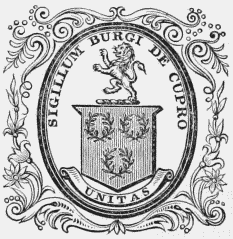
Seal and Arms.
The town is situated on the high road from Edinburgh, through Fife, to Dundee, and at the confluence of the rivers Eden and Ladyburn, over the former of which are three handsome bridges, facilitating the intercourse between the north and south portions. From its situation, it is the great thoroughfare between the ferries of the Forth and the Tay, and consequently, in addition to its trade and well-frequented markets, derives much traffic from the frequent influx of strangers. It is well built, and consists of several principal streets, of which some are of recent formation, originating in the modern improvements of the town, and of several smaller streets; they are cleansed, paved, and watched from the common funds of the corporation, and lighted with gas by assessment of the inhabitants. It has been considerably enlarged by the addition of the suburbs of Brae-Heads, Newtown, and Lebanon; and the whole has a cheerful and very respectable appearance. A public library has long been established, and is supported by subscription; it contains more than 6000 well-chosen volumes, among which are many scarce and valuable books selected by Dr. Gray, who bequeathed his library to the subscribers. There is also a public reading-room, well supplied with periodicals. A pack of fox-hounds for the Fifeshire hunt is kept here, as the chief place of the meeting of its members; the environs are pleasant, and afford much interest to the sportsman. The principal manufacture is that of linen, which gives employment to about 900 persons in the town and parish, who work with hand-looms at their own dwellings. The linen made is of various qualities, and is mostly exported to the East and West Indies, to the continent, and to America. Connected with this manufacture are three mills in the parish, two of which are for spinning flax, and one for thread. Of the former, one is set in motion by water, and the other partly by water and partly by steam, and the third entirely by steam; they employ in the aggregate nearly 240 persons. There are two mills for grinding oatmeal and barley, and two flour-mills, all of which were held under the corporation until recently, when the feu-duty was sold. The manufacture of snuff was formerly carried on to a considerable extent, for which purpose a mill was erected producing 60,000 pounds annually; and from the increasing demand for that article at one time, it was found requisite to add power to the mill by the erection of a steam-engine. There are also a fulling-mill and two tanneries in constant use, to the latter of which has been added a manufacture of glue; three public breweries have been established, and there is an extensive manufactory of coarse earthenware, for which the clay found in the parish is well adapted, and also for bricks and tiles, of which great numbers are made. The market is on Thursday, and is largely supplied with samples of corn, and numerously attended by dealers from the neighbouring districts; fairs are also held, for the sale of live stock, agricultural implements, and various other articles.
The inhabitants received their first charter of incorporation from David II. It bestowed many privileges, which were extended by Robert II., who also granted the burgesses considerable property in lands; and all these gifts were confirmed by subsequent charters down to the reign of James VI., who conferred upon the burgesses additional immunities, and the lands of the burgh at a fee-farm rent, by charter dated at Edinburgh in 1595. By these charters the government was vested in a provost, three bailies, a dean of guild, treasurer, and a council of thirteen, a convener, and seven deacons of trades, assisted by a town-clerk, and other officers; but the town council, composed of twenty-six members, is now elected in strict accordance with the provisions of the Municipal act of 1833. The provost and bailies, and all other officers, are chosen by the council; the town-clerk alone holds office for life. There are eight guilds of trade, the hammermen, wrights, weavers, tailors, shoemakers, waulkers, bakers, and butchers, who hold their exclusive privileges under a modifying charter of Queen Anne; each of these guilds elects its own deacon, and the deacons make one of their number convener, to preside over all the guilds. The freedom is inherited by patrimony, by marriage with a freeman's daughter, by apprenticeship, or by purchase, the amount of which varies in the different guilds from £20 to £50. The magistrates hold burgh courts for the determination of pleas to any amount, but the sheriff's courts for small debts have nearly superseded the practice, and their criminal jurisdiction, also, though by charter extending to all offences not capital, is by custom limited to misdemeanours and cases of petty assaults, all graver offences being referred to the county magistrates. By the act of the 2nd and 3rd of William IV., the burgh unites with those of St. Andrew's, Crail, the two Anstruthers, Kilrenny, and Pittenweem, in returning a member to the imperial parliament. The right of election is vested in the householders of the annual value of £10 and upwards, resident within the limits of the parliamentary boundary, which is more extensive than the municipal: St. Andrew's is the returning burgh. The assizes for the county, and the election of members for the county, are held here. The town-hall and county-hall are both neat and substantial buildings, well adapted to their respective uses, but not distinguished by architectural elegance. The latter is very spacious, and contains the requisite court-rooms for the sheriff and justices, a large room for holding county meetings, and also an office for keeping the public records; in the hall are, a portrait of the late General John, Earl of Hopetoun, finely painted by Raeburn, and one of Thomas, Earl of Kellie, lord lieutenant of the county, by Wilkie. The old town and county gaol, situated on the opposite side of the river Eden, was badly arranged, and has been superseded by a large county prison built to the north-east of the town, under the Prison act of the year 1839.
In 1618, the parish of Cupar was augmented by the union of that of Tarvit on the opposite bank of the Eden. At present it extends five miles in length, and nearly the same in breadth; it comprises 5545 acres, all of which, with the exception of a moderate proportion of woodland and pasture, are arable land in the highest state of cultivation. The surface is in some parts gently undulating, in others rising into hills of moderate elevation, and near the banks of the rivers by which it is intersected, forming extended plains; the scenery is enriched with woods of natural growth and thriving plantations. The river Eden, which rises in West Lomond, about fifteen miles distant, flows through the parish from west to east, in the centre of a broad and fertile vale; and the Ladyburn, which intersects the parish from north-west to south-east, flows into the Eden at the eastern extremity of the town. The soil is various, in some parts a light sand, in others a stiff clay, and in the valleys rich and fertile; but even the poorer soils are rendered abundantly productive by diligent cultivation and a liberal use of manure, which is plentiful. The system of husbandry is in the most improved state; the crops are, oats, barley, wheat, potatoes, of which great quantities are grown for the London market, and turnips, with the usual green crops. Great attention is also paid to the rearing of live stock. The oxen are mostly of the old Fifeshire breed, and, in the great cattle-shows, have generally obtained prizes awarded by the agricultural societies; some of the Teeswater breed have been introduced, but they are not generally approved. The substratum of the soil is various. White sandstone is prevalent along the banks of the Eden; on those of the Ladyburn, a conglomerate sandstone is found, in which are imbedded quartz and flint; and at a short distance from the confluence of those streams, is an extensive mound consisting of gravel. Greenstone, trap-rock, and clinkstone are likewise found, above the gravel and sandstone along the banks of the Eden, and are quarried, together with the white sandstone, for road-making and for building. The rateable annual value of the parish is £18,715. The ancient mansion of Carslogie, for many ages the family seat of the Clephanes, was erected about 400 years since, and is, with the grounds, still kept up; Wemyss Hall was built about the commencement of the last century, and has been recently enlarged. Kilmaron is a modern mansion in the castellated style, after a design by Gillespie. Tarvit, Springfield, Dalyell, Hilton, Carnie Lodge, Pitblado, Preston Hall, Middlefield, Balas, Ferrybank, Bellfield, Blalowne, and Westfield, are also within the parish, and are neat residences, pleasantly situated.
The parish is in the presbytery of Cupar and synod of Fife, and patronage of the Crown. There are two benefices; the minister of the first charge has a stipend of £259, with a manse, and a glebe valued at £21 per annum; the minister of the second charge has the same amount, but neither manse nor glebe. The church was erected in 1785, and has been altered and enlarged from time to time; and another church, called St. Michael's, has lately been built, at an expense of about £1800, partly raised by transferable shares, which entitle each subscriber to the choice of a seat. There is an episcopal chapel, a very handsome building; also places of worship for members of the Free Church, the Relief Connexion, Old Light Burghers, Baptists, and Glasites. The grammar and English schools, formerly supported by the burgh, have been discontinued, and an academy, for which an appropriate building has been erected on the Castle Hill, has been substituted in their place, the patronage and management being vested in the trustees of the late eminent Dr. Andrew Bell, of Madras, who bequeathed some property called Eggmore, in Dumfriesshire, and between £400 and £500 per annum, for the purposes of education in the town. The late Dr. Gray, of Middlesex, bequeathed £500 for the establishment of a female school here, the management of which is vested in the provost, clergy, and schoolmaster of Cupar. An almshouse for ten or twelve poor persons is under the management of the Kirk Session; it is of very ancient date, and the origin of its foundation is not distinctly known. There is also an asylum for females above fifty years of age, recently erected by a legacy of £3000 bequeathed by David Knox, Esq., of London, for its foundation and endowment. The poor likewise have the interest of £450 by Dr. Gray for their benefit. On the bank of the Eden, on the Tarvit side of that river, is a small conical eminence, anciently the site of the church of St. Michael of that parish, which had long ceased to exist previously to the union of Cupar and Tarvit; and in making some improvements in the road near the spot, many of the graves were thrown open, and the remains of the dead exposed to view. Upon the summit of a hill near Wemyss Hall, are the remains of the cross of Cupar, which, on its removal from its ancient site in the town, in order to the formation of a new street, was set up in its present situation by the late Col. Wemyss. It consists of a circular shaft, placed on a massive pedestal hewn from the rock on which it stands; and above the capital are placed the ancient arms of the town.
Cupar-Angus
CUPAR-ANGUS, or Coupar-Angus, a market-town and parish, partly in the county of Forfar, but chiefly in that of Perth; including the villages of Balbrogie, Longleys, and Washington, and containing 2745 inhabitants, of whom 1868 are in the town, 12 miles (N. N. E.) from Perth, and 55½ (N.) from Edinburgh. This place derives the affix distinguishing its name from that of Cupar in Fifeshire, from the more ancient part of the town, which is within the county of Forfar or Angus. An abbey of Cistercian monks was founded here in 1164, by Malcolm IV., who amply endowed it with lands in this parish, and various other estates in different parts of the country. Among its possessions here were, Cupar grange, the home-farm of the monastery, where the abbot had a country residence, and the lands of Keithick, Arthur-stone, Denhead, Balgersho, and Cronan. The endowment was augmented by the Hayes, of Errol, and other benefactors; and the establishment continued to flourish till the dissolution, when its revenue was valued at £1239 in money, and large payments in wheat, oats, barley, and other produce. The last abbot was Donald Campbell, of the Argyll family, who, with the commendator, was buried in Bendochy church. The buildings had begun to fall into a state of dilapidation some few years before the Reformation, and their ruin was completed by a body of reformers from Perth. The only vestiges now remaining of this once magnificent structure are in the north-west angle of the present churchyard, on the side of the road to Dundee. A portion of the building with a beautiful arch was taken down in 1780, to furnish materials for the erection of the parish church, of which the north wall rests upon part of the foundation of the ancient edifice. The lands belonging to the monastery were erected, after its dissolution, into a temporal lordship by James VI., and granted to the Hon. James Elphinston, second son of Lord Balmerino, who was created Lord Coupar in 1609. On his decease without issue the title and estates merged in the Balmerino family, and, on the attainder of Arthur, Lord Balmerino, in 1745, became forfeited to the crown.
The town, which was an ancient burgh of regality, is pleasantly situated on the banks of a stream that flows into the river Isla, about three miles to the west of it; and consists principally of four streets, formed by the lines of the Perth and Dundee high roads, which intersect each other in the market-place. The houses are generally neat and well built, and some, of more recent erection, are of elegant appearance; the streets are payed, and lighted with gas by a company established within the last few years, and the inhabitants are amply supplied with water. A public news and reading room, well furnished with the London and provincial journals, is supported by subscription; and an agricultural society formed about twenty years since, for awarding premiums to the best breeders and feeders of cattle, hold their meetings here twice every year. The post-office has a good delivery, and facility of communication with Perth and Dundee, and other towns in the vicinity, is afforded by excellent roads, and by the Cupar-Angus and Newtyle branch of the Dundee railway. The principal manufacture pursued is the hand-loom weaving of the coarser kinds of linen for the wholesale houses in the neighbourhood; there is also a tannery in operation. A salmonfishery is carried on in the river Isla, which likewise abounds with trout. The market is on Thursday, and fairs are held on the third Thursday in March, for horses and cattle; on the 26th of May, if on Thursday, otherwise on the first Thursday after, for cattle and sheep, and for hiring servants; on the third Wednesday in July, and the first Tuesday in October, for horses, sheep, and cattle; and on the 22nd of November, if on Thursday, or on the first Thursday after, for cattle and for hiring servants. Cattle-markets are also held on the first Thursday in December, and every succeeding Thursday till May. The Steeple was erected by subscription in 1767, on the site of the ancient prison of the burgh of regality, and the lower part of it is used as a place of temporary confinement.
The parish is bounded on the north by the river Isla, and is intersected by the great north road through the vale of Strathmore; it is about five miles in length, and from one mile and a half to two miles and a half in breadth, comprising 2800 acres. The surface is varied; and from a high ridge which intersects the parish, is obtained a splendid view of the Sidlaw mountains on the south, the lower range of the Grampians on the north, with the distant summits of Ben-More, Schihallion, and Ben-Voirlich. The soil is various; in some parts a rich alluvial loam; in others a stiff retentive clay, alternated with sand and gravel, and with peat-moss. The system of agriculture is improved, and the rotation plan of husbandry is in general use; the chief crops are, wheat, oats, barley, and turnips. The lands have been well drained, and much of inferior quality has been brought into profitable cultivation; the buildings on the larger farms are substantial and commodious, but on the smaller of a very inferior description. The cattle, generally of a mixed breed, have been much improved under the encouragement afforded by the agricultural society. The rateable annual value of the Perthshire portion of the parish is £9324, and of the Angus portion £591, making a total of £9915. Keithick and Arthurstone are handsome residences. There were formerly populous villages at Keithick and Caddam, but both have disappeared. The ecclesiastical affairs are under the superintendence of the presbytery of Meigle and synod of Angus and Mearns. The minister's stipend is £239, with a manse, and a glebe valued at £25 per annum; patron, the Crown. The church, a plain structure, was built in the year 1780, and enlarged in 1832, and contains 800 sittings. There are places of worship for members of the Free Church and United Associate Synod, Original Seceders, the Relief Church, and Episcopalians. The parochial school is well attended; the master has a salary of £34, with a house and garden, and the fees average above £70. A savings' bank was opened in 1839, and has deposits to the amount of £2600; there are also two friendly societies, and a ladies' society for visiting and assisting indigent and aged women. To the east of the churchyard are the remains of a Roman camp, supposed to have been that of Lollius Urbicus, and within the area of which the abbey was founded.
Currie
CURRIE, a parish, in the county of Edinburgh, 6 miles (S. W.) from Edinburgh; containing, with the villages of Balerno and Hermiston, 2000 inhabitants, of whom 297 are in the village of Currie. This place, called anciently Kil-Leith, from a religious establishment on the Water of Leith, is supposed to have derived its more general appellation from the remains of the Roman station Coria, which some antiquaries have identified with the immediate vicinity. The lands appear to have been the property of the Lennox family, of whose baronial residence, Lennox Tower, there are still considerable remains on an elevated situation on the bank of the river, commanding a fine view of the Frith of Forth. This castle, which was the occasional residence of Mary, Queen of Scots, and afterwards of the regent Morton, was a place of great strength, surrounded by a rampart, and inaccessible on all sides. A subterraneous passage afforded communication with the river, and has but recently been closed, to protect the cattle that graze on its site.
The parish is skirted on the south by the Pentland hills, and is about six miles in mean length, though its extreme points from east to west are eight miles distant. It is four miles in average breadth, and comprises an area of 11,000 acres, of which two-thirds are arable, and the remainder hill pasture and moss. The surface is generally elevated, and broken into numerous hills, of which Ravelrig, nearly in the centre of the parish, is 800 feet above the sea. There are also Currie hill and various others, of which some rise to a still greater height. The lower grounds are watered by the river of Leith, which has its source in three copious springs near the western extremity of the parish, and, after a course of fourteen miles, in which it turns numerous mills, flows into the Frith of Forth at the harbour of Leith. The soil is mostly a stiff retentive clay, and, though difficult to work, is fertile, producing favourable crops of grain of all kinds, notwithstanding that the harvests are usually late. The system of husbandry is in a very improved state; the lands are inclosed, and the farm-buildings substantial and commodious. Considerable numbers of black-cattle are reared in the pastures, and sent to Edinburgh; and during the spring and summer months, many sheep are purchased by the farmers, and fattened for the neighbouring markets. The rateable annual value of the parish is returned at £12,164.
The principal substrata are limestone and freestone of excellent quality; and along the banks of the river, ironstone is found in abundance. The limestone is not wrought for manure, from the want of coal; but near the village of Balerno are extensive quarries of freestone, from which materials have been taken for many of the buildings of the New Town of Edinburgh. In the lower parts of the parish, towards the north, are considerable remains of ancient woods; but on the higher lands, except on the demesnes of the landed proprietors, there are very few plantations. The seats are, Baberton, Ravelrig, Glen-Darroch, Glen-Brook, Riccarton, Currie Hill, Larch Grove, Bankhead, West Brook, and Malleny. The village of Currie is situated on the banks of the Water of Leith, and on the road to Lanark. The manufacture of paper was introduced here about the year 1790, by Messrs. Nisbet and Macniven, who erected extensive mills for that purpose; and there are also numerous corn and other mills in the parish. Facilities of communication are afforded by the roads to Lanark and Glasgow, and by the Union canal, which passes through a small portion of the parish.
The ecclesiastical affairs are under the superintendence of the presbytery of Edinburgh and synod of Lothian and Tweeddale. The minister's stipend is £264, with a manse, and a glebe valued at £16 per annum; patrons, the Town Council of Edinburgh. The church, a neat structure erected about the year 1790, is situated on an eminence on the south bank of the river; and its spire, rising above the foliage around, forms a pleasing feature in the scenery of the village. There is a place of worship for members of the United Secession Church. The parochial school is well attended; the master has a salary of £34, with a house and garden, and the fees average £42. Opposite to Lennox Tower, on the other side of the river, are the ruins of the ancient mansion of the Skenes, of Currie Hill; and on the summit of Ravelrig, are some remains of a Roman exploratory camp. Among the distinguished persons connected with the parish have been, Sir George Skene, lord registrar in the reign of James VI., and his son, Sir James, president of the court of session; Sir Thomas Craig, lord advocate in that reign; and the Scotts of Malleny, eminent lawyers of the same period. Sir Archibald Johnston of Warriston, uncle of Bishop Burnet, and whose son was envoy to Brandenburgh in the reigns of King William and Queen Anne, was a large landholder in the parish.
Cushnie
CUSHNIE, Aberdeen.—See Leochel.
Cuthbert's, St.
CUTHBERT'S, ST.—See Edinburgh.
Cuthill
CUTHILL, or Cuttle, a village, in the parish of Prestonpans, county of Haddington; containing 172 inhabitants. This place is on the shore of the Frith of Forth, and in the western part of the parish, adjoining the village of Prestonpans. Some salt-works, a pottery, and a magnesia manufactory were formerly carried on here.
Cyrus, Saint
CYRUS, SAINT, or Ecclescraig, a parish, in the county of Kincardine; including the villages of Lochside, Milton, Roadside, and Tangleha, and containing 1600 inhabitants, of whom 207 are in the village of St. Cyrus, 5½ miles (N. by E.) from Montrose. This place, now generally known by the former of the two names, is supposed to have derived the latter, in the Gaelic language Eaglais-Creag, from the situation of its church at the base of a rocky promontory projecting into the North Sea. The name of St. Cyrus, which, till the close of the last century, was limited to a portion only of the parish, is derived from a saint who lived in retirement on the adjacent lands of Criggie, where there is a well still called after him. At an early period, this place was distinguished for a castle named the Fortress of Lauriston, near the eastern boundary of the parish. It was erected about the 10th century, and, in the reign of Edward III. of England, sustained repeated assaults from the troops of that monarch, by whom, in 1336, it was taken and garrisoned with English soldiers; but towards the close of that year it was recaptured by the regent Murray, and dismantled. The castle, and the lands belonging to it, were, for more than four centuries, in the possession of the Straton family, but in 1695 were sold to Sir John Falconer. From his descendants they were, about the year 1789, purchased by Mr. Brand, who incorporated the remains of the ancient building, consisting of a square tower and a portion of the chapel, into a spacious modern mansion.
The parish, which is bounded on the south-east by the sea, and on the south and south-west by the North Esk river, is about five miles in length, and from two and a half to three in breadth. It contains 8477 acres, of which 6234 are arable, 300 woods and plantations, and the remainder meadow, pasture, and waste. The surface is diversified with hills, of which the principal are, Bridgeton and Jackston, in the east, and Morphy and Pitbeadly in the west, averaging about 500 feet in height, and Brands hill and Woodston hill, having an elevation of 630 feet above the sea. These hills are intersected with deep valleys and narrow glens, watered by various rivulets, one of which, in its progress towards the sea, forms a picturesque cascade. The coast, which is indented with several small bays, is a level beach of fine sand for about a mile from the mouth of the North Esk, beyond which it is lined by precipitous cliffs of limestone, worn by the action of the waves into caverns of fanciful appearance. In the vicinity of Milton-Mathers, where lime-works had been long established, the quarrymen had so undermined the elevated ledge which defended that part of the coast, that, in 1795, the whole of the village was swept away by an irruption of the sea, which has now encroached for 150 yards upon the land.
The soil is generally a rich and fertile clay, well adapted for grain of every kind; the crops are, oats, barley, wheat, beans, peas, turnips, and potatoes, of which last great quantities are raised. The system of agriculture is improved; the dairy-farms are productive, and a kind of sweet-milk cheese is made, which is in high estimation. The rateable annual value of the parish is £14,034. The woods mainly consist of ash, plane, elm, beech, and birch, and the plantations of larch and Scotch and silver firs; they are well managed, and are for the most part thriving. A great variety of other trees have been planted on the lands of Lauriston with entire success. The prevailing rocks in the parish are of the old red sandstone and trap formation. There are quarries of a durable white sandstone, used chiefly for ornamental building, on the lands of Kirkside; and at Woodston and Lauriston, sandstone which is easily wrought, and very durable, is extensively quarried, yielding a return of £1000 per annum. Tilestones were formerly obtained at Morphy, for roofing; but, from their insufficiency to resist the influence of the atmosphere, the use of them has been discontinued. Lime-works were also once carried on, to a great extent; and at Sea-Greens, on the coast, in the immediate vicinity of the works, is a small harbour accessible to boats of 50 or 60 tons' burthen, by which the produce of the works was conveyed to its destination. Among the seats in the parish is Lauriston, a handsome mansion erected by the late proprietor, and including portions of the ancient castle; it is romantically situated on the verge of a precipitous height rising from a deep and richly-wooded dell. Mount Cyrus stands on an eminence to the north-west of the village, with beautiful lawns and extensive plantations; and Kirkside House, a substantial modern mansion, is near the southern extremity of the parish, in grounds tastefully laid out, and commanding some fine views of the bay and town of Montrose. Bridgeton is also pleasantly situated, on rising ground near the eastern extremity of the parish. The manufacture of coarse linen is carried on, affording employment to about thirty persons. There are some valuable salmon-fisheries, together 'producing a rental of nearly £3000 per annum, and giving occupation to about sixty persons; the greater number of fish are packed in ice, and conveyed to the Edinburgh and London markets. Facility of communication is afforded by good roads, of which the great north road passes through the parish, and has on its line two handsome bridges, one built in 1775, at an expense of £6000, and the other in 1817, at a cost of £600.
The ecclesiastical affairs are under the superintendence of the presbytery of Fordoun and synod of Angus and Mearns. The minister's stipend is £247. 17., with a manse, and a glebe valued at £11 per annum; patron, the Crown. The church, erected in 1783, on a site nearly a mile to the north of the ancient church, and enlarged in 1830, is a neat substantial structure with a spire, and contains about 850 sittings. From its situation on an eminence 250 feet above the level of the sea, it forms a conspicuous landmark for mariners. There is a place of worship for members of the Free Church. The parochial school is well attended; the master has a salary of £33, with a good house and garden, and the fees average £30. The parochial library contains nearly 750 volumes, chiefly on religious subjects. Sir Joseph Straton, of Kirkside, bequeathed £500 for promoting education within the parish, the proceeds of which sum are applied to the payment of school fees for the children of the poor. Among the relics of antiquity is the Kaim of Mathers, a camp on those lands, situated on a rocky peninsula connected with the main land by a narrow isthmus, defended by battlements on each side: on the peninsula are the remains of a square tower, said to have been the residence of the ancestors of the Barclays of Ury. The castle of Morphy, supposed to have been the baronial seat of the Graham family, has totally disappeared, and the site has been effaced by the plough. On the lands, however, is still an upright stone, erected, according to tradition, to commemorate the defeat of the Danes in a battle that took place near the spot; it has the form of an obelisk, about thirteen feet in height, and the number of stone coffins containing human bones which have been found in an adjoining field, strengthens the probability of its supposed origin. On the hill of Pitbeadly are some remains of a circular camp.