
A Topographical Dictionary of Scotland. Originally published by S Lewis, London, 1846.
This free content was digitised by double rekeying. All rights reserved.
'Govan - Guthrie', in A Topographical Dictionary of Scotland, (London, 1846) pp. 514-527. British History Online https://www.british-history.ac.uk/topographical-dict/scotland/pp514-527 [accessed 24 April 2024]
In this section
Govan
GOVAN, a parish, chiefly in the Lower ward of the county of Lanark, but partly in the Upper ward of the county of Renfrew; including the village of Strathbungo, and the late quoad sacra district of Partick; and containing 7810 inhabitants, of whom 2474 are in the village of Govan, 2 miles (N. W.) from Glasgow. The name of this parish is generally supposed to have been derived from the two Saxon words god and win, "good wine," applied on account of the superior ale for which the place was celebrated, and which, after being kept for several years, approached in flavour to wine. Some, however, derive it from the Gaelic word gamham, pronounced gavan, and signifying "a ditch," used in reference to the river Clyde, which runs through the parish, and which, in ancient times, was a very narrow stream. The most remote historical information relating to Govan is connected with the removal of Constantine, King of Cornwall, into Scotland: that prince is said to have come from Ireland, after resigning his crown, among the followers of St. Columba, in the year 565, and to have founded a monastery here, of which he became the first abbot. He is supposed to have been martyred by the inhabitants of Cantyre, who thus resisted his attempts to convert them to Christianity, and afterwards to have been buried in his own monastery. Many of the estates of the parish were, in early times, successively made over as gifts to the church. David I. gave the lands of Govan to the church of St. Kentigern, otherwise called St. Mungo, at Glasgow; and in 1136, when present at the consecration of the cathedral of that city, he bestowed a part of the estate of Partick, and subsequently another portion of the same lands, on the see.
These grants, with many others, were confirmed by the bulls of several popes; and Bishop John, who filled the episcopal chair for thirty-two years, made Govan a prebend of Glasgow, the emoluments of which were increased by Herbert, chancellor of Scotland, who presided as Bishop of Glasgow till 1164. The lands were consequently long held by tenants under the bishops and archbishops; but at the Reformation, Walter, commendator of Blantyre, was commissioned to feu the estates, that the tenants, becoming heritable possessors of their several properties, might be encouraged to improve them to the utmost. In 1595, the landholders united in procuring a charter, to confirm this privilege, from James VI.; and from that time the crown became lessor. Afterwards, the college of Glasgow obtained leases of the lands from the crown, and continued to hold them for upwards of a century, to the year 1825, when, in lieu of the leases, a grant was made to the establishment of an annuity of £800, for fourteen years, by George IV. The heritors still pay feu duties to the crown, as coming in place of the archbishops. But the parish is not remarkable solely on account of its ecclesiastical history: as containing the Muir of Govan, it was in ancient times the scene of several important political and military transactions. That this was the case, is evident from the circumstance that the lords who had confederated together in defence of the Protestant religion, after the treaty between the queen regent and the Protestants, at Leith, on July 24th, 1559, suspecting her integrity, resolved to have a meeting with "their kin and friends, upon Govan Muir, beside Glasgow," for the purpose of providing for exigencies. This meeting, however, the queen regent, by the exercise of no common address, contrived successfully to prevent. The moor, also, is famed for the defeat of Queen Mary's army after her escape from the castle of Lochleven.
The parish is about five miles long, and from two to three miles broad. The lands of Haggs, Titwood, and Shields belong to the county of Renfrew: the remainder of Govan is bounded on the north by the parishes of New Kilpatrick, Barony, and Glasgow; by Cathcart, Eastwood, and the Abbey parish of Paisley, in Renfrewshire, on the south; on the east by Barony, Gorbals, and Rutherglen; and on the west by Renfrew parish. The surface is diversified by gentle undulations and acclivities, the extensive and fertile plain in the centre of the parish being succeeded on each side by gradually rising grounds; and the fields are defined by wellgrown hedges, which, with the Clyde, and the numerous and beautiful villas in different directions, constitute an assemblage of very agreeable and interesting scenery. The Clyde, after being joined by the Kelvin, runs through the centre of the parish, and, though anciently rather a narrow stream, is now a channel for ships of 600 tons' burthen, conveying stores from every part of the world into the harbour of Glasgow. The soil in general is of good quality, and produces fine crops of grain, as well as of the best potatoes and turnips. The five years' rotation is followed; and the ground is largely supplied with manure from Glasgow, to which it is chiefly indebted for its fertility: wheat and oats are the chief grain, and are grown in considerable quantities. Many improvements have been made, in remoter as well as more recent times, in the agricultural character of the district; and the celebrated moor, depicted in song as "the carpet of purple heath," now consists of a number of well-inclosed fields, bearing, year after year, as luxuriant crops as are any where to be met with. Similar changes have been effected in other parts, especially about Moss House and Heathery Hall. At White-Inch, the low ground along the north side of the Clyde has been recently enriched, and elevated to a height of from ten to fifteen feet, by soil obtained from the deepening and widening of the river, in consequence of which the worth of the land has been nearly doubled. The rateable annual value of Govan is £30,070.
The subterraneius contents of the parish are chiefly coal, with the strata peculiar to that formation. Several pits are regularly worked, in one of which, at Bellahoustown, on the south of the river, a portion of the layers consists of parrot or cannel coal, which sells at a high price for the purpose of being converted into gas. At Jordanhill and Cartnavel, about fifty fathoms beneath the surface, are sixteen beds of coal, some of them two feet thick, and part being, like the parrot coal, of the finest quality for making gas. Above the gas-coal, as well as at a lower depth, are numerous seams of ironstone, which vary in thickness from five to twelve inches, and are of excellent quality. The collieries of Govan, forming part of the well-known Glasgow coal-fields, have been long wrought; and it is supposed that, beneath the seven principal seams now open, lie others, which will afford a plentiful supply if at any time those at present being worked should be exhausted. The surface just above the coal is composed, in general, of diluvial matter, containing rolled stones, over which are deposits of sand, fine clay, and marine shells. A number of fossil trees were discovered a few years ago at Balgray, standing close to each other in their natural position, though two feet only of the trunks were found attached to the roots.
The population of the parish, which has very considerably increased of late years, from the growing prosperity of Glasgow, is chiefly employed in agriculture and Manufactures, and a large number in coal-pits and quarries. In the village of Govan are 340 handloom weavers; a dye-work employs 118 hands; and at a small distance from the village is a factory for throwing silk, erected in 1824, and which affords occupation to about 250 persons. Near Port-Eglinton is a carpet manufactory, established several years ago, in which 554 persons are engaged; and various other concerns are carried on in different parts, chiefly connected with the cotton manufacture. In the neighbourhood of the collieries are iron-works, containing several blast-furnaces, which produce many hundred tons of pig-iron annually; and near these, a bar-iron manufactory, belonging to the same proprietor, has been constructed, producing upwards of 400 tons weekly. There is a fishery for salmon on the Clyde, the rent of which was formerly £326; but it has fallen, since 1812, to £60 per annum, in consequence of the erection of the numerous manufactories on the banks of the river. In the villages of Govan and Partick are penny-posts, which communicate with Glasgow twice each day. Four great roads pass through the parish, one of which runs from Glasgow to Paisley; another leads to Kilmarnock and Ayr; the third to Port-Glasgow and Greenock, through Renfrew; and the fourth to the West Highlands by the town of Dumbarton. The Glasgow and Johnstone canal also intersects the parish, and a branch of the Forth and Clyde canal touches its northern boundary. A boat, capable of conveying horses and carriages, plies upon the ferry that connects the two parts of the parish at the village of Govan: all steam-boats, also, except those of the largest class, land and take in passengers here. The Pollock and Govan railway joins the mineral fields on the south-east of Glasgow, with that city and the harbour; and the Greenock and Ayr railroad runs for about three miles through the parish of Govan.
The ecclesiastical affairs are subject to the presbytery of Glasgow and synod of Glasgow and Ayr. The temporal immunities of the church came, at the time of the Reformation, into the possession of the college of Glasgow. The Regent Morton had offered the benefice to his uncle, Andrew Melville, principal of the college, on condition that he would not press his views of ecclesiastical polity; but this compromise being refused by Melville, the regent conveyed the temporalities to the college, devolving upon the principal the obligation of serving the cure; and since that time the university has held the patronage. The stipend of the minister is £315, with a good manse, standing near the church, and a glebe of seven acres, valued at £25 per annum. The church, situated at the west end of the village of Govan, and about 100 yards from the Clyde, was built in 1826, and is a plain structure containing 1096 sittings: the design of the tower and spire was taken from the church of Stratford-upon-Avon, in England. The churchyard is raised several feet above the level of the adjacent ground, and is surrounded by a double row of venerable elms. There are places of worship belonging to the Free Church, United Secession, Relief Church, and Roman Catholics. The parochial school is situated in the village of Govan; the master has the maximum salary, with £1. 13. 4. from Glasgow college, £1. 19. accruing from an ancient bequest of Lamb Hill, and £36 arising from a sum of £200, left by Mr. Abram Hill, in 1757. Mr. Hill was educated in the school as a poor orphan, and his gift was invested in ten acres of land, now producing the above sum, for which ten children are taught gratuitously: the master has also £18 fees, a good house, and an allowance in lieu of a garden. An infant school was instituted at Partick, in 1837, on a very extensive scale; and other schools are supported in different parts of the parish. There is a good parochial library, under the management of the trustees of Mrs. Thorm, its founder, and containing above 600 volumes; also a savings' bank, and several friendly societies.
The ruins of the once celebrated Hospital of Polmadie were, at the close of the last century, among the most interesting Antiquities of the parish. This hospital was built at a very remote period, for the reception of persons of both sexes to be maintained for life; and was dedicated to St. John. The church and temporalities of Strathblane were early annexed to it, with part of the lands of Little Govan; and these possessions, with many important privileges, were confirmed to the establishment by Alexander III., Robert Bruce, and several others. In the year 1427, Bishop Cameron, with the consent of the chapter, erected the hospital, and the church of Strathblane, into a prebend, with a provision that the person collated to the office should support a vicar in the parish of Strathblane, and pay four choristers to sing in the cathedral. St. Ninian's Hospital, founded by Lady Lochow, in the fourteenth century, for the reception of persons afflicted with leprosy, partly occupied a piece of ground called St. Ninian's croft, where Hutchesonton, formerly within this parish, but now in Gorbals, at present stands; and close to its site, a number of human bones were not long since found, pointing out the locality, as is supposed, of the lepers' churchyard. On the south of the Clyde, opposite the ferry-house, is an ancient circular hill, thought to have been the sepulchre of some celebrated hero; and in another part of the parish is the picturesque ruin of Hagg's Castle, built in 1585, by an ancestor of Sir John Maxwell, of Pollock.—See Gorbals.
Gowan-Bank
GOWAN-BANK, a hamlet, in the parish of St. Vigean's, county of Forfar; containing 72 inhabitants.
Gowkhall
GOWKHALL, a village, in the parish of Carnock, district of Dunfermline, county of Fife, 1 mile (E.) from Carnock; containing 196 inhabitants. It is situated in the eastern part of the parish, a short distance north of the high road from Dunfermline to Carnock; and is one of three villages of which the population is chiefly engaged in manufactures.
Gowkshill
GOWKSHILL, a village, in the parish of Cockpen, county of Edinburgh; containing 219 inhabitants.
Gilemsay Isle
GILEMSAY ISLE, in the parish of Hoy, county of Orkney; containing 214 inhabitants. It is one of the Orkney group, and lies about a mile and a half south from Stromness; in length it is nearly two miles, and in breadth one. The whole of the island is level, and is either cultivated for the production of grain, or suffered to remain in old grass for the pasturage of sheep and cattle. Through almost its whole extent runs a bed of schistus, or slate, used for the covering of houses. The inhabitants excel in fishing. The principal disadvantage under which they labour, is the scarcity of fuel. Græmsay was formerly a vicarage, but is now united to Hoy, which see.
Grahamston
GRAHAMSTON, a village, in the parish of Falkirk, county of Stirling, 1 mile (N.) from Falkirk. This village derives its name from Sir John the Graham, who was killed here in the battle which Wallace fought with Edward I. in 1298. It forms part of the suburbs of Falkirk, and is included within the burgh, and situated on the south bank of the Forth and Clyde canal, over which is a drawbridge, connecting it with Bainsford. The houses are handsomely built, chiefly of stone, and of modern appearance; and there are numerous shops, stored with various kinds of merchandise. The labouring portion of the inhabitants are chiefly employed in the Falkirk iron-works, and in those of the Carron Company. From its situation on the canal, the place carries on a considerable trade in timber and in grain; and numerous vessels arrive here with dried fish for the market of Falkirk, where it finds a ready sale. A post office, subordinate to that of Falkirk, has been established; and there are several schools in the village.
Grahamstown
GRAHAMSTOWN, a village, in the parish of Neilston, Upper ward of the county of Renfrew, 3 miles (S. S. E.) from Paisley; containing 706 inhabitants. This village, like many others in the parish, is indebted for its origin to the introduction of the cotton manufacture into this district about the year 1790, and to the erection of an extensive spinning-mill in 1801, by Mr. Graham, from whom it takes its name; it is neatly built, and principally inhabited by persons employed in the cotton-works.
Graitney
GRAITNEY, vulgarly called Gretna, a parish, in the county of Dumfries, 9½ miles (N. by W.) from Carlisle, and 309 (N. W. by N.) from London; containing, with the village of Springfield, 1761 inhabitants. The derivation of the name of this place is doubtful; but it is usually traced to the words Great knowe, descriptive of a hill standing at the distance of about a quarter of a mile from the church. The district is chiefly memorable for the many bloody feuds of which it was formerly the scene, as the frontier land of Scotland, and the celebration of which in tales and songs has scarcely at this time altogether passed away. The parish is skirted on the east by the river Sark; and the lands lying between that river and the Esk, now forming the English parish of Kirkandrews, were for many ages debateable ground, being common to both England and Scotland. These lands extended eight miles in length and four in breadth, and were long held by a kind of lawless banditti, whose chief employment was rapine and smuggling. In the year 1552, however, a line of demarkation was agreed upon by the sovereigns of the respective kingdoms; but notwithstanding this, the habits of the people continued nearly the same until the union of the crowns under James VI., from which time the state of the population gradually improved.
The parish is six miles in length and three in breadth, and contains about 11,000 acres. It is bounded on the north by the parishes of Kirkpatrick-Fleming and Halfmorton; on the south by the Solway Frith; on the east by the county of Cumberland; and on the west by the parish of Dornock. The surface is generally level towards the south and west; but towards the east and north it is diversified by many gentle acclivities, of which Graitney, the highest, rises about 250 feet above the sea. This eminence commands a beautiful and extensive view of the valleys of Esk and Eden, the Solway Frith, the coast of Cumberland, and St. Bees in a southern direction, and the mountains of Dumfriesshire and Northumberland. The eastern portion of the parish, from the number of its hedge rows, has the appearance of being well wooded; and the lands in this quarter are thickly interspersed with ash, oak, and plane trees, among which the first predominates. These, with the laburnum, give a pleasing variety to the scenery, and indicate, by their fine and expansive growth, the fostering power of a congenial soil. The whole southern boundary of the parish is washed by the Solway, the flat shore of which consists of sand and clay; but the only part of the coast approximating to the character of a bay is the curve between Redkirk and Tordoff points, the latter of which is about two miles from Bowness, on the opposite shore. The Frith, in the widest part, is between four and five miles across; and it is navigable as far as Sarkfoot, in this parish, for vessels of 120 tons' burthen. The tide flows with great rapidity, and rises, at its spring, twenty feet above the low-water mark; when it recedes, the streams of the rivers Esk and Eden, which run into the Solway from Cumberland, are seen with a wide bed of intermediate sand, and the Frith appears like a sandy waste, for a distance of forty miles, to the south-western extremity of Dumfriesshire, where the river Nith joins it. There are several little landing places along the shore; but the navigation is dangerous to those not acquainted with the soundings of the Frith. The Kirtle stream divides the parish into two nearly equal portions. There are excellent salmon-fisheries on the coast, and sturgeon, cod, and herrings are occasionally caught: salmon ascend the rivers for spawning, in the beginning of October, and return early in March.
The soil near the sea is a rich loam, with a subsoil of deep strong clay, and has the appearance of having been transported hither by the tides, which formerly came much higher up than at present. Further inland, the earth partakes more of the nature of clay and gravel, resting upon hills of sand of great dimensions. Portions of peat-moss are seen in different places, in which the remains of large oak-trees are imbedded; and in some of these, silver coins have been discovered, without a date, but bearing the scarcely legible marks of Canterbury and London, and partly belonging to the reign of one of the Edwards. About 10,000 acres are cultivated, or occasionally in tillage; 300 acres have never been cultivated, and sixty are planted with wood. All kinds of green crops and grain are produced, oats being the chief crop of the latter; and considerable quantities of every sort of live stock are kept. The most improved system of husbandry is followed: the manure in use comprises dung and lime, and guano, the lime being brought from several of the neighbouring parishes. The farms have been considerably enlarged, and are well inclosed with hedges; and the superior method of cultivation which has been pursued has nearly tripled the worth of the land since the year 1790, the rateable annual value of the parish now amounting to £6069. The prevailing rock is sandstone, through which many excellent springs of water find a passage. Among the villages and hamlets is that of Gretna, where a weekly cattle-market was formerly held, and which was a burgh of barony: the cross was standing till within these few years. The ancient mansion of Graitney Hall, in which one of the landowners once resided, has been fitted up in an elegant and commodious manner, as an inn; it is properly conducted, and every accommodation may be had, the same as at the best inns in England. The population are partly engaged in agriculture: about 600 persons are cottonweavers, employed by Carlisle houses, and who receive the yarn regularly every fortnight. Vessels of 100 tons arrive at various places along the shore, from the ports of Cumberland, and bring coal to the amount of 600 tons yearly, together with about an equal quantity of slate. Grain and potatoes are largely exported to Liverpool and other places on the coast of Lancashire. Till the commencement of the present century, an extensive contraband trade was carried on with the Isle of Man; but this traffic, with all its injurious consequences, has been abolished. The turnpike-roads between Glasgow and Carlisle, and between Carlisle and Portpatrick, run through the parish; and the old road to Carlisle crosses the Glasgow road at the village of Gretna, where is a post-office, connected with that of Carlisle. There are two bridges over the Sark, and one over the Kirtle, which, as well as the roads, are kept in good order. A cattle-market is held in June, and fairs on the 15th of September, the first Thursday after Falkirk tryst in October, and the second Thursday in November.
The ecclesiastical affairs are directed by the presbytery of Annan and synod of Dumfries; patron, the Earl of Mansfield. The stipend of the minister is £237; the manse has recently been enlarged and repaired, and is now a comfortable residence; the glebe consists of about sixteen acres, valued at £28 per annum. The church was built in 1790, and is a commodious building capable of containing 800 persons. There is a meeting-house at the village of Rigg, belonging to the United Associate Synod. Two parochial schools are supported, in which the usual branches of education are taught, and the masters of which have each £25 a year, with fees amounting to about £24 and £20 respectively. A friendly society was instituted more than fifty years ago. There are several ruinous towers in the parish, the relics of ancient times, and raised for the defence of the inhabitants against the English borderers; the walls were of great thickness, and the doors of massive iron, and within were formed caves for the safe custody of cattle, &c. They have port-holes above, for the inspecting or carrying on of warlike operations. The lands of Redkirk were formerly a separate parish; but its church, situated at Redkirk point, has been entirely swept away by the repeated encroachment of the tide. The remains of a Druidical temple are still visible on the farm of Old Graitney; and there are also the remains of several old camps in the neighbourhood. This being the nearest and most easily accessible point in Scotland from the sister kingdom, it has long been a place for fugitive marriages, first celebrated here by a man named Paisley, a tobacconist, whose original residence was on a green between Gretna and Springfield, to the latter of which villages he removed in 1782. It is said that between 300 and 400 marriages are annually celebrated in the neighbourhood by rival "priests," functionaries of the lowest class, who accost parties as they pass, and officiate for a very small charge. An attempt was made in the General Assembly, in 1826, to suppress this description of marriage, but without success. Paisley died at a great age, in 1814.
Grange
GRANGE, a parish, in the county of Banff, 3 miles (E. by N.) from Keith; containing 1661 inhabitants. This place originally formed a part of the parish of Keith, from which it was separated in the year 1618; it took its name from the circumstance of its being a country residence belonging to the abbots of Kinloss, to whom it was given by William the Lion in the 12th century. Attracted by the beauty of the place, at that time mostly under wood, the abbots had a castle here, situated upon an eminence, partly natural and partly artificial, and overlooking rich and extensive haughs, enlivened and refreshed for several miles by the meanderings of the picturesque Isla. In the neighbourhood is the Gallow-hill, the spot upon which criminals were executed within the local jurisdiction. At the time of the Reformation, the abbot, anticipating the change about to take place, feued out the district into many small properties, of which that of Edingight still belongs to the descendant of the original feuar, and about four-fifths of the others to Lord Fife, who inherits from his ancestor, Alexander Duff, of Braco, another of the first feuars. The remaining portion is in the possession of the Earl of Seafield.
The parish is six miles in length and five in breadth, and comprises about 20,000 acres, of which a large portion is under cultivation: there are extensive plantations of young wood. The surface is much diversified, and consists of high and low ground, the latter comprehending most of the cultivated parts: on the east is the Knock, an eminence rising 1600 feet above the level of the sea, and cultivated to a considerable height. This hill is chiefly covered with deep peat and heather, the moss running, at the summit, to the depth of eight or ten feet; and from it a very fine and extensive view may be obtained both of land and sea. In the dry summer of 1826, its sides were surrounded by a conflagration, destroying the combustible portion of the surface; but it has not been ascertained in what way the fire originated. There are also several lofty hills in the northern part of the parish; in the southern division are two called the Mickle and Little Balloch, ornamented around their base with wood; and in the centre is the Sillyearn, where there is a young, though large and thriving, plantation. The scenery is much indebted for its variety to its sylvan beauties, and to the course of its interesting stream, on the south of which a wide belt of larch and Scotch fir, of recent growth, especially improves the locality; and the Isla is rendered still more striking in pictorial effect by an ancient bridge, erected by a Mr. Christie, to render the church accessible to the residents of Cantly. This benevolent act was notified, and the memory of it transmitted to posterity, by an inscription on a stone once part of the bridge, but now supposed to be submerged in the flood below, consisting of these words: "Built by Alexander Christie, tenant in Cantly, for the glory of God, and the good of the people of Grange." A provision was made for the repairs of the bridge by the deposit of 100 merks in the hands of the laird of Edingight; and though this sum is supposed to have been long since exhausted, an addition was made to the structure in the year 1783, by erecting, and cementing to it, another bridge of the same size, to render it passable by carts, the first being only for foot-passengers. The cost of this was defrayed by the transfer, on the part of the patron, of the vacant stipend of that year.
The soil in some parts is very good, particularly on the banks of the Isla, where the ground, having a fine southern exposure, is tolerably dry, and produces early crops; but in the other parts, especially in the northern quarter, the soil is clayey, cold, and wet, with an impervious subsoil, and not only comparatively unproductive, but frequently of very poor quality. Oats forms the staple crop of grain; and the green crops consist of rye-grass and white and red clover. Husbandry is on a very respectable footing, and the six-shift course is that chiefly followed: bone-manure is much used for turnip-soils, and most of the larger farms have threshing-mills, and are inclosed with limestone dikes and good hedges. The portion under tillage is gradually increasing in extent; and many of the lower parts of the heathy and mossy hill of Aulmore, which is interspersed with numerous cottages of the poor, have been brought into cultivation. Substantial embankments, also, have been raised on some of the farms, against the floodings of the Isla; and on the better cultivated lands, all the implements of agriculture are of the best description, and the horses and cattle of a superior stock. Limestone of very fine quality is abundant, and is constantly worked to a great extent; many of the small farms have lime-kilns, and large lime-works are also in operation. At a place called Seggiecrook is a bed of plumbago. The deep and wide-spreading mosses supply abundance of peat for fuel; and the residue of the woods once beautifying the locality, is found deeply imbedded, comprising thick logs of oak and fir. The rateable annual value of Grange is £5299.
The mansion of Edingight, in the parish, is an ancient structure, irregularly built, and standing on an estate ornamented with young plantations covering fifty or sixty acres. Braco was formerly the residence of the ancient family of Duff. There is a hamlet named Nether-mills; and the parish is traversed by the turnpike-road from Keith to Banff: the produce, consisting of grain, pork, and fat-cattle, is shipped chiefly at Banff, for the London market. Grange is in the presbytery of Strathbogie and synod of Moray, and in the patronage of the Earl of Fife; the minister's stipend is £165, with a manse, and a glebe of five acres, valued at £7 per annum. The church was built in 1795, and contains 616 sittings; it is situated within a mile of the border of the parish, on the site of the old castle occupied by the abbots of Kinloss. There is a place of worship for members of the Free Church, and another for the United Associate Synod. The parochial school affords instruction in the usual branches; the master has a salary of £34, with a house, and about £6 fees. He also receives a bequest of £1. 2. yearly; the interest of £100 left by the late Rev. Mr. Bruce, minister of Dunbar; and a portion of the Dick bequest. There is likewise a General Assembly's school, the master of which has £25 per annum, with a small piece of land: the premises were built by subscription, in 1827, through the exertions of the minister, the Rev. W. Duff; and the tenants on the estate subscribe for the rent of the master's allotment. The Earl of Fife derives his title of Baron Braco from the farm of that name.
Grane
GRANGE, a hamlet, in the parish and district of St. Andrew's, county of Fife, 1¼ mile (S. by E.) from St. Andrew's; containing 84 inhabitants. It lies a short distance west of the high road from West Anstruthere to St. Andrew's.
Grange
GRANGE, a hamlet, in the parish of Errol, county of Perth, 2 miles (N. E. by N.) from Errol; containing 68 inhabitants. It is seated on the road from Errol to Invergowrie, and is one of several small hamlets in the parish, besides the village of Errol, in which the linen-cloth manufacture engages a part of the population.
Grangemouth
GRANGEMOUTH, lately a quoad sacra parish, in the county of Stirling; comprising the sea-port town of Grangemouth, in the parish of Falkirk, and also part of Polmont parish; the whole containing 1722 inhabitants, of whom 1488 are in the town, 3 miles (N. E.) from Falkirk. This place derives its name from its original situation at the mouth of the Grange burn, a stream flowing round the grange of the ancient abbey of Abbotshaugh, but now, by a recent diversion of its course, falling into the river Carron at a considerable distance to the east. The town, which is situated at the eastern extremity of the Forth and Clyde canal, was commenced in the year 1777, by Sir Laurence Dundas. The streets may be said to be regularly formed, and the houses are well built and of handsome appearance; the environs are pleasant, and the place has generally a cheerful and prepossessing aspect. The trade of the port has been progressively increasing since the formation of the harbour; and in 1810, an independent custom-house was in consequence established here. The trade consists principally in the exportation of coal, glass, and bricks to Russia, Sweden, and Norway; pig and wrought iron, to Denmark; coal, soap, woollens, and pig-iron, to Prussia; coal, pig and cast iron, and cotton manufactures, to Holland; pig and cast iron to Germany; coal, pig-iron, glass, and bricks, to France, Portugal, Italy, and Turkey; glass, and woollen and cotton manufactures, to Van Diemen's Land; coal, bricks, cordage, woollens, and cottons, to Canada and New Brunswick; and coal and beer to the ports of Brazil. The imports are chiefly corn, tallow, flax, hemp, matting, tar, bristles, and wooden wares, from Russia; manganese ore, pitch, and linseed-cakes, from Sweden; corn from Denmark and Germany; corn, flax, timber, and wooden wares, from Prussia; bark, cheese, madder, and geneva, from Holland; and timber from Canada and New Brunswick. The number of vessels that cleared outwards in a recent year to foreign ports was 615, of the aggregate burthen of 61,979 tons; the number that entered inwards from foreign ports was 148, of 21,145 tons; and the amount of duties paid at the customhouse was £20,000. This sum, however, does not show the full trade of the place, as a large part of the goods imported was removed, under bond, to Glasgow, where the duties were paid. The number of vessels registered as belonging to the port, in the same year, was fifty-two, of 7270 tons' aggregate burthen. A considerable coasting trade is also carried on here; and a very extensive inland trade by means of the Forth and Clyde canal, which is navigable for vessels of ninety tons from this place to Port-Dundas, near Glasgow, and also to the Clyde, and through which the number of vessels that passed in a late year was 2959. The custom-house establishment consists of a collector, comptroller, clerk, two land-waiters, six tide-waiters, and a locker; and the officers of the Canal Company here, are a collector, overseer of works, and a harbour-master.
The harbour and quays are situated near the mouth of the river Carron, at its junction with the Forth and Clyde canal. Considerable improvements have been recently made, under the superintendence of Sir John Macneill, civil engineer, of London, employed for that purpose by the late Earl of Zetland and the council of the Canal Company. According to the plan adopted, the channel of the Grange burn has been changed, and a spacious wet-dock to the east of the harbour has been constructed, which is twenty-seven feet in depth, and capable of receiving seventy sail of merchantmen or steamers of the largest class. The entrance-lock is 250 feet in length and 55 feet broad, and the facilities of trade have been consequently greatly increased. The basin for bonded timber has been very much enlarged; and a canal, fifteen feet in depth, has been cut, forming a communication between it and the wet-dock. The river Carron has been deepened so as to allow canal traders, drawing nine feet water, to enter and to depart at low tides; and all the local advantages of the port have been rendered available to its improvement, and to the extension of its commerce. Ship-building is carried on with success; and a graving-dock, which, at spring tides, has a depth of fourteen feet, was constructed by Lord Dundas in 1811, and is capable of receiving two vessels of 300 tons' burthen. The first steam-boat built here, was launched in 1839 as a towing vessel for the port of Memel: the vessels generally built at this place vary from ninety to 250 tons. The manufacture of sails and ropes is also extensive, and considerable quantities are exported to the colonies. The distance from the quay to the farthest beacon at the mouth of the Carron, is nearly a mile and a half: vessels were formerly exclusively conducted by the Carron pilots stationed here under the Trinity House of Leith, but they are now partly towed by steam-boats.
The parochial district until recently attached to the port, was separated for ecclesiastical purposes soon after the erection of a church here in 1837. It comprised about 1300 acres, of which 100, forming the demesne of Kerse House, a seat of the Earl of Zetland, are ornamented with thriving plantations, and the remainder is divided into farms not exceeding 120 acres each. The surface is generally flat, and the soil almost uniformly a rich alluvial clay, with a small intermixture of fine white sand; the lands are well cultivated, and the crops are usually favourable. Kerse House is the principal mansion in the district; it is surrounded with thriving plantations, and there are a few trees around some of the farm-houses; but otherwise there is little wood in the neighbourhood. The church was erected by the late earl, and is situated near Kerse House; it is a handsome structure in the Norman style of architecture, and contains 700 sittings, exclusively of the front gallery, which is appropriated to the family of the founder. In the year 1843, this edifice, with the consent of the Earl of Zetland, passed into the hands of the members of the Free Church, of whom there is now a very considerable congregation: the minister derives his stipend from the sustentation fund of the Free Church, aided by his hearers. The only other place of worship is one for Baptists; but many of the inhabitants attend places of worship at Falkirk. Schools for boys and girls, with dwelling-houses for the master and mistress, and a room which is used as a library, were erected by the late Lady Dundas, in 1827. The master has a salary of £10, and the mistress of £5, paid by the Earl of Zetland, with an allowance for the gratuitous instruction of poor children; and the fees average £40 and £20 per annum, respectively.
Grangepans
GRANGEPANS, a village, in the parish of Carriden, county of Linlithgow, ½ a mile (E. by S.) from Borrowstounness; containing 517 inhabitants. It is situated on the south shore of the Frith of Forth, and nearly equidistant from Borrowstounness and Bridgeness. The place has been for some time the seat of the salt manufacture, and although the trade in the article has been much reduced, yet in 1834 there were six pans in operation, producing annually about 23,000 bushels; in 1843 the number of pans had decreased to four. In the village is also a mailting establishment; and until lately the manufacture of sal-ammoniac was carried on. The mansion-house of Grange is of some antiquity, and, having undergone repair, is now occupied by a tenant. The coast road from Borrowstounness to Bridgeness passes through the village.
Granton
GRANTON, a growing town, in the parish of Cramond, county of Edinburgh, 2½ miles (N. W.) from Edinburgh. This place, formerly remarkable only as the spot where the English troops under the Earl of Hertford disembarked in the year 1544, now claims importance for its magnificent and extensive pier, the finest landing-place in the Frith of Forth. This truly national work was erected, at his sole expense, by the Duke of Buccleuch, who is proprietor of the estate of Caroline Park, formerly called Granton. It was commenced in November, 1835, and partially opened on the 28th of June, 1838, the day of the coronation of Her Majesty, by Lord John Scott, brother of his Grace, in presence of an immense concourse of spectators; and in commemoration of the day, one of the jetties is named the "Victoria." Vessels and steamers of the largest size can approach the pier, which is 1700 feet in length, and varies in breadth from eighty to 160 feet; it has a massive wall with occasional entrances to each side of the pier, running up the centre; and the whole is of the most solid and beautiful masonry. The Victoria jetty, on the west side, extends ninety feet; on the east side is a jetty of similar dimensions; and two others are at the distance of about 350 feet seawards. There are also two slips for shipping cattle; and a lighthouse at the extremity of the pier. On the Queen's visit to this part of her dominions in 1842, Granton pier was the place of Her Majesty's landing, on the 1st of September, and of her embarkation, on her return to England, on the 15th of the same month. In July, 1844, an act was obtained for the extension of the Edinburgh and Newhaven railway to Granton; the line has been commenced, and, it is expected, will be completed in 1846. An elegant and commodious inn has been erected here by the Duke of Buccleuch, and there is already the nucleus of a handsome town and sea-port. The most direct road from Edinburgh to Granton is by Inverleithrow, at the head of which is the new road, on the left, through Wardie grounds.
Grantown
GRANTOWN, a town, in the parish of Cromdale, county of Inverness, 135 miles (N. by W.) from Edinburgh; containing 1000 inhabitants. This place, situated about half a mile north of the river Spey, was founded upon an uncultivated moor, in 1766, by Sir James Grant, of Grant, Bart., since which it has risen to a flourishing condition, and become one of the neatest and most interesting towns, in appearance, in the north of Scotland. It contains several good shops; and in its centre is a spacious square, 700 feet in length, and 180 in breadth, on the south side of which is the Speyside Orphan Hospital, built in 1824, with money left by Lady Grant, of Monymusk. This charity is supported from a fund amounting to nearly £200 per annum, which has increased to the present sum by additions from the Grant family: the children, now about thirty in number, must be natives of the parishes of Cromdale, Abernethy, Duthil, Inveraven, or Knockando, and they are boarded, clothed, and educated. A branch of the National Bank of Scotland was established in 1829, and a branch of the Caledonian Bank in 1839; there is also a prison in the town. The post-office communicates daily with Carr-bridge, Forres, and Ballindalloch; and a good road runs from the place to Keith, and another to Forres. There are four annual markets, exclusive of cattle-trysts; cattle are purchased here by graziers for the southern markets, and much traffic is also carried on with the surrounding districts. A church was built in 1802, a little to the north of the town, containing accommodation for nearly 1000 persons; and the parochial minister officiated here alternately with the church at Cromdale, till the year 1835, when an ordained minister was appointed to this station, comprehending the old parish of Inverallan. There is also a place of worship for Baptists. A grammar school was built a few years since by the proprietor, from whom the master receives a salary of £25 per annum: in addition to the usual branches, instruction is given in the classics and mathematics.
Grasshouses Of Thornton
GRASSHOUSES OF THORNTON, a hamlet, in the parish of Glammis, county of Forfar; containing 74 inhabitants.
Graystone
GRAYSTONE, a hamlet, in the parish of Carmylie, county of Forfar, 4 miles (S. by E.) from Letham; containing 79 inhabitants. It lies about a mile westward of the high road from Monikie to Brechin; and is one of several small hamlets, of which the largest contains about twenty houses.
Great Cumbray.
GREAT CUMBRAY.—See Cumbray, Great.— And all places having a similar distinguishing prefix, will be found under the proper name.
Green Holm
GREEN HOLM, an isle, in the parish of Northmavine, county of Shetland. It lies a short distance north of the main land of Northmavine, between Fethaland point and Romna Stacks, and is uninhabited.
Green Holm
GREEN HOLM, an isle, in the parish of Tingwall, county of Shetland. This is an islet of very inconsiderable extent, one of the smallest of the Shetland group, situated about a mile south-west of Scalloway, a sea-port village on the main land of the parish. It is uninhabited.
Green Holm, Little and Muckle
GREEN HOLM, LITTLE and MUCKLE, two isles, in the parish of Eday, county of Orkney. They lie to the south of the island of Eday, about a mile distant from Warness point. The larger is appropriated to the pasturage of cattle and sheep; the smaller is very inconsiderable, and both are uninhabited.
Greenend
GREENEND, a village, in the parish of Old Monkland, Middle ward of the county of Lanark, 1 mile (S. W.) from Airdrie; containing 502 inhabitants. It is situated in the eastern part of the parish, a short distance north of the Calder water, which is here very devious in its course; and is one of numerous large villages which have latterly sprung up in this wealthy mining parish, now the principal seat of the iron manufacture in Scotland. The village is in the immediate vicinity of the great Calder iron-works, and of extensive coal-mines, in both of which a large portion of the male population is engaged.
Greengairs
GREENGAIRS, a village, in the parish of New Monkland, Middle ward of the county of Lanark, 3 miles (N. E.) from New Monkland; containing 184 inhabitants. This place is situated in the north-east part of the parish, and is divided into East and West. It is one of several thriving villages which owe their prosperity and increase of population to the valuable coal and iron mines of the district. The high road from New Monkland to Slamannan church runs for a short distance on the south; and in the neighbourhood are some small streams. In the village is a school, with a house for the master.
Greenhill
GREENHILL, a hamlet, in the parish of Lochmaben, county of Dumfries, 2 miles (S. W. by W.) from Lockerbie; containing 89 inhabitants. It is seated in the eastern part of the parish, and on the west side of the river Annan, which winds along the borders of Lochmaben, and separates it from the parish of Dryfesdale.
Greenlaw
GREENLAW, a burgh of barony, the county town, and a parish, in the county of Berwick, 8 miles (S. W.) from Dunse, and 36 (S. E. by E.) from Edinburgh; containing 1355 inhabitants. This place is supposed to have derived its name from the situation of the ancient village on one of those conical eminences of which there are several in the parish, which eminence, from its superior verdure, obtained the appellation of the Green Law. The manor anciently belonged to the earls of Dunbar, under whom Sir Patrick Home, ancestor of the Home family, held the lands in 1435, when the earldom became annexed to the crown. After Berwick had ceased to be part of Scotland, in 1482, the courts of justice previously held there were generally held at Dunse, and occasionally at Lauder, till towards the close of the seventeenth century, when the town of Greenlaw was declared, by act of parliament, to be the head burgh of the shire. Since that time this has continued to be the county town. The burgh, of which Sir Hugh Hume Purves Campbell, of Marchmont, Bart., is superior, is pleasantly situated on the north bank of the river Blackadder, over which are two bridges of stone; and consists principally of one street of considerable length, opening, on the south side, into a spacious quadrangular area. In the centre of this area was the market cross, a handsome Corinthian column, erected by the Earl of Marchmont, and on the site of which is the present county-hall. The houses are neatly built; and the inhabitants are amply supplied with water, conveyed into two spacious reservoirs of stone, erected at the expense of the superior of the burgh. A public library, containing a well-assorted collection of volumes, is supported by subscription; and there are several good innes in the town.
No manufacture is carried on here, and only a few persons are employed in a carding and fulling mill; a considerable degree of traffic, however, arises from its situation as a public thoroughfare, and there is a post-office subordinate to that of Dunse. The weekly market has long been discontinued; but fairs are held on the 22nd of May, and the last Thursday in October, for milchcows and various kinds of cattle, and are numerously attended. Facility of communication is afforded by the great road from London to Edinburgh, by way of Coldstream, and others that pass through the place. As the county town, the sheriff's and usual courts are held, and the public business of the county transacted, here; the sheriff's and commissary courts occur every Thursday during the session, and the justice-of-peace courts for small debts, monthly. The county-hall is a handsome structure in the Grecian style of architecture, erected by the late Sir W. P. H. Campbell, and contains a hall sixty feet long, forty feet wide, and twenty-eight feet in height, ornamented with columns of the Corinthian order; also various apartments for the accommodation of the sheriffs and others attending the county meetings. The principal entrance is by an elegant vestibule, lighted by a dome, and containing a room for the preservation of the records. The new gaol, erected in 1824, is a neat building containing eighteen sleeping-cells, two day-rooms for criminals, and one for debtors; attached to the day-rooms are spacious airing-yards, to which the prisoners have access during the day, and the whole is surrounded by a lofty wall. There is a plentiful supply of water; and the prison is under excellent management.
The parish is from eight to nine miles in length, and nearly three miles in average breadth, comprising an area of about 12,000 acres, of which nearly 7000 are arable, 500 woodland and plantations, 1200 undivided common affording good pasture, and the remainder moor, moss, and waste. The surface is diversified with hills of no great elevation, and, in the upper part of the parish, is intersected for almost two miles by a gravelly ridge called the Kaimes, about, sixty yards in width at the base, and forty feet high. On the south side of this ridge is the moss of Dugden, 500 acres in extent, and in some places ten feet deep, yielding peat which, when properly dried, is little inferior to coal. The only river of importance is the Blackadder, which flows through the parish, dividing it into two nearly equal parts, and, about two miles above the town, being joined by a small stream called the Faungrass; it abounds with trout, and is much frequented by anglers. The soil on the south side of the Blackadder is a deep rich loam, producing grain of excellent quality, and on the north side, moorland and heath; the crops are, wheat, oats, barley, potatoes, and turnips, with the usual grasses. The system of husbandry is in an improved state; the lands have been drained and partly inclosed, and the farm-buildings are generally substantial. The pastures are well adapted for sheep and black-cattle, of which considerable numbers are reared in the parish; and horses for agricultural purposes are bred upon many of the farms. The rateable annual value of the parish is £7410. The rocks are mostly of the primitive formation, and the substrata principally red sandstone; white sandstone and a claystone porphyry are also found in some places. The mansions are Rowchester and Lambden, both of modern erection: the pleasure-grounds and house of Marchmont, also, the noble seat of Sir H. H. P. Campbell, though situated in the adjoining parish of Polwarth, add much to the beauty of the scenery of Greenlaw. The ecclesiastical affairs are under the superintendence of the presbytery of Dunse and synod of Merse and Teviotdale. The minister's stipend is £254. 15., with a manse, and a glebe valued at £30 per annum; patron, Sir H. H. P. Campbell. The church, situated in the town, is a plain structure in good repair, containing 476 sittings. There are places of worship for members of the Free Church, the United Secession, and Original Burghers. The parochial school is attended by about 130 children; the master has a salary of £34, with a house and garden, and the fees average £50. Sir W. P. H. Campbell bequeathed £50 per annum to the poor. There are some remains of a Roman camp on the north bank of the Blackadder, about two miles from the town; and directly opposite to it, on the other side of the river, several trenches diverge towards Hume Castle, four miles distant. On the north-east of the parish, also, are still visible the remains of an intrenchment, intersecting the moor from east to west for more than a mile; it is called Herriot's Dyke.
Greenloaning
GREENLOANING, a village, in the parish of Dunblane, county of Perth, 5 miles (N. E. by N.) from Dunblane; containing 58 inhabitants. It is situated in the north-east part of the parish, and on the east bank of the river Allan: there is a Secession place of worship.
Greenock
GREENOCK, a sea-port, burgh, and market-town, in the Lower ward of the county of Renfrew, 17 miles (W. N. W.) from Renfrew, 22 (W. N. W.) from Glasgow, and 65 (W.) from Edinburgh; comprising the parishes of East, Middle, and West Greenock, and containing 36,936 inhabitants. This place is said by some to have derived its name, in the Gaelic language Grian-chnoc, from the site of its ancient baronial castle on a hill unsheltered by any intervening object from the rays of the sun. It originally consisted partly of the lands of Easter Greenock, in which is the suburb of Cartsdyke, or, as it is also called, Crawfordsyke, so named from the erection of a small quay by its proprietor, Thomas Crawfurd, Esq.; and partly of the small village of Greenock, belonging to Sir John Shaw, owner of the barony of Wester Greenock, and who, in 1669, purchased from Margaret Crawfurd, lady of Kilberny, the barony of Easter Greenock, with the exception of the lands of Crawfurdsdyke, which are now the property of William Crawfurd, Esq. On the decease of Sir J. Shaw, the last of that name, in 1752, John Shaw Stewart, Esq., afterwards Sir John Shaw Stewart, succeeded to the lands of Easter and Wester Greenock, in right of his mother; and on his death in 1812, they passed to his nephew, Sir Michael Shaw Stewart, from whom they descended to Sir Michael Robert Shaw Stewart, the present proprietor.
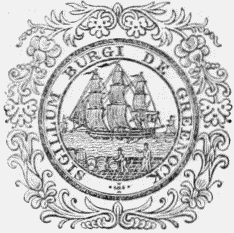
Burgh Seal.
The villages both of Wester Greenock and Crawfurdsdyke at first consisted only of a few thatched huts, stretching along the bay, and inhabited by fishermen; but they gradually increased, and in 1670, Sir John, son of the former Sir John Shaw, obtained from Charles II. a charter annexing the lands of Finnart, of which he had become proprietor, to the barony of Wester Greenock, and erecting both into one barony, under the designation of the barony of Greenock. The inhabitants appear to have pursued the fishery with success; they had some shipping, and carried on a considerable coasting, and a small foreign, trade, chiefly in herrings, of which, in 1674, they sent 20,000 barrels to Rochelle, exclusively of other quantities to Sweden and the Baltic. The two places had each a harbour capable of receiving vessels of large burthen; and from that of Crawfurdsdyke, a part of the expedition to Darien was fitted out, in 1697. The union of the two kingdoms opened to the inhabitants new channels of commerce; and in 1719, they fitted out the first vessel employed in the American trade, which they afterwards prosecuted with singular success, bringing home great quantities of tobacco, which they exported for the supply of the continent. The rapidly-increasing importance of Greenock was, in fact, such that it excited the jealousy of the ports of London, Bristol, and Liverpool; but the breaking out of the American war greatly obstructed its chief source of prosperity, and the loss of the American trade for some time impeded the commercial interests of the port. It was, however, soon counterbalanced by an enlarged traffic with South America and the East and West India colonies; the trade of the port revived; and it has continued to increase till the present time, the place now ranking as one of the principal sea-ports of the country. The town, extending in every direction for the accommodation of its growing population, has become the residence of numerous merchants and shipowners; the seat of various thriving manufactures, which put it nearly on a part with the most flourishing commercial and manufacturing towns in the kingdom; and more recently, a parliamentary borough.
The town is beautifully situated on the south shore of the Frith of Clyde, which is here four and a half miles broad; and extends for almost a mile along the margin of the united bays of Greenock and Crawfurdsdyke. The buildings occupy a narrow site of level land, bounded on the south by a ridge of hills which rises abruptly to an elevation of nearly 600 feet immediately above the town, commanding a richly-diversified view of the Frith and the coast of Dumbarton, on the north, and much variety of interesting scenery on the east and west. The place is for the most part very irregularly built, consisting, in the older portion, of various narrow and ill-formed streets, and in that of more modern date, of several spacious and handsome streets, with numerous pleasant villas, especially towards the west, in which direction chiefly the houses are increasing. It is paved, lighted with gas, and amply supplied with water from the vicinity, passed through filters previously to its being distributed through the town, the necessary works having been constructed by a company incorporated by act of parliament, in 1825, chiefly for providing water-power for giving motion to the machinery of mills and factories. For this latter purpose, an enterprize of vast magnitude has been completed under the direction of Mr. Thorm, civil engineer, and proprietor of the Rothesay cotton-works, at the suggestion of Sir Michael Shaw Stewart, from whom the undertaking is called the Shaw's-water works. These works, which are mostly situated at a distance of about three miles, on the south-west side of the ridge of hills that overlooks the town, consist partly of a spacious reservoir formed by strong embankments, inclosing an area of 295 acres, and containing 284,678,550 cubic feet of water, conveyed by an aqueduct six miles in length from numerous streams; and there is also a compensation reservoir of forty acres, containing 14,465,898 cubic feet. From the principal reservoir, which has an elevation of 500 feet above the town, the water descends by a gradual declivity, and in its course towards Greenock forms, at convenient intervals, many falls of greater or less height, from which it is diverted to the several factories that have been erected near it, supplying to each 1200 cubic feet per minute for twelve hours daily. The aggregate power of these different falls, which vary in depth, according to the wants of each factory, is estimated as equivalent to that of 1782 horses. This important undertaking was successfully completed in 1829, at an expense of £31,000, including the purchase of the ground.
The public library, established in the year 1783, and for many years held in the Freemasons' Hall, in Hamilton-street, has been removed into a building in Unionstreet, towards the erection of which Mr. James Watt contributed £3000, as a suitable place for the reception of a marble statue, by Chantrey, in honour of his father, the celebrated improver of the steam-engine, which statue had been voted at a public meeting of the inhabitants of Greenock, the native place of Watt. The building, which is in the early English style of architecture, consists of a centre, containing the library, and two wings, one of which forms a reading-room, and the other a house for the librarian; the library consists of above 10,000 volumes, and is supported by annual subscriptions of thirteen shillings and £1. 1. A mechanics' institution was established in 1836; and a handsome building has been erected for its use at an expense of more than £1300, raised by subscription. The ground-floor contains a library of 2000 volumes, a readingroom, and an apartment for mechanical and philosophical apparatus; above which is a hall sixty-two feet long, and thirty-nine feet wide, for the delivery of lectures on chemistry, mechanics, and other subjects. There is also a mechanics' library at Crawfurdsdyke, containing nearly 1500 volumes; and three circulating libraries have collections varying from 500 to 1500 volumes. Two public newsrooms are likewise supported, in one of which, in Cathcart-square, is a portrait of Sir John Shaw, who is justly regarded as the founder of the commercial prosperity of the town. Assemblies are held in the Exchange buildings, in which are elegant rooms; and a theatre, erected by Stephen Kemble, is opened occasionally. The Tontine hotel, in the principal street, is a spacious building, erected at an expense of £10,000, and contains some handsome apartments, and every requisite accommodation for families.
Manufactures of almost every kind are carried on here to a very considerable extent; and there are numerous large establishments for refining sugar, breweries, distilleries, tanneries, foundries, and forges. The manufacture of woollen cloth and yarn is pursued in two factories, in one of which 25,000 stones of wool are annually consumed in the production of tartans, twilled cloths, and yarn; and the other, of recent establishment, is still more extensive. A very large cotton factory has lately been opened, of which the machinery is propelled by the Shaw's water: the building, which is of stone, is 263 feet in length, sixty feet in breadth, and three stories in height. In those parts where the process carried on is most in danger of fire, the building is fire-proof; and in case of need, the pipes by which it is heated with steam can be rendered available as a fireengine. The water-wheel that drives the machinery is seventy feet in diameter, and wholly of iron, weighing about 180 tons. The number of people employed is generally 400, of whom the greater number are females. There are eleven large establishments for the refining of sugar, affording occupation to 350 persons; one of these is wholly engaged in refining for exportation, and the aggregate quantity is about 14,000 tons annually. Three breweries employ about forty-five persons, and do business to the amount of £30,000 per annum; and there is a distillery producing whisky annually to the amount of £50,000, and paying duties to the excise of £21,000. Connected with the distillery is a dairy of fifty cows. The manufacture of sail-cloth gives employment to nearly 300 persons, and consumes annually about 600 tons of raw material: attached to the premises, is an extensive rope-walk, in which large quantities of cordage are annually made, averaging 700 tons. There are also three other rope-walks, in the aggregate, affording employment to eighty persons. Four tanneries employ together about fifty hands, and do business to the amount of £18,000 annually; and two potteries, in which 200 people are constantly engaged, make on the average 100,000 dozens of white and printed earthenware. The paper manufacture provides occupation to about forty persons, of whom a considerable number are females, and produces annually 300 tons of packing and coloured papers. There are also some extensive cooperages, together employing about 500 men and boys. The strawplat manufacture of Greenock occupies generally about seventy persons on the premises, and affords employment to 150 who work at their own dwellings in the town, and to 1500 in the islands of Orkney. There are three extensive iron-foundries and forges for all kinds of castings, and for the manufacture of steam-engines and boilers, and various sorts of machinery, together affording employment to more than 1000 persons. In these establishments, steam-engines of the aggregate power of nearly 3000 horses are annually manufactured; and numerous English-built steamers have been supplied with engines and machinery from the works. Two manufactories for chain-cables and anchors, also, employ above 110 persons; and there is a work for the making of bar-iron, in which a considerable number are engaged. Four large mills for grinding grain, yield upwards of 50,000 bolls annually: one of them was also supplied with machinery for freeing rice imported into this country from the husk, but this was found to be attended without any of the expected benefit, and has been discontinued.
The trade of the port, which, after it had recovered from the depression it suffered during the American war, had greatly increased, has recently sustained some diminution from the deepening of the Clyde and the introduction of steam towing-boats, by which ships that previously landed their cargoes here are now enabled to reach Glasgow. The exports are chiefly linen, woollen, and silk manufactures, cotton-yarn, hardware, earthenware, glass, refined sugar, iron and machinery, copper, and lead. The imports are, cotton-wool, sugar, molasses, coffee, cocoa, pepper, tobacco, corn, wine, oil, spirits, timber, deals, mahogany, dye-woods, brimstone, and numerous other goods. The quantity of cotton-yarn exported in a recent year was valued at more than £1,000,000; and the quantity of cotton-wool imported was 11,597,653 lb. The number of vessels that entered inwards during 1843 was, 206 from British ports, of the aggregate burthen of 60,269 tons; and six from foreign ports, of the aggregate burthen of 2583 tons. The number that cleared outwards in 1838 was, 235 British vessels, of 63,582 tons; and nine foreign vessels, of 3411 tons. In the coasting trade, during the same year, 911 vessels entered inwards, of the burthen of 99,430 tons; and 1222 cleared outwards, of 128,017 tons' burthen. The amount of duty paid at the customhouse in 1843 was £347,869: the number of vessels registered as belonging to the port is 451, of 86,942 tons' aggregate burthen; and the number of seamen is 3365.
The harbour was commenced in 1707, by the inhabitants, to whom the lord of the manor. Sir John Shaw, conveyed the ground on which it is formed, together with his right, as superior of the barony, to levy anchorage dues; and in order to raise funds for its completion, they voluntarily imposed an assessment of 1s. 4d. on every sack of malt brewed into ale within the burgh. The harbour thus formed being found, however, totally inadequate to the rapid increase of the trade, an extension including the bay of Crawfurdsdyke was carried into effect, at an expense of £20,000; and the subsequent erection of dry-docks and other works requisite to render it complete, including warehouses, bonding-yards for timber, and other accommodations, have in the whole amounted to £119,000. The outer harbour, which is accessible to the largest vessels, has sufficient depth of water, and good anchorage; but the roadstead is contracted by a considerable sand-bank, which extends from Port-Glasgow towards Dumbarton. The entrance to the inner harbour is 105 feet wide, and the depth great enough to allow vessels of any burthen to approach the quays. The Custom-house quay is 1035 feet in length, the East quay 531, and the West quay 425 feet, forming together a line of very nearly 2000 feet, replete with every facility for the loading and landing of cargoes, with spacious warehouses and stores. Ship-building is carried on to a great extent, for which purpose there are seven dockyards belonging to different companies, affording employment to 1200 men, with dry-docks, and three patent-slips for repairing vessels, one of which is capable of receiving ships of 400 tons. The number of vessels annually launched averages about twenty, of the aggregate burthen of from 6000 to 7000 tons. Boat-building is also carried on, by companies confined to that object, who employ about forty workmen, and launch annually about 800 tons of all descriptions. The improvement of the harbour has greatly tended to increase the trade of the port as well as its revenue, which amounted in a recent year to as large a sum as £12,079.
The custom-house, which is situated in the central portion of the quay, is a spacious and elegant building in the Grecian style, with a stately portico in front, the whole erected in 1818, at an expense of £30,000. The chamber of commerce and manufactures was incorporated by royal charter in 1813, and is under the management of twelve directors, of whom three annually go out of office by rotation. The Exchange buildings, erected in 1814, at a cost of £7000, afford every accommodation for the meeting of merchants and shipowners, and, for the transaction of commercial affairs; they contain also two spacious assembly-rooms, in which, during the season, concerts and card and dancing assemblies are held. The post-office has a good delivery; and in addition to the Greenock and the Clydesdale Banks, there are branches of the Bank of Scotland, the Royal Bank of Scotland, the Glasgow Union Banking Company, and the Western Bank of Scotland. The market, which is on Friday, is abundantly supplied with grain and with provisions of all kinds; and fairs are held on the first Thursday in July and the fourth Thursday in November. Facility of communication is afforded by excellent roads, of which eight miles of turnpike-road pass through the parish, and by steamers, which have nearly superseded travelling by coaches. The Glasgow, Paisley, and Greenock Railway was commenced in 1837, by a company empowered to raise a joint-stock capital of £400,000 in shares, and £133,333 by loan. The length is twenty-two miles and a half, of which seven miles form part of the Glasgow and Ayr railway, whence the Greenock line diverges, to the south of Paisley, crossing the rivers Black Cart and Gryfe, and reaching its summit level on the Bishopton ridge. Thence it is continued by an embankment, running nearly parallel with the river Clyde, to Port-Glasgow, from which, taking a curvilinear direction, it terminates at Greenock, where is a short branch leading to the docks. There are sixty bridges on the whole line, including the viaducts at Greenock and Port-Glasgow; and four ascending and four descending planes, the former of nine miles, and the latter seven and a half, the remainder of the course being level. The line passes along two tunnels at Bishopton ridge, cut through hard rock for above a mile in length, and thirty-seven feet in depth; the embankment near the Clyde is more than a mile long, and twenty-eight feet in height, and there is also one crossing Fulwood moss, four miles long, but averaging only ten feet in height. The railway was completed in June, 1840, at an expense of £498, 142, including one-half the cost of the portion between Glasgow and Paisley, of which the other half was defrayed by the Glasgow and Ayr Railway Company. The present capital is £866,666.
The town was erected into a burgh of barony by charter of Charles I., granted to Sir John Shaw, its proprietor, in 1635, and confirmed by Charles II. in 1670. In 1741, the then Sir John Shaw, by a charter which was renewed in 1751, conferred upon his tenants in the burgh, the privilege of electing two bailies, a treasurer, and six councillors, with power to hold courts for the admission of burgesses, the good government of the town, and the trial and punishment of delinquents. This charter continued in force till the passing of the Municipal Reform act of the 3rd and 4th of William IV. A provost, four bailies, treasurer, and council are now elected agreeably with the provisions of that measure; and their jurisdiction extends over the whole of the municipal and parliamentary boundaries of the burgh. The magistrates hold courts daily for the trial of criminal causes not extending beyond petty thefts and misdemeanours, all higher matters being referred to the sheriff of the county, who holds a court here for those cases to which the jurisdiction of the magistrates does not extend. The burgh, under the provisions of the general Reform act of the 2nd and 3rd of William IV., returns one member to the imperial parliament: the right of election is vested in the £10 householders, of whom the number is 985. The town-hall was erected in 1765, after a design by the father of the distinguished Watt; it is a neat structure containing the several court-rooms, and other apartments for the transaction of the public business of the magistrates. The town gaol and bridewell, a handsome building in the castellated style, contains thirty-five cells for criminals. The sheriff's court-house, erected in 1834, by subscription, consists of a spacious hall for the courts, with the necessary apartments for the sheriff and his clerk, and rooms for jurymen and witnesses, appropriately fitted up.
The parish originally formed part of that of Innerkip, from which it was separated by act of parliament, in 1592; and it has since been subdivided into smaller parishes, including the lands of Easter Greenock and Crawfurdsburn, and a considerable portion of the parish of Houston, which were annexed to it by the Court of Teinds in 1650. It extends along the Clyde for nearly five miles, and is bounded on the south by the parish of Houston; on the south-east, by the parishes of Port-Glasgow and Kilmalcolm; and on the west, by Innerkip. The surface is hilly, rising towards the south, by elevated ridges, to a height of 600 feet. The coast is flat and sandy, and is not distinguished by any peculiarity of features, the hill of Binnans, the highest in the ridge, forming the only landmark of importance, and from which is obtained a beautiful view of the Frith. The soil on the shore is chiefly clay, intermixed with sea-shells and gravel; and in the higher grounds, a rich loam, alternated with peat-moss. The estimated number of acres is 8000, of which nearly 3000 are arable, 1150 meadow and pasture, about fifty woodland and plantations, and the remainder moor: there are some quarries of sandstone, but of very inferior quality. The scenery is beautifully diversified, and on the acclivities of the hills are numerous scattered villas, overlooking the Clyde. The mansion-house of Greenock is finely situated on an eminence above the town; the greater portion of it is ancient, but several additions have been made of more modern character. There is some fine old timber on the demesne, and also on that of Crawfurdsburn House, which is likewise an ancient building. The rateable annual value of real property in Greenock is £111,493.
The ecclesiastical affairs are under the superintendence of the presbytery of Greenock and synod of Glasgow and Ayr. The original parish, which, since the New or Middle parish was disjoined from it in 1741, has been designated the parish of West Kirk, is about three miles and a half in length and two and three-quarters in breadth. The minister's income is £718, arising from a stipend of £287, an annuity from the corporation of £25, and the rents of the glebe, amounting to £406, with a manse; patron, Sir Michael Robert Shaw Stewart. The old church, a cruciform structure built in 1590, being inconveniently situated, and greatly dilapidated, has been superseded by a new church built on a more commodious site; the present structure, which is of elegant design, contains 1400 sittings. There are places of worship for members of the Free Church, as well as for the United Secession, Baptists, the Relief, Independents, Reformed Presbyterians, and Wesleyans; and an episcopal, and a Roman Catholic chapel. The Middle Kirk parish, created by the Court of Teinds, is about one-third of a mile in length, and a quarter of a mile in breadth, and wholly within the town. The minister's stipend is £200, with £20 for communion elements, and a manse; patrons, the Magistrates and Town Council, the Kirk Session, and the Feuars in the parish. The church, erected in 1747, at an expense of £2388, by subscription, aided by a grant from the corporation, is a handsome structure in the Grecian style, with a portico of the Ionic order, and an elegant spire 145 feet in height, and contains 1497 sittings. A chapel, also, has been recently erected by the Society for Propagating Christian Knowledge, for the use of the mariners frequenting the port; it contains 350 sittings, and divine service is regularly performed on Sunday by a missionary, who has a salary of £26 per annum. The parish of East Kirk was divided from the original parish, also by the Court of Teinds, in 1809; it is about three miles and a half in length and two and a half in breadth. The minister's stipend is £200, with £20 for communion elements, and a manse; patrons, the Magistrates and Council, and a committee named by the Seat-proprietors. The church, erected in 1774 as a chapel of ease, contains 976 sittings. The late quoad sacra parish of North Kirk was separated from the parish of West Kirk by the General Assembly, in 1834, and was about half a mile in length, and less than a quarter of a mile in breadth; patrons, the Congregation. The church, at first a chapel of ease, was built in 1823, at an expense of £600, and contains 1165 sittings. South Kirk quoad sacra parish comprised a small district within the town; patrons, the Proprietors of the church, which was built as a Gaelic chapel of case, in 1791, at a cost of £1300, raised in shares, and is a neat structure with 1300 sittings. The late quoad sacra parish of St. Andrew was also separated from the old parish; patrons, the Trustees. The church was built by subscription, aided by grant from the Church-extension fund, at a cost of £2600; it is a handsome structure in the later English style of architecture, and contains 945 sittings. The late parish of St. Thomas was separated in 1839, from the old parish and the Middle parish: the church was built by private subscription, aided by a grant from the extension fund. Cartsdyke (which see) was separated from the East parish, in the year 1839, but has, like the four preceding districts, ceased to be a quoad sacra parish.
The old parochial school has been superseded by the establishment of two burgh schools, in one of which the Latin, Greek, and French languages are taught; and in the other, arithmetic, the mathematics, geography, and drawing. They are under the management of two masters, appointed by the corporation, and who have each a salary of £30, with the fees and an allowance of £25 in lieu of house and schoolroom. The Highlanders academy was built in 1837, partly by subscription, and partly by grant from government, on a site given by the late Sir Michael Shaw Stewart; it is a handsome building, containing two schools, and apartments for the masters of an infant and juvenile school, with a large inclosed play-ground. There are also two schools for orphans, built by the corporation, one for the gratuitous instruction of children in the elementary branches of education, and the other for teaching girls to sew and knit, and qualifying them for service; they are both supported by subscription, and partly by the proceeds of the children's work. The Greenock hospital and infirmary was established in 1809, when a building was erected at an expense of £1815, on a site of land given by Sir John Shaw Stewart; it is maintained by subscription. The number of patients averages about 585 annually received into the house, and 200 out-patients. Two wings have been added to the building, which is now adapted for the reception of 100 patients. The institution is under the superintendence of four physicians, two surgeons, and a resident apothecary; the annual expenditure is about £1000. There are numerous friendly and benefit societies; and a savings' bank has been for some time established, in which are deposits to the amount of £63,000. Galt, the novelist, resided at Greenock, where he died in 1839. The town gives the inferior title of Baron to the family of Cathcart, a dignity created in 1807, in the person of the late Earl Cathcart, upon his return from Copenhagen, where he had served as commander-in-chief of the military force employed in the expedition to that place.
Gretna
GRETNA, Dumfries.—See Graitney.
Grimsay
GRIMSAY, an island, in the parish of North Uist, county of Inverness; containing 269 inhabitants. This is an isle of the Hebrides, lying between North Uist and Benbecula, and is about two miles in length: a large portion of it is covered with heath. A great quantity of kelp is burned on its shores, the manufacture of which is the chief employment of the population. Grimsay is an island only at high water.
Groay
GROAY, an isle, in the parish of Harris, county of Inverness. It is one of a group of islets in the Sound of Harris, and is of very small extent, and uninhabited.
Gruinard
GRUINARD. or Greinord, an isle, in the parish of Lochbroom, county of Ross and Cromarty. It is situated at the entrance to a loch of the same name, on the western coast of the county, about five miles south-east of Udrigill Head.
Guildie
GUILDIE, a village, in the parish of Monikie, county of Forfar, 3½ miles (W. N. W.) from Muirdrum; containing 83 inhabitants. It is in the eastern part of the parish, and adjoining the village of Monikie: the population is chiefly employed in the weaving of linen for the manufacturers of the neighbouring towns.
Guildiemuir
GUILDIEMUIR, a village, in the above parish and county; containing 75 inhabitants. This village and Guildie adjoin each other.
Guildtown
GUILDTOWN, a village, in the parish of St. Martin, county of Perth; containing 178 inhabitants. It lies in the western part of the parish, and is of modern date, having been founded within the present century. The houses are in general neat and comfortable, with a piece of garden-ground attached to each. This village, and Caroline-Place, also in the parish, are the property of the Guildry Incorporation of Perth.
Gulane
GULANE, anciently Golyn, a village, in the parish of Dirleton, county of Haddington, 5½ miles (W. by S.) from North Berwick, containing 273 inhabitants. This village, which formerly gave name to the parish, is pleasantly situated; and the ground in the immediate vicinity is favourable to the training of race-horses, of which two separate establishments have been erected. There is a school attended by fifty children, of which the master is provided with a house and garden, rentfree, by Mrs. Ferguson, who also allows him a salary of £5 per annum, in addition to the fees.
Gunister
GUNISTER, an isle, in the parish of Northmavine, county of Shetland. It is one of the smallest of the Shetland group, and lies about a mile southward of the main land of the parish: there is pasturage for cattle and sheep.
Gunna
GUNNA, an isle, in the parish of Tiree, district of Mull, county of Argyll. This is a small isle of the Hebrides, lying in the sound between Tiree and Coll, and is about a mile in length, and half a mile in breadth. It is remarkable for the great quantity of sea-weed upon its shores.
Guthrie
GUTHRIE, a parish, in the county of Forfar, 8 miles (N. W.) from Arbroath; containing 530 inhabitants. This place confers its name upon the very ancient and distinguished family of the Guthries, one of whom, on the resignation of the guardianship of Scotland by Sir William Wallace, in 1299, and his retirement into France, was sent by the Scottish nobles to solicit the return of that hero, in order to assist his countrymen to expel the English invaders. His descendant, Sir David Guthrie, who was lord high treasurer of Scotland in the reign of James III., purchased from the monks of Arbroath, the church of Guthrie, which had for many years been attached to that abbey, and founded here a collegiate church for a provost and three prebendaries. This foundation was confirmed by a bull of Pope Sextus IV., in 1479; and to it was subsequently annexed the vicarage of Kirkbuddo, or Carbuddo, now forming a widely-detached portion of the parish of Guthrie. Sir David Guthrie also erected a spacious and strongly-fortified baronial castle here, which is still entire; and on his decease, the manor passed to his son, Sir Alexander, who, with one of his sons and three of his brothers-in-law, fell in the battle of Flodden Field. It is now the property of his descendant, John Guthrie, Esq. The parish, including Kirkbuddo, which is situated at a distance of nearly seven miles to the south-west, and separated by several intervening parishes, comprises an area of about 4000 acres, of which 3200 are arable, and the remainder woodland and plantations, with a very considerable tract of unreclaimed moor. The surface of the main portion is varied, sloping gradually from the hill of Guthrie, which is in the north-west, and has an elevation of about 500 feet, towards the south and east; while in the southern, or Kirkbuddo, portion, the land is nearly level, though considerably raised above the sea. The parish is watered by the small river Lunan, which flows through a narrow valley, and forms its boundary. The soil in some parts is a rich black loam, resting on a bed of retentive clay, and in others of inferior quality, but generally susceptible of improvement by draining, which is gradually growing into general practice. The system of agriculture is advanced, and some portions of the moor have been reclaimed; the farm-buildings are usually commodious, and considerable progress has been made in the inclosure of the lands. The woodlands around Guthrie Castle and Kirkbuddo House are under good management; and in different parts of the parish are some thriving plantations, which add much to the beauty of the scenery. The rateable annual value of the parish is £2727.
The castle, the seat of Mr. Guthrie, was originally built in 1468. The more ancient part consists of a massive square tower, crowned with embattled turrets, rising above the foliage of the richly-wooded demesne by which it is surrounded, and conveying an impressive idea of baronial grandeur; the more modern portions have been added at various times, and the whole has been recently improved by the present proprietor. It is beautifully situated on the banks of the river Lunan, which has its source in a lake in the vicinity. Kirkbuddo House, the seat of George Ogilvy, Esq., is a handsome modern mansion surrounded with plantations. There is no village properly so called; the population are principally agricultural, with the exception of a few who are employed in weaving for the manufacturers in the neighbourhood. In Kirktown, a hamlet consisting only of a small number of scattered houses, are some individuals engaged in the various handicraft trades requisite for the supply of the inhabitants of the parish. Facility of communication is afforded by the Arbroath and Forfar turnpike-road, and the Arbroath and Forfar railway, which pass near the church. The ecclesiastical affairs are under the superintendence of the presbytery of Arbroath and synod of Angus and Mearns. The minister's stipend is £158, of which nearly one-half is paid from the exchequer, with a manse, and a glebe valued at £9 per annum; patron, John Guthrie, Esq. The church, which is situated on an acclivity rising from the valley of the Lunan, is a substantial neat building erected in 1826, and contains 306 sittings. Divine service is occasionally also performed by the minister in a schoolroom at Kirkbuddo. The parochial schoolmaster is superannuated, and the school taught by an assistant; the salary is £27, with the fees, a house, and a garden. A school at Kirkbuddo is supported by subscription; and there is a parochial library, consisting chiefly of works on religious subjects. Of the collegiate church founded by Sir David Guthrie the only remains are a small aisle, now the burialplace of the family; and of the chapel of Kirkbuddo scarcely any vestiges can be traced. In the southern portion of the parish are some remains of a Roman camp, still in a very entire state, inclosing an area of about 760 yards in length and 360 yards wide: in the south-east angle, supposed to have been the site of the prætorium, is an eminence commanding a view of the whole of the interior. John Guthrie, of this place, was consecrated Bishop of Moray, over which see he continued to preside till 1638.