
A Topographical Dictionary of Scotland. Originally published by S Lewis, London, 1846.
This free content was digitised by double rekeying. All rights reserved.
'Kilmarnock - Kilspindie', in A Topographical Dictionary of Scotland, (London, 1846) pp. 42-61. British History Online https://www.british-history.ac.uk/topographical-dict/scotland/pp42-61 [accessed 25 April 2024]
In this section
Kilmarnock
KILMARNOCK, a burgh of barony and a parish, in the district of Cunninghame, county of Ayr; containing 19,956 inhabitants, of whom 17,846 are in the burgh, 12 miles (N. N. E.) from Ayr, and 22 (S. W. by S.) from Glasgow. This place, which is of great antiquity, derives its name from the foundation of a church by St. Marnoch, an eminent apostle of Christianity, who flourished in the fourth century, and to whose memory many churches in various parts of the country have been dedicated. The lands, at an early period, were part of the possessions of the ancient family of the Boyds, descendants of Simon, brother of Walter, the first high steward of Scotland, and of whom William, the ninth lord Boyd, was created Earl of Kilmarnock in 1661. The castle of Dean, the baronial residence of the earls of Kilmarnock, was destroyed by an accidental fire in 1735. In 1745, William, the fourth earl, having joined in the rebellion, was taken prisoner at the battle of Culloden, and sent to London, where he was beheaded in 1746; and the title and estates became forfeited to the crown. This place, originally a small hamlet depending solely on the baronial castle, which now forms an interesting ruin, gradually acquired importance from the introduction of various manufactures, for which the abundance of coal in the vicinity, and its facilities of water-carriage, rendered it peculiarly appropriate; and in 1592, it had so far increased in population and extent as to obtain from James VI. a charter erecting it into a burgh of barony. In 1800, an accidental fire, originating in some thatched buildings in the lower part of the town, spread with amazing rapidity to the houses on both sides of the street, which was nearly destroyed.
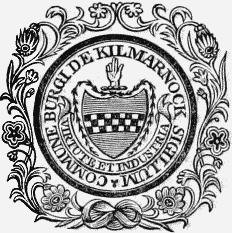
Burgh Seal.
The town is pleasantly situated in the south-western part of the parish, on a stream called the Kilmarnock water, about half a mile above its influx into the river Irvine, and over which are five substantial bridges, affording facility of communication. The streets in the older portion of the town are narrow and irregularly formed, but in the central portion of it, spacious and well built, consisting of handsome houses of freestone, of which many are of elegant aspect; and towards the south and east, in which directions the buildings have been greatly extended, are numerous pleasant villas, which add much to its appearance. Considerable improvements have recently taken place; the streets are well paved, and lighted with gas from works erected by a company of £10 shareholders, established in 1823; and the inhabitants are amply supplied with water. A public library, having an extensive collection of volumes on general history and literature, is supported by subscription; and there is a good library attached to the mechanics' institution. A handsome structure called the Exchange buildings, containing a commodious reading and news room, was erected in 1814, and is under the management of a committee of directors; there is also a newsroom for tradesmen, well supplied with daily journals and periodical publications. Two weekly newspapers are published in the town; the Kilmarnock Journal, which has been established for many years, and has an extensive circulation; and the Ayrshire Examiner, which is of more recent date. The first manufacture carried on here was that of the broad flat bonnets originally worn by the peasantry, and of red and blue caps called the Kilmarnock cowls, which was the chief trade till about the middle of the 18th century. The manufacture of carpets, however, was subsequently introduced, and soon became the staple trade of the place, for which it is still celebrated, the weaving of carpets of every variety of pattern and texture being carried on to a great extent, and affording employment to 1200 persons. The principal kinds are, Brussels, Venetian, Turkey, and Scotch carpets, for the finest specimens of which premiums were, in 1831, awarded by the commissioners to the manufacturers of this place, to the amount of £210. The value of the carpets made annually in the town is estimated at £150,000. About 1200 persons, too, are engaged in the manufacture of worsted and printed shawls, of which more than 1,250,000 are sold every year, estimated at £230,000: this trade, which was introduced in 1824, also affords employment to 200 printers. The number of bonnets annually made, the manufacture being still carried on, is about 20,000; and 2400 pairs of boots are made weekly, of which three-fourths are exported. There are also extensive tanneries and establishments for the dressing of leather, in which nearly 150,000 sheep and lamb skins are annually prepared.
Considerable improvements in machinery have been made by Mr. Thomas Morton, of this town, which have been adopted in the carpet factories with great advantage; and the same gentleman has also built an observatory, and furnished it with telescopes of a very superior description, made under his own inspection, and for which he has established a large manufactory. A handsome piece of massive plate was, in 1826, presented to Mr. Morton by the inhabitants of the town, in acknowledgment of his having so eminently contributed to the prosperity of their manufactures. There are also manufactories for machinery of all kinds, tobacco, candles, hats, hosiery, and saddlery, in all of which an extensive trade is carried on; and numerous handsome shops in the town are amply stored with various kinds of merchandise. Several branch banks have been opened; the principal is that of Ayr, for which an elegant building has been erected. The market days are Tuesday and Friday, on both of which business is transacted to a very great extent; and fairs are held on the second Tuesday in May, for cattle; the last Thursday in July, for horses, black-cattle, and wool; and the last Thursday in October, for horses. The post-office has a good delivery; and facility of communication is maintained by excellent roads, of which the turnpike-road from Glasgow to Portpatrick passes through the town, and several others through different parts of the parish. In addition to the bridges across the Kilmarnock water, there are two over the river Irvine, which bounds the parish on the south, communicating respectively with the town. The Kilmarnock and Troon railway, the first public railway formed in Scotland, was commenced under an act passed in 1808, with a view to connect the port of Troon, on the coast near Ayr, and the collieries in the neighbourhood, with the town of Kilmarnock and the north-eastern part of Ayrshire. It is nine and three-quarter miles in length, and was opened in 1812, at a cost of £50,000, and, throughout the whole line, which has a double way of flat rails, is worked by horses. An act was obtained in 1837, to enable the company to raise a further sum of money, and alter and amend the line by converting it into an edge railway; but it has not been acted upon, except to improve the line as a tram-road. The line of the Glasgow, Paisley, Kilmarnock, and Ayr railway separates near Dalry, into two branches, of which one runs direct to Kilmarnock; this branch is about eleven miles in length, and was opened on the 4th of April, 1843.
The government of the burgh, under the charter of James VI., confirmed by charter of Charles II. in 1672, is vested in a provost, four bailies, a treasurer, dean of guild, and eleven councillors, chosen under the provisions of the Municipal Reform act, and assisted by a town-clerk, who is appointed by the Duke of Portland, superior of the burgh. There are five incorporated trades, viz., the skinners, tailors, weavers, bonnetmakers, and shoemakers, the fees for admission into which vary, for sons of burgesses from 10s. to £2. 2., and for strangers from £1.11. 6. to £7. Persons holding leases under the Duke of Portland are privileged to carry on trade in the burgh. The magistrates exercise the usual civil and criminal jurisdiction; the municipal are less extensive than the parliamentary boundaries, which include the village of Riccarton, on the opposite bank of the Irvine. Bailie-courts are held for the determination of civil actions to any amount, in which the town-clerk acts as assessor; there is also a convener's court, in which debts not exceeding 6s. 8d. are recoverable, and the jurisdiction of the dean of guild is exercised by the bailie-court. The criminal jurisdiction is confined chiefly to cases of assault and police matters, all weighty offences being transmitted to the sheriff of the county. The burgh is associated with those of Dumbarton, Port-Glasgow, Renfrew, and Rutherglen, in returning a member to the imperial parliament; the number of qualified voters is 612. The town-hall, a handsome building two stories high, and crowned with a campanile turret, was erected in 1805, and contains the several courts, and apartments for the transaction of the public business of the burgh.
The parish is about nine miles in extreme length and four in breadth, comprising an area of nearly 9000 acres, of which by far the greater part are arable. The surface slopes gently from the river Irvine, and is pleasingly diversified with wood: the Kilmarnock water, which rises in the upper part of the parish of Fenwick, intersects the parish, and flows into the Irvine. The soil is generally fertile, and the lands are under good cultivation, producing excellent crops of oats, wheat, barley, beans, potatoes, and turnips; the system of husbandry is in a highly-improved state; the lands have been well drained, and inclosed with hedges of thorn; and the farm-buildings are substantial and well arranged. The pastures are rich, and great attention is paid to the management of the dairy-farms, on which cows of the Ayrshire breed are kept; about 12,000 stone of cheese are annually produced, and abundant supplies of milk for the use of the town. The sheep bred on the pastures are of the black-faced and Cheviot breeds; the cattle, of which 400 are annually reared, are of various breeds; and the horses, of which a few are reared for agricultural use, are the Clydesdale. Coal is found in abundance, and ironstone in sufficient quantity to remunerate the establishment of works. Freestone occurs in several places, in seams ten feet thick; and near Dean Castle is a bed forty feet thick, of a fine white colour, and well adapted for buildings of the higher class. Coal-mines are in operation on the lands of the Duke of Portland, affording employment to about 300 men, and producing annually 90,000 tons of coal, of which 30,000 are consumed in the parish, and the remainder sent by the Kilmarnock and Troon railway for exportation. Fire-bricks, for which clay of good quality is found in abundance, are made in great quantities on the lands near Dean Castle. The principal mansion in the parish is Crawfurdland Castle, an ancient structure in the early English style of architecture, of which the central portion was erected by the present proprietor; it is beautifully situated to the north-east of the town, and the older part of the building is remarkable for its strength and solidity. The rateable annual value of the parish is £37,570.
The ecclesiastical affairs are under the superintendence of the presbytery of Irvine and synod of Glasgow and Ayr. The old, or Laigh, parish church is collegiate, and under the care of two ministers, whose stipends are £150 each, with a manse and glebe; the glebe of the minister of the first charge is valued at £30, and that of the second at £12 per annum; patron, the Duke of Portland. The former church, with the exception of the tower and spire, was taken down in consequence of an alarm excited by the falling of some plaister from the ceiling in 1801, which, creating a panic in the minds of the congregation, produced a simultaneous rush to escape, in which many lives were lost. It was rebuilt in 1802, and repaired in 1831 at an expense of £1200, and contains 1457 sittings. The High church, to which a district of the parish, containing 3237 persons, was till lately annexed, was erected in 1732, by subscription, at a cost of £1000; it is a handsome structure in the Grecian style, with a tower eighty feet high, and has 902 sittings. The minister's stipend is £150, with £50 in lieu of manse and glebe. Henderson church, to which also was attached a quoad sacra district, with a population of 2377, is a neat edifice, recently erected. There are places of worship for members of the Free Church, the United Secession, Original Burghers, Original Seceders, the Relief, Reformed Presbyterians, Independents, and Wesleyans. The Academy, a spacious building, erected in 1807, at the joint expense of the heritors and the burgh, is under the superintendence of a committee of fifteen directors, of whom five are nominated by the town-council. There are a classical master, who has a salary of £34, with a house and garden; and an English master and commercial master, each of whom has £15, (without either house or garden,) in addition to the fees, which are fixed by the directors. The academy is attended by more than 300 pupils. There are branch schools at Rowallan and in the barony of Grongar, the masters of which have houses and gardens in addition to the fees, and numerous other schools throughout the parish, in which, collectively, above 2000 children receive instruction. The dispensary was established in 1827, and is supported by subscription; it is gratuitously attended by most of the medical practitioners, and administers extensive relief to the sick poor. There are also numerous benefit and friendly societies, and a savings' bank in which are many depositors. The late Mrs. Mary Cunninghame bequeathed £200, and John Mac Nider, Esq., £40, in trust to the minister of the High church, to be lent out in small sums, and the interest given to the poor. Rowallan Castle, about three miles to the north-west of the town, for many generations the seat of the barons of Rowallan, is a very ancient structure, and is supposed to have been the birthplace of Elizabeth More, first wife of Robert, high steward, and afterwards king of Scotland, as Robert II.: the more modern portion was built about the year 1560. It is beautifully situated, and surrounded with plantations; but the whole is passing rapidly into decay. The former Soules Cross, a rude stone pillar about nine feet high, surmounted with a gilt cross, was erected to the memory of Lord Soules, an English nobleman, who was killed on the spot by an arrow from one of the Boyds, of Kilmarnock, in 1444. A handsome fluted column, supporting a vase, was placed in a niche in the wall surrounding the churchyard, in 1825, in lieu of the old cross: on the pedestal is an appropriate inscription referring to Lord Soules' death. The Earl of Errol bears the title of Baron Kilmarnock.
Kilmaronock
KILMARONOCK, a parish, in the county of Dumbarton, 1 mile (W. by S.) from Drymen; containing 931 inhabitants. The name of this place signifies "the cell, chapel, or burial-place of St.Marnoch." The parish is beautifully situated on the southern bank of the river Endrick, and on Loch Lomond, and is about five miles in length and three in mean breadth. The surface rises in some places to 500, and in others to 1000, feet above the level of the sea: the highest parts are, the range of hills on the west, commonly called Mount Misery; Duncruin, in the centre; and the elevation towards Dumbarton moor, on the south. The lands are, however, mostly in tillage, the quantity of hill or moorland being very inconsiderable. Numerous plantations, hedge-rows, and natural wood adorn the parish; and it is watered by several springs and rivulets, and by the river Endrick, along which commodities are conveyed in flat-bottomed craft, as far as from Drymen bridge to Loch Lomond, a distance of nearly eight miles. It contains pike, perch, eels, trout, and other fish. The best land in the parish lies along the banks of this river, the soil being deep and rich, and producing excellent crops, though exposed, in rainy seasons, to injury from sudden and violent floods. The soil in the higher parts is damp and tilly, and at length degenerates into a sterile moss. Several impediments depending upon the peculiar locality have retarded the advance of the improved system of husbandry, which has been for some time introduced. In spite, however, of every obstacle, a spirit of industry and enterprise prevails, which is leading to many considerable changes. Above 660 acres are under wood. On the moorland grounds, about 500 sheep are reared, which are all of the black-faced or Highland breed; and a few of the Cheviots and Leicesters are kept on the lower grounds. The cattle are of the Argyllshire and the Ayrshire breeds, to the improvement of which considerable attention is paid. The fences are in general thorn hedges or stone dykes, which are, in many parts, in very bad condition. The rocks in the parish principally consist of red or grey sandstone; and limestone of good quality is also found. The rateable annual value of Kilmaronock is £7444.
The chief seat is Baturrich Castle, finished about twelve years ago, and which is built on part of the ruin of the ancient castle of the same name, upon rising ground about half a mile from Loch Lomond; it commands a very fine view of the lake, studded with its numerous wooded islands, and also of the whole vale of Leven to the river Clyde. Ross Priory, which is situated on the south-east bank of Loch Lomond, is about two miles from Baturrich; it is beautified with some very handsome trees. Catter House is an old mansion, seated on an eminence near Drymen bridge, on the river Endrick, and occupied by the factor of the Duke of Montrose, who is the principal heritor in the parish. There are two annual fairs, one for horses, at Craftammie, on the second Tuesday in February, and the other chiefly for milch-cows, at the farm of Ardoch, on the last Thursday in April. The road from Dumbarton to Drymen passes through the parish, as well as the Drymen and Glasgow road. There is a bridge across the Endrick, an old structure of four arches, situated at the boundary of the parish, on the road to Drymen. The ecclesiastical affairs are directed by the presbytery of Dumbarton and synod of Glasgow and Ayr; patron, the Duke of Montrose. The stipend of the minister is £200, with a manse, and a glebe of seven acres, valued at £11 per annum. The church was built in 1813, and is in good repair; it contains 400 sittings, but, on account of its situation near the northern extremity of the parish, it is found inconvenient for a great part of the population. There is also a Relief meeting-house. The parochial schoolmaster has £31 per annum as his salary, with a house, and about £26 fees. A parochial library was instituted in 1838, and is under the management of the Kirk Session.
Kilmartin
KILMARTIN, a parish, in the district and county of Argyll, 7½ miles (N. N. W.) from Lochgilphead; containing 1233 inhabitants. This place, which is supposed, like many others, to have derived its name from the founder of its ancient church, formed part of the possessions of the Campbell family, of whose baronial residence, Duntroon Castle, there are still considerable remains. The parish, which is bounded on the north-east by Loch Awe, on the north-west by Loch Craignish, and on the south-west by Loch Crinan, is about twelve miles in length and three and a half in breadth, comprising 24,530 acres, of which 3456 are arable, 400 meadow, 1200 woodland and plantations, and the remainder rough pasture and waste. The surface, towards the north-east, for some miles along the shore of Loch Awe, rises abruptly from the margin of the lake to an elevation of 1000 feet, from which it descends precipitously in the direction of Loch Craignish, forming a continuous ridge of hills, of which the highest, Benvan, adjoining the hill of Kilmartin, is 1200 feet above the level of the sea. The beautiful valley of Kilmartin extends from within a mile of Loch Awe, for nearly three miles, towards the west, between lofty hills ascending perpendicularly from their base. Not far from its termination at the village, it expands into a level plain almost 6000 acres in extent. Throughout the windings of the vale may be traced the channel of a large river, through which the waters of Loch Awe anciently discharged themselves into the bay of Crinan; and in several parts are terraces rising to a height of fifty or sixty feet above the level of the valley, supposed to have been formed by the river in its course.
The soil is generally a light friable mould, alternated in some parts with tracts of greater depth and fertility; the chief crops are, oats, bear, and barley, with turnips and potatoes, for which last the soil is more especially adapted. The system of husbandry is in an advancing state; draining is extensively practised, and tiles for that purpose are made in the vale of Kilmartin, where good clay is found. Great quantities of waste land have been reclaimed and brought into cultivation on the Poltalloch estate. The cattle are of the West Highland breed, with a few of the Ayrshire, Galloway, and Durham breeds, to the improvement of which much attention is paid; about 2000 head of all kinds are pastured in the parish. The sheep, of which 9000 are reared on the several farms, are of the black-faced native breed, with some of the Cheviot, Leicestershire, and South Down breeds, which have been recently introduced. The plantations are, ash, oak, birch, alder, hazel, larch, poplar, beech, plane, lime, holly, elm, and Scotch and silver firs, all of which are in a very thriving state. The substrata are chiefly mica and chlorite slate, with veins of crystalline limestone and hornblende: copper-ore has also been found, and was formerly worked, but with what success is uncertain. The rateable annual value of the parish is £5852. Kilmartin House is a handsome mansion, pleasantly situated about half a mile from the village, and the remains of the ancient castle of Duntroon have been repaired, and formed into a comfortable residence. The village has been entirely rebuilt within the last few years, and consists of substantial and neat cottages roofed with slate, to each of which is attached a garden and shrubbery, inclosed with railings. Large markets for the sale of horses and hiring of servants are held in the village, on the first Thursday in March and the fourth Thursday in November; and at the Ford, near Loch Awe, on the first Thursdays in August and September, at which considerable sales of lambs, sheep, and wool take place. A private runner brings letters daily from the post-office at Lochgilphead; and facility of communication is afforded by good roads, and by steamers from Lochgilphead to Glasgow and the intermediate ports, daily in winter, and twice in the day during the summer. There is an excellent harbour at Loch Crinan, which is much frequented by vessels taking shelter in stormy weather.
The ecclesiastical affairs are under the superintendence of the presbytery of Inverary and synod of Argyll. The minister's stipend is £189, with a manse, and a glebe valued at £15 per annum; patron, the Duke of Argyll. The church, erected in 1835, is a handsome structure in the early English style of architecture, with a square embattled tower, and contains 520 sittings: divine service is performed both in the English and Gaelic language. The parochial school is well attended; the master has a salary of £34, with a house and garden, in addition to the fees. There are two other schools at the extremities of the parish, for younger children, who, from its distance, are unable to attend the parochial school: Mr. Malcolm gives a salary to the masters. A school of industry for girls has recently been established within a mile of Kilmartin, for the tenants on the Poltalloch estate, and for which Mr. Malcolm has built a handsome house, at a cost of £1000: in addition to the usual routine of instruction, the children are taught all the most useful branches of needle-work, knitting, and laundry-work. In the valley of Kilmartin, are several large circular cairns, in which have been found stone coffins about four feet in length, containing ashes and human bones; and in one of them were some silver coins of Ethelred, and in others implements of war. Near the cairns are numerous upright stones. Not far from Duntroon is an ancient circular building of great thickness, inclosing a large area, into which is only one narrow entrance, and which is supposed to have been a place of safety for cattle and other property in times of danger. On an eminence to the north of the village are the ruins of the old castle of Kilmartin; and at the head of the valley are the remains of the castle of Carnassary, the residence of Bishop Carswell, who was appointed to the see of Argyll soon after the Reformation, and whose name is intimately associated with the controversy that was subsequently carried on respecting the authenticity of Ossian's poems.
Kilmaurs
KILMAURS, a burgh of barony and a parish, in the district of Cunninghame, county of Ayr; containing, with the villages of Knockentiber, Kirkton, Milton, and Crosshouse, 2617 inhabitants, of whom 1035 are in the burgh, 2 miles (N. N. W.) from Kilmarnock. This place, of which the name is obviously derived from the dedication of its church, was granted in the twelfth century to the ancestor of the Glencairn family, who came from England in the reign of Malcolm IV., and assumed the surname of Cunninghame from the name of the manor. The family obtained additional lands from Robert Bruce; and about the beginning of the fifteenth century, Sir William Cunninghame having enlarged his possessions by marriage, his descendant, Alexander, was created Earl of Glencairn by James II. William, the ninth earl, for his zealous attachment to the royal cause during the usurpation of Cromwell, was made chancellor of Scotland, and died in 1664. After the death of John, the twentyfifth earl, without issue, in 1796, the title became extinct; and the lands are now divided among several proprietors.
The town is pleasantly situated on the north bank of the rivulet Kilmaurs, and consists of one main street of considerable length, and of another intersecting it nearly at right angles. At a distant period, this place was celebrated for the manufacture of cutlery; and the clasp knives, or whittles, made here were in great repute; but the only manufactures at present carried on are those of cotton goods and shoes, in which most of the inhabitants are employed. The weekly market has fallen into disuse; but fairs, chiefly for cattle, are held in June and at Martinmas. A branch office, under the post-office at Kilmarnock, has been established; and facility of communication is maintained by the turnpikeroad from Stewarton to Kilmarnock, and by good statute roads which intersect the parish. The town was erected into a burgh of barony by charter of James V., granted to the Earl of Glencairn in 1527; and the government is vested in two bailies, and a council of burgesses, who derive their qualification from the tenure of certain lands leased to them in free burgage by charter of Cuthbert, Earl of Glencairn, and his son, Lord Kilmaurs. The magistrates have all the jurisdiction of royal burghs, both in civil and criminal cases, but hold no regular courts, the number of causes in both not exceeding two or three in a year. There are no exclusive privileges enjoyed by the burgesses; and the only patronage is that of a vote in the appointment of the parochial schoolmaster. The town-hall, situated in the centre of the main street, is a neat but small structure, ornamented with a steeple; it contains the necessary arrangements for transacting the public business of the burgh.
The parish, which is situated on the confines of the district of Kyle, is partly bounded on the south by the river Irvine, which separates it from the parish of Dundonald, and on the west by the Garrier burn, which divides it from the parish of Dreghorn. It is nearly six miles in length, and two miles and three-quarters in extreme breadth, comprising an area of almost 6000 acres, of which not far from the whole is arable and pasture in about equal portions. The surface is generally undulated, rising in some places into hills of moderate elevation, of which the summits are richly wooded, and command interesting views over the surrounding country, which is in a high state of cultivation. The river Kilmaurs, which has its source in the adjoining parish of Fenwick, divides this parish into two nearly equal parts: at some distance to the south of the town, it assumes the name of Carmel; and in its course westward, after receiving the waters of the Garrier burn, it flows into the Irvine. The soil is exuberantly fertile, producing abundant crops of wheat, beans, barley, oats, and potatoes; and the system of husbandry has been brought to great perfection. The lands have been drained and inclosed; the farm-buildings are substantial and commodious, and all the more recent improvements in agricultural implements have been extensively adopted. The pastures are luxuriantly rich; the cattle reared in the parish are of the best possible breeds, with cows of the Ayrshire on the dairy-farms, which are under excellent management. Large quantities of butter and cheese of good quality are produced, the latter of the Dunlop kind; and both obtain a ready sale in the markets. The rateable annual value of the parish is returned at £12,970.
The plantations, though not extensive, are in a very flourishing state, and, from their situation generally upon the hills and rising grounds, add much to the beauty of the scenery. The main substratum is coal, of which there are several mines in operation in the parish and in the immediate vicinity; the principal of these is at Gatehead, where a considerable number of persons are regularly employed. The chief seats in the parish are, Kilmaurs House, an ancient mansion, formerly the seat of the Cunninghame family; Thornton House; Carmel-Bank; and Craig; all modern mansions beautifully situated. There are some small hamlets, of which the principal are, Crosshouse, containing a population of 255 inhabitants, and Gatehead, in which are about 167, chiefly employed in the collieries. The ecclesiastical affairs are under the superintendence of the presbytery of Irvine and synod of Glasgow and Ayr. The minister's stipend is £261, with a manse, and a glebe valued at £10 per annum; patroness, Lady Mary Montgomerie. The church, a very ancient structure, was originally founded in 1403, by Sir William Cunninghame, who endowed it with lands for the support of a provost, seven prebendaries, and two choristers, which establishment was dissolved at the Reformation. The structure was repaired in 1804, and contains 550 sittings. In the aisle, which was the sepulchral chapel of the Glencairn family, is a beautiful monument to the memory of William, the ninth earl, chancellor of Scotland; but it has been much defaced. There are places of worship for members of the Free Church and the United Secession; and a missionary, who was supported by subscription, till lately officiated at Gatehead and Crosshouse. The parochial school is well attended; the master has a salary of £25. 13., with a house and garden, and the fees average £33 per annum. Among the monuments of antiquity are the remains of some tumuli, whereof one, near Carmel-Bank, of which the fosse may still be traced, is supposed to have been a place for distributing justice. The ruins of Busby Castle, an ancient seat of the Barclay family, are now the property of the Duke of Portland.
Kilmelford
KILMELFORD, county of Argyll.—See Kilninver.
Kilmeny
KILMENY, a large quoad sacra parish, in the parish of Kilarrow, district of Islay, county of Argyll, 4 miles (S. W. by S.) from Portaskaig; containing 1756 inhabitants. This district is in the north-eastern part of the island of Islay, and is between eleven and twelve miles in its greatest length, and from eight to nine miles in its greatest breadth, forming an area of sixtysix square miles. The description of the surface and nature of the soil is comprehended in the account given of Kilarrow, which see. There are lead-mines, but they have not been worked to any extent for a number of years; and limestone and mica-slate abound. The road from Bowmore to Portaskaig passes through; and the latter village is the place of ordinary communication with the main land of Scotland. A horse-market is held two or three times annually. The ecclesiastical affairs are under the presbytery of Islay and synod of Argyll, and the patronage is vested in the Crown: the stipend of the minister is £120, received from the exchequer, with a manse, and a glebe valued at £8 per annum. The church, built about sixty-four years ago, and repaired in 1826, is a plain structure. The parochial school has been lately erected, by government; the salary of the master is £35. There are some remains of encampments; and in Portanellan lake are the ruins of a chapel and dwelling-house, the latter said to have been inhabited at one time by the Mac Donalds, of the Isles.
Kilmichael-Glassary
KILMICHAEL-GLASSARY, a parish, in the district and county of Argyll, 18 miles (S. W.) from Inverary; containing, with part of the late quoad sacra parish of Lochgilphead, 4700 inhabitants. This place, of which the early history is almost unknown, is supposed to have derived its name of Glassary from the general appearance of its surface, as being more adapted for pasture than for tillage. It is said to have formed part of the possessions of the Mac Donalds, of whose baronial castle, on the northern bank of Loch Awe, and which, according to tradition, was destroyed by fire, there are still considerable remains. From the 11th to the 13th century, the place appears to have been exposed to frequent incursions of the Danes, who held nearly the whole of the western coast; and there are several watch-towers yet existing, which were erected to give notice of their approach. The parish is bounded on the south and south-east by Loch Fine, and on the north-east by Loch Awe, and varies from twelve to sixteen miles in length, and from eight to ten miles in breadth, comprising an area of nearly 150 square miles. The surface, which rises gradually from both sides towards the centre, is diversified with hills of no great elevation; and on the west is an extensive valley, varying in height from 200 to 600 feet above the level of the sea. The acclivities of the valley are partially wooded, and in the centre is the small lake Lochan Leamhan. There are other lakes in the parish, of which the principal is Loch Ederlin, about a mile to the west of Loch Awe, beautifully embosomed in hills crowned with thriving plantations; and Loch Glaissean and Loch Shineach, from which latter issues the river Ad, are situated in the moorlands. The main river is the Ad, which, after leaving its source, flows through the valley of Glassary into the Crinan: this stream, which is subject to great inundations from heavy rains, abounds with trout and salmon, and a fishery for the latter is conducted under the superintendence of the proprietor.
The soil along the banks of Loch Fine, towards the south-east, is gravel intermixed with peat; and towards the south-west, a deep rich loam of great fertility. Considerable portions of land have been improved by furrow-draining; but much yet remains in an unprofitable state. The system of husbandry, also, has made some progress under the auspices of the Agricultural Society established here, which includes also the neighbouring parishes of Craignish, Kilmartin, and North and South Knapdale; but the lands are but very partially inclosed, and the farm-buildings are still of an inferior description. The cattle reared in the pastures are generally of the Argyllshire or West Highland breed, and the sheep principally the black-faced, with some of the South Down breed on the lands of Kilmory, which thrive well. There are considerable remains of natural wood, consisting chiefly of oak, birch, and hazel, of which there are fine specimens on the shores of Loch Awe; and extensive plantations of oak, Scotch and silver firs, larch, ash, and other trees, have been formed in several parts, all of which, with the exception of the ash, are in a thriving state. The principal substrata are mica-slate, of which the rocks are mainly composed, with greenstone and limestone. Copper-ore, also, has been found, and a mine was recently opened by the Duke of Argyll; but, though the ore was of good quality, it did not occur in sufficient quantity to remunerate the expense of working it, and the mine has been abandoned. The rateable annual value of the parish is £11,343.
The principal mansion is Kilmory House, the seat of Sir John P. Orde, Bart., by whom it has been enlarged and greatly improved: the present structure, which is of blue ashler stone, is spacious, and surmounted at the south-west angle by a lofty octagonal tower, containing a dining-room twenty-nine feet in diameter, and other stately apartments. Over the entrance hall is a Chinese drawing-room, fifty-seven feet long, and twenty-seven feet wide, fitted up in appropriate style, and furnished with hangings and drapery made for the purpose in China. From the summit of the tower is obtained an extensive prospect, embracing the mountain of Ben-Ghoil, in Arran, the Mull, and the hills of Cowal. The village of Kilmichael is small, and not distinguished by any important features: that of Lochgilphead is separately noticed. Fairs for cattle are held at Kilmichael in May and October, and on the following days at Lochgilphead; and they are so regulated, that the stock remaining unsold may be driven to the Inverary markets. The ecclesiastical affairs are under the superintendence of the presbytery of Inverary and synod of Argyll. The minister's stipend is £266, with a manse, and a glebe valued at £28 per annum; patron, Campbell, of Auchinellan. The church, erected in 1827, is a spacious structure containing 1500 sittings. A government church was erected at the village of Lochgilphead in 1828; and in 1841, a church was built by the committee of the General Assembly at Camlodden, for the benefit of that portion of the parish and the adjacent district of Inverary. There are preaching stations at Lochfineside and Lochaweside, where a missionary preaches alternately; also places of worship in the parish for Independents and members of the Free Church. The parochial schoolmaster has a salary of £25, with a house and garden, and the fees average £35. There is a female school in the village of Lochgilphead, maintained by the heritors; and a school in the Camlodden district is supported by the General Assembly, who pay £25 per annum to the master, for whom a house and garden are provided rent-free by Sir Archibald Campbell, Bart. Remains of ancient churches exist in various parts of the parish, of which the most prominent are, Kilbride, on the west; Killevin, on the shore of Loch Fine; Kilmory, near Lochgilphead; and Kilneuair, on the bank of Loch Awe. The remains of Kilneuair display much beauty of style; the cemetery of Kilmory is still used as a place of sepulture.
Kilmodan
KILMODAN, a parish, in the district of Cowal, county of Argyll, 16 miles (N. W. by N.) from Rothesay; containing 567 inhabitants. This place derives its name from the dedication of its church to St. Modan, soon after the introduction of Christianity into Britain. The parish is separated from Loch Fine, with the exception of about three miles of coast, by the intervening parish of Kilfinnan, and is twelve miles in length, the arable lands lying principally in the bottom of a deep glen scarcely half a mile in breadth. The surface is boldly diversified with hills of mountainous elevation, chiefly covered with heath, and affording tolerable pasture for sheep and cattle. The river Ruail, which flows through the glen, after a course of a few miles falls into Loch Ridon, forming at its mouth a small bay, affording shelter for a few vessels of from twelve to thirty tons' burthen, employed in the herring-fishery. The Ruail once abounded with salmon and trout; but, within the last few years, the number has greatly diminished. The shore is flat and sandy; and off the coast are found cod, ling, haddocks, mackerel, and other whitefish. Of the lands, about 1500 acres are arable, 1000 woodland and plantations, and nearly 20,000 chiefly moorland pasture and waste. The soil of the arable ground is deep and fertile, and the system of agriculture has lately been much improved; the lands have been drained, and a due rotation of crops is regularly observed. Large quantities of potatoes are shipped from the bay of Ruail to the several ports on the Clyde, in smacks which return laden with manure. The sheep pastures have been greatly benefited by surface-draining; and much attention is paid to the management of the stock, under the inducements held out by a pastoral association in the district. The rateable annual value of the parish is £3439.
There is a considerable tract of natural wood, mostly copse; and very extensive plantations have been formed at Dunans, Glendaruel, and Ormidale, consisting chiefly of larch and the various kinds of fir, all of which are in a thriving state. The principal substrata are limestone and pipe-clay; but the scarcity of fuel renders the former inapplicable to the purpose of manure. The mansion-houses in the parish are, Dunans, Glendaruel, and Ormidale, which last estate has been greatly improved and embellished with plantations. The ecclesiastical affairs are under the superintendence of the presbytery of Dunoon and synod of Argyll. The minister's stipend is £150., of which sum £6. 8. are paid from the exchequer, with a manse, and a glebe valued at £20 per annum; patron, the Duke of Argyll. The church, which is conveniently situated, was built in 1783. There is a place of worship for members of the Free Church. The parochial schoolmaster has a salary of £27. 10., with a house and garden, and the fees average £10 per annum. There are several cairns in the parish; and some stone coffins have been found, supposed to have contained the ashes of chieftains slain in battle with the Danes. Colin Maclaurin, professor of mathematics in the university of Edinburgh, and the Rev. John Maclaurin, an eminent divine, were born in this parish, of which their father, the Rev. John Maclaurin, was minister in 1698.
Kilmonivaig
KILMONIVAIG, or Kilmanivaig, a parish, in the county of Inverness, 10 miles (N. N. E.) from Fort-William; containing 2791 inhabitants. This place is situated towards the western extremity of the county, in the district of Lochaber, and was the territory of Bancho, thane of Lochaber, and ancestor of the royal house of Stuart. That chief, as well as other thanes of Lochaber, is supposed to have occupied either the castle of Inverlochy, now in ruins, or a more ancient structure standing on the site; and their fortress was the most conspicuous feature in the once thriving burgh of Inverlochy, which has been termed by some of the old historians "the emporium of the west of Scotland." The castle is traditionally reported to have been originally a royal residence; and it is said that the celebrated league between Charlemagne, and Achaius, king of the Scots, was signed here about the end of the eighth century. Near this spot, a fierce encounter took place in 1645, between Montrose and Argyll; and near Keppoch, also in the parish, is a place called Mulray, the scene of the last feudal battle which was fought in Scotland by hostile clans, when, after a sanguinary engagement between the Macintoshes and the Mc Ronalds, the former were completely routed, and their chief taken prisoner. Kilmonivaig, and part of the adjacent country, have been denominated "the cradle of the rebellion" in 1745. The Pretender, in that year, erected his standard in this dreary and mountainous district, and was joined by the famous Cameron, of Locheil; and the first act of rebellion was an attack of the royal troops by the Macdonalds of Keppoch. After the suppression of the rebellion, Prince Charles Edward availed himself of the secluded glens of this district as a convenient refuge.
The parish is divided into the two districts of Lochaber and Glengarry. It was once united to Kilmalie, the two together being called the parish of Lochaber; but they were separated, by the authority of the Church courts, about the beginning of the eighteenth century. It is said to be the most wild and mountainous district in the kingdom, measuring in length, from south to north, about sixty miles, and twenty miles at its greatest breadth, and comprising 300,000 acres, of which a small portion is under natural wood and plantations, a much smaller part under tillage, and the remainder natural pasture. Glenspean, forming the chief part of the parish, is bounded on the south by Ben-Nevis, and its subordinate range, which stretches towards the east, and on the north by a series of elevations which, though lofty, reach a far less altitude than those on the opposite boundary. It commences near Ben-Nevis, and contracts its width gradually towards the middle until, a little above Keppoch, its whole breadth is occupied by the rapid stream of the Spean, a river issuing from Loch Laggan, and augmented by the Treig, from the south-west, and several other tributaries. After this, the glen expands again, and extends to the west end of Loch Laggan. It is joined near the centre by Glenroy; and in the parish is also a part of the great Caledonian glen, extending from the west end of Loch Lochy to the east end of Loch Oich, a distance of nearly fifteen miles, between which two lakes a portion of the Caledonian canal is cut. The Spean, with most of the rapid mountain streams, celebrated for their fine trout, empties itself into the river Lochy, which runs into Loch Eil, a branch of the Atlantic, at Fort-William.
The soil in some places is excellent, especially in Glenspean; but very little has been done in the way of husbandry, the hills and glens, affording superior pasture, being appropriated to sheep and black-cattle, which engross the chief attention. Upwards of 100,000 sheep are reared in the parish every year. Two of the sheepfarms exceed 100 square miles in extent; and the stock reared supplies large quantities of valuable wool, purchased by staplers from England, Glasgow, and Aberdeen. Very few agricultural improvements have been attempted; but the large number of acres of superior land in Glenspean alone, amounting to above 40,000, and capable of the highest cultivation, offer a temptation to wealthy proprietors, and might make an ample return for an outlay of capital. The rateable annual value of the parish is £12,745. The substrata consist chiefly of gneiss and mica-slate, and occasionally are seen enormous masses of protruding granite and of compact felspar rocks. A plumbago-mine exists in Glengarry, but it is not in operation. The only mansion of importance is Glengarry House, the seat of Lord Ward, beautifully situated on the margin of Loch Oich, and erected shortly after the demolition of the ancient castle of the same name by the order of the Duke of Cumberland. The roads to Inverness and Edinburgh pass through the parish; and at High-Bridge is a fine bridge of three arches over the Spean, built by General Wade. The chief traffic consists in sheep, black-cattle, and wool, mostly disposed of at the southern markets and in England; and there are salmon-fishings on the Garry, on Loch Oich, and on the Lochy river. There are five annual fairs for the sale of black-cattle and sheep, or for general business, respectively held in June (two), September, October, and November.
The parish is in the presbytery of Abertarff and synod of Glenelg, and in the patronage of the Marquess of Huntly: the minister's stipend is £289, with an allowance of £70 per annum in lieu of manse and glebe. The church is a very plain edifice, built about the year 1814. There are two missionaries in connexion with the Establishment, supported by the Royal Bounty; one officiates in the district of Brae Lochaber, and in a district of the parish of Kilmalie, alternately, and the other at three preaching stations in the district of Glengarry. There is a chapel at Brae Lochaber for Roman Catholics, who make about half of the population of the parish. The parochial school affords instruction in the usual branches; the master has a salary of £34, with £20 fees. There is also an Assembly's school at Bunroy, and a Society's school at Invergarry. The antiquities comprise the ruin of Inverlochy Castle, and a vitrified fort; and the parallel roads of Glenroy are highly celebrated, and have exercised the ingenuity of numerous antiquaries in the attempt to account for their formation. They are situated in the glen called Glenroy, a tract eleven miles in length and one in breadth, skirted with tolerably steep banks, on each of which are the terraces or roads, three in number, composed of gravel and clay. The roads are quite level, and exactly parallel with each other, varying from sixty to seventy feet in breadth, and accommodating themselves, throughout the whole extent of the glen, to the curvatures and windings of the mountains on each side. Imperfect terraces of a similar kind have been traced in some of the neighbouring glens; and the prevailing opinion with regard to their origin is, that the respective roads are deposits from the adjacent heights, brought down at three different periods, when the valley was a lake. It is thought that the loose materials carried down by floods met with a check when they reached the waters, and thus formed the highest road; that the lake afterwards was partially drained, and allowed of the formation of the second road; and that the third was subsequently made, in a similar manner. Ian Lom, the Jacobite Gaelic poet, well known in the era of the rebellion, resided in the parish.
Kilmorack
KILMORACK, a parish, in the county of Inverness, 11 miles (W. by S.) from Inverness; containing, with the village of Beauly, 2694 inhabitants. The term Kill-Mhorac signifies "the burial-ground of young Marion;" but it is uncertain what person is referred to in the appellation. The parish, which is of great extent, and chiefly a sylvan and pastoral district, is partly situated on the northern bank of the Beauly river, by which it is separated from the parish of Kiltarlity; and it reaches in the opposite direction to the southern confines of the county of Ross, measuring sixty-five miles in length, and about ten in average breadth. The surface is richly diversified, and the scenery in several places exquisitely beautiful, consisting of hill and mountain covered with pasture and wood, and rural valleys, with well-cultivated tracts, rivers, and lochs. The eastern division contains an open plain about three miles wide; and the Beauly, gently gliding, with some fine windings, along the southern boundary, amidst beautiful wood, from the wild and romantic district in the west, here advances to Loch Beauly. The western portion of the parish, where is the most striking scenery, is wild and mountainous, and indebted for its imposing character principally to the three great glens of Strath-Glass, Glen-Farrar, and Glen-Cannich, which are named from the several streams running through them, and contributing to form the principal river, the Beauly.
This river, in its course through the district called Dhruim, which extends two or three miles west of the church, passes between ranges of lofty mountains covered with birch and fir; and its banks are fringed with oak, alder, and weeping-birch. There are numerous cascades, falling over broken sandstone rocks, especially at the farm of Teanassie; but its finest display is about two miles west of the village, where is a splendid cataract, called the Falls of Kilmorack, formed by the stream dashing over a succession of precipitous rocks. The parish contains numerous lochs; the chief are, Loch Monar, Loch Beinevean, and Loch Affric, situated in the remains of an extensive pine forest, and seldom surpassed in striking scenery. The mountain of Maum-Soule, on the north side of Loch Beinevean, is distinguished for its summit of perpetual snow, which, even in the hottest summer weather, yields but very slightly to the rays of the sun. At the end of Glen-Farrar is Loch Muilie, containing an island where, it is said, Lord Lovat found a retreat after the defeat at Culloden, and on which the present proprietor has erected a shooting-box, the neighbouring hills and mountains abounding with grouse, partridges, and almost every kind of game. About four or five miles westward, is the mountain called Scour-na-lapich, almost as high as Ben-Nevis, and near which is Loch Monar, a favourite resort of the lovers of angling. The lochs in general are well stocked with various kinds of trout and pike, the latter of which are found also sometimes in the Beauly, though this river is most distinguished for its salmon, grilse, and trout, the fishery of which rents at £1600 per annum.
The parish belongs to Lord Lovat and Chisholm of Chisholm; but, from its great size, and the different situations of the farms, pastures, and woods, no correct estimate of their respective or aggregate extent has been made. Many thousands of acres are under natural wood and plantations, which are managed with great care, and annually thinned; the firs are usually sold for railway sleepers, and the birch made into staves for barrels. The upper part of the parish is more particularly pastoral, and the little attention paid to tillage is merely for the supply of domestic wants. The Lovat property is supposed to contain about 2000 arable acres, and that of the Chisholm 900; and the farms, some of which have been united within the last few years, to the exclusion of a considerable part of the population, many of whom have emigrated, are now remarkably well cultivated, and are subject to the five-shift rotation, producing wheat, barley, oats, and the usual green crops. Numerous improvements have been recently introduced, comprising the use of lime and bone-dust for manure; and draining, also, is making progress, being much required in some parts, as the soil, though it consists, to a great extent, of rich loamy, sandy, clayey, and gravelly earth, is frequently heavy and wet. There are, however, few inclosures; and the farmbuildings are in general indifferent, the want of capital on the part of the tenant being a great impediment to more extensive advancement. The sheep, which traverse the pastures in very large flocks, are of many different breeds; but those most common are the Cheviot and black-faced. The rocks in the district comprehend gneiss; inferior red sandstone, which is quarried; and conglomerate. A lead-mine was opened some years since on the Lovat property; but, the operations having been found difficult, and the material of inferior quality, it is no longer worked. The rateable annual value of the parish is £9931.
The only village is that of Beauly (which see), pleasantly situated at the eastern extremity of the parish; its buildings are of some extent, and in the principal street, the houses of which are slated, are some good shops, a post-office, used by the surrounding district, and a branch bank of the North of Scotland Banking Company, lately established. It has a small harbour formed by the river Beauly, which here expands into the basin called Loch Beauly, communicating with the Moray Frith. Two small vessels belong to the place; and it is visited by many others, chiefly from Inverness, Leith, Glasgow, and Liverpool, with coal, lime, and various other articles, taking in return, among other produce, cargoes of timber, many thousands of trees being annually cut down in the woods around. The village is traversed by the parliamentary road from Inverness, which runs through the whole of the parish, and on which the northern mail daily passes. A handsome bridge of five arches was, some time since, erected over the Farrar; and one was built across the Beauly in 1810, at a cost of nearly £10,000. The largest cattlefair in the north of Scotland is held on the Muir of Ord, for the accommodation of dealers from every part of Scotland, particularly the south, on the third Wednesday in April, the second Wednesdays in May and June, the third Thursday in July, the third Tuesdays in August, September, and October, and second Wednesday in November. There are also four annual fairs in the village of Beauly, in May, August, October, and November, the two last for the sale of country produce, and that in August for engaging shearers; but these fairs are ill attended.
The parish is in the presbytery of Dingwall and synod of Ross, and in the patronage of Professor Scott, of King's College, Aberdeen, to whom the presentation has been transferred by Lord Lovat. The minister's stipend is £244, with a manse, and a glebe valued at £8 per annum. The church is conveniently situated a few miles from the eastern boundary; it was enlarged in 1786, and lately new-seated, and now contains 506 sittings. A missionary, supported by the Royal Bounty, divides his services between this and the adjoining parish of Kiltarlity; and some of the inhabitants attend a church in the latter parish, built a few years since by the late Chisholm, on his property, and which accommodates 300 persons. In the same locality, the inhabitants of the higher district being chiefly Roman Catholics, are two Roman Catholic chapels, the one situated at Wester Eskadale, and the other not far from the house of Fasnakyle, and together accommodating about 500 persons. The parochial school affords instruction in English and Gaelic reading, the classics, algebra, and mathematics, in addition to other branches; the master has a salary of £25. 13., with a house and garden, and £24 fees. A school, also, is supported by the Chisholm; and the inhabitants enjoy the advantages of two schools belonging to the adjoining parish. There are remains of several Druidical temples, and a chain of walled structures along the course of the Beauly and the other streams; but the principal antiquity is the ruin of the priory of Beauly. This establishment was founded in 1230, by James Bisset, of Lovat, for monks of the order of Valliscaulium, a reformed branch of the Cistercians, and followers of the disclipine of St. Bennet, and who were brought into Scotland by Malvoison, Bishop of St. Andrew's, early in the thirteenth century. There are, however, no traces of turrets, or any kind of ornament; and the inclosed area is merely covered with tombstones, many without letters, and the earliest inscription dated 300 years after the foundation of the priory. The north aisle is the property of the Mackenzies of Gairloch; and Sir Kenneth Mackenzie, eighth laird of Kintail, who died in 1493, is represented by the effigy, in a recumbent posture, of a knight in full armour, under an arched canopy. The other portions consist of the burying-grounds of the chief branches of the clan Fraser, of the Chisholms, and others. Farquharson, a collector of Gaelic poetry, and conspicuous in the controversy concerning the poems of Ossian, resided for upwards of thirty years in the Strath-Glass district, in the capacity of Jesuit missionary.
Kilmore
KILMORE, county of Argyll.—See Kilninian.
Kilmore and Kilbride
KILMORE and KILBRIDE, a parish, in the district of Lorn, county of Argyll, 3½ miles (S. by E.) from Oban; containing, with the island of Kerera, and the late quoad sacra district of Oban, 2773 inhabitants. These two ancient parishes, which appear to have been united soon after the Reformation, are supposed to have derived their names, of Gaelic origin, from the dedication of their churches respectively to the Virgin Mary and St. Bridget. The early history of the place is involved in great obscurity, referring to a period of remote antiquity, of which few authentic records have been preserved. The castle of Dunstaffnage, of which neither the name of its founder nor the date of its erection is known, seems to have been either the seat of government, or the occasional residence, of the Pictish kings, till their subjugation by Kenneth Mc Alpine, who, about the year 834, finally established the Scottish monarchy. In this castle, which Kenneth for a time made his chief seat, was preserved the celebrated stone whereon the kings of Scotland were crowned, till its removal to the abbey of Scone by Mc Alpine, who, in 843, transferred the place of government to Forteviot, in the county of Perth, where he died. Alexander II., King of Scotland, having assembled a fleet in the bay of Oban, in order to exact from Angus, Lord of Argyll, that homage for his territories which the lords of Argyll had previously paid to the kings of Norway, was seized with a fever, of which he died in the island of Kerera in July, 1249. In 1305, Robert Bruce, having defeated the Mc Dougals at the pass of Loch Awe, laid waste the lands of Argyll, and besieged the castle of Dunstaffnage, which he reduced, and garrisoned with his own forces. In 1436, the castle, and the lands belonging to it, were granted by James II. to Dugald, son of Colin, Knight of Lochawe, in whose descendants, as "Captains of Dunstaffnage," they have remained till the present time. The castle was maintained as the principal stronghold of the Campbells, and, in the rebellions of 1715 and 1745, was garrisoned by the royal troops. The remains of this ancient palace are situated on a rock washed on the west by the Atlantic, and on the north skirted by Loch Etive, and consist chiefly of the walls, inclosing a quadrangle defended at three of the angles with circular towers. On three sides, the building is little more than a ruin; on the fourth, it is in tolerable preservation. A commodious tenement has recently been erected as a residence for the steward of the Duke of Argyll, who is hereditary keeper; and near it are the remains of a small roofless chapel, of elegant design, in which many of the kings of Scotland are interred, and of which the cemetery is still used as a burial-place by the inhabitants of Oban.
The parish is bounded on the north by Loch Etive, on the south by Loch Feochan, and on the west by the sound of Mull; it is twelve miles in length and nearly nine in breadth, but the number of acres has not been ascertained. The surface is diversified with hills of moderate elevation, and with valleys which are fertile and in good cultivation. There are several lakes in the parish, exclusively of those which form its boundaries; the largest is Loch Nell, abounding with trout; and in the river issuing from it are found salmon. The coast is indented with numerous bays, of which those of Oban and Dunstaffnage are excellent harbours; and in the north of the sound of Kerera is the Horse-shoe bay, which also forms a good harbour. The island of Kerera, inclosing the bay of Oban on the west, is about three miles in length and nearly two in breadth. The soil is in general light and sandy, and there are some extensive tracts of moss, of which considerable portions might be reclaimed; the chief crops are barley, oats, potatoes, and turnips. The system of agriculture has been much improved; and great attention is paid to the rearing of live stock, for which the hills afford good pasture. The cattle are of the West Highland breed, with the exception of some Ayrshire cows on the dairy-farms; the sheep are the black-faced, with some South-Downs on one of the farms. Freestone of superior quality, and slate, are found in abundance; and on the lands of Gallanach are quarries in operation. There are several fishing stations, chiefly for salmon and trout, and herrings are frequently taken in Loch Etive and Loch Feochan; shell-fish are found on the shores, and various kinds of white-fish off the coast. The rateable annual value of the parish is £8744.
The castle of Dunolly, the ancient seat of the lords of Lorn, together with the lands, became forfeited to the crown on the rebellion of 1715; but the property was subsequently restored to Alexander, grandfather of the existing proprietor, Capt. John Mc Dougal, R.N. The present family mansion is situated beneath the romantic ruins of the old castle, on the border of Loch Etive, about a mile from Oban: the principal remains of the castle are the keep and some portions of other buildings, overgrown with ivy. In the grounds is an upright pillar, called the Dog's pillar, and said to have been used by Fingal for fastening his dog "Bran." In the house are preserved many ancient relics, among which is the brooch of Robert Bruce taken by Allaster Mc Dougal from the owner, whom he had defeated at the battle of Dalree, near Tyndrum, and which, after passing through various hands, was purchased by General Duncan Campbell, of Lochnell, who, in 1826, restored it to the proprietor of Dunolly. Fairs are held four times in the year in Kilmore, but are not well attended. Facility of communication is afforded by good roads, and by ferries at Oban, Dunstaffnage, in the island of Kerera, and other places, and by one to the island of Mull. The ecclesiastical affairs are under the superintendence of the presbytery of Lorn and synod of Argyll. The minister's stipend is £249. 8., with a manse, and a glebe valued at £40 per annum; patron, the Duke of Argyll. The church of Kilmore was erected about the year 1490, and contains 350 sittings; the church of Kilbride, of a later date, contains 300 sittings. Divine service is performed in each on alternate Sundays. A church has also been erected at Oban, where are likewise places of worship for Seceders. There are two parochial schools, one at Kilmore, and the other in the island of Kerera; the master of the former has a salary of £25, with fees averaging £10, and that of the latter a salary of £21, with fees averaging £6: both have houses and gardens. There are also three Sabbath schools. Some remains exist of Gylen Castle, one of the strongholds of the Mc Dougals, romantically situated on a rocky promontory in Kerera, and which, in 1647, was besieged and taken by the forces under General Leslie.
Kilmorie
KILMORIE, a parish, in the Isle of Arran, county of Bute, 24 miles (S. W. by W.) from Saltcoats; containing 3455 inhabitants. This place, which occupies the western portion of Arran, and derives its name from the dedication of its ancient church to St. Mary, is, in all its historical details, identified with the parish of Kilbride, which occupies the eastern portion of the island. Kilmorie is bounded on the south by the Frith of Clyde, and on the west by the sound of Kilbrandon, which separates it from Cantyre, and is here about eight miles wide. It extends from Largybeg Point, in the southeast, to Loch Ranza in the north-west, and is thirty miles in length and six miles in breadth, comprising an area of nearly 93,000 acres, of which 8300 are arable, and the remainder hill pasture and waste. The surface is generally mountainous, and diversified with hills interspersed with deep and narrow glens; and the lands are watered by numerous rivulets descending from the heights, and of which some are of great rapidity, forming in their course beautiful cascades, the falls of Essmore and Esscumhan being the most prominent. The highest of the mountains is Beinn-Bharfhionn, or "the white-topped mountain," so called from its summit being usually covered with snow, and which has an elevation of more than 3000 feet above the level of the sea. There are several lakes in the parish, of which the principal are, Loch Tanna, about two miles, and Loch Iorsa, about one mile, in length, they are both very narrow, the former abounding with trout, and the latter with salmon. Trout are also found in the rivulets, all of which afford good sport to the angler.
The sea-coast, more than thirty miles in extent, is generally bold and rocky. The chief headlands are, Dippen Point, Benan Head, Brown Head, and Drumidoon; and the bays are, Pladda Sound, Drumidoon, Machray, and Loch Ranza, the last at the north-western extremity of the parish, and the only one affording safe anchorage for vessels. Opposite to Kildonan, in the sound, is the island of Pladda, on which a lighthouse was erected in 1800, and another, of greater elevation, in 1826, both exhibiting fixed lights, visible at a distance of five leagues. Fish of various kinds are taken off the coast; the chief are, haddock, whiting, mackerel, and cod. Ling and turbot are found towards the south; lobsters and crabs are caught in abundance near Kildonan, for the Glasgow market; and off the northern coast, the herring-fishery is carried on with considerable profit by the inhabitants. The rocks are indented with numerous caverns, of which one, at Drumidoon, called the King's Cave, was for some time the retreat of Robert Bruce, during his reverse of fortune, when contending for the throne. This cavern is 114 feet long, forty-four feet broad, and forty-seven and a half in height; and at the upper end is a hunting-scene rudely sketched in the rock, said to have been done by that monarch while in concealment.
The soil varies in different parts of the parish; near the shore, it is sandy and gravelly; towards the interior, clayey; and in the vicinity of the hills, mostly moss: the valleys, along the banks of the rivers, are generally a loam. The arable lands in the vale of Shisken and near the seacoast are usually fertile, and in good cultivation; the crops are, wheat, oats, barley, potatoes, and the various grasses. The system of husbandry has, within the last few years, been greatly bettered; the lands have been drained, and inclosed with hedges of thorn; and the farm buildings and offices are now substantial and well arranged. The cattle, formerly a mixture of the Galloway, Ayrshire, and Argyllshire breeds, are gradually improving under a more careful management; and the native breed of sheep, supposed to have been originally Norwegian, has been exchanged for the black-faced and Cheviots. The moors abound with black game, and grouse are found in profusion; but, since the destruction of the ancient forests, the roe, wild-boar, and other animals of the chase, have disappeared. There are still some small remains of old wood; and plantations have been formed upon a moderate scale, which are in a thriving state. The rocks are chiefly granite, mica and clay slate, conglomerate and trap; the principal substrata are, red and white sandstone, and limestone, of which last there are mines at Clachan and Glenloig, in operation to a moderate extent. The rateable annual value of the parish is £6806. There is a shooting-lodge at Dugharidh, about a mile below Loch Iorsa, and pleasantly situated on the river of that name. The only village is Shisken, and this is but inconsiderable; at Shedog is a grain-mill; and there is likewise a mill for lint and wool at Burican. About ninety boats are engaged in the herring-fishery, which are of the burthen of four tons and a half on an average, each having a crew of three men. Fairs are held at Shedog in November and December, and a fair, chiefly for horses, at Lag about the third week in November. The nearest post-offices are at Brodick and at Lamlash, in the parish of Kilbride. Facility of communication is maintained by the turnpike-roads to Brodick and Lamlash, and by packet-boats from Southend to Ayr, and from Blackwater to Campbelltown.
The ecclesiastical affairs are under the superintendence of the presbytery of Cantyre and synod of Argyll. The minister's stipend is £237, with a manse, and a glebe valued at £15 per annum; patron, the Duke of Hamilton. The parish church, rebuilt on the original site in 1785, and enlarged in 1824, is a neat structure, containing 832 sittings. A church at Shisken was rebuilt in 1805, at a cost of £700, raised by subscription, and contains 640 sittings: divine service is performed every third Sunday by the minister of the parish. The church at Loch Ranza, noticed in the account of Kilbride, is open to the inhabitants of both parishes. The members of the Free Church have a place of worship. There are three parochial schools, situated respectively at Kilmorie, Shisken, and Imachar; the masters of the two first have salaries of £17. 10. and £15 respectively, with a house and garden and some land, and the master of Imachar has a salary of £5. 16.: the fees in the aggregate average £10. There is also a school at Loch Ranza, common to both parishes. The principal relics of antiquity are, the ruins of Danish forts, Druidical monuments, obelisks of unhewn stone, cairns, and tumuli, which last are scattered in profusion over the whole island. On the lands of Drumidoon are the remains of a large fortress called the Doon, in front of which the cliffs rise perpendicularly from the sea to a height of 300 feet. Around the summit of the hill, which has a steep declivity towards the land, is a wall of dry stones, inclosing a level area of several acres, in which are the ruins of various rude buildings; the walls have been partly removed for the sake of the materials, but the gateway is still plainly to be seen. The largest of the cairns in the parish is Blackwater-Foot, originally 200 feet in diameter at the base, but of which a great part has been used for building. To the north of it is a tumulus where Fingal is said to have held his courts of justice. There are also vestiges of numerous ancient chapels; and in the burying-ground at Shisken is the grave of St. Molios, who removed from the isle of Lamlash, and ended his days here. The Rev. William Shaw, author of the first Gaelic grammar and dictionary ever published, was a native of the parish; he was favoured in his difficult undertaking by the patronage and advice of Dr. Johnson and the then Earl of Eglinton.
Kilmuir
KILMUIR, a parish, in the Isle of Skye, county of Inverness, 18 miles (N. by W.) from Portree; containing, with nearly all of the quoad sacra parish of Steinscholl, 3625 inhabitants. This place, which forms the northern extremity of the Isle of Skye, is known to have derived its name from the dedication of its church to St. Mary. Its early history is involved in great obscurity; but it is generally supposed to have been inhabited, in common with the adjacent districts, by the ancient Caledonians, or Picts, and subsequently by a colony of Norwegians, whom the tyranny of Harold Harfager, their king, had induced to quit their native country and to settle here. From this and the surrounding islands the settlers made frequent piratical incursions upon the coast of Norway; and for the suppression of these, the king, in concert with his allies, assembled a powerful fleet, which he sent against his revolted subjects; and he ultimately succeeded in annexing the islands to the crown of Norway. After the defeat of the Norwegians in the battle of Largs, by Alexander III., the Western Isles were ceded to the kingdom of Scotland, but were still under the government of the lords of the Isles, who exercised a kind of sovereignty independent of the crown. Of these chieftains the most important were the Macdonalds, descendants of Somerled, Lord of Argyll, between whom and the Macleods of Dunvegan, and other clans, feuds prevailed to such an extent as to induce James V., in 1540, to arm a fleet to reduce them to subjection. The king in person visited the different islands of the Hebrides, and in the parish of Kilmuir was met by a number of chiefs who claimed relationship with the lords of the Isles. In 1715, Sir Donald Macdonald sent a strong body of his vassals from this and neighbouring parishes to the battle of Sherriffmuir; but neither he nor Macleod of Dunvegan could be prevailed upon to join the forces of the Pretender at the battle of Culloden. Of this family was the heroic Flora Macdonald, who, in the disguise of a servant, conducted Prince Charles from Long Island to Monkstadt, in this parish, and was sent as a prisoner to the Tower of London, from which, however, she was released at the intercession of Frederick, Prince of Wales.
The parish is bounded on the north, east, and west by the sea, and on the south by the parish of Snizort; it is about sixteen miles in length, varying from six to ten miles in breadth, and comprises 30,000 acres, of which 5000 are arable, nearly the same quantity meadow and pasture, and the remainder chiefly moorland, hill pasture, and waste. The surface is intersected by a range of hills, of which the highest has an elevation of 1200 feet above the level of the sea; and there are several smaller hills, covered with verdure, and of picturesque appearance. Within the bosom of a mountainous height, of precipitous acclivity on the west, and on the north-east inaccessible on account of rugged rocks and masses of columnar basalt, is a fertile plain of singular beauty, designated Quiraing, of sufficient extent to afford pasture for a short time to 4000 head of cattle, and which was formerly resorted to as a place of safety in times of danger. The coast is indented with numerous bays, of which the principal are those of Cammusmore, Duntulm, Kilmaluag, and Altivaig; but Duntulm alone affords safe anchorage. The chief islands off the coast are, Iasgair or Yesker, Fladdachuain, Tulm, Trodda, Altivaig, and Fladda: of these, Fladdachuain, about three-quarters of a mile long and 300 yards in breadth, was the site of a Druidical temple. The isles are uninhabited, affording only pasture for cattle. There are some small lakes, in which are found black and yellow trout: one lake has been lately drained, and converted into good arable ground.
The land in cultivation is principally a tract about two miles in breadth along the shores, and the soil in that part is tolerably fertile, though the system of husbandry is still in a very imperfect state; the chief crops produced are oats and potatoes. The sheep generally reared in the pastures, are of the black-faced and Cheviot breeds; and the cattle, of the Highland, with the exception of cows on the dairy-farms, which are of the Ayrshire, breed. There is no village of any importance: a post-office, under that of Portree, has been established, from which letters are conveyed to Kilmaluag and Steinscholl districts, by a private runner. A road along the south-east boundary of the parish was opened about the year 1830, and is kept in repair by statute labour. The ecclesiastical affairs are under the superintendence of the presbytery of Skye and synod of Glenelg. The minister's stipend is £158. 6. 8., with a manse, and a glebe valued at £10 per annum; patron, the Crown. The church was built in 1810, and contains 700 sittings, which are all free. The parochial school is well attended; the master has a salary of £30, with a house and garden, and the fees average £3 per annum. There is also a school, of which the master has a salary of £15, with a house and a portion of land, supported by the Society for Propagating Christian Knowledge; and another school is maintained by the Gaelic School Society. The parish contains some interesting remains of the once magnificent castle of Duntulm, the ancient residence of the Macdonalds, situated on a lofty rock overlooking the bay of that name; and there are vestiges of Culdee cells, and numerous remains of ancient forts, supposed to be chiefly of Danish origin.
Kilmuir Easter
KILMUIR EASTER, a parish, in the county of Ross and Cromarty, 6 miles (S. S. W.) from Tain; containing, with the villages of Barbaraville, Milntown, and Portlich, 1486 inhabitants, of whom 1023 are in the rural districts of the parish. This place, which is situated on the shore of the Frith of Cromarty, derives its name from the dedication of its ancient church to St. Mary, and the adjunct by which it is distinguished, from its relative position with reference to the parish of Kilmuir, in the district of Wester Ross. The lands formed part of the ample possessions of the earls of Cromarty, of whom George, first earl, obtained the privilege of erecting his estates in this parish, and in the adjacent parts of Ross, into a separate county, called after him Cromarty. These estates became forfeited to the crown on the attainder of George, third earl, for his participation in the rebellion of 1745; and the baronial mansion, Tarbat House, which had been the family residence, was suffered to fall into a state of neglect and dilapidation. The forfeited estates were, however, restored, in 1784, to the late Lord Macleod, son of the last earl, who erected the present house of Tarbat, and extended and improved the ancient demesne, which was one of the most splendid and magnificent in the country; and the lands of Kilmuir are now the property of his descendant, John Hay Mackenzie, Esq., the principal landed proprietor.
The parish, which is bounded on the south by the Frith, is about ten miles in extreme length and four miles in breadth, comprising 21,500 acres, of which 3500 are arable, 5600 woodland and plantations, and the remainder meadow, pasture, and moorland. The surface near the shore is generally level; in other parts, diversified with rising grounds; and towards the north, skirted by a range of hills of moderate elevation, cultivated nearly to their summits. The Balnagown, a small stream, after bounding the parish on the north-east, flows into the Frith of Cromarty; it abounds with trout, and salmon of small size are sometimes found in its waters. The higher grounds command extensive views of the Moray Frith and country adjacent, which are seen with beautiful effect in the opening between the rocks called the Souters, at the entrance of the bay of Cromarty, in which the ships passing and repassing form an interesting feature in the landscape. The prevailing scenery of the parish, enriched with wood, and enlivened with the highly-ornamented grounds of Tarbat House and other handsome mansions, is generally pleasing, and in some parts strikingly picturesque. The coast, however, is flat and sandy; and at low water, the bay, which is here from three to four miles in breadth, is almost dry, and quite fordable to the opposite coast of Nigg. The sands on the sea-shore abound with cockles and muscles of fine quality; and there are some oysterbeds, which are tolerably productive, yielding a considerable revenue.
The soil is various; in most of the low lands, of a light gravelly quality, which has been greatly improved by careful management; in the higher lands, principally moor; and in others, alternated with tracts of moss. The crops are, oats, wheat, barley, potatoes, turnips, peas, and beans; the system of husbandry has been steadily improving; the lands have been partly drained and inclosed, and the farm-buildings generally are substantial and commodious. The sheep, of which more than 2000 are reared, are of the black-faced, Cheviot, and Leicestershire breeds; the cattle, of which about 1000 are fed on the hills, are of the Aberdeenshire black breed. A considerable number of swine are also reared for the markets; and large quantities of butter and cheese are made on the dairy-farms. There are very considerable remains of natural wood, though, during the continuance of the forfeiture, vast quantities of timber were cut down in the grounds of Tarbat House. On the demesne attached to it are still some groves of venerable and stately trees; and on the estate of Balnagown is a splendid avenue of oak, elm, birch, and chesnut, all of ancient and majestic growth. The more modern plantations consist chiefly of larch and Scotch fir. The substrata in the parish are principally red and white sandstone. White freestone of fine texture, resembling the Craigleith stone, and susceptible of a high polish, is quarried at Kenrive, on the lands of Kindace; and there are also several quarries of red sandstone, but of inferior quality. The rateable annual value of Kilmuir Easter is £3391.
Tarbat House, on the shore of the Frith, the seat of Mr. Mackenzie, is a handsome structure, beautifully situated in an extensive and richly-embellished demesne, and has been greatly improved since the date of its erection. Within the grounds are some inconsiderable remains of the old castle, the seat of the earls of Cromarty. The plantations have been extended, and the place is rapidly recovering its ancient magnificence. Balnagown Castle, the seat of Sir Charles W. A. Ross, Bart., is an old structure, originally the residence of the earls of Ross, and has been much improved by the present proprietor, who has erected some additions in a very elegant style; it is seated in a demesne adorned with stately timber, and commanding an extensive view over the surrounding country. Milnmount House, near the village of Milntown, a well-built edifice, was pulled down in the year 1845. Kindace House, in the upper part of the parish, and Rhives, are both handsome mansions. The villages of Barbaraville, Milntown, and Portlich are separately described. At Parkhill, in the village of Milntown, is a post-office, which has a daily delivery; and facility of communication is maintained by the high road from Tain to Inverness, and other good roads which intersect the parish. At Balintraid, on the shore of the Frith, is a small harbour affording accommodation for vessels from Leith and Aberdeen, and others, which bring supplies of coal and various kinds of goods, and considerable quantities of grain from Easter Ross, and fir timber for the use of the collieries, are annually shipped from the pier. The ecclesiastical affairs are under the superintendence of the presbytery of Tain and synod of Ross. The minister's stipend is £211. 13., with a manse, and a glebe valued at £12 per annum; patrons, the Mackenzie family. The church, erected in 1798, is a substantial structure, containing 900 sittings; at the east end is a round tower, used as a belfry, on which is the date 1616. The members of the Free Church have a place of worship. The parochial school affords instruction to more than sixty children; the master has a salary of £32, with a dwelling-house, and the fees average about £12 per annum. On a small hill covered with wood, on the lands of Kindace, were the remains of a Druidical circle, of which the stones were removed some few years since by the farmer, to afford materials for building a dyke. The hill of Kenrive, on the same property, is supposed to have been so called from a king who was killed in a battle near the spot, and over whose remains was reared the large cairn which crowns its summit.
Kilmuir Wester
KILMUIR WESTER, Ross-shire.—See Knockbain.
Kilmun
KILMUN, county of Argyll.—See Dunoon.
Kilninian and Kilmore
KILNINIAN and KILMORE, a parish, in the district of Mull, county of Argyll; comprising the late quoad sacra districts of Tobermory and Ulva, and part of Salen; and containing 4335 inhabitants. These two ancient parishes, now united, and the names of which respectively express to what saints the churches were dedicated, chiefly occupy the northern part of the island of Mull. The parish, to speak more particularly, consists partly of a peninsula, separated from the southern portion of the island by an isthmus formed by the sound of Mull on the east, and by the estuary called Lochnan-gaul, a large bay of the Atlantic Ocean, on the west; and partly of two groups of islands. Of these groups, one comprehends Ulva, Gometray, Little Colonsay, and Staffa, situated in the entrance of Loch-nan-gaul; and the other, called the Treshinish isles, comprehends Fladda, Linga, Bach or the Dutchman's Cap, and the two Cairnburghs, and lies a little further to the westward. Exclusive of the islands, the parish is supposed to cover about 150 or 160 square miles; and the whole number of acres, including the islands, is computed at 90,000, or 100,000, of which 15,000 are capable of tillage, 14,000 are under pasture, 1000 in plantation, and the remainder hilly ground producing only coarse grass or moss. Loch Sunart, a large arm of the Atlantic, washes the parish on the north, separating Mull from Ardnamurchan, the headland of which district is the western extremity of the main land of Scotland, and is distinctly seen, with the isles of Canna, Rum, Eigg, and Muck, farther north, from this locality. The Sound of Mull separates the parishes on the east from that of Morvern, and the Atlantic washes it on the west, the most violent gales here known proceeding from this and the southwest points. The coast is much varied in its outline, but without exhibiting any remarkable indentations, except on the north-west, where a long narrow inlet forms a partial division between the Kilninian and Kilmore districts. On the eastern shore, where there is a flexure of the sound of Mull, is the Bay of Aros, once protected by an ancient castle of the same name, said to have been built and inhabited by Mc Donald, Lord of the Isles, and still remaining. There are also, in different parts of the coast, several small creeks, especially on the north side, comprising those of Laorin, Lockmingary, Pollach, and Calgarry, the last opening towards Tiree. The principal harbour, however, is the bay of Tobermory, a bustling sea-port in the north-east.
Ulva, the largest of the islands, covers eighteen square miles, and is separated from Mull by the sound of Ulva, which is about 100 yards wide, and offers, as well as the bay of Ardnacallich, situated here, safe and convenient anchorage. On the north of Ulva, the bay of Soribi, and on the south, that of Crakaig, afford the same advantages, especially the former, which is sufficiently capacious for shipping of any tonnage. The shores of Ulva are marked by many headlands, islets, and rocks, several of them agreeably clothed with verdure, and depastured by sheep and cattle. On the east is the promontory of Ardnacallich, or "Old Wife's point," so named from the summit, which, as seen from a certain point in sailing out of the sound of Ulva towards Inchkenneth or Gribon, resembles the head and face of a woman, with the features distinctly pourtrayed. Towards the southern side of the island, near a cluster of columns called the Castles, is an extensive and remarkable cave, covering an area of nearly 3500 square feet, and displaying, at its arched entrance and in the interior, a singular combination of natural beauties, many of the portions assuming the character of a finished artificial structure. Not far distant, on the Ormaig shores, is Chirsty's Rock, also called Sceair Caristina, from a tragical event of ancient times. The basalt and wacken strata, beautifully varied in many instances by mixtures of zeolite, and sometimes phrenite and chalcedony, give a peculiar interest to the geological character of the island; but its fine assemblage of basaltic columns are, to a great extent, unnoticed, being eclipsed by the surpassing compositions of the celebrated Staffa. Gometray, situated on the west of Ulva, and separated only by a very narrow channel, is of much smaller extent and importance: attached to it, however, are two harbours, one on the south, and the other on the north. The islet of Colonsay, on the south of Ulva, is of still smaller size, and contains but a few inhabitants.
Staffa, lying at some distance to the south-west, is about a mile long and a quarter of a mile broad, and totally uninhabited. This rocky spot, diminutive in size, is, however, the centre of attraction to the tourist, and exhibits, in the grand assemblage and composition of its basaltic columns and caves, one of the most striking geological phenomena in the world. The name is of Scandinavian origin, and signifies "the island of columns." The isle, at its loftiest part, has an elevation of 144 feet above the sea; but in some places, especially in the north, it is nearly level with the water, and towards the west the cliffs are much depressed, and comparatively destitute of interest. The great face, at its highest point, is 112 feet above high-water mark, but sinks towards the west, the extreme elevation near Mackinnon's cave being only eighty-four feet. At the Clamshell cave, also, the same appearance is exhibited, the vertical cliffs being here displaced by an irregular columnar declivity, beneath which the landing-place is seen, in the midst of columns stretching in almost every direction, and of various forms. The Boat cave, which can be approached only by sea, is sixteen feet high, twelve broad, and 150 feet long; and Mackinnon's cave, or the Cormorant, approached by a gravelly beach, is fifty feet high at the entrance, forty-eight feet wide, and 224 feet long. There is also a celebrated rock called Buachaille, or "the Herdsman," a columnar pile about thirty feet high; but the chief point of interest is Fingal's cave, which is forty-two feet wide at the entrance, 227 feet long, and measures, from the top of the arch to the surface of the water at low-tide, sixty-six feet. The whole of this part of the island is supported by ranges of basaltic colonnades, much diversified in appearance. The columns along the sides of the cave are perpendicular, from two to four feet in diameter, and generally hexagonal and pentagonal in form, though often varying from this geometrical figure.
The shores of all the islands attached to the parish, as well as those of the Mull portion, afford a large supply of excellent fish, especially about Ulva, comprising skate, flounders, soles, and turbot, with lobsters, crabs, and other shell-fish. An almost incredible number of sea-fowl, also, and various migratory birds, frequent the district. The surface of the interior of the Mull portion of the parish is hilly, though no where assuming a mountainous appearance. The eminences are mostly covered with heath; but the inland parts of the more level ground consist of good pasture, interspersed with moss and heath, and along the sea-shore is some arable land. The scenery is much improved by the lakes, which are five in number, and supply good trout and pike, the former, also, and salmon, being found in the rivers. The soil is principally a light reddish earth, frequently mixed with moss, and occasionally marshy, and lying under water. That in Ulva, though sharp, is very fertile, and produces good crops of oats and bear. Wheat and peas were tried in the island a few years since, and, favoured by a genial climate, have succeeded far beyond expectation; potatoes and turnips, also, attain a great size. The grass-land in the parish supplies good nutritious pasture. Lime-shell sand, found in abundance round the shores, and sea-weed, furnish excellent manure; and from the sea-weed, about 100 tons of the best kelp are annually manufactured in Ulva. The farms are small, and well fenced with stone dykes; every tenant in Ulva is the owner of at least one boat, and has the privilege of feeding his horses and cattle, which are numerous and of fine quality, on the hilly grounds. Leases have recently been introduced; and an allowance is now made by the landowner of Ulva for the cultivation of every acre of waste ground, in consequence of which many improvements have taken place. A very great impediment, however, is found in the bad condition of the roads of the parish. The rateable annual value of Kilninian and Kilmore, including the isles, is £7900.
The strictures of Dr. Johnson show that, when he visited this place, in his tour through the Hebrides, it was entirely destitute of wood; but plantations have since sprung up in different parts, to the advantage of the scenery, and others are in progress. These plantations, with the other improvements already noticed, the recent introduction of turnips and clover, and the encouragement of the Cheviot breed of sheep, have produced a great change in the aspect and the agricultural character of the parish. The most commanding mansion is a modern building in the island of Ulva, situated in the midst of a large park, and about 400 yards distant from the old mansion of the Macquaries, the former owners of the property. The picturesque beauties of the grounds, and the plantations in the vicinity, greatly enrich the district; and a fine view is obtained of the mountains and the sound of Mull, its verdant islands, and the striking cataract of Esse-forse on Laggan Ulva. The other residences of most note are, Coll House, near Tobermory, an elegant modern structure; Quinish Lodge, towards the west; the Retreat Cottage; Morinish Castle, a small neat modern building; Ulva House; Achadashenag House: and Torloisk, surrounded by beautiful plantations, and commanding a fine view of the Treshinish islands. The chief traffic is carried on at Tobermory, whence black-cattle of fine quality, mostly reared in Ulva, are exported in considerable numbers, as well as sheep, horses, pigs, potatoes, bear, and eggs, with a portion of kelp; and besides a variety of other merchandise, oatmeal, seeds, corn, leather, and salt are imported, and coal for the more wealthy classes. There are two quays; and the town contains the post-office for the surrounding district, a branch of the Western Bank, and the court of the sheriff-substitute. It is also the polling-place, at county elections, for the electors residing in Mull, Ulva, Iona, Tiree and Coll, and Morvern.
The parish is ecclesiastically in the presbytery of Mull and synod of Argyll, and in the patronage of the Duke of Argyll. The minister's stipend is £231, with an allowance in lieu of a manse, and a glebe of the annual value of £20. There are two churches, about seven miles distant from each other, the one situated at Kilninian, and containing 300 sittings, and the other at Kilmore, having 350; they were both erected in 1754, and thoroughly repaired in 1842. In the year 1827, two quoad sacra parishes were formed by the parliamentary commissioners, with a church and manse to each; and a part of the parish was added to the new quoad sacra parish of Salen. These arrangements, however, are now abolished. One of the two parishes, called Ulva, consisted of the islands of Ulva, Gometray, Little Colonsay, Staffa, and a part of Mull, covering about sixty square miles. The other parish, named Tobermory, extended about six miles in length, and nearly two in breadth, comprehending about twelve square miles. The parochial school is situated in the Kilninian and Kilmore district; the salary of the master is £25, with a house and garden, and about £3 fees. There is also a school supported by the General Assembly; and others are maintained by the Society for Propagating Christian Knowledge, and other societies. The Ulva district contains three schools; two are branches of the parochial school, and the other is supported by the Society for Propagating Christian Knowledge. One of these is on the main land of Mull, and the remaining two in the island of Ulva. In the Tobermory district is a school supported by government; and a female school of industry is maintained chiefly by the Queen Dowager. The ruins of religious edifices are to be seen in different places; and on the height above Kilmore is a Druidical circle, consisting of five large stones. Cairnburgh, one of the Treshinish isles, a lofty rock, was taken by Cromwell's troops in the time of the Commonwealth, and was garrisoned by the Mc Leans in 1715. This, and the adjacent rock called Little Cairnburgh, are said to have been the boundary between the Nodorees and Sodorees, or Northern and Southern isles, which formed two distinct governments when the Hebrides were subject to Denmark.—See Staffa, Tobermory, Ulva, &c.
Kilninver and Kilmelford
KILNINVER and KILMELFORD, a parish, in the district of Lorn, county of Argyll, 8 miles (S. by W.) from Oban; containing 896 inhabitants. The name of the first of these two ancient parishes is formed from the two Gaelic words, kil, a "cell, chapel, or buryingplace," and inver, " the foot of the river or water," the latter term being descriptive of the situation of the ancient chapel or place of sepulture. Kilmelford, corrupted from Kilnamaolphort, or Kilnameallphort, or perhaps Kilnameallard, is also formed from two Gaelic words, signifying, as is generally supposed, "the burialground of the smooth or round bays," though some think the name means "the promontory's bay." Each of the derivations is strictly applicable to a rocky point of land projecting into the head of Loch Melford, and forming on either side two round bays. The parish, covering about twelve square miles, is situated on the seacoast, embracing a line of shore fourteen miles, marked by numerous inlets and bays affording convenient and safe anchorage. Kilninver is washed on the north by Loch Feuchan, and Kilmelford on the south by Loch Melford, each of them a branch of the Atlantic Ocean, which forms various channels or sounds bounding the parish on the west. Loch Feuchan, separating Kilninver from the parish of Kilbride, usually called Mid Lorn, is a boundary of the parish for three miles, and is about a mile broad, the depth being fifteen fathoms. Loch Melford is nearly four miles long, about half as wide, and thirty-five fathoms deep: the line of its northern shore, however, on account of its numerous indentations and curvatures, forming many excellent inlets and bays, measures as many as six miles.
On the western coast of the parish, for about five miles, from the estuary of the Euchar to the sound of Clachan-Seil, is a spacious and beautiful bay, formed by two lofty rocky promontories; it has a clayey bottom, and a fine smooth sandy beach. After this, and as far northward as the sound of Clachan, the rugged nature of the coast exposes shipping to great danger. This sound, which is a part of the western boundary of Kilninver, is two miles long, and eighty feet broad, exhibiting, on account of its smooth and straight course, the appearance of a fine canal. It may be crossed in some places at low water, and at all times by the ferry; but for greater convenience, a bridge has been thrown over, consisting of one arch, spanning seventy-two feet, and placed twenty-seven feet above the highest water-mark. Under this, vessels of twenty-tons' burthen can pass with ease, and obtain good anchorage either at the northern or southern ends of the sound. The whole of the coast supplies abundance of salmon, mackerel, turbot, herrings, ling, haddock, skate, and a variety of other fish; and on the shores of the two lochs are found oysters, lobsters, crabs, muscles, cockles, and welks.
The general surface of the parish is much diversified, comprising high mountains, hills, and dales, intersected by rivers, and ornamented with lochs, amidst a great profusion of beautiful and interesting scenery: there are also some tracts of level ground. The most lofty eminence is Ben-Chapull, or "Mares' mountain," rising about 1500 feet above the level of the sea, and commanding extensive and magnificent views to the west and north. The other hills are comprehended in four different ranges, which extend to the sea-coast. GlenEuchar, taking its name from the river running through it, and stretching for about six miles through the Kilninver district, from east to west, confers much pleasing variety on the scenery; its elevations produce, in rainy seasons, fine pasture, and the lower parts good crops of corn and potatoes. Another strath, called the Braes of Lorn, in the south, and parallel with GlenEuchar, though not so extensive or well cultivated, yet surpasses it in the richness of its pasture, and is remarkable also for its plentiful supply of limestone and peat, the latter affording the principal fuel. A tract in the west of the parish, called Nether Lorn, extending for about three miles, and having in general a clayey soil, but being in some parts loamy, on a sandy and slaty bottom, is exceedingly rich and fertile, yielding potatoes, grain, turnips, and fancy grasses.
The Euchar, the largest stream, rising in Loch Scamadale, after running westward for about two miles, takes, for the same distance, a northerly course, and falls into the sea at Kilninver. It is swelled by numerous tributary streams, and passes, for the most part, between finely-wooded banks. About a mile from the ocean, it flows through a deep rocky ravine, and forms a waterfall, distinguished both for its strikingly romantic scenery, and as the resort of fine salmon: near this spot, on the southern bank, formerly stood the mansion of the Mc Dougalls, of Raray. The river Oude, which rises in Loch Trallaig, and is nearly five miles in length, in its course from north-east to south-west runs for two miles through the braes of Lorn, in the parish of Kilninver. About a mile from its junction with the sea at the expansive bay north of the head of Loch Melford, it traverses a locality crowded with grand and romantic scenery, and crossed by the great road between Lochgilphead and Oban: the rocks in many places overhang the road, and rise on each side several hundred feet high. Of the numerous inland lochs, numbering about twenty, the largest is Loch Scamadale, measuring two miles in length and half a mile in breadth. The water is twenty fathoms deep; and the beautiful scenery in the vicinity is enlivened by tributary streams and mountain torrents, which, in time of flood, pour with impetuosity and deafening roar through the deep and narrow ravines around. Loch Trallaig, more than a mile long and half a mile broad, is situated in the braes of Lorn: near it, at the base of a very lofty rock, is the schoolhouse of the district; and on its northern side, a range of hills, 800 feet high, forms a conspicuous and striking feature in the scenery. Of the remaining lakes, that called Parson's lake is distinguished for the wildness of its vicinity, for its beautifully-wooded island, and the ruins of a castle or monastery containing twelve apartments. All the lochs, as well as the rivers, contain fine trout and perch, especially Line, or String, lake, in the eastern quarter, in which the trout, for size and flavour, are said to surpass all other trout in the county.
The soil, near the rivers, is frequently an alluvial deposit on clay or sand, and in other parts exhibits several varieties, comprising, frequently, loamy, clayey, or sandy earth. The husbandry approximates, as nearly as is practicable, to that in the southern districts of the country; and the tenants of the Marquess of Breadalbane, who holds two-thirds of Kilninver, as well as the proprietors who farm their own estates, are emulous to promote every agricultural improvement. Cattle-shows and ploughing-matches are annually held. The cattle are chiefly the black Highland breed, of which about 1200 are kept, besides 15,000 sheep. The rocks on the coast are chiefly sandstone and slate, with mixtures of whinstone; and limestone abounds in the hills skirting the parish on the east and south-east. The native trees comprise oak, ash, elm, alder, birch, mountain-ash, and hazel; those planted are, Scotch fir, larch, spruce, plane, poplar, lime, beech, and chesnut, covering altogether a considerable portion of ground. The rateable annual value of the parish is £4882. The only seats of importance are those of Melford and Glenmore. The inhabitants, who have diminished in number about 100 since the year 1831, are engaged in agriculture, with the exception of those employed at a large distillery, and in the salmon and herring fisheries. There are two salmonfisheries, one at the confluence of the Euchar with Loch Feuchan, and the other at the mouth of the Oude, producing together about £70 per annum: the herring-fishery is carried on in Loch Melford, and supplies a large stock of fish for the parish and surrounding district. About fourteen miles of public road pass through the parish; and important facilities for exporting agricultural produce are afforded by the extent of sea-coast. A fair or market is held in May, and another in November, for the purpose of hiring servants.
The parish is ecclesiastically in the presbytery of Lorn and synod of Argyll, and in the alternate presentation of the Duke of Argyll and the Marquess of Breadalbane, the former as possessing the old patronage of Kilmelford, and the latter that of Kilninver. The minister's stipend is £166, with an allowance of £50 in lieu of a manse; the glebe, situated chiefly at Kilmelford, is valued at £20. 10. per annum. There is a church in each district, kept in excellent order, and sharing alternately the ministry of the incumbent. That at Kilninver, built about 1793, accommodates 450 persons; and the edifice at Kilmelford, distant from the former eight miles, seats 250. The parochial school at Kilninver affords instruction in the usual branches; the master has a salary of £34, with an allowance of £6. 8. in lieu of house and garden. In the school at Kilmelford the same kind of instruction is given, the master receiving a salary of £25, and £4 in lieu of house and garden. The fees respectively amount to £20 and £15. There is also an Assembly's school, the master of which has £25 per annum, with an allowance for house and garden. The antiquities comprise tumuli, cairns, and perpendicular stones, with the ancient ruin called Dun-mhie Raonaill, or "Ronaldson's tower," formerly used as a watch and signal station. A tower or stronghold in Line lake served a desperate band of adventurers, for upwards of a century, as a secure retreat, whence they made predatory incursions throughout the country. There is also a place called the "Bones' barn," where the well-known Alexander Mc Donald, usually called in this locality Alastair MacCholla, burnt to death a large number of women and children who had fled thither to escape from his barbarity.
Kilpatrick, New, or East
KILPATRICK, NEW, or EAST, a parish, partly in the county of Dumbarton, and partly in the county of Stirling, 6 miles (N. W. by N.) from Glasgow; containing, with the village of Milngavie in the latter county, and in the former the villages of Blue-Row, Cannesburn, Craigton-Field, Dalsholm, New Kilpatrick, Knightswood, and Netherton-Quarry, 3457 inhabitants, of whom 1748 are in the county of Dumbarton, and 1709 in that of Stirling. This place occupies the eastern portion of the ancient parish of Kilpatrick, now called Old or West Kilpatrick, from which it was separated in 1649, and erected into an independent parish by the civil and ecclesiastical authorities. The new parish is about seven miles and a half in extreme length, and more than three miles in average breadth, comprising 13,500 acres, of which about 7000 are arable, 800 woodland and plantations, and the remainder meadow, pasture, and waste. The surface is diversified with pleasing undulations, which increase in boldness as they recede from the banks of the rivers, and with numerous large knolls, which are partly arable and partly wooded. The Kirkpatrick range of hills, of which some have an elevation of nearly 1200 feet, skirt the parish from east to west.
The principal river is the Kelvin, which has its source in the hills of Kilsyth; and though for the greater part of its course an inconsiderable stream, it expands into a broad and rapid current as it approaches Garscube House, in this parish, and, flowing between richly-wooded banks along its south-eastern boundary, falls into the Clyde below Glasgow. The Allander, a small stream issuing from a reservoir in the parish of West Kilpatrick, after skirting the northern boundary of this parish for more than a mile, takes a south-easterly course, and, supplying the bleachfields of Clober, and turning the mills of Milngavie, joins the Kelvin. The Forth and Clyde canal passes through the southern portion of the parish, and is carried over the river Kelvin by a noble aqueduct, 350 feet in length, fifty-seven feet in width, fifty-seven feet in height from the surface of the river to the top of the parapet, and supported on four arches of fifty feet span. There are several lakes in the parish, of which the largest, in the pleasure-grounds of Dugalston, is nearly 30 acres in extent. Another, in the grounds of Kilmardinny, of about ten acres, beautifully encompassed with shrubberies and plantations, abounds with perch, eels, and pike; and the still smaller lake of St. Germanus is enriched with many rare aquatic plants.
The soil generally is a retentive clay, of no great depth, resting upon a substratum of till; and along the banks of the rivers, a deep rich loam; several of the knolls are of a light dry quality, and on the higher grounds are extensive tracts of moorland and peat-moss. The crops are, wheat, oats, barley, beans, potatoes, and turnips; the system of husbandry is in a highly improved state, and a due rotation of crops is regularly observed. The lands have been drained, and inclosed partly with hedges of thorn, and partly with stone dykes. The farms vary from 40 to 400 acres in extent; and the buildings, of which several are of modern erection, are usually substantial and commodious. Great attention is paid to the management of the dairies, considerable quantities of butter being sent to the Glasgow market. The cattle fed on the pastures are of the West Highland breed, and on the dairy-farms, of the Ayrshire; they are mostly bought in at the neighbouring fairs, few being reared in the parish. The sheep are chiefly of the common black-faced breed. The plantations consist of ash, elm, beech, sycamore, and other forest trees, with Scotch, silver, and spruce firs, of all of which, on several of the lands, are some remarkably fine specimens. In most of the more recent plantations, the oak has been introduced with every prospect of success. The substrata are principally coal, forming part of the spacious basin surrounding the city of Glasgow, sandstone, whinstone, trap, and basalt; the coal is wrought at Garscube, Law Muir, and Castle-Hill, where it occurs at depths varying from eighteen to fifty fathoms from the surface. Limestone is worked at Culloch; and various strata of clay ironstone are found, of which one, at Garscube, was wrought some years since; but the ore was neither in sufficient quantity, nor of the requisite quality, for smelting. There are some quarries of excellent freestone of a fine cream colour in operation at Netherton, affording employment to about seventy persons: the stone, though comparatively soft when first taken from the quarry, becomes hard when exposed to the air; and formerly, large quantities of it were exported to Ireland and the West Indies. The rateable annual value of the parish is £28,038, including £4145 for the Dumbartonshire portion. Garscube House, the seat of Sir Archibald Campbell, Bart., is a spacious and elegant mansion, erected in 1827, and pleasantly situated on the banks of the Kelvin, in a demesne tastefully laid out, and embellished with stately timber. Clober House; Killermont House, partly ancient and partly modern; Garscadden; and Kilmardinny, are also handsome mansions finely situated; and the seat of Dugalston, which has been for some time deserted, is beautifully seated in extensive and well-ornamented grounds.
Various branches of manufacture are carried on in different parts of the parish, of which the principal are, the printing of calico, the spinning of cotton, the bleaching of cotton and linen, for which there are extensive works at Clober, and the manufacture of paper, snuff, and various other articles, which are minutely detailed in the notices of the several villages where they are carried on. The village of East Kilpatrick, in which the church is situated, contains thirty-five inhabitants, and consists of a few neat cottages: a fair, chiefly for milch-cows, is held on the 1st of May, O. S., and is still tolerably attended. There are post-offices in the village and at Milngavie; and facility of communication is maintained by the turnpike-roads from Glasgow and Dumbarton, by the Forth and Clyde canal, and by good bridges over the Kelvin and Allander. The ecclesiastical affairs are under the superintendence of the presbytery of Dumbarton and synod of Glasgow and Ayr. The minister's stipend is £270, with a manse, and a glebe valued at £11. 13. 4. per annum; patron, the Duke of Montrose. The church, erected in 1808, is a neat plain structure centrally situated, and containing 704 sittings. There is a place of worship in the village of Milngavie for members of the Relief. The parochial school is well conducted; the master has a salary of £34, with an allowance of £10 in lieu of a house and garden, and the fees average about £10 per annum. There are still considerable vestiges of the wall of Antoninus, which intersected the parish from east to west, and some remains of two ancient forts, from the ruins of which were dug two votive tablets, now preserved in the Hunterian museum of the university of Glasgow. On the lands of Dalsholm, near Garscube House, in a tumulus lately opened, was discovered a flight of steps, leading to a slab on which were ashes and cinders; and underneath it, was found a chamber inclosed with flag-stones, in which were fragments of ancient armour, military weapons, and various utensils. At Drumry, near Garscadden, are the remains of a chapel, of which the tower, overhanging a steep acclivity, bears much resemblance to a fortress. There was also a chapel at Lurg, of which little more than the site can now be traced; the tombstones in the cemetery have for many years been removed, and the land is under tillage.
Kilpatrick, Old, or West
KILPATRICK, OLD, or WEST, a parish, in the county of Dumbarton; containing, with the late quoad sacra parish of Duntocher, and the villages of BowlingBay, Dalmuir, Dalmuir-Shore, Dumbuck, Little-Mill, and Milton, 7020 inhabitants, of whom 819 are in the village of Old Kilpatrick, 5 miles (E. by S.) from Dumbarton, and 10 (N. W. by W.) from Glasgow. This place derives its name from the dedication of its ancient church to St. Patrick, the tutelar saint of Ireland, by whom it was originally founded, and who, though various places dispute the honour of his birth, is generally said to have been a native of this parish. That it had attained a considerable degree of importance at a very early period, appears evident from the numerous vestiges of Roman occupation that may still be traced. The wall of Antoninus between the Forth and the Clyde terminated at Chapel-Hill, in the parish; and though all remains of that structure have long been obliterated by the plough, the fosse by which it was defended is yet discernible. At Duntocher was a Roman fort, of which the site is obscurely pointed out; and an ancient bridge at the same place, which was repaired in 1772, by Lord Blantyre, is said to have been built in the time of the Emperor Adrian, though some antiquaries regard its sole claim to Roman origin as arising from its having been constructed with materials supplied from the ruins of the fort. Votive altars, also, and various stones with Roman inscriptions, have been found at Chapel-Hill and at Duntocher. Near the former place, a subterranean recess, containing Roman vases and coins, was discovered in 1790, by the workmen employed in digging the canal; and at the latter, the remains of a Roman sudatorium were found in 1775.
The parish is bounded on the south by the river Clyde, along which it extends for nearly eight miles, and is four miles and a half in extreme breadth, comprising 11,500 acres, of which 6000 are arable, 600 woodland and plantations, and the remainder meadow and pasture. The surface rises by a gentle acclivity from the river towards the north, and is diversified with hills, of which the most conspicuous are those of Dalnotter, Chapel-Hill, and Dumbuck, commanding from their summits extensive views of the Clyde, the county of Renfrew, and part of Lanarkshire. The Kilpatrick hills, of which Dumbuck hill forms a part, terminate near the western extremity of the parish; they are a prominent and lofty range, and some of them attain an elevation of upwards of 1200 feet above the level of the sea. The parish, as seen from the Clyde, constitutes one of the richest features in the picturesque and beautiful scenery for which that river is so celebrated. A nameless stream is supplied from two small lakes behind the range of the Kilpatrick hills, and, flowing southward, by Faifley and Duntocher, falls into the Clyde at Dalmuir. The soil along the banks of the Clyde is a fine deep loam, resting on a bed of clay; and in the higher grounds, light and gravelly. The crops are, oats, wheat, barley, potatoes, and turnips. The system of husbandry is improved, and the arable lands are in a high state of cultivation; great attention is paid to the management of the dairy-farms, and large quantities of butter are sent to the Glasgow market, where they find a ready sale. The cattle are generally of the Highland black breed, and on the dairy-farms the cows are of the Ayrshire breed; both are chiefly purchased at the neighbouring fairs, few being reared in the parish. The sheep, of which considerable numbers are reared in the moorland pastures, are all of the black-faced breed. The rateable annual value of the parish is £23,524.
The plantations, which are well managed, and in a thriving state, consist of oak, ash, elm, beech, plane, lime, and the various kinds of fir, for all of which the soil appears to be well adapted; and both in the lowlands and higher grounds are many fine specimens, of stately growth. The substrata of the parish are principally of the coal formation; and the rocks are composed of greenstone, amygdaloid, trap, greywacke, and basalt. Limestone and ironstone are also found. The coal, which is wrought in the lands near Duntocher, occurs at depths varying from 120 to 200 feet, in seams about five feet in thickness, and of good quality. The limestone, which is also of good quality, is wrought for manure; and there are some quarries of freestone and whinstone in operation. The principal seats within the parish are, Cochno, Edinbarnet, Milton House, Auchintorlie, Auchintoshan, Glenarbuck, Mount-Blow, Barnhill, and Dumbuck, most of which are handsome mansions, finely situated in richly-planted demesnes. The village of Kilpatrick was formerly a burgh of barony, and, by charter under the great seal, dated 1679, was made head of the barony, and invested with power to create burgesses, and appoint bailies for its government. These privileges have long been extinct, though it is not recorded by what means they became obsolete; and the old gaol, with the iron bars on the windows, is now a private house. A post-office has been established under the office at Glasgow; and facility of communication is afforded by the turnpike-road from Dumbarton to Glasgow, which intersects the parish for nearly eight miles; by other good roads; by the Forth and Clyde and the Monkland canals; by the Erskine ferry near Kilpatrick; and by numerous steamers which frequent the Clyde.
Various branches of manufacture are carried on, to a very great extent, in the several villages within the limits of the parish. The principal works are the cottonmills at Faifley, Duntocher, Milton, and Hardgate, in which 74,045 spindles and 530 power-looms are employed, producing as many as 875,000lb. of yarn, and 2,000,000 yards of cloth annually, and affording occupation to nearly 1500 persons. At Dalmuir are papermills, producing paper of all kinds to the amount of £30,000 annually, and giving employment to 176 persons, of whom one-half are women and children. There are soda-works at Dalmuir-Shore, in which thirty tons of sulphuric acid are produced weekly, and used in the making of bleaching-powder, chloride of lime, and soda: about 100 persons are engaged here. At Milton are an extensive bleachfield and some calico-printing works, in which from 400 to 500 people are employed; and at Cochney were once works for dyeing cotton cloth a Turkey red, and printing them when dyed, in which more than seventy persons were occupied. At BowlingBay is a ship-building yard, where about twenty persons are employed in building sloops of 170 tons' burthen, and vessels for canal navigation; and at Little-Mill, likewise, nearly one hundred people were formerly engaged in building steam-vessels of large dimensions. There is an iron-forge at Faifley, for the manufacture of spades and shovels, in which thirty persons are employed. At Little-Mill and Auchiutoshan are distilleries, in the former of which about 50,000, and in the latter about 16,000, gallons of whisky are annually made. Several handloom-weavers throughout the parish are employed by the Glasgow and Paisley houses; and a considerable number of females are engaged in embroidering muslin.
The ecclesiastical affairs are under the superintendence of the presbytery of Dumbarton and synod of Glasgow and Ayr. The minister's stipend is £225, with a manse, and a glebe valued at about £40 per annum; patron, Lord Blantyre. The parish church, erected in 1812, is an elegant structure in the later English style of architecture, with a square embattled tower, and contains 750 sittings. A church has been erected at Duntocher, in connexion with the Establishment; and there are places of worship at Old Kilpatrick for members of the Free Church and the Relief; at Duntocher, for the United Secession, Roman Catholics, and the Free Church; and at Faifley, for the United Secession. The parochial schoolmaster has a salary of £34, with a house and garden, and the fees average £15 per annum. There are also schools in several of the villages. On a promontory near the margin of the Clyde are the ruins of the ancient castle of Dunglass, the baronial seat of the Colquhouns, who were lords of the whole lands between it and Dumbarton, which lands constituted the barony of Colquhoun. A little to the west of it, is a lofty basaltic rock of singular form, called Dumbuck, resembling the rock of Dumbarton. In the churchyard is an erect stone, sculptured with the effigy of an armed knight; and in the gardens at Mount-Blow is a monumental cross, on which the figures, from its having been formerly used as a bridge, are much obliterated. There are also numerous vestiges of hill fortresses on the heights, and several tumuli of artificial formation.
Kilrenny
KILRENNY, a royal burgh and a parish, in the district of St. Andrew's, county of Fife, 3 miles (S. W. by W.) from Crail, and 10 (S. S. E.) from St. Andrew's; including the village of Nether Kilrenny or Cellardykes, and that of Upper Kilrenny; and containing 2039 inhabitants, of whom 1652 are in the burgh. This parish, which is situated on the north of the Frith of Forth, at the south-eastern extremity of the county, is supposed to have derived its name from the dedication of its church to St. Ireneus. The village of Nether Kilrenny, which is on the coast, is separated from Anstruther Easter only by a small rivulet; it obtained the name of Cellardykes from the numerous storehouses ranged along the shore for the use of the fisheries, which have long been carried on to a very great extent. The fish taken here are, cod, ling, haddocks, halibut, turbot, and salmon, of which supplies are sent to Edinburgh and other markets; and not less than seventy boats, with crews of six men each, belonging to this place, are employed in the herring-fishery. The fisheries are in a prosperous state, and still increasing, the fishermen hardy and enterprising, and their boats in first-rate order, and well managed. Cellardykes has a population of 1486, and consists chiefly of one main street irregularly built, and extending along the shore; a pier was erected in 1831, for the accommodation of vessels engaged in the fishery, and there is a favourable site for the construction of a commodious harbour. The village of Upper Kilrenny contains 233 persons, and is about a mile to the north-east of Cellardykes, with which it is connected by the road from Anstruther to Crail; it consists only of the church and manse, the houses of Innergelly and Renny-Hill, an inn, and some rural cottages. The post-town is Anstruther; and facility of communication is afforded with St. Andrew's and other towns by good roads which pass through the parish.
Burgh Seal.
The Burgh of Kilrenny, which includes both the villages already described, though said to have been erected into a royal burgh by James VI., does not appear to have received any regular charter of incorporation. The magistrates, appointed by Bethune of Balfour, the superior of the burgh, returned a member to the Scottish parliament without any legitimate authority; and at the time of the union, though it had been expunged from the list of royal burghs at the request of its magistrates, it was inadvertently classed with the royal burghs of the district. The government was until 1829 vested in a provost, two bailies, and twelve councillors, duly chosen; but in that year, the burgh was disfranchised owing to an irregularity in the election of the officers, and its affairs were placed under the direction of managers by the court of session. There never were any incorporated guilds possessing exclusive privileges, nor was any fee exacted for admission as a burgess. The magistrates had the usual civil and criminal jurisdiction within the burgh; but no civil causes had been brought for their decision within the last twenty years, and their criminal jurisdiction had been exercised only in breaches of the peace. The town-house is a small inferior building. The burgh is associated with those of St. Andrew's, Anstruther Easter, Anstruther Wester, Crail, Cupar, and Pittenweem, in returning a member to the imperial parliament; the number of qualified voters is fifty.
The parish is of triangular form, its base extending along the sea-shore for nearly three miles. The surface rises gradually from the coast towards the north, and is diversified with a few hills of inconsiderable height: there are no rivers in the parish, except the small burn that divides it from Anstruther, and another burn that intersects it about its centre. The coast is bold and rocky, and indented with some small bays; on the east of Cellardykes are some rocks called the Cardinal's Steps, and others are perforated with caves, of which one is of considerable extent. The soil is generally fertile, and the lands, chiefly arable, produce favourable crops of grain of every kind; the system of husbandry is improved, and sea-weed, of which abundance is thrown upon the coast, is used as manure. The ecclesiastical affairs are under the superintendence of the presbytery of St. Andrew's and synod of Fife. The minister's stipend is £251. 17. 11., with a manse, and a glebe valued at £27. 10. per annum; patron, Sir W. C. Anstruther, Bart. The church is a neat plain structure in good repair. The parochial school is well conducted; the master has a salary of £34, with a house and garden, and the fees may be said to average from £30 to £40 per annum.
Kilspindie
KILSPINDIE, a parish, in the county of Perth; containing, with the villages of Pitrodie and Rait, 709 inhabitants, of whom 56 are in the village of Kilspindie, 2 miles (N. W.) from Errol. This place includes the ancient parish of Rait, which, after the dilapidation of its church, whereof there are still some portions remaining, was united to the parish of Kilspindie, prior to the year 1634. The present parish, situated partly in the Carse of Gowrie, and partly among the Stormont hills, is about five miles in length and three and a half miles in breadth, comprising 6500 acres, of which 3500 are arable, 200 woodland and plantations, 200 undivided common, and the remainder permanent pasture and heath. The surface, towards the south, is flat for nearly a quarter of a mile, and thence rises gradually towards the north for almost two miles, till it attains an elevation of more than 600 feet above the level of the sea. It is diversified with several hills, of which that of Evelick, the highest of the range, and nearly in the centre of the parish, has an elevation of 832 feet. This hill, which is of a conical form, and covered with verdure, commands one of the most interesting prospects in this part of the country, embracing a portion of the beautiful vale of Strathmore, with the Grampians immediately behind, and the lofty mountains of Benglo, Schihallion, and Benvoirlich in the distance; the Carse of Gowrie on the south-east and south-west; and, beyond the Tay, the coasts of Fife, with the Lomond hills, and the hills near Stirling. Between the hills, which are generally of barren aspect, are several narrow glens of great fertility and pleasing appearance; the slopes of the hills towards the carse are well cultivated, and the scenery is enriched with wood, and enlivened with the windings of the burns of Kilspindie, Rait, and Pitrodie.
The soil of the lower grounds is extremely rich, producing fine crops of grain of all kinds; the slopes of the hills are of lighter quality, yielding a great abundance of turnips and potatoes. The system of agriculture is in a highly-improved state; the lands are well drained and inclosed; the buildings are substantial, and on most of the farms are threshing-mills. The hilly districts afford good pasture for sheep and cattle. The plantations, which are well managed, and in a thriving condition, consist chiefly of Scotch fir and ash. The substrata are mostly amygdaloid, trap, and whinstone, of which the hills are mainly composed; and beautiful specimens of agate are frequently found, which are made into brooches and other ornaments. Sandstone of coarse grain, and of a grey colour, is also met with; and whinstone is quarried at Pitrodie. The rateable annual value of the parish is £5822. Fingask Castle, the seat of Sir Patrick Murray Threipland, Bart., is beautifully situated on the braes of the carse, and commands a highly interesting view of the vale through which the river Tay pursues its course till it falls into the German Ocean, a few miles below Dundee. The castle, which is built on the brow of a deep glen thickly wooded, is a very ancient structure, bearing in one part the date 1194, but has been greatly enlarged and modernised by the addition of recent buildings, though still retaining its castellated form. The old castle was besieged by Cromwell in 1642; and in 1716, the Chevalier de St. George slept here, on his route from Glammis to Scone, on the 7th of January. In 1746, the castle was completely dismantled, and a great part of the building levelled with the ground, by the English troops, in consequence of the attachment of the Threipland family to the house of Stuart. There are three villages: a few families are employed in the weaving of linen for the manufacturers of Dundee, but the population of the parish is principally agricultural.
The ecclesiastical affairs are under the superintendence of the presbytery of Perth and synod of Perth and Stirling; patrons, the family of Robertson. The minister's stipend is returned at £224. 17. 3., with a manse, and a glebe valued at £20 per annum. The church, a plain structure erected in 1796, is pleasantly situated on an eminence in the village of Kilspindie, near the confluence of two small rivulets; it contains 350 sittings, and is in good repair. The parochial school is attended by about sixty children; the master has a salary of £34, with a house and garden, and the fees average £10 per annum. Attached to the school is a small library. A private school in the village of Rait, which is attended by about the same number, is supported partly by the fees, and partly by subscription. On the summit of Evelick hill are the remains of a circular encampment, inclosing an area of twenty yards in diameter, of which the vallum and fosse are still plainly discernible. Upon the high grounds at no great distance, are the ruins of Evelick Castle, the ancient seat of the Lindsays, and the birthplace of Helen Lindsay, wife of John Campbell, Esq., of Glenlyon, whose daughter, Helen, according to the session records, was married on the 22nd of September, 1663, to the farfamed Rob Roy.