
A Topographical Dictionary of Scotland. Originally published by S Lewis, London, 1846.
This free content was digitised by double rekeying. All rights reserved.
'Peter, St (Orkney) - Portpatrick', in A Topographical Dictionary of Scotland, (London, 1846) pp. 367-388. British History Online https://www.british-history.ac.uk/topographical-dict/scotland/pp367-388 [accessed 23 April 2024]
In this section
Peter, St.
PETER, ST., South Isles of Orkney.—See Ronaldshay, South.
Peter, St.
PETER, ST., North Isles of Orkney.—See Stronsay.
Peterculter
PETERCULTER, a parish, in the district and county of Aberdeen, 7 miles (W. S. W.) from Aberdeen; containing 1259 inhabitants. This place is said to have derived the latter portion of its name, a compound of the Gaelic terms Cul, signifying "a back," and Tir, "a country or district," from its situation on the side of the river Dee; and the former, from the dedication of its old chapels and wells to St. Peter. It lays claim to a very remote antiquity, and is supposed, upon very unquestionable authority, to have been a Roman station. On a hill of moderate elevation, in the south-west of the parish, are still some small remains of an ancient camp called Norman Dykes, which, till it was more minutely examined within the last few years, was generally thought to have been constructed by the Danes or Norwegians, during their invasions of this part of the country in the 11th century. But, from its form, and situation on an eminence commanding the fords of the river, and also on account of its distance from a similar station on the river Ythan, which corresponds exactly with the distance given in the Iter, it has been clearly identified with the Devana of Ptolemy and Richard, raised after the recall of Agricola from Britain. The rampart and ditch on the north side, of which some considerable portions are remaining, appear to have extended for nearly three-quarters of a mile in a direction from E. N. E. to W. S. W.; and from each extremity were carried, at right angles, a similar rampart and ditch, of which small parts can be traced; inclosing a rectangular area 938 yards in length and 543 yards in breadth. Of its identity with the Devana, constructed by Lollius Urbicus in his progress northwards through the county of Aberdeen, a strongly corroborating testimony is afforded by its dimensions, which are precisely the same as those of Rae-Dykes, on the river Ythan, in the parish of Auchterless, which is the second station in the Iter.
The parish is bounded on the south by the Dee, and is about seven miles in extreme length; an extent, however, including a large portion of the parish of Drumoak, by which Peterculter is deeply indented on the west, and exclusively of which its length cannot be estimated at more than five miles. It varies from four to five miles in breadth; but, from the great irregularity of its form, the superficial contents have not been strictly ascertained, though by estimation they are supposed to be about 10,000 acres, of which 5686 are arable, 1600 woodland and plantations, and the remainder meadow, pasture, and waste. The surface is very ununiform; rising in some parts abruptly into rocky hills interspersed with level tracts of moss; towards the south, ascending by a gentle acclivity from the banks of the river; and in other parts, undulating with greater or less degrees of boldness. The Dee is subject to frequent inundations; and in the summer of 1829 the water rose to such a height as greatly to damage the crops growing near its banks, and to sweep down many stacks of hay. The salmon-fisheries on this river, previously very lucrative, have been much injured by the introduction of stake-nets at its mouth, and now scarcely remunerate the labour of the fishermen. There are numerous rivulets flowing through the lands into the Dee; the principal are, the Leuchar, the Culter, and the Murtle. The Leuchar burn issues from Loch Skene, in the adjoining parish of that name, and, running eastward, near the northern boundary of this parish unites with the Culter, which passes at first from north to south, and, receiving the waters of the Gormack burn at the eastern boundary of Drumoak, afterwards flows south-eastward into the Dee near the church. The prevailing scenery is boldly diversified, and in many places enriched with thriving woods and plantations, and the tastefully embellished demesnes of numerous gentlemen's seats, imparting to it a highly pleasing aspect. In the vicinity of a papermill situated in a hollow surrounded by hills rising almost perpendicularly to a height of 400 feet, is an aqueduct of wood, 700 feet in length, supported on pillars of stone; it crosses the Culter, at a height of ten feet from its surface, and conveys water to the mill from an extensive reservoir in the rear.
The soil is in general light; on the banks of the river, gravel alternated with sand, with intervals of fine black mould; in the northern portions, mostly a red earth resting upon clay; and in some of the lower grounds, a mixture of black earth or peat-moss which has been rendered fertile. The crops are, oats, barley, a very little wheat, turnips, and potatoes, with the usual grasses. The system of husbandry has been greatly improved, and large tracts of waste have been brought into profitable cultivation; a due rotation of crops is invariably observed, and the trenching and draining of low lands have been extensively practised. The fields are well inclosed, usually with fences of stone. The farmhouses are substantially built of stone and lime, and commodiously arranged; they are upheld by the proprietor of the lands, and the cottages on the various farms are neat and comfortable. No sheep are kept, except merely for domestic use and for the sake of their wool, and these are all of the English breeds; the cattle are of the Aberdeenshire, polled Angus, and Galloway breeds, and are sent to the Aberdeen market, whither, also, is forwarded the agricultural and dairy produce. There are extensive tracts of wood, some of which are of ancient and luxuriant growth; they are chiefly beech, chesnut, oak, ash, pine, and plane. Among the earlier of the plantations are also some beautiful specimens, of which the most prominent are, a double avenue of spruce of stately dimensions, forming the approach to the mansion of Countesswells; and in the gardens of Murtle House, a fine row of Athenian poplar, and also one of arbor vitæ of unusual size. The more recent plantations, which are very extensive, consist principally of the various kinds of fir, of which the Scotch fir seems best adapted to the soil; they are regularly thinned, and, under the most careful management, are all in a thriving state. In the tracts of moss are frequently found remains of the ancient forests with which the district abounded. The rocks in the parish are generally a kind of conglomerate, of great durability, but irregular texture, and fit only for building fences; but in the south and west districts is granite of good quality, which is quarried, and of which formerly large quantities were sent to Aberdeen. The rateable annual value of Peterculter is £5588.
The mansion-house of Culter is an ancient structure of which the date is unknown, situated in a richlyplanted demesne, but at present occupied by a tenant. The house of Countesswells, a handsome mansion of more modern date, and occupied by a family from Aberdeen, is to the north-east of the former, in grounds also tastefully embellished with plantations. Murtle House, an elegant mansion in the Grecian style of architecture, is beautifully seated on the bank of the Dee, of which it commands an extensive view; and Binghill and Bieldside are also substantial pleasant residences, recently erected by their respective proprietors. There is no regular village in the parish; but several of the inhabitants are engaged in different branches of manufacture. On the burn of Culter, near its influx into the Dee, is a snuff manufactory; it is carried on in a low thatched building, and the machinery is driven by a water-wheel of eight-horse power, producing on an average about three hundred weight of snuff weekly. The manufacture of paper is carried on in a spacious pile of building erected in a romantic dell higher up the burn. The works, originally established in 1751, have been recently purchased by Messrs. Arbuthnot and Mc Combie, by whom they have been greatly extended and improved; the machinery is impelled by two powerful waterfalls. The articles produced are printing, cartridge, and all kinds of wrapping, papers, in the manufacture of which more than eighty persons are constantly employed, to whose comfort the greatest attention is paid by the proprietors; the works return a large revenue to government, and are not inferior in extent, or in the quality of the articles, to any establishment of the same description in the county. A mill for carding and spinning woollen yarn, and for the weaving of the coarser kinds of woollen cloth, was erected on the Leuchar in 1831, since which time it has been gradually increasing: at present it affords employment to about twenty persons. Facility of communication is maintained by the turnpike-road from Aberdeen to BanchoryTernan, and by cross roads kept in good repair by statute labour. The ecclesiastical affairs are under the superintendence of the presbytery and synod of Aberdeen: the minister's stipend is £196, with a manse, and a glebe valued at £11 per annum; patron, R. W. Duff, Esq., of Fetteresso and Culter. The church, situated on the bank of the Dee, was built in 1779; it is a neat substantial structure, and contains 550 sittings. The members of the Free Church have a place of worship. The parochial school, for which a handsome and appropriate building has lately been erected, capable of receiving 120 scholars, is well conducted. The master has a salary of £28, with £3. 14. 2., being the interest of a bequest for the instruction of poor children, a portion of the Dick bequest, and a house and garden; the fees average about £28 annually. In a plantation on the lands of Binghill are the remains of a Druidical circle, and near it a large tumulus said to have been the burying-place of the ancient family of Drum, whose descendants now reside in an adjoining parish.
Peterhead
PETERHEAD, a burgh of barony, sea-port, and parish, in the district of Buchan, county of Aberdeen; containing, with the villages of Boddam and Burnhaven, and the late quoad sacra district of East Peterhead, 7619 inhabitants, of whom 4586 are in the burgh, 32 miles (N. N. E.) from Aberdeen, and 145 (N. E. by N.) from Edinburgh. This place, formerly called Keith-Inch, anciently belonged to the family of the Keiths, earlsmarischal of Scotland, of whom George, the fifth earl, and founder of Marischal College, Aberdeen, built the town, which he also erected into a burgh of barony. The property continued in the possession of the Keiths till their attainder for participation in the rebellion of 1715, when the title and estates were forfeited to the crown, and the town and lands adjacent were purchased by the York Buildings' Company. They are now chiefly the property of the governor and trustees of the Merchants' Maiden Hospital, Edinburgh. The town is situated on a peninsula projecting into the German Sea, which bounds it on the east, and connected with the main land by an isthmus not more than 800 yards in breadth. It consists of several well-formed streets intersecting each other at right angles; the principal are, Kirk-street, Marischal, St. Andrew's, Broad and Longgate streets, with some smaller streets diverging from them in various directions. The houses are generally well built, chiefly of granite; and many of them are of handsome appearance. The town is paved, and lighted with gas by a company who have erected works in Longgate; and the inhabitants are supplied with water conveyed from springs at Auchtigall, two miles and a half distant.
The public subscription library, established in 1808, contains about 1500 volumes of standard works; and the Peterhead Mechanics' Library, instituted in 1836, has a collection of about 200 volumes. A news-room is well supported by subscribers, and amply furnished with daily journals and periodical publications; there is also a scientific association, established in 1835, which has a museum of natural curiosities and antiquities. The museum belonging to Adam Arbuthnot, Esq., and which by his permission is accessible to the public, is a valuable and extensive collection of specimens in the departments of natural history, mineralogy, and geology; and of Grecian, Roman, and British coins from the earliest dates to the present time. The beach affords excellent accommodation for bathing; and during the summer months the town is much frequented by visitors, for whose reception there are good lodging-houses and a spacious inn, with an establishment of hot and cold baths. Near the town are several mineral wells, of various qualities and strength. The principal, called the Winewell, from the sparkling of the water, is in high repute for disorders of the bowels, indigestion, debility, and nervous affections, and is much resorted to; it holds in solution muriates of iron and lime, and glauber and common salt, and under proper regimen has been found highly beneficial. There are a few manufactures carried on here. Several of the inhabitants are employed in hand-loom weaving for Aberdeen houses; and the usual handicraft trades are exercised in the town, in which are also numerous handsome shops, well stocked with different kinds of merchandise. There are also rope-works and brick and tile works; and ship and boat building is pursued to a considerable extent. The trade of the port consists partly in the exportation of grain, meal, eggs, butter, pork, potatoes, various kinds of fish, but chiefly cod and herrings, and blocks of granite. The imports are, rum, whisky, molasses, groceries, flour, salt, hoops, wool, lime, iron, foreign and British timber, manufactured woollen goods, and bone-dust for manure. The number of vessels registered as belonging to the port in a recent year was eighty-five, of the aggregate burthen of 11,429 tons; and the number of ships that entered inwards and cleared outwards was 832, of 48,136 aggregate tonnage. A custom-house has recently been established, in consequence of the rapidly-increasing prosperity of the port, of which the shore-dues, amounting in 1808 only to £367, have increased to nearly £3000.
There are two harbours, separated by the isthmus which connects Keith-Inch with the main land, and which, as the extreme eastern headland on this coast, renders them, in a national view, most valuable as harbours of refuge for vessels navigating the German Sea. The North harbour is nearly eleven acres in extent; it has a depth of eighteen feet at spring tides, and fourteen feet at neap tides, and the total length of the quays is 2219 feet. The area of the South harbour is about six acres and a half, having at spring tides a depth of from twelve to fourteen feet, and from eight to twelve feet at neap tides; the length of the south quay is 480 feet, and of the west 653 feet. Both harbours are easy of access; and were they united by cutting a canal through the isthmus, an improvement which has been often contemplated, vessels might enter and depart at all times without being detained by contrary winds. The entrance is greatly facilitated by a lighthouse on Buchan Ness, finished in 1825: this building, which is of granite, and 118 feet in height, displays a flashing light every five seconds, visible at a distance of six leagues, and has fully answered the purpose intended. The improvements of the harbour have been successively completed at an expense of more than £50,000 by the proprietors, exclusive of grants of £15,000 each from government and the Trades of the town, and the entire appropriation of the harbour dues. The fisheries off the coast are very extensive, and conducted with great spirit: cod, ling, haddock, and whiting are taken in abundance; and flounders, plaice, soles, turbot, halibut, and lobsters and crabs, are also plentiful. The herring-fishery is likewise profitable, and the fish generally of the best kind; nearly 300 boats are engaged in this branch, and the average quantity exceeds 40,000 barrels. The shoals of herrings are frequently followed by spout-whales, of which several have been killed upon this part of the coast. Many vessels were once engaged in the Greenland whale-fishery, which has of late been less productive than formerly; at present only eleven vessels are employed, and the quantity of oil obtained does not exceed 100 tons. The principal fishing stations are at Ronheads, on the north side of the harbour; and the villages of Buchanhaven and Boddam, which are noticed under their own heads.
The government of the burgh, by charter of the Earl-Marischal, was vested in a baron-bailie and other officers appointed by the earls; but since the passing of the Municipal Reform act it has been vested in a towncouncil of twelve members, of popular election, who choose from their own body a provost, three bailies, and a treasurer. The jurisdiction of the magistrates extends over the whole of the parliamentary boundaries, which have been extended; and is equal to that of royal burghs: a bailie, also, appointed by the governors of the Merchants' Maiden Hospital, holds a court-baron. The only important privilege enjoyed by the burgesses is that of paying less for harbour-dues than strangers. The burgh is associated with those of Banff, Cullen, Elgin, Inverury, and Kintore, in returning a member to the imperial parliament; the number of qualified voters is about 240. The town-house, situated at the head of Broad-street, is a quadrangular building of granite, sixty feet long and forty feet wide, and surmounted with a spire 110 feet in height. It was completed at a cost of £2000, and contains on the ground-floor various shops, and on the first-floor several schoolrooms; above which are two spacious rooms, one for transacting the general business of the burgh, and the other for holding the courts. Underneath the building is a vault, originally intended for a gaol; but it is not used. The cross, a handsome Tuscan pillar of granite, crowned by the arms of the Earl-Marischal, the founder of the town, was erected by subscription in commemoration of the grant of the parliamentary franchise, in 1832. The post-office has a good delivery; and the revenue, previously to the alteration in the rate of postage, averaged about £900. There are three branch banks, and several insurance companies established. The market is on Friday, and is abundantly supplied with grain and provisions of all kinds; and fairs are held on the first Tuesdays after Whitsunday and Martinmas, chiefly for hiring servants. Facility of communication is afforded by turnpike-roads to Fraserburgh, Banff, and Aberdeen, and by steamers, which now touch at the port.
The parish is bounded on the east by the sea, and on the north by the river Ugie, which separates it from the parish of St. Fergus; it is nearly five miles in length and from three to four in breadth, comprising about 9085 acres, of which 8266 are arable, seventy-two woodland and plantations, and the remainder waste. The surface rises gradually towards the west, and is diversified with hills and dales; the highest of the hills are, Stirlinghill and Blackhill, which have an elevation of about 280 feet, and Methill, which varies from 150 to 200 feet in height. The Ugie has its source in the upper part of the district, in the union of the Strichen and Deer waters, and, after winding round the northern boundaries of the parish, falls into the sea at Buchanhaven. The coast is in some parts low and rocky, and in others indented with bays, and broken by projecting headlands and promontories, of which the principal are, the North and South heads, Invernetty Point, and Buchan Ness: the shore of the bay at Peterhead is for some distance a fine sandy beach. The soil varies from a sandy loam to a deep black mould of great fertility, and a strong clay. The crops are, grain of all kinds, turnips, and potatoes; the system of agriculture has been greatly improved, and much waste land has been recently brought into profitable cultivation. Few sheep are reared: the cattle are principally of the polled Buchan breed, with a few of the Teeswater; the horses are all of the native breed, and well adapted for the purposes of husbandry. The lands are inclosed, and most of the modern improvements in the construction of implements have been adopted; the chief manure is dung brought from the town. The plantations are on a very confined scale: near the coast they consist of ash, elm, birch, beech, mountain-ash, plane, alder, and willow; and in other parts, of white American spruce, silver, and Scotch firs, in a thriving state. The substratum is mostly granite, of which the rocks are composed: there are extensive quarries at Stirlinghill, from which blocks were raised for the naval docks of Sheerness, for the Duke of York's column, London, and for numerous other public works. At Salthouse head is a quarry of beautiful grey or white granite, and at Blackhill are also extensive quarries: all is of excellent quality, and in the aggregate not less than 8000 tons are annually shipped from the port. The rateable annual value of the parish is £22,410.
The ecclesiastical affairs are under the superintendence of the presbytery of Deer and synod of Aberdeen: the minister's stipend is £235. 9. 2., with a manse, and a glebe valued at £50 per annum; patron, the Crown. The parish church, erected in 1803, is a handsome structure of granite, with a spire 118 feet high, and contains 1863 sittings. A church built in 1767, in the eastern part of Peterhead, was purchased in 1834 at a cost of £500, and repaired and improved at an additional expense of £100; and in 1836 a portion of the town, including a population of 1173 persons, was assigned to it as a quoad sacra parish, under the designation of the East Church: the building contains 702 sittings. There is also an episcopal chapel, a fine structure, erected in 1814 at a cost of £3500; and members of the Free Church, the United Secession Synod, Independents, and Wesleyans, have places of worship. The parochial school is at present held in a room in the town-house; the master has a salary of £34. 4. 4., with an allowance of £13 in lieu of house and garden, and the fees vary from £40 to £80 per annum. Another school called the Town school, is held in the same building, by a master appointed by the fourth bailie, and to whom the landholders pay a salary of £10 from a bequest of Mr. William Rhind, for teaching seven poor children. There is also a school in connexion with the episcopal chapel, of which the master receives a salary of £20 per annum from a bequest by the late Dr. Anderson, of St. Christopher's. A coal fund distributes from £53 to £68 in coal annually; and there are several friendly societies. Some considerable remains exist of the old castle of Ravenscraig, the baronial residence of the Keiths, who eventually acquired by marriage the castle of Inverugie, on the opposite bank of the river; and here are also ruins of Boddam Castle, the residence of a branch of the family. A flagon of pewter, after the fashion of the age of James IV., has been discovered in cutting a deep water-course through a peat-bog; and on the summit of Methill is a tumulus, said to have been a seat for the administration of justice in ancient times, and on which it was recently contemplated to erect a monument to the late Lord Grey. On the north side of the den of Boddam are various pits, generally supposed to have been Pictish camps, but by some thought rather to have been formed by the Danes when they landed on the eastern coast of Scotland.
Peterhythe
PETERHYTHE, a village, in the parish of Rathven, county of Banff; containing 49 inhabitants. This is a small place, contiguous to the village of Porteasie, and two miles north-eastward of Buckie.
Pettie, or Petty
PETTIE, or PETTY, a parish, partly in the county of Nairn, but chiefly in the mainland district of the county of Inverness, 6½ miles (N. E. by E.) from Inverness; containing, with the villages of Connage and Stuartown, 1749 inhabitants, of whom 88 are in that part of the parish which is within the shire of Nairn. This place includes the parishes of Petyn and Bracholy, which were united previously to the Reformation under the vicar of Petyn, who held a prebendal stall in the cathedral church of Elgin. The parish of Bracholy is supposed to have derived its name, originally Braichlich, from the Gaelic Eaglais-a-Bhraighe-choille, descriptive of its situation on a wooded hill; but the etymology of the name of Pettie is involved in great obscurity. Some of the lands long formed part of the territories erected into the successive earldoms of Moray; other portions seem to have belonged to the Mackintosh and Kilravock families at a very early period, and to have been subsequently held under the earls. In 1281, the Earl of Ross, having plundered the churches of Petyn and Bracholy, expiated his offence by a grant to the see of Elgin, of the lands of Cattepol and Pitkanny. At the battle of Clachnaharry, the Mackintoshes of Moy Castle levied the men of Pettie to aid them in the pursuit of Munro of Fowlis. In 1368, William, the seventh lord Mackintosh, had his residence here, at Connage; and after the earldom of Moray was annexed to the crown, in 1455, the barony of Pettie appears to have been held by the laird of Findlater for some time under the crown, and subsequently under the Earl of Moray, the title having been revived.
From 1495 the Earl of Huntly possessed Connage till the birth of James V., on which occasion the barony of Pettie was given to Sir William Ogilvie, of Banff, whose wife was the first to announce to James IV. the birth of the prince; and Sir William resided in the castle till it was besieged and burnt by the clan Chattan, who slew his son and eight men who were found in it. In 1548, the Earl of Huntly was invested with the earldom of Moray, and soon afterwards, under the powers he possessed as lieutenant-general in the north, put to death William, the fifteenth laird of Mackintosh, and declared all his lands to be forfeited. In 1551, the clan Chattan, to revenge this murder, entered the castle of Pettie by stratagem, and seizing Lachlan, Mackintosh's kinsman, by whom he had been betrayed to the Earl of Huntly, killed him on the spot; and the queen regent, to prevent further hostilities, annulled the act of forfeiture. The Mackintoshes seem never to have forgiven the murder of their chieftain, and with avidity took every opportunity of laying waste Huntly's lands; and on the murder of the regent, Queen Mary's brother, upon whom she had bestowed the earldom of Moray, and who was put to death at Donnybristle by Huntly in 1591, the Mackintoshes of Pettie, under Angus, ravaged the Earl of Huntly's estates of Strathdee and Glenmuick, and killed many of his retainers. The earl retaliated by ravaging the district of Pettie, and killing many of the Mackintoshes; but he had scarcely returned from his expedition, and disbanded his troops, when the clan, to the number of 800, entered his territories of Achindown and Cabrach, in which they committed fearful depredations.
The parish is bounded on the north-west by the Moray Frith, along the shore of which it extends for about eight miles; varying from two to three miles in breadth, and comprising 8120 acres, of which 5275 are arable, 1575 woodland and plantations, and the remainder meadow, pasture, and waste. The surface rises from the Frith in undulations more or less abrupt, being in some parts bold and precipitous, and in others gentle, and subsiding into pleasant vales; but, though it increases in elevation towards the south-east, it is no where of mountainous character. The only streams of any importance are, the burn of Ault-an-fhiler, which separates the parish from that of Inverness on the west; and a small burn flowing between it and the parish of Ardersier on the east, which has been diverted from its course to turn a mill, and empties itself into the Frith. From some of the higher lands, or braes, descend numerous small brooks, falling over a rocky bed into the chief vale, and which formerly supplied water to the tenants of the lands for the illicit purpose of making whisky; they are now employed to turn threshing-mills on their farms. The coast is not marked by any indenture deserving the name of a bay, with the exception only of that portion of the Frith inclosed between the headland of Altirlie and the small promontory on which the church is built. On the beach at this place, where a commodious harbour might easily be formed, coal and lime are landed for the supply of the district; and on the beach at Connage, towards Stuartown, the timber which is cut down in the eastern part of the parish is shipped for exportation. At low water the sea recedes to a great distance from the shore, except at Altirlie, which consequently during the bathing season is much frequented by visiters from Inverness, who find lodgings either in the fishing-villages or in the neighbouring farmhouses. The lakes are Loch Flemington and Loch Andunty, both situated on the ridge near the south-eastern extremity, and in the old parish of Bracholy; but neither of them is of any considerable extent, or distinguished by features of importance.
The soil in the low lands near the sea is generally light and sandy, but on the braes and higher lands, a rich black loam, of stronger and more fertile quality; the principal crops are, oats, barley, wheat, potatoes, and turnips. The system of husbandry, under the stimulus afforded by the Pettie and Ardersier Farmers' Society, established within the last fifty years, has made considerable advances; and the more liberal use of lime, since the enlargement of the farms, has tended much to the improvement of the soil. The lands have been drained, and subsoil ploughing and trenching are growing daily into more general use: on the Earl of Moray's lands, the main drains are formed and kept in order by the landlord, and the tributary drains by the tenant. The farm-buildings are substantial and well arranged, and are either built and kept in repair by the landlord, or by the tenant, according to the terms of the lease. The Aberdeen or Buchan polled breed of cows is preferred to the Ayrshire on the dairy-farms; but few cattle are reared in the parish, which is rather an agricultural than a pastoral district; though cattle and sheep purchased at the neighbouring trysts are fed, the former chiefly on turnips. The plantations, of which about 1200 acres are on the lands of the Earl of Moray, have been formed at successive periods; and some have attained more than sixty years' growth. They are usually oak and fir, at Flemington interspersed with larch and spruce; they are carefully managed, regularly thinned, and all in a thriving state. The principal substrata are of the old red sandstone formation, of which the rocks in the ridge to the south chiefly consist; there are thin seams of limestone and bituminous shale, but little or no conglomerate. The rateable annual value of Pettie is £4700.
Castle-Stuart, one of the seats of the earl, and from which he takes the title of baron, is a spacious and venerable structure erected about the year 1624; but it was not occupied, and consequently fell into a ruinous state. The eastern wing of this once stately castle has, however, within the last few years been put into repair, and is occasionally visited for a few weeks by the family during the shooting season. The other mansions are the houses of Gollanfield and Flemington, both occupied by their respective proprietors: these, with the lands belonging to them, originally formed one estate. A considerable portion of the village of Campbelton extends into this parish, under the appellation of Stuartown; and there are also the fishing-hamlets of Pettie and Connage, the former containing fifty-eight, and the latter ninety-seven inhabitants. Salmon are taken by stake-nets along the shore of the Frith, but not in any great numbers, the stations producing to the proprietors scarcely a rental of £60; oyster-beds have also been formed, by bringing oysters from a distance, but they are of very inferior quality. The principal fish taken off the coast are, haddocks, whiting, cod, skate, flounders, and soles; and during the season, twenty-four boats are engaged in the herring-fisheries at Helmsdale, Wick, and Burgh-Head, each boat having a crew of five men and a boy. The herring season generally commences about the middle of July, and terminates in the early part of September. The produce of the fisheries is usually sent to Inverness, the nearest market-town, whither is also sent the agricultural and dairy produce of the parish. A fair is held annually, at Lammas, in the village of Campbelton, chiefly for hiring servants. There is no post-office; the inhabitants in the eastern district receive their letters at Ardersier or Fort-George, and those of the western district at Inverness. Facility of communication is maintained by the turnpike-road from Inverness to Aberdeen, which passes through the whole length of the parish till it enters the county of Nairn; by other roads, of recent construction, kept in excellent repair; and by the steamers which ply regularly between Inverness and London.
The ecclesiastical affairs are under the superintendence of the presbytery of Inverness and synod of Moray: the minister's stipend is £234. 3. 4., with a manse, and a glebe valued at £5 per annum; patron, the Earl of Moray. The church, rebuilt in 1839, is a handsome and substantial structure with a campanile turret; the interior is well arranged, and contains 600 sittings. From its situation, however, near the western boundary of the parish, the inhabitants of the district of Bracholy are at an inconvenient distance. The members of the Free Church have a place of worship. The parochial school is attended by about fifty children; the master has a salary of £36, with a house and garden, and the fees average £5 per annum. A school at Gollanfield is supported by the Society for Propagating Christian Knowledge, and is held in a building towards the erection of which the sum of £40 was granted by government. The schools in several of the adjacent parishes are also available to the children of the eastern district of this parish. Among the relics of antiquity are some Druidical circles, and near Loch Flemington are vestiges of what is thought to have been a Flemish camp: in the loch were found, a few years ago, pistols rudely mounted with silver, and having the initials A. M. P., which are supposed to have lain there since the battle of Culloden. In digging the foundations for a house near the loch, was discovered an urn of clay, inclosed in slabs of stone rudely formed. Stone coffins, containing urns, have also been found near a moat on the farm of Balmachree; and on the farm of Culblair, the fragment of a battle-axe was discovered in the moss. Near the church are two artificial mounds called Tom-aMhoid, "the Court hill," and Tom-a-Chroich, "the Gallows' hill," in ancient times used for the administration of justice; and in the churchyard is the burying-ground of the chiefs of the clan Mackintosh. Dr. Fraser, of Chelsea, the munificent benefactor of King's College, Aberdeen, was the son of a minister of this parish.
Pettinain
PETTINAIN, a parish, in the Upper ward of the county of Lanark; containing 416 inhabitants, of whom 80 are in the village, 5 miles (E. by S.) from Lanark. The name of this parish is supposed to have been derived from the old British word Peithynan, signifying "a clear space of flat ground," in reference to a level tract stretching along the north of the village. It is stated in ancient records that the district was originally covered with wood, and that David I. gave to "Nicolas his clerk," a carucate of land in the forest here, with the right of common-pasture. This portion is thought to have been cleared of the wood after being thus assigned, and to have in consequence fixed the name of the place. No events of any consequence are recorded in connexion with Pettinain; but in the southern vicinity of the parish are the remains of a very extensive and well-fortified camp, adjacent to which are a large number of out-works, where many urns and other relics of antiquity have been found; and although no traces exist to identify this camp with any particular people, it evidently indicates the spot to have been the scene of some important military operations. The lands of Westraw, in the parish, were awarded to Sir Adam Johnston in the time of James II., King of Scotland, for his vigorous efforts in suppressing the rebellion of the Earl of Douglas. These were afterwards alienated, and came into the possession of the Earl of Hyndford, at whose death they passed, for want of male issue, into the family of Anstruther, an ancient branch of which had married a sister of the earl.
The parish is about three miles long and two and a half broad, and contains 3060 acres. It is bounded on the north by Carstairs and Carnwath parishes, on the south by Covington, on the east by Libberton, on the west by Carmichael, and on the north-west by a small part of Lanark. The figure of the parish, which stretches along the banks of the Clyde, is very irregular. The climate is damp and variable: in the spring the pastures and blossoms suffer severely from the east winds; while the plantations of young wood generally take an inclination north-eastward from the action of violent, and sometimes long-continued, south-west winds. A ridge runs from Covington, in a north-western direction, until it terminates in the western extremity of Pettinain, where it rises 500 feet above the bed of the river; the highest peak is Cairn-gryffe, and the other parts are called Westraw and Swaites hills, from the names of the respective places to which they are opposite. Pheasants and hares are seen in great numbers in almost every direction. The Clyde, rising twenty-five miles southward, in Crawford parish, flows with great impetuosity till it arrives within a few miles of this parish, when it assumes a totally different character; becomes deep and smooth; and, slowly approaching by numerous meanderings, quietly enters at its south-east boundary. Afterwards changing its course by a flexure from east to west, it runs along the northern limit of the parish, and, within about half a mile of its departure, rushes with considerable force over a bed of rocks. It is well stocked with trout, perch, and pike, the last of which make great depredations on the two first, and attain in some cases to the length of three feet, and the weight of upwards of twenty pounds.
The soil varies considerably, being in the vicinity of the river a mixture of soft clayey mould, running to a depth of several feet, and resting upon a gravelly subsoil; while in the neighbourhood of the village, as well as in several other parts, it is a rich loam; and in other places, again, is mixed with large quantities of gravel and sand. The haugh or holm land immediately close to the river is very fertile, and frequently inundated by the rising floods. On the high parts, which are covered with heath and bent, the soil is a poor and thin earth with a clayey or tilly subsoil. The number of acres under tillage is nearly 2320; and about 580 are waste or in pasture. The crops include potatoes, turnips, and hay; and about 580 acres are appropriated to the growth of oats and barley, the chief grain here cultivated, the high elevation of the land above the sea rendering it unfavourable to wheat. The manures used are chiefly those obtained from the farm, many cattle being kept, especially on the dairy-farms; and in very few instances is bone-dust employed. The character of the husbandry is in general good; and great care is taken in preparing the ground by ploughing and harrowing, and in the proper application of the manure; the result of which is unusually heavy crops, especially of turnips, which are grown in large quantities. Ayrshire cattle are preferred on the dairy-farms, which are very numerous, and managed in the best possible manner. Within the last twenty-five years, covered drains to the length of almost twelve miles, and from five to seven and a half feet deep, have been constructed. In addition to these, there are nearly 5000 yards of open drains; and surface drains to a great extent have been formed, in order to prepare the ground for plantations, ninety-two acres of which on hilly and waste land have been made within the last twenty years by one proprietor, besides others in different parts of the parish; amounting in the whole to about 160 acres. The farm-buildings are an exception to the general improvements that have taken place, being inferior in many respects to those of neighbouring districts; but in most cases the inclosures and stone fences are excellent, and the latter have been recently augmented by an addition of 4840 yards. The land is the property of three families, one of whom, of Carmichael House and Westraw, holds almost the whole. The rocks in the parish are mainly felspar-porphyry and sandstone, the former of which supplies an excellent material for the construction and repair of roads: limestone is wrought in two places, but only on a small scale, and used for burning into lime. The rateable annual value of Pettinain is £3235.
The chief mansion-house is that on the estate of Westraw, which has been at various times enlarged and improved, and is now a good and commodious building, belonging to Sir Windham Carmichael Anstruther, Bart., the representative of the ancient family of Carmichael. It has plantations of almost all the trees common to the county, and is encompassed with extensive grounds in the highest state of cultivation. With the exception of a few persons employed in hand-loom weaving, the population is entirely agricultural. About one-fifth reside in the village of Pettinain; the rest are scattered throughout the parish, and their intercourse is principally with the town of Lanark, to which they have easy access by a bridge over the Clyde at Hyndford. The town of Carnwath, only three miles distant, was formerly the chief place of resort; but the obstruction often raised by the swelling of the Clyde turned the traffic to Lanark. Since this change occurred, however, a large float has been placed at the Carnwath ferrystation, which is impelled by machinery, and safely conveys passengers and carriages at a small toll levied to defray the expense, £500. The turnpike-road leading from Carlisle to Stirling passes along the western boundary of the parish, and, as well as the parish roads, is kept in very good repair. The ecclesiastical affairs are subject to the presbytery of Lanark and synod of Glasgow and Ayr; and the patronage belongs to Sir W. C. Anstruther. The stipend of the minister is £162, of which £47. 6. are received from the exchequer, with a comfortable manse built in 1820, and a glebe of ten acres, valued at from £25 to £30 per annum. The old manse, still a good and substantial, but small house, serves as offices to the present residence. The church, which is a very plain building, is conveniently situated, is in good repair, and seats about 234 persons: the belfry, supposed to have belonged to an older church, bears the date of 1696 and the inscription, "Holiness becomes God's House." There is a parochial school, in which Latin and all the ordinary branches of education are taught; the master's salary is £32, with the interest of 500 merks left in 1708 by the Earl of Hyndford, and fees amounting to about £17, as well as a house and garden. The only relic of antiquity of note is the camp already mentioned, situated on a lofty moor; it covers about six acres, and is nearly of circular form. Its walls appear to have been very lofty and massive, and composed of large uncemented stones; and adjoining is a deep moss, in which is a fort, formerly connected with the camp. In the parish are also a number of tumuli.
Petty
PETTY, Inverness and Nairn.—See Pettie.
Pharay
PHARAY, an island, in the parish of Stronsay and Eday, North Isles of the county of Orkney; containing 67 inhabitants. This isle, which lies in the Westray Frith, about two miles west of Eday, is two miles in length and nearly one in breadth, and forms the northern point of the bay of Fersness; it is of level surface and covered with verdure, and in ordinary years supplies a sufficiency of grain for the use of the inhabitants. A good number of cattle are pastured on the island; its situation is also very advantageous for fishing. On Pharay was a chapel, now demolished.
Pharay
PHARAY, an island, in the parish of Walls, South Isles of the county of Orkney; containing 55 inhabitants. It is also called Faray isle, which see.
Philipstown
PHILIPSTOWN, a village, in the parish of Abercorn, county of Linlithgow, 1½ mile (S. W. by W.) from the village of Abercorn; containing 140 inhabitants. It is a very small place, situated in the western quarter of the parish, and having a few retail shops for groceries: the population is chiefly agricultural. Philipstown House is a short distance north-eastward of the village.
Pierwall
PIERWALL, a village, in the parish of Ladykirk, island of Westray, county of Orkney; containing 95 inhabitants. It is situated on the north-east shore of the island, and has a harbour where small vessels may safely anchor, it being sheltered in nearly all directions. There was formerly accommodation for ships of greater burthen, but from the blowing of the sand the water became more shallow: the sand has also spread over some of the most beautiful and fertile ground in this part of Westray. The basin forming the harbour is remarkably fine, not above three-quarters of a mile broad at the entrance, but within wide and spacious, and of almost circular form.
Piperhall
PIPERHALL, a hamlet, in the parish of Kingarth, isle and county of Bute; containing 29 inhabitants.
Pitcairn
PITCAIRN.—See Newtown of Pitcairn.
Pitcairn-Green
PITCAIRN-GREEN, a village, in the parish of Redgorton, county of Perth, 2 miles (S. by W.) from Monedy; containing 279 inhabitants. This is a thriving village, of modern erection, built on the estate of the Graham family, of Balgowan; it is situated in the vicinity of the Almond river, and largely partakes in the extensive manufactures of the parish, of which linen is the staple article. One of three extensive bleachfields within its limits is established here, and there is also a large flax-spinning mill on the Almond. Near the village are the remains of a circular camp, probably a camp of the natives for the purpose of watching the motions of the Romans, who had an important station at Orrea, about two miles distant; it stood upon an eminence, and commanded a view, not alone of Orrea, but of the whole line of approach to that station for several miles.
Pitcox
PITCOX, a village, in the parish of Stenton, county of Haddington, 1¼ mile (E. N. E.) from Stenton; containing 95 inhabitants. This place, which is situated on the road between Stenton and Dunbar, for ages gave name to the parish; but the stony nature of the soil induced the inhabitants to call it by its present name. The population is purely agricultural, with the exception, perhaps, of a few persons engaged in some handicraft trades.
Pitcur, Ford
PITCUR, FORD of, a hamlet, in the parish of Kettins, county of Forfar, 2½ miles (S. E.) from Cupar-Angus; containing 45 inhabitants. It is situated in the southern part of the parish, on the great road from Cupar-Angus to Dundee, and is one of six villages or hamlets within the limits of Kettins which formerly had each a chapel: it is now a very small place. The castle of Pitcur, not far from the hamlet, and some time in ruins, gave the title of baron, now extinct, to the ancient and noble family of Hallyburton, the chief of that name. A tumulus here, found about fifty years since, contained at least a thousand loads of stones; in the centre of it were some unwrought stones, without date or character, in the hollow formed by which, human bones were deposited. Hallyburton, a laird of Pitcur, fell, along with Viscount Dundee, at the battle of Killiecrankie in the year 1689.
Pitlessie
PITLESSIE, a village, in the parish of Cults, district of Cupar, county of Fife, 3 miles (W. S. W.) from Cupar; containing 490 inhabitants. This is a considerable village, on the great road from Cupar to Kirkcaldy, lying in the north-eastern quarter of the parish, and a short distance south of the river Eden. A large part of the population is employed in linen-weaving, of which the chief article is dowlas, for the manufacturers of the neighbouring towns, who have agents here, and by whom the materials are supplied. Along the brow of Pitlessie hill are extensive limestone quarries. Though this is the principal, and, properly so called, the only village, the parish church is nearly a mile distant from it; but it contains a dissenting place of worship in connexion with the United Associate Synod, and the parish school. The estimable and gifted Wilkie was a native of this parish; his first regular effort, while yet a youth, was "Pitlessie Fair," a fine picture, now in the possession of the Kinnear family, of Kinloch. It contains upwards of one hundred and fifty figures, graphically delineated and admirably grouped, including portraits of himself, his father, who was incumbent of the parish, brothers and sisters, and many other persons well known in the immediate neighbourhood of Pitlessie, during the painter's earlier years.
Pitlochry
PITLOCHRY, a village, in the parish of Moulin, county of Perth, 12 miles (N. N. W.) from Dunkeld; containing 291 inhabitants. This thriving village, which is situated on the great northern road from Perth to Inverness, about a mile to the south of the village of Moulin, has within the last few years acquired some degree of importance. Its advantageous situation on a public thoroughfare, affording facilities of intercourse with the principal towns in the south, has induced the settlement of numerous enterprising persons, from whose stores various articles of merchandise are dispersed through the surrounding district. A laboratory was established here in 1834; and there are not less than seven distilleries in the village and immediate vicinity, in which collectively 90,000 gallons of whisky are annually distilled, giving employment to about eighty persons, and paying to the excise, duties, including those on malt manufactured here, amounting to £20,000 per annum. Branches of the Central and Commercial Banks of Scotland, and also a branch of the Edinburgh Savings' Bank, were established here in 1836. The post-office has a daily delivery, and the revenue till lately produced £400 per annum. Fairs for horses and cattle are held in the village on the Saturday before the first Tuesday in May, and on the third Wednesday in October, O. S. Facility of communication is afforded, not only by the great north road, but by numerous statute roads that intersect the parish in various directions on both sides of the river Tummell, over which, and also over the Garry, substantial bridges have been erected.
Pitmiddie
PITMIDDIE, a village, in the parish of Kinnaird, county of Perth, 1 mile (N.) from the village of Kinnaird; containing 99 inhabitants. It is a small place, situated in the eastern part of the parish.
Pitmudie
PITMUDIE, a hamlet, in the parish of Lintrathen, county of Forfar, 1 mile (N. by W.) from the village of Lintrathen; containing not more than about 15 inhabitants. It is situated on the Melgum water, a tributary to the Isla, and on the road from Kingoldrum to Fergus.
Pitrodie
PITRODIE, a village, in the parish of Kilspindie, county of Perth; containing 92 inhabitants. This is a small village, or rather hamlet, near Erroll: it has a Secession place of worship.
Pitsligo
PITSLIGO, a parish, in the district of Buchan, county of Aberdeen, 4 miles (W. by N.) from Fraserburgh; containing, with the burgh of barony of Rosehearty, and the village of Pittullie, 1582 inhabitants, of whom 832 are included within the rural district. This place gave its name as the title of the Forbes family, to whom it anciently belonged, and of whose castle there are still some considerable remains. Alexander, the fourth lord Pitsligo, who succeeded his father in 1691, and was the author of several moral and philosophical essays, having joined in the rebellion of 1745, was attainted, and the title and estates were forfeited to the crown: the lands are now principally the property of Sir John Stuart Forbes, Bart. The parish, which was separated by act of the Scottish parliament, in 1633, from the parish of Aberdour, is bounded on the north by the Moray Frith, and is about three and a half miles in length and three miles in breadth, comprising 4500 acres, of which 4000 are arable and pasture, twenty woodland and plantations, and the remainder, whereof 200 acres are susceptible of improvement, sites of building, roads, and waste. The surface is generally level, broken only by some few cairns and tumuli, none of which have an elevation of more than thirty feet; and there are neither lakes, rivers, nor streams of any importance, though an ample supply of water for domestic use is obtained from springs, of which there are several, some of them possessing mineral properties. The coast is about four miles in extent; the shore on the east of Rosehearty is loose and flat, partly sandy and partly rocky, but on the west, towards Aberdour, consists mainly of bold and precipitous rocks. The soil is various, chiefly a light black mould, but partly a clayey loam; the crops are, oats, barley, beans, turnips, potatoes, and the various grasses. Considerable improvement has lately been made in the system of husbandry; the lands, where marshy, have been drained, and the fields inclosed, generally with dykes of stone; and there are threshing-mills on most of the farms. The cattle are mostly of the pure Aberdeenshire breed; a few of the Herefordshire were recently introduced, and a cross between the short-horned and the Buchan has been found to answer. A hard stone of a blueish colour is quarried for building; and flags are raised from the rocks on the beach, from four to sixteen inches in thickness, capable of being polished for mantel-pieces. There are fishing-stations at Rosehearty and at Pittullie; the fish taken are, cod, ling, haddocks, and skate, with several smaller kinds. Facility of communication is afforded by the old roads from Fraserburgh to Banff, and from Rosehearty to Strichen, which intersect each other in the centre of the parish; and by a turnpikeroad from Fraserburgh to Banff, which bounds it for more than two miles on the south. The rateable annual value of Pitsligo is £4602.
The ecclesiastical affairs are under the superintendence of the presbytery of Deer and synod of Aberdeen: the minister's stipend is £191. 4. 4., with a manse, and a glebe valued at £18 per annum; patron, the Crown. The church, erected in 1634, and distinctly seen from the coast, is a handsome structure with a square tower and angular turrets: the interior is embellished with richly-carved oak in that part forming the aisle; it contains 504 sittings. The minister officiates also on Sunday evenings, at Rosehearty, to a congregation of about 300 persons. A Free Church was built in 1844, and there is a place of worship for members of the United Secession. The parochial school, for which a building was erected in 1839, at a cost of £300, is attended by 100 children; the master has a salary of £34. 4.4., with a house, and an allowance of £2 in lieu of garden; and the fees average £30 per annum. Connected with the school is a library of 100 volumes. There are seven other schools in the parish; two have small endowments, and the rest are supported exclusively by the fees. Some remains exist of the ancient castles of Pitsligo and Pittullie, both on the estate of Sir John Forbes. The former stands about a quarter of a mile south-by-east of Rosehearty, and appears to have been of great strength; the grounds attached to it are well planted, and the gardens produce abundance of fine fruits. On the older portion of the castle of Pittullie are the arms of the Saltoun family, by whom it is supposed to have been founded. The various cairns and tumuli scattered over the surface of the parish, are said to have been raised over the bodies of invaders from Denmark and Norway who were slain in battle. Andrew Cant, remarkable as a defender of the Covenant, was tutor in the family of the first lord Pitsligo, and the first minister of the parish after its formation in 1633; he was translated in 1639 to another incumbency, and eventually died at Aberdeen, where his tombstone yet remains, in the churchyard of the West church. The church of Pitsligo is still generally designated Cant's Kirk by the fishermen.—See Rosehearty.
Pitsligo, New
PITSLIGO, NEW, lately a quoad sacra parish, and still a populous village, in the parish of Tyrie, district of Deer, county of Aberdeen; containing 1814 inhabitants, of whom 1363 are in the village, 11 miles (S. W.) from Fraserburgh. This place was separated for ecclesiastical purposes from the parish of Tyrie by the late Sir William Forbes, of Pitsligo, under the sanction of the General Assembly, in 1799, and in 1834 erected into a quoad sacra parish. The village is beautifully situated on the eastern brow of the hill of Tirlundie, which is clothed with verdure to its very summit; and consists of two spacious streets about a mile in length, and two smaller ranges of building called respectively Churchstreet and School-street. The houses are neatly built; and attached to each of them are some acres of arable land, with garden-ground and plantations, imparting to the village a pleasingly rural aspect, and affording to the inhabitants ample means of profitable employment. A horticultural society has been established, and is well supported under the patronage of the superior, Sir John Stuart Forbes; and much improvement has taken place in the production of fruits, flowers, plants, and vegetables of every kind. The linen and cotton manufactures have been introduced with success; and about 100 of the inhabitants are engaged in hand-loom weaving, for the wholesale houses in neighbouring towns. The postoffice has a tolerably good delivery; there is a respectable inn with excellent accommodation, and the several shops are well stored with various kinds of merchandise. Fairs for cattle, sheep, and horses, are held on the Wednesdays after the 26th of February, the 25th May, and the 5th October. Facility of communication is maintained by good roads, of which the turnpike-road leading to Banff passes through the western, and that to Peterhead through the south-eastern part of the village. The ecclesiastical affairs are under the superintendence of the presbytery of Deer and synod of Aberdeen. The church, erected by Sir William Forbes in 1828, is in excellent repair; the minister has a stipend of £80, with a manse, and a glebe of eight acres from Sir John Stuart Forbes, who is patron. An Episcopalian chapel, a handsome structure in the later English style of architecture, has been recently erected by Sir John, who has endowed it with £80 per annum, as a stipend to the minister, to whom he has also given a manse and a portion of land. A parochial school, of which the master has a salary of £25, with a house and garden, affords instruction to nearly 100 children; and there is also a school established by the Society for the Propagation of Christian Knowledge, of which the mistress receives £5 from the society, with a house and garden from the superior, and £10 paid by the sisters of Sir John Forbes.

Burgh Seal.
Pittenweem
PITTENWEEM, a small sea-port, royal burgh, and parish, in the district of St. Andrew's, county of Fife, 10 miles (S. by E.) from St. Andrew's, and 24 (N. E.) from Edinburgh; containing 1339 inhabitants, of whom 1320 are in the burgh. This place, of which the name is of doubtful etymology, appears to have derived its earliest importance from the foundation of a monastery for canons regular of the order of St. Augustine, but of which neither the exact date, nor the name of the founder, is known. This establishment, which was subordinate to the priory of St. Andrew's, and amply endowed, continued to flourish till the Reformation; and several of its priors were distinguished for important services rendered to their country: John Rowle, prior of Pittenweem, who in 1542 was a lord of session, and in 1544 one of the lords of Articles, accompanied the Regent Murray into France in 1550. On the dissolution of the priory in 1561, its revenues amounted to £412 in money, exclusively of large payments in kind. In 1583, William Stewart, captain of the King's Guards, obtained a grant of the priory and lands, and became commendator of Pittenweem; and in 1609 his son, Frederick, was created Lord Pittenweem by James VI., but, dying without issue, the title became extinct. In 1651, Charles II., in passing through the town on his route to Anstruther House, was hospitably entertained by the magistrates and council, with every demonstration of loyalty and respect.
The town, which is situated on the northern shore of the Frith of Forth, has one principal street from which diverge several others of inferior extent. Many of the houses are of ancient appearance, though well built; but considerable additions have been made, consisting of ranges of modern building, and numerous handsome houses have been erected within the last fifteen years on the north and east sides of the old town. There are no manufactures of any sort carried on, nor any trade (except the fisheries) beyond what is requisite for the supply of the neighbourhood, for which purpose there are several good shops, well stored with various kinds of merchandise. The inhabitants are principally employed in the fisheries, which are both lucrative and extensive. Cod, ling, skate, and haddocks are taken in abundance off the coast, and large quantities are cured and sent to Edinburgh and Glasgow, and to Liverpool and London: the herring-fishery, also, has been recently attended with considerable success, and promises to become in due time a source of great benefit to the town. There is a small yard for repairing the vessels used in the fisheries; likewise some mills, a granary, and a bleach-green. The harbour, though exposed to easterly winds, affords good accommodation, and has been much improved at the expense of the corporation; and should the herring-fishery continue to increase, it will be made still more commodious. Steamers to Edinburgh, Dundee, and the north of Scotland, ply daily during the summer; the post-office has a tolerable delivery, and facility of communication with the interior is maintained by the coast road to the east of Fife, and by other roads that pass through the parish. By charter of James V., bestowed on John, prior of Pittenweem, in 1542, the town was erected into a royal burgh; and in 1593 James VI. granted to the bailies, council, and burgesses, a portion of the ancient priory, with other privileges and immunities, which were ratified in a parliament holden at Edinburgh by Charles I. in 1633. The government is vested in a provost, three bailies, a treasurer, and nineteen councillors, annually elected under the provisions of the act of the 3rd of William IV.; there are no incorporated trades possessing exclusive privileges, and but a small fee is exacted for admission as a burgess. The magistrates have civil and criminal jurisdiction throughout the whole of the royalty, and hold both civil and criminal courts, in which the town-clerk acts as assessor; in the former causes to any amount are decided, but in the latter only petty offences. The town-hall, to which is attached a small prison, is part of the buildings of the old priory. The burgh is associated with those of Anstruther Easter, Anstruther Wester, Crail, Cupar, Kilrenny, and St. Andrew's, in returning a member to the imperial parliament; the number of qualified voters is fifty-eight.
The parish is about a mile and a quarter in length, and less than three-quarters of a mile in average breadth. The ground rises gradually from the coast towards the north, preserving a general uniformity of surface; the soil is mostly a black loam of great fertility, and the lands, chiefly arable, are in a state of high cultivation. The substratum is principally coal, which was formerly wrought to a very considerable extent; but the working of the mines has for many years been altogether discontinued, and supplies are now obtained from some collieries in the vicinity and from Newcastle. The rateable annual value of the parish is £3269. Its ecclesiastical affairs are under the superintendence of the presbytery of St. Andrew's and synod of Fife: the minister's stipend is £166. 1. 10., with a manse, and a glebe valued at £12. 12. per annum; patron, Sir W. C. Anstruther, Bart. The church is an ancient structure, originally forming part of the buildings of the priory. There are a place of worship for members of the Relief, and an episcopal chapel. The parochial school affords instruction to about 100 children; the master has a salary of £34. 4. 4., with a house and garden, and the fees average £50 per annum. Considerable remains exist of the priory, and the walls that inclosed the precincts are still tolerably entire; the prior's house is now the residence of the Right Reverend Dr. Low, bishop of the united dioceses of Moray, Ross, and Argyll. Below the priory, and near the sea-shore, is a spacious cavern of two apartments, in the innermost of which is a well of excellent water; and between the apartments is a stone staircase leading to a subterraneous passage, and at the extremity of the passage another staircase, conducting to the refectory of the priory. Dr. Douglas, bishop of Salisbury in 1792, an eminent divine, and author of a vindication of Milton, was a native of this town.
Pittheveliss
PITTHEVELISS, a village, in the East parish of the city and county of Perth; containing 77 inhabitants. This village is in the south-western suburbs of the city, on the road to Aberdalgie. In its vicinity is the ancient castle of Pittheveliss, the former seat of the lords Oliphant.
Pittullie
PITTULLIE, a village, in the parish of Pitsligo, district of Deer, county of Aberdeen, 1½ mile (E.) from Rosehearty; containing 227 inhabitants. This village, which is situated on the northern coast, is chiefly inhabited by persons employed in the fisheries, and in the manufacture of kelp, which was formerly carried on to a very great extent, though lately not more than twenty tons are annually made. The fishery is prosecuted with success; and large quantities of herrings, and of cod, ling, skate, and other white-fish, are taken during the seasons, for the landing of which the fishermen pay to the proprietor of the estate, £1. 5. per annum. A quay has been erected here by the Board of Fisheries, for the accommodation of the boats. There are some remains of the ancient castle of Pittullie near the coast.
Plada
PLADA, an isle, in the parish of Kilbrandon, district of Lorn, county of Argyll. It is a small isle of the Hebrides, lying north of Scarba, and, with Balna-Huaigh, contains quarries of excellent blue slate.
Plean
PLEAN, lately a quoad sacra parish, in the parish of St. Ninian's, county of Stirling, 5 miles (S. E. by S.) from Stirling; containing 872 inhabitants. This place is the seat of an extensive colliery, which may be considered as forming part of the great coal-field of the district. The village is on the road from Falkirk to Stirling, and about four miles south-east from the village of St. Ninian's. The late parish was included in the presbytery of Stirling, and synod of Perth and Stirling; the patronage was vested in the male communicants. The church was built to serve the wants of a large rural population who are at a considerable distance from the parochial church of St. Ninian's. The minister has a bond for £80; but as he is in the receipt of a liberal salary as chaplain of Plean Hospital, he makes no demand upon his congregation; the collections at the church-door are expended, partly in defraying expenses, and partly in relieving the poor. The members of the Free Church now hold the place of worship; and there is a good school. The hospital was founded by the late Francis Simpson, Esq., of Plean, for old men, with preference to soldiers and seamen: the endowment amounts to between £900 and £1000 of annual income, produced from lands and money; and it will be augmented by annuities and life-rents as they fall to the institution. There are at present about thirty inmates, who are comfortably lodged, clothed, and fed, and to whom a sum each is annually allowed. Near Plean mill are the ruins of an ancient tower, the greater part of which has been used for buildings on the farm adjoining. The vicinity of the village has been often chosen for the encampment of armies: in 1314, the English lay at West Plean on the night previous to the celebrated battle of Bannockburn; and in 1746, on the morning of the 17th of January, the Pretender assembled his troops on Plean moor, whence he marched to Falkirk.
Plockton
PLOCKTON, a burgh of regality, and lately a quoad sacra parish, in the parish of Lochalsh, district of Mainland, county of Ross and Cromarty, 12 miles (N. W.) from Kintail; containing 502 inhabitants. The village is advantageously situated on a peninsula upon the south side of Loch Carron, and is inhabited chiefly by persons engaged in the fisheries, which are carried on here to a very considerable extent. The fish taken are mostly cod, ling, skate, and herrings, in which several sloops and a number of boats are regularly employed during the season; the harbour is safe and commodious, though rather difficult of access, and several vessels bringing supplies of coal from Glasgow and Liverpool land their cargoes at the quay. The road to Lochalsh passes through the village, affording facility of communication with the neighbouring places. Plockton was separated from the parish of Lochalsh, for ecclesiastical purposes, by act of the General Assembly in 1833; and the quoad sacra district was assigned to a church which had been erected by parliamentary grant, in 1827. The church is a neat plain structure with ample accommodation for the inhabitants: the minister, who is appointed by the Crown, has a stipend of £120, with a manse. The members of the Free Church have a place of worship; and there are two schools, of which one is partly, and the other wholly, supported by the Society for Propagating Christian Knowledge, together affording instruction to about 100 children.
Pollock
POLLOCK, county of Renfrew.—See Eastwood.
Pollockshaws
POLLOCKSHAWS, an incorporated town, in the parish of Eastwood, Upper ward of the county of Renfrew, 3 miles (S. W.) from Glasgow; containing 5283 inhabitants. This place, which is conveniently situated on the river Cart, and on the high road to Glasgow, was originally a small village distinguished only as the residence of the ancient family of Pollock, from whom it derived its name. The advantages of its position in the centre of a populous district, and its proximity to Glasgow, Paisley, and other thriving towns, together with the abundance of coal which is worked in the parish, have made it a place of considerable business; and the introduction of the cotton trade and the various branches connected with it, has also contributed greatly to its increase in extent, and given it importance as a manufacturing town. About 200 persons are engaged in the spinning of cotton, and nearly 400 in weaving with power-looms, for which mills have been erected; very extensive dyeing-works have been established at Green Bank, which afford employment to a considerable number; and several hundreds of the inhabitants are constantly occupied in hand-loom weaving for the manufacturers of Glasgow and Paisley. A post-office under Glasgow has for some years been established in the town. There is no regular market; but a pleasure-fair is held annually on the last Friday in May, at which horse-racing and other amusements take place. The town was erected into a burgh of barony in the year 1813, when the inhabitants received a charter of incorporation, by which the government was vested in a provost, bailie, treasurer, and council of six burgesses, assisted by a town-clerk and other officers. The provost and bailie are elected from the councillors every two years, and are justices of the peace by virtue of their office; the treasurer and the members of the council are elected annually from among the burgesses, and all are eligible to be re-elected. The town-clerk is appointed by the magistrates, and acts as assessor. The burgesses are admitted by the provost and council; and the requisite qualifications are, residence, and possession of property of the value of £4 per annum. All persons carrying on business, either as manufacturers or tradesmen, are compelled to become burgesses, the fees for which are, for a stranger £1. 1., and for the son of a burgess half a guinea. The corporation by their charter are empowered to hold courts for the trial of civil actions, and of offences not capital; but few courts have been held since the year 1821, prior to which the average number of civil actions was fifteen, and of criminal cases twenty, per annum. The police are under the management of the magistrates, and the expense is paid from the common funds of the corporation. A substantial gaol was erected by the County Prison Board in the year 1845, and forms a great ornament to the place. The parish church is pleasantly situated on the slope of a hill at the extremity of the town; and there is a place of worship for members of the Free Church, as well as other meeting-houses; the parochial school is well attended, and there are numerous friendly societies in the town.
Polmont
POLMONT, a parish, in the county of Stirling, 3½ miles (E. by S.) from Falkirk; containing, with the villages of Bennetstone and Redding, and a part of the late quoad sacra parish of Grangemouth, 3584 inhabitants, of whom 2220 are in the rural districts of the parish. This place, the name of which is of very uncertain derivation, was originally included within the parish of Falkirk, but was severed under the authority of the Court of Teinds, and erected into an independent parish, in 1724. Very few particulars of its early history have been recorded, though undoubtedly it must have participated more or less with Falkirk in the wars between the Romans and the Caledonians under Fergus II., and in many important transactions subsequently. Till within the last few years vestiges of the wall of Antoninus, or Graham's dyke, as it has generally been called since the time of Robert Graham, who was killed by the Romans while fighting under Fergus, could be distinctly traced in its way through the parish from the Frith of Forth to the Frith of Clyde; but in the progress of cultivation within the present century, they have been totally obliterated. On a hill beyond the village of Redding is a stone called Wallace's stone, marking out the spot from which Sir William Wallace, after his quarrel with Sir John Stuart, one of the Scottish chiefs, is said to have viewed the battle of Falkirk, from which he had been compelled to retire, and to have witnessed the defeat of the Scottish army.
The parish is bounded on the north by the Frith of Forth, and on the east partly by the river Avon, which separates the counties of Stirling and Linlithgow. It is about six miles and a half in extreme length, and from two to three miles in extreme breadth; comprising 5000 acres, of which 3800 are arable, 100 woodland and plantations, and the remainder moorland pasture and waste. The surface is beautifully varied. Part extends for a considerable breadth, along the shore of the frith, in a tract of carse land having little elevation above the sea, against the encroachment of which it is defended by strong embankments; and from this the ground rises gradually towards the south, in gentle undulations, to a height of 550 feet. From the high lands, which in contradistinction to the carse are called the "dry-field," an extensive and richly-varied prospect is obtained, embracing the vale of Forth, in a high state of cultivation, and interspersed with numerous elegant mansions and pleasing villas, surrounded with stately woods and thriving plantations. The Avon has its source in a lake in the parish of Cumbernauld, in the county of Dumbarton, and, after a long course along the borders of Muiravonside, skirts a part of this parish, and flows by fantastic windings into the Frith of Forth. Of the several small rivulets in the parish, one called the Westquarter burn runs along nearly the whole of its western boundary into the Carron; another intersects the interior of the parish, and falls into the Westquarter; and a third, after forming its south-eastern boundary for nearly two miles, flows northward into the Avon. Sea-trout of large size are found in the Avon during the spring and autumn, but very few salmon ascend the river. The soil on the carse lands is a deep clay of fine quality, and, from the number of marine shells with which it is embedded, evidently alluvial: on the dry-field the soil, being lighter and of a gravelly or sandy kind, is less fertile and productive. Of the land not under regular cultivation the principal tract is Redding moor, of which the greater portion is undivided common, the property of the Duke of Hamilton, but on which various of the heritors claim a right of pasture: within the last few years, portions of it have been inclosed by permission of the superior, and cultivated with the spade by the neighbouring colliers at their leisure hours. The crops raised in the parish are, oats, wheat, barley, beans, potatoes, and turnips, with the usual grasses. The system of husbandry has been brought into a very advanced state: and from the facilities of obtaining manure from Edinburgh and Leith by the Union canal, the most abundant crops are grown. Tile-draining has been very generally introduced, to the great improvement of the lands, which have also been mostly inclosed; the farm buildings and offices are usually substantial and well arranged, and all the more recent improvements in the construction of agricultural implements have been adopted. The plantations, though not extensive, are in a thriving state, and contribute much to the beauty of the scenery; they consist of the various kinds of firs and the most usual hard-wood trees, for which latter the soil appears to be peculiarly favourable. The rateable annual value of Polmont, according to returns made under the income-tax, is £14,144.
The principal substrata are, freestone, ironstone, coal, and clay of excellent quality for pottery. The freestone, of which the rocks are chiefly composed, is extensively quarried, especially on the land of Brighton, where the quarries have been in operation for the supply of materials for constructing the railway from Edinburgh to Glasgow. It is of fine texture, of a brownish colour, and, from the hardness and durability of its quality, well adapted for public works. There is another vein of equally hard texture, and of a brilliant white colour, found at a greater depth from the surface, on the lands of Battock, where a new quarry is about to be opened. The ironstone occurs in several seams of different extent, of which three have long been wrought by the Carron Company, and are now almost exhausted; and besides these, two have been discovered at a greater depth, which have not yet been brought into operation. Coal is found in various parts, in seams from two and a half to four and a half feet thick, and at depths varying from eight to forty-six fathoms from the surface; they are the property of the Duke of Hamilton, and John G. Drummond, Esq., of Abbot's Grange. The principal colliery is that of Redding, belonging to the duke, which is wrought upon a very extensive scale, affording employment to about 600 men. The Shielhill colliery, of which the Carron Company are the lessees, was formerly wrought to a large extent; but the greater number of the men have been removed by the company, within the last few years, to their works at Falkirk. The coal is raised from the pits by steam-engines, and conveyed to the Union canal by railways constructed upon an inclined plane; one railway is 800 yards in length, and capable of delivering from ten to twelve tons at a time. The kinds mostly wrought at present are the splint and the soft coal, which are of excellent quality; they occur in seams thirty-four inches in thickness, at depths of twenty-five and thirty-five fathoms, and are sent in large quantities to the Edinburgh market. The clay is chiefly used for the making of bricks, and tiles for the draining of lands, for which it is well adapted; and two extensive works for that purpose have been lately established.
The seats are, Polmont Park, Park Hill, Polmont House, Polmont Bank, Kersiebank, Westquarter House, Millfield, and a few others, all of which are handsome modern houses situate in pleasant demesnes of moderate extent. The villages of Bennetstone and Redding, which are described under their own heads, are partly inhahabited by persons engaged in the collieries: the small village or kirktown of Polmont, situated on the road to Falkirk, nearly in the centre of the parish, contains only a few dwellings and an inn. Letters are delivered daily by a runner from the post-office at Falkirk, the nearest market-town; and facility of communication is partly maintained by the high road from Edinburgh to Glasgow, which passes through the parish, and by roads kept in good repair by statute labour. The Union canal, connecting the friths of the Forth and the Clyde, intersects Polmont for nearly three miles; and the Edinburgh and Glasgow railway, recently completed, takes, in its course through the parish, a direction almost parallel with that of the canal, to which in some places it approaches within a distance of a hundred yards. The ecclesiastical affairs are under the superintendence of the presbytery of Linlithgow and synod of Lothian and Tweeddale. The minister's stipend is £264. 1.11., with a manse, and a glebe valued at £12. 12. per annum; patron, the Crown. The old church, erected in 1731, and in many respects inconvenient, has been superseded by a handsome new church, built in the course of the year 1845, and containing about 1000 sittings. A probationer of the Established Church officiates regularly in a schoolroom belonging to the Redding colliery, where divine service was previously performed on the Sunday evenings by the parish clergyman; and there is also occasional service in the village of Bennetstone, in which various dissenting ministers officiate. The members of the Free Church have a place of worship. The parochial school affords instruction to nearly 150 children; the master has a salary of £34. 4. 4., a house and garden, and a small portion of land, and the fees average about £70 annually. A parochial library was established in 1820, and is supported by subscription; the collection contains about 340 volumes, but within the last few years it has not increased. There is also a savings' bank in which are deposits to the amount of more than £300. Dr. Henry, author of the History of Great Britain, though not a native, resided for several years during the summer months in this parish; he died in 1790, and was buried in the churchyard, where a monument has been erected to his memory. The place gives the title of Baron Polmont, created on the 31st of March, 1639, to the Duke of Hamilton.
Polton-Street
POLTON-STREET, a village, in the parish of Cockpen, county of Edinburgh; containing 59 inhabitants. This is a small colliery hamlet, in the north-western part of the parish, and on the borders of the parish of Lasswade.
Polwarth
POLWARTH, a parish, in the county of Berwick, 4 miles (S. W.) from Dunse; containing 260 inhabitants, of whom about 160 are in the village, and the remainder in the rural districts. This place once formed part of the estates of the Marchmont family, whose ancestor, Sir Patrick Hume, during the period of religious persecution was compelled to seek for safety in a vault under the church, where he remained in concealment, attended by his daughter, lady Grizzel Baillie, through whose assistance he was eventually enabled to make his escape into Holland, where he stayed till the era of the Revolution. After his return to his native land, he was successively created lord Polwarth and earl of Marchmont, which titles continued in the family till the time of Hugh, the third earl, in whose person they became extinct, and on whose demise the estates passed to the family of Sir Hugh Purves Hume Campbell, Bart., the present proprietor. The parish, which is situated nearly in the centre of the county, is of triangular form, about three miles in length and two miles in extreme breadth; and comprises 3052 acres, of which 1540 are arable, 400 woods and plantations, 1030 heathy moorland and moss, and eighty-two roads, fences, and homesteads. The surface is varied, rising by gentle undulations from the east to Kyleshill, an eminence of moderate elevation near the western extremity; the scenery is pleasing, and enriched with thriving plantations and clusters of trees, which, crowning the heights, have a very interesting appearance. The soil is various, but generally not unfertile; in some parts, of a light sandy quality, intermixed with clay; in others gravel; and in some places almost a sterile moor. The crops are, oats, barley, a few acres of wheat, potatoes, and turnips; the lands have been much improved by a judicious system of agriculture; and a considerable portion of old grass land, divided into portions of from ten to thirty acres, and inclosed, is let for very high rents to farmers who want additional pastures for live-stock. The rateable annual value of the parish, according to the income-tax returns, is £1829.
The woods, of which there is a moderate extent, consist of the ordinary kinds of trees; and the plantations, which are well kept and in a thriving condition, are Scotch and spruce firs, with a due variety of forest-trees. The chief substrata are sandstone of the new and old red formation, the former prevailing in the southern, and the latter in the northern districts; Kyleshill is formed of a compact reddish porphyry, thickly interspersed with crystals of felspar. Marchmont House, the seat of Sir Hugh Campbell, is a handsome mansion erected by the last earl of Marchmont, and is pleasantly situated in an ample demesne embellished with some stately timber and with young plantations. The village, in which the greater portion of the population reside, is not well situated; but it is neatly built, consisting of small clusters of houses in detached spots, and, from the portions of land and garden-ground attached to each of the houses, has a very pleasing and rural aspect. It is inhabited chiefly by persons employed in agricultural pursuits, and in the various handicraft trades requisite for the supply of the parish. In the centre of the villagegreen are two thorn-trees marking out the spot for the ancient celebration of festivities, for which this place was renowned. Facility of intercourse is maintained by the line of road from Dunse, the nearest market-town, to Edinburgh, which intersects the parish; and by good private roads kept in repair by statute labour. Polwarth is in the presbytery of Dunse and synod of Merse and Teviotdale: the minister's stipend is £194. 16., with a manse, and the glebe is valued at £19 per annum; patron, Sir Hugh Campbell. The church, pleasantly situated within the demesne of Marchmont House, appears to have been originally erected prior to the 9th century, and rebuilt in 1703, upon the ancient foundation; it is a neat edifice, and beneath it is the vault of the Marchmont family, in which Sir Patrick Hume was concealed. The parochial school affords instruction to about fifty children; the master has a salary of £31, with £15 fees, and a house and garden. Each of the poor on the parish list has a house and garden rent free, given by the late Sir W. P. H. Campbell, who also bequeathed £25 per annum for the relief of the poor.
Pomona, or Mainland
POMONA, or MAINLAND, an island, in the county of Orkney and Shetland; containing 16,141 inhabitants. This island, which is the largest of the Orkneys, is situated between the sound of Wire and other sounds, on the north, and Scalpa Flow, Holm sound, and other waters, on the south; and is about nineteen miles in extreme length and fourteen miles in extreme breadth, comprising an area of 150 square miles, or about 96,000 acres. It is divided into two unequal peninsulas by the bay of Kirkwall, on the north, and the still deeper indentation of Scalpa Flow on the south. The surface is diversified with hills, of which those in the western peninsula are of greater elevation than those of the eastern, which is also considerably less extensive in its area. Of these hills, several are clothed with verdure almost to the summits, affording excellent pasturage for sheep; and between them are fertile valleys of a loamy soil; but the principal land under cultivation is along the coast, where abundance of sea-weed is obtained for manure. In the western portion of the island are some inland lakes, of which by far the largest is Loch Stennis, divided nearly in the centre by a boldly projecting neck of land which forms a natural causeway reaching nearly to the opposite shore, and on which are the celebrated Druidical remains called the Stones of Stennis. The other lakes, of very inferior extent, are Orphir, Skail, Birsay, and Aikerness, from which issue several small streams abounding with different species of trout. The coast, especially on the west, is bold, rocky, and precipitous, rising into mural cliffs of considerable height, covered with sea-fowl of every variety, and perforated with natural arches leading into caverns of romantic appearance. The system of agriculture has recently made considerable progress, and the lands have been partially inclosed; the chief crops are, oats, beans, and an inferior kind of barley. Great numbers of sheep are pastured on the hills, and attention is paid to the improvement of the stock, for which purpose rams of the Merino breed have been introduced: large herds of swine are fed upon the commons. The island comprises the parishes of St. Andrew's, Birsay, Evie, Firth, Holm, Kirkwall, Orphir, Sandwick, and Stromness, all of which are separately described.
Pool
POOL, a village, in the parish of Muckart, county of Perth, 2½ miles (W.) from Crook of Devon; containing 179 inhabitants. It lies in about the centre of the parish, on the road from Dollar to Fossoway, and is the principal village: the population is almost entirely agricultural. At a short distance from it stands the parochial church.
Poolewe
POOLEWE, a fishing village, and lately a quoad sacra parish, in the Mainland district, county of Ross and Cromarty, 5 miles (N. N. E.) from Gairloch; containing, with the island of Ewe, 2529 inhabitants. This place, which occupies the western portion of the county, forms part of the parish of Gairloch, from which it was till lately separated for ecclesiastical purposes, by act of the General Assembly in 1833. The village is situated at the mouth of the river Ewe, which, issuing from Loch Maree, on the south-east of Gairloch, falls, after a course of about a mile towards the north-west through the centre of the district of Poolewe, into the loch whence the village takes its name. The river is remarkable for the excellent quality of the salmon with which it abounds, and of which a regular and lucrative fishery has been long established; and trout and other fish are also found, rendering it a favourite resort of anglers. From its situation at the head of Loch Ewe, and at the junction of two roads, of which one leads to the village of Gairloch, and the other to Loch Maree, the village has become a port for communication across the Minch, with the isle of Lewis. A branch post-office has been established, from which letters are sent daily by a runner to Gairloch; and there is also an inn, affording excellent accommodation to visitors, and parties who make excursions to the village for the purpose of angling. The island of Ewe is described under its own head. The quoad sacra parish of Poolewe comprised a district nearly twenty miles in length and twelve miles in breadth. The surface is generally hilly, and in some parts mountainous; and the scenery, diversified with numerous small inland lakes, is everywhere pleasing, and in many places highly picturesque. There are several respectable farms scattered through the district, all of which are under good cultivation; and also some small hamlets, of which the inhabitants are chiefly employed in the fisheries; but, except Poolewe, there are no villages. The ecclesiastical affairs are under the superintendence of the presbytery of Lochcarron and synod of Glenelg. The church, erected in 1828, under the authority of an act of parliament, is a neat structure with a campanile turret, and contains 350 sittings. The minister has a stipend of £120, wholly paid from the exchequer, with a manse, and a glebe valued at £5 per annum; patron, the Crown. The members of the Free Church have a place of worship; and there are some schools supported by the Society for Propagating Christian Knowledge, the Gaelic Society, and the Committee of the General Assembly, of which the masters have salaries varying from £5 to £25.
Portavata
PORTAVATA, an island, in that portion of the parish of Ardnamurchan which formed part of the late quoad sacra parish of Aharacle, county of Inverness; containing 58 inhabitants. It lies a short distance eastward of Shona island, in Loch Moydart.
Port-Bannatyne
PORT-BANNATYNE, a village, in the parish of Rothesay, county of Bute, 2 miles (N. E.) from the town of Rothesay; containing 326 inhabitants. This village, situated at the head of Kames bay, in the Frith of Clyde, takes its name from the family of the Bannatynes, for many years proprietors of Kames Castle, to the remains of which, comprising a lofty tower, a mansion was added by the late Lord Bannatyne. The village, which consists of neatly-built houses scattered along the circular shore of the bay, is much resorted to by visiters for sea-bathing during the season, and contains every requisite accommodation for that purpose. The inhabitants are chiefly engaged in the herringfishery, which is carried on to a great extent in the Kyles of Bute, and in which are employed twenty-five boats, with crews of five men each; they are also engaged in the white-fishery off the coast. There is a commodious haven, and a good quay has been constructed. About half a mile from the village is the seat of Kames Castle; and within a mile stands the church of the late quoad sacra, and now civil, parish of North Bute.
Port-Dundas
PORT-DUNDAS, a village and river-port, in the late ecclesiastical district of St. Stephen's, Barony parish, within the jurisdiction of the city of Glasgow, county of Lanark, 3 miles (N. W. by N.) from Glasgow. This place, which is situated on a branch of the Clyde canal, takes its name from Lord Dundas, to whose exertions the completion of that interesting and important line of communication may be principally ascribed. It is a flourishing village and inland port for the accommodation of the several traders frequenting the canal, and is rapidly increasing in extent and prosperity. A spacious basin has been constructed, with convenient quays, and extensive warehouses for the reception of merchandise; and the Monkland canal has its terminus also at this place, where there are wharfs for landing the coal brought from the various mines for the supply of the city. Communication with the Frith of Forth at Grangemouth, and with Stirling and Edinburgh, is maintained by swift boats, which leave the port and return to it daily.
Porteasie
PORTEASIE, a village, in the parish of Rathven, county of Banff; containing 362 inhabitants. This is a fishing-village, situated nearly two miles eastward of Buckie. In 1827 it contained but five houses, built by Hay, of Rannes, the proprietor of the soil, for the accommodation of the first fishermen, who came from Findhorn, in Morayshire. The number of boats now belonging to the place is about forty, of which twothirds are of large, and the remainder of small, size, all engaged, with the boats belonging to the other fishingvillages in the parish, in taking herrings and the various kinds of fish found in the adjacent seas.
Port-Ellen
PORT-ELLEN, a village and port, in the parish of Kildalton, district of Islay, county of Argyll, 11 miles (S. W.) from Bowmore; containing 904 inhabitants. In 1824 there was only one house here; in 1836 there were upwards of 160, most of them substantially built, together with a neat inn, and a very extensive distillery. The inhabitants are chiefly engaged in agriculture and fishing. The bay is safe; and a quay, formed on a rocky promontory, and constructed in 1826, and improved in 1832, by Campbell of Islay, who also erected a lighthouse, is very commodious, and affords suitable facilities for landing. The port is visited by steamers from Campbelltown and Glasgow. The members of the Free Church have a place of worship.
Port-Elphinstone
PORT-ELPHINSTONE, a village, in the parish of Kintore, district of Garioch, county of Aberdeen, ½ a mile (S.) from Inverury; containing 112 inhabitants. This place is of recent origin, and is quickly rising into importance from its favourable situation at the head of the Aberdeenshire canal, to which goods are sent from Inverury, and from all the surrounding country, for conveyance by the passage-boats. It is three miles from the church of Kintore, and has its name from Sir Robert Elphinstone, on account of his spirited patronage of the canal, which was opened in 1807, and is eighteen and a quarter miles in length from Aberdeen to this place, having been constructed, and subsequently enlarged, at a cost of nearly £50,000. Mills on a very large scale have been erected for grinding all sorts of grain, which, when converted into meal, is sent by the enterprising proprietor of the works, Mr. Tait, throughout the whole kingdom. The village also contains several granaries, two saw-mills, and extensive storehouses for coal, lime, and bone-dust, which, with sundry other commodities, are imported in exchange for grain, slate, timber, and various other articles. The traffic and the population are rapidly on the increase; and the boats for passengers, and numerous barges for merchandise, with the bustle arising from the shipping and landing of the goods, confer on the place the appearance of a small sea-port. It is included in the parliamentary boundaries of Inverury; and all the inhabitants possessed of the £10 franchise vote in the election of a member of parliament with the constituency of that burgh. A school was opened a few years since, assisted by a government grant.
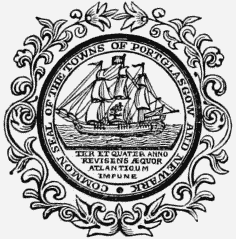
Burgh Seal.
Port-Glasgow
PORT-GLASGOW, a parish, sea-port, burgh, and market-town, in the Lower ward of the county of Renfrew; containing 7007 inhabitants, of whom 6973 are in the town, 19 miles (W. N. W.) from Glasgow, and 62 (W.) from Edinburgh. This place was originally part of the parish of Kilmalcolm, constituting the village of Newark, situated on the bay of that name. In 1668 it was purchased from Sir Patrick Maxwell, its proprietor, by the city of Glasgow, for the purpose of forming an out-port and harbour for the shipping of that place, for which object its position at the head of one of the finest bays in the Clyde rendered it peculiarly desirable. The land on which the town is built, together with some farms in its immediate vicinity, was in 1695 separated from Kilmalcolm, and erected into a distinct and independent parish; and in 1775 the town was made a burgh of barony by a charter of George III., which conferred on the inhabitants many privileges, and vested the government in two bailies and a council of eleven burgesses. The increase of the town has been striking, though gradual: from the erection of the first church in 1718 to the year 1790 the number of its inhabitants was augmented from about 700 to more than 4000. The Parish is about a mile in length and the same in breadth, and is bounded on the north by the Clyde, on the south and east by the parish of Kilmalcolm, and on the west by the parish of Greenock. The surface is very irregular and hilly; and immediately behind the town the land rises in two precipitous ridges to a great height, overlooking the river, and commanding an extensive and rich prospect of the shipping in the harbour, the venerable ruins of the baronial castle of Newark at the extremity of the bay, and the finely variegated scenery of the surrounding country. These heights, covered with verdure, and crowned with flourishing plantations, present a strikingly beautiful and picturesque back-ground to the view of the town from the river. Nearly on a level with the summits of the ridges, the lands extend for about half a mile inland, and are divided into farms which, from the sterility of the soil, are not very valuable. The richest land in the parish is along the banks of the river, which are laid out in garden-ground, and are abundantly productive of fruit and vegetables of excellent quality, for the supply of the town and neighbourhood. The principal landed proprietors are, Lady Shaw Stewart, and the corporation of the city of Glasgow: the former holds the rural district of the parish, with part of the land on which the town is built, and the gardens on the bank of the river; the latter are superiors of that portion of the town which may be properly regarded as the port.
The town is regularly built, consisting of well-formed streets crossing each other at right angles; the houses are nearly uniform, and, being whitewashed, wear a cheerful appearance. The streets are well paved, and lighted with gas, for which convenient works have been established by the corporation; and the inhabitants are amply supplied with water, which is conveyed by pipes to their houses. A public library is supported by subscription; there is likewise, in the town-hall, a good news and reading room, which is well attended. The environs are pleasant, and abound with objects of interest. At the eastern extremity of the bay are the remains of Newark Castle, the residence of the ancient barons of Newark, which, when entire, must have been a place of great strength; it is situated on an elevated, though small, promontory boldly projecting into the river, and presents an imposing memorial of feudal grandeur. The port carries on a very extensive trade with the East and West Indies, the United States, other parts of North America, the Mediterranean, and other places; the coasting trade is also considerable, but since the deepening of the Clyde, which has afforded to vessels of large burthen a facility of access to Glasgow, a great portion of the traffic of Port-Glasgow has been transferred to that place. The principal exports are British manufactures, which are shipped in great quantities, and exchanged for foreign produce of every kind, including timber from North America. The trade was formerly carried on exclusively in vessels belonging to the merchants of Glasgow; but for the last few years the merchants of this place have had ships of their own, and in 1843 they possessed as many as seventy-four registered vessels, of the aggregate burthen of 12,952 tons. The number of vessels that entered inwards in 1834 was eighty-two, and their aggregate burthen 28,693 tons: of these, three were from the East, and twenty-six from the West, Indies, thirty-six from North America, six from the United States, and eleven from the Mediterranean. During the same year, eighty-six vessels of the aggregate burthen of 28,530 tons cleared outwards, of which number twelve were to the East, and twenty-nine to the West, Indies, thirty to North America, four to the United States, and eleven to the Mediterranean. The duties paid at the custom-house amounted to £140,284. 8. 10., which sum was less than the amount in previous years, though the decrease did not originate in any diminution of the foreign trade of the port, but in the removal of the duties on tobacco to Glasgow, which were previously paid at this place. In 1843, the customs' duties paid here had further diminished to £92,906. This is one of the principal ports on the Clyde for the importation of American timber, of which, in a recent year, 27,975 tons were landed on the quays, and for the reception and preservation of which capacious ponds have been constructed along the shores.
There are two extensive and secure harbours, which are easy of access at all times to vessels of 600 tons, and so completely sheltered from the winds that in the severest weather they sustain no injury. Ships drawing twenty-one feet water may be towed up the channel of the river, which at this place is about two miles broad: in common tides the water rises to the height of nine, and in spring tides to the height of eleven, feet above the low-water mark. The quays are commodious, and ample sheds have been erected for the warehousing of merchandise; there is also a capacious graving-dock for repairing vessels, which has been recently improved at a considerable cost. The greatest number of vessels in the harbours at the same time, lately yielded the large aggregate burthen of 12,000 tons; but the harbours being found insufficient for the increasing trade of the port, the trustees for their improvement recently obtained an act of parliament for converting the bay of Newark into wet-docks; and funds to the amount of £35,000 were raised, which enabled them to commence the undertaking. These works, from their spacious quays easily accessible to vessels drawing twenty-five feet water, and their extensive warehouses built of stone, for bonding merchandise, are a vast acquisition to the port, and the only floating-docks on the western coast of Scotland. There is also a large area for bonding timber, as well as warehouses for the preparation of refined sugar for exportation to the Mediterranean. The revenue derived from the harbour dues, in the year ending April 5, 1845, amounted to £1900. Ship-building is carried on to a very considerable extent; and great numbers of steam-vessels, some of which are of the largest class and of the most elegant workmanship, have been built at this port: about 200 men are constantly employed in the yards. An extensive manufacture of ropes and sail-cloth has been long established by the Gourock Company: in the latter branch, which has of late much increased, about 300 men, and more than that number of women and children, are employed; and in the former, fifty men, and nearly an equal number of boys, are engaged. The refining of raw sugar is carried on with success to a great extent in the town; the method of refining by steam is adopted, and the works afford employment to more than fifty men. A savings' bank was established in 1818, and has met with great encouragement. The market is on Friday, and a fair is held on the third Tuesday in July. The road from Greenock to Glasgow, and the Glasgow, Paisley, and Greenock railway, pass through the parish.
The town, which, by its charter in the reign of George III., had enjoyed the privileges only of a burgh of barony, was by act of the 2nd and 3rd of William IV. raised to the rank of a parliamentary burgh; and the government is now vested in a provost, two bailies, and a council of six burgesses, assisted by a town-clerk, harbour-master, and other officers, the whole chosen agreeably with the provisions of the Municipal act of the 3rd and 4th of William. Formerly, the provost was elected annually by the magistrates and council of Glasgow, and only the bailies by the council of the town of Port-Glasgow; the council was chosen from among the occupiers of land or houses of the value of £5, and the bailies were required to have land or houses of the value of £10 per annum. A treasurer, procurator-fiscal, and other officers, were appointed by the council. The provost and bailies are justices of the peace by virtue of their office, and have jurisdiction in civil actions to any amount, and a considerable jurisdiction in criminal cases; but very few causes come under their decision, as parties in matters of dispute generally solicit, and are governed by, the advice of the magistrates, which prevents much litigation; and no criminal cases have been tried for many years, except in the police-court. The burgh unites with those of Kilmarnock, Rutherglen, Dumbarton, and Renfrew, in returning one member to the imperial parliament; the right of election is vested in the resident householders to the amount of £10 per annum, and the present constituency consists of about 220. The town-hall is a neat and commodious edifice of modern erection, with a portico of four columns of the Grecian-Doric order, from the centre of which rises a spire. The interior is well arranged; on the ground-floor are several handsome shops, and the upper story contains the council-chamber, offices for the town-clerk, counting-houses for merchants, and a reading-room well supplied with periodicals and newspapers. Ecclesiastically the parish is in the presbytery of Greenock and synod of Glasgow and Ayr, and patronage of the city of Glasgow: the minister's stipend is £250. The corporation receive the seat-rents, which produce on an average nearly £150 per annum. The present church was erected in 1823, partly by subscriptions of the parishioners, amounting to £1500; it is a plain neat edifice, and is adapted for a congregation of 1200 persons. There is also a chapel of ease, erected in 1774, and adapted for a congregation of 1500: the minister has a salary of £100, secured to him by bond. A parochial missionary was until very recently engaged by the members of the Established Church; and there are a Free church, and a place of worship for the Associate Synod. Three parochial schools were once supported, the masters of which had each a salary of £20, paid by the corporation; but for some years they have all been united under one master, who receives a salary of £20, with the school fees, which are considerable. There is also a school endowed by Mr. Beaton, in 1814, with £1400, for the instruction of poor children, and the erection of a school-house; the master has £60 per annum, with a house rent free, and the school is attended by about 150 children of both sexes.
Port-Gordon
PORT-GORDON, a village, in the parish of Rathven, county of Banff; 1¼ mile (W. S. W.) from Buckie; containing 457 inhabitants. This place was named from the late dukes of Gordon, and is now by inheritance the property of the Duke of Richmond. It is situated on the coast, and separated by a narrow stream from Port-Tannachy; and, having a tolerably good harbour, is the seat of a considerable traffic in the exportation of grain, and the importation of salt and coal. In 1841, as many as 1380 tons of salt, and 3517 tons of coal were imported; and 6223 quarters of grain were sent out. Nearly twenty boats, of various size, belong to the place; and fishing and the coasting-trade occupy nearly the whole male population. Port-Gordon is attached, quoad sacra, to the chapel of ease at Enzie; and a school is supported, partly by the Duke of Richmond, who pays the teacher £15 per annum, and allows him a free house and schoolroom.
Port-Gower
PORT-GOWER, a village, in the parish of Loth, county of Sutherland, 14 miles (N. E.) from Golspie; containing 236 inhabitants. This village, which is situated on the shore of the Moray Frith, about half way between the kirktown of Loth and the village of Helmsdale, is neatly built, and inhabited by persons employed partly in the cultivation of the adjacent lands, and partly in the herring-fisheries. It has a commodious inn, on the parliamentary road from Dunrobin to the Ord of Caithness; and the parochial school is in the village. The coast, from the western extremity of the parish to Port-Gower, is a level sandy beach, merely interrupted occasionally by low rocks which are completely covered with the tide; but from Port-Gower to the Ord, at the eastern extremity of Loth, is one continued chain of rugged limestone rocks.
Portlethen
PORTLETHEN, a village, in the parish of Banchory-Devenick, county of Kincardine, 7 miles (N. E. by N.) from Stonehaven; containing 265 inhabitants. This is a small village on the eastern coast, of which the inhabitants are employed in white-fishing, except during the herring-season, at which period several of them are engaged in the Moray Frith. Within the last few years a new chapel has been erected here, together with a manse and offices, having annexed a glebe of eight acres; the expense, about £1400, was defrayed by subscription. The chapel is erected on the site of the ancient edifice, which, notwithstanding the additions made to it from time to time, was inadequate to contain the increasing population of the neighbourhood. The minister is supported by seat-rents, by annual donations from the parish minister, and from some of the heritors, and by a small bequest left for the purpose, the whole amounting to about £80 per annum. A school was erected at the sole expense of the late Dr. Morison, and the interest of £200 was assigned by him as an endowment to the master, who has likewise hitherto received £10 a year for teaching thirteen children under Dr. Milne's bequest.
Portlich
PORTLICH, a village, in the parish of Kilmuir Easter, county of Ross and Cromarty, 3 miles (N. E.) from Invergordon; containing 90 inhabitants. This village, which is situated on the northern coast of the Frith of Cromarty, originally consisted only of a few huts occupied by persons engaged in the fishery. The fish chiefly taken were, cod, haddock, flounders, and occasionally a few herrings; but for some years the inhabitants, with the exception of sending a few boats to the herring-fishery, have abandoned the fisheries, and employed themselves in various handicraft trades.
Port-Logan
PORT-LOGAN, a village, in the parish of Kirkmaiden, county of Wigton, 15 miles (S. by E.) from Stranraer; containing 223 inhabitants. It is situated on the north-west coast of the parish, and has a small quay or harbour, opening into the bay of Portnessock, and chiefly used for shipping farm produce. Vessels of any burthen may find safe anchorage in the bay, but those only of smaller size can enter the harbour at low water. Logan House, standing about a mile south-east of the village, is a handsome modern mansion in an extensive and richly-embellished demesne. There is a post communication daily with Stranraer, three days in the week by a gig merely, and on the other days by a car which carries passengers. In the vicinity of this place is a natural cavity in the rocks, into which the tide enters at every flood, and in which are found various kinds of fish.
Portmahomack
PORTMAHOMACK, a village and fishing-port, in the parish of Tarbat, district of Mainland, county of Ross and Cromarty, 11 miles (E. by N.) from Tain; containing 479 inhabitants. This village, which is on the northern coast of the peninsula formed by the Dornoch and Moray Friths, is chiefly inhabited by persons employed in the fisheries, for which purpose its situation is highly advantageous. A pier was erected here by the first earl of Cromartie. The harbour, which was the only one on this part of the coast capable of receiving vessels of any considerable burthen, soon became much frequented by vessels trading to Tain, Dornoch, and other towns; and the subsequent introduction of manufactures into the vicinity has contributed greatly to the increase of the village. The principal fishery is that of herrings, which commences in July, and continues till September: about 100 boats are engaged, each of which on an average lands 105 cranes for the curers of this place, exclusively of large quantities carried away to other parts of the country. From the close to the commencement of the herring-season, the inhabitants are employed in the cod and haddock fishery; and from May till August, great numbers of lobsters and salmon are taken, and sold to vessels engaged in collecting them for the London market. The harbour has been much improved by the construction of a pier to replace that erected by the Earl of Cromartie, which had fallen into a dilapidated state: the new pier, which is 420 feet in length, was completed in 1815, at a cost of £3,500, onehalf paid by the Commissioners of the Northern Fisheries, and the other by the proprietor, Mr. Mc Leod, of Geanies. The depth of water at the pier is thirteen feet at spring, and nine feet at neap, tides; and the harbour affords safe anchorage for vessels driven by easterly gales, which can easily pass Tarbat Ness, where a lighthouse has been erected. A vessel trading regularly between the Little Ferry and Leith calls at the village both going and returning. The number of vessels that cleared outwards from the port in 1840 was 112, of the aggregate burthen of 6896 tons; and the quantity of grain exported to London, Leith, and Liverpool, was 3003 quarters, besides other agricultural produce and the fish. The spinning of hemp, for which there is an establishment in the village, belonging to Messrs. Grant and Company, of Inverness, is carried on by females at their own houses, affording employment to about 300 in the parish; and a few persons are also occupied in weaving. A post-office has been established here under that of Tain, from which place a gig conveying passengers arrives daily.
Portmoak
PORTMOAK, a parish, in the county of Kinross, 6 miles (S. E. by E.) from Kinross; containing, with the villages of Kinnesswood and Scotland-Well, 1616 inhabitants. This place, anciently called Servanus, derived that appellation from a priory on the island of St. Serf, or Servanus, in Loch Leven; and its present name, though upon very questionable authority, has been derived from St. Moak, to whom a priory by the side of the lake is said to have been dedicated, and from the village affording a convenient landing-place for the monks. The parish is about nine miles in length and five in breadth, of very irregular form, and bordering on the lake; it comprises 10,644 acres, of which 6444 are arable, 2000 pasture and meadow, 400 woodland and plantations, and 1800 covered by the water of Loch Leven. The surface rises gradually from the east margin of the lake till it attains a considerable elevation at the eminence called Bishop's hill, which is more than 1000 feet above the level of the sea; while to the south of the lake, the land ascends more abruptly, forming the hill of Benartie, of nearly equal height. Beyond these points the surface becomes level, constituting an extensive and pleasant plain. The river Leven issues from the lake here, and two excellent stone bridges have been erected over it; there are also numerous springs of pure water, of which several are very copious, and might be rendered available to the working of mills. The scenery has been much improved by comparatively recent plantations, and some pleasing views of the surrounding country are obtained from the higher lands. The soil is various; in some parts of the parish, a heavy loam; in others, light and sandy; and in some, a deep moss covered with heath. The crops are, grain of all kinds, potatoes, and turnips. The system of agriculture is in an improved state; the lands have been drained and inclosed, and a considerable quantity of unprofitable ground has been reclaimed and brought into cultivation; the farm houses and offices are in general substantial and well arranged, and all the more recent improvements in the construction of implements have been adopted. Much attention is paid to the rearing of live-stock; the cattle are now exclusively of the Fifeshire breed, and about 250 milch-cows, 350 calves, and 1200 head of young cattle, are annually pastured on the average. The sheep are of the Leicestershire and Cheviot breeds, of which 300 are annually bred; and there are about 300 horses, of equal quality to those of the Lothians. The rateable annual value of the parish is £8468.
The plantations are principally larch and Scotch fir, occasionally intermixed with forest-trees of every variety, for which the soil is well adapted. The substrata are chiefly whinstone, freestone, and limestone. The whinstone is of great compactness, and, from the difficulty of working it, little is quarried; the freestone, except in some few instances, is soft and porous. The limestone, which is of excellent quality, was once extensively quarried, and about 4000 tons were annually raised, of which much was made into lime for manure; but from its elevated situation, the working of it is attended with an expense which has tended to diminish the demand for it since other quarries in the neighbourhood have been opened. The manufactures carried on are those of woollen shawls and parchment, which are conducted with success; there were formerly a tannery and a thread manufactory, but they have both been discontinued for some time. Fairs are held annually, but very little business is transacted. Facility of communication is afforded by good roads with Kinross, the nearest post-town, and with other places in the district. The parish is in the presbytery of Kirkcaldy and synod of Fife, and in the patronage of Sir Graham Montgomery: the minister's stipend is £254. 2. 5., with a manse, and the glebe is valued at £10 per annum. The church was erected in 1832, in place of an older edifice which, after being rebuilt, was found to be too small and also unsafe; the present edifice, of which the cost was about £800, is neat and substantial, and is adapted for a congregation of 800 persons. There are places of worship for members of the Free Church and for the Associate Synod. The parochial school is well attended; the master has a salary of £34. 4. 4., with £20 fees, and a house and garden. There are also two libraries, one parochial, and the other supported by the congregation of the Secession church. In draining part of the lake a few years since, some spear heads and a shield were dug up; and there are some remains of the priory of the island of St. Serf, and also of an ancient chapel at Scotland-Well.—See Kinross.
Portnacroish
PORTNACROISH, a village, in the parish of Lismore and Appin, district of Lorn, county of Argyll. This village, situated on the estate of Laroch, at the foot of Glencoe, has gradually sprung up in consequence of the extensive operations in the adjacent slate-quarries, and is in a thriving and progressive state, and occupied principally by miners and others connected with the works. Previously to the year 1760 the then proprietor opened a vein, which was wrought with great profit for many years; but another being discovered, that offered superior facilities for quarrying, the works were transferred to it from the former, and have been there carried on for more than fifty years. These veins, which are so extensive as to be considered inexhaustible, are on the opposite sides of a valley; and the quarries now wrought are situated in the bed of a high mountain rising out of Loch Leven, a branch of Loch Linnhe. The rock is annually let to parties who manufacture the slates by contract, and are paid at a price before agreed upon. The colour of the material is a deep blue, spotted with pyrites, which are called by the workmen "diamonds," and are incorporated into the texture of the slate. The quantity annually produced varies from 8000 to 11,000 tons; and from five to seven millions of slates are formed, which are shipped to sea-ports both in Scotland and Northumberland, to be transmitted thence to most parts of the kingdom. Cargoes of them are sometimes even sent to America and the West India colonies. The number of persons employed, comprehending those engaged in the preservation and repair of the machinery, &c., amounts to about 300. The blocks, when separated from the rubbish within the quarries, are conveyed by waggon-trains on tram-roads to a bank raised in the sea by refuse thrown over. Here the slates are split and dressed; and they are afterwards conveyed by other tram-roads, along inclined planes, to the harbour, which is formed by banks of rubbish projecting into the sea on each side, and is safe and commodious. The distance from the most remote part of the quarries to the wharf does not exceed 650 yards. The larger part of the persons engaged in the works have houses built with stone and lime, slated, and consisting of three apartments; and to each of the houses are generally attached a cow-house, a small vegetable garden, and some potato-ground. The fuel in use is mostly coal, brought in the vessels which come for slates.
Portnahaven
PORTNAHAVEN, a port, and lately a quoad sacra parish, in the parish of Kilchoman, district of Islay, county of Argyll, 18 miles (S. W. by W.) from Bowmore; containing 1271 inhabitants. This place was separated from Kilchoman for ecclesiastical purposes, and erected into a quoad sacra parish, on the building of a church here by parliamentary grant, for the accommodation of the inhabitants in this distant part of the parish. The district comprises about 5000 acres, of which one-half are in tillage or in pasture. The village is situated at the southern extremity of the Rinns of Islay, opposite to the islands of Chenzie and Noarsa, from which it is divided by a narrow frith. The inhabitants are employed during the autumn in the fisheries, and at other times in agriculture; the fish taken here are, cod, ling, and coal-fish, which they cure, and send in great quantities to the Irish markets. The port is accessible to vessels of considerable burthen, but only during favourable weather, the swell of the Atlantic at other times rendering it unsafe: a lighthouse was erected on the isle of Noarsa, in 1824, by the Commissioners of Northern Lights. A good road, also, has been constructed by the parliamentary commissioners to this place from Bridgend; and it is there connected with another to Portaskaig, previously made at the sole expense of Walter Campbell, Esq. Together they afford an easy communication from the south to the north of the island of Islay. The ecclesiastical affairs are under the presbytery of Islay and Jura and synod of Argyll; and the patronage is vested in the Crown: the stipend of the minister is £120, with a manse, and a glebe valued at £8 per annum. A parochial school has been lately endowed by government.
Portnockie
PORTNOCKIE, a village, in the parish of Rathven, county of Banff, 1¼ mile (N. W.) from Cullen; containing 725 inhabitants. This fishing-station is the property of the Earl of Seafield, and is situated 2 miles to the eastward of Findochtie; it was built about the year 1677, and has now nearly 100 boats belonging to it, of which seventy are of the larger class, and all engaged in the herring and other fisheries on the coast. A church was built here a short time since, called Seafield church, at a cost of £400, raised by subscription, towards which the Hon. Col. Grant, now sixth earl of Seafield, gave £100. This portion of the parish has for a long period been annexed quoad sacra to Cullen; it was lately proposed to erect it into an ecclesiastical district, and attach it to the new church, but that proposition has not been carried into effect. The earl has built an excellent school-house, and allows £10 per annum to the teacher, who is permitted to charge the same fees as those at the parish school.
Portobello
PORTOBELLO, a parliamentary burgh, and lately a quoad sacra parish, chiefly in the parish of Duddingston, but partly in that of South Leith, county of Edinburgh, 3 miles (E.) from Edinburgh; containing 3588 inhabitants. This place, which is situated on the Frith of Forth, about half way between Leith and Musselburgh, is of very modern origin. It derives its name from a small inn built by a sailor, or soldier, who served under Admiral Vernon at the taking of Portobello, in America, in the year 1739, previously to which time it was one dreary tract of unproductive land covered with furze, with a wide expanse of low and sandy shore. On this waste, called the Figgate Whins, the monks of Holyrood were accustomed to turn loose their cattle; and the only passage through it was a road designated the Fishwives' Causeway, on the side of which was erected the inn of Portobello. In the year 1765, the discovery of a valuable bed of clay near the Figgate rivulet, induced an enterprising builder named Jamieson to erect a brick and tile manufactory and an extensive pottery, for the use of which he constructed a small harbour at the mouth of the rivulet, which has, however, long been in a ruinous condition. Mr. Jamieson afterwards letting portions of the land on building leases, a tower of brick, of fantastic design, was erected by Mr. Cunningham; it is now in ruins, but still gives name to one of the streets of the present town, at the end of which it is situated.
The convenience of the beach for sea-bathing soon after led to the erection of various houses; and its proximity to Edinburgh inducing many of the citizens to make Portobello a place of temporary residence, the buildings rapidly increased; and the present town of handsome streets, crescents of elegant houses, and pleasant villas, arose on the site of what had been not many years before a solitary waste. The streets are well paved, and lighted with gas from works at the mouth of the Esk, in the town of Musselburgh; and the inhabitants are amply supplied with water. The baths are a good range of buildings at the extremity of Bath-street, fitted up with every requisite accommodation; and card and dancing assemblies, and concerts, are held in a suite of rooms at the other end of the same street. During the summer months Portobello is frequented by numerous visiters, for whose accommodation there are many excellent lodging-houses; and the town, with its appendant villas beautifully situated in tastefully-ornamented grounds, has a cheerful and prepossessing appearance. There are some extensive potteries in the town and neighbourhood; a large flint-glass manufactory, in which eighty persons are employed; a bottle manufactory, in which are forty hands; some chemical works, a paper manufactory, and brick and tile works, in which also many of the inhabitants are engaged; and near the town a valuable oyster-bed was discovered in 1839. The Portobello sands, which are smooth and firm, afford a fine promenade; and during the visit of George IV. in 1822, the yeomanry cavalry were drawn up there, and reviewed by His Majesty. The markets are amply supplied with provisions of every kind; communication with Edinburgh is afforded by good roads; and the Dalkeith railway passes close to the place.
The town is governed by a provost, two bailies, and six councillors; and is associated with the towns of Leith and Musselburgh in returning a member to the imperial parliament. The late quoad sacra parish was separated from Duddingston by act of the General Assembly in 1834, and was about a mile in length and half a mile in breadth, and principally a town parish: the adjacent rural district is in a state of profitable cultivation. The ecclesiastical affairs are under the superintendence of the presbytery of Edinburgh and synod of Lothian and Tweeddale: the minister has a stipend of £200, derived from seat-rents, and secured by bond from the Managers of the congregation, the latter of whom are patrons. There is neither manse nor glebe. The church, or rather chapel of ease, was erected in 1810, at a cost of £2650, including its enlargement in 1839; it is a plain neat structure containing 800 sittings, of which thirty are free. The episcopal chapel dedicated to St. Mark is also a neat edifice, containing 504 sittings, of which fifty-six are free; the minister derives his income from the seat-rents. There are places of worship for members of the Free Church, the United Secession, Independents, and Wesleyan Methodists; and a Roman Catholic chapel. A school is supported in the town by voluntary subscription, and the fees; and is generally attended by about sixty scholars, which number, if the building would allow it, might be greatly increased. There is also a female school, principally supported by some benevolent ladies of the place, under whose superintendence it is conducted, and attended by seventy children. Among the charitable institutions is a Destitute and Sick Society.
Port Of Monteith
PORT OF MONTEITH, a parish, in the county of Perth, 9½ miles (W.) from Doune; containing, with the villages of Gartmore, Ruskie, and Tomachar, 1446 inhabitants. This place, which is of considerable antiquity, appears to have derived its appellation of Port from its position near a point on the east side of the lake of Inchmahome, which point is thought to have been the chief landing place of the earls of Monteith and the priors of Inchmahome, of whom the former had their baronial seat, and the latter their convent, here. An establishment of Culdees seems to have existed at a very early period, on the principal island in the lake of Inchmahome, or St. Columba; and this, in the time of Edgar, is supposed to have been superseded by a convent of Augustine monks, for whom, in 1238, Walter Cumin, earl of Monteith, obtained licence to erect a church, of which there are still some remains. The village of Port was made a burgh of barony by James III., in 1446. In 1547, the priory of Inchmahome became for some time the seat of the Scottish court. After the battle of Pinkie the Earl of Arran conveyed the Princess Mary, subsequently Queen of Scots, to this place for her greater safety; and here, with the queen-mother, she remained till the removal of the court to Dumbarton Castle, there to await the arrival of the fleet which eventually conveyed her to France. The remains of the priory, which are in tolerable preservation, consist chiefly of the nave and choir of the church, with a portion of the tower; the western entrance is almost entire; and the side walls of the choir, with the eastern window, though blocked up with modern rubble-work, are still in a good state. Not far from the centre of the choir is the beautiful monument of Walter Stewart, earl of Monteith, and his countess; and near it, a monument to Sir John Drummond, of inferior workmanship. There are also portions of the conventual buildings, to the south of the church, consisting of the refectory, kitchen, and dormitory.
The parish, including a portion of that of Lany, suppressed in 1615, is about nine miles in extreme length from east to west, and about six miles in average breadth. One-half of the lands are mountainous moor and peat-moss, and a considerable part is occupied by lakes of considerable extent, leaving but a comparatively small portion for agricultural purposes. The surface of the northern district is mountainous, forming part of the Grampian range, of which the highest point, Craig-Dhu, or "Black Craig," has an elevation of nearly 2000 feet; and to the east is another mountain, called by the Highlanders Craig-Dhereag, or "the Red Craig," of which the highest point has an elevation of 1600 feet. Upon the south side of this eminence, for about a quarter of a mile, great masses of rock which have fallen from it lie in detached heaps of rugged form, and partly overgrown with ivy. From the base a copious stream of limpid water issues even in the driest seasons; and within 300 feet of the summit is a lake half a mile in circumference, called Loch-an-Falloch, or "the hidden lake," whence a streamlet flows into Loch Vennachar, by which the parish is bounded on the north. Loch Inchmahome, the principal lake in the parish, is situated at the base of the mountains, and is about five miles in circumference, varying in different parts from forty-two to eighty-three feet in depth. The island of Inchmahome, on which are the ruins of the priory, is about five acres in extent, and thickly wooded; the trees are chiefly chesnut of great age and in a state of decay, interspersed with ash, oak, and plane, and a profusion of underwood, among which the venerable ruins are seen with beautiful effect. On the islet of Talla, which is also clothed with wood, are the picturesque remains of the castle of the earls of Monteith. The lake abounds with perch, trout, pike, and eels; and previously to the erection of some mills on the stream Guidie, or Goodie, which issues from it, and flows into the river Forth, salmon were often found in it. Loch Ruskie, to the south of Craig-Dhereag, is about a mile in circumference, and has a small island on which are the ruins of a mansion belonging to Sir John Monteith, commissioner of Edward I. of England; and to the west of Loch Inchmahome is Loch Macinrie, or "the lake of the King's Son," from which a rivulet flows into the Forth.
The soil is various. The most extensive of the mosses are those of Moss Flanders and Gartur, and the Talla moss; the first of these has been for some years under a process, by its proprietor, David Erskine, Esq., of Cardross, for clearing off the peat by cuts of water into the Forth, and converting the moss into a rich alluvial soil. In other parts the soil is more or less fertile, and along the Forth is a considerable tract of carse land. A large number of sheep, principally of the black-faced breed, are fed in the pastures; the cattle are a mixture between the Highland and Lowland breeds. The plantations, which are chiefly of modern growth, are generally in a thriving state; and in different parts of the parish are some trees of stately growth. The hills are mostly of conglomerate rock and limestone; some of the latter is of a blueish colour, streaked with white, and of good quality for working into mantel-pieces. In the open district is sandstone of a grey colour, and of compact texture, well adapted for pavements. The rateable annual value of the parish amounts to £8100. Cardross, the seat of Mr. Erskine, is a spacious and handsome mansion finely situated. Rednock House, the seat of General Graham Stirling, is a stately mansion to which additions have been made within the last few years, and is seated in an extensive park, which has been greatly improved, embellished with two sheets of water, and richly planted. Gartmore and Leitchtown are also handsome residences; and on the lands of Drunkie, Mrs. Eastmont has recently erected a mansion commanding a fine view of Loch Vennachar and the adjacent district. The village of Gartmore stands pleasantly on the road from Stirling to Inversnaid, and has a rural appearance. A fair is held annually; and there were formerly several others, but they have been discontinued. The ecclesiastical affairs are under the superintendence of the presbytery of Dunblane and synod of Perth and Stirling: the minister's stipend is £269. 16. 9., with a manse, and a glebe valued at £8 per annum; patron, Mr. Erskine. The parish church is a neat plain structure, containing 380 sittings; and a church was built by subscription, in 1790, at Gartmore, to which a quoad sacra parish was till recently annexed. The parochial school is attended by about sixty children; the master has a salary of £34. 4. 4., with a house and garden, and the fees average £15. There are three other schools in remote parts of the parish, one of which has for some time regularly received from William Campbell, Esq., of Glasgow, a native of this parish, £10 per annum as a salary for the master. In the vicinity of Loch Ruskie are some mineral springs, which are in considerable repute, but the water of which has not been accurately analyzed.
Portpartrick
PORTPATRICK, a burgh of barony, sea-port, and parish, in the county of Wigton, 6½ miles (S. W.) from Stranraer, and 34 (W.) from Wigton; containing 2043 inhabitants, of whom 996 are in the burgh. This place, of which the original name was derived from an ancient chapel dedicated to St. Patrick, is noticed in several documents under the designation of Port-Montgomery, from its having been purchased by that family, together with the castle of Dunskey, from its previous proprietor, Sir Robert Adair, of Kinhilt. It retained this appellation until its separation from the parish of Inch, in which it was included till about the year 1628, when, on the erection of the present church, which was dedicated to St. Patrick, and the formation of the lands into an independent parish, it resumed its original name. The estate subsequently became the property of the Blair family, of whom Sir James Hunter Blair, lord provost of Edinburgh, and member of parliament for that city, greatly improved the town and harbour; and the castle of Dunskey, and the principal lands in the parish, are now the property of Col. Hunter Blair, C.B.
The town is finely situated on the western shore of the peninsula formed by the bay of Luce and Loch Ryan, and is nearly opposite to the town of Donaghadee, on the Irish coast, from which it is only twenty-one miles distant. The houses are well built, principally of stone found in the parish; and the inhabitants are supplied with water from wells. There are no manufactures of any importance: a few hand-loom weavers are employed in working up the yarn spun by families, for domestic use; and several of the females are engaged in embroidering muslin. The chief trade of the town is derived from its being the principal packet-station for conveying the government mails to Ireland; and from the fisheries off the coast. The beach affords excellent accommodations for bathing; and the place during the summer months is much frequented by visiters, for whose reception there are numerous comfortable lodging-houses and a commodious inn. On the south side of the town, also, is a strongly impregnated chalybeate spring, issuing from a rock, during the whole of the year, and which is in high repute for its medicinal virtues, and often resorted to by invalids. The harbour has been greatly improved under the superintendence of the late Mr. Rennie and his son, the present Sir John Rennie, and is now one of the best on this part of the coast. A lighthouse has been erected on the pier, which displays a reflected light; and there is also one at Donaghadee; which together render the passage perfectly safe during the night. Ship and boat building are carried on here to a moderate extent; but very few vessels of large burthen have been recently built, and there are at present four vessels only belonging to the port, which is merely a creek under that of Stranraer. They are of from twenty to eighty tons each, and chiefly employed in the coasting-trade, which consists principally in the exportation of agricultural produce, and the importation of cattle and lime from Ireland, and coal from Ayr. The herring-fishery was formerly considerable, but has recently been altogether superseded by the cod-fishery, in which ten boats, of three men each, are engaged from the beginning of November till the beginning of April, each boat realising a profit of £20 during the season. Portpatrick was erected into a burgh of barony by charters of James VI. and Charles I., but the charters have never been carried into operation, nor have any magistrates for the burgh been appointed; a justice of peace for the county presides over the district, and a constable is resident here, under a superintendent at Stranraer, the nearest market-town. The post-office has a tolerable good delivery; and facility of communication is afforded by the turnpike-roads to Glasgow and Dumfries, and by the post-office steam-packets, of which two are stationed here for the conveyance of the mail to Donaghadee, and which also take passengers.
The parish is about four miles and a half in extreme length and four miles in extreme breadth, comprising an area of 9300 acres, of which 6300 are arable, 300 woodland and plantations, and the remainder meadow, pasture, and waste. The surface is boldly undulated, rising in some parts into hills of considerable elevation, which take their names from the farms whereon they stand, and of which the highest is Cairnpat, 800 feet above the level of the sea, and commanding an extensive and richly-diversified prospect over a country abounding with interesting features and beautifully romantic scenery. There are no rivers of any importance; but numerous small and rapid streams intersect the lands in various directions, of which the Craigoch burn abounds with trout: the Piltanton burn, after forming the eastern boundary of the parish, flows into the bay of Luce. The coast, about four miles in extent, is very precipitous, rising to a height of 130 feet, and indented with several caverns, though of no great extent, and with numerous bays, of which the principal are, Castle bay, Port-Murray, Port-Kaile, Mirroch bay at the extreme south, and Killintringan bay at the extreme north. The soil is various; in some parts, a hazel mould alternated with sand; in others, a black deep loam, chiefly of reduced moss, on a clayey subsoil; and in other parts, resting on gravel. The crops are, grain of all kinds, potatoes, and turnips, with other vegetables, and some garden produce. The system of husbandry is improved; much waste land has been brought into cultivation; the farm houses and offices are substantial and well arranged; and the lands generally inclosed with fences of stone. There are few sheep kept, and these are mostly the black-faced; the cattle are usually of the Galloway breed, and great attention is paid to their improvement. The plantations consist of oak, ash, sycamore, beech, elm, chesnut, larch, spruce and silver fir, and pinaster; they are carefully managed, and in a very thriving state. The rocks are mainly of the transition class; and the substrata, greywacke, and greywacke and clay slate of various tints, with other varieties: an attempt has been made to obtain coal, but without any success. The rateable annual value of the parish is £3185.
Dunskey House, the seat of Col. Blair, is a spacious and handsome mansion, erected in 1706, and since greatly enlarged and improved by the late and the present proprietor; the grounds are tastefully laid out, and embellished with plantations. Behind the house is an artificial lake of four acres, round which a carriage drive has been formed along the margin; and in a glen within the demesne, is a romantic cataract formed by the Auchtrematane burn, which, when swollen with rains, falls from a rocky height of sixty feet into the ravine beneath, and flows with a gentle current through the glen into the bay of Port-Kaile. The ecclesiastical affairs are under the superintendence of the presbytery of Stranraer and synod of Galloway. The minister's stipend is £158. 6. 8., of which about one-half is paid from the exchequer; with a manse, and a glebe valued at £30 per annum: patron, Col. Blair. The old church, erected in 1628, was a cruciform structure with a circular belfry turret, and contained 300 sittings; but it was in very indifferent repair, and a new church has been just completed. The members of the Free Church have a place of worship. The parochial school is well conducted; the master has a salary of £30, with a house and garden, and the fees average about £25 per annum. Of several other schools some are partly endowed, and others supported solely by the fees: for one, a handsome house has been erected in the rural part of the parish by Col. Blair and his sister. There are also Sabbath schools, to which, and to the parochial school, libraries are attached; and the poor receive the proceeds of a bequest of £180 by a former earl of Stair. Some remains exist of the castle of Dunskey; and the site of the ancient mansion of the Adairs, of Kinhilt, is still pointed out, though no part of the building is left. Around the summit of the hill of Cairnpat are remains of two circular walls of stone, the intrenchments probably of some fortress; but the greater portion has been removed for the making of fences.